
Chin J Plant Ecol ›› 2025, Vol. 49 ›› Issue (11): 1869-1877.DOI: 10.17521/cjpe.2024.0270 cstr: 32100.14.cjpe.2024.0270
• Research Articles • Previous Articles Next Articles
LI Bing-Sa1,2, MA Wang2, BAI Long1, WANG Zheng-Wen2,*( )(
)( )
)
Received:2024-08-12
Accepted:2025-01-09
Online:2025-11-20
Published:2025-11-20
Contact:
WANG Zheng-Wen
Supported by:LI Bing-Sa, MA Wang, BAI Long, WANG Zheng-Wen. Effects of rhizome storage on sprouting, survival and establishment of new clonal ramets in Leymus chinensis[J]. Chin J Plant Ecol, 2025, 49(11): 1869-1877.
Add to citation manager EndNote|Ris|BibTeX
URL: https://www.plant-ecology.com/EN/10.17521/cjpe.2024.0270
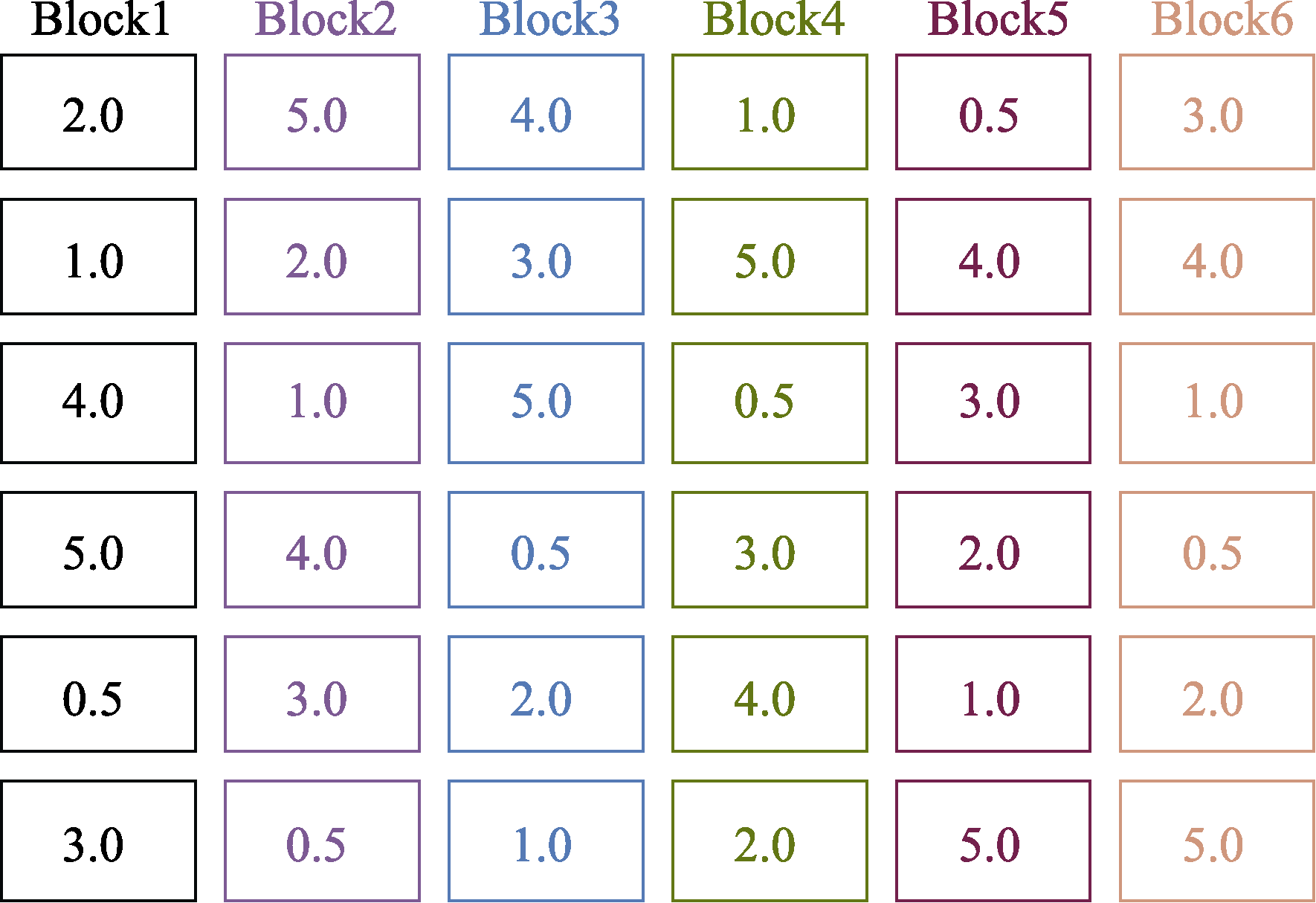
Fig. 1 Experimental design for planting rhizome fragments of Leymus chinensis with different initial lengths. Different numbers indicate the initial lengths of L. chinensis rhizomes buried in the pots (cm).
| 萌动 Sprouting | 出土 Emergence | 成苗 Establishment | ||||
|---|---|---|---|---|---|---|
| χ2 | p | χ2 | p | χ2 | p | |
| 初始根茎片段长度 Initial length of rhizome fragments | 23.234 | <0.001 | 20.458 | 0.001 | 19.512 | 0.002 |
Table 1 Effects of initial rhizome length on the sprouting status of rhizome buds and the emergence and establishment of ramets of Leymus chinensis
| 萌动 Sprouting | 出土 Emergence | 成苗 Establishment | ||||
|---|---|---|---|---|---|---|
| χ2 | p | χ2 | p | χ2 | p | |
| 初始根茎片段长度 Initial length of rhizome fragments | 23.234 | <0.001 | 20.458 | 0.001 | 19.512 | 0.002 |
| 初始根茎片段长度 Initial length of rhizome fragments (cm) | 萌动率 Sprouting rate (%) | 出土率 Emergence rate (%) | 成苗率 Establishment rate (%) |
|---|---|---|---|
| 0.5 | 0 ± 0b | 0 ± 0b | 0 ± 0b |
| 1.0 | 0 ± 0b | 0 ± 0b | 0 ± 0b |
| 2.0 | 33 ± 19.2b | 17 ± 15.2b | 0 ± 0b |
| 3.0 | 17 ± 15.2b | 17 ± 15.2b | 0 ± 0b |
| 4.0 | 83 ± 15.2a | 83 ± 15.2a | 50 ± 20.4a |
| 5.0 | 83 ± 15.2a | 67 ± 19.2a | 67 ± 19.2a |
Table 2 Bud sprouting and ramet emergence and establishment of the rhizome fragments of Leymus chinensis with different initial lengths (mean ± SE)
| 初始根茎片段长度 Initial length of rhizome fragments (cm) | 萌动率 Sprouting rate (%) | 出土率 Emergence rate (%) | 成苗率 Establishment rate (%) |
|---|---|---|---|
| 0.5 | 0 ± 0b | 0 ± 0b | 0 ± 0b |
| 1.0 | 0 ± 0b | 0 ± 0b | 0 ± 0b |
| 2.0 | 33 ± 19.2b | 17 ± 15.2b | 0 ± 0b |
| 3.0 | 17 ± 15.2b | 17 ± 15.2b | 0 ± 0b |
| 4.0 | 83 ± 15.2a | 83 ± 15.2a | 50 ± 20.4a |
| 5.0 | 83 ± 15.2a | 67 ± 19.2a | 67 ± 19.2a |
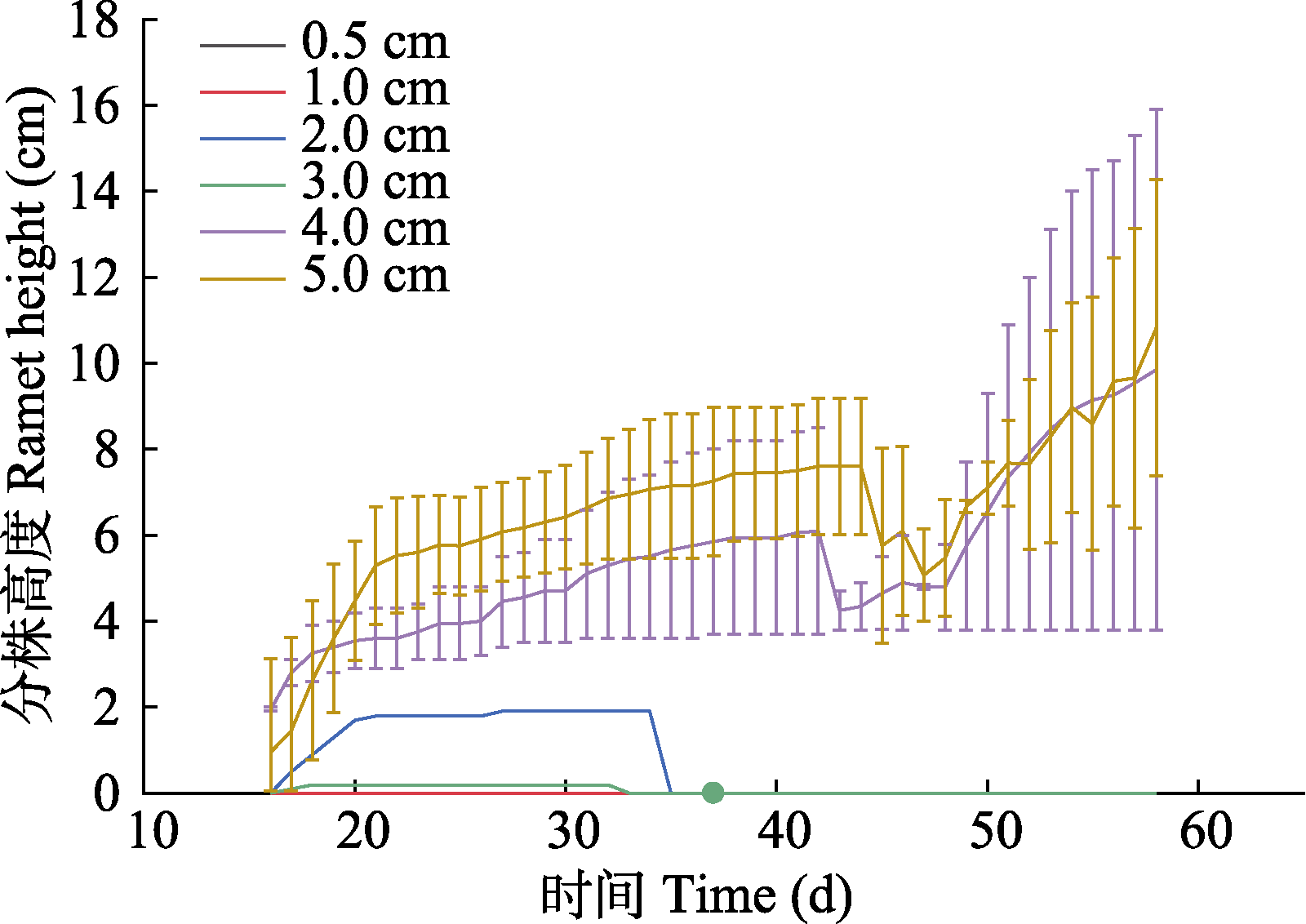
Fig. 2 Temporal changes of height of clonal ramets originated from the rhizome fragments of Leymus chinensis of different initial lengths (mean ± SE).
| 地下鲜质量 Belowground fresh mass | 地下干质量 Belowground dry mass | 地上鲜质量 Aboveground fresh mass | 地上干质量 Aboveground dry mass | |||||
|---|---|---|---|---|---|---|---|---|
| df | F | df | F | df | F | df | F | |
| 初始根茎片段长度 Initial length of rhizome fragments | 5, 30 | 20.697*** | 5, 30 | 7.701*** | 5, 30 | 1.386 | 5, 30 | 1.068 |
Table 3 One-way ANOVA for the effects of initial length of rhizome fragments of Leymus chinensis on aboveground and underground biomass of clonal ramets originated from rhizome fragments
| 地下鲜质量 Belowground fresh mass | 地下干质量 Belowground dry mass | 地上鲜质量 Aboveground fresh mass | 地上干质量 Aboveground dry mass | |||||
|---|---|---|---|---|---|---|---|---|
| df | F | df | F | df | F | df | F | |
| 初始根茎片段长度 Initial length of rhizome fragments | 5, 30 | 20.697*** | 5, 30 | 7.701*** | 5, 30 | 1.386 | 5, 30 | 1.068 |
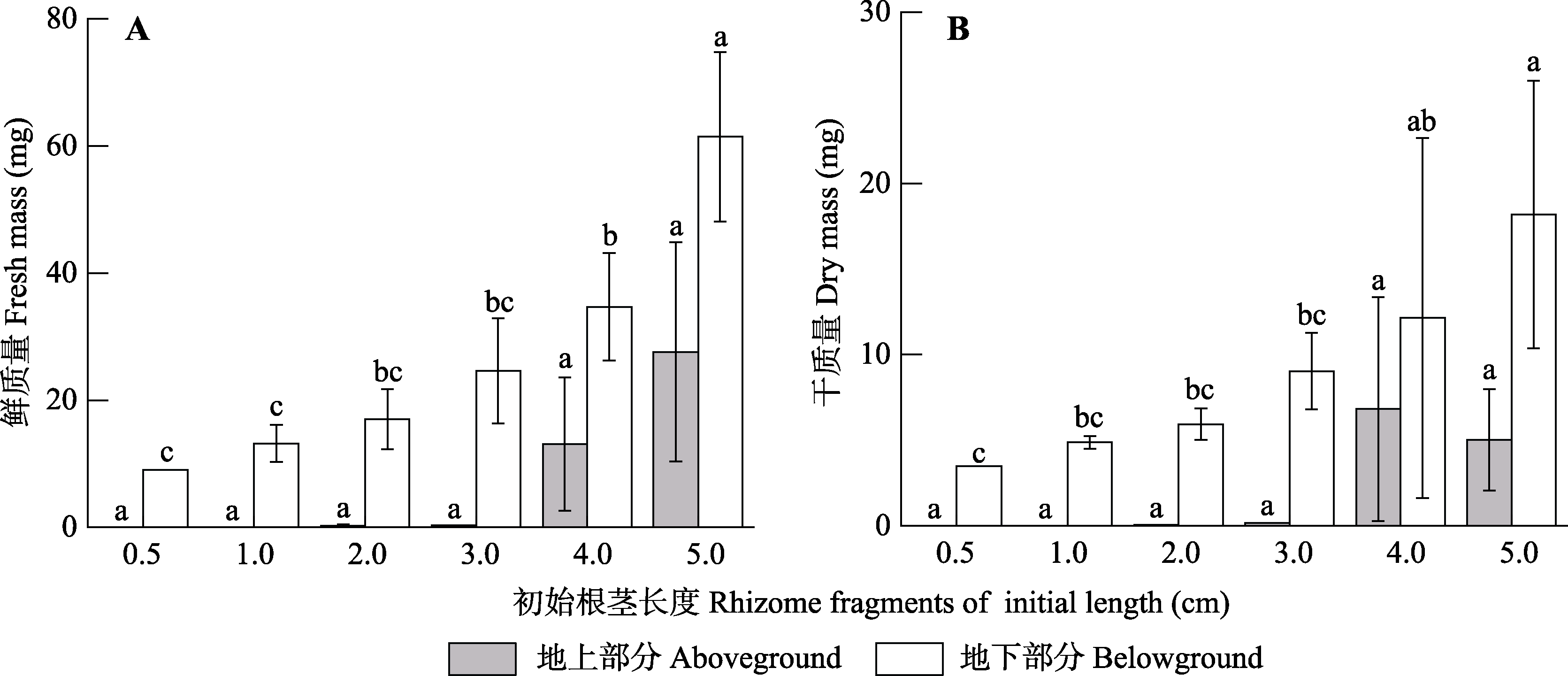
Fig. 3 Aboveground and belowground fresh mass and dry mass of clonal ramets originated from rhizome fragments of Leymus chinensis of different initial lengths (mean ± SE). Different lowercase letters indicate significant differences between rhizome fragments of different initial lengths (p < 0.05).
| [1] |
Abdullahi AE, Cavers PB (1997). Factors affecting regeneration from root fragments in two Physalis species. Phytoprotection, 78, 23-33.
DOI URL |
| [2] |
Alpert P (1999). Clonal integration in Fragaria chiloensis differs between populations: ramets from grassland are selfish. Oecologia, 120, 69-76.
DOI PMID |
| [3] | Ba CQ, Ma Q, Wang HY, Liu ZM (2022). Challenges in research on rhizomatous clonal plants. Acta Prataculturae Sinica, 31(12), 200-207. |
|
[巴超群, 马群, 汪海洋, 刘志民 (2022). 根茎克隆植物研究面临的挑战. 草业学报, 31(12), 200-207.]
DOI |
|
| [4] | Bai WM, Xun F, Li Y, Zhang WH, Li LH (2010). Rhizome severing increases root lifespan of Leymus chinensis in a typical steppe of Inner Mongolia. PLoS ONE, 5, e12125. DOI: 10.1371/journal.pone.0012125. |
| [5] |
Bartušková A, Lubbe FC, Qian JQ, Herben T, Klimešová J (2022). The effect of moisture, nutrients and disturbance on storage organ size and persistence in temperate herbs. Functional Ecology, 36, 314-325.
DOI URL |
| [6] |
Boller BC, Nösberger J (1983). Effects of temperature and photoperiod on stolon characteristics, dry matter partitioning, and nonstructural carbohydrate concentration of two white clover ecotypes. Crop Science, 23, 1057-1062.
DOI URL |
| [7] |
Chapin III FS, Schulze ED, Mooney HA (1990). The ecology and economics of storage in plants. Annual Review of Ecology and Systematics, 21, 423-447.
DOI URL |
| [8] |
Chapman DF, Robson MJ (1992). The physiological role of old stolon material in white clover (Trifolium repens L.). New Phytologist, 122, 53-62.
DOI PMID |
| [9] | Collins RP, Abberton MT, Michaelson-Yeates TPT, Rhodes I (1997). Response to divergent selection for stolon characters in white clover (Trifolium repens). Journal of Agricultural Science, 129, 279-285. |
| [10] | Collins RP, Rhodes I (1995). Stolon characteristics related to winter survival in white clover. Journal of Agricultural Science, 124, 11-16. |
| [11] | Dong BC, Liu RH, Zhang Q, Li HL, Zhang MX, Lei GC, Yu FH (2011). Burial depth and stolon internode length independently affect survival of small clonal fragments. PLoS ONE, 6, e23942. DOI: 10.1371/journal.pone.0023942. |
| [12] |
Dong BC, Wang P, Luo FL (2022). Sharing of nitrogen between connected ramets of Alternanthera philoxeroides in homogeneous environments. Plant and Soil, 478, 445-460.
DOI |
| [13] |
Dong BC, Yu GL, Guo W, Zhang MX, Dong M, Yu FH (2010). How internode length, position and presence of leaves affect survival and growth of Alternanthera philoxeroides after fragmentation? Evolutionary Ecology, 24, 1447-1461.
DOI URL |
| [14] | Dong M (1999). Effects of severing rhizome on clonal growth in rhizomatous grass species Psammochloa villosa and Leymus secalinus. Acta Botanica Sinica, 41, 194-198. |
| [董鸣 (1999). 切断根茎对根茎禾草沙鞭和赖草克隆生长的影响. 植物学报, 41, 194-198.] | |
| [15] | Eckert CG, Kroon H, Groenendael JM (1997). The Ecology and Evolution of Clonal Plants. Springer-Verlag, Berlin. |
| [16] |
Edwards JT, Oliver LR (2004). Emergence and growth of trumpetcreeper (Campsis radicans) as affected by rootstock size and planting depth. Weed Technology, 18, 816-819.
DOI URL |
| [17] |
Eisen KE, Siegmund GF, Watson MA, Geber MA (2022). Variation in the location and timing of experimental severing demonstrates that the persistent rhizome serves multiple functions in a clonal forest understorey herb. Functional Ecology, 36, 356-367.
DOI URL |
| [18] | Eriksson O, Jerling L (1990). Clonal Growth in Plants: Regulation and Function. Springer, Berlin. |
| [19] |
Harris D, Davy AJ (1986). Regenerative potential of Elymus farctus from rhizome fragments and seed. Journal of Ecology, 74, 1057-1067.
DOI URL |
| [20] | He LX, Xiao X, Zhang XM, Jin Y, Pu ZH, Lei NF, He XF, Chen JS (2021). Clonal fragments of stoloniferous invasive plants benefit more from stolon storage than their congeneric native species. Flora, 281, 151877. DOI: 10.1016/j.flora.2021.151877. |
| [21] |
Herben T, Klimešová J (2020). Evolution of clonal growth forms in angiosperms. New Phytologist, 225, 999-1010.
DOI PMID |
| [22] |
Huang QQ, Shen YD, Li XX, Zhang GL, Huang DD, Fan ZW (2015). Regeneration capacity of the small clonal fragments of the invasive Mikania micrantha H.B.K.: effects of the stolon thickness, internode length and presence of leaves. Weed Biology and Management, 15, 70-77.
DOI URL |
| [23] | Huber H, Visser EJW, Clements G, Peters JL (2014). Flooding and fragment size interact to determine survival and regrowth after fragmentation in two stoloniferous Trifolium species. AoB PLANTS, 6, plu024. DOI: 10.1093/aobpla/plu024. |
| [24] |
Iwasa Y, Cohen D (1989). Optimal growth schedule of a perennial plant. The American Naturalist, 133, 480-505.
DOI URL |
| [25] |
Iwasa Y, Kubo T (1997). Optimal size of storage for recovery after unpredictable disturbances. Evolutionary Ecology, 11, 41-65.
DOI URL |
| [26] |
Jaafry WH, Li DZ, Fatima SA, Hassan M (2016). Role of clonal integration among different environmental conditions (a review). Natural Science, 8, 475-486.
DOI URL |
| [27] | Larcher W (2003). Physiological Plant Ecology. 4th ed. Springer-Verlag, Berlin. |
| [28] | Li R (1998). Clonal Growth in the Giant Bamboo Phyllostachys pubescens. PhD dassertation, Utrecht University, Utrecht. |
| [29] | Li XX, Shen YD, Huang QQ, Fan ZW, Huang DD (2013). Regeneration capacity of small clonal fragments of the invasive Mikania micrantha H.B.K.: effects of burial depth and stolon internode length. PLoS ONE, 8, e84657. DOI: 10.1371/journal.pone.0084657. |
| [30] | Liu GS (2024). Chinese Sheepgrass. China Forestry Publishing House, Beijing. 106-113. |
| [刘公社 (2024). 中国羊草. 中国林业出版社, 北京. 106-113.] | |
| [31] | Lu JM, Li JD, Hu AL, Li XL, Zhang HQ, Zhou DW (1996). Ecological and evolutionary morphological characteristics of Aneurolepidium chinense population. Chinese Journal of Applied Ecology, 7, 44-48. |
| [陆静梅, 李建东, 胡阿林, 历锡亮, 张洪芹, 周道玮 (1996). 羊草种群生态和演化形态学特性的比较研究. 应用生态学报, 7, 44-48.] | |
| [32] |
Luo WC, Zhao WZ (2015). Burial depth and diameter of the rhizome fragments affect the regenerative capacity of a clonal shrub. Ecological Complexity, 23, 34-40.
DOI URL |
| [33] | Midorikawa B, Shimada Y, Iwaki H, Ohga N (1975). Root production in semi-natural grassland community dominated by Miscanthus sinensis in the Kawatabi area. JIBP Synthesis, 13, 114-122. |
| [34] |
Mooney HA, Billings WD (1961). Comparative physiological ecology of Arctic and alpine populations of Oxyria digyna. Ecological Monographs, 31, 1-29.
DOI URL |
| [35] | Mutoh N, Yoshida KH, Yokol Y, Yimurq M, Hogetsu K (1968). Studies on production processes and net production of Miscanthus sacchariflorus community. Japanese Journal of Botany, 20, 67-92. |
| [36] |
Price EAC, Gamble R, Williams GG, Marshall C (2001). Seasonal patterns of partitioning and remobilization of 14C in the invasive rhizomatous perennial Japanese knotweed (Fallopia japonica (Houtt.) Ronse Decraene). Evolutionary Ecology, 15, 347-362.
DOI URL |
| [37] |
Roiloa SR, Alpert P, Tharayil N, Hancock G, Bhowmik PC (2007). Greater capacity for division of labour in clones of Fragaria chiloensis from patchier habitats. Journal of Ecology, 95, 397-405.
DOI URL |
| [38] | Shi JM, Ye XH, Chen FS, Yang QP, Li ZY, Fang K, Yang GY (2014). Adaptation of bamboo to heterogeneous habitat: phenotypic plasticity. Acta Ecologica Sinica, 34, 5687-5695. |
| [39] |
Song YB, Yu FH, Keser LH, Dawson W, Fischer M, Dong M, van Kleunen M (2013). United we stand, divided we fall: a meta-analysis of experiments on clonal integration and its relationship to invasiveness. Oecologia, 171, 317-327.
DOI URL |
| [40] |
Stuefer JF, Hutchings MJ (1994). Environmental heterogeneity and clonal growth: a study of the capacity for reciprocal translocation in Glechoma hederacea L. Oecologia, 100, 302-308.
DOI PMID |
| [41] |
Stuefer JF, Huber H (1999). The role of stolon internodes for ramet survival after clone fragmentation in Potentilla anserina. Ecology Letters, 2, 135-139.
DOI URL |
| [42] |
Suzuki JI, Stuefer JF (1999). On the ecological and evolutionary significance of storage in clonal plants. Plant Species Biology, 14, 11-17.
DOI URL |
| [43] |
Turkington R, Klein E (1991). Integration among ramets of Trifolium repens. Canadian Journal of Botany, 69, 226-228.
DOI URL |
| [44] |
Turner LB, Pollock CJ (1998). Changes in stolon carbohydrates during the winter in four varieties of white clover (Trifolium repens L.) with contrasting hardiness. Annals of Botany, 81, 97-107.
DOI URL |
| [45] |
Wang ZW (2007). Temporal variation of water-soluble carbohydrate in the rhizome clonal grass Leymus chinensis in response to defoliation. Chinese Journal of Plant Ecology, 31, 673-679.
DOI URL |
| [46] |
Wang ZW, Li LH, Han XG, Dong M (2004). Do rhizome severing and shoot defoliation affect clonal growth of Leymus chinensis at ramet population level? Acta Oecologica, 26, 255-260.
DOI URL |
| [47] |
Watson MA (2008). Resource storage and the expression of clonal plant life histories. Evolutionary Ecology, 22, 471-475.
DOI URL |
| [48] |
Wiens JA (1976). Population responses to patchy environments. Annual Review of Ecology and Systematics, 7, 81-120.
DOI URL |
| [49] | Yang YF, Zheng HY, Li JD (1997). Comparative study on characters of two divergence types of the clone population Leymus chinensis in the Songnen Plain of China. Acta Botanica Sinica, 39, 1058-1064. |
| [杨允菲, 郑慧莹, 李建东 (1997). 松嫩平原两个趋异类型羊草无性系种群特征的比较研究. 植物学报, 39, 1058-1064.] | |
| [50] |
Yu FH, Dong M, Krüsi B (2004). Clonal integration helps Psammochloa villosa survive sand burial in an inland dune. New Phytologist, 162, 697-704.
DOI URL |
| [51] | Zhai SS, Qian JQ, Ma Q, Liu ZM, Ba CQ, Xin ZM, Tian L, Zong L, Liang W, Zhu JL (2022). Effect of rhizome severing on survival and growth of rhizomatous herb Phragmites communis is regulated by sand burial depth. Plants, 11, 3191. DOI: 10.3390/plants11233191. |
| [1] | WANG Zu-Xing, HE Wei-Ming. Effects of soil-burial depths on the relationship between seed mass and seed emergence [J]. Chin J Plant Ecol, 2019, 43(10): 899-908. |
| Viewed | ||||||
|
Full text |
|
|||||
|
Abstract |
|
|||||
Copyright © 2026 Chinese Journal of Plant Ecology
Tel: 010-62836134, 62836138, E-mail: apes@ibcas.ac.cn, cjpe@ibcas.ac.cn

