
Chin J Plant Ecol ›› 2025, Vol. 49 ›› Issue (9): 1388-1398.DOI: 10.17521/cjpe.2024.0439 cstr: 32100.14.cjpe.2024.0439
Special Issue: 虚拟专辑 | 干旱响应与适应 | 整合生物学期刊集群跨刊组建
• Research Articles • Previous Articles Next Articles
LIU Ying, LI Jiang-Feng, WU Jia-Qi, WANG Yi-Fan, YIN Qing-Lin, WANG Jing*( )(
)( )
)
Received:2024-12-05
Accepted:2025-03-21
Online:2025-09-20
Published:2025-03-21
Contact:
WANG Jing
Supported by:LIU Ying, LI Jiang-Feng, WU Jia-Qi, WANG Yi-Fan, YIN Qing-Lin, WANG Jing. Effects of root and mycorrhizal fungi of Cleistogenes squarrosa on soil carbon and nitrogen under drought conditions[J]. Chin J Plant Ecol, 2025, 49(9): 1388-1398.
Add to citation manager EndNote|Ris|BibTeX
URL: https://www.plant-ecology.com/EN/10.17521/cjpe.2024.0439
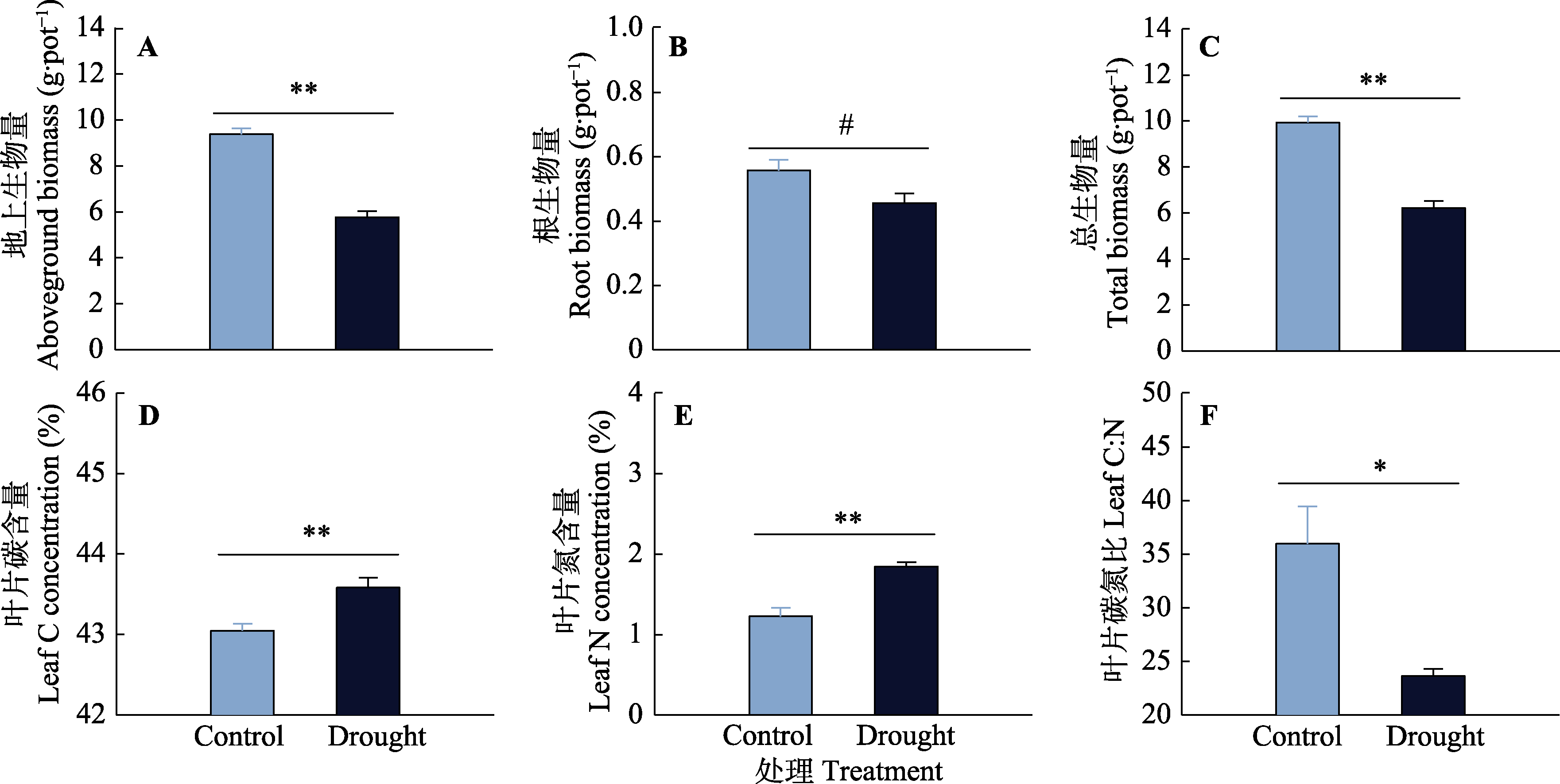
Fig. 1 Effects of drought treatment on aboveground, root biomass and the carbon (C) concentration, nitrogen (N) concentration, C:N of Cleistogenes squarrosa (mean ± SE). ** indicated that the treatment effect was extremely significant (p ≤ 0.01); * indicated that the treatment effect was significant (p ≤ 0.05); # indicated that the treatment effect was marginally significant (p ≤ 0.1).
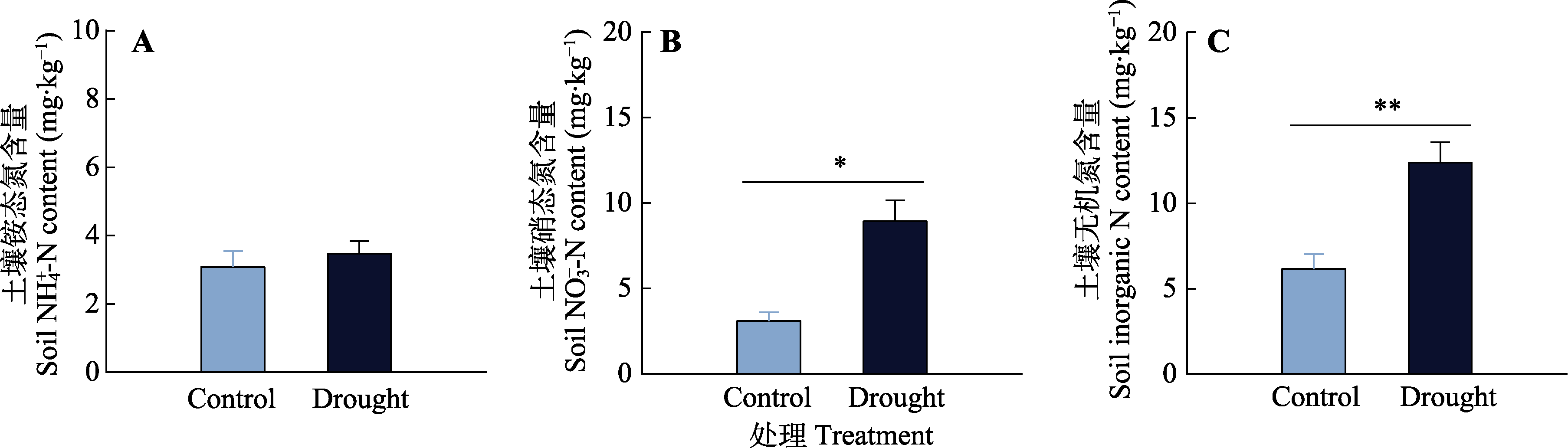
Fig. 2 Effects of drought treatment on soil inorganic nitrogen (N) content (mean ± SE). ** indicated that the treatment effect was extremely significant (p ≤ 0.01). NH4+-N, ammonium nitrogen; NO3--N, nitrate nitrogen.
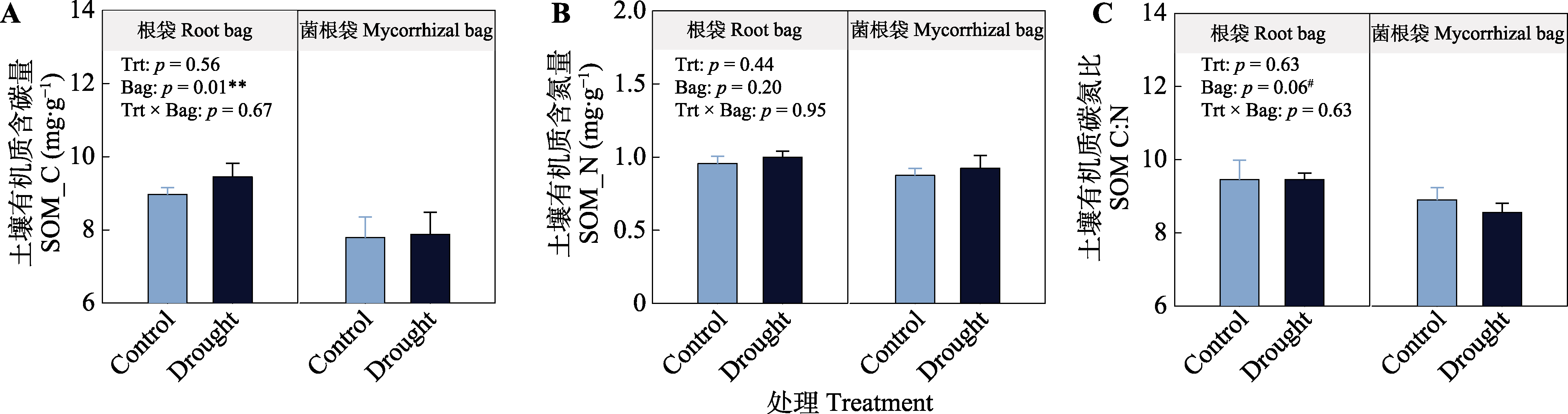
Fig. 3 Effects of drought treatment on carbon and nitrogen concentration of soil organic matter (SOM) (mean ± SE). The results of two-way ANOVA were shown in the figures. Trt represents the main effect of drought, Bag represents the main effect of different sources of root bag and mycorrhizal bag, and Trt × Bag represents the interactive effect of both. ** indicated that the main effect or interaction effect of the treatment was extremely significant (p ≤ 0.01); # indicated that the main effect or interaction effect of the treatment was marginally significant (p ≤ 0.1). SOM_C, carbon concentration of soil organic matter; SOM_N, nitrogen concentration of soil organic matter.
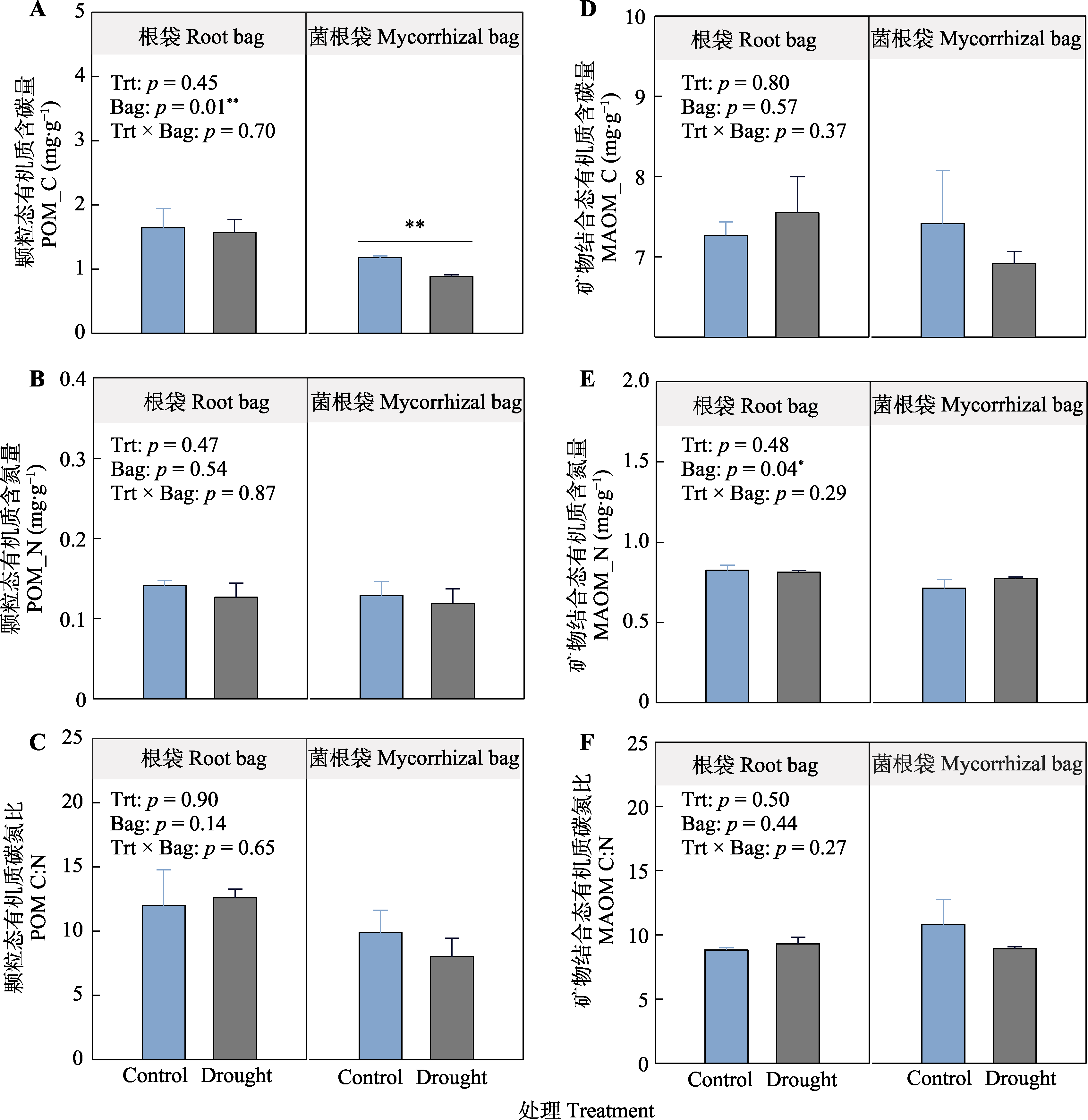
Fig. 4 Effects of drought treatment on carbon and nitrogen concentration of soil particulate organic matter (POM) and soil mineral-associated organic matter (MAOM) (mean ± SE). The results of two-way ANOVA were shown in the figures. Trt represents the main effect of drought, Bag represents the main effect of different sources of root bag and mycorrhizal bag, and Trt × Bag represents the interactive effect of both. ** indicated that the main effect or interaction effect of the treatment was extremely significant (p ≤ 0.01); * indicated that the main effect or interaction effect was significant (p ≤ 0.05). MAOM_C, carbon concentration of mineral-associated organic matter; MAOM_N, nitrogen concentration of mineral-associated organic matter; POC_C, carbon concentration of particulate organic matter; POC_N, nitrogen concentration of particulate organic matter.
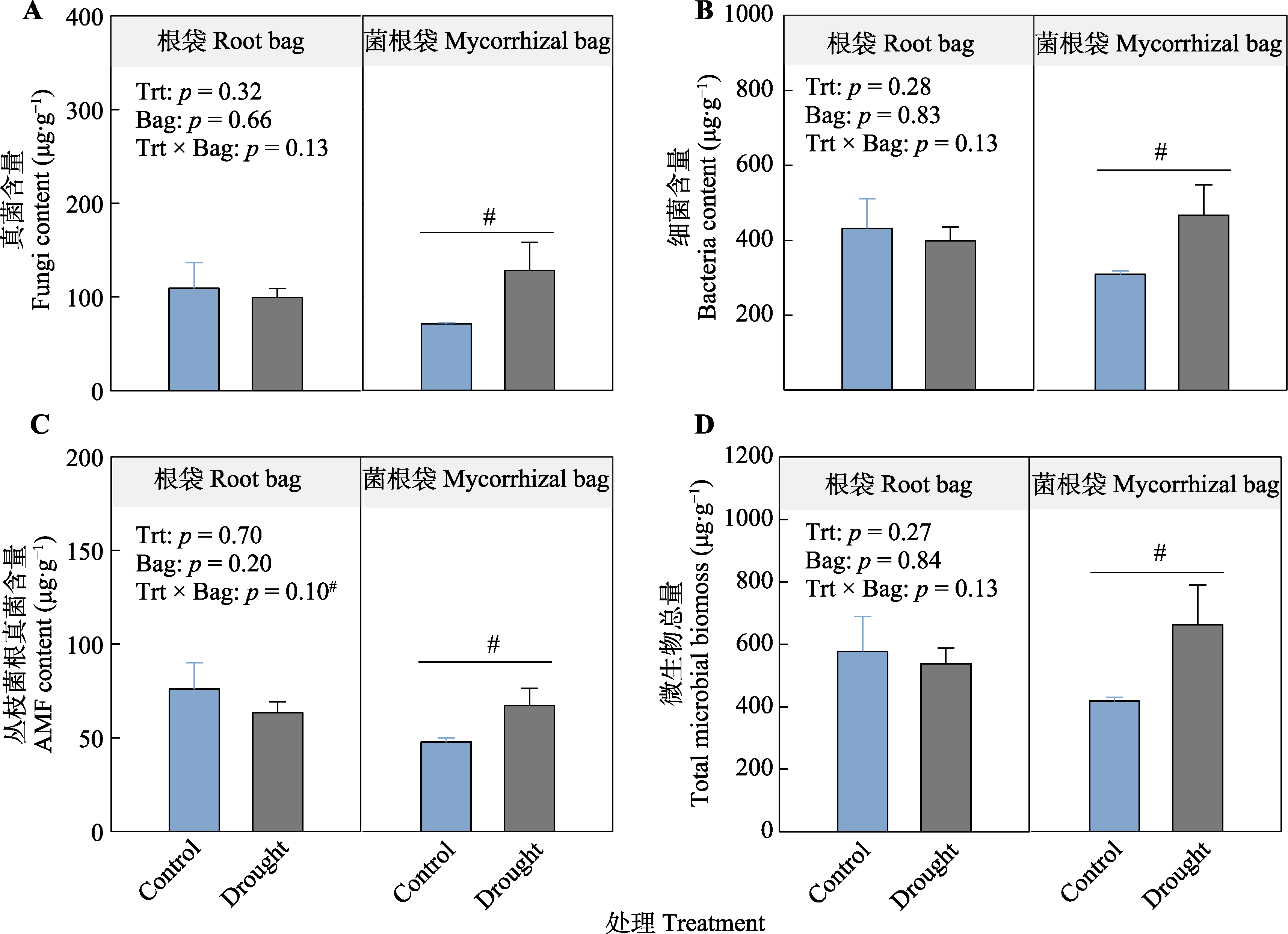
Fig. 5 Effects of drought treatment on soil microbial community composition (mean ± SE). The results of two-way ANOVA were shown in the figures. Trt represents the main effect of drought, Bag represents the main effect of different sources of root bag and mycorrhizal bag, and Trt × Bag represents the interactive effect of both. AMF, arbuscular mycorrhizal fungi. # indicated that the main effect or interaction effect of the treatment was marginally significant (p ≤ 0.1).
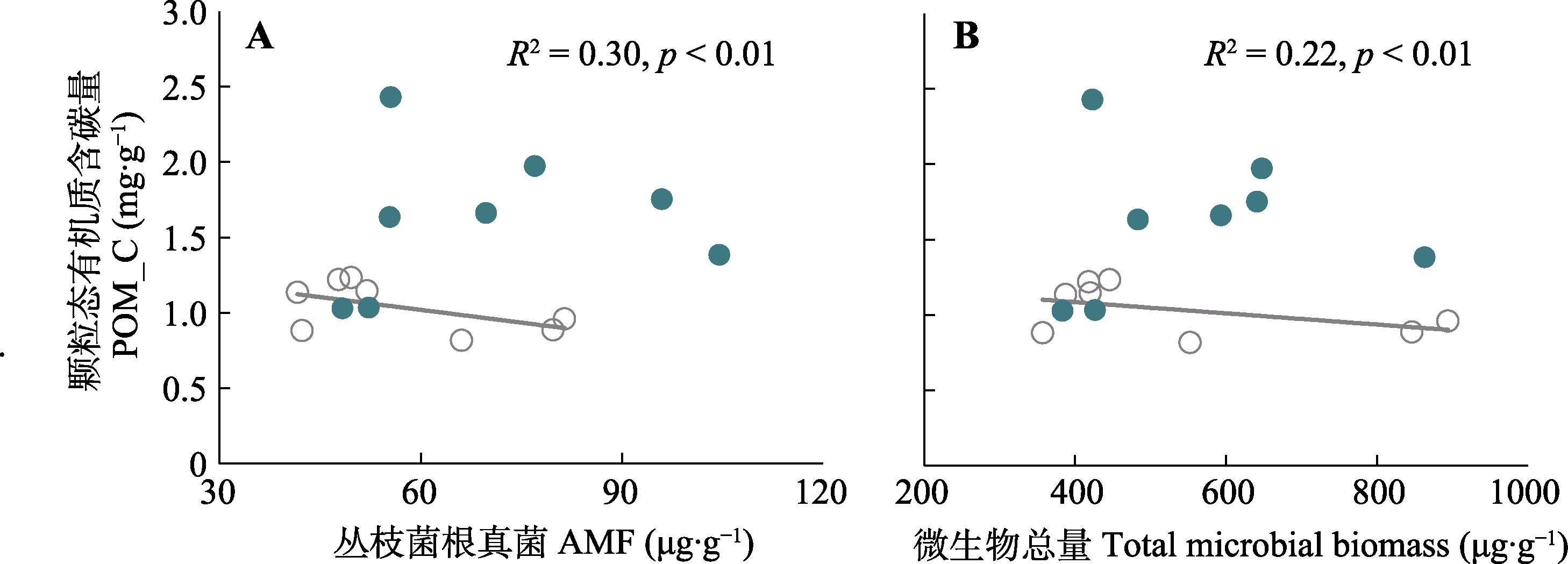
Fig. 6 Relationships between carbon concentration of soil particulate organic matter (POM_C) and total amount of arbuscular mycorrhizal fungi (AMF, A) or total microbial biomass (B). Dots and circles represent the data from root bags and mycorrhizal bags, respectively.
| [1] |
Bai TS, Qiu YP, Hu SJ (2024). Nitrogen availability mediates the effects of roots and mycorrhizal fungi on soil organic carbon decomposition: a meta-analysis. Pedosphere, 34, 289-296.
DOI URL |
| [2] |
Bai YF, Cotrufo MF (2022). Grassland soil carbon sequestration: current understanding, challenges, and solutions. Science, 377, 603-608.
DOI PMID |
| [3] |
Chen BD, Fu W, Wu SL, Zhu YG (2024). Involvements of mycorrhizal fungi in terrestrial ecosystem carbon cycling. Chinese Journal of Plant Ecology, 48, 1-20.
DOI URL |
|
[陈保冬, 付伟, 伍松林, 朱永官 (2024). 菌根真菌在陆地生态系统碳循环中的作用. 植物生态学报, 48, 1-20.]
DOI |
|
| [4] |
Cheng L, Booker FL, Tu C, Burkey KO, Zhou LS, Shew HD, Rufty TW, Hu SJ (2012). Arbuscular mycorrhizal fungi increase organic carbon decomposition under elevated CO2. Science, 337, 1084-1087.
DOI PMID |
| [5] |
Cotrufo MF, Soong JL, Horton AJ, Campbell EE, Haddix ML, Wall DH, Parton WJ (2015). Formation of soil organic matter via biochemical and physical pathways of litter mass loss. Nature Geoscience, 8, 776-779.
DOI |
| [6] |
Cotrufo MF, Wallenstein MD, Boot CM, Denef K, Paul E (2013). The Microbial Efficiency-Matrix Stabilization (MEMS) framework integrates plant litter decomposition with soil organic matter stabilization: Do labile plant inputs form stable soil organic matter? Global Change Biology, 19, 988-995.
DOI PMID |
| [7] |
Dai AG (2013). Increasing drought under global warming in observations and models. Nature Climate Change, 3, 52-58.
DOI |
| [8] |
Davidson EA, Janssens IA (2006). Temperature sensitivity of soil carbon decomposition and feedbacks to climate change. Nature, 440, 165-173.
DOI |
| [9] | Deng L, Peng CH, Kim DG, Li JW, Liu YL, Hai XY, Liu QY, Huang CB, Shangguan ZP, Kuzyakov Y (2021). Drought effects on soil carbon and nitrogen dynamics in global natural ecosystems. Earth-Science Reviews, 214, 103501. DOI: 10.1016/j.earscirev.2020.103501. |
| [10] |
Dijkstra FA, Zhu B, Cheng WX (2021). Root effects on soil organic carbon: a double-edged sword. New Phytologist, 230, 60-65.
DOI PMID |
| [11] |
Ekblad A, Mikusinska A, Ågren GI, Menichetti L, Wallander H, Vilgalys R, Bahr A, Eriksson U (2016). Production and turnover of ectomycorrhizal extramatrical mycelial biomass and necromass under elevated CO2 and nitrogen fertilization. New Phytologist, 211, 874-885.
DOI PMID |
| [12] |
Feng JG, He KY, Zhang QF, Han MG, Zhu B (2022). Changes in plant inputs alter soil carbon and microbial communities in forest ecosystems. Global Change Biology, 28, 3426-3440.
DOI URL |
| [13] | Feng XJ (2022). Plant influences on soil organic carbon dynamics//Rumpel C. Understanding and Fostering Soil Carbon Sequestration. Burleigh Dodds Science Publishing, Cambridge, UK. |
| [14] |
Fulton-Smith S, Cotrufo MF (2019). Pathways of soil organic matter formation from above and belowground inputs in a Sorghum bicolor bioenergy crop. Global Change Biology Bioenergy, 11, 971-987.
DOI URL |
| [15] |
Godbold DL, Hoosbeek MR, Lukac M, Cotrufo MF, Janssens IA, Ceulemans R, Polle A, Velthorst EJ, Scarascia-Mugnozza G, de Angelis P, Miglietta F, Peressotti A (2006). Mycorrhizal hyphal turnover as a dominant process for carbon input into soil organic matter. Plant and Soil, 281, 15-24.
DOI URL |
| [16] |
Hodge A, Storer K (2015). Arbuscular mycorrhiza and nitrogen: implications for individual plants through to ecosystems. Plant and Soil, 386, 1-19.
DOI URL |
| [17] |
Horsch CCA, Antunes PM, Fahey C, Grandy AS, Kallenbach CM (2023). Trait-based assembly of arbuscular mycorrhizal fungal communities determines soil carbon formation and retention. New Phytologist, 239, 311-324.
DOI URL |
| [18] | Huang JS, Liu WX, Yang S, Yang L, Peng ZY, Deng MF, Xu S, Zhang BB, Ahirwal J, Liu LL (2021). Plant carbon inputs through shoot, root, and mycorrhizal pathways affect soil organic carbon turnover differently. Soil Biology & Biochemistry, 160, 108322. DOI: 10.1016/j.soilbio.2021.108322. |
| [19] |
Keller AB, Brzostek ER, Craig ME, Fisher JB, Phillips RP (2021). Root-derived inputs are major contributors to soil carbon in temperate forests, but vary by mycorrhizal type. Ecology Letters, 24, 626-635.
DOI PMID |
| [20] | Klink S, Keller AB, Wild AJ, Baumert VL, Gube M, Lehndorff E, Meyer N, Mueller CW, Phillips RP, Pausch J (2022). Stable isotopes reveal that fungal residues contribute more to mineral-associated organic matter pools than plant residues. Soil Biology & Biochemistry, 168, 108634. DOI: 10.1016/j.soilbio.2022.108634. |
| [21] |
Kou L, Jiang L, Fu XL, Dai XQ, Wang HM, Li SG (2018). Nitrogen deposition increases root production and turnover but slows root decomposition in Pinus elliottii plantations. New Phytologist, 218, 1450-1461.
DOI URL |
| [22] |
Lal R (2004). Soil carbon sequestration impacts on global climate change and food security. Science, 304, 1623-1627.
DOI PMID |
| [23] |
Liang C, Schimel JP, Jastrow JD (2017). The importance of anabolism in microbial control over soil carbon storage. Nature Microbiology, 2, 17105. DOI: 10.1038/nmicrobiol.2017.105.
PMID |
| [24] |
Ma XH, Huang JY, Yu HL, Han C, Li B (2024). Soil organic carbon and its easily decomposed components under precipitation change and nitrogen addition in a desert steppe in northwest China. Chinese Journal of Plant Ecology, 48, 1065-1077.
DOI URL |
|
[马煦晗, 黄菊莹, 余海龙, 韩翠, 李冰 (2024). 降水量变化及氮添加下荒漠草原土壤有机碳及其易分解组分研究. 植物生态学报, 48, 1065-1077.]
DOI |
|
| [25] |
Peng YF, Guo DL, Yang YH (2017). Global patterns of root dynamics under nitrogen enrichment. Global Ecology and Biogeography, 26, 102-114.
DOI URL |
| [26] | Ridgeway J, Kane J, Morrissey E, Starcher H, Brzostek E (2024). Roots selectively decompose litter to mine nitrogen and build new soil carbon. Ecology Letters, 27, e14331. DOI: 10.1111/ele.14331. |
| [27] |
See CR, Keller AB, Hobbie SE, Kennedy PG, Weber PK, Pett-Ridge J (2022). Hyphae move matter and microbes to mineral microsites: integrating the hyphosphere into conceptual models of soil organic matter stabilization. Global Change Biology, 28, 2527-2540.
DOI URL |
| [28] | Shi BK, Delgado-Baquerizo M, Knapp AK, Smith MD, Reed S, Osborne B, Carrillo Y, Maestre FT, Zhu Y, Chen AP, Wilkins K, Holdrege MC, Kulmatiski A, Picon-Cochard C, Roscher C, et al. (2024). Aridity drives the response of soil total and particulate organic carbon to drought in temperate grasslands and shrublands. Science Advances, 10, eadq2654. DOI: 10.1126/sciadv.adq2654. |
| [29] |
Sokol NW, Bradford MA (2019). Microbial formation of stable soil carbon is more efficient from belowground than aboveground input. Nature Geoscience, 12, 46-53.
DOI |
| [30] |
Sokol NW, Kuebbing SE, Karlsen-Ayala E, Bradford MA (2019). Evidence for the primacy of living root inputs, not root or shoot litter, in forming soil organic carbon. New Phytologist, 221, 233-246.
DOI PMID |
| [31] |
van Diepen LTA, Lilleskov EA, Pregitzer KS, Miller RM (2007). Decline of arbuscular mycorrhizal fungi in northern hardwood forests exposed to chronic nitrogen additions. New Phytologist, 176, 175-183.
DOI PMID |
| [32] |
Verlinden MS, Ven A, Verbruggen E, Janssens IA, Wallander H, Vicca S (2018). Favorable effect of mycorrhizae on biomass production efficiency exceeds their carbon cost in a fertilization experiment. Ecology, 99, 2525-2534.
DOI PMID |
| [33] | Villarino SH, Pinto P, Jackson RB, Piñeiro G (2021). Plant rhizodeposition: a key factor for soil organic matter formation in stable fractions. Science Advances, 7, eabd3176. DOI: 10.1126/sciadv.abd3176. |
| [34] | Wang ZH, Lian JQ, Liang JW, Wei HJ, Chen H, Hu WT, Tang M (2024). Arbuscular mycorrhizal symbiosis modulates nitrogen uptake and assimilation to enhance drought tolerance of Populus cathayana. Plant Physiology and Biochemistry, 210, 108648. DOI: 10.1016/j.plaphy.2024.108648. |
| [35] |
Wu SL, Fu W, Rillig MC, Chen BD, Zhu YG, Huang LB (2024). Soil organic matter dynamics mediated by arbuscular mycorrhizal fungi—An updated conceptual framework. New Phytologist, 242, 1417-1425.
DOI URL |
| [36] |
Xu XY, Qiu YP, Zhang KC, Yang F, Chen MF, Luo X, Yan XB, Wang P, Zhang Y, Chen HH, Guo H, Jiang L, Hu SJ (2022). Climate warming promotes deterministic assembly of arbuscular mycorrhizal fungal communities. Global Change Biology, 28, 1147-1161.
DOI URL |
| [37] | Zhang M, Wang CY, Luo S, Xu QY, Yang LM, Yue K, Fan YX (2025). Influence of nitrogen fertilization on soil organic nitrogen components in agroecosystems: a meta-analysis. Acta Ecologica Sinica, 45, 1328-1338. |
| [章梦, 王晨颖, 罗松, 许秋月, 杨柳明, 岳楷, 范跃新 (2025). 施用氮肥对农田土壤有机氮组分影响的整合分析. 生态学报, 45, 1328-1338.] | |
| [38] |
Zhou XH, Zhou LY, Nie YY, Fu YL, Du ZG, Shao JJ, Zheng ZM, Wang XH (2016). Similar responses of soil carbon storage to drought and irrigation in terrestrial ecosystems but with contrasting mechanisms: a meta-analysis. Agriculture Ecosystems & Environment, 228, 70-81.
DOI URL |
| [39] |
Zhu XM, Zhang ZL, Wang QT, Peñuelas J, Sardans J, Lambers H, Li N, Liu Q, Yin HJ, Liu ZF (2022). More soil organic carbon is sequestered through the mycelium pathway than through the root pathway under nitrogen enrichment in an alpine forest. Global Change Biology, 28, 4947-4961.
DOI URL |
| [1] | HE Zheng-Jia, ZENG Xin-Ran, WANG Lin-Ying, XUE Xin-Yu, SU Qin-Ze, LI Yu, ZHANG Yin-Jie, WU Hui-Huang, CHEN Cheng-Cong, WU Liang-Quan, WEI An-Ni, QIU Yun-Peng, GUO Li-Jin. Response of arbuscular mycorrhizal fungal communities and soil organic carbon to magnesium fertilization in tea plantations [J]. Chin J Plant Ecol, 2026, 50(3): 700-709. |
| [2] | DUAN Shi-Long, YU Cheng-Jin, XU Xin-Yao, FENG Gu, XIE Xian-An, ZHANG Lin. Plant-arbuscular mycorrhizal fungi-bacteria continuum and its maintenance mechanisms [J]. Chin J Plant Ecol, 2026, 50(3): 600-611. |
| [3] | JIANG Kang-Wei, LÜ Cheng, WANG Ya-Fei, LI Hong, ZHANG Zhi-Qing, WANG Yu, ZHANG Qing-Qing, Tuerxunnayi REYIMU. Effects of soil arbuscular mycorrhizal fungal communities on soil multifunctionality under grazing disturbance [J]. Chin J Plant Ecol, 2026, 50(3): 685-699. |
| [4] | HE Tang-Qing, WANG Bian-Bian, CAO Xin-Xin, ZHANG Kang-Cheng, WANG Xiao-Dong, WANG Hao, BAI Tong-Shuo, ZHAO Ye-Xin, ZHANG Yi, WANG Yi, QIU Yun-Peng, HU Shui-Jin. Responses of plants and arbuscular mycorrhizal fungal communities to long-term precipitation increase in a semi-arid grassland [J]. Chin J Plant Ecol, 2026, 50(3): 674-684. |
| [5] | LI Wen-Zhu, LUAN Jun-Wei, DI Ya-Ping, WANG Yi, NIE Xiu-Qing, LIU Shi-Rong. Effects of manipulative drought on mycorrhiza-mediated soil enzyme activities and soil organic carbon fractions in a warm temperate Quercus aliena var. acuteserrata forest [J]. Chin J Plant Ecol, 2026, 50(3): 660-673. |
| [6] | ZHANG Cheng-Hang, WEI Xing, WU Chun-Ze, WANG Yu-Yao, LI Hao-Nan. Growth response of mycorrhizal Fraxinus mandshurica and Larix gmelinii seedlings to dry and wet deposition of atmospheric reduced nitrogen [J]. Chin J Plant Ecol, 2026, 50(3): 649-659. |
| [7] | ZOU Ji-Kai, WU Jia-Yi, GU Yun-Yi, CHEN Bao-Ming. Effects of different nitrogen forms and arbuscular mycorrhizal fungi on competitive ability of invasive alien plant Bidens alba [J]. Chin J Plant Ecol, 2026, 50(3): 722-730. |
| [8] | QIN Fei-Fei, TANG Zhao-Hui, SI Tong, CI Dun-Wei. Response mechanisms of growth and rhizosphere soil properties in salt-tolerant and salt-sensitive peanut (Arachis hypogaea) to arbuscular mycorrhizal fungi [J]. Chin J Plant Ecol, 2026, 50(3): 742-759. |
| [9] | WANG Hai-Lang, FU Wei, WU Song-Lin, CHEN Bao-Dong. Ecological functions and community regulation of arbuscular mycorrhizal fungi [J]. Chin J Plant Ecol, 2026, 50(3): 515-535. |
| [10] | MA Jian-Hui, TONG Xin, ZHANG Si-Rong, MAO Zi-Kun, QIN Jun, MA Ke-Ping. Research advances and perspectives on physiological and ecological functions of mycorrhizal fungi [J]. Chin J Plant Ecol, 2026, 50(3): 498-514. |
| [11] | JIANG Qing-Hong, DING Lu, WANG Zhe, ZHENG Chun-Li, FENG Zhao-Chuo. Growth-promoting effects of arbuscular mycorrhizal fungi combined with different functional bacteria on Medicago sativa [J]. Chin J Plant Ecol, 2026, 50(3): 774-788. |
| [12] | ZHOU Chun-Han, XIONG Zhi-Cheng, YANG Ming-Xin, SHI Hai-Lan, ZHOU Ya-Xing, TANG Yu, ZHANG Jing, JI Bao-Ming, DAI Xin-Ling. Community characteristics and drivers of arbuscular mycorrhizal fungi in alpine wetlands of the Yellow River Source Region [J]. Chin J Plant Ecol, 2026, 50(3): 625-638. |
| [13] | WEI Li, WANG Peng-Sen, LIU Shan, FAN Rui, HUANG Nan, ZHANG Jian-Guo, Qimeilamu , GOU Yang, LIU Mo-Han, HUANG Ting, ZHOU Ji-Qiong. Arbuscular mycorrhizal fungi influence nutrient uptake along vertical niches in legume-grass mixtures [J]. Chin J Plant Ecol, 2026, 50(3): 760-773. |
| [14] | TAN Qiu-Yan, ZHANG Qing, GAO Cheng, CHU Hai-Yan, YANG Teng. Ectomycorrhizal fungi: key drivers of carbon and nitrogen cycling in alpine ecosystems [J]. Chin J Plant Ecol, 2026, 50(3): 584-599. |
| [15] | WANG Meng-Xue, HU Ming-Yan, CHU Cheng-Jin, CHEN Yang, LUO Wen-Qi, MA Zi-Long. C, N, P stoichiometric characteristics of leaves and fine roots in different mycorrhizal tree species in subtropical forests [J]. Chin J Plant Ecol, 2026, 50(2): 334-343. |
| Viewed | ||||||
|
Full text |
|
|||||
|
Abstract |
|
|||||
Copyright © 2026 Chinese Journal of Plant Ecology
Tel: 010-62836134, 62836138, E-mail: apes@ibcas.ac.cn, cjpe@ibcas.ac.cn

