
Chin J Plant Ecol ›› 2026, Vol. 50 ›› Issue (4): 947-958.DOI: 10.17521/cjpe.2025.0031 cstr: 32100.14.cjpe.2025.0031
• Research Articles • Previous Articles Next Articles
WANG Lin-Xu, QIAN Ni-Peng, LI Gang-Dun, LIU Qi-Jing*( )
)
Received:2025-01-21
Accepted:2025-03-21
Online:2026-04-20
Published:2025-03-21
Contact:
LIU Qi-Jing
Supported by:WANG Lin-Xu, QIAN Ni-Peng, LI Gang-Dun, LIU Qi-Jing. Seasonal dynamics of radial growth and its responses to non-structural carbohydrates in Pinus koraiensis and Quercus mongolica[J]. Chin J Plant Ecol, 2026, 50(4): 947-958.
Add to citation manager EndNote|Ris|BibTeX
URL: https://www.plant-ecology.com/EN/10.17521/cjpe.2025.0031
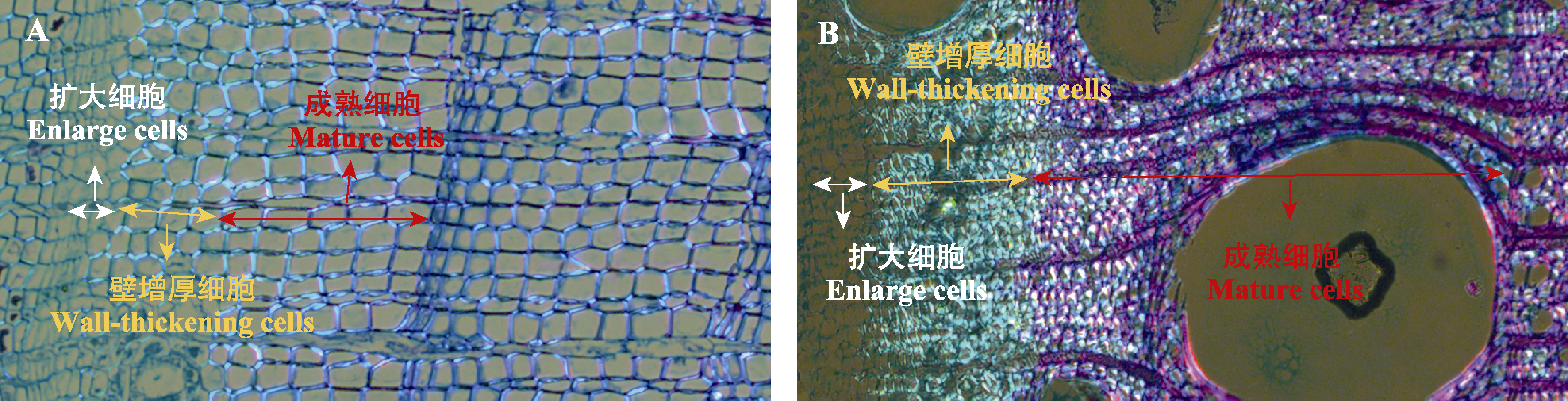
Fig. 1 Paraffin sections of xylem cells of Pinus koraiensis and Quercus mongolica (in June). A, Pinus koraiensis. B, Quercus mongolica.
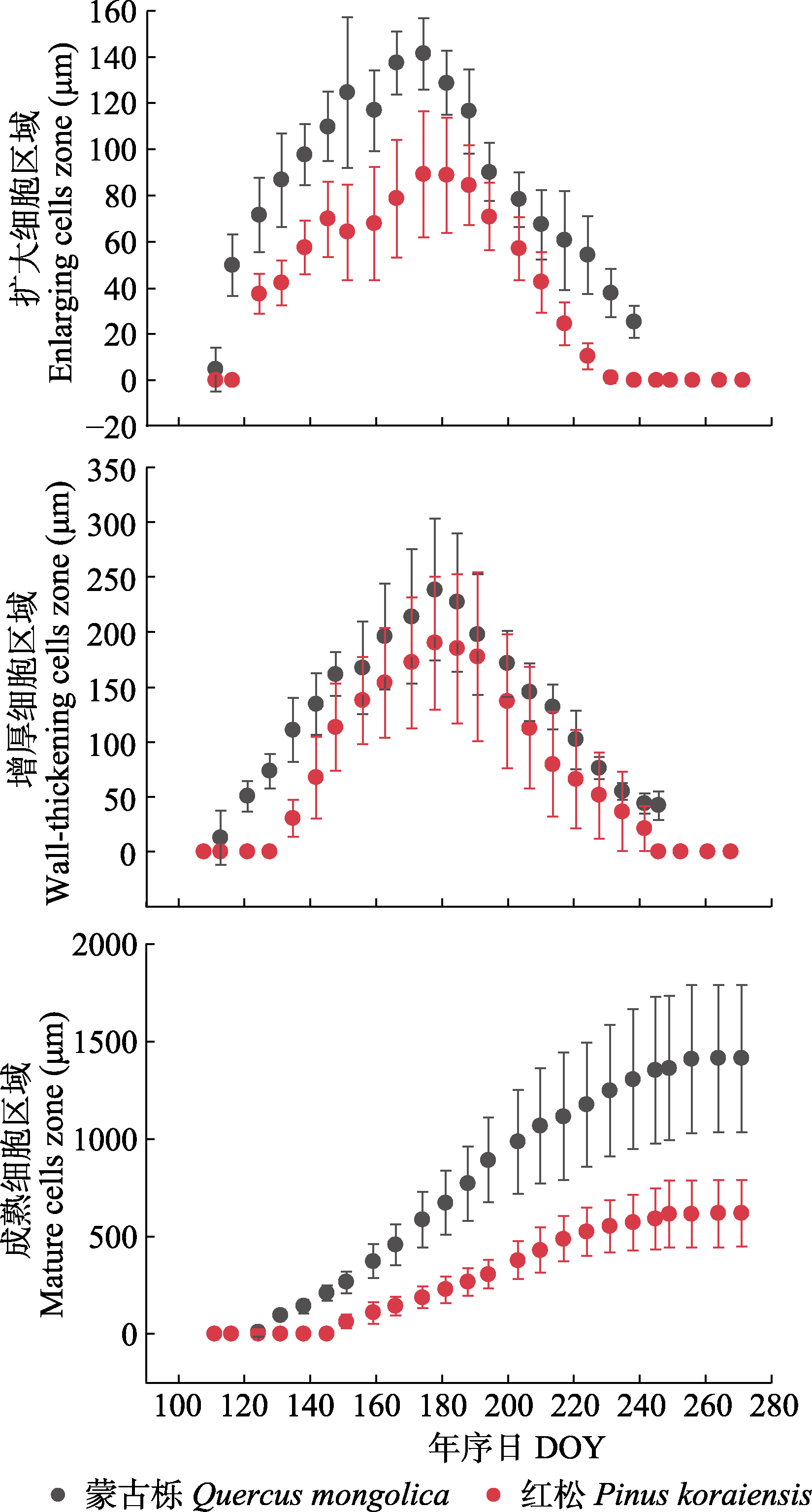
Fig. 2 Seasonal progression of the three differentiation stages in the xylem of Pinus koraiensis and Quercus mongolica in the mixed broadleaf-Korean pine forest of Changbai Mountains (mean ± SD). DOY, day of year.
| 树种 Species | 扩大阶段 Enlargement stage | 壁增厚阶段 Wall-thickening stage | 成熟阶段 Lignification stage | 生长持续时间 Duration of growing season (d) | |||
|---|---|---|---|---|---|---|---|
| 开始 Onset (DOY) | 结束 End (DOY) | 开始 Onset (DOY) | 结束 End (DOY) | 开始 Onset (DOY) | 结束 End (DOY) | ||
| 红松 Pinus koraiensis | 120 ± 1 | 226 ± 3 | 135 ± 2 | 241 ± 7 | 148 ± 2 | 247 ± 3 | 121 |
| 蒙古栎 Quercus mongolica | 112 ± 2 | 241 ± 1 | 119 ± 3 | 252 ± 1 | 126 ± 8 | 259 ± 4 | 140 |
Table 1 Seasonal characteristics of radial growth of Pinus koraiensis and Quercus mongolica in the mixed broadleaf-Korean pine forest of Changbai Mountains (mean ± SD)
| 树种 Species | 扩大阶段 Enlargement stage | 壁增厚阶段 Wall-thickening stage | 成熟阶段 Lignification stage | 生长持续时间 Duration of growing season (d) | |||
|---|---|---|---|---|---|---|---|
| 开始 Onset (DOY) | 结束 End (DOY) | 开始 Onset (DOY) | 结束 End (DOY) | 开始 Onset (DOY) | 结束 End (DOY) | ||
| 红松 Pinus koraiensis | 120 ± 1 | 226 ± 3 | 135 ± 2 | 241 ± 7 | 148 ± 2 | 247 ± 3 | 121 |
| 蒙古栎 Quercus mongolica | 112 ± 2 | 241 ± 1 | 119 ± 3 | 252 ± 1 | 126 ± 8 | 259 ± 4 | 140 |
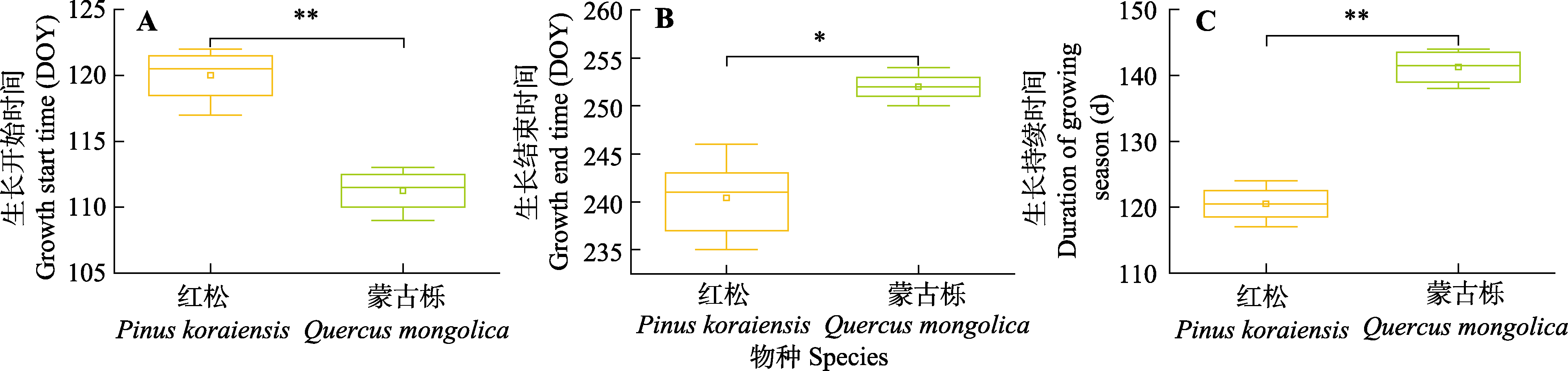
Fig. 3 Analysis of the differences in the beginning, end and duration of xylem growth between Pinus koraiensis and Quercus mongolica (mean ± SD). *, p ≤ 0.05; **, p ≤ 0.01. DOY, day of year.
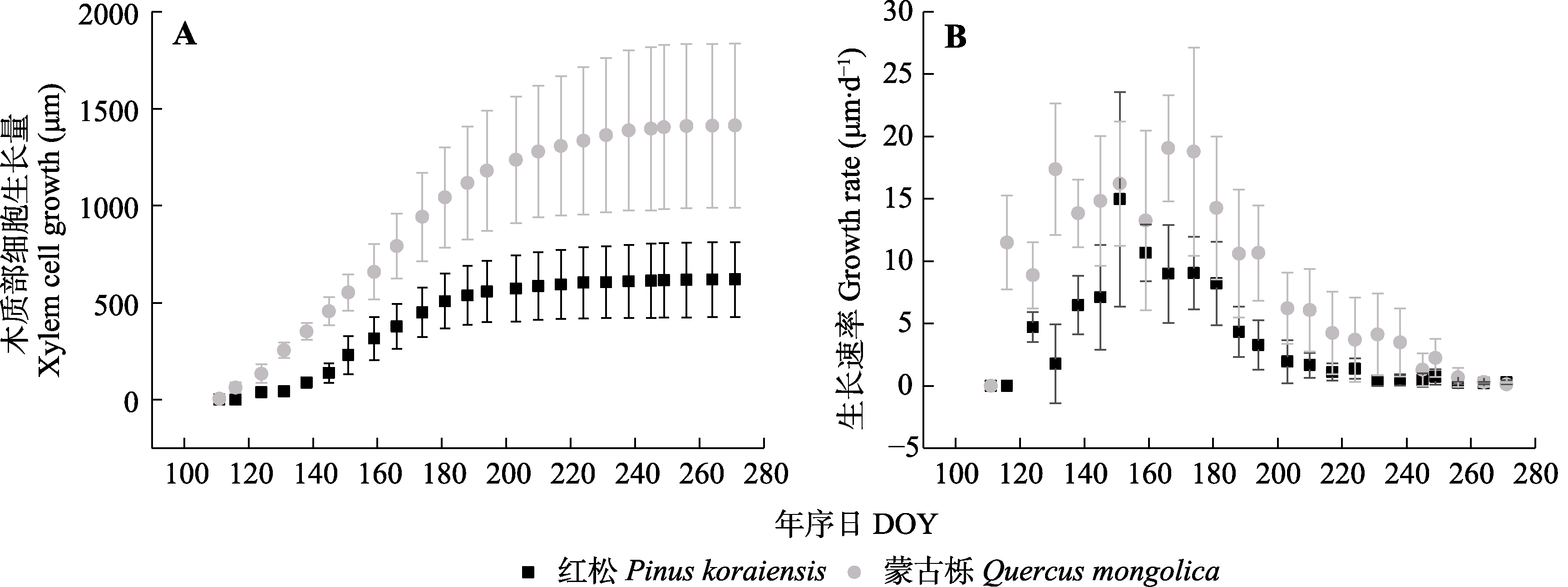
Fig. 4 Seasonal patterns of radial growth of Pinus koraiensis and Quercus mongolica (mean ± SD). DOY, day of year.
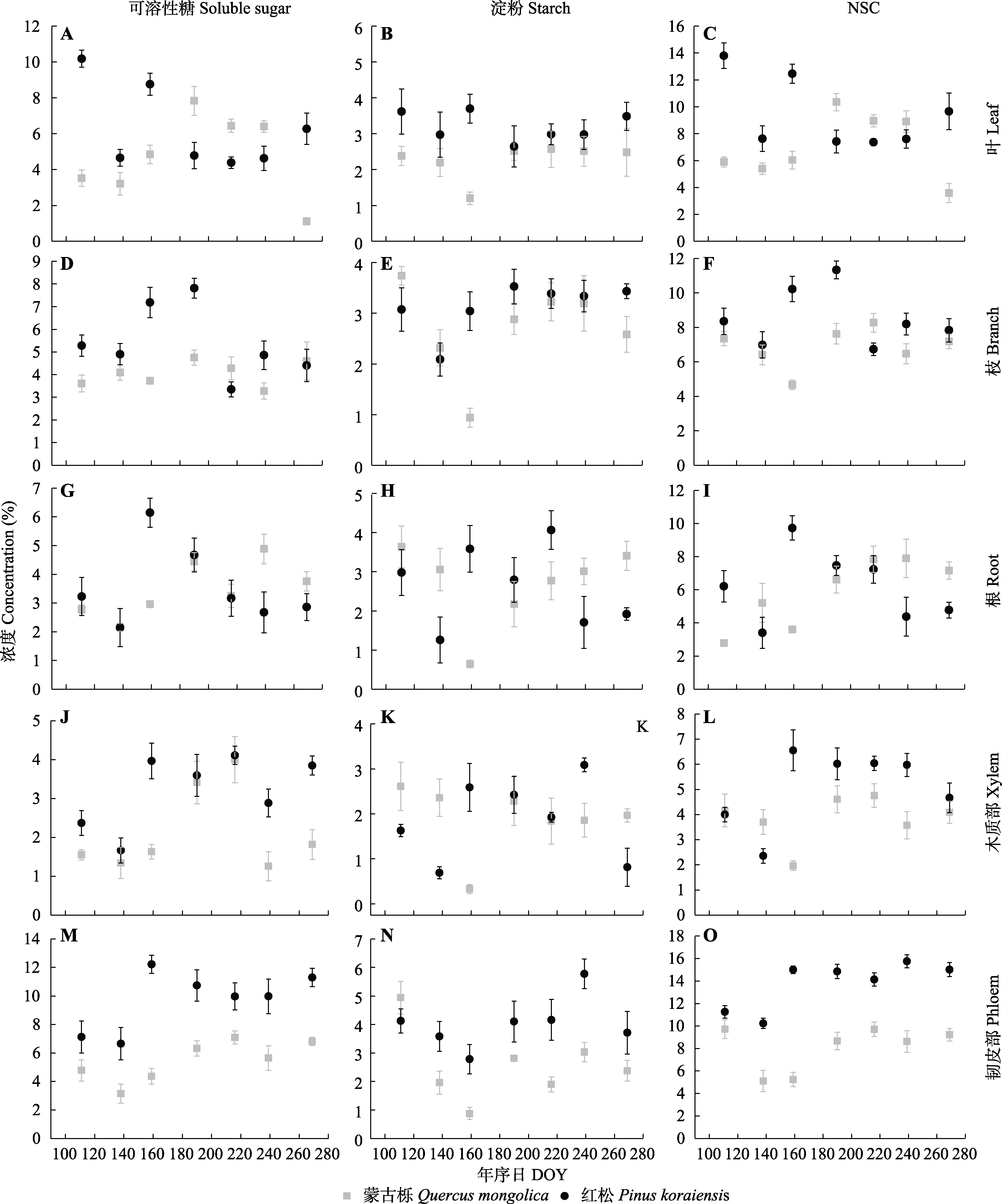
Fig. 5 Seasonal variations in the concentrations of sugar, starch, and non-structural carbohydrates (NSC) in components of Pinus koraiensis and Quercus mongolica (mean ± SE). DOY, day of year.
| 树种 Species | 部位 Section | 指标 Index | 相关系数 Correlation coefficient (r) | p |
|---|---|---|---|---|
| 红松 Pinus koraiensis | 木质部 Xylem | NSC浓度 NSC concentration | 0.423 | 0.345 |
| 可溶性糖浓度 Soluble sugar concentration | 0.320 | 0.484 | ||
| 淀粉浓度 Starch concentration | 0.376 | 0.406 | ||
| 韧皮部 Phloem | NSC浓度 NSC concentration | 0.246 | 0.595 | |
| 可溶性糖浓度 Soluble sugar concentration | 0.495 | 0.259 | ||
| 淀粉浓度 Starch concentration | -0.560 | 0.191 | ||
| 枝 Branch | NSC浓度 NSC concentration | 0.776 | 0.040 | |
| 可溶性糖浓度 Soluble sugar concentration | 0.842 | 0.018 | ||
| 淀粉浓度 Starch concentration | -0.030 | 0.950 | ||
| 叶 Leaf | NSC浓度 NSC concentration | 0.242 | 0.602 | |
| 可溶性糖浓度 Soluble sugar concentration | 0.093 | 0.844 | ||
| 淀粉浓度 Starch concentration | 0.573 | 0.179 | ||
| 根 Root | NSC浓度 NSC concentration | 0.709 | 0.075 | |
| 可溶性糖浓度 Soluble sugar concentration | 0.871 | 0.011 | ||
| 淀粉浓度 Starch concentration | 0.325 | 0.478 | ||
| 蒙古栎 Quercus mongolica | 木质部 Xylem | NSC浓度 NSC concentration | -0.339 | 0.457 |
| 可溶性糖浓度 Soluble sugar concentration | 0.206 | 0.657 | ||
| 淀粉浓度 Starch concentration | -0.373 | 0.410 | ||
| 韧皮部 Phloem | NSC浓度 NSC concentration | -0.677 | 0.095 | |
| 可溶性糖浓度 Soluble sugar concentration | -0.340 | 0.456 | ||
| 淀粉浓度 Starch concentration | -0.570 | 0.181 | ||
| 枝 Branch | NSC浓度 NSC concentration | -0.403 | 0.370 | |
| 可溶性糖浓度 Soluble sugar concentration | 0.289 | 0.530 | ||
| 淀粉浓度 Starch concentration | -0.635 | 0.126 | ||
| 叶 Leaf | NSC浓度 NSC concentration | 0.339 | 0.457 | |
| 可溶性糖浓度 Soluble sugar concentration | 0.457 | 0.303 | ||
| 淀粉浓度 Starch concentration | -0.502 | 0.251 | ||
| 根 Root | NSC浓度 NSC concentration | -0.143 | 0.760 | |
| 可溶性糖浓度 Soluble sugar concentration | -0.078 | 0.868 | ||
| 淀粉浓度 Starch concentration | -0.758 | 0.048 |
Table 2 Pearson correlation relationship between soluble sugar, starch and non-structural carbon (NSC) concentrations and xylem cell growth rate in xylem, phloem, branch, leaf, and root of Pinus koraiensis and Quercus mongolica
| 树种 Species | 部位 Section | 指标 Index | 相关系数 Correlation coefficient (r) | p |
|---|---|---|---|---|
| 红松 Pinus koraiensis | 木质部 Xylem | NSC浓度 NSC concentration | 0.423 | 0.345 |
| 可溶性糖浓度 Soluble sugar concentration | 0.320 | 0.484 | ||
| 淀粉浓度 Starch concentration | 0.376 | 0.406 | ||
| 韧皮部 Phloem | NSC浓度 NSC concentration | 0.246 | 0.595 | |
| 可溶性糖浓度 Soluble sugar concentration | 0.495 | 0.259 | ||
| 淀粉浓度 Starch concentration | -0.560 | 0.191 | ||
| 枝 Branch | NSC浓度 NSC concentration | 0.776 | 0.040 | |
| 可溶性糖浓度 Soluble sugar concentration | 0.842 | 0.018 | ||
| 淀粉浓度 Starch concentration | -0.030 | 0.950 | ||
| 叶 Leaf | NSC浓度 NSC concentration | 0.242 | 0.602 | |
| 可溶性糖浓度 Soluble sugar concentration | 0.093 | 0.844 | ||
| 淀粉浓度 Starch concentration | 0.573 | 0.179 | ||
| 根 Root | NSC浓度 NSC concentration | 0.709 | 0.075 | |
| 可溶性糖浓度 Soluble sugar concentration | 0.871 | 0.011 | ||
| 淀粉浓度 Starch concentration | 0.325 | 0.478 | ||
| 蒙古栎 Quercus mongolica | 木质部 Xylem | NSC浓度 NSC concentration | -0.339 | 0.457 |
| 可溶性糖浓度 Soluble sugar concentration | 0.206 | 0.657 | ||
| 淀粉浓度 Starch concentration | -0.373 | 0.410 | ||
| 韧皮部 Phloem | NSC浓度 NSC concentration | -0.677 | 0.095 | |
| 可溶性糖浓度 Soluble sugar concentration | -0.340 | 0.456 | ||
| 淀粉浓度 Starch concentration | -0.570 | 0.181 | ||
| 枝 Branch | NSC浓度 NSC concentration | -0.403 | 0.370 | |
| 可溶性糖浓度 Soluble sugar concentration | 0.289 | 0.530 | ||
| 淀粉浓度 Starch concentration | -0.635 | 0.126 | ||
| 叶 Leaf | NSC浓度 NSC concentration | 0.339 | 0.457 | |
| 可溶性糖浓度 Soluble sugar concentration | 0.457 | 0.303 | ||
| 淀粉浓度 Starch concentration | -0.502 | 0.251 | ||
| 根 Root | NSC浓度 NSC concentration | -0.143 | 0.760 | |
| 可溶性糖浓度 Soluble sugar concentration | -0.078 | 0.868 | ||
| 淀粉浓度 Starch concentration | -0.758 | 0.048 |
| [1] |
Büntgen U, Myglan VS, Ljungqvist FC, McCormick M, Di Cosmo N, Sigl M, Jungclaus J, Wagner S, Krusic PJ, Esper J, Kaplan JO, de Vaan MAC, Luterbacher J, Wacker L, Tegel W, et al. (2016). Cooling and societal change during the Late Antique Little Ice Age from 536 to around 660 AD. Nature Geoscience, 9, 231-236.
DOI |
| [2] | Chang XH (2009). Study on Ecosystem Management of Broad-leaved Korean Pine Forest in Changbai Mountain. PhD dissertation, Beijing Forestry University, Beijing. |
| [常新华 (2009). 长白山阔叶红松林生态系统管理研究. 博士学位论文, 北京林业大学, 北京.] | |
| [3] | Cheng CX, Mao ZJ, Jin SB, Song GH, Sun PF, Sun T (2017). Sensitivity of fruiting for Pinus koraiensis to climate change and mechanisms of masting in the original broad-leaved Korean pine forest in north Xiaoxing’an Mountain, China. Bulletin of Botanical Research, 37, 118-127. |
|
[程春香, 毛子军, 靳世波, 宋国华, 孙鹏飞, 孙涛 (2017). 小兴安岭北部原始阔叶红松林红松结实气候敏感性及其种子年机制探讨. 植物研究, 37, 118-127.]
DOI |
|
| [4] |
Ciais P, Reichstein M, Viovy N, Granier A, Ogée J, Allard V, Aubinet M, Buchmann N, Bernhofer C, Carrara A, Chevallier F, de Noblet N, Friend AD, Friedlingstein P, Grünwald T, et al. (2005). Europe-wide reduction in primary productivity caused by the heat and drought in 2003. Nature, 437, 529-533.
DOI |
| [5] |
Cleland EE, Chuine I, Menzel A, Mooney HA, Schwartz MD (2007). Shifting plant phenology in response to global change. Trends in Ecology & Evolution, 22, 357-365.
DOI URL |
| [6] |
Delpierre N, Berveiller D, Granda E, Dufrêne E (2016). Wood phenology, not carbon input, controls the interannual variability of wood growth in a temperate oak forest. New Phytologist, 210, 459-470.
DOI PMID |
| [7] | Dong HJ (2022). Non-structural Carbohydrate and Trunk Radial Growth of Tree Species with Different Wood Porosities Intemperate Zone. Master degree dissertation, Northeast Forestry University, Harbin. |
| [董涵君 (2022). 温带不同材性树种非结构性碳与树干径向生长. 硕士学位论文, 东北林业大学, 哈尔滨.] | |
| [8] |
Essiamah S, Eschrich W (1986). Water uptake in deciduous trees during winter and the role of conducting tissues in spring reactivation. IAWA Journal, 7, 31-38.
DOI URL |
| [9] | Gao F, Wang BS (2008). A study on global warming and the temperature changes in the northeast region. Marine Forecasts, 25(1), 25-30. |
| [高锋, 王宝书 (2008). 全球变暖与东北地区气温变化研究. 海洋预报, 25(1), 25-30.] | |
| [10] |
Gao LS, Wang XM, Zhao XH (2011). Response of Pinus koraiensis and Picea jezoensis var. komarovii to climate in the transition zone of Changbai Mountain, China. Chinese Journal of Plant Ecology, 35, 27-34.
DOI URL |
|
[高露双, 王晓明, 赵秀海 (2011). 长白山过渡带红松和鱼鳞云杉径向生长对气候因子的响应. 植物生态学报, 35, 27-34.]
DOI |
|
| [11] |
Hoch G, Körner C (2012). Global patterns of mobile carbon stores in trees at the high-elevation tree line. Global Ecology and Biogeography, 21, 861-871.
DOI URL |
| [12] |
Hoch G, Richter A, Körner C (2003). Non-structural carbon compounds in temperate forest trees. Plant, Cell & Environment, 26, 1067-1081.
DOI URL |
| [13] |
Huang JG, Deslauriers A, Rossi S (2014). Xylem formation can be modeled statistically as a function of primary growth and cambium activity. New Phytologist, 203, 831-841.
DOI URL |
| [14] | IPCC (Intergovernmental Panel on Climate Change) (2023). Climate Change 2023: Synthesis Report. IPCC, Geneva, Switzerland. 35-115. |
| [15] |
Kozlowski TT (1992). Carbohydrate sources and sinks in woody plants. The Botanical Review, 58, 107-222.
DOI URL |
| [16] |
Lebourgeois F, Rathgeber CBK, Ulrich E (2010). Sensitivity of French temperate coniferous forests to climate variability and extreme events (Abies alba, Picea abies and Pinus sylvestris). Journal of Vegetation Science, 21, 364-376.
DOI URL |
| [17] | Li QL (2024). Study on Coupling Mechanism Between Non-structural Carbondrate and Intra-annual Xylem Growth Dynamic of Different Tree Species. Master degree dissertation, Guangxi University, Nanning. |
| [李乾林 (2024). 不同树种非结构性碳与木质部年内生长动态耦合机制的研究. 硕士学位论文, 广西大学, 南宁.] | |
| [18] |
Liu QJ (1997). Structure and dynamics of the subalpine coniferous forest on Changbai mountain, China. Plant Ecology, 132, 97-105.
DOI |
| [19] |
Liu Y, He FL (2021). Warming intensifies soil pathogen negative feedback on a temperate tree. New Phytologist, 231, 2297-2307.
DOI PMID |
| [20] |
Loustau D, Bosc A, Colin A, Ogee J, Davi H, Francois C, Dufrene E, Deque M, Cloppet E, Arrouays D, le Bas C, Saby N, Pignard G, Hamza N, Granier A, et al. (2005). Modeling climate change effects on the potential production of French Plains forests at the sub-regional level. Tree Physiology, 25, 813-823.
PMID |
| [21] |
Marqués L, Madrigal-González J, Zavala MA, Camarero JJ, Hartig F (2018). Last-century forest productivity in a managed dry-edge scots pine population: the two sides of climate warming. Ecological Applications, 28, 95-105.
DOI PMID |
| [22] |
Michelot A, Simard S, Rathgeber C, Dufrêne E, Damesin C (2012). Comparing the intra-annual wood formation of three European species (Fagus sylvatica, Quercus petraea and Pinus sylvestris) as related to leaf phenology and non-structural carbohydrate dynamics. Tree Physiology, 32, 1033-1045.
DOI PMID |
| [23] |
Muller B, Pantin F, Génard M, Turc O, Freixes S, Piques M, Gibon Y (2011). Water deficits uncouple growth from photosynthesis, increase C content, and modify the relationships between C and growth in sink organs. Journal of Experimental Botany, 62, 1715-1729.
DOI URL |
| [24] | Pan QM, Han XG, Bai YF, Yang JC (2002). Advances in physiology and ecology studies on stored non-structure carbohydrates in plants. Chinese Bulletin of Botany, 19, 30-38. |
| [潘庆民, 韩兴国, 白永飞, 杨景成 (2002). 植物非结构性贮藏碳水化合物的生理生态学研究进展. 植物学通报, 19, 30-38.] | |
| [25] |
Pompa-García M, Camarero JJ, Colangelo M (2023). Different xylogenesis responses to atmospheric water demand contribute to species coexistence in a mixed pine-oak forest. Journal of Forestry Research, 34, 51-62.
DOI |
| [26] |
Qian NP, Gao HX, Song CJ, Dong CC, Liu QJ (2024). Seasonal dynamics of radial growth of Betula platyphylla and its response to environmental factors in Changbai Mountains. Chinese Journal of Plant Ecology, 48, 1001-1010.
DOI URL |
|
[钱尼澎, 高浩鑫, 宋超杰, 董淳超, 刘琪璟 (2024). 长白山白桦径向生长季节动态及其对环境因子的响应. 植物生态学报, 48, 1001-1010.]
DOI |
|
| [27] | Qian NP, Xu ZZ, Gao HX, Song CJ, Dong CC, Hu B, Liu QJ (2024). Linkages between intra-annual radial growth and photosynthetic production of four main species in a temperate forest in northeast China. Agricultural and Forest Meteorology, 345, 109866. DOI: 10.1016/j.agrformet.2023.109866. |
| [28] |
Rossi S, Anfodillo T, Cufar K, Cuny HE, Deslauriers A, Fonti P, Frank D, Gricar J, Gruber A, King GM, Krause C, Morin H, Oberhuber W, Prislan P, Rathgeber CBK (2013). A meta-analysis of cambium phenology and growth: linear and non-linear patterns in conifers of the northern hemisphere. Annals of Botany, 112, 1911-1920.
DOI PMID |
| [29] |
Rossi S, Anfodillo T, Menardi R (2006). Trephor: a new tool for sampling microcores from tree stems. IAWA Journal, 27, 89-97.
DOI URL |
| [30] |
Rossi S, Deslauriers A, Morin H (2003). Application of the Gompertz equation for the study of xylem cell development. Dendrochronologia, 21, 33-39.
DOI URL |
| [31] | Rossi S, Rathgeber CBK, Deslauriers A (2009). Comparing needle and shoot phenology with xylem development on three conifer species in Italy. Annals of Forest Science, 66, 206. DOI: 10.1051/forest/2008088. |
| [32] |
Seifter S, Dayton S (1950). The estimation of glycogen with the anthrone reagent. Archives of Biochemistry, 25, 191-200.
PMID |
| [33] |
van der Maaten E, Pape J, van der Maaten-Theunissen M, Scharnweber T, Smiljanić M, Cruz-García R, Wilmking M (2018). Distinct growth phenology but similar daily stem dynamics in three co-occurring broadleaved tree species. Tree Physiology, 38, 1820-1828.
DOI PMID |
| [34] |
Venegas-González A, von Arx G, Chagas MP, Filho MT (2015). Plasticity in xylem anatomical traits of two tropical species in response to intra-seasonal climate variability. Trees, 29, 423-435.
DOI URL |
| [35] | Wang HX, Xu JL, Sheng LX, Ma L, Liu XJ (2020). Study on the characteristics of climate change in Changbai Mountain National Natural Reserve from 1958 to 2017. Arabian Journal of Geosciences, |
| [36] | Wang XY (2023). Seasonal Stem Radial Variation and Its Influencing Factors of Six Tree Species in Northeast China. Master degree dissertation, Northeast Forestry University, Harbin. |
| [王雪羽 (2023). 东北6种乔木树干径向季节变化及影响因素. 硕士学位论文, 东北林业大学, 哈尔滨.] | |
| [37] |
Yemm EW, Willis AJ (1954). The estimation of carbohydrates in plant extracts by anthrone. The Biochemical Journal, 57, 508-514.
DOI URL |
| [38] | Zhang HY (2013). Spatiotemporal Variability in Non-structural Carbohydrates of Stem and Branch for Twelve Tree Species in Chinese Temperate Forest. PhD dissertation, Northeast Forestry University, Harbin. |
| [张海燕 (2013). 中国温带森林12个树种树干和树枝的非结构性碳时空变异. 博士学位论文, 东北林业大学, 哈尔滨.] | |
| [39] |
Zhang HY, Wang CK, Wang XC (2014). Spatial variations in non-structural carbohydrates in stems of twelve temperate tree species. Trees, 28, 77-89.
DOI URL |
| [40] | Zhang JZ (2018). Cambial Phenology and Intra-annual Radial Growth Dynamics of Conifers over the Qilian Mountains. PhD dissertation, Lanzhou University, Lanzhou. |
| [张军周 (2018). 祁连山树木形成层活动及年内径向生长动态监测研究. 博士学位论文, 兰州大学, 兰州.] | |
| [41] | Zhang JZ, Gou XH, Alexander MR, Xia JQ, Wang F, Zhang F, Man ZH, Pederson N (2021). Drought limits wood production of Juniperus przewalskii even as growing seasons lengthens in a cold and arid environment. Catena, 196, 104936. DOI: 10.1016/j.catena.2020.104936. |
| [42] |
Zhang JZ, Gou XH, Zhao ZQ, Liu WH, Zhang F, Cao ZY, Zhou FF (2013). Improved method of obtaining micro-core paraffin sections in dendroecological research. Chinese Journal of Plant Ecology, 37, 972-972.
DOI URL |
|
[张军周, 勾晓华, 赵志千, 刘文火, 张芬, 曹宗英, 周非飞 (2013). 树轮生态学研究中微树芯石蜡切片制作的方法探讨. 植物生态学报, 37, 972-972.]
DOI |
|
| [43] |
Ziemińska K, Rosa E, Gleason SM, Holbrook NM (2020). Wood day capacitance is related to water content, wood density, and anatomy across 30 temperate tree species. Plant, Cell & Environment, 43, 3048-3067.
DOI URL |
| [44] |
Zweifel R, Item H, Häsler R (2001). Link between diurnal stem radius changes and tree water relations. Tree Physiology, 21, 869-877.
PMID |
| [1] | ZHANG Jie, LI Xu, BAO Yan-Feng, WANG Yuan Chun, Zhang Fuchong, YU Ming-Han. Photosynthetic physiology and non-structural carbohydrates allocation responses of Artemisia ordosica across age classes to drought stress [J]. Chin J Plant Ecol, 2026, 50(5): 1202-1212. |
| [2] | LU Zhixiao, GAO Lu-Shuang, Yang Zhinian, Zhang Ruibo, Qin Li, Yeerjiang BAIKETUERHAN, HAN Xin-Yu, ZHANG Xinyu, Li Sijie. Drought legacy of Picea schrenkiana across elevations gradient in Western Tianshan Abstract [J]. Chin J Plant Ecol, 2026, 50(5): 1177-1186. |
| [3] | WANG Zi-Ping, MAO Zi-Kun, HE Han, JIANG Peng-Cheng, YAN Rui-Huan, WANG Xu-Gao. Spatial distribution and association patterns of tree species across successional stages in broadleaf Korean pine forests of Northeast China [J]. Chin J Plant Ecol, 2026, 50(4): 833-845. |
| [4] | CAI Rong-Rong, SHEN Li-Du, LIU Ya-Ge, FEI Wen-Li, DAI Guan-Hua. Dataset of plant species composition and community characteristics of the Changbai Mountain broadleaf Korean pine forest permanent plot from 2005 to 2010 [J]. Chin J Plant Ecol, 2025, 49(8): 1236-1245. |
| [5] | ZHANG Bin, ZHANG Hao-Cheng, QIAO Tian, LÜ Zhi-Bing, XU Ya-Nan, LI Xue-Qin, YUAN Xiang-Yang, FENG Mei-Chen, ZHANG Mei-Jun. Effect of arbuscular mycorrhizal fungi inoculation on non-structural carbohydrates and C, N and P stoichiometry in oat plants under drought stress [J]. Chin J Plant Ecol, 2025, 49(7): 1082-1095. |
| [6] | LI Gang-Dun, QIAN Ni-Peng, WANG Lin-Xu, DONG Chun-Chao, LIU Qi-Jing. Seasonal dynamics of radial growth of Pinus koraiensis and Ulmus davidiana var. japonica are related to environmental factors in Changbai Mountain, China [J]. Chin J Plant Ecol, 2025, 49(7): 1110-1118. |
| [7] | HU Xiao-Hui, WANG Xing-Chang, DONG Han-Jun, LIU Yu-Long, YUAN Dan-Yang, LIU Di, WANG Xiao-Chun. Variation and coordination of non-structural carbohydrates among organs in 32 tree species from a temperate conifer-broadleaf mixed forest in Northeast China [J]. Chin J Plant Ecol, 2025, 49(3): 432-445. |
| [8] | ZHANG Le, JIAO Liang, XUE Ru-Hong, ZHANG Peng, WANG Xu-Ge, QIN Ya-Rong, HOU Sai-Peng, MA Yuan-Yuan. Response of intra-annual radial growth of Juniperus przewalskii in the Qilian Mountains to hydrothermal factors [J]. Chin J Plant Ecol, 2025, 49(11): 1878-1889. |
| [9] | LI Shi-Jie, WANG Li, DU Ying-Jun, ZHENG Lei, ZENG Fan-Suo, XIN Ying. Radial growth response of natural Fraxinus mandshurica to climate in the Changbai Mountains [J]. Chin J Plant Ecol, 2024, 48(8): 1011-1020. |
| [10] | ZHANG Peng, JIAO Liang, XUE Ru-Hong, WEI Meng-Yuan, DU Da-Shi, WU Xuan, WANG Xu-Ge, LI Qian. Drought intensity affected the growth recovery of Picea crassifolia across different altitudes in western Qilian Mountains [J]. Chin J Plant Ecol, 2024, 48(8): 977-987. |
| [11] | QIAN Ni-Peng, GAO Hao-Xin, SONG Chao-Jie, DONG Chun-Chao, LIU Qi-Jing. Seasonal dynamics of radial growth of Betula platyphylla and its response to environmental factors in Changbai Mountains [J]. Chin J Plant Ecol, 2024, 48(8): 1001-1010. |
| [12] | PENG Zhong-Tao, JIN Guang-Ze, LIU Zhi-Li. Leaf trait variations and relationships of three Acer species in different tree sizes and canopy conditions in Xiao Hinggan Mountains of Northeast China [J]. Chin J Plant Ecol, 2024, 48(6): 730-743. |
| [13] | LI Min-Qing, ZHOU Xiao-Ming, WANG Shuang-Long, CHEN Li-Dan, LI Cong-Juan, LIU Ran. Effects of stem photosynthesis on hydraulic traits and leaf photosynthesis in Calligonum arborescens under drought stress [J]. Chin J Plant Ecol, 2024, 48(11): 1524-1535. |
| [14] | SU Wei, CHEN Ping, WU Ting, LIU Yue, SONG Yu-Ting, LIU Xu-Jun, LIU Ju-Xiu. Effects of nitrogen addition and extended dry season on non-structural carbohydrates, nutrients and biomass of Dalbergia odorifera seedlings [J]. Chin J Plant Ecol, 2023, 47(8): 1094-1104. |
| [15] | YU Hai-Xia, QU Lu-Ping, TANG Xing-Hao, LIU Nan, ZHANG Zi-Lei, WANG Hao, WANG Yi-Xuan, SHAO Chang-Liang, DONG Gang, HU Ya-Lin. Divergent responses of non-structural carbohydrates in Phoebe bournei and Schima superba to different heat wave patterns [J]. Chin J Plant Ecol, 2023, 47(2): 249-261. |
| Viewed | ||||||
|
Full text |
|
|||||
|
Abstract |
|
|||||
Copyright © 2026 Chinese Journal of Plant Ecology
Tel: 010-62836134, 62836138, E-mail: apes@ibcas.ac.cn, cjpe@ibcas.ac.cn

