
Chin J Plant Ecol ›› 2026, Vol. 50 ›› Issue (2): 442-460.DOI: 10.17521/cjpe.2024.0394 cstr: 32100.14.cjpe.2024.0394
• Research Articles • Previous Articles Next Articles
DAI Li-Jun1,2,3, XIANG Ling-Yi4, JIAN Chen1,2,3, WANG Xiao-Feng1,2,3,*( )
)
Received:2024-11-05
Accepted:2025-05-01
Online:2026-02-28
Published:2026-04-01
Contact:
WANG Xiao-Feng
Supported by:DAI Li-Jun, XIANG Ling-Yi, JIAN Chen, WANG Xiao-Feng. Intensified local differentiation in plant functional traits among typical herbaceous plants by backwater disturbance within riparian zone of small watersheds in the Three Gorges Reservoir area[J]. Chin J Plant Ecol, 2026, 50(2): 442-460.
Add to citation manager EndNote|Ris|BibTeX
URL: https://www.plant-ecology.com/EN/10.17521/cjpe.2024.0394
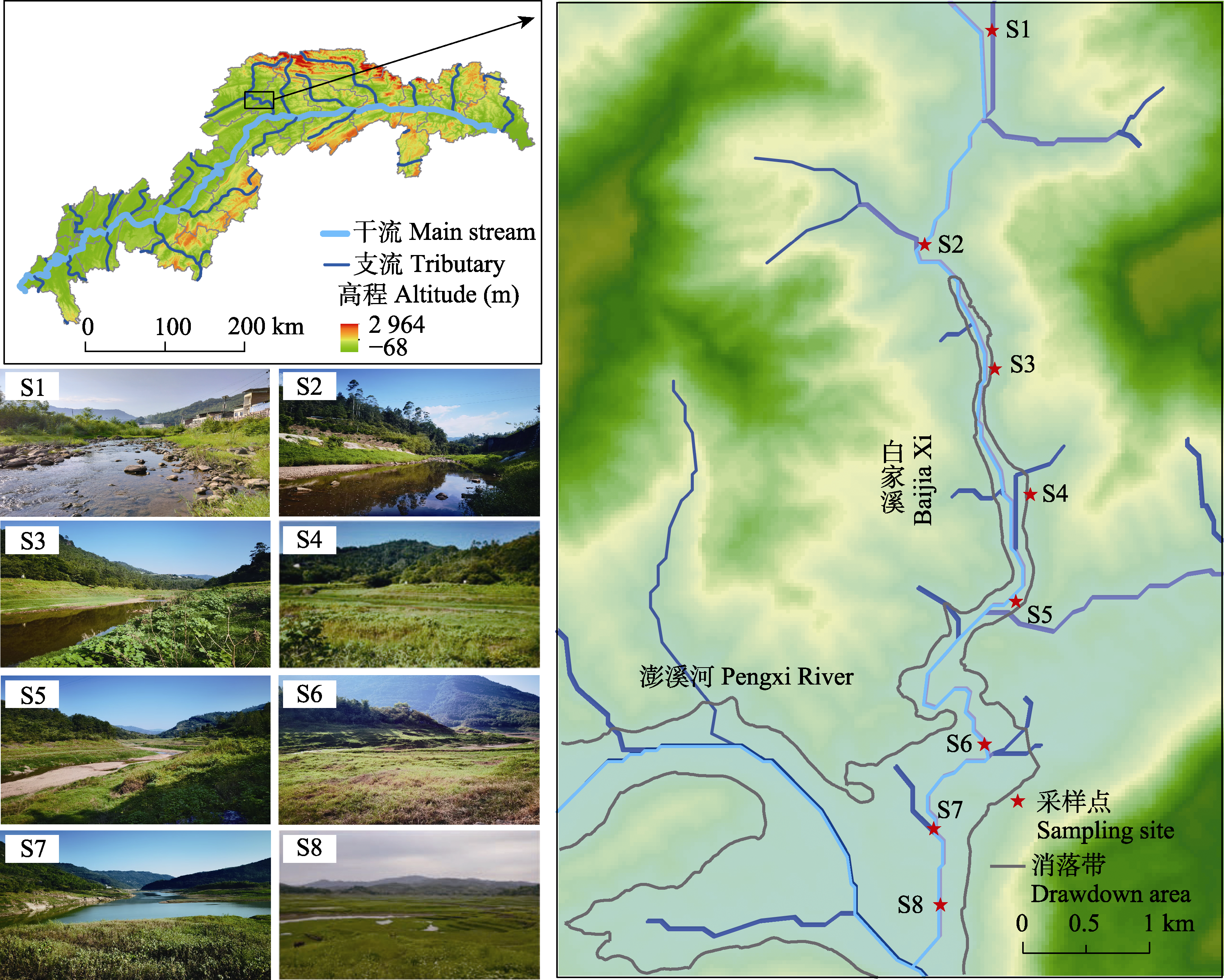
Fig. 1 Layout of sampling site in the drawdown zone of Baijiaxi. S1, S2, natural riparian zone; S3-S5, transition zone; S6-S8, drawdown zone.
| 断面 Transect | 土壤pH Soil pH | 土壤温度 Soil temperature (℃) | 土壤湿度 Soil humidity (%) | 土壤含水量 Soil water content (%) | 植物群落 Phytocoenosium | |
|---|---|---|---|---|---|---|
| 优势种 Dominant species | 盖度 Coverage (%) | |||||
| 1 | 7.39 ± 0.37c | 34.3 ± 4.6ab | 49.7 ± 14.7a | 35.4 ± 9.8a | 水蓼、空心莲子草、狗牙根、苍耳 Polygonum hydropiper, Alternanthera philoxeroides, Cynodon dactylon, Xanthium strumarium | 83-100 |
| 2 | 7.29 ± 0.49c | 33.0 ± 5.2b | 30.5 ± 11.6b | 20.9 ± 4.5b | 空心莲子草、狗牙根、狼杷草 Alternanthera philoxeroides, Cynodon dactylon, Bidens tripartite | 88-100 |
| 3 | 7.84 ± 0.50b | 37.3 ± 5.4a | 22.3 ± 5.2b | 14.0 ± 3.8c | 狗牙根、苍耳、水蓼、狼杷草、香附子 Cynodon dactylon, Xanthium strumarium, Polygonum hydropiper, Bidens tripartite, Cyperus rotundus | 95-100 |
| 4 | 7.84 ± 0.32b | 35.7 ± 3.6ab | 20.0 ± 6.0b | 12.8 ± 4.2c | 狗牙根、苍耳、水蓼、苘麻、狼杷草、香附子 Cynodon dactylon, Xanthium strumarium, Polygonum hydropiper, Abutilon theophrasti, Bidens tripartite, Cyperus rotundus | 95-100 |
| 5 | 8.17 ± 0.53ab | 36.5 ± 3.5ab | 21.3 ± 4.3b | 10.0 ± 2.1c | 狗牙根、苍耳、苘麻、水蓼、狼杷草 Cynodon dactylon, Xanthium strumarium, Abutilon theophrasti, Polygonum hydropiper, Bidens tripartite | 100 |
| 6 | 8.09 ± 0.26ab | 36.4 ± 2.3ab | 22.1 ± 4.9b | 7.8 ± 1.6c | 狗牙根、苍耳、苘麻、水蓼、狼杷草 Cynodon dactylon, Xanthium strumarium, Abutilon theophrasti, Polygonum hydropiper, Bidens tripartite | 100 |
| 7 | 8.36 ± 0.4a | 38.3 ± 4.7a | 21.6 ± 3.5b | 7.9 ± 1.8c | 狗牙根、苍耳、苘麻、水蓼、狼杷草 Cynodon dactylon, Xanthium strumarium, Abutilon theophrasti, Polygonum hydropiper, Bidens tripartite | 100 |
| 8 | 8.31 ± 0.56a | 35.6 ± 2.9ab | 21.3 ± 3.2b | 7.7 ± 0.9c | 狗牙根、苍耳、苘麻、水蓼、狼杷草 Cynodon dactylon, Xanthium strumarium, Abutilon theophrasti, Polygonum hydropiper, Bidens tripartite | 100 |
Table 1 Soil physical properties from natural riparian zone to subsidence zone in Baijiaxi Watershed
| 断面 Transect | 土壤pH Soil pH | 土壤温度 Soil temperature (℃) | 土壤湿度 Soil humidity (%) | 土壤含水量 Soil water content (%) | 植物群落 Phytocoenosium | |
|---|---|---|---|---|---|---|
| 优势种 Dominant species | 盖度 Coverage (%) | |||||
| 1 | 7.39 ± 0.37c | 34.3 ± 4.6ab | 49.7 ± 14.7a | 35.4 ± 9.8a | 水蓼、空心莲子草、狗牙根、苍耳 Polygonum hydropiper, Alternanthera philoxeroides, Cynodon dactylon, Xanthium strumarium | 83-100 |
| 2 | 7.29 ± 0.49c | 33.0 ± 5.2b | 30.5 ± 11.6b | 20.9 ± 4.5b | 空心莲子草、狗牙根、狼杷草 Alternanthera philoxeroides, Cynodon dactylon, Bidens tripartite | 88-100 |
| 3 | 7.84 ± 0.50b | 37.3 ± 5.4a | 22.3 ± 5.2b | 14.0 ± 3.8c | 狗牙根、苍耳、水蓼、狼杷草、香附子 Cynodon dactylon, Xanthium strumarium, Polygonum hydropiper, Bidens tripartite, Cyperus rotundus | 95-100 |
| 4 | 7.84 ± 0.32b | 35.7 ± 3.6ab | 20.0 ± 6.0b | 12.8 ± 4.2c | 狗牙根、苍耳、水蓼、苘麻、狼杷草、香附子 Cynodon dactylon, Xanthium strumarium, Polygonum hydropiper, Abutilon theophrasti, Bidens tripartite, Cyperus rotundus | 95-100 |
| 5 | 8.17 ± 0.53ab | 36.5 ± 3.5ab | 21.3 ± 4.3b | 10.0 ± 2.1c | 狗牙根、苍耳、苘麻、水蓼、狼杷草 Cynodon dactylon, Xanthium strumarium, Abutilon theophrasti, Polygonum hydropiper, Bidens tripartite | 100 |
| 6 | 8.09 ± 0.26ab | 36.4 ± 2.3ab | 22.1 ± 4.9b | 7.8 ± 1.6c | 狗牙根、苍耳、苘麻、水蓼、狼杷草 Cynodon dactylon, Xanthium strumarium, Abutilon theophrasti, Polygonum hydropiper, Bidens tripartite | 100 |
| 7 | 8.36 ± 0.4a | 38.3 ± 4.7a | 21.6 ± 3.5b | 7.9 ± 1.8c | 狗牙根、苍耳、苘麻、水蓼、狼杷草 Cynodon dactylon, Xanthium strumarium, Abutilon theophrasti, Polygonum hydropiper, Bidens tripartite | 100 |
| 8 | 8.31 ± 0.56a | 35.6 ± 2.9ab | 21.3 ± 3.2b | 7.7 ± 0.9c | 狗牙根、苍耳、苘麻、水蓼、狼杷草 Cynodon dactylon, Xanthium strumarium, Abutilon theophrasti, Polygonum hydropiper, Bidens tripartite | 100 |
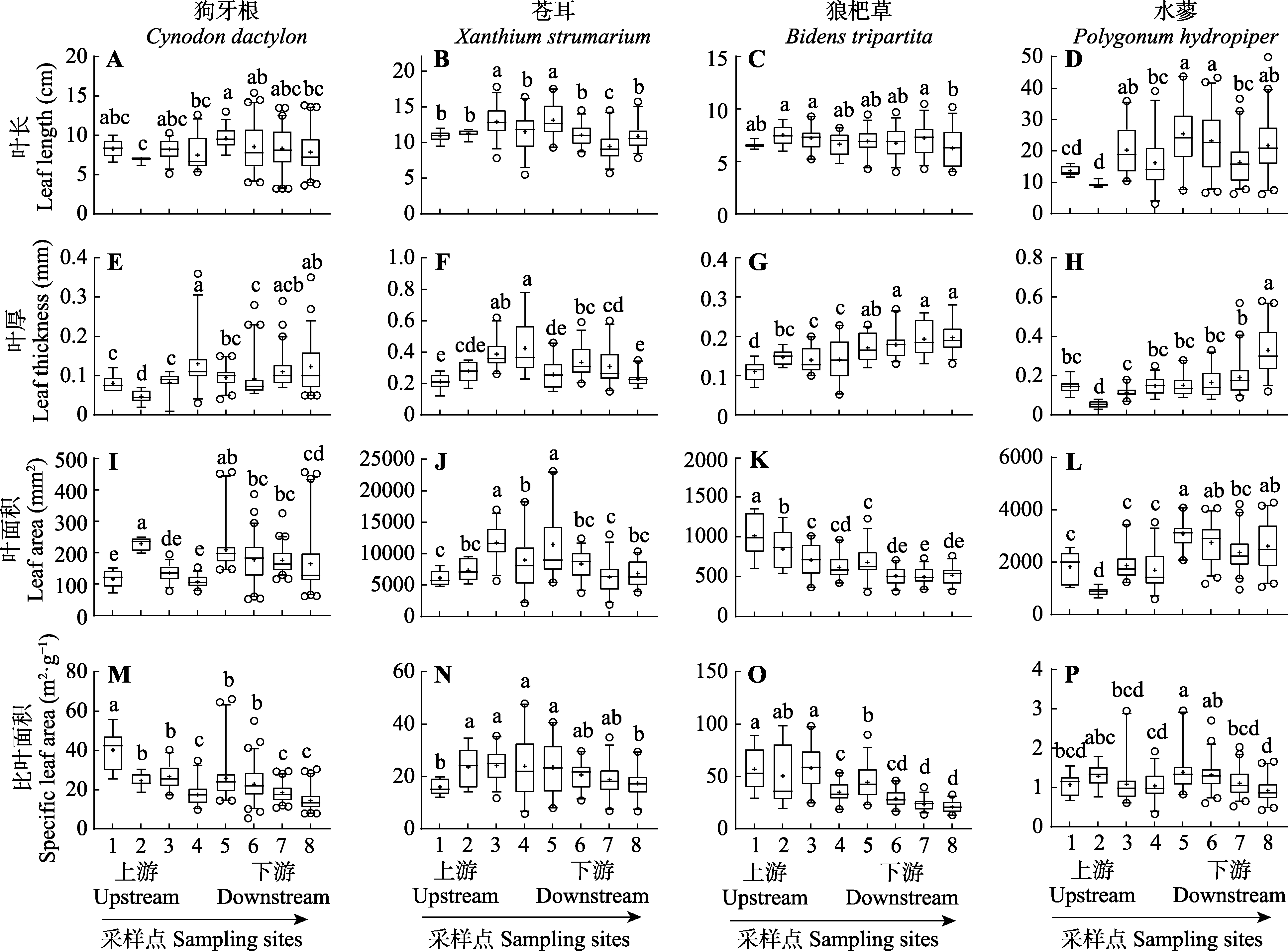
Fig. 2 Spatial distribution characteristics of leaf morphology of four species in Baijiaxi along the river. S1, S2, natural riparian zone; S3-S5, transition zone; S6-S8, drawdown zone. Lowercase letters in the figure represent significant difference (p < 0.05).
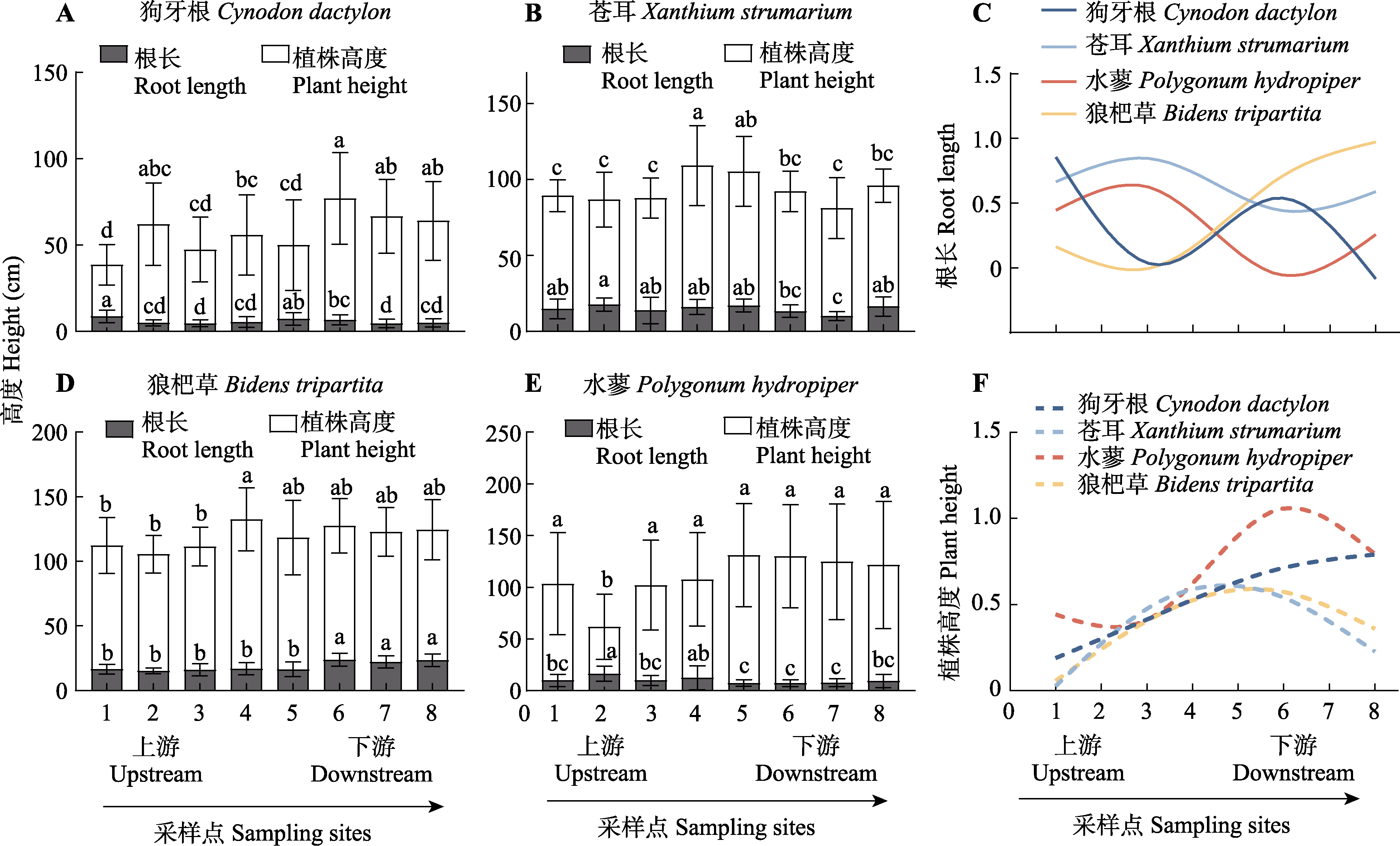
Fig. 3 Longitudinal spatial distribution characteristics of root and stem morphology of plants in Baijiaxi (mean ± SD). S1, S2, natural riparian zone; S3-S5, transition zone; S6-S8, drawdown zone. C is the plant root length after standardization. F is the plant height after standardization. Lowercase letters in the figure represent significant difference (p < 0.05).
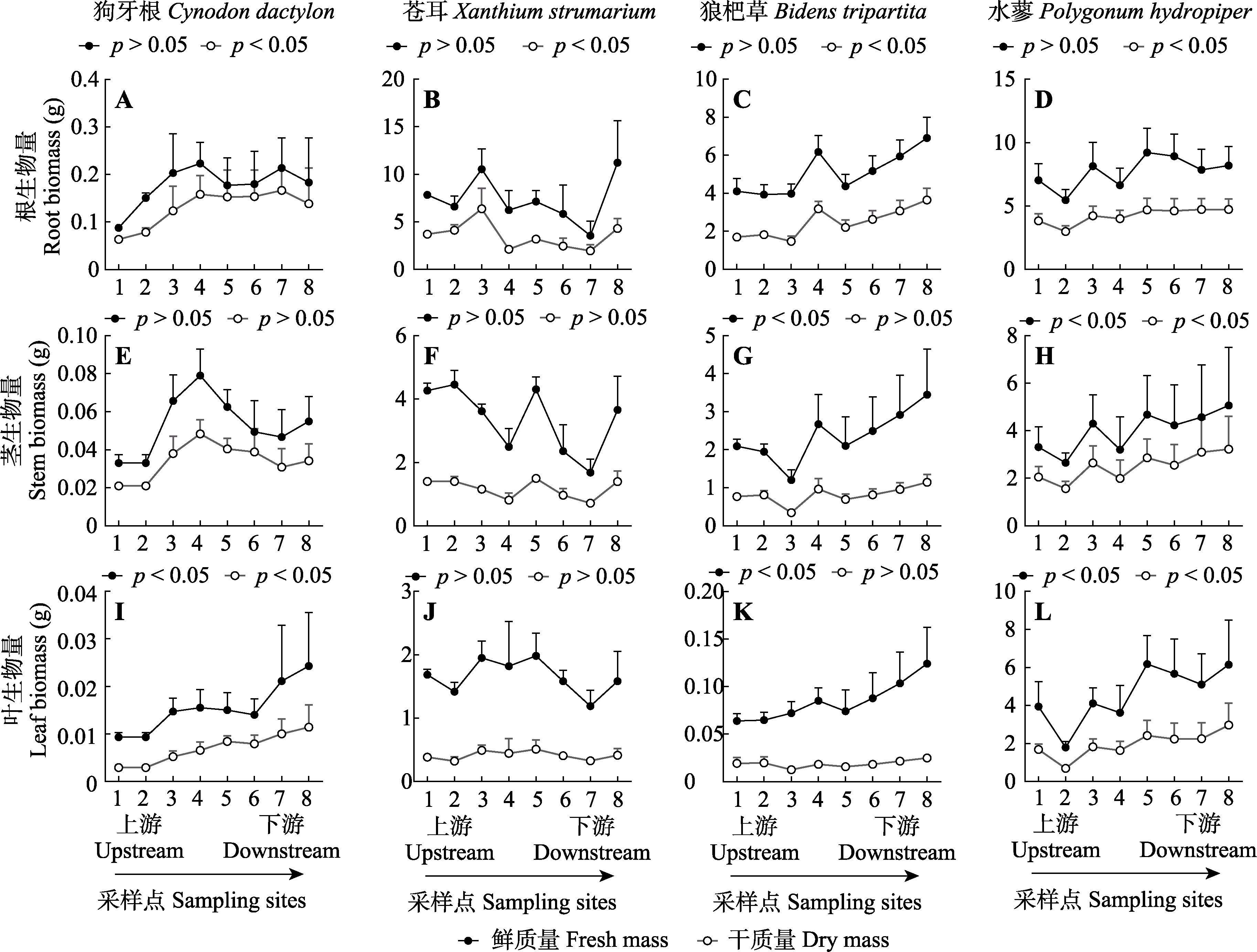
Fig. 4 Longitudinal spatial distribution of fresh mass and dry mass of plant roots, stems and leaves in Baijiaxi Watershed. S1, S2, natural riparian zone; S3-S5, transition zone; S6-S8, drawdown zone. p < 0.05 indicates a significant linear relationship; p > 0.05 indicates that the linear relationship is not significant.
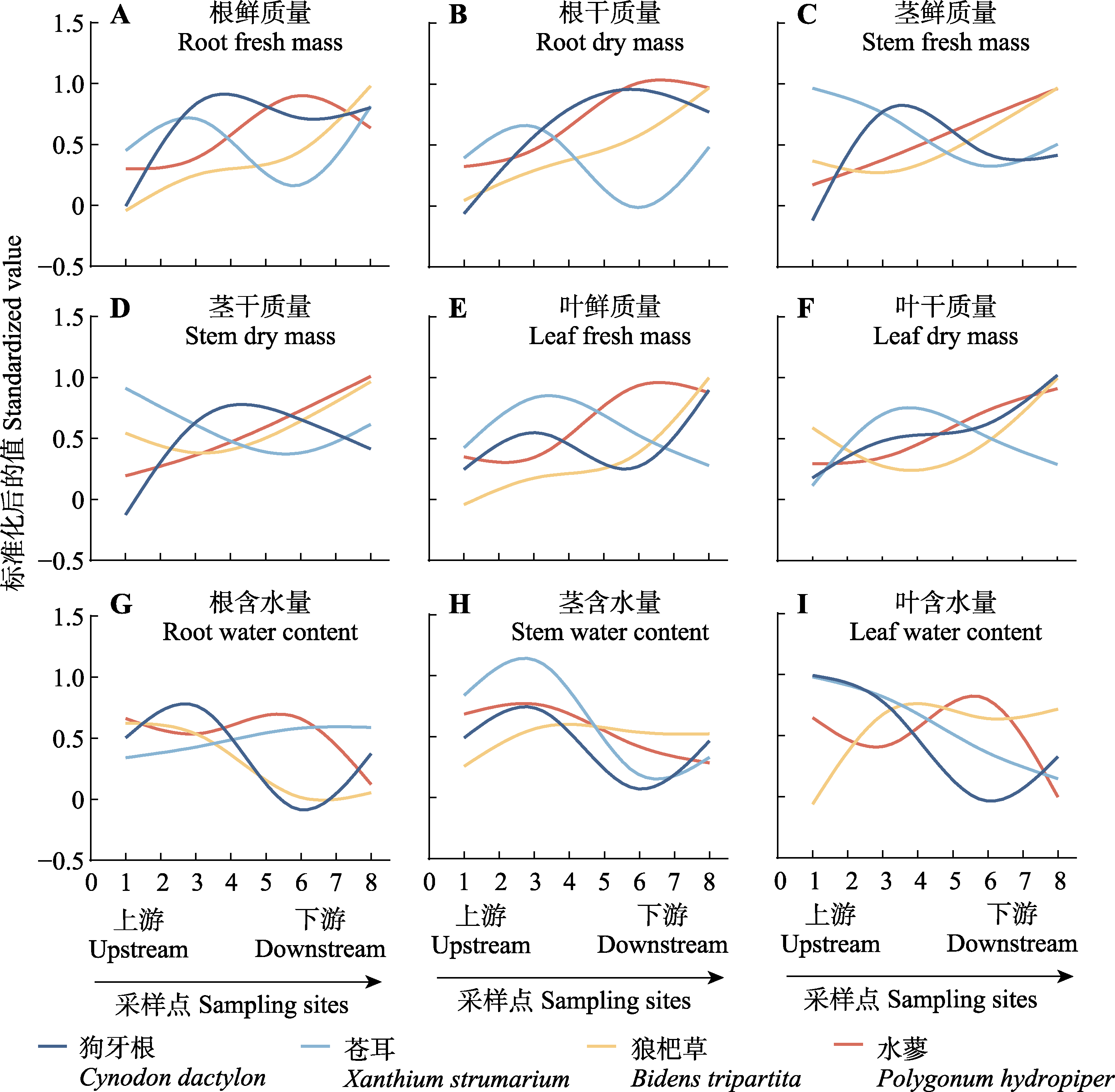
Fig. 5 Longitudinal zonation of relative biomass and water content in roots, stems, and leaves of Baijiaxi plants. S1, S2, natural riparian zone; S3-S5, transition zone; S6-S8, drawdown zone.
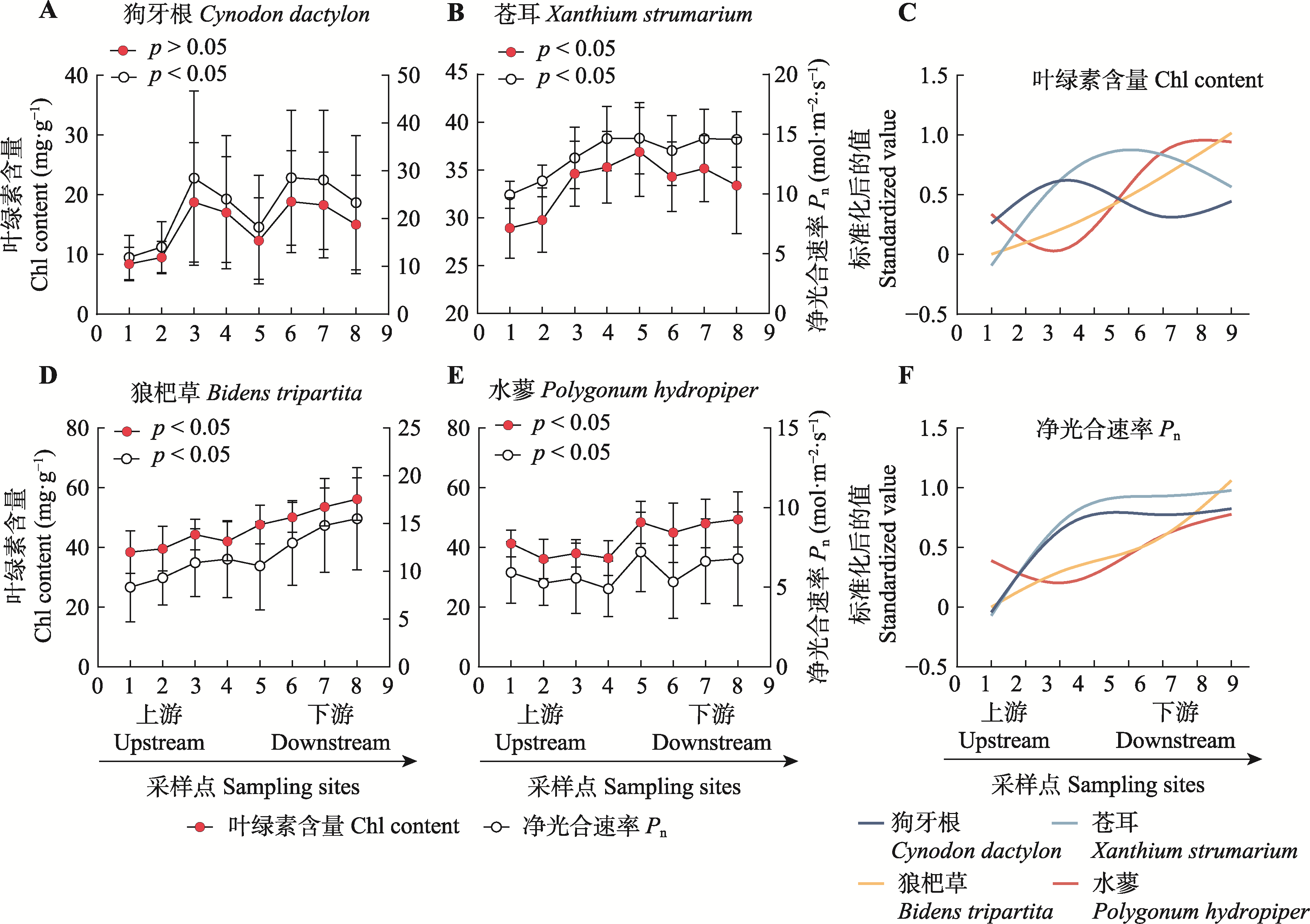
Fig. 6 Longitudinal spatial distribution of photosynthetic traits in Baijiaxi plants. S1, S2, natural riparian zone; S3-S5, transition zone; S6-S8, drawdown zone. p < 0.05 indicates a significant linear relationship; p > 0.05 indicates that the linear relationship is not significant. Chl, chlorophyll; Pn, net photosynthetic rate.
| 性状 Trait | 狗牙根 Cynodon dactylon | 苍耳 Bidens tripartita | 狼杷草 Xanthium strumarium | 水蓼 Polygonum hydropiper |
|---|---|---|---|---|
| 植株高度 Plant height | 25 | 11 | 7 | 26 |
| 根长 Root length | 22 | 18 | 20 | 31 |
| 叶长 Leaf length | 9 | 11 | 6 | 30 |
| 叶厚 Leaf thickness | 42 | 24 | 19 | 48 |
| 叶面积 Leaf area | 22 | 25 | 27 | 34 |
| 比叶面积 Specific leaf area | 34 | 16 | 36 | 13 |
| 叶鲜质量 Leaf fresh mass | 34 | 16 | 25 | 33 |
| 叶干质量 Leaf dry mass | 43 | 17 | 20 | 34 |
| 茎鲜质量 Stem fresh mass | 30 | 31 | 29 | 19 |
| 茎干质量 Stem dry mass | 28 | 26 | 29 | 23 |
| 根鲜质量 Root fresh mass | 31 | 34 | 23 | 16 |
| 根干质量 Root dry mass | 33 | 41 | 32 | 14 |
| 叶绿素含量 Chlorophyll content | 27 | 8 | 14 | 13 |
| 净光合速率 Net photosynthetic rate | 29 | 14 | 22 | 14 |
| 叶含水量 Leaf water content | 19 | 2 | 5 | 8 |
| 茎含水量 Stem water content | 19 | 9 | 5 | 7 |
| 根含水量 Root water content | 31 | 18 | 11 | 9 |
Table 2 Coefficient of variation (%) of 4 plants functional traits in longitudinal spatial distribution along the river
| 性状 Trait | 狗牙根 Cynodon dactylon | 苍耳 Bidens tripartita | 狼杷草 Xanthium strumarium | 水蓼 Polygonum hydropiper |
|---|---|---|---|---|
| 植株高度 Plant height | 25 | 11 | 7 | 26 |
| 根长 Root length | 22 | 18 | 20 | 31 |
| 叶长 Leaf length | 9 | 11 | 6 | 30 |
| 叶厚 Leaf thickness | 42 | 24 | 19 | 48 |
| 叶面积 Leaf area | 22 | 25 | 27 | 34 |
| 比叶面积 Specific leaf area | 34 | 16 | 36 | 13 |
| 叶鲜质量 Leaf fresh mass | 34 | 16 | 25 | 33 |
| 叶干质量 Leaf dry mass | 43 | 17 | 20 | 34 |
| 茎鲜质量 Stem fresh mass | 30 | 31 | 29 | 19 |
| 茎干质量 Stem dry mass | 28 | 26 | 29 | 23 |
| 根鲜质量 Root fresh mass | 31 | 34 | 23 | 16 |
| 根干质量 Root dry mass | 33 | 41 | 32 | 14 |
| 叶绿素含量 Chlorophyll content | 27 | 8 | 14 | 13 |
| 净光合速率 Net photosynthetic rate | 29 | 14 | 22 | 14 |
| 叶含水量 Leaf water content | 19 | 2 | 5 | 8 |
| 茎含水量 Stem water content | 19 | 9 | 5 | 7 |
| 根含水量 Root water content | 31 | 18 | 11 | 9 |
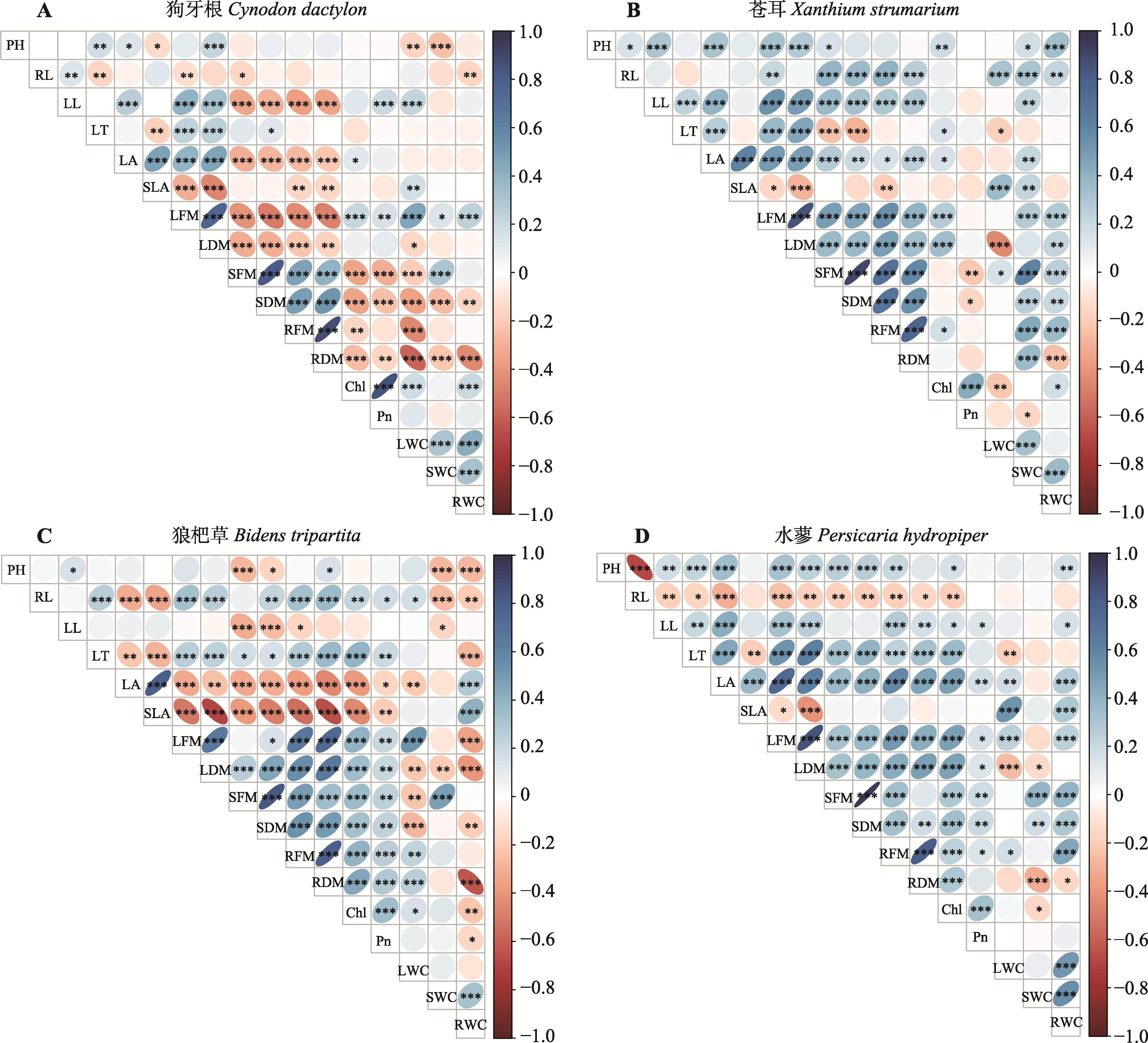
Fig. 7 Correlation of functional traits among four plant species along the longitudinal river gradient in Baijiaxi. Blue represents a positive correlation, red represents a negative correlation, and the darker the color, the greater the correlation. Chl, chlorophyll content; LA, leaf area; LDM, leaf dry mass; LFM, leaf fresh mass; LL, leaf length; LT, leaf thickness; LWC, leaf water content; PH, plant height; Pn, net photosynthetic rate; RDM, root dry mass; RFM, root fresh mass; RL, root length; RWC, root water content; SDM, stem dry mass; SFM, stem fresh mass; SLA, specific leaf area; SWC, stem water content. *, p < 0.05; **, p < 0.01; ***, p < 0.001.
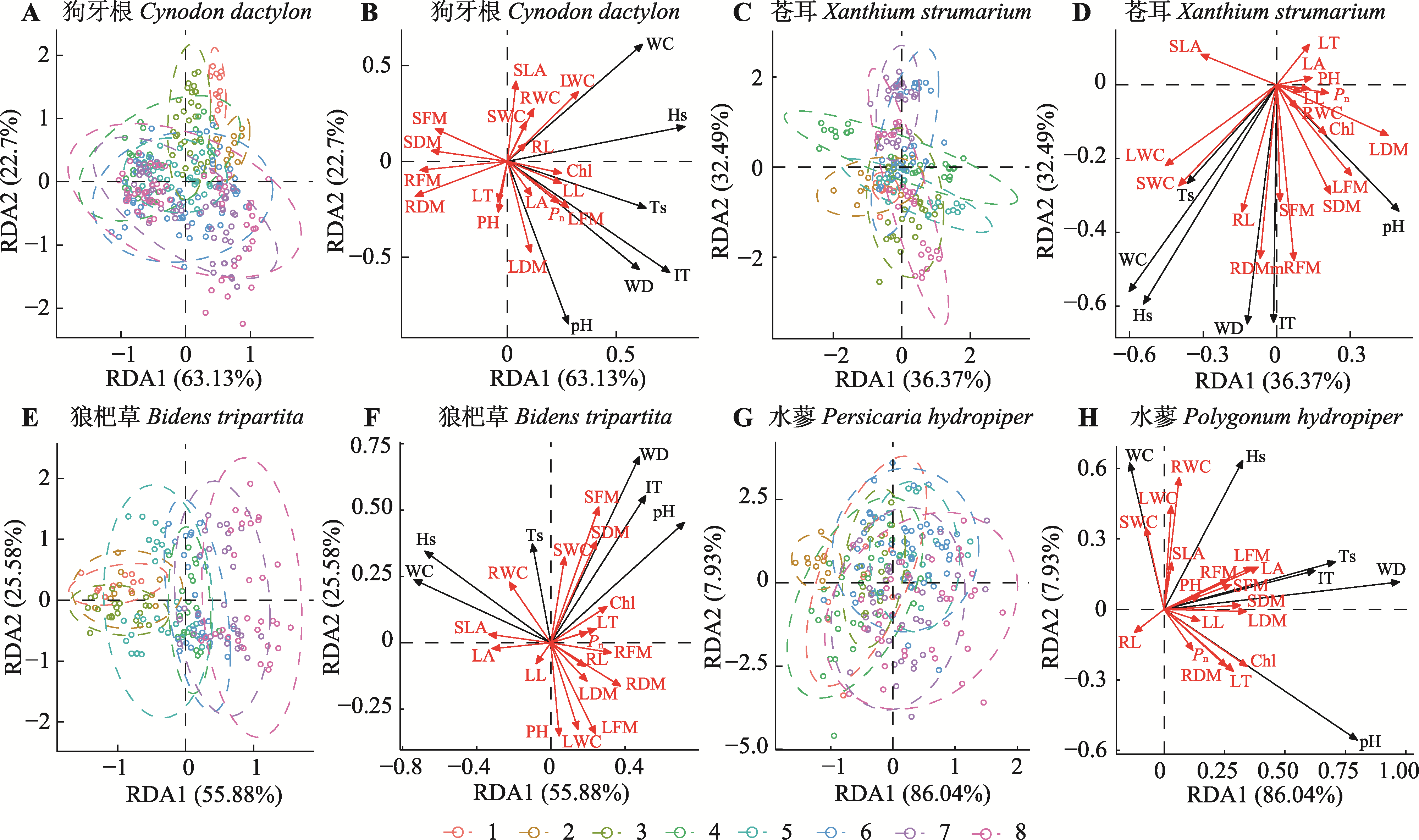
Fig. 8 Redundancy analysis (RDA) analysis of plant functional traits and environmental factors from natural riparian zone to water level zone in Baijiaxi Watershed. Contribution of environmental variables to functional traits is presented in Appendix II. 1, 2, natural riparian zone; 3-5, transition zone; 6-8, drawdown zone. Chl, chlorophyll content; Hs, soil humidity; IT, inundation time; LA, leaf area; LDM, leaf dry mass; LFM, leaf fresh mass; LL, leaf length; LT, leaf thickness; LWC, leaf water content; PH, plant height; Pn, net photosynthetic rate; RDM, root dry mass; RFM, root fresh mass; RL, root length; RWC, root water content; SDM, stem dry mass; SFM, stem fresh mass; SLA, specific leaf area; SWC, stem water content; Ts, soil temperature; WC, soil water content; WD, water depth.
| [1] |
Albert CH, Grassein F, Schurr FM, Vieilledent G, Violle C (2011). When and how should intraspecific variability be considered in trait-based plant ecology. Perspectives in Plant Ecology, Evolution and Systematics, 13, 217-225.
DOI URL |
| [2] | Arthington AH, Naiman RJ, McClain ME, Nilsson C (2010). Preserving the biodiversity and ecological services of rivers: new challenges and research opportunities. Freshwater Biology, 55, 1-16. |
| [3] |
Bao YH, Gao P, He XB (2015). The water-level fluctuation zone of Three Gorges Reservoir—A unique geomorphological unit. Earth-Science Reviews, 150, 14-24.
DOI URL |
| [4] |
Birkinshaw SJ, Guerreiro SB, Nicholson A, Liang QH, Quinn P, Zhang LL, He B, Yin JX, Fowler HJ (2017). Climate change impacts on Yangtze River discharge at the Three Gorges Dam. Hydrology and Earth System Sciences, 21, 1911-1927.
DOI URL |
| [5] |
Brodribb TJ, Jordan GJ (2011). Water supply and demand remain balanced during leaf acclimation of Nothofagus cunninghamii trees. New Phytologist, 192, 437-448.
DOI PMID |
| [6] | Chen SR, Zang LP, Wu YH, Yang ZY, Zhang GQ, Liu QF, Chen DM, Zhang SZ, Sui MZ (2024). Source, quantification and application of intraspecific variation of plant functional traits. Chinese Journal of Ecology, 43, 1442-1452. |
| [陈世仁, 臧丽鹏, 吴宇航, 杨泽宇, 张广奇, 刘庆福, 陈丹梅, 张树梓, 隋明浈 (2024). 植物功能性状种内变异的来源、量化及应用. 生态学杂志, 43, 1442-1452.] | |
| [7] | Chen ZL, Feng Y, Zhu ZH, Zhao Q, Shao Y (2024). Review of research hotspots on plant ecology of the water level fluctuation zones of reservoirs: a case study of the Three Gorges Reservoir. Pratacultural Science, 41, 1909-1923. |
| [陈忠礼, 冯源, 朱姿涵, 赵青, 邵迎 (2024). 水库消落带植物生态学研究热点——以三峡水库为例. 草业科学, 41, 1909-1923.] | |
| [8] |
Chen ZL, Schäffer A (2016). The fate of the herbicide propanil in plants of the littoral zone of the Three Gorges Reservoir (TGR), China. Journal of Environmental Sciences, 48, 24-33.
DOI PMID |
| [9] | Chen ZL, Yuan XZ, Roß-Nickoll M, Hollert H, Schäffer A (2020). Moderate inundation stimulates plant community assembly in the drawdown zone of China’s Three Gorges Reservoir. Environmental Sciences Europe, 32, 79. DOI: 10.1186/s12302-020-00355-0. |
| [10] | Cheng LD, Yuan XZ, Sun K, Tang T, Yuan J (2024). Responses of plant communities and their functional traits in the water level fluctuation zone of the Three Gorges Reservoir area to different flooding intensities. Acta Ecologica Sinica, 44, 4795-4807. |
| [程莅登, 袁兴中, 孙阔, 唐婷, 袁嘉 (2024). 三峡库区消落带植物群落及其功能性状对不同水淹强度的响应. 生态学报, 44, 4795-4807.] | |
| [11] |
Craine JM, Froehle J, Tilman DG, Wedin DA, Chapin III FS (2001). The relationships among root and leaf traits of 76 grassland species and relative abundance along fertility and disturbance gradients. Oikos, 93, 274-285.
DOI URL |
| [12] |
Dawson SK, Warton DI, Kingsford RT, Berney P, Keith DA, Catford JA (2017). Plant traits of propagule banks and standing vegetation reveal flooding alleviates impacts of agriculture on wetland restoration. Journal of Applied Ecology, 54, 1907-1918.
DOI URL |
| [13] |
Deng B, Wang XF, Liao J (2024). Ecophysiological responses of herbaceous and woody plants to environmental stresses in the riparian zone of Three Gorges Reservoir: a meta-analysis. Chinese Journal of Plant Ecology, 48, 623-637.
DOI |
|
[邓蓓, 王晓锋, 廖君 (2024). 环境胁迫影响三峡库区消落带草本和木本植物生理生态特征的meta分析. 植物生态学报, 48, 623-637.]
DOI |
|
| [14] |
Dong N, Prentice IC, Wright IJ, Evans BJ, Togashi HF, Caddy-Retalic S, McInerney FA, Sparrow B, Leitch E, Lowe AJ (2020). Components of leaf-trait variation along environmental gradients. New Phytologist, 228, 82-94.
DOI URL |
| [15] |
Dou WQ, Jia WT, Zhang JH, Yi XM, Wen ZF, Wu SJ, Ma MH (2023). Research progress of vegetation status, adaptive strategies and ecological restoration in the water-level fluctuation zone of the Three Gorges Reservoir. Chinese Journal of Ecology, 42, 208-218.
DOI |
| [窦文清, 贾伟涛, 张久红, 易雪梅, 温兆飞, 吴胜军, 马茂华 (2023). 三峡水库消落带植被现状、适生策略及生态修复研究进展. 生态学杂志, 42, 208-218.] | |
| [16] |
Fraser B (2018). Dams nudge Amazon’s ecosystems off-kilter. Science, 359, 508-509.
DOI URL |
| [17] |
Freschet GT, Violle C, Bourget MY, Scherer-Lorenzen M, Fort F (2018). Allocation, morphology, physiology, architecture: the multiple facets of plant above- and below-ground responses to resource stress. New Phytologist, 219, 1338-1352.
DOI PMID |
| [18] |
Gao JJ, Carmel Y (2020). Can the intermediate disturbance hypothesis explain grazing-diversity relations at a global scale. Oikos, 129, 493-502.
DOI URL |
| [19] | Gao T, Chen M, Dang CQ, Huang HM, Dong R, Tao JP (2017). Functional traits of major herbaceous plants in the hydro-fluctuation belt of the Three Gorges Reservoir. Pratacultural Science, 34, 2493-2503. |
| [高婷, 陈淼, 党成强, 黄慧敏, 董蓉, 陶建平 (2017). 三峡库区消落带主要草本植物功能性状特征. 草业科学, 34, 2493-2503.] | |
| [20] | Gaudichet C, Greulich S, Grellier S, Janssen P, Rodrigues S (2024). Influence of local environmental gradients on ecological strategies of herbaceous communities in riverine side channels. Journal of Vegetation Science, 35, e13227. DOI: 10.1111/jvs.13227. |
| [21] | Gong ZN, Li H, A D, Cheng QW (2017). Spatial distribution characteristics of organic matter in the water level fluctuation zone of Guanting Reservoir. Acta Ecologica Sinica, 37, 8336-8347. |
| [宫兆宁, 李洪, 阿多, 程庆文 (2017). 官厅水库消落带土壤有机质空间分布特征. 生态学报, 37, 8336-8347.] | |
| [22] |
Grime JP (2006). Trait convergence and trait divergence in herbaceous plant communities: mechanisms and consequences. Journal of Vegetation Science, 17, 255-260.
DOI URL |
| [23] | Guo EH, Fan ZH, Zhang RX, Sun JH, Yang XT (2021). Research progresses on the response of vegetation and soil to hydrological changes in riparian ecosystems. Acta Ecologica Sinica, 41, 9164-9173. |
| [郭二辉, 樊子豪, 张瑞香, 孙金华, 杨喜田 (2021). 河岸带生态系统植被与土壤对水文变化的响应研究进展. 生态学报, 41, 9164-9173.] | |
| [24] | He RT, Yang K, Zeng B, Li R, Niu HG, Shi SH, Ayi QL, Su XL (2020). Distribution pattern of vegetation in water-level fluctuation zone of the Three Gorges Reservoir as affected by differential flooding regimes. Acta Ecologica Sinica, 40, 834-842. |
| [何蕊廷, 杨康, 曾波, 李瑞, 牛汉刚, 史邵华, 阿依巧丽, 苏晓磊 (2020). 三峡水库消落区植被在差异性水淹环境中的分布格局. 生态学报, 40, 834-842.] | |
| [25] |
Holeštová A, Doudová J, Havrdová A, Černá M, Boublík K, Douda J (2024). Contrasting responses of forest phenological guilds to complex floodplain change. Journal of Ecology, 112, 1397-1412.
DOI URL |
| [26] | Huang ZH, Yan SJ, Sun YT, Guan YX, Ling L, Gu LZ, Hu WJ, Lü W (2024). Response of plant leaf functional traits to different riparian distances in Fuzhou section of Minjiang River. Journal of Hydroecology. DOI: 10.15928/j.1674-3075.202401230026. |
| [黄子宏, 闫淑君, 孙玉婷, 关永鑫, 凌玲, 顾灵帧, 胡文静, 吕蔚 (2024). 闽江福州段河岸带植物叶片功能性状对不同河岸距离的响应. 水生态学杂志. DOI: 10.15928/j.1674-3075.202401230026.] | |
| [27] |
Jackson MB, Colmer TD (2005). Response and adaptation by plants to flooding stress. Annals of Botany, 96, 501-505.
DOI PMID |
| [28] |
Jansson R, Nilsson C, Dynesius M, Andersson E (2000). Effects of river regulation on river-margin vegetation: a comparison of eight boreal rivers. Ecological Applications, 10, 203-224.
DOI URL |
| [29] |
Jiang WW, Li WT, Zhou JG, Wang PC, Xiao HL (2022). Drone-based investigation of natural restoration of vegetation in the water level fluctuation zone of cascade reservoirs in Jinsha River. Scientific Reports, 12, 12895. DOI: 10.1038/s41598-022-14578-z.
PMID |
| [30] |
Jie SL, Fan DY, Xie ZQ, Zhang XY, Xiong GM (2012). Features of leaf photosynthesis and leaf nutrient traits in reservoir riparian region of Three Gorges Reservoir, China. Acta Ecologica Sinica, 32, 1723-1733.
DOI URL |
| [揭胜麟, 樊大勇, 谢宗强, 张想英, 熊高明 (2012). 三峡水库消落带植物叶片光合与营养性状特征. 生态学报, 32, 1723-1733.] | |
| [31] | Kong WW, Yuan XZ, Lu HY, Chen X, Liu TT, Gong XJ, Wang XF (2020). Ecological stoichiometry of the representative herbaceous plants in the littoral zone of Pengxi River in Three Gorges Reservoir. Journal of Chongqing Normal University (Natural Science), 37(5), 73-82. |
| [孔维苇, 袁兴中, 卢虹宇, 陈稀, 刘婷婷, 龚小杰, 王晓锋 (2020). 三峡库区澎溪河消落带典型草本植物养分及生态化学计量特征. 重庆师范大学学报(自然科学版), 37(5), 73-82.] | |
| [32] |
Li HL, Yu KL, Ratajczak Z, Nippert JB, Tondrob D, Xu DH, Li W, Du GZ (2016). When variability outperforms the mean: trait plasticity predicts plant cover and biomass in an alpine wetland. Plant and Soil, 407, 401-415.
DOI URL |
| [33] |
Li SS, Liu XQ (2024). Analysis of functional traits of wetland plants in floodplains in middle reaches of Yangtze River. Chinese Journal of Plant Ecology, 48, 601-611.
DOI URL |
|
[李闪闪, 刘学勤 (2024). 长江中游河漫滩湿地植物功能性状分析. 植物生态学报, 48, 601-611.]
DOI |
|
| [34] | Li SZ, Deng Y, Shi FN, Hu MM, Pang BH, Wang YC, Li K, Chen M, Peng WQ, Qu XD, Bao YF, Meng JJ (2019). Research progress on water-level-fluctuation zone of reservoirs: a review. Wetland Science, 17, 689-696. |
| [李姗泽, 邓玥, 施凤宁, 胡明明, 庞博慧, 王雨春, 李坤, 陈铭, 彭文启, 渠晓东, 包宇飞, 孟晶晶 (2019). 水库消落带研究进展. 湿地科学, 17, 689-696.] | |
| [35] | Li SZ, Wang YC, Hu LC, Zhao JW, Liao XL, Xie T, Wen J, Bao YF, Li LF (2023). Nitrogen fixation of Cyndon dactylon: a possible strategy coping with long-term flooding in the Three Gorges Reservoir. Science of the Total Environment, 866, 161422. DOI: 10.1016/j.scitotenv.2023.161422. |
| [36] | Li XL, He D, Chen G, Yang J, Yang ZJ, Guo XJ, Wang CF, Zhu SJ, Huang YP, Chen HF, Huang GY, Zhang DJ, Ye C (2022). Responses of leaf functional traits to different hydrological regimes and leaf economics spectrum in the water level fluctuation zone of Three Gorges Reservoir, China. Frontiers in Plant Science, 13, 939452. DOI: 10.3389/fpls.2022.939452. |
| [37] | Li XL, Yi WX, Xu ST, He D, Min QF, Chen G, Yang J, Deng DL, Yang ZJ, Huang GY, Hu MX, Ye C (2024). Assessment of the divergent influence of natural and non-seasonal hydrological fluctuations on functional traits and niche characteristics of plant guilds along the Xiangxi River, China. Water, 16, 1808. DOI: 10.3390/w16131808. |
| [38] | Liu CG, Duan N, Chen XN, Li HQ, Zhao XL, Duo PZ, Wang J, Li QH (2022). Metabolic pathways involved in the drought stress response of Nitraria tangutorum as revealed by transcriptome analysis. Forests, 13, 509. DOI: 10.3390/f13040509. |
| [39] | Liu DY, Zhao CZ, Li GY, Chen ZN, Wang SH, Huang CL, Zhang PX (2024a). Shrub leaf area and leaf vein trait trade-offs in response to the light environment in a vegetation transitional zone. Functional Plant Biology, 51, FP24011. DOI: 10.1071/FP24011. |
| [40] |
Liu H, Yin DY, He PC, Cadotte MW, Ye Q (2024b). Linking plant functional traits to biodiversity under environmental change. Biological Diversity, 1, 22-28.
DOI URL |
| [41] |
Liu M, Peñuelas J, Trugman AT, Vargas GG, Yang LQ, Anderegg WRL (2025). Diverging responses of terrestrial ecosystems to water stress after disturbances. Nature Climate Change, 15, 73-79.
DOI |
| [42] | Liu ZB, Cheng RM, Xiao WF, Guo QS, Wang N (2014). Effect of flooding on growth, photosynthesis and fluorescence characteristics of Distylium chinense Scientia Silvae Sinicae, 50(9), 73-81. |
| [刘泽彬, 程瑞梅, 肖文发, 郭泉水, 王娜 (2014). 模拟水淹对中华蚊母树生长及光合特性的影响. 林业科学, 50(9), 73-81.] | |
| [43] | Long QZ, Du H, Su L, Zeng FP, Lian ZW, Peng WX, Liu KP, Tan WN (2023). Variation of plant functional traits and adaptive strategies in Karst evergreen deciduous broad-leaved forest. Acta Ecologica Sinica, 43, 8875-8883. |
| [隆庆之, 杜虎, 苏樑, 曾馥平, 连子文, 彭晚霞, 刘坤平, 谭卫宁 (2023). 喀斯特常绿落叶阔叶林木本植物功能性状变异及其适应策略. 生态学报, 43, 8875-8883.] | |
| [44] | Mao Y, Yuan J, You FY, Hou CL, Cheng LD (2024). Functional traits and community structure of herbaceous plants in urban riparian zone of the Three Gorges Reservoir ares. Acta Ecologica Sinica, 44, 9848-9861. |
| [毛媛, 袁嘉, 游奉溢, 侯春丽, 程莅登 (2024). 三峡库区城市河岸带草本植物功能性状及群落结构研究. 生态学报, 44, 9848-9861.] | |
| [45] |
Mensah S, Glèlè Kakaï R, Seifert T (2016). Patterns of biomass allocation between foliage and woody structure: the effects of tree size and specific functional traits. Annals of Forest Research, 59, 49-60.
DOI URL |
| [46] |
Moor H, Rydin H, Hylander K, Nilsson MB, Lindborg R, Norberg J (2017). Towards a trait-based ecology of wetland vegetation. Journal of Ecology, 105, 1623-1635.
DOI URL |
| [47] | Pei SX, Hong M, Guo QS, Qin AL, Zhu L, Zhu NN (2014). Photosynthetic characteristics of Cynodon dactylon in hydro-fluctuation belt of Three Gorges Reservoir at the end of flooding. Chinese Journal of Ecology, 33, 3222-3229. |
| [裴顺祥, 洪明, 郭泉水, 秦爱丽, 朱莉, 朱妮妮 (2014). 三峡库区消落带水淹结束后狗牙根的光合生理生态特性. 生态学杂志, 33, 3222-3229.] | |
| [48] |
Pérez-Harguindeguy N, Díaz S, Garnier E, Lavorel S, Poorter H, Jaureguiberry P, Bret-Harte MS, Cornwell WK, Craine JM, Gurvich DE, Urcelay C, Veneklaas EJ, Reich PB, Poorter L, Wright IJ, et al. (2013). New handbook for standardised measurement of plant functional traits worldwide. Australian Journal of Botany, 61, 167-234.
DOI URL |
| [49] | Rao J, Duan DQ, Tang Q, Ma MG, Wei J, He XB (2023). Vegetation differentiation along elevation gradient in the water level fluctuation zone of the Three Gorges Reservoir and its response to habitat stressing. Acta Ecologica Sinica, 43, 6649-6660. |
| [饶洁, 段丁琪, 唐强, 马明国, 韦杰, 贺秀斌 (2023). 三峡水库消落带植被高程梯度分异及其对生境胁迫的响应. 生态学报, 43, 6649-6660.] | |
| [50] | Rao J, Tang Q, Duan DQ, Xu YH, Wei J, Bao YH, He XB, Collins AL (2024). UAV-based modelling of vegetation recovery under extreme habitat stresses in the water level fluctuation zone of the Three Gorges Reservoir, China. Science of the Total Environment, 934, 173185. DOI: 10.1016/j.scitotenv.2024.173185. |
| [51] |
Scoffoni C, Rawls M, McKown A, Cochard H, Sack L (2011). Decline of leaf hydraulic conductance with dehydration: relationship to leaf size and venation architecture. Plant Physiology, 156, 832-843.
DOI PMID |
| [52] |
Shipley B, Meziane D (2002). The balanced-growth hypothesis and the allometry of leaf and root biomass allocation. Functional Ecology, 16, 326-331.
DOI URL |
| [53] | Sun R, Yuan XZ, Chen ZL, Zhang YW, Liu H (2010). Patterns of plant community species richness in the fluctuating water level zone along the Pengxihe River of the Three Gorges Reservoir. Research of Environmental Sciences, 23, 1382-1389. |
| [孙荣, 袁兴中, 陈忠礼, 张跃伟, 刘红 (2010). 三峡水库澎溪河消落带植物群落物种丰富度格局. 环境科学研究, 23, 1382-1389.] | |
| [54] | Sun YT, Yan SJ, Ling L, Guan YX, Huang ZH (2023). Research progress in ecological adaptation strategies of riparian plants. World Forestry Research, 36(6), 8-13. |
| [孙玉婷, 闫淑君, 凌玲, 关永鑫, 黄子宏 (2023). 河岸带植物生态适应策略研究进展. 世界林业研究, 36(6), 8-13.] | |
| [55] |
Violle C, Navas ML, Vile D, Kazakou E, Fortunel C, Hummel I, Garnier E (2007). Let the concept of trait be functional! Oikos, 116, 882-892.
DOI URL |
| [56] |
Voesenek LACJ, Bailey-Serres J (2015). Flood adaptive traits and processes: an overview. New Phytologist, 206, 57-73.
DOI PMID |
| [57] |
Wang Q, Yuan XZ, Liu H, Zhang YW, Chen ZL, Li B (2011). Effect of initial impoundment on the vegetation and species diversity in water-level fluctuation zone of the Three Gorges Reservoir. Journal of Natural Resources, 26, 1680-1693.
DOI |
| [王强, 袁兴中, 刘红, 张跃伟, 陈忠礼, 李波 (2011). 三峡水库初期蓄水对消落带植被及物种多样性的影响. 自然资源学报, 26, 1680-1693.] | |
| [58] | Wang QX, Peng ST, Gan WY, Peng ZD, Xu Q, Huang LJ (2024). Responses of leaf and fine root functional traits to water-salt gradients in the Fuzhou section of the Minjiang River Basin. Plant Science Journal, 42, 454-465. |
| [王秋雪, 彭书婷, 甘婉怡, 彭正东, 徐琪, 黄柳菁 (2024). 闽江福州段湿地草本植物叶片与细根功能性状对水盐梯度的响应. 植物科学学报, 42, 454-465.] | |
| [59] | Wang WY, Huang JX, Zou H, Ma MH (2023). Divergence of seed mass in riparian plant communities dominated by filtering and random processes. Diversity-Basel, 15, 1164. DOI: 10.3390/d15121164. |
| [60] | Wang YF, Wu SJ, Liu Y, Li XH, Zhang J (2022). Functional trait diversity shapes the biomass in the dam-induced riparian zone. Agriculture, 12, 423. DOI: 10.3390/agriculture12030423. |
| [61] | Wei GW, Sun XS, Chen YH, Luo FL, Yu FH (2020). Growth and reproductive responses of Polygonum hydropiper populations to elevational difference associated with flooding. Global Ecology and Conservation, 23, e01156. DOI: 10.1016/j.gecco.2020.e01156. |
| [62] |
Westoby M, Falster DS, Moles AT, Vesk PA, Wright IJ (2002). Plant ecological strategies: some leading dimensions of variation between species. Annual Review of Ecology and Systematics, 33, 125-159.
DOI URL |
| [63] | Ye C, Butler OM, Chen CR, Liu WZ, Du M, Zhang QF (2020). Shifts in characteristics of the plant-soil system associated with flooding and revegetation in the riparian zone of Three Gorges Reservoir, China. Geoderma, 361, 114015. DOI: 10.1016/j.geoderma.2019.114015. |
| [64] |
Ye C, Chen CR, Butler OM, Rashti MR, Esfandbod M, Du M, Zhang QF (2019). Spatial and temporal dynamics of nutrients in riparian soils after nine years of operation of the Three Gorges Reservoir, China. Science of the Total Environment, 664, 841-850.
DOI |
| [65] | Ye C, Li SY, Yang YY, Shu X, Zhang JQ, Zhang QF (2015). Advancing analysis of spatio-temporal variations of soil nutrients in the water level fluctuation zone of China’s Three Gorges Reservoir using self-organizing map. PLoS ONE, 10, e0121210. DOI: 10.1371/journal.pone.0121210. |
| [66] |
Yin QL, Tian TT, Han XH, Xu JS, Chai YF, Mo J, Lei ML, Wang L, Yue M (2019). The relationships between biomass allocation and plant functional trait. Ecological Indicators, 102, 302-308.
DOI |
| [67] |
Yu B, Zhao CY, Li J, Li JY, Peng G (2015). Morphological, physiological, and biochemical responses of Populus euphratica to soil flooding. Photosynthetica, 53, 110-117.
DOI URL |
| [68] | Zhang AY, Fan DY, Ma L, Yang D, Xiong GM, Xie ZQ (2022). Intra-annual variations in leaf traits of Cynodon dactylon (L.) Pers. during exposure period in riparian zone of Three Gorges Reservoir Area. Plant Science Journal, 40, 453-461. |
| [张爱英, 樊大勇, 马良, 杨丹, 熊高明, 谢宗强 (2022). 三峡消落带优势植物狗牙根在水库落干期的叶性状变化. 植物科学学报, 40, 453-461.] | |
| [69] | Zhang LM, Tan X, Dong Z, Zheng J, Yuan ZX, Li CX (2023). The relationship between plant functional traits and soil physicochemical properties in the riparian zones of drawtown Chongqing. Acta Ecologica Sinica, 43, 1892-1901. |
| [张丽苗, 谭雪, 董智, 郑杰, 袁中勋, 李昌晓 (2023). 重庆主城河岸带植物群落功能性状与土壤理化性质的关系. 生态学报, 43, 1892-1901.] | |
| [70] |
Zhang ZY, Xiang L, Wan CY, Shi F, Zhang DX, Zheng ZW, Zhu W, Xu P, Yuan YJ, Zhu LM (2023). Structure of plant community and its seasonal variation in the water level fluctuation zone of the Three Gorges Reservoir. Journal of Lake Sciences, 35, 553-563.
DOI URL |
| [张志永, 向林, 万成炎, 史方, 张道熙, 郑志伟, 朱稳, 许盼, 袁玉洁, 朱利明 (2023). 三峡水库消落带植物群落演变趋势及优势植物适应策略. 湖泊科学, 35, 553-563.] | |
| [71] | Zhao Q, Feng Y, Shao Y, Huang JL, Chen ZL (2024). Response mechanism of Cynodon dactylon to flooding stress based on integrating metabonomics and transcriptomics analysis. Environmental and Experimental Botany, 225, 105846. DOI: 10.1016/j.envexpbot.2024.105846. |
| [72] |
Zheng J, Arif M, Zhang SL, Yuan ZX, Zhang LM, Dong Z, Tan X, Charles W, Li CX (2021b). The convergence of species composition along the drawdown zone of the Three Gorges Dam Reservoir, China: implications for restoration. Environmental Science and Pollution Research International, 28, 42609-42621.
DOI |
| [73] | Zheng J, Arif M, Zhang SL, Yuan ZX, Zhang LM, Li JJ, Ding DD, Li CX (2021a). Dam inundation simplifies the plant community composition. Science of the Total Environment, 801, 149827. DOI: 10.1016/j.scitotenv.2021.149827. |
| [74] | Zhu ZH, Chen ZL, Li L, Shao Y (2020). Response of dominant plant species to periodic flooding in the riparian zone of the Three Gorges Reservoir (TGR), China. Science of the Total Environment, 747, 141101. DOI: 10.1016/j.scitotenv.2020.141101. |
| [75] | Zou H, Wang WY, Huang JX, Li XH, Ma MH, Wu SJ, Zhao CF (2024). Soil nitrogen and flooding intensity determine the trade-off between leaf and root traits of riparian plant species. Plants, 13, 978. DOI: 10.3390/plants13070978. |
| [76] | Zou H, Wu SJ, Ma MH, Yang J (2024). Plant growth-flood tolerance and their implications for riparian zone natural restoration. Resources and Environment in the Yangtze Basin, 33, 347-361. |
| [邹航, 吴胜军, 马茂华, 杨军 (2024). 植物生长-耐淹权衡策略及其对河岸带自然恢复的启示. 长江流域资源与环境, 33, 347-361.] |
| [1] | feng yifan, zhu shiying, ZHOU Shu-Rong, jiang lele, chen long, wang miao, deng guofang, Liu Lan. The influence of soil microorganisms on the survival and growth traits of mycorrhized seedlings in tropical secondary forest restoration [J]. Chin J Plant Ecol, 2026, 50(预发表): 1-. |
| [2] | Rao Chaokang, Tang Liang. Characteristics and Drivers of Mangrove Phyllosphere Microbial Communities across Different Tidal Elevations [J]. Chin J Plant Ecol, 2026, 50(预发表): 1-. |
| [3] | Lin Lin-Lin, Xiao Jin-Xiang, Huang Shen-Shen, Zhao Yang-Mei, Zhang De-Xu, Cheng Yi-Kang, Long Wen-Xing. Effects of phosphorus addition on functional traits across seedlings and saplings in a tropical cloud forest [J]. , 2026, 50(预发表): 0-. |
| [4] | XI Nian-Xun. The impact of multiple global change factors on traits of mycorrhizal plants [J]. , 2026, 50(预发表): 0-. |
| [5] | ZHANG An-Ning, XIAO Ya-Ning, ZHAO Xia, ZHANG Miao, CUI Han Wen, Chen Shu-Yan, AN Li-Zhe. Interactions between shrub encroachment and nitrogen addition on nematode community and functional traits on Qinghai–Tibetan Plateau [J]. Chin J Plant Ecol, 2026, 50(预发表): 0-. |
| [6] | CHEN Ya-Xuan, HAN Yu-Yin, CHEN Yan-Mei, LIU Qian-Yuan. Plant functional traits and carbon-nitrogen stoichiometry of plantations at different forest ages in North China [J]. Chin J Plant Ecol, 2026, 50(2): 318-333. |
| [7] | WANG Shuang, CHEN Ya-Xuan, CHEN Yan-Mei, WANG Jia-Le, LIU Qian-Yuan. Root resource-acquisition strategies of Ziziphus jujuba in different habitats in typical areas of Taihang Mountains [J]. Chin J Plant Ecol, 2026, 50(2): 374-387. |
| [8] | ZHANG Jing, CHEN Jie, LI Yan-Peng, PAN Li-Jun, XU Han, LI Yi-De, HE Hai-Sheng. Comparison of plant biomass in conifer and broadleaf mixed artificial forests in south subtropical area and analyses of influential factors [J]. Chin J Plant Ecol, 2026, 50(2): 400-416. |
| [9] | ZHANG Yong-Jun, LI Jing-Dong, AN Qi, HONG Ling-Gui, REN Zheng-Wei, ZHANG Rui, ZHOU Xiao-Long. Effects of nitrogen addition and warming on community traits in an alpine grassland community of Tianshan Mountains [J]. Chin J Plant Ecol, 2026, 50(2): 417-428. |
| [10] | LIANG Tian-Hao, WU Fan, HUANG Jin-Xue, JING Chen-Hong, FU He-Jing, YANG Zhi-Jie, XIONG De-Cheng. Effects of soil warming on fine root growth and morphology of Castanopsis kawakamii in mid-subtropical forests [J]. Chin J Plant Ecol, 2026, 50(1): 94-106. |
| [11] | ZHENG Zi-Yi, CHEN Jiang-Hui, LIU Hui-Ying. Climate warming increases root exudation rates of dominant species in alpine meadow on the Qingzang Plateau [J]. Chin J Plant Ecol, 2025, 49(9): 1363-1373. |
| [12] | CHEN Kai, YANG Yan, XU Ling, JIANG Zhong-Hua. Variations in seed morphology and germination of Primula denticulata along an elevational gradient in the mountains of southwestern Yunnan, China [J]. Chin J Plant Ecol, 2025, 49(7): 1119-1127. |
| [13] | CUI Dong-Qing, TIAN Chen, SONG Hui-Min, LU Xiao-Ming, SA Qi-Ri, XU Guo-Qing, YANG Pei-Zhi, BAI Yong-Fei, TIAN Jian-Qing. Response mechanisms of rhizosphere bacterial community diversity and functional group composition of dominant plants in typical grasslands to long-term grazing [J]. Chin J Plant Ecol, 2025, 49(7): 1163-1176. |
| [14] | ZHANG Xiao-Di, WANG Xiao-Xia, ZHANG Yu-Wen, HOU Jing-Yu, SHI Xiao-Peng, HE Lu-Lu, LIU Ya-Dong, XUE Liu, HE Bao-Hua, DUAN Jie. Hydraulic architecture, leaf functional traits and environmental adaptation strategies of three understory shrubs in Beijing mountainous areas [J]. Chin J Plant Ecol, 2025, 49(7): 1128-1143. |
| [15] | LI Meng-Qi, MIAO Ling-Feng, LI Da-Dong, LONG Yi-Fan, YE Bing-Bing, YANG Fan. Response of mangrove fine root functional traits to sediment nutrient changes at different tide levels in Dongzhaigang, Hainan, China [J]. Chin J Plant Ecol, 2025, 49(4): 552-561. |
| Viewed | ||||||
|
Full text |
|
|||||
|
Abstract |
|
|||||
Copyright © 2026 Chinese Journal of Plant Ecology
Tel: 010-62836134, 62836138, E-mail: apes@ibcas.ac.cn, cjpe@ibcas.ac.cn

