
Chin J Plant Ecol ›› 2025, Vol. 49 ›› Issue (10): 1612-1625.DOI: 10.17521/cjpe.2024.0387 cstr: 32100.14.cjpe.2024.0387
• Research Articles • Previous Articles Next Articles
LI Li-Ping1, YU Kun1, CHEN Fang-Miao1, CHEN Qiang1, JING Yu-Hang1,3, NIU Zhen-Guo1,3, HU Chen-Lu1,3, QIN Hai-Ning2,3, HUANG Hui-Ping1,3, TIAN Yi-Chen1,3,*( )
)
Received:2024-11-06
Accepted:2025-04-03
Online:2025-10-20
Published:2025-06-04
Contact:
TIAN Yi-Chen
Supported by:LI Li-Ping, YU Kun, CHEN Fang-Miao, CHEN Qiang, JING Yu-Hang, NIU Zhen-Guo, HU Chen-Lu, QIN Hai-Ning, HUANG Hui-Ping, TIAN Yi-Chen. Red List Index of Chinese higher plants based on IUCN global assessment data[J]. Chin J Plant Ecol, 2025, 49(10): 1612-1625.
Add to citation manager EndNote|Ris|BibTeX
URL: https://www.plant-ecology.com/EN/10.17521/cjpe.2024.0387
| 总物种数 Total species | 已评估 Assessed species | 占比 Percentage (%) | 受威胁物种数 Threatened species | |
|---|---|---|---|---|
| 苔藓类 Mosses | 21 925 | 327 | 1.5 | 181 |
| 蕨类 Ferns and Allies | 11 800 | 821 | 7.0 | 321 |
| 裸子植物 Gymnosperm | 1 113 | 1 059 | 95.1 | 451 |
| 被子植物 Angiosperm | 369 000 | 68 704 | 18.6 | 26 367 |
| 绿藻类 Green algae | 13 960 | 17 | 0.1 | 0 |
| 红藻类 Red algae | 7 523 | 78 | 1.0 | 9 |
| 总计 Total | 425 321 | 71 006 | 17.0 | 27 329 |
Table 1 Numbers of plant species by IUCN global assessment as of June 27th, 2024
| 总物种数 Total species | 已评估 Assessed species | 占比 Percentage (%) | 受威胁物种数 Threatened species | |
|---|---|---|---|---|
| 苔藓类 Mosses | 21 925 | 327 | 1.5 | 181 |
| 蕨类 Ferns and Allies | 11 800 | 821 | 7.0 | 321 |
| 裸子植物 Gymnosperm | 1 113 | 1 059 | 95.1 | 451 |
| 被子植物 Angiosperm | 369 000 | 68 704 | 18.6 | 26 367 |
| 绿藻类 Green algae | 13 960 | 17 | 0.1 | 0 |
| 红藻类 Red algae | 7 523 | 78 | 1.0 | 9 |
| 总计 Total | 425 321 | 71 006 | 17.0 | 27 329 |
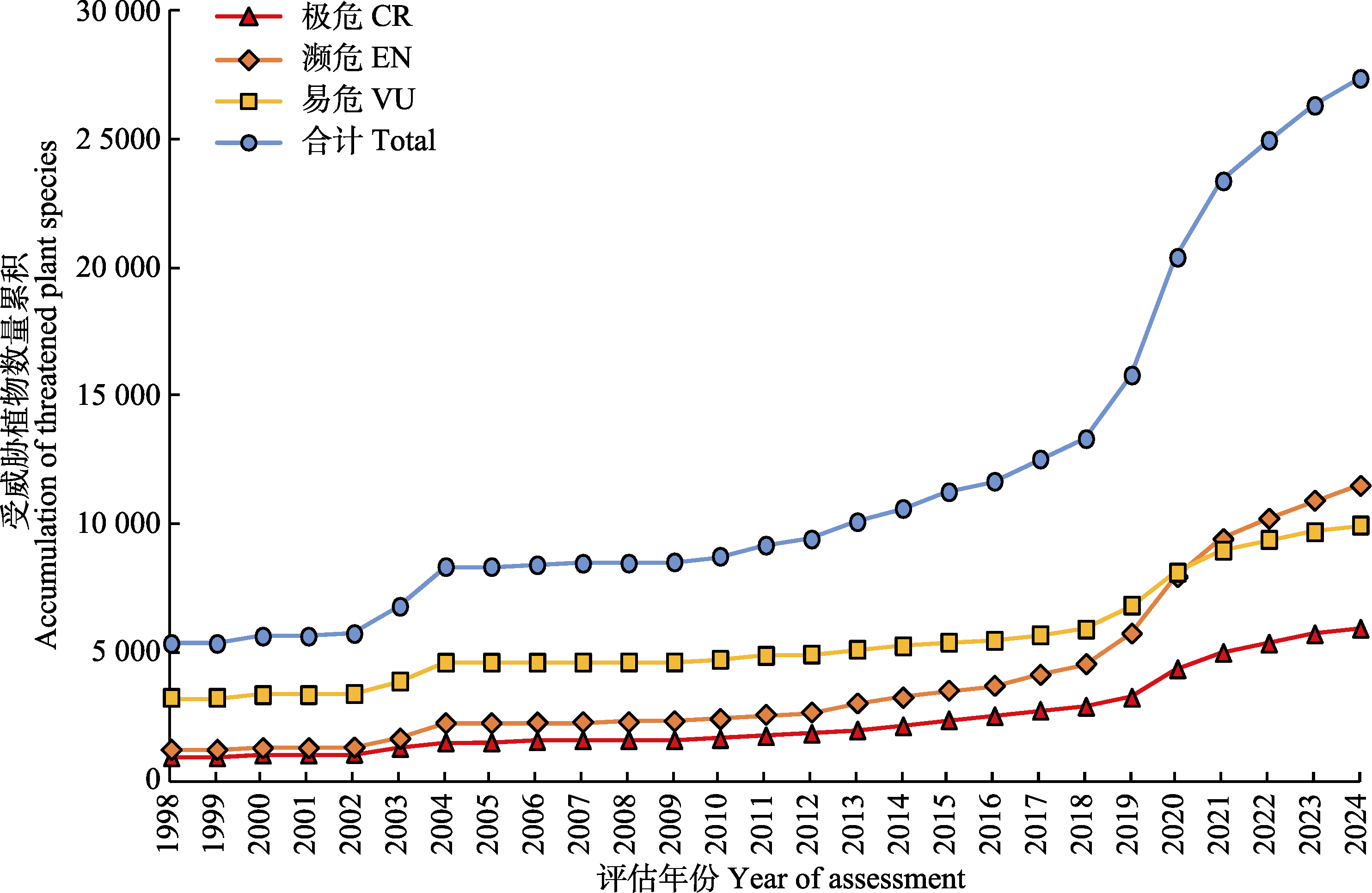
Fig. 1 Accumulated numbers of threatened plant species in IUCN global assessment database: CR (Critically Endangered), EN (Engdangered), VU (Vulnerable), and Total threatened species (1998-2004, as of June 27th, 2024). Data source: https://www.iucnredlist.org/resources/summary-statistics.
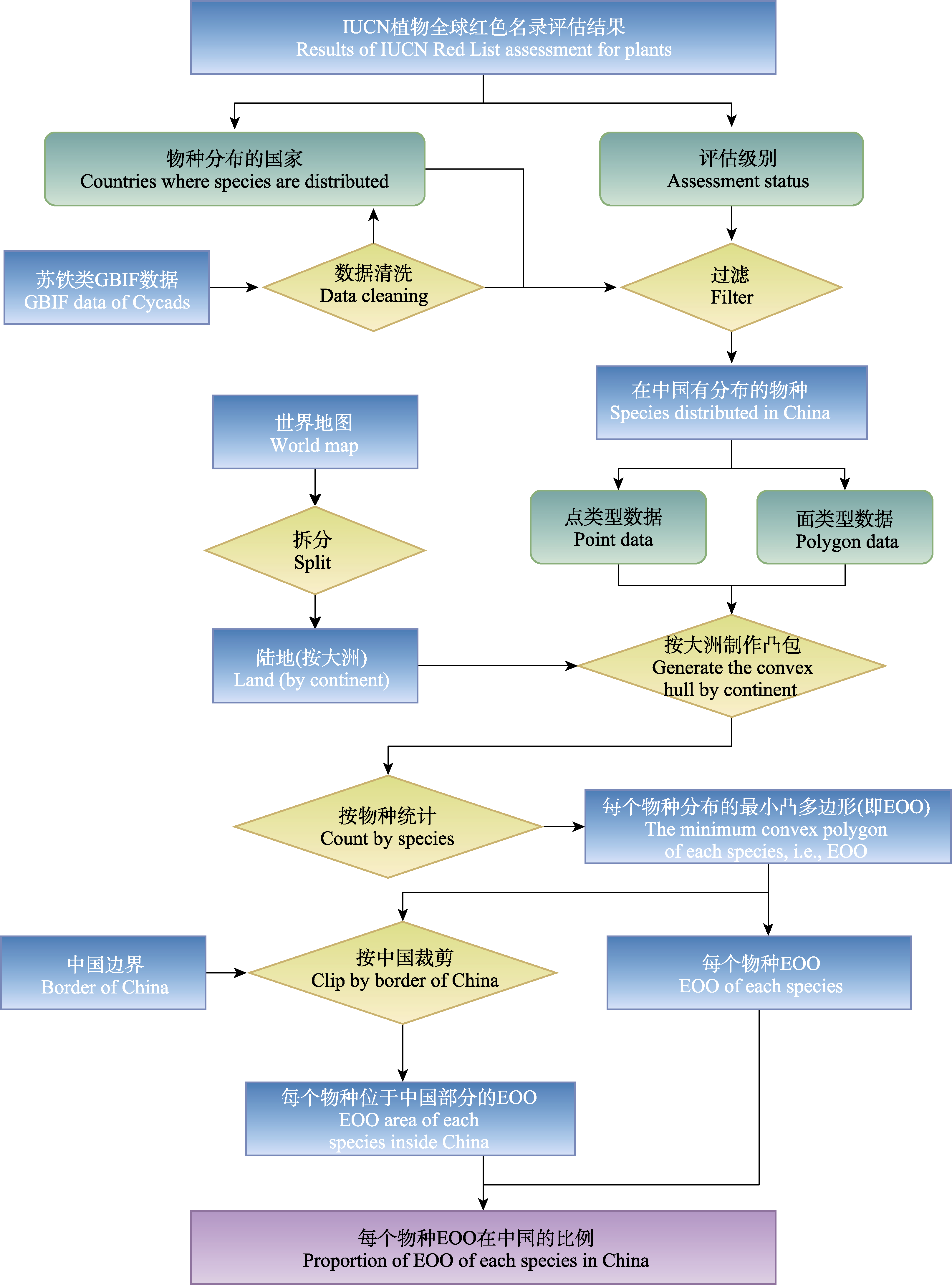
Fig. 2 Flowchart of calculating and partitioning species’ Extent of Occurrence (EOO).
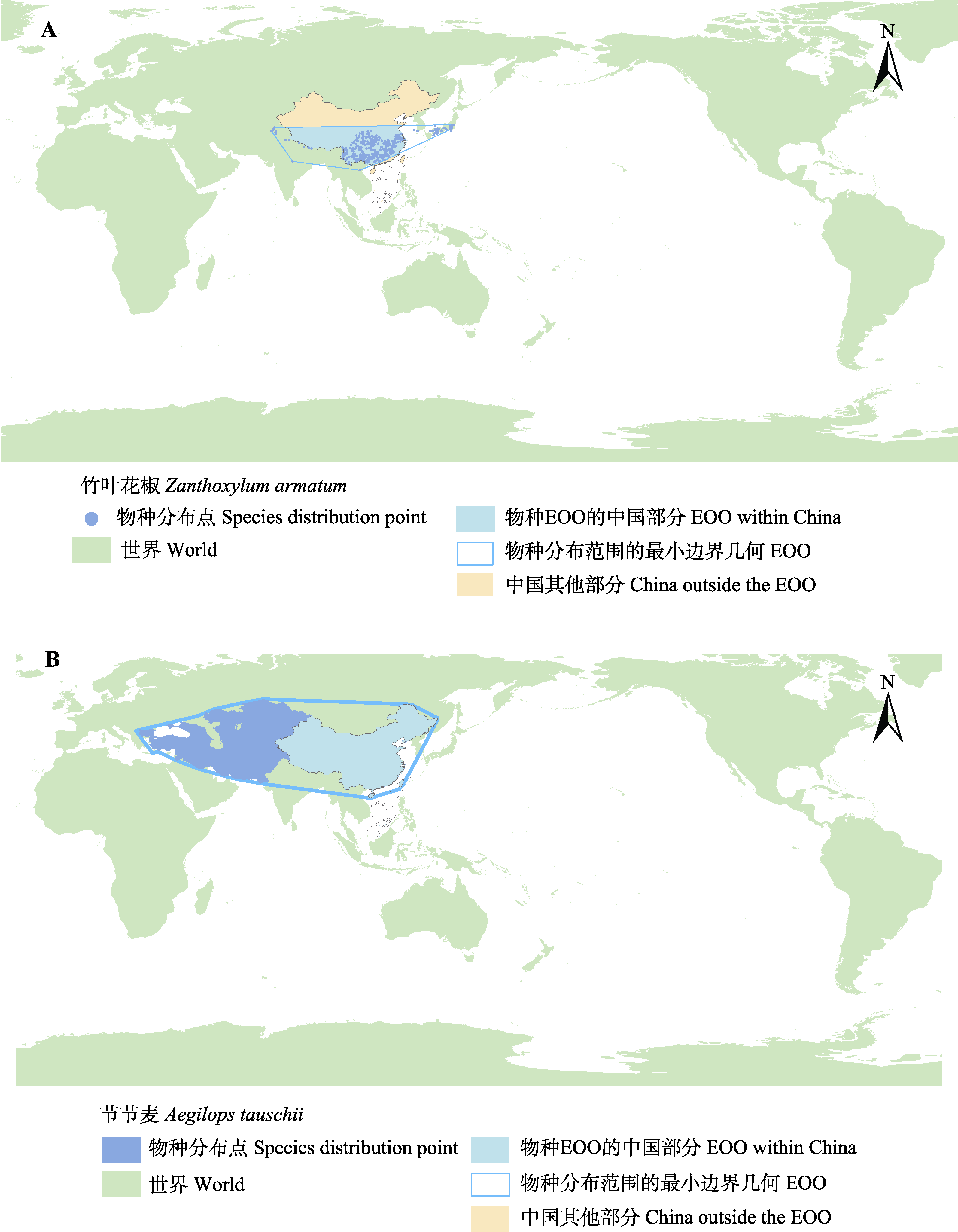
Fig. 3 Examples for the partition of Extent of Occurrence (EOO) in China and outside China. A, Zanthoxylum armatum, with point source data. B, Aegilops tauschii, with polygon source data.
| 级别 Status | 等步长法 Equal steps method | 灭绝风险法 Extinction risk method |
|---|---|---|
| 灭绝 Extinct (EX) | 5 | 1 |
| 野外灭绝 Extinct in the wild (EW) | 5 | 1 |
| 极危 Critically endangered (CR) | 4 | 0.5 |
| 濒危 Endangered (EN) | 3 | 0.05 |
| 易危 Vulnerable (VU) | 2 | 0.005 |
| 近危 Near threatened (NT) | 1 | 0.000 5 |
| 无危 Least concern (LC) | 0 | 0 |
Table 2 IUCN Red List status and weights for two methods of Red List Index calculation
| 级别 Status | 等步长法 Equal steps method | 灭绝风险法 Extinction risk method |
|---|---|---|
| 灭绝 Extinct (EX) | 5 | 1 |
| 野外灭绝 Extinct in the wild (EW) | 5 | 1 |
| 极危 Critically endangered (CR) | 4 | 0.5 |
| 濒危 Endangered (EN) | 3 | 0.05 |
| 易危 Vulnerable (VU) | 2 | 0.005 |
| 近危 Near threatened (NT) | 1 | 0.000 5 |
| 无危 Least concern (LC) | 0 | 0 |
| 等级 Status | 科 Family | 属 Genus | 种 Species |
|---|---|---|---|
| 灭绝 Extinct (EX) | 6 | 6 | 6 |
| 极危 Critically endangered (CR) | 46 | 75 | 150 |
| 濒危 Endangered (EN) | 69 | 165 | 370 |
| 易危 Vulnerable (VU) | 75 | 163 | 331 |
| 近危 Near threatened (NT) | 43 | 74 | 135 |
| 无危 Least concern (LC) | 212 | 896 | 2 873 |
| 数据缺乏 Data deficient (DD) | 47 | 99 | 294 |
| 评估物种总计 Total assessed species | 241 | 1 104 | 4 159 |
| 受威胁种总计 Total threatened species | 110 | 309 | 851 |
Table 3 Numbers of family, genus, and species distributed in China by status in IUCN assessment database
| 等级 Status | 科 Family | 属 Genus | 种 Species |
|---|---|---|---|
| 灭绝 Extinct (EX) | 6 | 6 | 6 |
| 极危 Critically endangered (CR) | 46 | 75 | 150 |
| 濒危 Endangered (EN) | 69 | 165 | 370 |
| 易危 Vulnerable (VU) | 75 | 163 | 331 |
| 近危 Near threatened (NT) | 43 | 74 | 135 |
| 无危 Least concern (LC) | 212 | 896 | 2 873 |
| 数据缺乏 Data deficient (DD) | 47 | 99 | 294 |
| 评估物种总计 Total assessed species | 241 | 1 104 | 4 159 |
| 受威胁种总计 Total threatened species | 110 | 309 | 851 |
| 方法和物种数 Methods and species numbers | IUCN评估物种 IUCN assessed species | IUCN评估物种&中国特有种 IUCN assessed species & Chinese endemic species | 仅苏铁类 Solely Cycas |
|---|---|---|---|
| 等步长法 Equal steps method | 0.946 7 | 0.908 2 | 0.540 1 |
| 灭绝风险法 Extinction risk method | 0.987 7 | 0.985 4 | 0.871 6 |
| 物种数 Species number | 2 212 | 18 298 | 18 |
Table 4 Red List Index of Chinese higher plants based on IUCN global assessment data (gRLI)
| 方法和物种数 Methods and species numbers | IUCN评估物种 IUCN assessed species | IUCN评估物种&中国特有种 IUCN assessed species & Chinese endemic species | 仅苏铁类 Solely Cycas |
|---|---|---|---|
| 等步长法 Equal steps method | 0.946 7 | 0.908 2 | 0.540 1 |
| 灭绝风险法 Extinction risk method | 0.987 7 | 0.985 4 | 0.871 6 |
| 物种数 Species number | 2 212 | 18 298 | 18 |
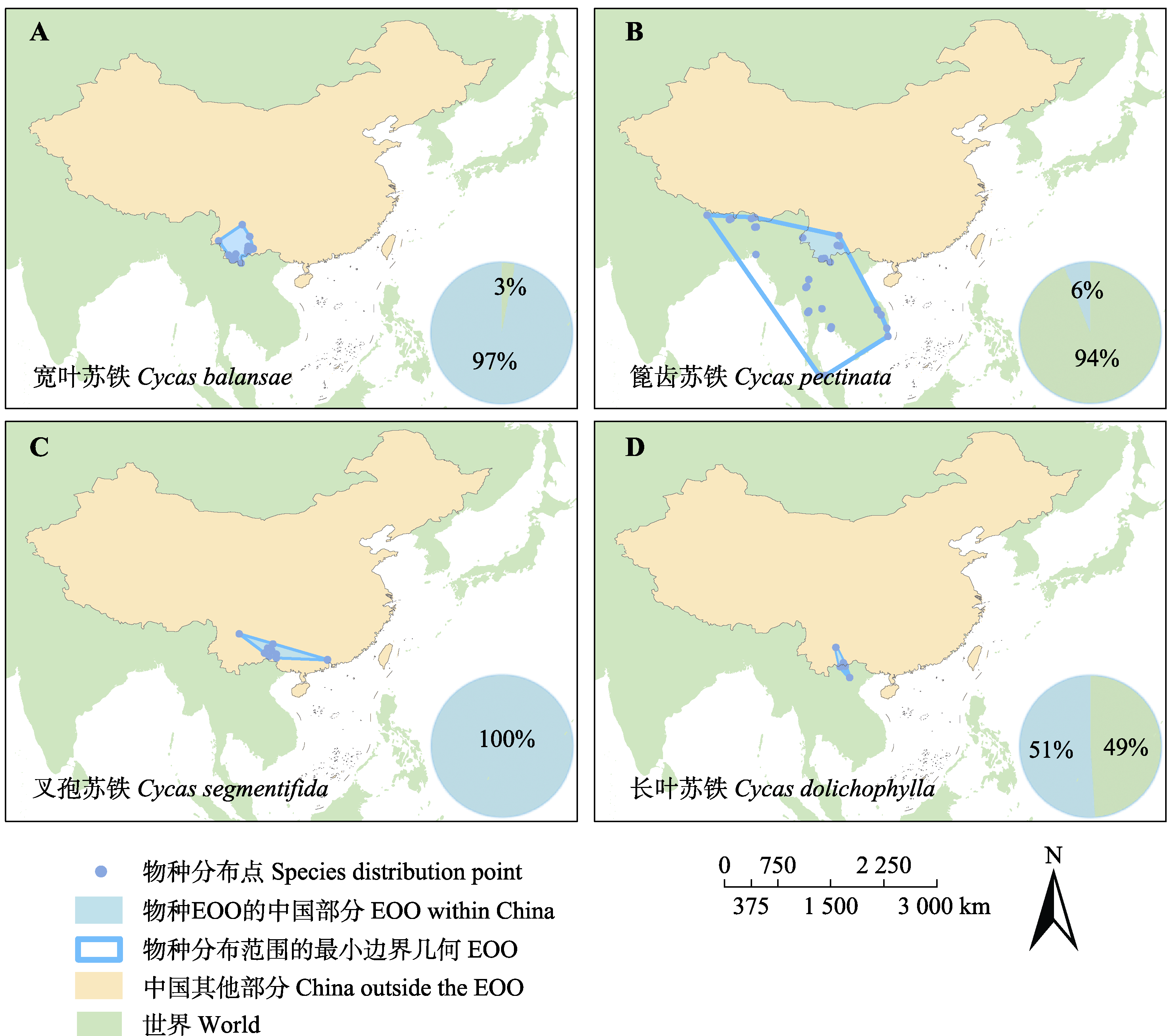
Fig. 4 Species distribution point, Extent of Occurrence (EOO) and the partition of EOO. The pie charts show the percentages of species EOO inside vs. outside of China, respectively.
| [1] | Allen D, Bilz M, Leaman D, Miller R, Timoshyna A, Window J (2014). European Red List of Medicinal Plants. Publications Office of the European Union, Luxembourg. |
| [2] |
Bachman SP, Brown MJM, Leão TCC, Nic Lughadha E, Walker BE (2024). Extinction risk predictions for the world’s flowering plants to support their conservation. New Phytologist, 242, 797-808.
DOI PMID |
| [3] |
Bachman SP, Field R, Reader T, Raimondo D, Donaldson J, Schatz GE,Nic Lughadha E (2019). Progress, challenges and opportunities for Red Listing. Biological Conservation, 234, 45-55.
DOI |
| [4] | Bilz M, Kell SP, Maxted N, Lansdown RV (2011). European Red List of Vascular Plants. Publications Office of the European Union, Luxembourg. |
| [5] |
Breiner FT, Bergamini A (2018). Improving the estimation of area of occupancy for IUCN Red List assessments by using a circular buffer approach. Biodiversity and Conservation, 27, 2443-2448.
DOI |
| [6] | Brooks TM, Pimm SL, Akçakaya HR, Buchanan GM, Butchart SHM, Foden W, Hilton-Taylor C, Hoffmann M, Jenkins CN, Joppa L, Li BV, Menon V, Ocampo-Peñuela N, Rondinini C (2019). Measuring Terrestrial Area of Habitat (AOH) and its utility for the IUCN Red List. Trends in Ecology & Evolution, 34, 977-986. |
| [7] |
Brown MJM, Walker BE, Black N, Govaerts RHA, Ondo I, Turner R,Nic Lughadha E (2023). rWCVP: a companion R package for the World Checklist of Vascular Plants. New Phytologist, 240, 1355-1365.
DOI PMID |
| [8] | Brummitt NA, Bachman SP, Griffiths-Lee J, Lutz M, Moat JF, Farjon A, Donaldson JS, Hilton-Taylor C, Meagher TR, Albuquerque S, Aletrari E, Andrews AK, Atchison G, Baloch E, Barlozzini B, et al. (2015). Green plants in the red: a baseline global assessment for the IUCN sampled red list index for plants. PLoS ONE, 10, e0135152. DOI: 10.1371/journal.pone.0135152. |
| [9] | Butchart SHM, Resit Akçakaya H, Chanson J, Baillie JEM, Collen B, Quader S, Turner WR, Amin R, Stuart SN, Hilton-Taylor C (2007). Improvements to the Red List Index. PLoS ONE, 2, e140. DOI: 10.1371/journal.pone. 0000140. |
| [10] | Butchart SHM, Stattersfield AJ, Bennun LA, Shutes SM, Akçakaya HR, Baillie JEM, Stuart SN, Hilton-Taylor C, Mace GM (2004). Measuring global trends in the status of biodiversity: red list indices for birds. PLoS Biology, 2, e383. DOI: 10.1371/journal.pbio.0020383. |
| [11] |
Butchart SHM, Walpole M, Collen B, van Strien A, Scharlemann JPW, Almond REA, Baillie JEM, Bomhard B, Brown C, Bruno J, Carpenter KE, Carr GM, Chanson J, Chenery AM, et al. (2010). Global biodiversity: indicators of recent declines. Science, 328, 1164-1168.
DOI PMID |
| [12] |
Cardoso P, Borges PAV, Triantis KA, Ferrández MA, Martín JL (2011). Adapting the IUCN Red List criteria for invertebrates. Biological Conservation, 144, 2432-2440.
DOI URL |
| [13] |
Cowell CR, Nic Lughadha E, Anderson PML, Leão T, Williams J, Annecke WA (2023). Prioritising species for monitoring in a South African protected area and the Red List for plants. Biodiversity and Conservation, 32, 119-137.
DOI |
| [14] |
Cui P, Xu HG, Wu J, Ding H, Cao MC, Lu XQ, Yong F, Chen B (2014). Assessing the Red List Index for vertebrate species in China. Biodiversity Science, 22, 589-595.
DOI |
|
[崔鹏, 徐海根, 吴军, 丁晖, 曹铭昌, 卢晓强, 雍凡, 陈冰 (2014). 中国脊椎动物红色名录指数评估. 生物多样性, 22, 589-595.]
DOI |
|
| [15] | Eastwood A, Lazkov G, Newton A (2009). The Red List of Trees of Central Asia. Fauna and Flora International, Cambridge, UK. |
| [16] | Edgar GJ (2025). IUCN Red List criteria fail to recognise most threatened and extinct species. Biological Conservation, 301, 110880. DOI: 10.1016/j.biocon.2024.110880. |
| [17] | Fu LG, Jin JM (1991). China Plant Red Data Book: Rare and Endangered Plants: Vol. 1. Science Press, Beijing. |
| [傅立国, 金鉴明 (1991). 中国植物红皮书——稀有濒危植物: 第一册. 科学出版社, 北京.] | |
| [18] | Gao ZW, Sun H (2021). Species Red List of Yunnan Province (2017). Yunnan Science and Technology Press, Kunming. |
| [高正文, 孙航 (2021). 云南省生物物种红色名录(2017版). 云南科技出版社, 昆明.] | |
| [19] | Gärdenfors U (2010). The 2010 Red List of Swedish Species. ArtDatabanken, Uppsala, Sweden. |
| [20] |
Han XM, Josse C, Young BE, Smyth RL, Hamilton HH, Bowles-Newark N (2017). Monitoring national conservation progress with indicators derived from global and national datasets. Biological Conservation, 213, 325-334.
DOI URL |
| [21] | Henriques S, Böhm M, Collen B, Luedtke J, Hoffmann M, Hilton-Taylor C, Cardoso P, Butchart SHM, Freeman R (2020). Accelerating the monitoring of global biodiversity: revisiting the sampled approach to generating Red List Indices. Conservation Letters, 13, e12703. DOI: 10.1111/conl.12703. |
| [22] |
Huang JH, Chen JH, Ying JS, Ma KP (2011). Features and distribution patterns of Chinese endemic seed plant species. Journal of Systematics and Evolution, 49, 81-94.
DOI URL |
| [23] | Huang LQ, Zhang BG, Qin HN (2022). Chinese Medicinal Plant Red Data Book. Beijing Science and Technology Press, Beijing. |
| [黄璐琦, 张本刚, 覃海宁 (2022). 中国药用植物红皮书. 北京科学技术出版社, 北京.] | |
| [24] | IUCN (2001). IUCN Red List Categories and Criteria, Version 3.1. 1st ed. Gland, Switzerland and Cambridge, UK. |
| [25] | IUCN (2012). IUCN Red List Categories and Criteria, Version 3.1. 2nd ed. Gland, Switzerland and Cambridge, UK. |
| [26] |
Jiang ZG, Jiang JP, Wang YZ, Zhang E, Zhang YY, Cai B (2020). Significance of country red lists of endangered species for biodiversity conservation. Biodiversity Science, 28, 558-565.
DOI |
|
[蒋志刚, 江建平, 王跃招, 张鹗, 张雁云, 蔡波 (2020). 国家濒危物种红色名录的生物多样性保护意义. 生物多样性, 28, 558-565.]
DOI |
|
| [27] |
Juslén A, Pykälä J, Kuusela S, Kaila L, Kullberg J, Mattila J, Muona J, Saari S, Cardoso P (2016). Application of the Red List Index as an indicator of habitat change. Biodiversity and Conservation, 25, 569-585.
DOI URL |
| [28] |
Keith DA, Mahony M, Hines H, Elith J, Regan TJ, Baumgartner JB, Hunter D, Heard GW, Mitchell NJ, Parris KM, Penman T, Scheele B, Simpson CC, Tingley R, Tracy CR, et al. (2014). Detecting extinction risk from climate change by IUCN Red List criteria. Conservation Biology, 28, 810-819.
DOI PMID |
| [29] | Kyrkjeeide MO, Pedersen B, Evju M, Magnussen K, Mair L, Bolam FC, McGowan PJK, Vestergaard KM, Braa J, Rusch G (2021). Bending the curve: Operationalizing national Red Lists to customize conservation actions to reduce extinction risk. Biological Conservation, 261, 109227. DOI: 10.1016/j.biocon.2021.109227. |
| [30] |
Li LP, Qin HN, Nic Lughadha E, Zheng YM, Wan HW, Plummer J, Howes MR, Liu HY, Jiang YM, Wang T, Zhao HH, Shen ZF, Huang HP (2023). Red list assessments of Chinese higher plants. International Journal of Digital Earth, 16, 2762-2775.
DOI URL |
| [31] |
Marsh CJ, Gavish Y, Kunin WE, Brummitt NA (2019). Mind the gap: Can downscaling Area of Occupancy overcome sampling gaps when assessing IUCN Red List status? Diversity and Distributions, 25, 1832-1845.
DOI URL |
| [32] | Meng JH, Cui Y, Luo A, Yang Y, Qin HN, Ma KP, Fang JY, Wang ZH (2024). Threat assessment of future climate change to China’s seed plants. Scientia Sinica (Vitae), 54, 751-765. |
| [孟佳慧, 崔宇, 罗奥, 杨永, 覃海宁, 马克平, 方精云, 王志恒 (2024). 未来气候变化情景下的中国种子植物受威胁等级评估. 中国科学: 生命科学, 54, 751-765.] | |
| [33] | Mi XC, Feng G, Hu YB, Zhang J, Chen L, Corlett RT, Hughes AC, Pimm S, Schmid B, Shi SH, Svenning JC, Ma KP (2021). The global significance of biodiversity science in China: an overview. National Science Review, 8, nwab032. DOI: 10.1093/nsr/nwab032. |
| [34] | Ministry of Ecology and Environment of the People’s Republic of China, Chinese Academy of Sciences (2023). Announcement on the Release of the “China Red List of Biodiversity—Vertebrates (2020)” and “China Red List of Biodiversity—Higher Plants (2020)”. [2025-04-29]. https://www.mee.gov.cn/xxgk2018/xxgk/xxgk01/202305/t20230522_1030745.html. |
| [中华人民共和国生态环境部, 中国科学院 (2023). 关于发布《中国生物多样性红色名录——脊椎动物卷(2020)》和《中国生物多样性红色名录——高等植物卷(2020)》的公告. [2025-04-29]. https://www.mee.gov.cn/xxgk2018/xxgk/xxgk01/202305/t20230522_1030745.html.] | |
| [35] | Ministry of Environmental Protection of the People’s Republic of China, Chinese Academy of Sciences (2013). Announcement on the Release of the “China Biodiversity Red List—Higher Plant Volume”. [2025-04-29]. https://www.mee.gov.cn/gkml/hbb/bgg/201309/t20130912_260061.htm. |
| [中华人民共和国环境保护部, 中国科学院 (2013). 关于发布《中国生物多样性红色名录——高等植物卷》的公告. [2025-04-29]. https://www.mee.gov.cn/gkml/hbb/bgg/201309/t20130912_260061.htm.] | |
| [36] |
Nic Lughadha E, Bachman SP, Leão TCC, Forest F, Halley JM, Moat J, Acedo C, Bacon KL, Brewer RFA, Gâteblé G, Gonçalves SC, Govaerts R, Hollingsworth PM, Krisai-Greilhuber I, de Lirio EJ, et al. (2020). Extinction risk and threats to plants and fungi. Plants, People, Planet, 2, 389-408.
DOI |
| [37] | Peng SJ, Luo Y, Cai HY, Zhang XL, Wang ZH (2022). A new list of threatened woody species in China under future global change scenarios. Biodiversity Science, 30, 21459. DOI: 10.17520/biods.2021459. |
| [彭莳嘉, 罗源, 蔡宏宇, 张晓玲, 王志恒 (2022). 全球变化情景下的中国木本植物受威胁物种名录. 生物多样性, 30, 21459. DOI: 10.17520/biods.2021459.] | |
| [38] |
Peng SJ, Shrestha N, Luo Y, Li YQ, Cai HY, Qin HN, Ma KP, Wang ZH (2023). Incorporating global change reveals extinction risk beyond the current Red List. Current Biology, 33, 3669-3678.
DOI URL |
| [39] |
Peng XJ, Zhao JC, Li L, Sun YZ, Niu YL, Guo XL (2008). Assessment of Hebei flora against the IUCN Red List Criteria in China. Frontiers of Biology in China, 3, 176-186.
DOI URL |
| [40] | Plant Data Center of Chinese Academy of Sciences (2023). Checklist of plant species in China (2023 Edition). DOI: 10.12282/plantdata.1390. |
| [中国科学院植物科学数据中心 (2023). 中国植物物种名录(2023版). DOI: 10.12282/plantdata.1390.] | |
| [41] | Raimondo D, Young BE, Brooks TM, Cardoso P, van der Colff D, de Souza Dias BF, Vercillo U, de Souza E, Juslén A, Hyvarinen E, von Staden L, Tolley K, McGowan PJK (2023). Using Red List Indices to monitor extinction risk at national scales. Conservation Science and Practice, 5, e12854. DOI: 10.1111/csp2.12854. |
| [42] |
Rueda-Cediel P, Anderson KE, Regan TJ, Regan HM (2018). Effects of uncertainty and variability on population declines and IUCN Red List classifications. Conservation Biology, 32, 916-925.
DOI PMID |
| [43] |
Saiz JCM, Lozano FD, Gómez MM, Baudet ÁB (2015). Application of the Red List Index for conservation assessment of Spanish vascular plants. Conservation Biology, 29, 910-919.
DOI PMID |
| [44] |
Visconti P, Bakkenes M, Baisero D, Brooks T, Butchart SHM, Joppa L, Alkemade R, Di Marco M, Santini L, Hoffmann M, Maiorano L, Pressey RL, Arponen A, Boitani L, Reside AE, et al. (2016). Projecting global biodiversity indicators under future development scenarios. Conservation Letters, 9, 5-13.
DOI URL |
| [45] | Walker BE, Leão TCC, Bachman SP, Bolam FC,Nic Lughadha E (2020). Caution needed when predicting species threat status for conservation prioritization on a global scale. Frontiers in Plant Science, 11, 520. DOI: 10.3389/fpls. 2020.00520. |
| [46] | Wang S, Xie Y (2004). China Species Red List Vol. 1: Red List. Higher Education Press, Beijing. |
| [汪松, 解焱 (2004). 中国物种红色名录第一卷: 红色名录. 高等教育出版社, 北京.] | |
| [47] | Williams BA, Watson JEM, Butchart SHM, Ward M, Brooks TM, Butt N, Bolam FC, Stuart SN, Mair L, McGowan PJK, Gregory R, Hilton-Taylor C, Mallon D, Harrison I, Simmonds JS (2021). A robust goal is needed for species in the Post-2020 Global Biodiversity Framework. Conservation Letters, 14, e12778. DOI: 10.1111/conl. 12778. |
| [48] |
Williams VL, Victor JE, Crouch NR (2013). Red listed medicinal plants of South Africa: status, trends, and assessment challenges. South African Journal of Botany, 86, 23-35.
DOI URL |
| [49] | Xi HH, Wang YQ, Pan YZ, Xu T, Zhan QQ, Liu J, Feng XY, Gong X (2022). Resources and protection of Cycas plants in China. Biodiversity Science, 30, 21495. DOI: 10.17520/biods.2021495. |
| [席辉辉, 王祎晴, 潘跃芝, 许恬, 湛青青, 刘健, 冯秀彦, 龚洵 (2022). 中国苏铁属植物资源和保护. 生物多样性, 30, 21495. DOI: 10.17520/biods.2021495.] | |
| [50] | Xie Y (2022). Progress and application of IUCN Red List of Threatened Species. Biodiversity Science, 30, 22445. DOI: 10.17520/biods.2022445. |
| [解焱 (2022). IUCN受威胁物种红色名录进展及应用. 生物多样性, 30, 22445. DOI: 10.17520/biods.2022445.] | |
| [51] | Zhang JL (2023). LPSC: tools for searching list of plant species in China. [2025-04-29]. https://github.com/helixcn/LPSC. |
| [52] | Zhang M, Gao JX (2016). Analysis of biodiversity variation trend in China. Environmental Protection Science, 42(6), 85-91. |
| [张明, 高吉喜 (2016). 中国生物多样性变化趋势分析. 环境保护科学, 42(6), 85-91.] |
| [1] | MA Jian-Hui, TONG Xin, ZHANG Si-Rong, MAO Zi-Kun, QIN Jun, MA Ke-Ping. Research advances and perspectives on physiological and ecological functions of mycorrhizal fungi [J]. Chin J Plant Ecol, 2026, 50(3): 498-514. |
| [2] | MA Fu-Long, WANG Yu-Qing, HAO Yu, DUAN Ji-Chao, LIU Fei-Fei, XI Lin-Qiao, HAN Lu. Effects of altitude gradient on plant and soil microbial community structure and diversity in the middle part of the northern slope of the Kunlun Mountains, China [J]. Chin J Plant Ecol, 2025, 49(5): 732-747. |
| [3] | WU Yan-Ning, HAO Min-Hui, HE Huai-Jiang, ZHANG Chun-Yu, ZHAO Xiu-Hai. Relationships between functional diversity and aboveground carbon sink functions and their changes with forest succession in Changbai Mountains, China [J]. Chin J Plant Ecol, 2025, 49(2): 232-243. |
| [4] | QIU Dan-Ni, PENG Qing-Qing, ZHANG Hui-Ling, WEN Hui-Hui, WU Fu-Zhong. Seasonal effects of typical canopy tree species on ant community dynamics in mid-subtropical evergreen broadleaf forests [J]. Chin J Plant Ecol, 2025, 49(11): 1805-1816. |
| [5] | GUO Huan-Min, SHEN Xiao-Xue, LI Rui-Li. Species co-occurrence and distribution probability in Futian Mangrove Nature Reserve of Shenzhen Bay [J]. Chin J Plant Ecol, 2025, 49(11): 1833-1843. |
| [6] | GAO Yu-Xuan, SU Yan-Jun, FENG Yu-Cai, ZHANG Jun, WANG Xiao-Quan, LIU Ling-Li. Research and conservation status of the rare and endangered relict plant Cathaya argyrophylla [J]. Chin J Plant Ecol, 2025, 49(10): 1572-1582. |
| [7] | HE Yi, ZHOU Jing, CHEN Chen, FANG Ting-Zhou, SU Jian, GAO Hao-Jie, CAO Jia-Hao, YANG Fei-Yu, FAN Qi-Bo, ZHU Le-Yao, CHEN Yi-Ming, YANG Fei, WANG Yi-Teng, FENG Lei, LIU Fei, LIANG Shuang, JIANG Ming-Kai, CHEN Jun, ZHAO Yun-Peng, CHEN Wei-Le, ZHAO Ying, HUANG Jian-Guo. Protection and restoration of endangered tree species on coastal islands of Zhejiang, China [J]. Chin J Plant Ecol, 2025, 49(10): 1583-1599. |
| [8] | ZHANG Zhong-Yang, SONG Xi-Qiang, REN Ming-Xun, ZHANG Zhe. Ecological functions of vascular epiphytes in habitat construction [J]. Chin J Plant Ecol, 2023, 47(7): 895-911. |
| [9] | YANG Jia-Rong, DAI Dong, CHEN Jun-Fang, WU Xian, LIU Xiao-Lin, LIU Yu. Insight into recent studies on the diversity of arbuscular mycorrhizal fungi in shaping plant community assembly and maintaining rare species [J]. Chin J Plant Ecol, 2023, 47(6): 745-755. |
| [10] | LI Yao-Qi, WANG Zhi-Heng. Functional biogeography of plants: research progresses and challenges [J]. Chin J Plant Ecol, 2023, 47(2): 145-169. |
| [11] | MA He-Ping, WANG Rui-Hong, QU Xing-Le, YUAN Min, MU Jin-Yong, LI Jin-Hang. Effects of different habitats on the diversity and biomass of ground moss in the southeast Xizang, China [J]. Chin J Plant Ecol, 2022, 46(5): 552-560. |
| [12] | TIAN Jia-Yu, WANG Bin, ZHANG Zhi-Ming, LIN Lu-Xiang. Application of spectral diversity in plant diversity monitoring and assessment [J]. Chin J Plant Ecol, 2022, 46(10): 1129-1150. |
| [13] | LI Xiao-Long, ZHOU Jun, PENG Fei, ZHONG Hong-Tao, Hans LAMBERS. Temporal trends of plant nutrient-acquisition strategies with soil age and their ecological significance [J]. Chin J Plant Ecol, 2021, 45(7): 714-727. |
| [14] | SUN Hao-Zhe, WANG Xiang-Ping, ZHANG Shu-Bin, WU Peng, YANG Lei. Abiotic and biotic modulators of litterfall production and its temporal stability during the succession of broad-leaf and Korean pine mixed forest [J]. Chin J Plant Ecol, 2021, 45(6): 594-605. |
| [15] | LI Zhou-Yuan, YE Xiao-Zhou, WANG Shao-Peng. Ecosystem stability and its relationship with biodiversity [J]. Chin J Plant Ecol, 2021, 45(10): 1127-1139. |
| Viewed | ||||||
|
Full text |
|
|||||
|
Abstract |
|
|||||
Copyright © 2026 Chinese Journal of Plant Ecology
Tel: 010-62836134, 62836138, E-mail: apes@ibcas.ac.cn, cjpe@ibcas.ac.cn

