
Chin J Plant Ecol ›› 2025, Vol. 49 ›› Issue (10): 1572-1582.DOI: 10.17521/cjpe.2024.0476 cstr: 32100.14.cjpe.2024.0476
Special Issue: 虚拟专辑 | 濒危植物多样性与保护
• Reviews • Previous Articles Next Articles
GAO Yu-Xuan1,3,4( ), SU Yan-Jun1,3,4, FENG Yu-Cai5, ZHANG Jun6, WANG Xiao-Quan2,3,4, LIU Ling-Li1,3,4,*()(
 )
)
Received:2024-12-31
Accepted:2025-03-04
Online:2025-10-20
Published:2025-11-20
Contact:
LIU Ling-Li
Supported by:GAO Yu-Xuan, SU Yan-Jun, FENG Yu-Cai, ZHANG Jun, WANG Xiao-Quan, LIU Ling-Li. Research and conservation status of the rare and endangered relict plant Cathaya argyrophylla[J]. Chin J Plant Ecol, 2025, 49(10): 1572-1582.
Add to citation manager EndNote|Ris|BibTeX
URL: https://www.plant-ecology.com/EN/10.17521/cjpe.2024.0476
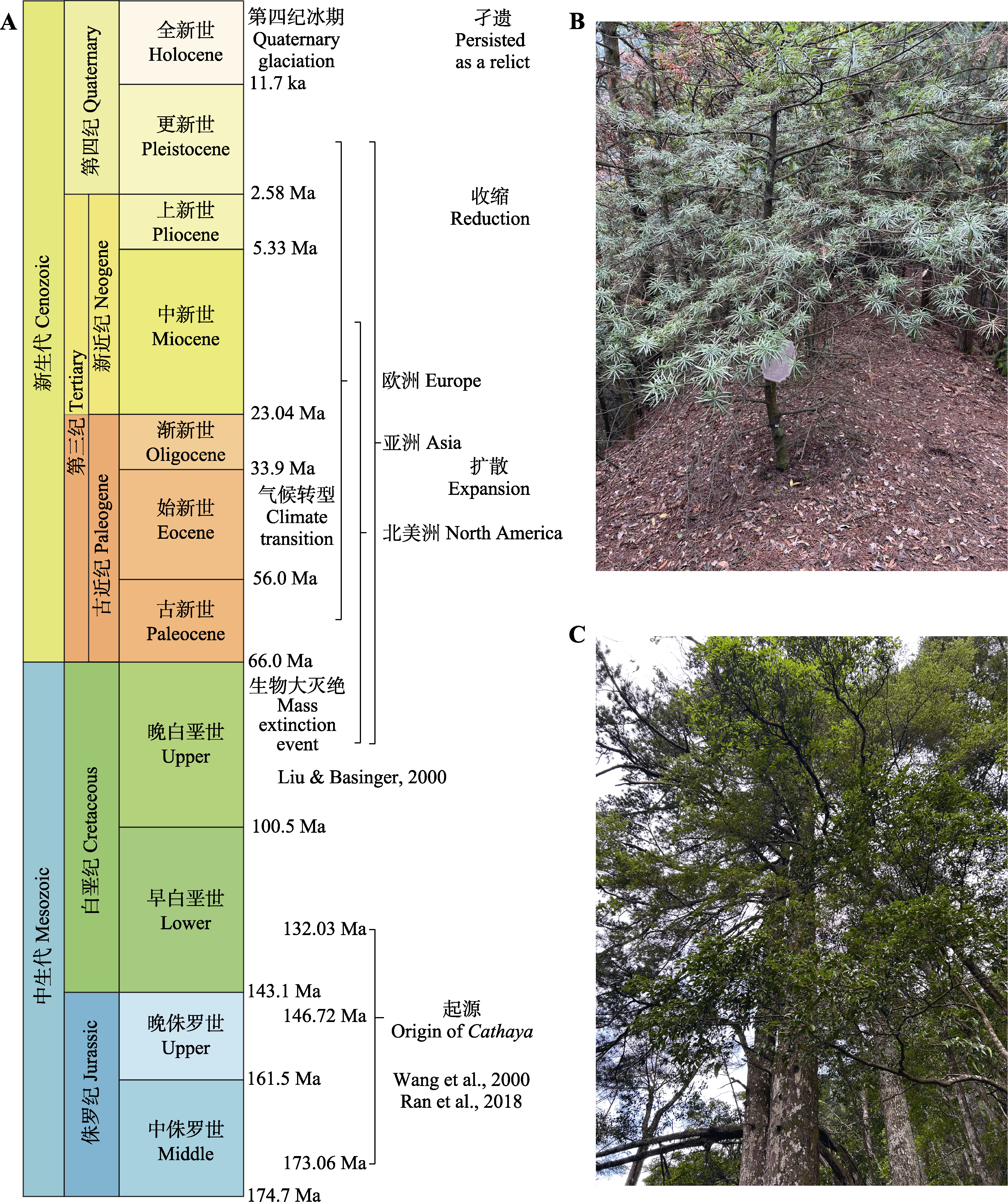
Fig. 1 Origin, expansion and reduction of Cathaya. A, Historical dynamics of Cathaya. B, A Cathaya argyrophylla sapling located at Laolongdong, Jinfoshan National Nature Reserve, Chongqing. C, A close look at the world’s largest C. argyrophylla located at Dayaoshan National Nature Reserve, Guangxi.
| 分布区 Distribution area | 保护区 Nature reserve (NR) | 总个体数 Total abundance | 幼苗株数 Number of seedlings | 数据来源 Data source |
|---|---|---|---|---|
| 大娄山 Dalou Mts. | 大沙河国家级自然保护区 Dashahe National NR | 866 | 197 (H < 1 m) | 大沙河国家级自然保护区 Dashahe National NR |
| 金佛山国家级自然保护区 Jinfoshan National NR | 562 | 153 (H < 1 m) | 金佛山国家级自然保护区 Jinfoshan National NR | |
| 白马山市级自然保护区 Baimashan Municipal NR | 303 | 244 (H < 5 m) | Guan & Chen, | |
| 柏箐市级自然保护区 Baiqing Municipal NR | 10 | 实地考察 Field investigation | ||
| 八面山 Bamian Mts. | 八面山国家级自然保护区 Bamianshan National NR | 406 | 271 (D < 6 cm) | Han et al., |
| 桃源洞国家级自然保护区 Taoyuandong National NR | 60 | 桃源洞国家级自然保护区 Taoyuandong National NR | ||
| 越城岭 Yuecheng Mts. | 舜皇山国家级自然保护区 Shunhuangshan National NR | 22 | 实地考察 Field investigation | |
| 花坪国家级自然保护区 Huaping National NR | 124 | 花坪国家级自然保护区 Huaping National NR | ||
| 大瑶山 Dayao Mts. | 大瑶山国家级自然保护区 Dayaoshan National NR | 104 | 大瑶山国家级自然保护区 Dayaoshan National NR | |
| 总计 Total | 2 457 |
Table 1 Population size of the existing wild populations of Cathaya argyrophylla
| 分布区 Distribution area | 保护区 Nature reserve (NR) | 总个体数 Total abundance | 幼苗株数 Number of seedlings | 数据来源 Data source |
|---|---|---|---|---|
| 大娄山 Dalou Mts. | 大沙河国家级自然保护区 Dashahe National NR | 866 | 197 (H < 1 m) | 大沙河国家级自然保护区 Dashahe National NR |
| 金佛山国家级自然保护区 Jinfoshan National NR | 562 | 153 (H < 1 m) | 金佛山国家级自然保护区 Jinfoshan National NR | |
| 白马山市级自然保护区 Baimashan Municipal NR | 303 | 244 (H < 5 m) | Guan & Chen, | |
| 柏箐市级自然保护区 Baiqing Municipal NR | 10 | 实地考察 Field investigation | ||
| 八面山 Bamian Mts. | 八面山国家级自然保护区 Bamianshan National NR | 406 | 271 (D < 6 cm) | Han et al., |
| 桃源洞国家级自然保护区 Taoyuandong National NR | 60 | 桃源洞国家级自然保护区 Taoyuandong National NR | ||
| 越城岭 Yuecheng Mts. | 舜皇山国家级自然保护区 Shunhuangshan National NR | 22 | 实地考察 Field investigation | |
| 花坪国家级自然保护区 Huaping National NR | 124 | 花坪国家级自然保护区 Huaping National NR | ||
| 大瑶山 Dayao Mts. | 大瑶山国家级自然保护区 Dayaoshan National NR | 104 | 大瑶山国家级自然保护区 Dayaoshan National NR | |
| 总计 Total | 2 457 |
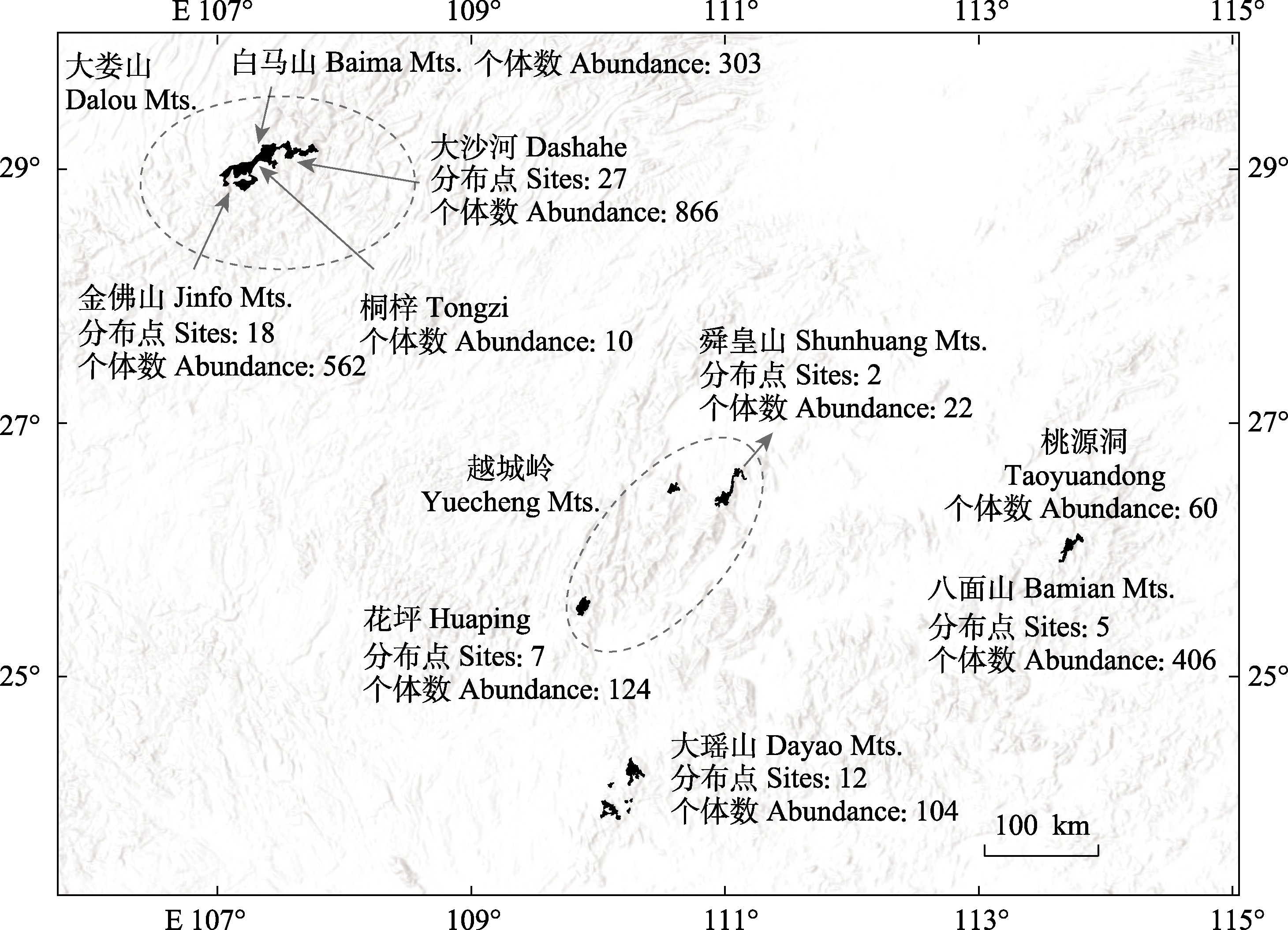
Fig. 2 Geographic distribution of the existing wild populations of Cathaya argyrophylla.
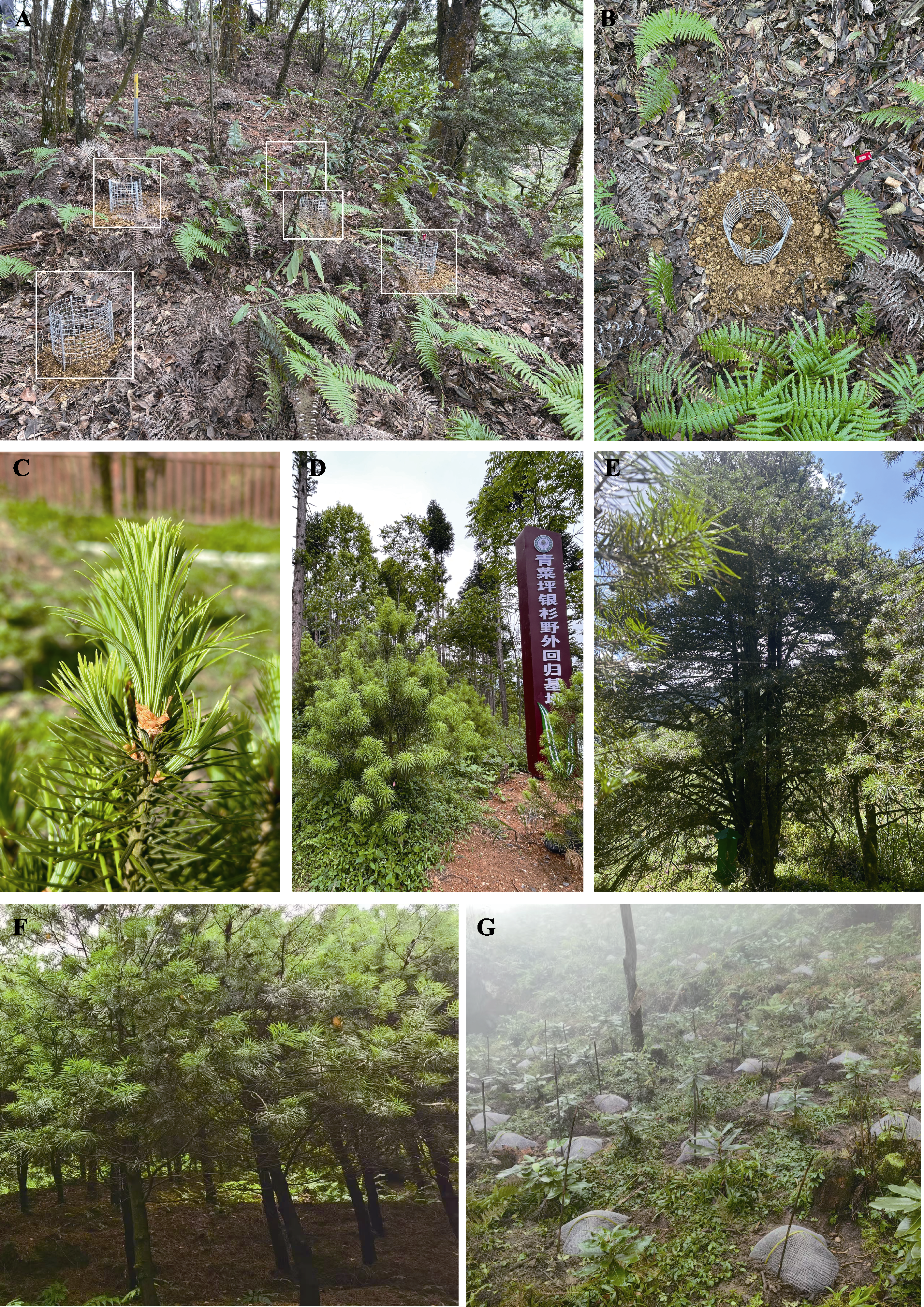
Fig. 3 In situ and ex situ conservation of Cathaya argyrophylla. A, B, In situ conservation of C. argyrophylla seedlings at Zengziyan, Dashahe National Nature Reserve, Guizhou. C, Seedlings cultured at Jinfoshan National Nature Reserve, Chongqing. D, Young tree cultured at Qingcaiping, Dashahe National Nature Reserve, Guizhou. E, Mature tree cultured at Hongtan, Huaping National Nature Reserve, Guangxi. F, C. argyrophylla forest planted in Langshan, Xinning, Hunan. G, Transplanting experiment conducted in Longchi, West China Subalpine Botanical Garden.
| [1] | Cao JW, Liu CL, Zhang B, Wu Y, Zhu L, Liu G, Li SC (2010). Seed germination of endangered Cathaya argyrophylla Chun & Kuang. Acta Ecologica Sinica, 30, 4027-4034. |
| [曹基武, 刘春林, 张斌, 吴毅, 朱玲, 刘国, 李双春 (2010). 珍稀植物银杉的种子萌发特性. 生态学报, 30, 4027-4034.] | |
| [2] | Chun WY, Kuang KZ (1958). Новый род Pinaceae Cаthаya Chun et Kuang gen. nov. из южного и западного Китая Botanicheskii Zhurnal, 43, 461-470. |
| [3] | Chun WY, Kuang KZ (1962). De genere Cathaya Chun et Kuang. Acta Botanica Sinica, 10, 245-246. |
| [陈焕镛, 匡可任 (1962). 银杉——我国特产的松柏类植物. 植物学报, 10, 245-246.] | |
| [4] | Fan DY, Wang XP, Zhang WF, Zhang XY, Zhang SR, Xie ZQ (2020). Does Cathaya argyrophylla, an ancient and threatened Pinaceae species endemic to China, show eco-physiological outliers to its Pinaceae relatives? Conservation Physiology, 8, coaa094. DOI: 10.1093/ conphys/coaa094. |
| [5] | Fan DY, Zhang WF, Chen ZG, Xie ZQ (2005). Acclimation of Cathaya argyrophylla to light across a gradient of canopy openness. Acta Phytoecologica Sinica, 29, 713-723. |
|
[樊大勇, 张旺峰, 陈志刚, 谢宗强 (2005). 沿林冠开度梯度的银杉幼树对光的适应性. 植物生态学报, 29, 713-723.]
DOI |
|
| [6] | Feng YC, Cheng ZJ, Jiang L, Han JH, Gou W, Feng MQ, Wang Y, Li QM (2023). Study on the direct seeding afforestation technology of Chinese endemic plant Cathaya argyrophylla. Chinese Wild Plant Resources, 42(10), 7-12. |
| [冯育才, 程泽佳, 江龙, 韩继怀, 勾伟, 冯明桥, 王尤, 李乔明 (2023). 中国特有植物银杉直播造林技术研究. 中国野生植物资源, 42(10), 7-12.] | |
| [7] | Feng YC, Han JH, An MT, Xu Q, Tang C (2024). Research on Cathaya argyrophylla in Dashahe, Guizhou I. Guizhou Science and Technology Publishing House, Guiyang. 315-320, 330-333. |
| [冯育才, 韩继怀, 安明态, 徐钦, 唐昶 (2024). 贵州大沙河银杉研究I. 贵州科技出版社, 贵阳. 315-320, 330-333.] | |
| [8] | Fu LG, Cheng SZ (1981). Discovery and nomenclature of Cathaya argyrophylla. Plants, (4), 42-43. |
| [傅立国, 程树志 (1981). 银杉的发现及命名. 植物杂志, (4), 42-43.] | |
| [9] | Ge S, Hong DY, Wang HQ, Liu ZY, Zhang CM (1998). Population genetic structure and conservation of an endangered conifer, Cathaya argyrophylla (Pinaceae). International Journal of Plant Sciences, 159, 351-357. |
| [10] | Guan ZT, Chen Y (1986). A priliminary study on the Cathaya mixed forest in Jinfoshan, Sichuan. Acta Botanica Sinica, 28, 646-656. |
| [管中天, 陈尧 (1986). 四川金佛山银杉混交林的初步研究. 植物学报, 28, 646-656.] | |
| [11] | Han WB, Gao RD, Wang Y (2018). Characteristics in quantity and growth pattern of Cathaya argyrophylla population in Bamianshan Reserve of Hunan. Shaanxi Forest Science and Technology, 46(4), 1-5. |
| [韩文斌, 高瑞东, 王杨 (2018). 湖南八面山保护区银杉的种群数量和生长特征. 陕西林业科技, 46(4), 1-5.] | |
| [12] | Huang HY (2006). Studies on Cathaya argyrophylla Pest Ecological Management. Master degree dissertation, Guangxi Normal University, Guilin, Guangxi. |
| [黄华艳 (2006). 银杉有害生物的生态调控研究. 硕士学位论文, 广西师范大学, 广西桂林.] | |
| [13] |
Kuzmina OB, Nikitenko BL (2024). First findings of fossil pollen of ancestor forms of Cathaya conifers, a modern relic, and a climate indicator in the Paleogene and Neogene of West Siberia (Kulunda). Doklady Earth Sciences, 518, 1709-1716.
DOI |
| [14] | Li QM, Xie ZQ, Zhu RG (1997). The cone and seed output characteritics of endemic and endangered species Cathaya argyrophylla. Seed, 16(2), 1-3. |
| [李庆梅, 谢宗强, 朱日光 (1997). 我国特有濒危植物银杉的球果特征与出种量. 种子, 16(2), 1-3.] | |
| [15] | Li QM, Zhang YY, Feng YC, Gou W, Feng MQ, Han JH, Jiang L (2019). Growth research on Cathaya argyrophylla in different growth years. Seed, 38(1), 90-93. |
| [李乔明, 张耀尹, 冯育才, 勾伟, 冯明桥, 韩继怀, 江龙 (2019). 银杉播种苗木不同年份生长量研究. 种子, 38(1), 90-93.] | |
| [16] | Li RG, Huang ZF, Shi JH (1981). Investigation and study on the ecological environment of Cathaya argyrophylla. Guihaia, 1(1), 12-17. |
| [李瑞高, 黄正福, 石金华 (1981). 银杉生态环境的调查研究. 广西植物, 1(1), 12-17.] | |
| [17] | Liu QX (1991). Several fundamental issues in saving the national treasure—Cathaya argyrophylla. Hunan Forestry Science & Technology, 18(1), 39-41. |
| [刘起衔 (1991). 抢救国宝——银杉的几个根本问题. 湖南林业科技, 18(1), 39-41.] | |
| [18] |
Liu YS, Basinger JF (2000). Fossil Cathaya (Pinaceae) pollen from the Canadian High Arctic. International Journal of Plant Sciences, 161, 829-847.
DOI URL |
| [19] | Ma JS, He R, Wei Y (2022). China: Mother of Gardens, in the Twenty-first Century: Volume 1: Chapter III. China Forestry Publishing House, Beijing. |
| [马金双, 贺然, 魏钰 (2022). 中国: 二十一世纪的园林之母: 第一卷: 第三章. 中国林业出版社, 北京.] | |
| [20] |
Manchester SR, Chen ZD, Lu AM, Uemura K (2009). Eastern Asian endemic seed plant genera and their paleogeographic history throughout the Northern Hemisphere. Journal of Systematics and Evolution, 47, 1-42.
DOI |
| [21] | Mao ZZ (1989). Cathaya argyrophylla, an endemic tree of China, its resources, distribution and environment. Guihaia, 9(1), 1-11. |
| [毛宗铮 (1989). 我国特有植物银杉的资源、分布及其环境. 广西植物, 9(1), 1-11.] | |
| [22] |
Qian SH, Yang YC, Tang CQ, Momohara A, Yi SR, Ohsawa M (2016). Effective conservation measures are needed for wild Cathaya argyrophylla populations in China: insights from the population structure and regeneration characteristics. Forest Ecology and Management, 361, 358-367.
DOI URL |
| [23] |
Ran JH, Shen TT, Wu H, Gong X, Wang XQ (2018). Phylogeny and evolutionary history of Pinaceae updated by transcriptomic analysis. Molecular Phylogenetics and Evolution, 129, 106-116.
DOI URL |
| [24] | Su LY, Zhao WY, Zhang JJ, Yang YP, Guo YF, Fan Q, Liao WB (2016). Analyses on community characteristics and its relict and conservation of Cathaya argyrophylla at Bamianshan in Hunan Province. Journal of Plant Resources and Environment, 25(4), 76-86. |
| [苏乐怡, 赵万义, 张记军, 杨玉鹏, 郭远飞, 凡强, 廖文波 (2016). 湖南八面山银杉群落特征及其残遗性和保守性分析. 植物资源与环境学报, 25(4), 76-86.] | |
| [25] |
Sun JJ, Xia XM, Wei XX, Wang XQ (2023). Tracing the geographic origin of endangered plant species using transcriptome-derived SNPs: an example of Cathaya argyrophylla. Molecular Ecology Resources, 23, 844-854.
DOI URL |
| [26] | Sun X (2006). Establishment of in Vitro Plantlet Regeneration, Mycorrhiza-like Structures of Cathaya argyrophylla and Mycorrhization of Abies chensiensis. Master degree dissertation, Northeast Forestry University, Harbin. |
| [孙雪 (2006). 银杉再生体系、拟菌根诱导系及秦岭冷杉菌根诱导系的建立. 硕士学位论文, 东北林业大学, 哈尔滨.] | |
| [27] | Tang SH, Sun M (1994). Studies on seed germination of Cathaya argyrophyllaby orthogonal test. Journal of Guizhou University (Natural Science), 11(2), 106-110. |
| [汤绍虎, 孙敏 (1994). 银杉种子萌发的多因子正交试验. 贵州大学学报(自然科学版), 11(2), 106-110.] | |
| [28] | Wang HW (2006). A Phylogeographic Study of Cathaya argyrophylla. PhD dissertation, Institute of Botany, Chinese Academy of Sciences, Beijing. |
| [王红卫 (2006). 银杉的分子谱系地理学研究. 博士学位论文, 中国科学院植物研究所, 北京.] | |
| [29] |
Wang XQ, Han Y, Hong DY (1998). A molecular systematic study of Cathaya, a relic genus of the Pinaceae in China. Plant Systematics and Evolution, 213, 165-172.
DOI URL |
| [30] |
Wang XQ, Tank DC, Sang T (2000). Phylogeny and divergence times in Pinaceae: evidence from three genomes. Molecular Biology and Evolution, 17, 773-781.
PMID |
| [31] | Wang XQ, Zou YP, Zhang DM, Hong DY, Liu ZY (1996). Genetic diversity analysis by RAPD in Cathaya argyrophylla Chun et Kuang. Science in China Series C: Life Sciences, 26, 436-441. |
| [汪小全, 邹喻苹, 张大明, 洪德元, 刘正宇 (1996). 银杉遗传多样性的RAPD分析. 中国科学C辑: 生命科学, 26, 436-441.] | |
| [32] | Wang ZS (2011). A Study on Population Genetic Structure and Inbreeding Depression of Cathaya argyrophylla. PhD dissertation, Institute of Botany, Chinese Academy of Sciences, Beijing. |
| [王兆山 (2011). 银杉的群体遗传结构和近交衰退. 博士学位论文, 中国科学院植物研究所, 北京.] | |
| [33] | Xie Q, Tan HM, Li CC, Luo G, Huang M (1998). The demography and analysis of distribution of Cathaya argyrophylla population in Guangxi. Journal of Guangxi Normal University (Natural Science Edition), 16(4), 68-74. |
| [谢强, 谭海明, 李长春, 罗钢, 黄明 (1998). 广西银杉种群的数量和分布格局分析. 广西师范大学学报(自然科学版), 16(4), 68-74.] | |
| [34] | Xie ZQ (1995). Research on Cathaya argyrophylla, a Chinese endemic plant. Chinese Biodiversity, 3(2), 99-103. |
| [谢宗强 (1995). 中国特有植物银杉及其研究. 生物多样性, 3(2), 99-103.] | |
| [35] | Xie ZQ (1999). Gap regeneration of Cathaya argyrophylla forests. Acta Ecologica Sinica, 19, 775-779. |
| [谢宗强 (1999). 银杉(Cathaya argyrophylla)林林窗更新的研究. 生态学报, 19, 775-779.] | |
| [36] | Xie ZQ, Chen WL (1999). The endangering causes and preserving strategies for Cathaya argyrophylla, a plant endemic to China. Acta Phytoecologica Sinica, 23, 1-7. |
| [谢宗强, 陈伟烈 (1999). 中国特有植物银杉的濒危原因及保护对策. 植物生态学报, 23, 1-7.] | |
| [37] | Xie ZQ, Chen WL, Hu D, Zhu RG (1998). The fruiting characteristics of an endangered plant, Cathaya argyrophylla and the impact of animals on fruits. Acta Phytoecologica Sinica, 22, 319-326. |
| [谢宗强, 陈伟烈, 胡东, 朱日光 (1998). 濒危植物银杉的结实特性及动物对果实的危害性. 植物生态学报, 22, 319-326.] | |
| [38] | Xie ZQ, Chen WL, Liu ZY, Jiang MX, Huang HD (1999a). Spatial distribution pattern of Cathaya argyrophylla population. Acta Botanica Sinica, 41, 95-101. |
| [谢宗强, 陈伟烈, 刘正宇, 江明喜, 黄汉东 (1999a). 银杉种群的空间分布格局. 植物学报, 41, 95-101.] | |
| [39] | Xie ZQ, Chen WL, Lu P, Hu D (1999b). The demography and age structure of the endangered plant population of Cathaya argyrophylla. Acta Ecologica Sinica, 19, 523-528. |
| [谢宗强, 陈伟烈, 路鹏, 胡东 (1999b). 濒危植物银杉的种群统计与年龄结构. 生态学报, 19, 523-528.] | |
| [40] | Xie ZQ, Chen WL, Lu P, Liu ZY, Tan HM (1999c). Growth and population biomass of Cathaya argyrophylla. Acta Phytoecologica Sinica, 23, 536-543. |
| [谢宗强, 陈伟烈, 路鹏, 刘正宇, 谭海明 (1999c). 银杉单株生长规律与种群生物量的研究. 植物生态学报, 23, 536-543.] | |
| [41] | Xie ZQ, Li QM (2000). Seed characteristics of endangered plant Cathaya argyrophylla. Acta Phytoecologica Sinica, 24, 82-86. |
| [谢宗强, 李庆梅 (2000). 濒危植物银杉种子特性的研究. 植物生态学报, 24, 82-86.] | |
| [42] |
Zhang WF, Fan DY, Xie ZQ, Jiang XH (2005). The seasonal photosynthetic responses of seedlings of the endangered plant Cathaya argyrophylla to different growth light environments. Biodiversity Science, 13, 387-397.
DOI URL |
| [张旺锋, 樊大勇, 谢宗强, 蒋晓晖 (2005). 濒危植物银杉幼树对生长光强的季节性光合响应. 生物多样性, 13, 387-397.] | |
| [43] | Zhang XF, Wang YJ, Wang YQ, Guo P, Liu CX, Zheng PL (2011). Characteristics of photosynthetic and transpiration of Cathaya argyrophylla Chun et Kuang leaves. Acta AgriculturaeBoreali-Sinica, 26(S2), 75-79. |
|
[张向峰, 王玉杰, 王云琦, 郭平, 刘春霞, 郑培龙 (2011). 银杉的光合特性. 华北农学报, 26(S2), 75-79.]
DOI |
| [1] | MA Jian-Hui, TONG Xin, ZHANG Si-Rong, MAO Zi-Kun, QIN Jun, MA Ke-Ping. Research advances and perspectives on physiological and ecological functions of mycorrhizal fungi [J]. Chin J Plant Ecol, 2026, 50(3): 498-514. |
| [2] | MA Fu-Long, WANG Yu-Qing, HAO Yu, DUAN Ji-Chao, LIU Fei-Fei, XI Lin-Qiao, HAN Lu. Effects of altitude gradient on plant and soil microbial community structure and diversity in the middle part of the northern slope of the Kunlun Mountains, China [J]. Chin J Plant Ecol, 2025, 49(5): 732-747. |
| [3] | WU Yan-Ning, HAO Min-Hui, HE Huai-Jiang, ZHANG Chun-Yu, ZHAO Xiu-Hai. Relationships between functional diversity and aboveground carbon sink functions and their changes with forest succession in Changbai Mountains, China [J]. Chin J Plant Ecol, 2025, 49(2): 232-243. |
| [4] | QIU Dan-Ni, PENG Qing-Qing, ZHANG Hui-Ling, WEN Hui-Hui, WU Fu-Zhong. Seasonal effects of typical canopy tree species on ant community dynamics in mid-subtropical evergreen broadleaf forests [J]. Chin J Plant Ecol, 2025, 49(11): 1805-1816. |
| [5] | GUO Huan-Min, SHEN Xiao-Xue, LI Rui-Li. Species co-occurrence and distribution probability in Futian Mangrove Nature Reserve of Shenzhen Bay [J]. Chin J Plant Ecol, 2025, 49(11): 1833-1843. |
| [6] | ZHANG Zi-Rui, ZHOU Jing, HU Yan-Ping, LIANG Shuang, MA Yong-Peng, CHEN Wei-Le. Root-associated fungal communities of the critically endangered plant Pinus squamata [J]. Chin J Plant Ecol, 2025, 49(10): 1600-1611. |
| [7] | LI Li-Ping, YU Kun, CHEN Fang-Miao, CHEN Qiang, JING Yu-Hang, NIU Zhen-Guo, HU Chen-Lu, QIN Hai-Ning, HUANG Hui-Ping, TIAN Yi-Chen. Red List Index of Chinese higher plants based on IUCN global assessment data [J]. Chin J Plant Ecol, 2025, 49(10): 1612-1625. |
| [8] | HE Yi, ZHOU Jing, CHEN Chen, FANG Ting-Zhou, SU Jian, GAO Hao-Jie, CAO Jia-Hao, YANG Fei-Yu, FAN Qi-Bo, ZHU Le-Yao, CHEN Yi-Ming, YANG Fei, WANG Yi-Teng, FENG Lei, LIU Fei, LIANG Shuang, JIANG Ming-Kai, CHEN Jun, ZHAO Yun-Peng, CHEN Wei-Le, ZHAO Ying, HUANG Jian-Guo. Protection and restoration of endangered tree species on coastal islands of Zhejiang, China [J]. Chin J Plant Ecol, 2025, 49(10): 1583-1599. |
| [9] | ZHANG Zhong-Yang, SONG Xi-Qiang, REN Ming-Xun, ZHANG Zhe. Ecological functions of vascular epiphytes in habitat construction [J]. Chin J Plant Ecol, 2023, 47(7): 895-911. |
| [10] | YANG Jia-Rong, DAI Dong, CHEN Jun-Fang, WU Xian, LIU Xiao-Lin, LIU Yu. Insight into recent studies on the diversity of arbuscular mycorrhizal fungi in shaping plant community assembly and maintaining rare species [J]. Chin J Plant Ecol, 2023, 47(6): 745-755. |
| [11] | LI Yao-Qi, WANG Zhi-Heng. Functional biogeography of plants: research progresses and challenges [J]. Chin J Plant Ecol, 2023, 47(2): 145-169. |
| [12] | MA He-Ping, WANG Rui-Hong, QU Xing-Le, YUAN Min, MU Jin-Yong, LI Jin-Hang. Effects of different habitats on the diversity and biomass of ground moss in the southeast Xizang, China [J]. Chin J Plant Ecol, 2022, 46(5): 552-560. |
| [13] | TIAN Jia-Yu, WANG Bin, ZHANG Zhi-Ming, LIN Lu-Xiang. Application of spectral diversity in plant diversity monitoring and assessment [J]. Chin J Plant Ecol, 2022, 46(10): 1129-1150. |
| [14] | LI Xiao-Long, ZHOU Jun, PENG Fei, ZHONG Hong-Tao, Hans LAMBERS. Temporal trends of plant nutrient-acquisition strategies with soil age and their ecological significance [J]. Chin J Plant Ecol, 2021, 45(7): 714-727. |
| [15] | SUN Hao-Zhe, WANG Xiang-Ping, ZHANG Shu-Bin, WU Peng, YANG Lei. Abiotic and biotic modulators of litterfall production and its temporal stability during the succession of broad-leaf and Korean pine mixed forest [J]. Chin J Plant Ecol, 2021, 45(6): 594-605. |
| Viewed | ||||||
|
Full text |
|
|||||
|
Abstract |
|
|||||
Copyright © 2026 Chinese Journal of Plant Ecology
Tel: 010-62836134, 62836138, E-mail: apes@ibcas.ac.cn, cjpe@ibcas.ac.cn

