
Chin J Plant Ecol ›› 2026, Vol. 50 ›› Issue (2): 374-387.DOI: 10.17521/cjpe.2025.0107 cstr: 32100.14.cjpe.2025.0107
• Research Articles • Previous Articles Next Articles
WANG Shuang, CHEN Ya-Xuan, CHEN Yan-Mei, WANG Jia-Le, LIU Qian-Yuan*( )
)
Received:2025-03-27
Accepted:2025-07-09
Online:2026-02-28
Published:2026-04-01
Contact:
LIU Qian-Yuan
Supported by:WANG Shuang, CHEN Ya-Xuan, CHEN Yan-Mei, WANG Jia-Le, LIU Qian-Yuan. Root resource-acquisition strategies of Ziziphus jujuba in different habitats in typical areas of Taihang Mountains[J]. Chin J Plant Ecol, 2026, 50(2): 374-387.
Add to citation manager EndNote|Ris|BibTeX
URL: https://www.plant-ecology.com/EN/10.17521/cjpe.2025.0107
| 采样点 Sampling site | 简称 Abbreviation | 海拔 Altitude (m) | 经纬度 Latitude and longitude | 株高(平均值±标准误) Plant height (mean ± SE) (cm) | 地径(平均值±标准误) Ground diameter (mean ± SE) (cm) |
|---|---|---|---|---|---|
| 北孟村 Beimeng Village | BM | 62 | 114.58° E, 37.46° N | 198.75 ± 0.24 | 1.20 ± 0.12 |
| 北高村 Beigao Village | BG | 65 | 114.57° E, 37.53° N | 188.75 ± 0.28 | 1.98 ± 0.37 |
| 东楼线村 Donglouxian Village | DL | 96 | 114.48° E, 37.42° N | 223.75 ± 0.39 | 3.38 ± 0.63 |
| 崆山村 Kongshan Village | KS | 98 | 114.45° E, 37.47° N | 446.00 ± 0.18 | 5.58 ± 1.88 |
| 丰乐村 Fengle Village | FL | 99 | 114.56° E, 37.41° N | 270.25 ± 0.13 | 3.88 ± 0.05 |
| 李家韩村 Lijiahan Village | LJ | 108 | 114.54° E, 37.53° N | 262.50 ± 0.13 | 2.68 ± 0.25 |
| 彭家泉村 Pengjiaquan Village | PJ | 110 | 114.41° E, 37.45° N | 162.50 ± 0.18 | 1.75 ± 0.14 |
| 岗头村 Gangtou Village | GT | 111 | 114.46° E, 37.46° N | 337.50 ± 0.63 | 2.88 ± 0.77 |
| 东竖村 Dongshu Village | DS | 122 | 114.42° E, 37.47° N | 307.50 ± 0.49 | 4.68 ± 1.02 |
| 柏畅村 Bochang Village | BC | 123 | 114.43° E, 37.43° N | 172.50 ± 0.26 | 1.75 ± 0.14 |
| 赵家崇村 Zhaojiachong Village | ZJ | 132 | 114.43° E, 37.41° N | 265.25 ± 0.06 | 3.18 ± 1.36 |
| 乱木村 Luanmu Village | LM | 135 | 114.41° E, 37.44° N | 207.75 ± 0.21 | 2.55 ± 0.16 |
| 绿蕾村 Lülei Village | LL | 138 | 114.50° E, 37.49° N | 336.25 ± 0.41 | 6.72 ± 0.73 |
| 南三岐村 Nansanqi Village | NS | 155 | 114.39° E, 37.42° N | 192.75 ± 0.19 | 2.50 ± 0.61 |
| 王家辉村 Wangjiahui Village | WJ | 165 | 114.38° E, 37.40° N | 170.00 ± 0.14 | 2.15 ± 0.30 |
| 南灰村 Nanhui Village | NH | 176 | 114.33° E, 37.46° N | 153.50 ± 0.18 | 1.90 ± 0.16 |
| 水峪村 Shuiyu Village | SY | 187 | 114.35° E, 37.51° N | 370.00 ± 0.54 | 6.40 ± 0.68 |
| 上炉子村 Shangluzi Village | SL | 196 | 114.32° E, 37.42° N | 297.50 ± 0.49 | 6.93 ± 0.21 |
| 石城村 Shicheng Village | SC | 206 | 114.33° E, 37.40° N | 377.50 ± 1.48 | 2.08 ± 0.43 |
| 闫家村 Yanjia Village | YJ | 207 | 114.43° E, 37.53° N | 219.00 ± 0.37 | 3.23 ± 0.50 |
| 北沟村 Beigou Village | BO | 228 | 114.39° E, 37.51° N | 210.00 ± 0.15 | 3.78 ± 0.27 |
| 郝庄村 Haozhuang Village | HZ | 236 | 114.25° E, 37.47° N | 150.00 ± 0.13 | 1.68 ± 0.11 |
| 青羊头村 Qingyangtou Village | QY | 258 | 114.27° E, 37.43° N | 224.75 ± 0.22 | 2.80 ± 0.43 |
| 寨沟村 Zhaigou Village | ZG | 528 | 114.16° E, 37.46° N | 122.50 ± 0.26 | 1.65 ± 0.53 |
Table 1 Basic information on sampling points of Ziziphus jujuba
| 采样点 Sampling site | 简称 Abbreviation | 海拔 Altitude (m) | 经纬度 Latitude and longitude | 株高(平均值±标准误) Plant height (mean ± SE) (cm) | 地径(平均值±标准误) Ground diameter (mean ± SE) (cm) |
|---|---|---|---|---|---|
| 北孟村 Beimeng Village | BM | 62 | 114.58° E, 37.46° N | 198.75 ± 0.24 | 1.20 ± 0.12 |
| 北高村 Beigao Village | BG | 65 | 114.57° E, 37.53° N | 188.75 ± 0.28 | 1.98 ± 0.37 |
| 东楼线村 Donglouxian Village | DL | 96 | 114.48° E, 37.42° N | 223.75 ± 0.39 | 3.38 ± 0.63 |
| 崆山村 Kongshan Village | KS | 98 | 114.45° E, 37.47° N | 446.00 ± 0.18 | 5.58 ± 1.88 |
| 丰乐村 Fengle Village | FL | 99 | 114.56° E, 37.41° N | 270.25 ± 0.13 | 3.88 ± 0.05 |
| 李家韩村 Lijiahan Village | LJ | 108 | 114.54° E, 37.53° N | 262.50 ± 0.13 | 2.68 ± 0.25 |
| 彭家泉村 Pengjiaquan Village | PJ | 110 | 114.41° E, 37.45° N | 162.50 ± 0.18 | 1.75 ± 0.14 |
| 岗头村 Gangtou Village | GT | 111 | 114.46° E, 37.46° N | 337.50 ± 0.63 | 2.88 ± 0.77 |
| 东竖村 Dongshu Village | DS | 122 | 114.42° E, 37.47° N | 307.50 ± 0.49 | 4.68 ± 1.02 |
| 柏畅村 Bochang Village | BC | 123 | 114.43° E, 37.43° N | 172.50 ± 0.26 | 1.75 ± 0.14 |
| 赵家崇村 Zhaojiachong Village | ZJ | 132 | 114.43° E, 37.41° N | 265.25 ± 0.06 | 3.18 ± 1.36 |
| 乱木村 Luanmu Village | LM | 135 | 114.41° E, 37.44° N | 207.75 ± 0.21 | 2.55 ± 0.16 |
| 绿蕾村 Lülei Village | LL | 138 | 114.50° E, 37.49° N | 336.25 ± 0.41 | 6.72 ± 0.73 |
| 南三岐村 Nansanqi Village | NS | 155 | 114.39° E, 37.42° N | 192.75 ± 0.19 | 2.50 ± 0.61 |
| 王家辉村 Wangjiahui Village | WJ | 165 | 114.38° E, 37.40° N | 170.00 ± 0.14 | 2.15 ± 0.30 |
| 南灰村 Nanhui Village | NH | 176 | 114.33° E, 37.46° N | 153.50 ± 0.18 | 1.90 ± 0.16 |
| 水峪村 Shuiyu Village | SY | 187 | 114.35° E, 37.51° N | 370.00 ± 0.54 | 6.40 ± 0.68 |
| 上炉子村 Shangluzi Village | SL | 196 | 114.32° E, 37.42° N | 297.50 ± 0.49 | 6.93 ± 0.21 |
| 石城村 Shicheng Village | SC | 206 | 114.33° E, 37.40° N | 377.50 ± 1.48 | 2.08 ± 0.43 |
| 闫家村 Yanjia Village | YJ | 207 | 114.43° E, 37.53° N | 219.00 ± 0.37 | 3.23 ± 0.50 |
| 北沟村 Beigou Village | BO | 228 | 114.39° E, 37.51° N | 210.00 ± 0.15 | 3.78 ± 0.27 |
| 郝庄村 Haozhuang Village | HZ | 236 | 114.25° E, 37.47° N | 150.00 ± 0.13 | 1.68 ± 0.11 |
| 青羊头村 Qingyangtou Village | QY | 258 | 114.27° E, 37.43° N | 224.75 ± 0.22 | 2.80 ± 0.43 |
| 寨沟村 Zhaigou Village | ZG | 528 | 114.16° E, 37.46° N | 122.50 ± 0.26 | 1.65 ± 0.53 |
| 根系性状 Root trait | 单位 Unit | 样本数量 Sample number | 最小值 Min | 最大值 Max | 平均值 Mean | 标准误差 Standard error | 变异系数 Coefficient of variation |
|---|---|---|---|---|---|---|---|
| 平均直径 Average diameter | mm | 96 | 0.15 | 0.26 | 0.19 | 0.002 3 | 0.12 |
| 根组织密度 Root tissue density | g•cm-3 | 96 | 0.26 | 1.43 | 0.83 | 0.018 7 | 0.22 |
| 比根长 Specific root length | m•g-1 | 96 | 19.67 | 74.85 | 40.34 | 1.157 6 | 0.28 |
| 比根面积 Specific root area | cm2•g-1 | 96 | 125.14 | 403.93 | 229.50 | 4.838 4 | 0.21 |
| 根分支比 Branching ratio | - | 96 | 0.89 | 6.45 | 2.08 | 0.097 1 | 0.46 |
| 根分支强度 Branching intensity | cm-1 | 96 | 0.72 | 7.80 | 2.20 | 0.113 7 | 0.51 |
| 根氮含量 Root nitrogen content | % | 96 | 0.90 | 1.57 | 1.12 | 0.014 7 | 0.13 |
| 根碳含量 Root carbon content | % | 96 | 34.24 | 45.29 | 41.95 | 0.252 3 | 0.06 |
Table 2 Description of variation in root traits of Ziziphus jujuba
| 根系性状 Root trait | 单位 Unit | 样本数量 Sample number | 最小值 Min | 最大值 Max | 平均值 Mean | 标准误差 Standard error | 变异系数 Coefficient of variation |
|---|---|---|---|---|---|---|---|
| 平均直径 Average diameter | mm | 96 | 0.15 | 0.26 | 0.19 | 0.002 3 | 0.12 |
| 根组织密度 Root tissue density | g•cm-3 | 96 | 0.26 | 1.43 | 0.83 | 0.018 7 | 0.22 |
| 比根长 Specific root length | m•g-1 | 96 | 19.67 | 74.85 | 40.34 | 1.157 6 | 0.28 |
| 比根面积 Specific root area | cm2•g-1 | 96 | 125.14 | 403.93 | 229.50 | 4.838 4 | 0.21 |
| 根分支比 Branching ratio | - | 96 | 0.89 | 6.45 | 2.08 | 0.097 1 | 0.46 |
| 根分支强度 Branching intensity | cm-1 | 96 | 0.72 | 7.80 | 2.20 | 0.113 7 | 0.51 |
| 根氮含量 Root nitrogen content | % | 96 | 0.90 | 1.57 | 1.12 | 0.014 7 | 0.13 |
| 根碳含量 Root carbon content | % | 96 | 34.24 | 45.29 | 41.95 | 0.252 3 | 0.06 |
| 土壤 Soil | 单位 Unit | 数量 Number | 最小值 Min | 最大值 Max | 平均值 Mean | 标准误差 Standard error | 变异系数 Coefficient of variation |
|---|---|---|---|---|---|---|---|
| pH | - | 96 | 5.51 | 9.00 | 8.13 | 0.064 0 | 0.08 |
| 土壤含水量 Soil water content | % | 96 | 4.20 | 25.40 | 15.99 | 0.559 6 | 0.34 |
| 土壤有机碳含量 Soil organic carbon content | g•kg-1 | 96 | 3.24 | 20.37 | 10.59 | 0.466 7 | 0.43 |
| 土壤全氮含量 Soil total nitrogen content | g•kg-1 | 96 | 0.41 | 2.04 | 1.06 | 0.039 8 | 0.37 |
| 土壤全磷含量 Soil total phosphorus content | g•kg-1 | 96 | 0.03 | 3.15 | 0.47 | 0.057 5 | 1.01 |
| 土壤全钾含量 Soil total potassium content | g•kg-1 | 96 | 12.20 | 38.24 | 22.78 | 0.475 0 | 0.20 |
| 土壤粉粒含量 Soil silt content | % | 96 | 10.56 | 79.65 | 52.52 | 2.244 8 | 0.12 |
| 土壤砂粒含量 Soil sand content | % | 96 | 8.58 | 89.33 | 39.39 | 2.720 9 | 0.68 |
| 土壤黏粒含量 Soil clay content | % | 96 | 0.06 | 19.85 | 8.10 | 0.535 1 | 0.65 |
Table 3 Description of variations in soil property in Ziziphus jujuba populations
| 土壤 Soil | 单位 Unit | 数量 Number | 最小值 Min | 最大值 Max | 平均值 Mean | 标准误差 Standard error | 变异系数 Coefficient of variation |
|---|---|---|---|---|---|---|---|
| pH | - | 96 | 5.51 | 9.00 | 8.13 | 0.064 0 | 0.08 |
| 土壤含水量 Soil water content | % | 96 | 4.20 | 25.40 | 15.99 | 0.559 6 | 0.34 |
| 土壤有机碳含量 Soil organic carbon content | g•kg-1 | 96 | 3.24 | 20.37 | 10.59 | 0.466 7 | 0.43 |
| 土壤全氮含量 Soil total nitrogen content | g•kg-1 | 96 | 0.41 | 2.04 | 1.06 | 0.039 8 | 0.37 |
| 土壤全磷含量 Soil total phosphorus content | g•kg-1 | 96 | 0.03 | 3.15 | 0.47 | 0.057 5 | 1.01 |
| 土壤全钾含量 Soil total potassium content | g•kg-1 | 96 | 12.20 | 38.24 | 22.78 | 0.475 0 | 0.20 |
| 土壤粉粒含量 Soil silt content | % | 96 | 10.56 | 79.65 | 52.52 | 2.244 8 | 0.12 |
| 土壤砂粒含量 Soil sand content | % | 96 | 8.58 | 89.33 | 39.39 | 2.720 9 | 0.68 |
| 土壤黏粒含量 Soil clay content | % | 96 | 0.06 | 19.85 | 8.10 | 0.535 1 | 0.65 |
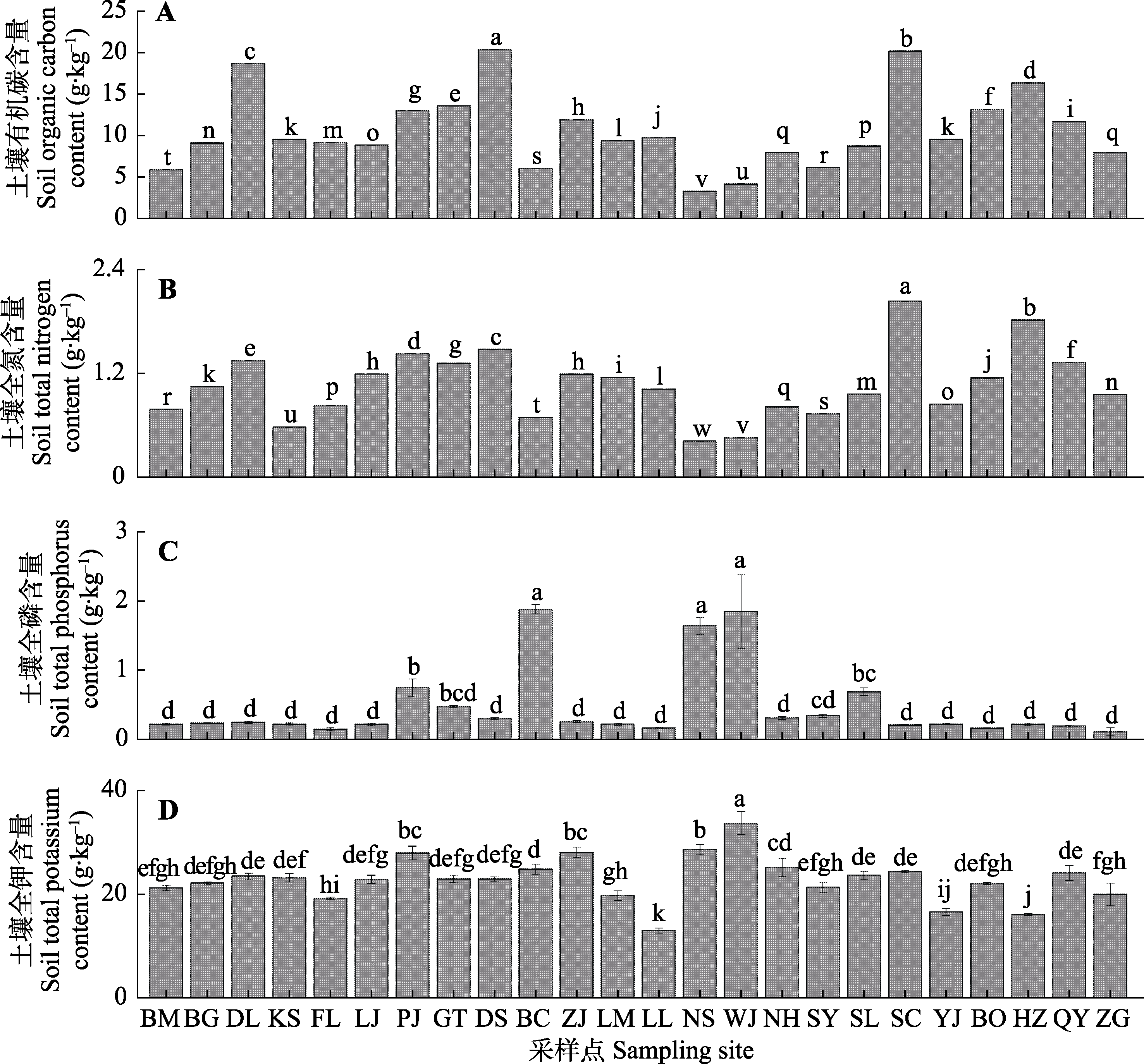
Fig. 1 Soil chemical properties of Ziziphus jujuba in different habitats (mean ± SE). Different letters indicate significant differences among different species (p < 0.05). Abbreviation of sampling sites see Table 1.
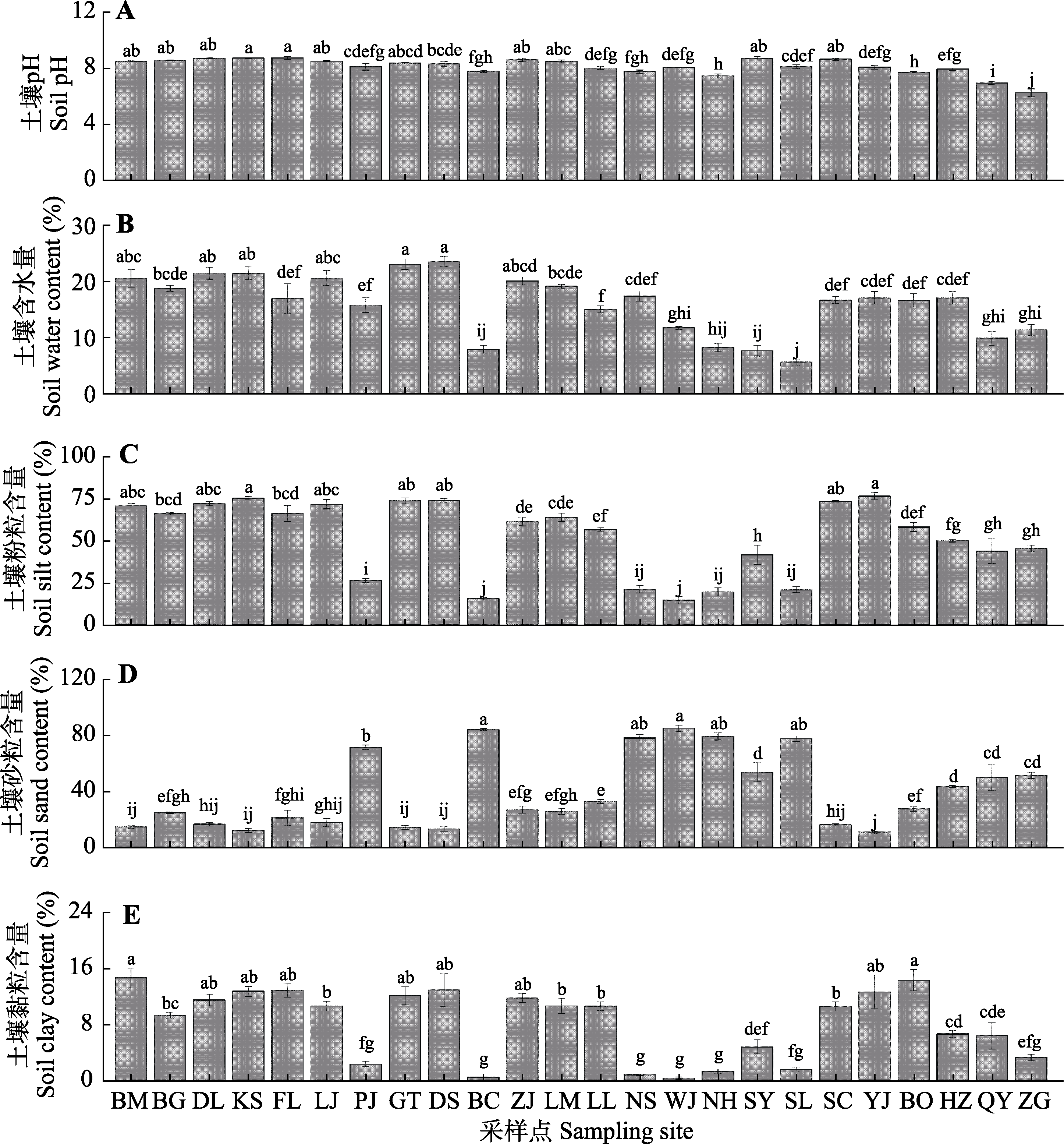
Fig. 2 Soil physical properties of Ziziphus jujuba in different habitats (mean ± SE). Different letters indicate significant differences among different species (p < 0.05). Abbreviation of sampling sites see Table 1.
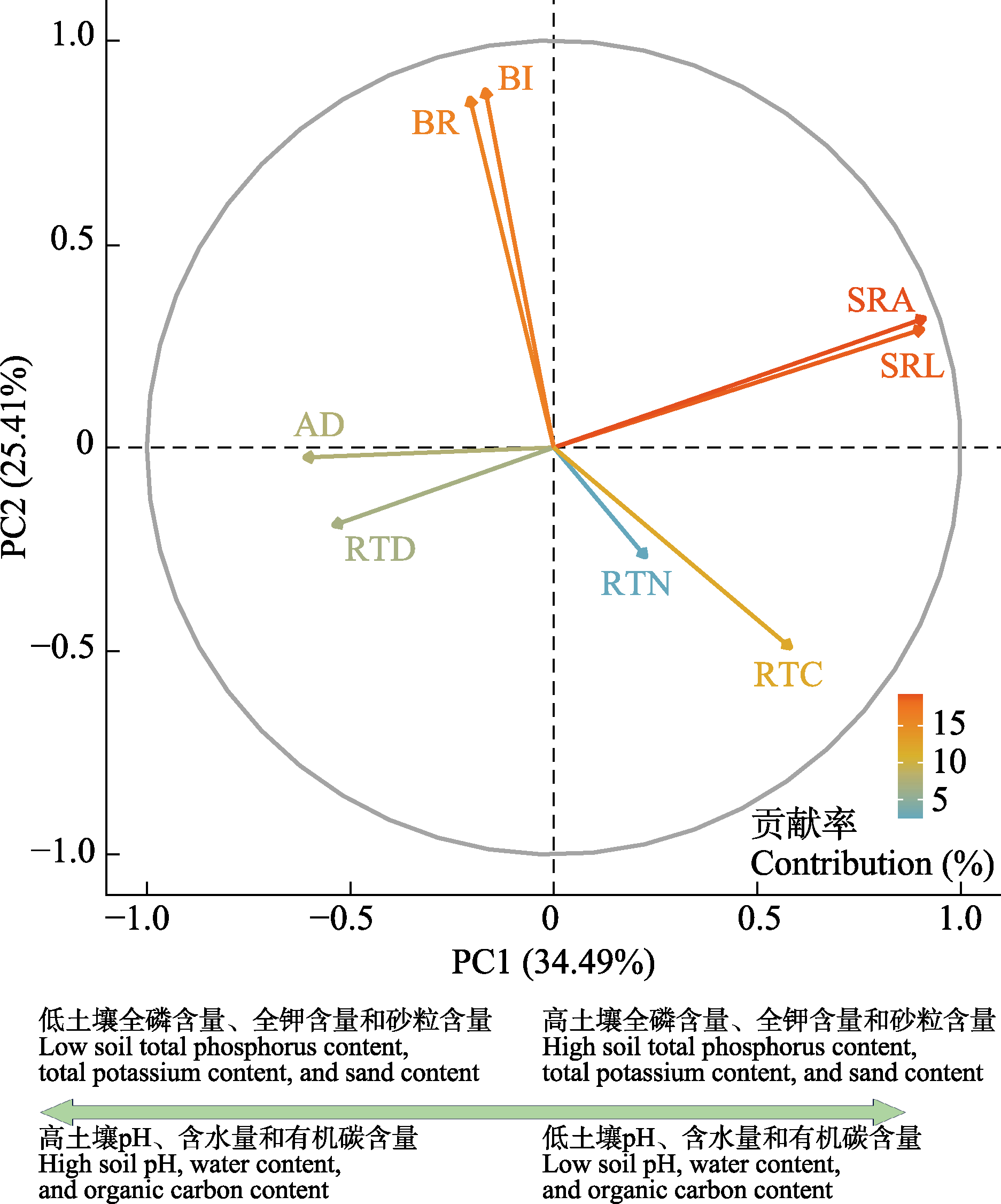
Fig. 3 Principal component analysis (PCA) of root traits of Ziziphus jujuba. AD, root average diameter; BI, branching intensity; BR, branching ratio; RTC, root carbon content; RTD, root tissue density; RTN, root nitrogen content; SRA, specific root area; SRL, specific root length.
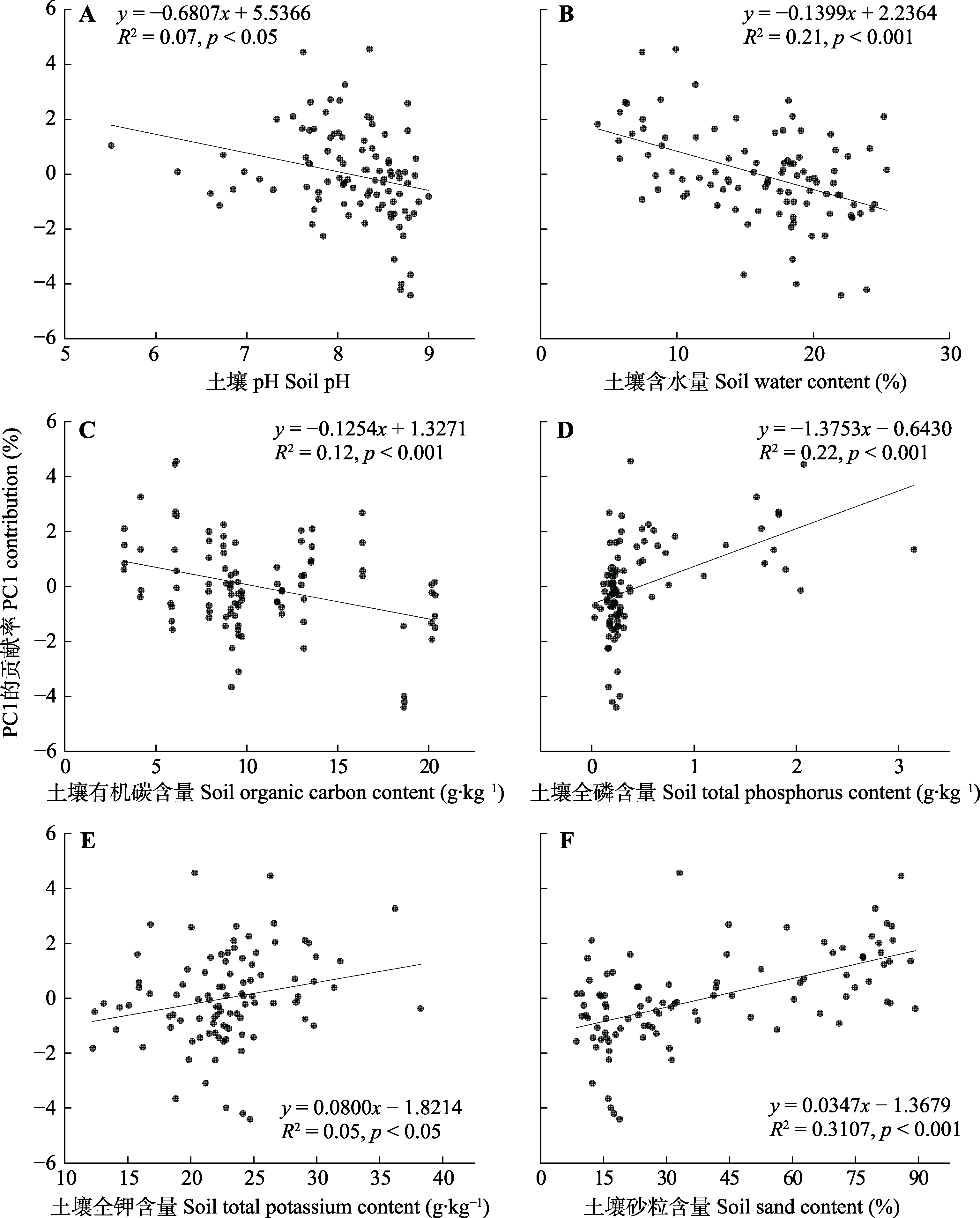
Fig. 4 Linear fitting of PC1 contribution in principal component (PC) analysis and soil factors.
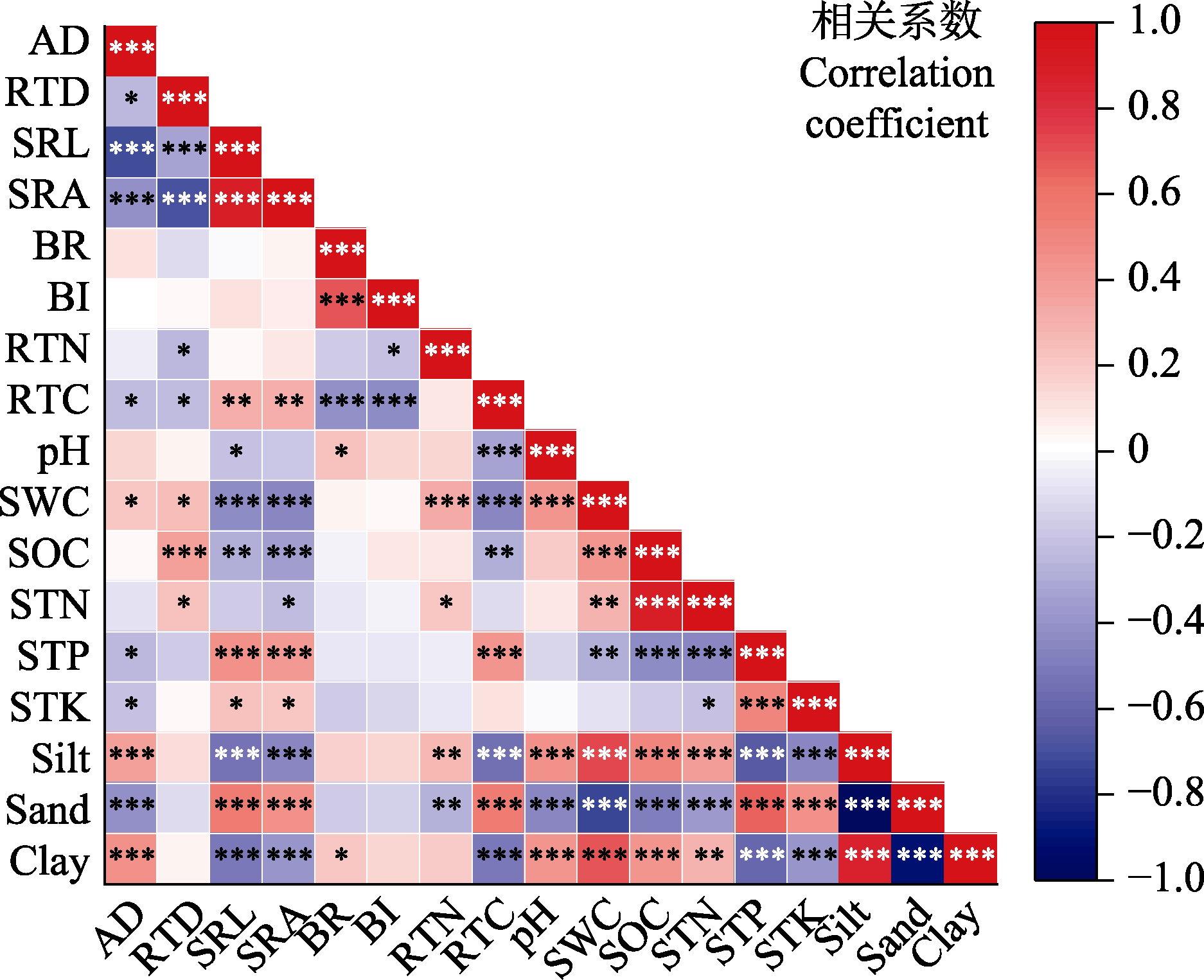
Fig. 5 Correlations between root traits of Ziziphus jujuba and soil factors. AD, root average diameter; BI, branching intensity; BR, branching ratio; Clay, soil clay content; RTC, root carbon content; RTD, root tissue density; RTN, root nitrogen content; Sand, soil sand content; Silt, soil silt content; SOC, soil organic carbon content; SRA, specific root area; SRL, specific root length; STK, soil total potassium content; STN, soil total nitrogen content; STP, soil total phosphorus content; SWC, soil water content. *, p < 0.05; **, p < 0.01; ***, p < 0.001.
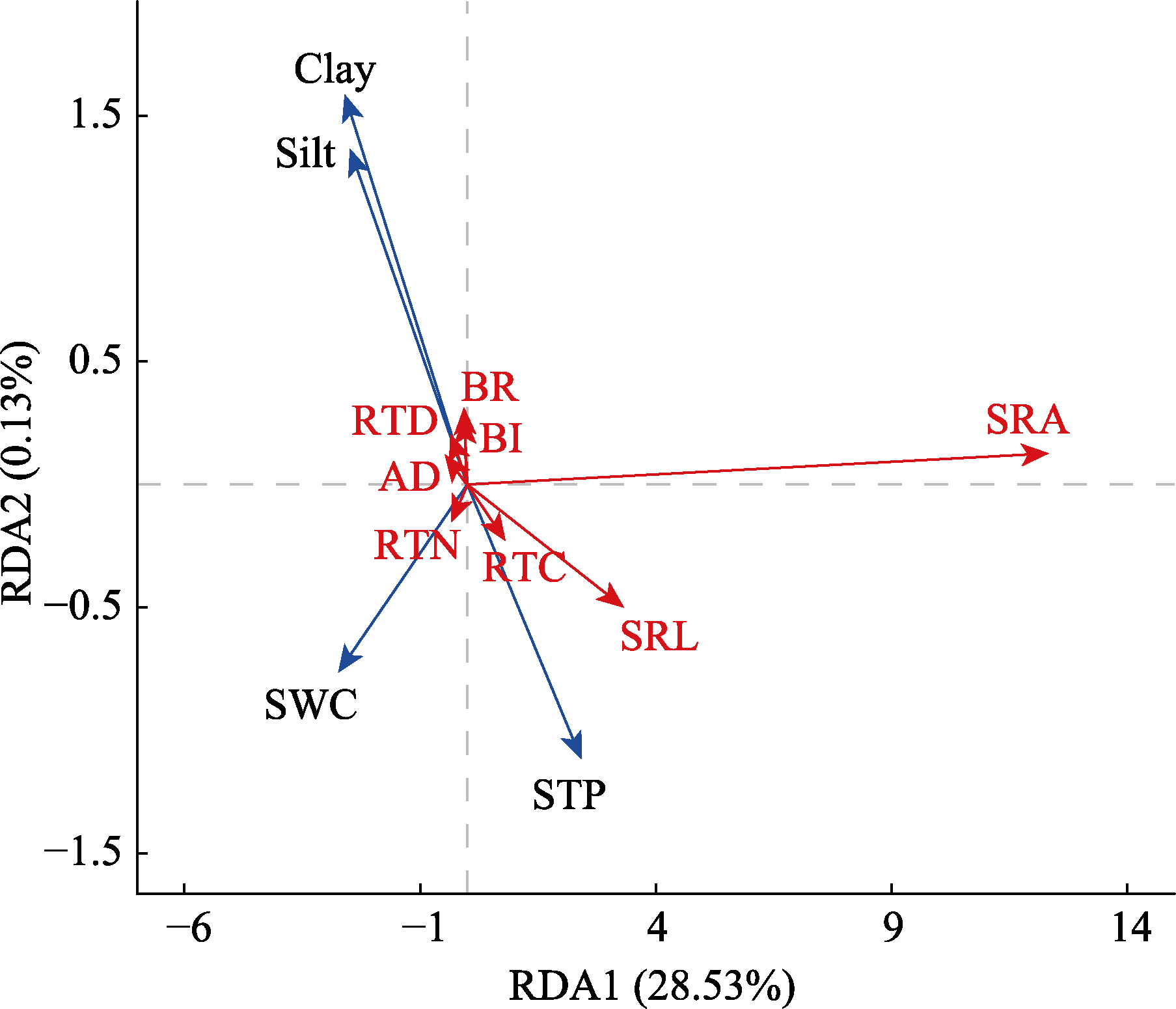
Fig. 6 Redundancy analysis (RDA) for the influence of soil factors on root traits of Ziziphus jujuba. AD, root average diameter; BI, branching intensity; BR, branching ratio; Clay, soil clay content; RTC, root carbon content; RTD, root tissue density; RTN, root nitrogen content; Silt, soil silt content; SRA, specific root area; SRL, specific root length; STP, soil total phosphorus content; SWC, soil water content.
| [1] |
An F, Li BY, Zhong QL, Cheng DL, Xu CB, Zou YX, Zhang X, Deng XY, Lin QY (2023). Nitrogen addition affects growth and functional traits of Machilus pauhoi seedlings from different provenances. Chinese Journal of Plant Ecology, 47, 1693-1707.
DOI URL |
|
[安凡, 李宝银, 钟全林, 程栋梁, 徐朝斌, 邹宇星, 张雪, 邓兴宇, 林秋燕 (2023). 不同种源刨花楠苗木生长与主要功能性状对氮添加的响应. 植物生态学报, 47, 1693-1707.]
DOI |
|
| [2] |
Bengough AG, McKenzie BM, Hallett PD, Valentine TA (2011). Root elongation, water stress, and mechanical impedance: a review of limiting stresses and beneficial root tip traits. Journal of Experimental Botany, 62, 59-68.
DOI PMID |
| [3] | Bergmann J, Weigelt A, van der Plas F, Laughlin DC, Kuyper TW, Guerrero-Ramirez N, Valverde-Barrantes OJ, Bruelheide H, Freschet GT, Iversen CM, Kattge J, McCormack ML, Meier IC, Rillig MC, Roumet C, et al. (2020). The fungal collaboration gradient dominates the root economics space in plants. Science Advances, 6, eaba3756. DOI: 10.1126/sciadv.aba3756. |
| [4] | Borges R, Giroto AS, Ohrem B, Beckmann S, Ademi A, Boeckem V, Bochmann H, Müller-Linow M, Lenz H, Ribeiro C, Wojciechowski T, Jablonowski ND, Postma JA (2025). Optimizing Cassava growth with localized struvite application: root proliferation and fertilization efficiency. Agronomy, 15, 353. DOI: 10.3390/agronomy15020353. |
| [5] |
Chen W, Zeng H, Eissenstat DM, Guo D (2013). Variation of first-order root traits across climatic gradients and evolutionary trends in geological time. Global Ecology and Biogeography, 22, 846-856.
DOI URL |
| [6] | Chen YF, Lin CL, Zhang S, Zheng DX, Jin SF, Lu FL, Lin JD (2022). Functional characteristics of Castanopsis fargesii fine roots and their relationship with soil factors at different elevations in Guoyan Mountain. Journal of Tropical and Subtropical Botany, 30, 413-422. |
| [陈逸飞, 林晨蕾, 张硕, 郑德祥, 靳少非, 卢丰林, 林建东 (2022). 郭岩山不同海拔丝栗栲细根功能性状及其与土壤因子的关系. 热带亚热带植物学报, 30, 413-422.] | |
| [7] |
Colombi T, Walter A (2016). Root responses of Triticale and soybean to soil compaction in the field are reproducible under controlled conditions. Functional Plant Biology, 43, 114-128.
DOI PMID |
| [8] |
Comas LH, Eissenstat DM (2004). Linking fine root traits to maximum potential growth rate among 11 mature temperate tree species. Functional Ecology, 18, 388-397.
DOI URL |
| [9] |
Comas LH, Mueller KE, Taylor LL, Midford PE, Callahan HS, Beerling DJ (2012). Evolutionary patterns and biogeochemical significance of angiosperm root traits. International Journal of Plant Sciences, 173, 584-595.
DOI URL |
| [10] |
Craine JM, Lee WG, Bond WJ, Williams RJ, Johnson LC (2005). Environmental constraints on a global relationship among leaf and root traits of grasses. Ecology, 86, 12-19.
DOI URL |
| [11] |
Ding JX, Kong DL, Zhang ZL, Cai Q, Xiao J, Liu Q, Yin HJ (2020). Climate and soil nutrients differentially drive multidimensional fine root traits in ectomycorrhizal- dominated alpine coniferous forests. Journal of Ecology, 108, 2544-2556.
DOI URL |
| [12] | Du CH, Cui XF, Pei XP, Yan Y, Qin XM (2019). Research progress on Ziziphi Spinosae Semen saponins and its biological action on nervous system. Chinese Traditional and Herbal Drugs, 50, 1258-1268. |
| [杜晨晖, 崔小芳, 裴香萍, 闫艳, 秦雪梅 (2019). 酸枣仁皂苷类成分及其对神经系统作用研究进展. 中草药, 50, 1258-1268.] | |
| [13] |
Eissenstat DM, Kucharski JM, Zadworny M, Adams TS, Koide RT (2015). Linking root traits to nutrient foraging in arbuscular mycorrhizal trees in a temperate forest. New Phytologist, 208, 114-124.
DOI PMID |
| [14] |
Eissenstat DM, Wells CE, Yanai RD, Whitbeck JL (2000). Building roots in a changing environment: implications for root longevity. New Phytologist, 147, 33-42.
DOI URL |
| [15] |
Fort F, Volaire F, Guilioni L, Barkaoui K, Navas ML, Roumet C (2017). Root traits are related to plant water-use among rangeland Mediterranean species. Functional Ecology, 31, 1700-1709.
DOI URL |
| [16] | Fu HX (2023). Effect of Brushing Shrubs and Weeds on Morphological and Physiological Characteristics of Artificial Regeneration Tilia amurensis Saplings. Master degree dissertation, Northeast Forestry University, Harbin. |
| [付瀚萱 (2023). 割灌除草对人工更新紫椴幼树形态和生理特征的影响. 硕士学位论文, 东北林业大学, 哈尔滨.] | |
| [17] |
Gavito ME, Olsson PA (2003). Allocation of plant carbon to foraging and storage in arbuscular mycorrhizal fungi. FEMS Microbiology Ecology, 45, 181-187.
DOI PMID |
| [18] |
Graham JH, Eissenstat DM (1998). Field evidence for the carbon cost of Citrus mycorrhizas. New Phytologist, 140, 103-110.
DOI URL |
| [19] |
Guo DL, Xia MX, Wei X, Chang WJ, Liu Y, Wang ZQ (2008). Anatomical traits associated with absorption and mycorrhizal colonization are linked to root branch order in twenty-three Chinese temperate tree species. New Phytologist, 180, 673-683.
DOI PMID |
| [20] |
Henry A (2013). IRRI’s drought stress research in rice with emphasis on roots: accomplishments over the last 50 years. Plant Root, 7, 92-106.
DOI URL |
| [21] |
Hodge A (2004). The plastic plant: root responses to heterogeneous supplies of nutrients. New Phytologist, 162, 9-24.
DOI URL |
| [22] | Hu R, Wu X, Wu YG, Liu Y (2023). Traits of fine roots and composition of microbial communities of Abies beshanzuensis at different altitudes. Journal of Forest and Environment, 43, 84-91. |
| [胡瑞, 吴宪, 吴友贵, 刘宇 (2023). 不同海拔百山祖冷杉细根性状及微生物群落组成. 森林与环境学报, 43, 84-91.] | |
| [23] | Kang DD, Han LH, Ma PF, Wei XZ, Bi RC (2008). Comparison on characters of leaf anatomy of Ziziphus jujuba var. spinosa in different geography environment. Scientia Silvae Sinicae, 44(12), 135-139. |
| [康东东, 韩利慧, 马鹏飞, 魏学智, 毕润成 (2008). 不同地理环境下酸枣叶的形态解剖特征. 林业科学, 44(12), 135-139.] | |
| [24] |
Koide RT (1991). Nutrient supply, nutrient demand and plant response to mycorrhizal infection. New phytologist, 117, 365-386.
DOI PMID |
| [25] |
Koide RT, Kabir Z (2000). Extraradical hyphae of the mycorrhizal fungus Glomus intraradices can hydrolyse organic phosphate. New Phytologist, 148, 511-517.
DOI PMID |
| [26] |
Kong DL, Ma CG, Zhang Q, Li L, Chen XY, Zeng H, Guo DL (2014). Leading dimensions in absorptive root trait variation across 96 subtropical forestspecies. New Phytologist, 203, 863-872.
DOI URL |
| [27] | Kong DL, Wang JJ, Wu HF, Valverde-Barrantes OJ, Wang RL, Zeng H, Kardol P, Zhang HY, Feng YL (2019). Nonlinearity of root trait relationships and the root economics spectrum. Nature Communications, 10, 2203. DOI: 10.1038/s41467-019-10245-6. |
| [28] | Li JX, Sun XM, Liu N, Li L, Chen NL (2021). Response and plasticity of functional traits in Lycium ruthenicum to N and P addition. Chinese Journal of Applied Ecology, 32, 1279-1288. |
|
[李金霞, 孙小妹, 刘娜, 李良, 陈年来 (2021). 黑果枸杞功能性状对氮磷添加的响应及其可塑性. 应用生态学报, 32, 1279-1288.]
DOI |
|
| [29] | Li Q, Chen Q, He FR, Bharani M, Dai ZC, Qi SS, Du DL (2020). Arbuscular mycorrhizal fungi promote the growth of Wedelia trilobata and the absorption of insoluble phosphorus. Journal of Tropical and Subtropical Botany, 28, 339-346. |
| [李琴, 陈琪, 贺芙蓉, Bharani M, 戴志聪, 祁珊珊, 杜道林 (2020). 丛枝菌根真菌促进南美蟛蜞菊生长及对难溶磷的吸收. 热带亚热带植物学报, 28, 339-346.] | |
| [30] |
Li SYN, Xiong DC, Yao XD, Wang XH, Chen TT, Jiang Q, Jia LQ, Fan AL, Chen GS (2022). Morphology and nutrient contents of fine roots from different orders in Fagaceae species in an evergreen broad-leaved forest. Chinese Journal of Ecology, 41, 833-840.
DOI |
| [李石一宁, 熊德成, 姚晓东, 王小红, 陈廷廷, 姜琦, 贾林巧, 范爱莲, 陈光水 (2022). 常绿阔叶林中壳斗科树种细根形态与养分含量的序级变化特征. 生态学杂志, 41, 833-840.] | |
| [31] | Li XQ (2022). Root Morphology and Distribution Characteristics of Alpine Steppe Under Different Water Conditions. Master degree dissertation, Institute of Mountain Hazards and Environment, Chinese Academy of Sciences, Chengdu. |
| [李雪琴 (2022). 不同水分条件下高寒草原植物根系形态与分布特征. 硕士学位论文, 中国科学院水利部成都山地灾害与环境研究所, 成都.] | |
| [32] | Li ZK, Zhang YR, Deng ZW, Liu JY, Rong JD, Chen LG, He TY, Zheng YS (2024). Effects of enclosure term on fine root functional traits of moso bamboo (Phyllostachys edulis) in the Wuyi Mountains. Acta Ecologica Sinica, 44, 7725-7737. |
| [李震凯, 张贻荣, 邓智文, 柳佳莹, 荣俊东, 陈礼光, 何天友, 郑郁善 (2024). 封育年限对武夷山毛竹细根功能性状的影响. 生态学报, 44, 7725-7737.] | |
| [33] |
Liu B, Li H, Zhu B, Koide RT, Eissenstat DM, Guo D (2015). Complementarity in nutrient foraging strategies of absorptive fine roots and arbuscular mycorrhizal fungi across 14 coexisting subtropical tree species. New Phytologist, 208, 125-136.
DOI PMID |
| [34] | Liu L, Liao H, Wang XR, Yan XL (2008). Regulation effect of soil P availability on mycorrhizal infection in relation to root architecture and P efficiency of Glycine max. Chinese Journal of Applied Ecology, 19, 564-568. |
| [刘灵, 廖红, 王秀荣, 严小龙 (2008). 磷有效性对大豆菌根侵染的调控及其与根构型、磷效率的关系. 应用生态学报, 19, 564-568.] | |
| [35] | Liu XJ, Ma KP (2015). Plant functional traits—Concepts, applications and future directions. Scientia Sinica: Vitae, 45, 325-339. |
| [刘晓娟, 马克平 (2015). 植物功能性状研究进展. 中国科学: 生命科学, 45, 325-339.] | |
| [36] |
Liu Y, Zhong QL, Xu CB, Cheng DL, Zheng YF, Zou YX, Zhang X, Zheng XJ, Zhou YR (2024). Relationship between fine root functional traits and rhizosphere microenvironment of Machilus pauhoi at different sizes. Chinese Journal of Plant Ecology, 48, 744-759.
DOI URL |
|
[刘瑶, 钟全林, 徐朝斌, 程栋梁, 郑跃芳, 邹宇星, 张雪, 郑新杰, 周云若 (2024). 不同大小刨花楠细根功能性状与根际微环境关系. 植物生态学报, 48, 744-759.]
DOI |
|
| [37] |
Liu YJ, Shi GX, Mao L, Cheng G, Jiang SJ, Ma XJ, An LZ, Du GZ, Collins Johnson N, Feng HY (2012). Direct and indirect influences of 8 yr of nitrogen and phosphorus fertilization on Glomeromycota in an alpine meadow ecosystem. New Phytologist, 194, 523-535.
DOI URL |
| [38] |
López-Bucio J, Hernández-Abreu E, Sánchez-Calderón L, Nieto-Jacobo MF, Simpson J, Herrera-Estrella L (2002). Phosphate availability alters architecture and causes changes in hormone sensitivity in the Arabidopsis root system. Plant Physiology, 129, 244-256.
DOI PMID |
| [39] | Lu YJ, Feng MJ, Sun PC, Wang XJ (2022). Research on differences of root distribution characteristics of grey jujube and acid jujube in Alar reclamation area. Modern Agricultural Science and Technology, (5), 34-38. |
| [卢瑜珺, 封明军, 孙鹏程, 王新建 (2022). 阿拉尔垦区灰枣和酸枣根系分布特征差异研究. 现代农业科技, (5), 34-38.] | |
| [40] |
Lugli LF, Rosa JS, Andersen KM, Di Ponzio R, Almeida RV, Pires M, Cordeiro AL, Cunha HFV, Martins NP, Assis RL, Moraes ACM, Souza ST, Aragão LEOC, Camargo JL, Fuchslueger L, et al. (2021). Rapid responses of root traits and productivity to phosphorus and cation additions in a tropical lowland forest in Amazonia. New Phytologist, 230, 116-128.
DOI PMID |
| [41] | Ma YH, Feng T, Li YZ, Jin QQ (2021). Adaptability of the Hippophae rhamnoides seedlings on different degrees of soil dressing for rocky desertification. Journal of Desert Research, 41(1), 228-233. |
|
[马赟花, 冯图, 李仰征, 金青青 (2021). 沙棘(Hippophae rhamnoides)对经客土改良石漠化土壤的适应性. 中国沙漠, 41(1), 228-233.]
DOI |
|
| [42] |
Ma ZQ, Guo DL, Xu XL, Lu MZ, Bardgett RD, Eissenstat DM, McCormack ML, Hedin LO (2018). Evolutionary history resolves global organization of root functional traits. Nature, 555, 94-97.
DOI URL |
| [43] |
McCormack ML, Adams TS, Smithwick EAH, Eissenstat DM (2012). Predicting fine root lifespan from plant functional traits in temperate trees. New Phytologist, 195, 823-831.
DOI PMID |
| [44] |
McCormack ML, Iversen CM (2019). Physical and functional constraints on viable belowground acquisition strategies. Frontiers in Plant Science, 10, 1215. DOI: 10.3389/fpls.2019.01215.
PMID |
| [45] |
Meier IC, Leuschner C (2008). Genotypic variation and phenotypic plasticity in the drought response of fine roots of European beech. Tree Physiology, 28, 297-309.
PMID |
| [46] |
Mommer L, Weemstra M (2012). The role of roots in the resource economics spectrum. New Phytologist, 195, 725-727.
DOI PMID |
| [47] |
Pregitzer KS, DeForest JL, Burton AJ, Allen MF, Ruess RW, Hendrick RL (2002). Fine root architecture of nine North American trees. Ecological Monographs, 72, 293-309.
DOI URL |
| [48] |
Raven JA, Lambers H, Smith SE, Westoby M (2018). Costs of acquiring phosphorus by vascular land plants: patterns and implications for plant coexistence. New Phytologist, 217, 1420-1427.
DOI PMID |
| [49] |
Reich PB (2014). The world-wide ‘fast-slow’ plant economics spectrum: a traits manifesto. Journal of Ecology, 102, 275-301.
DOI URL |
| [50] | Shen H, Shan LS, Ma J, Xie TT, Wang HY, Yang J, He C (2024). Effects of moisture change on fine root characteristics of desert plants Reaumuria soongorica and Salsola passerine. Acta Agrestia Sinica, 32, 3530-3538. |
|
[申惠, 单立山, 马静, 解婷婷, 王红永, 杨洁, 何彩 (2024). 水分变化对荒漠植物红砂和珍珠猪毛菜细根性状的影响. 草地学报, 32, 3530-3538.]
DOI |
|
| [51] | Shou Y, Wang B, Niu X, Song XQ, Xu TY, Wang YH (2024). Fine root respiration and its relationship with morphological and chemical traits of Cunninghamia lanceolata provenances. Forest Research, 37(4), 148-156. |
| [寿烨, 王兵, 牛香, 宋希强, 许庭毓, 王以惠 (2024). 不同地理种源杉木细根呼吸及其与形态、化学性状的关系研究. 林业科学研究, 37(4), 148-156.] | |
| [52] |
Walbridge MR (2000). Phosphorus biogeochemistry. Ecology, 81, 1474-1475.
DOI URL |
| [53] | Wang QX, Peng ST, Gan WY, Peng ZD, Xu Q, Wang J, Huang LJ (2024). Response of reed leaf and fine root functional traits to water and salt environment: a case study of Fuzhou section of the Min River. Acta Ecologica Sinica, 44, 8338-8348. |
| [王秋雪, 彭书婷, 甘婉怡, 彭正东, 徐琪, 王洁, 黄柳菁 (2024). 芦苇叶片、细根功能性状对水盐环境的响应——以闽江流域福州段为例. 生态学报, 44, 8338-8348.] | |
| [54] | Wang SC, Luo YY, Wang SS, Zhang HW, Wen SYLT, Liu J, Zhang J (2022). Study on carbon reserve and carbon fixation and oxygen release function of four artificial shrub communities in the south foot of Langshan Mountain. Shandong Agricultural Sciences, 54(8), 116-122. |
| [王事成, 罗于洋, 王树森, 张宏武, 温苏雅勒图, 刘静, 张俊 (2022). 狼山南麓4种人工灌木群落植被碳储量及固碳释氧功能研究. 山东农业科学, 54(8), 116-122.] | |
| [55] | Wang XD, Liang DQ, Ma YZ (2023). Comparison and comprehensive evaluation of fruit and seed kernel quality of sour jujube (Ziziphus acidojujuba C. Y. Cheng et M. J. Liu) from different producing areas. Journal of Agricultural Science and Technology, 25(6), 50-58. |
| [王向东, 梁大琦, 马艳芝 (2023). 不同产地酸枣果实及种仁品质比较与综合评价. 中国农业科技导报, 25(6), 50-58.] | |
| [56] | Wang ZY, Cheng L, Wang MT, Sun J, Zhong QL, Li M, Cheng DL (2018). Fine root traits of woody plants in deciduous forest of the Wuyi Mountains. Acta Ecologica Sinica, 38, 8088-8097. |
| [王钊颖, 程林, 王满堂, 孙俊, 钟全林, 李曼, 程栋梁 (2018). 武夷山落叶林木本植物细根性状研究. 生态学报, 38, 8088-8097.] | |
| [57] |
Weemstra M, Mommer L, Visser EJW, van Ruijven J, Kuyper TW, Mohren GMJ, Sterck FJ (2016). Towards a multidimensional root trait framework: a tree root review. New Phytologist, 211, 1159-1169.
DOI PMID |
| [58] |
Wen Z, White PJ, Shen J, Lambers H (2022). Linking root exudation to belowground economic traits for resource acquisition. New Phytologist, 233, 1620-1635.
DOI URL |
| [59] | Wu HY (2020). Characteristics of Root Architecture and Single Root Tensile of Different Plants Under Simulated Slope Conditions. Master degree dissertation, Beijing Forestry University, Beijing. |
| [伍红燕 (2020). 模拟边坡条件下不同植物根构型及其单根抗拉特性研究. 硕士学位论文, 北京林业大学, 北京.] | |
| [60] |
Xu B, Gao Z, Wang J, Xu W, Huang J (2015). Morphological changes in roots of Bothriochloa ischaemum intercropped with Lespedeza davurica following phosphorus application and water stress. Plant Biosystems, 149, 298-306.
DOI URL |
| [61] | Xu MQ, Gao YJ, Zhang ZH, Zeng FJ (2021). Adaptation of the main functional trait of Alhagi sparsifolia leaves and roots to soil water stress. Pratacultural Science, 38, 1559-1569. |
| [徐梦琦, 高艳菊, 张志浩, 曾凡江 (2021). 骆驼刺叶片和根系主要功能性状对水分胁迫的适应. 草业科学, 38, 1559-1569.] | |
| [62] | Xu Y, Deng L (2023). Relationships of fine root morphology and soil physicochemical properties in different mingling intensity of Picea crassifolia in Qilian Mountains. Research of Soil and Water Conservation, 30, 181-187. |
| [徐莹, 邓磊 (2023). 祁连山不同混交度青海云杉林细根形态特征及与土壤理化性质的关系. 水土保持研究, 30, 181-187.] | |
| [63] |
Yi RJ, Liu QY, Yang FT, Dai XQ, Meng SW, Fu XL, Li SG, Kou L, Wang HM (2023). Complementary belowground strategies underlie species coexistence in an early successional forest. New Phytologist, 238, 612-623.
DOI PMID |
| [64] | Yin HM (2012). Study on root architecture of Ziziphus jujuba. Soil and Water Conservation in China, (10), 59-61. |
| [尹惠敏 (2012). 酸枣根系构型特征研究. 中国水土保持, (10), 59-61.] | |
| [65] | Yuan ZY, Chen HYH, Reich PB (2011). Global-scale latitudinal patterns of plant fine-root nitrogen and phosphorus. Nature Communications, 2, 344. DOI: 10.1038/ncomms1346. |
| [66] | Zhan LH, Xu AM, Wei XZ (2012). Responses of root system architecture and root activities of Ziziphus jujuba var. spinosa to arid climate. Journal of Anhui Agricultural Sciences, 40, 10435-10438. |
| [战立花, 许阿美, 魏学智 (2012). 酸枣根系构型和活力对极端干旱气候的响应规律研究. 安徽农业科学, 40, 10435-10438.] | |
| [67] | Zhang HJ (2012). Investigation on Germplasm Resources and Genetic Diversity of Ziziphus spinosus Hu in Henan. Master degree dissertation, Henan Agricultural University, Zhengzhou. |
| [张惠娟 (2012). 河南酸枣种质资源调查及其遗传多样性研究. 硕士学位论文, 河南农业大学, 郑州.] | |
| [68] | Zhang X, Yao C, Du T, Ma ZQ, Zhu HJ, Wang Y, Du F (2025). Three-dimensional visual simulation and root morphological parameter analysis of three slope protection plants in loess region. Research of Soil and Water Conservation, 32(1), 218-226. |
| [张旭, 姚晨, 杜婷, 马志强, 朱宏杰, 汪艳, 杜峰 (2025). 黄土区3种护坡植物三维可视化模拟与根系构型参数分析. 水土保持研究, 32(1), 218-226.] | |
| [69] | Zhang XS, Zhou CN, Lu J, Zhang M (2022). Responses of root characteristics of Abies georgei var. smithii seedlings to altitude, stand age and soil factors. Journal of West China Forestry Science, 51(3), 81-90. |
| [张新生, 周晨霓, 卢杰, 张萌 (2022). 急尖长苞冷杉幼苗根系特征对海拔、林龄及土壤因子的响应. 西部林业科学, 51(3), 81-90.] | |
| [70] | Zhang Y, Song CL, Chen J, Shi ZM, Xiao WF, Zhao GD, Yuan XP, Wu JG (2022). Leaf and fine root functional traits response of 10-year-old Cunninghamia lanceolate plantations to soil phosphorus addition. Forest Research, 35(4), 23-32. |
| [张运, 宋崇林, 陈健, 史作民, 肖文发, 赵广东, 袁小平, 吴建国 (2022). 10年生杉木人工林叶片和细根功能性状对土壤磷添加的响应. 林业科学研究, 35(4), 23-32.] | |
| [71] | Zhu GL, Chen XB, Guo XQ, Jiao XR, Zhou GS (2018). Plasticity of root morphology of Ziziphus jujuba var. spinosa in response to natural drought gradient ecotopes. Acta Ecologica Sinica, 38, 5810-5818. |
| [朱广龙, 陈许兵, 郭小倩, 焦秀荣, 周桂生 (2018). 酸枣根系结构可塑性对自然梯度干旱生境的适应机制. 生态学报, 38, 5810-5818.] |
| Viewed | ||||||
|
Full text |
|
|||||
|
Abstract |
|
|||||
Copyright © 2026 Chinese Journal of Plant Ecology
Tel: 010-62836134, 62836138, E-mail: apes@ibcas.ac.cn, cjpe@ibcas.ac.cn

