
Chin J Plant Ecol ›› 2026, Vol. 50 ›› Issue (2): 362-373.DOI: 10.17521/cjpe.2025.0161 cstr: 32100.14.cjpe.2025.0161
• Research Articles • Previous Articles Next Articles
TIAN Di1( ), CHI Xiao-Long1, SHI Liang2,*(
 ), LIU Xiao-Han1, ZHAO Chang-Ti1, WU Mei1, ZHANG Yu-Zhong3, GAO Yong-Liang4
Received:2025-05-06
Accepted:2025-11-29
Online:2026-02-28
Published:2026-04-01
Contact:
SHI Liang
Supported by:TIAN Di, CHI Xiao-Long, SHI Liang, LIU Xiao-Han, ZHAO Chang-Ti, WU Mei, ZHANG Yu-Zhong, GAO Yong-Liang. Stoichiometric characteristics of dominant afforestation tree species and their environmental drivers in Saihanba region[J]. Chin J Plant Ecol, 2026, 50(2): 362-373.
Add to citation manager EndNote|Ris|BibTeX
URL: https://www.plant-ecology.com/EN/10.17521/cjpe.2025.0161
| 样地 Plot | 树种 Tree species | 纬度 Latitude (° N) | 经度 Longitude (° E) | 海拔 Altitude (m) | 气温 Atmospheric temperature (℃) | 大气湿度 Atmospheric humidity (%) | 饱和水汽压差 Vapor pressure deficit (kPa) | 土壤温度 Soil temperature (℃) | 土壤湿度 Soil moisture (m3·m-3) | 林龄 Stand age (a) | 平均胸径 Mean diameter at breast height (cm) | 平均树高 Mean height (m) |
|---|---|---|---|---|---|---|---|---|---|---|---|---|
| 1 | LP | 42.43 | 117.19 | 1 400 | 15.61 ± 4.30 | 71.76 ± 13.68 | 0.68 ± 0.45 | 14.01 ± 2.84 | 0.13 ± 0.03 | 40-45 | 17.88 ± 1.72 | 20.35 ± 1.50 |
| 2 | LP | 42.40 | 117.30 | 1 500 | 14.77 ± 4.49 | 71.81 ± 13.72 | 0.63 ± 0.43 | 11.84 ± 2.47 | 0.10 ± 0.02 | 40-45 | 18.43 ± 0.24 | 18.10 ± 1.69 |
| 3 | LP | 42.38 | 117.36 | 1 600 | 14.29 ± 4.30 | 76.71 ± 13.06 | 0.51 ± 0.39 | 12.82 ± 2.48 | 0.10 ± 0.02 | 45-50 | 15.73 ± 1.55 | 18.25 ± 1.73 |
| 4 | PM | 42.43 | 117.19 | 1 400 | 15.96 ± 4.09 | 71.54 ± 12.25 | 0.70 ± 0.46 | 13.24 ± 2.63 | 0.10 ± 0.04 | 45-50 | 15.56 ± 0.62 | 19.05 ± 1.63 |
| 5 | PM | 42.40 | 117.31 | 1 500 | 15.12 ± 4.52 | 70.52 ± 14.50 | 0.67 ± 0.46 | 10.23 ± 2.73 | 0.07 ± 0.01 | 40-45 | 16.04 ± 1.21 | 19.60 ± 0.81 |
| 6 | PM | 42.38 | 117.36 | 1 600 | 14.64 ± 4.41 | 72.26 ± 13.90 | 0.60 ± 0.42 | 10.58 ± 2.49 | 0.07 ± 0.01 | 45-50 | 15.90 ± 1.02 | 16.30 ± 2.06 |
Table 1 Environmental condition and forest stand information of the field experiment site in saihanba region (mean ± SD)
| 样地 Plot | 树种 Tree species | 纬度 Latitude (° N) | 经度 Longitude (° E) | 海拔 Altitude (m) | 气温 Atmospheric temperature (℃) | 大气湿度 Atmospheric humidity (%) | 饱和水汽压差 Vapor pressure deficit (kPa) | 土壤温度 Soil temperature (℃) | 土壤湿度 Soil moisture (m3·m-3) | 林龄 Stand age (a) | 平均胸径 Mean diameter at breast height (cm) | 平均树高 Mean height (m) |
|---|---|---|---|---|---|---|---|---|---|---|---|---|
| 1 | LP | 42.43 | 117.19 | 1 400 | 15.61 ± 4.30 | 71.76 ± 13.68 | 0.68 ± 0.45 | 14.01 ± 2.84 | 0.13 ± 0.03 | 40-45 | 17.88 ± 1.72 | 20.35 ± 1.50 |
| 2 | LP | 42.40 | 117.30 | 1 500 | 14.77 ± 4.49 | 71.81 ± 13.72 | 0.63 ± 0.43 | 11.84 ± 2.47 | 0.10 ± 0.02 | 40-45 | 18.43 ± 0.24 | 18.10 ± 1.69 |
| 3 | LP | 42.38 | 117.36 | 1 600 | 14.29 ± 4.30 | 76.71 ± 13.06 | 0.51 ± 0.39 | 12.82 ± 2.48 | 0.10 ± 0.02 | 45-50 | 15.73 ± 1.55 | 18.25 ± 1.73 |
| 4 | PM | 42.43 | 117.19 | 1 400 | 15.96 ± 4.09 | 71.54 ± 12.25 | 0.70 ± 0.46 | 13.24 ± 2.63 | 0.10 ± 0.04 | 45-50 | 15.56 ± 0.62 | 19.05 ± 1.63 |
| 5 | PM | 42.40 | 117.31 | 1 500 | 15.12 ± 4.52 | 70.52 ± 14.50 | 0.67 ± 0.46 | 10.23 ± 2.73 | 0.07 ± 0.01 | 40-45 | 16.04 ± 1.21 | 19.60 ± 0.81 |
| 6 | PM | 42.38 | 117.36 | 1 600 | 14.64 ± 4.41 | 72.26 ± 13.90 | 0.60 ± 0.42 | 10.58 ± 2.49 | 0.07 ± 0.01 | 45-50 | 15.90 ± 1.02 | 16.30 ± 2.06 |
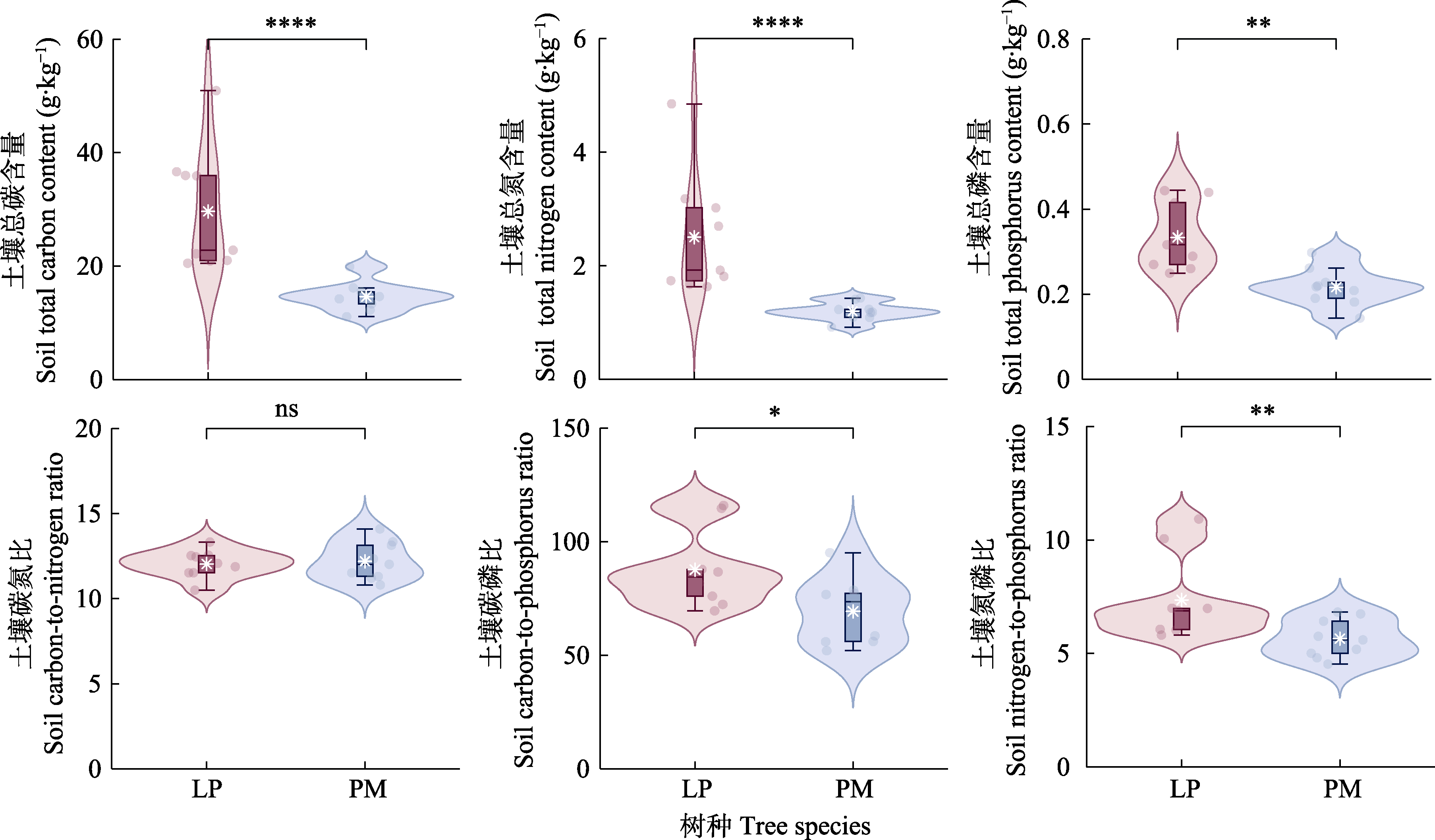
Fig. 1 Comparative analysis of soil stoichiometric characteristics between larch and pine forests in the Saihanba region, China. LP, Larix gmelinii var. principis-rupprechtii; PM, Pinus sylvestris var. mongholica. Statistical significance is denoted as follows: ns, p > 0.05; *, p < 0.05; **, p < 0.01; ****, p < 0.000 1.
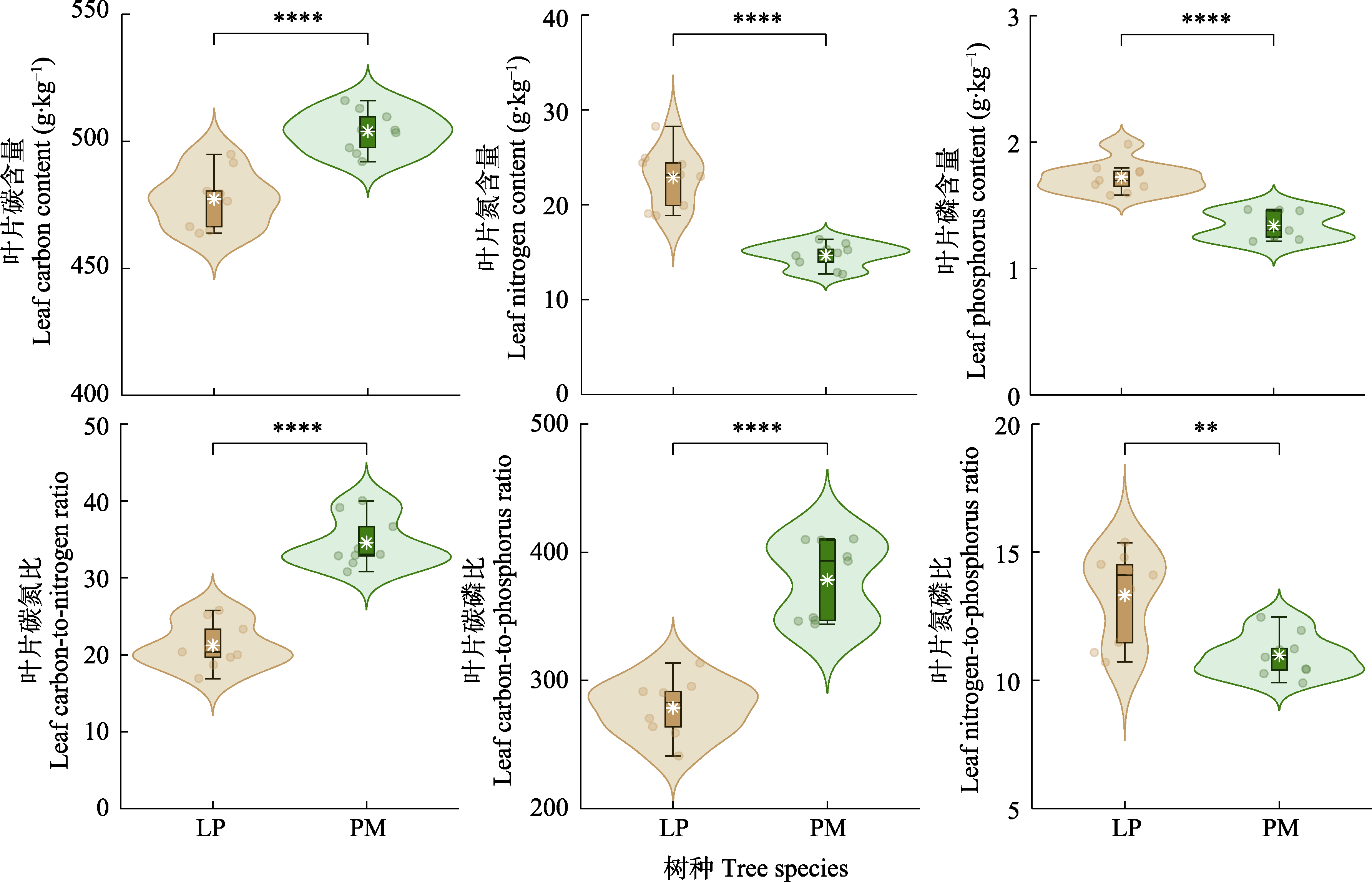
Fig. 2 Comparative analysis of leaf stoichiometric characteristics between larch and pine in the Saihanba region, China. LP, Larix gmelinii var. principis-rupprechtii; PM, Pinus sylvestris var. mongholica. Statistical significance is denoted as follows: **, p < 0.01; ****, p < 0.000 1.
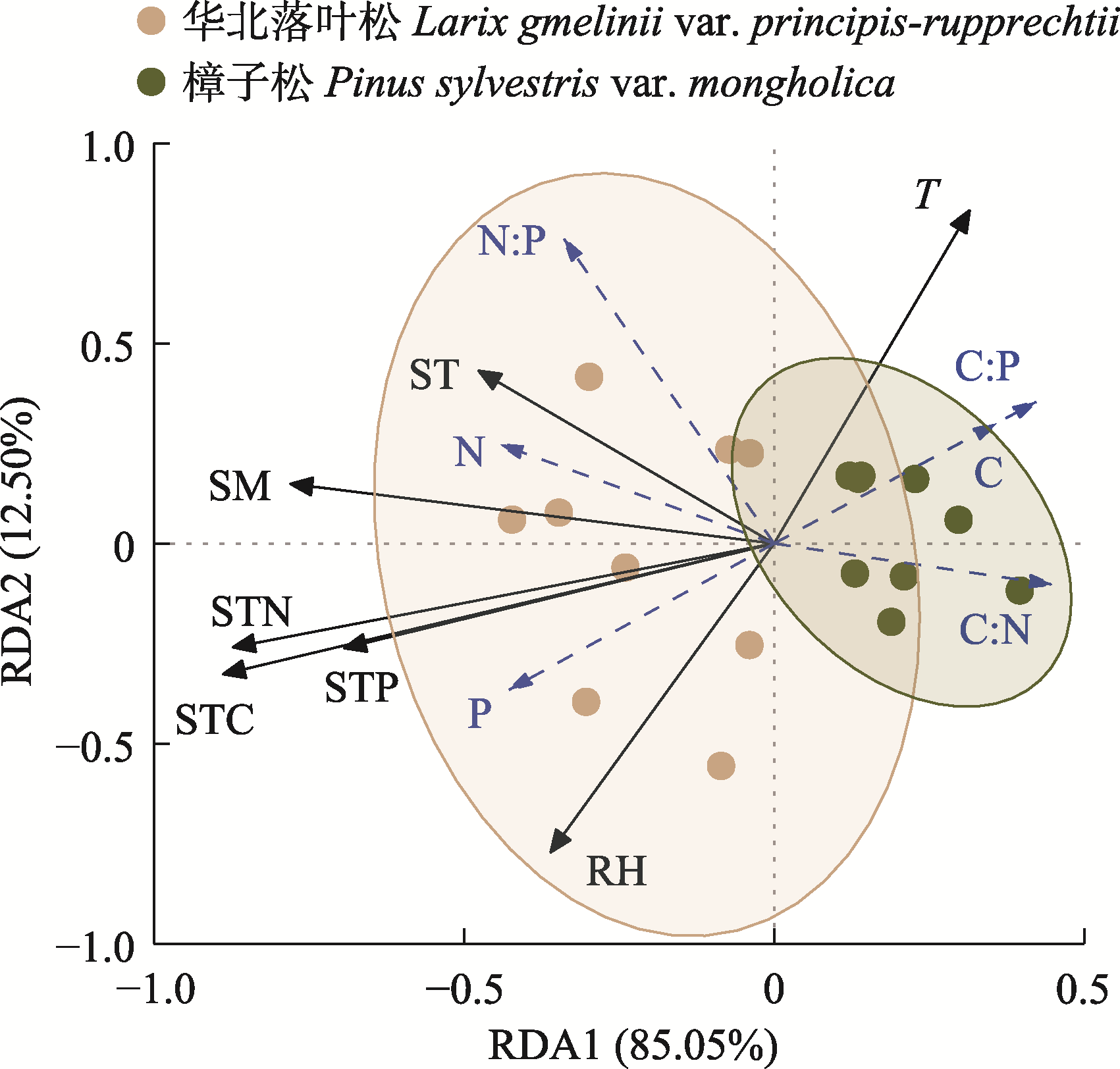
Fig. 3 Redundancy analysis (RDA) of factors influencing leaf stoichiometric characteristics of afforestation tree species in the Saihanba region, China. Blue dashed arrows represent leaf stoichiometric characteristics, including leaf carbon content (C), nitrogen content (N), phosphorus content (P), C:N, C:P, and N:P. Black solid arrows represent environmental factors and soil stoichiometric characteristics, including annual mean soil moisture (SM), soil total carbon content (STC), soil total nitrogen content (STN), soil total phosphorus content (STP), annual mean air temperature (T), soil temperature (ST), and relative humidity (RH).
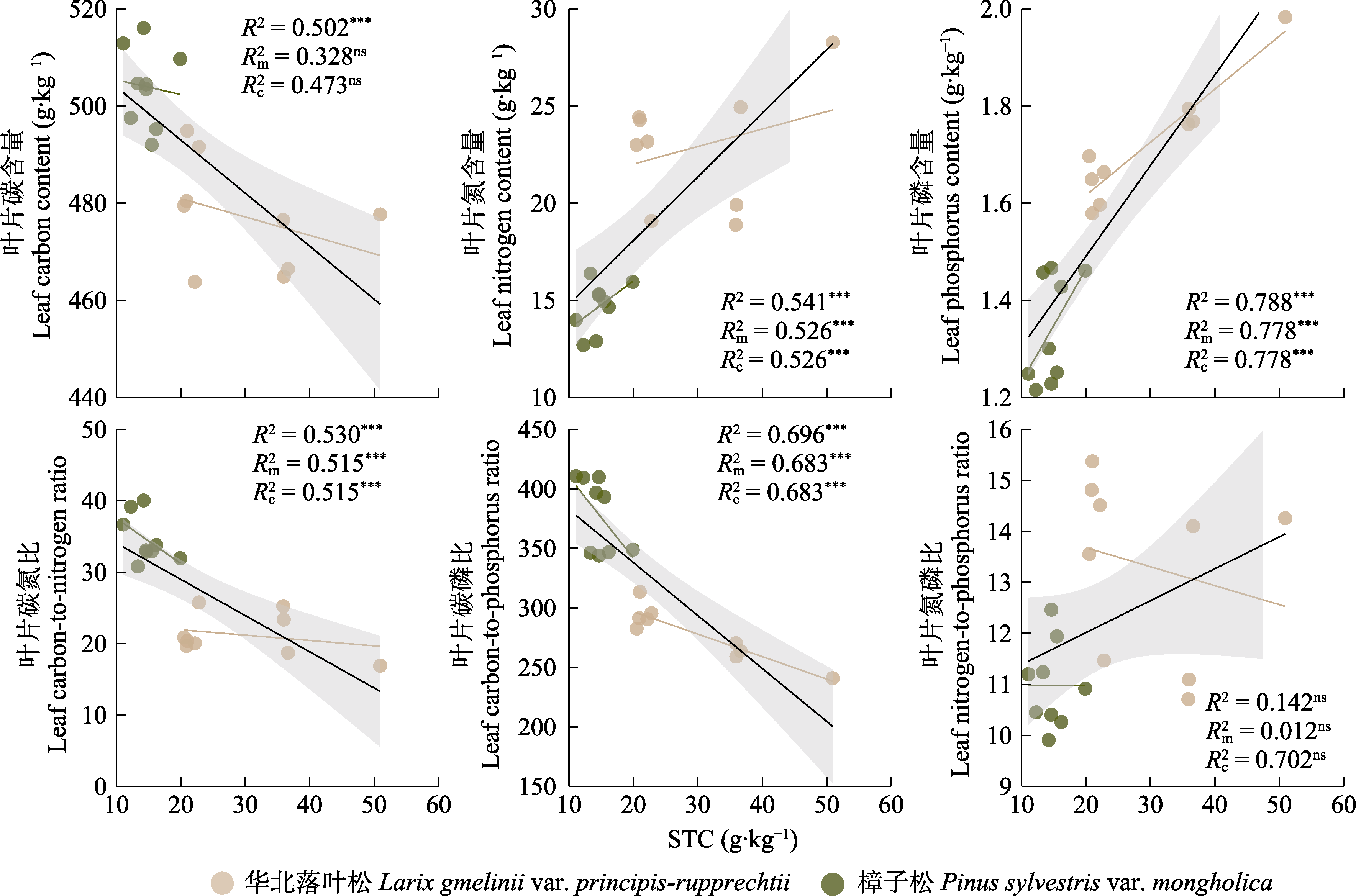
Fig. 4 Univariate linear modeling of leaf stoichiometric characteristics and soil organic carbon content (STC). Both generalized (thick black lines) and linear mixed models including a random species intercept (thin colored lines) were fitted to the data. Corresponding model marginal or conditional R2 (LMM: R2m, R2c) and R2 (LM) and significance (ns, p > 0.05; ***, p < 0.001) are indicated on the top right corner of each value, respectively.
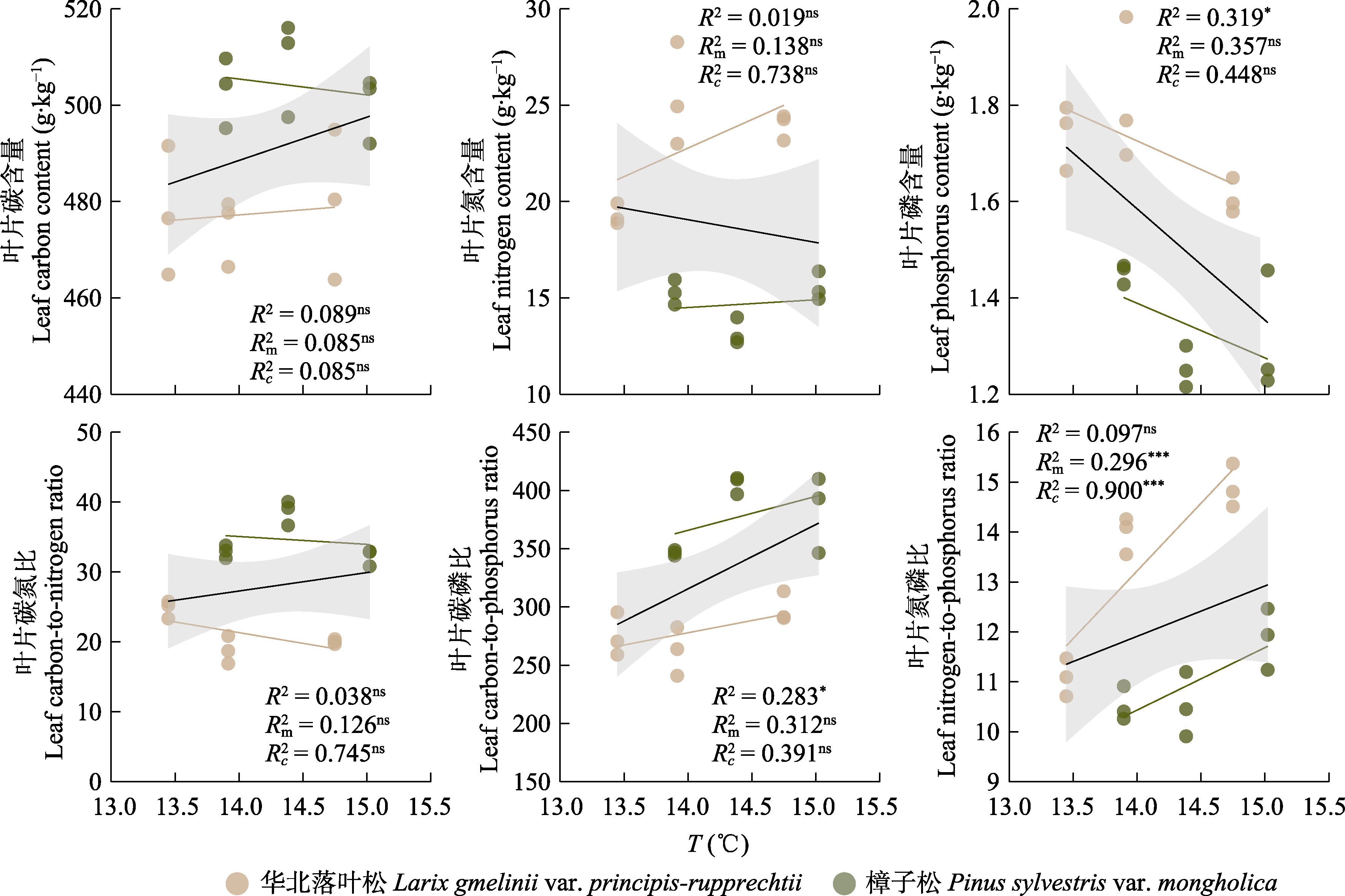
Fig. 5 Univariate linear modeling of leaf stoichiometric characteristics and annual mean temperature (T). Both generalized (thick black lines) and linear mixed models including a random species intercept (thin colored lines) were fitted to the data. Corresponding model marginal or conditional R2 (LMM: R2m, R2c) and R2 (LM) and significance (ns, p > 0.05; *, p < 0.05; ***, p < 0.001) are indicated on the top right corner of each value, respectively.
| [1] | Asner GP, Knapp DE, Anderson CB, Martin RE, Vaughn N (2016). Large-scale climatic and geophysical controls on the leaf economics spectrum. Proceedings of the National Academy of Sciences of the United States of America, 113, E4043-E4051. |
| [2] |
Austin AT, Vivanco L (2006). Plant litter decomposition in a semi-arid ecosystem controlled by photodegradation. Nature, 442, 555-558.
DOI URL |
| [3] |
Bai KD, Lv SH, Ning SJ, Zeng DJ, Guo YL, Wang B (2019). Leaf nutrient concentrations associated with phylogeny, leaf habit and soil chemistry in tropical karst seasonal rainforest tree species. Plant and Soil, 434, 305-326.
DOI |
| [4] | Bates D, Mächler M, Bolker B, Walker S (2015). Fitting linear mixed-effects models using lme4. Journal of Statistical Software, 67, 1-48. |
| [5] |
Cornelissen JHC, Cerabolini B, Castro-Díez P, Villar-Salvador P, Montserrat-Martí G, Puyravaud JP, Maestro M, Werger MJA, Aerts R (2003). Functional traits of woody plants: correspondence of species rankings between field adults and laboratory-grown seedlings. Journal of Vegetation Science, 14, 311-322.
DOI URL |
| [6] |
Cornwell WK, Cornelissen JHC, Amatangelo K, Dorrepaal E, Eviner VT, Godoy O, Hobbie SE, Hoorens B, Kurokawa H, Pérez-Harguindeguy N, Quested HM, Santiago LS, Wardle DA, Wright IJ, Aerts R, et al. (2008). Plant species traits are the predominant control on litter decomposition rates within biomes worldwide. Ecology Letters, 11, 1065-1071.
DOI PMID |
| [7] |
Dai AG, Zhao TB, Chen J (2018). Climate change and drought: a precipitation and evaporation perspective. Current Climate Change Reports, 4, 301-312.
DOI |
| [8] | Dang R, Liu J, Lichtfouse E, Zhou L, Zhou M, Xiao L (2024). Soil microbial carbon use efficiency and the constraints. Annals of Microbiology, 74, 37. DOI: 10.1186/s13213-024-01780-9. |
| [9] | Deng JJ, Zhou YB, Yin Y, Wei YW, Qin SJ, Zhu WX (2019). Soil bacterial community structure characteristics in coniferous forests of montane regions of eastern Liaoning Province, China. Acta Ecologica Sinica, 39, 997-1008. |
| [邓娇娇, 周永斌, 殷有, 魏亚伟, 秦胜金, 朱文旭 (2019). 辽东山区典型人工针叶林土壤细菌群落多样性特征. 生态学报, 39, 997-1008.] | |
| [10] |
Díaz S, Kattge J, Cornelissen JHC, Wright IJ, Lavorel S, Dray S, Reu B, Kleyer M, Wirth C, Prentice IC, Garnier E, Bönisch G, Westoby M, Poorter H, Reich PB, et al. (2016). The global spectrum of plant form and function. Nature, 529, 167-171.
DOI |
| [11] |
Fahey TJ, Siccama TG, Driscoll CT, Likens GE, Campbell J, Johnson CE, Battles JJ, Aber JD, Cole JJ, Fisk MC, Groffman PM, Hamburg SP, Holmes RT, Schwarz PA, Yanai RD (2005). The biogeochemistry of carbon at Hubbard brook. Biogeochemistry, 75, 109-176.
DOI URL |
| [12] | Feng WL, Yang JL, Xu LG, Zhang GL (2024). The spatial variations and driving factors of C, N, P stoichiometric characteristics of plant and soil in the terrestrial ecosystem. Science of the Total Environment, 951, 175543. DOI: 10.1016/j.scitotenv.2024.175543. |
| [13] | Guan W, Xiong W, Wang YH, Yu PT, He CQ, Du AP, Liu HL (2007). Stem diameter growth of Larix principis- rupprechtii and its response to meteorological factors in the north of Liupan Mountain. Scientia Silvae Sinicae, 43(9), 1-6. |
| [管伟, 熊伟, 王彦辉, 于澎涛, 何常清, 杜阿朋, 刘海龙 (2007). 六盘山北侧华北落叶松树干直径生长变化及其对环境因子的响应. 林业科学, 43(9), 1-6.] | |
| [14] | Guo JP, Ding YX, Zhang YX (2009). Decomposition process and nutrient dynamic of litterfall in a Larix principis- rupprechtii stand in Guandishan Mountains. Acta Ecologica Sinica, 29, 5684-5695. |
| [郭晋平, 丁颖秀, 张芸香 (2009). 关帝山华北落叶松林凋落物分解过程及其养分动态. 生态学报, 29, 5684-5695.] | |
| [15] |
Güsewell S, Gessner MO (2009). N:P ratios influence litter decomposition and colonization by fungi and bacteria in microcosms. Functional Ecology, 23, 211-219.
DOI URL |
| [16] |
Han WX, Fang JY, Guo DL, Zhang Y (2005). Leaf nitrogen and phosphorus stoichiometry across 753 terrestrial plant species in China. New Phytologist, 168, 377-385.
DOI PMID |
| [17] | Hong S, Chen J, Biswas A, Cao J, Dong X (2024). Leaf stoichiometry of common species along altitude gradients in the Qilian Mountains, China. Journal of Plant Ecology, 17, rtad044. DOI: 10.1093/jpe/rtad044. |
| [18] |
Hu HF, Wang GG (2008). Changes in forest biomass carbon storage in the South Carolina Piedmont between 1936 and 2005. Forest Ecology and Management, 255, 1400-1408.
DOI URL |
| [19] | Hu YK, Zhang YL, Liu GF, Pan X, Yang XJ, Li WB, Dai WH, Tang SL, Xiao T, Chen LY, Xiong W, Song YB, Dong M (2017). Intraspecific N and P stoichiometry of Phragmites australis: geographic patterns and variation among climatic regions. Scientific Reports, 7, 43018. DOI: 10.1038/srep43018. |
| [20] |
Ishizawa H, Onoda Y, Kitajima K, Kuroda M, Inoue D, Ike M (2021). Coordination of leaf economics traits within the family of the world’s fastest growing plants (Lemnaceae). Journal of Ecology, 109, 2950-2962.
DOI URL |
| [21] | Ji CY, Sun HJ, Zhou Y, Qian JL, Fu LH, Liu Q (2025). Biomass allocation characteristics and model development of Pinus sylvestris var. mongolica in northern Hebei mountainous area. Journal of Shanxi Agricultural University (Natural Science Edition), 45(2), 90-101. |
| [籍翠莹, 孙鹤嘉, 周颖, 钱甲龙, 付立华, 刘强 (2025). 冀北山区樟子松生物量分配特征及模型研建. 山西农业大学学报(自然科学版), 45(2), 90-101.] | |
| [22] | Ji PP, Zhang JF, Zhang YZ, Huang XR, Zhang ZD (2020). Ecological stoichiometry characteristics of Larix principis-rupprechtii plantations at different ages. Journal of Nanjing Forestry University (Natural Sciences Edition), 44(3), 126-132. |
|
[冀盼盼, 张健飞, 张玉珍, 黄选瑞, 张志东 (2020). 不同林龄华北落叶松人工林生态化学计量特征. 南京林业大学学报(自然科学版), 44(3), 126-132.]
DOI |
|
| [23] |
Kim C, Jeong J, Cho HS, Son Y (2010). Carbon and nitrogen status of litterfall, litter decomposition and soil in even-aged larch, red pine and rigitaeda pine plantations. Journal of Plant Research, 123, 403-409.
DOI PMID |
| [24] | Kuznetsova A, Brockhoff PB, Christensen RHB (2017). lmerTest package: tests in linear mixed effects models. Journal of Statistical Software, 82, 1-26. |
| [25] |
Li WB, Lyu ZG, Huang XR, Zhang ZD (2019). Predicting productivity and spatial distribution of Larix principis-rupprechtii plantation. Journal of Natural Resources, 34, 1365-1375.
DOI URL |
|
[李文博, 吕振刚, 黄选瑞, 张志东 (2019). 塞罕坝华北落叶松人工林生产力及其空间分布预测. 自然资源学报, 34, 1365-1375.]
DOI |
|
| [26] |
Markesteijn L, Poorter L (2009). Seedling root morphology and biomass allocation of 62 tropical tree species in relation to drought- and shade-tolerance. Journal of Ecology, 97, 311-325.
DOI URL |
| [27] | Niklas KJ, Cobb ED, Niinemets Ü, Reich PB, Sellin A, Shipley B, Wright IJ (2007). “Diminishing returns” in the scaling of functional leaf traits across and within species groups. Proceedings of the National Academy of Sciences of the United States of America, 104, 8891-8896. |
| [28] | Ordoñez JC, van Bodegom PM, Witte JM, Wright IJ, Reich PB, Aerts R (2009). A global study of relationships between leaf traits, climate and soil measures of nutrient fertility. Global Ecology and Biogeography, 18, 137-149. |
| [29] |
Pennacchi JP, Lira JMS, Rodrigues M, Garcia FHS, Mendonça AMDC, Barbosa JPRAD (2021). A systemic approach to the quantification of the phenotypic plasticity of plant physiological traits: the multivariate plasticity index. Journal of Experimental Botany, 72, 1864-1878.
DOI PMID |
| [30] | Peñuelas J, Fernández-Martínez M, Ciais P, Jou D, Piao SL, Obersteiner M, Vicca S, Janssens IA, Sardans J (2019). The bioelements, the elementome, and the biogeochemical niche. Ecology, 100, e02652. DOI: 10.1002/ecy.2652. |
| [31] |
Peñuelas J, Hunt JM, Ogaya R, Jump AS (2008). Twentieth century changes of tree-ring δ13C at the southern range-edge of Fagus sylvatica: increasing water-use efficiency does not avoid the growth decline induced by warming at low altitudes. Global Change Biology, 14, 1076-1088.
DOI URL |
| [32] | Qu FZ, Meng L, Yu JB, Liu JT, Sun JK, Yang HJ, Dong LS (2017). Influences of micro-geomorphology on the stoichiometry of C, N and P in Chenier Island soils and plants in the Yellow River Delta, China. PLoS ONE, 12, e0189431. DOI: 10.1371/journal.pone.0189431. |
| [33] |
Reich PB (2014). The world-wide ‘fast’-‘slow’ plant economics spectrum: a traits manifesto. Journal of Ecology, 102, 275-301.
DOI URL |
| [34] |
Reich PB, Grigal DF, Aber JD, Gower ST (1997). Nitrogen mineralization and productivity in 50 hardwood and conifer stands on diverse soils. Ecology, 78, 335-347.
DOI URL |
| [35] |
Reich PB, Wright IJ, Cavender-Bares J, Craine JM, Oleksyn J, Westoby M, Walters MB (2003). The evolution of plant functional variation: traits, spectra, and strategies. International Journal of Plant Sciences, 164, S143-S164.
DOI URL |
| [36] |
Reich PB, Wright IJ, Lusk CH (2007). Predicting leaf physiology from simple plant and climate attributes: a global GLOPNET analysis. Ecological Applications, 17, 1982-1988.
PMID |
| [37] | Ren Y, Gao GL, Ding GD, Zhang Y, Guo MS, Cao HY, Su M (2019). Stoichiometric characteristics of nitrogen and phosphorus in leaf-litter-soil system of Pinus sylvestris var. mongolica plantations. Chinese Journal of Applied Ecology, 30, 743-750. |
|
[任悦, 高广磊, 丁国栋, 张英, 郭米山, 曹红雨, 苏敏 (2019). 沙地樟子松人工林叶片-枯落物-土壤氮磷化学计量特征. 应用生态学报, 30, 743-750.]
DOI |
|
| [38] | Ren Y, Gao GL, Ding GD, Zhang Y, Park K, Guo MS, Cao HY (2018). Characteristics of organic carbon content of leaf-litter-soil system in Pinus sylvestris var. mongolica plantations. Journal of Beijing Forestry University, 40(7), 36-44. |
| [任悦, 高广磊, 丁国栋, 张英, 朴起亨, 郭米山, 曹红雨 (2018). 沙地樟子松人工林叶片—枯落物—土壤有机碳含量特征. 北京林业大学学报, 40(7), 36-44.] | |
| [39] | Sardans J, Peñuelas J (2021). Potassium control of plant functions: ecological and agricultural implications. Plants, 10, 419. DOI: 10.3390/plants10020419. |
| [40] |
Schjoerring JK, Cakmak I, White PJ (2019). Plant nutrition and soil fertility: synergies for acquiring global green growth and sustainable development. Plant and Soil, 434, 1-6.
DOI |
| [41] | Sterner RW, Elser JJ (2002). Ecological Stoichiometry: the Biology of Elements from Molecules to the Biosphere. Princeton University Press, Oxford. |
| [42] | Sun K, Li JQ, Yang GL, Zuo M, Hu J (2021). Effect of alterations in forest litter inputs on soil C and N storage distribution in Pinus yunnanensis forest in central Yunnan Plateau. Acta Ecologica Sinica, 41, 3100-3110. |
| [孙轲, 黎建强, 杨关吕, 左嫚, 胡景 (2021). 滇中高原云南松林枯落物输入对土壤碳氮储量及其分布格局的影响. 生态学报, 41, 3100-3110.] | |
| [43] |
Sun XB, Li DJ, Lü XT, Fang YT, Ma ZL, Wang ZC, Chu CJ, Li MM, Chen H (2023). Widespread controls of leaf nutrient resorption by nutrient limitation and stoichiometry. Functional Ecology, 37, 1653-1662.
DOI URL |
| [44] | Tian D, Kattge J, Chen YH, Han WX, Luo YK, He JS, Hu HF, Tang ZY, Ma SH, Yan ZB, Lin QH, Schmid B, Fang JY (2019). A global database of paired leaf nitrogen and phosphorus concentrations of terrestrial plants. Ecology, 100, e02812. DOI: 10.1002/ecy.2812. |
| [45] |
Tian D, Yan ZB, Fang JY (2021). Review on characteristics and main hypotheses of plant ecological stoichiometry. Chinese Journal of Plant Ecology, 45, 682-713.
DOI |
|
[田地, 严正兵, 方精云 (2021). 植物生态化学计量特征及其主要假说. 植物生态学报, 45, 682-713.]
DOI |
|
| [46] |
Tian D, Yan ZB, Niklas KJ, Han WX, Kattge J, Reich PB, Luo YK, Chen YH, Tang ZY, Hu HF, Wright IJ, Schmid B, Fang JY (2018). Global leaf nitrogen and phosphorus stoichiometry and their scaling exponent. National Science Review, 5, 728-739.
DOI URL |
| [47] | Tian D, Yan ZB, Schmid B, Kattge J, Fang JY, Stocker BD (2024). Environmental versus phylogenetic controls on leaf nitrogen and phosphorous concentrations in vascular plants. Nature Communications, 15, 5346. DOI: 10.1038/s41467-024-49665-4. |
| [48] |
Valladares F, Sanchez-Gomez D, Zavala MA (2006). Quantitative estimation of phenotypic plasticity: bridging the gap between the evolutionary concept and its ecological applications. Journal of Ecology, 94, 1103-1116.
DOI URL |
| [49] | Wang K, Wang GG, Song LN, Zhang RS, Yan T, Li YH (2021). Linkages between nutrient resorption and ecological stoichiometry and homeostasis along a chronosequence of Mongolian pine plantations. Frontiers in Plant Science, 12, 692683. DOI: 10.3389/fpls.2021.692683. |
| [50] | Wang LL, Xu FL, Wang WL, Zhao HY, Sun PY, Bai XF (2016). Assessment of soil fertility in different aged Larix principis-rupprechtii plantation. Journal of Southwest Forestry University (Natural Sciences), 36(2), 17-24. |
| [王玲玲, 徐福利, 王渭玲, 赵海燕, 孙鹏跃, 白小芳 (2016). 不同林龄华北落叶松人工林地土壤肥力评价. 西南林业大学学报(自然科学), 36(2), 17-24.] | |
| [51] | Wei SK, Fan SX, Zhang YZ, Huang XR, Zhang ZD (2018). Dynamics and driving forces of main vegetation types in the Saihanba Nature Reserve, Hebei Province, China. Chinese Journal of Applied Ecology, 29, 1170-1178. |
|
[魏士凯, 范顺祥, 张玉珍, 黄选瑞, 张志东 (2018). 塞罕坝自然保护区主要植被类型动态及其驱动力. 应用生态学报, 29, 1170-1178.]
DOI |
|
| [52] |
Wei YF, Fang J, Zhao XY, Li SG (2011). Eco-physiological traits of different-age needles of Pinus sylvestris var. mongolica plantation in Horqin sandy land of China. Chinese Journal of Plant Ecology, 35, 1271-1280.
DOI URL |
|
[魏雅芬, 方杰, 赵学勇, 李胜功 (2011). 科尔沁沙地樟子松人工林不同年龄针叶生理生态性状. 植物生态学报, 35, 1271-1280.]
DOI |
|
| [53] |
Wright IJ, Dong N, Maire V, Prentice IC, Westoby M, Díaz S, Gallagher RV, Jacobs BF, Kooyman R, Law EA, Leishman MR, Niinemets Ü, Reich PB, Sack L, Villar R, et al. (2017). Global climatic drivers of leaf size. Science, 357, 917-921.
DOI PMID |
| [54] |
Wright IJ, Reich PB, Cornelissen JHC, Falster DS, Groom PK, Hikosaka K, Lee W, Lusk CH, Niinemets Ü, Oleksyn J, Osada N, Poorter H, Warton DI, Westoby M (2005). Modulation of leaf economic traits and trait relationships by climate. Global Ecology and Biogeography, 14, 411-421.
DOI URL |
| [55] |
Wright IJ, Reich PB, Westoby M, Ackerly DD, Baruch Z, Bongers F, Cavender-Bares J, Chapin T, Cornelissen JHC, Diemer M, Flexas J, Garnier E, Groom PK, Gulias J, Hikosaka K, et al. (2004). The worldwide leaf economics spectrum. Nature, 428, 821-827.
DOI |
| [56] |
Wright SJ, Kitajima K, Kraft NJB, Reich PB, Wright IJ, Bunker DE, Condit R, Dalling JW, Davies SJ, Díaz S, Engelbrecht BMJ, Harms KE, Hubbell SP, Marks CO, Ruiz-Jaen MC, et al. (2010). Functional traits and the growth-mortality trade-off in tropical trees. Ecology, 91, 3664-3674.
PMID |
| [57] | Wu M, Tian D, Shi L, Xu CY, Mo YE, Zhang GC, Gao YL (2025). Suitable tree species for afforestation in semiarid China: evidence from tree stem growth monitoring. Forests, 16, 50. DOI: 10.3390/f16010050. |
| [58] | Wu P (2017). Study on Ecological Stoichiometric Characteristics of Plant Leaf-Litter-Soil in the Process of Natural Restoration in Maolan Karst Forest. PhD dissertation, Chinese Academy of Forestry, Beijing. |
| [吴鹏 (2017). 茂兰喀斯特森林自然恢复过程中植物叶片-凋落物-土壤生态化学计量特征研究. 博士学位论文, 中国林业科学研究院, 北京.] | |
| [59] |
Yuan ZY, Chen HYH (2009). Global-scale patterns of nutrient resorption associated with latitude, temperature and precipitation. Global Ecology and Biogeography, 18, 11-18.
DOI URL |
| [60] |
Zhang MH, Cheng XL, Geng QH, Shi Z, Luo YQ, Xu X (2019). Leaf litter traits predominantly control litter decomposition in streams worldwide. Global Ecology and Biogeography, 28, 1469-1486.
DOI URL |
| [61] | Zhang SZ (2014). Analysis on Regeneration Characteristics and Factors Affecting Natural Regeneration of Larix principis-rupprechtii Plantations in Saihanba Forest Farm. Master degree dissertation, Hebei Agricultural University, Baoding, Hebei. |
| [张树梓 (2014). 塞罕坝华北落叶松人工林种群更新特征及影响因素. 硕士学位论文, 河北农业大学, 河北保定.] | |
| [62] |
Zhao CT, Tian D, Mo YE, Yu G, Ji CJ, Fan DY, Wang XP, Fang JY (2025). Trouble follows the needy: more severe leaf herbivory in the resource-poor temperate oak forest than in the birch forest. Functional Ecology, 39, 1083-1095.
DOI URL |
| [63] | Zhao JM, Han XY, Cheng RM, Zhang ZD (2023). Soil quality evaluation of Larix principis-rupprechtii and Pinus sylvestris plantations in the Saihanba Nature Reserve. Journal of Northeast Forestry University, 51(7), 123-127. |
| [赵金满, 韩馨悦, 程瑞明, 张志东 (2023). 塞罕坝自然保护区华北落叶松和樟子松人工林土壤质量评价. 东北林业大学学报, 51(7), 123-127.] | |
| [64] | Zhao Y, Zhang F, Xu ZQ, Zhang Y, Cheng S, Cui TX (2017). Study on the growth of scotch pine in Saihanba area. Forest Resources Management, 28(5), 39-44. |
| [赵娱, 张菲, 许中旗, 张岩, 程顺, 崔同祥 (2017). 塞罕坝地区樟子松生长过程研究. 林业资源管理, 28(5), 39-44.] | |
| [65] | Zhou YJ, Wang MT, Wang ZY, Zhu GJ, Sun J, Zhong QL, Cheng DL (2020). Nutrient and ecological stoichiometry of different root order fine roots of 59 evergreen and deciduous tree species in subtropical zone. Acta Ecologica Sinica, 40, 4975-4984. |
| [周永姣, 王满堂, 王钊颖, 朱国洁, 孙俊, 钟全林, 程栋梁 (2020). 亚热带59个常绿与落叶树种不同根序细根养分及化学计量特征. 生态学报, 40, 4975-4984.] | |
| [66] |
Zhu YH, Xiao H, Wang B, Wu Y, Bai YF, Chen DM (2022). Stoichiometric characteristics of soil carbon, nitrogen and phosphorus along soil depths in response to climatic variables in grasslands on the Mongolia Plateau. Chinese Journal of Plant Ecology, 46, 340-349.
DOI URL |
|
[朱玉荷, 肖虹, 王冰, 吴颖, 白永飞, 陈迪马 (2022). 蒙古高原草地不同深度土壤碳氮磷化学计量特征对气候因子的响应. 植物生态学报, 46, 340-349.]
DOI |
| [1] | guangjin wu, 郭 垚鑫, Ren Chengjie, Wang Jun, YUE Ming, Zhao Fazhu. Distribution of soil organic carbon content and its influencing factors in different vegetation type on the northern foot of the Qinling Mountains [J]. Chin J Plant Ecol, 2026, 50(预发表): 1-. |
| [2] | WEI Xin, JIANG Lan, ZHENG Chen-Cheng, ZHU Jing, CHEN Bo, LI Wen-Zhou, LAI Shu-Yu, LIU Jin-Fu, HE Zhong-Sheng. Distribution and influencing factors of woody plant sexual systems along elevational gradient on the south slope of Daiyun Mountain [J]. Chin J Plant Ecol, 2026, 50(1): 150-159. |
| [3] | HUANG Mei-Hong, NIU Meng-Qiu, YANG Peng-Fei, LIN Jie, LIAO Zhou-Yu, CHEN Jian-Guo, XIANG Jian-Ying. Effects of temperature and burial depth on seedling emergence and growth of the alpine cushion plant Arenaria oreophila [J]. Chin J Plant Ecol, 2025, 49(12): 2092-2104. |
| [4] | ZHU Wan-Kuan, XU Yu-Xing, HUANG Run-Xia, DU A-Peng, WANG Zhi-Chao. Differences in water use efficiency between dry and rainy seasons and their controlling factors in Eucalyptus plantation in Leizhou Peninsula [J]. Chin J Plant Ecol, 2025, 49(12): 2015-2029. |
| [5] | FU Zhao-Qi, HU Xu, TIAN Qin-Rui, GE Yan-Ling, ZHOU Hong-Juan, WU Xiao-Yun, CHEN Li-Xin. Nocturnal sap flow characteristics of two typical forest tree species and responses to environmental factors in the loess region of West Shanxi, China [J]. Chin J Plant Ecol, 2024, 48(9): 1128-1142. |
| [6] | MA Xu-Han, HUANG Ju-Ying, YU Hai-Long, HAN Cui, LI Bing. Soil organic carbon and its easily decomposed components under precipitation change and nitrogen addition in a desert steppe in northwest China [J]. Chin J Plant Ecol, 2024, 48(8): 1065-1077. |
| [7] | PAN Yuan-Fang, PAN Liang-Hao, QIU Si-Ting, QIU Guang-Long, SU Zhi-Nan, SHI Xiao-Fang, FAN Hang-Qing. Variations in tree height among mangroves and their environmental adaptive mechanisms in China’s coastal areas [J]. Chin J Plant Ecol, 2024, 48(4): 483-495. |
| [8] | WANG Li-Li, SONG Xiao-Tong, GU Ji-Qi, SHAO Xiao-Ming. Relationship between morphological characteristics of Didymodon constrictus and environmental changes in Xizang and its response strategies [J]. Chin J Plant Ecol, 2024, 48(10): 1351-1360. |
| [9] | ZHAO Meng-Juan, JIN Guang-Ze, LIU Zhi-Li. Vertical variations in leaf functional traits of three typical ferns in mixed broadleaved- Korean pine forest [J]. Chin J Plant Ecol, 2023, 47(8): 1131-1143. |
| [10] | LI An-Yan, HUANG Xian-Fei, TIAN Yuan-Bin, DONG Ji-Xing, ZHENG Fei-Fei, XIA Pin-Hua. Chlorophyll a variation and its driving factors during phase shift from macrophyte- to phytoplankton-dominated states in Caohai Lake, Guizhou, China [J]. Chin J Plant Ecol, 2023, 47(8): 1171-1181. |
| [11] | YANG Li-Lin, XING Wan-Qiu, WANG Wei-Guang, CAO Ming-Zhu. Variation of sap flow rate of Cunninghamia lanceolata and its response to environmental factors in the source area of Xinʼanjiang River [J]. Chin J Plant Ecol, 2023, 47(4): 571-583. |
| [12] | WANG Xiao-Yue, XU Yi-Xin, LI Chun-Huan, YU Hai-Long, HUANG Ju-Ying. Changes of plant biomass, species diversity, and their influencing factors in a desert steppe of northwestern China under long-term changing precipitation [J]. Chin J Plant Ecol, 2023, 47(4): 479-490. |
| [13] | ZHAO Zhen-Xian, CHEN Yin-Ping, WANG Li-Long, WANG Tong-Tong, LI Yu-Qiang. Comparison on leaf construction cost of different plant groups in the desert area of the Hexi Corridor [J]. Chin J Plant Ecol, 2023, 47(11): 1551-1560. |
| [14] | ZHANG Xiao, WU Juan-Juan, JIA Guo-Dong, LEI Zi-Ran, ZHANG Long-Qi, LIU Rui, LÜ Xiang-Rong, DAI Yuan-Meng. Effects of precipitation variations on characteristics of sap flow and water source of Platycladus orientalis [J]. Chin J Plant Ecol, 2023, 47(11): 1585-1599. |
| [15] | ZHENG Ning, LI Su-Ying, WANG Xin-Ting, LÜ Shi-Hai, ZHAO Peng-Cheng, ZANG Chen, XU Yu-Long, HE Jing, QIN Wen-Hao, GAO Heng-Rui. Dominance of different plant life forms in the typical steppe evidenced from impacts of environmental factors on chlorophyll [J]. Chin J Plant Ecol, 2022, 46(8): 951-960. |
| Viewed | ||||||
|
Full text |
|
|||||
|
Abstract |
|
|||||
Copyright © 2026 Chinese Journal of Plant Ecology
Tel: 010-62836134, 62836138, E-mail: apes@ibcas.ac.cn, cjpe@ibcas.ac.cn

