
Chin J Plant Ecol ›› 2026, Vol. 50 ›› Issue (6): 1408-1418.DOI: 10.17521/cjpe.2025.0157 cstr: 32100.14.cjpe.2025.0157
• Research Articles • Previous Articles Next Articles
WANG Yan-Yuan, MA Guo-Yong, TIAN Peng, DAI Yong-Xin, WANG Lin*( )(
)( )
)
Received:2025-05-03
Accepted:2025-10-17
Online:2026-06-28
Published:2026-08-26
Contact:
WANG Lin
Supported by:WANG Yan-Yuan, MA Guo-Yong, TIAN Peng, DAI Yong-Xin, WANG Lin. Pressure-volume traits and stomatal sensitivity of leaves and fine roots of 12 common tree species in loess gully region[J]. Chin J Plant Ecol, 2026, 50(6): 1408-1418.
Add to citation manager EndNote|Ris|BibTeX
URL: https://www.plant-ecology.com/EN/10.17521/cjpe.2025.0157
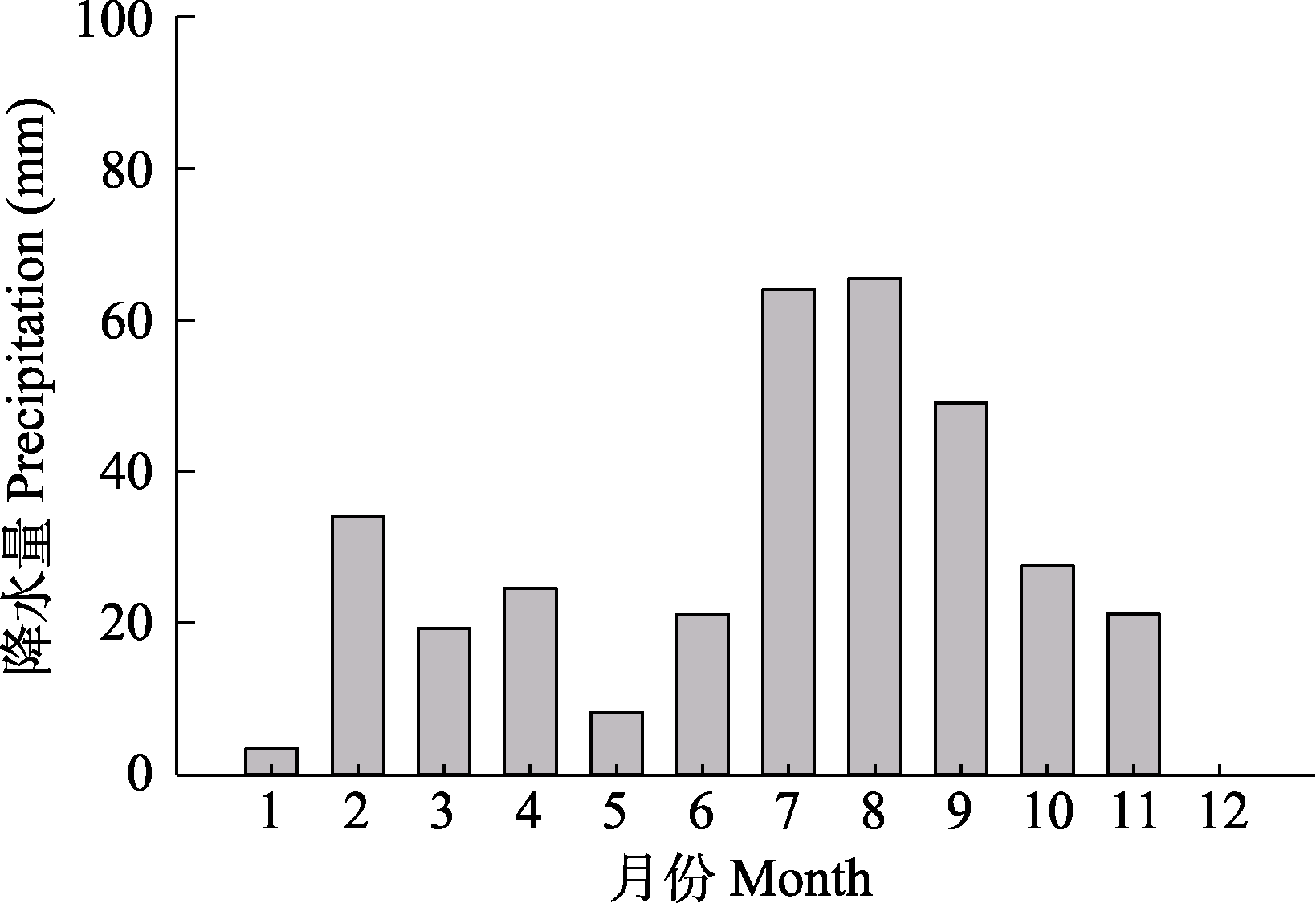
Fig. 1 Monthly precipitation in 2024 for artificial forest plots in the low mountains and hills of Taigu, Shanxi.
| 树种 Tree species | 树高 Tree height (m) | 胸径 Diameter at breast height (cm) | 树龄 Tree age (a) |
|---|---|---|---|
| 油松 Pinus tabuliformis (Pt) | 4.3 ± 1.09 | 12.4 ± 1.67 | 10-15 |
| 云杉 Picea asperata (Pa) | 5.7 ± 0.61 | 9.5 ± 0.61 | 10-15 |
| 侧柏 Platycladus orientalis (Po) | 5.8 ± 0.47 | 11.5 ± 2.90 | 10-15 |
| 白皮松 Pinus bungeana (Pb) | 5.8 ± 0.56 | 10.0 ± 2.08 | 10-15 |
| 雪松 Cedrus deodara (Cd) | 4.4 ± 0.47 | 14.0 ± 1.60 | 15-20 |
| 白榆 Ulmus pumila (Up) | 8.7 ± 0.40 | 11.7 ± 0.55 | 10-15 |
| 垂柳 Salix babylonica (Sb) | 14.9 ± 0.30 | 22.5 ± 2.86 | 10-12 |
| 臭椿 Ailanthus altissima (Aa) | 6.8 ± 0.70 | 11.5 ± 0.87 | 8-10 |
| 刺槐 Robinia pseudoacacia (Rp) | 3.5 ± 0.31 | 15.4 ± 0.56 | 8-10 |
| 国槐 Sophora japonica (Sj) | 4.8 ± 0.42 | 14.7 ± 0.38 | 8-10 |
| 毛白杨 Populus tomentosa (Pot) | 7.2 ± 0.35 | 17.6 ± 0.81 | 8-10 |
| 洋白蜡 Fraxinus pennsylvanica (Fp) | 5.1 ± 0.25 | 13.4 ± 0.68 | 8-10 |
Table 1 Information on sampling plots for plantation in the loess hilly region (mean ± SD)
| 树种 Tree species | 树高 Tree height (m) | 胸径 Diameter at breast height (cm) | 树龄 Tree age (a) |
|---|---|---|---|
| 油松 Pinus tabuliformis (Pt) | 4.3 ± 1.09 | 12.4 ± 1.67 | 10-15 |
| 云杉 Picea asperata (Pa) | 5.7 ± 0.61 | 9.5 ± 0.61 | 10-15 |
| 侧柏 Platycladus orientalis (Po) | 5.8 ± 0.47 | 11.5 ± 2.90 | 10-15 |
| 白皮松 Pinus bungeana (Pb) | 5.8 ± 0.56 | 10.0 ± 2.08 | 10-15 |
| 雪松 Cedrus deodara (Cd) | 4.4 ± 0.47 | 14.0 ± 1.60 | 15-20 |
| 白榆 Ulmus pumila (Up) | 8.7 ± 0.40 | 11.7 ± 0.55 | 10-15 |
| 垂柳 Salix babylonica (Sb) | 14.9 ± 0.30 | 22.5 ± 2.86 | 10-12 |
| 臭椿 Ailanthus altissima (Aa) | 6.8 ± 0.70 | 11.5 ± 0.87 | 8-10 |
| 刺槐 Robinia pseudoacacia (Rp) | 3.5 ± 0.31 | 15.4 ± 0.56 | 8-10 |
| 国槐 Sophora japonica (Sj) | 4.8 ± 0.42 | 14.7 ± 0.38 | 8-10 |
| 毛白杨 Populus tomentosa (Pot) | 7.2 ± 0.35 | 17.6 ± 0.81 | 8-10 |
| 洋白蜡 Fraxinus pennsylvanica (Fp) | 5.1 ± 0.25 | 13.4 ± 0.68 | 8-10 |
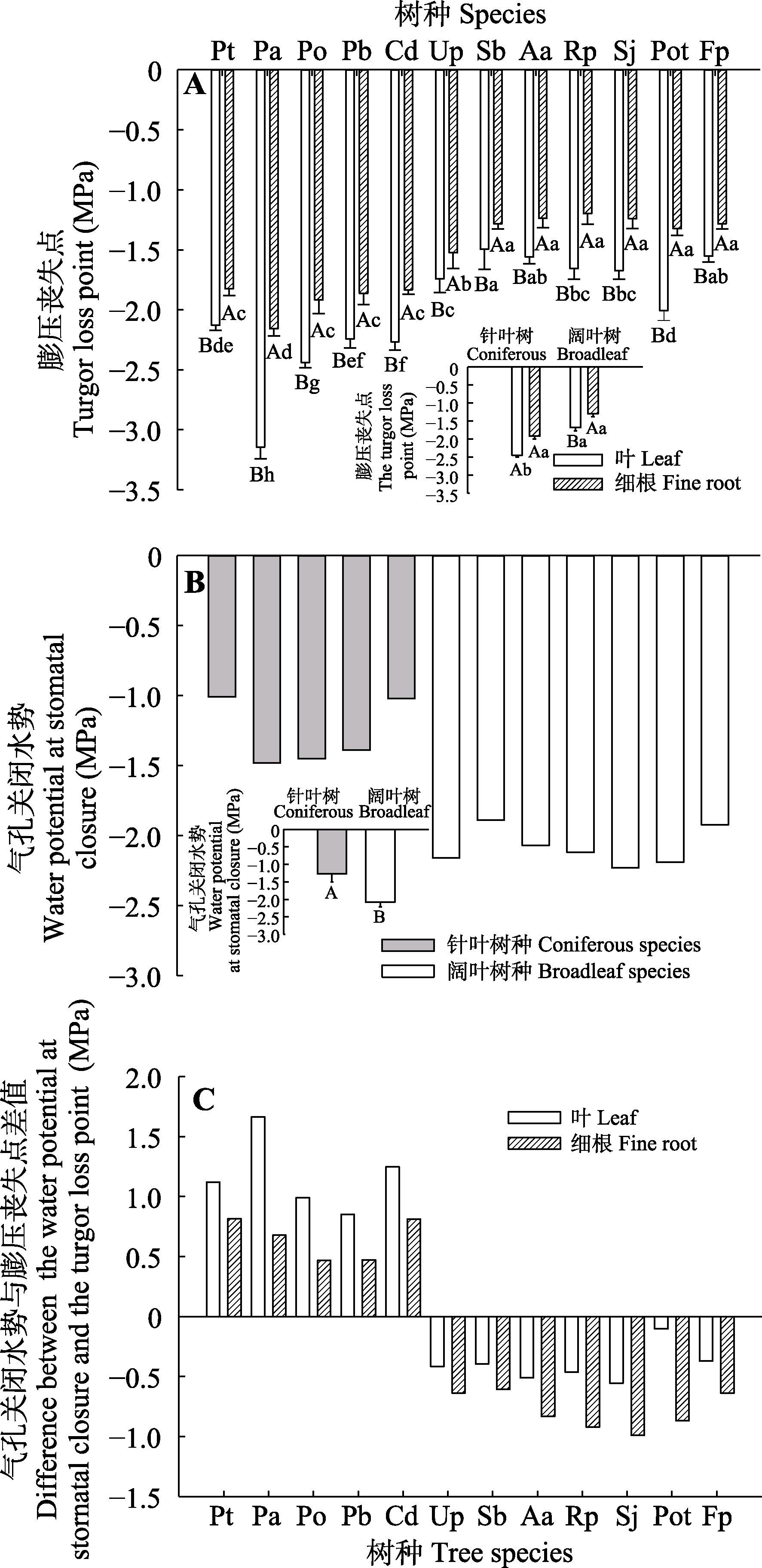
Fig. 2 Turgor loss point (A), the water potential at stomatal closure (B), and their difference (C) of leaves and fine roots of 12 tree species in the loess hilly region (mean ± SD, n = 6). Different uppercase letters represent significant differences in leaves and fine roots, and different lowercase letters represent significant differences among different tree species (p < 0.05). Tree species see Table 1.
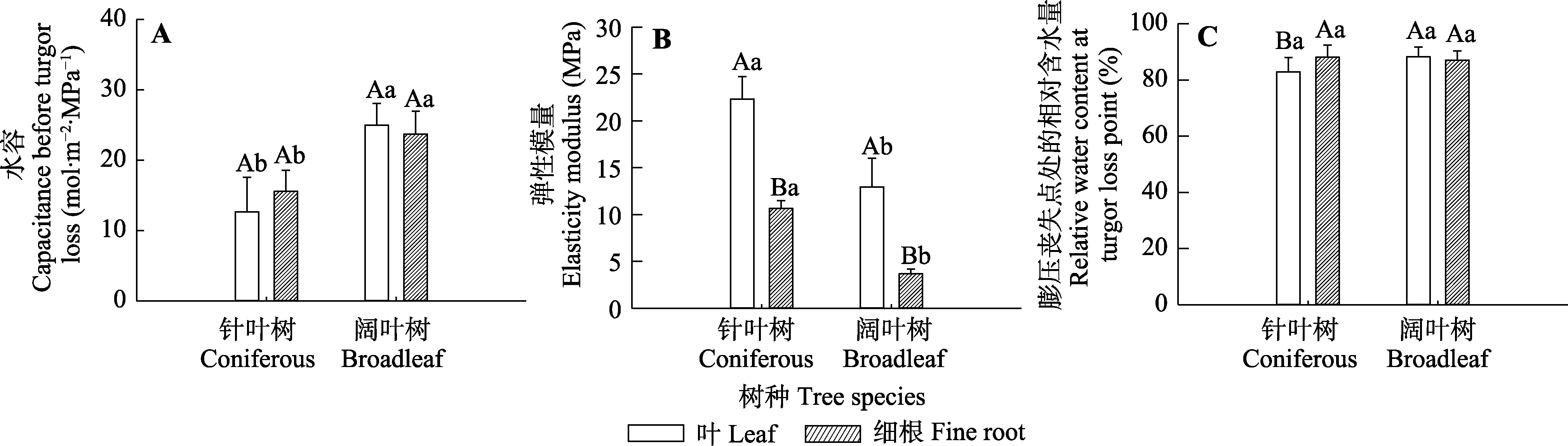
Fig. 3 Comparison of pressure-volume (P-V) traits of leaves and fine roots of 12 tree species in loess hilly region (mean ± SD, n = 6). Different uppercase letters represent significant differences in leaves and fine roots, and different lowercase letters represent significant differences among different tree species (p < 0.05).
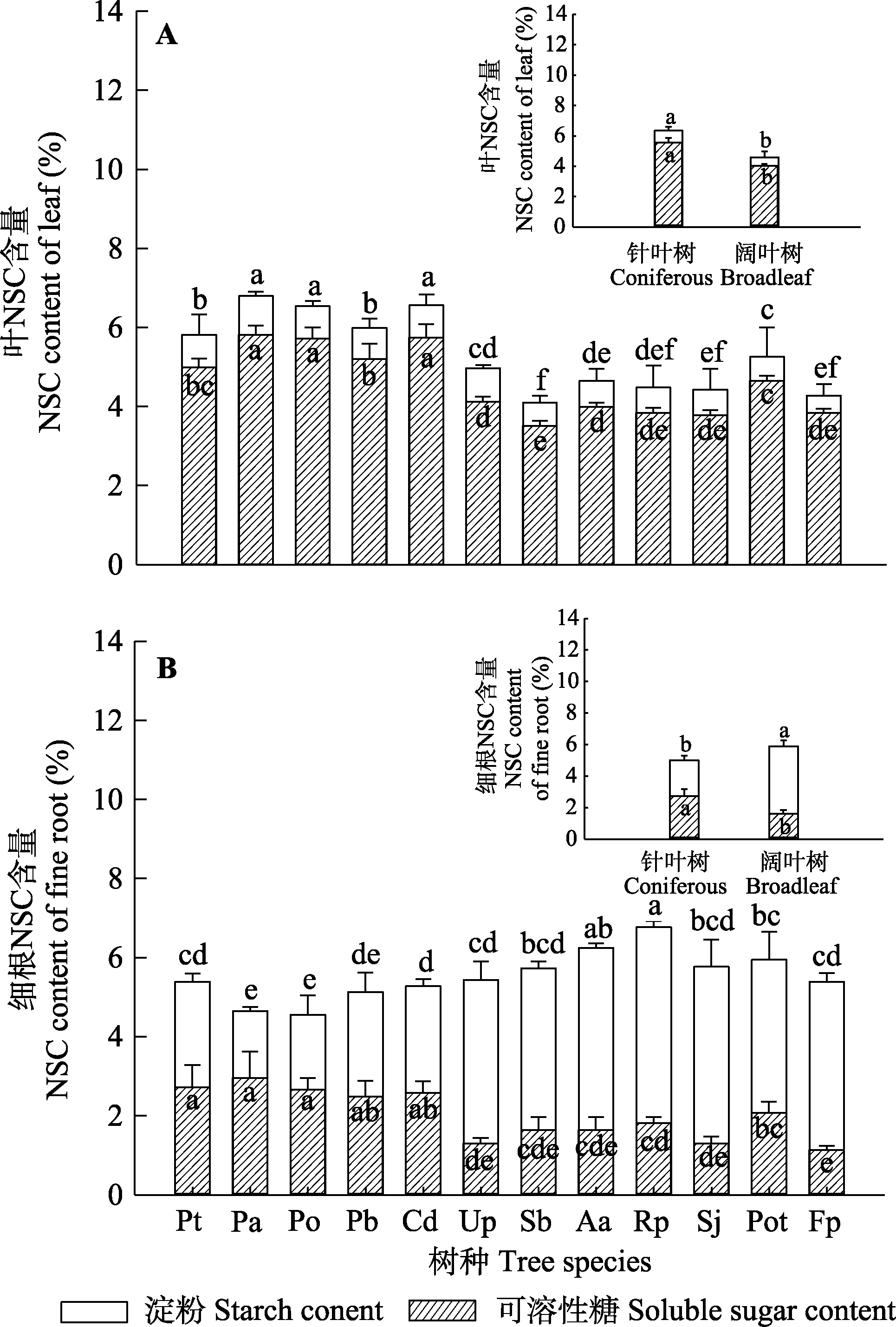
Fig. 4 Comparison of starch, soluble sugar and non-structural carbohydrate (NSC) contents in leaves and fine roots of 12 tree species in the loess hilly region (mean ± SD, n = 6). Different lowercase letters represent significant differences among different tree species (p < 0.05). Tree species see Table 1.
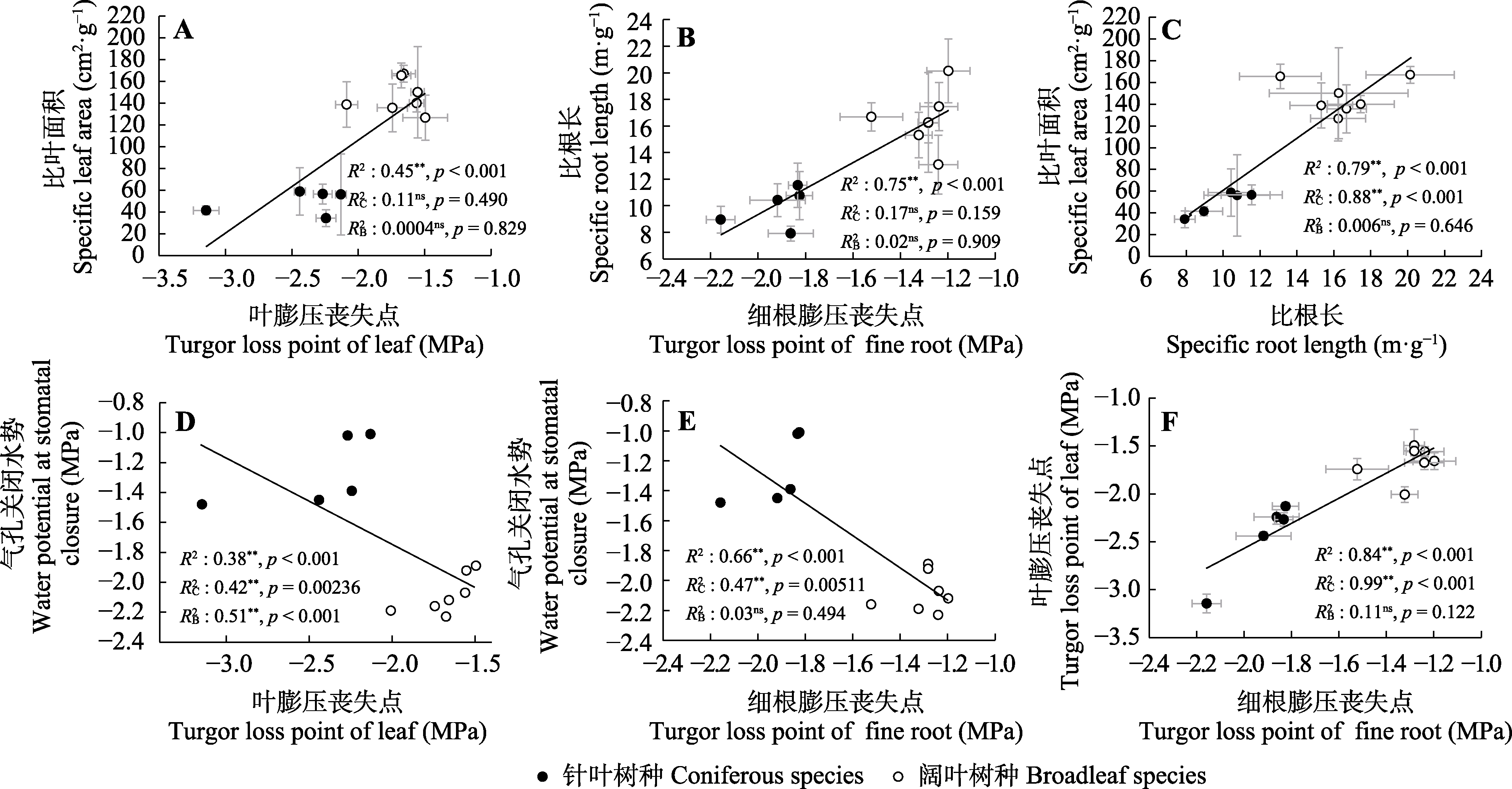
Fig. 5 Relationships among leaf-root turgor loss point (TLP) and morphological traits and leaf water potential at stomatal closure (Ψclose) of 12 tree species in the loess hilly region. R2 denotes the correlation coefficient of coniferous species and broadleaf species. R2C denotes the correlation coefficient of coniferous species and R2B denotes the correlation coefficient of broadleaf species (n = 6). ns, p > 0.05; **, p < 0.01.
| [1] |
Aritsara ANA, Wang S, Li BN, Jiang X, Qie YD, Tan FS, Zhang QW, Cao KF (2022). Divergent leaf and fine root “pressure-volume relationships” across habitats with varying water availability. Plant Physiology, 190, 2246-2259.
DOI PMID |
| [2] |
Baffoin R, Charrier G, Bouchardon AE, Bonhomme M, Améglio T, Lacointe A (2021). Seasonal changes in carbohydrates and water content predict dynamics of frost hardiness in various temperate tree species. Tree Physiology, 41, 1583-1600.
DOI PMID |
| [3] |
Bartlett MK, Klein T, Jansen S, Choat B, Sack L (2016). The correlations and sequence of plant stomatal, hydraulic, and wilting responses to drought. Proceedings of the National Academy of Sciences of the United States of America, 113, 13098-13103.
PMID |
| [4] |
Bartlett MK, Scoffoni C, Ardy R, Zhang Y, Sun SW, Cao KF, Sack L (2012a). Rapid determination of comparative drought tolerance traits: using an osmometer to predict turgor loss point. Methods in Ecology and Evolution, 3, 880-888.
DOI URL |
| [5] |
Bartlett MK, Scoffoni C, Sack L (2012b). The determinants of leaf turgor loss point and prediction of drought tolerance of species and biomes: a global meta-analysis. Ecology Letters, 15, 393-405.
DOI URL |
| [6] |
Bartlett MK, Sinclair G, Fontanesi G, Knipfer T, Walker MA, McElrone AJ (2022). Root pressure-volume curve traits capture rootstock drought tolerance. Annals of Botany, 129, 389-402.
DOI URL |
| [7] |
Blackman CJ, Brodribb TJ (2011). Two measures of leaf capacitance: insights into the water transport pathway and hydraulic conductance in leaves. Functional Plant Biology, 38, 118-126.
DOI PMID |
| [8] |
Bourgoin C, Ceccherini G, Girardello M, Vancutsem C, Avitabile V, Beck PSA, Beuchle R, Blanc L, Duveiller G, Migliavacca M, Vieilledent G, Cescatti A, Achard F (2024). Human degradation of tropical moist forests is greater than previously estimated. Nature, 631, 570-576.
DOI |
| [9] |
Brodribb TJ, McAdam SAM (2011). Passive origins of stomatal control in vascular plants. Science, 331, 582-585.
DOI PMID |
| [10] |
Brodribb TJ, Powers J, Cochard H, Choat B (2020). Hanging by a thread? Forests and drought. Science, 368, 261-266.
DOI PMID |
| [11] | Cai J, Tyree MT (2010). The impact of vessel size on vulnerability curves: data and models for within-species variability in saplings of aspen, Populus tremuloides Michx. Plant, Cell & Environment, 33, 1059-1069. |
| [12] |
Carminati A, Vetterlein D, Weller U, Vogel HJ, Oswald SE (2009). When roots lose contact. Vadose Zone Journal, 8, 805-809.
DOI URL |
| [13] |
Chen ZC, Li S, Luan JW, Zhang YT, Zhu SD, Wan XC, Liu SR (2019). Prediction of temperate broadleaf tree species mortality in arid limestone habitats with stomatal safety margins. Tree Physiology, 39, 1428-1437.
DOI PMID |
| [14] | Chen ZC, Li S, Wan XC, Liu SR (2022). Strategies of tree species to adapt to drought from leaf stomatal regulation and stem embolism resistance to root properties. Frontiers in Plant Science, 13, 926535. DOI: 10.3389/fpls.2022.926535. |
| [15] |
Choat B, Brodribb TJ, Brodersen CR, Duursma RA, López R, Medlyn BE (2018). Triggers of tree mortality under drought. Nature, 558, 531-539.
DOI |
| [16] |
Choat B, Jansen S, Brodribb TJ, Cochard H, Delzon S, Bhaskar R, Bucci SJ, Feild TS, Gleason SM, Hacke UG, Jacobsen AL, Lens F, Maherali H, Martínez-Vilalta J, Mayr S, et al. (2012). Global convergence in the vulnerability of forests to drought. Nature, 491, 752-755.
DOI |
| [17] |
Cochard H, Lemoine D, Améglio T, Granier A (2001). Mechanisms of xylem recovery from winter embolism in Fagus sylvatica. Tree Physiology, 21, 27-33.
PMID |
| [18] |
Cuneo IF, Knipfer T, Brodersen CR, McElrone AJ (2016). Mechanical failure of fine root cortical cells initiates plant hydraulic decline during drought. Plant Physiology, 172, 1669-1678.
PMID |
| [19] |
Farrell C, Szota C, Arndt SK (2017). Does the turgor loss point characterize drought response in dryland plants? Plant, Cell & Environment, 40, 1500-1511.
DOI URL |
| [20] | Guo JJ, Gong XW, Li XH, Zhang C, Duan CY, Lohbeck M, Sterck F, Hao GY (2024). Coupled hydraulics and carbon economy underlie age-related growth decline and revitalisation of sand-fixing shrubs after crown removal. Plant, Cell & Environment, 47, 2999-3014. |
| [21] | Huang JP, Yu HP, Guan XD, Wang GY, Guo RX (2016). Accelerated dryland expansion under climate change. Nature Climate Change, 6, 166-171. |
| [22] | Jin Y, Hao GY, Hammond WM, Yu KL, Liu XR, Ye Q, Zhou ZH, Wang CK (2023). Aridity-dependent sequence of water potentials for stomatal closure and hydraulic dysfunctions in woody plants. Global Change Biology, 29, 2030-2040. |
| [23] |
Kramer-Walter KR, Bellingham PJ, Millar TR, Smissen RD, Richardson SJ, Laughlin DC (2016). Root traits are multidimensional: specific root length is independent from root tissue density and the plant economic spectrum. Journal of Ecology, 104, 1299-1310.
DOI URL |
| [24] |
Lenz TI, Wright IJ, Westoby M (2006). Interrelations among pressure-volume curve traits across species and water availability gradients. Physiologia Plantarum, 127, 423-433.
DOI URL |
| [25] | Liu WD, Su JR, Li SF, Xu CH, Lang XD, Huang XB, Zhong H (2018). Non-structural carbohydrates characteristics of different forest layers in monsoon broad-leaved evergreen forest in Pu’er, Yunnan Province, China. Chinese Journal of Applied Ecology, 29, 775-782. |
| [刘万德, 苏建荣, 李帅锋, 徐崇华, 郎学东, 黄小波, 钟华 (2018). 云南普洱季风常绿阔叶林不同林层非结构性碳水化合物特征. 应用生态学报, 29, 775-782.] | |
| [26] |
McDowell N, Pockman WT, Allen CD, Breshears DD, Cobb N, Kolb T, Plaut J, Sperry J, West A, Williams DG, Yepez EA (2008). Mechanisms of plant survival and mortality during drought: Why do some plants survive while others succumb to drought? New Phytologist, 178, 719-739.
DOI PMID |
| [27] |
Milani P, Braybrook SA, Boudaoud A (2013). Shrinking the hammer: micromechanical approaches to morphogenesis. Journal of Experimental Botany, 64, 4651-4662.
DOI PMID |
| [28] |
Moore JP, Vicré-Gibouin M, Farrant JM, Driouich A (2008). Adaptations of higher plant cell walls to water loss: drought vs desiccation. Physiologia Plantarum, 134, 237-245.
DOI URL |
| [29] |
Nardini A, Battistuzzo M, Savi T (2013). Shoot desiccation and hydraulic failure in temperate woody angiosperms during an extreme summer drought. New Phytologist, 200, 322-329.
DOI PMID |
| [30] |
Nardini A, Pedà G, La Rocca N (2012). Trade-offs between leaf hydraulic capacity and drought vulnerability: morpho-anatomical bases, carbon costs and ecological consequences. New Phytologist, 196, 788-798.
DOI PMID |
| [31] |
North GB, Nobel PS (1997). Root-soil contact for the desert succulent Agave deserti in wet and drying soil. New Phytologist, 135, 21-29.
DOI URL |
| [32] |
Oliva J, Stenlid J, Martinez-Vilalta J (2014). The effect of fungal pathogens on the water and carbon economy of trees: implications for drought-induced mortality. New Phytologist, 203, 1028-1035.
DOI PMID |
| [33] | Petek-Petrik A, Petrík P, Halmová M, Plichta R, Matoušková M, Houšková K, Chudomelová M, Urban J, Hédl R (2024). Contrasting strategies in morphological and physiological response to drought stress among temperate forest understory forbs and graminoids. Plant Biology, 814-826. |
| [34] |
Piper FI, Fajardo A, Hoch G (2017). Single-provenance mature conifers show higher non-structural carbohydrate storage and reduced growth in a drier location. Tree Physiology, 37, 1001-1010.
DOI PMID |
| [35] |
Poorter L, Kitajima K (2007). Carbohydrate storage and light requirements of tropical moist and dry forest tree species. Ecology, 88, 1000-1011.
PMID |
| [36] |
Powell TL, Wheeler JK, de Oliveira AAR, da Costa ACL, Saleska SR, Meir P, Moorcroft PR (2017). Differences in xylem and leaf hydraulic traits explain differences in drought tolerance among mature Amazon rainforest trees. Global Change Biology, 23, 4280-4293.
DOI PMID |
| [37] |
Ren JP, Li JP, Wang WF, Dai YX, Wang L (2021). Responses of leaf hydraulic traits to water conditions in eight tree species and the driving factors. Chinese Journal of Plant Ecology, 45, 942-951.
DOI URL |
|
[任金培, 李俊鹏, 王卫锋, 代永欣, 王林 (2021). 八个树种叶水力性状对水分条件的响应及其驱动因素. 植物生态学报, 45, 942-951.]
DOI |
|
| [38] |
Rodriguez-Dominguez CM, Brodribb TJ (2020). Declining root water transport drives stomatal closure in olive under moderate water stress. New Phytologist, 225, 126-134.
DOI PMID |
| [39] |
Roumet C, Birouste M, Picon-Cochard C, Ghestem M, Osman N, Vrignon-Brenas S, Cao KF, Stokes A (2016). Root structure-function relationships in 74 species: evidence of a root economics spectrum related to carbon economy. New Phytologist, 210, 815-826.
DOI PMID |
| [40] |
Sade N, Moshelion M (2014). The dynamic isohydric-anisohydric behavior of plants upon fruit development: taking a risk for the next generation. Tree Physiology, 34, 1199-1202.
DOI PMID |
| [41] |
Sala A, Woodruff DR, Meinzer FC (2012). Carbon dynamics in trees: feast or famine? Tree Physiology, 32, 764-775.
DOI PMID |
| [42] | Sardans J, Miralles A, Tariq A, Zeng FJ, Wang R, Peñuelas J (2024). Growing aridity poses threats to global land surface. Communications Earth & Environment, 5, 776. DOI: 10.1038/s43247-024-01935-1. |
| [43] |
Sevanto S, McDowell NG, Dickman LT, Pangle R, Pockman WT (2014). How do trees die? A test of the hydraulic failure and carbon starvation hypotheses. Plant, Cell & Environment, 37, 153-161.
DOI URL |
| [44] | Slatyer RO, Markus DK (1968). Plant-water relationships. Soil Science, 106, 478. DOI: 10.1097/00010694-196812000-00020. |
| [45] |
Song YJ, Sterck F, Zhou XQ, Liu Q, Kruijt B, Poorter L (2022). Drought resilience of conifer species is driven by leaf lifespan but not by hydraulic traits. New Phytologist, 235, 978-992.
DOI PMID |
| [46] |
Sperry JS, Tyree MT (1988). Mechanism of water stress-induced xylem embolism. Plant Physiology, 88, 581-587.
DOI PMID |
| [47] | Tyree MT (2003). Plant hydraulics: the ascent of water. Nature, 423, 923. DOI: 10.1038/423923a. |
| [48] | Walthert L, Etzold S, Carminati A, Saurer M, Köchli R, Zweifel R (2024). Coordination between degree of isohydricity and depth of root water uptake in temperate tree species. Science of the Total Environment, 946, 174346. DOI: 10.1016/j.scitotenv.2024.174346. |
| [49] | Wang AY, Han SJ, Zhang JH, Wang M, Yin XH, Fang LD, Yang D, Hao GY (2018). The interaction between nonstructural carbohydrate reserves and xylem hydraulics in Korean pine trees across an altitudinal gradient. Tree Physiology, 38, 1792-1804. |
| [50] | Wang LL, Zhou ZH, Jin Y, Wang CK (2022). Drought tolerance traits of leaves of 20 tree species in temperate forest of Northeast China. Chinese Journal of Applied Ecology, 33, 1-8. |
|
[王乐乐, 周正虎, 金鹰, 王传宽 (2022). 东北温带森林20种乔木树种叶片干旱容忍性特征. 应用生态学报, 33, 1-8.]
DOI |
|
| [51] |
Xiong DL, Flexas J, Yu TT, Peng SB, Huang JL (2017). Leaf anatomy mediates coordination of leaf hydraulic conductance and mesophyll conductance to CO2 in Oryza. New Phytologist, 213, 572-583.
DOI URL |
| [52] | Xu JJ, Li Q, Wu WJ, Muhammad Haroon UR, Ma XQ, Wu PF (2019). Effects of vertical phosphorus competition on root growth and biomass distribution of Chinese fir seedlings. Acta Ecologica Sinica, 39, 2071-2081. |
| [许静静, 李琦, 吴文景, Muhammad Haroon UR, 马祥庆, 吴鹏飞 (2019). 垂直方向磷素竞争对杉木根系生长及生物量分配的影响. 生态学报, 39, 2071-2081.] | |
| [53] | Yan CL, Ni MY, Cao KF, Zhu SD (2020). Leaf hydraulic safety margin and safety-efficiency trade-off across angiosperm woody species. Biology Letters, 16, 20200456. DOI: 10.1098/rsbl.2020.0456. |
| [54] |
Yang YH, Ma XL, Yan L, Li YC, Wei SH, Teng ZP, Zhang H, Tang W, Peng SB, Li Y (2024). Soil-root interface hydraulic conductance determines responses of photosynthesis to drought in rice and wheat. Plant Physiology, 194, 376-390.
DOI URL |
| Viewed | ||||||
|
Full text |
|
|||||
|
Abstract |
|
|||||
Copyright © 2026 Chinese Journal of Plant Ecology
Tel: 010-62836134, 62836138, E-mail: apes@ibcas.ac.cn, cjpe@ibcas.ac.cn

