
Chin J Plant Ecol ›› 2026, Vol. 50 ›› Issue (6): 1419-1435.DOI: 10.17521/cjpe.2025.0049 cstr: 32100.14.cjpe.2025.0049
• Research Articles • Previous Articles Next Articles
WANG Hai-Zhen1, WANG Yu-Qing2, MA Fu-Long3, HAN Lu3,*( )
)
Received:2025-02-10
Accepted:2025-10-17
Online:2026-06-28
Published:2026-07-25
Contact:
HAN Lu
Supported by:WANG Hai-Zhen, WANG Yu-Qing, MA Fu-Long, HAN Lu. Effects of hydraulic traits and anatomical structures on leaf morphological changes of Populus euphratica[J]. Chin J Plant Ecol, 2026, 50(6): 1419-1435.
Add to citation manager EndNote|Ris|BibTeX
URL: https://www.plant-ecology.com/EN/10.17521/cjpe.2025.0049
| 样地 Site | 经纬度 Longitude and latitude | 地下水埋深 Groundwater depth (m) | 胡杨 Populus euphratica | ||
|---|---|---|---|---|---|
| 平均胸径 Average DBH (cm) | 平均树高 Average height (m) | 密度 Density (inds·hm-2) | |||
| 肖夹克 Xiaojiake (U1) | 80.95° E, 40.48° N | 1.0-1.5 | 26.3 | 6.4 | 290.5 |
| 塔南镇 Tanan Town (U2) | 81.15° E, 40.44° N | 2.3-2.7 | 22.6 | 8.5 | 171.3 |
| 阿瓦提县 Awat County (U3) | 80.39° E, 40.33° N | 4.5-5.0 | 21.1 | 7.9 | 268.1 |
| 沙雅县 Shaya County (U4) | 82.01° E, 40.69° N | 7.5-8.0 | 36.4 | 7.8 | 120.2 |
Table 1 Overview of the survey plots and characteristics of Populus euphratica population in study area
| 样地 Site | 经纬度 Longitude and latitude | 地下水埋深 Groundwater depth (m) | 胡杨 Populus euphratica | ||
|---|---|---|---|---|---|
| 平均胸径 Average DBH (cm) | 平均树高 Average height (m) | 密度 Density (inds·hm-2) | |||
| 肖夹克 Xiaojiake (U1) | 80.95° E, 40.48° N | 1.0-1.5 | 26.3 | 6.4 | 290.5 |
| 塔南镇 Tanan Town (U2) | 81.15° E, 40.44° N | 2.3-2.7 | 22.6 | 8.5 | 171.3 |
| 阿瓦提县 Awat County (U3) | 80.39° E, 40.33° N | 4.5-5.0 | 21.1 | 7.9 | 268.1 |
| 沙雅县 Shaya County (U4) | 82.01° E, 40.69° N | 7.5-8.0 | 36.4 | 7.8 | 120.2 |
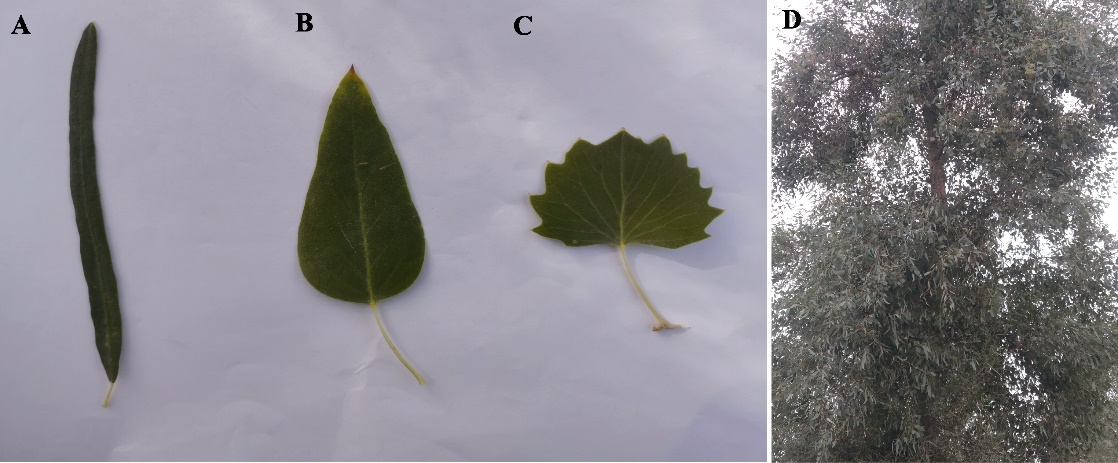
Fig. 1 Morphological characteristics of three heteromorphic leaves of Populus euphratica. A, Lanceolate leaf at lower layer. B, Oval leaf at middle-upper layer. C, Serrated broad-oval leaf at upper layer. D, Distribution of different leaf shapes on vertical height.
| 垂直高度 Vertical height | 叶形 Leaf Shape | 地下水埋深 GWD (m) | 叶长 Leaf length (cm) | 叶宽 Leaf width (cm) | 叶面积 Leaf area (cm2) | 周长 Leaf perimeter (cm) | 长宽比 Length/ width | 叶圆度指数 Roundness index | 叶锯齿化指数 Dissection index |
|---|---|---|---|---|---|---|---|---|---|
| 下层 Lower | L | 1.0-1.5 | 11.89 ± 1.65a/A | 1.25 ± 0.24a/C | 11.77 ± 3.11a/B | 25.80 ± 3.65a/b | 9.67 ± 4.75a/A | 0.22 ± 0.03a/C | 2.14 ± 0.16a/A |
| 2.3-2.7 | 9.39 ± 1.49b/A | 1.01 ± 0.20b/C | 7.56 ± 2.42b/B | 20.35 ± 3.22b/a | 9.59 ± 1.80a/A | 0.23 ± 0.03a/B | 2.12 ± 0.16a/A | ||
| 4.5-5.0 | 9.86 ± 2.91b/A | 1.09 ± 0.15ab/C | 8.36 ± 1.80b/C | 22.60 ± 4.80ab/b | 9.40 ± 3.52a/A | 0.22 ± 0.05a/B | 2.20 ± 0.30a/A | ||
| 7.5-8.0 | 9.88 ± 1.30b/A | 0.91 ± 0.12b/C | 7.09 ± 1.37b/B | 21.41 ± 2.87b/a | 10.96 ± 1.65a/A | 0.20 ± 0.03a/B | 2.27 ± 0.15a/A | ||
| 均值 Mean | 10.26 ± 1.11 | 1.06 ± 0.15 | 8.70 ± 2.12 | 22.54 ± 2.36 | 9.91 ± 0.71 | 0.21 ± 0.01 | 2.19 ± 0.07 | ||
| 中层 Middle | O | 1.0-1.5 | 8.49 ± 1.72A/B | 3.40 ± 1.00a/B | 17.21 ± 5.55ab/B | 20.77 ± 3.65A/c | 2.63 ± 0.72a/B | 0.50 ± 0.08a/A | 1.43 ± 0.11ab/B |
| 2.3-2.7 | 8.07 ± 1.55A/A | 3.07 ± 0.76a/B | 14.48 ± 4.37b/A | 19.27 ± 3.25A/a | 2.75 ± 0.75a/B | 0.49 ± 0.09aA | 1.44 ± 0.13a/B | ||
| 4.5-5.0 | 8.16 ± 0.83A/A | 3.63 ± 0.74a/B | 17.94 ± 4.22a/B | 20.06 ± 2.01A/c | 2.32 ± 0.45a/B | 0.56 ± 0.07aA | 1.35 ± 0.08b/B | ||
| 7.5-8.0 | 6.03 ± 1.24B/B | 2.37 ± 0.57b/B | 8.82 ± 3.47c/B | 14.50 ± 2.80B/c | 2.63 ± 0.64a/B | 0.51 ± 0.07a/A | 1.40 ± 0.09ab/C | ||
| 均值 Mean | 7.69 ± 1.12 | 3.12 ± 0.55 | 14.61 ± 4.14 | 18.65 ± 2.83 | 2.58 ± 0.18 | 0.51 ± 0.03 | 1.41 ± 0.04 | ||
| 上层 Upper | S | 1.0-1.5 | 4.55 ± 0.72B/C | 8.53 ± 0.90A/A | 27.72 ± 5.09A/A | 31.10 ± 2.86A/a | 0.54 ± 0.06c/C | 0.36 ± 0.03C/B | 1.67 ± 0.08A/B |
| 2.3-2.7 | 3.76 ± 0.58C/B | 5.77 ± 0.67C/A | 15.17 ± 3.79B/A | 19.83 ± 2.26C/a | 0.65 ± 0.05b/C | 0.48 ± 0.05B/A | 1.45 ± 0.08B/B | ||
| 4.5-5.0 | 5.67 ± 0.68A/B | 7.63 ± 0.58B/A | 30.94 ± 4.65A/A | 25.19 ± 2.45B/a | 0.74 ± 0.08a/B | 0.61 ± 0.06A/A | 1.28 ± 0.07C/B | ||
| 7.5-8.0 | 3.65 ± 0.41C/C | 5.15 ± 0.57C/A | 13.74 ± 2.68B/A | 18.72 ± 2.78C/b | 0.71 ± 0.04a/C | 0.50 ± 0.06B/A | 1.43 ± 0.09B/B | ||
| 均值 Mean | 4.40 ± 0.93 | 6.77 ± 1.58 | 21.89 ± 8.61 | 23.71 ± 5.58 | 0.66 ± 0.09 | 0.49 ± 0.10 | 1.46 ± 0.16 | ||
| GWD | ** | ** | ** | ** | ns | ** | ** | ||
| VH | ** | ** | ** | ** | ** | ** | ** | ||
| VH × GWD | ** | ** | ** | ** | ns | ** | ** | ||
Table 2 Morphological characteristics of three heteromorphic leaf types in Populus euphratica (mean ± SD)
| 垂直高度 Vertical height | 叶形 Leaf Shape | 地下水埋深 GWD (m) | 叶长 Leaf length (cm) | 叶宽 Leaf width (cm) | 叶面积 Leaf area (cm2) | 周长 Leaf perimeter (cm) | 长宽比 Length/ width | 叶圆度指数 Roundness index | 叶锯齿化指数 Dissection index |
|---|---|---|---|---|---|---|---|---|---|
| 下层 Lower | L | 1.0-1.5 | 11.89 ± 1.65a/A | 1.25 ± 0.24a/C | 11.77 ± 3.11a/B | 25.80 ± 3.65a/b | 9.67 ± 4.75a/A | 0.22 ± 0.03a/C | 2.14 ± 0.16a/A |
| 2.3-2.7 | 9.39 ± 1.49b/A | 1.01 ± 0.20b/C | 7.56 ± 2.42b/B | 20.35 ± 3.22b/a | 9.59 ± 1.80a/A | 0.23 ± 0.03a/B | 2.12 ± 0.16a/A | ||
| 4.5-5.0 | 9.86 ± 2.91b/A | 1.09 ± 0.15ab/C | 8.36 ± 1.80b/C | 22.60 ± 4.80ab/b | 9.40 ± 3.52a/A | 0.22 ± 0.05a/B | 2.20 ± 0.30a/A | ||
| 7.5-8.0 | 9.88 ± 1.30b/A | 0.91 ± 0.12b/C | 7.09 ± 1.37b/B | 21.41 ± 2.87b/a | 10.96 ± 1.65a/A | 0.20 ± 0.03a/B | 2.27 ± 0.15a/A | ||
| 均值 Mean | 10.26 ± 1.11 | 1.06 ± 0.15 | 8.70 ± 2.12 | 22.54 ± 2.36 | 9.91 ± 0.71 | 0.21 ± 0.01 | 2.19 ± 0.07 | ||
| 中层 Middle | O | 1.0-1.5 | 8.49 ± 1.72A/B | 3.40 ± 1.00a/B | 17.21 ± 5.55ab/B | 20.77 ± 3.65A/c | 2.63 ± 0.72a/B | 0.50 ± 0.08a/A | 1.43 ± 0.11ab/B |
| 2.3-2.7 | 8.07 ± 1.55A/A | 3.07 ± 0.76a/B | 14.48 ± 4.37b/A | 19.27 ± 3.25A/a | 2.75 ± 0.75a/B | 0.49 ± 0.09aA | 1.44 ± 0.13a/B | ||
| 4.5-5.0 | 8.16 ± 0.83A/A | 3.63 ± 0.74a/B | 17.94 ± 4.22a/B | 20.06 ± 2.01A/c | 2.32 ± 0.45a/B | 0.56 ± 0.07aA | 1.35 ± 0.08b/B | ||
| 7.5-8.0 | 6.03 ± 1.24B/B | 2.37 ± 0.57b/B | 8.82 ± 3.47c/B | 14.50 ± 2.80B/c | 2.63 ± 0.64a/B | 0.51 ± 0.07a/A | 1.40 ± 0.09ab/C | ||
| 均值 Mean | 7.69 ± 1.12 | 3.12 ± 0.55 | 14.61 ± 4.14 | 18.65 ± 2.83 | 2.58 ± 0.18 | 0.51 ± 0.03 | 1.41 ± 0.04 | ||
| 上层 Upper | S | 1.0-1.5 | 4.55 ± 0.72B/C | 8.53 ± 0.90A/A | 27.72 ± 5.09A/A | 31.10 ± 2.86A/a | 0.54 ± 0.06c/C | 0.36 ± 0.03C/B | 1.67 ± 0.08A/B |
| 2.3-2.7 | 3.76 ± 0.58C/B | 5.77 ± 0.67C/A | 15.17 ± 3.79B/A | 19.83 ± 2.26C/a | 0.65 ± 0.05b/C | 0.48 ± 0.05B/A | 1.45 ± 0.08B/B | ||
| 4.5-5.0 | 5.67 ± 0.68A/B | 7.63 ± 0.58B/A | 30.94 ± 4.65A/A | 25.19 ± 2.45B/a | 0.74 ± 0.08a/B | 0.61 ± 0.06A/A | 1.28 ± 0.07C/B | ||
| 7.5-8.0 | 3.65 ± 0.41C/C | 5.15 ± 0.57C/A | 13.74 ± 2.68B/A | 18.72 ± 2.78C/b | 0.71 ± 0.04a/C | 0.50 ± 0.06B/A | 1.43 ± 0.09B/B | ||
| 均值 Mean | 4.40 ± 0.93 | 6.77 ± 1.58 | 21.89 ± 8.61 | 23.71 ± 5.58 | 0.66 ± 0.09 | 0.49 ± 0.10 | 1.46 ± 0.16 | ||
| GWD | ** | ** | ** | ** | ns | ** | ** | ||
| VH | ** | ** | ** | ** | ** | ** | ** | ||
| VH × GWD | ** | ** | ** | ** | ns | ** | ** | ||
| 项目 Item | 叶面积 Leaf area | 周长 Leaf perimeter | 叶长 Leaf length | 叶宽 Leaf width | 长宽比 Length/ width | 叶圆度指数 Roundness index | 叶锯齿化指数 Dissection index |
|---|---|---|---|---|---|---|---|
| 地下水埋深 Groundwater depth | -0.287** | -0.424** | -0.173** | -0.171** | 0.039 | 0.106 | -0.039 |
| 树高 Tree height | -0.168** | -0.149* | -0.067 | -0.071 | 0.008 | -0.073 | 0.029 |
| 胸径 Diameter at breast height | -0.187** | -0.222** | -0.099 | -0.090 | 0.010 | 0.017 | -0.016 |
| 叶着生高度 Blade attachment height | 0.514** | -0.097 | -0.734** | 0.737** | -0.898** | 0.776** | -0.834** |
| 水力路径长度 Hydraulic path length | 0.122 | -0.381** | -0.612** | 0.357** | -0.560** | 0.589** | -0.577** |
Table 3 Relationship between morphological characteristics of heteromorphic leaves in Populus euphratica and factors
| 项目 Item | 叶面积 Leaf area | 周长 Leaf perimeter | 叶长 Leaf length | 叶宽 Leaf width | 长宽比 Length/ width | 叶圆度指数 Roundness index | 叶锯齿化指数 Dissection index |
|---|---|---|---|---|---|---|---|
| 地下水埋深 Groundwater depth | -0.287** | -0.424** | -0.173** | -0.171** | 0.039 | 0.106 | -0.039 |
| 树高 Tree height | -0.168** | -0.149* | -0.067 | -0.071 | 0.008 | -0.073 | 0.029 |
| 胸径 Diameter at breast height | -0.187** | -0.222** | -0.099 | -0.090 | 0.010 | 0.017 | -0.016 |
| 叶着生高度 Blade attachment height | 0.514** | -0.097 | -0.734** | 0.737** | -0.898** | 0.776** | -0.834** |
| 水力路径长度 Hydraulic path length | 0.122 | -0.381** | -0.612** | 0.357** | -0.560** | 0.589** | -0.577** |
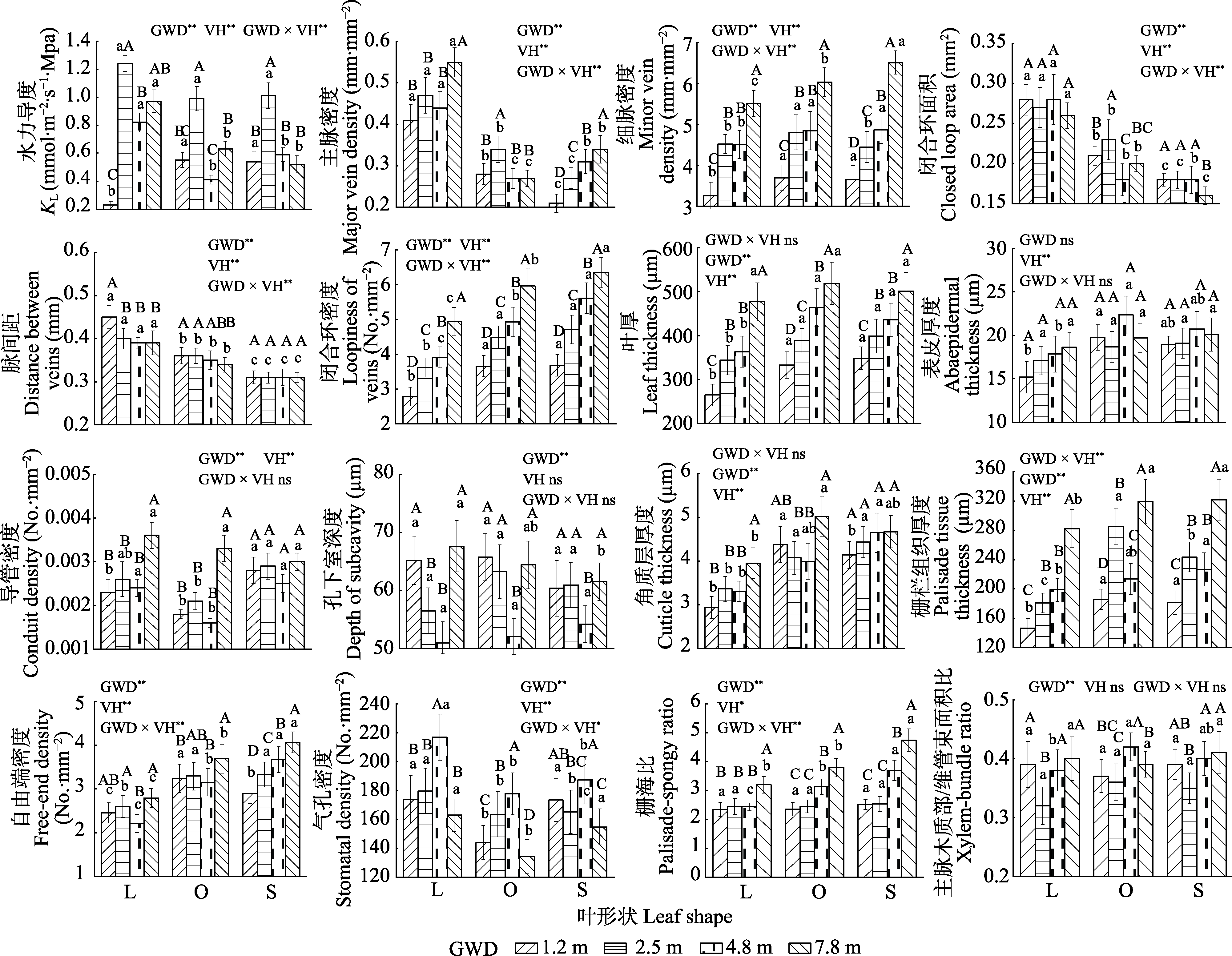
Fig. 2 Effect of vertical height and groundwater depth on hydraulic traits and anatomical structure of Populus euphratica heteromorphic leaves (mean ± SD). VH, vertical height; GWD, groundwater depth; L, lanceolate leaf; O, oval leaf; S, serrated broad-oval leaf. Different lowercase letters indicate significant difference among heteromorphic leaves at different canopy heights under the same groundwater depths (p < 0.05), different uppercase letters denote significant difference in the same leaf morphology across varying groundwater depths (p < 0.05). **, p < 0.01; *, p < 0.05; ns, p > 0.05.
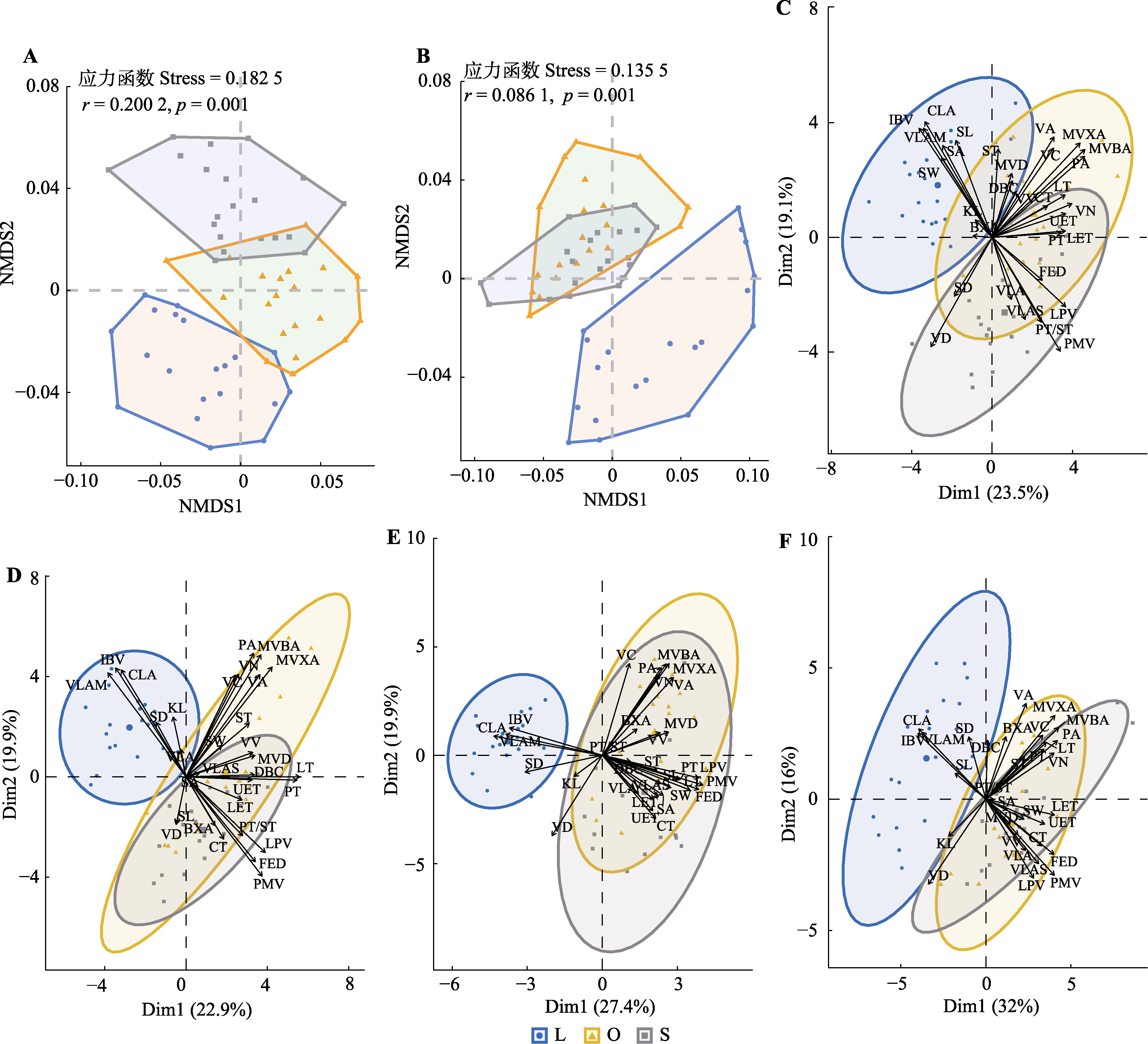
Fig. 3 Differences in morphological, hydraulic and anatomical traits of heteromorphic leaves in Populus euphratica. A, C, U1 plot with groundwater depth (GWD) 1.2 m; B, F, U4 plot with GWD 7.8 m; D, U2 plot with GWD 2.5 m; E, U3 plot with GWD 4.8 m. L, lanceolate leaf; O, oval leaf; S, serrated broad-oval leaf. BXA, xylem-bundle ratio; CLA, closed loop area; CT, cuticle thickness; DBC, depth of subcavity; FED, free-end density; IBV, interval between veins; KL, hydraulic conductance; LET, aba-epidermis thickness; LPV, loopiness of veins; LT, leaf thickness; MVBA, major vein bundle area; MVD, vessel diameter of major vein; MVXA, major vein xylem area; PMV, percentage of minor vein (%); PA, phloem area; PT, palisade tissue thickness; SA, stomatal area; SD, stomatal density; SL, stomatal length; ST, spongy tissue thickness; SW, stomatal width; UET, ada-epidermal thickness; VA, vessel area; VC, vessel diameter; VD, vessel density; VLA, total vein density; VLAM, major vein density; VLAS, minor vein density; VN, vessel number; VV, total vein volume.
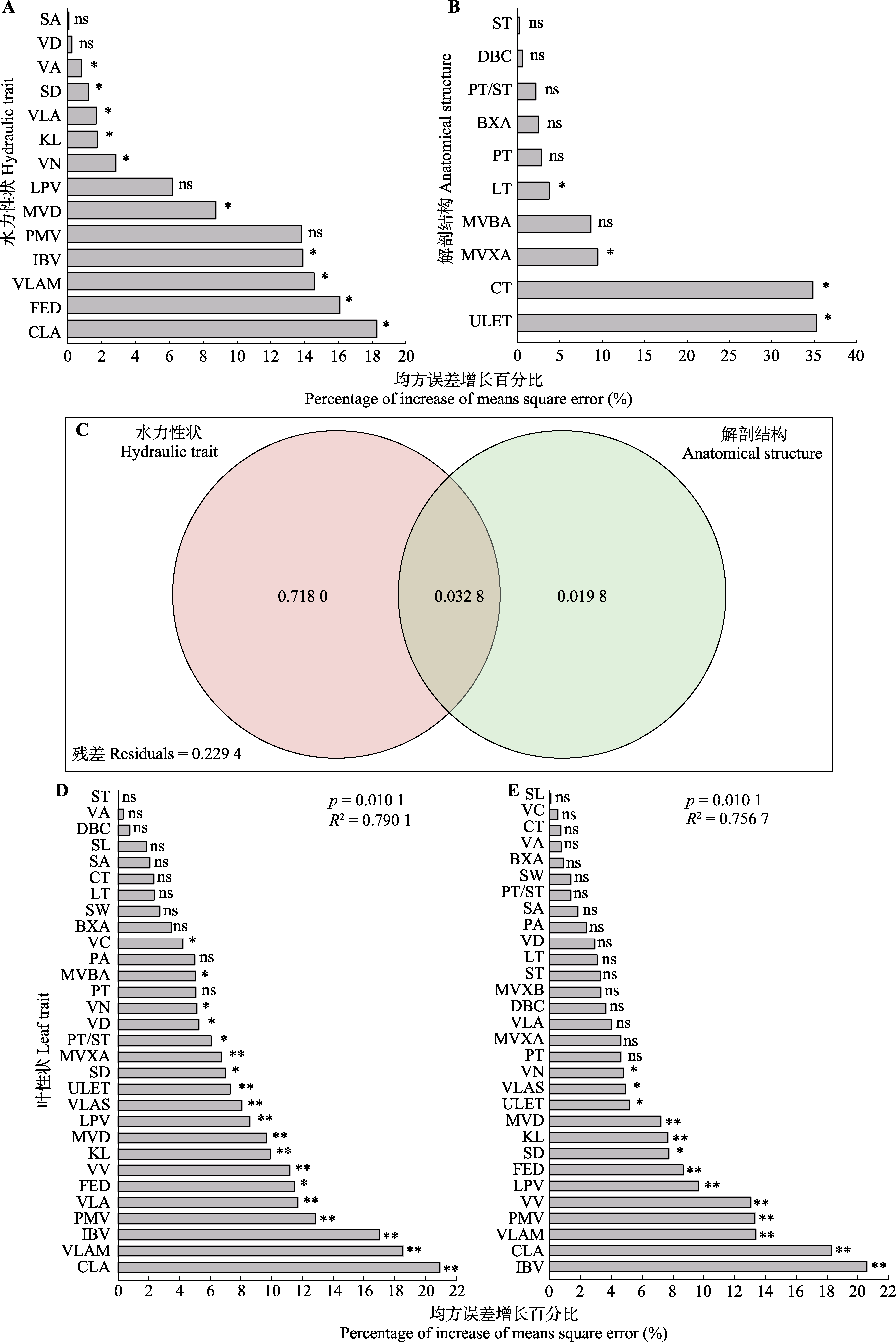
Fig. 4 Intrinsic factors driving the leaf shape of heteromorphic leaves in Populus euphratica. ULET, ada-aba epidermal thickness; See Fig. 3 for details of other index. **, p < 0.01; *, p < 0.05; ns, p > 0.05.
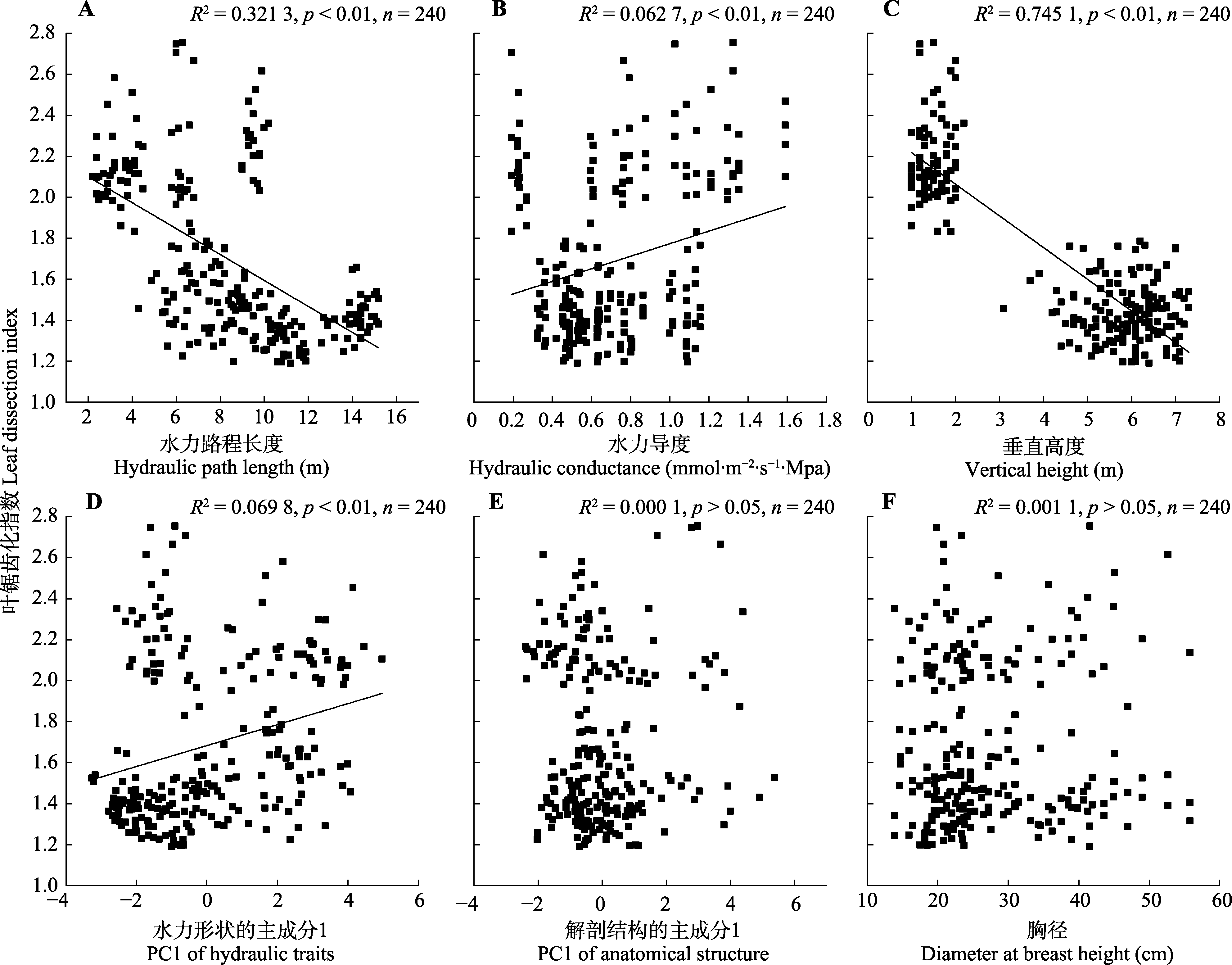
Fig. 5 Bivariate relationships between leaf dissection index and influencing factors of Populus euphratica. PC1, principal component 1.
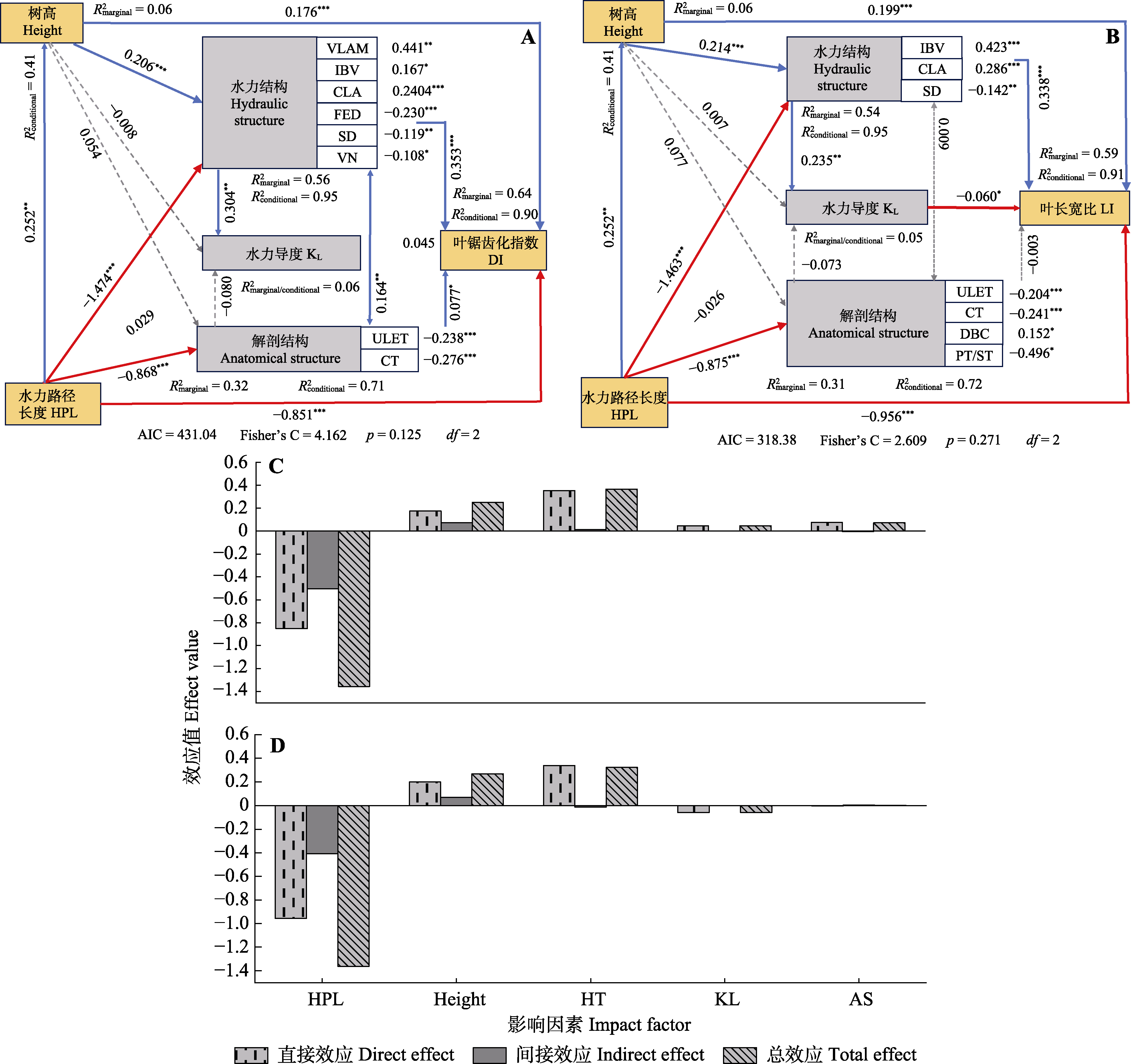
Fig. 6 Path diagram of structural equation model with direct and indirect path coefficients of driving factors of leaf morphology in Populus euphratica. AIC, akaike information criterion; AS, anatomical structure; CLA, Closed loop area; CT, cuticle thickness; DBC, depth of subcavity; DI, Leaf dissection index; df, degree of freedom; FED, free-end density; HPL, hydraulic path length; HT, hydraulic structure; IBV, interval between veins; KL, hydraulic conductance; LI, Length/width ratio; SD, stomatal density; ULET: ada-aba epidermal thickness; VLAM, major vein density; VN, vessel number. The dotted line indicates no significant correlation, blue and red lines indicate the positive and negative effects, respectively. Width of the lines shows the strength of the causal relationship, the numbers on lines are standardized path coefficients. All of the drivers of the DI/LI were chosen based on previous associations and random forest analysis. The R2conditional and R2marginal represent the proportion of variance explained by all predictors without and with accounting for random effects. ***, p < 0.001; **, p < 0.01; *, p < 0.05.
| [1] |
Eisenring M, Unsicker SB, Lindroth RL (2021). Spatial, genetic and biotic factors shape within-crown leaf trait variation and herbivore performance in a foundation tree species. Functional Ecology, 35, 54-66.
DOI URL |
| [2] |
England JR, Attiwill PM (2006). Changes in leaf morphology and anatomy with tree age and height in the broadleaved evergreen species, Eucalyptus regnans F. Muell. Trees, 20, 79-90.
DOI URL |
| [3] |
Fan XK, Yan X, Qian CJ, Bachir DG, Yin XY, Sun PP, Ma XF (2020). Leaf size variations in a dominant desert shrub, Reaumuria soongarica, adapted to heterogeneous environments. Ecology and Evolution, 10, 10076-10094.
DOI URL |
| [4] |
Gong R, Gao Q (2015). Research progress in the effects of leaf hydraulic characteristics on plant physiological functions. Chinese Journal of Plant Ecology, 39, 300-308.
DOI |
|
[龚容, 高琼 (2015). 叶片结构的水力学特性对植物生理功能影响的研究进展. 植物生态学报, 39, 300-308.]
DOI |
|
| [5] | Hao JQ, Yue N, Zheng CX (2017). Analysis of changes in anatomical characteristics and physiologic features of heteromorphic leaves in a desert tree, Populus euphratica. Acta Physiologiae Plantarum, 39, 160. DOI: 10.1007/s11738-017-2467-9. |
| [6] |
Huang MJ, Liu X, Zhou SR (2020). Asynchrony among species and functional groups and temporal stability under perturbations: patterns and consequences. Journal of Ecology, 108, 2038-2046.
DOI URL |
| [7] | Kong CC, Anwar E, Ma LG, Long YX, Wang YY, Yang XD (2022). Response of twig-leaf size relationships Populus euphratica with heteromorphic leaves to drought stress. Scientia Silvae Sinicae, 58(12), 42-51. |
| [孔翠翠, 伊力哈穆江·艾尼弯, 马利刚, 隆彦昕, 王雅芸, 杨晓东 (2022). 胡杨异形叶枝叶大小关系对干旱胁迫的响应. 林业科学, 58(12), 42-51.] | |
| [8] |
Lai JS, Zou Y, Zhang S, Zhang XG, Mao LF (2022). Glmm.hp: an R package for computing individual effect of predictors in generalized linear mixed models. Journal of Plant Ecology, 15, 1302-1307.
DOI |
| [9] |
Leigh A, Zwieniecki MA, Rockwell FE, Boyce CK, Nicotra AB, Holbrook NM (2011). Structural and hydraulic correlates of heterophylly in Ginkgo biloba. New Phytologist, 189, 459-470.
DOI PMID |
| [10] |
Li L, Zeng H, Guo DL (2013). Leaf venation functional traits and their ecological significance. Chinese Journal of Plant Ecology, 37, 691-698.
DOI |
|
[李乐, 曾辉, 郭大立 (2013). 叶脉网络功能性状及其生态学意义. 植物生态学报, 37, 691-698.]
DOI |
|
| [11] | Li WH (2020). Structure and Hydraulic Conductivity of the Xylem in Branches Affects the Morphology and Photosynthesis Diversity of Leaves in Populus euphratica Oliv. PhD dissertation, Beijing Forestry University, Beijing. |
| [李文海 (2020). 胡杨枝条木质部导管结构与导水特征对叶片形态变化和光合作用的影响. 博士学位论文, 北京林业大学, 北京.] | |
| [12] |
Li YH, Lu Q, Wu B, Zhu YJ, Liu DJ, Zhang JX, Jin ZH (2012). A review of leaf morphology plasticity linked to plant response and adaptation characteristics in arid ecosystems. Chinese Journal of Plant Ecology, 36, 88-98.
DOI URL |
|
[李永华, 卢琦, 吴波, 朱雅娟, 刘殿君, 张金鑫, 靳占虎 (2012). 干旱区叶片形态特征与植物响应和适应的关系. 植物生态学报, 36, 88-98.]
DOI |
|
| [13] |
Li YQ, Wang ZH (2021). Leaf morphological traits: ecological function, geographic distribution and drivers. Chinese Journal of Plant Ecology, 45, 1154-1172.
DOI URL |
|
[李耀琪, 王志恒 (2021). 植物叶片形态的生态功能、地理分布与成因. 植物生态学报, 45, 1154-1172.]
DOI |
|
| [14] |
Liu WS, Zheng L, Qi DH (2020). Variation in leaf traits at different altitudes reflects the adaptive strategy of plants to environmental changes. Ecology and Evolution, 10, 8166-8175.
DOI PMID |
| [15] | Liu YB, Li XR, Chen GX, Li MM, Liu ML, Liu D (2015). Epidermal micromorphology and mesophyll structure of Populus euphratica heteromorphic leaves at different development stages. PLoS ONE, 10, e0137701. DOI: 10.1371/journal.pone.0141578. |
| [16] |
Nardini A, Luglio J (2014). Leaf hydraulic capacity and drought vulnerability: possible trade-offs and correlations with climate across three major biomes. Functional Ecology, 28, 810-818.
DOI URL |
| [17] |
Nicotra AB, Leigh A, Boyce CK, Jones CS, Niklas KJ, Royer DL, Tsukaya H (2011). The evolution and functional significance of leaf shape in the angiosperms. Functional Plant Biology, 38, 535-552.
DOI PMID |
| [18] |
Pan YP, Chen YP, Chen YN, Wang RZ, Ren ZG (2016). Impact of groundwater depth on leaf hydraulic properties and drought vulnerability of Populus euphratica in the Northwest of China. Trees, 30, 2029-2039.
DOI URL |
| [19] | Pan YP, Chen YP, Wang HJ, Ren ZG (2018). Leaf structure and functional traits of Populus euphratica. Journal of Desert Research, 38, 765-771. |
|
[潘莹萍, 陈亚鹏, 王怀军, 任志国 (2018). 胡杨(Populus euphratica)叶片结构与功能关系. 中国沙漠, 38, 765-771.]
DOI |
|
| [20] |
Reich PB (2014). The world-wide ‘fast-slow’ plant economics spectrum: a traits manifesto. Journal of Ecology, 102, 275-301.
DOI URL |
| [21] |
Reich PB, Wright IJ, Cavender-Bares J, Craine J, Oleksyn J, Westoby M, Walters M (2003). The evolution of plant functional variation: traits, spectra and strategies. International Journal of Plant Sciences, 164, S143-S164.
DOI URL |
| [22] |
Ren CJ, Zhang W, Zhong ZK, Han XH, Yang GH, Feng YZ, Ren GX (2018). Differential responses of soil microbial biomass, diversity, and compositions to altitudinal gradients depend on plant and soil characteristics. Science of the Total Environment, 610-611, 750-758.
DOI URL |
| [23] |
Ryan MG, Yoder BJ (1997). Hydraulic limits to tree height and tree growth. BioScience, 47, 235-242.
DOI URL |
| [24] |
Sack L, Frole K (2006). Leaf structural diversity is related to hydraulic capacity in tropical rain forest trees. Ecology, 87, 483-491.
DOI PMID |
| [25] | Sack L, Scoffoni C (2012). Measurement of leaf hydraulic conductance and stomatal conductance and their responses to irradiance and dehydration using the Evaporative Flux Method (EFM). Journal of Visualized Experiments, 70, e4179. DOI: 10.3791/4179. |
| [26] |
Sack L, Scoffoni C (2013). Leaf venation: structure, function, development, evolution, ecology and applications in the past, present and future. New Phytologist, 198, 983-1000.
DOI PMID |
| [27] |
Scoffoni C, Rawls M, McKown A, Cochard H, Sack L (2011). Decline of leaf hydraulic conductance with dehydration: relationship to leaf size and venation architecture. Plant Physiology, 156, 832-843.
DOI PMID |
| [28] |
Sellin A, Alber M, Jasińska AK, Rosenvald K (2022). Adjustment of leaf anatomical and hydraulic traits across vertical canopy profiles of young broadleaved forest stands. Trees, 36, 67-80.
DOI |
| [29] |
Sellin A, Taneda H, Alber M (2019). Leaf structural and hydraulic adjustment with respect to air humidity and canopy position in silver birch (Betula pendula). Journal of Plant Research, 132, 369-381.
DOI PMID |
| [30] | Shao S, Li GJ, Wang JM, Wang Y, Qu MJ, Zhao H, Zhu WL, Li JW (2024). Temperature and soil attributes drive the regional variation in leaf anatomical traits of Populus euphratican. Global Ecology and Conservation, 54, e03107. DOI: 10.1016/j.gecco.2024.e03107. |
| [31] | Shi PJ, Yu KX, Niinemets Ü, Gielis J (2021). Can leaf shape be represented by the ratio of leaf width to length? Evidence from nine species of Magnolia and Michelia (Magnoliaceae). Forests, 12, 41. DOI: 10.3390/f12010041. |
| [32] |
Sisó S, Camarero J, Gil-Pelegrín E (2001). Relationship between hydraulic resistance and leaf morphology in broadleaf Quercus species: a new interpretation of leaf lobation. Trees, 15, 341-345.
DOI URL |
| [33] |
Wang HZ, Han L, Xu YL, Niu JL (2014). Photosynthetic responses of the heteromorphic leaves in Populus euphratica to light intensity and CO2 concentration. Chinese Journal of Plant Ecology, 38, 1099-1109.
DOI URL |
|
[王海珍, 韩路, 徐雅丽, 牛建龙 (2014). 胡杨异形叶光合作用对光强与CO2浓度的响应. 植物生态学报, 38, 1099-1109.]
DOI |
|
| [34] | Wang WJ, Lü H, Zhong YM, Chen LJ, Li JW, Ma Q (2019). Relationship between heteromorphic leaf traits of Populus euphratica and its individual development. Journal of Beijing Forestry University, 41(2), 62-69. |
| [王文娟, 吕慧, 钟悦鸣, 陈利俊, 李景文, 马青 (2019). 胡杨异形叶性状与其个体发育的关系. 北京林业大学学报, 41(2), 62-69.] | |
| [35] | Wei YH, Liang WZ, Han L, Wang HZ (2021). Leaf functional traits of Populus euphratica and its response to groundwater depths in Tarim extremely arid area. Acta Ecologica Sinica, 41, 5368-5376. |
| [魏圆慧, 梁文召, 韩路, 王海珍 (2021). 胡杨叶功能性状特征及其对地下水埋深的响应. 生态学报, 41, 5368-5376.] | |
| [36] |
Wright IJ, Reich PB, Westoby M, Ackerly DD, Baruch Z, Bongers F, Cavender-Bares J, Chapin T, Cornelissen JHC, Diemer M, Flexas J, Garnier E, Groom PK, Gulias J, Hikosaka K, et al. (2004). The worldwide leaf economics spectrum. Nature, 428, 821-827.
DOI |
| [37] |
Xiong DL, Flexas J, Yu TT, Peng SB, Huang JL (2017). Leaf anatomy mediates coordination of leaf hydraulic conductance and mesophyll conductance to CO2 in Oryza. New Phytologist, 213, 572-583.
DOI URL |
| [38] |
Xiong YJ, Yu G, Wei KL, Peng J, Geng HR, Yang DM, Peng GQ (2022). Relationships between lamina size, vein density and vein cell wall dry mass per unit vein length of broad-leaved woody species in Tiantong Mountain, southeastern China. Chinese Journal of Plant Ecology, 46, 136-147.
DOI URL |
|
[熊映杰, 于果, 魏凯璐, 彭娟, 耿鸿儒, 杨冬梅, 彭国全 (2022). 天童山阔叶木本植物叶片大小与叶脉密度及单位叶脉长度细胞壁干质量的关系. 植物生态学报, 46, 136-147.]
DOI |
|
| [39] | Yang SD, Zhen WJ, Chen GC, Zhang CL, Chen J, Wang XC (2005). Difference of ultrastructure and photosynthetic characteristics between lanceolate and broad-ovate leaves in Populus euphratica. Acta Botanica Boreali-occidentalia Sinica, 25, 14-21. |
| [杨树德, 郑文菊, 陈国仓, 张承烈, 陈珈, 王学臣 (2005). 胡杨披针形叶与宽卵形叶的超微结构与光合特性的差异. 西北植物学报, 25, 14-21.] | |
| [40] | Yang XD, Anwar E, Xu YL, Zhou J, Sha LB, Gong XW, Ali A, Gao YC, Liu YJ, Ge P (2022). Hydraulic constraints determine the distribution of heteromorphic leaves along plant vertical height. Frontiers in Plant Science, 13, 941764. DOI: 10.3389/fpls.2022.941764. |
| [41] | Ye M, Wu M, Zhang H, Zhang ZL, Zhang ZJ (2021). High leaf vein density promotes leaf gas exchange by enhancing leaf hydraulic conductance in Oryza sativa L. plants. Frontiers in Plant Science, 12, 693815. DOI: 10.3389/fpls.2021.693815. |
| [42] |
Zhai JT, Li YL, Han ZJ, Li ZJ (2020). Morphological, structural and physiological differences in heteromorphic leaves of Euphrates poplar during development stages and at crown scales. Plant Biology, 22, 366-375.
DOI PMID |
| [43] | Zhai JT, Li ZJ, Si JH, Zhang SH, Han XL, Chen XX (2022). Structural and functional responses of the heteromorphic leaves of different tree heights on Populus euphratica Oliv. to different soil moisture conditions. Plants, 11, 2376. DOI: 10.3390/plants11182376. |
| [44] |
Zwieniecki MA, Boyce CK, Holbrook NM (2004). Functional design space of single-veined leaves: role of tissue hydraulic properties in constraining leaf size and shape. Annals of Botany, 94, 507-513.
PMID |
| Viewed | ||||||
|
Full text |
|
|||||
|
Abstract |
|
|||||
Copyright © 2026 Chinese Journal of Plant Ecology
Tel: 010-62836134, 62836138, E-mail: apes@ibcas.ac.cn, cjpe@ibcas.ac.cn

