
Chin J Plant Ecol ›› 2026, Vol. 50 ›› Issue (6): 1393-1407.DOI: 10.17521/cjpe.2025.0115 cstr: 32100.14.cjpe.2025.0115
• Research Articles • Previous Articles Next Articles
ZUO Kun-Jiao1, JIA Guo-Dong1,2,*( ), YU Xin-Xiao1,2, JIANG Tao1, LIU Zi-He1
Received:2025-03-28
Accepted:2025-06-09
Online:2026-06-28
Published:2026-08-29
Contact:
JIA Guo-Dong
Supported by:ZUO Kun-Jiao, JIA Guo-Dong, YU Xin-Xiao, JIANG Tao, LIU Zi-He. Canopy rainfall interception characteristics and simulation in typical plantation forests in the mountainous region of Beijing[J]. Chin J Plant Ecol, 2026, 50(6): 1393-1407.
Add to citation manager EndNote|Ris|BibTeX
URL: https://www.plant-ecology.com/EN/10.17521/cjpe.2025.0115
| 林分类型 Forest type | 海拔 Elevation (m) | 经纬度 Latitude and longitude | 叶面积指数 Leaf area index | 郁闭度 Canopy cover | 林分密度 Stand density (plant·hm-2) | 平均胸径 Mean diameter at breast height (DBH) (cm) | 平均树高 Average height (m) | 坡度 Slope (°) | 坡向 Aspect |
|---|---|---|---|---|---|---|---|---|---|
| 侧柏纯林 Platycladus orientalis forest | 142.43 | 40.06° N 116.10° E | 3.18 | 0.87 | 2 050 | 12.77 | 9.4 | 15.0 | 阴坡 Shady slope |
| 栓皮栎纯林 Quercus variabilis forest | 319.29 | 40.06° N 116.09° E | 3.26 | 0.91 | 1 983 | 17.21 | 10.9 | 20.0 | 阴坡Shady slope |
| 混交林 Mixed forest | 411.16 | 40.06° N 116.09° E | 3.19 | 0.92 | 1 800 | 14.64 | 10.0 | 25.4 | 阴坡Shady slope |
Table 1 Basic characteristics of the three typical plantation plots in the mountainous region of Beijing
| 林分类型 Forest type | 海拔 Elevation (m) | 经纬度 Latitude and longitude | 叶面积指数 Leaf area index | 郁闭度 Canopy cover | 林分密度 Stand density (plant·hm-2) | 平均胸径 Mean diameter at breast height (DBH) (cm) | 平均树高 Average height (m) | 坡度 Slope (°) | 坡向 Aspect |
|---|---|---|---|---|---|---|---|---|---|
| 侧柏纯林 Platycladus orientalis forest | 142.43 | 40.06° N 116.10° E | 3.18 | 0.87 | 2 050 | 12.77 | 9.4 | 15.0 | 阴坡 Shady slope |
| 栓皮栎纯林 Quercus variabilis forest | 319.29 | 40.06° N 116.09° E | 3.26 | 0.91 | 1 983 | 17.21 | 10.9 | 20.0 | 阴坡Shady slope |
| 混交林 Mixed forest | 411.16 | 40.06° N 116.09° E | 3.19 | 0.92 | 1 800 | 14.64 | 10.0 | 25.4 | 阴坡Shady slope |
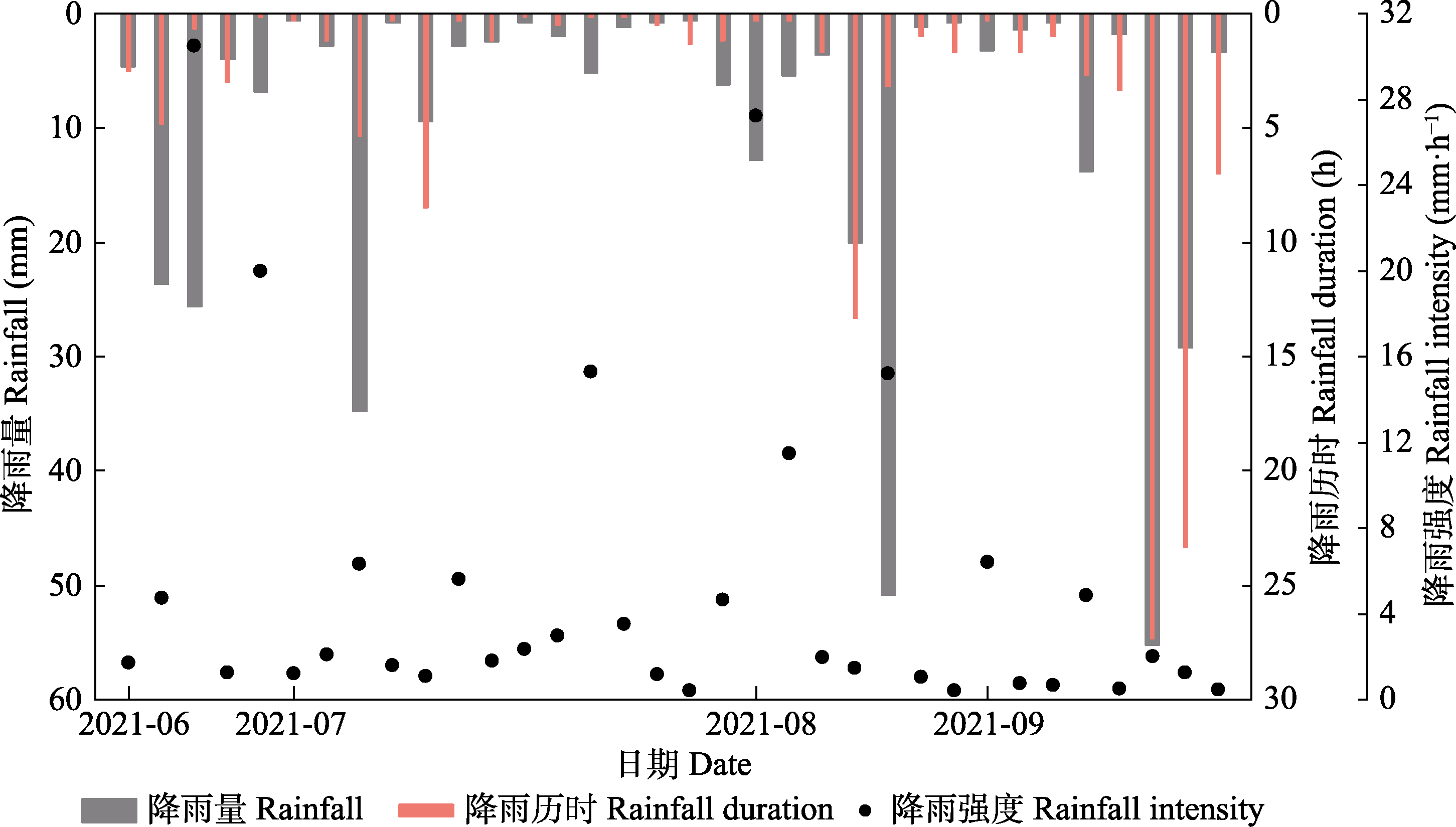
Fig. 1 Rainfall characteristics during the study period (June to September, 2021): gross rainfall, duration, and intensity.
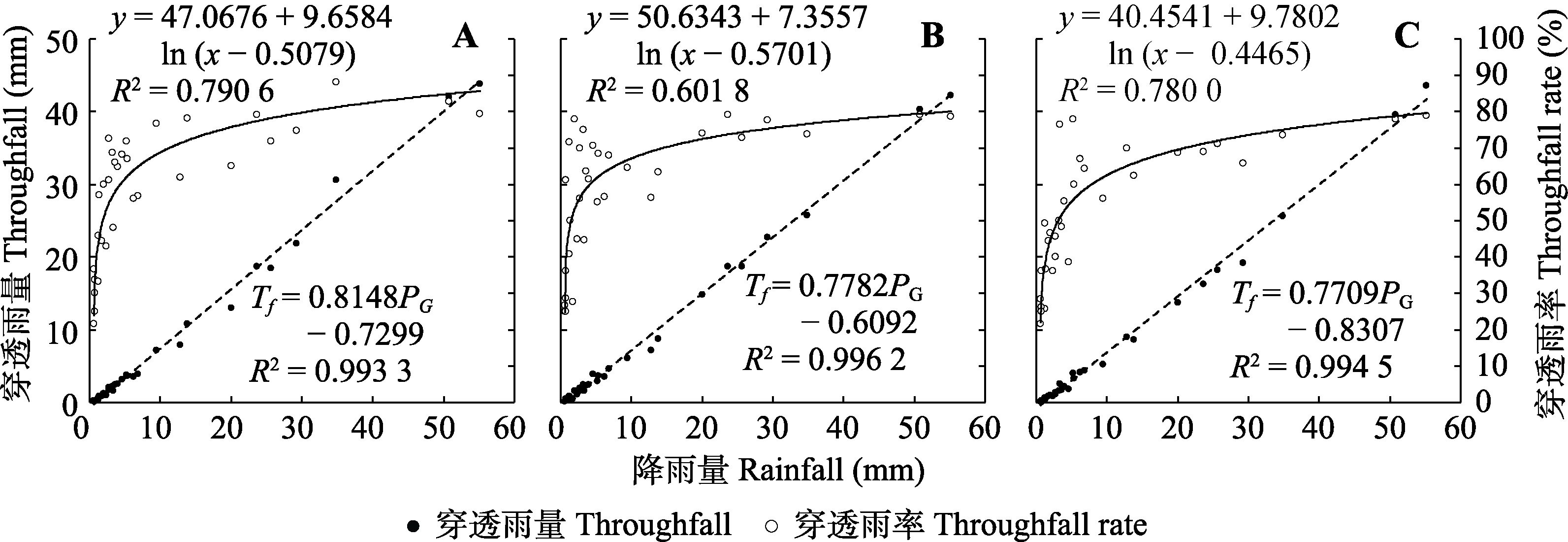
Fig. 2 Relationship between throughfall and gross rainfall in Platycladus orientalis forest (A), Quercus variabilis forest (B) and mixed forest (C) during the study period from June to September 2021. Tf, throughfall; PG, rainfall.
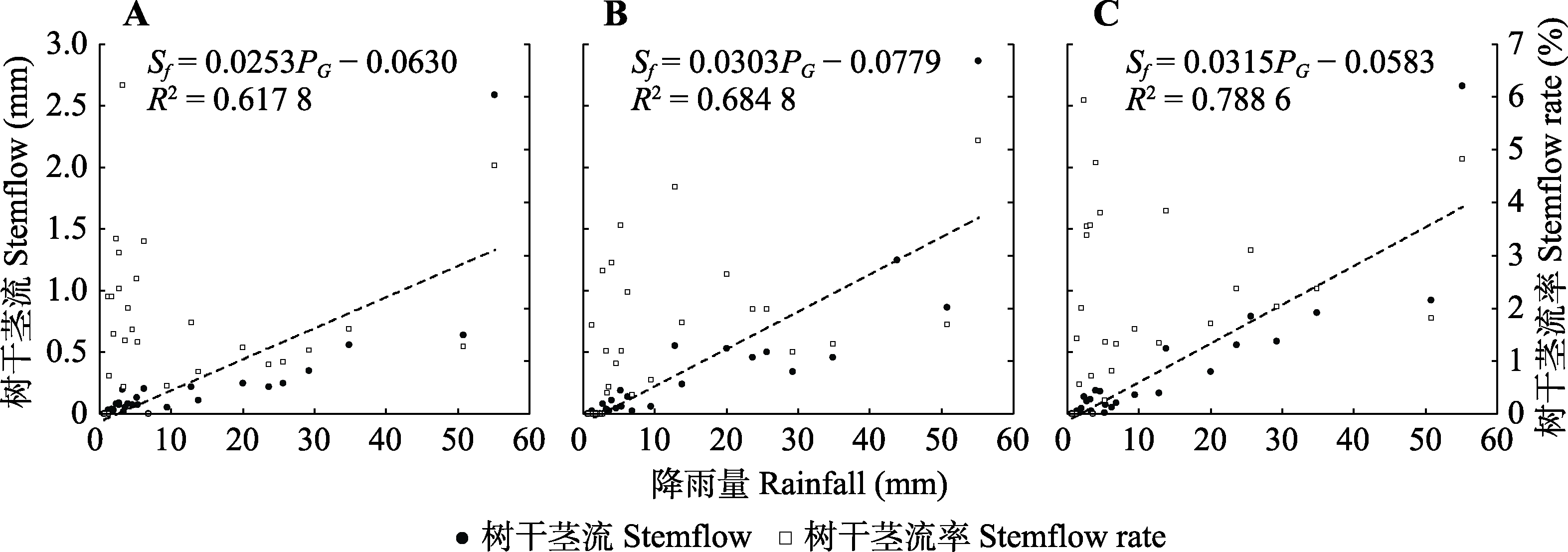
Fig. 3 Relationship between stemflow and gross rainfall in Platycladus orientalis forest (A), Quercus variabilis forest (B) and mixed forest (C) during the study period from June to September 2021. Sf, stemflow; PG, rainfall.
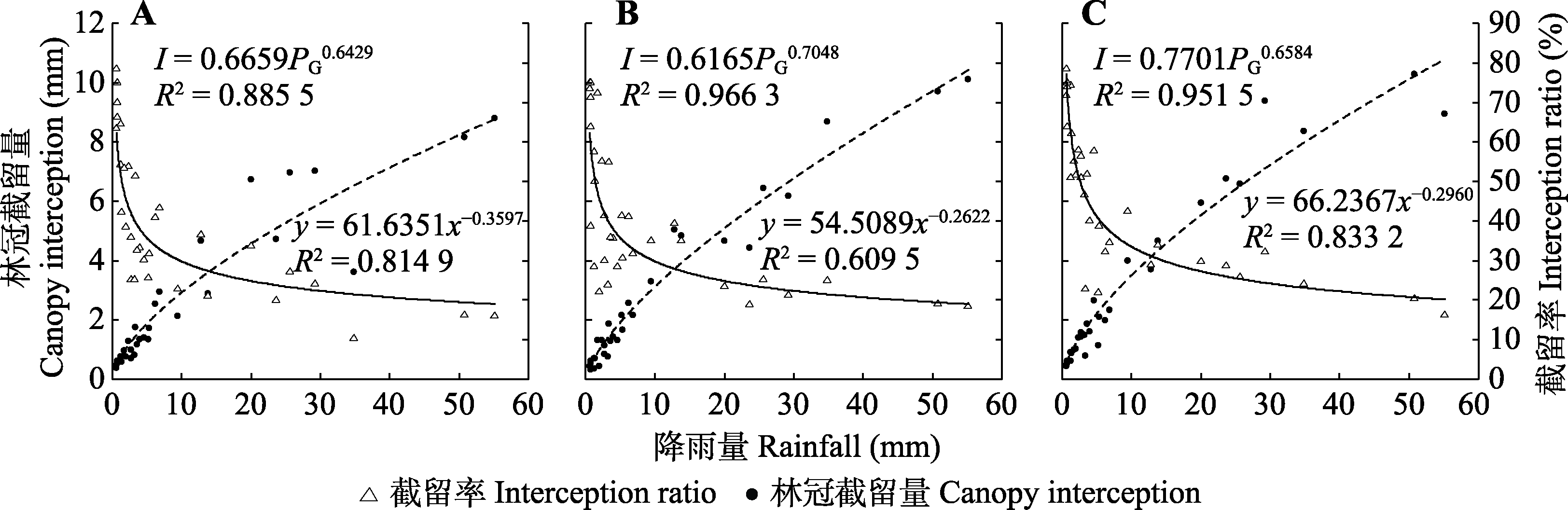
Fig. 4 Relationship between canopy interception and gross rainfall in Platycladus orientalis forest (A), Quercus variabilis forest (B) and mixed forest (C) during the study period from June to September 2021. I, canopy interception; PG, rainfall.
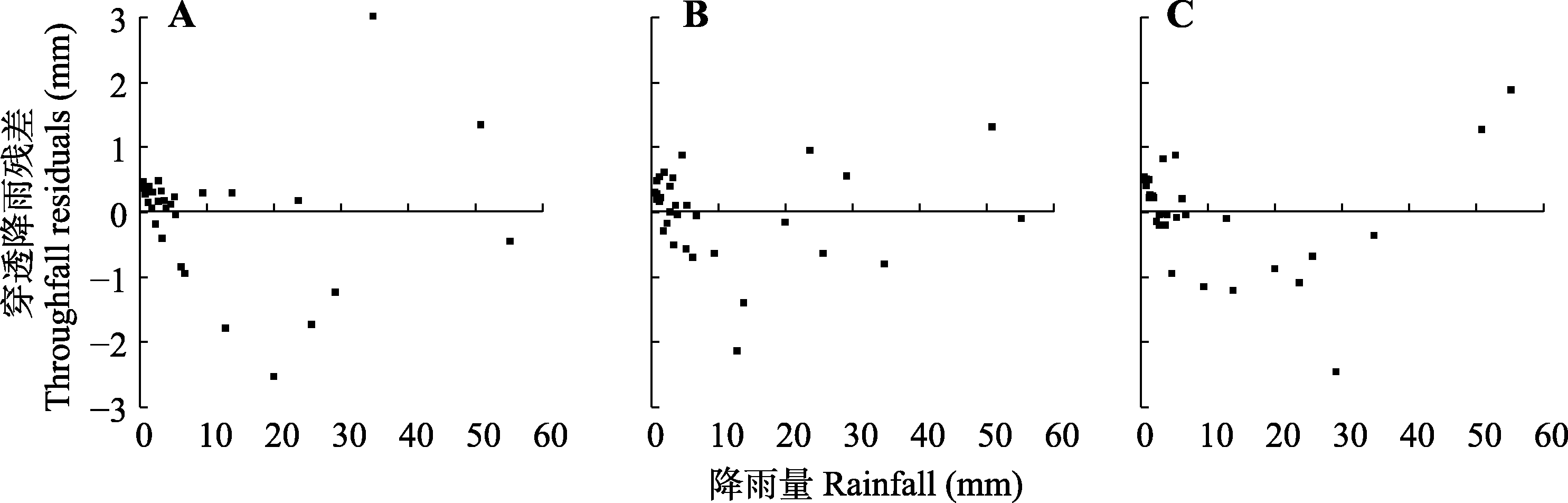
Fig. 5 Relationship between throughfall residuals and gross rainfall in Platycladus orientalis forest (A), Quercus variabilis forest (B) and mixed forest (C) during the study period from June to September 2021.
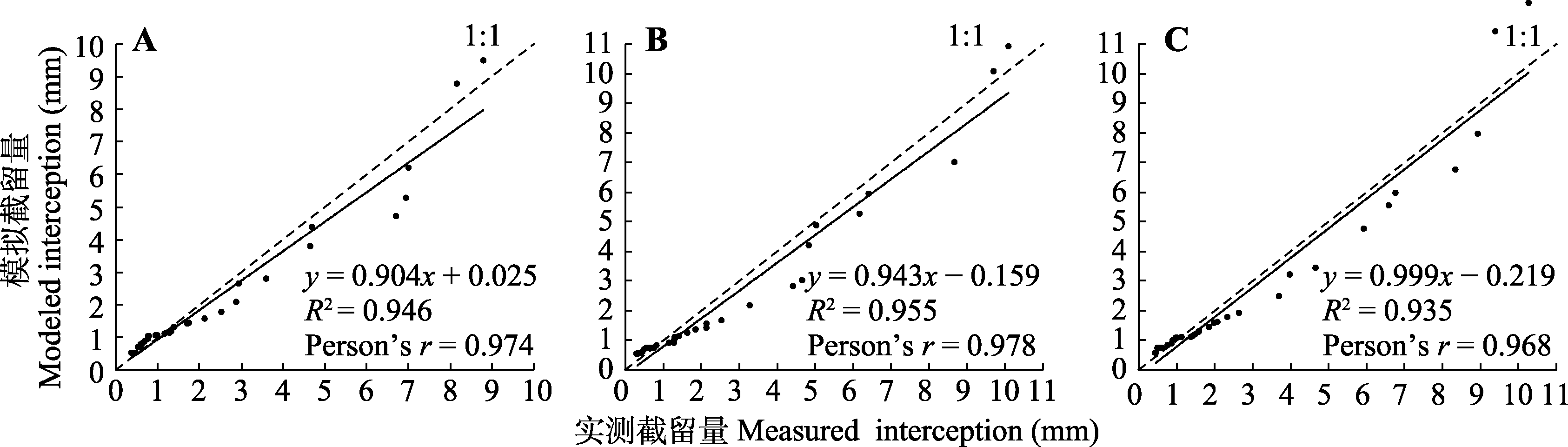
Fig. 6 Relationship between observed and simulated canopy interception using the modified Gash model in Platycladus orientalis forest (A), Quercus variabilis forest (B), and mixed forest (C) during the study period from June to September 2021.
| 林冠截留损失的组成部分 Components of canopy interception loss | 表达式 Expression | 截留量 Interception amount (mm) | ||
|---|---|---|---|---|
| 侧柏林 Platycladus orientalis forest | 栓皮栎林 Quercus variabilis forest | 混交林 Mixed forest | ||
| 林冠未达到饱和降雨次数 Number of rainfall events without canopy saturation | m | 9 | 7 | 9 |
| 林冠达到饱和降雨次数 Number of canopy-saturating rainfall events | n | 25 | 27 | 25 |
| 林冠未达饱和的m次降雨量 Unsaturated m-falls of canopy rainfall (PG < P′G) (mm) | 6.61 | 4.73 | 6.99 | |
| 林冠达到饱和的n次降雨量 Canopy reaches n times of saturated rainfall (PG≥P′G) (mm) | 1.46 | 1.08 | 1.53 | |
| 降雨停止前的林冠蒸发量 Canopy evaporation before the end of rainfall (mm) | 50.69 | 61.60 | 68.55 | |
| 降雨停止后的林冠蒸发量 Canopy evaporation after the end of rainfall (mm) | 13.70 | 8.83 | 10.93 | |
| 树干蒸发量 Trunk evaporation (mm) | 1.71 | 2.03 | 1.58 | |
| 总截留量 Total interception (mm) | I | 74.17 | 78.27 | 89.58 |
Table 2 Component structure of the modified Gash model
| 林冠截留损失的组成部分 Components of canopy interception loss | 表达式 Expression | 截留量 Interception amount (mm) | ||
|---|---|---|---|---|
| 侧柏林 Platycladus orientalis forest | 栓皮栎林 Quercus variabilis forest | 混交林 Mixed forest | ||
| 林冠未达到饱和降雨次数 Number of rainfall events without canopy saturation | m | 9 | 7 | 9 |
| 林冠达到饱和降雨次数 Number of canopy-saturating rainfall events | n | 25 | 27 | 25 |
| 林冠未达饱和的m次降雨量 Unsaturated m-falls of canopy rainfall (PG < P′G) (mm) | 6.61 | 4.73 | 6.99 | |
| 林冠达到饱和的n次降雨量 Canopy reaches n times of saturated rainfall (PG≥P′G) (mm) | 1.46 | 1.08 | 1.53 | |
| 降雨停止前的林冠蒸发量 Canopy evaporation before the end of rainfall (mm) | 50.69 | 61.60 | 68.55 | |
| 降雨停止后的林冠蒸发量 Canopy evaporation after the end of rainfall (mm) | 13.70 | 8.83 | 10.93 | |
| 树干蒸发量 Trunk evaporation (mm) | 1.71 | 2.03 | 1.58 | |
| 总截留量 Total interception (mm) | I | 74.17 | 78.27 | 89.58 |
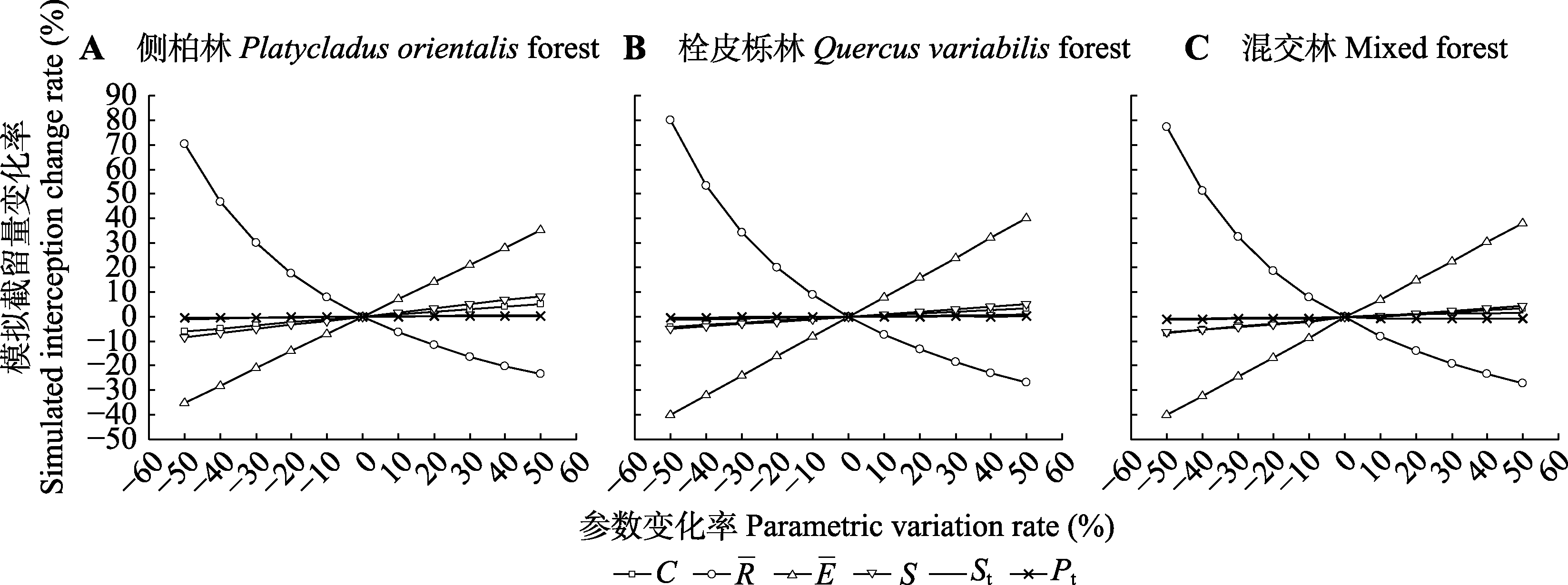
Fig. 7 Sensitivity analysis of the modified Gash model parameters. c, canopy cover; $\overline{E}$, mean evaporation rate; Pt, stemflow coefficient; $\overline{R}$, mean rainfall intensity; $S$, canopy storage capacity; St, trunk storage capacity.
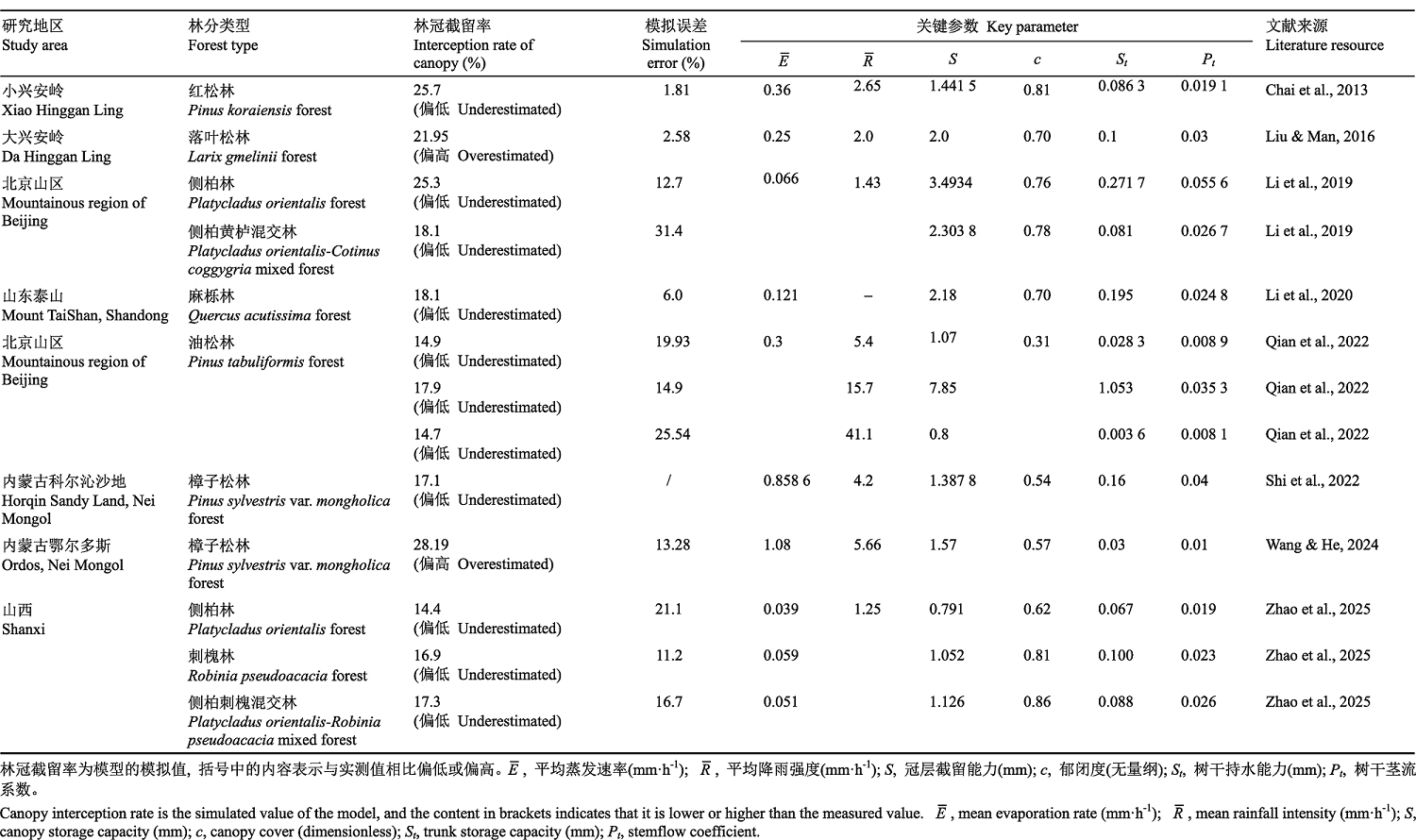 |
Table 3 Application of the modified Gash model to simulate canopy interception in parts of northern China: simulation errors and key model parameters
| |
| [1] | Ahmadi MT, Attarod P, Mohadjer MRM, Rahmani R, Fathi J (2009). Partitioning rainfall into throughfall, stemflow and interception loss in an oriental beech (Fagus orientalis Lipsky) forest during the growing season. Turkish Journal of Agriculture and Forestry, 33, 557-568. |
| [2] |
Chai RS, Cai TJ, Man XL, Wang H, Guan JQ (2013). Simulation of rainfall interception process of primary Korean pine forest in Xiaoxing’an Mountains by using the modified Gash model. Acta Ecologica Sinica, 33, 1276-1284.
DOI URL |
| [柴汝杉, 蔡体久, 满秀玲, 王贺, 关俊祺 (2013). 基于修正的Gash模型模拟小兴安岭原始红松林降雨截留过程. 生态学报, 33, 1276-1284.] | |
| [3] | Chen RS, Kang WX, He JN, Huang ZH (2022). Water storage capacities of different vegetation ecosystems. Journal of Central South University of Forestry & Technology, 42(6), 108-116. |
| [陈日升, 康文星, 何介南, 黄志宏 (2022). 不同植被生态系统的调蓄水量能力. 中南林业科技大学学报, 42(6), 108-116.] | |
| [4] | Chen SJ, Chen CG, Cao TJ, Hou L, Li RH, Zhang SX (2013). Effects of rainfall characteristics and micrometeorology on rainfall redistribution within Chinese red pine forest. Advances in Water Science, 24, 513-521. |
| [陈书军, 陈存根, 曹田健, 侯琳, 李荣华, 张硕新 (2013). 降雨特征及小气候对秦岭油松林降雨再分配的影响. 水科学进展, 24, 513-521.] | |
| [5] | de Carvalho Lopes D, Steidle Neto AJ, de Queiroz MG, de Souza LSB, Zolnier S, da Silva TGF (2020). Sparse Gash model applied to seasonal dry tropical forest. Journal of Hydrology, 590, 125497. DOI: 10.1016/j.jhydrol.2020.125497. |
| [6] | Deng YL, Zhao XY, Cui ZJ, Feng YJ, Zhang WQ, Liu XD (2024). Canopy rainfall interception characteristics of forest ecosystems in China. Acta Ecologica Sinica, 44, 2981-2992. |
| [邓雅丽, 赵新宇, 崔自杰, 冯英杰, 张卫强, 刘效东 (2024). 中国森林生态系统林冠层降雨截留特征. 生态学报, 44, 2981-2992.] | |
| [7] |
Feng YH, Schmid B, Loreau M, Forrester DI, Fei SL, Zhu JX, Tang ZY, Zhu JL, Hong PB, Ji CJ, Shi Y, Su HJ, Xiong XY, Xiao J, Wang SP, et al. (2022). Multispecies forest plantations outyield monocultures across a broad range of conditions. Science, 376, 865-868.
DOI PMID |
| [8] | Gao CC, Peng HH, Zhao CY, Liu XM (2015). Simulation of rainfall interception of Qinghai spruce (Picea crassifolia) forest in the eastern part of Qilian Mountains by Gash model. Chinese Journal of Ecology, 34, 288-294. |
| [高婵婵, 彭焕华, 赵传燕, 刘兴明 (2015). 基于Gash模型的青海云杉林降水截留模拟. 生态学杂志, 34, 288-294.] | |
| [9] |
Gash JHC, Lloyd CR, Lachaud G (1995). Estimating sparse forest rainfall interception with an analytical model. Journal of Hydrology, 170, 79-86.
DOI URL |
| [10] | Guo B, Yang H, Li JC, Zhu CY, Zhao YH, Cao JS, Shen YJ (2023). Rainfall partitioning patterns by Pinus tabulaeformis forest in Taihang Mountains. Chinese Journal of Eco-Agriculture, 31, 2011-2021. |
| [郭波, 阳辉, 李佳聪, 朱春雨, 赵宇寒, 曹建生, 沈彦俊 (2023). 太行山典型油松林降雨再分配规律. 中国生态农业学报(中英文), 31, 2011-2021.] | |
| [11] | Guo MC, Yu PT, Wang YH, Shen ZX, Shi ZJ, Du AP, He CQ (2005). Rainfall interception model of forest canopy: a preliminary study. Chinese Journal of Applied Ecology, 16, 1633-1637. |
| [郭明春, 于澎涛, 王彦辉, 沈振西, 时忠杰, 杜阿朋, 何常清 (2005). 林冠截持降雨模型的初步研究. 应用生态学报, 16, 1633-1637.] | |
| [12] |
Kang WX, Deng XW, Zhao ZH (2008). Effects of canopy interception on energy conversion processes in a Chinese fir plantation ecosystem. Frontiers of Forestry in China, 3, 264-270.
DOI URL |
| [13] |
Kermavnar J, Vilhar U (2017). Canopy precipitation interception in urban forests in relation to stand structure. Urban Ecosystems, 20, 1373-1387.
DOI URL |
| [14] |
Levia DF, Germer S (2015). A review of stemflow generation dynamics and stemflow-environment interactions in forests and shrublands. Reviews of Geophysics, 53, 673-714.
DOI URL |
| [15] | Li C, Gao P, Dong XD, Jiang YK, Zhang YQ, Liu HY, Xu JW, Tun XJ (2020). Canopy interception characteristics of Quercus acutissima plantation forest in Mountain Tai, China and its estimation by the revised Gash model. Science of Soil and Water Conservation, 18(3), 31-38. |
| [李成, 高鹏, 董学德, 姜尧琨, 张义群, 刘海燕, 许景伟, 囤兴建 (2020). 泰山麻栎人工林降雨截留特征及修正的Gash模型模拟. 中国水土保持科学, 18(3), 31-38.] | |
| [16] |
Li X, Xiao Q, Niu J, Dymond S, van Doorn NS, Yu X, Xie B, Lv X, Zhang K, Li J (2016). Process-based rainfall interception by small trees in Northern China: the effect of rainfall traits and crown structure characteristics. Agricultural and Forest Meteorology, 218-219, 65-73.
DOI URL |
| [17] | Li YR, Ma R, Zhang YT, Cheng TT, Li ZD, Niu Y (2019). Simulation of canopy rainfall interception of Platycladus orientalis forest and its mixed forest using the modified Gash model. Chinese Journal of Ecology, 38, 1331-1338. |
| [李亦然, 马睿, 张永涛, 程甜甜, 李泽东, 牛勇 (2019). 基于Gash修正模型模拟侧柏及其混交林的林冠截留过程. 生态学杂志, 38, 1331-1338.] | |
| [18] |
Limousin JM, Rambal S, Ourcival JM, Joffre R (2008). Modelling rainfall interception in a Mediterranean Quercus ilex ecosystem: lesson from a throughfall exclusion experiment. Journal of Hydrology, 357, 57-66.
DOI URL |
| [19] | Liu SG (1998). Estimation of rainfall storage capacity in the canopies of cypress wetlands and slash pine uplands in North-Central Florida. Journal of Hydrology, 207, 32-41. |
| [20] | Liu YJ, Man XL (2016). Simulation of canopy rainfall interception of the Larix gmelinii forest by the modified Gash model in Greater Hinggan Mountains. Journal of Nanjing Forestry University (Natural Sciences Edition), 40(4), 81-88. |
|
[刘玉杰, 满秀玲 (2016). 修正Gash模型在兴安落叶松天然林林冠截留中的应用. 南京林业大学学报(自然科学版), 40(4), 81-88.]
DOI |
|
| [21] | Liu YX, Shi WJ, Tao FL, Shi XL, Fu BJ (2023). A global synthesis of multi-factors affecting water storage capacity in forest canopy, litter and soil layers. Geophysical Research Letters, 50, e2022GL099888. DOI: 10.1029/2022GL099888. |
| [22] | Luo YK, Fang JY, Hu HF (2017). Biomass estimation models and allocation patterns of 14 shrub species in Mountain Luya, Shanxi, China. Chinese Journal of Plant Ecology, 41, 115-125. |
|
[罗永开, 方精云, 胡会峰 (2017). 山西芦芽山14种常见灌木生物量模型及生物量分配. 植物生态学报, 41, 115-125.]
DOI |
|
| [23] | Ma CK, Li XD, Luo Y, Shao MG, Jia XX (2019). The modelling of rainfall interception in growing and dormant seasons for a pine plantation and a black locust plantation in semi-arid Northwest China. Journal of Hydrology, 577, 123849. DOI: 10.1016/j.jhydrol.2019.06.021. |
| [24] |
Magliano PN, Whitworth-Hulse JI, Baldi G (2019). Interception, throughfall and stemflow partition in drylands: global synthesis and meta-analysis. Journal of Hydrology, 568, 638-645.
DOI URL |
| [25] |
Muzylo A, Llorens P, Valente F, Keizer JJ, Domingo F, Gash JHC (2009). A review of rainfall interception modelling. Journal of Hydrology, 370, 191-206.
DOI URL |
| [26] | Qian YK, Shi CQ, Zhao TN, Lu JS, Bi B, Luo GT (2022). Canopy interception of different rainfall patterns in the rocky mountain areas of Northern China: an application of the revised Gash model. Forests, 13, 1666. DOI: 10.3390/f13101666. |
| [27] |
Sadeghi SMM, Attarod P, van Stan JT, Pypker TG (2016). The importance of considering rainfall partitioning in afforestation initiatives in semiarid climates: a comparison of common planted tree species in Tehran, Iran. Science of the Total Environment, 568, 845-855.
DOI URL |
| [28] | Sadeghi SMM, Attarod P, van Stan JT, Pypker TG, Dunkerley D (2015). Efficiency of the reformulated Gash’s interception model in semiarid afforestations. Agricultural and Forest Meteorology, 201, 76-85. |
| [29] | Shi X, Bao Y, Liang Q (2022). Applying the revised Gash analytical model of precipitation interception to Pinus sylvestris var. mongolica in Horqin Sandy Land, northeastern China. Fresenius Environmental Bulletin, 31, 572-582. |
| [30] | Shi Y (2011). Eco-hydrological Process Analysis of Forest Ecosystems of Main Dominant Tree Species in Beijing Mountainous Area. PhD dissertation, Beijing Forestry University, Beijing. |
| [史宇 (2011). 北京山区主要优势树种森林生态系统生态水文过程分析. 博士学位论文, 北京林业大学, 北京.] | |
| [31] |
Su L, Zhao CM, Xu WT, Xie ZQ (2016). Modelling interception loss using the revised Gash model: a case study in a mixed evergreen and deciduous broadleaved forest in China. Ecohydrology, 9, 1580-1589.
DOI URL |
| [32] |
Sun JM, Yu XX, Wang HN, Jia GD, Zhao Y, Tu ZH, Deng WP, Jia JB, Chen JG (2018). Effects of forest structure on hydrological processes in China. Journal of Hydrology, 561, 187-199.
DOI URL |
| [33] | Sun TM, Yang H, Cao JS (2023). Rainfall redistribution of different vegetations in Taihang Mountain, China. Chinese Journal of Eco-Agriculture, 31, 1471-1481. |
| [孙天妙, 阳辉, 曹建生 (2023). 太行山区不同植被降雨再分配特征. 中国生态农业学报(中英文), 31, 1471-1481.] | |
| [34] |
Wallace J, McJannet D (2006). On interception modelling of a lowland coastal rainforest in northern Queensland, Australia. Journal of Hydrology, 329, 477-488.
DOI URL |
| [35] | Wang X, Yang ZQ, Guo JY, Qin FC, Wang YB, Ning JJ (2024). Applicability of a modified Gash model for artificial forests in the transitional zone between the Loess Hilly Region and the Mu Us Sandy Land, China. Sustainability, 16, 8709. DOI: 10.3390/su16198709. |
| [36] | Wang X, Zhang YP, Liu WJ (2006). Modeling canopy rainfall interception of a tropical seasonal rainforest in Xishuangbanna, Southwest China. Acta Ecologica Sinica, 26, 722-729. |
| [王馨, 张一平, 刘文杰 (2006). Gash模型在热带季节雨林林冠截留研究中的应用. 生态学报, 26, 722-729.] | |
| [37] |
Wang YB, Shangguan ZP (2022). Formation mechanisms and remediation techniques for low-efficiency artificial shelter forests on the Chinese Loess Plateau. Journal of Arid Land, 14, 837-848.
DOI |
| [38] |
Wang YP, Wang L, Wei SP (2012). Modeling canopy rainfall interception of a replanted Robinia pseudoacacia forest in the Loess Plateau. Acta Ecologica Sinica, 32, 5445-5453.
DOI URL |
| [王艳萍, 王力, 卫三平 (2012). Gash模型在黄土区人工刺槐林冠降雨截留研究中的应用. 生态学报, 32, 5445-5453.] | |
| [39] | Wang ZX, He KN (2024). Comprehensive assessment of water conservation capacity in different forest stands in the eastern Qilian Mountains. Acta Ecologica Sinica, 44, 7662-7672. |
| [王作枭, 贺康宁 (2024). 祁连山东部地区不同林分水源涵养能力综合评估. 生态学报, 44, 7662-7672.] | |
| [40] | Wu XM (2022). Influence of Typical Vegetation Structure on Rainfall Interception Process in Beijing Mountainous Areas. Master degree dissertation, Beijing Forestry University, Beijing. |
| [吴雪铭 (2022). 北京山区典型植被结构对降雨截留过程的影响. 硕士学位论文, 北京林业大学, 北京.] | |
| [41] | Wu XR, Jin M, Zhao WJ, Jing WM, Ma J, Zhao JZ, Wang RX, Ma XE (2020). Application of modified Gash model to simulate rainfall interception of Picea crassifolia forest in the middle of the northern slope of Qilian Mountains. Journal of Soil and Water Conservation, 34, 216-222. |
| [武秀荣, 金铭, 赵维俊, 敬文茂, 马剑, 赵晶忠, 王荣新, 马雪娥 (2020). 运用Gash修正模型对祁连山北麓中段青海云杉林降水截留的模拟. 水土保持学报, 34, 216-222.] | |
| [42] | Yin Y, Zhou YB, Cui JG, Liu YC, Su BL (2001). The model for crown interception. Journal of Liaoning Forestry Science and Technology, (5), 10-12. |
| [殷有, 周永斌, 崔建国, 刘雅春, 苏宝玲 (2001). 林冠截留模型. 辽宁林业科技, (5), 10-12.] | |
| [43] |
Zhang G, Zeng GM, Jiang YM, Huang GH, Li JB, Yao JM, Tan W, Xiang R, Zhang XL (2006). Modelling and measurement of two-layer-canopy interception losses in a subtropical evergreen forest of central-south China. Hydrology and Earth System Sciences, 10, 65-77.
DOI URL |
| [44] | Zhang GZ, Gan J, Zhu JG (2011). Multi-scale health assessment of forests in mountainous regions of Beijing. Scientia Silvae Sinicae, 47(6), 143-151. |
| [张国祯, 甘敬, 朱建刚 (2011). 北京山区森林健康的多尺度评价. 林业科学, 47(6), 143-151.] | |
| [45] |
Zhang YF, Wang XP, Hu R, Pan YX (2016). Throughfall and its spatial variability beneath xerophytic shrub canopies within water-limited arid desert ecosystems. Journal of Hydrology, 539, 406-416.
DOI URL |
| [46] | Zhao JC, Yu Y, Hu YW, Beyer M, Zhang JJ (2025). Measurement and modeling of canopy interception loss of evergreen, deciduous and mixed forests in a subhumid watershed on the Loess Plateau, China. Journal of Hydrology, 654, 132820. DOI: 10.1016/j.jhydrol.2025.132820. |
| [47] |
Zhao WY, Ji XB (2021). A review of research advances and future perspectives of evaporation of intercepted rainfall from sparse tree canopy in drylands. Advances in Earth Science, 36, 862-879.
DOI |
|
[赵文玥, 吉喜斌 (2021). 干旱区稀疏树木冠层降雨截留蒸发的研究进展与展望. 地球科学进展, 36, 862-879.]
DOI |
|
| [48] | Zhao YY, Wang YJ, Wang YQ, Liu N, Liu M, Wu Y, Chen L (2011). Simulation of canopy rainfall interception of the Phyllostachys edulis forest with the revised Gash model in the Jinyun Mountains of Chongqing. Scientia Silvae Sinicae, 47(9), 15-20. |
| [赵洋毅, 王玉杰, 王云琦, 刘楠, 刘敏, 吴云, 陈林 (2011). 基于修正的Gash模型模拟缙云山毛竹林降雨截留. 林业科学, 47(9), 15-20.] | |
| [49] | Zong H (2019). A review of characteristics and mechanisms of rainfall interception and redistribution in forest canopy. World Forestry Research, 32(1), 28-35. |
| [宗桦 (2019). 森林乔木冠层雨水再分配特征及机制研究综述. 世界林业研究, 32(1), 28-35.] | |
| [50] | Zuo YF, He KN, Wang SJ, Yu GF, Chai SX, Li YH (2021). Rainfall distribution characteristics of typical coniferous species in the alpine region of Qinghai and the application of revised Gash model. Science of Soil and Water Conservation, 19(5), 53-62. |
| [左亚凡, 贺康宁, 王帅军, 俞国峰, 柴世秀, 李远航 (2021). 青海高寒地区典型针叶林的降雨分配特征及Gash修正模型的应用. 中国水土保持科学, 19(5), 53-62.] |
| [1] | LI Zhen-Xin, OUYANG Zhi-Yun, ZHENG Hua, LIU Xing-Liang, SU Yi-Ming. COMPARISON OF RAINFALL REDISTRIBUTION IN TWO ECOSYSTEMS IN MINJIANG UPPER CATCHMENTS, CHINA [J]. Chin J Plant Ecol, 2006, 30(5): 723-731. |
| [2] | LI Chong-Wei, LIU Shi-Rong, SUN Peng-Sen, ZHANG Yuan-Dong, GE Jian-Ping. MODELING CANOPY RAINFALL INTERCEPTION IN THE UPPER WATERSHED OF THE MINJIANG RIVER [J]. Chin J Plan Ecolo, 2005, 29(1): 60-67. |
| Viewed | ||||||
|
Full text |
|
|||||
|
Abstract |
|
|||||
Copyright © 2026 Chinese Journal of Plant Ecology
Tel: 010-62836134, 62836138, E-mail: apes@ibcas.ac.cn, cjpe@ibcas.ac.cn

