
Chin J Plant Ecol ›› 2026, Vol. 50 ›› Issue (2): 256-267.DOI: 10.17521/cjpe.2025.0248 cstr: 32100.14.cjpe.2025.0248
• Research Articles • Previous Articles Next Articles
YE Xue-Min1, GAO Wei1, TANG Xing-Lin1, CHEN Fu-Sheng2, SUN Rong-Xi2, LUO Kun-Shui1,*( )
)
Received:2025-06-30
Accepted:2025-12-13
Online:2026-02-28
Published:2026-04-01
Contact:
LUO Kun-Shui
Supported by:YE Xue-Min, GAO Wei, TANG Xing-Lin, CHEN Fu-Sheng, SUN Rong-Xi, LUO Kun-Shui. Effects of nitrogen and phosphorus additions on leaf herbivory damage and its underlying mechanisms in saplings in an evergreen broad-leaved forest[J]. Chin J Plant Ecol, 2026, 50(2): 256-267.
Add to citation manager EndNote|Ris|BibTeX
URL: https://www.plant-ecology.com/EN/10.17521/cjpe.2025.0248
| 物种 Species | 合计 Total | 取样个体数量 Number of sampled individuals | |||
|---|---|---|---|---|---|
| 对照 Control | 氮添加 Nitrogen (N) addition | 磷添加 Phosphorus (P) addition | 氮磷共同添加 Combined N + P | ||
| 木荷 Schima superba | 115 | 30 | 29 | 29 | 27 |
| 短序润楠 Machilus breviflora | 81 | 19 | 24 | 21 | 17 |
| 绒毛润楠 M. velutina | 85 | 22 | 24 | 23 | 16 |
| 丝栗栲 Castanopsis fargesii | 83 | 23 | 21 | 16 | 23 |
| 米槠 C. carlesii | 76 | 19 | 16 | 26 | 15 |
| 甜槠 C. eyrei | 68 | 20 | 15 | 18 | 15 |
| 幼树 Saplings | 508 | 133 | 129 | 133 | 113 |
Table 1 Number of individuals of different species measured by leaf herbivorous damage rate
| 物种 Species | 合计 Total | 取样个体数量 Number of sampled individuals | |||
|---|---|---|---|---|---|
| 对照 Control | 氮添加 Nitrogen (N) addition | 磷添加 Phosphorus (P) addition | 氮磷共同添加 Combined N + P | ||
| 木荷 Schima superba | 115 | 30 | 29 | 29 | 27 |
| 短序润楠 Machilus breviflora | 81 | 19 | 24 | 21 | 17 |
| 绒毛润楠 M. velutina | 85 | 22 | 24 | 23 | 16 |
| 丝栗栲 Castanopsis fargesii | 83 | 23 | 21 | 16 | 23 |
| 米槠 C. carlesii | 76 | 19 | 16 | 26 | 15 |
| 甜槠 C. eyrei | 68 | 20 | 15 | 18 | 15 |
| 幼树 Saplings | 508 | 133 | 129 | 133 | 113 |
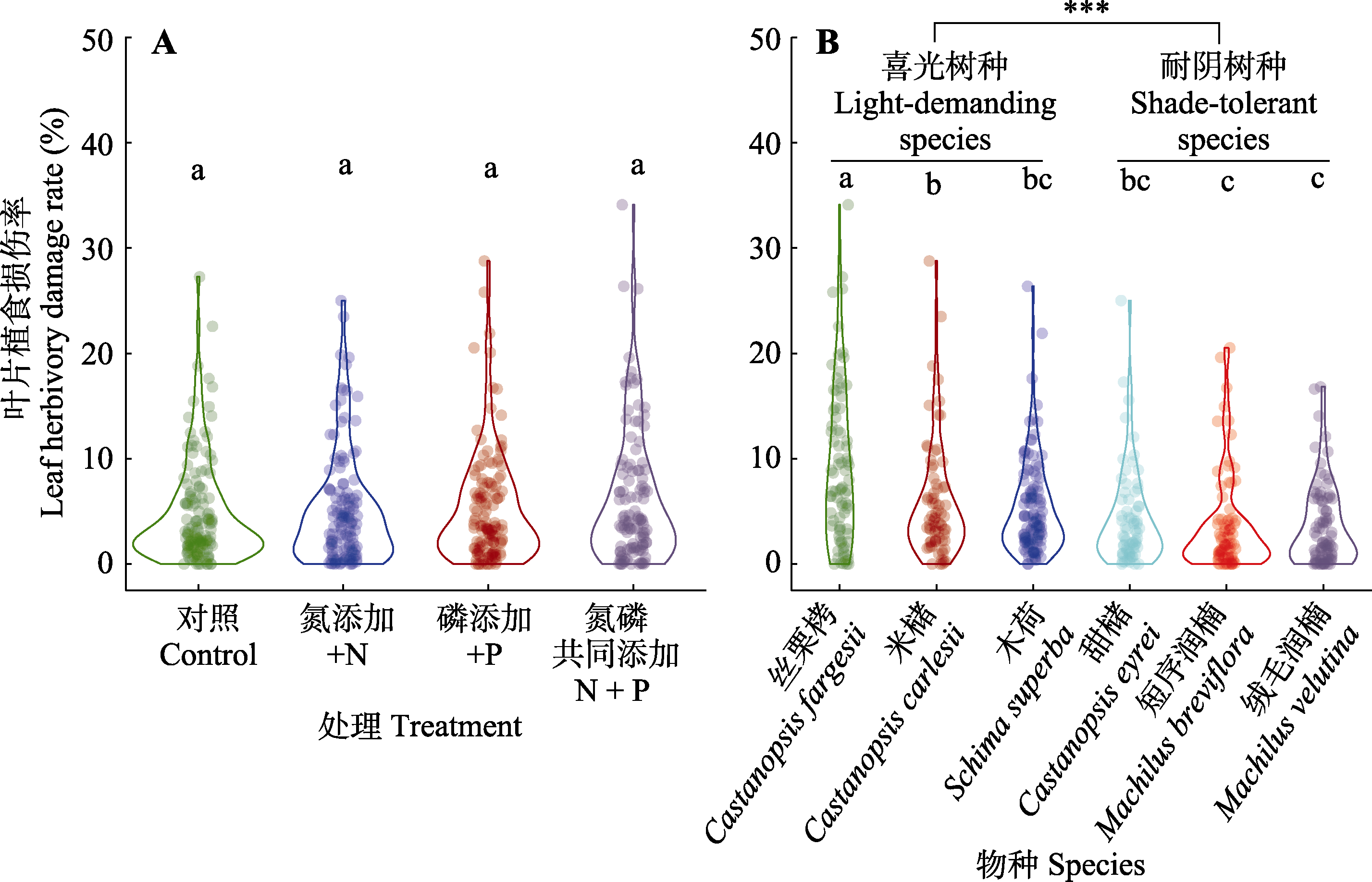
Fig. 1 Responses of leaf herbivorous damage rate of saplings to nitrogen and phosphorus addition (A), interspecific differences (B) in an evergreen broad-leaved forest. Different lowercase letters indicate differences among different treatments or species (p < 0.05), *** indicate differences between light-demaning species and shade-tolerant species (p < 0.001). +N, nitrogen addition; +P, phosphorus addition; N+P, nitrogen and phosphorus combined addition.
| LMM | LHDR | p | LMM | LHDR | p | LMM | LHDR | p |
|---|---|---|---|---|---|---|---|---|
| 固定效应 Fixed effect | 物种 Species | <0.001 | 固定效应 Fixed effect | 叶片大小 Leaf size | 0.002 | 固定效应 Fixed effect | 株高 Height | 0.004 |
| 氮添加 N | 0.289 | 氮添加 N | 0.123 | 氮添加 N | 0.265 | |||
| 磷添加 P | 0.217 | 磷添加 P | 0.209 | 磷添加 P | 0.209 | |||
| N × P | 0.998 | N × P | 0.717 | N × P | 0.635 | |||
| N × species | 0.052 | N × leaf size | 0.003 | N × height | 0.018 | |||
| P × species | 0.724 | P × leaf size | 0.836 | P × height | 0.544 | |||
| N × P × species | 0.756 | N × P × leaf size | 0.089 | N × P × height | 0.758 | |||
| 模型解释度 Model statistics | R2m | 0.141 | 模型解释度 Model statistics | R2m | 0.048 | 模型解释度 Model statistics | R2m | 0.034 |
| R2c | 0.141 | R2c | 0.048 | R2c | 0.034 |
Table 2 Linear mixed model (LMM) analysis for leaf herbivorous damage rate (LHDR) of six dominant tree species in an evergreen broad-leaved forest treated with nitrogen and phosphorus addition
| LMM | LHDR | p | LMM | LHDR | p | LMM | LHDR | p |
|---|---|---|---|---|---|---|---|---|
| 固定效应 Fixed effect | 物种 Species | <0.001 | 固定效应 Fixed effect | 叶片大小 Leaf size | 0.002 | 固定效应 Fixed effect | 株高 Height | 0.004 |
| 氮添加 N | 0.289 | 氮添加 N | 0.123 | 氮添加 N | 0.265 | |||
| 磷添加 P | 0.217 | 磷添加 P | 0.209 | 磷添加 P | 0.209 | |||
| N × P | 0.998 | N × P | 0.717 | N × P | 0.635 | |||
| N × species | 0.052 | N × leaf size | 0.003 | N × height | 0.018 | |||
| P × species | 0.724 | P × leaf size | 0.836 | P × height | 0.544 | |||
| N × P × species | 0.756 | N × P × leaf size | 0.089 | N × P × height | 0.758 | |||
| 模型解释度 Model statistics | R2m | 0.141 | 模型解释度 Model statistics | R2m | 0.048 | 模型解释度 Model statistics | R2m | 0.034 |
| R2c | 0.141 | R2c | 0.048 | R2c | 0.034 |
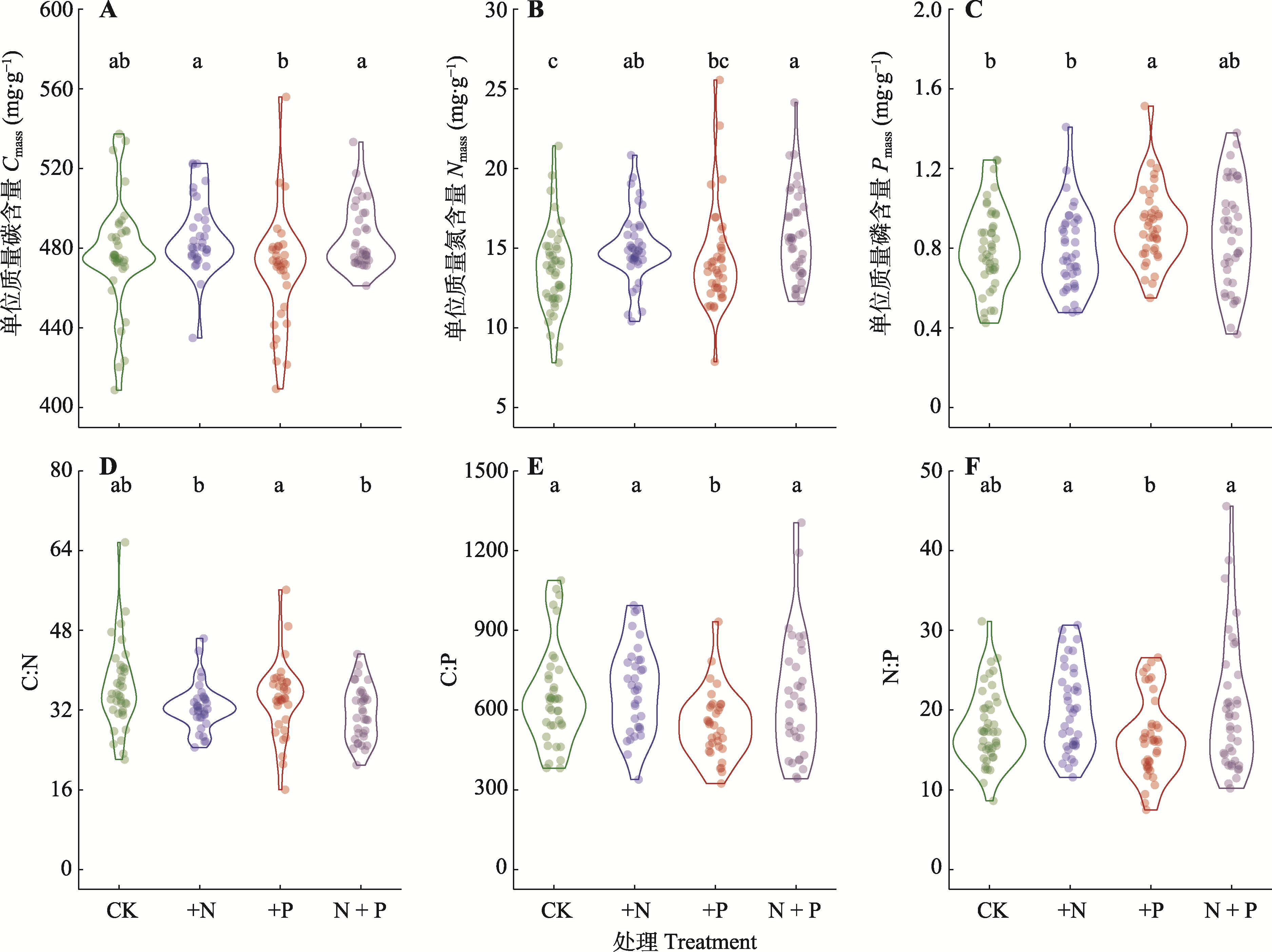
Fig. 2 Responses of leaf stoichiometry of saplings to nitrogen and phosphorus addition in an evergreen broad-leaved forest. Different lowercase letters indicate differences among different treatments (p < 0.05). CK, control; +N, nitrogen addition; +P, phosphorus addition; N+P, nitrogen and phosphorus combined addition. Cmass, carbon content per unit mass; Nmass, nitrogen content per unit mass; Pmass, phosphorus content per unit mass.
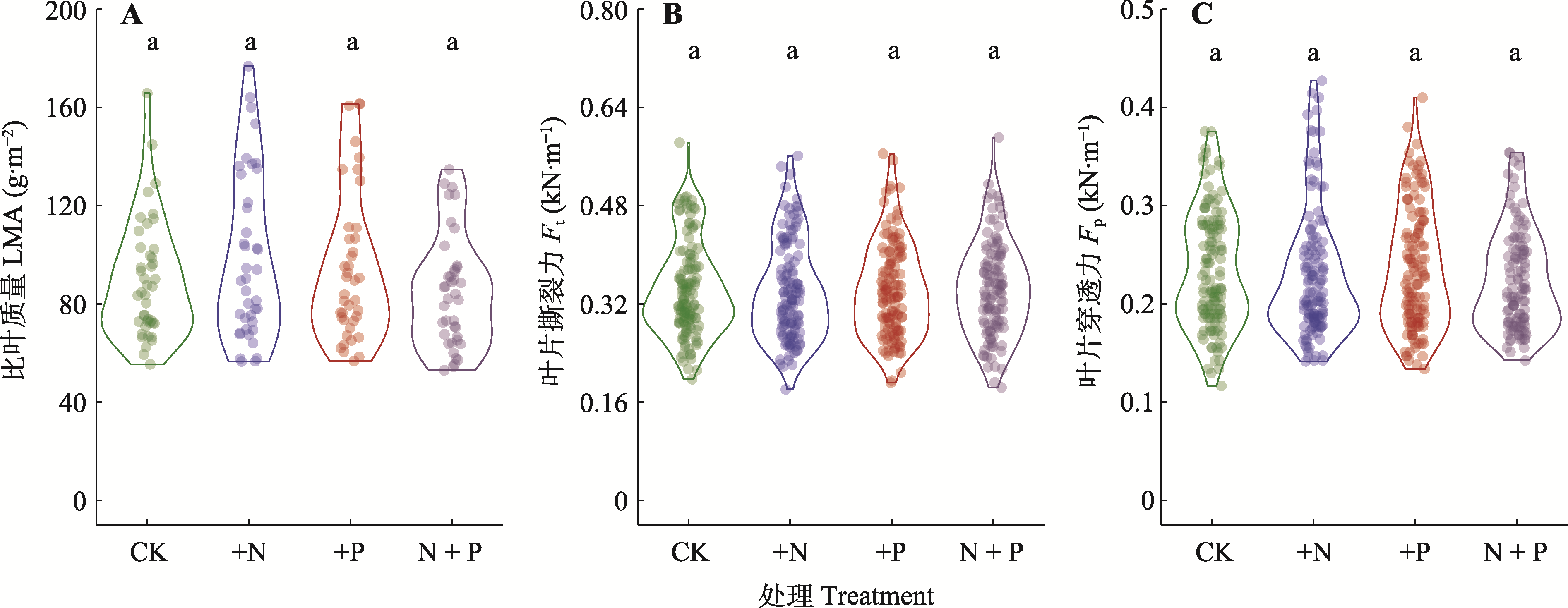
Fig. 3 Responses of leaf mass per area (LMA) and leaf mechanical resistance of saplings to nitrogen and phosphorus addition in an evergreen broad-leaved forest. Different lowercase letters indicate differences among different treatments (p < 0.05). CK, control; +N, nitrogen addition; +P, phosphorus addition; N+P, nitrogen and phosphorus combined addition. Fp, leaf force to punch; Ft, leaf force to tear.
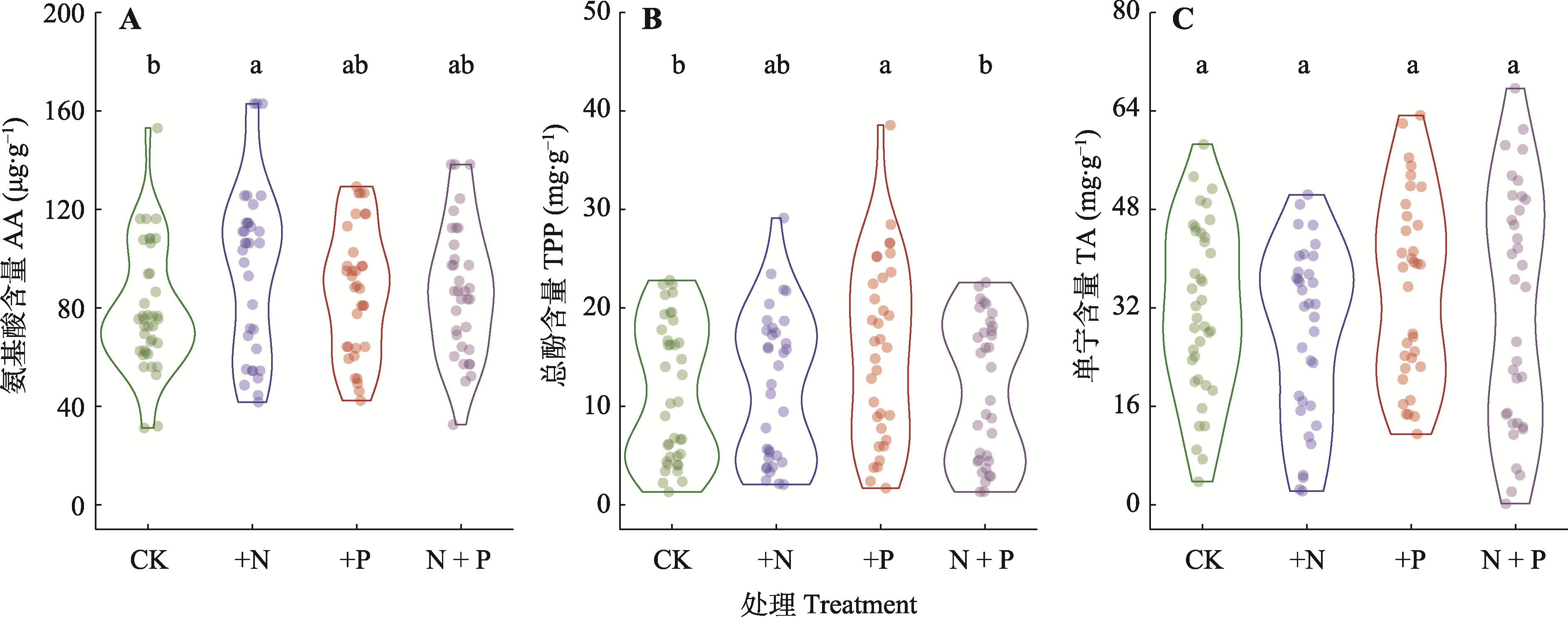
Fig. 4 Responses of leaf chemical resistance of saplings to nitrogen and phosphorus addition in an evergreen broad-leaved forest. Different lowercase letters indicate differences among different treatments (p < 0.05). CK, control; +N, nitrogen addition; +P, phosphorus addition; N+P, nitrogen and phosphorus combined addition. AA, amino acid content; TA, tannin content; TPh, total phenolic content.
| 叶片性状 Leaf trait | 喜光树种 Light-demanding species | 耐阴树种 Shadow-tolerant species | p |
|---|---|---|---|
| 叶片植食损伤率 LHDR (%) | 7.13 ± 0.51 | 3.38 ± 0.28 | *** |
| 单位质量碳含量 Cmass (mg·g-1) | 478.19 ± 2.47 | 480.20 ± 3.04 | 0.22 |
| 单位质量氮含量 Nmass (mg·g-1) | 15.71 ± 0.32 | 13.79 ± 0.27 | *** |
| 单位质量磷含量 Pmass (mg·g-1) | 0.864 ± 0.026 | 0.824 ± 0.022 | 0.18 |
| C:N | 31.20 ± 0.67 | 35.79 ± 0.83 | *** |
| C:P | 622.2 ± 24.0 | 637.1 ± 20.7 | 0.54 |
| N:P | 19.70 ± 0.78 | 17.78 ± 0.57 | 0.13 |
| 比叶质量 LMA (g·m-2) | 89.44 ± 3.17 | 96.31 ± 3.36 | 0.06 |
| 叶片撕裂力 Ft (KN·m-1) | 0.299 ± 0.007 | 0.402 ± 0.009 | *** |
| 叶片穿透力 Fp (KN·m-1) | 0.198 ± 0.004 | 0.281 ± 0.007 | *** |
| 氨基酸含量 AA (μg·g-1) | 84.13 ± 3.66 | 90.83 ± 2.83 | * |
| 总酚含量 TPh (mg·g-1) | 11.18 ± 0.79 | 14.68 ± 1.08 | ** |
| 单宁含量 TA (mg·g-1) | 33.21 ± 2.26 | 30.79 ± 1.62 | 0.21 |
Table 3 Comparison of leaf traits between light-demanding and shade-tolerant species in an evergreen broad-leaved forest
| 叶片性状 Leaf trait | 喜光树种 Light-demanding species | 耐阴树种 Shadow-tolerant species | p |
|---|---|---|---|
| 叶片植食损伤率 LHDR (%) | 7.13 ± 0.51 | 3.38 ± 0.28 | *** |
| 单位质量碳含量 Cmass (mg·g-1) | 478.19 ± 2.47 | 480.20 ± 3.04 | 0.22 |
| 单位质量氮含量 Nmass (mg·g-1) | 15.71 ± 0.32 | 13.79 ± 0.27 | *** |
| 单位质量磷含量 Pmass (mg·g-1) | 0.864 ± 0.026 | 0.824 ± 0.022 | 0.18 |
| C:N | 31.20 ± 0.67 | 35.79 ± 0.83 | *** |
| C:P | 622.2 ± 24.0 | 637.1 ± 20.7 | 0.54 |
| N:P | 19.70 ± 0.78 | 17.78 ± 0.57 | 0.13 |
| 比叶质量 LMA (g·m-2) | 89.44 ± 3.17 | 96.31 ± 3.36 | 0.06 |
| 叶片撕裂力 Ft (KN·m-1) | 0.299 ± 0.007 | 0.402 ± 0.009 | *** |
| 叶片穿透力 Fp (KN·m-1) | 0.198 ± 0.004 | 0.281 ± 0.007 | *** |
| 氨基酸含量 AA (μg·g-1) | 84.13 ± 3.66 | 90.83 ± 2.83 | * |
| 总酚含量 TPh (mg·g-1) | 11.18 ± 0.79 | 14.68 ± 1.08 | ** |
| 单宁含量 TA (mg·g-1) | 33.21 ± 2.26 | 30.79 ± 1.62 | 0.21 |
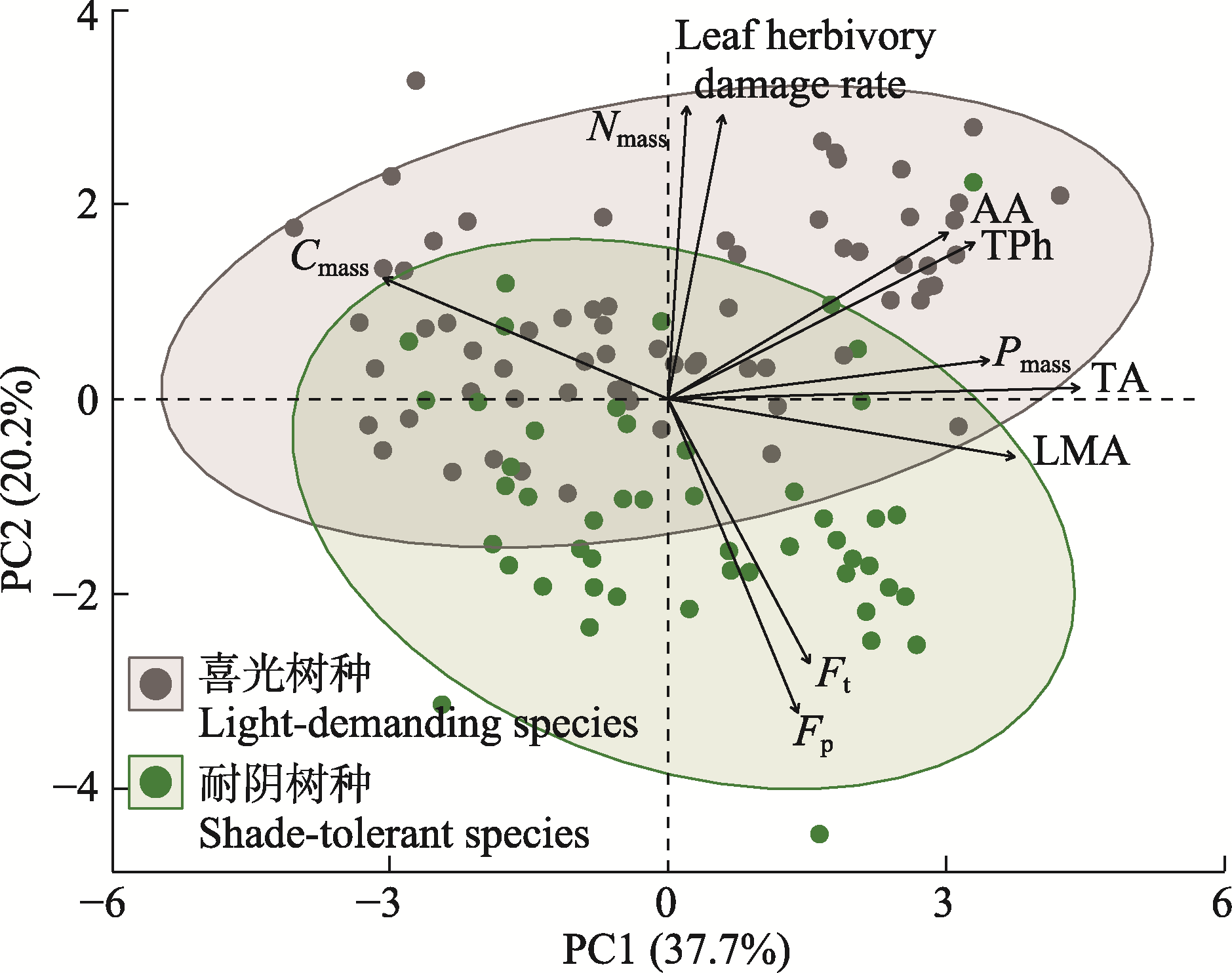
Fig. 5 Principal component (PC) analysis on the leaf herbivory damage and leaf traits. The first two principal components and scores are represented along the axes for light-demanding (gray circle) and shade-tolerant (green circle) species. Abbreviations of leaf traits are provided in Table 3.
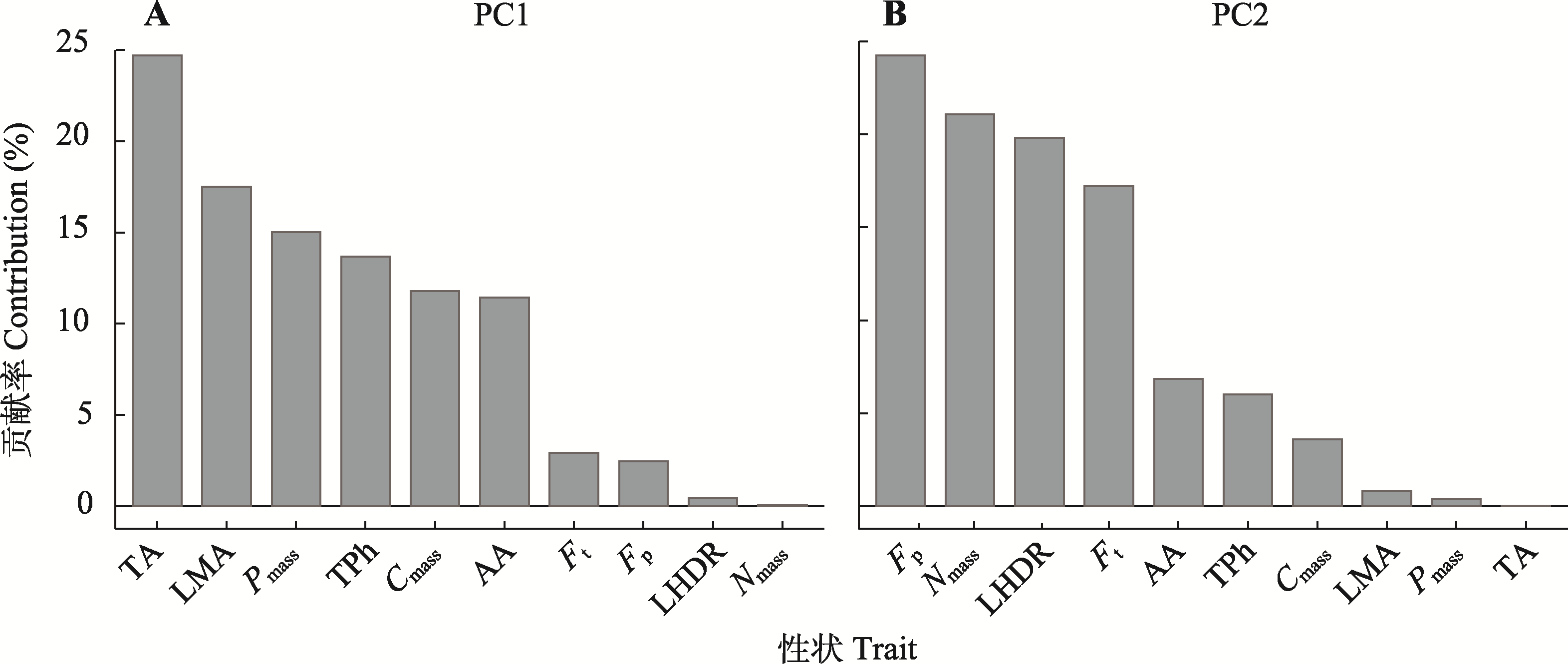
Supplement Contribution of leaf herbivory damage and leaf traits to the first two principal components AA, amino acid content; Cmass, carbon content per unit mass; Fp, leaf force to punch; Ft, leaf force to tear; LHDR, leaf herbivorous damage rate; LMA, leaf mass per area; Nmass, nitrogen content per unit mass; Pmass, phosphorus content per unit mass; PC1, the first principal component; PC2, the second principal component; TA, tannin content; TPh, total phenolic content.
| [1] |
Aldea M, Hamilton JG, Resti JP, Zangerl AR, Berenbaum MR, DeLucia EH (2005). Indirect effects of insect herbivory on leaf gas exchange in soybean. Plant, Cell & Environment, 28, 402-411.
DOI URL |
| [2] |
Björkman C, Berggren Å, Bylund H (2011). Causes behind insect folivory patterns in latitudinal gradients. Journal of Ecology, 99, 367-369.
PMID |
| [3] |
Borer ET, Seabloom EW, Mitchell CE, Cronin JP (2014). Multiple nutrients and herbivores interact to govern diversity, productivity, composition, and infection in a successional grassland. Oikos, 123, 214-224.
DOI URL |
| [4] |
Butler J, Garratt MPD, Leather SR (2012). Fertilisers and insect herbivores: a meta-analysis. Annals of Applied Biology, 161, 223-233.
DOI URL |
| [5] |
Cappelli SL, Pichon NA, Kempel A, Allan E (2020). Sick plants in grassland communities: a growth-defense trade-off is the main driver of fungal pathogen abundance. Ecology Letters, 23, 1349-1359.
DOI PMID |
| [6] | Castagneyrol B, Lagache L, Giffard B, Kremer A, Jactel H (2012). Genetic diversity increases insect herbivory on oak saplings. PLoS ONE, 7, e44247. DOI: 10.1371/journal.pone.0044247. |
| [7] | Cha DH, Appel HM, Frost CJ, Schultz JC, Steiner KC (2010). Red oak responses to nitrogen addition depend on herbivory type, tree family, and site. Forest Ecology and Management, 259, 1930-1937. |
| [8] |
Coley PD, Barone JA (1996). Herbivory and plant defenses in tropical forests. Annual Review of Ecology and Systematics, 27, 305-335.
DOI URL |
| [9] | Condit R, Hernández A, Calderón O, Pérez R, Aguilar S, Comita LS, Hubbell SP, Wright SJ (2025). Lifespan of tropical trees from seed to 1-cm diameter. Forest Ecosystems, 13, 100309. DOI: 10.1016/j.fecs.2025.100309. |
| [10] |
Couture JJ, Meehan TD, Kruger EL, Lindroth RL (2015). Insect herbivory alters impact of atmospheric change on northern temperate forests. Nature Plants, 1, 15016. DOI: 10.1038/nplants.2015.16.
PMID |
| [11] |
DeForest JL, Snell RS (2020). Tree growth response to shifting soil nutrient economy depends on mycorrhizal associations. New Phytologist, 225, 2557-2566.
DOI PMID |
| [12] |
Ebeling A, Strauss AT, Adler PB, Arnillas CA, Barrio IC, Biederman LA, Borer ET, Bugalho MN, Caldeira MC, Cadotte MW, Daleo P, Eisenhauer N, Eskelinen A, Fay PA, Firn J, et al. (2022). Nutrient enrichment increases invertebrate herbivory and pathogen damage in grasslands. Journal of Ecology, 110, 327-339.
DOI URL |
| [13] |
Elser JJ, Urabe J (1999). The stoichiometry of consumer-driven nutrient recycling: theory, observations, and consequences. Ecology, 80, 735-751.
DOI URL |
| [14] | Galmán A, Abdala-Roberts L, Zhang S, Berny-Mier y Teran JC, Rasmann S, Moreira X (2018). A global analysis of elevational gradients in leaf herbivory and its underlying drivers: effects of plant growth form, leaf habit and climatic correlates. Journal of Ecology, 106, 413-421. |
| [15] |
He PC, Wright IJ, Zhu SD, Onoda Y, Liu H, Li RH, Liu XR, Hua L, Oyanoghafo OO, Ye Q (2019). Leaf mechanical strength and photosynthetic capacity vary independently across 57 subtropical forest species with contrasting light requirements. New Phytologist, 223, 607-618.
DOI PMID |
| [16] |
Hidaka A, Kitayama K (2013). Relationship between photosynthetic phosphorus-use efficiency and foliar phosphorus fractions in tropical tree species. Ecology and Evolution, 3, 4872-4880.
DOI PMID |
| [17] | Jia T, Long FQ, Xin HY, Wang XW, Sun T (2025). Leaf herbivory patterns and regulatory factors at 16 forest sites in China. Acta Ecologica Sinica, 45, 4368-4379. |
| [贾婷, 龙福强, 辛浩瑀, 王秀伟, 孙涛 (2025). 中国16个森林站点叶片植食格局及其调控因子. 生态学报, 45, 4368-4379.] | |
| [18] | Jiang J, Wang YP, Liu FC, Du Y, Zhuang W, Chang ZB, Yu MX, Yan JH (2021). Antagonistic and additive interactions dominate the responses of belowground carbon-cycling processes to nitrogen and phosphorus additions. Soil Biology & Biochemistry, 156, 108216. DOI: 10.1016/j.soilbio.2021.108216. |
| [19] |
Jonas JL, Joern A (2008). Host-plant quality alters grass/forb consumption by a mixed-feeding insect herbivore, Melanoplus bivittatus (Orthoptera: Acrididae). Ecological Entomology, 33, 546-554.
DOI URL |
| [20] | Katagiri S, Li CH, Kawaguchi H, Nagayama T (2001). Nutrient return of litterfall in natural evergreen broad-leaved forests in southern China. Resources Science, 23, 58-67. |
| [片桐成夫, 李昌华, 川口英之, 长山泰秀 (2001). 中国南部天然常绿阔叶林的凋落物养分归还. 资源科学, 23, 58-67.] | |
| [21] | Kozlov MV, Lanta V, Zverev V, Zvereva EL (2015). Global patterns in background losses of woody plant foliage to insects. Global Ecology & Biogeography, 24, 1126-1135. |
| [22] |
Kurz WA, Dymond CC, Stinson G, Rampley GJ, Neilson ET, Carroll AL, Ebata T, Safranyik L (2008). Mountain pine beetle and forest carbon feedback to climate change. Nature, 452, 987-990.
DOI |
| [23] |
La Pierre KJ, Smith MD (2016). Soil nutrient additions increase invertebrate herbivore abundances, but not herbivory, across three grassland systems. Oecologia, 180, 485-497.
DOI URL |
| [24] |
Li FR, Dudley TL, Chen BM, Chang XY, Liang LY, Peng SL (2016). Responses of tree and insect herbivores to elevated nitrogen inputs: a meta-analysis. Acta Oecologica, 77, 160-167.
DOI URL |
| [25] |
Liu M, Jiang PX, Chase JM, Liu X (2024). Global insect herbivory and its response to climate change. Current Biology, 34, 2558-2569.
DOI URL |
| [26] |
Loughnan D, Williams JL (2019). Climate and leaf traits, not latitude, explain variation in plant-herbivore interactions across a species’ range. Journal of Ecology, 107, 913-922.
DOI |
| [27] | Lu XK, Mo JM, Zhang W, Mao QG, Liu RZ, Wang C, Wang SH, Zheng MH, Mori T, Mao JH, Zhang YQ, Wang YF, Huang J (2019). Research progress on the effects of simulated atmospheric nitrogen deposition on Chinese forest ecosystems in China: an overview. Journal of Tropical and Subtropical Botany, 27, 500-522. |
| [鲁显楷, 莫江明, 张炜, 毛庆功, 刘荣臻, 王聪, 王森浩, 郑棉海, Mori T, 毛晋花, 张勇群, 王玉芳, 黄娟 (2019). 模拟大气氮沉降对中国森林生态系统影响的研究进展. 热带亚热带植物学报, 27, 500-522.] | |
| [28] |
Machado BB, Orue JPM, Arruda MS, Santos CV, Sarath DS, Goncalves WN, Silva GG, Pistori H, Roel AR, Rodrigues Jr JF (2016). BioLeaf: a professional mobile application to measure foliar damage caused by insect herbivory. Computers and Electronics in Agriculture, 129, 44-55.
DOI URL |
| [29] | Mao QG, Chen H, Wang C, Pang ZQ, Mo JM, Lu XK (2021). Effect of long-term nitrogen and phosphorus additions on understory plant nutrients in a primary tropical forest. Forests, 12, 803. DOI: 10.3390/f12060803. |
| [30] |
Metcalfe DB, Asner GP, Martin RE, Silva Espejo JE, Huasco WH, Farfán Amézquita FF, Carranza-Jimenez L, Galiano Cabrera DF, Baca LD, Sinca F, Huaraca Quispe LP, Taype IA, Mora LE, Dávila AR, Solórzano MM, et al. (2014). Herbivory makes major contributions to ecosystem carbon and nutrient cycling in tropical forests. Ecology Letters, 17, 324-332.
DOI PMID |
| [31] |
Minocha R, Turlapati SA, Long S, McDowell WH, Minocha SC (2015). Long-term trends of changes in pine and oak foliar nitrogen metabolism in response to chronic nitrogen amendments at Harvard Forest, MA. Tree Physiology, 35, 894-909.
DOI PMID |
| [32] | Moles AT, Wallis IR, Foley WJ, Warton DI, Stegen JC, Bisigato AJ, Cella-Pizarro L, Clark CJ, Cohen PS, Cornwell WK, Edwards W, Ejrnæs R, Gonzales-Ojeda T, Graae BJ, Hay G, et al. (2011). Putting plant resistance traits on the map: a test of the idea that plants are better defended at lower latitudes. New Phytologist, 191, 777-788. |
| [33] |
Moore TR, Trofymow JA, Prescott CE, Titus BD,CIDET Working Group (2011). Nature and nurture in the dynamics of C, N and P during litter decomposition in Canadian forests. Plant and Soil, 339, 163-175.
DOI URL |
| [34] |
Mueller UG, Gerardo NM, Aanen DK, Six DL, Schultz TR (2005). The evolution of agriculture in insects. Annual Review of Ecology, Evolution, and Systematics, 36, 563-595.
DOI URL |
| [35] |
Nebel G, Dragsted J, Vega AS (2001). Litter fall, biomass and net primary production in flood plain forests in the Peruvian Amazon. Forest Ecology and Management, 150, 93-102.
DOI URL |
| [36] |
Onoda Y, Westoby M, Adler PB, Choong AMF, Clissold FJ, Cornelissen JHC, Díaz S, Dominy NJ, Elgart A, Enrico L, Fine PVA, Howard JJ, Jalili A, Kitajima K, Kurokawa H, et al. (2011). Global patterns of leaf mechanical properties. Ecology Letters, 14, 301-312.
DOI PMID |
| [37] |
Peng YF, Peng ZP, Zeng XT, Houx JH (2019). Effects of nitrogen-phosphorus imbalance on plant biomass production: a global perspective. Plant and Soil, 436, 245-252.
DOI |
| [38] |
Rheubottom SI, Barrio IC, Kozlov MV, Alatalo JM, Andersson T, Asmus AL, Baubin C, Brearley FQ, Egelkraut DD, Ehrich D, Gauthier G, Jónsdóttir IS, Konieczka S, Lévesque E, Olofsson J, et al. (2019). Hiding in the background: community-level patterns in invertebrate herbivory across the tundra biome. Polar Biology, 42, 1881-1897.
DOI |
| [39] |
Ritchie ME, Tilman D, Knops JMH (1998). Herbivore effects on plant and nitrogen dynamics in oak savanna. Ecology, 79, 165-177.
DOI URL |
| [40] |
Sam K, Koane B, Sam L, Mrazova A, Segar S, Volf M, Moos M, Simek P, Sisol M, Novotny V (2020). Insect herbivory and herbivores of Ficus species along a rain forest elevational gradient in Papua New Guinea. Biotropica, 52, 263-276.
DOI URL |
| [41] | Song LN, Fan XD, Ji YS, Gu YJ, Li L (2010). Relationship betweem feeding rate, loss rate and tannins content in Castanopsis sclerophylla leaves under different habit. Journal of Anhui Agricultural Sciences, 38, 3784-3786. |
| [宋丽娜, 范旭东, 冀永生, 顾咏洁, 李伶 (2010). 不同生境中苦槠叶片取食率损失率及单宁含量变化关系. 安徽农业科学, 38, 3784-3786.] | |
| [42] |
Staudacher K, Schallhart N, Thalinger B, Wallinger C, Juen A, Traugott M (2013). Plant diversity affects behavior of generalist root herbivores, reduces crop damage, and enhances crop yield. Ecological Applications, 23, 1135-1145.
PMID |
| [43] | Throop HL, Lerdau MT (2004). Effects of nitrogen deposition on insect herbivory: implications for community and ecosystem processes. Ecosystems, 7, 109-133. |
| [44] | Turcotte MM, Davies TJ, Thomsen CJM, Johnson MTJ (2014). Macroecological and macroevolutionary patterns of leaf herbivory across vascular plants. Proceedings of the Royal Society B: Biological Sciences, 281, 20140555. DOI: 10.1098/rspb.2014.0555. |
| [45] |
Wright SJ, Yavitt JB, Wurzburger N, Turner BL, Tanner EVJ, Sayer EJ, Santiago LS, Kaspari M, Hedin LO, Harms KE, Garcia MN, Corre MD (2011). Potassium, phosphorus, or nitrogen limit root allocation, tree growth, or litter production in a lowland tropical forest. Ecology, 92, 1616-1625.
PMID |
| [46] |
Yavitt JB, Harms KE, Garcia MN, Mirabello MJ, Wright SJ (2011). Soil fertility and fine root dynamics in response to 4 years of nutrient (N, P, K) fertilization in a lowland tropical moist forest, Panama. Austral Ecology, 36, 433-445.
DOI URL |
| [47] | Ye XM, Bu WS, Hu XF, Wang FC, Sun RX, He PC, Liang XY, Chen FS (2023). Are small trees more responsive to nutrient addition than large trees in an evergreen broadleaved forest. Forest Ecology and Management, 543, 121129. DOI: 10.1016/j.foreco.2023.121129. |
| [48] |
Zhao CT, Xia QL, Tian D, Chen BR, Zhu RD, Liu XH, Yu G, Ji CJ (2024). Effects of long-term nitrogen addition on leaf secondary metabolites of the dominant plant species in a temperate deciduous broad-leaved forest. Chinese Journal of Plant Ecology, 48, 1576-1588.
DOI URL |
|
[赵常提, 夏青霖, 田地, 陈冰瑞, 朱瑞德, 刘宵含, 俞果, 吉成均 (2024). 长期氮添加对温带落叶阔叶林优势植物叶片次生代谢产物的影响. 植物生态学报, 48, 1576-1588.]
DOI |
|
| [49] | Zvereva EL, Castagneyrol B, Kozlov MV (2024). Does spatial variation in insect herbivory match variations in plant quality? A meta-analysis. Ecology Letters, 27, e14440. DOI: 10.1111/ele.14440. |
| [50] |
Zvereva EL, Kozlov MV (2012). Sources of variation in plant responses to belowground insect herbivory: a meta-analysis. Oecologia, 169, 441-452.
DOI PMID |
| [51] |
Zvereva EL, Kozlov MV (2014). Effects of herbivory on leaf life span in woody plants: a meta-analysis. Journal of Ecology, 102, 873-881.
DOI URL |
| [1] | PING Xiao-Yan, DU Yi-Qian, LAI Shi-Rong, KONG Meng-Qiao, YU Guo-Jie. Research progress of plant chemical defense strategies in response to herbivory [J]. Chin J Plant Ecol, 2025, 49(5): 667-680. |
| [2] | ZHAO Chang-Ti, XIA Qing-Lin, TIAN Di, CHEN Bing-Rui, ZHU Rui-De, LIU Xiao-Han, YU Guo, JI Cheng-Jun. Effects of long-term nitrogen addition on leaf secondary metabolites of the dominant plant species in a temperate deciduous broad-leaved forest [J]. Chin J Plant Ecol, 2024, 48(12): 1576-1588. |
| [3] | Yu-Peng LU, Ji-Yuan XU, Xiao-Xi ZHANG, Bo-Ya WANG, Bo XIE, Zeng-Wen LIU. Effects of leachate from understory medicinal plants on litter decomposition and soil enzyme activities of Betula albo-sinensis and Eucommia ulmoides [J]. Chin J Plant Ecol, 2017, 41(6): 639-649. |
| Viewed | ||||||
|
Full text |
|
|||||
|
Abstract |
|
|||||
Copyright © 2026 Chinese Journal of Plant Ecology
Tel: 010-62836134, 62836138, E-mail: apes@ibcas.ac.cn, cjpe@ibcas.ac.cn

