
Chin J Plant Ecol ›› 2007, Vol. 31 ›› Issue (4): 645-651.DOI: 10.17521/cjpe.2007.0083 cstr: 32100.14.cjpe.2007.0083
• Articles • Previous Articles Next Articles
CHEN Lin1, DENG Zi-Fa1,2, AN Shu-Qing1,*( ), ZHAO Cong-Jiao1, ZHOU Chang-Fang1, ZHI Ying-Biao1
Received:2006-07-19
Accepted:2007-01-05
Online:2007-07-19
Published:2007-07-30
Contact:
AN Shu-Qing
CHEN Lin, DENG Zi-Fa, AN Shu-Qing, ZHAO Cong-Jiao, ZHOU Chang-Fang, ZHI Ying-Biao. ALTERNATE IRRIGATION OF FRESH AND SALT WATER RESTRAINS CLONAL GROWTH AND REPRODUCTION OF SPARTINA ALTERNIFLORA[J]. Chin J Plant Ecol, 2007, 31(4): 645-651.
Add to citation manager EndNote|Ris|BibTeX
URL: https://www.plant-ecology.com/EN/10.17521/cjpe.2007.0083
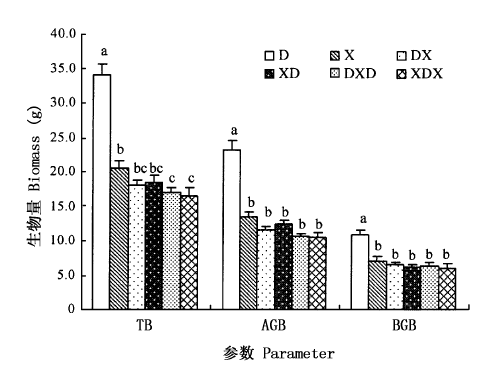
Fig.1 Total biomass, above-ground biomass and below-ground biomass of Spartina alterniflora after irrigation treatment D: 3个月淡水Freshwater treatment for 3 months X: 3个月咸水Saltwater treatment for 3 months DX: 前1.5个月淡水,后1.5个月咸水Freshwater treatment for the former one and half months, then saltwater treatment for the latter ones XD: 前1.5个月咸水,后1.5个月淡水 Saltwater treatment for the former one and half months, then freshwater treatment for the latter ones DXD: 先1个月淡水,后1个月咸水,再1个月淡水Freshwater treatment for the first month, and saltwater treatment for the second month, then freshwater treatment for the third month XDX: 先1个月咸水,后1个月淡水,再1个月咸水Saltwater treatment for the first month, and freshwater treatment for the second month, then saltwater treatment for the third month TB: 总生物量Total biomass AGB: 地上生物量Above-ground biomass BGB: 地下生物量Below-ground biomass 不同的字母表示处理间差异显著(p<0.05) The different letters indicate significant differences at p<0.05 level
| 处理 Treatments | D | X | DX | XD | DXD | XDX | p |
|---|---|---|---|---|---|---|---|
| 茎生物量Stem biomass (g) | 6.60(0.48)a | 3.83(0.35)b | 3.20(0.29)b | 3.72(0.17)b | 2.96(0.21)b | 3.19(0.24)b | 0 |
| 叶生物量Leaf biomass (g) | 14.90(0.86)a | 8.98(0.65)b | 7.56(0.52)bc | 8.09(0.44)bc | 7.06(0.33)c | 6.82(0.48)c | 0 |
| 根生物量Root biomass (g) | 4.92(0.51)a | 4.35(0.41)ab | 3.43(0.38)bc | 3.19(0.31)c | 3.14(0.32)c | 2.88(0.32)c | 0 |
| 根茎生物量Rhizome biomass (g) | 5.88(0.43)a | 2.72(0.30)b | 3.06(0.20)b | 2.93(0.19)b | 3.22(0.24)b | 3.06(0.47)b | 0 |
| RSR (g·g-1) | 0.48(0.04) | 0.55(0.06) | 0.58(0.04) | 0.49(0.02) | 0.60(0.04) | 0.56(0.06) | 0.32 |
| SWR (g·g-1) | 0.19(0.01) | 0.19(0.02) | 0.18(0.01) | 0.20(0.01) | 0.18(0.01) | 0.20(0.01) | 0.44 |
| LWR (g·g-1) | 0.44(0.01) | 0.44(0.02) | 0.42(0.02) | 0.44(0.01) | 0.42(0.01) | 0.42(0.02) | 0.86 |
| RWR (g·g-1) | 0.14(0.01)b | 0.21(0.02)a | 0.19(0.02)a | 0.17(0.01)ab | 0.18(0.02)ab | 0.17(0.01)ab | 0.04 |
| RhWR (g·g-1) | 0.17(0.01) | 0.13(0.02) | 0.17(0.01) | 0.16(0.01) | 0.19(0.01) | 0.18(0.02) | 0.09 |
Table 1 Effects of irrigation treatments on stem biomass, leaf biomass, root biomass and rhizome biomass, and on the allocation of total biomass among these organs
| 处理 Treatments | D | X | DX | XD | DXD | XDX | p |
|---|---|---|---|---|---|---|---|
| 茎生物量Stem biomass (g) | 6.60(0.48)a | 3.83(0.35)b | 3.20(0.29)b | 3.72(0.17)b | 2.96(0.21)b | 3.19(0.24)b | 0 |
| 叶生物量Leaf biomass (g) | 14.90(0.86)a | 8.98(0.65)b | 7.56(0.52)bc | 8.09(0.44)bc | 7.06(0.33)c | 6.82(0.48)c | 0 |
| 根生物量Root biomass (g) | 4.92(0.51)a | 4.35(0.41)ab | 3.43(0.38)bc | 3.19(0.31)c | 3.14(0.32)c | 2.88(0.32)c | 0 |
| 根茎生物量Rhizome biomass (g) | 5.88(0.43)a | 2.72(0.30)b | 3.06(0.20)b | 2.93(0.19)b | 3.22(0.24)b | 3.06(0.47)b | 0 |
| RSR (g·g-1) | 0.48(0.04) | 0.55(0.06) | 0.58(0.04) | 0.49(0.02) | 0.60(0.04) | 0.56(0.06) | 0.32 |
| SWR (g·g-1) | 0.19(0.01) | 0.19(0.02) | 0.18(0.01) | 0.20(0.01) | 0.18(0.01) | 0.20(0.01) | 0.44 |
| LWR (g·g-1) | 0.44(0.01) | 0.44(0.02) | 0.42(0.02) | 0.44(0.01) | 0.42(0.01) | 0.42(0.02) | 0.86 |
| RWR (g·g-1) | 0.14(0.01)b | 0.21(0.02)a | 0.19(0.02)a | 0.17(0.01)ab | 0.18(0.02)ab | 0.17(0.01)ab | 0.04 |
| RhWR (g·g-1) | 0.17(0.01) | 0.13(0.02) | 0.17(0.01) | 0.16(0.01) | 0.19(0.01) | 0.18(0.02) | 0.09 |
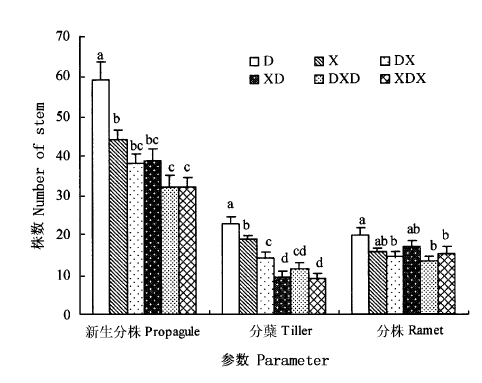
Fig.2 Numbers of propagule, tiller and ramet of Spartina alterniflora after irrigation treatment D、X、DX、XD、DXD、XDX: See Fig. 1 The different letters indicate significant differences at p<0.05 level
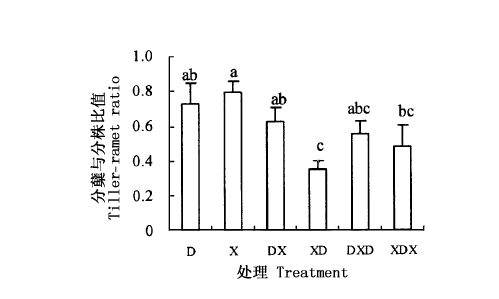
Fig.3 Tiller/ramet tradeoff of Spartina alterniflora under irrigation treatment Notes see Fig. 2
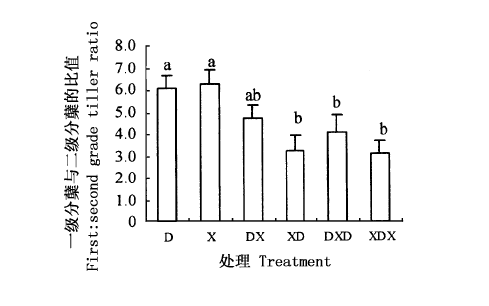
Fig.4 Hierarchical selection of asexual reproduction of Spartina alterniflora after irrigation treatment Notes see Fig. 2
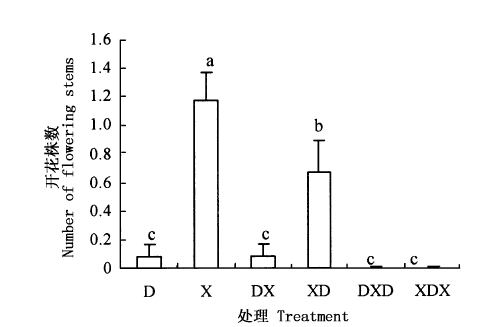
Fig.5 Number of flowering stems of Spartina alterniflora after irrigation treatment Notes see Fig. 2
| [1] |
Adams JB, Bate GC (1995). Ecological implications of tolerance of salinity and inundation by Spartina maritima. Aquatic Botany, 52, 183-191.
DOI URL |
| [2] |
Bradley PM, Morris JT (1991). Relative importance of ion exclusion, secretion and accumulation in Spartina alterniflora Loisel. Journal of Experimental Botany, 42, 1525-1532.
DOI URL |
| [3] |
Cavalieri AJ (1983). Proline and glycine betaine accumulation by Spartina alterniflora Loisel in response to NaCl and nitrogen in a controlled environment. Oecologia, 57, 20-24.
DOI URL PMID |
| [4] | Chen ZY (陈中义), Li B (李博), Chen JK (陈家宽) (2005). Effects of salt stress and elevation of tideland on the growth of introduced Spartina alterniflora at Dongtan of Chongming, the Yangtze River estuary. Journal of Yangtze University (Natural Science Edition) (长江大学学报(自然科学版)), 2(2), 6-9. (in Chinese with English abstract) |
| [5] |
Chung CH, Zhuo RZ, Xu GW (2004). Creation of Spartina plantations for reclaiming Dongtai, China, tidal flats and offshore sands. Ecological Engineering, 23, 135-150.
DOI URL |
| [6] |
Daehler CC, Strong DR (1996). tatus, prediction and prevention of introduced cordgrass Spartina spp. invasions in Pacific estuaries, USA. Biological Conservation, 78, 51-58.
DOI URL |
| [7] | Deng ZF (邓自发), An SQ (安树青), Zhi YB (智颖飙), Zhou CF (周长芳), Chen L (陈琳), Zhao CJ (赵聪蛟), Fang SB (方淑波), Li HL (李红丽) (2006). Preliminary studies on invasive model and outbreak mechanism of exotic species, Spartina alterniflora Loisel. Acta Ecologica Sinica (生态学报), 26, 2678-2686. (in Chinese with English abstract) |
| [8] |
El-Haddad ESH, Noaman MM (2001). Leaching requirement and salinity threshold for the yield and agronomic characteristics of halophytes under salt stress. Journal of Arid Environments, 49, 865-874.
DOI URL |
| [9] |
Flowers TJ, Troke PF, Yeo AR (1977). The mechanism of salt tolerance in halophytes. Annual Review of Plant Physiology, 28, 89-121.
DOI URL |
| [10] |
Hester MW, Mendelssohn IA, McKee KL (2001). Species and population variation to salinity stress in Panicum hemitomon, Spartina patens, and Spartina alterniflora: morphological and physiological constraints. Environmental and Experimental Botany, 46, 277-297.
DOI URL |
| [11] |
Hester MW, McKee KL, Burdick DM, Koch MS, Flynn KM, Patterson S, Mendelssohn IA (1994). Clonal integration in Spartina patens across a nitrogen and salinity gradient. Canadian Journal of Botany, 72, 767-770.
DOI URL |
| [12] | Jiang XM (江香梅), Huang MR (黄敏仁), Wang MX (王明庥) (2001). A review on salt and drought resistance gene engineering in plants. Journal of Nanjing Forestry University (Natural Science Edition) (南京林业大学学报(自然科学版)), 25, 57-62. (in Chinese with English abstract) |
| [13] |
Lewis MA, Weber DE (2002). Effects of substrate salinity on early seedling survival and growth of Scirpus robustus Pursh and Spartina alterniflora Loisel. Ecotoxicology, 11, 19-26.
DOI URL PMID |
| [14] |
Linthurst RA, Seneca ED (1980). The effects of standing water and drainage potential on the Spartina alterniflora-substrate complex in a North Carolina salt marsh. Estuarine and Coastal Marine Science, 11, 41-52.
DOI URL |
| [15] | Liu YX (刘永学), Li MC (李满春), Zhang RS (张忍顺) (2004). Approach on the dynamic change and influence factors of Spartina alterniflora Loisel salt-marsh along the coast of the Jiangsu Province. Wetland Science (湿地科学), 2(2), 116-121. (in Chinese with English abstract) |
| [16] |
Nieva FJJ, Castellanos EM, Figueroa ME, Gil F (1999). Gas exchange and chlorophyll fluorescence of C3 and C4 saltmarsh species. Photosynthetica, 36, 397-406.
DOI URL |
| [17] | Nieva FJJ, Castillo JM, Luque CJ, Figueroa ME (2003). Ecophysiology of tidal and non-tidal populations of the invading cordgrass Spartina densiflora: seasonal and diurnal patterns in a Mediterranean climate. Estuarine, Coastal and Shelf Science, 57, 919-928. |
| [18] |
Portnoy JW, Valiela I (1997). Short-term effects of salinity reduction and drainage on salt-marsh biogeochemical cycling and Spartina (cordgrass) production. Estuaries, 20, 569-578.
DOI URL |
| [19] |
Seliskar DM, Gallagher JL, Burdick DM, Mutz LA (2002). The regulation of ecosystem functions by ecotypic variation in the dominant plant: a Spartina alterniflora salt-marsh case study. Journal of Ecology, 90, 1-11.
DOI URL |
| [20] |
Shumway SW, Bertness MD (1992). Salt stress limitation of seedling recruitment in a salt marsh plant community. Oecologia, 92, 490-497.
DOI URL PMID |
| [21] |
Smart RM, Barko JW (1980). Nitrogen nutrition and salinity tolerance of Distichlis spicata and Spartina alterniflora. Ecology, 61, 630-638.
DOI URL |
| [22] |
Smekens MJ, van Tienderen PH (2001). Genetic variation and plasticity of Plantago coronopus under saline conditions. Acta Oecologia, 22, 187-200.
DOI URL |
| [23] |
van Zandt PA, Tobler MA, Mouton E, Hasenstein KH, Mopper S (2003). Positive and negative consequences of salinity stress for the growth and reproduction of the clonal plant, Iris hexagona. Journal of Ecology, 91, 837-846.
DOI URL |
| [24] | Wang Q (王卿), An SQ (安树青), Ma ZJ (马志军), Zhao B (赵斌), Chen JK (陈家宽), Li B (李博) (2006). Invasive Spartina alterniflora: biology, ecology and management. Acta Phytotaxonomica Sinica (植物分类学报), 44, 559-588. (in Chinese with English abstract) |
| [25] | Xiao Q (肖强), Zheng HL (郑海雷), Chen Y (陈瑶), Huang WB (黄伟滨), Zhu Z (朱珠) (2005). Effects of salinity on the growth and proline, soluble sugar and protein contents of Spartina alterniflora. Chinese Journal of Ecology (生态学杂志), 24, 373-376. (in Chinese with English abstract) |
| [26] | Yu HW (于海武), Li Y (李莹) (2004). Research progress on salt tolerance of plant. Journal of Beihua University (Natural Science Edition) (北华大学学报(自然科学版)), 5, 257-263. (in Chinese with English abstract) |
| [1] | ZHANG Jing, CHEN Jie, LI Yan-Peng, PAN Li-Jun, XU Han, LI Yi-De, HE Hai-Sheng. Comparison of plant biomass in conifer and broadleaf mixed artificial forests in south subtropical area and analyses of influential factors [J]. Chin J Plant Ecol, 2026, 50(2): 400-416. |
| [2] | XU En-Xiang, ZHOU Lei, ZHANG Xiao-Wei, ZHANG Guo-Ping, ZHONG Du-Wei, HUANG Zhi, LIU Pai, CHI Yong-Gang. Estimation of rice yield based on canopy reflectance spectra and carbon flux in diverse growth phases [J]. Chin J Plant Ecol, 2026, 50(1): 82-93. |
| [3] | LIANG Tian-Hao, WU Fan, HUANG Jin-Xue, JING Chen-Hong, FU He-Jing, YANG Zhi-Jie, XIONG De-Cheng. Effects of soil warming on fine root growth and morphology of Castanopsis kawakamii in mid-subtropical forests [J]. Chin J Plant Ecol, 2026, 50(1): 94-106. |
| [4] | ZHU Rui-De, YANG Jun-Wei, LIU Xiao-Han, CHEN Bing-Rui, CHI Xiu-Lian, TIAN Di, YANG Guang, CHENG Meng, DAI Ya-Feng, WANG Shi-Wen. Nutrient regulation of plant-microbial association in Dendrobium huoshanense facilities and understory cultivation patterns [J]. Chin J Plant Ecol, 2025, 49(9): 1434-1447. |
| [5] | SONG Shan-Shan, TANG Zhi-Yao. Relationship between rhizosphere soil fungi and plant aboveground biomass in the meadow steppe of Saihanba, Hebei, China [J]. Chin J Plant Ecol, 2025, 49(9): 1461-1471. |
| [6] | XING Qiang, ZHAO Bin, HU Yong-Hong, YANG Jun, QIN Jun, LIU He-Ming, WANG Hong-Bing, ZHOU Peng. Root trait variation in response to a novel soil substrate in two typical vertical greening plants from the East China [J]. Chin J Plant Ecol, 2025, 49(9): 1498-1514. |
| [7] | ZHANG Fa-Wei, LI Hong-Qin, ZHU Jing-Bin, FAN Bo, ZHOU Hua-Kun, LI Ying-Nian, LIANG Nai-Shen. Response of aboveground and belowground carbon storage to nitrogen addition and precipitation change in an alpine meadow ecosystem [J]. Chin J Plant Ecol, 2025, 49(9): 1399-1409. |
| [8] | FAN Yue-Ling, JIANG Zheng-De, YE Jia-Shu, ZHENG Li-Chen, CHEN Xin. Dataset on harvest traits and yield of major crops in long-term farmland observation plots in the Lower Liaohe Plain from 2005 to 2015 [J]. Chin J Plant Ecol, 2025, 49(8): 1271-1282. |
| [9] | DUAN Jun-Cheng, WANG Zhi-Yong, GAO Wei-Cong, ZHANG Cheng-Kai, GAO Chang-Hong, LIU Xiao-Tong, LI Zhen-Jin. Spatiotemporal evolution and landscape pattern analysis of the invasive species Spartina alterniflora in the Yellow River Delta wetland [J]. Chin J Plant Ecol, 2025, 49(6): 922-938. |
| [10] | LIU Xin-Yue, WANG Li-Ping, LIU Chun-He, SUN Yan-Li, LIU Peng, TIAN Yun, JIA Xin, ZHA Tian-Shan, QIAN Duo. Spatial pattern of biomass and its influencing factors for plantations with different stand ages in Beijing [J]. Chin J Plant Ecol, 2025, 49(6): 939-951. |
| [11] | MA Teng-Fei, HAO Jie, DIAO Hua-Jie, NING Ya-Nan, $\boxed{\hbox{WANG Chang-Hui}}$ , DONG Kuan-Hu. Seasonal variations of soil inorganic nitrogen contents and their responses to changing grazing intensity in grasslands of an agro-pastoral ecotone in northern Shanxi, China [J]. Chin J Plant Ecol, 2025, 49(6): 965-974. |
| [12] | CHEN Wen-Yi, WANG Zhi-Yong, ZHOU Meng-Yan, MA Wen-Jun, WANG Jun-Hui, LUO Zhi-Bin, ZHOU Jing. Biomass allocation and allometric growth model of young Catalpa bungei [J]. Chin J Plant Ecol, 2025, 49(2): 356-366. |
| [13] | HAO Yi-Qing, LIU Wei, YANG Yang, AN Bing-Er, FAN Bing, LI Chao, CUI Jiu-Hui, CHENG Yan-Bin, SUN Jia-Mei, PAN Qing-Min. Effects of organic and inorganic fertilizers on density and individual biomass of Leymus chinensis in degraded grasslands [J]. Chin J Plant Ecol, 2025, 49(1): 148-158. |
| [14] | WANG Xiao-Ying, SUN Zhi-Gao, CHEN Bing-Bing, WU Hui-Hui, ZHANG Dang-Yu. Ex situ decomposition and phosphorus release characteristics of Spartina alterniflora litter in Minjiang estuary [J]. Chin J Plant Ecol, 2024, 48(7): 844-857. |
| [15] | WANG Ge, HU Shu-Ya, LI Yang, CHEN Xiao-Peng, LI Hong-Yu, DONG Kuan-Hu, HE Nian-Peng, WANG Chang-Hui. Temperature sensitivity of soil net nitrogen mineralization rates across different grassland types [J]. Chin J Plant Ecol, 2024, 48(4): 523-533. |
| Viewed | ||||||
|
Full text |
|
|||||
|
Abstract |
|
|||||
Copyright © 2026 Chinese Journal of Plant Ecology
Tel: 010-62836134, 62836138, E-mail: apes@ibcas.ac.cn, cjpe@ibcas.ac.cn

