
植物生态学报 ›› 2026, Vol. 50 ›› Issue (2): 279-292.DOI: 10.17521/cjpe.2025.0022 cstr: 32100.14.cjpe.2025.0022
郝雅昕, 金光泽, 刘志理*( )(
)( )
)
收稿日期:2025-01-14
接受日期:2025-04-16
出版日期:2026-02-28
发布日期:2026-04-01
通讯作者:
*刘志理 (liuzl2093@126.com)基金资助:
HAO Ya-Xin, JIN Guang-Ze, LIU Zhi-Li*()()
Received:2025-01-14
Accepted:2025-04-16
Online:2026-02-28
Published:2026-04-01
Contact:
*LIU Zhi-Li (liuzl2093@126.com)Supported by:摘要:
以往研究显示生长季不同阶段和枝龄是影响植物枝性状变异的重要因素, 但少有研究探究随生长季阶段和枝龄改变, 植物枝性状以及性状间关系的变化规律。该研究以我国东北典型常绿针叶树种红松(Pinus koraiensis)、红皮云杉(Picea koraiensis)和臭冷杉(Abies nephrolepis)为研究对象, 通过测定生长季前期(7月)、中期(9月)、后期(11月) 3个时期共135株样树当年生和多年生枝的比枝长、枝干物质含量、木质密度、髓面积占比、木质部面积占比、韧皮部面积占比和树脂道面积占比7个性状, 探讨不同生长季阶段和枝龄对枝性状及性状间相关性的影响。结果表明: 在生长季前期, 枝干物质含量和木质密度显著低于生长季中期和后期; 木质部面积占比和韧皮部面积占比随着枝龄的增加而显著增大; 比枝长与枝干物质含量的负相关性仅存在于生长季前期当年生枝中。生长季前期及当年生枝表现为高比枝长和低干物质含量, 这证实生长季前期当年生枝采取“快速投资-收益”型生存策略, 而生长季后期以及多年生枝与之相反, 采取“缓慢投资-收益”型生存策略。研究结果有助于深入了解植物如何通过调控枝性状来适应生境变化。
郝雅昕, 金光泽, 刘志理. 生长季不同阶段和枝龄对常绿针叶树种枝性状的影响. 植物生态学报, 2026, 50(2): 279-292. DOI: 10.17521/cjpe.2025.0022
HAO Ya-Xin, JIN Guang-Ze, LIU Zhi-Li. Effects of different stages of growing season and twig ages on twig traits in evergreen conifers. Chinese Journal of Plant Ecology, 2026, 50(2): 279-292. DOI: 10.17521/cjpe.2025.0022
| 性状 Trait | 最大值 Maximum | 最小值 Minimum | 平均值(标偏差) Mean (SD) | 变异系数 KCV (%) |
|---|---|---|---|---|
| 比枝长 Specific twig length (cm·g-1) | 588.235 | 5.692 | 82.52 (74.45) | 66.99 |
| 枝干物质含量 Twig dry matter content (g·g-1) | 0.815 | 0.044 | 0.44 (0.19) | 39.57 |
| 木质密度 Twig wood density (g·cm-3) | 0.671 | 0.039 | 0.32 (0.12) | 35.73 |
| 髓面积占比 Pith proportion cross-sectional area ratio | 0.144 | 0.004 | 0.04 (0.02) | 52.79 |
| 木质部面积占比 Xylem proportion cross-sectional area ratio | 0.557 | 0.021 | 0.15 (0.09) | 33.98 |
| 韧皮部面积占比 Phloem proportion cross-sectional area ratio | 0.202 | 0.020 | 0.09 (0.03) | 47.39 |
| 树脂道面积占比 Resin channel proportion cross-sectional area ratio | 0.171 | 0.007 | 0.05 (0.02) | 49.40 |
表1 三种常绿针叶树种枝性状统计信息
Table 1 Statistical information of twig traits of three evergreen conifers
| 性状 Trait | 最大值 Maximum | 最小值 Minimum | 平均值(标偏差) Mean (SD) | 变异系数 KCV (%) |
|---|---|---|---|---|
| 比枝长 Specific twig length (cm·g-1) | 588.235 | 5.692 | 82.52 (74.45) | 66.99 |
| 枝干物质含量 Twig dry matter content (g·g-1) | 0.815 | 0.044 | 0.44 (0.19) | 39.57 |
| 木质密度 Twig wood density (g·cm-3) | 0.671 | 0.039 | 0.32 (0.12) | 35.73 |
| 髓面积占比 Pith proportion cross-sectional area ratio | 0.144 | 0.004 | 0.04 (0.02) | 52.79 |
| 木质部面积占比 Xylem proportion cross-sectional area ratio | 0.557 | 0.021 | 0.15 (0.09) | 33.98 |
| 韧皮部面积占比 Phloem proportion cross-sectional area ratio | 0.202 | 0.020 | 0.09 (0.03) | 47.39 |
| 树脂道面积占比 Resin channel proportion cross-sectional area ratio | 0.171 | 0.007 | 0.05 (0.02) | 49.40 |
| 性状 Trait | 生长季阶段 Growing season stages | 枝龄 Twig ages | 生长季阶段×枝龄 Growing season stages × twig ages | 截距 Intercept | ||||
|---|---|---|---|---|---|---|---|---|
| 估计标准差 Estimate SD | p | 估计标准差 Estimate SD | p | 估计标准差 Estimate SD | p | 估计标准差 Estimate SD | p | |
| STL (cm·g-1) | -0.049 7 | 0.092 6 | -0.143 9 | <0.001*** | 0.025 1 | 0.178 1 | 0.433 4 | <0.001*** |
| TDMC (g·g-1) | 0.224 9 | <0.001*** | 0.261 4 | <0.001*** | -0.101 9 | <0.001*** | -0.046 1 | 0.385 0 |
| TWD (g·cm-3) | 0.098 8 | <0.001*** | 0.138 9 | <0.001*** | -0.040 2 | <0.001*** | 0.089 4 | 0.063 6 |
| RPA | 0.037 8 | 0.180 3 | -0.048 2 | 0.272 4 | -0.024 2 | 0.177 4 | 0.369 8 | 0.006 4** |
| RXA | 0.036 6 | 0.077 7 | 0.229 7 | 0.019 2* | 0.004 3 | 0.744 3 | -0.166 2 | 0.028 4* |
| RPHA | 0.043 1 | 0.027 9* | 0.212 2 | <0.001*** | -0.005 0 | 0.687 9 | -0.020 6 | 0.579 9 |
| RRC | -0.008 1 | 0.158 4 | -0.008 1 | 0.756 6 | -0.034 1 | 0.013 6* | 0.264 8 | <0.001*** |
表2 三种常绿针叶树种枝性状与生长季阶段、枝龄的线性混合模型(LMM)
Table 2 Linear Mixed-effect Models (LMM) of twig traits, growing season stages and twig ages of three evergreen conifers
| 性状 Trait | 生长季阶段 Growing season stages | 枝龄 Twig ages | 生长季阶段×枝龄 Growing season stages × twig ages | 截距 Intercept | ||||
|---|---|---|---|---|---|---|---|---|
| 估计标准差 Estimate SD | p | 估计标准差 Estimate SD | p | 估计标准差 Estimate SD | p | 估计标准差 Estimate SD | p | |
| STL (cm·g-1) | -0.049 7 | 0.092 6 | -0.143 9 | <0.001*** | 0.025 1 | 0.178 1 | 0.433 4 | <0.001*** |
| TDMC (g·g-1) | 0.224 9 | <0.001*** | 0.261 4 | <0.001*** | -0.101 9 | <0.001*** | -0.046 1 | 0.385 0 |
| TWD (g·cm-3) | 0.098 8 | <0.001*** | 0.138 9 | <0.001*** | -0.040 2 | <0.001*** | 0.089 4 | 0.063 6 |
| RPA | 0.037 8 | 0.180 3 | -0.048 2 | 0.272 4 | -0.024 2 | 0.177 4 | 0.369 8 | 0.006 4** |
| RXA | 0.036 6 | 0.077 7 | 0.229 7 | 0.019 2* | 0.004 3 | 0.744 3 | -0.166 2 | 0.028 4* |
| RPHA | 0.043 1 | 0.027 9* | 0.212 2 | <0.001*** | -0.005 0 | 0.687 9 | -0.020 6 | 0.579 9 |
| RRC | -0.008 1 | 0.158 4 | -0.008 1 | 0.756 6 | -0.034 1 | 0.013 6* | 0.264 8 | <0.001*** |
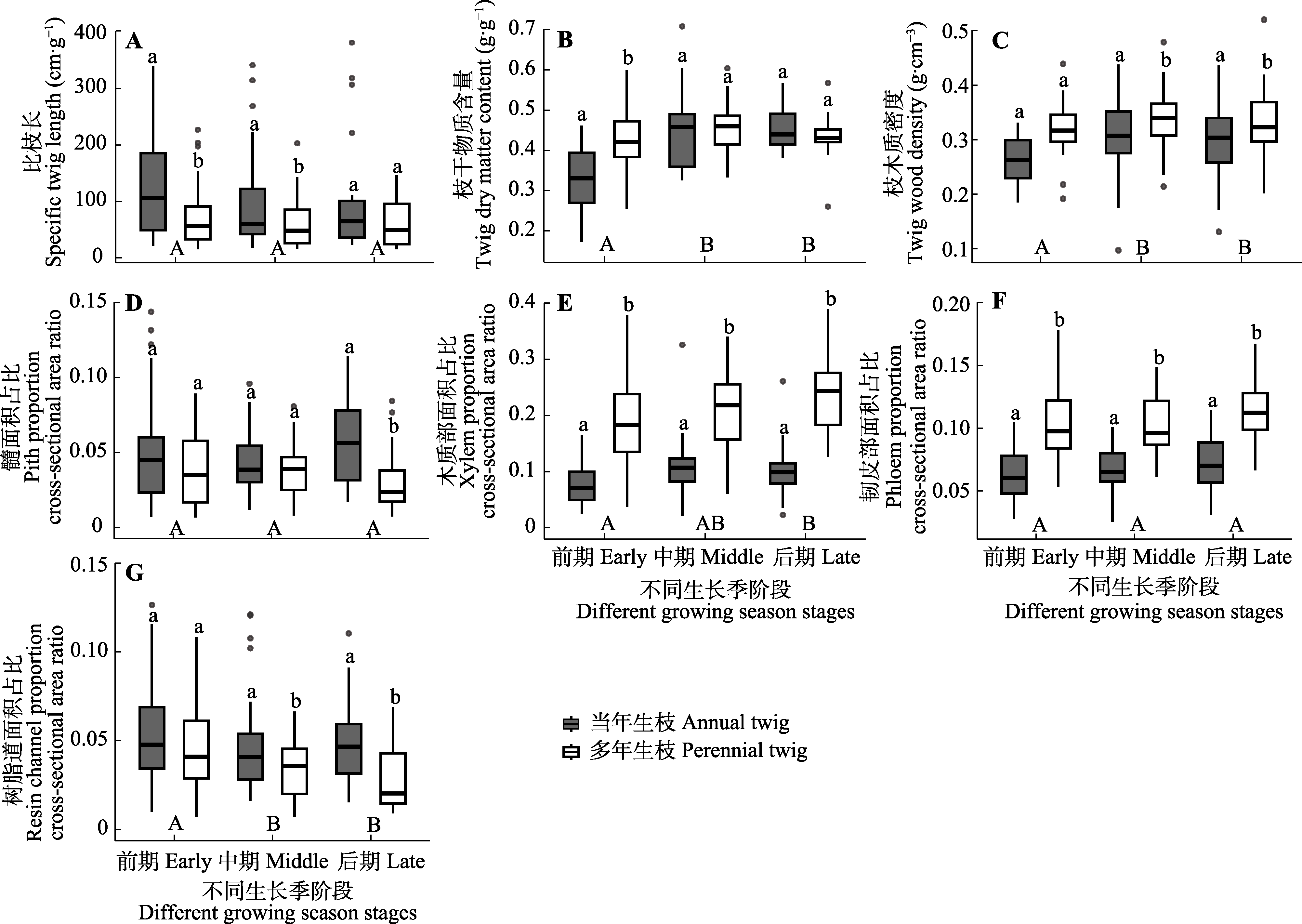
图1 三种常绿针叶树种生长季不同阶段不同枝龄枝性状差异。不同大写字母表示生长季不同阶段枝性状间具有显著差异(p < 0.05), 不同小写字母表示不同枝龄的枝性状间具有显著差异(p < 0.05)。
Fig. 1 Difference of twig traits of three evergreen conifer species in different stages of growing season and different twig ages. Different uppercase letters indicate significant differences between twig traits in different stages of growing season (p < 0.05), and different lowercase letters indicated significant difference in twig traits at different ages (p < 0.05).
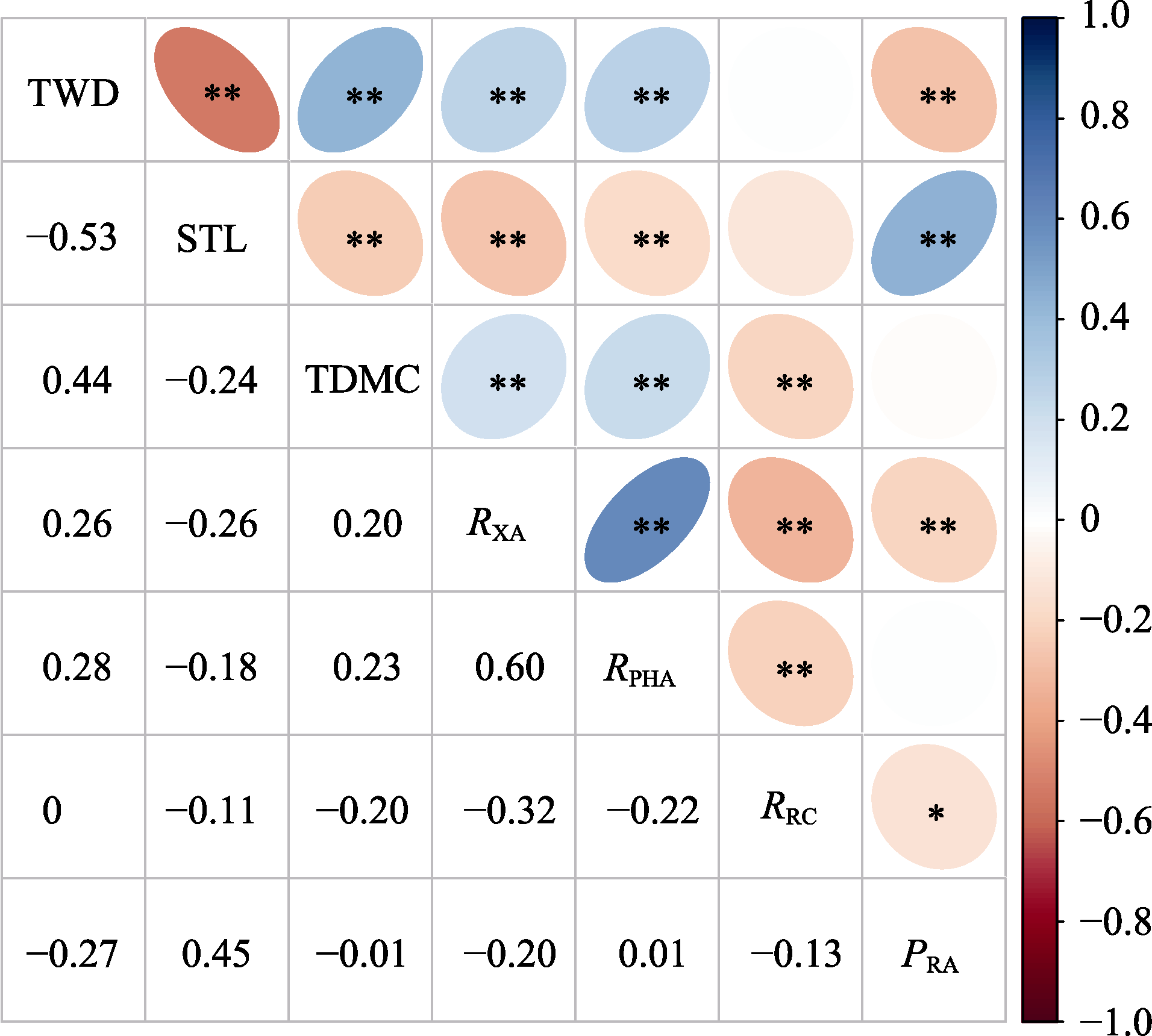
图2 三种常绿针叶树种枝性状Spearman相关分析热图。RPA, 髓面积占比; RPHA, 韧皮部面积占比; RRC, 树脂道面积占比; RXA, 木质部面积占比; STL, 比枝长; TDMC, 枝干物质含量; TWD, 枝木质密度。*, p < 0.05; **, p < 0.01。
Fig. 2 Spearman correlation heat map for twig traits of three evergreen conifers. RPA, pith proportion cross-sectional area ratio; RPHA, phloem proportion cross-sectional area ratio; RRC, resin channel proportion cross-sectional area ratio; RXA, xylem proportion cross-sectional area ratio; STL, specific twig length; TDMC, twig dry matter content; TWD, twig wood density. *, p < 0.05; **, p < 0.01.
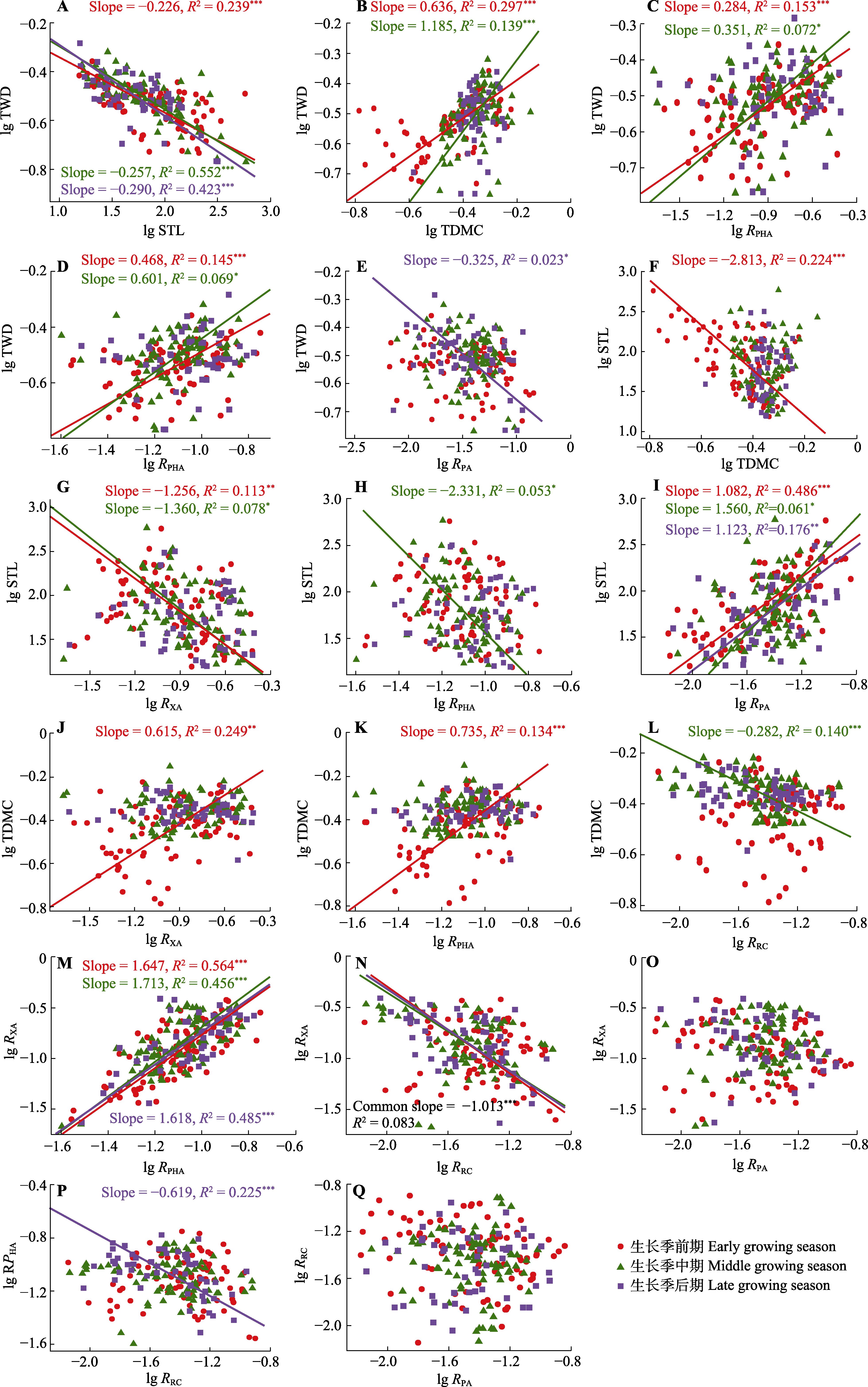
图3 三种常绿针叶树种生长季不同阶段枝性状相关关系。RPA, 髓面积占比; RPHA, 韧皮部面积占比; RRC, 树脂道面积占比; RXA, 木质部面积占比; slope, 斜率; STL, 比枝长; TDMC, 枝干物质含量; TWD, 枝木质密度。*, p < 0.05; **, p < 0.01; ***, p < 0.001。不同颜色标注代表生长季不同阶段枝性状间相关斜率, N中黑色标注代表3个生长季阶段枝性状间相关斜率相同, 若性状间没有显著相关性(p < 0.05), 则不显示线条。
Fig. 3 Correlation of twig traits in different stages of growing season among three evergreen conifer species. RPA, pith proportion cross-sectional area ratio; RPHA, phloem proportion cross-sectional area ratio; RRC, resin channel proportion cross-sectional area ratio; RXA, xylem proportion cross-sectional area ratio; STL, specific twig length; TDMC, twig dry matter content; TWD, twig wood density. *, p < 0.05; **, p < 0.01; ***, p < 0.001. Different color marks represent the correlation slopes between traits in different stages of growing season, the black marks in N represent the same correlation slope among the twig traits in the three growing season stages. If there is no significant correlation between traits (p < 0.05), no lines are displayed.
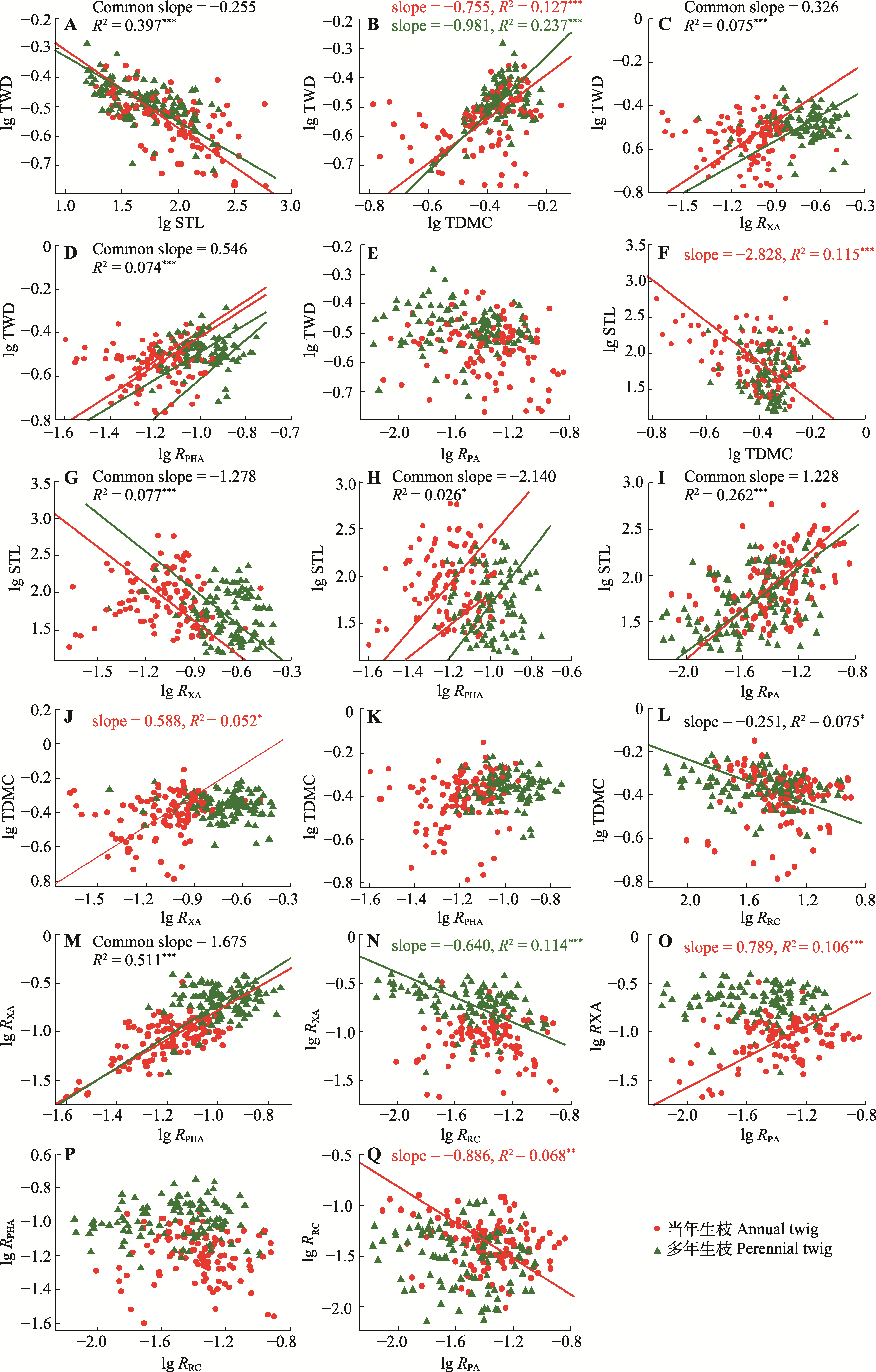
图4 三种常绿针叶树种不同枝龄枝性状相关关系。Common slop, 共同斜率; RPA, 髓面积占比; RPHA, 韧皮部面积占比; RRC, 树脂道面积占比; RXA, 木质部面积占比; slope, 斜率; STL, 比枝长; TDMC, 枝干物质含量; TWD, 枝木质密度。*, p < 0.05; **, p < 0.01; ***, p < 0.001。不同颜色标注代表不同枝龄性状间相关斜率, 黑色标注代表两个枝龄性状间相关斜率相同, 若性状间没有显著相关性(p < 0.05), 则不显示线条。
Fig. 4 Correlation of twig traits of three evergreen conifer species at different ages. RPA, pith proportion cross-sectional area ratio; RPHA, phloem proportion cross-sectional area ratio; RRC, resin channel proportion cross-sectional area ratio; RXA, xylem proportion cross-sectional area ratio; STL, specific twig length; TDMC, twig dry matter content; TWD, twig wood density. *, p < 0.05; **, p < 0.01; ***, p < 0.001. Different color marks represent the correlation slopes between traits at different twig ages, the black marks indicate the same correlation slope between the two ages traits. If there is no significant correlation between traits (p < 0.05), no lines are displayed.
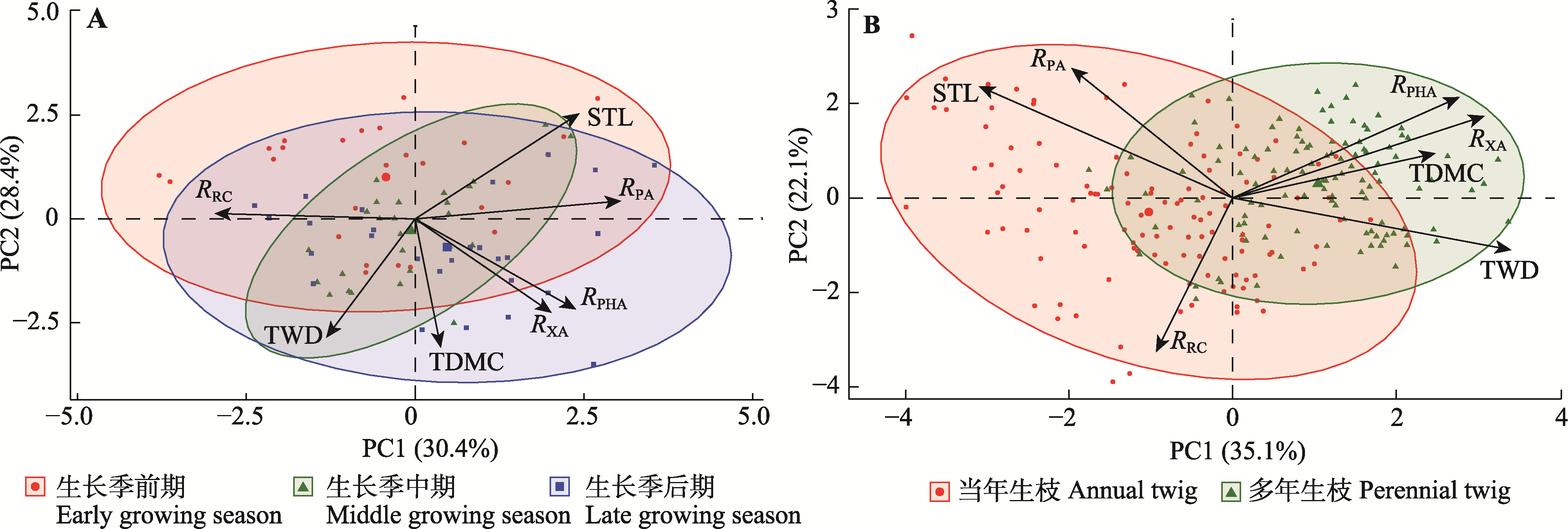
图5 枝性状的主成分(PC)分析。A, 生长季不同阶段时期当年生枝主成分分析。B, 不同枝龄枝主成分分析。RPA, 髓面积占比; RPHA, 韧皮部面积占比; RRC, 树脂道面积占比; RXA, 木质部面积占比; STL, 比枝长; TDMC, 枝干物质含量; TWD, 枝木质密度。
Fig. 5 Principal component (PC) analysis of twig traits. A, Principal component analysis of annual twigs in different stages of growing season. B, Principal component analysis of different twig ages. RPA, pith proportion cross-sectional area ratio; RPHA, phloem proportion cross-sectional area ratio; RRC, resin channel proportion cross-sectional area ratio; RXA, xylem proportion cross-sectional area ratio; STL, specific twig length; TDMC, twig dry matter content; TWD, twig wood density.
| [1] |
Agustí J, Blázquez MA (2020). Plant vascular development: mechanisms and environmental regulation. Cellular and Molecular Life Sciences, 77, 3711-3728.
DOI PMID |
| [2] | Arco Molina JG, Altman J, Rai S, Korznikov K, Pejcha V, Dvorsky M, Doležal J (2024). Climate drivers of Pinus ponderosa tree development on volcanic tephra deposits in the Southwestern USA: insights from radial increment and wood density variations. Dendrochronologia, 88, 126242. DOI: 10.1016/j.dendro.2024.126242. |
| [3] |
Arndt SK, Sanders GJ, Bristow M, Hutley LB, Beringer J, Livesley SJ (2015). Vulnerability of native savanna trees and exotic Khaya senegalensis to seasonal drought. Tree Physiology, 35, 783-791.
DOI URL |
| [4] |
Bag P, Lihavainen J, Delhomme N, Riquelme T, Robinson KM, Jansson S (2021). An atlas of the Norway spruce needle seasonal transcriptome. The Plant Journal, 108, 1815-1829.
DOI PMID |
| [5] | Beker C, Turski M, Kaźmierczak K, Najgrakowski T, Jaszczak R, Rączka G, Wajchman-Świtalska S (2021). The size of the assimilatory apparatus and its relationship with selected taxation and increment traits in pine (Pinus sylvestris L.) stands. Forests, 12, 1502. DOI: 10.3390/f12111502. |
| [6] |
Bjorkman AD, Myers-Smith IH, Elmendorf SC, Normand S, Rüger N, Beck PSA, Blach-Overgaard A, Blok D, Cornelissen JHC, Forbes BC, Georges D, Goetz SJ, Guay KC, Henry GHR, HilleRisLambers J, et al. (2018). Plant functional trait change across a warming tundra biome. Nature, 562, 57-62.
DOI |
| [7] | Bruelheide H, Dengler J, Purschke O, Lenoir J, Jiménez-Alfaro B, Hennekens SM, Botta-Dukát Z, Chytrý M, Field R, Jansen F, Kattge J, Pillar VD, Schrodt F, Mahecha MD, Peet RK, et al. (2018). Global trait-environment relationships of plant communities. Nature Ecology & Evolution, 2, 1906-1917. |
| [8] |
Cary KL, Ranieri GM, Pittermann J (2020). Xylem form and function under extreme nutrient limitation: an example from California’s pygmy forest. New Phytologist, 226, 760-769.
DOI URL |
| [9] | Chen C, Wang GJ, Zhao Y, Zhou GX, Li L, Gao JQ (2016). Seasonal dynamics and allometric growth relationships of C, N, and P stoichiometry in the organs of Cunninghamia lanceolata from Huitong. Acta Ecologica Sinica, 36, 7614-7623. |
| [陈婵, 王光军, 赵月, 周国新, 李栎, 高吉权 (2016). 会同杉木器官间C、N、P化学计量比的季节动态与异速生长关系. 生态学报, 36, 7614-7623.] | |
| [10] |
Cornelissen JHC, Lavorel S, Garnier E, Díaz S, Buchmann N, Gurvich DE, Reich PB, ter Steege H, Morgan HD, van der Heijden MGA, Pausas JG, Poorter H (2003). A handbook of protocols for standardised and easy measurement of plant functional traits worldwide. Australian Journal of Botany, 51, 335-380.
DOI URL |
| [11] |
Davis TS, Hofstetter RW (2014). Allometry of phloem thickness and resin flow and their relation to tree chemotype in a southwestern ponderosa pine forest. Forest Science, 60, 270-274.
DOI URL |
| [12] |
de Micco V, Aronne G (2007). Anatomical features, monomer lignin composition and accumulation of phenolics in 1-year-old branches of the Mediterranean Cistus ladanifer L. Botanical Journal of the Linnean Society, 155, 361-371.
DOI URL |
| [13] |
Eimil-Fraga C, Sánchez-Rodríguez F, Álvarez-Rodríguez E, Rodríguez-Soalleiro R (2015). Relationships between needle traits, needle age and site and stand parameters in Pinus pinaster. Trees, 29, 1103-1113.
DOI URL |
| [14] |
Fan HK, Zeng T, Jin GZ, Liu ZL (2024). Leaf trait variation and trade-offs among growth types of broadleaf plants in Xiao Hinggan Mountains. Chinese Journal of Plant Ecology, 48, 364-376.
DOI URL |
|
[范宏坤, 曾涛, 金光泽, 刘志理 (2024). 小兴安岭不同生长型阔叶植物叶性状变异及权衡. 植物生态学报, 48, 364-376.]
DOI |
|
| [15] | Fan ZX, Zhang SB, Hao GY, Ferry Slik JW, Cao KF (2012). Hydraulic conductivity traits predict growth rates and adult stature of 40 Asian tropical tree species better than wood density. Journal of Ecology, 100, 732-741. |
| [16] | Garcia-Barreda S, Valeriano C, Camarero JJ (2023). Drought constrains acorn production and tree growth in the Mediterranean holm oak and triggers weak legacy effects. Agricultural and Forest Meteorology, 334, 109435. DOI: 10.1016/j.agrformet.2023.109435. |
| [17] |
Gebauer R, Albrechtová P, Plichta R, Volařík D (2019). The comparative xylem structure and function of petioles and twigs of mistletoe Loranthus europaeus and its host Quercus pubescence. Trees, 33, 933-942.
DOI |
| [18] |
Givnish TJ (1987). Comparative studies of leaf form: assessing the relative roles of selective pressures and phylogenetic constraints. New Phytologist, 106, 131-160.
DOI URL |
| [19] | Joswig JS, Wirth C, Schuman MC, Kattge J, Reu B, Wright IJ, Sippel SD, Rüger N, Richter R, Schaepman ME, van Bodegom PM, Cornelissen JHC, Díaz S, Hattingh WN, Kramer K, et al. (2022). Climatic and soil factors explain the two-dimensional spectrum of global plant trait variation. Nature Ecology & Evolution, 6, 36-50. |
| [20] |
Jump AS, Ruiz-Benito P, Greenwood S, Allen CD, Kitzberger T, Fensham R, Martínez-Vilalta J, Lloret F (2017). Structural overshoot of tree growth with climate variability and the global spectrum of drought-induced forest dieback. Global Change Biology, 23, 3742-3757.
DOI PMID |
| [21] |
Kvålseth TO (2017). Coefficient of variation: the second-order alternative. Journal of Applied Statistics, 44, 402-415.
DOI URL |
| [22] |
Larios Mendieta KA, Burleigh JG, Putz FE (2021). Pith width, leaf size, and twig thickness. American Journal of Botany, 108, 2143-2149.
DOI PMID |
| [23] | Liu C, Jin GZ, Liu ZL (2021). Importance of organ age in driving intraspecific trait variation and coordination for three evergreen coniferous species. Ecological Indicators, 121, 107099. DOI: 10.1016/j.ecolind.2020.107099. |
| [24] |
Liu Q, Fu YH, Zeng ZZ, Huang MT, Li XR, Piao SL (2016). Temperature, precipitation, and insolation effects on autumn vegetation phenology in temperate China. Global Change Biology, 22, 644-655.
DOI PMID |
| [25] |
Liu RH, Bai JL, Bao H, Nong JL, Zhao JJ, Jiang Y, Liang SC, Li YJ (2020). Variation and correlation in functional traits of main woody plants in the Cyclobalanopsis glauca community in the karst hills of Guilin, southwest China. Chinese Journal of Plant Ecology, 44, 828-841.
DOI URL |
| [刘润红, 白金连, 包含, 农娟丽, 赵佳佳, 姜勇, 梁士楚, 李月娟 (2020). 桂林岩溶石山青冈群落主要木本植物功能性状变异与关联. 植物生态学报, 44, 828-841.] | |
| [26] |
Liu XJ, Ma KP (2015). Plant functional traits—Concepts, applications and future directions. Scientia Sinica Vitae, 45, 325-339.
DOI URL |
| [刘晓娟, 马克平 (2015). 植物功能性状研究进展. 中国科学: 生命科学, 45, 325-339.] | |
| [27] |
Miehe W, Czempik L, Klebl F, Lohaus G (2023). Sugar concentrations and expression of SUTs suggest active phloem loading in tall trees of Fagus sylvatica and Quercus robur. Tree Physiology, 43, 805-816.
DOI URL |
| [28] | Mo L, Crowther TW, Maynard DS, van Den Hoogen J, Ma H, Bialic-Murphy L, Liang JJ, de-Miguel S, Nabuurs GJ, Reich PB, Phillips OL, Abegg M, Adou Yao YC, Alberti G, Almeyda Zambrano AM, et al. (2024). The global distribution and drivers of wood density and their impact on forest carbon stocks. Nature Ecology & Evolution, 8, 2195-2212. |
| [29] |
Nikinmaa E, Messier C, Sievänen R, Perttunen J, Lehtonen M (2003). Shoot growth and crown development: effect of crown position in three-dimensional simulations. Tree Physiology, 23, 129-136.
PMID |
| [30] |
Olson ME (2005). Wood, bark, and pith anatomy in Pittocaulon (-Senecio, Asteraceae): water storage and systematics. Journal of the Torrey Botanical Society, 132, 173-186.
DOI URL |
| [31] |
Osada N (2006). Crown development in a pioneer tree, Rhus trichocarpa, in relation to the structure and growth of individual branches. New Phytologist, 172, 667-678.
DOI URL |
| [32] |
Pérez-Harguindeguy N, Díaz S, Garnier E, Lavorel S, Poorter H, Jaureguiberry P, Bret-Harte MS, Cornwell WK, Craine JM, Gurvich DE, Urcelay C, Veneklaas EJ, Reich PB, Poorter L, Wright IJ, et al. (2013). New handbook for standardised measurement of plant functional traits worldwide. Australian Journal of Botany, 61, 167-234.
DOI URL |
| [33] |
Peters RL, Steppe K, Cuny HE, de Pauw DJW, Frank DC, Schaub M, Rathgeber CBK, Cabon A, Fonti P (2021). Turgor-A limiting factor for radial growth in mature conifers along an elevational gradient. New Phytologist, 229, 213-229.
DOI URL |
| [34] |
Pickup M, Westoby M, Basden A (2005). Dry mass costs of deploying leaf area in relation to leaf size. Functional Ecology, 19, 88-97.
DOI URL |
| [35] |
Poorter L, Rose SA (2005). Light-dependent changes in the relationship between seed mass and seedling traits: a meta-analysis for rain forest tree species. Oecologia, 142, 378-387.
PMID |
| [36] | Poorter L, Rozendaal DMA, Bongers F, de Almeida-Cortez JS, Almeyda Zambrano AM, Álvarez FS, Andrade JL, Villa LFA, Balvanera P, Becknell JM, Bentos TV, Bhaskar R, Boukili V, Brancalion PHS, Broadbent EN, et al. (2019). Wet and dry tropical forests show opposite successional pathways in wood density but converge over time. Nature Ecology & Evolution, 3, 928-934. |
| [37] | Qian NP, Gao HX, Xu ZZ, Song CJ, Dong CC, Zeng W, Sun Z, Siqing B, Liu QJ (2023). Cambial phenology and wood formation of Korean pine in response to climate change in Changbai Mountain, northeast China. Dendrochronologia, 77, 126045. DOI: 10.1016/j.dendro.2022.126045. |
| [38] |
Reich PB (2014). The world-wide ‘fast-slow’ plant economics spectrum: a traits manifesto. Journal of Ecology, 102, 275-301.
DOI URL |
| [39] |
Rodríguez-García A, López R, Martín JA, Pinillos F, Gil L (2014). Resin yield in Pinus pinaster is related to tree dendrometry, stand density and tapping-induced systemic changes in xylem anatomy. Forest Ecology and Management, 313, 47-54.
DOI URL |
| [40] |
Rodriguez-Zaccaro FD, Valdovinos-Ayala J, Percolla MI, Venturas MD, Pratt RB, Jacobsen AL (2019). Wood structure and function change with maturity: age of the vascular cambium is associated with xylem changes in current-year growth. Plant, Cell & Environment, 42, 1816-1831.
DOI URL |
| [41] |
Schumann K, Leuschner C, Schuldt B (2019). Xylem hydraulic safety and efficiency in relation to leaf and wood traits in three temperate Acer species differing in habitat preferences. Trees, 33, 1475-1490.
DOI |
| [42] |
Seidl R, Thom D, Kautz M, Martin-Benito D, Peltoniemi M, Vacchiano G, Wild J, Ascoli D, Petr M, Honkaniemi J, Lexer MJ, Trotsiuk V, Mairota P, Svoboda M, Fabrika M, et al. (2017). Forest disturbances under climate change. Nature Climate Change, 7, 395-402.
DOI PMID |
| [43] |
Sevanto S, Hölttä T, Holbrook NM (2011). Effects of the hydraulic coupling between xylem and phloem on diurnal phloem diameter variation. Plant, Cell & Environment, 34, 690-703.
DOI URL |
| [44] |
Shui W, Guo PP, Zhu SF, Feng J, Sun X, Li H (2022). Variation of plant functional traits and adaptive strategy of woody species in degraded karst tiankeng of Yunnan Province. Scientia Geographica Sinica, 42, 1295-1306.
DOI |
|
[税伟, 郭平平, 朱粟锋, 冯洁, 孙祥, 李慧 (2022). 云南喀斯特退化天坑木本植物功能性状变异特征及适应策略. 地理科学, 42, 1295-1306.]
DOI |
|
| [45] |
Silvestro R, Zeng Q, Buttò V, Sylvain JD, Drolet G, Mencuccini M, Thiffault N, Yuan S, Rossi S (2023). A longer wood growing season does not lead to higher carbon sequestration. Scientific Reports, 13, 4059. DOI: 10.1038/s41598-023-31336-x.
PMID |
| [46] | Słupianek A, Dolzblasz A, Sokołowska K (2021). Xylem parenchyma—Role and relevance in wood functioning in trees. Plants, 10, 1247. DOI: 10.3390/plants10061247. |
| [47] |
Suzuki M (2003). Size structure of current-year shoots in mature crowns. Annals of Botany, 92, 339-347.
PMID |
| [48] |
Tang DT, Peng GQ, Zhang S (2019). Age-related variations of needles and twigs in nutrient, nonstructural carbon and isotope composition along altitudinal gradients. Journal of Mountain Science, 16, 1546-1558.
DOI |
| [49] |
Trifilò P, Kiorapostolou N, Petruzzellis F, Vitti S, Petit G, Lo Gullo MA, Nardini A, Casolo V (2019). Hydraulic recovery from xylem embolism in excised branches of twelve woody species: relationships with parenchyma cells and non-structural carbohydrates. Plant Physiology and Biochemistry, 139, 513-520.
DOI PMID |
| [50] |
Tumber-Dávila SJ, Schenk HJ, Du EZ, Jackson RB (2022). Plant sizes and shapes above and belowground and their interactions with climate. New Phytologist, 235, 1032-1056.
DOI PMID |
| [51] |
van Gelder HA, Poorter L, Sterck FJ (2006). Wood mechanics, allometry, and life-history variation in a tropical rain forest tree community. New Phytologist, 171, 367-378.
PMID |
| [52] |
Vázquez-González C, Zas R, Erbilgin N, Ferrenberg S, Rozas V, Sampedro L (2020). Resin ducts as resistance traits in conifers: linking dendrochronology and resin-based defences. Tree Physiology, 40, 1313-1326.
DOI PMID |
| [53] | Wang F, Zhang F, Gou XH, Fonti P, Xia JQ, Cao ZY, Liu JG, Wang YF, Zhang JZ (2021). Seasonal variations in leaf-level photosynthesis and water use efficiency of three isohydric to anisohydric conifers on the Tibetan Plateau. Agricultural and Forest Meteorology, 308, 108581. DOI: 10.1016/j.agrformet.2021.108581. |
| [54] |
Wang XM, Wang XP (2024). Hotter drought and trade-off between fast and slow growth strategies as major drivers of tree-ring growth variability of global conifers. Journal of Ecology, 112, 1123-1139.
DOI URL |
| [55] |
Warton DI, Wright IJ, Falster DS, Westoby M (2006). Bivariate line-fitting methods for allometry. Biological Reviews, 81, 259-291.
DOI PMID |
| [56] |
Weithmann G, Link RM, Banzragch BE, Würzberg L, Leuschner C, Schuldt B (2022). Soil water availability and branch age explain variability in xylem safety of European beech in Central Europe. Oecologia, 198, 629-644.
DOI PMID |
| [57] |
West GB, Brown JH, Enquist BJ (1999). A general model for the structure and allometry of plant vascular systems. Nature, 400, 664-667.
DOI |
| [58] |
Westoby M, Falster DS, Moles AT, Vesk PA, Wright IJ (2002). Plant ecological strategies: some leading dimensions of variation between species. Annual Review of Ecology and Systematics, 33, 125-159.
DOI URL |
| [59] |
Wright IJ, Falster DS, Pickup M, Westoby M (2006). Cross-species patterns in the coordination between leaf and stem traits, and their implications for plant hydraulics. Physiologia Plantarum, 127, 445-456.
DOI URL |
| [60] |
Wright IJ, Reich PB, Westoby M, Ackerly DD, Baruch Z, Bongers F, Cavender-Bares J, Chapin T, Cornelissen JHC, Diemer M, Flexas J, Garnier E, Groom PK, Gulias J, Hikosaka K, et al. (2004). The worldwide leaf economics spectrum. Nature, 428, 821-827.
DOI |
| [61] | Wu ZF, Lin CF, Wang SX, Gong YF, Fu YH, Tang J, de Boeck HJ, Vitasse Y, Zhao YP (2022). The sensitivity of ginkgo leaf unfolding to the temperature and photoperiod decreases with increasing elevation. Agricultural and Forest Meteorology, 315, 108840. DOI: 10.1016/j.agrformet.2022.108840. |
| [62] |
Xiang S, Liu YL, Fang F, Wu N, Sun SC (2009). Stem architectural effect on leaf size, leaf number, and leaf mass fraction in plant twigs of woody species. International Journal of Plant Sciences, 170, 999-1008.
DOI URL |
| [63] | Yan JM, Zhang SH, Wang M, Hang W, Qian S, Qiu D, Tao Y (2021). Seasonal dynamics of N, P, and K stoichiometry in twigs and needles of Pinus dabeshanensis, an endangered gymnosperm species. Bulletin of Botanical Research, 41, 395-407. |
|
[闫景明, 张世航, 汪漫, 杭伟, 钱申, 邱东, 陶冶 (2021). 濒危植物大别山五针松枝叶NPK化学计量特征季节动态. 植物研究, 41, 395-407.]
DOI |
|
| [64] |
Yang DM, Niklas KJ, Xiang S, Sun SC (2010). Size-dependent leaf area ratio in plant twigs: implication for leaf size optimization. Annals of Botany, 105, 71-77.
DOI PMID |
| [65] | Yang DM, Zhang JJ, Zhou D, Qian MJ, Zheng Y, Jin LM (2012). Leaf and twig functional traits of woody plants and their relationships with environmental change: a review. Chinese Journal of Ecology, 31, 702-713. |
| [杨冬梅, 章佳佳, 周丹, 钱敏杰, 郑瑶, 金灵妙 (2012). 木本植物茎叶功能性状及其关系随环境变化的研究进展. 生态学杂志, 31, 702-713.] | |
| [66] | Yin FJ (2022). Variation and Trade-off of Twig and Leaf Traits of Korean Pine at Different Time Scales. Master degree dissertation, Northeast Forestry University, Harbin. |
| [尹凤娟 (2022). 不同时间尺度红松枝叶性状变异及权衡. 硕士学位论文, 东北林业大学, 哈尔滨.] | |
| [67] |
Yu QH, Jin GZ, Liu ZL (2020). lant size, branch age and environment factors co-drive variations of branch traits of Pinus koraiensis. Chinese Journal of Plant Ecology, 44, 939-950.
DOI URL |
| [于青含, 金光泽, 刘志理 (2020). 植株大小、枝龄和环境共同驱动红松枝性状的变异. 植物生态学报, 44, 939-950.] | |
| [68] |
Zhang L, Copini P, Weemstra M, Sterck F (2016). Functional ratios among leaf, xylem and phloem areas in branches change with shade tolerance, but not with local light conditions, across temperate tree species. New Phytologist, 209, 1566-1575.
DOI PMID |
| [69] | Zhang S, He JY, Suyalatu, Zhao M, Ma SW (2024). Sex differences in response of twig functional traits to wind erosion of Salix gordejevii in Hunshandake sandy land. Acta Ecologica Sinica, 44, 6874-6880. |
| [张萨如拉, 贺俊英, 苏亚拉图, 赵敏, 马少薇 (2024). 浑善达克沙地黄柳小枝功能性状对风蚀环境响应的性别差异. 生态学报, 44, 6874-6880.] | |
| [70] | Zhang SJ, Lin YM, Zhang LH, Ye GF, Huang ZL, Lin GH (2010). Seasonal changes of K, Ca, Mg contents and resorption efficiency in Casuarina equisetifolia branchlets during senescence. Journal of Xiamen University (Natural Science), 49, 880-885. |
| [张尚炬, 林益明, 张立华, 叶功富, 黄珠兰, 林光辉 (2010). 短枝木麻黄小枝衰老过程中K、Ca、Mg含量及其内吸收率季节动态. 厦门大学学报(自然科学版), 49, 880-885.] | |
| [71] | Zhang XS, Jin GZ, Liu ZL (2019). Contribution of leaf anatomical traits to leaf mass per area among canopy layers for five coexisting broadleaf species across shade tolerances at a regional scale. Forest Ecology and Management, 452, 117569. DOI: 10.1016/j.foreco.2019.117569. |
| [1] | 于青含, 金光泽, 刘志理. 植株大小、枝龄和环境共同驱动红松枝性状的变异[J]. 植物生态学报, 2020, 44(9): 939-950. |
| 阅读次数 | ||||||
|
全文 |
|
|||||
|
摘要 |
|
|||||
Copyright © 2026 版权所有 《植物生态学报》编辑部
地址: 北京香山南辛村20号, 邮编: 100093
Tel.: 010-62836134, 62836138; Fax: 010-82599431; E-mail: apes@ibcas.ac.cn, cjpe@ibcas.ac.cn
备案号: 京ICP备16067583号-19

