
植物生态学报 ›› 2026, Vol. 50 ›› Issue (4): 883-894.DOI: 10.17521/cjpe.2025.0347 cstr: 32100.14.cjpe.2025.0347
洪翎桂1, 安琦1, 张佛军1, 任宇飞1, 任正炜3, 周小龙1,2,*( )
)
收稿日期:2025-09-21
接受日期:2026-01-08
出版日期:2026-04-20
发布日期:2026-07-15
通讯作者:
*周小龙(zhouxiaolong@xju.edu.cn)基金资助:
HONG Ling-Gui1, AN Qi1, ZHANG Fo-Jun1, REN Yu-Fei1, REN Zheng-Wei3, ZHOU Xiao-Long1,2,*()
Received:2025-09-21
Accepted:2026-01-08
Online:2026-04-20
Published:2026-07-15
Contact:
*ZHOU Xiao-Long(zhouxiaolong@xju.edu.cn)Supported by:摘要: 理解养分添加如何影响群落构建的过程, 对于预测高寒草地生态系统对养分富集的响应至关重要。但是当前关于养分添加后群落构建过程的变化, 尤其是确定性和随机性过程的相对作用大小, 仍然存在争议。该研究在天山南麓的巴音布鲁克高寒草地设置了包括对照、氮、磷以及氮磷混合添加4个处理的养分添加实验, 调查了物种相对多度、地上生物量及植物功能性状, 使用性状-多度关系、β Raup-Crick指数、功能多样性、生态位重叠程度和土壤理化性质对养分添加的响应模式, 探讨养分添加后确定性与随机性过程在群落构建中的相对作用, 并进一步分析环境过滤与相似性限制两种生态位过程的相对重要性。结果表明, 氮添加处理下物种相对多度与植物高度呈显著正线性回归关系, 氮和氮磷混合添加处理中物种相对多度与种子大小呈显著负线性回归关系, 表明具有较高高度和种子较小的物种分别凭借光竞争和快速定植优势成为群落优势种, 为基于性状的生态位理论提供了依据; 此外, 零模型分析(β Raup-Crick指数)结果表明, 养分添加后群落间物种组成差异明显小于随机模拟, 群落构建逐渐由随机过程向确定性过程转变; 含氮肥的养分添加显著提高了地上生物量, 同时导致功能丰富度、功能离散度和Rao指数显著下降, 并增加了生态位重叠程度, 表明养分添加增强了环境过滤作用, 促进功能性状趋同和物种组成同质化。然而, 短期养分添加并未显著降低物种丰富度, 可能是受限于本区域物种库稀有种比例低的特点。综上所述, 氮是该区域地上生物量的主要限制性养分, 养分添加通过强化环境过滤, 增强了高寒草地群落构建中的确定性过程。该研究揭示了高寒草地在养分富集背景下的功能趋同趋势, 为该区域草地的生物多样性保护提供了理论依据。
洪翎桂, 安琦, 张佛军, 任宇飞, 任正炜, 周小龙. 氮磷添加增强天山高寒草地群落构建中确定性过程. 植物生态学报, 2026, 50(4): 883-894. DOI: 10.17521/cjpe.2025.0347
HONG Ling-Gui, AN Qi, ZHANG Fo-Jun, REN Yu-Fei, REN Zheng-Wei, ZHOU Xiao-Long. Nitrogen and phosphorus addition enhances deterministic processes in community assembly of alpine grasslands in Tianshan Mountains. Chinese Journal of Plant Ecology, 2026, 50(4): 883-894. DOI: 10.17521/cjpe.2025.0347
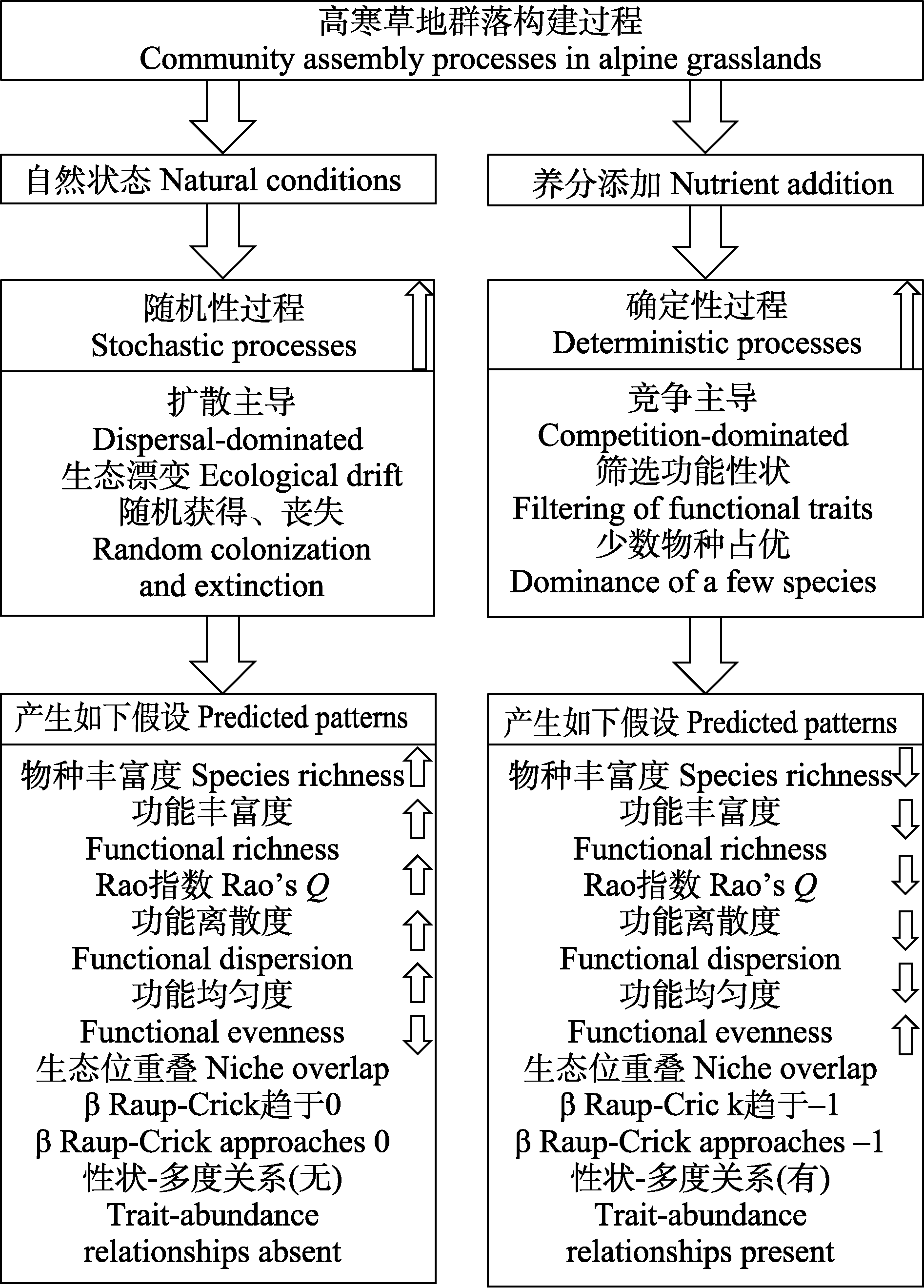
图1 养分添加影响草地群落构建过程的框架图。
Fig. 1 Conceptual framework illustrating the effects of nutrient addition on grassland community assembly processes.
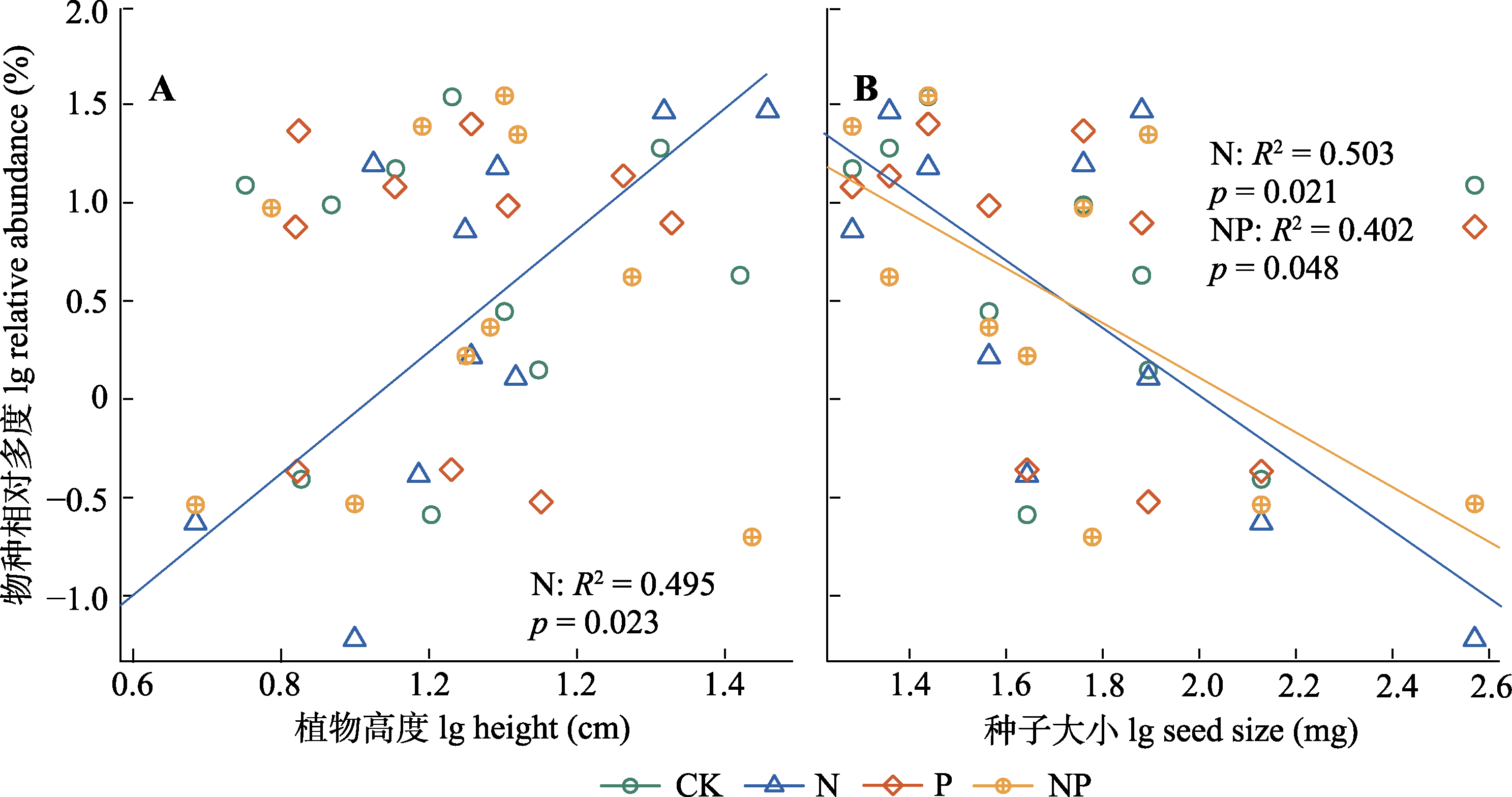
图2 物种相对多度和功能性状之间的线性回归关系。CK, 对照; N, 氮添加; NP, 氮磷混合添加; P, 磷添加。R2和p值通过标准主轴(SMA)回归估算。显著关系标注在右上角。
Fig. 2 Linear regression relationships between species relative abundance and functional traits. CK, control; N, nitrogen addition; NP, combined nitrogen and phosphorus addition; P, phosphorus addition. R2 and p values were estimated using standardized major axis (SMA) regression. Significant relationships are indicated in the top-right corner.
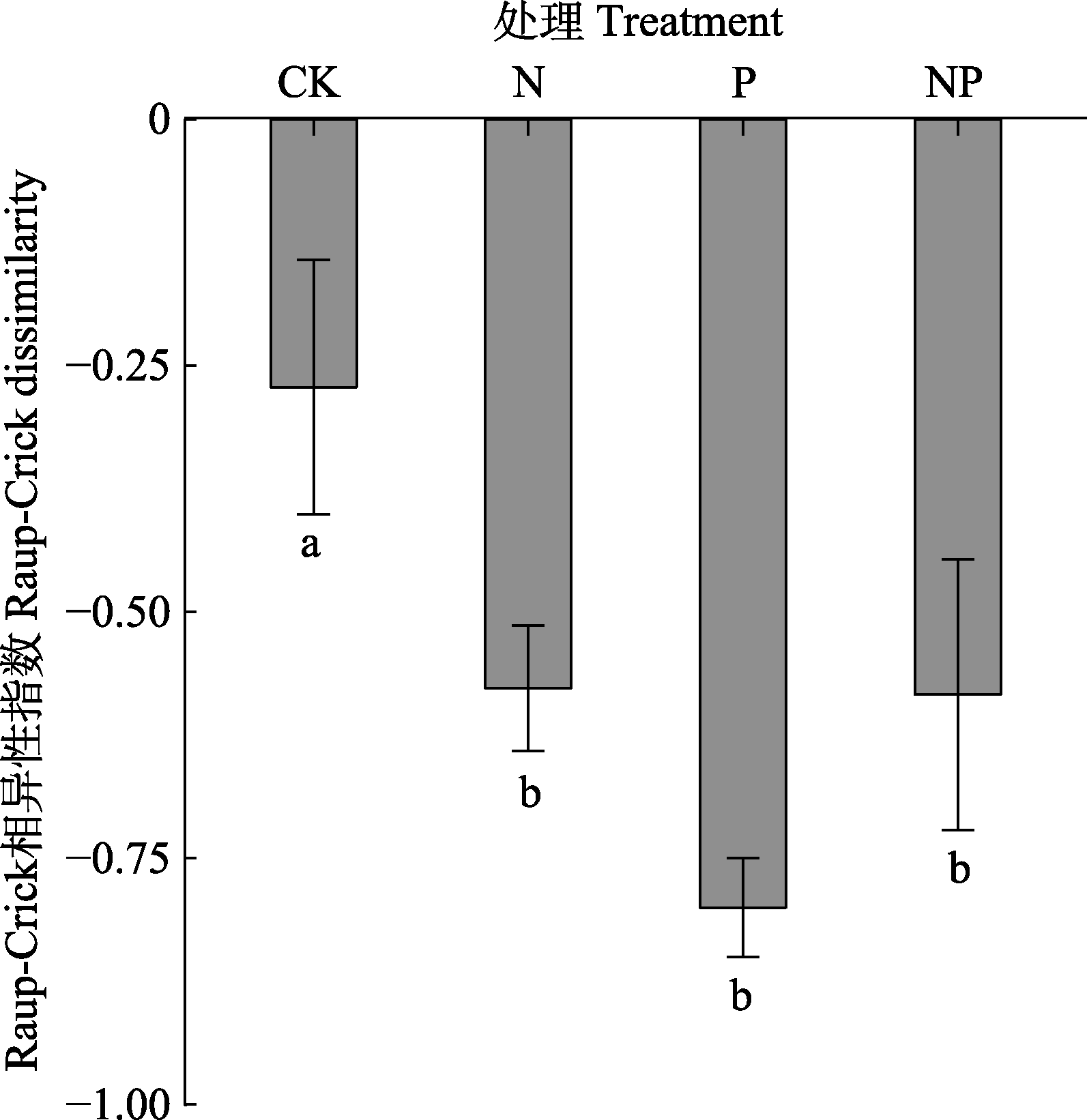
图3 养分添加对天山高寒草地群落Raup-Crick相异性指数的影响(平均值±标准误)。CK, 对照; N, 氮添加; NP, 氮磷混合添加; P, 磷添加。不同小写字母代表处理间差异显著(p < 0.05)。
Fig. 3 Effects of nutrient addition on the Raup-Crick dissimilarity index of alpine grassland communities in Tianshan Mountains (mean ± SE). CK, control; N, nitrogen addition; NP, combined nitrogen and phosphorus addition; P, phosphorus addition. Different lowercase letters indicate significant differences (p < 0.05).
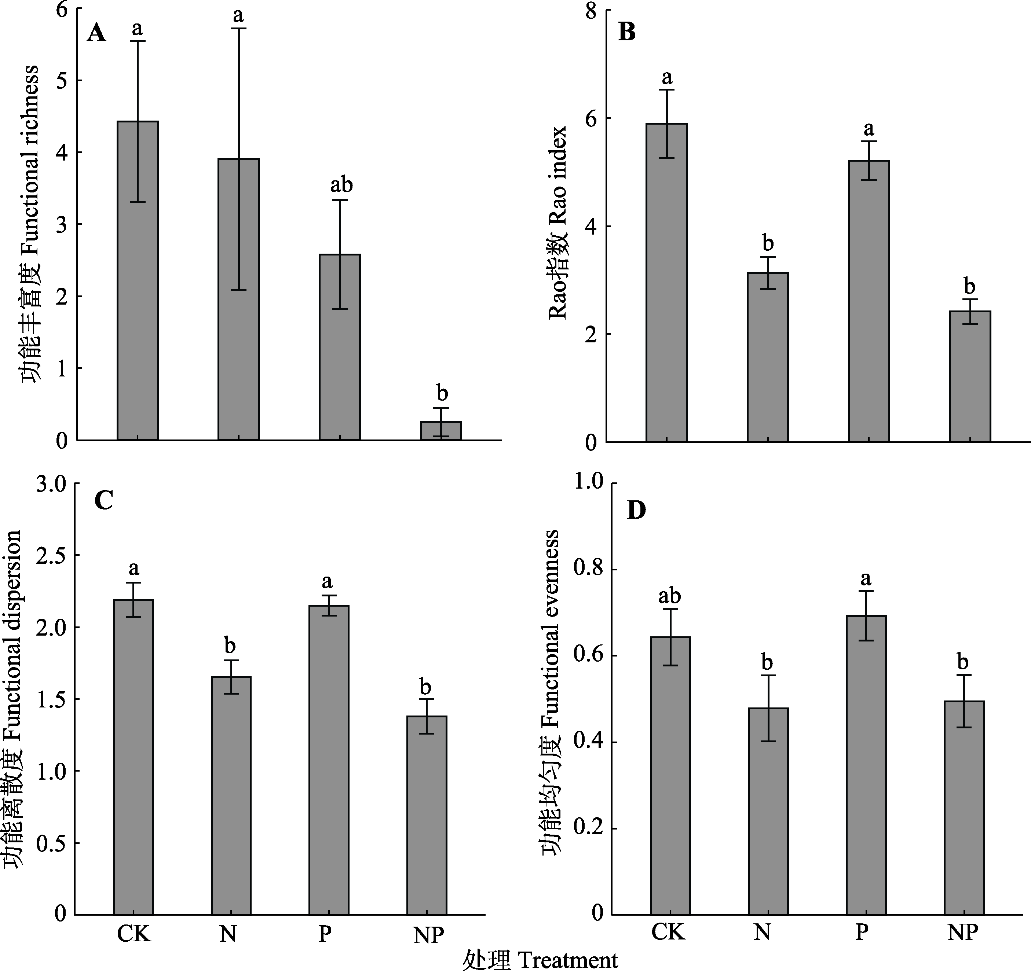
图4 养分添加对天山高寒草地群落功能多样性的影响(平均值±标准误)。CK, 对照; N, 氮添加; NP, 氮磷混合添加; P, 磷添加。不同小写字母代表处理间差异显著(p < 0.05)。
Fig. 4 Effects of nutrient addition on functional diversity of alpine grassland communities in Tianshan Mountains (mean ± SE). CK, control; N, nitrogen addition; NP, combined nitrogen and phosphorus addition; P, phosphorus addition. Different lowercase letters indicate significant differences (p < 0.05).
| 处理 Treatment | 观测指数 Observed index | 模拟指数 Mean of stimulated index | 95%置信区间 95% CI | p |
|---|---|---|---|---|
| CK | 0.944 | 0.288 | 0.234-0.388 | <0.001 |
| N | 0.963 | 0.302 | 0.248-0.401 | <0.001 |
| P | 0.966 | 0.291 | 0.227-0.401 | <0.001 |
| NP | 0.960 | 0.303 | 0.239-0.423 | <0.001 |
表1 不同养分添加处理中观测生态位重叠值和零模型模拟生态位重叠值的比较
Table 1 Comparison of observed niche overlap and null model-simulated niche overlap under different nutrient addition treatments
| 处理 Treatment | 观测指数 Observed index | 模拟指数 Mean of stimulated index | 95%置信区间 95% CI | p |
|---|---|---|---|---|
| CK | 0.944 | 0.288 | 0.234-0.388 | <0.001 |
| N | 0.963 | 0.302 | 0.248-0.401 | <0.001 |
| P | 0.966 | 0.291 | 0.227-0.401 | <0.001 |
| NP | 0.960 | 0.303 | 0.239-0.423 | <0.001 |
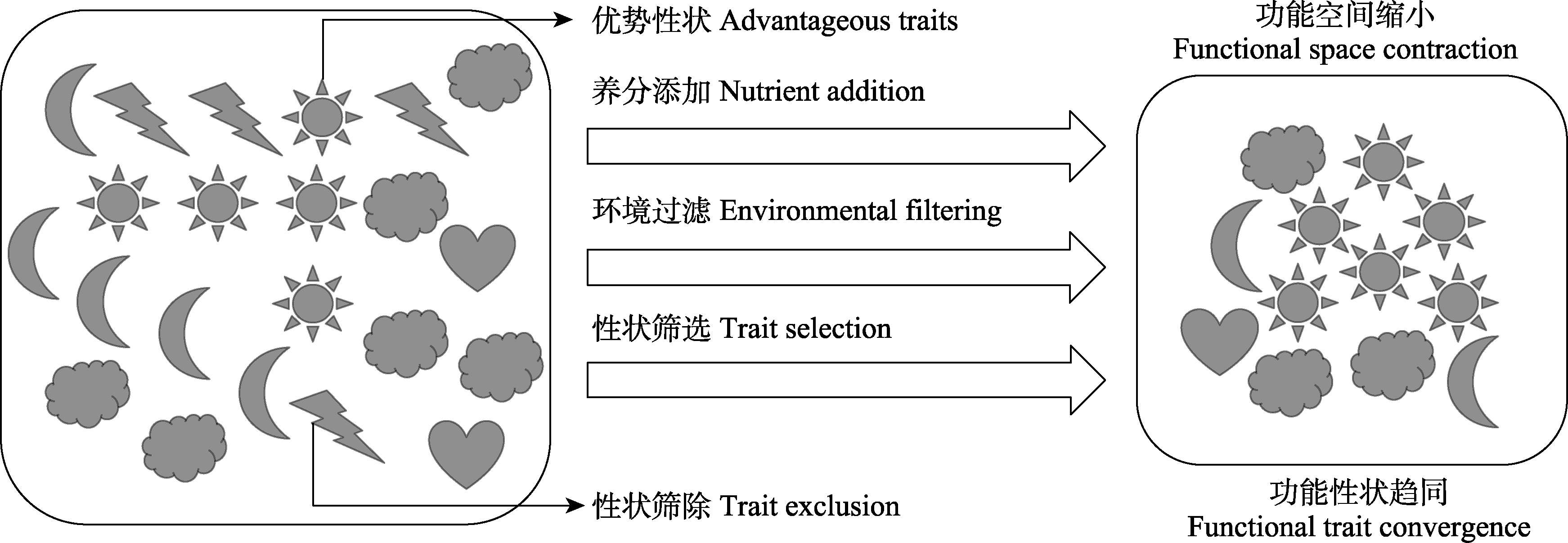
图5 模拟养分添加后群落构建过程的概念模型。边框大小代表不同群落中物种所占据的功能空间的大小; 不同的图形代表具有不同功能性状的物种。
Fig. 5 Conceptual model illustrating the processes of community assembly under nutrient addition. The borders represent the size of the functional space occupied by species in different communities, and the different shapes denote species with distinct functional traits.
| [1] |
Ackerly DD, Cornwell WK (2007). A trait-based approach to community assembly: partitioning of species trait values into within- and among-community components. Ecology Letters, 10, 135-145.
PMID |
| [2] |
Adler PB, HilleRisLambers J, Levine JM (2007). A niche for neutrality. Ecology Letters, 10, 95-104.
PMID |
| [3] |
Alberti J, Bakker ES, van Klink R, Olff H, Smit C (2017). Herbivore exclusion promotes a more stochastic plant community assembly in a natural grassland. Ecology, 98, 961-970.
DOI PMID |
| [4] |
Anderson MJ, Crist TO, Chase JM, Vellend M, Inouye BD, Freestone AL, Sanders NJ, Cornell HV, Comita LS, Davies KF, Harrison SP, Kraft NJB, Stegen JC, Swenson NG (2011). Navigating the multiple meanings of β diversity: a roadmap for the practicing ecologist: roadmap for beta diversity. Ecology Letters, 14, 19-28.
DOI PMID |
| [5] |
Bell G (2000). The distribution of abundance in neutral communities. The American Naturalist, 155, 606-617.
DOI PMID |
| [6] |
Borer ET, Seabloom EW, Gruner DS, Harpole WS, Hillebrand H, Lind EM, Adler PB, Alberti J, Anderson TM, Bakker JD, Biederman L, Blumenthal D, Brown CS, Brudvig LA, Buckley YM, et al. (2014). Herbivores and nutrients control grassland plant diversity via light limitation. Nature, 508, 517-520.
DOI |
| [7] |
Callaway RM, Brooker RW, Choler P, Kikvidze Z, Lortie CJ, Michalet R, Paolini L, Pugnaire FI, Newingham B, Aschehoug ET, Armas C, Kikodze D, Cook BJ (2002). Positive interactions among alpine plants increase with stress. Nature, 417, 844-848.
DOI |
| [8] |
Cavieres LA, Badano EI (2009). Do facilitative interactions increase species richness at the entire community level? Journal of Ecology, 97, 1181-1191.
DOI URL |
| [9] |
Chase JM, Biro EG, Ryberg WA, Smith KG (2009). Predators temper the relative importance of stochastic processes in the assembly of prey metacommunities. Ecology Letters, 12, 1210-1218.
DOI PMID |
| [10] | Chase JM, Kraft NJB, Smith KG, Vellend M, Inouye BD (2011). Using null models to disentangle variation in community dissimilarity from variation in α-diversity. Ecosphere, 2, art24. DOI: 10.1890/ES10-00117.1. |
| [11] |
Chase JM, Myers JA (2011). Disentangling the importance of ecological niches from stochastic processes across scales. Philosophical Transactions of the Royal Society B: Biological Sciences, 366, 2351-2363.
DOI URL |
| [12] |
Chen L, Tian XM, Ren ZW, Dong LW, Xie CD, Zhou XL (2022). Effects of nutrient addition on plant diversity and above-ground biomass in alpine grasslands of Tianshan Mountains, China. Chinese Journal of Plant Ecology, 46, 280-289.
DOI |
|
[陈丽, 田新民, 任正炜, 董六文, 谢晨笛, 周小龙 (2022). 养分添加对天山高寒草地植物多样性和地上生物量的影响. 植物生态学报, 46, 280-289.]
DOI |
|
| [13] |
Chen XX, Tian YQ, Zhang Y, Cui Y, Zhao Y, Sun WJ (2020). Plant community dynamics during the growing season of typical ecosystems on the Tibetan Plateau. Geography and Sustainability, 1, 266-274.
DOI |
| [14] | Clark CM, Bell MD, Boyd JW, Compton JE, Davidson EA, Davis C, Fenn ME, Geiser L, Jones L, Blett TF (2017). Nitrogen-induced terrestrial eutrophication: cascading effects and impacts on ecosystem services. Ecosphere, 8, e01877. DOI: 10.1002/ecs2.1877. |
| [15] |
Conradi T, Temperton VM, Kollmann J (2017). Resource availability determines the importance of niche-based versus stochastic community assembly in grasslands. Oikos, 126, 1134-1141.
DOI URL |
| [16] |
DeMalach N (2018). Toward a mechanistic understanding of the effects of nitrogen and phosphorus additions on grassland diversity. Perspectives in Plant Ecology, Evolution and Systematics, 32, 65-72.
DOI URL |
| [17] | Diamond JM (1975). Assembly of species communities//Cody ML, Diamond JM. Ecology and Evolution of Communities. Belknap Press, Cambridge, USA. 342-444. |
| [18] |
Díaz S, Cabido M, Casanoves F (1998). Plant functional traits and environmental filters at a regional scale. Journal of Vegetation Science, 9, 113-122.
DOI URL |
| [19] |
Dong LW, Ren ZW, Zhang R, Xie CD, Zhou XL (2022). Functional diversity rather than species diversity can explain community biomass variation following short-term nitrogen addition in an alpine grassland. Chinese Journal of Plant Ecology, 46, 871-881.
DOI URL |
|
[董六文, 任正炜, 张蕊, 谢晨笛, 周小龙 (2022). 功能多样性比物种多样性更好解释氮添加对高寒草地生物量的影响. 植物生态学报, 46, 871-881.]
DOI |
|
| [20] |
Fisher CK, Mehta P (2014). The transition between the niche and neutral regimes in ecology. Proceedings of the National Academy of Sciences of the United States of America, 111, 13111-13116.
DOI PMID |
| [21] |
Galloway JN, Townsend AR, Erisman JW, Bekunda M, Cai ZC, Freney JR, Martinelli LA, Seitzinger SP, Sutton MA (2008). Transformation of the nitrogen cycle: recent trends, questions, and potential solutions. Science, 320, 889-892.
DOI PMID |
| [22] |
Hautier Y, Niklaus PA, Hector A (2009). Competition for light causes plant biodiversity loss after eutrophication. Science, 324, 636-638.
DOI PMID |
| [23] | Huang SQ, Liu GX, Han JG (2007). Effect of seed mass and sowing depth on seedling establishment. Pratacultural Science, 24(6), 44-49. |
| [黄双全, 刘桂霞, 韩建国 (2007). 种子大小和播种深度对种苗建植的影响. 草业科学, 24(6), 44-49.] | |
| [24] | Hubbell SP (2001). The Unified Neutral Theory of Biodiversity and Biogeography. Princeton, USA. |
| [25] |
Hubbell SP (2005). Neutral theory in community ecology and the hypothesis of functional equivalence. Functional Ecology, 19, 166-172.
DOI URL |
| [26] |
Jakobsson A, Eriksson O (2000). A comparative study of seed number, seed size, seedling size and recruitment in grassland plants. Oikos, 88, 494-502.
DOI URL |
| [27] |
Keddy PA (1992). Assembly and response rules: two goals for predictive community ecology. Journal of Vegetation Science, 3, 157-164.
DOI URL |
| [28] |
Kraft NJB, Adler PB, Godoy O, James EC, Fuller S, Levine JM (2015). Community assembly, coexistence and the environmental filtering metaphor. Functional Ecology, 29, 592-599.
DOI URL |
| [29] |
Leibold MA, McPeek MA (2006). Coexistence of the niche and neutral perspectives in community ecology. Ecology, 87, 1399-1410.
PMID |
| [30] | Li W, Cheng JM, Yu KL, Epstein HE, Du GZ (2015). Niche and neutral processes together determine diversity loss in response to fertilization in an alpine meadow community. PLoS ONE, 10, e0134560. DOI: 10.1371/journal.pone.0134560. |
| [31] |
Liston A, Wilson BL, Robinson WA, Doescher PS, Harris NR, Svejcar T (2003). The relative importance of sexual reproduction versus clonal spread in an aridland bunchgrass. Oecologia, 137, 216-225.
PMID |
| [32] |
Lloret F, Médail F, Brundu G, Hulme PE (2004). Local and regional abundance of exotic plant species on Mediterranean islands: Are species traits important? Global Ecology and Biogeography, 13, 37-45.
DOI URL |
| [33] |
Ma L, Zhang ZH, Yao BQ, Ma Z, Huang XT, Zhou BR, Xu MH, Guo J, Zhou HK (2021). Effects of drought and heat on the productivity and photosynthetic characteristics of Alpine meadow plants on the Qinghai-Tibetan Plateau. Journal of Mountain Science, 18, 2079-2093.
DOI |
| [34] |
MacArthur R, Levins R (1967). The limiting similarity, convergence, and divergence of coexisting species. The American Naturalist, 101, 377-385.
DOI URL |
| [35] |
Mason NWH, de Bello F, Doležal J, Lepš J (2011). Niche overlap reveals the effects of competition, disturbance and contrasting assembly processes in experimental grassland communities. Journal of Ecology, 99, 788-796.
DOI URL |
| [36] |
Mason NWH, Lanoiselée C, Mouillot D, Wilson JB, Argillier C (2008). Does niche overlap control relative abundance in French lacustrine fish communities? A new method incorporating functional traits. Journal of Animal Ecology, 77, 661-669.
DOI PMID |
| [37] |
Mason NWH, Mouillot D, Lee WG, Wilson JB (2005). Functional richness, functional evenness and functional divergence: the primary components of functional diversity. Oikos, 111, 112-118.
DOI URL |
| [38] |
Michaels HJ, Benner B, Hartgerink AP, Lee TD, Rice S, Willson MF, Bertin RI (1988). Seed size variation: magnitude, distribution, and ecological correlates. Evolutionary Ecology, 2, 157-166.
DOI URL |
| [39] | Moreno-García P, Montaño-Centellas F, Liu Y, Reyes-Mendez EY, Jha RR, Guralnick RP, Folk R, Waller DM, Verheyen K, Baeten L, Becker-Scarpitta A, Berki I, Bernhardt-Römermann M, Brunet J, van Calster H, et al. (2024). Long-term nitrogen deposition reduces the diversity of nitrogen-fixing plants. Science Advances, 10, eadp7953. DOI: 10.1126/sciadv.adp7953. |
| [40] |
Niu KC, Choler P, de Bello F, Mirotchnick N, Du GZ, Sun SC (2014). Fertilization decreases species diversity but increases functional diversity: a three-year experiment in a Tibetan alpine meadow. Agriculture, Ecosystems & Environment, 182, 106-112.
DOI URL |
| [41] |
Niu KC, Zhang ST, Zhao BB, Du GZ (2010). Linking grazing response of species abundance to functional traits in the Tibetan alpine meadow. Plant and Soil, 330, 215-223.
DOI URL |
| [42] |
Peguero G, Coello F, Sardans J, Asensio D, Grau O, Llusià J, Ogaya R, Urbina I, van Langenhove L, Verryckt LT, Stahl C, Bréchet L, Courtois EA, Chave J, Hérault B, et al. (2023). Nutrient-based species selection is a prevalent driver of community assembly and functional trait space in tropical forests. Journal of Ecology, 111, 1218-1230.
DOI URL |
| [43] |
Pillar VD, Duarte LDS, Sosinski EE, Joner F (2009). Discriminating trait-convergence and trait-divergence assembly patterns in ecological community gradients. Journal of Vegetation Science, 20, 334-348.
DOI URL |
| [44] |
Price J, Tamme R, Gazol A, de Bello F, Takkis K, Uria-Diez J, Kasari L, Pärtel M (2017). Within-community environmental variability drives trait variability in species-rich grasslands. Journal of Vegetation Science, 28, 303-312.
DOI URL |
| [45] |
Radny J, van der Putten WH, Tielbörger K, Meyer KM (2018). Influence of seed size on performance of non-native annual plant species in a novel community at two planting densities. Acta Oecologica, 92, 131-137.
DOI URL |
| [46] | Ricklefs RE, Travis J (1980). A morphological approach to the study of avian community organization. The Auk, 97, 321-338. |
| [47] |
Salvagiotti F, Cassman KG, Specht JE, Walters DT, Weiss A, Dobermann A (2008). Nitrogen uptake, fixation and response to fertilizer N in soybeans: a review. Field Crops Research, 108, 1-13.
DOI URL |
| [48] | Skinner DM (2007). Plant propagation protocol for Koeleria macrantha. [2025-09-21]. https://courses.washington.edu/esrm412/protocols/2015/KOMA.pdf |
| [49] |
Stubbs WJ, Wilson JB (2004). Evidence for limiting similarity in a sand dune community. Journal of Ecology, 92, 557-567.
DOI URL |
| [50] |
Tian QY, Liu NN, Bai WM, Li LH, Chen JQ, Reich PB, Yu Q, Guo DL, Smith MD, Knapp AK, Cheng WX, Lu P, Gao Y, Yang A, Wang TZ, et al. (2016). A novel soil manganese mechanism drives plant species loss with increased nitrogen deposition in a temperate steppe. Ecology, 97, 65-74.
PMID |
| [51] |
Villéger S, Mason NWH, Mouillot D (2008). New multidimensional functional diversity indices for a multifaceted framework in functional ecology. Ecology, 89, 2290-2301.
DOI PMID |
| [52] | Wang XJ, Ge WJ, Zhang MT, Fernández-Pascual E, Moles A, Saatkamp A, Rosbakh S, Bu HY, Panahi P, Ma MJ (2024). Large and non-spherical seeds are less likely to form a persistent soil seed bank. Proceedings of the Royal Society B: Biological Sciences, 291, 20232764. DOI: 10.1098/rspb.2023.2764. |
| [53] |
Weiher E, Clarke GDP, Keddy PA (1998). Community assembly rules, morphological dispersion, and the coexistence of plant species. Oikos, 81, 309-322.
DOI URL |
| [54] |
Westoby M (1998). A leaf-height-seed (LHS) plant ecology strategy scheme. Plant and Soil, 199, 213-227.
DOI |
| [55] |
Westoby M, Jurado E, Leishman M (1992). Comparative evolutionary ecology of seed size. Trends in Ecology & Evolution, 7, 368-372.
DOI URL |
| [56] | Wright SJ (2019). Plant responses to nutrient addition experiments conducted in tropical forests. Ecological Monographs, 89, e01382. DOI: 10.1002/ecm.1382. |
| [57] | Yang YT, Chen ZF, Xu BC, Ghanizadeh H, Li W, Ding CQ, Zhou RL, Wen ZM (2023). Contrasting patterns of community-weighted mean traits and functional diversity in driving grassland productivity changes under N and P addition. Frontiers in Plant Science, 14, 1145709. DOI: 10.3389/fpls.2023.1145709. |
| [58] |
Yang ZL, Guo H, Zhang JY, Du GZ (2013). Stochastic and deterministic processes together determine alpine meadow plant community composition on the Tibetan Plateau. Oecologia, 171, 495-504.
DOI PMID |
| [59] | Zhao M, Loreau M, Ochoa-Hueso R, Zhang HX, Yang JJ, Zhang YH, Liu HY, Jiang Y, Han XG (2024). Decoupled responses of above- and below-ground beta-diversity to nitrogen enrichment in a typical steppe. Ecology Letters, 27, e14339. DOI: 10.1111/ele.14339. |
| [60] |
Zhou XL, Wang YS, Zhang PF, Guo Z, Chu CJ, Du GZ (2016). The effects of fertilization on the trait-abundance relationships in a Tibetan alpine meadow community. Journal of Plant Ecology, 9, 144-152.
DOI |
| [1] | 喻越, 王刚. 扩散和选择过程共同影响木瓜榕榕果小蜂群落构建的实证研究[J]. , 2027, 51(动植物互作): 0-. |
| [2] | 卢萍, 牛亚平, 孟媛超, 周丽娜, 刘洋, 杨元合, 程晓莉, 彭云峰. 高寒草地生态功能耦合特征与植物多样性的关联[J]. 植物生态学报, 2026, 50(预发表): 0-. |
| [3] | 陈佳乐, 赵颖菲, 昌海超, 董必成, 于飞海. 基于大语言模型的植物性状自动提取框架构建与评价体系[J]. , 2026, 50(生态统计方法专题): 0-. |
| [4] | 丁明利, 魏瑶, 马健妤, 兰玉婷, 刘慧颖, 张振华. 典型高寒植物抗氧化与渗透调节系统对季节性干旱的响应及光合调控[J]. 植物生态学报, 2026, 50(5): 1187-1201. |
| [5] | 封逸凡, 朱时应, 周淑荣, 江乐乐, 陈隆, 王苗, 邓国芳, 刘兰. 热带次生林恢复过程中土壤微生物对不同菌根类型树苗存活和生长性状的影响[J]. 植物生态学报, 2026, 50(4): 846-858. |
| [6] | 饶朝康, 唐亮. 不同潮位红树植物叶际微生物群落特征及其影响因素[J]. 植物生态学报, 2026, 50(4): 987-1002. |
| [7] | 林琳琳, 肖劲祥, 黄深深, 赵杨梅, 张德旭, 程毅康, 龙文兴. 磷添加对热带云雾林幼苗及幼树功能性状的影响[J]. 植物生态学报, 2026, 50(4): 917-928. |
| [8] | 段建林, 孟晟, 陈仁利, 熊林峰, 卢春洋, 席念勋. 全球变化因子数量对菌根植物性状的影响[J]. 植物生态学报, 2026, 50(4): 907-916. |
| [9] | 张安宁, 肖亚宁, 赵霞, 张淼, 崔瀚文, 陈书燕, 安黎哲. 青藏高原灌丛化与氮添加对土壤线虫群落及功能性状的交互作用[J]. 植物生态学报, 2026, 50(4): 859-869. |
| [10] | 张静, 陈洁, 李艳朋, 盘李军, 许涵, 李意德, 何海生. 南亚热带针阔混交人工林植物生物量比较及其影响因子分析[J]. 植物生态学报, 2026, 50(2): 400-416. |
| [11] | 张永军, 李敬东, 安琦, 洪翎桂, 任正炜, 张蕊, 周小龙. 氮添加和增温对天山高寒草地群落性状的影响[J]. 植物生态学报, 2026, 50(2): 417-428. |
| [12] | 戴丽君, 向玲艺, 蹇陈, 王晓锋. 三峡回水扰动增强入库小流域河岸带典型草本植物功能性状的局域分化[J]. 植物生态学报, 2026, 50(2): 442-460. |
| [13] | 王爽, 陈雅轩, 陈艳梅, 王佳乐, 刘倩愿. 太行山典型区不同生境酸枣根系资源获取策略[J]. 植物生态学报, 2026, 50(2): 374-387. |
| [14] | 陈雅轩, 韩雨音, 陈艳梅, 刘倩愿. 华北不同林龄人工林植物功能性状与碳氮化学计量[J]. 植物生态学报, 2026, 50(2): 318-333. |
| [15] | 叶学敏, 高伟, 唐星林, 陈伏生, 孙荣喜, 罗坤水. 氮磷添加对常绿阔叶林幼树叶片植食损伤的影响及调控机制[J]. 植物生态学报, 2026, 50(2): 256-267. |
| 阅读次数 | ||||||
|
全文 |
|
|||||
|
摘要 |
|
|||||
Copyright © 2026 版权所有 《植物生态学报》编辑部
地址: 北京香山南辛村20号, 邮编: 100093
Tel.: 010-62836134, 62836138; Fax: 010-82599431; E-mail: apes@ibcas.ac.cn, cjpe@ibcas.ac.cn
备案号: 京ICP备16067583号-19

