
植物生态学报 ›› 2026, Vol. 50 ›› Issue (2): 400-416.DOI: 10.17521/cjpe.2024.0398 cstr: 32100.14.cjpe.2024.0398
张静1,2, 陈洁1,*( ), 李艳朋1, 盘李军3, 许涵1, 李意德1, 何海生3
收稿日期:2024-11-05
接受日期:2025-04-08
出版日期:2026-02-28
发布日期:2026-04-01
通讯作者:
*陈洁 (chenjiecaf@hotmail.com)基金资助:
ZHANG Jing1,2, CHEN Jie1,*(), LI Yan-Peng1, PAN Li-Jun3, XU Han1, LI Yi-De1, HE Hai-Sheng3
Received:2024-11-05
Accepted:2025-04-08
Online:2026-02-28
Published:2026-04-01
Contact:
*CHEN Jie (chenjiecaf@hotmail.com)Supported by:摘要:
热带亚热带是我国人工林分布的重要区域, 明确该区域内典型人工林林分生物量现状及其影响因子有利于揭示人工林生产力的限制性因素, 为人工林经营管理提供理论指导。该研究以广东省佛山市云勇林场内由杉木(Cunninghamia lanceolata)纯林改造形成的针阔混交林为对象, 对比了恢复初期(8-16年)不同树种配置模式之间人工林植物各器官生物量以及总生物量的差异; 解析了不同树种配置模式下, 土壤理化性质和群落水平植物功能性状的变化; 分析了树种配置模式、土壤性质及植物性状对生物量变异的相对贡献及影响路径, 探讨了南亚热带人工林生物量变化的关键驱动因子。主要结果: 研究发现植物各器官生物量以及总生物量均随树种配置模式的变化而存在显著差异。树种配置模式主要通过调节植物叶片功能性状和土壤养分含量间接影响植物生物量, 其中叶片功能性状对树叶和树枝生物量的影响较大, 而土壤养分含量的差异是导致树干、树根以及总生物量变化的主要因子。具体地, 具有较高叶片氮磷比和叶片功能多样性的树种配置模式群落生物量较高。土壤总磷含量增加对群落生物量的增长具有显著的促进作用, 而土壤总钾含量过多却会抑制生物量的增长。该文初步比较了不同树种配置模式下, 叶片功能性状和土壤理化性质对南亚热带典型针阔混交人工林植被生物量的相对影响, 并解析了各器官及总生物量的关键影响因子, 为南亚热带人工林植被恢复、经营与管理提供了理论支撑。
张静, 陈洁, 李艳朋, 盘李军, 许涵, 李意德, 何海生. 南亚热带针阔混交人工林植物生物量比较及其影响因子分析. 植物生态学报, 2026, 50(2): 400-416. DOI: 10.17521/cjpe.2024.0398
ZHANG Jing, CHEN Jie, LI Yan-Peng, PAN Li-Jun, XU Han, LI Yi-De, HE Hai-Sheng. Comparison of plant biomass in conifer and broadleaf mixed artificial forests in south subtropical area and analyses of influential factors. Chinese Journal of Plant Ecology, 2026, 50(2): 400-416. DOI: 10.17521/cjpe.2024.0398
| 模式 Mode | 树种配置 Species composition | 修复年限 Recovery year (a) | 树高 Tree height (m) | 物种数 No. of species | 个体数 No. of individuals | 胸径 Diameter at breast height (cm) | 杉木个体数占比 Proportion of No. of Chinese fir individuals (%) |
|---|---|---|---|---|---|---|---|
| M1 | 米老排、桂南木莲、樟树、阴香、长芒杜英、枫香、盆架树 Mytilaria laosensis, Manglietia conifera, Cinnamomum camphora, Cinnamomum burmanni, Elaeocarpus rugosus, Liquidambar formosana, Winchia calophylla | 13 | 6.39 ± 0.65 | 15.00 ± 4.36 | 187.00 ± 44.31 | 8.15 ± 0.23 | 37.22 ± 7.59 |
| M2 | 观光木、降香黄檀、樟树、桂南木莲、非洲楝、红锥 Michelia odora, Dalbergia odorifera, Cinnamomum camphora, Mangletia glauca, Khaya senegalensis, Castanopsis hystrix | 9 | 6.93 ± 0.32 | 16.67 ± 0.58 | 130.00 ± 2.00 | 7.31 ± 0.24 | 51.62 ± 8.80 |
| M3 | 红锥、非洲楝、黧蒴锥、阴香、杨梅、山杜英、海南红豆 Castanopsis hystrix, Khaya senegalensis, Castanopsis fissa, Cinnamomum burmanni, Myrica rubra, Elaeocarpus sylvestris, Ormosia pinnata | 14 | 6.66 ± 0.67 | 12.67 ± 4.04 | 76.00 ± 23.00 | 8.12 ± 1.09 | 33.96 ± 10.30 |
| M4 | 红锥、非洲楝、黧蒴锥、阴香、红花荷、山杜英、木荷、壳菜果 Castanopsis hystrix, Khaya senegalensis, Castanopsis fissa, Cinnamomum burmanni, Rhodoleia championii, Elaeocarpus sylvestris, Schima superba, Mytilaria laosensis | 13 | 7.95 ± 0.33 | 15.33 ± 5.69 | 101.33 ± 25.58 | 10.31 ± 0.08 | 41.79 ± 5.54 |
| M5 | 人面子、格木、阴香、降香黄檀、醉香含笑、苦梓、任豆、铁刀木 Dracontomelon duperreanum, Erythrophleum fordii, Cinnamomum burmanni, Dalbergia odorifera, Michelia macclurei, Gmelina hainanensis, Zenia insignis, Cassia siamea | 13 | 8.53 ± 0.28 | 9.00 ± 0.00 | 88.00 ± 26.06 | 10.42 ± 0.80 | 47.32 ± 7.77 |
| M6 | 枫香、乌桕、喜树、黧蒴锥、楝叶吴萸、山杜英 Liquidambar formosana, Sapium sebiferum, Camptotheca acuminata, Castanopsis fissa, Evodia glabrifolia, Elaeocarpus sylvestris | 8 | 5.73 ± 0.12 | 14.67 ± 0.58 | 126.67 ± 34.70 | 6.63 ± 0.14 | 54.30 ± 1.96 |
| M7 | 凤凰木、西南木荷、醉香含笑、木荷、海南蒲桃、大花紫薇、红花羊蹄甲 Delonix regia, Schima wallichii, Michelia macclurei, Schima superba, Syzygium hainanense, Lagerstroemia speciosa, Bauhinia blakeana | 16 | 6.88 ± 0.06 | 7.33 ± 2.52 | 136.33 ± 27.61 | 9.51 ± 0.50 | 25.83 ± 2.59 |
| M8 | 枫香、观光木、醉香含笑、壳菜果、山杜英、黧蒴锥、阴香、格木 Liquidambar formosana, Tsoongiodendron odorum, Michelia macclurei, Mytilaria laosensis, Elaeocarpus sylvestris, Castanopsis fissa, Cinnamomum burmanni, Erythrophleum fordii | 15 | 7.88 ± 0.36 | 14.33 ± 2.08 | 262.33 ± 9.29 | 8.65 ± 0.58 | 19.57 ± 7.28 |
| M9 | 毛果青冈、樟树、阴香、香椿、木荷、红锥、醉香含笑 Cyclobalanopsis patelliformis, Cinnamomum camphora, Cinnamomum burmanni, Toona sinensis, Schima superba, Castanopsis hystrix, Michelia macclurei | 9 | 5.78 ± 0.13 | 13.33 ± 1.53 | 220.67 ± 37.69 | 6.79 ± 0.35 | 65.71 ± 3.36 |
| M10 | 铁刀木、黧蒴锥、樟树、格木、降香黄檀、醉香含笑、非洲楝、红锥、任豆、桂南木莲 Cassia siamea, Castanopsis fissa, Cinnamomum camphora, Erythrophleum fordii, Dalbergia odorifera, Michelia macclurei, Khaya senegalensis, Castanopsis hystrix, Zenia insignis, Mangletia glauca | 14 | 7.81 ± 0.04 | 19.33 ± 0.67 | 150.00 ± 1.53 | 12.23 ± 1.53 | 56.06 ± 5.05 |
| M11 | 红花荷、木棉、醉香含笑、盆架树、火焰树、朱槿 Rhodoleia championii, Bombax malabaricum, Michelia macclurei, Winchia calophylla, Spathodea campanulate, Hibiscus rosa-sinensis | 15 | 10.66 ± 1.03 | 9.67 ± 2.91 | 97.33 ± 29.87 | 5.43 ± 0.15 | 69.05 ± 8.26 |
表1 云勇林场不同树种配置模式的主要阔叶树种组成情况(平均值±标准误)
Table 1 Composition of main trees in different tree species configuration mode in Yunyong forest farm (mean ± SE)
| 模式 Mode | 树种配置 Species composition | 修复年限 Recovery year (a) | 树高 Tree height (m) | 物种数 No. of species | 个体数 No. of individuals | 胸径 Diameter at breast height (cm) | 杉木个体数占比 Proportion of No. of Chinese fir individuals (%) |
|---|---|---|---|---|---|---|---|
| M1 | 米老排、桂南木莲、樟树、阴香、长芒杜英、枫香、盆架树 Mytilaria laosensis, Manglietia conifera, Cinnamomum camphora, Cinnamomum burmanni, Elaeocarpus rugosus, Liquidambar formosana, Winchia calophylla | 13 | 6.39 ± 0.65 | 15.00 ± 4.36 | 187.00 ± 44.31 | 8.15 ± 0.23 | 37.22 ± 7.59 |
| M2 | 观光木、降香黄檀、樟树、桂南木莲、非洲楝、红锥 Michelia odora, Dalbergia odorifera, Cinnamomum camphora, Mangletia glauca, Khaya senegalensis, Castanopsis hystrix | 9 | 6.93 ± 0.32 | 16.67 ± 0.58 | 130.00 ± 2.00 | 7.31 ± 0.24 | 51.62 ± 8.80 |
| M3 | 红锥、非洲楝、黧蒴锥、阴香、杨梅、山杜英、海南红豆 Castanopsis hystrix, Khaya senegalensis, Castanopsis fissa, Cinnamomum burmanni, Myrica rubra, Elaeocarpus sylvestris, Ormosia pinnata | 14 | 6.66 ± 0.67 | 12.67 ± 4.04 | 76.00 ± 23.00 | 8.12 ± 1.09 | 33.96 ± 10.30 |
| M4 | 红锥、非洲楝、黧蒴锥、阴香、红花荷、山杜英、木荷、壳菜果 Castanopsis hystrix, Khaya senegalensis, Castanopsis fissa, Cinnamomum burmanni, Rhodoleia championii, Elaeocarpus sylvestris, Schima superba, Mytilaria laosensis | 13 | 7.95 ± 0.33 | 15.33 ± 5.69 | 101.33 ± 25.58 | 10.31 ± 0.08 | 41.79 ± 5.54 |
| M5 | 人面子、格木、阴香、降香黄檀、醉香含笑、苦梓、任豆、铁刀木 Dracontomelon duperreanum, Erythrophleum fordii, Cinnamomum burmanni, Dalbergia odorifera, Michelia macclurei, Gmelina hainanensis, Zenia insignis, Cassia siamea | 13 | 8.53 ± 0.28 | 9.00 ± 0.00 | 88.00 ± 26.06 | 10.42 ± 0.80 | 47.32 ± 7.77 |
| M6 | 枫香、乌桕、喜树、黧蒴锥、楝叶吴萸、山杜英 Liquidambar formosana, Sapium sebiferum, Camptotheca acuminata, Castanopsis fissa, Evodia glabrifolia, Elaeocarpus sylvestris | 8 | 5.73 ± 0.12 | 14.67 ± 0.58 | 126.67 ± 34.70 | 6.63 ± 0.14 | 54.30 ± 1.96 |
| M7 | 凤凰木、西南木荷、醉香含笑、木荷、海南蒲桃、大花紫薇、红花羊蹄甲 Delonix regia, Schima wallichii, Michelia macclurei, Schima superba, Syzygium hainanense, Lagerstroemia speciosa, Bauhinia blakeana | 16 | 6.88 ± 0.06 | 7.33 ± 2.52 | 136.33 ± 27.61 | 9.51 ± 0.50 | 25.83 ± 2.59 |
| M8 | 枫香、观光木、醉香含笑、壳菜果、山杜英、黧蒴锥、阴香、格木 Liquidambar formosana, Tsoongiodendron odorum, Michelia macclurei, Mytilaria laosensis, Elaeocarpus sylvestris, Castanopsis fissa, Cinnamomum burmanni, Erythrophleum fordii | 15 | 7.88 ± 0.36 | 14.33 ± 2.08 | 262.33 ± 9.29 | 8.65 ± 0.58 | 19.57 ± 7.28 |
| M9 | 毛果青冈、樟树、阴香、香椿、木荷、红锥、醉香含笑 Cyclobalanopsis patelliformis, Cinnamomum camphora, Cinnamomum burmanni, Toona sinensis, Schima superba, Castanopsis hystrix, Michelia macclurei | 9 | 5.78 ± 0.13 | 13.33 ± 1.53 | 220.67 ± 37.69 | 6.79 ± 0.35 | 65.71 ± 3.36 |
| M10 | 铁刀木、黧蒴锥、樟树、格木、降香黄檀、醉香含笑、非洲楝、红锥、任豆、桂南木莲 Cassia siamea, Castanopsis fissa, Cinnamomum camphora, Erythrophleum fordii, Dalbergia odorifera, Michelia macclurei, Khaya senegalensis, Castanopsis hystrix, Zenia insignis, Mangletia glauca | 14 | 7.81 ± 0.04 | 19.33 ± 0.67 | 150.00 ± 1.53 | 12.23 ± 1.53 | 56.06 ± 5.05 |
| M11 | 红花荷、木棉、醉香含笑、盆架树、火焰树、朱槿 Rhodoleia championii, Bombax malabaricum, Michelia macclurei, Winchia calophylla, Spathodea campanulate, Hibiscus rosa-sinensis | 15 | 10.66 ± 1.03 | 9.67 ± 2.91 | 97.33 ± 29.87 | 5.43 ± 0.15 | 69.05 ± 8.26 |
| 树种 Tree species | 树干生物量 Stem biomass (kg) | 树枝生物量 Branch biomass (kg) | 树叶生物量 Leaf biomass (kg) | 树根生物量 Root biomass (kg) |
|---|---|---|---|---|
| 杉木 Cunninghamia lanceolata | W = 0.0556D2.3579 | W = 0.0198D2.1333 | W = 0.0070D1.5090 | W = 0.3366D1.1952 |
| 木荷 Schima superba | W = 0.0310D2.7140 | W = 0.2120D1.6440 | W = 0.0181D1.9945 | W = 0.0310D2.2582 |
| 黧蒴锥 Castanopsis fissa | W = 0.153D2.2007 | W = 0.0117D2.7605 | W = 0.0133D2.3320 | W = 0.0255D2.3650 |
| 山杜英 Elaeocarpus sylvestris | W = 0.0367D2.6863 | W = 0.0058D3.1688 | W = 0.0227D1.8112 | W = 0.0175D2.5561 |
| 樟树 Cinnamomum camphora | W = 0.119122D2.1521 | W = 0.015418D2.7002 | W = 0.095227D1.4724 | W = 0.157486D1.7732 |
| 阔叶树 Broadleaf forest | W = 0.1098D2.2797 | W = 0.0130D2.6923 | W = 0.0144D2.2200 | W = 0.0422D2.2333 |
表2 植物各器官生物量生长方程
Table 2 Biomass growth equation of different plant organs
| 树种 Tree species | 树干生物量 Stem biomass (kg) | 树枝生物量 Branch biomass (kg) | 树叶生物量 Leaf biomass (kg) | 树根生物量 Root biomass (kg) |
|---|---|---|---|---|
| 杉木 Cunninghamia lanceolata | W = 0.0556D2.3579 | W = 0.0198D2.1333 | W = 0.0070D1.5090 | W = 0.3366D1.1952 |
| 木荷 Schima superba | W = 0.0310D2.7140 | W = 0.2120D1.6440 | W = 0.0181D1.9945 | W = 0.0310D2.2582 |
| 黧蒴锥 Castanopsis fissa | W = 0.153D2.2007 | W = 0.0117D2.7605 | W = 0.0133D2.3320 | W = 0.0255D2.3650 |
| 山杜英 Elaeocarpus sylvestris | W = 0.0367D2.6863 | W = 0.0058D3.1688 | W = 0.0227D1.8112 | W = 0.0175D2.5561 |
| 樟树 Cinnamomum camphora | W = 0.119122D2.1521 | W = 0.015418D2.7002 | W = 0.095227D1.4724 | W = 0.157486D1.7732 |
| 阔叶树 Broadleaf forest | W = 0.1098D2.2797 | W = 0.0130D2.6923 | W = 0.0144D2.2200 | W = 0.0422D2.2333 |
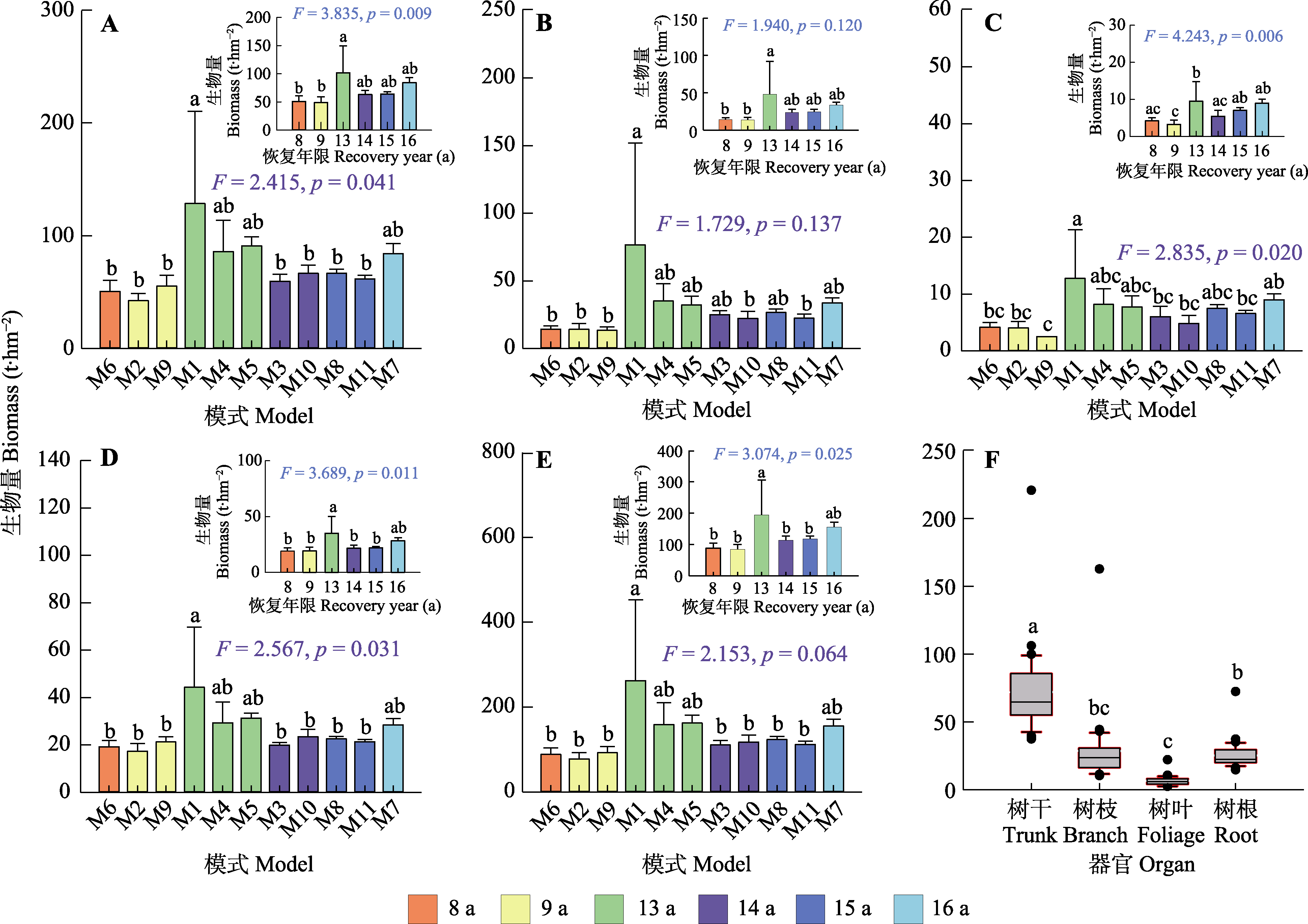
图1 植被恢复初期不同模式之间生物量的差异(平均值±标准误)。A, 树干生物量。B, 树枝生物量。C, 树叶生物量。D, 树根生物量。E, 总生物量。F, 各器官生物量比较。图中F代表单因素方差分析统计值, p代表显著性水平。不同小写字母表示差异显著(p < 0.05)。模式编号信息见表1。
Fig. 1 Differences in biomass among different modes at the initial stage of vegetation recovery (mean ± SE). A, Trunk biomass. B, Branch biomass. C, Foliage biomass. D, Root biomass. E, Total biomass. F, Comparison between the biomass of each organ. F mean the statistic of One-Way ANOVA and p indicate the significant level. Different lowercase letters mean significant differences among different models at p < 0.05. The information for the number of modes is displayed in Table 1.
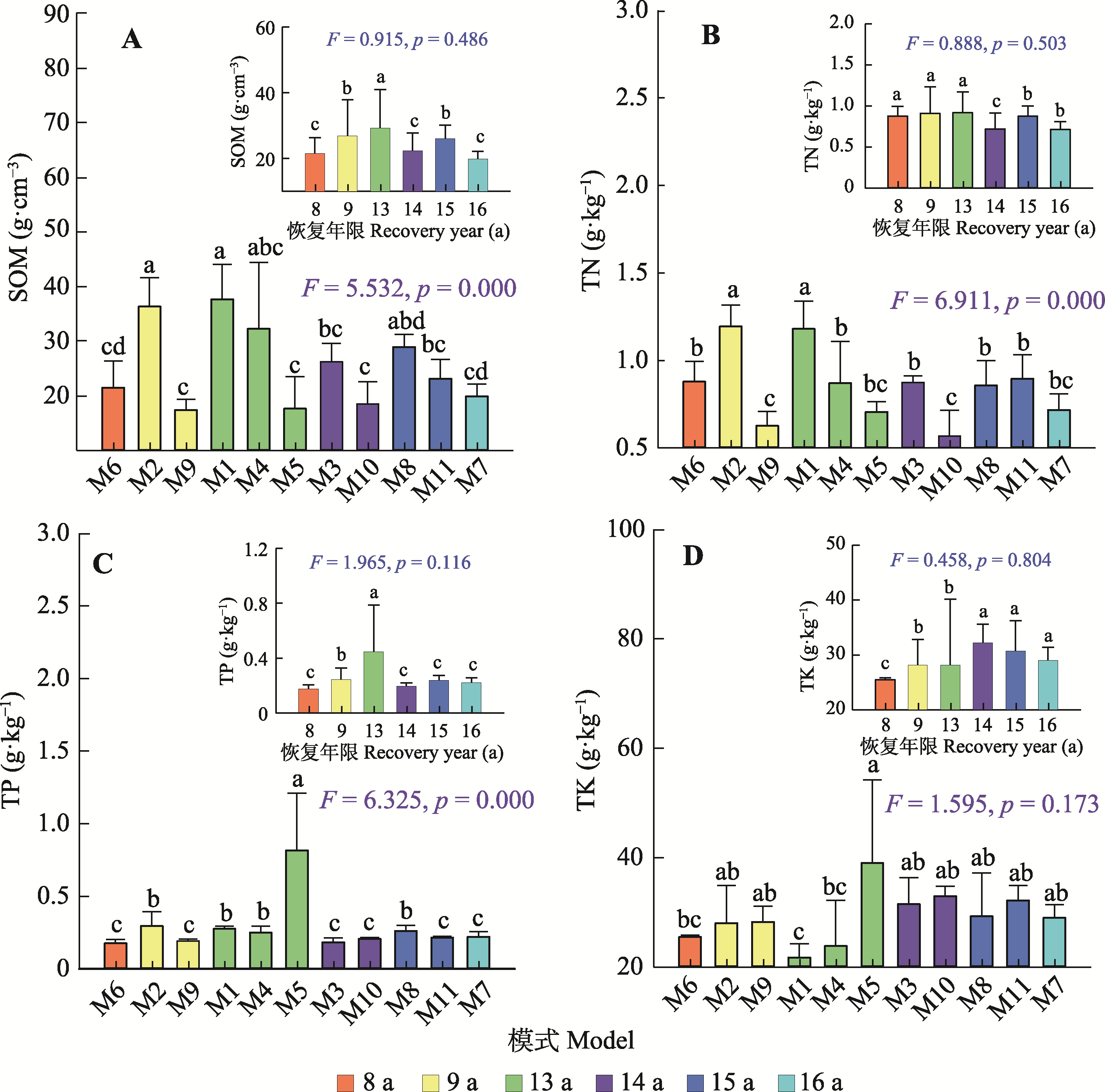
图2 植被恢复初期不同模式之间土壤养分的差异(平均值±标准误)。不同小写字母表示不同模式间差异显著(p < 0.05)。模式编号信息见表1。SOM, 土壤有机质含量; TK, 总钾含量; TN, 总氮含量; TP, 总磷含量。
Fig. 2 Differences in soil nutrients among different modes at the initial stage of vegetation recovery (mean ± SE). Different lowercase letters mean significant differences among different models at p < 0.05. See Table 1 for model ID information. SOM, soil organic matter content; TK, total potassium content; TN, total nitrogen content; TP, total phosphorus content.
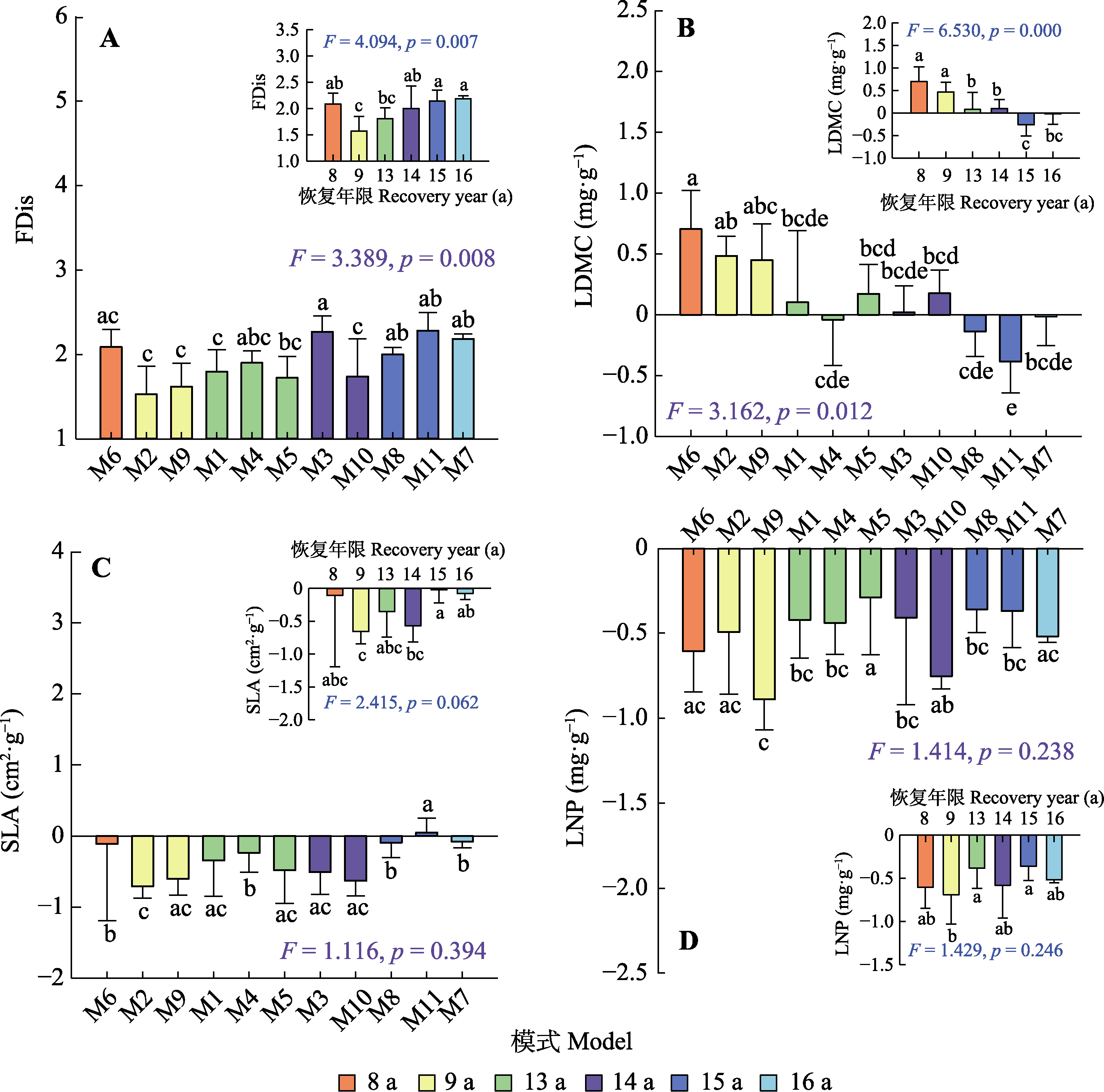
图3 植被恢复初期不同模式之间植物群落水平功能多样性与功能性状的差异(平均值±标准误)。B-D中数值均为群落水平性状均值, 计算群落水平均值的时候我们对功能性状进行了标准化。不同小写字母表示不同模式间差异显著(p < 0.05)。模式编号信息见表1。FDis, 功能离散度; LDMC, 叶干物质含量; LNP, 叶片氮磷比; SLA, 比叶面积。
Fig. 3 Differences in plant functional diversity and functional traits among different modes at the initial stage of vegetation recovery (mean ± SE). Data in B-D are mean values of community level trait. We have standardized the plant functional traits when calculating the community-weighted mean values. Different lowercase letters mean significant differences among different models at p < 0.05. See Table 1 for model ID information. FDis, functional dispersion; LDMC, leaf dry matter content; LNP, leaf N:P; SLA, specific leaf area.
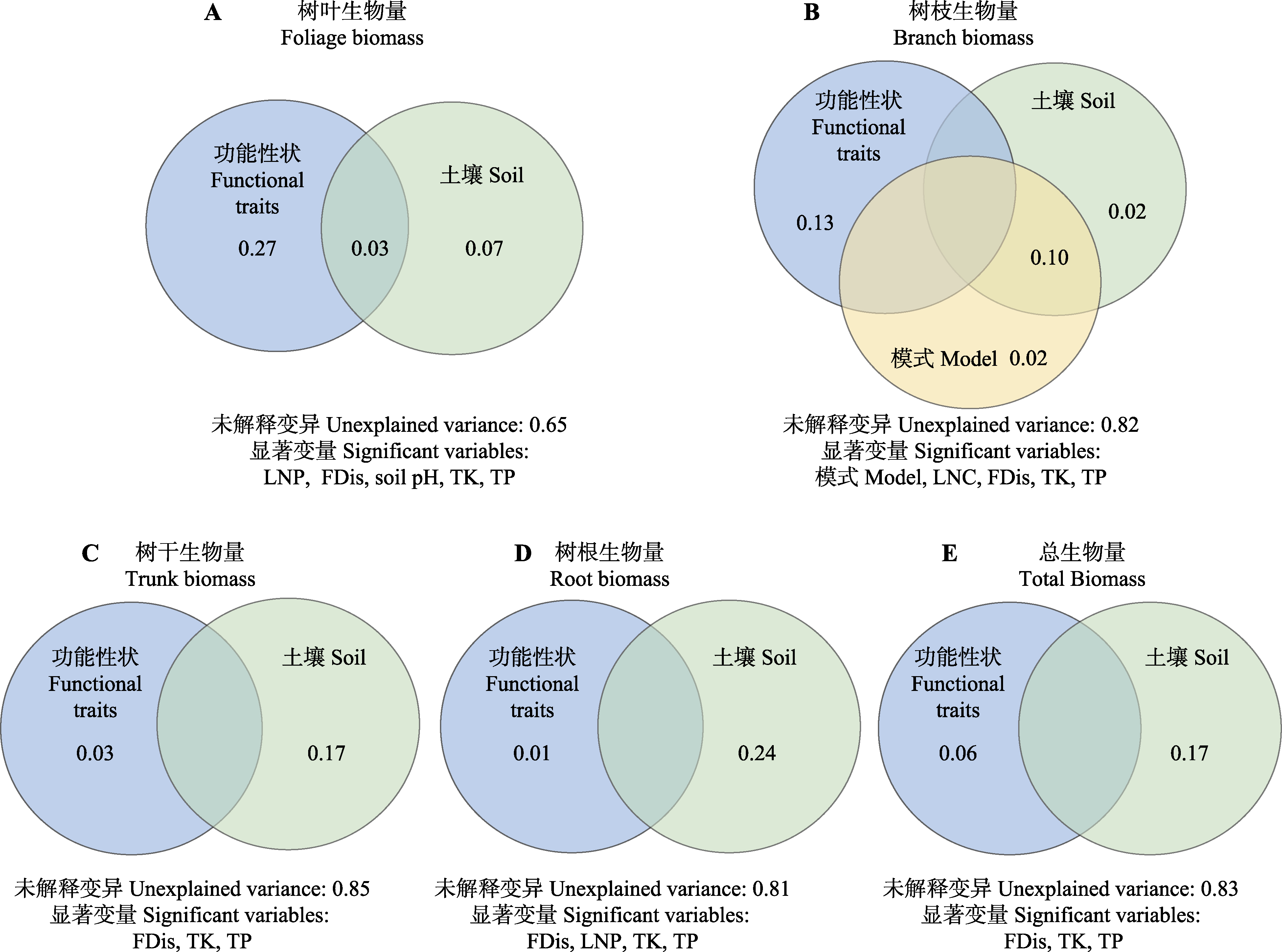
图4 各器官及总生物量变异的方差分解。FDis, 功能离散度; LNC, 叶片碳氮比; LNP, 叶片氮磷比; TK, 土壤总钾含量; TP, 土壤总磷含量。
Fig. 4 Variation partitioning of biomass of each organ and the total plant. FDis, functional dispersion; LNC, leaf C:N; LNP, leaf N:P; TK, soil total potassium content; TP, soil total phosphorus content.
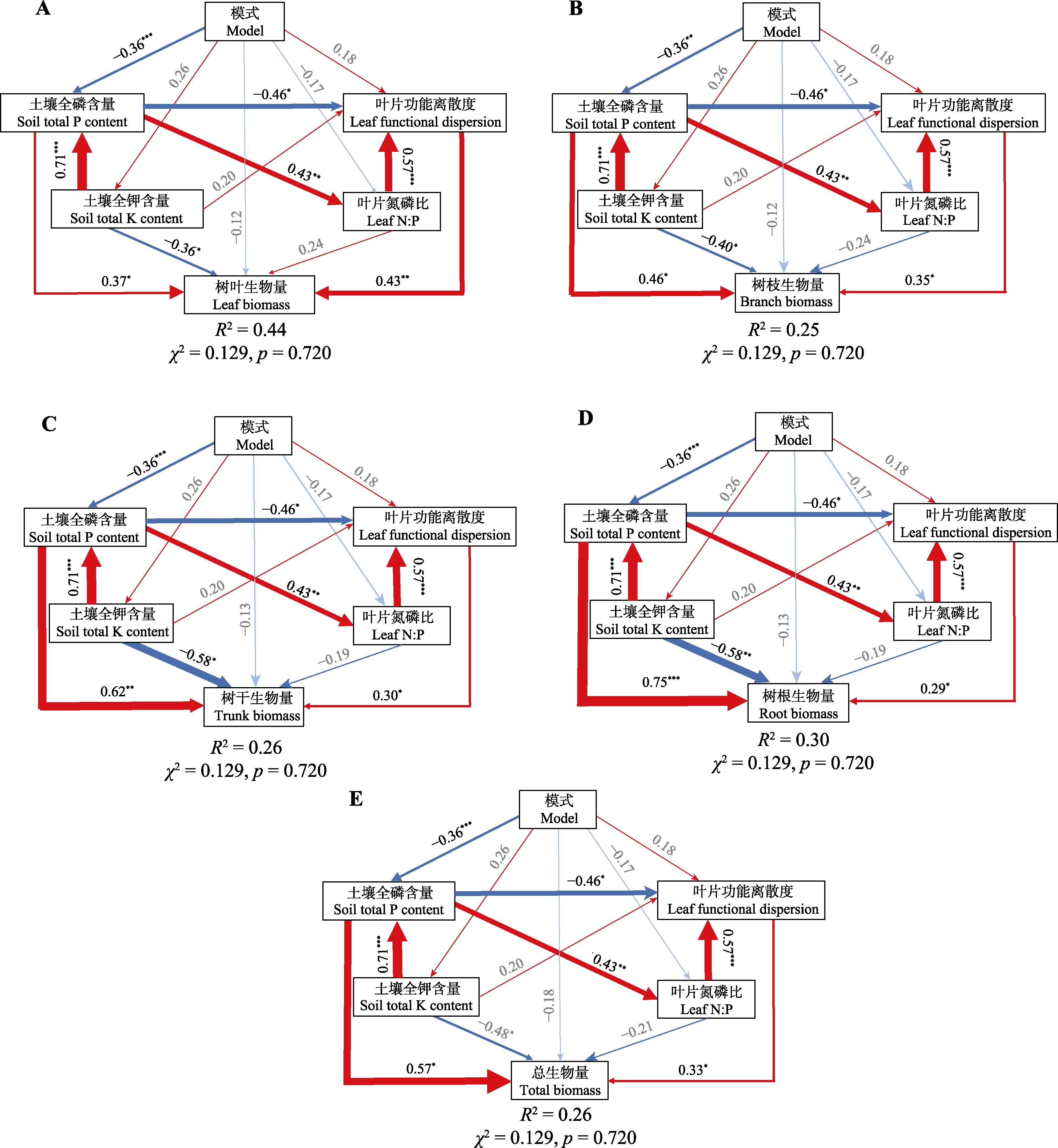
图5 路径分析结果检验树种配置模式、土壤理化性状及叶片功能性状对生物量的直接和间接影响。红色和蓝色箭头分别代表正的和负的路径, 箭头粗细与路径影响大小成正比, 路径的显著性表示为: *, p < 0.05; **, p < 0.01, ***, p < 0.001。R2为生物量变异的解释率。K, 钾; N, 氮; P, 磷。
Fig. 5 Path analyses illustrating the direct and indirect effects of tree species configuration modes, soil physicochemical properties and leaf functional traits on biomass. Red and blue arrows indicates positive and negative paths, and the width of the arrows is in proportion to the effect strength of the paths, with the significant levels marked as follows: *, p < 0.05; **, p < 0.01, ***, p < 0.001. R2 donates the explained variances of the target biomass. K, potassium; N, nitrogen; P, phosphorus.
| [1] |
Balazs KR, Munson SM, Butterfield BJ (2022). Functional composition of plant communities mediates biomass effects on ecosystem service recovery across an experimental dryland restoration network. Functional Ecology, 36, 2317-2330.
DOI URL |
| [2] | Bongers FJ, Schmid B, Bruelheide H, Bongers F, Li S, von Oheimb G, Li Y, Cheng AP, Ma KP, Liu XJ (2021). Functional diversity effects on productivity increase with age in a forest biodiversity experiment. Nature Ecology & Evolution, 5, 1594-1603. |
| [3] | Che Z, Shi J, Xu DL (2016). Aboveground biomass distribution of desert grasslands and its responses to environmental factors in middle regions of Hexi Corridors. Bulletin of Soil and Water Conservation, 36(4), 193-196. |
| [车卓, 石菁, 徐德亮 (2016). 河西走廊中段荒漠草地地上生物量分布特征及其与环境因子的关系. 水土保持通报, 36(4), 193-196.] | |
| [4] | Chen BZ, Fang JC, Piao SL, Ciais P, Black TA, Wang F, Niu SL, Zeng ZZ, Luo YQ (2024). A meta-analysis highlights globally widespread potassium limitation in terrestrial ecosystems. New Phytologist, 241, 154-165. |
| [5] | Chen XL, Ju Q, Lin KL (2014). Development status, issues and countermeasures of China’s plantation. World Forestry Research, 27(6), 54-59. |
| [陈幸良, 巨茜, 林昆仑 (2014). 中国人工林发展现状、问题与对策. 世界林业研究, 27(6), 54-59.] | |
| [6] | Cheng DL, Lin N (2009). Research on the specific leaf area of common plants in Fuzhou City. Journal of Anhui Agricultural Sciences, 37, 15131-15133. |
| [程栋梁, 林娜 (2009). 福州市常见植物比叶面积研究. 安徽农业科学, 37, 15131-15133.] | |
| [7] |
Cui EQ, Lu RL, Xu XN, Sun HF, Qiao Y, Ping JY, Qiu SY, Lin YH, Bao JH, Yong YT, Zheng ZM, Yan ER, Xia JY (2022). Soil phosphorus drives plant trait variations in a mature subtropical forest. Global Change Biology, 28, 3310-3320.
DOI PMID |
| [8] | Deng RM (2018). Relationship between the biomass characteristics and soil nutrients among different forest types in Daiyun Mountain. Forestry Construction, (6), 29-32. |
| [邓瑞明 (2018). 戴云山不同类型森林生物量差异特征及其与土壤养分的关系. 林业建设, (6), 29-32.] | |
| [9] |
Fang MQ, Yu FZ, Zhang ZQ, Shan YB (2020). Evaluation of soil fertility under typical subtropical forest vegetations in Lushan Mountain Region. Hans Journal of Soil Science, 8, 34-41.
DOI URL |
| [方明晴, 于法展, 张忠启, 单勇兵 (2020). 庐山亚热带典型森林植被类型下土壤肥力评价. 土壤科学, 8, 34-41.] | |
| [10] | Fu Y (2023). The Leaf Functional Traits of Main Plants on the West Slope of Mount Wuyi Mountain and Their Relationship with Environmental Factors. Master degree dissertation, Jiangxi Agricultural University, Nanchang. |
| [付裕 (2023). 武夷山西坡主要植物叶片功能性状及其与环境因子之间的关系. 硕士学位论文, 江西农业大学, 南昌.] | |
| [11] |
Garnier E, Laurent G, Bellmann A, Debain S, Berthelier P, Ducout B, Roumet C, Navas ML (2001). Consistency of species ranking based on functional leaf traits. New Phytologist, 152, 69-83.
DOI PMID |
| [12] |
Gillespie LM, Hättenschwiler S, Milcu A, Wambsganss J, Shihan A, Fromin N (2021). Tree species mixing affects soil microbial functioning indirectly via root and litter traits and soil parameters in European forests. Functional Ecology, 35, 2190-2204.
DOI URL |
| [13] | Guo Q, Zhao HB, Zhou GY, Long WG, Gan GL, Wu SY, Meng MY, Chen JL (2022). Biomass and its distribution pattern of four tree species plantation in south subtropical China. Forest Research, 35(1), 182-189. |
| [郭耆, 赵厚本, 周光益, 隆卫革, 甘谷列, 吴尚勇, 蒙敏燕, 陈金兰 (2022). 南亚热带4个树种人工林生物量及其分配格局. 林业科学研究, 35(1), 182-189.] | |
| [14] | Guo Y, Liu Y, Fan GQ, Chen FQ, Liu JX, Tang XL, Li X (2023). Characteristics of biomass allocation and carbon, nitrogen and phosphorus accumulation in the south subtropical Castanopsis hystrix plantation. Journal of Anhui Agricultural University, 50, 199. DOI: 10.13610/j.cnki.1672-352x.20230511.010. |
| [郭勇, 刘岳, 范国强, 陈富强, 刘菊秀, 唐旭利, 李旭 (2023). 南亚热带红锥人工林生物量分配与碳氮磷积累特征. 安徽农业大学学报, 50, 199. DOI: 10.13610/j.cnki.1672-352x.20230511.010.] | |
| [15] | Han TT, Tang X, Ren H, Wang J, Liu N, Guo QF (2021). Community/ecosystem functional diversity: measurements and development. Acta Ecologica Sinica, 41, 3286-3295. |
| [韩涛涛, 唐玄, 任海, 王俊, 刘楠, 郭勤峰 (2021). 群落/生态系统功能多样性研究方法及展望. 生态学报, 41, 3286-3295.] | |
| [16] | He B, Wei XM, Feng JQ, Yang JQ, Huang CB, Zhang RS (2023). Soil physicochemical properties in different stand ages of Taiwania flousiana in northwestern Guangxi. Journal of Northeast Forestry University, 51(6), 77-82. |
| [何斌, 韦秀媚, 冯建强, 杨家强, 黄承标, 张日施 (2023). 桂西北不同林龄秃杉人工林土壤理化性质. 东北林业大学学报, 51(6), 77-82.] | |
| [17] | He PY, Chen HH (2018). Comparison of water content and biomass of different organs of single plant in Pinus massoniana forest. Jiangsu Agricultural Sciences, 46(20), 139-142. |
| [何佩云, 谌红辉 (2018). 连栽马尾松林单株不同器官含水率及生物量的比较. 江苏农业科学, 46(20), 139-142.] | |
| [18] | Hu EC, Wang Z, Li ZH, Yang HF, Li ZF, Wang XJ, Gao RH (2024). Dynamics of understory plant diversity and biomass of Pinus sylvestris var. mongolica plantations with different ages in Mu Us Sandy Land. Chinese Journal of Ecology, 43, 3246-3254. |
| [胡尔查, 王铮, 李梓豪, 杨海峰, 李卓凡, 王晓江, 高润红 (2024). 毛乌素沙地不同林龄樟子松人工林林下植物多样性和生物量的动态变化. 生态学杂志, 43, 3246-3254.] | |
| [19] | Huang QF (2011). Structure and Biomass of Dominant Tree of Natural Secondary Broad-leaved Forest in the Low Mountain of Southern Anhui. PhD dissertation, Anhui Agricultural University, Hefei. |
| [黄庆丰 (2011). 皖南低山天然次生阔叶林林分结构与优势树种地上生物量. 博士学位论文, 安徽农业大学, 合肥.] | |
| [20] | Huang XM, You YM, Lan JC, Liu SR, Jia HY, Zhu HG, Wen YG (2016). The effect of carbon storage and its allocation in Cunninghamia lanceolata plantations with different thinning intensities. Acta Ecologica Sinica, 36, 156-163. |
| [黄雪蔓, 尤业明, 蓝嘉川, 刘世荣, 贾宏炎, 朱宏光, 温远光 (2016). 不同间伐强度对杉木人工林碳储量及其分配的影响. 生态学报, 36, 156-163.] | |
| [21] | Huang YH, Zhang WQ, Gan XH, Tang HH, Pan LJ, Xian GB (2016). Evaluation of different tree species composition patterns in stand conversion of Cunninghamia lanceolata in southern subtropical region of China. Ecology and Environmental Sciences, 25, 956-964. |
|
[黄钰辉, 张卫强, 甘先华, 唐洪辉, 盘李军, 冼杆标 (2016). 南亚热带杉木林分改造中不同树种组合模式评价. 生态环境学报, 25, 956-964.]
DOI |
|
| [22] | Jiang J, Cao NN, Yu MX, Chang ZB, Chen Y, Zhang S, Yan JH (2019). A review of the key mechanisms of acidic forest soils to buffer acid deposition. Journal of Tropical and Subtropical Botany, 27, 491-499. |
| [江军, 曹楠楠, 俞梦笑, 常中兵, 陈洋, 张硕, 闫俊华 (2019). 酸性森林土壤缓冲酸沉降关键机理研究进展. 热带亚热带植物学报, 27, 491-499.] | |
| [23] | Jiang XL, Zhang WG (2010). Functional diversity and its research method. Acta Ecologica Sinica, 30, 2766-2773. |
| [江小雷, 张卫国 (2010). 功能多样性及其研究方法. 生态学报, 30, 2766-2773.] | |
| [24] | Jiang YD, Guo WX, Qin YY, Zhao LL, Wang YJ, Guo WY (2023). Study on aboveground biomass and soil physicochemical properties of different shrub types in Western Ordos. Environment and Development, 35(3), 38-47. |
| [姜亚东, 郭威星, 秦玉英, 赵利龙, 王玉婕, 郭威艳 (2023). 西鄂尔多斯不同灌丛类型地上生物量与土壤理化性质研究. 环境与发展, 35(3), 38-47.] | |
| [25] | Kang B, Liu SR, Cai DX, Lu LH (2009). Characteristics of biomass, carbon accumulation and its spatial distribution in Cunninghamia lanceolata forest ecosystem in low subtropical area. Scientia Silvae Sinicae, 45(8), 147-153. |
| [康冰, 刘世荣, 蔡道雄, 卢立华 (2009). 南亚热带杉木生态系统生物量和碳素积累及其空间分布特征. 林业科学, 45(8), 147-153.] | |
| [26] | Kaur H (2019). Forms of potassium in soil and their relationship with soil properties—A review. International Journal of Current Microbiology and Applied Sciences, 8, 1580-1586. |
| [27] |
Laliberté E, Lambers H, Burgess TI, Wright SJ (2015). Phosphorus limitation, soil-borne pathogens and the coexistence of plant species in hyperdiverse forests and shrublands. New Phytologist, 206, 507-521.
DOI PMID |
| [28] |
Lambers H, Raven JA, Shaver GR, Smith SE (2008). Plant nutrient-acquisition strategies change with soil age. Trends in Ecology & Evolution, 23(2), 95-103.
DOI URL |
| [29] |
Lewis SL, Edwards DP, Galbraith D (2015). Increasing human dominance of tropical forests. Science, 349, 827-832.
DOI PMID |
| [30] | Li KJ, Hu ZY, Liu P, Xu ZC (2022). Evaluation on forest biomass and carbon storage in Pearl River Delta in Guangdong Province. Forest Resources Management, (4), 54-60. |
| [李康杰, 胡中岳, 刘萍, 徐正春 (2022). 广东省珠三角乔木林生物量碳储量评估. 林业资源管理, (4), 54-60.] | |
| [31] | Li XN, Qi JH, Xu ZX, Lu ZY, Fan ZX, Li ZF, Zhang SB (2024). Recovery of tree species diversity and biomass of degraded evergreen broad-leaved forest in Ailao Mountain, Yunnan Province, southwest China. Journal of Tropical and Subtropical Botany, 32, 500-510. |
| [李雪楠, 杞金华, 徐志雄, 鲁志云, 范泽鑫, 栗忠飞, 张树斌 (2024). 云南哀牢山退化常绿阔叶林乔木多样性和生物量的恢复. 热带亚热带植物学报, 32, 500-510.] | |
| [32] | Liu S, Luo Y, Huang YH, Zhou GY (2007). Studies on the community biomass and its allocations of five forest types in Dinghushan Nature Reserve. Ecological Science, 26, 387-393. |
| [刘申, 罗艳, 黄钰辉, 周国逸 (2007). 鼎湖山五种植被类型群落生物量及其径级分配特征. 生态科学, 26, 387-393.] | |
| [33] |
Liu WJ, Chen SY, Hu FZ, Sha N (2012). Distributions pattern of phosphorus, potassium and influencing factors in the upstream of Shule river basin. Acta Ecologica Sinica, 32, 5429-5437.
DOI URL |
| [刘文杰, 陈生云, 胡凤祖, 莎娜 (2012). 疏勒河上游土壤磷和钾的分布及其影响因素. 生态学报, 32, 5429-5437.] | |
| [34] | Lu WY, Ye JY, Fu J, Chen ZH, Guo F, Xiang ZF, Li Y, Zhou YL, Chen H, Li P, Li XT (2023). Study on soil physical and chemical properties of pure and mixed forest of Pinus massoniana and Castanopsis hystrix Journal of Green Science and Technology, 25(13), 119-124. |
| [陆卫勇, 叶家义, 付军, 陈振华, 郭飞, 项栽芳, 李苑, 周艳玲, 陈虎, 李鹏, 李学团 (2023). 马尾松红锥纯林及混交林土壤理化性质研究. 绿色科技, 25(13), 119-124.] | |
| [35] | Ming AG, Zhang ZJ, Chen HH, Zhang XQ, Tao Y, Su Y (2013). Effects of thinning on the biomass and carbon storage in Pinus massoniana plantation. Scientia Silvae Sinicae, 49(10), 1-6. |
| [明安刚, 张治军, 谌红辉, 张显强, 陶怡, 苏勇 (2013). 抚育间伐对马尾松人工林生物量与碳贮量的影响. 林业科学, 49(10), 1-6.] | |
| [36] | Ming AG, Zheng L, Ma J, Tao Y, Lao QX, Lu LH (2015). Biomass, carbon stock and allocation characteristics in Mesua ferrea plantation. Journal of Beijing Forestry University, 37(2), 32-39. |
| [明安刚, 郑路, 麻静, 陶怡, 劳庆祥, 卢立华 (2015). 铁力木人工林生物量与碳储量及其分配特征. 北京林业大学学报, 37(2), 32-39.] | |
| [37] | Niu YJ, Squires V, Jentsch A (2023). Risks of China’s increased forest area. Science, 379, 447-448. |
| [38] | Pan LJ, Xu H, Li YP, Ye XP, Tan S, Wu HJ, He ZL (2023). The effects of configuration modes of different trees on the restoration of species diversity and functional diversity in planted forests. Forestry and Environmental Science, 39(1), 55-64. |
| [盘李军, 许涵, 李艳朋, 叶小萍, 谭莎, 吴华俊, 何增丽 (2023). 不同树种配置模式对人工林物种和功能多样性恢复的影响. 林业与环境科学, 39(1), 55-64.] | |
| [39] |
Paterno GB, Brambach F, Guerrero-Ramírez N, Zemp DC, Cantillo AF, Camarretta N, Moura CCM, Gailing O, Ballauff J, Polle A, Schlund M, Erasmi S, Iddris NA, Khokthong W, Sundawati L, et al. (2024). Diverse and larger tree islands promote native tree diversity in oil palm landscapes. Science, 386, 795-802.
DOI PMID |
| [40] |
Poorter H, Niklas KJ, Reich PB, Oleksyn J, Poot P, Mommer L (2012). Biomass allocation to leaves, stems and roots: meta-analyses of interspecific variation and environmental control. New Phytologist, 193, 30-50.
DOI PMID |
| [41] | Puissant J, Jones B, Goodall T, Mang DN, Blaud A, Gweon HS, Malik A, Jones DL, Clark IM, Hirsch PR, Griffiths R (2019). The pH optimum of soil exoenzymes adapt to long term changes in soil pH. Soil Biology & Biochemistry, 138, 107601. DOI: 10.1016/j.soilbio.2019.107601. |
| [42] |
Schmidt MWI, Torn MS, Abiven S, Dittmar T, Guggenberger G, Janssens IA, Kleber M, Kögel-Knabner I, Lehmann J, Manning DAC, Nannipieri P, Rasse DP, Weiner S, Trumbore SE (2011). Persistence of soil organic matter as an ecosystem property. Nature, 478, 49-56.
DOI |
| [43] | Shi ZM, Tang JC, Cheng RM, Luo D, Liu SR (2015). A review of nitrogen allocation in leaves and factors in its effects. Acta Ecologica Sinica, 35, 5909-5919. |
| [史作民, 唐敬超, 程瑞梅, 罗达, 刘世荣 (2015). 植物叶片氮分配及其影响因子研究进展. 生态学报, 35, 5909-5919.] | |
| [44] | Song YT, Wang P, Zhou DW (2011). Methods of measuring plant community functional diversity. Chinese Journal of Ecology, 30, 2053-2059. |
| [宋彦涛, 王平, 周道玮 (2011). 植物群落功能多样性计算方法. 生态学杂志, 30, 2053-2059.] | |
| [45] | Su MR, Zhang WQ, Xian WG, Tang HH, Yin ZY, Chen WG, Xu XJ, Pan LJ (2014). Physical and chemical characteristics of soil of Cunninghamia lanceolata conifer-broadleaved mixed forest with different age. Guangdong Forestry Science and Technology, 30(5), 43-47. |
| [苏木荣, 张卫强, 冼伟光, 唐洪辉, 殷祚云, 陈伟光, 许雄坚, 盘李军 (2014). 南亚热带不同林龄杉木针阔混交林土壤理化性质分析. 广东林业科技, 30(5), 43-47.] | |
| [46] |
Sun J, Zhan TY, Liu M, Zhang ZC, Wang Y, Liu SL, Wu GL, Liu GH, Tsunekawa A (2021). Verification of the biomass transfer hypothesis under moderate grazing across the Tibetan Plateau: a meta-analysis. Plant and Soil, 458, 139-150.
DOI |
| [47] | Tan XP, Tang X, Guo HB, He JH, Wang WR, Wang SH, Nie YX, Zhang W, Ye Q, Shen WJ (2022). Status and strategy of sustainable management of planted forests in South China. Terrestrial Ecosystem and Conservation, 2(5), 102-108. |
| [谭向平, 汤萱, 郭惠斌, 何金红, 王玮韧, 王森浩, 聂彦霞, 张炜, 叶清, 申卫军 (2022). 华南地区人工林现状与可持续经营对策. 陆地生态系统与保护学报, 2(5), 102-108.] | |
| [48] |
Tobner CM, Paquette A, Gravel D, Reich PB, Williams LJ, Messier C (2016). Functional identity is the main driver of diversity effects in young tree communities. Ecology Letters, 19, 638-647.
DOI PMID |
| [49] |
Villéger S, Mason NWH, Mouillot D (2008). New multidimensional functional diversity indices for a multifaceted framework in functional ecology. Ecology, 89, 2290-2301.
DOI PMID |
| [50] | Wang H, Chen L, Song M, Song TQ, Zeng FP, Peng WX, Du H, Su L (2017). Spatial heterogeneity of soil phosphorus and potassium in a mixed evergreen and deciduous broad-leaved forest in karst region of southwest China. Acta Ecologica Sinica, 37, 8285-8293. |
| [王华, 陈莉, 宋敏, 宋同清, 曾馥平, 彭晚霞, 杜虎, 苏樑 (2017). 喀斯特常绿落叶阔叶混交林土壤磷钾养分空间异质性. 生态学报, 37, 8285-8293.] | |
| [51] | Wang JL, Wang ZG, Gao Y, Xu WS (2022). Effects of plant allocation patterns on soil nutrients and their stoichiometry in red soil slope. Chinese Science of Soil and Water Conservation, 20(2), 89-98. |
| [王家乐, 王志刚, 高阳, 许文盛 (2022). 植物配置模式对红壤坡地土壤养分及其化学计量特征的影响. 中国水土保持科学(中英文), 20(2), 89-98.] | |
| [52] | Wang JR, Shi WK, Wu HF, Hu BA, Cheng XQ, Han HR (2023). Characteristics of leaf functional traits of typical coniferous plantations in northern Shanxi and their relationship with soil factors. Acta Botanica Boreali-Occidentalia Sinica, 43, 835-845. |
| [王洁茹, 石文凯, 吴会峰, 胡保安, 程小琴, 韩海荣 (2023). 晋北典型针叶人工林叶功能性状特征及其与土壤因子的关系. 西北植物学报, 43, 835-845.] | |
| [53] | Xiong L, Long CL, Liang S, Wu TH, Liu Q, Liao QL, Xue F (2024). Response of leaf functional traits of woody plants to soil characteristics in karst forests. Journal of Tropical and Subtropical Botany, 32, 310-318. |
| [熊玲, 龙翠玲, 梁盛, 吴陶红, 刘奇, 廖全兰, 薛飞 (2024). 喀斯特森林木本植物叶片功能性状对土壤特性的响应. 热带亚热带植物学报, 32, 310-318.] | |
| [54] | Xu QH, Lin LP, Xue CQ, Luo Y, Lei YC (2019). Component specific carbon content and storage of Cinnamomum camphora in Guangdong Province. Journal of Zhejiang A&F University, 36(1), 70-79. |
| [徐期瑚, 林丽平, 薛春泉, 罗勇, 雷渊才 (2019). 广东樟树各器官含碳率及碳储量. 浙江农林大学学报, 36(1), 70-79.] | |
| [55] | Xue W, Rillig MC, Yu MF, Hu JN, Huang L, Yu FH (2023). Soil nutrient heterogeneity alters productivity and diversity of experimental plant communities under multiple global change factors. Oikos, 2023, e10189. DOI: 10.1111/oik.10189. |
| [56] | Yang L, Wang MT, Chen XP, Sun J, Zhong QL, Cheng DL (2020). Relationship between leaf area and leaf biomass of different canopies in subtropical evergreen forest. Acta Ecologica Sinica, 40, 7745-7754. |
| [杨力, 王满堂, 陈晓萍, 孙俊, 钟全林, 程栋梁 (2020). 亚热带常绿林不同冠层小枝叶面积-叶生物量关系研究. 生态学报, 40, 7745-7754.] | |
| [57] |
Yin QL, Tian TT, Han XH, Xu JS, Chai YF, Mo J, Lei ML, Wang L, Yue M (2019). The relationships between biomass allocation and plant functional trait. Ecological Indicators, 102, 302-308.
DOI |
| [58] | Zhang GJ, Chao L, Zhang WD, Wang SL, Yu X, Zheng WH (2018). Heterogeneity and optimal sample size of soil physicochemical properties in subtropical forest. Chinese Journal of Applied Ecology, 29, 2139-2148. |
|
[张广杰, 巢林, 张伟东, 汪思龙, 余鑫, 郑文辉 (2018). 亚热带森林土壤理化性质的异质性和最佳取样量. 应用生态学报, 29, 2139-2148.]
DOI |
|
| [59] | Zhang K, Hou JH, He NP (2017). Leaf functional trait distribution and controlling factors of Pinus tabuliformis. Acta Ecologica Sinica, 37, 736-749. |
| [张凯, 侯继华, 何念鹏 (2017). 油松叶功能性状分布特征及其控制因素. 生态学报, 37, 736-749.] | |
| [60] | Zhang Q, Li LJ, Chen YR, Lu HF, Liu BX, Zhao WH, Su RN (2024). Species diversity, biomass, and their relationship in mountainous areas of Beijing. Chinese Environmental Science, 44, 5180-5191. |
| [张蔷, 李令军, 陈韵如, 鹿海峰, 刘保献, 赵文慧, 苏日娜 (2024). 北京森林群落物种多样性、生物量及关系分析. 中国环境科学, 44, 5180-5191.] | |
| [61] | Zhang YT, Guo SF, Zhang XP, Shi QD, Zhao FS, Chang SL, Peng JB (2015). Biomass and soil physical-chemical properties of poplar plantations in Karamay. Arid Zone Research, 32, 402-409. |
| [张毓涛, 郭树芳, 张新平, 师庆东, 赵福生, 常顺利, 彭佳宾 (2015). 克拉玛依人工林生物量与土壤理化性质. 干旱区研究, 32, 402-409.] | |
| [62] | Zhao JP (2023). Biomass and productivity characteristics of natural Larix gmelinii with different structures. South China Agriculture, 17(4), 101-104. |
| [赵吉平 (2023). 不同结构落叶松天然林生物量及生产力特征. 南方农业, 17(4), 101-104.] | |
| [63] | Zhao W, Faust F, Schubert S (2020). Potassium is a potential toxicant for Arabidopsis thaliana under saline conditions. Journal of Plant Natural Nutrition and Soil Science, 183, 455-467. |
| [64] | Zhao YH (2024). The effect of different thinning intensities on the growth of Pinus koraiensis plantations. South China Agriculture, 18(4), 197-199. |
| [赵玉红 (2024). 不同抚育间伐强度对红松人工林生长的影响. 南方农业, 18(4), 197-199.] | |
| [65] | Zhe HY, Luo YY, Zhang HL, Sun FX (2011). The relationship between the root biomass of Fraxinus mandschurica Rupr., Ulums Macrocarpa Hance., Quercus mongolica Fisch. ex Turcz. and soil nutrient and pH value in Daqinggou. Journal of Arid Land Resources and Environment, 25(12), 183-189. |
| [折红燕, 罗于洋, 张海龙, 孙福星 (2011). 大青沟水曲柳、蒙古栎、大果榆苗木根系生物量与土壤养分及pH值关系的研究. 干旱区资源与环境, 25(12), 183-189.] | |
| [66] | Zhen GY (2023). Restoration technology and model of natural secondary forest in mountainous areas of eastern Liaoning Province. Forest Science and Technology, (10), 78-81. |
| [甄广韵 (2023). 辽东山区天然次生林修复技术与模式. 林业科技通讯, (10), 78-81.] | |
| [67] |
Zhu JB, Zhang ZC, Li HQ, Wu QH, He HD, Zhang FW, Li YN (2023). Characteristics and interrelationship of vegetation biomass and soil properties in alpine meadow under grazing gradients. Scientia Sinica Vitae, 53, 1166-1175.
DOI URL |
| [祝景彬, 张志成, 李红琴, 吴启华, 贺慧丹, 张法伟, 李英年 (2023). 牧压梯度下高寒草甸植被生物量与土壤理化性质变化特征及相互关系. 中国科学: 生命科学, 53, 1166-1175.] |
| [1] | 封逸凡, 朱时应, 周淑荣, 江乐乐, 陈隆, 王苗, 邓国芳, 刘兰. 热带次生林恢复中土壤微生物对菌根化树苗存活和生长性状的影响[J]. 植物生态学报, 2026, 50(预发表): 1-. |
| [2] | 饶朝康, 唐亮. 不同潮位红树植物叶际微生物群落特征及其影响因素[J]. 植物生态学报, 2026, 50(预发表): 1-. |
| [3] | 林琳琳, 肖劲祥, 黄深深, 赵杨梅, 张德旭, 程毅康, 龙文兴. 磷添加对热带云雾林幼苗及幼树功能性状的影响[J]. , 2026, 50(预发表): 0-. |
| [4] | 段建林, 孟晟, 陈仁利, 熊林峰, 卢春洋, 席念勋. 全球变化因子多样性对菌根植物性状的影响[J]. , 2026, 50(预发表): 0-. |
| [5] | 张安宁, 肖亚宁, 赵霞, 张淼, 崔瀚文, 陈书燕, 安黎哲. 青藏高原灌木化与氮添加对土壤线虫及功能性状的交互作用[J]. 植物生态学报, 2026, 50(预发表): 0-. |
| [6] | 秦斐斐, 唐朝辉, 司彤, 慈敦伟. 盐碱耐受型和敏感型花生生长发育及根际土壤特性对丛枝菌根真菌的响应[J]. 植物生态学报, 2026, 50(3): 742-759. |
| [7] | 张永军, 李敬东, 安琦, 洪翎桂, 任正炜, 张蕊, 周小龙. 氮添加和增温对天山高寒草地群落性状的影响[J]. 植物生态学报, 2026, 50(2): 417-428. |
| [8] | 戴丽君, 向玲艺, 蹇陈, 王晓锋. 三峡回水扰动增强入库小流域河岸带典型草本植物功能性状的局域分化[J]. 植物生态学报, 2026, 50(2): 442-460. |
| [9] | 王爽, 陈雅轩, 陈艳梅, 王佳乐, 刘倩愿. 太行山典型区不同生境酸枣根系资源获取策略[J]. 植物生态学报, 2026, 50(2): 374-387. |
| [10] | 陈雅轩, 韩雨音, 陈艳梅, 刘倩愿. 华北不同林龄人工林植物功能性状与碳氮化学计量[J]. 植物生态学报, 2026, 50(2): 318-333. |
| [11] | 梁天豪, 吴帆, 黄锦学, 景陈鸿, 傅贺菁, 杨智杰, 熊德成. 增温对中亚热带格氏栲天然林细根生长量及形态特征的影响[J]. 植物生态学报, 2026, 50(1): 94-106. |
| [12] | 赵琨, 王云琦, 梁军, 周小舟, 冯印成, 祁子寒, 李俊杰, 崔芯蕊, 刘烜沃, 毛维. 不同时间尺度下缙云山针阔混交林能量通量特征及影响因子分析[J]. 植物生态学报, 2026, 50(1): 70-81. |
| [13] | 郑子仪, 陈江慧, 刘慧颖. 气候变暖提高青藏高原高寒草甸优势物种的根系分泌速率[J]. 植物生态学报, 2025, 49(9): 1363-1373. |
| [14] | 陈凯, 杨艳, 徐玲, 蒋忠华. 滇西南山地球花报春种子形态与萌发沿海拔梯度的变异[J]. 植物生态学报, 2025, 49(7): 1119-1127. |
| [15] | 崔冬晴, 田晨, 宋慧敏, 鲁小名, 萨其日, 徐国庆, 杨培志, 白永飞, 田建卿. 典型草原优势植物根际细菌群落多样性和功能群组成对长期放牧的响应机制[J]. 植物生态学报, 2025, 49(7): 1163-1176. |
| 阅读次数 | ||||||
|
全文 |
|
|||||
|
摘要 |
|
|||||
Copyright © 2026 版权所有 《植物生态学报》编辑部
地址: 北京香山南辛村20号, 邮编: 100093
Tel.: 010-62836134, 62836138; Fax: 010-82599431; E-mail: apes@ibcas.ac.cn, cjpe@ibcas.ac.cn
备案号: 京ICP备16067583号-19

