
植物生态学报 ›› 2026, Vol. 50 ›› Issue (2): 388-399.DOI: 10.17521/cjpe.2025.0202 cstr: 32100.14.cjpe.2025.0202
谭聪1, 石亮2,*( ), 赵常提1, 甘沛钦1, 陈冰瑞1, 谭深1, 卜燕华3, 田地1
收稿日期:2025-06-05
接受日期:2025-11-29
出版日期:2026-02-28
发布日期:2026-04-01
通讯作者:
*石亮 (shiliang0330@igsnrr.ac.cn)基金资助:
TAN Cong1, SHI Liang2,*(), ZHAO Chang-Ti1, GAN Pei-Qin1, CHEN Bing-Rui1, TAN Shen1, BU Yan-Hua3, TIAN Di1
Received:2025-06-05
Accepted:2025-11-29
Online:2026-02-28
Published:2026-04-01
Contact:
*SHI Liang (shiliang0330@igsnrr.ac.cn)Supported by:摘要:
城市森林是缓解城市热岛效应、提升生态服务功能的重要生态屏障, 其结构与功能备受关注。植物功能性状既可表征植物生态策略, 也是揭示生态系统功能调控机制的重要指标。然而, 现有研究多集中于自然生态系统, 对于城市森林主要树种的生态策略及其生态功能效应仍缺乏深入探索。该研究以北京平原林主要树种刺槐(Robinia pseudoacacia)、杜仲(Eucommia ulmoides)、国槐(Styphnolobium japonicum)、元宝槭(Acer truncatum)、油松(Pinus tabuliformis)和银杏(Ginkgo biloba)为对象, 测定叶片形态、元素、化学防御和水力4类功能性状, 旨在揭示不同树种生态策略差异及平原林性状网络特征。结果表明, 不同树种的叶片功能性状及其生态策略差异显著: 油松比叶面积和膨压丧失点的水势最低, 体现其资源保守和抗旱优先的策略; 元宝槭比叶面积较高且总酚含量最高, 具有快速资源获取与高化学防御的特征; 刺槐氮含量最高, 总酚含量居中, 表现为快速生长和基础化学防御; 国槐磷含量最高, 总酚含量最低, 属于快速生长但化学防御低的类型; 杜仲叶干物质含量和碳含量较高, 偏向资源适度保守和结构性防御的策略; 银杏生长和化学防御相关性状表现为中等偏低, 凸显出均衡生长和化学防御较低的特征。此外, 基于6个树种构建的叶片功能性状网络整体参数(边密度0.37、直径4、平均路径长度1.90、平均聚类系数0.59、模块度0.26)显示网络结构较为简单, 仅以比叶面积为核心枢纽性状连接不同功能模块, 反映了北京平原林“速生高效”导向下的初步功能分化, 但同时也潜藏着生态系统脆弱性的特征。这些结果为理解城市森林树种的功能定位提供了新视角, 并为平原林多功能提升提供了理论依据。
谭聪, 石亮, 赵常提, 甘沛钦, 陈冰瑞, 谭深, 卜燕华, 田地. 基于叶片功能性状多维特征的北京平原林生态优化策略解析. 植物生态学报, 2026, 50(2): 388-399. DOI: 10.17521/cjpe.2025.0202
TAN Cong, SHI Liang, ZHAO Chang-Ti, GAN Pei-Qin, CHEN Bing-Rui, TAN Shen, BU Yan-Hua, TIAN Di. Analysis of ecological optimization strategies for Beijing plain forests based on multidimensional characteristics of leaf functional traits. Chinese Journal of Plant Ecology, 2026, 50(2): 388-399. DOI: 10.17521/cjpe.2025.0202
| 树种 Tree species | 密度 Density (plant·m-2) | 胸径 Diameter at breast height (cm) | 土壤总碳含量 Soil total carbon content (mg·g-1) | 土壤总氮含量 Soil total nitrogen content (mg·g-1) | 土壤总磷含量 Soil total phosphorus content (mg·g-1) |
|---|---|---|---|---|---|
| 刺槐 Robinia pseudoacacia | 0.04 | 21.49 ± 0.89 | 13.162 | 1.050 | 0.616 |
| 杜仲 Eucommia ulmoides | 0.07 | 16.63 ± 0.44 | 16.468 ± 0.761 | 1.422 ± 0.005 | 0.589 ± 0.004 |
| 国槐 Styphnolobium japonicum | 0.04 | 22.03 ± 0.74 | 10.689 | 1.233 | 0.576 |
| 元宝槭 Acer truncatum | 0.06 | 19.83 ± 0.61 | 13.491 ± 0.269 | 1.029 ± 0.009 | 0.557 ± 0.001 |
| 油松 Pinus tabuliformis | 0.05 | 16.07 ± 0.38 | 13.892 ± 0.675 | 0.729 ± 0.010 | 0.522 ± 0.000 |
| 银杏 Ginkgo biloba | 0.05 | 15.09 ± 0.51 | 16.021 ± 0.682 | 0.994 ± 0.007 | 0.573 ± 0.002 |
表1 北京平原林样地基本信息
Table 1 Basic characteristics of sample plots across Beijing plain forests
| 树种 Tree species | 密度 Density (plant·m-2) | 胸径 Diameter at breast height (cm) | 土壤总碳含量 Soil total carbon content (mg·g-1) | 土壤总氮含量 Soil total nitrogen content (mg·g-1) | 土壤总磷含量 Soil total phosphorus content (mg·g-1) |
|---|---|---|---|---|---|
| 刺槐 Robinia pseudoacacia | 0.04 | 21.49 ± 0.89 | 13.162 | 1.050 | 0.616 |
| 杜仲 Eucommia ulmoides | 0.07 | 16.63 ± 0.44 | 16.468 ± 0.761 | 1.422 ± 0.005 | 0.589 ± 0.004 |
| 国槐 Styphnolobium japonicum | 0.04 | 22.03 ± 0.74 | 10.689 | 1.233 | 0.576 |
| 元宝槭 Acer truncatum | 0.06 | 19.83 ± 0.61 | 13.491 ± 0.269 | 1.029 ± 0.009 | 0.557 ± 0.001 |
| 油松 Pinus tabuliformis | 0.05 | 16.07 ± 0.38 | 13.892 ± 0.675 | 0.729 ± 0.010 | 0.522 ± 0.000 |
| 银杏 Ginkgo biloba | 0.05 | 15.09 ± 0.51 | 16.021 ± 0.682 | 0.994 ± 0.007 | 0.573 ± 0.002 |
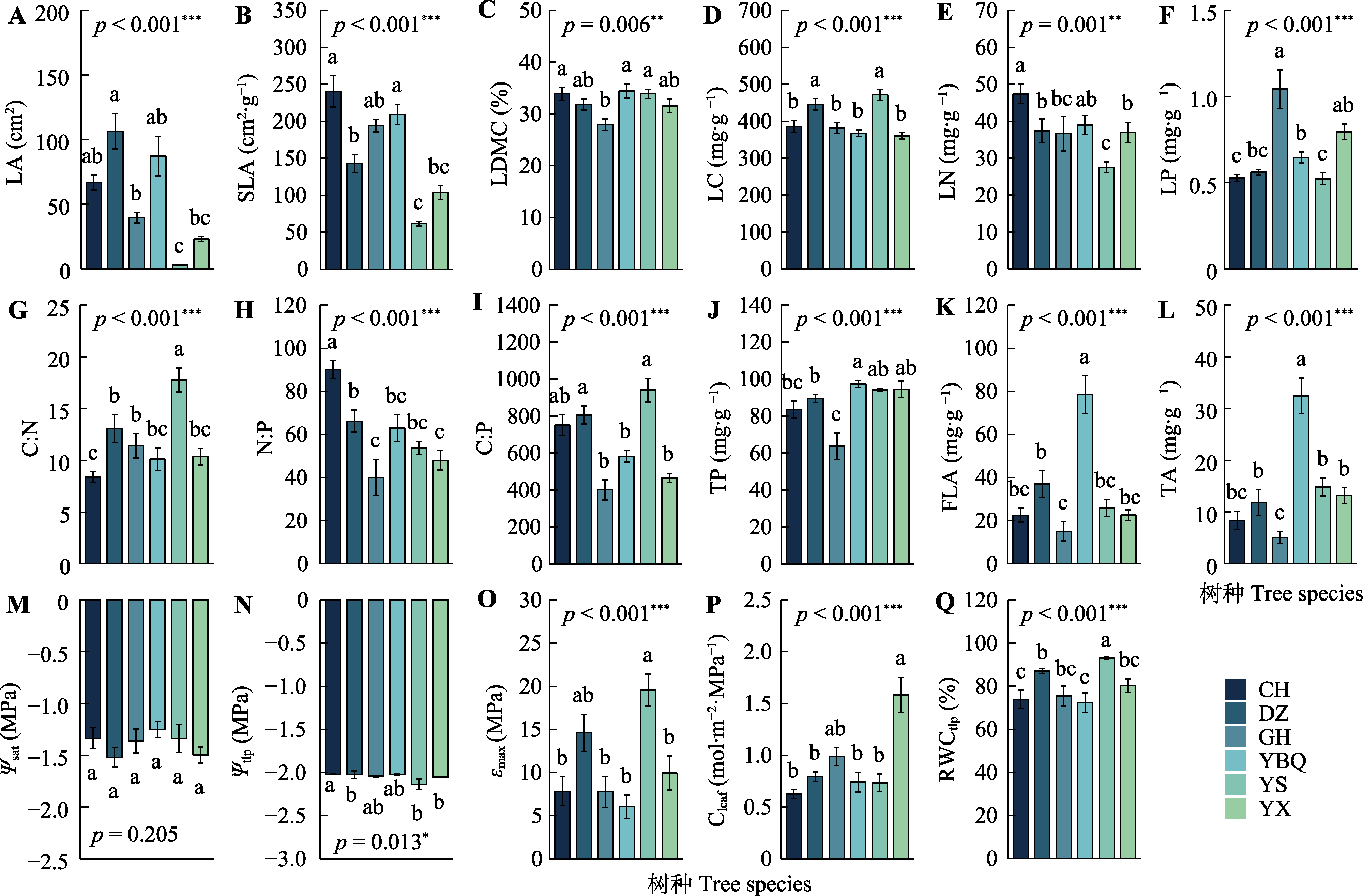
图1 不同树种叶片功能性状的差异比较。Cleaf, 叶水容; C:N, 碳氮比; C:P, 碳磷比; FLA, 黄酮含量, LA, 叶面积; LC, 叶碳含量; LDMC, 叶干物质含量; LN, 叶氮含量; LP, 叶磷含量; N:P, 氮磷比; RWCtlp, 膨压丧失点的相对含水量; SLA, 比叶面积; TA, 单宁含量; TP, 总酚含量; εmax, 最大细胞弹性模量; Ψsat, 饱和渗透势; Ψtlp, 膨压丧失点水势。CH, 刺槐; DZ, 杜仲; GH, 国槐; YBQ, 元宝槭; YS, 油松; YX, 银杏。不同小写字母代表树种间差异显著(p < 0.05)。
Fig. 1 Interspecific variation in leaf functional traits across tree species. Cleaf, leaf water capacity; C:N, carbon-to-nitrogen ratio; C:P, carbon-to-phosphorus ratio; FLA, flavonoid content; LA, leaf area; LC, leaf carbon content; LDMC, leaf dry matter content; LN, leaf nitrogen content; LP, leaf phosphorus content; N:P, nitrogen-to-phosphorus ratio; RWCtlp, relative water content at turgor loss point; SLA, specific leaf area; TA, tannin content; TP, total phenolic content; εmax, maximum bulk elastic modulus; Ψsat, saturated osmotic potential; Ψtlp, water potential at turgor loss point. CH, Robinia pseudoacacia; DZ, Eucommia ulmoides; GH, Styphnolobium japonicum; YBQ, Acer truncatum; YS, Pinus tabuliformis; YX, Ginkgo biloba. Different lowercase letters indicate statistically significant differences among species (p < 0.05, Kruskal-Wallis test with Dunn’s post hoc comparison).
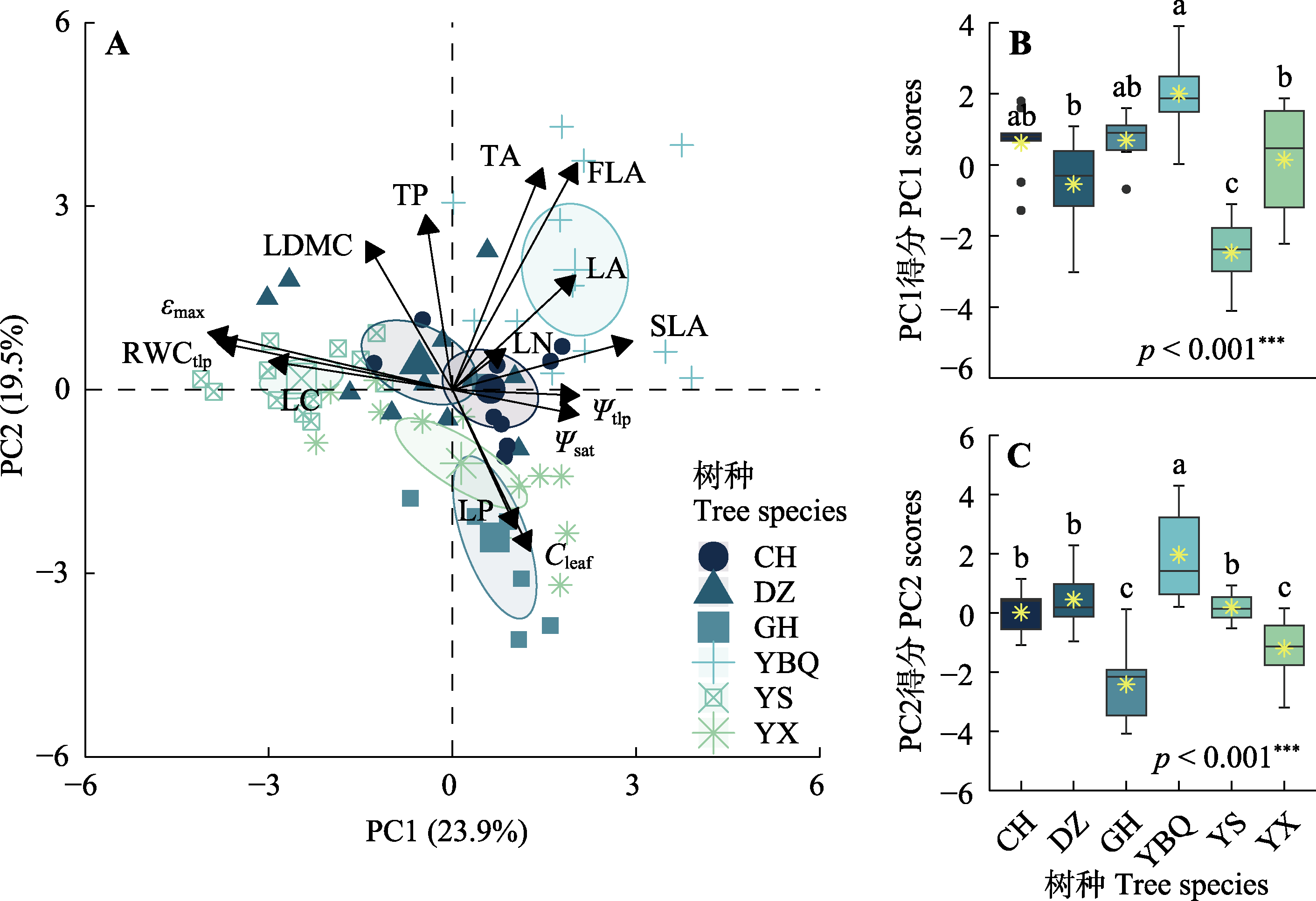
图2 6个树种14个叶片功能性状的主成分分析(PCA) (A)以及得分差异比较(B、C)。不同颜色代表不同树种。箱线图表示第一(PC1)和第二(PC2)主成分得分在不同树种间的差异, 黄色“ ”代表该组数据平均值点, 不同小写字母表示树种间差异显著(p < 0.05)。Cleaf, 叶水容; FLA, 黄酮含量, LA, 叶面积; LC, 叶碳含量; LDMC, 叶干物质含量; LN, 叶氮含量; LP, 叶磷含量; RWCtlp, 膨压丧失点的相对含水量; SLA, 比叶面积; TA, 单宁含量; TP, 总酚含量; εmax, 最大细胞弹性模量; Ψsat, 饱和渗透势; Ψtlp, 膨压丧失点水势。CH, 刺槐; DZ, 杜仲; GH, 国槐; YBQ, 元宝槭; YS, 油松; YX, 银杏。
Fig. 2 Principal component analysis (PCA) of leaf functional traits across six tree species (A) and comparisons of score differences (B, C). Different colors represent distinct tree species. Box plots display the variations in the first (PC1) and second (PC2) principal component scores among species, with different lowercase letters indicating significant differences (p < 0.05). Cleaf, leaf water capacity; FLA, flavonoid content; LA, leaf area; LC, leaf carbon content; LDMC, leaf dry matter content; LN, leaf nitrogen content; LP, leaf phosphorus content; RWCtlp, relative water content at turgor loss point; SLA, specific leaf area; TA, tannin content; TP, total phenolic content; εmax, maximum bulk elastic modulus; Ψsat, saturated osmotic potential; Ψtlp, water potential at turgor loss point. CH, Robinia pseudoacacia; DZ, Eucommia ulmoides; GH, Styphnolobium japonicum; YBQ, Acer truncatum; YS, Pinus tabuliformis; YX, Ginkgo biloba.
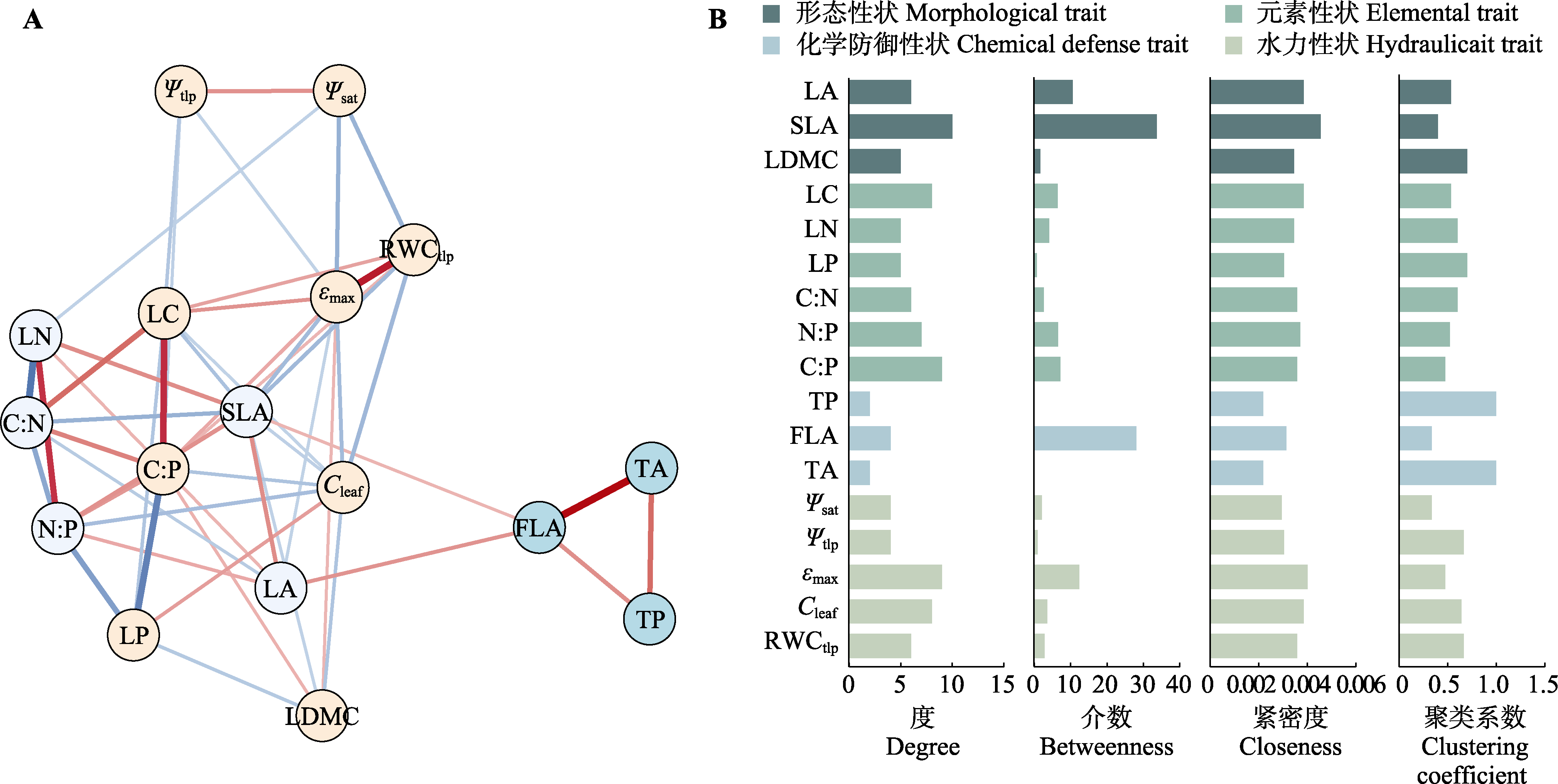
图3 叶片性状网络(A)及网络节点参数(B)。该网络为无方向无权重网络, 红色和蓝色连接线仅代表正相关和负相关关系, 线的宽度代表相关性强度, 同一颜色的节点(性状)代表属于同一功能模块。Cleaf, 叶水容; C:N, 碳氮比; C:P, 碳磷比; FLA, 黄酮含量, LA, 叶面积; LC, 叶碳含量; LDMC, 叶干物质含量; LN, 叶氮含量; LP, 叶磷含量; N:P, 氮磷比; RWCtlp, 膨压丧失点的相对含水量; SLA, 比叶面积; TA, 单宁含量; TP, 总酚含量; εmax, 最大细胞弹性模量; Ψsat, 饱和渗透势; Ψtlp, 膨压丧失点水势。
Fig. 3 Leaf trait network architecture (A) with node parameters (B). The network is undirected and unweighted. Red and blue edges represent positive and negative correlations, respectively, with edge width proportional to correlation strength. Nodes (traits) sharing identical colors belong to the same functional module. Cleaf, leaf water capacity; C:N, carbon-to-nitrogen ratio; C:P, carbon-to-phosphorus ratio; FLA, flavonoid content; LA, leaf area; LC, leaf carbon content; LDMC, leaf dry matter content; LN, leaf nitrogen content; LP, leaf phosphorus content; N:P, nitrogen-to-phosphorus ratio; RWCtlp, relative water content at turgor loss point; SLA, specific leaf area; TA, tannin content; TP, total phenolic content; εmax, maximum bulk elastic modulus; Ψsat, saturated osmotic potential; Ψtlp, water potential at turgor loss point.
| [1] |
Bennett RN, Wallsgrove RM (1994). Secondary metabolites in plant defence mechanisms. New Phytologist, 127, 617-633.
DOI PMID |
| [2] | Chen BB, Yang H, Jiang J (2022). Leaf N and P resorption and stoichiometry characteristics of main tree species in the plain afforestation area of Beijing. Journal of Beijing Forestry University, 44(7), 8-15. |
| [陈贝贝, 杨浩, 姜俊 (2022). 北京平原地区主要造林树种叶片氮磷再吸收及生态化学计量特征. 北京林业大学学报, 44(7), 8-15.] | |
| [3] |
Chen C, Bongers FJ, Schmid B, Ma KP, Liu XJ (2025). Ecosystem consequences of functional diversity in forests and implications for restoration. New Phytologist, 247, 1081-1097.
DOI URL |
| [4] |
Coley PD, Barone JA (1996). Herbivory and plant defenses in tropical forests. Annual Review of Ecology and Systematics, 27, 305-335.
DOI URL |
| [5] |
Coley PD, Bryant JP, Chapin III FS (1985). Resource availability and plant antiherbivore defense. Science, 230, 895-899.
DOI PMID |
| [6] | Csárdi G, Nepusz T (2006). Package ‘igraph’. The igraph software package for complex network research. [2025-06-05]. InterJournal Complex Systems, 1695. https://igraph.org. . |
| [7] | Cui CC, Zha TG, Zhang XX, Chen YJ, Gao LW, Bai LR, Ma ZA, Yu Y (2022). Spatial structure characteristics of plain ecological plantation in Tongzhou District, Beijing, China. Chinese Journal of Applied Ecology, 33, 2088-2096. |
|
[崔成乘, 查同刚, 张晓霞, 陈瑜佳, 高连炜, 白凌然, 马子澳, 于洋 (2022). 北京通州平原生态林空间结构特征. 应用生态学报, 33, 2088-2096.]
DOI |
|
| [8] |
Díaz S, Kattge J, Cornelissen JHC, Wright IJ, Lavorel S, Dray S, Reu B, Kleyer M, Wirth C, Prentice IC, Garnier E, Bönisch G, Westoby M, Poorter H, Reich PB, et al. (2016). The global spectrum of plant form and function. Nature, 529, 167-171.
DOI |
| [9] | Duan MW (2023). Moth Diversity in Patch Plantation and Its Pure Forest Ecotone in Beijing Urban. Master degree dissertation, Beijing Forestry University, Beijing. |
| [段曼微 (2023). 北京城区斑块状人工林及其纯林交错带的蛾类多样性研究. 硕士学位论文, 北京林业大学, 北京.] | |
| [10] | Duan WY, Li X, Li Q, Jing RN, Zhang S, Zhang BY, Hamel C, Sheng M (2024). Arbuscular mycorrhizal fungal community association determines the production of flavonoids and chlorogenic acid in Acer truncatum Bunge. Industrial Crops and Products, 208, 117858. DOI: 10.1016/j.indcrop.2023.117858. |
| [11] | Epskamp S, Costantini G, Haslbeck J, Isvoranu A, Cramer AOJ, Waldorp LJ, Schmittmann VD, Borsboom D (2023). Package ‘qgraph’. Graph plotting methods, psychometric data visualization and graphical model estimation (version 1.9.8). [2025-06-05]. https://cran.r-project.org/web/packages/qgraph/index.html. |
| [12] |
Erb M, Kliebenstein DJ (2020). Plant secondary metabolites as defenses, regulators, and primary metabolites: the blurred functional trichotomy. Plant Physiology, 184, 39-52.
DOI PMID |
| [13] | Feng X, Ma LY, Cai BJ, Duan J, Jia LM, Jia ZK, Wang JZ (2016). Effectiveness evaluation based on the afforestine construction in Beijing Plain. Journal of Northwest Forestry University, 31(1), 136-144. |
| [冯雪, 马履一, 蔡宝军, 段劼, 贾黎明, 贾忠奎, 王金增 (2016). 北京平原百万亩造林工程建设效果评价研究. 西北林学院学报, 31(1), 136-144.] | |
| [14] |
Fremout T, Thomas E, Taedoumg H, Briers S, Gutiérrez-Miranda CE, Alcázar-Caicedo C, Lindau A, Mounmemi Kpoumie H, Vinceti B, Kettle C, Ekué M, Atkinson R, Jalonen R, Gaisberger H, Elliott S, et al. (2022). Diversity for Restoration (D4R): guiding the selection of tree species and seed sources for climate-resilient restoration of tropical forest landscapes. Journal of Applied Ecology, 59, 664-679.
DOI |
| [15] | Gross N, Le Bagousse-Pinguet Y, Liancourt P, Berdugo M, Gotelli NJ, Maestre FT (2017). Functional trait diversity maximizes ecosystem multifunctionality. Nature Ecology & Evolution, 1, 132. DOI: 10.1038/s41559-017-0132. |
| [16] | Guo J, Wu YQ, Wang B, Lu Y, Cao FL, Wang GB (2016). The effects of fertilization on the growth and physiological characteristics of Ginkgo biloba L. Forests, 7, 293. DOI: 10.3390/f7120293. |
| [17] |
He NP, Li Y, Liu CC, Xu L, Li MX, Zhang JH, He JS, Tang ZY, Han XG, Ye Q, Xiao CW, Yu Q, Liu SR, Sun W, Niu SL, et al. (2020). Plant trait networks: improved resolution of the dimensionality of adaptation. Trends in Ecology & Evolution, 35, 908-918.
DOI URL |
| [18] |
Hikosaka K (2004). Interspecific difference in the photosynthesis-nitrogen relationship: patterns, physiological causes, and ecological importance. Journal of Plant Research, 117, 481-494.
PMID |
| [19] |
Hua FY, Bruijnzeel LA, Meli P, Martin PA, Zhang J, Nakagawa S, Miao XR, Wang WY, McEvoy C, Peña-Arancibia JL, Brancalion PHS, Smith P, Edwards DP, Balmford A (2022). The biodiversity and ecosystem service contributions and trade-offs of forest restoration approaches. Science, 376, 839-844.
DOI URL |
| [20] | Hughes C, Ringelberg JJ, Bruneau A (2025). Legumes. Current Biology, 35, R323-R328. |
| [21] | Jiang J, Lu YC, Qin YS, Meng BN, Wei Q, Xiao JW (2020). Ecological stoichiometric characteristics of leaf-litter-soil for four dominant tree species in plain afforestation area, Beijing. Ecology and Environmental Sciences, 29, 702-708. |
|
[姜俊, 陆元昌, 秦永胜, 孟丙南, 魏琦, 肖佳伟 (2020). 北京平原地区不同人工林叶片-凋落物-土壤生态化学计量特征. 生态环境学报, 29, 702-708.]
DOI |
|
| [22] | Jiang Y, Chen ZQ, Lin HL, Deng RX, Liang ZH, Li YL, Liang SC (2024). Trait-based community assembly and functional strategies across three subtropical karst forests, Southwestern China. Frontiers in Plant Science, 15, 1451981. DOI: 10.3389/fpls.2024.1451981. |
| [23] | Kassambara A, Mundt F (2020). Package ‘factoextra’. Extract and visualize the results of multivariate data analyses (version 1.0.7) [2025-06-05]. https://cran.r-project.org/web/packages/factoextra/index.html. |
| [24] |
Klichowska E, Nobis M, Piszczek P, Błaszkowski J, Zubek S (2019). Soil properties rather than topography, climatic conditions, and vegetation type shape AMF-feathergrass relationship in semi-natural European grasslands. Applied Soil Ecology, 144, 22-30.
DOI |
| [25] | Lei XD (2024). Forest ecosystem service multi-functionality: definitions, indicators and simulation models for forest management. Journal of Beijing Forestry University, 46(5), 1-11. |
| [雷相东 (2024). 森林生态系统服务多功能性: 概念、指标和经营模拟模型. 北京林业大学学报, 46(5), 1-11.] | |
| [26] | Li XN, Li ZF, Xu ZX, Lu ZY, Fan ZX, Chen YJ, Zhang SB (2024). Leaf trait networks shift toward high modularity during the succession of a subtropical forest, in southwest China. Ecological Indicators, 166, 112490. DOI: 10.1016/j.ecolind.2024.112490. |
| [27] | Li Y (2020). Variation of Leaf Trait Network Among Different Vegetation Types and Its Influencing Factors. PhD dissertation, Beijing Forestry University, Beijing. |
| [李颖 (2020). 叶片性状网络在不同植被类型间的变异规律及其影响因素. 博士学位论文, 北京林业大学, 北京.] | |
| [28] | Li Y, He NP, Liu CC (2024). Plant functional trait networks: development of conceptual framework and advances in applications. Acta Ecologica Sinica, 44, 7944-7961. |
| [李颖, 何念鹏, 刘聪聪 (2024). 植物功能性状网络: 概念体系发展与应用进展. 生态学报, 44, 7944-7961.] | |
| [29] |
Li Y, Liu CC, Sack L, Xu L, Li MX, Zhang JH, He NP (2022). Leaf trait network architecture shifts with species-richness and climate across forests at continental scale. Ecology Letters, 25, 1442-1457.
DOI URL |
| [30] | Lin ZY, Fan DY, Ma SP, Miao WH, Wang XP (2022). Relative growth rate for trees at the growth stage is coordinated with leaf bulk modulus of elasticity and osmotic potential in a subtropical forest of China. Ecological Indicators, 141, 109135. DOI: 10.1016/j.ecolind.2022.109135. |
| [31] |
Liu CC, He NP, Li Y, Zhang JH, Yan P, Wang RM, Wang RL (2024). Current and future trends of plant functional traits in macro-ecology. Chinese Journal of Plant Ecology, 48, 21-40.
DOI URL |
|
[刘聪聪, 何念鹏, 李颖, 张佳慧, 闫镤, 王若梦, 王瑞丽 (2024). 宏观生态学中的植物功能性状研究: 历史与发展趋势. 植物生态学报, 48, 21-40.]
DOI |
|
| [32] |
Liu JL, Yang ZL, Dang P, Zhu HL, Gao Y, Ha VN, Zhao Z (2018). Response of soil microbial community dynamics to Robinia pseudoacacia L. afforestation in the Loess Plateau: a chronosequence approach. Plant and Soil, 423, 327-338.
DOI URL |
| [33] |
Liu SR, Yang YJ, Wang H (2018). Development strategy and management countermeasures of planted forests in China: transforming from timber-centered single objective management towards multi-purpose management for enhancing quality and benefits of ecosystem services. Acta Ecologica Sinica, 38, 1-10.
DOI URL |
| [刘世荣, 杨予静, 王晖 (2018). 中国人工林经营发展战略与对策:从追求木材产量的单一目标经营转向提升生态系统服务质量和效益的多目标经营. 生态学报, 38, 1-10.] | |
| [34] |
Liu XJ, Ma KP (2015). Plant functional traits—Concepts, applications and future directions. Scientia Sinica Vitae, 45, 325-339.
DOI URL |
| [刘晓娟, 马克平 (2015). 植物功能性状研究进展. 中国科学: 生命科学, 45, 325-339.] | |
| [35] | Liu XQ, Feng YH, Hu TY, Luo Y, Zhao XX, Wu J, Maeda EE, Ju WM, Liu LL, Guo QH, Su YJ (2024). Enhancing ecosystem productivity and stability with increasing canopy structural complexity in global forests. Science Advances, 10, eadl1947. DOI: 10.1126/sciadv.adl1947. |
| [36] |
Liu XR, Liu H, Gleason SM, Goldstein G, Zhu SD, He PC, Hou H, Li RH, Ye Q (2019). Water transport from stem to stomata: the coordination of hydraulic and gas exchange traits across 33 subtropical woody species. Tree Physiology, 39, 1665-1674.
DOI PMID |
| [37] | Ma LL, Ma J, Yan P, Tian F, Peñuelas J, Rao MP, Fu YS, Hu ZH (2025). Planted forests in China have higher drought risk than natural forests. Global Change Biology, 31, e70055. DOI: 10.1111/gcb.70055. |
| [38] |
Medeiros CD, Trueba S, Henry C, Fletcher LR, Lutz JA, Méndez Alonzo R, Kraft NJB, Sack L (2025). Simplification of woody plant trait networks among communities along a climatic aridity gradient. Journal of Ecology, 113, 896-912.
DOI URL |
| [39] | Merchant TK, Henn JJ, de Silva I, van Cleemput E, Suding KN (2023). Four reasons why functional traits are not being used in restoration practice. Restoration Ecology, 31, e13788. DOI: 10.1111/rec.13788. |
| [40] |
Onoda Y, Westoby M, Adler PB, Choong AMF, Clissold FJ, Cornelissen JHC, Díaz S, Dominy NJ, Elgart A, Enrico L, Fine PVA, Howard JJ, Jalili A, Kitajima K, Kurokawa H, et al. (2011). Global patterns of leaf mechanical properties. Ecology Letters, 14, 301-312.
DOI PMID |
| [41] |
Prentice IC, Dong N, Gleason SM, Maire V, Wright IJ (2014). Balancing the costs of carbon gain and water transport: testing a new theoretical framework for plant functional ecology. Ecology Letters, 17, 82-91.
DOI PMID |
| [42] |
Qian CJ, Zhang RR, Li J, Huang ZS, Liu X, Yu LF, Yan LB, Fu YH (2022). The characteristics of habitat, functional traits and medicinal components of Eucommia ulmoides from Guizhou. Environmental Science and Pollution Research, 29, 12629-12647.
DOI |
| [43] |
Ramachandran A, Dee L, Hayden M, Suding K (2024). Leveraging plant functional traits in the design of nature-based solutions: a research agenda. Journal of Ecology, 112, 2492-2501.
DOI URL |
| [44] |
Raven JA, Lambers H, Smith SE, Westoby M (2018). Costs of acquiring phosphorus by vascular land plants: patterns and implications for plant coexistence. New Phytologist, 217, 1420-1427.
DOI PMID |
| [45] | Sha GL, Yu H, Chen YX, Ren K, Xin PC, Guo X, Xiao J, Fu YC (2024). Understory plant diversity supports the delivery of ecosystem multifunctionality on the Loess Plateau: a comparative of plantations and natural forests. Journal of Environmental Management, 371, 123191. DOI: 10.1016/j.jenvman.2024.123191. |
| [46] | Shang WB (2024). The hope project for ecological restoration in Beijing plain. China Green Times, 2024-05-08. https://yllhj.beijing.gov.cn/ztxx/mtjj/mtbd/202405/t20240530_3699753.shtml. |
| [尚文博 (2024). 北京平原生态再添希望工程. 中国绿色时报, 2024-05-08.] | |
| [47] |
Sperry JS, Hacke UG, Pittermann J (2006). Size and function in conifer tracheids and angiosperm vessels. American Journal of Botany, 93, 1490-1500.
DOI PMID |
| [48] | Tang M (1991). A study of the nitrogenase activity associated with the root systems of seedlings of Sophora japonica and Robinia pseudoacacia Journal of Beijing Forestry University, 13(3), 15-20. |
| [唐敏 (1991). 国槐、剌槐幼苗根系固氮酶活性的研究. 北京林业大学学报, 13(3), 15-20.] | |
| [49] | Tang ZY, Xu WT, Zhou GY, Bai YF, Li JX, Tang XL, Chen DM, Liu Q, Ma WH, Xiong GM, He HL, He NP, Guo YP, Guo Q, Zhu JL, et al. (2018). Patterns of plant carbon, nitrogen, and phosphorus concentration in relation to productivity in China’s terrestrial ecosystems. Proceedings of the National Academy of Sciences of the United States of America, 115, 4033-4038. |
| [50] |
Wan CY, Yu JR, Zhu SD (2023). Differences in leaf traits and trait correlation networks between karst and non-karst forest tree species. Chinese Journal of Plant Ecology, 47, 1386-1397.
DOI URL |
|
[万春燕, 余俊瑞, 朱师丹 (2023). 喀斯特与非喀斯特森林乔木叶性状及其相关性网络的差异. 植物生态学报, 47, 1386-1397.]
DOI |
|
| [51] | Wang C, Jia BQ, Qie GF, Jin JL, Gu L, Zhang C, Sun RL (2017). Effect and development countermeasures of Beijing Plain afforestation. Journal of Chinese Urban Forestry, 15(6), 6-11. |
| [王成, 贾宝全, 郄光发, 金佳莉, 古琳, 张昶, 孙睿霖 (2017). 北京平原造林的成效与发展对策研究. 中国城市林业, 15(6), 6-11.] | |
| [52] | Wang H, Prentice IC, Wright IJ, Warton DI, Qiao SC, Xu XT, Zhou J, Kikuzawa K, Stenseth NC (2023). Leaf economics fundamentals explained by optimality principles. Science Advances, 9, eadd5667. DOI: 10.1126/sciadv.add5667. |
| [53] | Wang JY (2023). Response of the Hydraulic Architecture of a Street Tree Species (Fraxinus velutina Torr.) to the Percentage of Impervious Pavement in Beijing. Master degree dissertation, Beijing Forestry University, Beijing. |
| [王嘉仪 (2023). 北京市行道树绒毛白蜡的水力结构对城市不透水表面比例的响应. 硕士学位论文, 北京林业大学, 北京.] | |
| [54] | Wang X, Guo X, Yu Y, Cui H, Wang RQ, Guo WH (2018). Increased nitrogen supply promoted the growth of non-N-fixing woody legume species but not the growth of N-fixing Robinia pseudoacacia. Scientific Reports, 8, 17896. DOI: 10.1038/s41598-018-35972-6. |
| [55] |
Wang ZY, Huang ZQ (2024). Effects of leaf traits on herbivory across 27 woody plants in the subtropical forest: testing the growth-defense trade-off hypothesis. Chinese Journal of Plant Ecology, 48, 1501-1509.
DOI URL |
|
[王振宇, 黄志群 (2024). 亚热带27种木本植物叶片性状对植食作用的影响: 验证生长-防御权衡假说. 植物生态学报, 48, 1501-1509.]
DOI |
|
| [56] |
Wright IJ, Reich PB, Westoby M, Ackerly DD, Baruch Z, Bongers F, Cavender-Bares J, Chapin T, Cornelissen JHC, Diemer M, Flexas J, Garnier E, Groom PK, Gulias J, Hikosaka K, et al. (2004). The worldwide leaf economics spectrum. Nature, 428, 821-827.
DOI |
| [57] | Wu DM, Feng JY, Lai ML, Ouyang JH, Liao DD, Yu WW, Wang GB, Cao FL, Jacobs DF, Zeng SC (2020). Combined application of bud and leaf growth fertilizer improves leaf flavonoids yield of Ginkgo biloba. Industrial Crops and Products, 150, 112379. DOI: 10.1016/j.indcrop.2020.112379. |
| [58] | Xie CP, Chen SF, Liu DW, Jim CY (2024). Unveiling the complex networks of urban tree diversity research: a global perspective. Ecology and Evolution, 14, e11630. DOI: 10.1002/ece3.11630. |
| [59] | Yao JP (2024). Study on the Occurrence Regularity and Chemical Control of Major Leaf-eating Pests of Virescence Tree Styphnolobium japonicum. Master degree dissertation, Tarim University, Aral, Xinjiang. |
| [姚江萍 (2024). 绿化树国槐主要食叶害虫的发生规律与化学防治研究. 硕士学位论文, 塔里木大学, 新疆阿拉尔.] | |
| [60] | Yao N, van den Bosch CCK, Yang J, Devisscher T, Wirtz Z, Jia LM, Duan J, Ma LY (2019). Beijing’s 50 million new urban trees: strategic governance for large-scale urban afforestation. Urban Forestry & Urban Greening, 44, 126392. DOI: 10.1016/j.ufug.2019.126392. |
| [61] |
Ye ZQ, Mu YM, van Duzen S, Ryser P (2024). Root and shoot phenology, architecture, and organ properties: an integrated trait network among 44 herbaceous wetland species. New Phytologist, 244, 436-450.
DOI PMID |
| [62] | Yin AH, Jin H, Han ZM, Han SF (2006). Study on the relationship between chromosome numbers and nodulation of 18 species of leguminous trees. Scientia Silvae Sinicae, 42(1), 26-28. |
| [殷爱华, 金辉, 韩正敏, 韩素芬 (2006). 18种豆科树种染色体数目与结瘤关系的研究. 林业科学, 42(1), 26-28.] | |
| [63] |
Yin QL, Wang L, Lei ML, Dang H, Quan JX, Tian TT, Chai YF, Yue M (2018). The relationships between leaf economics and hydraulic traits of woody plants depend on water availability. Science of the Total Environment, 621, 245-252.
DOI URL |
| [64] | Zhai JT (2024). Spatial Variation and Environmental Drivers of Functional Traits in Populus euphratica. PhD dissertation, Tarim University, Aral, Xinjiang. |
| [翟军团 (2024). 胡杨功能性状的空间变异及其环境驱动力研究. 博士学位论文, 塔里木大学, 新疆阿拉尔.] | |
| [65] | Zhang J, Yang M, Bai JW, Wei BF, Shi DY, Li HP (2022). Investigation on the host species and damages of Hyphantria cunea in the Xiongan New Area. Forestry and Ecological Sciences, 37(1), 107-114. |
|
[张杰, 杨苗, 白嘉伟, 魏步飞, 史丹阳, 李会平 (2022). 雄安新区千年秀林美国白蛾危害寄主种类及危害情况调查. 林业与生态科学, 37(1), 107-114.]
DOI |
|
| [66] | Zhang L, Chen YJ, Hao GY, Ma KP, Bongers F, Sterck FJ (2020). Conifer and broadleaved trees differ in branch allometry but maintain similar functional balances. Tree Physiology, 40, 511-519. |
| [67] | Zhang X, Yu MY, Su JX, Xu JL, Zhang XT, Shang JL, Gao J (2024). Leaf nutrient traits of planted forests demonstrate a heightened sensitivity to environmental changes compared to natural forests. Frontiers in Plant Science, 15, 1372530. DOI: 10.3389/fpls.2024.1372530. |
| [68] |
Zhao CT, Xia QL, Tian D, Chen BR, Zhu RD, Liu XH, Yu G, Ji CJ (2024). Effects of long-term nitrogen addition on leaf secondary metabolites of the dominant plant species in a temperate deciduous broad-leaved forest. Chinese Journal of Plant Ecology, 48, 1576-1588.
DOI URL |
|
[赵常提, 夏青霖, 田地, 陈冰瑞, 朱瑞德, 刘宵含, 俞果, 吉成均 (2024). 长期氮添加对温带落叶阔叶林优势植物叶片次生代谢产物的影响. 植物生态学报, 48, 1576-1588.]
DOI |
|
| [69] | Zhao JJ, Yang XD, Liu XY, Ma Y, Li XY, Yang J (2024). Assessing the potential of large-scale urban forest projects as a natural climate solution. Nature-Based Solutions, 6, 100153. DOI: 10.1016/j.nbsj.2024.100153. |
| [1] | 刘新月, 王立平, 刘春和, 孙艳丽, 刘鹏, 田赟, 贾昕, 查天山, 钱多. 北京不同林龄人工林生物量空间格局及其影响因素[J]. 植物生态学报, 2025, 49(6): 939-951. |
| [2] | 徐铭泽, 赵洪贤, 李成, 李满乐, 田赟, 刘鹏, 查天山. 季节尺度毛乌素沙地黑沙蒿的叶片性状网络特征及驱动因素[J]. 植物生态学报, 2024, 48(12): 1650-1665. |
| 阅读次数 | ||||||
|
全文 |
|
|||||
|
摘要 |
|
|||||
Copyright © 2026 版权所有 《植物生态学报》编辑部
地址: 北京香山南辛村20号, 邮编: 100093
Tel.: 010-62836134, 62836138; Fax: 010-82599431; E-mail: apes@ibcas.ac.cn, cjpe@ibcas.ac.cn
备案号: 京ICP备16067583号-19

