
植物生态学报 ›› 2026, Vol. 50 ›› Issue (4): 929-936.DOI: 10.17521/cjpe.2025.0235 cstr: 32100.14.cjpe.2025.0235
胡光明1, 肖楚楚1, 欧旭1, 龙文兴2,*( )
)
收稿日期:2025-06-24
接受日期:2025-11-29
出版日期:2026-04-20
发布日期:2026-06-10
通讯作者:
*龙文兴(oklong@hainanu.edu.cn)基金资助:
HU Guang-Ming1, XIAO Chu-Chu1, OU Xu1, LONG Wen-Xing2,*()
Received:2025-06-24
Accepted:2025-11-29
Online:2026-04-20
Published:2026-06-10
Contact:
*LONG Wen-Xing(oklong@hainanu.edu.cn)Supported by:摘要: 粗糙树皮不仅为附生维管植物提供物理支撑,也创造了多样的微生境,从而有助于提高物种多样性。以海南热带雨林国家公园霸王岭片区热带云雾林附生维管植物为研究对象, 调查21个20 m × 20 m样地内宿主树皮粗糙度、胸径及附生维管植物多样性; 实施附生维管植物孢子附着实验, 探究宿主树皮粗糙度对附生维管植物多样性和蕨类孢子附着的影响。结果显示: 宿主树皮粗糙度随树木生长而显著增加; 树皮粗糙度与宿主生长阶段对样地内所有附生维管植物、附生蕨类植物和附生兰科植物的丰富度及多度都有显著影响。其中, 树皮粗糙度对丰富度和多度的解释率分别为0-1.4%及2.8%-7.4%, 宿主生长阶段对丰富度和多度的解释率分别为3.1%-79.8%及5.4%-40.1%; 树皮粗糙度与宿主生长阶段的交互作用对附生维管植物丰富度的解释率为3.1%-5.3%, 对多度的解释率为5.4%-20.6%, 说明宿主生长阶段通过影响树皮粗糙度来影响附生植物多样性; 附生蕨类植物孢子附着数量随宿主树皮粗糙度增大而显著增加。可见, 宿主的粗糙树皮为附生维管植物提供了丰富的附着点和微生境, 促进了附生维管植物群落的构建, 对附生维管植物保育有重要意义。
胡光明, 肖楚楚, 欧旭, 龙文兴. 热带云雾林宿主树皮粗糙度对附生维管植物多样性和蕨类孢子附着的影响. 植物生态学报, 2026, 50(4): 929-936. DOI: 10.17521/cjpe.2025.0235
HU Guang-Ming, XIAO Chu-Chu, OU Xu, LONG Wen-Xing. Impact of host tree bark roughness on epiphytic vascular plant diversity and fern spore attachment in tropical cloud forests. Chinese Journal of Plant Ecology, 2026, 50(4): 929-936. DOI: 10.17521/cjpe.2025.0235
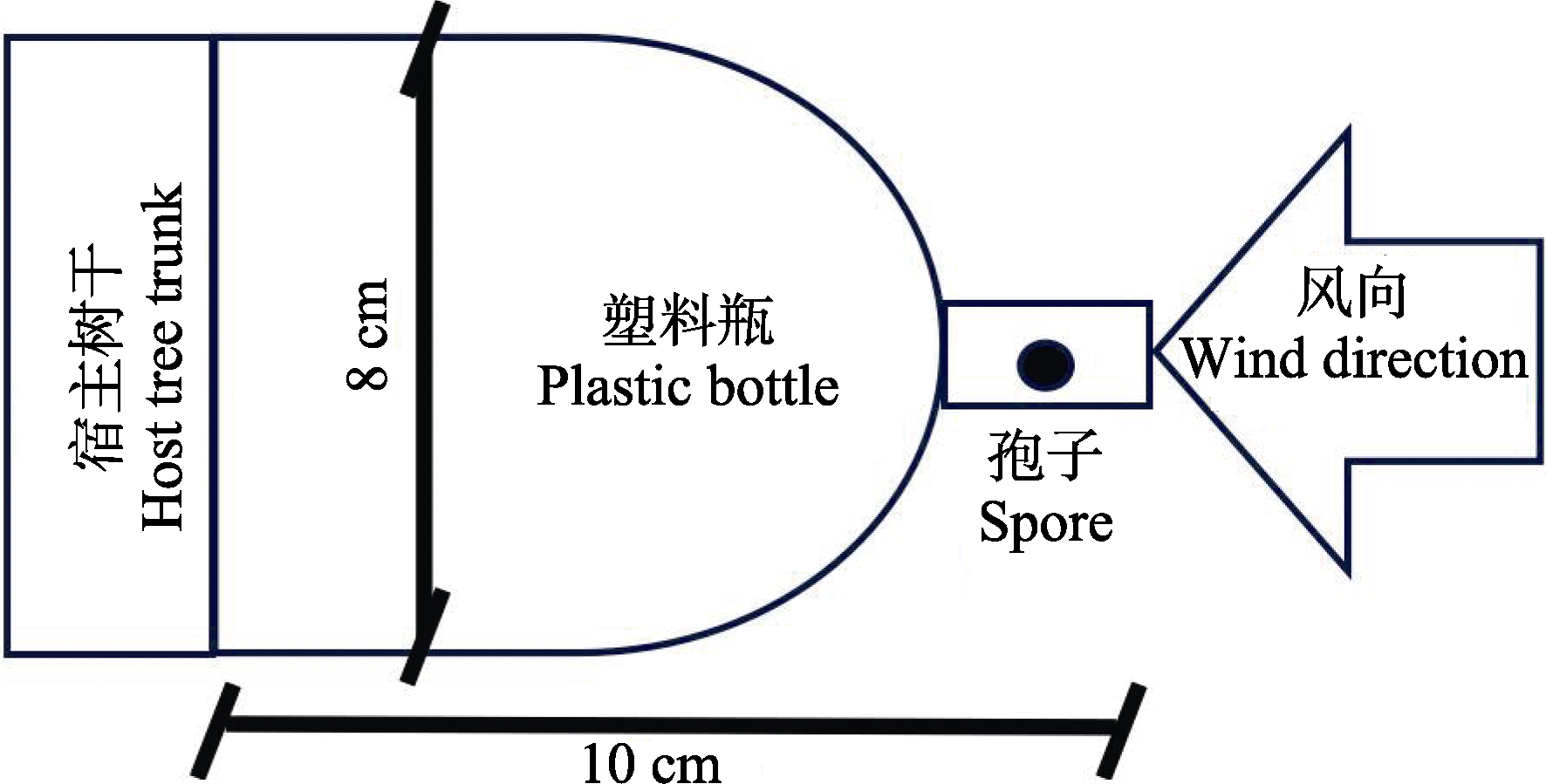
图1 附生维管植物孢子附着实验装置。
Fig. 1 Experimental device for the fern spore attachment.
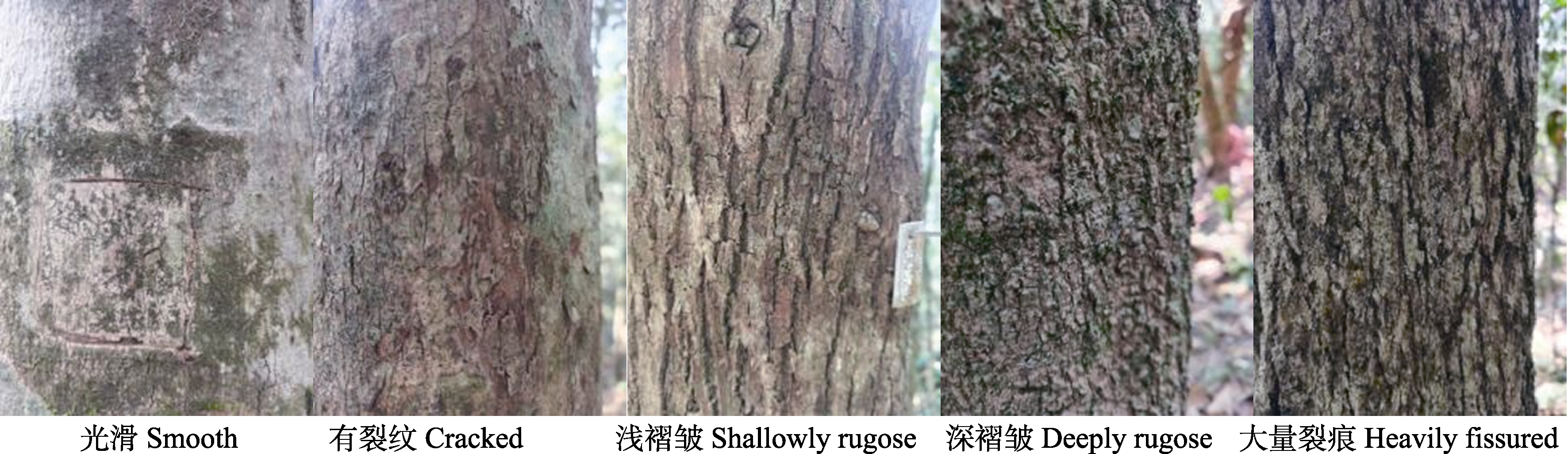
图2 不同宿主树皮粗糙度(从左往右分别为白花含笑、赤楠、碟斗青冈、厚壳桂、木荷)。
Fig. 2 Bark roughness of different host trees (Michelia mediocris, Syzygium buxifolium, Quercus disciformis, Cryptocarya chinensis, and Schima superba from the left pannel to the right one).
| 序号 No. | 物种名 Species name | 拉丁名 Scientific name |
|---|---|---|
| 1 | 赤楠 | Syzygium buxifolium |
| 2 | 蚊母树 | Distylium racemosum |
| 3 | 黄杞 | Engelhardia roxburghiana |
| 4 | 碟斗青冈 | Quercus disciformis |
| 5 | 白花含笑 | Michelia mediocris |
| 6 | 岭南青冈 | Quercus championii |
| 7 | 陆均松 | Dacrydium pectinatum |
| 8 | 平托桂 | Cinnamomum tsoi |
| 9 | 光叶山矾 | Symplocos lancifolia |
| 10 | 木荷 | Schima superba |
| 11 | 厚壳桂 | Cryptocarya chinensis |
| 12 | 线枝蒲桃 | Syzygium araiocladum |
| 13 | 锈毛杜英 | Elaeocarpus howii |
| 14 | 绒毛润楠 | Machilus velutina |
表1 附生维管植物孢子附着实验中的宿主树种
Table 1 Host tree species used for the experiments of fern spore attachment
| 序号 No. | 物种名 Species name | 拉丁名 Scientific name |
|---|---|---|
| 1 | 赤楠 | Syzygium buxifolium |
| 2 | 蚊母树 | Distylium racemosum |
| 3 | 黄杞 | Engelhardia roxburghiana |
| 4 | 碟斗青冈 | Quercus disciformis |
| 5 | 白花含笑 | Michelia mediocris |
| 6 | 岭南青冈 | Quercus championii |
| 7 | 陆均松 | Dacrydium pectinatum |
| 8 | 平托桂 | Cinnamomum tsoi |
| 9 | 光叶山矾 | Symplocos lancifolia |
| 10 | 木荷 | Schima superba |
| 11 | 厚壳桂 | Cryptocarya chinensis |
| 12 | 线枝蒲桃 | Syzygium araiocladum |
| 13 | 锈毛杜英 | Elaeocarpus howii |
| 14 | 绒毛润楠 | Machilus velutina |
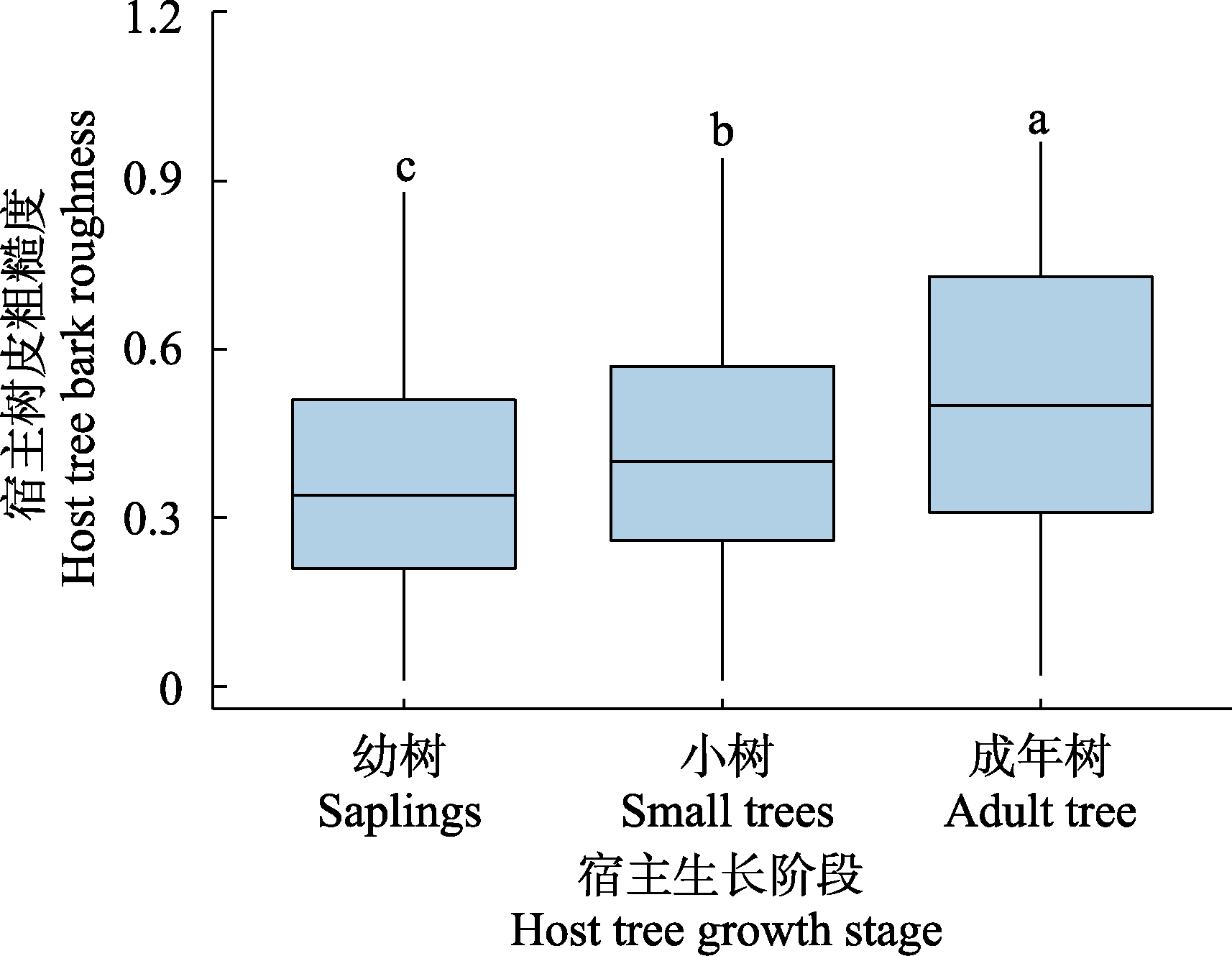
图3 宿主不同生长阶段树皮粗糙度比较。不同小写字母表示差异显著(p < 0.001)。
Fig. 3 Comparisons of bark roughness across different growth stages of host trees. Different lowercase letters indicate significant differences (p < 0.001).
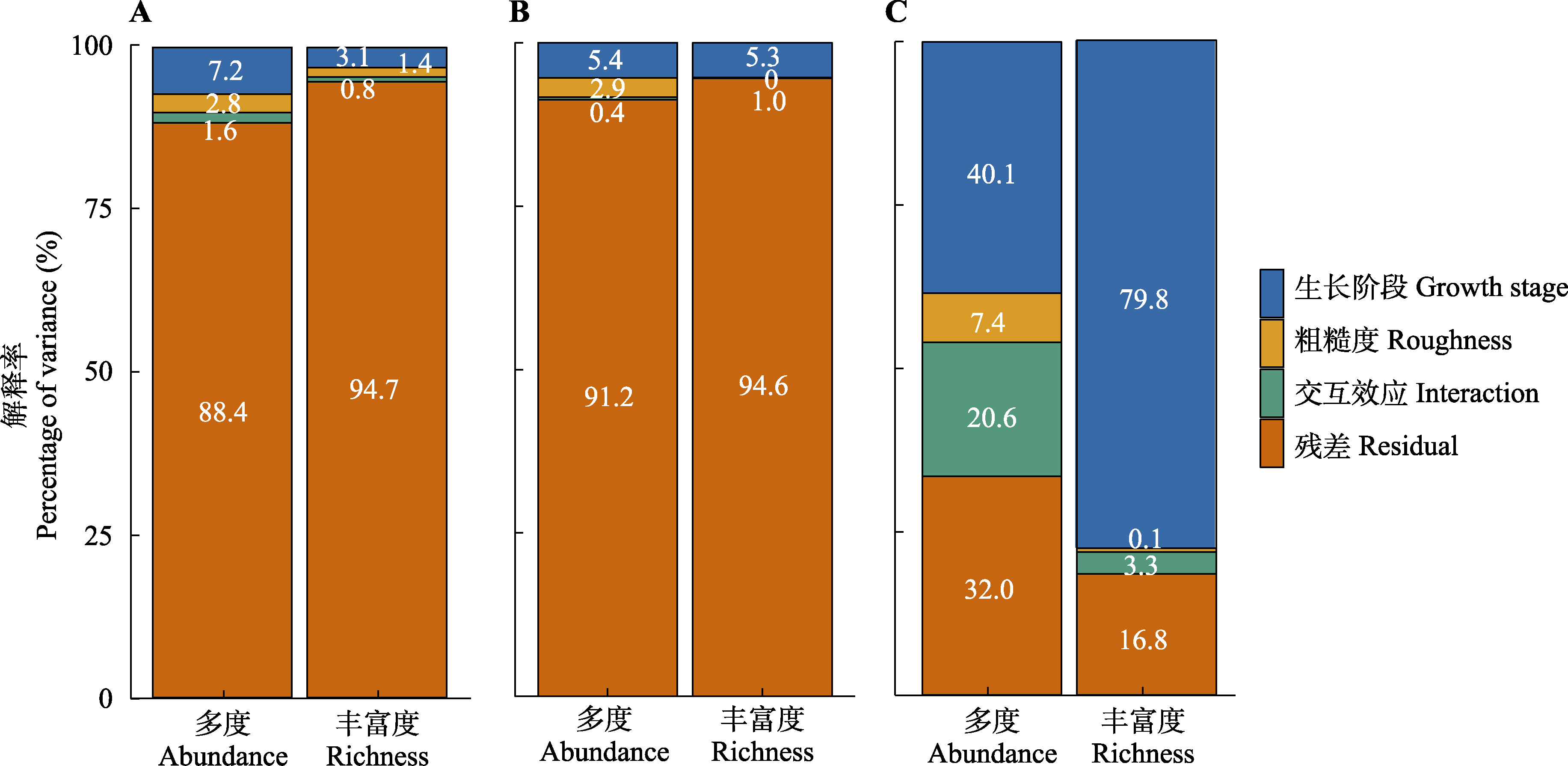
图4 宿主树皮粗糙度和宿主生长阶段对附生维管植物丰富度和多度的解释方差比例。A, 蕨类。B, 兰科。C, 样地所有附生植物。
Fig. 4 Variance proportion of the richness and abundance of vascular epiphytic plants explained by the bark roughness and growth stages of host trees. A, Ferns. B, Orchidaceae. C, All epiphytic plants in the plot.
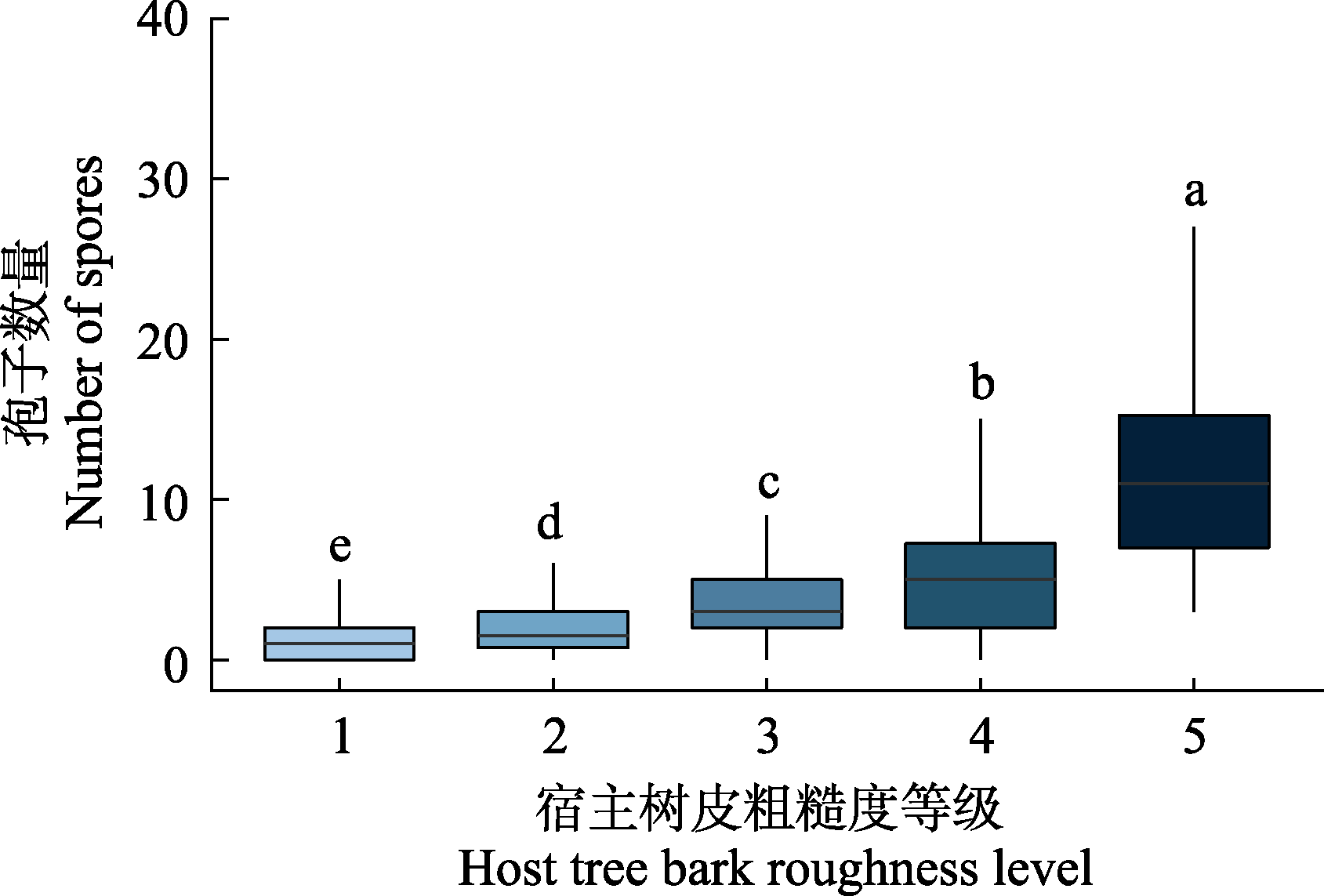
图5 不同粗糙度宿主间附着的蕨类植物孢子数量比较。不同小写字母表示孢子数量差异显著(p < 0.001)。
Fig. 5 Comparisons of number of fern spores across different bark roughness of host trees. Different lowercase letters indicate significant differences in the number of fern spores (p < 0.001).
| [1] |
Adhikari YP, Fischer A, Fischer HS (2016). Epiphytic orchids and their ecological niche under anthropogenic influence in central Himalayas, Nepal. Journal of Mountain Science, 13, 774-784.
DOI URL |
| [2] |
Adhikari YP, Fischer HS, Fischer A (2012). Host tree utilization by epiphytic orchids in different land-use intensities in Kathmandu Valley, Nepal. Plant Ecology, 213, 1393-1412.
DOI URL |
| [3] |
Boelter CR, Dambros CS, Nascimento HEM, Zartman CE (2014). A tangled web in tropical tree-tops: effects of edaphic variation, neighbourhood phorophyte composition and bark characteristics on epiphytes in a central Amazonian forest. Journal of Vegetation Science, 25, 1090-1099.
DOI URL |
| [4] |
Cáceres MES, Lücking R, Rambold G (2007). Phorophyte specificity and environmental parameters versus stochasticity as determinants for species composition of corticolous crustose lichen communities in the Atlantic rain forest of northeastern Brazil. Mycological Progress, 6, 117-136.
DOI URL |
| [5] |
Callaway RM, Reinhart KO, Moore GW, Moore DJ, Pennings SC (2002). Epiphyte host preferences and host traits: mechanisms for species-specific interactions. Oecologia, 132, 221-230.
DOI PMID |
| [6] |
Duarte MM, Gandolfi S (2017). Diversifying growth forms in tropical forest restoration: enrichment with vascular epiphytes. Forest Ecology and Management, 401, 89-98.
DOI URL |
| [7] | Einzmann HJR, Zotz G (2017). Dispersal and establishment of vascular epiphytes in human-modified landscapes. AoB Plants, 9, plx052. DOI: 10.1093/aobpla/plx052. |
| [8] |
Ellis CJ, Coppins BJ (2007). Reproductive strategy and the compositional dynamics of crustose lichen communities on aspen (Populus tremula L.) in Scotland. The Lichenologist, 39, 377-391.
DOI URL |
| [9] |
Gotsch SG, Dawson TE, Draguljić D (2018). Variation in the resilience of cloud forest vascular epiphytes to severe drought. New Phytologist, 219, 900-913.
DOI PMID |
| [10] |
Hietz P, Hietz-Seifert U (1995). Composition and ecology of vascular epiphyte communities along an altitudinal gradient in central Veracruz, Mexico. Journal of Vegetation Science, 6, 487-498.
DOI URL |
| [11] | Hu YJ, Li YX (1992). Tropical Rain Forest in Hainan Island. Guangdong Higher Education Press, Guangzhou. 7-32. |
| [胡玉佳, 李玉杏 (1992). 海南岛热带雨林. 广东高等教育出版社, 广州. 7-32.] | |
| [12] | Huang MH, Shang SQ, Cui SP, Wang GJ, Luo YQ, Deng B, Wang LX (2023). Relationship between bark physical characteristics of different host trees and damage of Anoplophora glabripennis. Northwest Agricultural Journal, 32, 952-959. |
| [黄铭昊, 尚素琴, 崔树鹏, 王改进, 骆有庆, 邓彬, 王立祥 (2023). 不同树种树皮物理特征与光肩星天牛危害的关系. 西北农业学报, 32, 952-959.] | |
| [13] | Johansson D (1974). Ecology of vascular epiphytes in West African Rain Forest. Acta Phytogeographica Suecica, 59, 1-136. |
| [14] | Kang Y, Deng ZY, Zang RG, Long WX (2017). DNA barcoding analysis and phylogenetic relationships of tree species in tropical cloud forests. Scientific Reports, 7, 12564. DOI: 10.1038/s41598-017-13057-0. |
| [15] | Liu GF (2010). Diversity and Distribution of Vascular Epiphytes of Tropical Forests in Hainan Island, China. PhD dissertation, Chinese Academy of Forestry Sciences, Beijing. |
| [刘广福 (2010). 海南岛热带森林附生维管植物多样性和分布. 博士学位论文, 中国林业科学研究院, 北京.] | |
| [16] |
Liu WY, Ma WZ, Yang LP (2006). Advances in ecological studies on epiphytes in forest canopies. Chinese Journal of Plant Ecology, 30, 522-533.
DOI URL |
|
[刘文耀, 马文章, 杨礼攀 (2006). 林冠附生植物生态学研究进展. 植物生态学报, 30, 522-533.]
DOI |
|
| [17] | Long WX (2011). Community Structure and Assembly Mechanisms of Tropical Cloud Rainforest in Hainan Island, China. PhD dissertation, Chinese Academy of Forestry Sciences, Beijing. |
| [龙文兴 (2011). 海南岛热带云雾林群落结构及组配机制研究. 博士学位论文, 中国林业科学研究院, 北京.] | |
| [18] |
López-Villalobos A, Flores-Palacios A, Ortiz-Pulido R (2008). The relationship between bark peeling rate and the distribution and mortality of two epiphyte species. Plant Ecology, 198, 265-274.
DOI URL |
| [19] |
Mehltreter K, Flores-Palacios A (2005). Host preferences of low-trunk vascular epiphytes in a cloud forest of Veracruz, Mexico. Journal of Tropical Ecology, 21, 651-660.
DOI URL |
| [20] | Mitchell RJ, Hewison RL, Beaton J, Douglass JR (2021). Identifying substitute host tree species for epiphytes: the relative importance of tree size and species, bark and site characteristics. Applied Vegetation Science, 24, e12569. DOI: 10.1111/avsc.12569. |
| [21] |
Moran RC, Russell RV (2004). The occurrence of Trichomanes godmanii (Hymenophyllaceae) on Welfia georgii (Arecaceae) at the La Selva Biological Station, Costa Rica. American Fern Journal, 94(2), 70-76.
DOI URL |
| [22] |
Nieder J, Engwald S, Klawun M, Barthlott W (2000). Spatial distribution of vascular epiphytes (including Hemiepiphytes) in a lowland Amazonian rain forest (surumoni crane plot) of Southern Venezuela. Biotropica, 32, 385-396.
DOI URL |
| [23] |
Otero JT, Aragón S, Ackerman JD (2007). Site variation in spatial aggregation and phorophyte preference in Psychilis monensis (Orchidaceae). Biotropica, 39, 227-231.
DOI URL |
| [24] |
Phillips JW, Chung AYC, Edgecombe GD, Farnon Ellwood MD (2020). Bird’s nest ferns promote resource sharing by centipedes. Biotropica, 52, 335-344.
DOI URL |
| [25] |
Sanford WW (1968). Distribution of epiphytic orchids in semi-deciduous tropical forest in southern Nigeria. Journal of Ecology, 56, 697-705.
DOI URL |
| [26] | Schievenin DF, Santos CA, de Lima K, de Melo ACG, Engel VL, Durigan G (2024). Traits of the host trees, not community diversity, drive epiphytes abundance in tropical seasonal forests. Biota Neotropica, 24, e20231558. DOI: 10.1590/1676-0611-BN-2023-1558. |
| [27] |
Segovia-Rivas A, Meave JA, González EJ, Pérez-García EA (2018). Experimental reintroduction and host preference of the microendemic and endangered orchid Barkeria whartoniana in a Mexican Tropical Dry Forest. Journal for Nature Conservation, 43, 156-164.
DOI URL |
| [28] |
Siaz-Torres SS, Mora-Olivo A, Arellano-Méndez LU, Vanoye- Eligio V, Flores-Rivas J, de la Rosa-Manzano E (2021). Contribution of peeling host for epiphyte abundance in two tropical dry forests in the “El Cielo Biosphere Reserve”, Mexico. Plant Species Biology, 36, 269-283.
DOI |
| [29] | Soto Medina E, Lücking R, Bolaños Rojas A (2012). Especificidad de forófito y preferencias microambientales de los líquenes cortícolas en Cinco forófitos del bosque premontano de finca Zíngara, Cali, Colombia. Revista de Biología Tropical, 60, 843-856. |
| [30] |
Spier L, van Dobben H, van Dort K (2010). Is bark pH more important than tree species in determining the composition of nitrophytic or acidophytic lichen floras? Environmental Pollution, 158, 3607-3611.
DOI PMID |
| [31] |
Tatsumi S, Ohgue T, Azuma WA, Nishizawa K (2023). Bark traits affect epiphytic bryophyte community assembly in a temperate forest. Plant Ecology, 224, 1089-1095.
DOI |
| [32] |
Timsina B, Rokaya MB, Münzbergová Z, Kindlmann P, Shrestha B, Bhattarai B, Raskoti BB (2016). Diversity, distribution and host-species associations of epiphytic orchids in Nepal. Biodiversity and Conservation, 25, 2803-2819.
DOI URL |
| [33] | Wagner K, Mendieta-Leiva G, Zotz G (2015). Host specificity in vascular epiphytes: a review of methodology, empirical evidence and potential mechanisms. AoB Plants, 7, plu092. DOI: 10.1093/aobpla/plu092. |
| [34] | Wagner K, Wanek W, Zotz G (2021). Functional traits of a rainforest vascular epiphyte community: trait covariation and indications for host specificity. Diversity, 13, 97. DOI: 10.3390/d13020097. |
| [35] |
Wang YC, Deng ZY, Zhang SX, Xiao CC, Feng G, Long WX, Liu JS (2022). Host tree selection by vascular epiphytes in tropical cloud forest of Hainan Island, China. Chinese Journal of Plant Ecology, 46, 405-415.
DOI URL |
|
[王艺宸, 邓芝燕, 张守信, 肖楚楚, 冯广, 龙文兴, 刘积史 (2022). 海南热带云雾林附生维管植物对宿主的选择性. 植物生态学报, 46, 405-415.]
DOI |
|
| [36] | Wierzcholska S, Łubek A, Dyderski MK, Horodecki P, Rawlik M, Jagodziński AM (2024). Light availability and phorophyte identity drive epiphyte species richness and composition in mountain temperate forests. Ecological Informatics, 80, 102475. DOI: 10.1016/j.ecoinf.2024.102475. |
| [37] |
Williams VL, Witkowski ETF, Balkwill K (2007). Relationship between bark thickness and diameter at breast height for six tree species used medicinally in South Africa. South African Journal of Botany, 73, 449-465.
DOI URL |
| [38] |
Woods CL, Cardelús CL, DeWalt SJ (2015). Microhabitat associations of vascular epiphytes in a wet tropical forest canopy. Journal of Ecology, 103, 421-430.
DOI URL |
| [39] |
Zarate-García AM, Noguera-Savelli E, Andrade-Canto SB, Zavaleta-Mancera HA, Gauthier A, Alatorre-Cobos F (2020). Bark water storage capacity influences epiphytic orchid preference for host trees. American Journal of Botany, 107, 726-734.
DOI PMID |
| [40] |
Zotz G, Vollrath B (2003). The epiphyte vegetation of the palm Socratea exorrhiza: correlations with tree size, tree age and bryophyte cover. Journal of Tropical Ecology, 19, 81-90.
DOI URL |
| [41] |
Zotz G, Winkler U (2013). Aerial roots of epiphytic orchids: the velamen radicum and its role in water and nutrient uptake. Oecologia, 171, 733-741.
DOI PMID |
| [1] | 刘志祥, 黎凤兰, 黄晓磊. 昆虫虫瘿生态系统的复杂性及成瘿机制研究进展[J]. , 2027, 51(动植物互作): 0-. |
| [2] | 许敏慧, 江子怡, 耿文迪, 王子晴, 林雨蝶, 王建青, 施秀珍. 不同邻体树种丰富度下亚热带杉木幼林凋落物碳氮磷生态化学计量特征[J]. 植物生态学报, 2026, 50(预发表): 0-. |
| [3] | 卢萍, 牛亚平, 孟媛超, 周丽娜, 刘洋, 杨元合, 程晓莉, 彭云峰. 高寒草地生态功能耦合特征与植物多样性的关联[J]. 植物生态学报, 2026, 50(预发表): 0-. |
| [4] | 陈佳乐, 赵颖菲, 昌海超, 董必成, 于飞海. 基于大语言模型的植物性状自动提取框架构建与评价体系[J]. , 2026, 50(生态统计方法专题): 0-. |
| [5] | 林琳琳, 肖劲祥, 黄深深, 赵杨梅, 张德旭, 程毅康, 龙文兴. 磷添加对热带云雾林幼苗及幼树功能性状的影响[J]. 植物生态学报, 2026, 50(4): 917-928. |
| [6] | 杨梅花, 张子嘉, 乔栋, 冯俊娜, 庞子杰, 钱龙, 刘志晖, 蔡娜娜, 胡中民, 杨国姣. 海南热带森林乔木树种每木清查和多样性数据集[J]. 植物生态学报, 2026, 50(4): 1016-1022. |
| [7] | 李燚, 黄欢, 赵艳超, 陈立同. 养分添加对不同海拔高寒草甸物种多样性及组成的影响[J]. 植物生态学报, 2026, 50(4): 870-882. |
| [8] | 何青, 袁旭东, 任博申, 冯治洋, 鲁梦珍, 林巧玲, 姜庆虎, 杨林森, 余辉亮, 姚辉, 杨敬元, 刘峰, 江明喜. 一年蓬入侵对亚高山泥炭湿地植物群落结构与多样性的影响[J]. 植物生态学报, 2026, 50(4): 895-906. |
| [9] | 张安宁, 肖亚宁, 赵霞, 张淼, 崔瀚文, 陈书燕, 安黎哲. 青藏高原灌丛化与氮添加对土壤线虫群落及功能性状的交互作用[J]. 植物生态学报, 2026, 50(4): 859-869. |
| [10] | 周春菡, 熊智诚, 杨明新, 史海兰, 周亚星, 唐玉, 张静, 纪宝明, 代心灵. 黄河源园区高寒湿地菌根真菌群落特征及其影响因素[J]. 植物生态学报, 2026, 50(3): 625-638. |
| [11] | 马建辉, 童鑫, 张思榕, 毛子昆, 秦俊, 马克平. 菌根真菌生理生态功能研究进展及展望[J]. 植物生态学报, 2026, 50(3): 498-514. |
| [12] | 惠城阳, 章巧依, 刘腾腾, 刘维勇, 周丽娜, 金鑫杰, 张永华, 刘金亮. 温州大罗山主要植被类型及物种组成特征[J]. 植物生态学报, 2025, 49(6): 990-998. |
| [13] | 马富龙, 王雨晴, 郝瑜, 段继超, 刘霏霏, 席琳乔, 韩路. 海拔梯度对昆仑山北坡中部草原植物与土壤微生物群落结构与多样性的影响[J]. 植物生态学报, 2025, 49(5): 732-747. |
| [14] | 李冬梅, 孙龙, 韩宇, 胡同欣, 杨光, 蔡慧颖. 计划火烧对红松人工林生物多样性与生态系统多功能性关系的影响[J]. 植物生态学报, 2025, 49(3): 379-392. |
| [15] | 刘盈麟, 李春明, 王昊, 武长路, 贺强. 长江口滨海湿地水鸟对底栖微藻群落的营养级联效应[J]. 植物生态学报, 2025, 49(3): 367-378. |
| 阅读次数 | ||||||
|
全文 |
|
|||||
|
摘要 |
|
|||||
Copyright © 2026 版权所有 《植物生态学报》编辑部
地址: 北京香山南辛村20号, 邮编: 100093
Tel.: 010-62836134, 62836138; Fax: 010-82599431; E-mail: apes@ibcas.ac.cn, cjpe@ibcas.ac.cn
备案号: 京ICP备16067583号-19

