
植物生态学报 ›› 2018, Vol. 42 ›› Issue (5): 526-538.DOI: 10.17521/cjpe.2017.0305 cstr: 32100.14.cjpe.2017.0305
所属专题: 全球变化与生态系统; 生态遥感及应用; 青藏高原植物生态学:生态系统生态学
周彤1,曹入尹2,王少鹏1,陈晋3,唐艳鸿1,*( )
)
收稿日期:2017-11-21
修回日期:2018-02-11
出版日期:2018-05-20
发布日期:2018-07-20
基金资助:
ZHOU Tong1,CAO Ru-Yin2,WANG Shao-Peng1,CHEN Jin3,TANG Yan-Hong1,*()
Received:2017-11-21
Revised:2018-02-11
Online:2018-05-20
Published:2018-07-20
Supported by:摘要:
长期以来, 气候与植物物候关系的研究大多基于线性模型, 但植被物候对气候变化的响应可能是非线性的。该文利用非线性模型——生存分析模型来分析时间序列中过去事件(气候因子)对目的变量(物候)的作用: 用生存分析模型分析了春季气温和降水量对内蒙古草地、青藏高原草甸和欧洲地区木本植物返青期的影响。其中, 内蒙古与青藏高原的物候信息来自遥感数据, 欧洲地区物候信息为实测数据。蒙特卡洛方法用于拟合模型参数。结果表明: 生存分析模型适合对上述不同研究对象的物候影响因素进行分析, 并能模拟非线性效应; 在内蒙古草地, 春季气温和降水对春季返青有很大的影响, 而青藏高原草甸和欧洲地区木本植物返青期对春季降水响应较小, 对春季气温变化的响应随Holdridge干燥度指数上升而下降; 在预测返青期时发现: 春季平均气温提高1 ℃会导致上述地区返青期提前1-6天; 而春季气温与降水的增加会导致返青期发生明显的非线性变化, 这种非线性效应无法基于线性模型模拟出来。结果说明生存分析模型既能用于分析不同尺度下植物物候与气候的关系, 也能用于模型预测, 尤其适合探讨大幅度气候变化对物候的非线性影响。
周彤, 曹入尹, 王少鹏, 陈晋, 唐艳鸿. 中国草地和欧洲木本植物返青期对气温和降水变化的响应: 基于生存分析的研究. 植物生态学报, 2018, 42(5): 526-538. DOI: 10.17521/cjpe.2017.0305
ZHOU Tong, CAO Ru-Yin, WANG Shao-Peng, CHEN Jin, TANG Yan-Hong. Responses of green-up dates of grasslands in China and woody plants in Europe to air temperature and precipitation: Empirical evidences based on survival analysis. Chinese Journal of Plant Ecology, 2018, 42(5): 526-538. DOI: 10.17521/cjpe.2017.0305
| 属 Genus | 物种 Species | 植株数 Plant No. |
|---|---|---|
| 七叶树属 Aesculus | 欧洲七叶树 Aesculus hippocastanum | 31 |
| 桤木属 Alnus | Alnus glutinosa | 4 |
| 桦木属 Betula | 垂枝桦 Betula pendula | 19 |
| 山毛榉属 Fagus | Fagus sylvatica | 16 |
| 栎属 Quercus | 夏栎 Quercus robur | 16 |
| 梣属 Fraxinus | 欧梣 Fraxinus excelsior | 9 |
| 茶藨子属 Ribes | Ribes grossularia | 12 |
表1 欧洲研究区木本植物物种
Table 1 List of woody plant species in European database
| 属 Genus | 物种 Species | 植株数 Plant No. |
|---|---|---|
| 七叶树属 Aesculus | 欧洲七叶树 Aesculus hippocastanum | 31 |
| 桤木属 Alnus | Alnus glutinosa | 4 |
| 桦木属 Betula | 垂枝桦 Betula pendula | 19 |
| 山毛榉属 Fagus | Fagus sylvatica | 16 |
| 栎属 Quercus | 夏栎 Quercus robur | 16 |
| 梣属 Fraxinus | 欧梣 Fraxinus excelsior | 9 |
| 茶藨子属 Ribes | Ribes grossularia | 12 |
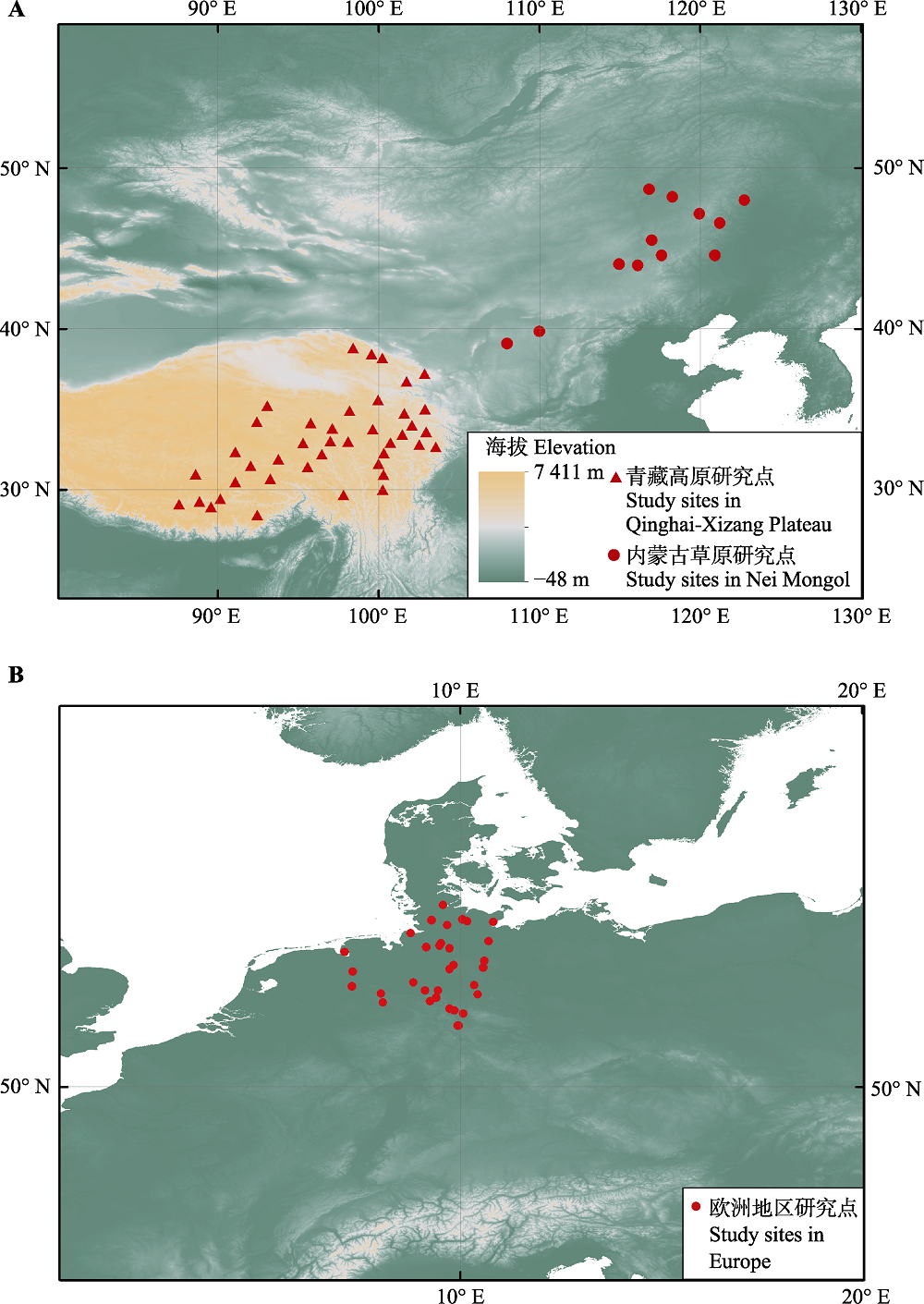
图1 中国与欧洲的研究点分布。 A图中三角形表示位于青藏高原的气象站点, 圆点表示位于内蒙古的气象站点。B图中圆点表示欧洲地区木本植物物候观测点。
Fig. 1 Spatial distribution of study sites in China (A) and Europe (B). The triangles/dots in (A) are the distributions of meteorological stations in Qinghai-Xizang Plateau and in Nei Mongol, respectively. The points in (B) indicate the locations of phenological observation sites for woody plants in Europe.
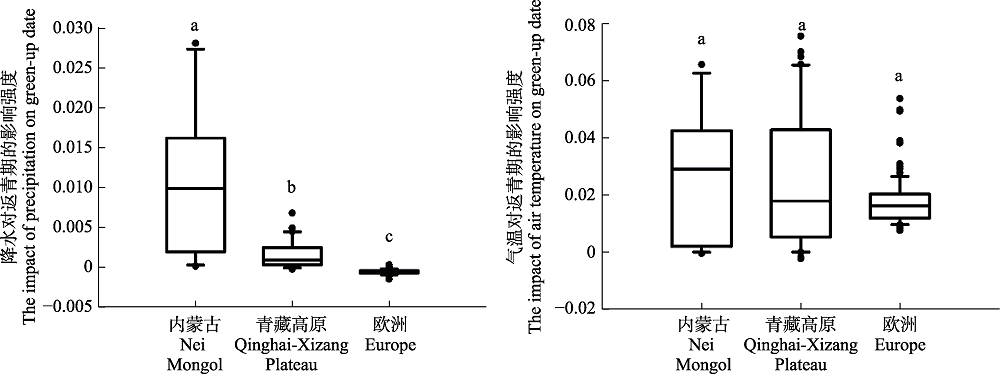
图2 春季降水与气温对内蒙古草原、青藏高原草甸和欧洲地区木本植物返青期的影响。每一方框的上下横线分别表示样本统计量的四分位值即75%和25%的位点, 框内中央横线是中位数, 上下端短横线分别是统计量的90%和10%的位点, 圆点表示统计分布的特异最大或最小值。
Fig. 2 The changes in model coefficients of green-up date with spring precipitation and air temperature for the grasslands in Nei Mongol, meadows in Qinghai-Xizang Plateau, and woody plants in Europe. In these boxplots, the top and bottom values of the bars indicate the 25th and 75th percentiles, respectively; the black line within the box indicates the median; whiskers below and above the box indicate the 10th and 90th percentiles; and points indicate outliers. Letters on top of the whiskers are the results of an analysis of variance: different letters indicate statistically significant difference between the mean values (p < 0.01, t-test).
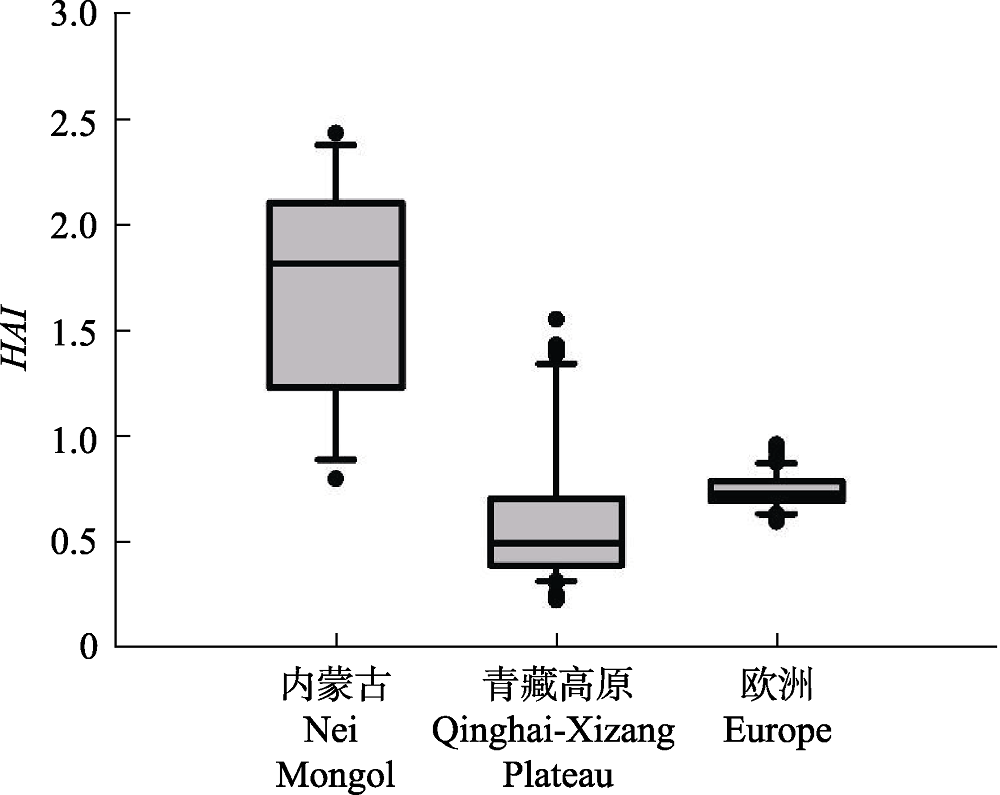
图3 内蒙古草原、青藏高原草甸和欧洲地区木本植物的Holdridge干燥度指数(HAI)的分布统计特征。统计变量的说明参见图2。
Fig. 3 Boxplots of the Holdridge aridity index (HAI) for the grasslands of Nei Mongol, meadows in Qinghai-Xizang Plateau, and woody plants in Europe. See Fig. 2 for explanations of the symbols.
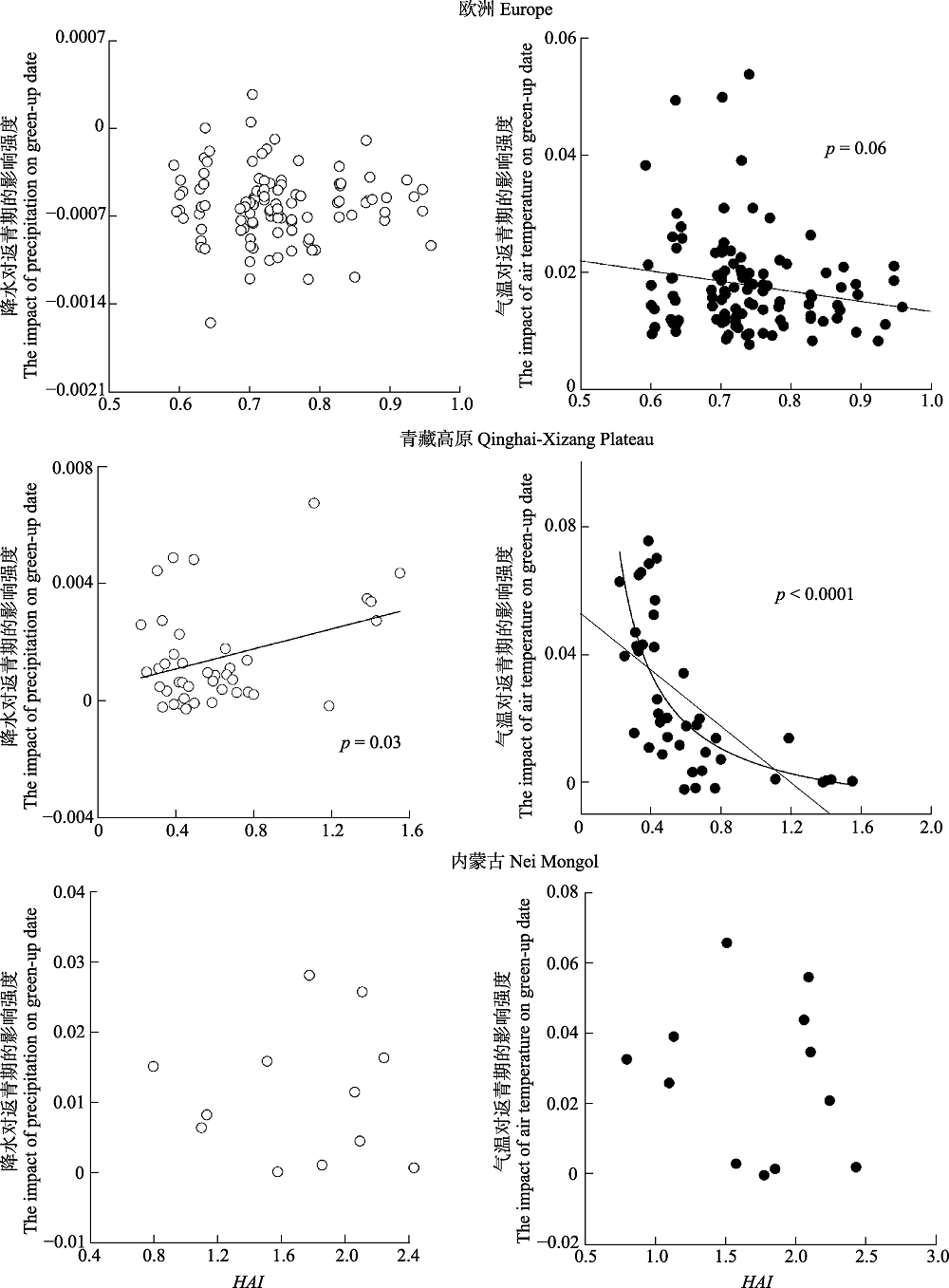
图4 内蒙古草原、青藏高原草甸和欧洲地区木本植物降水与气温对返青期的影响强度与Holdridge干燥度指数(HAI)的关系。
Fig. 4 The changes in the model coefficient of precipitation and temperature with the Holdridge aridity index (HAI) for the grasslands of Nei Mongol,meadows in Qinghai-Xizang Plateau, and woody plants in Europe.
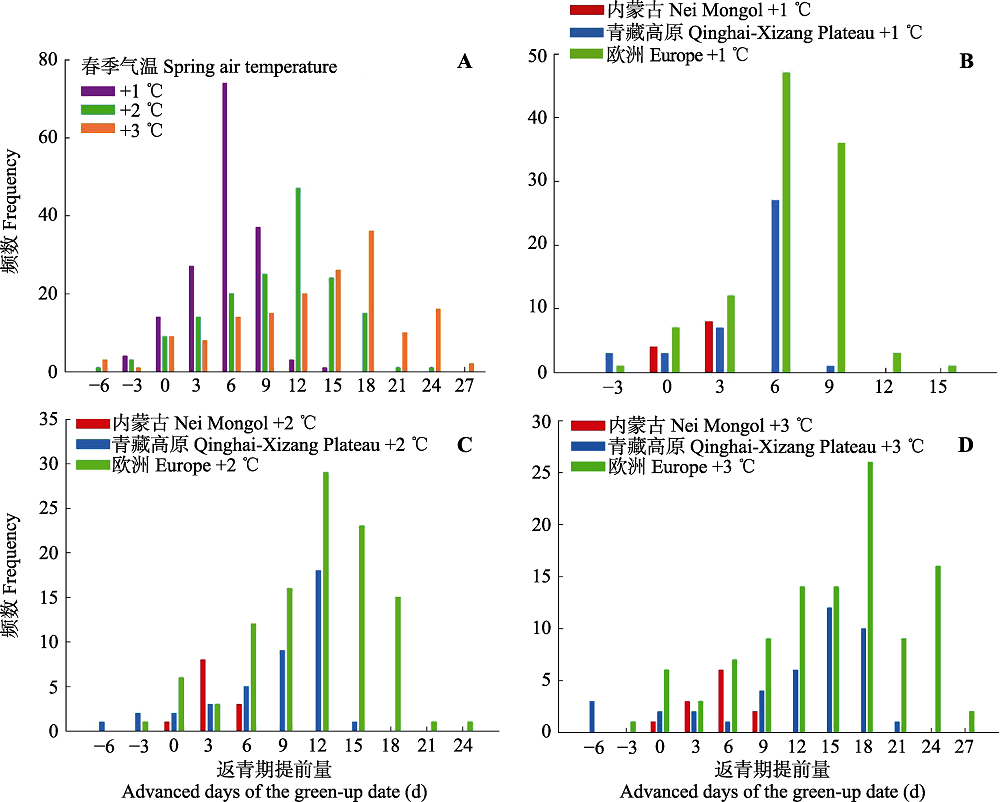
图5 在春季气温上升的3种情境下(+1、+2、+3 ℃)所研究生态系统返青期的变化。负值为返青期延后, 正值为返青期提前。A, 升温1、2和3 ℃情况下所有研究点返青期变化量的频数。B、C、D分别为升温1、2 和3 ℃时各个生态系统返青期变化量的频数。
Fig. 5 Predicted changes of green-up date under the three scenarios of elevated spring-temperature at 1, 2 and 3 °C for the target areas. Negative and positive dates indicate the delayed and advanced days of the green-up date, respectively. A, Predicted changes under all the three temperature scenarios. B, C, D, Predicted changes for each target area with the temperature increase of 1, 2 and 3 °C, respectively.
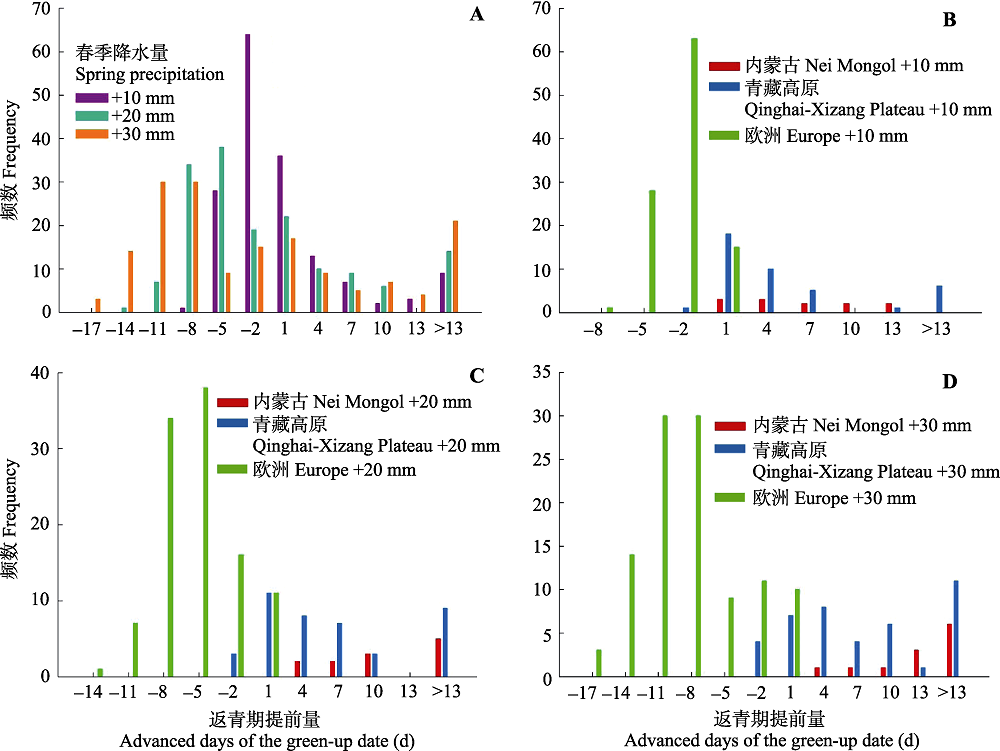
图6 在3种春季降水增加的情景下(+10、+20、+30 mm)所研究生态系统返青期的变化情况。负值表示返青期延后, 正值表示返青期提前。A, 增水10、20和30 mm情况下所有研究点返青期变化量的频数。B、C、D分别为增水10、20和30 mm时各个生态系统返青期变化量的频数。
Fig. 6 Predicted changes of green-up date under the three scenarios of elevated spring-precipitation at 10, 20 and 30 mm among each target area. Negative and positive dates indicate the delayed and advanced days of the green-up date, respectively. A, Predicted changes for all the three precipitation scenarios. B, C, D, Predicted changes for each target area with the precipitation increase at 10, 20 and 30 mm, respectively.
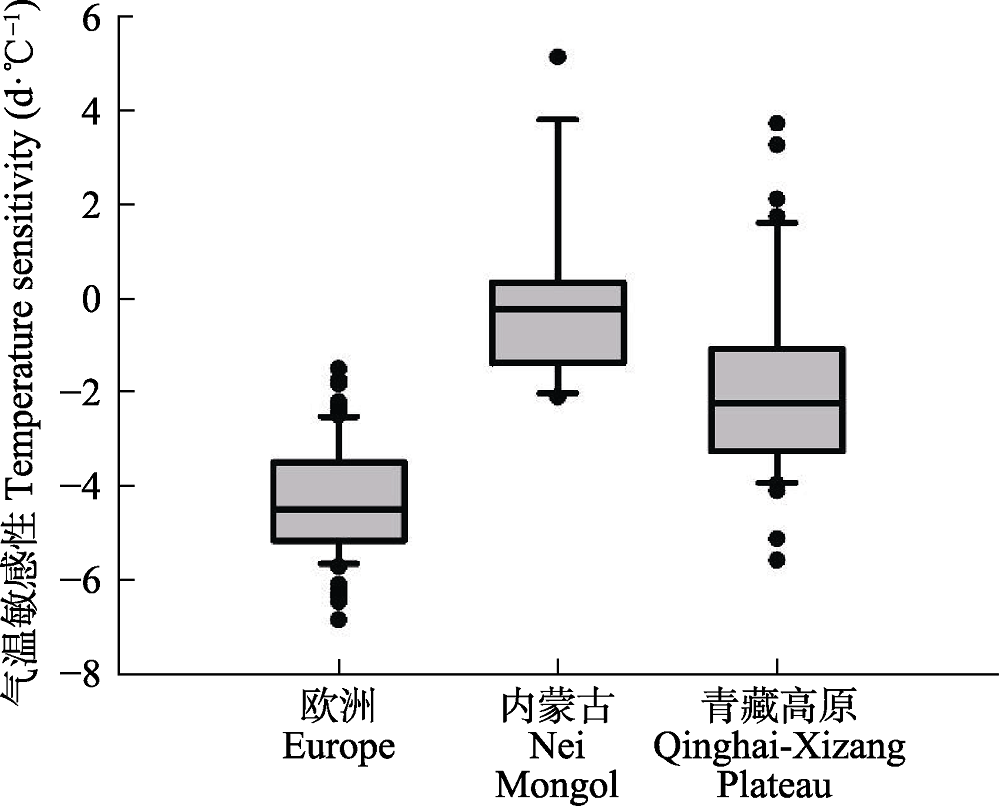
图7 利用线性回归模型计算的3个地区返青期气温敏感性。统计变量的说明参见图2。
Fig. 7 Boxplots of temperature sensitivity of green-up date from linear regression models for the three cases of the study. See Fig. 2 for explanations of the symbols.
| 升温情景 Warming scenarios (℃) | 内蒙古 Nei Mongol | 青藏高原 Qinghai-Xizang Plateau | 欧洲 Europe | ||||||
|---|---|---|---|---|---|---|---|---|---|
| 生存分析法 Survival analysis | 线性回归法 Linear analysis | p | 生存分析法 Survival analysis | 线性回归法 Linear analysis | p | 生存分析法 Survival analysis | 线性回归法 Linear analysis | p | |
| + 1 | 0.92 | 0.13 | 0.04 | 3.56 | 1.87 | < 0.001 | 5.66 | 4.47 | < 0.001 |
| + 2 | 2.33 | 0.26 | 0.01 | 7.29 | 3.74 | < 0.001 | 10.5 | 8.94 | < 0.001 |
| + 3 | 4.17 | 0.39 | < 0.01 | 10.88 | 5.61 | < 0.001 | 14.06 | 13.41 | < 0.001 |
表2 升温1 、2 和3 ℃下内蒙古、青藏高原和欧洲地区返青期提前天数的平均值(从3月1日起每天比2009年升温1、2和3 ℃)
Table 2 The mean advanced days of green-up date for the two grasslands in Nei Mongol and the Qinghai-Xizang Plateau, and woody plants in Europe under three warming scenarios: elevated spring temperature at +1, +2 and +3 °C for each day as compared with the days from March 1st, 2009.
| 升温情景 Warming scenarios (℃) | 内蒙古 Nei Mongol | 青藏高原 Qinghai-Xizang Plateau | 欧洲 Europe | ||||||
|---|---|---|---|---|---|---|---|---|---|
| 生存分析法 Survival analysis | 线性回归法 Linear analysis | p | 生存分析法 Survival analysis | 线性回归法 Linear analysis | p | 生存分析法 Survival analysis | 线性回归法 Linear analysis | p | |
| + 1 | 0.92 | 0.13 | 0.04 | 3.56 | 1.87 | < 0.001 | 5.66 | 4.47 | < 0.001 |
| + 2 | 2.33 | 0.26 | 0.01 | 7.29 | 3.74 | < 0.001 | 10.5 | 8.94 | < 0.001 |
| + 3 | 4.17 | 0.39 | < 0.01 | 10.88 | 5.61 | < 0.001 | 14.06 | 13.41 | < 0.001 |
| [1] |
Allen JM, Terres MA, Katsuki T, Iwamoto K, Kobori H, Higuchi H, Primack RB, Wilson AM, Gelfand A, Silander JA ( 2014). Modeling daily flowering probabilities: Expected impact of climate change on Japanese cherry phenology. Global Change Biology, 20, 1251-1263.
DOI URL PMID |
| [2] |
Bradley AV, Gerard FF, Barbier N, Weedon GP, Anderson LO, Huntingford C, Aragão LEOC, Zelazowski P, Arai E ( 2011). Relationships between phenology, radiation and precipitation in the Amazon region. Global Change Biology, 17, 2245-2260.
DOI URL |
| [3] |
Chen J, Jönsson P, Tamura M, Gu Z, Matsushita B, Eklundh L ( 2004). A simple method for reconstructing a high-quality NDVI time-series data set based on the Savitzky-Golay filter. Remote Sensing of Environment, 91, 332-344.
DOI URL |
| [4] |
Chen J, Rao Y, Shen M, Wang C, Zhou Y, Ma L, Tang Y, Yang X ( 2016). A simple method for detecting phenological change from time series of vegetation idexindex. IEEE Transactions on Geoscience & Remote Sensing, 54, 3436-3449.
DOI URL |
| [5] | Chen W, Yu SZ ( 1997). Comparison of the Cox Model and log-linear models in analysing survival data. Chinese Journal of Health Statistics, 14, 18-20. |
| [ 陈文, 俞顺章 ( 1997). Cox回归模型与对数线性回归模型在生存分析中应用的比较. 中国卫生统计, 14, 18-20.] | |
| [6] |
Cox DR ( 1972). Regression models and life-tables. Biometrical Journal, 34, 187.
DOI URL |
| [7] |
Diez JM, Ibanez I, Silander Jr JA, Primack R, Higuchi H, Kobori H, Sen A, James TY ( 2014). Beyond seasonal climate: Statistical estimation of phenological responses to weather. Ecological Applications, 24, 1793-1802.
DOI URL PMID |
| [8] |
Ding M, Zhang Y, Sun X, Liu L, Wang Z, Bai W ( 2013). Spatiotemporal variation in alpine grassland phenology in the Qinghai-Tibetan Plateau from 1999 to 2009. Chinese Science Bulletin, 58, 396-405.
DOI URL |
| [9] |
Forkel M, Migliavacca M, Thonicke K, Reichstein M, Schaphoff S, Weber U, Carvalhais N ( 2015). Codominant water control on global interannual variability and trends in land surface phenology and greenness. Global Change Biology, 21, 3414-3435.
DOI URL PMID |
| [10] |
Fu YH, Zhao H, Piao S, Peaucelle M, Peng S, Zhou G, Ciais P, Huang M, Menzel A, Peñuelas J, Song Y, Vitasse Y, Zeng Z, Janssens IA ( 2015). Declining global warming effects on the phenology of spring leaf unfolding. Nature, 526, 104-107.
DOI URL PMID |
| [11] |
Grace J, Allen SJ, Wilson C ( 1989). Climate and the meristem temperatures of plant communities near the tree-line. Oecologia, 79, 198-204.
DOI URL |
| [12] |
Güsewell S, Furrer R, Gehrig R, Pietragalla B ( 2017). Changes in temperature sensitivity of spring phenology with recent climate warming in Switzerland are related to shifts of the preseason. Global Change Biology, 23, 5189-5202.
DOI URL PMID |
| [13] |
Haylock MR, Hofstra N, Klein Tank AMG, Klok EJ, Jones PD, New M ( 2008). A European daily high-resolution gridded data set of surface temperature and precipitation for 1950-2006. Journal of Geophysical Research, 113, D20119. DOI: 10.1029/2008JD010201.
DOI URL |
| [14] |
Iler AM, Hoye TT, Inouye DW, Schmidt NM ( 2013). Long-term trends mask variation in the direction and magnitude of short-term phenological shifts. American Journal of Botany, 100, 1398-1406.
DOI URL PMID |
| [15] |
Jochner S, Sparks TH, Laube J, Menzel A ( 2016). Can we detect a nonlinear response to temperature in European plant phenology? International Journal of Biometeorology, 60, 1551-1561.
DOI URL PMID |
| [16] | Li XZ, Han GD, Guo CY ( 2013). Impacts of climate change on dominant pasture growing season in central Inner Mongolia. Acta Ecologica Sinica, 33, 4146-4155. |
| [ 李夏子, 韩国栋, 郭春燕 ( 2013). 气候变化对内蒙古中部草原优势牧草生长季的影响. 生态学报, 33, 4146-4155.] | |
| [17] | Lian JS, Jiang HS ( 1995). The ecological meaning and its identification of the Logistic population growth model. Supplement to the Journal of Sun Yatsen University, ( 3), 160-164. |
| [ 练健生, 江海声 ( 1995). Logistic种群增长模型参数的生态学意义及其辨识──南湾野生猕猴种群的应用. 中山大学学报论丛, ( 3), 160-164.] | |
| [18] |
Mazer SJ, Travers SE, Cook BI, Davies TJ, Bolmgren K, Kraft NJB, Salamin N, Inouye DW ( 2013). Flowering date of taxonomic families predicts phenological sensitivity to temperature: Implications for forecasting the effects of climate change on unstudied taxa. American Journal of Botany, 100, 1381-1397.
DOI URL PMID |
| [19] | Meng M, Ni J, Zhang ZG ( 2004). Aridity index and its applications in geo-ecological study. Acta Phytoecologica Sinica, 28, 853-861. |
| [ 孟猛, 倪健, 张治国 ( 2004). 地理生态学的干燥度指数及其应用评述. 植物生态学报, 28, 853-861.] | |
| [20] |
Menzel A, Sparks TH, Estrella N, Koch E, Aasa A, Ahas R, Alm-Kübler K, Bissolli P, Braslavská O, Briede A, Chmielewski FM, Crepinsek Z, Curnel Y, Dahl Å, Defila C, Donnelly A, Filella Y, Jatczak K, Måge F, Mestre A, Nordli Ø, Peñuelas J, Pirinen P, Remišová V, Scheifinger H, Striz M, Susnik A, van Vliet AJH, Wielgolaski F, Zach S, Zust A ( 2006). European phenological response to climate change matches the warming pattern. Global Change Biology, 12, 1969-1976.
DOI URL |
| [21] |
Niu JM ( 2001). Impacts prediction of climatic change on distribution and production of grassland in Inner Mongolia. Acta Agrestia Sinica, 9, 277-282.
DOI URL |
|
[ 牛建明 ( 2001). 气候变化对内蒙古草原分布和生产力影响的预测研究. 草地学报, 9, 277-282.]
DOI URL |
|
| [22] | Richard P, Liu HY, Yin Y ( 2011). Conservation of biodiversity under impact of human activities: Vegetation evolution in Central Europe and its implication, Chinese Journal of Ecology, 30, 584-588. |
| [ Richard P, 刘鸿雁, 印轶 ( 2011). 人类活动影响下的生物多样性保护: 中欧的植被演化及其启示. 生态学杂志, 30, 584-588.] | |
| [23] |
Sadras VO, Moran MA ( 2013). Nonlinear effects of elevated temperature on grapevine phenology. Agricultural and Forest Meteorology, 173, 107-115.
DOI URL |
| [24] | Sarmiento G, Monasterio M ( 1983). Life Forms and Phenology: Tropical Savannas. Elsevier,Amsterdam. 79-104. |
| [25] |
Shen M, Cong N, Cao R ( 2015 a). Temperature sensitivity as an explanation of the latitudinal pattern of green-up date trend in Northern Hemisphere vegetation during 1982-2008. International Journal of Climatology, 35, 3707-3712.
DOI URL |
| [26] |
Shen M, Piao S, Cong N, Zhang G, Jassens IA ( 2015 b). Precipitation impacts on vegetation spring phenology on the Tibetan Plateau. Global Change Biology, 21, 3647-3656.
DOI URL PMID |
| [27] |
Shen M, Tang Y, Chen J, Yang X, Wang C, Cui X, Yang Y, Han L, Li L, Du J, Zhang G, Cong N ( 2014). Earlier-?season vegetation has greater temperature sensitivity of spring phenology in Northern Hemisphere. POLS ONE, 9, e88178. DOI: 10.1371/journal.pone.0088178.
DOI URL PMID |
| [28] |
Shen M, Tang Y, Chen J, Zhu X, Zheng Y ( 2011). Influences of temperature and precipitation before the growing season on spring phenology in grasslands of the central and eastern Qinghai-Tibetan Plateau. Agricultural and Forest Meteorology, 151, 1711-1722.
DOI URL |
| [29] |
Sun HL, Zheng D, Yao TD, Zhang YL ( 2012). Protection and construction of the national ecological security shelter zone on Tibetan Plateau. Acta Geographica Sinca, 67, 3-12.
DOI URL |
|
[ 孙鸿烈, 郑度, 姚檀栋, 张镱锂 ( 2012). 青藏高原国家生态安全屏障保护与建设. 地理学报, 67, 3-12.]
DOI URL |
|
| [30] | The Editorial Committee of Vegetation Map of China, Chinese Academy of Sciences ( 2001). 1:1000000 Vegetation Atlas of China. Secience Press, Beijing . |
| [ 中国科学院中国植被图编辑委员会 ( 2001). 1:1000000中国植被图集. 科学出版社, 北京] | |
| [31] |
Vitasse Y, Hoch G, Randin CF, Lenz A, Kollas C, Scheepens JF, Koerner C ( 2013). Elevational adaptation and plasticity in seedling phenology of temperate deciduous tree species. Oecologia, 171, 663-678.
DOI URL |
| [32] |
Wang C, Chen J, Wu J, Tang Y, Shi P, Black TA, Zhu K ( 2017). A snow-free vegetation index for improved monitoring of vegetation spring green-up date in deciduous ecosystems. Remote Sensing of Environment, 196, 1-12.
DOI URL |
| [33] |
Wang SP, Meng FD, Duan JC, Wang YF, Cui XY, Piao SL, Niu HS, Xu GP, Luo CY, Zhang ZH, Zhu XX, Shen MG, Li YN, Du MY, Tang YH, Zhao XQ, Ciais P, Kimball B, Penuelas J, Janssens IA, Cui SJ, Zhao L, Zhang FW ( 2014). Asymmetric sensitivity of first flowering date to warming and cooling in alpine plants. Ecology, 95, 3387-3398.
DOI URL |
| [34] |
White MA, de Beurs KM, Didan K, Inouye DW, Richardson AD, Jensen OP, O’Keefe J, Zhang G, Nemani RR, van Leeuwen WJD, Brown JF, de Wit A, Schaepman M, Lin X, Dettinger M, Bailey AS, Kimball J, Schwartz MD, Baldocchi DD, Lee JT, Lauenroth WK ( 2009). Intercomparison, interpretation, and assessment of spring phenology in North America estimated from remote sensing for 1982-2006. Global Change Biology, 15, 2335-2359.
DOI URL |
| [35] |
Xie Y, Ahmed KF, Allen JM, Wilson AM, Silander JA ( 2015). Green-up of deciduous forest communities of northeastern North America in response to climate variation and climate change. Landscape Ecology, 30, 109-123.
DOI URL |
| [36] |
Yu H, Luedeling E, Xu J ( 2010). Winter and spring warming result in delayed spring phenology on the Tibetan Plateau. Proceedings of the National Academy of Sciences of the United States of America, 107, 22151-22156.
DOI URL PMID |
| [37] | Zhou GS, Zhang XS ( 1996). Study on climate-vegetation classification for global change in China. Acta Botanica Sinica, 38, 8-17. |
| [ 周广胜, 张新时 ( 1996). 全球变化的中国气候-植被分类研究. 植物学报, 38, 8-17.] |
| [1] | 张安宁, 肖亚宁, 赵霞, 张淼, 崔瀚文, 陈书燕, 安黎哲. 青藏高原灌木化与氮添加对土壤线虫及功能性状的交互作用[J]. 植物生态学报, 2026, 50(预发表): 0-. |
| [2] | 贾元, 张琳, 宋创业, 赵常明, 郭虓, 祝晓光, 吴冬秀. 基于深度学习目标检测的植物物候自动识别方法对比研究——以神农架粉白杜鹃为例[J]. 植物生态学报, 2026, 50(生态统计方法专题): 1-. |
| [3] | 何堂庆, 王变变, 曹鑫鑫, 张康成, 汪晓东, 王浩, 白彤硕, 赵叶新, 张艺, 王益, 仇云鹏, 胡水金. 半干旱草地植物和丛枝菌根真菌群落对长期降水增加的响应[J]. 植物生态学报, 2026, 50(3): 674-684. |
| [4] | 张永军, 李敬东, 安琦, 洪翎桂, 任正炜, 张蕊, 周小龙. 氮添加和增温对天山高寒草地群落性状的影响[J]. 植物生态学报, 2026, 50(2): 417-428. |
| [5] | 吕卫东, 董全民, 孙彩彩, 刘文亭, 刘玉祯, 张振祥, 李梦棋, 杨晓霞. 牦牛和藏羊放牧对高寒草地植物和微生物碳氮库的影响[J]. 植物生态学报, 2025, 49(9): 1424-1433. |
| [6] | 常鹏飞, 李平, 纳尔斯格, 王静, 王振华, 杨森, 贾舟, 杨璐, 刘玲莉, 邓美凤. 内蒙古温带草原不同草地类型土壤有机碳和无机碳储量对总碳储量的贡献及其驱动因素[J]. 植物生态学报, 2025, 49(9): 1374-1387. |
| [7] | 张琳, 陈华阳, 黄振英. 2004-2010年鄂尔多斯沙地草地长期监测样地植物物种组成和群落特征数据集[J]. 植物生态学报, 2025, 49(8): 1263-1270. |
| [8] | 张琳, 袁伟影, 宋创业, 吴冬秀. 1998-2010年中国典型生态系统长期监测样地环境要素、物种丰富度和生物量动态数据集[J]. 植物生态学报, 2025, 49(8): 1182-1190. |
| [9] | 范亚冉, 夏少攀, 于冰冰, 朱紫琪, 杨威, 范豫川, 刘晓雨, 张旭辉, 郑聚锋. 大气CO2浓度升高和增温对土壤有机碳库积累、分子组成和结构稳定性的影响[J]. 植物生态学报, 2025, 49(7): 1053-1069. |
| [10] | 王尧, 王耀彬, 陈子彦, 伊如汉, 白永飞, 赵玉金, 金晶炜. 连续干旱对蒙古高原草地恢复力和抵抗力的影响[J]. 植物生态学报, 2025, 49(7): 1070-1081. |
| [11] | 严文秀, 赵诗晗, 郑春燕, 张萍, 沈海花, 常锦峰, 徐亢. 基于多物候指标的人工饲草长势监测及产量估测[J]. 植物生态学报, 2025, 49(7): 1096-1109. |
| [12] | 陈龙, 郭柯, 勾晓华, 赵秀海, 马泓若. 祁连圆柏林群落组成及特征[J]. 植物生态学报, 2025, 49(6): 852-864. |
| [13] | 王世松, 曲孝云, 董劭琼, 李佳鸿, 杨琦, 侯满福, 赵利清, 郭柯, 刘长成, 胥晓. 西藏札达典型荒漠植被类型及群落特征[J]. 植物生态学报, 2025, 49(5): 801-812. |
| [14] | 王娟, 张登山, 肖元明, 裴全帮, 王博, 樊博, 周国英. 长期围封后高寒草原植物根系分泌物特征与环境因子关系[J]. 植物生态学报, 2025, 49(4): 596-609. |
| [15] | 李思雨, 杨风亭, 王辉民, 戴晓琴, 孟盛旺. 杉木和木荷木质部形成季节动态及其对环境因子的响应[J]. 植物生态学报, 2025, 49(2): 295-307. |
| 阅读次数 | ||||||
|
全文 |
|
|||||
|
摘要 |
|
|||||
Copyright © 2026 版权所有 《植物生态学报》编辑部
地址: 北京香山南辛村20号, 邮编: 100093
Tel.: 010-62836134, 62836138; Fax: 010-82599431; E-mail: apes@ibcas.ac.cn, cjpe@ibcas.ac.cn
备案号: 京ICP备16067583号-19

