
植物生态学报 ›› 2015, Vol. 39 ›› Issue (4): 383-387.DOI: 10.17521/cjpe.2015.0037 cstr: 32100.14.cjpe.2015.0037
杨海水*( ), 王琪, 郭伊, 熊艳琴, 许明敏, 戴亚军
收稿日期:2014-10-11
接受日期:2015-01-17
出版日期:2015-04-01
发布日期:2015-04-21
作者简介:*作者简介:E-mail:
基金资助:
YANG Hai-Shui*(), WANG Qi, GUO Yi, XIONG Yan-Qin, XU Ming-Min, DAI Ya-Jun
Received:2014-10-11
Accepted:2015-01-17
Online:2015-04-01
Published:2015-04-21
About author:# Co-first authors
摘要:
为弄清丛枝菌根(arbuscular mycorrhiza, AM)真菌群落随宿主植物演化的变异规律,通过对MaarjAM数据库进行数据挖掘, 根据每个分子虚拟种(virtual taxa, VT)包含的DNA序列不少于5条的标准, 筛选出188种菌根植物。通过分析植物与其根内AM真菌的关系发现: AM真菌的物种丰富度随着寄主植物的分化而增加; 在不同的植物系统类群中, AM真菌的物种丰富度显著不同; 在起源时间较晚的被子植物和裸子植物中, AM真菌的物种丰富度显著高于起源较早的苔类、角苔类和蕨类植物类群, 而与寄生植物共生的AM真菌物种丰富度与早期植物无显著差异; 不同寄主植物进化类群间AM真菌组成差异显著。以上结果表明: AM真菌群落随着寄主植物进化而发生变化。在进化过程中, 寄主植物倾向于选择保留共生效率较高的AM真菌。
杨海水, 王琪, 郭伊, 熊艳琴, 许明敏, 戴亚军. 丛枝菌根真菌群落与植物系统发育的相关性分析. 植物生态学报, 2015, 39(4): 383-387. DOI: 10.17521/cjpe.2015.0037
YANG Hai-Shui,WANG Qi,GUO Yi,XIONG Yan-Qin,XU Ming-Min,DAI Ya-Jun. Correlation analysis between arbuscular mycorrhizal fungal community and host plant phylogeny. Chinese Journal of Plant Ecology, 2015, 39(4): 383-387. DOI: 10.17521/cjpe.2015.0037
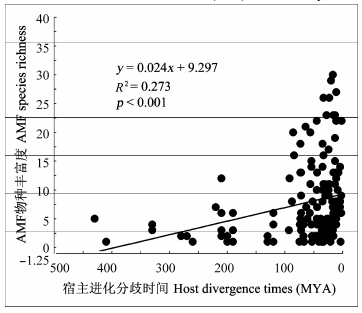
图1 寄主进化分歧时间(MYA, 百万年)与根内丛枝菌根真菌(AMF)物种丰富度之间的关系。
Fig. 1 Relationship between the time of divergence of hosts (MYA, million year) and the richness of arbuscular mycorrhizal fungal (AMF) species in roots.
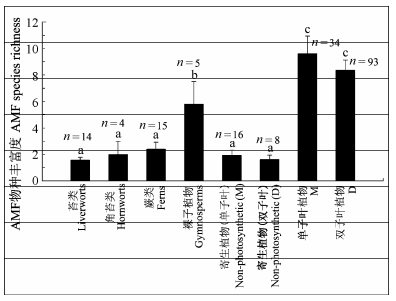
图2 丛枝菌根真菌(AMF)物种丰富度在不同植物系统类群之间的分布(平均值±标准误差)。不同小写字母表示不同植物系统类群间差异显著(p < 0.05)。
Fig. 2 Distribution of species richness of arbuscular mycorrhizal fungi (AMF) in different plant phylogenetic groups (mean ± SE). Different lowercase letters indicate significant differences among different plant phylogenetic groups (p < 0.05). D, dicotyledons; M, monocotyledons.
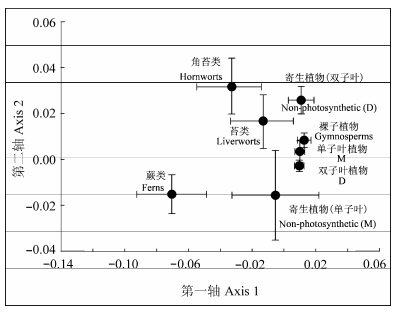
图3 不同植物进化类群根内丛枝菌根真菌群落组成的无度量多维尺度(NMDS)分析。
Fig. 3 Non-metric multidimensional scaling (NMDS) analysis of arbuscular mycorrhizal fungal community composition in different phylogenetic groups. D, dicotyledons; M, monocotyledons.
| L | H | F | G | NPM | M | NPD | D | |
|---|---|---|---|---|---|---|---|---|
| L | - | 0.02 | <0.01 | 0.46 | <0.01 | <0.01 | <0.01 | <0.01 |
| H | - | 0.02 | 0.02 | 0.01 | <0.01 | <0.01 | <0.01 | |
| F | - | 0.07 | 0.01 | <0.01 | <0.01 | <0.01 | ||
| G | - | 0.21 | 0.58 | <0.01 | 0.68 | |||
| NPM | - | <0.01 | <0.01 | <0.01 | ||||
| M | - | <0.01 | 0.94 | |||||
| NPD | - | <0.01 | ||||||
| D | - |
表1 不同植物进化类群根内丛枝菌根真菌群落组成的单因素非参数MANOVA分析
Table 1 One-way NPMANOVA of arbuscular mycorrhizal fungal community composition in different phylogenetic groups of host plants
| L | H | F | G | NPM | M | NPD | D | |
|---|---|---|---|---|---|---|---|---|
| L | - | 0.02 | <0.01 | 0.46 | <0.01 | <0.01 | <0.01 | <0.01 |
| H | - | 0.02 | 0.02 | 0.01 | <0.01 | <0.01 | <0.01 | |
| F | - | 0.07 | 0.01 | <0.01 | <0.01 | <0.01 | ||
| G | - | 0.21 | 0.58 | <0.01 | 0.68 | |||
| NPM | - | <0.01 | <0.01 | <0.01 | ||||
| M | - | <0.01 | 0.94 | |||||
| NPD | - | <0.01 | ||||||
| D | - |
| [1] | Bidartondo MI, Redecker D, Hijri I, Wiemken A, Bruns TD, Domínguez L, Sersic A, Leake JR, Read DJ (2002). Epiparasitic plants specialized on arbuscular mycorrhizal fungi.Nature, 419, 389-392. |
| [2] | Borowicz VA (2001). Do arbuscular mycorrhizal fungi alter plant-pathogen relations? Ecology, 82, 3057-3068. |
| [3] | Field KJ, Cameron DD, Leake JR, Tille S, Bidartondo MI, Beerling DJ (2012). Contrasting arbuscular mycorrhizal responses of vascular and non-vascular plants to a simulated palaeozoic CO2 decline.Nature Communica- tions, 3, 1-8. |
| [4] | Fiz-Palacios O, Schneider H, Heinrichs J, Savolainen V (2011). Diversification of land plants: Insights from a family-level phylogenetic analysis.BMC Evolutionary Biology, 11, 341. |
| [5] | Fonseca HMAC, Berbara RLL (2008). Does Lunularia cruciata form symbiotic relationships with either Glomus proliferum or G. intraradices?Mycological Research, 112, 1063-1068. |
| [6] | Franke T, Beenken L, Döring M, Kocyan A, Agerer R (2006). Arbuscular mycorrhizal fungi of the Glomus-group A lineage (Glomerales; Glomeromycota) detected in myco- heterotrophic plants from tropical Africa.Mycological Progress, 5, 24-31. |
| [7] | Hammer Ø, Harper DAT, Ryan PD (2001). PAST: Paleontolo- gical statistics software package for education and data analysis.Palaeontologia Electronica, 4, 1-9. |
| [8] | Humphreys CP, Franks PJ, Rees M, Bidartondo MI, Leake JR, Beerling DJ (2010). Mutualistic mycorrhiza-like symbiosis in the most ancient group of land plants.Nature Communications, 1, 103. |
| [9] | Kiers ET, Duhamel M, Beesetty Y, Mensah JA, Franken O, Verbruggen E, Fellbaum CR, Kowalchuk GA, Hart MM, Bago A (2011). Reciprocal rewards stabilize cooperation in the mycorrhizal symbiosis.Science, 333, 880-882. |
| [10] | Koide R, Dickie I (2002). Effects of mycorrhizal fungi on plant populations.Plant and Soil, 244, 307-317. |
| [11] | Kottke I, Nebel M (2005). The evolution of mycorrhiza-like associations in liverworts: An update.New Phytologist, 167, 330-334. |
| [12] | Kovács GM, Balázs T, Pénzes Z (2007). Molecular study of arbuscular mycorrhizal fungi colonizing the sporophyte of the eusporangiate rattlesnake fern (Botrychium virginian- um, Ophioglossaceae). Mycorrhiza, 17, 597-605. |
| [13] | Ligrone R, Carafa A, Lumini E, Bianciotto V, Bonfante P, Duckett JG (2007). Glomeromycotean associations in liverworts: A molecular, cellular, and taxonomic analysis.American Journal of Botany, 94, 1756-1777. |
| [14] | Öpik M, Vanatoa A, Vanatoa E, Moora M, Davison J, Kalwij JM, Reier Ü, Zobel M (2010). The online database Maarj AM reveals global and ecosystemic distribution patterns in arbuscular mycorrhizal fungi (Glomeromy- cota).New Phytologist, 188, 223-241. |
| [15] | Pirozynski KA, Malloch DW (1975). The origin of land plants: Amatter of mycotrophism.Biosystems, 6, 153-164. |
| [16] | Read D, Duckett J, Francis R, Ligrone R, Russell A (2000). Symbiotic fungal associations in “lower” land plants.Philosophical Transactions of the Royal Society of London, Series B: Biological Sciences, 355, 815-831. |
| [17] | Redecker D, Kodner R, Graham LE (2000). Glomalean fungi from the Ordovician.Science, 289, 1920-1921. |
| [18] | Remy W, Taylor TN, Hass H, Kerp H (1994). Four hundred- million-year-old vesicular arbuscular mycorrhizae.Proceedings of the National Academy of Sciences of the United of America, 91, 11841-11843. |
| [19] | Russell J, Bulman S (2005). The liverwort Marchantia foliacea forms a specialized symbiosis with arbuscular mycorrhizal fungi in the genus Glomus.New Phytologist, 165, 567-579. |
| [20] | Sanderson MJ (2003). r8s: Inferring absolute rates of molecular evolution and divergence times in the absence of a molecular clock.Bioinformatics, 19, 301-302. |
| [21] | Smith SE, Read DJ (2008). Mycorrhizal Symbiosis. 3rd edn. Academic Press, San Diego, USA. |
| [22] | Stamatakis A (2006). RAxML-VI-HPC: Maximum likelihood- based phylogenetic analyses with thousands of taxa and mixed models.Bioinformatics, 22, 2688-2690. |
| [23] | van der Heijden MGA, Klironomos JN, Ursic M, Moutoglis P, Streitwolf-Engel R, Boller T, Wiemken A, Sanders IR (1998). Mycorrhizal fungal diversity determines plant biodiversity, ecosystem variability and productivity.Nature, 396, 69-72. |
| [24] | van der Heijden MGA, Scheublin TR, Brader A (2004). Taxon- omic and functional diversity in arbuscular mycorrhizal fungi―Is there any relationship?New Phytologist, 164, 201-204. |
| [25] | Wagg C, Jansa J, Stadler M, Schmid B, van der Heijden MGA (2011). Mycorrhizal fungal identity and diversity relaxes plant-plant competition.Ecology, 92, 1303-1313. |
| [26] | Wang B, Yeun LH, Xue JY, Liu Y, Ané JM, Qiu YL (2010). Presence of three mycorrhizal genes in the common ancestor of land plants suggests a key role of mycorrhizas in the colonization of land by plants.New Phytologist, 186, 514-525. |
| [27] | Winther JL, Friedman WE (2007). Arbuscular mycorrhizal symbionts in Botrychium (Ophioglossaceae).American Journal of Botany, 94, 1248-1255. |
| [28] | Wu JP, Liu ZF, Wang XL, Sun YX, Zhou LX, Lin YB, Fu SL (2011). Effects of understory removal and tree girdling on soil microbial community composition and litter decomposition in two Eucalyptus plantations in South China.Functional Ecology, 25, 921-931. |
| [1] | 刘志祥, 黎凤兰, 黄晓磊. 昆虫虫瘿生态系统的复杂性及成瘿机制研究进展[J]. , 2027, 51(动植物互作): 0-. |
| [2] | 何青, 袁旭东, 任博申, 冯治洋, 鲁梦珍, 林巧玲, 姜庆虎, 杨林森, 余辉亮, 姚辉, 杨敬元, 刘峰, 江明喜. 一年蓬(Erigeron annuus)入侵对亚高山泥炭湿地植物群落结构与多样性的影响[J]. 植物生态学报, 2026, 50(预发表): 0-. |
| [3] | 张安宁, 肖亚宁, 赵霞, 张淼, 崔瀚文, 陈书燕, 安黎哲. 青藏高原灌木化与氮添加对土壤线虫及功能性状的交互作用[J]. 植物生态学报, 2026, 50(预发表): 0-. |
| [4] | 李燚, 黄欢, 赵艳超, 陈立同. 养分添加对不同海拔高寒草甸群落多样性及组成的影响[J]. 植物生态学报, 2026, 50(预发表): 0-. |
| [5] | 胡光明, 欧旭, 龙文兴. 热带云雾林宿主树皮粗糙度对附生维管植物多样性与孢子定殖的影响[J]. 植物生态学报, 2026, 50(预发表): 1-. |
| [6] | 段建林, 孟晟, 陈仁利, 熊林峰, 卢春洋, 席念勋. 全球变化因子多样性对菌根植物性状的影响[J]. , 2026, 50(预发表): 0-. |
| [7] | 杨梅花, 张子嘉, 乔栋, 冯俊娜, 庞子杰, 钱龙, 刘志晖, 蔡娜娜, 胡中民, 杨国姣. 海南热带森林乔木群落调查和多样性数据集[J]. 植物生态学报, 2026, 50(预发表): 0-. |
| [8] | 魏莉, 王鹏森, 刘珊, 樊锐, 黄楠, 张建国, 其美拉姆, 苟扬, 刘沫含, 黄婷, 周冀琼. 丛枝菌根真菌对豆禾混播植物垂直生态位养分吸收的影响[J]. 植物生态学报, 2026, 50(3): 760-773. |
| [9] | 周春菡, 熊智诚, 杨明新, 史海兰, 周亚星, 唐玉, 张静, 纪宝明, 代心灵. 黄河源园区高寒湿地菌根真菌群落特征及其影响因素[J]. 植物生态学报, 2026, 50(3): 625-638. |
| [10] | 姜庆宏, 丁露, 王哲, 郑春丽, 冯昭绰. 丛枝菌根真菌与不同功能细菌联用对苜蓿的促生作用[J]. 植物生态学报, 2026, 50(3): 774-788. |
| [11] | 马建辉, 童鑫, 张思榕, 毛子昆, 秦俊, 马克平. 菌根真菌生理生态功能研究进展及展望[J]. 植物生态学报, 2026, 50(3): 498-514. |
| [12] | 王海浪, 付伟, 伍松林, 陈保冬. 丛枝菌根真菌生态功能及群落调控[J]. 植物生态学报, 2026, 50(3): 515-535. |
| [13] | 秦斐斐, 唐朝辉, 司彤, 慈敦伟. 盐碱耐受型和敏感型花生生长发育及根际土壤特性对丛枝菌根真菌的响应[J]. 植物生态学报, 2026, 50(3): 742-759. |
| [14] | 邹纪开, 吴佳怡, 谷云懿, 陈宝明. 不同形态氮添加与丛枝菌根真菌对外来入侵植物白花鬼针草竞争力的影响[J]. 植物生态学报, 2026, 50(3): 722-730. |
| [15] | 何正嘉, 曾歆然, 王琳影, 薛昕宇, 苏钦泽, 李宇, 张寅杰, 吴辉煌, 陈成聪, 吴良泉, 魏安妮, 仇云鹏, 郭梨锦. 茶园丛枝菌根真菌群落和土壤有机碳对镁肥的响应[J]. 植物生态学报, 2026, 50(3): 700-709. |
| 阅读次数 | ||||||
|
全文 |
|
|||||
|
摘要 |
|
|||||
Copyright © 2026 版权所有 《植物生态学报》编辑部
地址: 北京香山南辛村20号, 邮编: 100093
Tel.: 010-62836134, 62836138; Fax: 010-82599431; E-mail: apes@ibcas.ac.cn, cjpe@ibcas.ac.cn
备案号: 京ICP备16067583号-19

