
植物生态学报 ›› 2005, Vol. 29 ›› Issue (3): 487-496.DOI: 10.17521/cjpe.2005.0065 cstr: 32100.14.cjpe.2005.0065
王永峰1,2, 李庆军1,*( )
)
收稿日期:2004-06-02
接受日期:2004-12-14
出版日期:2005-05-30
发布日期:2005-05-30
作者简介:*E-mail: qjlixtbg@bn.yn.cninfo.net基金资助:
WANG Yong-Feng1,2, LI Qing-Jun1,*()
Received:2004-06-02
Accepted:2004-12-14
Online:2005-05-30
Published:2005-05-30
摘要:
综述了国内外生物源挥发性有机化合物 (Biologicalvolatileorganiccompounds, BVOCs) 研究现状及未来的研究方向, 侧重介绍了陆地生态系统中植物排放BVOCs的种类、生物学功能及其对大气化学过程的影响。BVOCs按其化学结构以及在大气中的滞留时间可以分为 4类 :异戊二烯、单萜、其它活性BVOCs和其它次活性BVOCs。不同的植物类群排放不同的BVOCs种类并具有不同的排放特性, 环境条件对植物不同BVOCs的排放影响也不同。BVOCs作为有机物质被排放到体外, 从植物能量代谢的角度来讲要消耗一部分植物光合作用产物从而降低植物的生产力, 因此推测植物排放BVOCs具有一定的生理学或者生态学的功能。其中比较成熟的假说是抗热胁迫假说, 其次是抗氧化假说, 也有一些其它假说例如促氮同化假说等。但这些假说都还缺乏直接的有力证据, 有待更多的研究来支持。BVOCs被排放到大气中对大气化学过程的影响更是科学家关注的问题, BVOCs对大气的影响一方面是在大气对流层中促进臭氧 (O3 ) 的形成, 造成环境污染, 另一方面BVOCs通过对大气中的OH自由基和臭氧等氧化物浓度的调整而影响到大气中甲烷等温室气体的平衡, 对大气温室效应具有间接的贡献。我国在BVOCs的研究上也做了大量的工作, 包括分析鉴定了一些植物排放的BVOCs, 探讨了环境因子对植物BVOCs排放速率的影响, 从不同尺度估测了BVOCs的排放量等等。今后对BVOCs的研究将会集中在以下几个方面 :1) 进一步研究不同植物类群释放的BVOCs种类及其它们在大气中的理化性质 ;2 ) 继续探讨植物排放BVOCs的合成与代谢途径及其生物学功能 ;3) 研究BVOCs对大气化学过程的作用, 以及区域植被变化对BVOCs排放格局进而对区域乃至全球环境变化的影响 ;4 ) 加强对一些研究比较薄弱的生态系统例如在热带地区所进行的BVOCs研究工作 ;5 ) 进一步建立和完善BVOCs排放的理论模型, 以模拟不同陆地生态系统BVOCs排放的时空动态。
王永峰, 李庆军. 陆地生态系统植物挥发性有机化合物的排放及其生态学功能研究进展. 植物生态学报, 2005, 29(3): 487-496. DOI: 10.17521/cjpe.2005.0065
WANG Yong-Feng, LI Qing-Jun. BVOCs EMITTED FROM PLANTS OF TERRESTRIAL ECOSYSTEMSAND THEIR ECOLOGICAL FUNCTIONS. Chinese Journal of Plant Ecology, 2005, 29(3): 487-496. DOI: 10.17521/cjpe.2005.0065
| 种类 Species | 在大气中的寿命 Lifetime in air (h) | 化学式 Formula | 全球年排放量 Global emission (Tg C·a-1) | 主要代表物 Example |
|---|---|---|---|---|
| 异戊二烯 Isoprene | 1~2 | C5H8 | 503 | 异戊二烯 Isoprene |
| 单萜 Monoterpene | 0.5~3 | C10H18 | 127 | α-蒎烯, β-蒎烯 α- pinene, β-pinene |
| 其它活性BVOCs Other reactive BVOCs | < 24 | CxHyOz | 260 | 甲基丁烯醇, 己烯醛 Methylbutenol, Hexenal |
| 其它次活性BVOCs Other less reactive BVOCs | > 24 | CxHyOz | 260 | 甲醇, 乙醇, 丙酮 Methanol, Ethanol, Acetone |
表1 生物源挥发性有机化合物 (BVOCs) 的种类及其特性
Table 1 Categories and traits of biogenic volatile organic compounds (BVOCs)
| 种类 Species | 在大气中的寿命 Lifetime in air (h) | 化学式 Formula | 全球年排放量 Global emission (Tg C·a-1) | 主要代表物 Example |
|---|---|---|---|---|
| 异戊二烯 Isoprene | 1~2 | C5H8 | 503 | 异戊二烯 Isoprene |
| 单萜 Monoterpene | 0.5~3 | C10H18 | 127 | α-蒎烯, β-蒎烯 α- pinene, β-pinene |
| 其它活性BVOCs Other reactive BVOCs | < 24 | CxHyOz | 260 | 甲基丁烯醇, 己烯醛 Methylbutenol, Hexenal |
| 其它次活性BVOCs Other less reactive BVOCs | > 24 | CxHyOz | 260 | 甲醇, 乙醇, 丙酮 Methanol, Ethanol, Acetone |
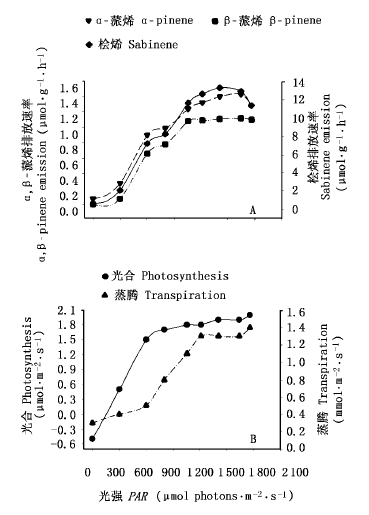
图1 光强对橡胶排放α-蒎烯, β-蒎烯和桧烯的影响
Fig.1 Effect of increasing photosynthesis active radiation (PAR) on α-pinene, sabinene and β-pinene emissions of rubber tree (Hevea brasiliensis)
| [1] |
Affek HP, Yakir D (2002). Protection by isoprene against singlet oxygen in leaves. Plant Physiology, 129,269-277.
DOI URL |
| [2] | Asada K (1994). Production and action of active oxygen species in photosynthetic tissues. In: Foyer CH, Mullineaux PM eds. Causes of Photooxidative Stress and Amelioration of Defense Systems in Plants. CRC, London,77-104. |
| [3] | Bai JH (白建辉), Baker B (2004). Model simulation of isoprene emission flux in a tropical forest plantation of rubber trees. Acta Scientiae Circumstantiae (环境科学学报), 24,197-203. (in Chinese with English abstract) |
| [4] | Bai JH (白建辉), Wang GC (王庚辰), Ren LX (任丽新), Baker B, Zimmerman P, Liang BS (梁宝生) (2003). The emission flux of volatile organic compounds in the Inner Mongolia grassland. Environmental Science (环境科学), 24,17-22. (in Chinese with English abstract) |
| [5] | Bai JH (白建辉), Wang MX (王明星), Graham JR, Prinn G (2001). A study of the nonmethane hydrocarbons at subtropical forest Part Ⅱ. Diurnal variation. Climatic and Environmental Research (气候与环境研究), 6,456-466. (in Chinese with English abstract) |
| [6] | Bai JH (白建辉), Wang MX (王明星), Graham J, Prinn RG, Huang ZL (黄忠良) (1998). Primary study on the concentrations of nonmethane hydrocarbon emitted from the forest. Scientia Atmospherica Sinica (大气科学), 22,247-251. (in Chinese with English abstract) |
| [7] | Bai YH (白郁华), Li JL (李金龙), Zhao MP (赵美萍), Xia Y (夏羽), Tang XY (唐孝炎) (1995). Relative factor of hydrocarbons emission from popular tree. Environmental Chemistry (环境化学), 14,118-123. (in Chinese with English abstract) |
| [8] |
Benjamin MT (1996). Low-emitting urban forests: a taxonomic methodology for assessing isoprene and monoterpene emission rates. Atmospheric Environment, 30,1437-1452.
DOI URL |
| [9] | Brasseur G, Chatfield R (1991). The fate of biogenic trace gases in the atmosphere. In: Sharkey T, Holland E, Mooney H eds. Trace Gas Emissions by Plants. Academic Press, San Diego,1-27. |
| [10] |
Carter WPL, Atkinson R (1996). Development and evaluation of a detailed mechanism for the atmospheric reactions of isoprene and NOx. International Journal of Chemical Kinetics, 28,497-530.
DOI URL |
| [11] |
Delwiche CF, Sharkey TD (1993). Rapid appearance of 13C in biogenic isoprene when 13CO2 is fed to intact leaves. Plant, Cell and Environment, 16,587-591.
DOI URL |
| [12] |
De Moraes CM, Mescher MC, Tumlinson JH (2001). Caterpillar-induced nocturnal plant volatiles repel conspecific females. Nature, 410,577-580.
PMID |
| [13] | Fehsenfeld F, Calvert J, Fall R, Goldan P, Guenther AB, Lamb B, Trainer M, Westberg H, Zimmerman P, Hewitt CN (1992). Emissions of volatile organic compounds from vegetation and the implications for atmospheric chemistry. Global Biogeochemical Cycles, 6,389-430. |
| [14] | Fuentes JD, Hayden BP, Garstang M, Lerdau M, Fitzjarrald D, Baldocchi DD, Monson R, Lamb B, Geron C (2000). VOCs and biosphere-atmosphere feedbacks. Atmospheric Environment, 31,189-191. |
| [15] |
Gershenzon J, McConkey ME, Croteau RB (2000). Regulation of monoterpene accumulation in leaves of peppermint. Plant Physiology, 122,205-213.
DOI URL |
| [16] |
Gray DW, Lerdau MT, Goldstein AH (2003). Influrences of temperature history, water stress, and needle age on methylbutenol emissions. Ecology, 84,765-776.
DOI URL |
| [17] |
Guenther AB, Hewitt CN, Erickson D, Fall R, Geron C, Graedel T, Harley P, Klinger L, Lerdau M, McKay WA, Pierce T, Scholes B, Steinbrecher R, Tallamraju R, Taylor J, Zimmerman P (1995). A global model of natural volatile organic compound emissions. Journal of Geophysical Research, 100,8873-8892.
DOI URL |
| [18] |
Guenther AB, Monson RK, Fall R (1991). Isoprene and monoterpene emission rate variability: observations with eucalyptus and emission rate algorithm development. Journal of Geophysical Research, 96,10799-10808.
DOI URL |
| [19] |
Harley P, Fridd-Stroud V, Greenberg J, Guenther A, Vasconcellos P (1998). Emission of 2-methyl-3-buten-2-ol by pines: a potentially large natural source of reactive carbon to the atmosphere. Journal of Geophysical Research, 103,25479-25486.
DOI URL |
| [20] | Hewitt CN, Kok GL, Fall R (1990). Hydroperoxides in plants exposed to ozone mediate air pollution damage to alkene emitters. Nature, 344,56-58. |
| [21] |
Jacob DJ, Wofsy SC (1988). Photochemistry of biogenic emissions over the Amazon forest. Journal of Geophysical Research, 93,1477-1486.
DOI URL |
| [22] |
Kavouras LG, Mihalopoulos N, Stephanou EG (1998). Formation of atmospheric particles from organic acids produced by forests. Nature, 395,683-686.
DOI URL |
| [23] |
Kesselmeier J, Staudt M (1999). Biogenic volatile organic compounds (VOC) : an overview on emission, physiology and ecology. Journal of Atmospheric Chemistry, 33,23-88.
DOI URL |
| [24] |
Klinger LF, Greenberg JP, Guenther AB, Tyndall G, Zimmerman P, M'Bangui M, Moutsamboté JM, Kenfack D (1998). Patterns in volatile organic compound emissions along a savanna-rainforest gradient in central Africa. Journal of Geophysical Research, 103,1443-1454.
DOI URL |
| [25] | Klinger LF, Li QJ, Guenther AB, Greenberg JP, Baker B, Bai JH (2002). Assessment of volatile organic compound emissions from ecosystems of China. Journal of Geophysical Research, 107,4603-4624. |
| [26] |
Langenheim J (1994). Higher plant terpenoids: a phytocentric overview of their ecological roles. Journal of Chemical Ecology, 20,1223-1280.
DOI URL |
| [27] |
Larom D, Garstang M, Lindeque M, Raspet R, Zunckel M, Hong Y, Brassel K, O'Beirne S, Sokolic F (1997). The influence of surface atmospheric conditions on the range and area reached by animal vocalizations. Journal of Experimental Biology, 200,421-431.
PMID |
| [28] | Li JL (李金龙), Bai YH (白郁华), Hu JX (胡建信), Shao M (邵敏), Zhang BX (张宝祥), Xia Y (夏羽), Tang XY (唐孝炎) (1994). Diurnal variation in the concentration of terpenes and its emission rate measurements from oil pine. China Environmental Science (中国环境科学), 14,165-169. (in Chinese with English abstract) |
| [29] | Li QJ (李庆军), Klinger LF (2001). The correlation between the volatile organic compound emissions and the vegetation succession of ecosystems in different climatic zones of China. Acta Botanica Sinica (植物学报), 43,1065-1071. (in Chinese with English abstract) |
| [30] |
Lichtenthaler HK, Schwender J, Disch A, Rohmer M (1997). Biosynthesis of isoprenoids in higher plant chloroplasts proceeds via a mevalonate-independent pathway. FEBS Letters, 400,271-274.
DOI URL |
| [31] | Loreto F, Ciccioli P, Brancaleoni E, Valentini R, Lillis MD, Csiky O, Seufert G (1998). A hypothesis on the evolution of isoprenoid emission by oaks based on the correlation between emission type and Quercus taxonomy. Oecologia, 11,302-305. |
| [32] |
Loreto F, Ciccioli P, Cecinato A, Brancaleoni E, Frattoni M, Tricoli D (1996). Influence of environmental factors and air composition on the emission of alpha-pinene from Quercus ilex leaves. Plant Physiology, 110,267-275.
PMID |
| [33] |
Loreto F, Mannozzi M, Maris C, Nascetti P, Ferranti F, Pasqualini S (2001). Ozone quenching properties of isoprene and its antioxidant role in leaves. Plant Physiology, 126,993-1000.
DOI URL |
| [34] |
Loreto F, Sharkey TD (1990). A gas-exchange study of photosynthesis and isoprene emission in Quercus rubru L. Planta, 182,523-531.
DOI PMID |
| [35] |
Loreto F, Velikova V (2001). Isoprene produced by leaves protects the photosynthetic apparatus against ozone damage, quenches ozone products, and reduces lipid peroxidation of cellular membranes. Plant Physiology, 127,1781-1787.
DOI URL |
| [36] |
Martin DM, Gershenzon J, Bohlmann J (2003). Induction of volatile terpene biosynthesis and diurnal emission by Methyl Jasmonate in foliage of Norway spruce. Plant Physiology, 132,1586-1599.
DOI URL |
| [37] |
Martin PH, Guenther AB (1995). Insights into the dynamics of forest succession and non-methane hydrocarbon trace gas emissions. Journal of Biogeography, 22,493-499.
DOI URL |
| [38] |
Monson R, Harley P, Litvak M, Wildermuth M, Guenther A, Zimmerman P, Fall R (1994). Environmental and developmental controls over the seasonal pattern of isoprene emission from aspen leaves. Oecologia, 99,260-270.
DOI PMID |
| [39] |
Niinemets M, Reichstein M, Seufert G, Tenhunen JD (2002). Stomatal constraints may affect emission of oxygenated monoterpenoids from the foliage of Pinus pinea. Plant Physiology, 130,1371-1385.
DOI URL |
| [40] | Owen SM, Harley P, Guenther AB, Hewitt CN (2002). Light dependency of VOC emissions from selected Mediterranean plant species. Atmospheric Environment, 36,3147-3159. |
| [41] |
Paré PW, Tumlinson JH (1997). De novo biosynthesis of volatiles induced by insect herbivory in cotton plants. Plant Physiology, 114,1161-1167.
DOI URL |
| [42] |
Peñuelas J, Llusià J (2001). The complexity of factors driving volatile organic compound emissions by plants. Biologia Plantarum, 44,481-487.
DOI URL |
| [43] |
Peñuelas J, Llusià J (2003). BVOCs: plant defense against climate warming? Trends in Plant Science, 8,105-109.
DOI URL |
| [44] |
Rohmer M (1993). The biosynthesis of triterpenoids of the hopane series in the Eubacteria: a mine of new enzyme reactions. Pure and Applied Chemistry, 65,1293-1298.
DOI URL |
| [45] |
Rohmer M, Knani M, Simonin P, Sahm H (1993). Isoprenoid biosynthesis in bacteria: a novel pathway for the early steps leading to isopentenyl diphosphate. The Biochemical Journal, 295,517-524.
DOI URL |
| [46] |
Rosenstiel TN, Fisher AJ, Fall R, Monson RK (2002). Differential accumulation of dimethylallyl diphosphate in leaves and needles of isoprene- and methylbutenol-emitting and nonemitting species. Plant Physiology, 129,1276-1284.
DOI URL |
| [47] | Sharkey TD, Singsaas EL (1995). Why plants emit isoprene? Nature, 374,769. |
| [48] |
Sharkey TD, Chen X, Yeh S (2001). Isoprene increases thermotolerance of fosmidomycin-fed leaves. Plant Physiology, 125,2001-2006.
DOI URL |
| [49] | Sharkey TD, Yeh S (2001). Isoprene emission from plants. Annual Review of Plant Physiology & Plant Molecular Biology, 52,407-436. |
| [50] |
Shallcross DE, Monks PS (2000). A role for isoprene in biosphere-climate-chemistry feedbacks? Atmospheric Environment, 34,1659-1660.
DOI URL |
| [51] |
Shen B, Jensen RG, Bohnert HJ (1997). Mannitol protects against oxidation by hydroxyl radicals. Plant Physiology, 115,527-532.
PMID |
| [52] |
Singsaas EL, Lerdau M, Winter K, Sharkey TD (1997). Isoprene increases thermotolerance of isoprene-emitting species. Plant Physiology, 115,1413-1420.
PMID |
| [53] |
Staudt M, Seufert G (1995). Light-dependent emissions of monoterpenes by holm oak (Quercus ilex L.). Naturwissenschaften, 82,89-92.
DOI URL |
| [54] |
Terry GM, Stokes NJ, Hewitt CN, Mansfield TA (1995). Exposure to isoprene promotes flowering in plants. Journal of Experimental Botany, 46,1629-1631.
DOI URL |
| [55] | Tingey TD, Turner DP, Weber JA (1991). Factors controlling the emissions of monoterpenes and other volatile organic compounds. Trace Gas Emissions by Plants. Academic Press, San Diego,93-119. |
| [56] |
Trainer M, Williams E, Parrish D, Buhr M, Allwine E, Westberg H, Fehsenfeld F, Liu S (1987). Models and observations of the impact of natural hydrocarbons on rural ozone. Nature, 329,705-707.
DOI URL |
| [57] |
Tuazon EC, Atkinson R (1990). A product study of the gas-phase reaction of isoprene with the OH radical in the presence of NOx. International Journal of Chemical Kinetics, 22,1221-1236.
DOI URL |
| [58] |
Wildermuth MC, Fall R (1998). Biochemical characterization of stromal and thylakoid-bound isoforms of isoprene synthase in willow leaves. Plant Physiology, 116,1111-1123.
PMID |
| [59] | Zhang L (张莉), Bai YY (白艳莹), Wang XK (王效科), Ouyang ZY (欧阳志云), Mu YJ (牟玉静), Miao QL (缪启龙) (2002). Isoprene emission of bamboo and its implication to ozone level in region. Acta Ecologica Sinica (生态学报), 22,1339-1344. (in Chinese with English abstract) |
| [60] | Zhao MP (赵美萍), Shao M (邵敏), Bai YH (白郁华), Li JL (李金龙), Tang XY (唐孝炎) (1996). Study on NMHC emission characteristics of several typical trees in China. Environmental Chemistry (环境化学), 15,69-75. (in Chinese with English abstract) |
| [1] | 曹伊菲, 苏涛, 曹敏, 汪海燕, 杨洁. 新生代被子植物叶脉密度演化的驱动因素研究:气候适应与植食压力[J]. , 2027, 51(动植物互作): 0-. |
| [2] | 段建林, 孟晟, 陈仁利, 熊林峰, 卢春洋, 席念勋. 全球变化因子多样性对菌根植物性状的影响[J]. , 2026, 50(预发表): 0-. |
| [3] | 谭秋颜, 张清, 高程, 褚海燕, 杨腾. 外生菌根真菌: 高寒生态系统碳氮循环的关键驱动者[J]. 植物生态学报, 2026, 50(3): 584-599. |
| [4] | 方迪, 马宁, 李胜功, 郑甲佳, 褚云馨, 杨锦昌, 杨赞明, 张龙宁, 孟盛旺, 高德才, 戴晓琴, 付晓莉, 王辉民, 寇亮. 菌根共生类型对森林养分内循环的调控作用[J]. 植物生态学报, 2026, 50(3): 552-565. |
| [5] | 王发园, 张莘, 陈保冬. 土壤微塑料与丛枝菌根真菌的相互作用[J]. 植物生态学报, 2026, 50(3): 612-624. |
| [6] | 侯霄帆, 马辰涵, 孙语倩, 高钰涵, 李品. 臭氧胁迫下叶片与细根凋落物分解的生态化学计量特征差异[J]. 植物生态学报, 2026, 50(2): 268-278. |
| [7] | 常鹏飞, 李平, 纳尔斯格, 王静, 王振华, 杨森, 贾舟, 杨璐, 刘玲莉, 邓美凤. 内蒙古温带草原不同草地类型土壤有机碳和无机碳储量对总碳储量的贡献及其驱动因素[J]. 植物生态学报, 2025, 49(9): 1374-1387. |
| [8] | 张琳, 袁伟影, 宋创业, 吴冬秀. 1998-2010年中国典型生态系统长期监测样地环境要素、物种丰富度和生物量动态数据集[J]. 植物生态学报, 2025, 49(8): 1182-1190. |
| [9] | 范亚冉, 夏少攀, 于冰冰, 朱紫琪, 杨威, 范豫川, 刘晓雨, 张旭辉, 郑聚锋. 大气CO2浓度升高和增温对土壤有机碳库积累、分子组成和结构稳定性的影响[J]. 植物生态学报, 2025, 49(7): 1053-1069. |
| [10] | 李港墩, 钱尼澎, 王林旭, 董淳超, 刘琪璟. 长白山红松和春榆径向生长季节动态对环境因子的响应[J]. 植物生态学报, 2025, 49(7): 1110-1118. |
| [11] | 刘碧颖, 陈子豪, 源思浩, 周婷. 植被志书研编中图表绘制的常见问题与技术参考[J]. 植物生态学报, 2025, 49(6): 911-921. |
| [12] | 乔沛阳, 顾肖璇, 刘昌鑫, 曹泽宇, 张婷婷, 林晨, 陈钦常, 彭修凡, 陈菲菲, 李华亮, 陈伟, 陈鹭真. 超强台风“摩羯”登陆点海南东寨港红树林受损状况研究[J]. 植物生态学报, 2025, 49(4): 540-551. |
| [13] | 周思琪, 艾灵, 倪祥银, 吴福忠, 吴秋霞, 朱晶晶, 张欣影. 全球植物凋落物纤维素分解速率的变化特征及其影响因子[J]. 植物生态学报, 2025, 49(3): 393-403. |
| [14] | 王堃莹, 邱贵福, 刘子赫, 孟君, 刘宇轩, 贾国栋. 气候变化对不同退化程度小叶杨林分生长和内在水分利用效率的调节[J]. 植物生态学报, 2025, 49(2): 343-355. |
| [15] | 黄美红, 牛梦秋, 杨鹏飞, 林洁, 廖周瑜, 陈建国, 向建英. 不同温度和埋藏深度对高山垫状植物山生福禄草种子出苗及幼苗生长的影响[J]. 植物生态学报, 2025, 49(12): 2092-2104. |
| 阅读次数 | ||||||
|
全文 |
|
|||||
|
摘要 |
|
|||||
Copyright © 2026 版权所有 《植物生态学报》编辑部
地址: 北京香山南辛村20号, 邮编: 100093
Tel.: 010-62836134, 62836138; Fax: 010-82599431; E-mail: apes@ibcas.ac.cn, cjpe@ibcas.ac.cn
备案号: 京ICP备16067583号-19

