
植物生态学报 ›› 2022, Vol. 46 ›› Issue (1): 114-122.DOI: 10.17521/cjpe.2021.0223 cstr: 32100.14.cjpe.2021.0223
所属专题: 青藏高原植物生态学:植被生态学; 青藏高原植物生态学:数据论文; 植被生态学; 数据论文
• 数据论文 • 上一篇
朱芩1, 宁盼1, 侯琳1,*( ), 郝家田2, 胡云云2
收稿日期:2021-06-11
接受日期:2021-09-28
出版日期:2022-01-20
发布日期:2022-04-13
通讯作者:
*(houlin_1969@nwsuaf.edu.cn)基金资助:
Qin ZHU1, Pan NING1, Lin HOU1,*(), Jia-Tian HAO2, Yun-Yun HU2
Received:2021-06-11
Accepted:2021-09-28
Online:2022-01-20
Published:2022-04-13
摘要:
三江源地区位于青藏高原的腹地, 是典型的生态脆弱区, 刺柏属(Juniperus)植物群落是该地区天然林资源的重要组分, 在维持生物多样性与水生态安全方面发挥着重要作用。该研究调查了刺柏属植物群落的主要植被类型, 通过对53个样地的样方数据分析, 量化描述了其各个群落类型的主要特征。结果表明: (1)根据生活型和优势度原则, 该区刺柏属植物群落可划分为祁连圆柏(J. przewalskii)林、大果圆柏(J. tibetica)林、密枝圆柏(J. convallium)林、塔枝圆柏(J. komarovii)林、大果圆柏灌丛和密枝圆柏灌丛, 进一步分为15个群丛。(2)调查所得维管植物共有142种, 隶属34科90属, 其中菊科种数最多, 占总种数的16.20%。(3)群落垂直结构明显, 其中乔木层优势种单一, 灌木层优势种主要有鲜黄小檗(Berberis diaphana)、银露梅(Potentilla glabra)及灌木状的大果圆柏, 草本层以薹草属(Carex)和马先蒿属(Pedicularis)占优势。(4)该区种子植物种的地理成分中, 温带成分占总种数的52.59%, 温带亚洲分布、东亚分布和中亚分布等为本区分布占比较大的分布区类型; 中国特有种占47.41%; 区系成分呈现横断山植物区系和唐古特植物区系成分互相交融的特点。
朱芩, 宁盼, 侯琳, 郝家田, 胡云云. 三江源地区刺柏属植物群落类型特征. 植物生态学报, 2022, 46(1): 114-122. DOI: 10.17521/cjpe.2021.0223
Qin ZHU, Pan NING, Lin HOU, Jia-Tian HAO, Yun-Yun HU. Characteristics of Juniperus community types in the Three-River-Source Region. Chinese Journal of Plant Ecology, 2022, 46(1): 114-122. DOI: 10.17521/cjpe.2021.0223
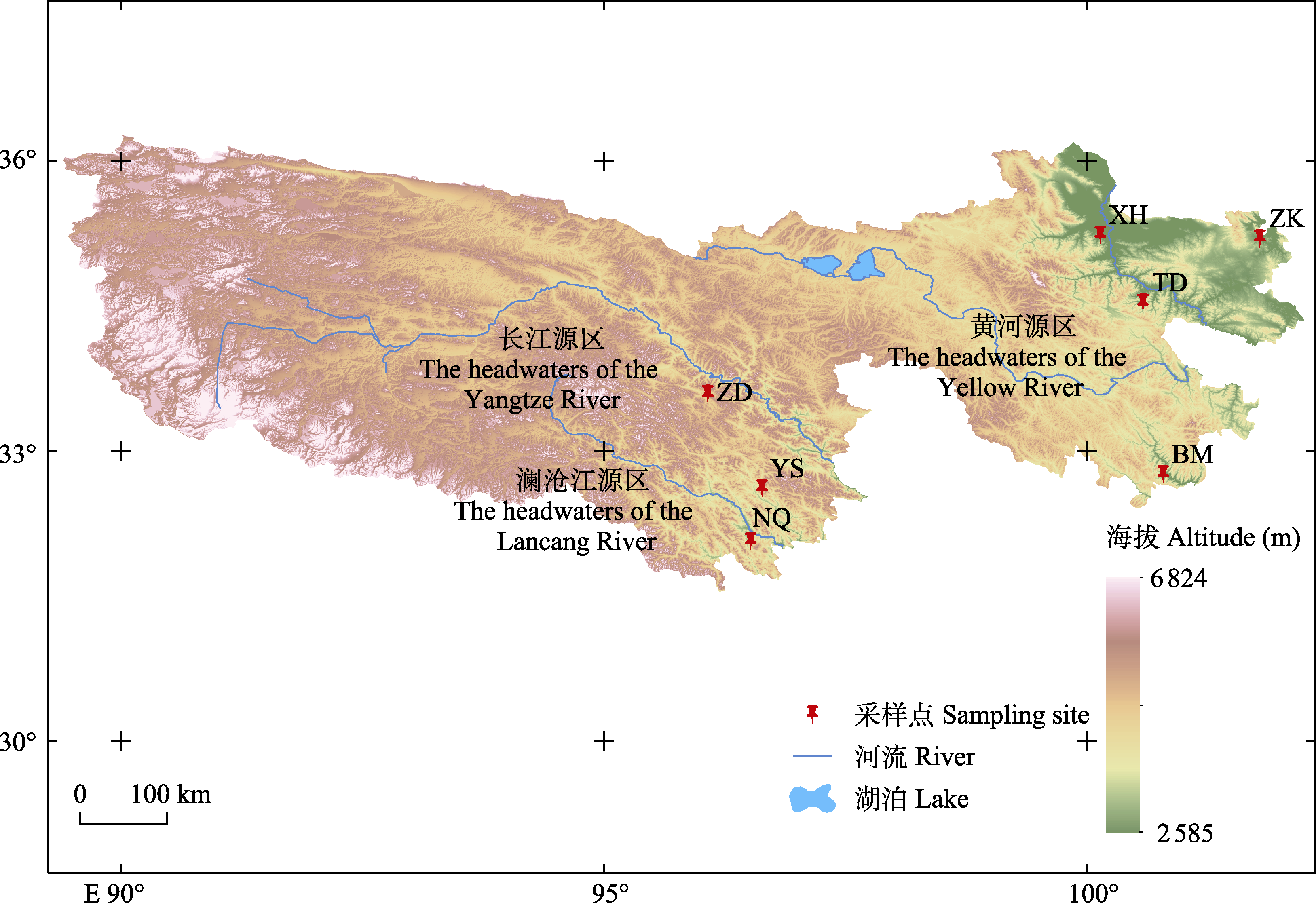
图1 三江源地区植物群落调查采样点。 BM, 班玛县玛可河林场; NQ, 囊谦县白扎林场; TD, 同德县河北林场; XH, 兴海县中铁林场; YS, 玉树市江西林场; ZD, 治多县立新乡; ZK, 泽库县麦秀林场。
Fig. 1 Sampling sites for plant community investigation in the Three-River-Source Region. BM, Make River Forest Farm in Baima County; NQ, Baizha Forest Farm in Nangqên County; TD, Hebei Forest Farm in Tongde County; XH, Zhongtie Forest Farm in Xinghai County; YS, Jiangxi Forest Farm in Yushu City; ZD, Lixin township in Zhidoi County; ZK, Maixiu Forest Farm in Zêkog County.
| 群丛 Association | 样地号 No. of plot | 分布地 Location | 海拔 Altitude (m) | 坡向 Aspect | 坡度 Slope gradient (°) | 林分平均胸径 Stand average DBH (cm) | 林分平均高 Stand mean height (m) |
|---|---|---|---|---|---|---|---|
| I | 37, 38, 49 | ZK | 2 930-3 322 | 阳坡或半阳坡 Sunny slope or half sunny slope | 24-38 | 29.5 ± 7.9 | 8.8 ± 0.9 |
| II | 32, 34 | ZK | 3 020-3 082 | 阳坡 Sunny slope | 31-37 | 20.7 ± 0.0 | 8.5 ± 0.2 |
| III | 31, 33, 35, 36 | ZK | 2 940-3 100 | 阳坡 Sunny slope | 34-40 | 22.3 ± 4.2 | 8.5 ± 0.8 |
| IV | 42, 43, 44 | TD | 3 360-3 420 | 阳坡 Sunny slope | 25-32 | 28.8 ± 6.7 | 10.0 ± 2.3 |
| V | 39, 40, 41 | TD | 3 322-3 350 | 阴坡 Shady slope | 25-30 | 35.0 ± 2.7 | 7.4 ± 1.9 |
| VI | 45, 46, 47, 48, 50 | XH | 3 630-3 800 | 阳坡或半阳坡 Sunny slope or half sunny slope | 31-39 | 32.0 ± 11.3 | 9.4 ± 2.5 |
| VII | 14, 23, 24, 25, 26, 27, 28, 29, 30 | NQ | 3 640-4 170 | 阳坡 Sunny slope | 33-40 | 23.1 ± 9.1 | 6.3 ± 1.3 |
| VIII | 7, 8, 11, 12 | BM | 3 710-3 755 | 阳坡或半阳坡 Sunny slope or half sunny slope | 22-30 | 19.5 ± 4.3 | 6.2 ± 1.0 |
| IX | 9 | BM | 3 660 | 阳坡 Sunny slope | 38 | 17.6 | 5.4 |
| X | 18, 19, 20, 21, 22 | YS | 3 532-3 755 | 阳坡或半阳坡 Sunny slope or half sunny slope | 29-34 | 22.8 ± 4.0 | 7.8 ± 0.6 |
| XI | 1, 2, 3, 4, 5, 6 | BM | 3 573-3 600 | 阳坡或半阳坡 Sunny slope or half sunny slope | 24-33 | 17.0 ± 4.8 | 6.2 ± 0.4 |
| XII | 51, 52, 53 | ZD | 4 102-4 290 | 阳坡 Sunny slope | 32-40 | - | - |
| XIII | 15, 16, 17 | NQ | 3 972-4 060 | 阳坡 Sunny slope | 29-35 | - | - |
| XIV | 10 | BM | 3 790 | 阳坡 Sunny slope | 49 | - | - |
| XV | 13 | NQ | 3 800 | 阴坡 Shady slope | 28 | - | - |
表1 三江源地区刺柏属植物群落分类主要特征
Table 1 Main traits of Juniperus community in the Three-River-Source Region
| 群丛 Association | 样地号 No. of plot | 分布地 Location | 海拔 Altitude (m) | 坡向 Aspect | 坡度 Slope gradient (°) | 林分平均胸径 Stand average DBH (cm) | 林分平均高 Stand mean height (m) |
|---|---|---|---|---|---|---|---|
| I | 37, 38, 49 | ZK | 2 930-3 322 | 阳坡或半阳坡 Sunny slope or half sunny slope | 24-38 | 29.5 ± 7.9 | 8.8 ± 0.9 |
| II | 32, 34 | ZK | 3 020-3 082 | 阳坡 Sunny slope | 31-37 | 20.7 ± 0.0 | 8.5 ± 0.2 |
| III | 31, 33, 35, 36 | ZK | 2 940-3 100 | 阳坡 Sunny slope | 34-40 | 22.3 ± 4.2 | 8.5 ± 0.8 |
| IV | 42, 43, 44 | TD | 3 360-3 420 | 阳坡 Sunny slope | 25-32 | 28.8 ± 6.7 | 10.0 ± 2.3 |
| V | 39, 40, 41 | TD | 3 322-3 350 | 阴坡 Shady slope | 25-30 | 35.0 ± 2.7 | 7.4 ± 1.9 |
| VI | 45, 46, 47, 48, 50 | XH | 3 630-3 800 | 阳坡或半阳坡 Sunny slope or half sunny slope | 31-39 | 32.0 ± 11.3 | 9.4 ± 2.5 |
| VII | 14, 23, 24, 25, 26, 27, 28, 29, 30 | NQ | 3 640-4 170 | 阳坡 Sunny slope | 33-40 | 23.1 ± 9.1 | 6.3 ± 1.3 |
| VIII | 7, 8, 11, 12 | BM | 3 710-3 755 | 阳坡或半阳坡 Sunny slope or half sunny slope | 22-30 | 19.5 ± 4.3 | 6.2 ± 1.0 |
| IX | 9 | BM | 3 660 | 阳坡 Sunny slope | 38 | 17.6 | 5.4 |
| X | 18, 19, 20, 21, 22 | YS | 3 532-3 755 | 阳坡或半阳坡 Sunny slope or half sunny slope | 29-34 | 22.8 ± 4.0 | 7.8 ± 0.6 |
| XI | 1, 2, 3, 4, 5, 6 | BM | 3 573-3 600 | 阳坡或半阳坡 Sunny slope or half sunny slope | 24-33 | 17.0 ± 4.8 | 6.2 ± 0.4 |
| XII | 51, 52, 53 | ZD | 4 102-4 290 | 阳坡 Sunny slope | 32-40 | - | - |
| XIII | 15, 16, 17 | NQ | 3 972-4 060 | 阳坡 Sunny slope | 29-35 | - | - |
| XIV | 10 | BM | 3 790 | 阳坡 Sunny slope | 49 | - | - |
| XV | 13 | NQ | 3 800 | 阴坡 Shady slope | 28 | - | - |
| 分布类型 Areal-type | 种数 Species | 占总种数的比例 Ratio to total species (%) |
|---|---|---|
| 1. 世界分布 Cosmopolitan distribution | 7 | - |
| 温带分布 Temperate distribution | 71 | 52.59 |
| 8. 北温带 North Temperate | 8 | 5.93 |
| 10. 旧世界温带 Old World Temperate | 4 | 2.96 |
| 11. 温带亚洲 Temperate Asia | 26 | 19.26 |
| 13. 中亚 Central Asia | 13 | 9.63 |
| 13-0. 中亚广布 Pan-Central Asia | (3) | (2.22) |
| 13-1. 中亚东部(亚洲中部) East Central Asia (Asia Media) | (6) | (4.44) |
| 13-2. 中亚至喜马拉雅和我国西南 Central Asia to Himalaya & Southwest China | (4) | (2.96) |
| 14. 东亚 East Asia | 20 | 14.81 |
| 14-0. 东亚广布 Pan-East Asia | (4) | (2.96) |
| 14-1. 中国-喜马拉雅 Sino-Himalaya | (15) | (11.11) |
| 14-2. 中国日本 Sino-Japan | (1) | (0.74) |
| 非中国特有种 Non-Chinese endemic species | 78 | - |
| 15. 中国特有种 Endemic to China | 64 | 47.41 |
| 合计(不含世界分布) Total (excluded the cosmopolitan distribution) | 135 | 100 |
表2 刺柏属典型群落种子植物种的分布区类型
Table 2 Species areal-types of seed plants in typical communities of Juniperus
| 分布类型 Areal-type | 种数 Species | 占总种数的比例 Ratio to total species (%) |
|---|---|---|
| 1. 世界分布 Cosmopolitan distribution | 7 | - |
| 温带分布 Temperate distribution | 71 | 52.59 |
| 8. 北温带 North Temperate | 8 | 5.93 |
| 10. 旧世界温带 Old World Temperate | 4 | 2.96 |
| 11. 温带亚洲 Temperate Asia | 26 | 19.26 |
| 13. 中亚 Central Asia | 13 | 9.63 |
| 13-0. 中亚广布 Pan-Central Asia | (3) | (2.22) |
| 13-1. 中亚东部(亚洲中部) East Central Asia (Asia Media) | (6) | (4.44) |
| 13-2. 中亚至喜马拉雅和我国西南 Central Asia to Himalaya & Southwest China | (4) | (2.96) |
| 14. 东亚 East Asia | 20 | 14.81 |
| 14-0. 东亚广布 Pan-East Asia | (4) | (2.96) |
| 14-1. 中国-喜马拉雅 Sino-Himalaya | (15) | (11.11) |
| 14-2. 中国日本 Sino-Japan | (1) | (0.74) |
| 非中国特有种 Non-Chinese endemic species | 78 | - |
| 15. 中国特有种 Endemic to China | 64 | 47.41 |
| 合计(不含世界分布) Total (excluded the cosmopolitan distribution) | 135 | 100 |
| 分布亚型 Areal-subtypes | 种数 Species | 占本类型比例 Ratio of this type (%) | 占总种数的比例 Ratio to total species (%) |
|---|---|---|---|
| 15-2. 三江源地区与唐古特地区共有 Species common to the Three-River Headwater Region and Tanggute Region | 1 | 1.56 | 0.74 |
| 15-3. 三江源地区与中国其他地区共有 Species common to the Three-River Headwater Region and other areas in China | 63 | 98.44 | 46.67 |
| a. 西藏(北部)或(西北部) North Xizang or Northeast Xizang | (1) | (1.56) | (0.74) |
| b. 四川(西部) West Sichuan | (3) | (4.69) | (2.22) |
| c. 西藏-四川 Xizang and Sichuan | (2) | (3.13) | (1.48) |
| e. 四川-云南 Sichuan and Yunnan | (1) | (1.56) | (0.74) |
| f. 西南(藏、滇、川) Southwest China (Xizang, Sichuan and Yunnan) | (4) | (6.25) | (2.96) |
| g. 甘肃或甘肃(南部) Gansu or South Gansu | (4) | (6.25) | (2.96) |
| i. 四川-甘肃 Sichuan and Gansu | (7) | (10.94) | (5.19) |
| j. 西藏-四川-甘肃 Xizang, Sichuan and Gansu | (11) | (17.19) | (8.15) |
| k. 四川-甘肃-陕西 Sichuan, Gansu and Shaanxi | (1) | (1.56) | (0.74) |
| o. 甘肃-陕西 Gansu and Shaanxi | (1) | (1.56) | (0.74) |
| r. 西南-西北 Southwest & Northwest China | (11) | (17.19) | (8.15) |
| s. 西北-华北 Northwest & North China | (4) | (6.25) | (2.96) |
| t. 西南-西北-华北 Southwest, Northwest & North China | (6) | (9.38) | (4.44) |
| u. 北方(西北-华北-东北) North of China (Northwest, North and Northeast China) | (2) | (3.13) | (1.48) |
| v. 西南-西北-华中 Southwest, Northwest & Central China | (2) | (3.13) | (1.48) |
| w. 西南-西北-华北-华中 Southwest, Northwest, North & Central China | (1) | (1.56) | (0.74) |
| x. 北方-西南 North & Southwest China | (1) | (1.56) | (0.74) |
| z. 北方-南方 Throughout the mainland of China | (1) | (1.56) | (0.74) |
| 合计 Total | 64 | 100 | 47.41 |
表3 刺柏属典型群落种子植物中国特有种的分布亚型
Table 3 Areal-subtypes of Chinese endemic species of seed plants in typical communities of Juniperus
| 分布亚型 Areal-subtypes | 种数 Species | 占本类型比例 Ratio of this type (%) | 占总种数的比例 Ratio to total species (%) |
|---|---|---|---|
| 15-2. 三江源地区与唐古特地区共有 Species common to the Three-River Headwater Region and Tanggute Region | 1 | 1.56 | 0.74 |
| 15-3. 三江源地区与中国其他地区共有 Species common to the Three-River Headwater Region and other areas in China | 63 | 98.44 | 46.67 |
| a. 西藏(北部)或(西北部) North Xizang or Northeast Xizang | (1) | (1.56) | (0.74) |
| b. 四川(西部) West Sichuan | (3) | (4.69) | (2.22) |
| c. 西藏-四川 Xizang and Sichuan | (2) | (3.13) | (1.48) |
| e. 四川-云南 Sichuan and Yunnan | (1) | (1.56) | (0.74) |
| f. 西南(藏、滇、川) Southwest China (Xizang, Sichuan and Yunnan) | (4) | (6.25) | (2.96) |
| g. 甘肃或甘肃(南部) Gansu or South Gansu | (4) | (6.25) | (2.96) |
| i. 四川-甘肃 Sichuan and Gansu | (7) | (10.94) | (5.19) |
| j. 西藏-四川-甘肃 Xizang, Sichuan and Gansu | (11) | (17.19) | (8.15) |
| k. 四川-甘肃-陕西 Sichuan, Gansu and Shaanxi | (1) | (1.56) | (0.74) |
| o. 甘肃-陕西 Gansu and Shaanxi | (1) | (1.56) | (0.74) |
| r. 西南-西北 Southwest & Northwest China | (11) | (17.19) | (8.15) |
| s. 西北-华北 Northwest & North China | (4) | (6.25) | (2.96) |
| t. 西南-西北-华北 Southwest, Northwest & North China | (6) | (9.38) | (4.44) |
| u. 北方(西北-华北-东北) North of China (Northwest, North and Northeast China) | (2) | (3.13) | (1.48) |
| v. 西南-西北-华中 Southwest, Northwest & Central China | (2) | (3.13) | (1.48) |
| w. 西南-西北-华北-华中 Southwest, Northwest, North & Central China | (1) | (1.56) | (0.74) |
| x. 北方-西南 North & Southwest China | (1) | (1.56) | (0.74) |
| z. 北方-南方 Throughout the mainland of China | (1) | (1.56) | (0.74) |
| 合计 Total | 64 | 100 | 47.41 |
| [1] | Editorial Board of the Vegetation of China(1980). Vegetation of China. Science Press, Beijing. |
| [ 中国植被编辑委员会 (1980). 中国植被. 科学出版社, 北京.] | |
| [2] |
Fang JY, Guo K, Wang GH, Tang ZY, Xie ZQ, Shen ZH, Wang RQ, Qiang S, Liang CZ, Da LJ, Yu D (2020). Vegetation classification system and classification of vegetation types used for the compilation of vegetation of China. Chinese Journal of Plant Ecology, 44, 96-110.
DOI URL |
|
[ 方精云, 郭柯, 王国宏, 唐志尧, 谢宗强, 沈泽昊, 王仁卿, 强胜, 梁存柱, 达良俊, 于丹 (2020). 《中国植被志》的植被分类系统、植被类型划分及编排体系. 植物生态学报, 44, 96-110.]
DOI |
|
| [3] | Goosem M, Paz C, Fensham R, Preece N, Goosem S, Laurance SGW (2016). Forest age and isolation affect the rate of recovery of plant species diversity and community composition in secondary rain forests in tropical Australia. Journal of Vegetation Science, 27, 504-514. |
| [4] | Guo QQ, Chi X, Wang SL, Ren YH, Zheng WL (2019). Types and species diversity of Cupressus communities in Southeast Tibet, China. Chinese Journal of Applied Ecology, 30, 735-742. |
| [ 郭其强, 池翔, 汪书丽, 任毅华, 郑维列 (2019). 西藏东南部柏木属群落类型及物种多样性. 应用生态学报, 30, 735-742.] | |
| [5] |
Guo K, Fang JY, Wang GH, Tang ZY, Xie ZQ, Shen ZH, Wang RQ, Qiang S, Liang CZ, Da LJ, Yu D (2020). A revised scheme of vegetation classification system of China. Chinese Journal of Plant Ecology, 44, 111-127.
DOI URL |
|
[ 郭柯, 方精云, 王国宏, 唐志尧, 谢宗强, 沈泽昊, 王仁卿, 强胜, 梁存柱, 达良俊, 于丹 (2020). 中国植被分类系统修订方案. 植物生态学报, 44, 111-127.]
DOI |
|
| [6] | He YJ, Cui GF, Zou DL, Zheng J, Dong JS, Li YB (2007). Plant species diversity of main forest community types in San Jiangyuan National Nature Reserve. Forest Research, 20, 241-245. |
| 何友均, 崔国发, 邹大林, 郑杰, 董建生, 李永波 (2007). 三江源自然保护区主要森林群落物种多样性研究. 林业科学研究, 20, 241-245.] | |
| [7] | Li HX, Liu GH, Fu BJ (2011). Response of vegetation to climate change and human activity based on NDVI in the Three-River Headwaters region. Acta Ecologica Sinica, 31, 5495-5504. |
| [ 李辉霞, 刘国华, 傅伯杰 (2011). 基于NDVI的三江源地区植被生长对气候变化和人类活动的响应研究. 生态学报, 31, 5495-5504.] | |
| [8] | Pan YF, Liang ZH, Li JB, Liang SC, Jiang Y, Wu HP, Wang JJ, Fu RJ, Zhou JM (2021). Community structure and species diversity of evergreen deciduous broad-leaved mixed forest in karst hills of Guilin. Acta Ecologica Sinica, 41, 2451-2459. |
| [ 盘远方, 梁志慧, 李嘉宝, 梁士楚, 姜勇, 吴华萍, 王菁菁, 傅瑞静, 周健梅 (2021). 桂林岩溶石山常绿落叶阔叶混交林群落结构与物种多样性. 生态学报, 41, 2451-2459.] | |
| [9] | Song FS, Fang OY (2019). Research on history of Juniperus tibetica growth decline in Three-River-Source National Park. Journal of Forest and Environment, 39, 386-392. |
| [ 宋馥杉, 方欧娅 (2019). 三江源国家公园大果圆柏生长衰退历史研究. 森林与环境学报, 39, 386-392.] | |
| [10] | Song ML, Wang YQ, Bao GS, Wang HS (2020). Effect of Stellera chamaejasme removal on the nutrient resorption of plants in an alpine grassland community. Acta Prataculturae Sinica, 29, 47-57. |
| [ 宋梅玲, 王玉琴, 鲍根生, 王宏生 (2020). 狼毒防除对高寒草地群落植物养分重吸收的影响. 草业学报, 29, 47-57.] | |
| [11] | Song RL, Wang H, Zhang D, Lü Z, Zhu ZY, Zhang L, Liu YL, Caiwen GB, Wu L (2018). Conservation outcomes assessment of Sanjiangyuan alpine grassland with MODIS- EVI approach. Biodiversity Science, 26, 149-157. |
|
宋瑞玲, 王昊, 张迪, 吕植, 朱子云, 张璐, 刘炎林, 才文公保, 吴岚 (2018). 基于MODIS-EVI评估三江源高寒草地的保护成效. 生物多样性, 26, 149-157.]
DOI |
|
| [12] | Sun HQ, Shi HX, Ma L (2013). Floristic Study on Sanjiangyuan National Nature Reserve. Chinese Journal of Grassland, 27, 504-514. |
| [ 孙海群, 石红霄, 马雷 (2013). 三江源自然保护区种子植物区系分析. 中国草地学报, 35, 85-91.] | |
| [13] | Sun QL, Li BL, Li F, Zhang ZJ, Ding LL, Zhang T, Xu LL (2016). Review on the estimation of net primary productivity of vegetation in the Three-River Headwater Region, China. Acta Geographica Sinica, 71, 1596-1612. |
|
[ 孙庆龄, 李宝林, 李飞, 张志军, 丁玲玲, 张涛, 许丽丽 (2016). 三江源植被净初级生产力估算研究进展. 地理学报, 71, 1596-1612.]
DOI |
|
| [14] |
Wang GH, Fang JY, Guo K, Xie ZQ, Tang ZY, Shen ZH, Wang RQ, Wang XP, Wang DL, Qiang S, Yu D, Peng SL, Da LJ, Liu Q, Liang CZ (2020). Contents and protocols for the classification and description of Vegetation Formations, Alliances and Associations of vegetation of China. Chinese Journal of Plant Ecology, 44, 128-178.
DOI |
|
[ 王国宏, 方精云, 郭柯, 谢宗强, 唐志尧, 沈泽昊, 王仁卿, 王襄平, 王德利, 强胜, 于丹, 彭少麟, 达良俊, 刘庆, 梁存柱 (2020). 《中国植被志》研编内容与规范. 植物生态学报, 44,128-178.]
DOI |
|
| [15] | Wu YH (2000). The floristic characteristics in the source area of Changjiang (Yangtze) River. Acta Botanica Boreali- Occidentalia Sinica, 20, 1086-1101. |
| [ 吴玉虎 (2000). 长江源区植物区系研究. 西北植物学报, 20, 1086-1101.] | |
| [16] | Wu YH (2009). Floristic study on the source area of Lancangjiang (Mekong river), China. Journal of Wuhan Botanical Research, 27, 277-289. |
| [ 吴玉虎 (2009). 澜沧江源区种子植物区系研究. 武汉植物学研究, 27, 277- 289.] | |
| [17] |
Wu GL, Wang D, Liu Y, Ding LM, Liu ZH (2017). Warm- season grazing benefits species diversity conservation and topsoil nutrient sequestration in alpine meadow. Land Degradation & Development, 28, 1311-1319.
DOI URL |
| [18] | Zhang J, Chen ZL, Hou XW, Yan YS, Jing S, Hou L (2020). Species diversity of Juniperus przewalskii community in three river headwater along altitude gradient. Acta Botanica Boreali-Occidentalia Sinica, 40, 1759-1767. |
| [ 张静, 陈志林, 侯晓巍, 闫义生, 井赛, 侯琳 (2020). 三江源区祁连圆柏群落物种多样性沿海拔梯度的变化格局. 西北植物学报, 40, 1759-1767.] | |
| [19] | Zhang J, Caiwen DJ, Xie YP, Li DK, Li HY, Sun HQ (2019). Characteristics on the flora of seed plants in Sanjiangyuan National Park. Acta Botanica Boreali-Occidentalia Sinica, 39, 935-947. |
| [ 张静, 才文代吉, 谢永萍, 李德凯, 李海燕, 孙海群 (2019). 三江源国家公园种子植物区系特征分析. 西北植物学报, 39, 935-947.] | |
| [20] | Zhong YM, Wang JM, Zhang TH, Li JW, Feng YM, Lu Q (2017). Composition of seed plant species and floristic features in the Gobi area of the northern Qinghai-Tibet Plateau of China. Plant Science Journal, 35, 525-533. |
| [ 钟悦鸣, 王健铭, 张天汉, 李景文, 冯益明, 卢琦 (2017). 中国青藏高原北部戈壁区种子植物物种组成及其区系特征. 植物科学学报, 35, 525-533.] |
| [1] | 杨梅花, 张子嘉, 乔栋, 冯俊娜, 庞子杰, 钱龙, 刘志晖, 蔡娜娜, 胡中民, 杨国姣. 海南热带森林乔木群落调查和多样性数据集[J]. 植物生态学报, 2026, 50(预发表): 0-. |
| [2] | 何青, 袁旭东, 任博申, 冯治洋, 鲁梦珍, 林巧玲, 姜庆虎, 杨林森, 余辉亮, 姚辉, 杨敬元, 刘峰, 江明喜. 一年蓬(Erigeron annuus)入侵对亚高山泥炭湿地植物群落结构与多样性的影响[J]. 植物生态学报, 2026, 50(预发表): 0-. |
| [3] | 蔡榕榕, 沈历都, 刘雅各, 费雯丽, 戴冠华. 2005-2010年长白山阔叶红松林长期监测样地植物物种组成和群落特征数据集[J]. 植物生态学报, 2025, 49(8): 1236-1245. |
| [4] | 白帆, 王杨. 2007-2015年北京东灵山暖温带落叶阔叶林长期监测样地植物物种组成和群落特征数据集[J]. 植物生态学报, 2025, 49(8): 1229-1235. |
| [5] | 赵常明, 熊高明, 申国珍, 葛结林, 徐文婷, 徐凯, 武元帅, 谢宗强. 2010年神农架常绿落叶阔叶混交林和亚高山针叶林长期监测样地植物物种组成和群落特征数据集[J]. 植物生态学报, 2025, 49(8): 1215-1228. |
| [6] | 饶兴权, 蔡锡安, 林永标, 刘素萍. 2005-2015年鹤山马占相思林长期监测样地植物物种组成和群落特征数据集[J]. 植物生态学报, 2025, 49(8): 1246-1254. |
| [7] | 徐志雄, 杞金华, 杨国平, 鲁志云, 杨效东, 范泽鑫. 2005-2010年哀牢山中山湿性常绿阔叶林长期监测样地植物物种组成和群落特征数据集[J]. 植物生态学报, 2025, 49(8): 1191-1204. |
| [8] | 周志琼, 丁建林, 李晓明, 何其华. 2005-2010年西南山地人工林长期监测样地植物物种组成与群落特征数据集[J]. 植物生态学报, 2025, 49(8): 1255-1262. |
| [9] | 刘世忠, 张倩媚, 张德强, 刘菊秀, 褚国伟, 李跃林. 1999-2015年鼎湖山季风常绿阔叶林长期监测样地植物物种组成和群落特征数据集[J]. 植物生态学报, 2025, 49(8): 1205-1214. |
| [10] | 张坤, 伊丽晴, 刘占军, 张志杰, 王顼, 李明乐, 苗百岭, 张景慧, 李智勇, 董雷, 梁存柱. 毛刺锦鸡儿群落特征及分类[J]. 植物生态学报, 2025, 49(6): 888-896. |
| [11] | 韩鹏宾, 裴康迪, 何斌, 肖书礼, 唐勤. 中国云南铁杉林的群落组成及特征[J]. 植物生态学报, 2025, 49(6): 840-851. |
| [12] | 何斌, 韩鹏宾, 唐勤. 中国铁坚油杉林的群落类型及特征[J]. 植物生态学报, 2025, 49(6): 833-839. |
| [13] | 韩鹏宾, 何斌, 陆树刚, 唐勤. 中国柔毛油杉林的群落类型及特征[J]. 植物生态学报, 2025, 49(6): 825-832. |
| [14] | 杜燕, 刘鑫, 张瀚曰, 马少伟, 包维楷. 中国高山松群系的群落特征[J]. 植物生态学报, 2025, 49(6): 816-824. |
| [15] | 韦丹丹, 杜燕, 包维楷, 胡斌, 张瀚曰, 王瀚婕, 唐圆圆, 黄龙, 郭昌安, 刘鑫. 冬麻豆群落的地理分布、特征和分类[J]. 植物生态学报, 2025, 49(10): 1698-1709. |
| 阅读次数 | ||||||
|
全文 |
|
|||||
|
摘要 |
|
|||||
Copyright © 2026 版权所有 《植物生态学报》编辑部
地址: 北京香山南辛村20号, 邮编: 100093
Tel.: 010-62836134, 62836138; Fax: 010-82599431; E-mail: apes@ibcas.ac.cn, cjpe@ibcas.ac.cn
备案号: 京ICP备16067583号-19

