
植物生态学报 ›› 2024, Vol. 48 ›› Issue (5): 612-622.DOI: 10.17521/cjpe.2023.0328 cstr: 32100.14.cjpe.2023.0328
徐子怡1, 金光泽1,2,*( )(
)( )
)
收稿日期:2023-11-07
接受日期:2024-01-23
出版日期:2024-05-20
发布日期:2024-01-23
通讯作者:
* (taxus@126.com)基金资助:
XU Zi-Yi1, JIN Guang-Ze1,2,*()()
Received:2023-11-07
Accepted:2024-01-23
Online:2024-05-20
Published:2024-01-23
Supported by:摘要:
细根是植物在生长发育过程中吸收与运输养分的重要器官, 研究不同菌根类型植物幼苗细根功能性状之间的变异与权衡有利于更全面地理解植物早期的生存策略。该研究以黑龙江凉水国家级自然保护区阔叶红松(Pinus koraiensis)林内3种丛枝菌根(AM)和3种外生菌根(EM)树种幼苗为研究对象, 通过测定其细根的3个形态性状: 比根长(SRL)、根组织密度(RTD)、根直径(D)与4个化学性状: 全磷(P)含量、全碳(C)含量、全氮(N)含量、碳氮比(C:N), 分析了细根性状在不同菌根类型间、根级间以及根功能模块间的差异及其权衡。结果表明, 与AM幼苗相比, EM幼苗细根具有更大的RTD, 这是由于AM真菌的定植方式会增大细根的体积, 同时提高AM菌根对限制性养分的吸收能力, 而其余性状在两种菌根间无显著差异; AM幼苗细根整体符合资源获取型策略, 而EM则相反; 随着根级增加, 两种菌根幼苗细根的RTD、D均显著增加, SRL则显著减小, 细根的功能从主要负责吸收转变为主要负责运输, 细根的C含量、C:N随之上升, N含量下降; 细根的形态特征与化学计量特征间存在权衡关系, 即根功能模块随根级变化时, 细根的形态性状与化学性状也产生相应改变, 研究结果支持根经济谱假说。
徐子怡, 金光泽. 阔叶红松林不同菌根类型幼苗细根功能性状的变异与权衡. 植物生态学报, 2024, 48(5): 612-622. DOI: 10.17521/cjpe.2023.0328
XU Zi-Yi, JIN Guang-Ze. Variation and trade-offs in fine root functional traits of seedlings of different mycorrhizal types in mixed broadleaf-Korean pine forests. Chinese Journal of Plant Ecology, 2024, 48(5): 612-622. DOI: 10.17521/cjpe.2023.0328
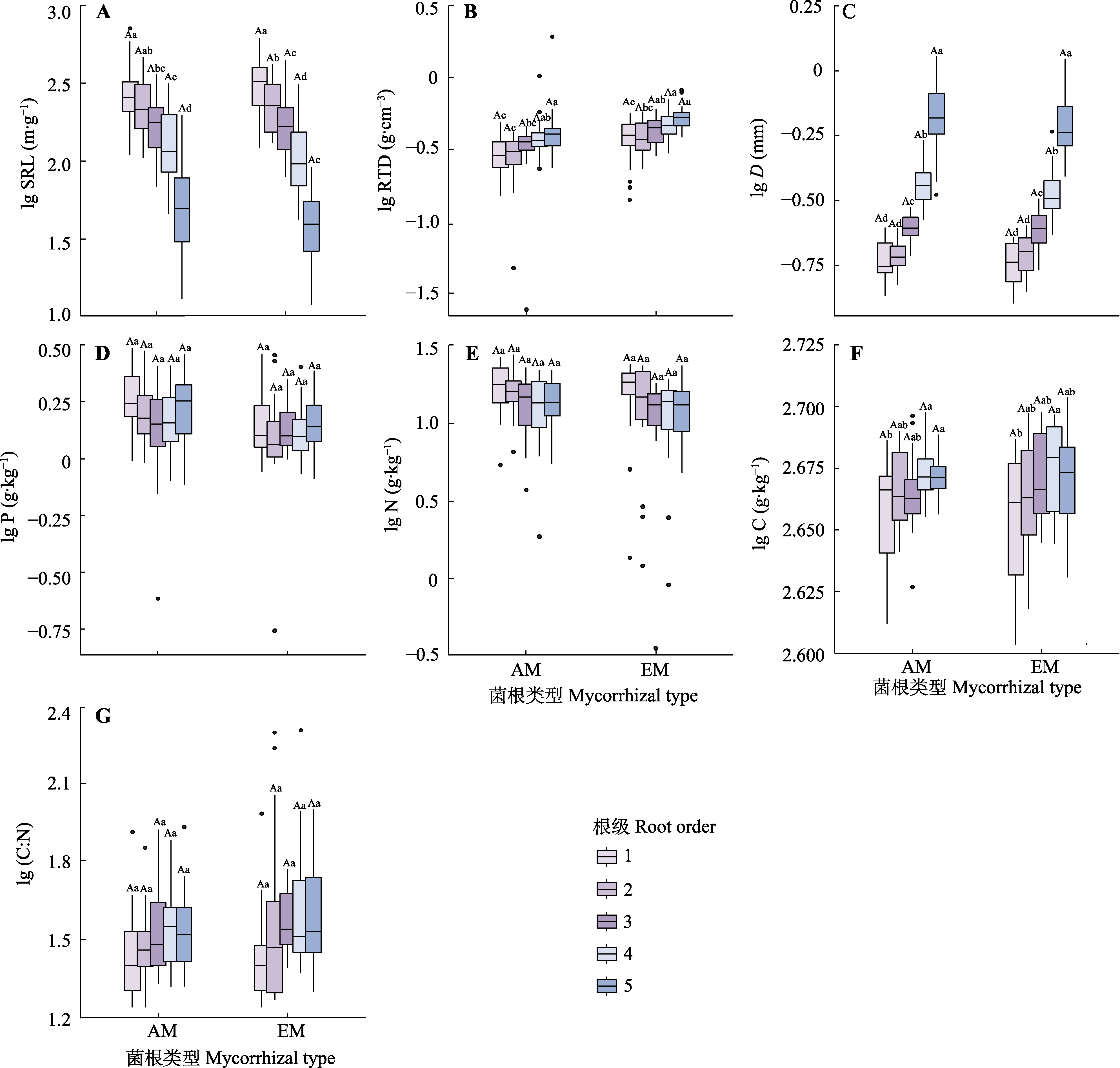
图1 阔叶红松林幼苗在不同根级以及菌根类型间细根性状的比较。AM, 丛枝菌根; C, 全碳含量; C:N, 碳氮比; D, 根直径; EM, 外生菌根; N, 全氮含量; P, 全磷含量; RTD, 根组织密度; SRL, 比根长。不同小写字母表示同一菌根类型内根级间差异显著(p < 0.05), 不同大写字母表示同一根级内两种菌根间差异显著(p < 0.05)。
Fig. 1 Comparison of fine root traits of seedlings across different root orders and mycorrhizal types in mixed broadleaf-Korean pine forests. AM, arbuscular mycorrhiza; C, total carbon content; C:N, carbon nitrogen ratio; D, root diameter; EM, ectomycorrhiza; N, total nitrogen content; P, total phosphorus content; RTD, root tissue density; SRL, specific root length. Different lowercase letters indicate significant differences among different root orders in the same mycorrhizal type (p < 0.05), and different uppercase letters indicate significant differences between two mycorrhizal types within identical root orders (p < 0.05).
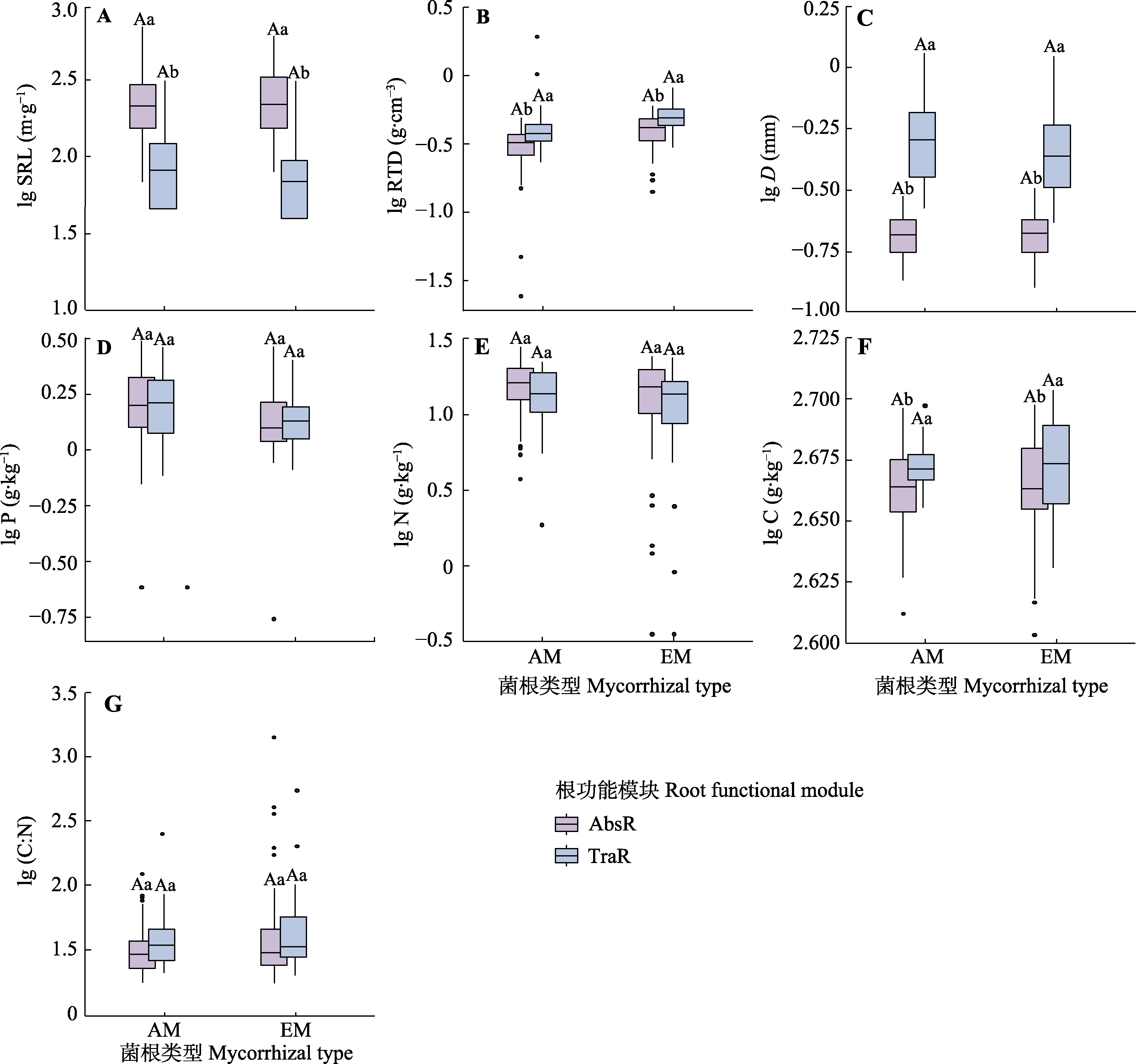
图2 阔叶红松林幼苗在不同细根功能模块间以及菌根类型间的细根性状的比较。AbsR, 吸收根; AM, 丛枝菌根; C, 全碳含量; C:N, 碳氮比; D, 根直径; EM, 外生菌根; N, 全氮含量; P, 全磷含量; RTD, 根组织密度; SRL, 比根长; TraR, 运输根。不同小写字母表示同一菌根类型内根功能模块间差异显著(p < 0.05), 不同大写字母表示同一功能模块根内两种菌根类型间差异显著(p < 0.05)。
Fig. 2 Comparison of fine root traits of seedlings among different root functional modules and mycorrhizal types in mixed broadleaf-Korean pine forests. AbsR, absorptive roots; AM, arbuscular mycorrhiza; C, total carbon content; C:N, carbon nitrogen ratio; D, root diameter; EM, ectomycorrhiza; N, total nitrogen content; P, total phosphorus content; RTD, root tissue density; SRL, specific root length; TraR, transport roots. Different lowercase letters indicate significant differences between root functional modules in the same mycorrhizal type (p < 0.05), and different uppercase letters indicate significant differences between two mycorrhizal types in the same root functional module (p < 0.05).
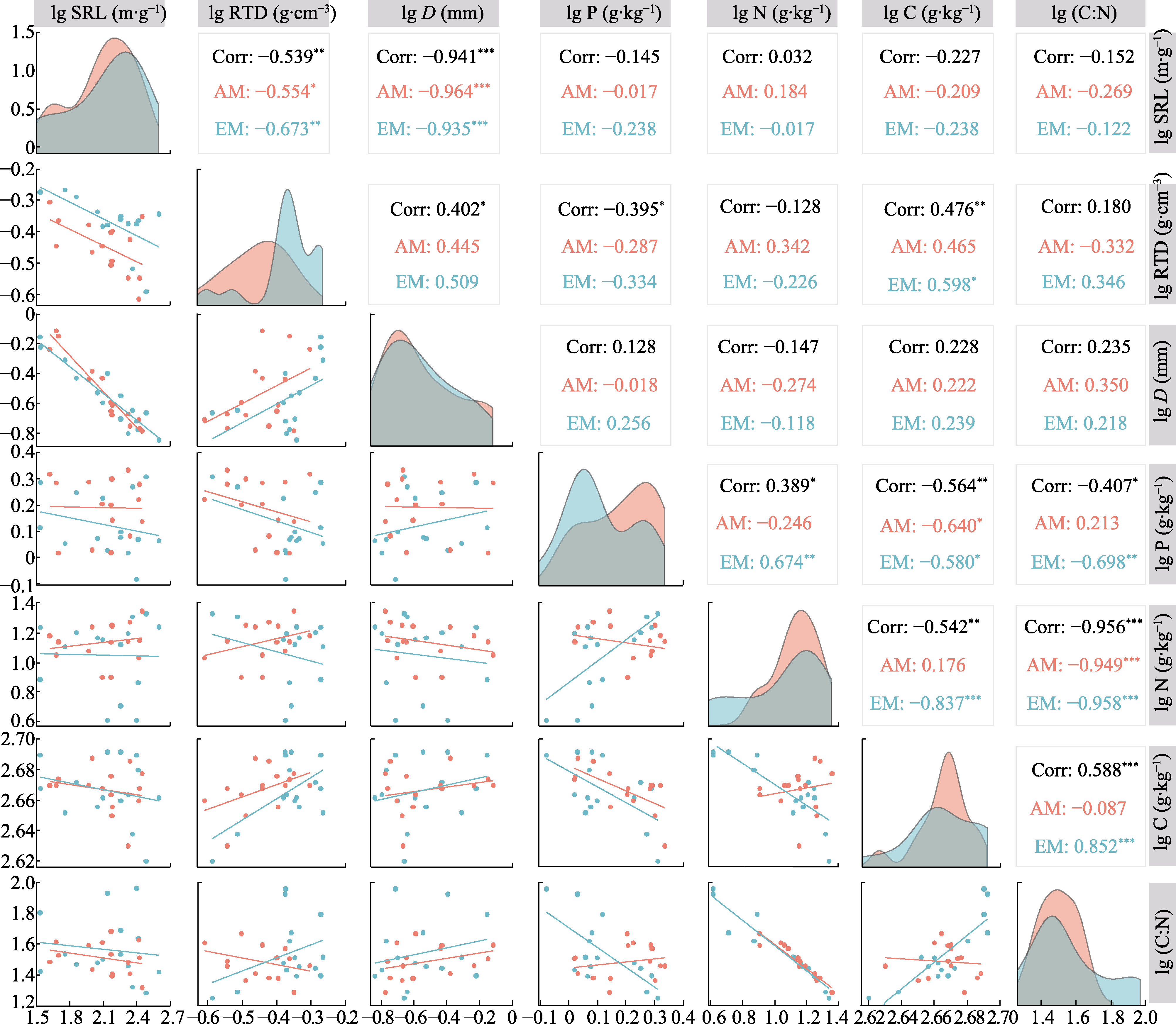
图3 阔叶红松林内丛枝菌根(AM)和外生菌根(EM)树种幼苗不同细根性状的相关性。C, 全碳含量; C:N, 碳氮比; D, 根直径; N, 全氮含量; P, 全磷含量; RTD, 根组织密度; SRL, 比根长。Corr, 总体相关系数。*, p < 0.05; **, p < 0.01; ***, p < 0.001。
Fig. 3 Correlation between different fine root traits in arbuscular mycorrhizal (AM) and ectomycorrhizal (EM) seedlings in mixed broadleaf-Korean pine forests. C, total carbon content; C:N, carbon nitrogen ratio; D, root diameter; N, total nitrogen content; P, total phosphorus content; RTD, root tissue density; SRL, specific root length. Corr, correlation coefficient of overall. *, p < 0.05; **, p < 0.01; ***, p < 0.001.
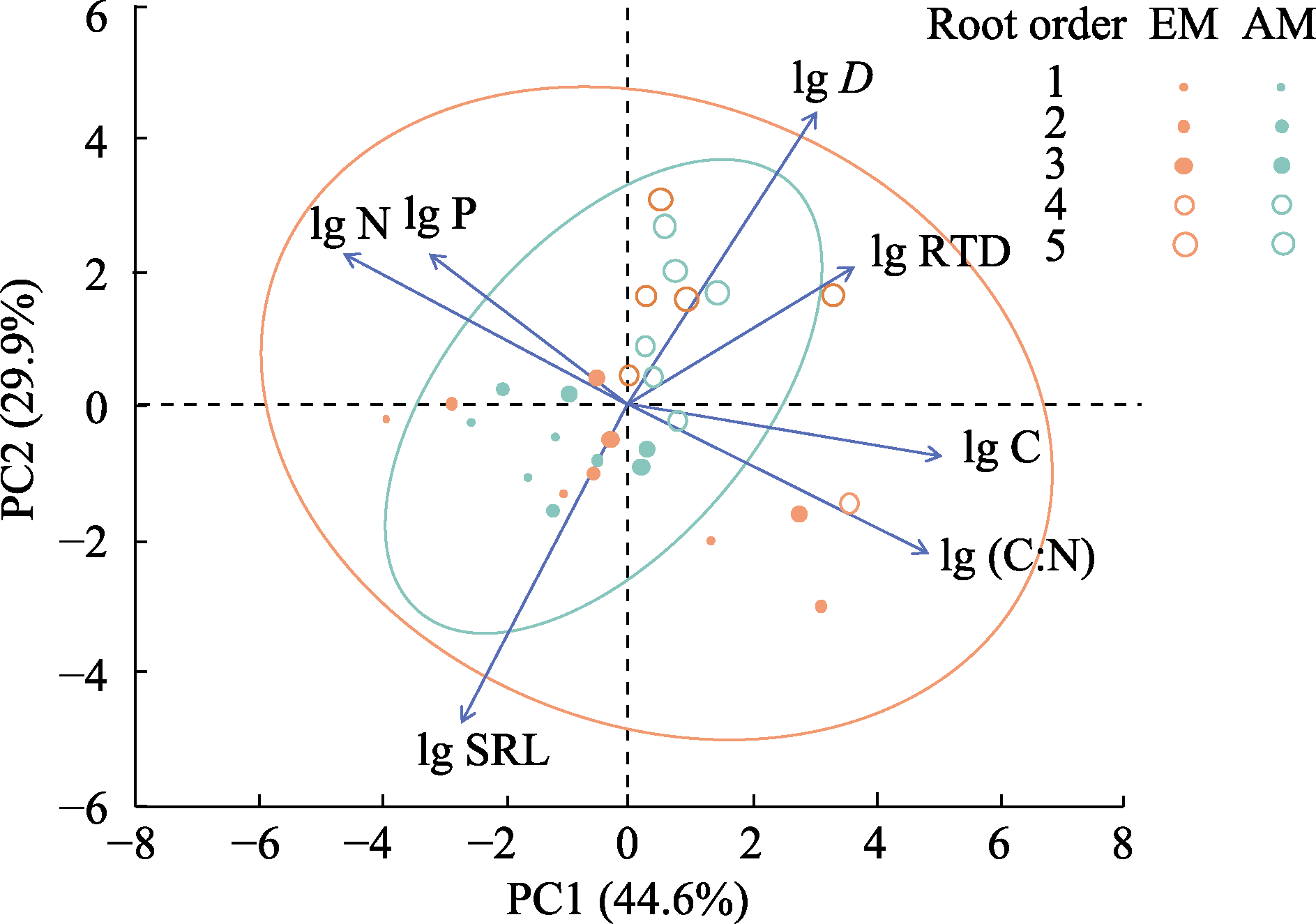
图4 阔叶红松林丛枝菌根(AM)与外生菌根(EM)幼苗细根性状的主成分(PC)分析二维图。C, 全碳含量; C:N, 碳氮比; D, 根直径; N, 全氮含量; P, 全磷含量; Root order, 根级; RTD, 根组织密度; SRL, 比根长。
Fig. 4 Principal component (PC) analysis of arbuscular mycorrhizal (AM) and ectomycorrhizal (EM) seedlings fine root traits in mixed broadleaf-Korean pine forests. C, total carbon content; C:N, carbon nitrogen ratio; D, root diameter; N, total nitrogen content; P, total phosphorus content; RTD, root tissue density; SRL, specific root length.
| [1] | Bergmann J, Weigelt A, van der Plas F, Laughlin DC, Kuyper TW, Guerrero-Ramirez N, Valverde-Barrantes OJ, Bruelheide H, Freschet GT, Iversen CM, Kattge J, McCormack ML, Meier IC, Rillig MC, Roumet C, et al. (2020). The fungal collaboration gradient dominates the root economics space in plants. Science Advances, 6, eaba3756. DOI: 10.1126/sciadv.aba3756. |
| [2] | Berntson GM (1994). Modelling root architecture: Are there tradeoffs between efficiency and potential of resource acquisition. New Phytologist, 127, 483-493. |
| [3] |
Bidartondo MI, Read DJ (2008). Fungal specificity bottlenecks during orchid germination and development. Molecular Ecology, 17, 3707-3716.
DOI PMID |
| [4] |
Chen WL, Koide RT, Adams TS, DeForest JL, Cheng L, Eissenstat DM (2016). Root morphology and mycorrhizal symbioses together shape nutrient foraging strategies of temperate trees. Proceedings of the National Academy of Sciences of the United States of America, 113, 8741-8746.
DOI PMID |
| [5] |
Comas LH, Callahan HS, Midford PE (2014). Patterns in root traits of woody species hosting arbuscular and ectomycorrhizas: implications for the evolution of belowground strategies. Ecology and Evolution, 4, 2979-2990.
DOI PMID |
| [6] | Ding JX, Kong DL, Zhang ZL, Cai Q, Xiao J, Liu Q, Yin HJ (2020). Climate and soil nutrients differentially drive multidimensional fine root traits in ectomycorrhizal- dominated alpine coniferous forests. Journal of Ecology, 108, 2544-2556. |
| [7] |
Eissenstat DM, Achor DS (1999). Anatomical characteristics of roots of citrus rootstocks that vary in specific root length. New Phytologist, 141, 309-321.
DOI PMID |
| [8] | Eissenstat DM, Wells CE, Yanai RD, Whitbeck JL (2000). Building roots in a changing environment: implications for root longevity. New Phytologist, 147, 33-42. |
| [9] | Eissenstat DM, Yanai RD (1997). The ecology of root lifespan. Advances in Ecological Research, 27, 1-60. |
| [10] | Ekblad A, Wallander H, Godbold DL, Cruz C, Johnson D, Baldrian P, Björk RG, Epron D, Kieliszewska-Rokicka B, Kjøller R, Kraigher H, Matzner E, Neumann J, Plassard C (2013). The production and turnover of extramatrical mycelium of ectomycorrhizal fungi in forest soils: role in carbon cycling. Plant and Soil, 366, 1-27. |
| [11] |
Ferrol N, Azcón-Aguilar C, Pérez-Tienda J (2019). Arbuscular mycorrhizas as key players in sustainable plant phosphorus acquisition: an overview on the mechanisms involved. Plant Science, 280, 441-447.
DOI PMID |
| [12] | Fitter AH (1982). Morphometric analysis of root systems: application of the technique and influence of soil fertility on root system development in two herbaceous species. Plant, Cell & Environment, 5, 313-322. |
| [13] | Fort F, Volaire F, Guilioni L, Barkaoui K, Navas ML, Roumet C (2017). Root traits are related to plant water-use among rangeland Mediterranean species. Functional Ecology, 31, 1700-1709. |
| [14] | Gu JC, Wang DN, Xia XX, Wang SZ (2016). Applications of functional classification methods for tree fine root biomass estimation: advancements and synthesis. Chinese Journal of Plant Ecology, 40, 1344-1351. |
|
[谷加存, 王东男, 夏秀雪, 王韶仲 (2016). 功能划分方法在树木细根生物量研究中的应用: 进展与评述. 植物生态学报, 40, 1344-1351.]
DOI |
|
| [15] |
Gu JC, Xu Y, Dong XY, Wang HF, Wang ZQ (2014). Root diameter variations explained by anatomy and phylogeny of 50 tropical and temperate tree species. Tree Physiology, 34, 415-425.
DOI PMID |
| [16] |
Guo D, Mitchell RJ, Hendricks JJ (2004). Fine root branch orders respond differentially to carbon source-sink manipulations in a longleaf pine forest. Oecologia, 140, 450-457.
PMID |
| [17] |
Guo DL, Xia MX, Wei X, Chang WJ, Liu Y, Wang ZQ (2008). Anatomical traits associated with absorption and mycorrhizal colonization are linked to root branch order in twenty-three Chinese temperate tree species. New Phytologist, 180, 673-683.
DOI PMID |
| [18] | Hishi T (2007). Heterogeneity of individual roots within the fine root architecture: causal links between physiological and ecosystem functions. Journal of Forest Research, 12, 126-133. |
| [19] | Holdaway RJ, Richardson SJ, Dickie IA, Peltzer DA, Coomes DA (2011). Species- and community-level patterns in fine root traits along a 120 000-year soil chronosequence in temperate rain forest. Journal of Ecology, 99, 954-963. |
| [20] |
Jorritsma-Wienk LD, Ameloot E, Lenssen JPM, de Kroon H (2007). Differential responses of germination and seedling establishment in populations of Tragopogon pratensis (Asteraceae). Plant Biology, 9, 109-115.
PMID |
| [21] |
Kiers ET, Duhamel M, Beesetty Y, Mensah JA, Franken O, Verbruggen E, Fellbaum CR, Kowalchuk GA, Hart MM, Bago A, Palmer TM, West SA, Vandenkoornhuyse P, Jansa J, Bücking H (2011). Reciprocal rewards stabilize cooperation in the mycorrhizal symbiosis. Science, 333, 880-882.
DOI PMID |
| [22] | Kong D, Wang J, Kardol P, Wu H, Zeng H, Deng X, Deng Y (2016). Economic strategies of plant absorptive roots vary with root diameter. Biogeosciences, 13, 415-424. |
| [23] | Kong D, Wang J, Wu H, Valverde-Barrantes OJ, Wang R, Zeng H, Kardol P, Zhang H, Feng Y (2019). Nonlinearity of root trait relationships and the root economics spectrum. Nature Communications, 10, 2203. DOI: 10.1038/s41467- 019-10245-6. |
| [24] | Leuschner C, Hertel D, Schmid I, Koch O, Muhs A, Hölscher D (2004). Stand fine root biomass and fine root morphology in old-growth beech forests as a function of precipitation and soil fertility. Plant and Soil, 258, 43-56. |
| [25] |
Liese R, Lübbe T, Albers NW, Meier IC (2018). The mycorrhizal type governs root exudation and nitrogen uptake of temperate tree species. Tree Physiology, 38, 83-95.
DOI PMID |
| [26] | Liu XJ, Ma KP (2015). Plant functional traits—Concepts, applications and future directions. Scientia Sinica (Vitae), 45, 325-339. |
| [刘晓娟, 马克平 (2015). 植物功能性状研究进展. 中国科学: 生命科学, 45, 325-339.] | |
| [27] |
McCormack ML, Adams TS, Smithwick EAH, Eissenstat DM (2012). Predicting fine root lifespan from plant functional traits in temperate trees. New Phytologist, 195, 823-831.
DOI PMID |
| [28] |
McCormack ML, Dickie IA, Eissenstat DM, Fahey TJ, Fernandez CW, Guo D, Helmisaari HS, Hobbie EA, Iversen CM, Jackson RB, Leppälammi-Kujansuu J, Norby RJ, Phillips RP, Pregitzer KS, Pritchard SG, et al. (2015). Redefining fine roots improves understanding of below-ground contributions to terrestrial biosphere processes. New Phytologist, 207, 505-518.
DOI PMID |
| [29] | Ostonen I, Püttsepp Ü, Biel C, Alberton O, Bakker MR, Lõhmus K, Majdi H, Metcalfe D, Olsthoorn AFM, Pronk A, Vanguelova E, Weih M, Brunner I (2007). Specific root length as an indicator of environmental change. Plant Biosystecms, 141, 426-442. |
| [30] | Ouyang YL, Zhang CC, Lin XF, Tian LX, Gu HJ, Chen FS, Bu WS (2021). Growth differences and characteristics of root and leaf morphological traits for different mycorrhizal tree species in the subtropical China: a case study of Xingangshan, Jiangxi Province. Biodiversity Science, 29, 746-758. |
| [欧阳园丽, 张参参, 林小凡, 田立新, 顾菡娇, 陈伏生, 卜文圣 (2021). 中国亚热带不同菌根树种的根叶形态学性状特征与生长差异: 以江西新岗山为例. 生物多样性, 29, 746-758.] | |
| [31] | Pregitzer KS, DeForest JL, Burton AJ, Allen MF, Ruess RW, Hendrick RL (2002). Fine root architecture of nine North American trees. Ecological Monographs, 72, 293-309. |
| [32] | Qin Y, Gao CL, Jin GZ, Liu ZL, Shi BK (2021). Latitude patterns in fine root morphological and anatomical traits across root orders of Pinus koraiensis . Scandinavian Journal of Forest Research, 36, 539-549. |
| [33] |
Queenborough SA, Burslem DFRP, Garwood NC, Valencia R (2007). Neighborhood and community interactions determine the spatial pattern of tropical tree seedling survival. Ecology, 88, 2248-2258.
PMID |
| [34] | Razaq M, Salahuddin, Shen HL, Sher H, Zhang P (2017). Influence of biochar and nitrogen on fine root morphology, physiology, and chemistry of Acer mono. Scientific Reports, 7, 5367. DOI: 10.1038/s41598-017-05721-2. |
| [35] | Reich PB (2014). The world-wide ‘fast-slow’ plant economics spectrum: a traits manifesto. Journal of Ecology, 102, 275-301. |
| [36] |
Reich PB, Tjoelker MG, Pregitzer KS, Wright IJ, Oleksyn J, Machado JL (2008). Scaling of respiration to nitrogen in leaves, stems and roots of higher land plants. Ecology Letters, 11, 793-801.
DOI PMID |
| [37] |
Rewald B, Rechenmacher A, Godbold DL (2014). It’s complicated: intraroot system variability of respiration and morphological traits in four deciduous tree species. Plant Physiology, 166, 736-745.
DOI PMID |
| [38] |
Roumet C, Birouste M, Picon-Cochard C, Ghestem M, Osman N, Vrignon-Brenas S, Cao KF, Stokes A (2016). Root structure-function relationships in 74 species: evidence of a root economics spectrum related to carbon economy. New Phytologist, 210, 815-826.
DOI PMID |
| [39] | Segnitz RM, Russo SE, Davies SJ, Peay KG (2020). Ectomycorrhizal fungi drive positive phylogenetic plant- soil feedbacks in a regionally dominant tropical plant family. Ecology, 101, e03083. DOI: 10.1002/ecy.3083. |
| [40] | Sun JH, Shi HL, Chen KY, Ji BM, Zhang J (2023). Research advances on trade-off relationships of plant fine root functional traits. Chinese Journal of Plant Ecology, 47, 1055-1070. |
|
[孙佳慧, 史海兰, 陈科宇, 纪宝明, 张静 (2023). 植物细根功能性状的权衡关系研究进展. 植物生态学报, 47, 1055-1070.]
DOI |
|
| [41] | Taylor AFS, Alexander I (2005). The ectomycorrhizal symbiosis: life in the real world. Mycologist, 19, 102-112. |
| [42] | Tjoelker MG, Craine JM, Wedin D, Reich PB, Tilman D (2005). Linking leaf and root trait syndromes among 39 grassland and savannah species. New Phytologist, 167, 493-508. |
| [43] |
Valverde-Barrantes OJ, Freschet GT, Roumet C, Blackwood CB (2017). A worldview of root traits: the influence of ancestry, growth form, climate and mycorrhizal association on the functional trait variation of fine-root tissues in seed plants. New Phytologist, 215, 1562-1573.
DOI PMID |
| [44] | Violle C, Navas ML, Vile D, Kazakou E, Fortunel C, Hummel I, Garnier E (2007). Let the concept of trait be functional! Oikos, 116, 882-892. |
| [45] | Wells CE, Eissenstat DM (2002). Beyond the roots of young seedlings: the influence of age and order on fine root physiology. Journal of Plant Growth Regulation, 21, 324-334. |
| [46] | Wright SJ, Muller-Landau HC, Calderón O, Hernandéz A (2005). Annual and spatial variation in seedfall and seedling recruitment in a neotropical forest. Ecology, 86, 848-860. |
| [47] | Xia MX, Valverde-Barrantes OJ, Suseela V, Blackwood CB, Tharayil N (2021). Coordination between compound- specific chemistry and morphology in plant roots aligns with ancestral mycorrhizal association in woody angiosperms. New Phytologist, 232, 1259-1271. |
| [48] |
Xu LN, Jin GZ (2012). Species composition and community structure of a typical mixed broadleaved-Korean pine (Pinus koraiensis) forest plot in Liangshui Nature Reserve, Northeast China. Biodiversity Science, 20, 470-481.
DOI |
|
[徐丽娜, 金光泽 (2012). 小兴安岭凉水典型阔叶红松林动态监测样地: 物种组成与群落结构. 生物多样性, 20, 470-481.]
DOI |
|
| [49] |
Xu Y, Gu JC, Dong XY, Liu Y, Wang ZQ (2011). Fine root morphology, anatomy and tissue nitrogen and carbon contents of the first five orders in four tropical hardwood species in Hainan Island, China. Chinese Journal of Plant Ecology, 35, 955-964.
DOI |
|
[许旸, 谷加存, 董雪云, 刘颖, 王政权 (2011). 海南岛4个热带阔叶树种前5级细根的形态, 解剖结构和组织碳氮含量. 植物生态学报, 35, 955-964.]
DOI |
|
| [50] | You C, Li J, Yang K, Tan B, Yin R, Li H, Zhang L, Cui X, Liu S, Wang L, Liu Y, Chen L, Yuan Y, Li J, Sardans J, et al. (2023). Variations and patterns of C and N stoichiometry in the first five root branch orders across 218 woody plant species. New Phytologist, 238, 1838-1848. |
| [51] |
Zadworny M, McCormack ML, Rawlik K, Jagodziński AM (2015). Seasonal variation in chemistry, but not morphology, in roots of Quercus robur growing in different soil types. Tree Physiology, 35, 644-652.
DOI PMID |
| [52] |
Zadworny M, McCormack ML, Żytkowiak R, Karolewski P, Mucha J, Oleksyn J (2017). Patterns of structural and defense investments in fine roots of Scots pine (Pinus sylvestris L.) across a strong temperature and latitudinal gradient in Europe. Global Change Biology, 23, 1218-1231.
DOI PMID |
| [53] | Zhang JR, Yan XJ, Jia LQ, Fan AL, Wang X, Chen TT, Chen GS (2022). Morphology and C and N stoichiometry traits of fine roots of nine understory shrubs in subtropical natural evergreen broad-leaved forest. Acta Ecologica Sinica, 42, 3716-3726. |
| [张进如, 闫晓俊, 贾林巧, 范爱连, 王雪, 陈廷廷, 陈光水 (2022). 亚热带天然常绿阔叶林林下9种灌木细根形态和C、N化学计量特征. 生态学报, 42, 3716-3726.] |
| [1] | 张安宁, 肖亚宁, 赵霞, 张淼, 崔瀚文, 陈书燕, 安黎哲. 青藏高原灌木化与氮添加对土壤线虫及功能性状的交互作用[J]. 植物生态学报, 2026, 50(预发表): 0-. |
| [2] | 段建林, 孟晟, 陈仁利, 熊林峰, 卢春洋, 席念勋. 全球变化因子多样性对菌根植物性状的影响[J]. , 2026, 50(预发表): 0-. |
| [3] | 林琳琳, 肖劲祥, 黄深深, 赵杨梅, 张德旭, 程毅康, 龙文兴. 磷添加对热带云雾林幼苗及幼树功能性状的影响[J]. , 2026, 50(预发表): 0-. |
| [4] | 饶朝康, 唐亮. 不同潮位红树植物叶际微生物群落特征及其影响因素[J]. 植物生态学报, 2026, 50(预发表): 1-. |
| [5] | 封逸凡, 朱时应, 周淑荣, 江乐乐, 陈隆, 王苗, 邓国芳, 刘兰. 热带次生林恢复中土壤微生物对菌根化树苗存活和生长性状的影响[J]. 植物生态学报, 2026, 50(预发表): 1-. |
| [6] | 张诚航, 卫星, 吴纯泽, 王裕尧, 李浩楠. 大气还原态氮干湿沉降下水曲柳和兴安落叶松菌根化苗木生长响应[J]. 植物生态学报, 2026, 50(3): 649-659. |
| [7] | 李文竹, 栾军伟, 邸雅平, 王一, 聂秀青, 刘世荣. 模拟干旱对暖温带锐齿槲栎林菌根介导下土壤酶活性和土壤有机碳组分的影响[J]. 植物生态学报, 2026, 50(3): 660-673. |
| [8] | 何堂庆, 王变变, 曹鑫鑫, 张康成, 汪晓东, 王浩, 白彤硕, 赵叶新, 张艺, 王益, 仇云鹏, 胡水金. 半干旱草地植物和丛枝菌根真菌群落对长期降水增加的响应[J]. 植物生态学报, 2026, 50(3): 674-684. |
| [9] | 江康威, 吕程, 王亚菲, 李宏, 张芷晴, 王雨, 张青青, 吐尔逊娜依•热依木. 放牧干扰下丛枝菌根真菌群落对土壤多功能性的影响[J]. 植物生态学报, 2026, 50(3): 685-699. |
| [10] | 段世龙, 余成瑾, 许心垚, 冯固, 谢贤安, 张林. 植物-丛枝菌根真菌-细菌连续体及其维持机制[J]. 植物生态学报, 2026, 50(3): 600-611. |
| [11] | 何正嘉, 曾歆然, 王琳影, 薛昕宇, 苏钦泽, 李宇, 张寅杰, 吴辉煌, 陈成聪, 吴良泉, 魏安妮, 仇云鹏, 郭梨锦. 茶园丛枝菌根真菌群落和土壤有机碳对镁肥的响应[J]. 植物生态学报, 2026, 50(3): 700-709. |
| [12] | 邹纪开, 吴佳怡, 谷云懿, 陈宝明. 不同形态氮添加与丛枝菌根真菌对外来入侵植物白花鬼针草竞争力的影响[J]. 植物生态学报, 2026, 50(3): 722-730. |
| [13] | 秦斐斐, 唐朝辉, 司彤, 慈敦伟. 盐碱耐受型和敏感型花生生长发育及根际土壤特性对丛枝菌根真菌的响应[J]. 植物生态学报, 2026, 50(3): 742-759. |
| [14] | 王海浪, 付伟, 伍松林, 陈保冬. 丛枝菌根真菌生态功能及群落调控[J]. 植物生态学报, 2026, 50(3): 515-535. |
| [15] | 马建辉, 童鑫, 张思榕, 毛子昆, 秦俊, 马克平. 菌根真菌生理生态功能研究进展及展望[J]. 植物生态学报, 2026, 50(3): 498-514. |
| 阅读次数 | ||||||
|
全文 |
|
|||||
|
摘要 |
|
|||||
Copyright © 2026 版权所有 《植物生态学报》编辑部
地址: 北京香山南辛村20号, 邮编: 100093
Tel.: 010-62836134, 62836138; Fax: 010-82599431; E-mail: apes@ibcas.ac.cn, cjpe@ibcas.ac.cn
备案号: 京ICP备16067583号-19

