
Chin J Plant Ecol ›› 2026, Vol. 50 ›› Issue (3): 600-611.DOI: 10.17521/cjpe.2025.0239 cstr: 32100.14.cjpe.2025.0239
• Reviews • Previous Articles Next Articles
DUAN Shi-Long1, YU Cheng-Jin1, XU Xin-Yao1, FENG Gu1, XIE Xian-An2, ZHANG Lin1,*( )
)
Received:2025-06-25
Accepted:2025-10-17
Online:2026-03-20
Published:2026-04-03
Contact:
ZHANG Lin
Supported by:DUAN Shi-Long, YU Cheng-Jin, XU Xin-Yao, FENG Gu, XIE Xian-An, ZHANG Lin. Plant-arbuscular mycorrhizal fungi-bacteria continuum and its maintenance mechanisms[J]. Chin J Plant Ecol, 2026, 50(3): 600-611.
Add to citation manager EndNote|Ris|BibTeX
URL: https://www.plant-ecology.com/EN/10.17521/cjpe.2025.0239
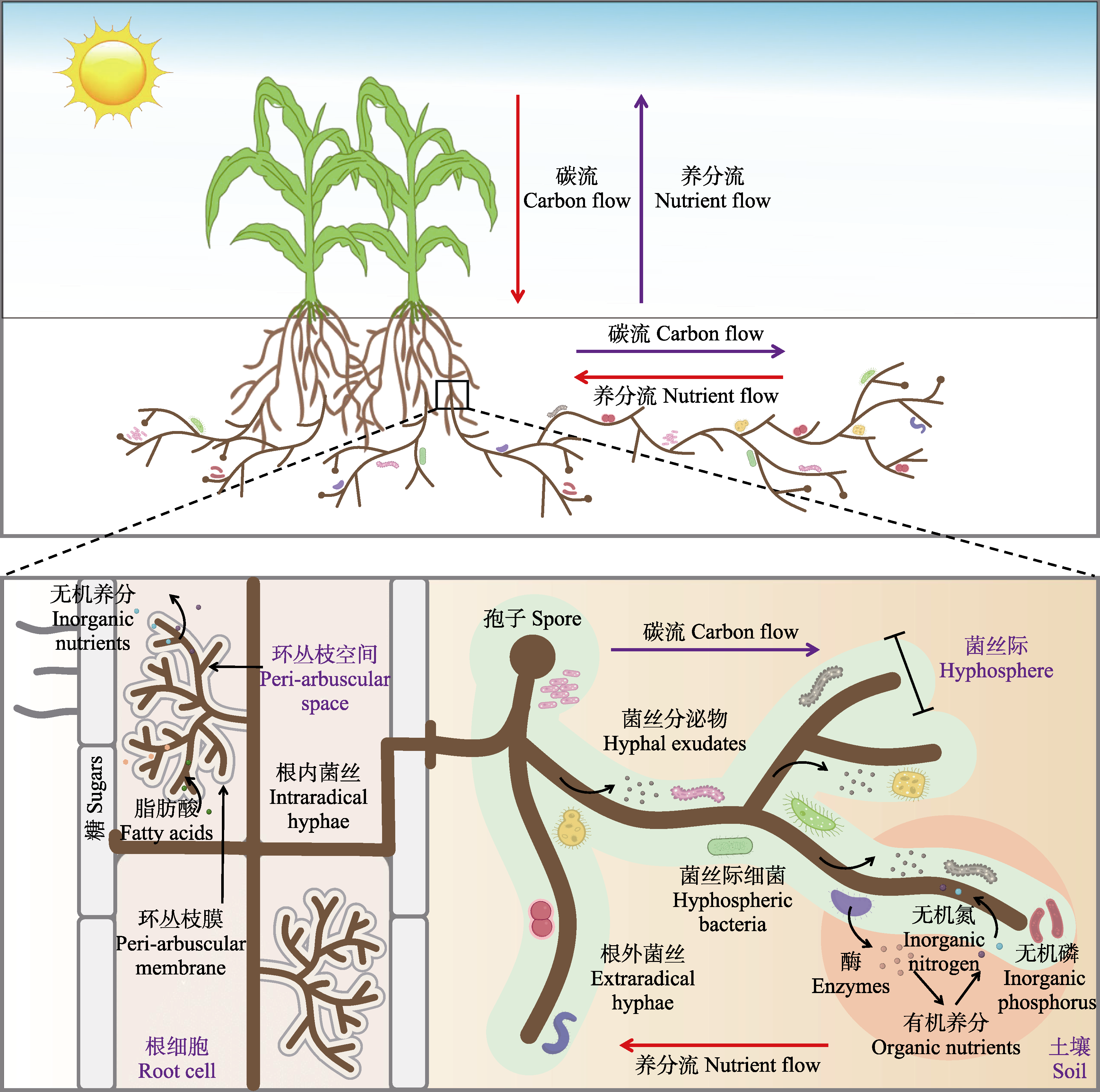
Fig. 1 An overview of the plant-AM fungus-bacterium continuum and the peri-arbuscular space and hyphosphere involved in carbon and nutrient exchange.
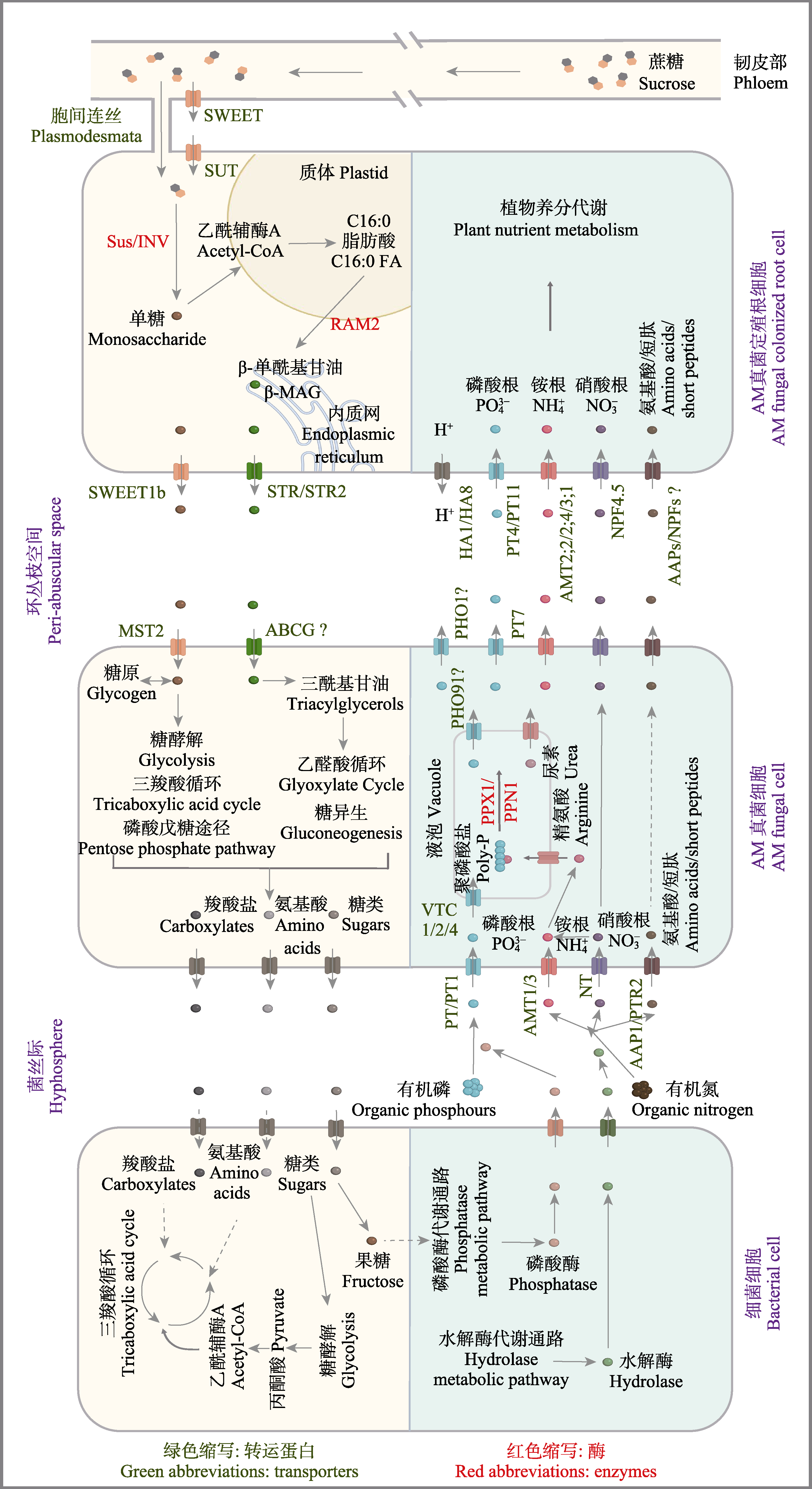
Fig. 2 Carbon and mineral nutrient flows in the plant-AM fungus-bacterium continuum. The following transporters and enzymes participate in the transport of C and nutrients in the continuum: amino acid transporters (AAP1 and AAPs), ATP-binding cassette G-type transporter (ABCG), ammonium transporters (AMT1, AMT3, AMT2;2, AMT2;4 and AMT3;1), H+-ATPases (HA1 and HA8), invertase (INV), monosaccharide transporter MST2, nitrate transporters (NT and NPF4.5), SYG1-Pho81-XPR1 domain-containing phosphate transporters (PHO1 and PHO91), AM fungal exopolyphosphatases (PPX1 and PPN1), phosphate transporters (PT, PT1, PT4, PT7 and PT11), short peptide transporters (PTR2 and NPFs), glycerol-3-phosphate acyltransferase (RAM2), heterodimeric half-size ABCG transporters (STR and STR2), reversible sucrose synthase (Sus), sucrose uptake transporter (SUT), sugars will eventually be exported transporters (SWEET and SWEET1b), vacuolar transporter chaperon (VTC) complex (VTC1, VTC2 and VTC4). The solid line represents the currently identified metabolic pathway, and the dotted line needs further verification. Transporters marked with question marks have not been functionally verified, and unmarked transporters are unknown.
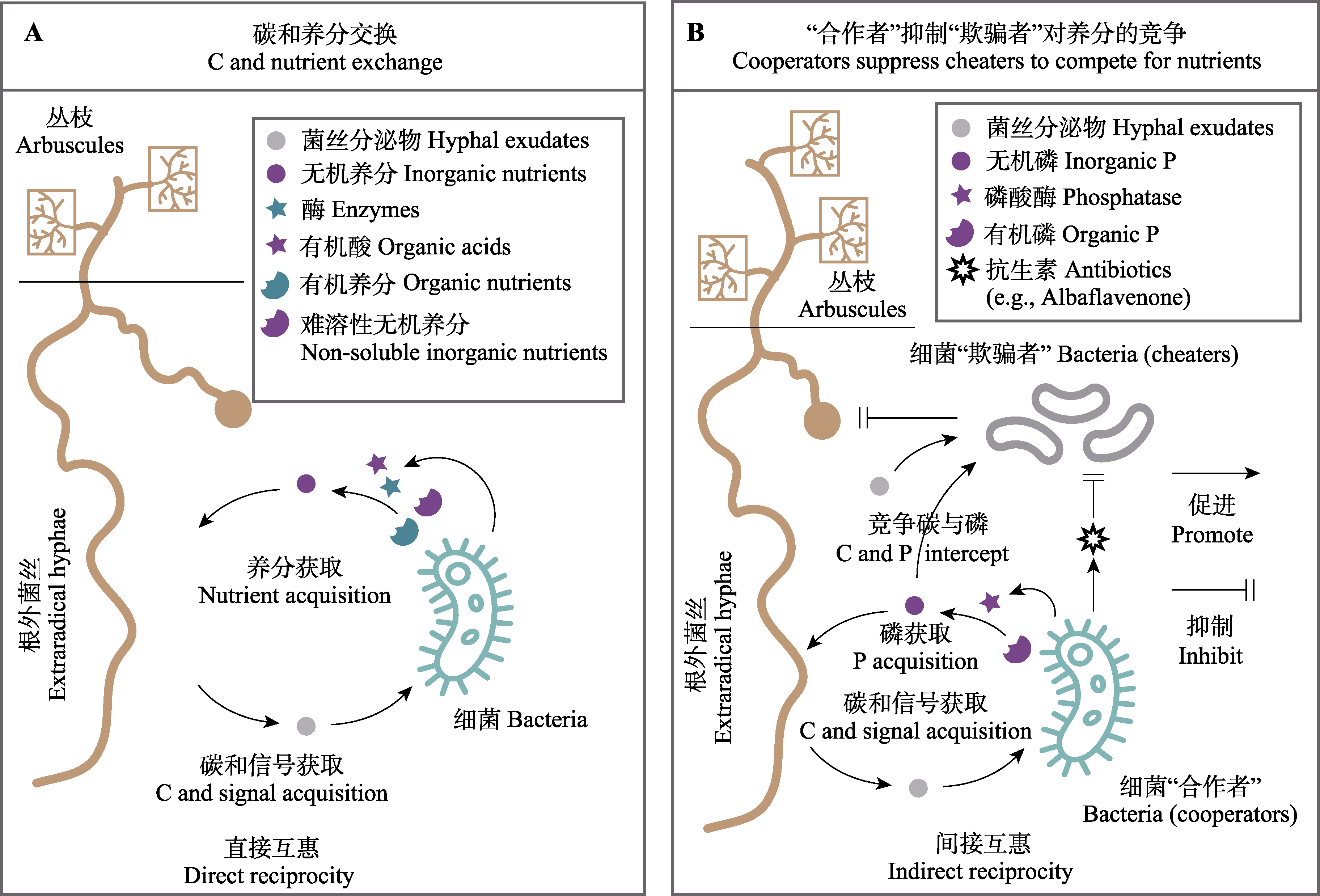
Fig. 3 Schematic diagram of direct and indirect reciprocity between arbuscular mycorrhizal fungi and bacteria in the soil. C, carbon; P, phosphorus.
| [1] |
An J, Zeng T, Ji C, de Graaf S, Zheng Z, Xiao TT, Deng X, Xiao S, Bisseling T, Limpens E (2019). A Medicago truncatula SWEET transporter implicated in arbuscule maintenance during arbuscular mycorrhizal symbiosis. New Phytologist, 224, 396-408.
DOI URL |
| [2] |
Bago B, Pfeffer PE, Abubaker J, Jun J, Allen JW, Brouillette J, Douds DD, Lammers PJ, Shachar-Hill Y (2003). Carbon export from arbuscular mycorrhizal roots involves the translocation of carbohydrate as well as lipid. Plant Physiology, 131, 1496-1507.
DOI PMID |
| [3] |
Bago B, Pfeffer PE, Zipfel W, Lammers P, Shachar-Hill Y (2002). Tracking metabolism and imaging transport in arbuscular mycorrhizal fungi: metabolism and transport in AM fungi. Plant and Soil, 244, 189-197.
DOI |
| [4] |
Belmondo S, Fiorilli V, Pérez-Tienda J, Ferrol N, Marmeisse R, Lanfranco L (2014). A dipeptide transporter from the arbuscular mycorrhizal fungus Rhizophagus irregularis is upregulated in the intraradical phase. Frontiers in Plant Science, 5, 436. DOI: 10.3389/fpls.2014.00436.
PMID |
| [5] |
Blagodatskaya E, Kuzyakov Y (2013). Active microorganisms in soil: Critical review of estimation criteria and approaches. Soil Biology & Biochemistry, 67, 192-211.
DOI URL |
| [6] |
Bonfante P, Venice F (2020). Mucoromycota: going to the roots of plant-interacting fungi. Fungal Biology Reviews, 34, 100-113.
DOI |
| [7] |
Bravo A, Brands M, Wewer V, Dörmann P, Harrison MJ (2017). Arbuscular mycorrhiza-specific enzymes FatM and RAM2 fine-tune lipid biosynthesis to promote development of arbuscular mycorrhiza. New Phytologist, 214, 1631-1645.
DOI PMID |
| [8] |
Breuillin-Sessoms F, Floss DS, Gomez SK, Pumplin N, Ding Y, Levesque-Tremblay V, Noar RD, Daniels DA, Bravo A, Eaglesham JB, Benedito VA, Udvardi MK, Harrison MJ (2015). Suppression of arbuscule degeneration in Medicago truncatula phosphate transporter 4 mutants is dependent on the ammonium transporter 2 family protein AMT2;3. The Plant Cell, 27, 1352-1366.
DOI PMID |
| [9] |
Cappellazzo G, Lanfranco L, Fitz M, Wipf D, Bonfante P (2008). Characterization of an amino acid permease from the endomycorrhizal fungus Glomus mosseae. Plant Physiology, 147, 429-437.
DOI PMID |
| [10] |
Charters MD, Sait SM, Field KJ (2020). Aphid herbivory drives asymmetry in carbon for nutrient exchange between plants and an arbuscular mycorrhizal fungus. Current Biology, 30, 1801-1808.
DOI PMID |
| [11] |
Choi J, Summers W, Paszkowski U (2018). Mechanisms underlying establishment of arbuscular mycorrhizal symbioses. Annual Review of Phytopathology, 56, 135-160.
DOI PMID |
| [12] | Das D, Paries M, Hobecker K, Gigl M, Dawid C, Lam HM, Zhang J, Chen M, Gutjahr C (2022). Phosphate starvation response transcription factors enable arbuscular mycorrhiza symbiosis. Nature Communications, 13, 477. DOI: 10.1038/s41467-022-27976-8. |
| [13] |
Drechsler N, Courty PE, Brulé D, Kunze R (2018). Identification of arbuscular mycorrhiza-inducible nitrate transporter 1/peptide transporter family (NPF) genes in rice. Mycorrhiza, 28, 93-100.
DOI PMID |
| [14] |
Duan SL, Declerck S, Feng G, Zhang L (2023). Hyphosphere interactions between Rhizophagus irregularis and Rahnella aquatilis promote carbon-phosphorus exchange at the peri-arbuscular space in Medicago truncatula. Environmental Microbiology, 25, 867-879.
DOI URL |
| [15] |
Duan SL, Declerck S, Zhang L, Feng G (2022). Two-component system in Rahnella aquatilis is impacted by the hyphosphere of the arbuscular mycorrhizal fungus Rhizophagus irregularis. Environmental Microbiology Reports, 14, 119-129.
DOI URL |
| [16] |
Duan SL, Feng G, Limpens E, Bonfante P, Xie XA, Zhang L (2024). Cross-kingdom nutrient exchange in the plant-arbuscular mycorrhizal fungus-bacterium continuum. Nature Reviews Microbiology, 22, 773-790.
DOI |
| [17] | Duan SL, Jin ZX, Zhang L, Declerck S (2025a). Mechanisms of cooperation in the plants-arbuscular mycorrhizal fungi-bacteria continuum. ISME Journal, 19, wraf023. DOI: 10.1093/ismejo/wraf023. |
| [18] | Duan SL, Zhang L, Declerck S (2025b). Early-stage reciprocal cooperation between the arbuscular mycorrhizal fungus Rhizophagus irregularis and the phosphate-solubilizing bacterium Rahnella aquatilis is dependent on external phosphorus availability. Communications Biology, 8, 1075. DOI: 10.1038/s42003-025-08501-1. |
| [19] |
Emmett BD, Lévesque-Tremblay V, Harrison MJ (2021). Conserved and reproducible bacterial communities associate with extraradical hyphae of arbuscular mycorrhizal fungi. ISME Journal, 15, 2276-2288.
DOI PMID |
| [20] |
Escudero-Martinez C, Coulter M, Alegria Terrazas R, Foito A, Kapadia R, Pietrangelo L, Maver M, Sharma R, Aprile A, Morris J, Hedley PE, Maurer A, Pillen K, Naclerio G, Mimmo T, et al. (2022). Identifying plant genes shaping microbiota composition in the barley rhizosphere. Nature Communications, 13, 3443. DOI: 10.1038/s41467-022-31022-y.
PMID |
| [21] |
Ezawa T, Saito K (2018). How do arbuscular mycorrhizal fungi handle phosphate? New insight into fine-tuning of phosphate metabolism. New Phytologist, 220, 1116-1121.
DOI PMID |
| [22] |
Fiorilli V, Lanfranco L, Bonfante P (2013). The expression of GintPT, the phosphate transporter of GintPT, the phosphate transporter of Rhizophagus irregularis, depends on the symbiotic status and phosphate availability. Planta, 237, 1267-1277.
DOI URL |
| [23] |
Genre A, Lanfranco L, Perotto S, Bonfante P (2020). Unique and common traits in mycorrhizal symbioses. Nature Reviews Microbiology, 18, 649-660.
DOI |
| [24] |
Gomes SIF, van Bodegom PM, Merckx VSFT, Soudzilovskaia NA (2019). Environmental drivers for cheaters of arbuscular mycorrhizal symbiosis in tropical rainforests. New Phytologist, 223, 1575-1583.
DOI PMID |
| [25] |
Govindarajulu M, Pfeffer PE, Jin H, Abubaker J, Douds DD, Allen JW, Bücking H, Lammers PJ, Shachar-Hill Y (2005). Nitrogen transfer in the arbuscular mycorrhizal symbiosis. Nature, 435, 819-823.
DOI |
| [26] |
Harrison MJ, Dewbre GR, Liu J (2002). A phosphate transporter from Medicago truncatula involved in the acquisition of phosphate released by arbuscular mycorrhizal fungi. The Plant Cell, 14, 2413-2429.
DOI URL |
| [27] | Hawkins HJ, Cargill RIM, Nuland MEV, Hagen SC, Field KJ, Sheldrake M, Soudzilovskaia NA, Kiers ET (2023). Mycorrhizal mycelium as a global carbon pool. Current Biology, 33, 560-573. |
| [28] |
Helber N, Wippel K, Sauer N, Schaarschmidt S, Hause B, Requena N (2011). A versatile monosaccharide transporter that operates in the arbuscular mycorrhizal fungus Glomus sp is crucial for the symbiotic relationship with plants. The Plant Cell, 23, 3812-3823.
DOI URL |
| [29] |
Hui J, An X, Li Z, Neuhäuser B, Ludewig U, Wu X, Schulze WX, Chen F, Feng G, Lambers H, Zhang FS, Yuan LX (2022). The mycorrhiza-specific ammonium transporter ZmAMT3;1 mediates mycorrhiza-dependent nitrogen uptake in maize roots. . The Plant Cell, 34, 4066-4087.
DOI PMID |
| [30] | Jiang F, Zhang L, Zhou JC, George TS, Feng G (2021). Arbuscular mycorrhizal fungi enhance mineralisation of organic phosphorus by carrying bacteria along their extraradical hyphae. New Phytologist, 230, 304-315. |
| [31] |
Jiang YN, Wang WX, Xie QJ, Liu N, Liu LX, Wang DP, Zhang XW, Yang C, Chen XY, Tang DZ, Wang ET (2017). Plants transfer lipids to sustain colonization by mutualistic mycorrhizal and parasitic fungi. Science, 356, 1172-1175.
DOI PMID |
| [32] | Jin ZX, Jiang FY, Wang LT, Declerck S, Feng G, Zhang L (2024). Arbuscular mycorrhizal fungi and Streptomyces: brothers in arms to shape the structure and function of the hyphosphere microbiome in the early stage of interaction. Microbiome, 12, 83. DOI: 10.1186/s40168-024-01811-2. |
| [33] | Johansen A, Finlay RD, Olsson PA (1996). Nitrogen metabolism of external hyphae of the arbuscular mycorrhizal fungus Glornus intraradices. New Phytologist, 133, 705-712. |
| [34] |
Kakouridis A, Yuan M, Nuccio EE, Hagen JA, Fossum CA, Moore ML, Estera-Molina KY, Nico PS, Weber PK, Pett-Ridge J, Firestone MK (2024). Arbuscular mycorrhiza convey significant plant carbon to a diverse hyphosphere microbial food web and mineral-associated organic matter. New Phytologist, 242, 1661-1675.
DOI PMID |
| [35] |
Kiers ET, Duhamel M, Beesetty Y, Mensah JA, Franken O, Verbruggen E, Fellbaum CR, Kowalchuk GA, Hart MM, Bago A, Palmer TM, West SA, Vandenkoornhuyse P, Jansa J, Bücking H (2011). Reciprocal rewards stabilize cooperation in the mycorrhizal symbiosis. Science, 333, 880-882.
DOI PMID |
| [36] |
Kikuchi Y, Hijikata N, Ohtomo R, Handa Y, Kawaguchi M, Saito K, Masuta C, Ezawa T (2016). Aquaporin-mediated long-distance polyphosphate translocation directed towards the host in arbuscular mycorrhizal symbiosis: application of virus-induced gene silencing. New Phytologist, 211, 1202-1208.
DOI PMID |
| [37] |
Kikuchi Y, Hijikata N, Yokoyama K, Ohtomo R, Handa Y, Kawaguchi M, Saito K, Ezawa T (2014). Polyphosphate accumulation is driven by transcriptome alterations that lead to near-synchronous and near-equivalent uptake of inorganic cations in an arbuscular mycorrhizal fungus. New Phytologist, 204, 638-649.
DOI PMID |
| [38] | Lanfranco L, Bonfante P (2023). Lessons from arbuscular mycorrhizal fungal genomes. Current Opinion in Microbiology, 75, 102357. DOI: 10.1016/j.mib.2023.102357. |
| [39] |
Lanfranco L, Fiorilli V, Venice F, Bonfante P (2018). Strigolactones cross the kingdoms: plants, fungi, and bacteria in the arbuscular mycorrhizal symbiosis. Journal of Experimental Botany, 69, 2175-2188.
DOI PMID |
| [40] |
Lareen A, Burton F, Schäfer P (2016). Plant root-microbe communication in shaping root microbiomes. Plant Molecular Biology, 90, 575-587.
DOI PMID |
| [41] |
Lebreton A, Zeng Q, Miyauchi S, Kohler A, Dai YC, Martin FM (2021). Evolution of the mode of nutrition in symbiotic and saprotrophic fungi in forest ecosystems. Annual Review of Ecology, Evolution, and Systematics, 52, 385-404.
DOI |
| [42] |
Li X, Zhao RT, Li DD, Wang GZ, Bei SK, Ju XT, An R, Li L, Kuyper TW, Christie P, Bender FS, Veen C, van der Heijden MGA, van der Putten WH, Zhang FS, et al. (2023). Mycorrhiza-mediated recruitment of complete denitrifying Pseudomonas reduces N2O emissions from soil. Microbiome, 11, 1-18.
DOI URL |
| [43] |
López-Pedrosa A, González-Guerrero M, Valderas A, Azcón-Aguilar C, Ferrol N (2006). GintAMT1 encodes a functional high-affinity ammonium transporter that is expressed in the extraradical mycelium of Glomus intraradices. Fungal Genetics and Biology, 43, 102-110.
DOI PMID |
| [44] |
Luthfiana N, Inamura N, Tantriani, Sato T, Saito K, Oikawa A, Chen W, Tawaraya K (2021). Metabolite profiling of the hyphal exudates of Rhizophagus clarus and Rhizophagus irregularis under phosphorus deficiency. Mycorrhiza, 31, 403-412.
DOI PMID |
| [45] |
McDonald MD, Owusu-Ansah C, Ellenbogen JB, Malone ZD, Ricketts MP, Frolking SE, Ernakovich JG, Ibba M, Bagby SC, Weissman JL (2024). What is microbial dormancy? Trends in Microbiology, 32, 142-150.
DOI URL |
| [46] |
Mougi A, Kondoh M (2014). Adaptation in a hybrid world with multiple interaction types: a new mechanism for species coexistence. Ecological Research, 29, 113-119.
DOI URL |
| [47] |
Noë R, Kiers ET (2018). Mycorrhizal markets, firms, and co-ops. Trends in Ecology & Evolution, 33, 777-789.
DOI URL |
| [48] |
Nuccio EE, Blazewicz SJ, Lafler M, Campbell AN, Kakouridis A, Kimbrel JA, Wollard J, Vyshenska D, Riley R, Tomatsu A, Hestrin R, Malmstrom RR, Firestone M, Pett-Ridge J (2022). HT-SIP: a semi-automated stable isotope probing pipeline identifies cross-kingdom interactions in the hyphosphere of arbuscular mycorrhizal fungi. Microbiome, 10, 199. DOI: 10.1186/s40168-022-01391-z.
PMID |
| [49] |
Parniske M (2008). Arbuscular mycorrhiza: the mother of plant root endosymbioses. Nature Reviews Microbiology, 6, 763-775.
DOI PMID |
| [50] |
Pfeffer PE, Douds DD, Bécard G, Shachar-Hill Y (1999). Carbon uptake and the metabolism and transport of lipids in an arbuscular mycorrhiza. Plant Physiology, 120, 587-598.
DOI PMID |
| [51] |
Powell JR, Rillig MC (2018). Biodiversity of arbuscular mycorrhizal fungi and ecosystem function. New Phytologist, 220, 1059-1075.
DOI PMID |
| [52] | Qiu TY, Peñuelas J, Chen YL, Sardans J, Yu JL, Xu ZY, Cui QL, Liu J, Cui YX, Zhao SL, Wang YQ, Fang LC (2024). Arbuscular mycorrhizal fungal interactions bridge the support of root-associated microbiota for slope multifunctionality in an erosion-prone ecosystem. iMeta, 3, e187. DOI: 10.1002/imt2.187. |
| [53] | Qiu W, Kang J, Ye ZM, Yang SD, Tu XJ, Xie PH, Ge JP, Ping WX, Yuan J (2025). Arbuscular mycorrhizal fungi build a bridge for soybeans to recruit Pseudomonas putida. Pseudomonas putida. New Phytologist, 246, 1276-1292. |
| [54] |
Sánchez-Cañizares C, Jorrín B, Poole PS, Tkacz A (2017). Understanding the holobiont: the interdependence of plants and their microbiome. Current Opinion in Microbiology, 38, 188-196.
DOI PMID |
| [55] |
Tao J, Liu X (2024). Does arbuscular mycorrhizal fungi inoculation influence soil carbon sequestration? Biology and Fertility of Soils, 60, 213-225.
DOI |
| [56] |
Tian C, Kasiborski B, Koul R, Lammers PJ, Bücking H, Shachar-Hill Y (2010). Regulation of the nitrogen transfer pathway in the arbuscular mycorrhizal symbiosis: gene characterization and the coordination of expression with nitrogen flux. Plant Physiology, 153, 1175-1187.
DOI PMID |
| [57] |
Trivedi P, Leach JE, Tringe SG, Sa T, Singh BK (2020). Plant-microbiome interactions: from community assembly to plant health. Nature Reviews Microbiology, 18, 607-621.
DOI |
| [58] |
Van’T Padje A, Werner GDA, Kiers ET (2021). Mycorrhizal fungi control phosphorus value in trade symbiosis with host roots when exposed to abrupt ‘crashes’ and ‘booms’ of resource availability. New Phytologist, 229, 2933-2944.
DOI URL |
| [59] |
Wang ET, Yu N, Bano SA, Liu C, Miller AJ, Cousins D, Zhang X, Ratet P, Tadege M, Mysore KS, Downie JA, Murray JD, Oldroyd GED, Schultze M (2014). A H+-ATPase that energizes nutrient uptake during mycorrhizal symbioses in rice and Medicago truncatula. The Plant Cell, 26, 1818-1830.
DOI URL |
| [60] | Wang F, Zhang L, Zhou JC, Rengel Z, George TS, Feng G (2022). Exploring the secrets of hyphosphere of arbuscular mycorrhizal fungi: processes and ecological functions. Plant and Soil, 481, 1-22. |
| [61] |
Wang GW, Jin ZX, George TS, Feng G, Zhang L (2023a). Arbuscular mycorrhizal fungi enhance plant phosphorus uptake through stimulating hyphosphere soil microbiome functional profiles for phosphorus turnover. New Phytologist, 238, 2578-2593.
DOI URL |
| [62] |
Wang LT, Zhang L, George TS, Feng G (2023b). A core microbiome in the hyphosphere of arbuscular mycorrhizal fungi has functional significance in organic phosphorus mineralization. New Phytologist, 238, 859-873.
DOI URL |
| [63] | Wang SS, Chen AQ, Xie K, Yang XF, Luo ZZ, Chen JD, Zeng DC, Ren YH, Yang CF, Wang LX, Feng HM, López-Arredondo DL, Herrera-Estrella LR, Xu GH (2020a). Functional analysis of the OsNPF4.5 nitrate transporter reveals a conserved mycorrhizal pathway of nitrogen acquisition in plants. Proceedings of the National Academy of Sciences of the United States of America, 117, 16649-16659. |
| [64] |
Wang XX, van der Werf W, Yu Y, Hoffland E, Feng G, Kuyper TW (2020b). Field performance of different maize varieties in growth cores at natural and reduced mycorrhizal colonization: yield gains and possible fertilizer savings in relation to phosphorus application. Plant and Soil, 450, 613-624.
DOI |
| [65] |
Whiteside MD, Werner GDA, Caldas VEA, Van’T Padje A, Dupin SE, Elbers B, Bakker M, Wyatt GAK, Klein M, Hink MA, Postma M, Vaitla B, Noë R, Shimizu TS, West SA, et al (2019). Mycorrhizal fungi respond to resource inequality by moving phosphorus from rich to poor patches across networks. Current Biology, 29, 2043-2050.
DOI PMID |
| [66] |
Wyatt GAK, Kiers ET, Gardner A, West SA (2014). A biological market analysis of the plant-mycorrhizal symbiosis. Evolution, 68, 2603-2618.
DOI PMID |
| [67] |
Xie X, Lai W, Che X, Wang S, Ren Y, Hu W, Chen H, Tang M (2022). A SPX domain-containing phosphate transporter from Rhizophagus irregularis handles phosphate homeostasis at symbiotic interface of arbuscular mycorrhizas. New Phytologist, 234, 650-671.
DOI URL |
| [68] |
Xie XA, Lin H, Peng X, Xu C, Sun Z, Jiang K, Huang A, Wu X, Tang N, Salvioli A, Bonfante P, Zhao B (2016). Arbuscular mycorrhizal symbiosis requires a phosphate transceptor in the Gigaspora margarita fungal symbiont. Molecular Plant, 9, 1583-1608.
DOI URL |
| [69] |
Yang S, Grønlund M, Jakobsen I, Grotemeyer MS, Rentsch D, Miyao A, Hirochika H, Kumar CS, Sundaresan V, Salamin N, Catausan S, Mattes N, Heuer S, Paszkowski U (2012). Nonredundant regulation of rice arbuscular mycorrhizal symbiosis by two members of the PHOSPHATE TRANSPORTER1 gene family. The Plant Cell, 24, 4236-4251.
DOI URL |
| [70] | Zhang C, van der Heijden MGA, Dodds BK, Nguyen TB, Spooren J, Valzano-Held A, Cosme M, Berendsen RL (2024). A tripartite bacterial-fungal-plant symbiosis in the mycorrhiza-shaped microbiome drives plant growth and mycorrhization. Microbiome, 12, 13. DOI: 10.1186/s40168-023-01726-4. |
| [71] |
Zhang L, Feng G, Declerck S (2018). Signal beyond nutrient, fructose, exuded by an arbuscular mycorrhizal fungus triggers phytate mineralization by a phosphate solubilizing bacterium. The ISME Journal, 12, 2339-2351.
DOI URL |
| [72] | Zhang L, Zhou JC, George TS, Limpens E, Feng G (2022). Arbuscular mycorrhizal fungi conducting the hyphosphere bacterial orchestra. Trends in Plant Science, 27, 402-411. |
| [73] |
Zhang Q, Blaylock LA, Harrison MJ (2010). Two Medicago truncatula half-ABC transporters are essential for arbuscule development in arbuscular mycorrhizal symbiosis. The Plant Cell, 22, 1483-1497.
DOI PMID |
| [74] |
Zhang SJ, Lehmann A, Zheng WS, You ZY, Rillig MC (2019). Arbuscular mycorrhizal fungi increase grain yields: a meta-analysis. New Phytologist, 222, 543-555.
DOI PMID |
| [75] | Zhang SY, Nie YY, Fan XN, Wei W, Chen H, Xie XA, Tang M (2023). A transcriptional activator from Rhizophagus irregularis regulates phosphate uptake and homeostasis in AM symbiosis during phosphorous starvation. Frontiers in Microbiology, 13, 1114089. DOI: 10.3389/fmicb.2022.1114089. |
| [76] |
Zheng L, Zhao S, Zhou Y, Yang G, Chen A, Li X, Wang J, Tian J, Liao H, Wang X (2024). The soybean sugar transporter GmSWEET6 participates in sucrose transport towards fungi during arbuscular mycorrhizal symbiosis. Plant, Cell & Environment, 47, 1041-1052.
DOI URL |
| [77] | Zhou JC, Chai XF, Zhang L, George TS, Wang F, Feng G (2020). Different arbuscular mycorrhizal fungi cocolonizing on a single plant root system recruit distinct microbiomes. mSystems, 5, e00929-20. DOI: 10.1128/msystems.00929-20. |
| [1] | LIU Zhi-Xiang, LI Fenglan, HUANG Xiaolei. The complexity of insect gall ecosystem and advances in gall induction mechanisms [J]. , 2027, 51(动植物互作): 0-. |
| [2] | XIAO Zhi-Shu. Advances in pollination and seed dispersal of tropical liana Mucuna (Fabaceae): current status and outlook [J]. Chin J Plant Ecol, 2027, 51(动植物互作): 0-. |
| [3] | ZHANG Kun, CHEN Ming-Tao, XIN Fu-Ning, FENG Jin-Xia, LIU Xing, GOU Chang, WU Shuai-Kai, Bai Jian-Hua, WANG Le, YANG Xiao-Hui. A plot-based dataset of plant communities on the Xiaowutai Mountain, China [J]. Chin J Plant Ecol, 2026, 50(预发表): 0-. |
| [4] | yu, Xu, HOU Ji-hua. Stoichiometry across leaves, twigs, and roots of desert plants in the Baijitan of Ningxia and their adaptations [J]. Chin J Plant Ecol, 2026, 50(预发表): 0-. |
| [5] | XU Min-Hui, JIANG Zi-Yi, GENG Wen-Di, WANG Zi-Qing, LIN Yu-Die, WANG Jian-Qing, SHI Xiu-Zhen. Characteristics of litter carbon, nitrogen, and phosphorus ecological stoichiometry in young subtropical Cunninghamia lanceolata under different neighbourhood tree species richness [J]. Chin J Plant Ecol, 2026, 50(预发表): 0-. |
| [6] | 苏 豪齐, 于 宏伟, 何 维明. Differential impacts of polypropylene microplastics on plant diversity and community productivity in multispecies-invaded communities [J]. Chin J Plant Ecol, 2026, 50(预发表): 0-. |
| [7] | Chen Ya-Song, Lan Zhi-Chun, Wang Yin-Liu, Jiang Xin-Yi, NIU Guo-Xiang. Effects of Nitrogen and Phosphorus Inputs on the Interspecific Competition of Dominant Plants in Poyang Lake [J]. Chin J Plant Ecol, 2026, 50(预发表): 1-. |
| [8] | Jia-Le Chen, Ying-Fei Zhao, Hai-Chao Chang, Bi-Cheng Dong, Fei-Hai Yu. A framework and evaluation system for plant trait extraction based on large language models [J]. , 2026, 50(生态统计方法专题): 0-. |
| [9] | Zhao Zhi-Yi, HUANG Wei-Quan, HU Jing-Yan, WANG Yi-yue, Yu Mengjie, Yuhuan Wu. Advances of plant litter decomposition and its microbial mechanisms in peatland [J]. Chin J Plant Ecol, 2026, 50(4): 801-813. |
| [10] | CHEN Xin-Rui, SONG Wei-Feng, Yi WANG, Hao WANG, Shi-Yao SUN, Cai-Jiang WANG, Shi-Peng CAI, Hong REN, Yu-Tao HE, Min PAN, Guang-Xiu CAO, Yi YAN, Zhi-Yong XIE, WANG Hang. Nitrogen and phosphorus resorption characteristics and adaptive strategies of typical emergent plants in the lakeshore zone of Dianchi Lake, China [J]. Chin J Plant Ecol, 2026, 50(4): 971-986. |
| [11] | Qing He, Xudong Yuan, Boshen Ren, Zhiyang Feng, Mengzhen Lu, Qiaoling Lin, Qinghu Jiang, Linsen Yang, Huiliang Yu, Hui Yao, Jingyuan Yang, Feng Liu, Mingxi Jiang. Effects of Erigeron annuus invasion on plant community structure and diversity in subalpine peat wetlands [J]. Chin J Plant Ecol, 2026, 50(4): 895-906. |
| [12] | XI Nian-Xun. The impact of multiple global change factors on traits of mycorrhizal plants [J]. Chin J Plant Ecol, 2026, 50(4): 907-916. |
| [13] | Yang Meihua, Zhang ZiJia, Qiao Dong, Feng Junna, Pang ZiJie, Qian Long, Liu Zhihui, Cai Nana, Hu Zhongmin, Yang Guojiao. A dataset of arbor community surveys and species diversity in Hainan tropical forests [J]. Chin J Plant Ecol, 2026, 50(4): 1016-1022. |
| [14] | REN Xi-Tong, LI Ying, ZHANG Yu, XIONG Hu-An-He, ZHANG Rui-Ke, QI Shan-Shan, DAI Zhi-Cong, DU Dao-Lin. Interaction between arbuscular mycorrhizal fungi and litter contributes to responses of Solidago canadensis to nutrient stress [J]. Chin J Plant Ecol, 2026, 50(3): 710-721. |
| [15] | HE Tang-Qing, WANG Bian-Bian, CAO Xin-Xin, ZHANG Kang-Cheng, WANG Xiao-Dong, WANG Hao, BAI Tong-Shuo, ZHAO Ye-Xin, ZHANG Yi, WANG Yi, QIU Yun-Peng, HU Shui-Jin. Responses of plants and arbuscular mycorrhizal fungal communities to long-term precipitation increase in a semi-arid grassland [J]. Chin J Plant Ecol, 2026, 50(3): 674-684. |
| Viewed | ||||||
|
Full text |
|
|||||
|
Abstract |
|
|||||
Copyright © 2026 Chinese Journal of Plant Ecology
Tel: 010-62836134, 62836138, E-mail: apes@ibcas.ac.cn, cjpe@ibcas.ac.cn

