
Chin J Plant Ecol ›› 2026, Vol. 50 ›› Issue (3): 584-599.DOI: 10.17521/cjpe.2025.0350 cstr: 32100.14.cjpe.2025.0350
• Reviews • Previous Articles Next Articles
TAN Qiu-Yan1,2, ZHANG Qing1,3, GAO Cheng4, CHU Hai-Yan1,2, YANG Teng1,2,5,*( )
)
Received:2025-09-24
Accepted:2026-02-25
Online:2026-03-20
Published:2026-05-18
Contact:
YANG Teng
Supported by:TAN Qiu-Yan, ZHANG Qing, GAO Cheng, CHU Hai-Yan, YANG Teng. Ectomycorrhizal fungi: key drivers of carbon and nitrogen cycling in alpine ecosystems[J]. Chin J Plant Ecol, 2026, 50(3): 584-599.
Add to citation manager EndNote|Ris|BibTeX
URL: https://www.plant-ecology.com/EN/10.17521/cjpe.2025.0350
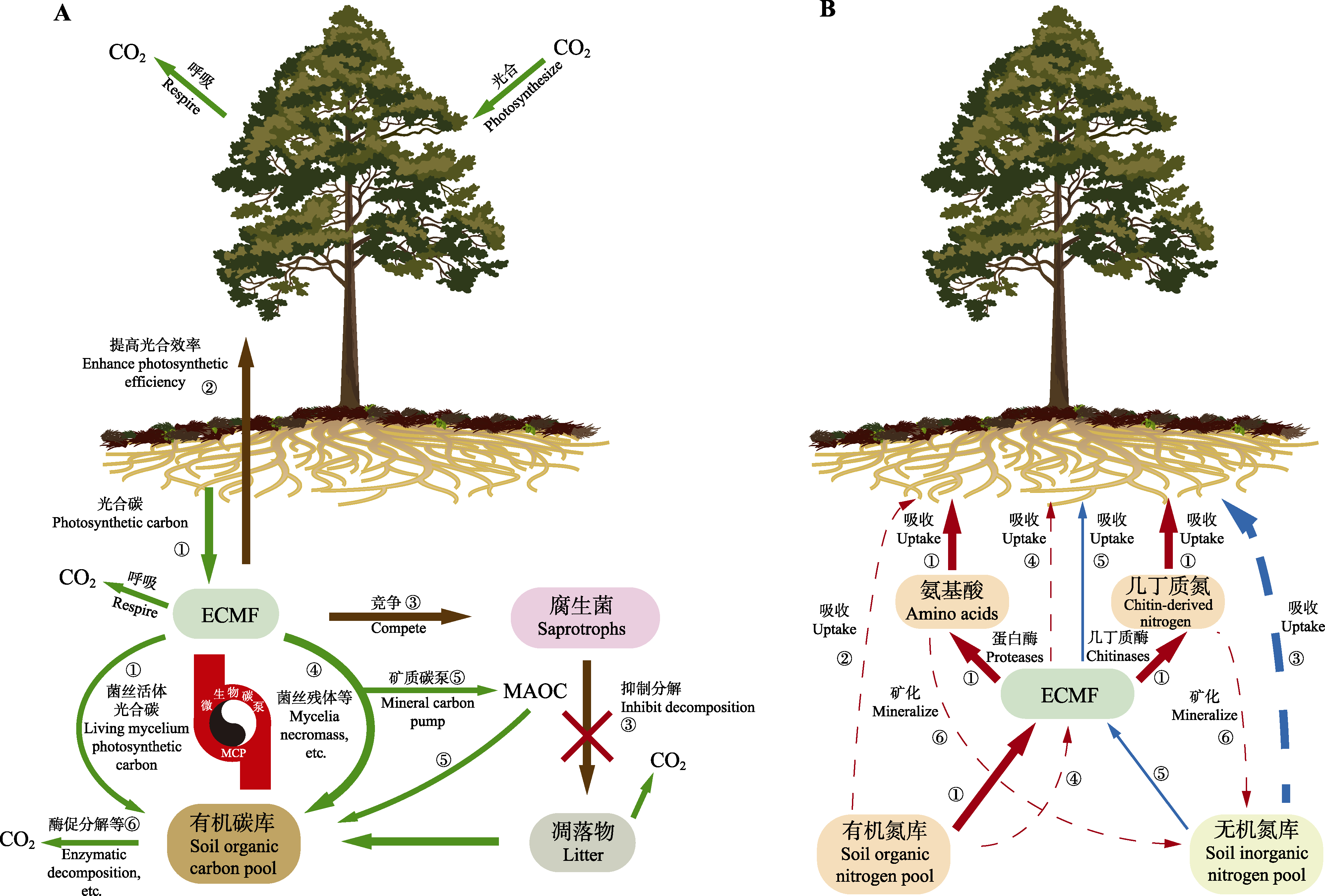
Fig. 1 Role of ectomycorrhizal fungi (ECMF) in carbon and nitrogen cycling in alpine ecosystems. A, Role of ECMF in carbon cycling. ① Input of photosynthetic carbon into the soil organic carbon pool via ECMF; ② ECMF enhance ecosystem carbon input by improving plant photosynthetic efficiency; ③ Gadgil effect: ECMF compete with saprotrophic fungi for nitrogen, thereby suppressing litter decomposition; ④ Input of ECMF mycelia necromass, exudates, and metabolites into the soil organic carbon pool (entombing effect); ⑤ Transformation of ECMF mycelia necromass and exudates into mineral-associated organic carbon (MAOC), which stabilizes the soil organic carbon pool; ⑥ Soil organic carbon pools are decomposed through enzymatic decomposition and other processes. Green arrows represent carbon flow; brown arrows represent fungal-mediated processes. MCP: Microbial carbon pump. B, Role of ECMF in nitrogen cycling. ① Proteases and chitinases secreted by ECMF decompose soil organic nitrogen into amino acids and chitin-derived nitrogen for plant uptake; ② Plants directly absorb a small amount of organic nitrogen via roots; ③ A large amount of inorganic nitrogen is supplied to plants through root uptake; ④ Plants absorb low-molecular-weight organic nitrogen via ECMF; ⑤ A small amount of inorganic nitrogen is supplied to plants through ECMF mycelia; ⑥ Amino acids and chitin-derived nitrogen are further mineralized into inorganic nitrogen. Red and blue arrows represent organic and inorganic nitrogen flow, respectively; solid lines indicate ECMF-mediated pathways, and dashed lines indicate pathways not involving ECMF.
| 全球变化因子 Global change factor | 生态系统/地点 Ecosystem/Location | 碳氮循环过程变化 Changes in C/N cycling processes | 参考文献 Reference |
|---|---|---|---|
| 全球变暖 Global warming | 北方森林 Boreal forest | 限制地下外生菌根网络碳氮养分通道的形成和发展 Restrict the formation and development of underground ectomycorrhizal network pathways for carbon and nitrogen transfer | Fernandez et al., |
| 北极苔原 Arctic tundra | 增加外生菌根真菌菌丝体生物量, 更多光合碳经外生菌根真菌进入土壤; 菌丝体氮含量提高, 外生菌根真菌介导的氮矿化过程加强 Increase mycelial biomass of ECMF, and more photosynthetic carbon entering the soil via ECMF; enhance nitrogen content in mycelia and strengthen the ECMF-mediated nitrogen mineralization process | Clemmensen et al., | |
| 氮沉降 Nitrogen deposition | 北方森林 Boreal forest | 减少光合碳流向外生菌根真菌; 减少外生菌根真菌对有机氮的矿化 Reduce the flow of photosynthetic carbon to ECMF; reduce the mineralization of organic nitrogen by ECMF | Högberg et al., |
| CO2浓度升高 Elevated CO2 concentration | 北方森林 Boreal forest | 增加外生菌根真菌残体碳的积累, 促进土壤碳固持; 增加外生菌根真菌的氮获取能力, 促进植物的氮吸收 Increase the accumulation of necromass carbon from ECMF, promoting soil carbon sequestration; enhance the nitrogen acquisition capacity of ECMF, facilitating plant nitrogen uptake | Liu et al., Reay et al., |
| 干旱 Drought | 北方森林 Boreal forest | 减少外生菌根真菌的定殖, 减弱加吉尔效应, 加速土壤有机质分解 Reduce colonization by ECMF, weaken the Gadgil effect, and therefore accelerate the decomposition of soil organic matter | Kilpeläinen et al., |
Table 1 Impacts of climate change factors on carbon and nitrogen cycling processes driven by ectomycorrhizal fungi (ECMF) in alpine ecosystems
| 全球变化因子 Global change factor | 生态系统/地点 Ecosystem/Location | 碳氮循环过程变化 Changes in C/N cycling processes | 参考文献 Reference |
|---|---|---|---|
| 全球变暖 Global warming | 北方森林 Boreal forest | 限制地下外生菌根网络碳氮养分通道的形成和发展 Restrict the formation and development of underground ectomycorrhizal network pathways for carbon and nitrogen transfer | Fernandez et al., |
| 北极苔原 Arctic tundra | 增加外生菌根真菌菌丝体生物量, 更多光合碳经外生菌根真菌进入土壤; 菌丝体氮含量提高, 外生菌根真菌介导的氮矿化过程加强 Increase mycelial biomass of ECMF, and more photosynthetic carbon entering the soil via ECMF; enhance nitrogen content in mycelia and strengthen the ECMF-mediated nitrogen mineralization process | Clemmensen et al., | |
| 氮沉降 Nitrogen deposition | 北方森林 Boreal forest | 减少光合碳流向外生菌根真菌; 减少外生菌根真菌对有机氮的矿化 Reduce the flow of photosynthetic carbon to ECMF; reduce the mineralization of organic nitrogen by ECMF | Högberg et al., |
| CO2浓度升高 Elevated CO2 concentration | 北方森林 Boreal forest | 增加外生菌根真菌残体碳的积累, 促进土壤碳固持; 增加外生菌根真菌的氮获取能力, 促进植物的氮吸收 Increase the accumulation of necromass carbon from ECMF, promoting soil carbon sequestration; enhance the nitrogen acquisition capacity of ECMF, facilitating plant nitrogen uptake | Liu et al., Reay et al., |
| 干旱 Drought | 北方森林 Boreal forest | 减少外生菌根真菌的定殖, 减弱加吉尔效应, 加速土壤有机质分解 Reduce colonization by ECMF, weaken the Gadgil effect, and therefore accelerate the decomposition of soil organic matter | Kilpeläinen et al., |
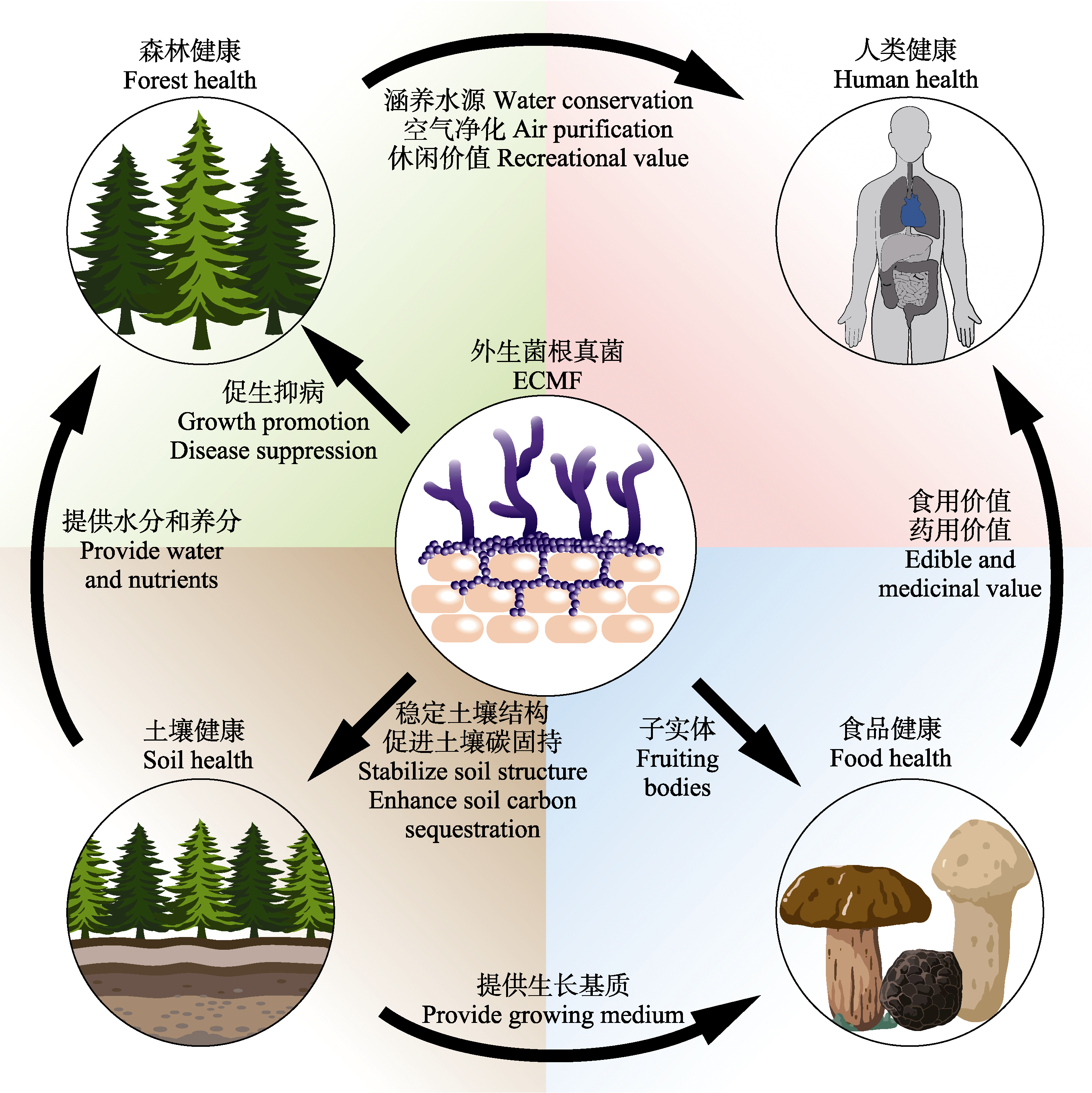
Fig. 2 Ectomycorrhizal fungi (ECMF) function as vital links between soil, forest, food, and human health. By forming symbiotic relationships with plant roots, ECMF enhance soil carbon sequestration and stabilize soil structure, while also playing key roles in tree growth promotion and disease resistance, thereby contributing to soil and forest health. Healthy soil supports the growth of healthy plants, which provide nutritious food and promote human health; healthy forests further enhance human well-being by delivering diverse ecosystem services. Additionally, the fruiting bodies of ECMF (such as matsutake, truffles, and porcini) possess edible and medicinal value.
| [1] | Adamczyk B, Smolander A, Kitunen V, Godlewski M (2010). Proteins as nitrogen source for plants: a short story about exudation of proteases by plant roots. Plant Signaling & Behavior, 5, 817-819. |
| [2] |
Allen MF, Kitajima K (2014). Net primary production of ectomycorrhizas in a California forest. Fungal Ecology, 10, 81-90.
DOI URL |
| [3] |
Audisio M, Muhr J, Polle A (2024). Ectomycorrhizal fungi of Douglas-fir retain newly assimilated carbon derived from neighboring European beech. New Phytologist, 243, 1980-1990.
DOI URL |
| [4] |
Averill C, Dietze MC, Bhatnagar JM (2018). Continental-scale nitrogen pollution is shifting forest mycorrhizal associations and soil carbon stocks. Global Change Biology, 24, 4544-4553.
DOI PMID |
| [5] |
Averill C, Turner BL, Finzi AC (2014). Mycorrhiza-mediated competition between plants and decomposers drives soil carbon storage. Nature, 505, 543-545.
DOI |
| [6] |
Banerjee S, van der Heijden MGA (2023). Soil microbiomes and one health. Nature Reviews Microbiology, 21, 6-20.
DOI |
| [7] |
Barbi F, Martinović T, Odriozola I, Machac A, Moravcová A, Algora C, Ballian D, Barthold S, Brabcová V, Hollá SA, Human Z, Kraigher H, Lazarević J, Lepinay C, Mészárošová L, et al. (2025). Disentangling drivers behind fungal diversity gradients along altitude and latitude. New Phytologist, 247, 295-308.
DOI URL |
| [8] |
Cairney JWG (2012). Extramatrical mycelia of ectomycorrhizal fungi as moderators of carbon dynamics in forest soil. Soil Biology & Biochemistry, 47, 198-208.
DOI URL |
| [9] |
Carrillo Y, Castañeda-Gómez L, Wong-Bajracharya J, Plett JM, Plett KL (2025). Elevated CO2 mediates ectomycorrhizal fungi species-specific decreases of native soil carbon and causes negative priming under low nutrients. New Phytologist, 248, 2052-2063.
DOI URL |
| [10] |
Chalot M, Brun A (1998). Physiology of organic nitrogen acquisition by ectomycorrhizal fungi and ectomycorrhizas. FEMS Microbiology Reviews, 22, 21-44.
DOI PMID |
| [11] |
Chen BD, Fu W, Wu SL, Zhu YG (2024). Involvements of mycorrhizal fungi in terrestrial ecosystem carbon cycling. Chinese Journal of Plant Ecology, 48, 1-20.
DOI URL |
|
[陈保冬, 付伟, 伍松林, 朱永官 (2024). 菌根真菌在陆地生态系统碳循环中的作用. 植物生态学报, 48, 1-20.]
DOI |
|
| [12] |
Chen C, Xiao WY, Chen HYH (2023). Mapping global soil acidification under N deposition. Global Change Biology, 29, 4652-4661.
DOI PMID |
| [13] | Chen LY, Gao YH (2022). Global climate change effects on soil microbial biomass stoichiometry in alpine ecosystems. Land, 11, 1661. DOI: 10.3390/land11101661. |
| [14] | Chen LY, Yang GB, Bai YX, Chang JF, Qin SQ, Liu FT, He M, Song YT, Zhang F, Peñuelas J, Zhu B, Zhou GY, Yang YH (2024). Permafrost carbon cycle and its dynamics on the Tibetan Plateau. Science China: Life Sciences, 67, 1833-1848. |
| [15] |
Clemmensen KE, Bahr A, Ovaskainen O, Dahlberg A, Ekblad A, Wallander H, Stenlid J, Finlay RD, Wardle DA, Lindahl BD (2013). Roots and associated fungi drive long-term carbon sequestration in boreal forest. Science, 339, 1615-1618.
DOI PMID |
| [16] |
Clemmensen KE, Durling MB, Michelsen A, Hallin S, Finlay RD, Lindahl BD (2021). A tipping point in carbon storage when forest expands into tundra is related to mycorrhizal recycling of nitrogen. Ecology Letters, 24, 1193-1204.
DOI URL |
| [17] |
Clemmensen KE, Michelsen A, Jonasson S, Shaver GR (2006). Increased ectomycorrhizal fungal abundance after long-term fertilization and warming of two arctic tundra ecosystems. New Phytologist, 171, 391-404.
PMID |
| [18] |
Courty PE, Buée M, Diedhiou AG, Frey-Klett P, Le Tacon F, Rineau F, Turpault MP, Uroz S, Garbaye J (2010). The role of ectomycorrhizal communities in forest ecosystem processes: new perspectives and emerging concepts. Soil Biology & Biochemistry, 42, 679-698.
DOI URL |
| [19] | Cuartero J, Querejeta JI, Prieto I, Frey B, Alguacil MM (2024). Warming and rainfall reduction alter soil microbial diversity and co-occurrence networks and enhance pathogenic fungi in dryland soils. Science of the Total Environment, 949, 175006. DOI: 10.1016/j.scitotenv.2024.175006. |
| [20] |
Dawes MA, Schleppi P, Hagedorn F (2017). The fate of nitrogen inputs in a warmer alpine treeline ecosystem: a 15N labelling study. Journal of Ecology, 105, 1723-1737.
DOI URL |
| [21] |
Deslippe JR, Hartmann M, Mohn WW, Simard SW (2011). Long-term experimental manipulation of climate alters the ectomycorrhizal community of Betula nana in Arctic tundra. Global Change Biology, 17, 1625-1636.
DOI URL |
| [22] | Drijber RA, McPherson MR (2021). Mycorrhizal symbioses// Gentry TJ, Fuhrmann JJ, Zuberer DA. Principles and Applications of Soil Microbiology. 3rd ed. Elsevier, Amsterdam. 303-325. |
| [23] |
Du EZ, Terrer C, Pellegrini AFA, Ahlström A, van Lissa CJ, Zhao X, Xia N, Wu XH, Jackson RB (2020). Global patterns of terrestrial nitrogen and phosphorus limitation. Nature Geoscience, 13, 221-226.
DOI |
| [24] | Dunleavy HR, Mack MC (2021). Long-term experimental warming and fertilization have opposing effects on ectomycorrhizal root enzyme activity and fungal community composition in arctic tundra. Soil Biology & Biochemistry, 154, 108151. DOI: 10.1016/j.soilbio.2021.108151. |
| [25] |
Fernandez CW, Langley JA, Chapman S, McCormack ML, Koide RT (2016). The decomposition of ectomycorrhizal fungal necromass. Soil Biology & Biochemistry, 93, 38-49.
DOI URL |
| [26] | Fernandez CW, Mielke L, Stefanski A, Bermudez R, Hobbie SE, Montgomery RA, Reich PB, Kennedy PG (2023). Climate change-induced stress disrupts ectomycorrhizal interaction networks at the boreal-temperate ecotone. Proceedings of the National Academy of Sciences of the United States of America, 120, e2221619120. DOI: 10.1073/pnas.2221619120. |
| [27] |
Fernandez CW, Nguyen NH, Stefanski A, Han Y, Hobbie SE, Montgomery RA, Reich PB, Kennedy PG (2017). Ectomycorrhizal fungal response to warming is linked to poor host performance at the boreal-temperate ecotone. Global Change Biology, 23, 1598-1609.
DOI PMID |
| [28] | Fitch AA, Goldsmith SB, Lankau RA, Wurzburger N, Shortt ZD, Vrattos A, Laurent EN, Pries CEH (2024). Mycorrhizal associations of temperate forest seedlings mediate rhizodeposition, but not soil carbon storage, under elevated nitrogen availability. Global Change Biology, 30, e17446. DOI: 10.1111/gcb.17446. |
| [29] | Gadgil RL, Gadgil PD (1971). Mycorrhiza and litter decomposition. Nature, 233, 133. DOI: 10.1038/233133a0. |
| [30] |
Gao C, Guo L (2013). Distribution pattern and maintenance of ectomycorrhizal fungus diversity. Biodiversity Science, 21, 488-498.
DOI |
| [31] | Gao Y, Wu XQ (2010). Effects of several ectomycorrhizal fungi on the chlorophyll content and chlorophyll fluorescence parameters in different pine seedlings. Journal of Nanjing Forestry University (Natural Sciences Edition), 34(6), 9-12. |
|
[高悦, 吴小芹 (2010). 6种外生菌根菌对3种松苗叶绿素含量及叶绿素荧光参数的影响. 南京林业大学学报(自然科学版), 34(6), 9-12.]
DOI |
|
| [32] | Geml J, Morgado LN, Semenova TA, Welker JM, Walker MD, Smets E (2015). Long-term warming alters richness and composition of taxonomic and functional groups of Arctic fungi. FEMS Microbiology Ecology, 91, fiv095. DOI: 10.1098/rsbl.2016.0503. |
| [33] | Guo Y, Ji L, Wang MW, Shan CF, Shen FY, Yang YC, He GX, Purahong W, Yang LX (2022). View from the top: insights into the diversity and community assembly of ectomycorrhizal and saprotrophic fungi along an altitudinal gradient in Chinese boreal Larix gmelinii- dominated forests. Microorganisms, 10, 1997. DOI: 10.3390/microorganisms10101997. |
| [34] |
Hagenbo A, Clemmensen KE, Finlay RD, Kyaschenko J, Lindahl BD, Fransson P, Ekblad A (2017). Changes in turnover rather than production regulate biomass of ectomycorrhizal fungal Mycelium across a Pinus sylvestris chronosequence. New Phytologist, 214, 424-431.
DOI URL |
| [35] | Hawkins HJ, Cargill RIM, van Nuland ME, Hagen SC, Field KJ, Sheldrake M, Soudzilovskaia NA, Kiers ET (2023). Mycorrhizal mycelium as a global carbon pool. Current Biology, 33, R560-R573. |
| [36] |
He NP, Liu CC, Piao SL, Sack L, Xu L, Luo YQ, He JS, Han XG, Zhou GS, Zhou XH, Lin Y, Yu Q, Liu SR, Sun W, Niu SL, et al. (2019). Ecosystem traits linking functional traits to macroecology. Trends in Ecology & Evolution, 34, 200-210.
DOI URL |
| [37] | Hilman B, Solly EF, Kuhlmann I, Brunner I, Hagedorn F (2024). Species-specific reliance of trees on ectomycorrhizal fungi for nitrogen supply at an alpine treeline. Fungal Ecology, 71, 101361. DOI: 10.1016/j.funeco.2024.101361. |
| [38] |
Hobbie EA, Agerer R (2010). Nitrogen isotopes in ectomycorrhizal sporocarps correspond to belowground exploration types. Plant and Soil, 327, 71-83.
DOI URL |
| [39] |
Hobbie EA, Högberg P (2012). Nitrogen isotopes link mycorrhizal fungi and plants to nitrogen dynamics. New Phytologist, 196, 367-382.
DOI PMID |
| [40] |
Hobbie JE, Hobbie EA (2006). 15N in symbiotic fungi and plants estimates nitrogen and carbon flux rates in Arctic tundra. Ecology, 87, 816-822.
PMID |
| [41] | Högberg MN, Briones MJI, Keel SG, Metcalfe DB, Campbell C, Midwood AJ, Thornton B, Hurry V, Linder S, Näsholm T, Högberg P (2010). Quantification of effects of season and nitrogen supply on tree below-ground carbon transfer to ectomycorrhizal fungi and other soil organisms in a boreal pine forest. New Phytologist, 187, 485-493. |
| [42] | Hu CC, Liu XY, Driscoll AW, Kuang YW, Brookshire ENJ, Lü XT, Chen CJ, Song W, Mao R, Liu CQ, Houlton BZ (2024). Global distribution and drivers of relative contributions among soil nitrogen sources to terrestrial plants. Nature Communications, 15, 6407. DOI: 10.1038/s41467-024-50674-6. |
| [43] |
Jörgensen K, Clemmensen KE, Wallander H, Lindahl BD (2024). Ectomycorrhizal fungi are more sensitive to high soil nitrogen levels in forests exposed to nitrogen deposition. New Phytologist, 242, 1725-1738.
DOI PMID |
| [44] |
Keller AB, Phillips RP (2019). Leaf litter decay rates differ between mycorrhizal groups in temperate, but not tropical, forests. New Phytologist, 222, 556-564.
DOI PMID |
| [45] |
Kerley SJ, Read DJ (1995). The biology of mycorrhiza in the Ericaceae: XVIII. Chitin degradation by Hymenoscyphus ericae and transfer of chitin-nitrogen to the host plant. New Phytologist, 131, 369-375.
DOI URL |
| [46] |
Kerley SJ, Read DJ (1998). The biology of mycorrhiza in the Ericaceae: XX. Plant and mycorrhizal necromass as nitrogenous substrates for the ericoid mycorrhizal fungus Hymenoscyphus ericae and its host. New Phytologist, 139, 353-360.
DOI URL |
| [47] |
Kilpeläinen J, Barbero-López A, Vestberg M, Heiskanen J, Lehto T (2017). Does severe soil drought have after-effects on arbuscular and ectomycorrhizal root colonisation and plant nutrition? Plant and Soil, 418, 377-386.
DOI URL |
| [48] | Koelemeijer IA, Castaño C, Clemmensen KE, Ehrlén J, de Frenne P, Jönsson M, Hylander K (2025). Effects of rainfall exclusion on soil fungi in a boreal forest landscape. Fungal Ecology, 77, 101452. DOI: 10.1016/j.funeco.2025.101452. |
| [49] |
Kottek M, Grieser J, Beck C, Rudolf B, Rubel F (2006). World Map of the Köppen-Geiger climate classification updated. Meteorologische Zeitschrift, 15, 259-263.
DOI URL |
| [50] |
Langley JA, Dijkstra P, Drake BG, Hungate BA (2003). Ectomycorrhizal colonization, biomass, and production in a regenerating scrub oak forest in response to elevated CO2. Ecosystems, 6, 424-430.
DOI URL |
| [51] |
Lehto T, Zwiazek JJ (2011). Ectomycorrhizas and water relations of trees: a review. Mycorrhiza, 21, 71-90.
DOI PMID |
| [52] | Li XX, Liang EY, Camarero JJ, Rossi S, Zhang JT, Zhu HF, Fu YH, Sun J, Wang T, Piao SL, Peñuelas J (2023). Warming-induced phenological mismatch between trees and shrubs explains high-elevation forest expansion. National Science Review, 10, nwad182. DOI: 10.1093/nsr/nwad182. |
| [53] |
Liang C, Zhu XF (2021). The soil microbial carbon pump as a new concept for terrestrial carbon sequestration. Science China Earth Sciences, 64, 545-558.
DOI |
| [54] |
Lilleskov EA, Kuyper TW, Bidartondo MI, Hobbie EA (2019). Atmospheric nitrogen deposition impacts on the structure and function of forest mycorrhizal communities: a review. Environmental Pollution, 246, 148-162.
DOI PMID |
| [55] |
Lin GG, McCormack ML, Ma CG, Guo DL (2017). Similar below-ground carbon cycling dynamics but contrasting modes of nitrogen cycling between arbuscular mycorrhizal and ectomycorrhizal forests. New Phytologist, 213, 1440-1451.
DOI PMID |
| [56] |
Lindahl BD, Kyaschenko J, Varenius K, Clemmensen KE, Dahlberg A, Karltun E, Stendahl J (2021). A group of ectomycorrhizal fungi restricts organic matter accumulation in boreal forest. Ecology Letters, 24, 1341-1351.
DOI PMID |
| [57] | Liu B, Fan XL, Meng D, Liu ZP, Gao DC, Chang Q, Bai E (2024). Ectomycorrhizal trees rely on nitrogen resorption less than arbuscular mycorrhizal trees globally. Ecology Letters, 27, e14346. DOI: 10.1111/ele.14346. |
| [58] | Liu SG, Wang H, Tian P, Yao X, Sun H, Wang QK, Delgado-Baquerizo M (2020). Decoupled diversity patterns in bacteria and fungi across continental forest ecosystems. Soil Biology & Biochemistry, 144, 107763. DOI: 10.1016/j.soilbio.2020.107763. |
| [59] |
Lucic E, Fourrey C, Kohler A, Martin F, Chalot M, Brun-Jacob A (2008). A gene repertoire for nitrogen transporters in Laccaria bicolor. New Phytologist, 180, 343-364.
DOI PMID |
| [60] |
Luo YH, Ma LL, Cadotte MW, Seibold S, Zou JY, Burgess KS, Tan SL, Ye LJ, Zheng W, Chen ZF, Liu DT, Zhu GF, Shi XC, Zhao W, Bi Z, et al. (2024). Testing the ectomycorrhizal-dominance hypothesis for ecosystem multifunctionality in a subtropical mountain forest. New Phytologist, 243, 2401-2415.
DOI URL |
| [61] |
Luo YH, Ma LL, Seibold S, Cadotte MW, Burgess KS, Tan SL, Ye LJ, Zheng W, Zou JY, Chen ZF, Liu DT, Zhu GF, Shi XC, Zhao W, Li DZ, et al. (2023). The diversity of mycorrhiza-associated fungi and trees shapes subtropical mountain forest ecosystem functioning. Journal of Biogeography, 50, 715-729.
DOI URL |
| [62] | Ma LJ, Xiao CD, Kang SC (2022). Characteristics, and similarities and differences of climate change in major high mountains in the world—Comprehensive interpretation of IPCC AR6 WGI report and SROCC. Climate Change Research, 18, 605-621. |
| [马丽娟, 效存德, 康世昌 (2022). 全球主要山地气候变化特征和异同——IPCC AR6 WGI报告和SROCC综合解读. 气候变化研究进展, 18, 605-621.] | |
| [63] | Mahmood S, Fahad Z, Bolou-Bi EB, King K, Köhler SJ, Bishop K, Ekblad A, Finlay RD (2024). Ectomycorrhizal fungi integrate nitrogen mobilisation and mineral weathering in boreal forest soil. New Phytologist, 242, 1545-1560. |
| [64] | Mao ZK, Wiegand T, Corrales A, Fang S, Hao ZQ, Lin F, Ye J, Yuan ZQ, Wang XG (2024). Mycorrhizal types regulate tree spatial associations in temperate forests: Ectomycorrhizal trees might favour species coexistence. Ecology Letters, 27, e70005. DOI: 10.1111/ele.70005. |
| [65] |
Meeran K, Verbrigghe N, Ingrisch J, Fuchslueger L, Müller L, Sigurðsson P, Sigurdsson BD, Wachter H, Watzka M, Soong JL, Vicca S, Janssens IA, Bahn M (2023). Individual and interactive effects of warming and nitrogen supply on CO2 fluxes and carbon allocation in subarctic grassland. Global Change Biology, 29, 5276-5291.
DOI URL |
| [66] | Mehmood K, Hassan ST, Qiu XC, Ali S (2024). Comparative analysis of CO2 emissions and economic performance in the United States and China: navigating sustainable development in the climate change era. Geoscience Frontiers, 15, 101843. DOI: 10.1016/j.gsf.2024.101843. |
| [67] | Meng ZX, Wu YP, Chen J, Cui YX, Hu YL, Zhao FB, Li HW, Chen WQ, Abalos D (2026). The trade-offs among fungal guilds are associated with soil organic carbon dynamics in alpine ecosystems. The Innovation Geoscience, 4, 100178. DOI: 10.59717/j.xinn-geo.2026.100178. |
| [68] |
Midolo G, Alkemade R, Schipper AM, Benítez-López A, Perring MP, de Vries W (2019). Impacts of nitrogen addition on plant species richness and abundance: a global meta-analysis. Global Ecology and Biogeography, 28, 398-413.
DOI URL |
| [69] |
Miyamoto Y, Terashima Y, Nara K (2018). Temperature niche position and breadth of ectomycorrhizal fungi: reduced diversity under warming predicted by a nested community structure. Global Change Biology, 24, 5724-5737.
DOI PMID |
| [70] |
Morgado LN, Semenova TA, Welker JM, Walker MD, Smets E, Geml J (2015). Summer temperature increase has distinct effects on the ectomycorrhizal fungal communities of moist tussock and dry tundra in Arctic Alaska. Global Change Biology, 21, 959-972.
DOI PMID |
| [71] |
Morrison EW, Frey SD, Sadowsky JJ, van Diepen LTA, Thomas WK, Pringle A (2016). Chronic nitrogen additions fundamentally restructure the soil fungal community in a temperate forest. Fungal Ecology, 23, 48-57.
DOI URL |
| [72] |
Näsholm T, Persson J (2001). Plant acquisition of organic nitrogen in boreal forests. Physiologia Plantarum, 111, 419-426.
DOI URL |
| [73] |
Nehls U, Plassard C (2018). Nitrogen and phosphate metabolism in ectomycorrhizas. New Phytologist, 220, 1047-1058.
DOI PMID |
| [74] |
Nicolás C, Martin-Bertelsen T, Floudas D, Bentzer J, Smits M, Johansson T, Troein C, Persson P, Tunlid A (2019). The soil organic matter decomposition mechanisms in ectomycorrhizal fungi are tuned for liberating soil organic nitrogen. The ISME Journal, 13, 977-988.
DOI URL |
| [75] |
Nieves DJ, Reich PB, Stefanski A, Bermudez R, Beidler KV, Kennedy PG (2024). Ectomycorrhizal fungal community response to warming and rainfall reduction differs between co-occurring temperate-boreal ecotonal Pinus saplings. Mycorrhiza, 34, 403-416.
DOI |
| [76] |
Nottingham AT, Meir P, Velasquez E, Turner BL (2020). Soil carbon loss by experimental warming in a tropical forest. Nature, 584, 234-237.
DOI |
| [77] | Nouwen O, Rineau F, Kohout P, Baldrian P, Eisenhauer N, Beenaerts N, Thijs S, Vangronsveld J, Soudzilovskaia NA (2025). Towards understanding the impact of mycorrhizal fungal environments on the functioning of terrestrial ecosystems. FEMS Microbiology Ecology, 101, fiaf062. DOI: 10.1093/femsec/fiaf062. |
| [78] |
Orwin KH, Kirschbaum MUF, St John MG, Dickie IA (2011). ORGANIC nutrient uptake by mycorrhizal fungi enhances ecosystem carbon storage: a model-based assessment: organic nutrient uptake enhances soil C. Ecology Letters, 14, 493-502.
DOI PMID |
| [79] |
Oyarte Galvez L, Bisot C, Bourrianne P, Cargill R, Klein M, van Son M, van Krugten J, Caldas V, Clerc T, Lin KK, Kahane F, van Staalduine S, Stewart JD, Terry V, Turcu B, et al. (2025). A travelling-wave strategy for plant- fungal trade. Nature, 639, 172-180.
DOI |
| [80] |
Phillips RP, Brzostek E, Midgley MG (2013). The mycorrhizal- associated nutrient economy: a new framework for predicting carbon-nutrient couplings in temperate forests. New Phytologist, 199, 41-51.
DOI PMID |
| [81] | Potter TS, Owens WM, Bowman WD (2019). Do plant- microbe interactions and aluminum tolerance influence alpine sedge species’ responses to nitrogen deposition? Ecosphere, 10, e02775. DOI: 10.1002/ecs2.2775. |
| [82] |
Querejeta JI, Schlaeppi K, López-García Á, Ondoño S, Prieto I, van der Heijden MGA, Alguacil MM (2021). Lower relative abundance of ectomycorrhizal fungi under a warmer and drier climate is linked to enhanced soil organic matter decomposition. New Phytologist, 232, 1399-1413.
DOI PMID |
| [83] | Reay MK, Sayer EJ, Smith A, Pastor V, Kourmouli A, Marshall M, Grzesik RT, Evans I, Rumeau M, Hart K, Ma JJ, Norby RJ, MacKenzie AR, Hamilton RL, Hartley IP, et al. (2025). Elevated CO2alters relative belowground carbon investment for nutrient acquisition in a mature temperate forest. Proceedings of the National Academy of Sciences of the United States of America, 122, e2503595122. DOI: 10.1073/pnas.2503595122. |
| [84] | Ren S, Wang T, Guenet B, Liu D, Cao YF, Ding JZ, Smith P, Piao SL (2024). Projected soil carbon loss with warming in constrained Earth system models. Nature Communications, 15, 102. DOI: 10.1038/s41467-023-44433-2. |
| [85] |
Rillig MC, Ryo M, Lehmann A, Aguilar-Trigueros CA, Buchert S, Wulf A, Iwasaki A, Roy J, Yang GW (2019). The role of multiple global change factors in driving soil functions and microbial biodiversity. Science, 366, 886-890.
DOI PMID |
| [86] | Schmeller DS, Urbach D, Bates K, Catalan J, Cogălniceanu D, Fisher MC, Friesen J, Füreder L, Gaube V, Haver M, Jacobsen D, Le Roux G, Lin YP, Loyau A, Machate O, et al. (2022). Scientists’ warning of threats to mountains. Science of the Total Environment, 853, 158611. DOI: 10.1016/j.scitotenv.2022.158611. |
| [87] |
Schulten HR, Schnitzer M (1997). The chemistry of soil organic nitrogen: a review. Biology and Fertility of Soils, 26, 1-15.
DOI URL |
| [88] |
Schweigert M, Herrmann S, Miltner A, Fester T, Kästner M (2015). Fate of ectomycorrhizal fungal biomass in a soil bioreactor system and its contribution to soil organic matter formation. Soil Biology & Biochemistry, 88, 120-127.
DOI URL |
| [89] | Shao SY, Wurzburger N, Sulman B, Hicks Pries C (2023). Ectomycorrhizal effects on decomposition are highly dependent on fungal traits, climate, and litter properties: a model-based assessment. Soil Biology & Biochemistry, 184, 109073. DOI: 10.1016/j.soilbio.2023.109073. |
| [90] |
Shaver GR, Canadell J, Chapin FS, Gurevitch J, Harte J, Henry G, Ineson P, Jonasson S, Melillo J, Pitelka L, Rustad L (2000). Global warming and terrestrial ecosystems: a conceptual framework for analysis. Bioscience, 50, 871-882.
DOI URL |
| [91] |
Shelton BR, Larrere J, Yusta Belsham D, Omacini M, Argüelles-Moyao A, Buscardo E, Alves da Silva DK, Zhao XY, Nakamura N, Ángeles-Argáiz R, Paz C, Matías-Ferrer N, Hart MM (2026). Fungal ecology in the age of ′omics. New Phytologist, 250, 822-833.
DOI URL |
| [92] |
Singh BK, Yan ZZ, Whittaker M, Vargas R, Abdelfattah A (2023). Soil microbiomes must be explicitly included in One Health policy. Nature Microbiology, 8, 1367-1372.
DOI PMID |
| [93] | Steidinger B, Bhatnagar J, Vilgalys R, Taylor J, Bruns T, Peay K (2018). Global climate changes will lead to regionally divergent trajectories for ectomycorrhizal communities in North American Pinaceae forests. bioRxiv. DOI: 10.1101/393009. |
| [94] |
Steidinger BS, Crowther TW, Liang J, van Nuland ME, Werner GDA, Reich PB, Nabuurs G, De-Miguel S, Zhou M, Picard N, Herault B, Zhao X, Zhang C, Routh D, Peay KG, et al. (2019). Climatic controls of decomposition drive the global biogeography of forest-tree symbioses. Nature, 569, 404-408.
DOI |
| [95] |
Sterkenburg E, Clemmensen KE, Ekblad A, Finlay RD, Lindahl BD (2018). Contrasting effects of ectomycorrhizal fungi on early and late stage decomposition in a boreal forest. The ISME Journal, 12, 2187-2197.
DOI URL |
| [96] | Sun JQ, Cao WQ, Leng PS, Hu ZH (2021). Effect of four ectomycorrhizal fungi inoculation on the growth, photosynthesis, and nutrient element content of Quercus dentata seedlings. Journal of Central South University of Forestry & Technology, 41(10), 67-74. |
| [孙佳琦, 曹文琪, 冷平生, 胡增辉 (2021). 接种4种外生菌根真菌对槲树幼苗生长、光合及营养元素含量的影响. 中南林业科技大学学报, 41(10), 67-74.] | |
| [97] | Sun YY, Xu M, Li YF, Zhang XB (2023). Elevational distribution pattern of fungal diversity and the driving mechanisms at different soil depths in mount Segrila. Acta Pedologica Sinica, 60, 1169-1182. |
| [孙媛媛, 徐梦, 李月芬, 张旭博 (2023). 色季拉山不同深度土壤真菌多样性的海拔分布格局及其影响机制. 土壤学报, 60, 1169-1182.] | |
| [98] | Tatsumi C, Taniguchi T, Du S, Yamanaka N, Tateno R (2020). Soil nitrogen cycling is determined by the competition between mycorrhiza and ammonia-oxidizing prokaryotes. Ecology, 101, e02963. DOI: 10.1002/ecy.2963. |
| [99] | Tedersoo L, Bahram M, Põlme S, Kõljalg U, Yorou NS, Wijesundera R, Ruiz LV, Vasco-Palacios AM, Thu PQ, Suija A, Smith ME, Sharp C, Saluveer E, Saitta A, Rosas M, et al. (2014). Global diversity and geography of soil fungi. Science, 346, 1256688. DOI: 10.1126/science.1256688. |
| [100] | Tedersoo L, Bahram M, Zobel M (2020). How mycorrhizal associations drive plant population and community biology. Science, 367, eaba1223. DOI: 10.1126/science.aba1223. |
| [101] |
Tibbett M, Sanders FE, Minto SJ, Dowell M, Cairney JWG (1998). Utilization of organic nitrogen by ectomycorrhizal fungi (Hebeloma spp.) of arctic and temperate origin. Mycological Research, 102, 1525-1532.
DOI URL |
| [102] | van Nuland ME, Qin C, Pellitier PT, Zhu K, Peay KG (2024). Climate mismatches with ectomycorrhizal fungi contribute to migration lag in North American tree range shifts. Proceedings of the National Academy of Sciences of the United States of America, 121, e2308811121. DOI: 10.1073/pnas.2308811121. |
| [103] |
Walker DA, Jia GJ, Epstein HE, Raynolds MK, Chapin FS, Copass C, Hinzman LD, Knudson JA, Maier HA, Michaelson GJ, Nelson F, Ping CL, Romanovsky VE, Shiklomanov N (2003). Vegetation-soil-thaw-depth relationships along a low-arctic bioclimate gradient, Alaska: synthesis of information from the ATLAS studies. Permafrost and Periglacial Processes, 14, 103-123.
DOI URL |
| [104] |
Wang C, Liu DW, Bai E (2018). Decreasing soil microbial diversity is associated with decreasing microbial biomass under nitrogen addition. Soil Biology & Biochemistry, 120, 126-133.
DOI URL |
| [105] |
Wang K, Zhang TJ, Mu CC, Zhong XY, Peng XQ, Cao B, Lu L, Zheng L, Wu XD, Liu J (2020). From the Third Pole to the Arctic: changes and impacts of the climate and cryosphere. Journal of Glaciology and Geocryology, 42(1), 104-123.
DOI |
|
[王康, 张廷军, 牟翠翠, 钟歆玥, 彭小清, 曹斌, 鲁蕾, 郑雷, 吴小丹, 刘佳 (2020). 从第三极到北极: 气候与冰冻圈变化及其影响. 冰川冻土, 42(1), 104-123.]
DOI |
|
| [106] | Wang X, Yu GH, Kuzyakov Y, Yin BH, Kappler A, Liu CQ (2025). Contribution of fungal biomass to persistent soil carbon across natural ecosystems. Science China Earth Sciences, 55, 454-467. |
| [王翔, 余光辉, Kuzyakov Y, 殷博昊, Kappler A, 刘丛强 (2025). 生态系统中真菌生物量对土壤稳定碳库的贡献. 中国科学: 地球科学, 55, 454-467.] | |
| [107] |
Wang XQ, Wang CK, Zhang TD (2017). New perspectives on forest soil carbon and nitrogen cycling processes: roles of arbuscular mycorrhizal versus ectomycorrhizal tree species. Chinese Journal of Plant Ecology, 41, 1113-1125.
DOI URL |
|
[王薪琪, 王传宽, 张泰东 (2017). 森林土壤碳氮循环过程的新视角: 丛枝与外生菌根树种的作用. 植物生态学报, 41, 1113-1125.]
DOI |
|
| [108] | Xiang G, Wu RT, Zhang MM, Li K, He X, Song Y, Song FQ (2023). Simulated nitrogen deposition alters the ectomycorrhizal fungal community structure in northern Korean pine plantations. Catena, 233, 107525. DOI: 10.1016/j.catena.2023.107525. |
| [109] | Xiao KQ, Zhao Y, Liang C, Zhao MY, Moore OW, Otero-Fariña A, Zhu YG, Johnson K, Peacock CL (2023). Introducing the soil mineral carbon pump. Nature Reviews Earth & Environment, 4, 135-136. |
| [110] |
Xie LL, Yang YM, Ma JR, Lin GG, Deng JJ, Robson TM, Peng H, Zhou L, Yu DP, Wang QW (2024). Variations in ectomycorrhizal exploration types parallel seedling fine root traits of two temperate tree species under extreme drought and contrasting solar radiation treatments. Plant, Cell & Environment, 47, 5053-5066.
DOI URL |
| [111] | Xue JH, Mo JM, Li J, Fang YT, Li DJ (2004). Effects of nitrogen deposition on ectomycorrhizal fungi. Acta Ecologica Sinica, 24, 1789-1796. |
| [薛璟花, 莫江明, 李炯, 方运霆, 李德军 (2004). 氮沉降对外生菌根真菌的影响. 生态学报, 24, 1789-1796.] | |
| [112] | Yan GY, Fan CN, Zheng JQ, Liu GC, Yu JH, Guo ZL, Cao W, Wang LH, Wang WJ, Meng QF, Zhang JH, Li Y, Zheng JP, Cui XY, Wang XC, et al. (2024). Forest carbon stocks increase with higher dominance of ectomycorrhizal trees in high latitude forests. Nature Communications, 15, 5959. DOI: 10.1038/s41467-024-50423-9. |
| [113] | Yang T, Tedersoo L, Fu X, Zhao C, Liu X, Gao GF, Cheng L, Adams JM, Chu HY (2021). Saprotrophic fungal diversity predicts ectomycorrhizal fungal diversity along the timberline in the framework of island biogeography theory. ISME Communications, 1, 15. DOI: 10.1038/s43705-021-00015-1. |
| [114] |
Yang T, Tedersoo L, Liu X, Gao GF, Dong K, Adams JM, Chu HY (2022). Fungi stabilize multi-Kingdom community in a high elevation timberline ecosystem. iMeta, 1, e49. DOI: 10.1002/imt2.49.
PMID |
| [115] | Yiallouris A, Pana ZD, Marangos G, Tzyrka I, Karanasios S, Georgiou I, Kontopyrgia K, Triantafyllou E, Seidel D, Cornely OA, Johnson EO, Panagiotou S, Filippou C (2024). Fungal diversity in the soil mycobiome: implications for ONE health. One Health, 18, 100720. DOI: 10.1016/j.onehlt.2024.100720. |
| [116] | Yin HJ, Adamczyk B, Wang QT, Zhu B, Guo WJ, Zhu XM, Liu Q, Zhang ZL (2022). How do nitrogen-limited alpine coniferous forests acquire nitrogen? A rhizosphere perspective. Forest Ecosystems, 9, 100071. DOI: 10.1016/j.fecs.2022.100071. |
| [117] | You QL, Cai ZY, Pepin N, Chen DL, Ahrens B, Jiang ZH, Wu FY, Kang SC, Zhang RN, Wu TH, Wang PL, Li MC, Zuo ZY, Gao YH, Zhai PM, et al. (2021). Warming amplification over the Arctic Pole and Third Pole: trends, mechanisms and consequences. Earth-Science Reviews, 217, 103625. DOI: 10.1016/j.earscirev.2021.103625. |
| [118] |
Yu JR, Yuan HS (2023). Research progress on symbiotic interaction and host selection mechanisms of ectomycorrhizal fungi. Mycosystema, 42(1), 86-100.
DOI |
|
[俞嘉瑞, 袁海生 (2023). 外生菌根真菌的共生互作和宿主选择机制研究进展. 菌物学报, 42(1), 86-100.]
DOI |
|
| [119] | Zhang MX, Shen ZF, Walden L, Sepanta F, Luo ZK, Gao L, Serrano O, Viscarra Rossel RA (2025). Deep learning of the particulate and mineral-associated organic carbon fractions using a compositional transform and mid-infrared spectroscopy. Geoderma, 455, 117207. DOI: 10.1016/j.geoderma.2025.117207. |
| [120] | Zhang T, Tang YY, Shan BX, Xu MJ, Cong N, Chen N, Ji XM, Zhao G, Zheng ZT, Zhu JT, Zhang YJ (2023). Drought- induced resource use efficiency responses in an alpine meadow ecosystem of northern Tibet. Agricultural and Forest Meteorology, 342, 109745. DOI: 10.1016/j.agrformet.2023.109745. |
| [121] |
Zhang TA, Chen HYH, Ruan HH (2018). Global negative effects of nitrogen deposition on soil microbes. The ISME Journal, 12, 1817-1825.
DOI URL |
| [122] |
Zhang ZL, Phillips RP, Zhao WQ, Yuan YS, Liu Q, Yin HJ (2019a). Mycelia-derived C contributes more to nitrogen cycling than root-derived C in ectomycorrhizal alpine forests. Functional Ecology, 33, 346-359.
DOI URL |
| [123] | Zhang ZL, Yuan YS, Liu Q, Yin HJ (2019b). Plant nitrogen acquisition from inorganic and organic sources via root and mycelia pathways in ectomycorrhizal alpine forests. Soil Biology & Biochemistry, 136, 107517. DOI: 10.1016/j.soilbio.2019.06.013. |
| [124] | Zhao YH, Zhou YJ, Jia X, Han L, Liu L, Ren K, Ye X, Qu Z, Pei YJ (2022). Soil characteristics and microbial community structure on along elevation gradient in a Pinus armandii forest of the Qinling Mountains, China. Forest Ecology and Management, 503, 119793. DOI: 10.1016/j.foreco.2021.119793. |
| [125] |
Zhou J, Gube M, Holz M, Song B, Shan I, Shi LL, Kuzyakov Y, Dippold MA, Pausch J (2022). Ectomycorrhizal and non-mycorrhizal rhizosphere fungi increase root-derived C input to soil and modify enzyme activities: a 14C pulse labelling of Picea abies seedlings. Plant, Cell & Environment, 45, 3122-3133.
DOI URL |
| [126] | Zhou ZH, Wang CK, Luo YQ (2020). Meta-analysis of the impacts of global change factors on soil microbial diversity and functionality. Nature Communications, 11, 3072. DOI: 10.1038/s41467-020-16881-7. |
| [127] | Zhu JX, Jia YL, Yu GR, Wang QF, He NP, Chen Z, He HL, Zhu XJ, Li P, Zhang FS, Liu XJ, Goulding K, Fowler D, Vitousek P (2025). Changing patterns of global nitrogen deposition driven by socio-economic development. Nature Communications, 16, 46. DOI: 10.1038/s41467-024-55606-y. |
| [128] |
Zhu XM, Zhang ZL, Wang QT, Peñuelas J, Sardans J, Lambers H, Li N, Liu Q, Yin HJ, Liu ZF (2022). More soil organic carbon is sequestered through the mycelium pathway than through the root pathway under nitrogen enrichment in an alpine forest. Global Change Biology, 28, 4947-4961.
DOI URL |
| [129] | Zuev AG, Hauer A, Angst G, Chatzinotas A, Eisenhauer N, Ferlian O, Jurburg SD, Lillipuu EM, Öpik M, Vasar M, Zhang AJ, Zueva AI, Potapov A (2026). Rapid allocation of freshly added organic nitrogen to particulate organic matter in ectomycorrhiza- but not arbuscular mycorrhiza- dominated forests. Soil Biology & Biochemistry, 212, 109999. DOI: 10.1016/j.soilbio.2025.109999. |
| [1] | Zhao Zhi-Yi, HUANG Wei-Quan, HU Jing-Yan, WANG Yi-yue, Yu Mengjie, Yuhuan Wu. Advances of plant litter decomposition and its microbial mechanisms in peatland [J]. Chin J Plant Ecol, 2026, 50(4): 801-813. |
| [2] | MA Jian-Hui, TONG Xin, ZHANG Si-Rong, MAO Zi-Kun, QIN Jun, MA Ke-Ping. Research advances and perspectives on physiological and ecological functions of mycorrhizal fungi [J]. Chin J Plant Ecol, 2026, 50(3): 498-514. |
| [3] | LI Wen-Zhu, LUAN Jun-Wei, DI Ya-Ping, WANG Yi, NIE Xiu-Qing, LIU Shi-Rong. Effects of manipulative drought on mycorrhiza-mediated soil enzyme activities and soil organic carbon fractions in a warm temperate Quercus aliena var. acuteserrata forest [J]. Chin J Plant Ecol, 2026, 50(3): 660-673. |
| [4] | WANG Meng-Xue, HU Ming-Yan, CHU Cheng-Jin, CHEN Yang, LUO Wen-Qi, MA Zi-Long. C, N, P stoichiometric characteristics of leaves and fine roots in different mycorrhizal tree species in subtropical forests [J]. Chin J Plant Ecol, 2026, 50(2): 334-343. |
| [5] | RAN Jia-Xin, HE Shu-Ting, LUO Su-Ping, WANG Yun, MAO Chao. Global patterns and drivers of soil gross nitrogen transformations of forest ecosystems [J]. Chin J Plant Ecol, 2026, 50(1): 45-54. |
| [6] | ZHANG Lin, YUAN Wei-Ying, SONG Chuang-Ye, WU Dong-Xiu. Dynamic dataset of environmental elements, species richness and biomass of long-term observation plots of typical ecosystems in China from 1998 to 2010 [J]. Chin J Plant Ecol, 2025, 49(8): 1182-1190. |
| [7] | FAN Ya-Ran, XIA Shao-Pan, YU Bing-Bing, ZHU Zi-Qi, YANG Wei, FAN Yu-Chuan, LIU Xiao-Yu, ZHANG Xu-Hui, ZHENG Ju-Feng. Effects of elevated atmospheric CO2 concentration and warming on stability of soil organic carbon pool accumulation, molecular composition and structure stability [J]. Chin J Plant Ecol, 2025, 49(7): 1053-1069. |
| [8] | WANG Kun-Ying, QIU Gui-Fu, LIU Zi-He, MENG Jun, LIU Yu-Xuan, JIA Guo-Dong. Climate change regulate tree growth and intrinsic water use efficiency of Populus simonii at different levels of degradation [J]. Chin J Plant Ecol, 2025, 49(2): 343-355. |
| [9] | HUANG Mei-Hong, NIU Meng-Qiu, YANG Peng-Fei, LIN Jie, LIAO Zhou-Yu, CHEN Jian-Guo, XIANG Jian-Ying. Effects of temperature and burial depth on seedling emergence and growth of the alpine cushion plant Arenaria oreophila [J]. Chin J Plant Ecol, 2025, 49(12): 2092-2104. |
| [10] | ZHANG Zi-Rui, ZHOU Jing, HU Yan-Ping, LIANG Shuang, MA Yong-Peng, CHEN Wei-Le. Root-associated fungal communities of the critically endangered plant Pinus squamata [J]. Chin J Plant Ecol, 2025, 49(10): 1600-1611. |
| [11] | HE Yi, ZHOU Jing, CHEN Chen, FANG Ting-Zhou, SU Jian, GAO Hao-Jie, CAO Jia-Hao, YANG Fei-Yu, FAN Qi-Bo, ZHU Le-Yao, CHEN Yi-Ming, YANG Fei, WANG Yi-Teng, FENG Lei, LIU Fei, LIANG Shuang, JIANG Ming-Kai, CHEN Jun, ZHAO Yun-Peng, CHEN Wei-Le, ZHAO Ying, HUANG Jian-Guo. Protection and restoration of endangered tree species on coastal islands of Zhejiang, China [J]. Chin J Plant Ecol, 2025, 49(10): 1583-1599. |
| [12] | ZHANG Peng, JIAO Liang, XUE Ru-Hong, WEI Meng-Yuan, DU Da-Shi, WU Xuan, WANG Xu-Ge, LI Qian. Drought intensity affected the growth recovery of Picea crassifolia across different altitudes in western Qilian Mountains [J]. Chin J Plant Ecol, 2024, 48(8): 977-987. |
| [13] | SHI Qian, TONG Xiao-Juan, XU Ling-Ling, MENG Ping, YU Pei-Yang, LI Jun, YANG Ming-Xin. Response of radial growth of early and late wood of planted Pinus tabuliformis to climate variables [J]. Chin J Plant Ecol, 2024, 48(8): 988-1000. |
| [14] | CHEN Yi-Heng, Yusufujiang RUSULI, Abdureheman WUSIMAN. Analysis of spatial and temporal variation in grassland vegetation cover in Xinjiang section of Tianshan Mountains and the driving factors from 2001 to 2020 [J]. Chin J Plant Ecol, 2024, 48(5): 561-576. |
| [15] | WU Ru-Ru, LIU Mei-Zhen, GU Xian, CHANG Xin-Yue, GUO Li-Yue, JIANG Gao-Ming, QI Ru-Yi. Prediction of suitable habitat distribution and potential impact of climate change on distribution patterns of Cupressus gigantea [J]. Chin J Plant Ecol, 2024, 48(4): 445-458. |
| Viewed | ||||||
|
Full text |
|
|||||
|
Abstract |
|
|||||
Copyright © 2026 Chinese Journal of Plant Ecology
Tel: 010-62836134, 62836138, E-mail: apes@ibcas.ac.cn, cjpe@ibcas.ac.cn

