
Chin J Plant Ecol ›› 2026, Vol. 50 ›› Issue (4): 917-928.DOI: 10.17521/cjpe.2025.0361 cstr: 32100.14.cjpe.2025.0361
• Research Articles • Previous Articles Next Articles
LIN Lin-Lin1,3, XIAO Jin-Xiang1,3, HUANG Shen-Shen1,3, ZHAO Yang-Mei2,3, ZHANG De-Xu2,3, CHENG Yi-Kang2,3,*( ), LONG Wen-Xing2,3,*()
Received:2025-10-08
Accepted:2026-02-25
Online:2026-04-20
Published:2026-06-29
Contact:
CHENG Yi-Kang, LONG Wen-Xing
Supported by:LIN Lin-Lin, XIAO Jin-Xiang, HUANG Shen-Shen, ZHAO Yang-Mei, ZHANG De-Xu, CHENG Yi-Kang, LONG Wen-Xing. Effects of phosphorus addition on functional traits across seedlings and saplings in a tropical cloud forest[J]. Chin J Plant Ecol, 2026, 50(4): 917-928.
Add to citation manager EndNote|Ris|BibTeX
URL: https://www.plant-ecology.com/EN/10.17521/cjpe.2025.0361
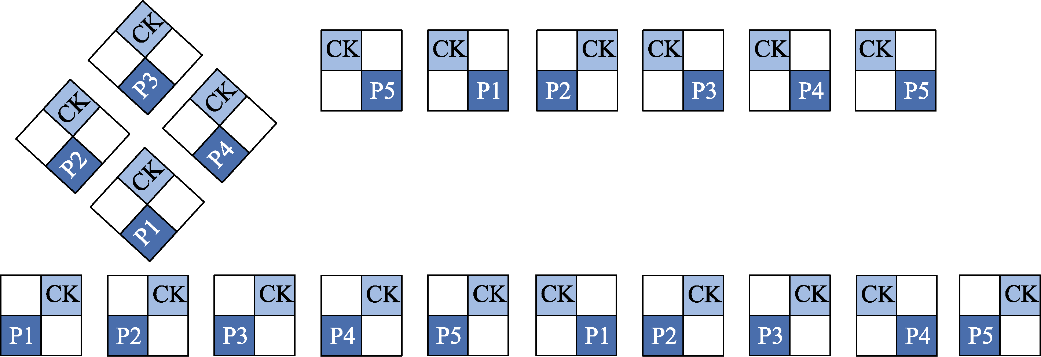
Fig. 1 Distribution map of sample plots for phosphorus addition in a tropical cloud forest. Phosphorus addition level (g·m-2·a-1): CK, 0; P1, 1.0; P2, 2.0; P3, 4.0; P4, 8.0; P5, 16.0.
| 固定效应 Fixed effect | BD | LT | SLA | LDMC | LN | LP | ||||||
|---|---|---|---|---|---|---|---|---|---|---|---|---|
| F | p | F | p | F | p | F | p | F | p | F | p | |
| 磷浓度 Phosphorus concentration (P) | 2.38 | 0.07 | 3.30 | 0.02 | 11.52 | <0.01 | 6.27 | <0.01 | 0.38 | 0.77 | 38.02 | <0.01 |
| 生长阶段 Growth stage (G) | 20.61 | <0.01 | 28.27 | <0.01 | 48.73 | <0.01 | 7.02 | <0.01 | 0.23 | 0.63 | 10.15 | <0.01 |
| P × G | 0.53 | 0.66 | 4.43 | <0.01 | 3.22 | 0.02 | 0.60 | 0.61 | 2.58 | <0.05 | 0.40 | 0.75 |
Table 1 Influence of phosphorus addition and growth stage on plant functional traits in a tropical cloud forest
| 固定效应 Fixed effect | BD | LT | SLA | LDMC | LN | LP | ||||||
|---|---|---|---|---|---|---|---|---|---|---|---|---|
| F | p | F | p | F | p | F | p | F | p | F | p | |
| 磷浓度 Phosphorus concentration (P) | 2.38 | 0.07 | 3.30 | 0.02 | 11.52 | <0.01 | 6.27 | <0.01 | 0.38 | 0.77 | 38.02 | <0.01 |
| 生长阶段 Growth stage (G) | 20.61 | <0.01 | 28.27 | <0.01 | 48.73 | <0.01 | 7.02 | <0.01 | 0.23 | 0.63 | 10.15 | <0.01 |
| P × G | 0.53 | 0.66 | 4.43 | <0.01 | 3.22 | 0.02 | 0.60 | 0.61 | 2.58 | <0.05 | 0.40 | 0.75 |
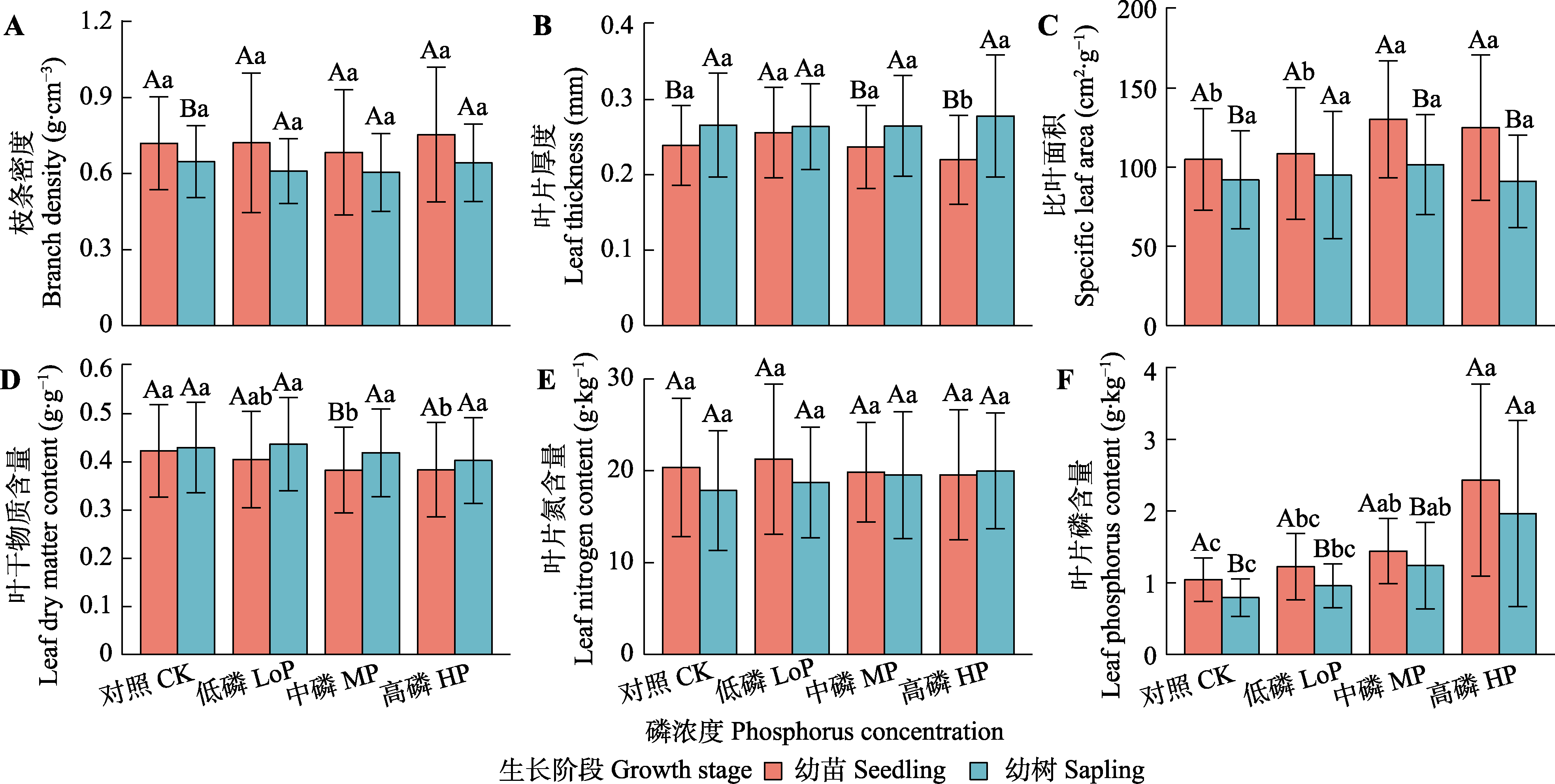
Fig. 2 Influence of different phosphorus addition levels on plant functional traits at different growth stages in a tropical cloud forest (mean ± SD). Different uppercase letters indicate significant differences between different growth stages at the same phosphorus concentration (p < 0.05), while different lowercase letters indicate significant differences between different phosphorus concentrations at the same growth stage (p < 0.05). CK, control treatment; LoP, low phosphorus concentration addition treatment; MP, medium phosphorus concentration addition treatment; HP, high phosphorus concentration addition treatment.
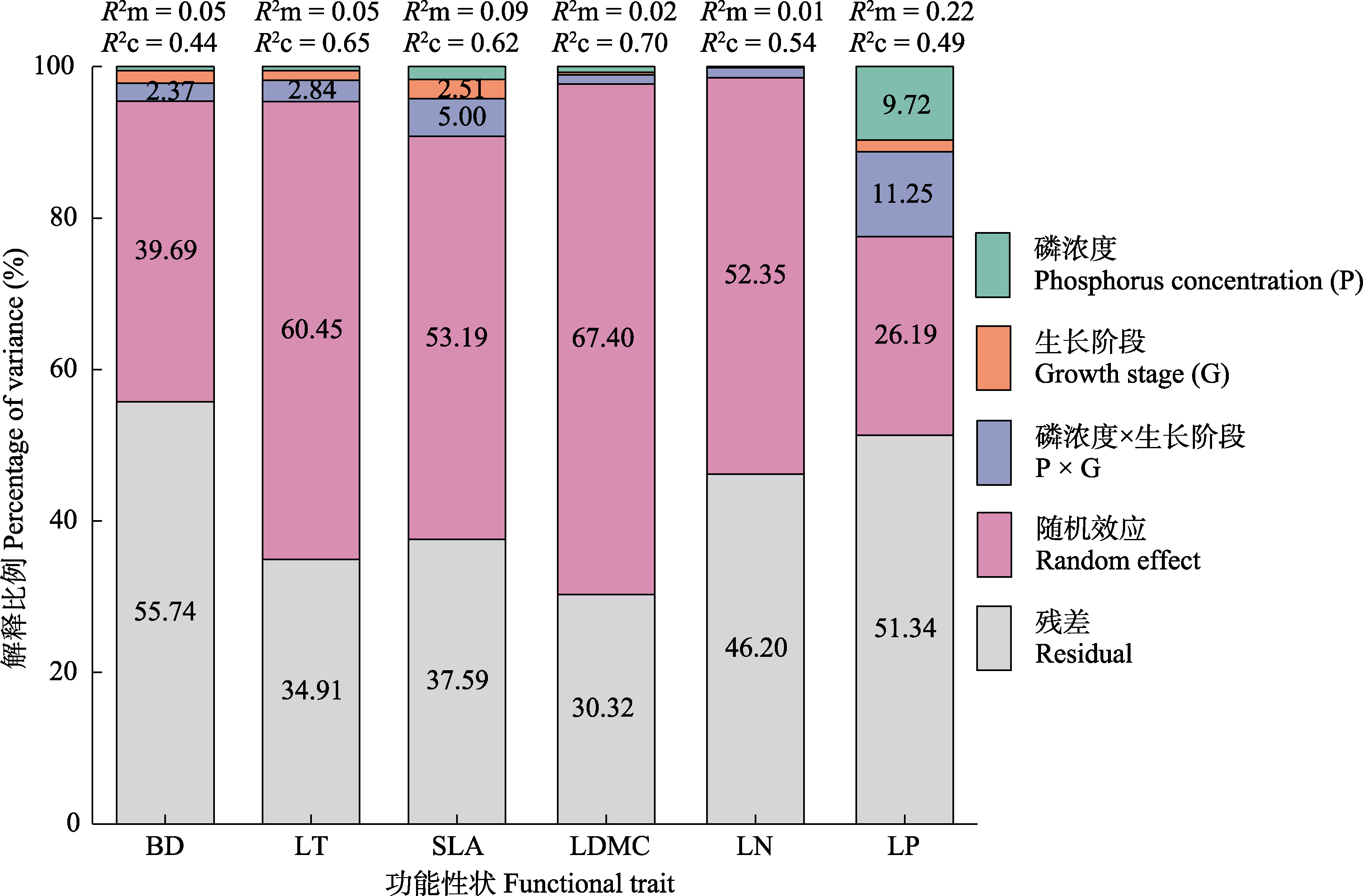
Fig. 3 Variance decomposition analysis of functional traits. BD, branch density; LDMC, leaf dry matter content; LN, leaf nitrogen content; LP, leaf phosphorus content; LT, leaf thickness; SLA, specific leaf area. R2c, fixed effects and random effects explanation of goodness of fit of the model; R2m, fixed effects explanation of goodness of fit of the model.
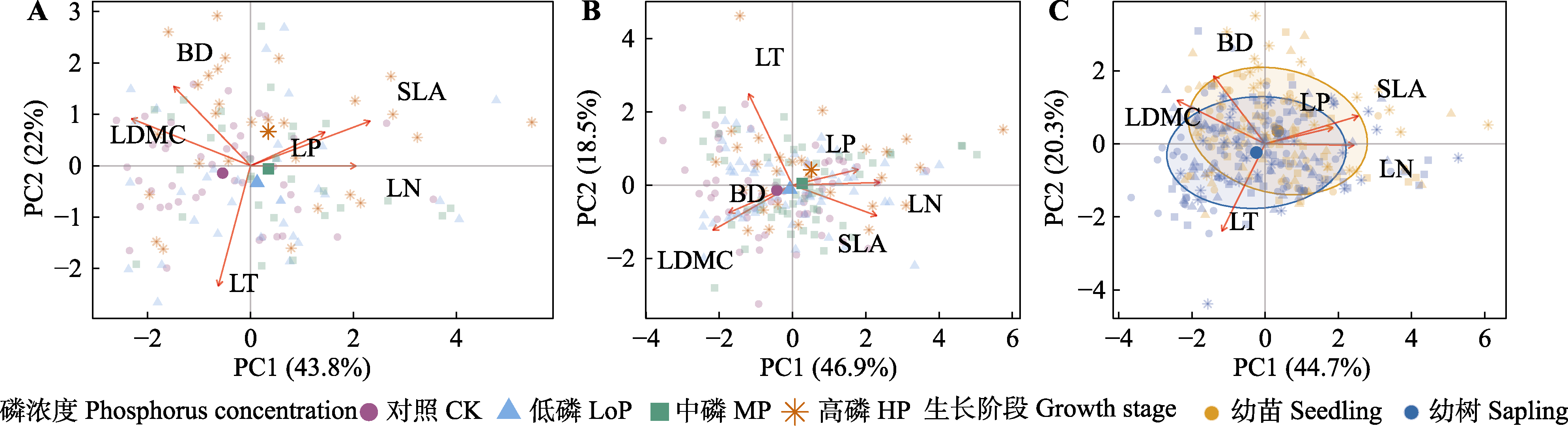
Fig. 4 Principal component analysis of plant functional traits at different growth stages. A, B and C are respectively the functional traits of seedlings, sapling and plants at the two growth stages. CK, control treatment; LoP, low phosphorus concentration addition treatment; MP, medium phosphorus concentration addition treatment; HP, high phosphorus concentration addition treatment. BD, branch density; LDMC, leaf dry matter content; LN, leaf nitrogen content; LP, leaf phosphorus content; LT, leaf thickness; SLA, specific leaf area.
| Y | X | 磷浓度 Phosphorus concentration | 幼苗 Seeding | 幼树 Sapling | Y | X | 磷浓度 Phosphorus concentration | 幼苗 Seeding | 幼树 Sapling | ||||
|---|---|---|---|---|---|---|---|---|---|---|---|---|---|
| p | 斜率 Slope | p | 斜率 Slope | p | 斜率 Slope | p | 斜率 Slope | ||||||
| BD | LDMC | 对照 CK | 0.16 | 1.15Aa | <0.01 | 1.02Aa | LDMC | LP | 对照 CK | 0.09 | -0.34Aa | <0.01 | -0.58Bab |
| 低磷 LoP | <0.01 | 1.55Aa | <0.01 | 0.91Ba | 低磷 LoP | 0.01 | -0.56Ab | <0.01 | -0.66Ab | ||||
| 中磷 MP | <0.01 | 1.54Aa | <0.01 | 1.09Ba | 中磷 MP | 0.03 | -0.61Ab | <0.01 | -0.49Aab | ||||
| 高磷 HP | <0.01 | 1.53Aa | <0.01 | 0.96Ba | 高磷 HP | 0.01 | -0.33Aa | 0.03 | -0.41Aa | ||||
| BD | SLA | 对照 CK | 0.22 | -0.97Aa | 0.02 | -0.71Aab | SLA | LT | 对照 CK | <0.01 | -1.22Aa | <0.01 | -1.24Aa |
| 低磷 LoP | <0.01 | -0.95Ba | <0.01 | -0.57Aa | 低磷 LoP | 0.01 | -1.63Aa | <0.01 | -1.70Ab | ||||
| 中磷 MP | 0.03 | -1.41Bb | <0.01 | -0.80Ab | 中磷 MP | <0.01 | -1.35Aa | <0.01 | -1.28Aab | ||||
| 高磷 HP | 0.01 | -1.24Bab | 0.03 | -0.73Aab | 高磷 HP | <0.01 | -1.18Aa | <0.01 | -1.24Aab | ||||
| BD | LT | 对照 CK | 0.22 | -1.25Ba | 0.47 | 0.88Aa | SLA | LN | 对照 CK | <0.01 | 0.78Aa | <0.01 | 0.89Ab |
| 低磷 LoP | 0.26 | -1.64Bab | 0.51 | 0.97Aa | 低磷 LoP | 0.01 | 0.97Aa | <0.01 | 1.35Aa | ||||
| 中磷 MP | 0.40 | -1.77Bb | 0.99 | 1.02Aa | 中磷 MP | 0.01 | 1.00Aa | <0.01 | 0.93Ab | ||||
| 高磷 HP | 0.56 | -1.42Bab | 0.88 | -0.91Aa | 高磷 HP | <0.01 | 0.75Ba | <0.01 | 1.14Aab | ||||
| BD | LN | 对照 CK | 0.24 | -0.70Aa | 0.09 | -0.63Aa | SLA | LP | 对照 CK | 0.07 | 0.44Bb | <0.01 | 0.86Aab |
| 低磷 LoP | 0.36 | -1.01Aab | <0.01 | -0.70Aa | 低磷 LoP | 0.03 | 0.81Aa | 0.02 | 1.06Aa | ||||
| 中磷 MP | 0.06 | -1.36Bb | <0.01 | -0.77Aa | 中磷 MP | 0.01 | 0.57Aab | <0.01 | 0.66Abc | ||||
| 高磷 HP | 0.02 | -0.93Aab | 0.06 | -0.78Aa | 高磷 HP | 0.02 | 0.37Ab | <0.01 | 0.56Ac | ||||
| BD | LP | 对照 CK | 0.82 | 0.37Aa | 0.09 | -0.60Bb | LT | LN | 对照 CK | 0.33 | -0.64Aa | <0.01 | -0.70Aa |
| 低磷 LoP | 0.11 | -0.82Ab | <0.01 | -0.55Aab | 低磷 LoP | 0.18 | -0.74Aa | 0.11 | -0.74Aa | ||||
| 中磷 MP | 0.03 | -0.78Ab | <0.01 | -0.55Aab | 中磷 MP | 0.78 | 0.89Aa | <0.05 | -0.76Aa | ||||
| 高磷 HP | 0.24 | -0.46Aa | 0.44 | -0.38Aa | 高磷 HP | 0.86 | -0.76Aa | 0.02 | -0.88Aa | ||||
| LDMC | SLA | 对照 CK | <0.01 | -0.84Ab | <0.01 | -0.69Aa | LT | LP | 对照 CK | 0.14 | -0.37Aa | 0.02 | -0.68Bb |
| 低磷 LoP | <0.01 | -0.63Aa | <0.01 | -0.63Aa | 低磷 LoP | 0.46 | -0.61Ab | 0.81 | -0.58Aab | ||||
| 中磷 MP | <0.01 | -0.87Ab | <0.01 | -0.73Aa | 中磷 MP | 0.83 | -0.51Aab | 0.17 | -0.54Aab | ||||
| 高磷 HP | <0.01 | -0.81Aab | <0.01 | -0.76Aa | 高磷 HP | 0.46 | 0.37Aab | 0.17 | -0.43Aa | ||||
| LDMC | LT | 对照 CK | 0.39 | -1.03Aa | 0.54 | -0.86Aa | LN | LP | 对照 CK | 0.01 | 0.57Bb | <0.01 | 0.97Aa |
| 低磷 LoP | 0.76 | -1.03Aa | 0.43 | 1.07Aa | 低磷 LoP | <0.01 | 0.83Aa | <0.01 | 0.79Ab | ||||
| 中磷 MP | 0.52 | -1.17Aa | 0.28 | -0.93Aa | 中磷 MP | <0.01 | 0.57Ab | <0.01 | 0.71Ab | ||||
| 高磷 HP | 0.78 | -0.96Aa | 0.70 | -0.94Aa | 高磷 HP | <0.01 | 0.49Ab | <0.01 | 0.49Ac | ||||
| LDMC | LN | 对照 CK | <0.01 | -0.60Aa | <0.01 | -0.60Aa | |||||||
| 低磷 LoP | 0.01 | -0.67Aa | <0.01 | -0.83Ab | |||||||||
| 中磷 MP | 0.01 | -1.06Bb | <0.01 | -0.69Aab | |||||||||
| 高磷 HP | <0.01 | -0.66Aa | <0.01 | -0.85Aab | |||||||||
Table 2 Correlation between the functional traits of branches and leaves under different phosphorus addition levels and growth stages
| Y | X | 磷浓度 Phosphorus concentration | 幼苗 Seeding | 幼树 Sapling | Y | X | 磷浓度 Phosphorus concentration | 幼苗 Seeding | 幼树 Sapling | ||||
|---|---|---|---|---|---|---|---|---|---|---|---|---|---|
| p | 斜率 Slope | p | 斜率 Slope | p | 斜率 Slope | p | 斜率 Slope | ||||||
| BD | LDMC | 对照 CK | 0.16 | 1.15Aa | <0.01 | 1.02Aa | LDMC | LP | 对照 CK | 0.09 | -0.34Aa | <0.01 | -0.58Bab |
| 低磷 LoP | <0.01 | 1.55Aa | <0.01 | 0.91Ba | 低磷 LoP | 0.01 | -0.56Ab | <0.01 | -0.66Ab | ||||
| 中磷 MP | <0.01 | 1.54Aa | <0.01 | 1.09Ba | 中磷 MP | 0.03 | -0.61Ab | <0.01 | -0.49Aab | ||||
| 高磷 HP | <0.01 | 1.53Aa | <0.01 | 0.96Ba | 高磷 HP | 0.01 | -0.33Aa | 0.03 | -0.41Aa | ||||
| BD | SLA | 对照 CK | 0.22 | -0.97Aa | 0.02 | -0.71Aab | SLA | LT | 对照 CK | <0.01 | -1.22Aa | <0.01 | -1.24Aa |
| 低磷 LoP | <0.01 | -0.95Ba | <0.01 | -0.57Aa | 低磷 LoP | 0.01 | -1.63Aa | <0.01 | -1.70Ab | ||||
| 中磷 MP | 0.03 | -1.41Bb | <0.01 | -0.80Ab | 中磷 MP | <0.01 | -1.35Aa | <0.01 | -1.28Aab | ||||
| 高磷 HP | 0.01 | -1.24Bab | 0.03 | -0.73Aab | 高磷 HP | <0.01 | -1.18Aa | <0.01 | -1.24Aab | ||||
| BD | LT | 对照 CK | 0.22 | -1.25Ba | 0.47 | 0.88Aa | SLA | LN | 对照 CK | <0.01 | 0.78Aa | <0.01 | 0.89Ab |
| 低磷 LoP | 0.26 | -1.64Bab | 0.51 | 0.97Aa | 低磷 LoP | 0.01 | 0.97Aa | <0.01 | 1.35Aa | ||||
| 中磷 MP | 0.40 | -1.77Bb | 0.99 | 1.02Aa | 中磷 MP | 0.01 | 1.00Aa | <0.01 | 0.93Ab | ||||
| 高磷 HP | 0.56 | -1.42Bab | 0.88 | -0.91Aa | 高磷 HP | <0.01 | 0.75Ba | <0.01 | 1.14Aab | ||||
| BD | LN | 对照 CK | 0.24 | -0.70Aa | 0.09 | -0.63Aa | SLA | LP | 对照 CK | 0.07 | 0.44Bb | <0.01 | 0.86Aab |
| 低磷 LoP | 0.36 | -1.01Aab | <0.01 | -0.70Aa | 低磷 LoP | 0.03 | 0.81Aa | 0.02 | 1.06Aa | ||||
| 中磷 MP | 0.06 | -1.36Bb | <0.01 | -0.77Aa | 中磷 MP | 0.01 | 0.57Aab | <0.01 | 0.66Abc | ||||
| 高磷 HP | 0.02 | -0.93Aab | 0.06 | -0.78Aa | 高磷 HP | 0.02 | 0.37Ab | <0.01 | 0.56Ac | ||||
| BD | LP | 对照 CK | 0.82 | 0.37Aa | 0.09 | -0.60Bb | LT | LN | 对照 CK | 0.33 | -0.64Aa | <0.01 | -0.70Aa |
| 低磷 LoP | 0.11 | -0.82Ab | <0.01 | -0.55Aab | 低磷 LoP | 0.18 | -0.74Aa | 0.11 | -0.74Aa | ||||
| 中磷 MP | 0.03 | -0.78Ab | <0.01 | -0.55Aab | 中磷 MP | 0.78 | 0.89Aa | <0.05 | -0.76Aa | ||||
| 高磷 HP | 0.24 | -0.46Aa | 0.44 | -0.38Aa | 高磷 HP | 0.86 | -0.76Aa | 0.02 | -0.88Aa | ||||
| LDMC | SLA | 对照 CK | <0.01 | -0.84Ab | <0.01 | -0.69Aa | LT | LP | 对照 CK | 0.14 | -0.37Aa | 0.02 | -0.68Bb |
| 低磷 LoP | <0.01 | -0.63Aa | <0.01 | -0.63Aa | 低磷 LoP | 0.46 | -0.61Ab | 0.81 | -0.58Aab | ||||
| 中磷 MP | <0.01 | -0.87Ab | <0.01 | -0.73Aa | 中磷 MP | 0.83 | -0.51Aab | 0.17 | -0.54Aab | ||||
| 高磷 HP | <0.01 | -0.81Aab | <0.01 | -0.76Aa | 高磷 HP | 0.46 | 0.37Aab | 0.17 | -0.43Aa | ||||
| LDMC | LT | 对照 CK | 0.39 | -1.03Aa | 0.54 | -0.86Aa | LN | LP | 对照 CK | 0.01 | 0.57Bb | <0.01 | 0.97Aa |
| 低磷 LoP | 0.76 | -1.03Aa | 0.43 | 1.07Aa | 低磷 LoP | <0.01 | 0.83Aa | <0.01 | 0.79Ab | ||||
| 中磷 MP | 0.52 | -1.17Aa | 0.28 | -0.93Aa | 中磷 MP | <0.01 | 0.57Ab | <0.01 | 0.71Ab | ||||
| 高磷 HP | 0.78 | -0.96Aa | 0.70 | -0.94Aa | 高磷 HP | <0.01 | 0.49Ab | <0.01 | 0.49Ac | ||||
| LDMC | LN | 对照 CK | <0.01 | -0.60Aa | <0.01 | -0.60Aa | |||||||
| 低磷 LoP | 0.01 | -0.67Aa | <0.01 | -0.83Ab | |||||||||
| 中磷 MP | 0.01 | -1.06Bb | <0.01 | -0.69Aab | |||||||||
| 高磷 HP | <0.01 | -0.66Aa | <0.01 | -0.85Aab | |||||||||
| [1] |
Ahrens CW, Andrew ME, Mazanec RA, Ruthrof KX, Challis A, Hardy G, Byrne M, Tissue DT, Rymer PD (2020). Plant functional traits differ in adaptability and are predicted to be differentially affected by climate change. Ecology and Evolution, 10, 232-248.
DOI URL |
| [2] |
Alvarez-Clare S, Mack MC, Brooks M (2013). A direct test of nitrogen and phosphorus limitation to net primary productivity in a lowland tropical wet forest. Ecology, 94, 1540-1551.
PMID |
| [3] |
Ammer C (2019). Diversity and forest productivity in a changing climate. New Phytologist, 221, 50-66.
DOI PMID |
| [4] | Bao SD (2000). Soil and Agricultural Chemistry Analysis. 3rd ed. China Agricultural Press, Beijing. |
| [鲍士旦 (2000). 土壤农化分析(第三版). 中国农业出版社, 北京.] | |
| [5] | Brum M, Vadeboncoeur M, Asbjornsen H, Puma Vilca BL, Galiano D, Horwath AB, Metcalfe DB (2023). Ecophysiological controls on water use of tropical cloud forest trees in response to experimental drought. Tree Physiology, 43, 1514-1532. |
| [6] | Bubb P, May I, Miles L, Sayer JA (2004). Cloud Forest Agenda. UNEP World Conservation Monitoring Centre, Cambridge, UK. 28-30. |
| [7] | Čapek P, Manzoni S, Kaštovská E, Wild B, Diáková K, Bárta J, Schnecker J, Biasi C, Martikainen PJ, Alves RJE, Guggenberger G, Gentsch N, Hugelius G, Palmtag J, Mikutta R, et al. (2018). A plant-microbe interaction framework explaining nutrient effects on primary production. Nature Ecology & Evolution, 2, 1588-1596. |
| [8] |
Chave J, Coomes D, Jansen S, Lewis SL, Swenson NG, Zanne AE (2009). Towards a worldwide wood economics spectrum. Ecology Letters, 12, 351-366.
DOI PMID |
| [9] | Cui EQ, Weng ES, Yan ER, Xia JY (2020). Robust leaf trait relationships across species under global environmental changes. Nature Communications, 11, 2999. DOI: 10.1038/s41467-020-16839-9. |
| [10] |
Fortunel C, Fine PVA, Baraloto C (2012). Leaf, stem and root tissue strategies across 758 Neotropical tree species. Functional Ecology, 26, 1153-1161.
DOI URL |
| [11] | Geng MY, Chen FQ, Lü K, Wang YB, Xiang L, Xie LL (2018). Effects of developmental stage on the leaf functional traits of the endangered shrub species Disanthus cercidifolius var. longipes. Plant Science Journal, 36, 851-858. |
| [耿梦娅, 陈芳清, 吕坤, 王玉兵, 向琳, 谢伶莉 (2018). 濒危植物长柄双花木(Disanthus cercidifolius var. longipes)叶功能性状随生长发育阶段的变化. 植物科学学报, 36, 851-858.] | |
| [12] |
Goswami S, Fisk MC, Vadeboncoeur MA, Garrison-Johnston M, Yanai RD, Fahey TJ (2018). Phosphorus limitation of aboveground production in northern hardwood forests. Ecology, 99, 438-449.
DOI PMID |
| [13] | He NP, Liu CC, Zhang JH, Xu L, Yu GR (2018). Perspectives and challenges in plant traits: from organs to communities. Acta Ecologica Sinica, 38, 6787-6796. |
| [何念鹏, 刘聪聪, 张佳慧, 徐丽, 于贵瑞 (2018). 植物性状研究的机遇与挑战: 从器官到群落. 生态学报, 38, 6787-6796.] | |
| [14] |
Hidaka A, Kitayama K (2009). Divergent patterns of photosynthetic phosphorus-use efficiency versus nitrogen-use efficiency of tree leaves along nutrient-availability gradients. Journal of Ecology, 97, 984-991.
DOI URL |
| [15] | Hu J, Wang Z, Williams GDZ, Dwyer GS, Gatiboni L, Duckworth OW, Vengosh A (2024). Evidence for the accumulation of toxic metal(loid)s in agricultural soils impacted from long-term application of phosphate fertilizer. Science of the Total Environment, 907, 167863. DOI: 10.1016/j.scitotenv.2023.167863. |
| [16] | Hu LY, Qin DY, Lu HY, Li W, Shang KK, Lin DM, Zhao L, Yang YC, Qian SH (2021). Urban growth drives trait composition of urban spontaneous plant communities in a mountainous city in China. Journal of Environmental Management, 293, 112869. DOI: 10.1016/j.jenvman.2021.112869. |
| [17] | Hu YJ, Li YX (1992). Tropical Rain Forest of Hainan Island. Guangdong Higher Education Press, Guangzhou. |
| [胡玉佳, 李玉杏 (1992). 海南岛热带雨林. 广东高等教育出版社, 广州.] | |
| [18] |
Ji M, Jin GZ, Liu ZL (2021). Effects of ontogenetic stage and leaf age on leaf functional traits and the relationships between traits in Pinus koraiensis. Journal of Forestry Research, 32, 2459-2471.
DOI |
| [19] |
Jiang L, Tian D, Ma SH, Zhou XL, Xu LC, Zhu JX, Jing X, Zheng CY, Shen HH, Zhou Z, Li YD, Zhu B, Fang JY (2018). The response of tree growth to nitrogen and phosphorus additions in a tropical montane rainforest. Science of the Total Environment, 618, 1064-1070.
DOI URL |
| [20] | Kang Y, Deng ZY, Zang RG, Long WX (2017). DNA barcoding analysis and phylogenetic relationships of tree species in tropical cloud forests. Scientific Reports, 7, 12564. DOI: 10.1038/s41598-017-13057-0. |
| [21] | Kang Y, Xiong MH, Huang J, Long WX, Yang XB, Zang RG, Wang XX, Lin D (2017). Variation in woody plant functional traits of the tropical cloud forests in Bawangling, Hainan Island. Acta Ecologica Sinica, 37, 1572-1582. |
| [康勇, 熊梦辉, 黄瑾, 龙文兴, 杨小波, 臧润国, 王茜茜, 林灯 (2017). 海南岛霸王岭热带云雾林木本植物功能性状的分异规律. 生态学报, 37, 1572-1582.] | |
| [22] |
Klipel J, Bergamin RS, Dos Santos Seger GD, Carlucci MB, Müller SC (2021). Plant functional traits explain species abundance patterns and strategies shifts among saplings and adult trees in Araucaria forests. Austral Ecology, 46, 1084-1096.
DOI |
| [23] |
Lai JS, Zou Y, Zhang S, Zhang XG, Mao LF (2022). Glmm.hp: an R package for computing individual effect of predictors in generalized linear mixed models. Journal of Plant Ecology, 15, 1302-1307.
DOI |
| [24] |
Ledo A, Condés S, Alberdi I (2012). Forest biodiversity assessment in Peruvian Andean Montane cloud forest. Journal of Mountain Science, 9, 372-384.
DOI URL |
| [25] | Li JX, Sun XM, Liu N, Li L, Chen NL (2021). Response and plasticity of functional traits in Lycium ruthenicum to N and P addition. Chinese Journal of Applied Ecology, 32, 1279-1288. |
|
[李金霞, 孙小妹, 刘娜, 李良, 陈年来 (2021). 黑果枸杞功能性状对氮磷添加的响应及其可塑性. 应用生态学报, 32, 1279-1288.]
DOI |
|
| [26] |
Li Y, Tian DS, Yang H, Niu SL (2018). Size-dependent nutrient limitation of tree growth from subtropical to cold temperate forests. Functional Ecology, 32, 95-105.
DOI URL |
| [27] | Liu B, Zhang CC, Deng J, Zhang BW, Chen FS, Chen W, Fang XM, Li JJ, Zu KL, Bu WS (2024). Response of tree growth to nutrient addition is size dependent in a subtropical forest. Science of the Total Environment, 923, 171501. DOI: 10.1016/j.scitotenv.2024.171501. |
| [28] | Liu S, Zhang XY, Wang HM, Kuzyakov Y, Pan JX, Chen FS, Wang FC, Li DD, Tang YQ, Ma ZQ (2025). Phosphorus- transforming microbes enhance phosphatase catalytic efficiency to alleviate phosphorus limitation under nitrogen and phosphorus additions in subtropical forest soil. Soil Biology & Biochemistry, 209, 109915. DOI: 10.1016/j.soilbio.2025.109915. |
| [29] | Liu XJ, Ma KP (2015). Plant functional traits—Concepts, applications and future directions. Science in China (Series C), 45, 325-339. |
| [刘晓娟, 马克平 (2015). 植物功能性状研究进展. 中国科学(生命科学), 45, 325-339.] | |
| [30] |
Long WX, Schamp BS, Zang RG, Ding Y, Huang YF, Xiang YZ (2015). Community assembly in a tropical cloud forest related to specific leaf area and maximum species height. Journal of Vegetation Science, 26, 513-523.
DOI URL |
| [31] | Long WX, Zang RG, Ding Y (2011). Air temperature and soil phosphorus availability correlate with trait differences between two types of tropical cloud forests. Flora - Morphology, Distribution, Functional Ecology of Plants, 206, 896-903. |
| [32] | Long WX, Zang RG, Wang XX, Bahadur S (2022). Environmental Characteristics in Tropical Cloud Forests. Springer Nature Singapore, Singapore. |
| [33] |
Long WX, Zhou YD, Schamp BS, Zang RG, Yang XB, Poorter L, Xiao CC, Xiong MH (2020). Scaling relationships among functional traits are similar across individuals, species, and communities. Journal of Vegetation Science, 31, 571-580.
DOI URL |
| [34] | Ma XM, Zhou Z, Chen J, Xu H, Ma SH, Dippold MA, Kuzyakov Y (2023). Long-term nitrogen and phosphorus fertilization reveals that phosphorus limitation shapes the microbial community composition and functions in tropical montane forest soil. Science of the Total Environment, 854, 158709. DOI: 10.1016/j.scitotenv.2022.158709. |
| [35] | Manu R, Corre MD, Aleeje A, Mwanjalolo MJG, Babweteera F, Veldkamp E, van Straaten O (2022). Responses of tree growth and biomass production to nutrient addition in a semi-deciduous tropical forest in Africa. Ecology, 103, e3659. DOI: 10.1002/ecy.3659. |
| [36] | Mariano RF, Rezende VL, de Souza CR, Pompeu PV, dos Santos RM, Mendes CN, de Moura AS, Machado FS, Carvalho WAC, Fontes MAL (2024). Evolutionary fingerprint, phylogenetic and forest structure of tropical montane Atlantic cloud forests along an elevation gradient. Journal of Mountain Science, 21, 1259-1271. |
| [37] |
Meinzer F (2003). Functional convergence in plant responses to the environment. Oecologia, 134, 1-11.
PMID |
| [38] |
Moeneclaey I, Schelfhout S, Vanhellemont M, DeCock E, van Coillie F, Verheyen K, Baeten L (2022). Species ecological strategy and soil phosphorus supply interactively affect plant biomass and phosphorus concentration. Basic and Applied Ecology, 62, 1-11.
DOI URL |
| [39] |
Pardow A, Gehrig-Downie C, Gradstein R, Lakatos M (2012). Functional diversity of epiphytes in two tropical lowland rainforests, French Guiana: using bryophyte life-forms to detect areas of high biodiversity. Biodiversity and Conservation, 21, 3637-3655.
DOI URL |
| [40] |
Pérez-Harguindeguy N, Díaz S, Garnier E, Lavorel S, Poorter H, Jaureguiberry P, Bret-Harte MS, Cornwell WK, Craine JM, Gurvich DE, Urcelay C, Veneklaas EJ, Reich PB, Poorter L, Wright IJ, et al. (2013). New handbook for standardised measurement of plant functional traits worldwide. Australian Journal of Botany, 61, 167-234.
DOI URL |
| [41] |
Saldaña-Acosta A, Meave JA, Paz H, Sánchez-Velásquez LR, Villaseñor JL, Martínez-Ramos M (2008). Variation of functional traits in trees from a biogeographically complex Mexican cloud forest. Acta Oecologica, 34, 111-121.
DOI URL |
| [42] | Shi XQ (2006). Liverwort Flora of Bawangling Nature Reserve and the Relationship Between the Liverwort Flora of Hainan Island and Adjacent Islands. Master degree dissertation, East China Normal University, Shanghai. |
| [师雪芹 (2006). 海南霸王岭自然保护区苔类植物区系以及海南苔类植物区系与临近岛屿的关系. 硕士学位论文, 华东师范大学, 上海.] | |
| [43] | Sun Y, Hong WT, Han Y, Xu ZK, Cheng LY (2021). Targeting internal phosphorus re-utilization to improve plant phosphorus use efficiency. Journal of Plant Nutrition and Fertilizers, 27, 2216-2228. |
| [孙艳, 洪婉婷, 韩阳, 徐梓楷, 程凌云 (2021). 植物内部磷循环利用提高磷效率的研究进展. 植物营养与肥料学报, 27, 2216-2228.] | |
| [44] |
Toledo M, Poorter L, Peña-Claros M, Alarcón A, Balcázar J, Leaño C, Licona JC, Llanque O, Vroomans V, Zuidema P, Bongers F (2011). Climate is a stronger driver of tree and forest growth rates than soil and disturbance. Journal of Ecology, 99, 254-264.
DOI URL |
| [45] | Tonello KC, de Oliveira JC, Starzynski R, Campos SD (2025). Scaling up bark hydrology: tree size and functional traits shape water storage in a tropical cloud forest. Hydrological Processes, 39, e70211. DOI: 10.1002/hyp.70211. |
| [46] |
Tucker DBL, Gotsch SG, Vaughan D, Gradstein SR, Moreno L, Shackelford N, Starzomski BM (2025). Community-level trait variation of epiphytic bryophytes supports trade-off aligned with leaf-economic spectrum in vertically stratified tropical montane cloud forest canopies. Functional Ecology, 39, 2300-2313.
DOI URL |
| [47] |
Turner BL, Brenes-Arguedas T, Condit R (2018). Pervasive phosphorus limitation of tree species but not communities in tropical forests. Nature, 555, 367-370.
DOI URL |
| [48] |
van Bodegom PM, Douma JC, Verheijen LM (2014). A fully traits-based approach to modeling global vegetation distribution. Proceedings of the National Academy of Sciences of the United States of America, 111, 13733-13738.
DOI PMID |
| [49] |
Vance CP, Uhde-Stone C, Allan DL (2003). Phosphorus acquisition and use: critical adaptations by plants for securing a nonrenewable resource. New Phytologist, 157, 423-447.
DOI PMID |
| [50] |
Wang XX, Long WX, Yang XB, Xiong MH, Kang Y, Huang J, Wang X, Hong XJ, Zhou ZL, Lu YQ, Fang J, Li SX (2016). Patterns of plant diversity within and among three tropical cloud forest communities in Hainan Island. Chinese Journal of Plant Ecology, 40, 469-479.
DOI |
|
[王茜茜, 龙文兴, 杨小波, 熊梦辉, 康勇, 黄瑾, 王旭, 洪小江, 周照骊, 陆雍泉, 方精, 李时兴 (2016). 海南岛3个林区热带云雾林植物多样性变化. 植物生态学报, 40, 469-479.]
DOI |
|
| [51] | Wang YK, Lv K, Wu Y, Chen FQ (2021). Changes in the functional traits of Platycrater arguta Sieb. et Zucc. leaves with plant growth and development. Plant Science Journal, 39, 526-534. |
| [王英鲲, 吕坤, 吴宇, 陈芳清 (2021). 蛛网萼叶功能性状随植物生长发育进程的变化. 植物科学学报, 39, 526-534.] | |
| [52] |
Warton DI, Wright IJ, Falster DS, Westoby M (2006). Bivariate line-fitting methods for allometry. Biological Reviews, 81, 259-291.
DOI PMID |
| [53] | Wen LY, Zhang DX, Xiao CC, Feng G, Linger E, Long WX (2025). Drought-induced water use patterns in epiphytic ferns and orchids of the Hainan tropical cloud forest, South China. Agricultural and Forest Meteorolog, 363, 110400. DOI: 10.1016/j.agrformet.2025.110400. |
| [54] |
Wright IJ, Reich PB, Westoby M, Ackerly DD, Baruch Z, Bongers F, Cavender-Bares J, Chapin T, Cornelissen JHC, Diemer M, Flexas J, Garnier E, Groom PK, Gulias J, Hikosaka K, et al. (2004). The worldwide leaf economics spectrum. Nature, 428, 821-827.
DOI |
| [55] |
Wright SJ, Muller-Landau HC, Calderón O, Hernandéz A (2005). Annual and spatial variation in seedfall and seedling recruitment in a neotropical forest. Ecology, 86, 848-860.
DOI URL |
| [56] | Xing YT, Deng SQ, Bai YY, Wu ZJ, Luo J (2024). Leaf functional traits and their influencing factors in six typical vegetation communities. Plants, 13, 2423. DOI: 10.3390/plants13172423. |
| [57] |
Yan ZB, Li XP, Tian D, Han WX, Hou XH, Shen HH, Guo YL, Fang JY (2018). Nutrient addition affects scaling relationship of leaf nitrogen to phosphorus in Arabidopsis thaliana. Functional Ecology, 32, 2689-2698.
DOI URL |
| [58] | Yang YY, Xiao CC, Wu XM, Long WX, Feng G, Liu GY (2021). Differing trade-off patterns of tree vegetative organs in a tropical cloud forest. Frontiers in Plant Science, 12, 680379. DOI: 10.3389/fpls.2021.680379. |
| [59] | Ye XM, Bu WS, Hu XF, Wang FC, Sun RX, He PC, Liang XY, Chen FS (2023). Are small trees more responsive to nutrient addition than large trees in an evergreen broadleaved forest? Forest Ecology and Management, 543, 121129. DOI: 10.1016/j.foreco.2023.121129. |
| [60] | Yin FJ, Wang MQ, Jin GZ, Liu ZL (2021). Trade-off between twig and leaf of Pinus koraiensis at different life history stages. Scientia Silvae Sinicae, 57(4), 54-62. |
| [尹凤娟, 王明琦, 金光泽, 刘志理 (2021). 红松不同生活史阶段的枝叶权衡. 林业科学, 57(4), 54-62.] | |
| [61] | Yu BY, Kang J, Tang JL, Wang ZC, Zhang SK, Ma QQ, Su HX (2025). Effect of nitrogen addition on the intra-annual leaf and stem traits and their relationships in two dominant species in a subtropical forest. Forests, 16, 28. DOI: 10.3390/f16010028. |
| [62] | Zhang H, Sun M, Wen YX, Tong R, Wang G, Wu QQ, Li Y, Wu TG (2022). The effects of stand age on leaf N:P cannot be neglected: a global synthesis. SSRN Electronic Journal, 518, 120294. DOI: 10.1016/j.foreco.2022.120294. |
| [63] | Zhang LB, He MZ, Zhang K (2023). Response of biomass allocation and allometric growth of Caragana korshiniskii to nitrogen and phosphorus addition. Acta Ecologica Sinica, 43, 6627-6636. |
| [张力斌, 何明珠, 张珂 (2023). 柠条锦鸡儿生物量分配规律与异速生长对氮、磷添加的响应. 生态学报, 43, 6627-6636.] | |
| [64] | Zhang LY (2023). Effects of Simulated Nitrogen Deposition on Leaf Traits and Their Trade-offs of Evergreen Broad-leaved Forest in Rainy Area of West China. |
| [张璐瑶 (2023). 模拟氮沉降对华西雨屏区常绿阔叶林叶性状及性状间关系的影响. 硕士学位论文, 四川农业大学, 成都.] | |
| [65] | Zhu XA, Jiang XJ, Kumar Singh A, Zeng HH, Chen CF, Lu EF, Liu WJ (2022). Reduced litterfall and decomposition alters nutrient cycling following conversion of tropical natural forests to rubber plantations. Ecological Indicators, 138, 108819. DOI: 10.1016/j.ecolind.2022.108819. |
| [66] |
Zhu XA, Liu WJ, Chen H, Deng Y, Chen CF, Zeng HH (2019). Effects of forest transition on litterfall, standing litter and related nutrient returns: implications for forest management in tropical China. Geoderma, 333, 123-134.
DOI URL |
| Viewed | ||||||
|
Full text |
|
|||||
|
Abstract |
|
|||||
Copyright © 2026 Chinese Journal of Plant Ecology
Tel: 010-62836134, 62836138, E-mail: apes@ibcas.ac.cn, cjpe@ibcas.ac.cn

