
Chin J Plant Ecol ›› 2026, Vol. 50 ›› Issue (6): 1331-1342.DOI: 10.17521/cjpe.2025.0029 cstr: 32100.14.cjpe.2025.0029
• Research Articles • Previous Articles Next Articles
DENG Xiao-Ling1, AI Ling1, HUANG Xing-Zhou1, WU Fu-Zhong1,2,3, XU Qi-Wen1, ZHU Jing-Jing1, NI Xiang-Yin1,2,3,*( )
)
Received:2025-01-19
Accepted:2025-07-09
Online:2026-06-28
Published:2026-08-29
Contact:
NI Xiang-Yin
Supported by:DENG Xiao-Ling, AI Ling, HUANG Xing-Zhou, WU Fu-Zhong, XU Qi-Wen, ZHU Jing-Jing, NI Xiang-Yin. Release rates and controlling factors of dissolved and hot-water extractable organic carbon during litter decomposition of 21 tree species in a subtropical forest[J]. Chin J Plant Ecol, 2026, 50(6): 1331-1342.
Add to citation manager EndNote|Ris|BibTeX
URL: https://www.plant-ecology.com/EN/10.17521/cjpe.2025.0029
| 土壤基础理化指标 Soil basic physicochemical property | 值 Value |
|---|---|
| 砂粒含量 Sand content (%) | 12.90 ± 0.60 |
| 粉粒含量 Silt content (%) | 45.27 ± 0.56 |
| 黏粒含量 Clay content (%) | 41.83 ± 0.89 |
| 含水率 Water content (%) | 18.45 ± 1.16 |
| pH | 4.56 ± 0.09 |
| 总碳含量 Total carbon content (g·kg-1) | 32.03 ± 0.62 |
| 总氮含量 Total nitrogen content (g·kg-1) | 1.94 ± 0.05 |
| 总磷含量 Total phosphorus content (mg·kg-1) | 216.20 ± 16.41 |
| 速效磷含量 Available phosphorus content (mg·kg-1) | 14.82 ± 1.06 |
| 冷水溶性有机碳含量 Dissolved organic carbon content (mg·kg-1) | 31.27 ± 3.05 |
| 溶解性有机氮含量 Dissolved organic nitrogen content (mg·kg-1) | 1.38 ± 0.27 |
| 铵态氮含量 Ammonium nitrogen content (mg·kg-1) | 3.20 ± 0.32 |
| 硝态氮含量 Nitrate nitrogen content (mg·kg-1) | 3.61 ± 0.64 |
Table 1 Soil basic physicochemical properties of the litter-input microcosm experimental site in a subtropical evergreen broadleaf forest in Sanming, Fujian (mean ± SE, n = 4)
| 土壤基础理化指标 Soil basic physicochemical property | 值 Value |
|---|---|
| 砂粒含量 Sand content (%) | 12.90 ± 0.60 |
| 粉粒含量 Silt content (%) | 45.27 ± 0.56 |
| 黏粒含量 Clay content (%) | 41.83 ± 0.89 |
| 含水率 Water content (%) | 18.45 ± 1.16 |
| pH | 4.56 ± 0.09 |
| 总碳含量 Total carbon content (g·kg-1) | 32.03 ± 0.62 |
| 总氮含量 Total nitrogen content (g·kg-1) | 1.94 ± 0.05 |
| 总磷含量 Total phosphorus content (mg·kg-1) | 216.20 ± 16.41 |
| 速效磷含量 Available phosphorus content (mg·kg-1) | 14.82 ± 1.06 |
| 冷水溶性有机碳含量 Dissolved organic carbon content (mg·kg-1) | 31.27 ± 3.05 |
| 溶解性有机氮含量 Dissolved organic nitrogen content (mg·kg-1) | 1.38 ± 0.27 |
| 铵态氮含量 Ammonium nitrogen content (mg·kg-1) | 3.20 ± 0.32 |
| 硝态氮含量 Nitrate nitrogen content (mg·kg-1) | 3.61 ± 0.64 |
| 树种 Tree species | DOC (mg·g-1) | HWEC (mg·g-1) | 碳 Carbon (mg·g-1) | 氮 Nitrogen (mg·g-1) | 磷 Phosphorus (mg·g-1) | 纤维素 Cellulose (mg·g-1) | 木质素 Lignin (mg·g-1) |
|---|---|---|---|---|---|---|---|
| 檫木 Sassafras tzumu | 41.25 ± 0.68 | 60.28 ± 0.81 | 510.22 ± 2.51 | 8.11 ± 1.39 | 0.60 ± 0.11 | 63.91 ± 0.39 | 460.17 ± 2.55 |
| 杜英 Elaeocarpus decipiens | 104.66 ± 1.52 | 163.95 ± 2.10 | 457.50 ± 0.67 | 6.14 ± 0.47 | 0.50 ± 0.09 | 73.66 ± 0.46 | 246.78 ± 2.67 |
| 木荷 Schima superba | 56.29 ± 0.47 | 82.71 ± 0.53 | 472.36 ± 0.57 | 5.21 ± 0.59 | 0.23 ± 0.03 | 79.92 ± 0.37 | 335.32 ± 1.34 |
| 柠檬桉 Eucalyptus citriodora | 95.84 ± 1.44 | 132.85 ± 1.92 | 466.52 ± 0.57 | 4.63 ± 0.35 | 0.37 ± 0.09 | 71.01 ± 0.52 | 246.86 ± 3.95 |
| 青冈 Cyclobalanopsis glauca | 52.67 ± 1.37 | 81.03 ± 1.56 | 451.17 ± 0.74 | 7.59 ± 0.67 | 0.37 ± 0.05 | 131.45 ± 0.64 | 351.13 ± 0.93 |
| 细叶榕 Ficus benjamina | 34.40 ± 0.36 | 52.97 ± 0.28 | 431.75 ± 0.43 | 5.48 ± 0.14 | 0.74 ± 0.20 | 88.20 ± 0.74 | 326.02 ± 4.87 |
| 台湾相思 Acacia confusa | 59.18 ± 1.17 | 93.12 ± 1.82 | 512.03 ± 2.03 | 12.30 ± 1.17 | 0.44 ± 0.09 | 76.19 ± 0.97 | 359.86 ± 2.36 |
| 香樟 Cinnamomum septentrionale | 57.17 ± 0.81 | 81.43 ± 1.07 | 479.76 ± 0.31 | 5.33 ± 0.08 | 0.48 ± 0.32 | 82.02 ± 1.07 | 360.72 ± 2.28 |
| 悬铃木 Platanus orientalis | 43.39 ± 0.65 | 66.33 ± 0.79 | 468.22 ± 0.76 | 8.57 ± 1.82 | 1.01 ± 0.20 | 77.28 ± 0.89 | 370.36 ± 1.93 |
| 红锥 Castanopsis hystrix | 21.64 ± 0.23 | 50.31 ± 0.49 | 498.88 ± 0.37 | 8.51 ± 0.50 | 0.26 ± 0.02 | 90.95 ± 0.71 | 358.23 ± 3.04 |
| 山茶 Camellia japonica | 44.86 ± 0.24 | 83.79 ± 0.34 | 446.88 ± 0.45 | 8.83 ± 1.04 | 0.67 ± 0.09 | 89.16 ± 1.17 | 303.22 ± 2.28 |
| 小叶榄仁 Terminalia neotaliala | 35.39 ± 0.37 | 60.24 ± 0.72 | 424.15 ± 1.36 | 7.53 ± 2.34 | 1.12 ± 0.36 | 82.28 ± 1.08 | 335.09 ± 2.88 |
| 枫香树 Liquidambar formosana | 28.77 ± 0.91 | 42.86 ± 1.11 | 421.78 ± 1.29 | 8.61 ± 1.65 | 0.94 ± 0.07 | 70.35 ± 1.01 | 453.15 ± 4.02 |
| 秋枫 Bischofia javanica | 59.69 ± 0.76 | 99.37 ± 1.16 | 378.33 ± 1.94 | 7.97 ± 1.29 | 0.78 ± 0.10 | 62.16 ± 0.84 | 386.64 ± 4.21 |
| 黧蒴锥 Castanopsis fissa | 48.00 ± 1.09 | 77.06 ± 1.36 | 481.98 ± 1.60 | 6.21 ± 0.31 | 0.28 ± 0.03 | 86.42 ± 0.80 | 295.23 ± 1.42 |
| 阴香 Cinnamomum burmannii | 33.61 ± 0.74 | 52.00 ± 0.96 | 456.45 ± 0.70 | 8.05 ± 0.70 | 0.52 ± 0.13 | 106.22 ± 0.46 | 358.25 ± 6.42 |
| 马尾松 Pinus massoniana | 45.74 ± 0.66 | 68.45 ± 0.61 | 475.72 ± 0.67 | 3.93 ± 0.23 | 0.24 ± 0.03 | 128.82 ± 0.38 | 421.43 ± 1.71 |
| 木麻黄 Casuarina equisetifolia | 23.26 ± 0.51 | 36.91 ± 0.52 | 452.21 ± 0.72 | 7.30 ± 0.96 | 0.27 ± 0.08 | 123.47 ± 0.36 | 394.58 ± 4.05 |
| 柳杉 Cryptomeria fortunei | 27.27 ± 0.50 | 41.98 ± 0.52 | 478.37 ± 2.00 | 5.76 ± 1.75 | 0.43 ± 0.12 | 94.60 ± 0.55 | 408.56 ± 6.96 |
| 杉木 Cunninghamia lanceolata | 43.01 ± 2.17 | 62.58 ± 1.55 | 479.38 ± 0.86 | 5.63 ± 0.38 | 0.32 ± 0.02 | 133.22 ± 0.38 | 413.41 ± 1.26 |
| 圆柏 Sabina chinensis | 31.16 ± 0.73 | 46.84 ± 0.98 | 456.73 ± 0.61 | 9.06 ± 0.79 | 1.08 ± 0.19 | 98.56 ± 0.48 | 337.86 ± 2.62 |
Table 2 Initial concentrations of carbon fractions and nutrients in foliar litter of 21 tree species used in the litter-input microcosm experiment in a subtropical evergreen broadleaf forest (mean ± SE, n = 4)
| 树种 Tree species | DOC (mg·g-1) | HWEC (mg·g-1) | 碳 Carbon (mg·g-1) | 氮 Nitrogen (mg·g-1) | 磷 Phosphorus (mg·g-1) | 纤维素 Cellulose (mg·g-1) | 木质素 Lignin (mg·g-1) |
|---|---|---|---|---|---|---|---|
| 檫木 Sassafras tzumu | 41.25 ± 0.68 | 60.28 ± 0.81 | 510.22 ± 2.51 | 8.11 ± 1.39 | 0.60 ± 0.11 | 63.91 ± 0.39 | 460.17 ± 2.55 |
| 杜英 Elaeocarpus decipiens | 104.66 ± 1.52 | 163.95 ± 2.10 | 457.50 ± 0.67 | 6.14 ± 0.47 | 0.50 ± 0.09 | 73.66 ± 0.46 | 246.78 ± 2.67 |
| 木荷 Schima superba | 56.29 ± 0.47 | 82.71 ± 0.53 | 472.36 ± 0.57 | 5.21 ± 0.59 | 0.23 ± 0.03 | 79.92 ± 0.37 | 335.32 ± 1.34 |
| 柠檬桉 Eucalyptus citriodora | 95.84 ± 1.44 | 132.85 ± 1.92 | 466.52 ± 0.57 | 4.63 ± 0.35 | 0.37 ± 0.09 | 71.01 ± 0.52 | 246.86 ± 3.95 |
| 青冈 Cyclobalanopsis glauca | 52.67 ± 1.37 | 81.03 ± 1.56 | 451.17 ± 0.74 | 7.59 ± 0.67 | 0.37 ± 0.05 | 131.45 ± 0.64 | 351.13 ± 0.93 |
| 细叶榕 Ficus benjamina | 34.40 ± 0.36 | 52.97 ± 0.28 | 431.75 ± 0.43 | 5.48 ± 0.14 | 0.74 ± 0.20 | 88.20 ± 0.74 | 326.02 ± 4.87 |
| 台湾相思 Acacia confusa | 59.18 ± 1.17 | 93.12 ± 1.82 | 512.03 ± 2.03 | 12.30 ± 1.17 | 0.44 ± 0.09 | 76.19 ± 0.97 | 359.86 ± 2.36 |
| 香樟 Cinnamomum septentrionale | 57.17 ± 0.81 | 81.43 ± 1.07 | 479.76 ± 0.31 | 5.33 ± 0.08 | 0.48 ± 0.32 | 82.02 ± 1.07 | 360.72 ± 2.28 |
| 悬铃木 Platanus orientalis | 43.39 ± 0.65 | 66.33 ± 0.79 | 468.22 ± 0.76 | 8.57 ± 1.82 | 1.01 ± 0.20 | 77.28 ± 0.89 | 370.36 ± 1.93 |
| 红锥 Castanopsis hystrix | 21.64 ± 0.23 | 50.31 ± 0.49 | 498.88 ± 0.37 | 8.51 ± 0.50 | 0.26 ± 0.02 | 90.95 ± 0.71 | 358.23 ± 3.04 |
| 山茶 Camellia japonica | 44.86 ± 0.24 | 83.79 ± 0.34 | 446.88 ± 0.45 | 8.83 ± 1.04 | 0.67 ± 0.09 | 89.16 ± 1.17 | 303.22 ± 2.28 |
| 小叶榄仁 Terminalia neotaliala | 35.39 ± 0.37 | 60.24 ± 0.72 | 424.15 ± 1.36 | 7.53 ± 2.34 | 1.12 ± 0.36 | 82.28 ± 1.08 | 335.09 ± 2.88 |
| 枫香树 Liquidambar formosana | 28.77 ± 0.91 | 42.86 ± 1.11 | 421.78 ± 1.29 | 8.61 ± 1.65 | 0.94 ± 0.07 | 70.35 ± 1.01 | 453.15 ± 4.02 |
| 秋枫 Bischofia javanica | 59.69 ± 0.76 | 99.37 ± 1.16 | 378.33 ± 1.94 | 7.97 ± 1.29 | 0.78 ± 0.10 | 62.16 ± 0.84 | 386.64 ± 4.21 |
| 黧蒴锥 Castanopsis fissa | 48.00 ± 1.09 | 77.06 ± 1.36 | 481.98 ± 1.60 | 6.21 ± 0.31 | 0.28 ± 0.03 | 86.42 ± 0.80 | 295.23 ± 1.42 |
| 阴香 Cinnamomum burmannii | 33.61 ± 0.74 | 52.00 ± 0.96 | 456.45 ± 0.70 | 8.05 ± 0.70 | 0.52 ± 0.13 | 106.22 ± 0.46 | 358.25 ± 6.42 |
| 马尾松 Pinus massoniana | 45.74 ± 0.66 | 68.45 ± 0.61 | 475.72 ± 0.67 | 3.93 ± 0.23 | 0.24 ± 0.03 | 128.82 ± 0.38 | 421.43 ± 1.71 |
| 木麻黄 Casuarina equisetifolia | 23.26 ± 0.51 | 36.91 ± 0.52 | 452.21 ± 0.72 | 7.30 ± 0.96 | 0.27 ± 0.08 | 123.47 ± 0.36 | 394.58 ± 4.05 |
| 柳杉 Cryptomeria fortunei | 27.27 ± 0.50 | 41.98 ± 0.52 | 478.37 ± 2.00 | 5.76 ± 1.75 | 0.43 ± 0.12 | 94.60 ± 0.55 | 408.56 ± 6.96 |
| 杉木 Cunninghamia lanceolata | 43.01 ± 2.17 | 62.58 ± 1.55 | 479.38 ± 0.86 | 5.63 ± 0.38 | 0.32 ± 0.02 | 133.22 ± 0.38 | 413.41 ± 1.26 |
| 圆柏 Sabina chinensis | 31.16 ± 0.73 | 46.84 ± 0.98 | 456.73 ± 0.61 | 9.06 ± 0.79 | 1.08 ± 0.19 | 98.56 ± 0.48 | 337.86 ± 2.62 |
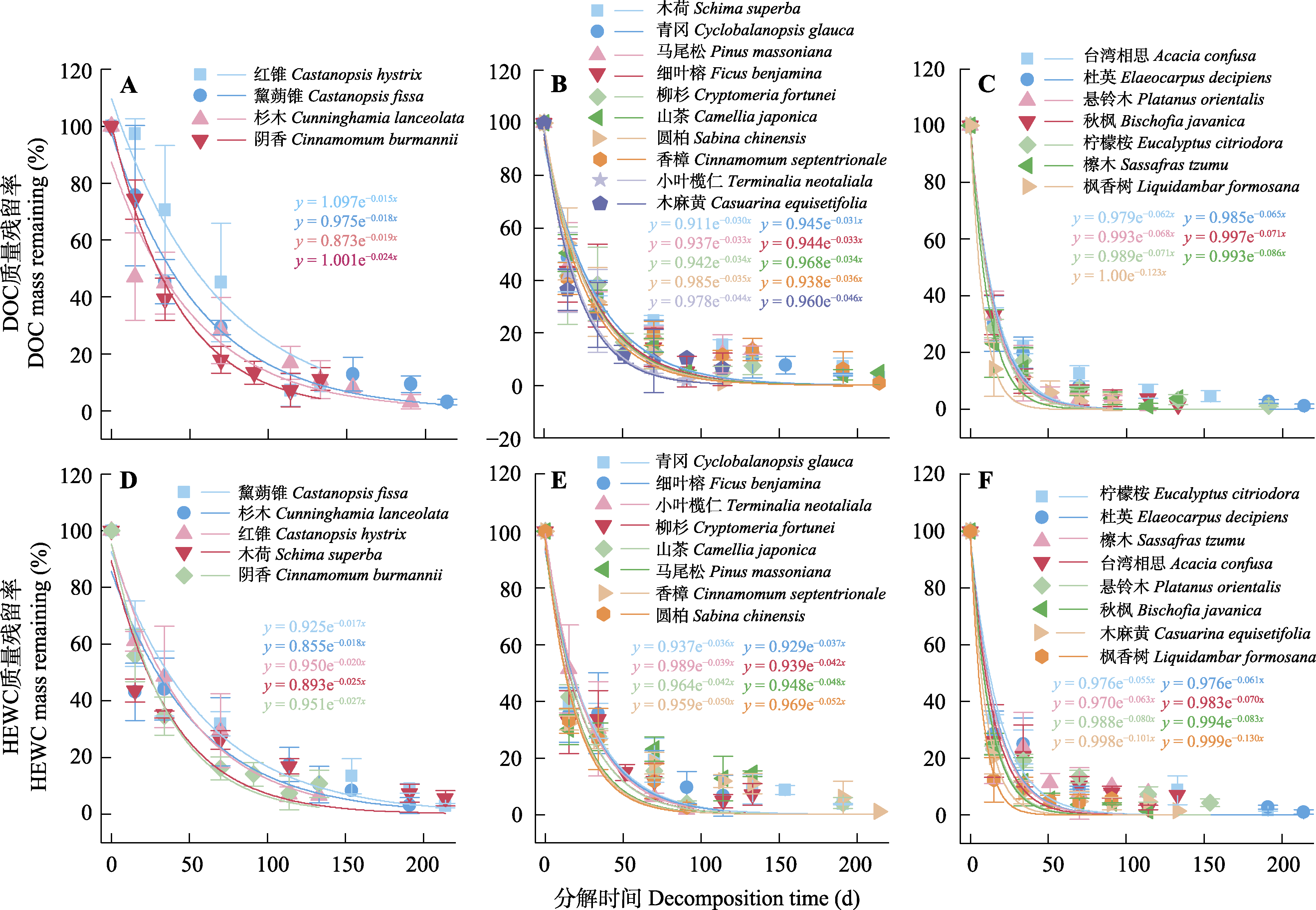
Fig. 1 Dissolved organic carbon (DOC) and hot-water extractable carbon (HWEC) release rates (k) of foliar litter of 21 tree species in subtropical forest (mean ± SE, n = 4). A, D, k < 0.03 d-1; B, E, 0.03 d-1 ≤ k < 0.06 d-1; C, F, k ≥ 0.06 d-1.
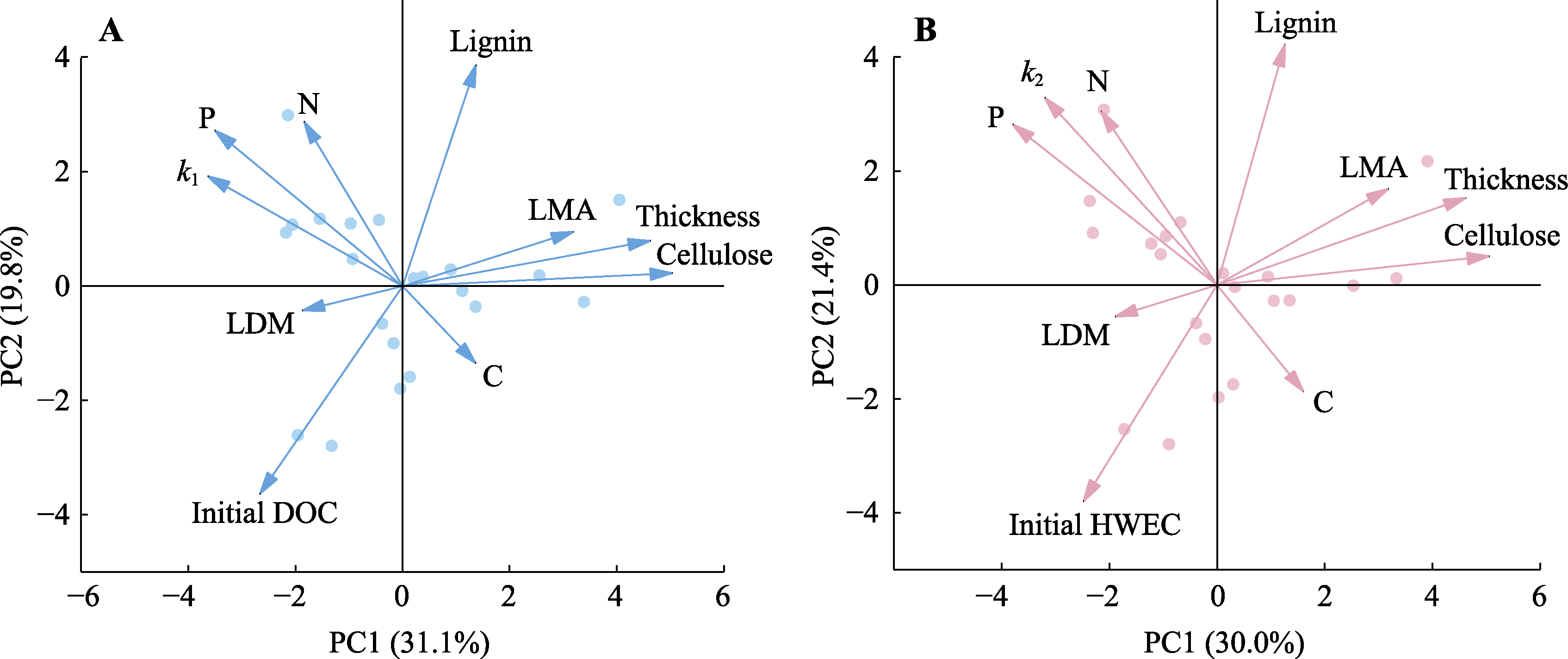
Fig. 2 Relative importance of litter substrate quality and morphological traits on dissolved organic carbon (A) and hot-water extractable carbon (B) release rates. C, initial carbon content; Cellulose, initial cellulose content; Initial DOC, initial dissolved organic carbon content; Initial HWEC, initial hot-water extractable carbon content; k1: DOC release rate; k2, HWEC release rate; LDM, leaf dry mass; Lignin, initial lignin content; LMA, leaf mass per unit area; N, initial nitrogen content; P, initial phosphorus content; Thickness: foliar litter thickness. PC1, first principal component; PC2, second principal component.
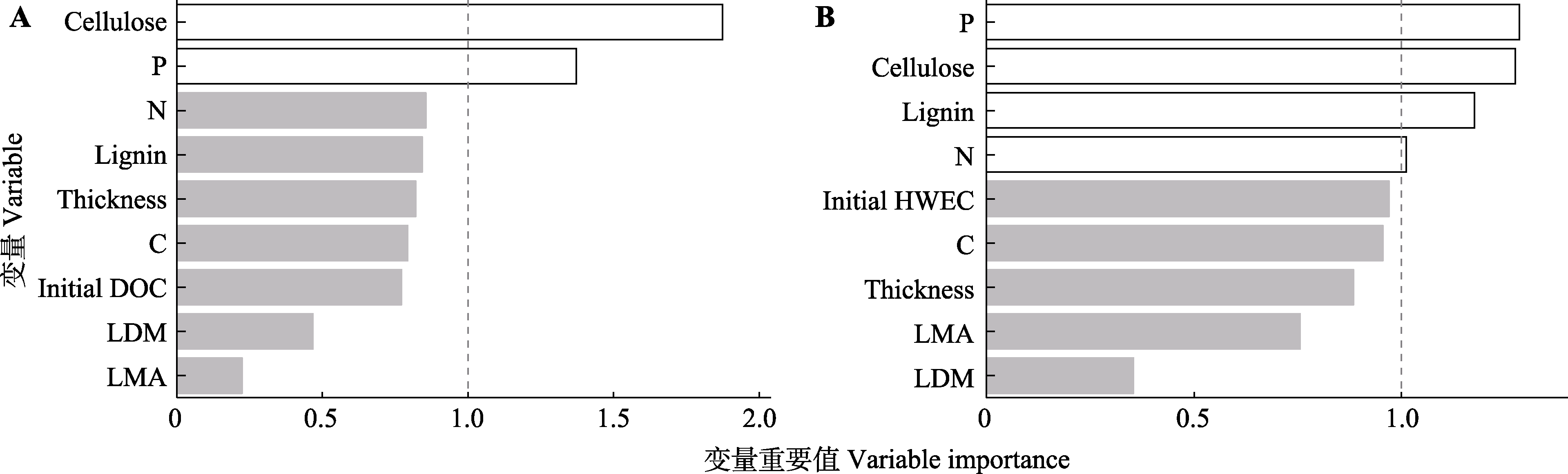
Fig. 3 Relative importance of litter substrate quality and morphological traits on DOC (A) and HWEC (B) release rates. The variables greater than 1 (marked in white) show significant effects. C, initial carbon content; Cellulose, initial cellulose content; Initial DOC, initial dissolved organic carbon content; Initial HWEC, initial hot-water extractable carbon content; LDM, leaf dry mass; Lignin, initial lignin content; LMA, leaf mass per unit area; N, initial nitrogen content; P, initial phosphorus content; Thickness: foliar litter thickness.
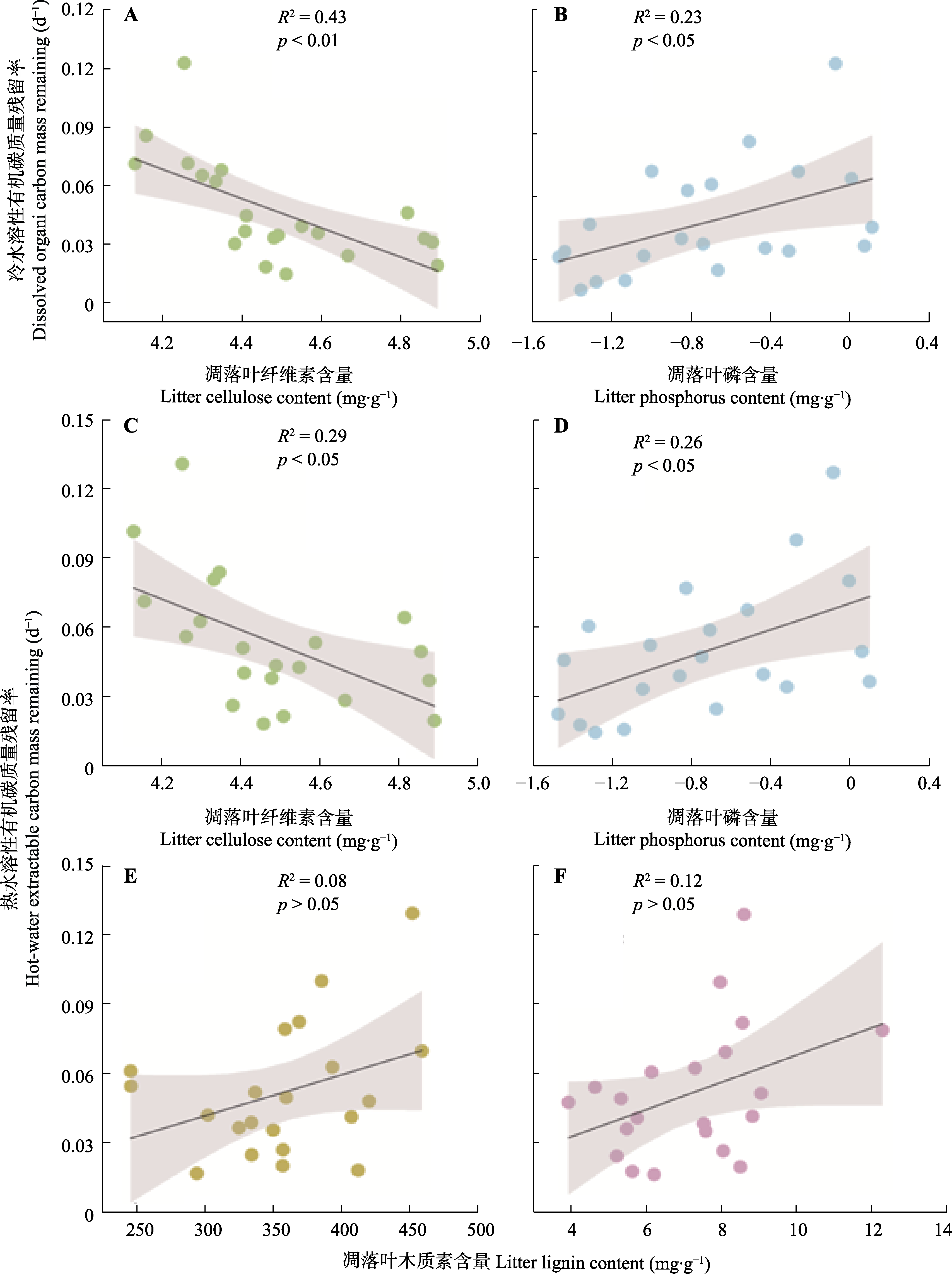
Fig. 4 Litter dissolved organic carbon (A, B) and hot-water extractable carbon (C-F) release rates were related to substrate quality traits. Lines are slopes (r) from linear regression model, with 95% confidence intervals shaded.
| [1] |
Adair EC, Parton WJ, Del Grosso SJ, Silver WL, Harmon ME, Hall SA, Burke IC, Hart SC (2008). Simple three-pool model accurately describes patterns of long-term litter decomposition in diverse climates. Global Change Biology, 14, 2636-2660.
DOI URL |
| [2] |
Berg B (2014). Decomposition patterns for foliar litter—A theory for influencing factors. Soil Biology & Biochemistry, 78, 222-232.
DOI URL |
| [3] | Berg B, Hannus K, Popoff T, Theander O (1982). Changes in organic chemical components of needle litter during decomposition. Long-term decomposition in a Scots pine forest. I. Canadian Journal of Botany, 60, 1310-1319. |
| [4] | Berg B, McClaugherty C (2020). Plant Litter: Decomposition, Humus Formation, Carbon Sequestration. 4th ed. Springer, Cham. 132-141. |
| [5] |
Bradford MA, Berg B, Maynard DS, Wieder WR, Wood SA (2016). Understanding the dominant controls on litter decomposition. Journal of Ecology, 104, 229-238.
DOI URL |
| [6] | Castillo-Figueroa D, Posada JM (2025). Are leaf anatomical traits strong predictors of litter decomposability? Evidence from upper Andean tropical species along a forest successional gradient. Oecologia, 207, 110. DOI: 10.1007/s00442-025-05739-8. |
| [7] | Chae HM, Choi SH, Lee SH, Cha S, Yang KC, Shim JK (2019). Effect of litter quality on needle decomposition for four pine species in Korea. Forests, 10, 371. DOI: 10.3390/f10050371. |
| [8] | Chen SP, Wang WT, Xu WT, Wang Y, Wan HW, Chen DM, Tang ZY, Tang XL, Zhou GY, Xie ZQ, Zhou DW, Shangguan ZP, Huang JH, He JS, Wang YF, et al. (2018). Plant diversity enhances productivity and soil carbon storage. Proceedings of the National Academy of Sciences of the United States of America, 115, 4027-4032. |
| [9] | Chen YM, He RL, Liu Y, Zhang J, Deng CC, Song XY, Yang L, Liu JW (2016). Leaf litter invertase activity in the early stage of litter decomposition in alpine timberline ecotone of western Sichuan, China. Acta Ecologica Sinica, 36, 4099-4108. |
| [陈亚梅, 和润莲, 刘洋, 张健, 邓长春, 宋小艳, 杨林, 刘军伟 (2016). 川西高山林线交错带凋落叶分解初期转化酶特征. 生态学报, 36, 4099-4108.] | |
| [10] |
Cleveland CC, Townsend AR, Schmidt SK (2002). Phosphorus limitation of microbial processes in moist tropical forests: evidence from short-term laboratory incubations and field studies. Ecosystems, 5, 680-691.
DOI URL |
| [11] |
Cotrufo MF, Soong JL, Horton AJ, Campbell EE, Haddix ML, Wall DH, Parton WJ (2015). Formation of soil organic matter via biochemical and physical pathways of litter mass loss. Nature Geoscience, 8, 776-779.
DOI |
| [12] |
Cotrufo MF, Wallenstein MD, Boot CM, Denef K, Paul E (2013). The Microbial Efficiency-Matrix Stabilization (MEMS) framework integrates plant litter decomposition with soil organic matter stabilization: Do labile plant inputs form stable soil organic matter? Global Change Biology, 19, 988-995.
DOI PMID |
| [13] |
Don A, Kalbitz K (2005). Amounts and degradability of dissolved organic carbon from foliar litter at different decomposition stages. Soil Biology & Biochemistry, 37, 2171-2179.
DOI URL |
| [14] |
Egene CE, Sigurnjak I, Regelink IC, Schoumans OF, Adani F, Michels E, Sleutel S, Tack FMG, Meers E (2021). Solid fraction of separated digestate as soil improver: implications for soil fertility and carbon sequestration. Journal of Soils and Sediments, 21, 678-688.
DOI |
| [15] | Ganault P, Barantal S, Coq S, Hättenschwiler S, Lucas S, Decaëns T, Nahmani J (2022). Leaf litter morphological traits, invertebrate body mass and phylogenetic affiliation explain the feeding and feces properties of saprophagous macroarthropods. European Journal of Soil Biology, 109, 103383. DOI: 10.1016/j.ejsobi.2021.103383. |
| [16] |
Ghani A, Dexter M, Perrott KW (2003). Hot-water extractable carbon in soils: a sensitive measurement for determining impacts of fertilisation, grazing and cultivation. Soil Biology & Biochemistry, 35, 1231-1243.
DOI URL |
| [17] |
Hagedorn F, Machwitz M (2007). Controls on dissolved organic matter leaching from forest litter grown under elevated atmospheric CO2. Soil Biology & Biochemistry, 39, 1759-1769.
DOI URL |
| [18] |
He XJ, Augusto L, Goll DS, Ringeval B, Wang YP, Helfenstein J, Huang YY, Yu KL, Wang ZQ, Yang YC, Hou EQ (2021). Global patterns and drivers of soil total phosphorus concentration. Earth System Science Data, 13, 5831-5846.
DOI URL |
| [19] |
Hensgens G, Lechtenfeld OJ, Guillemette F, Laudon H, Berggren M (2021). Impacts of litter decay on organic leachate composition and reactivity. Biogeochemistry, 154, 99-117.
DOI |
| [20] | Ho PC, Nakajima S, Urabe J (2023). Stoichiometry of carbon, nitrogen, and phosphorus released from the leaf litter of various temperate tree species. Ecology and Evolution, 13, e10372. DOI: 10.1002/ece3.10372. |
| [21] |
Huang ZQ, Xu ZH, Chen CR (2008). Effect of mulching on labile soil organic matter pools, microbial community functional diversity and nitrogen transformations in two hardwood plantations of subtropical Australia. Applied Soil Ecology, 40, 229-239.
DOI URL |
| [22] | Jia SX, Wu CJ, Liu XF, Guo JF (2019). Effects of harvest residue treatments on soil phosphorus fractions and availability in a young Chinese fir plantation. Chinese Journal of Applied Ecology, 30, 3662-3670. |
|
[贾淑娴, 吴传敬, 刘小飞, 郭剑芬 (2019). 采伐剩余物的处理方式对杉木幼林土壤磷组分及其有效性的影响. 应用生态学报, 30, 3662-3670.]
DOI |
|
| [23] |
Kalbitz K, Kaiser K, Bargholz J, Dardenne P (2006). Lignin degradation controls the production of dissolved organic matter in decomposing foliar litter. European Journal of Soil Science, 57, 504-516.
DOI URL |
| [24] |
Kalbitz K, Solinger S, Park JH, Michalzik B, Matzner E (2000). Controls on the dynamics of dissolved organic matter in soils: a review. Soil Science, 165, 277-304.
DOI URL |
| [25] | Kaźmierczak M, Błońska E, Lasota J (2024). Effect of litter decomposition and nutrient release from shrub litter on enzymatic activity and C/N/P stoichiometry of soils in a temperate pine forest. Acta Oecologica, 124, 104020. DOI: 10.1016/j.actao.2024.104020. |
| [26] |
Keegstra K (2010). Plant cell walls. Plant Physiology, 154, 483-486.
DOI PMID |
| [27] |
Kiikkilä O, Kitunen V, Spetz P, Smolander A (2012). Characterization of dissolved organic matter in decomposing Norway spruce and silver birch litter. European Journal of Soil Science, 63, 476-486.
DOI URL |
| [28] |
Landgraf D, Leinweber P, Makeschin F (2006). Cold and hot water-extractable organic matter as indicators of litter decomposition in forest soils. Journal of Plant Nutrition and Soil Science, 169, 76-82.
DOI URL |
| [29] |
Lehmann J, Kleber M (2015). The contentious nature of soil organic matter. Nature, 528, 60-68.
DOI |
| [30] | Li XW, Yang J, Chen CZ, Vähätalo AV, Riise G, Liu CQ, Xiao YH (2024). Effects of mineral adsorption on the molecular composition of soil dissolved organic matter: evidence from spectral analyses. Chemical Geology, 669, 122352. DOI: 10.1016/j.chemgeo.2024.122352. |
| [31] |
Li YL, Meng QT, Zhao XY, Cui JY (2008). Relationships of fresh leaf traits and leaf litter decomposition in Kerqin sandy land. Acta Ecologica Sinica, 28, 2486-2494.
DOI URL |
| [李玉霖, 孟庆涛, 赵学勇, 崔建垣 (2008). 科尔沁沙地植物成熟叶片性状与叶凋落物分解的关系. 生态学报, 28, 2486-2494.] | |
| [32] |
Liang C, Schimel JP, Jastrow JD (2017). The importance of anabolism in microbial control over soil carbon storage. Nature Microbiology, 2, 17105. DOI: 10.1038/nmicrobiol.2017.105.
PMID |
| [33] | Liao S, Yang WQ, Tan Y, Peng Y, Li J, Tan B, Wu FZ (2015). Soil fauna affects dissolved carbon and nitrogen in foliar litter in alpine forest and alpine meadow. PLoS ONE, 10, e0139099. DOI: 10.1371/journal.pone.0139099. |
| [34] |
Liu GF, Wang L, Jiang L, Pan X, Huang ZY, Dong M, Cornelissen JHC (2018). Specific leaf area predicts dryland litter decomposition via two mechanisms. Journal of Ecology, 106, 218-229.
DOI URL |
| [35] |
Lyu MK, Homyak PM, Xie JS, Peñuelas J, Ryan MG, Xiong XL, Sardans J, Lin WS, Wang MH, Chen GS, Yang YS (2023). Litter quality controls tradeoffs in soil carbon decomposition and replenishment in a subtropical forest. Journal of Ecology, 111, 2181-2193.
DOI URL |
| [36] |
Maie N, Jaffé R, Miyoshi T, Childers DL (2006). Quantitative and qualitative aspects of dissolved organic carbon leached from senescent plants in an oligotrophic wetland. Biogeochemistry, 78, 285-314.
DOI URL |
| [37] |
Makkonen M, Berg MP, Handa IT, Hättenschwiler S, van Ruijven J, van Bodegom PM, Aerts R (2012). Highly consistent effects of plant litter identity and functional traits on decomposition across a latitudinal gradient. Ecology Letters, 15, 1033-1041.
DOI PMID |
| [38] |
Melillo JM, Aber JD, Muratore JF (1982). Nitrogen and lignin control of hardwood leaf litter decomposition dynamics. Ecology, 63, 621-626.
DOI URL |
| [39] | Ni XY, Lin CF, Chen GS, Xie JS, Yang ZJ, Liu XF, Xiong DC, Xu C, Yue K, Wu FZ, Yang YS (2021). Decline in nutrient inputs from litterfall following forest plantation in subtropical China. Forest Ecology and Management, 496, 119445. DOI: 10.1016/j.foreco.2021.119445. |
| [40] |
Olson JS (1963). Energy storage and the balance of producers and decomposers in ecological systems. Ecology, 44, 322-331.
DOI URL |
| [41] | Pan X, Song YB, Liu GF, Hu YK, Ye XH, Cornwell WK, Prinzing A, Dong M, Cornelissen JHC (2015). Functional traits drive the contribution of solar radiation to leaf litter decomposition among multiple arid-zone species. Scientific Reports, 5, 13217. DOI: 10.1038/srep13217. |
| [42] | Patil M, Kumar A, Kumar P, Cheema NK, Kaur R, Bhatti R, Singh AN (2020). Comparative litter decomposability traits of selected native and exotic woody species from an urban environment of north-western Siwalik region, India. Scientific Reports, 10, 7888. DOI: 10.1038/s41598-020-64576-2. |
| [43] | Qin LH, Liu QJ, Sun Z, Xu ZZ, Siqing B (2022). Leaf litter decomposition rate of main tree species in broad-leaved Korean pine forest and its relationship with leaf traits. Acta Ecologica Sinica, 42, 5894-5905. |
| [秦立厚, 刘琪璟, 孙震, 徐振招, 斯庆毕力格 (2022). 长白山阔叶红松林主要树种凋落叶分解速率及其与叶性状的关系. 生态学报, 42, 5894-5905.] | |
| [44] |
Soong JL, Calderón FJ, Betzen J, Cotrufo MF (2014). Quantification and FTIR characterization of dissolved organic carbon and total dissolved nitrogen leached from litter: a comparison of methods across litter types. Plant and Soil, 385, 125-137.
DOI URL |
| [45] |
Soong JL, Parton WJ, Calderon F, Campbell EE, Cotrufo MF (2015). A new conceptual model on the fate and controls of fresh and pyrolized plant litter decomposition. Biogeochemistry, 124, 27-44.
DOI URL |
| [46] |
Staaf H, Berg B (1982). Accumulation and release of plant nutrients in decomposing scots pine needle litter. Long-term decomposition in a scots pine forest II. Canadian Journal of Botany, 60, 1561-1568.
DOI URL |
| [47] | Sun ZL, Tian P, Zhao XC, Wang YP, Wang SZ, Fang XM, Wang QK, Liu SG (2022). Temporal shifts in the explanatory power and relative importance of litter traits in regulating litter decomposition. Forest Ecosystems, 9, 100072. DOI: 10.1016/j.fecs.2022.100072. |
| [48] | Swift MJ, Heal OW, Anderson JM (1979). Decomposition in Terrestrial Ecosystems. University of California Press, Berkeley. |
| [49] |
Talbot JM, Yelle DJ, Nowick J, Treseder KK (2012). Litter decay rates are determined by lignin chemistry. Biogeochemistry, 108, 279-295.
DOI URL |
| [50] |
Vaieretti MV, Harguindeguy NP, Gurvich DE, Cingolani AM, Cabido M (2005). Decomposition dynamics and physico-chemical leaf quality of abundant species in a montane woodland in central Argentina. Plant and Soil, 278, 223-234.
DOI URL |
| [51] |
Vitousek PM, Porder S, Houlton BZ, Chadwick OA (2010). Terrestrial phosphorus limitation: mechanisms, implications, and nitrogen-phosphorus interactions. Ecological Applications, 20, 5-15.
PMID |
| [52] | Wang DJ, Xie WY, Lin XY, Li F, Deng CC, Zeng XY, Tan K, Yuan YP, Gu ZR, Jiang MX, Mao Z, Zuo J (2024). Multifaceted leaf litter traits shape soil fauna communities: evidence from subtropical monocultural plantations. Forest Ecology and Management, 563, 121965. DOI: 10.1016/j.foreco.2024.121965. |
| [53] | Wang QK, Wang SL, Yu XJ, Zhang J, Liu YX (2007). Effects of Cunninghamia lanceolata-broadleaved tree species mixed leaf litters on active soil organic matter. Chinese Journal of Applied Ecology, 18, 1203-1207. |
| [王清奎, 汪思龙, 于小军, 张剑, 刘燕新 (2007). 杉木与阔叶树叶凋落物混合分解对土壤活性有机质的影响. 应用生态学报, 18, 1203-1207.] | |
| [54] | Wang W, Hu K, Huang K, Tao JP (2021). Mechanical fragmentation of leaf litter by fine root growth contributes greatly to the early decomposition of leaf litter. Global Ecology and Conservation, 26, e01456. DOI: 10.1016/j.gecco.2021.e01456. |
| [55] | Wang XH, Huang JJ, Yan ER (2004). Leaf litter decomposition of common trees in Tiantong. Acta Phytoecologica Sinica, 28, 457-467. |
|
[王希华, 黄建军, 闫恩荣 (2004). 天童国家森林公园常见植物凋落叶分解的研究. 植物生态学报, 28, 457-467.]
DOI |
|
| [56] |
Wickings K, Grandy AS, Reed SC, Cleveland CC (2012). The origin of litter chemical complexity during decomposition. Ecology Letters, 15, 1180-1188.
DOI PMID |
| [57] | Wu JJ, Zhang H, Cheng XL, Liu GH (2023). Nitrogen addition stimulates litter decomposition rate: from the perspective of the combined effect of soil environment and litter quality. Soil Biology & Biochemistry, 179, 108992. DOI: 10.1016/j.soilbio.2023.108992. |
| [58] | Wu LJ, Zhang AD, Mou L, Li YQ, Li H, You CM, Zhang L, Tan B, Xu ZF (2021). Litter decomposition of seven common colored-leaf tree species of western Sichuan. Chinese Journal of Applied and Environmental Biology, 27, 625-631. |
| [伍六斤, 张傲冬, 牟凌, 李羿桥, 李晗, 游成铭, 张丽, 谭波, 徐振锋 (2021). 川西地区7种常见彩叶树种凋落物分解. 应用与环境生物学报, 27, 625-631.] | |
| [59] | Xu R, Liu J, Wang LY, Yan Y, Ma XQ, Li M (2022). Analysis of Root and leaf functional traits and C, N, P stoichiometry of Cunninghamia lanceolate from different provenances. Acta Ecologica Sinica, 42, 6298-6310. |
| [徐睿, 刘静, 王利艳, 颜耀, 马祥庆, 李明 (2022). 不同地理种源杉木根叶功能性状与碳氮磷化学计量分析. 生态学报, 42, 6298-6310.] | |
| [60] |
Xu XN, Hirata E (2005). Decomposition patterns of leaf litter of seven common canopy species in a subtropical forest: N and P dynamics. Plant and Soil, 273, 279-289.
DOI URL |
| [61] | Yang GR, Zhang XQ, Cai DS, Shi XH, Zhang H, Huang CB (2012). Litter decomposition of dominant plantations in Guangxi and its effects on leachate quality. Chinese Journal of Applied Ecology, 23, 9-16. |
| [杨钙仁, 张秀清, 蔡德所, 石贤辉, 张华, 黄承标 (2012). 广西主要人工林凋落物分解过程及其对淋溶水质的影响. 应用生态学报, 23, 9-16.] | |
| [62] |
Yang L, Deng CC, Chen YM, He RL, Zhang J, Liu Y (2015). Relationships between decomposition rate of leaf litter and initial quality across the alpine timberline ecotone in Western Sichuan, China. Chinese Journal of Applied Ecology, 26, 3602-3610.
PMID |
| [杨林, 邓长春, 陈亚梅, 和润莲, 张健, 刘洋 (2015). 川西高山林线交错带凋落叶分解速率与初始质量的关系. 应用生态学报, 26, 3602-3610.] | |
| [63] | Yang YS, Lin P, Guo JF, Lin RY, Chen GS, He ZM, Xie JS (2004). Litter production, nutrient return and leaf litter decomposition in natural and monoculture plantation forests of Castanopsis kawakamii in subtropical China. Acta Ecologica Sinica, 23, 1278-1289. |
| [64] | Yu HX, Wang JY, Wan FH, Zhou XY, Cai ML, Ou QJ, Li WH (2018). Research progress on effects of plant litter on the decomposition of soil organic matter. Journal of Biosafety, 27(2), 88-94. |
| [余涵霞, 王家宜, 万方浩, 周小燕, 蔡敏玲, 欧巧菁, 李伟华 (2018). 植物凋落物影响土壤有机质分解的研究进展. 生物安全学报, 27(2), 88-94.] | |
| [65] | Zhang Y, Zhang DJ, Li X, Liu H, Zhang MJ, Yang WQ, Zhang J (2016). Edge effects of forest gap in Pinus massoniana plantations on the decomposition of leaf litter recalcitrant components of Cinnamomum camphora and Toona ciliata. Chinese Journal of Applied Ecology, 27, 1116-1124. |
|
[张艳, 张丹桔, 李勋, 刘华, 张明锦, 杨万勤, 张健 (2016). 马尾松人工林林窗边缘效应对樟和红椿凋落叶难降解物质分解的影响. 应用生态学报, 27, 1116-1124.]
DOI |
|
| [66] | Zhou G, Wan J, Gu ZJ, Ding W, Hu S, Du Q, Meng SW, Yang CX (2023). Functional diversity accelerates the decomposition of litter recalcitrant carbon but reduces the decomposition of labile carbon in subtropical forests. Forests, 14, 2258. DOI: 10.3390/f14112258. |
| [67] |
Zhu JJ, Wu QX, Wu FZ, Yue K, Ni XY (2022). Decline in carbon decomposition from litter after snow removal is driven by a delayed release of carbohydrates. Plant and Soil, 481, 83-95.
DOI |
| [1] | YUAN Yuan, Jiang Xiaojun, YANG ShaoBo, WANG QingKui, TIAN Peng. Effect of in-situ warming on the priming effect of soil organic carbon decomposition in a subtropical forest [J]. Chin J Plant Ecol, 2026, 50(7): 0-. |
| [2] | XU Min-Hui, JIANG Zi-Yi, GENG Wen-Di, WANG Zi-Qing, LIN Yu-Die, WANG Jian-Qing, SHI Xiu-Zhen. Characteristics of litter carbon, nitrogen, and phosphorus ecological stoichiometry in young subtropical Cunninghamia lanceolata under different neighbourhood tree species richness [J]. Chin J Plant Ecol, 2026, 50(7): 0-. |
| [3] | ZHAO Zhi-Yi, HUANG Wei-Quan, HU Jing-Yan, WANG Yi-Yue, YU Meng-Jie, WU Yu-Huan. Advances of plant litter decomposition and its microbial mechanisms in peatland [J]. Chin J Plant Ecol, 2026, 50(4): 801-813. |
| [4] | HOU Xiao-Fan, MA Chen-Han, SUN Yu-Qian, GAO Yu-Han, LI Pin. Differential ecological stoichiometry of leaf and fine root litter decomposition under ozone stress [J]. Chin J Plant Ecol, 2026, 50(2): 268-278. |
| [5] | WANG Zi-Xuan, XING Ai-Jun, CHEN Zi-Xin, SHEN Hai-Hua, FANG Jing-Yun. Effects of long-term nitrogen addition on understory plant functional traits in a boreal forest [J]. Chin J Plant Ecol, 2026, 50(2): 244-255. |
| [6] | WANG Rong-Jun, WU Fu-Zhong, WU Qiu-Xia, ZHU Jing-Jing, NI Xiang-Yin. Differences in leaf nitrogen reabsorption efficiency among plants with different life forms [J]. Chin J Plant Ecol, 2026, 50(2): 344-351. |
| [7] | JIA Zi-Xuan, FANG Tao, ZHANG Shu-Xin, LIU Yi-Fan, ZHAO Wei, WANG Rong, CHANG Hai-Chao, ZHU Yao-Jun, LUO Fang-Li, GUO Yun-Qian, YU Fei-Hai. Responses of aboveground-belowground traits of Phragmites australis in different marsh wetlands to changes in soil moisture [J]. Chin J Plant Ecol, 2025, 49(9): 1448-1460. |
| [8] | ZHOU Si-Qi, AI Ling, NI Xiang-Yin, WU Fu-Zhong, WU Qiu-Xia, ZHU Jing-Jing, ZHANG Xin-Ying. Global patterns and controls of variation in cellulose decomposition rates of plant litters [J]. Chin J Plant Ecol, 2025, 49(3): 393-403. |
| [9] | LU Lei-Qin, SUN Long, SONG Yu-Xuan, YANG Guang, CAI Hui-Ying. Post-fire time impacts on nonstructural carbohydrates in leaves-branches-roots of Vaccinium vitis-idaea in Da Hinggan Mountains [J]. Chin J Plant Ecol, 2025, 49(12): 2105-2118. |
| [10] | QIU Dan-Ni, PENG Qing-Qing, ZHANG Hui-Ling, WEN Hui-Hui, WU Fu-Zhong. Seasonal effects of typical canopy tree species on ant community dynamics in mid-subtropical evergreen broadleaf forests [J]. Chin J Plant Ecol, 2025, 49(11): 1805-1816. |
| [11] | CHEN Cheng-Zhi, GAO Yu-Sen, LUO Li-Jia, WANG Dong. Twig and leaf litter production and decomposition in an alpine Sibiraea angustata shrubland of western Sichuan, China [J]. Chin J Plant Ecol, 2025, 49(10): 1733-1743. |
| [12] | RAN Jia-Xin, ZHANG Yu-Hui, WANG Yun, YANG Zhi-Jie, MAO Chao. Effects of warming and nitrogen and phosphorus addition on dissolved organic carbon biodegradability of litter in a subtropical forest [J]. Chin J Plant Ecol, 2024, 48(9): 1232-1242. |
| [13] | WANG Xiao-Ying, SUN Zhi-Gao, CHEN Bing-Bing, WU Hui-Hui, ZHANG Dang-Yu. Ex situ decomposition and phosphorus release characteristics of Spartina alterniflora litter in Minjiang estuary [J]. Chin J Plant Ecol, 2024, 48(7): 844-857. |
| [14] | ZHANG Yu, DU Ting, CHEN Yu-Lian, ZHU He-Meng, TAN Bo, YOU Cheng-Ming, ZHANG Li, XU Zhen-Feng, LI Han. Contribution of litter-derived carbon to soil organic carbon fractions and its response to freezing-thaw cycling in a subalpine forest [J]. Chin J Plant Ecol, 2024, 48(11): 1422-1433. |
| [15] | LU Xiao-Fei, QIN Zhang-Fen, WANG Bin, KUANG Yuan-Wen. Effects of nitrogen addition on phytolith-occluded carbon of understory plant-soil system in a subtropical evergreen broadleaf forest in south China [J]. Chin J Plant Ecol, 2024, 48(10): 1302-1311. |
| Viewed | ||||||
|
Full text |
|
|||||
|
Abstract |
|
|||||
Copyright © 2026 Chinese Journal of Plant Ecology
Tel: 010-62836134, 62836138, E-mail: apes@ibcas.ac.cn, cjpe@ibcas.ac.cn

