
Chin J Plant Ecol ›› 2026, Vol. 50 ›› Issue (1): 134-149.DOI: 10.17521/cjpe.2025.0035 cstr: 32100.14.cjpe.2025.0035
• Research Articles • Previous Articles Next Articles
LI Shu-Ying1, ZHU Jia-Bao1, MA Yan2,*( ), XU Dao-Qing1,*(), KAN Hua-Chun1, CHEN Min1, LIU Xiao-Ling1, ZHENG Shu-Feng1, MA Xiao-Yan2
Received:2025-01-24
Accepted:2025-04-03
Online:2026-01-20
Published:2026-02-13
Contact:
MA Yan, XU Dao-Qing
Supported by:LI Shu-Ying, ZHU Jia-Bao, MA Yan, XU Dao-Qing, KAN Hua-Chun, CHEN Min, LIU Xiao-Ling, ZHENG Shu-Feng, MA Xiao-Yan. Influence of goosegrass density and critical period for its control on cotton[J]. Chin J Plant Ecol, 2026, 50(1): 134-149.
Add to citation manager EndNote|Ris|BibTeX
URL: https://www.plant-ecology.com/EN/10.17521/cjpe.2025.0035
| 月份 Month | 月平均气温 Monthly mean air temperature (℃) | 月降水量 Monthly precipitation (mm) | ||||
|---|---|---|---|---|---|---|
| 2010 | 2011 | 2012 | 2010 | 2011 | 2012 | |
| 4 | 14.3 | 17.9 | 18.8 | 178.4 | 53.6 | 85.8 |
| 5 | 21.9 | 22.4 | 22.3 | 105.6 | 89.3 | 200.6 |
| 6 | 25.0 | 24.8 | 26.5 | 170.2 | 377.1 | 121.5 |
| 7 | 28.4 | 28.9 | 30.7 | 727.9 | 245.3 | 326.3 |
| 8 | 29.8 | 27.9 | 28.2 | 208.4 | 128.5 | 144.5 |
| 9 | 24.6 | 23.5 | 23.2 | 137.5 | 28.5 | 129.0 |
| 10 | 17.7 | 18.3 | 19.0 | 75.7 | 27.1 | 60.7 |
| 总计 Total | - | - | - | 1 603.7 | 949.4 | 1 068.4 |
Table 1 Monthly mean air temperature and total precipitation from April to October in 2010-2012 at the experimental site (Anqing Meteorological Bureau)
| 月份 Month | 月平均气温 Monthly mean air temperature (℃) | 月降水量 Monthly precipitation (mm) | ||||
|---|---|---|---|---|---|---|
| 2010 | 2011 | 2012 | 2010 | 2011 | 2012 | |
| 4 | 14.3 | 17.9 | 18.8 | 178.4 | 53.6 | 85.8 |
| 5 | 21.9 | 22.4 | 22.3 | 105.6 | 89.3 | 200.6 |
| 6 | 25.0 | 24.8 | 26.5 | 170.2 | 377.1 | 121.5 |
| 7 | 28.4 | 28.9 | 30.7 | 727.9 | 245.3 | 326.3 |
| 8 | 29.8 | 27.9 | 28.2 | 208.4 | 128.5 | 144.5 |
| 9 | 24.6 | 23.5 | 23.2 | 137.5 | 28.5 | 129.0 |
| 10 | 17.7 | 18.3 | 19.0 | 75.7 | 27.1 | 60.7 |
| 总计 Total | - | - | - | 1 603.7 | 949.4 | 1 068.4 |
| 杂草密度 Weed density (plants·m-1) | 株高 Plant height (cm) | 茎直径 Stem diameter (mm) | ||||||||
|---|---|---|---|---|---|---|---|---|---|---|
| 牛筋草 Goosegrass | 棉花 Cotton | 棉花 Cotton | ||||||||
| 2010 | 2011 | 2012 | 2010 | 2011 | 2012 | 2010 | 2011 | 2012 | ||
| 0 | - | - | - | 105.9a | 109.5a | 118.2a | 18.4a | 18.8a | 20.7a | |
| 0.125 | 71.5ab | 72.3ab | 119.5a | 105.7a | 110.6a | 116.7a | 18.8a | 18.6ab | 20.4a | |
| 0.25 | 72.1ab | 72.4ab | 96.4b | 105.2a | 107.0a | 117.4a | 17.9a | 18.3ab | 20.7a | |
| 0.5 | 78.4a | 76.7a | 98.5b | 102.3a | 107.1a | 112.9a | 18.9a | 17.6ab | 20.1a | |
| 1 | 72.3ab | 74.1ab | 94.5b | 104.0a | 105.8a | 111.9a | 18.8a | 16.7b | 19.4a | |
| 2 | 77.6ab | 72.8ab | 89.5b | 102.1a | 106.1a | 95.8b | 17.7a | 17.4ab | 18.5a | |
| 3 | 66.1b | 65.1b | 86.3b | 102.5a | 108.4a | 98.0b | 18.3a | 16.5b | 18.1a | |
| 4 | 67.2ab | 65.7b | 86.3b | 99.2a | 103.1a | 88.1b | 18.3a | 16.4b | 15.0b | |
Table 2 Influence of goosegrass densities on plant height and stem diameter of cotton and goosegrass from 2010 to 2012
| 杂草密度 Weed density (plants·m-1) | 株高 Plant height (cm) | 茎直径 Stem diameter (mm) | ||||||||
|---|---|---|---|---|---|---|---|---|---|---|
| 牛筋草 Goosegrass | 棉花 Cotton | 棉花 Cotton | ||||||||
| 2010 | 2011 | 2012 | 2010 | 2011 | 2012 | 2010 | 2011 | 2012 | ||
| 0 | - | - | - | 105.9a | 109.5a | 118.2a | 18.4a | 18.8a | 20.7a | |
| 0.125 | 71.5ab | 72.3ab | 119.5a | 105.7a | 110.6a | 116.7a | 18.8a | 18.6ab | 20.4a | |
| 0.25 | 72.1ab | 72.4ab | 96.4b | 105.2a | 107.0a | 117.4a | 17.9a | 18.3ab | 20.7a | |
| 0.5 | 78.4a | 76.7a | 98.5b | 102.3a | 107.1a | 112.9a | 18.9a | 17.6ab | 20.1a | |
| 1 | 72.3ab | 74.1ab | 94.5b | 104.0a | 105.8a | 111.9a | 18.8a | 16.7b | 19.4a | |
| 2 | 77.6ab | 72.8ab | 89.5b | 102.1a | 106.1a | 95.8b | 17.7a | 17.4ab | 18.5a | |
| 3 | 66.1b | 65.1b | 86.3b | 102.5a | 108.4a | 98.0b | 18.3a | 16.5b | 18.1a | |
| 4 | 67.2ab | 65.7b | 86.3b | 99.2a | 103.1a | 88.1b | 18.3a | 16.4b | 15.0b | |
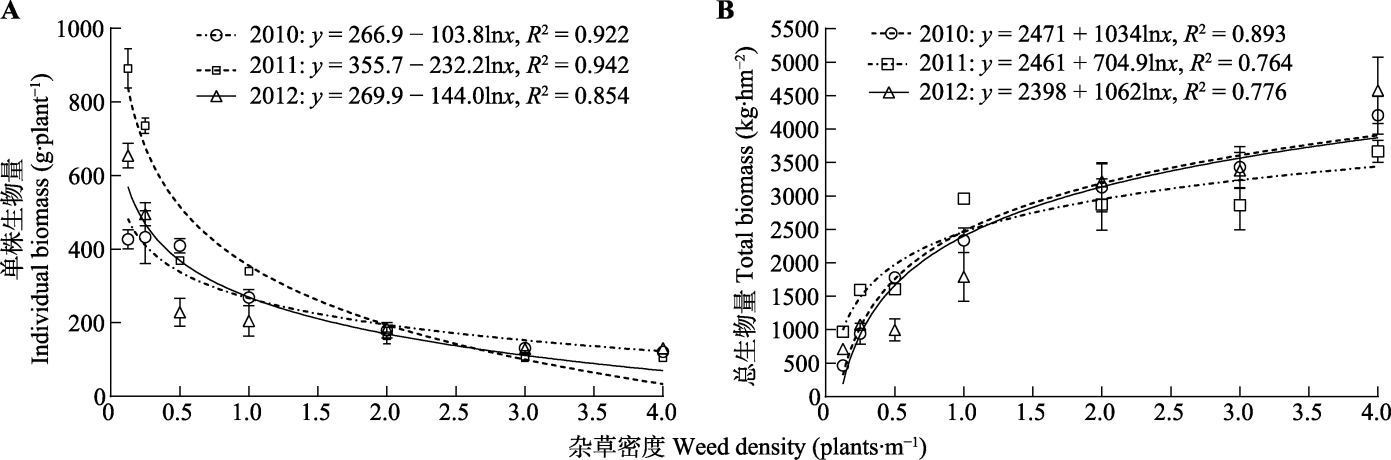
Fig. 1 Relationship between goosegrass density and its dry biomass from 2010 to 2012 (mean ± SD). A, Trend of biomass per plant with density from 2010 to 2012, fitted to the equation of y = a - blnx. B, Variation trend of total biomass per unit area with weed density from 2010 to 2012, fitted to the equation of y = a + blnx.
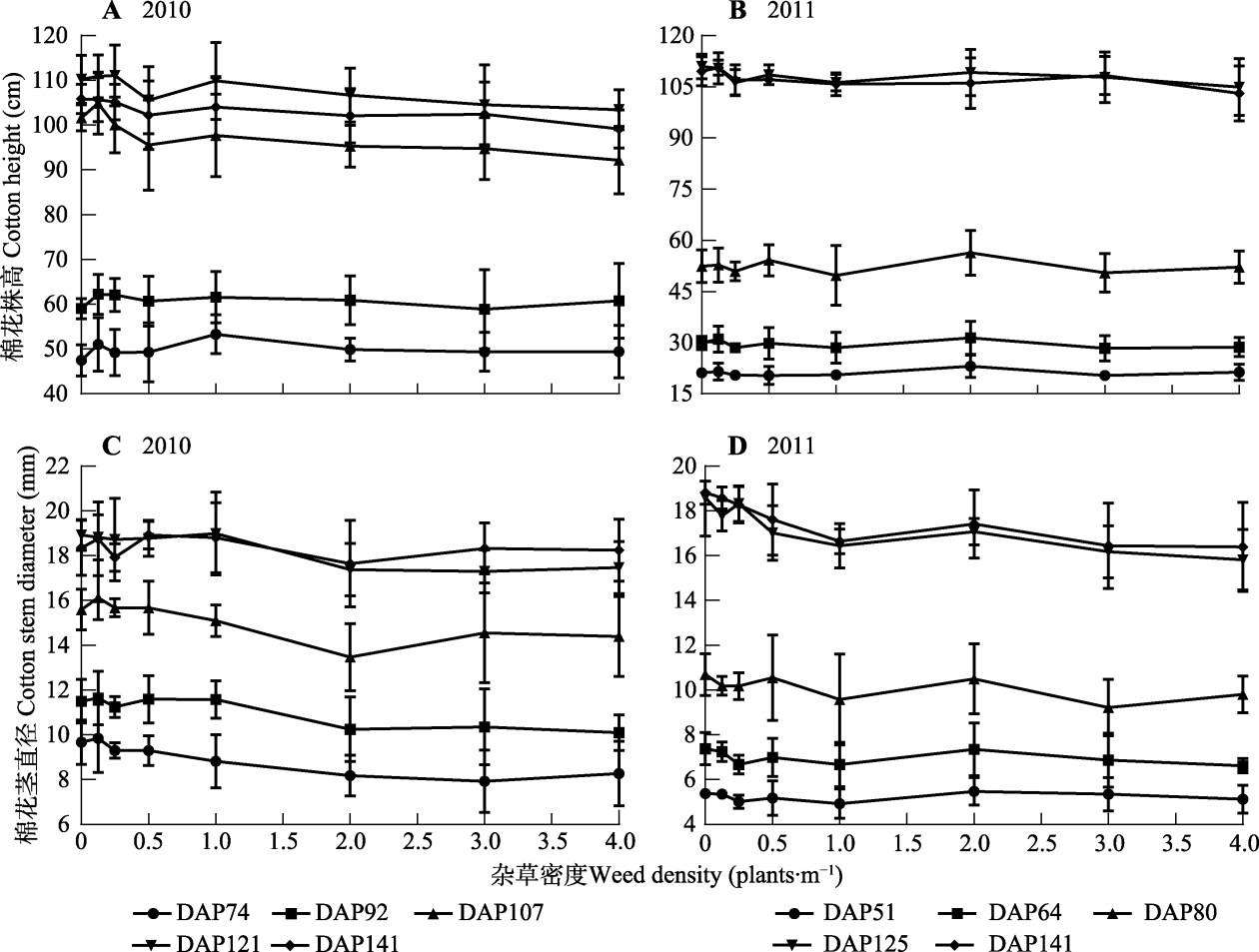
Fig. 2 Time dynamics of cotton plant height (A, B) and stem diameter (C, D) under different weed densities competition during 2010 to 2011 (mean ± SD). DAP, days after planting.
| 处理时间 Treatment time (week) | 除草临界期 Weeding critical period | 无杂草临界期 Weed free critical period | ||||||||||
|---|---|---|---|---|---|---|---|---|---|---|---|---|
| 株高 Plant height (cm) | 茎直径 Stem diameter (mm) | 株高 Plant height (cm) | 茎直径 Stem diameter (mm) | |||||||||
| 2010 | 2011 | 2012 | 2010 | 2011 | 2012 | 2010 | 2011 | 2012 | 2010 | 2011 | 2012 | |
| 0 | 120.6a | 111.0a | 117.7a | 20.3ab | 20.8a | 22.6a | 105.7b | 96.2c | 99.9b | 17.6b | 18.2b | 18.8b |
| 2 | 118.6ab | 107.0ab | 115.8ab | 19.2abc | 19.5ab | 21.7ab | 113.3ab | 99.9bc | 114.1a | 17.6b | 18.4b | 21.0a |
| 4 | 115.6abc | 102.7ab | 111.8abc | 21.0a | 19.5ab | 20.6abc | 114.2a | 102.4abc | 115.4a | 19.5ab | 18.5b | 21.3a |
| 6 | 114.9abc | 105.6ab | 108.4abc | 20.1ab | 19.2b | 20.7abc | 115.5a | 103.9abc | 114.4a | 18.9ab | 18.9b | 20.8a |
| 8 | 111.4abc | 99.8ab | 103.8bc | 19.5abc | 18.4b | 20.0bc | 115.7a | 107.5ab | 115.2a | 19.4ab | 18.7b | 21.4a |
| 10 | 110.2bc | 96.2b | 104.5bc | 18.9abc | 18.7b | 19.9bc | 116.7a | 105.1abc | 116.3a | 19.6ab | 18.7b | 21.6a |
| 12 | 108.2c | 97.3b | 103.1bc | 19.3abc | 18.6b | 19.7bc | 117.7a | 107.6ab | 115.4a | 20.0a | 19.7ab | 21.8a |
| 14 | 109.8bc | 96.6b | 103.2bc | 18.4bc | 18.5b | 19.7bc | 118.5a | 110.2ab | 117.3a | 20.4a | 19.7ab | 22.4a |
| 20 | 105.7c | 96.2b | 99.9c | 17.6c | 18.2b | 18.8c | 120.6a | 111.0a | 117.7a | 20.3a | 20.8a | 22.6a |
Table 3 Effects of critical period of weed competition on plant height and stem diameter of cotton from 2010 to 2012
| 处理时间 Treatment time (week) | 除草临界期 Weeding critical period | 无杂草临界期 Weed free critical period | ||||||||||
|---|---|---|---|---|---|---|---|---|---|---|---|---|
| 株高 Plant height (cm) | 茎直径 Stem diameter (mm) | 株高 Plant height (cm) | 茎直径 Stem diameter (mm) | |||||||||
| 2010 | 2011 | 2012 | 2010 | 2011 | 2012 | 2010 | 2011 | 2012 | 2010 | 2011 | 2012 | |
| 0 | 120.6a | 111.0a | 117.7a | 20.3ab | 20.8a | 22.6a | 105.7b | 96.2c | 99.9b | 17.6b | 18.2b | 18.8b |
| 2 | 118.6ab | 107.0ab | 115.8ab | 19.2abc | 19.5ab | 21.7ab | 113.3ab | 99.9bc | 114.1a | 17.6b | 18.4b | 21.0a |
| 4 | 115.6abc | 102.7ab | 111.8abc | 21.0a | 19.5ab | 20.6abc | 114.2a | 102.4abc | 115.4a | 19.5ab | 18.5b | 21.3a |
| 6 | 114.9abc | 105.6ab | 108.4abc | 20.1ab | 19.2b | 20.7abc | 115.5a | 103.9abc | 114.4a | 18.9ab | 18.9b | 20.8a |
| 8 | 111.4abc | 99.8ab | 103.8bc | 19.5abc | 18.4b | 20.0bc | 115.7a | 107.5ab | 115.2a | 19.4ab | 18.7b | 21.4a |
| 10 | 110.2bc | 96.2b | 104.5bc | 18.9abc | 18.7b | 19.9bc | 116.7a | 105.1abc | 116.3a | 19.6ab | 18.7b | 21.6a |
| 12 | 108.2c | 97.3b | 103.1bc | 19.3abc | 18.6b | 19.7bc | 117.7a | 107.6ab | 115.4a | 20.0a | 19.7ab | 21.8a |
| 14 | 109.8bc | 96.6b | 103.2bc | 18.4bc | 18.5b | 19.7bc | 118.5a | 110.2ab | 117.3a | 20.4a | 19.7ab | 22.4a |
| 20 | 105.7c | 96.2b | 99.9c | 17.6c | 18.2b | 18.8c | 120.6a | 111.0a | 117.7a | 20.3a | 20.8a | 22.6a |
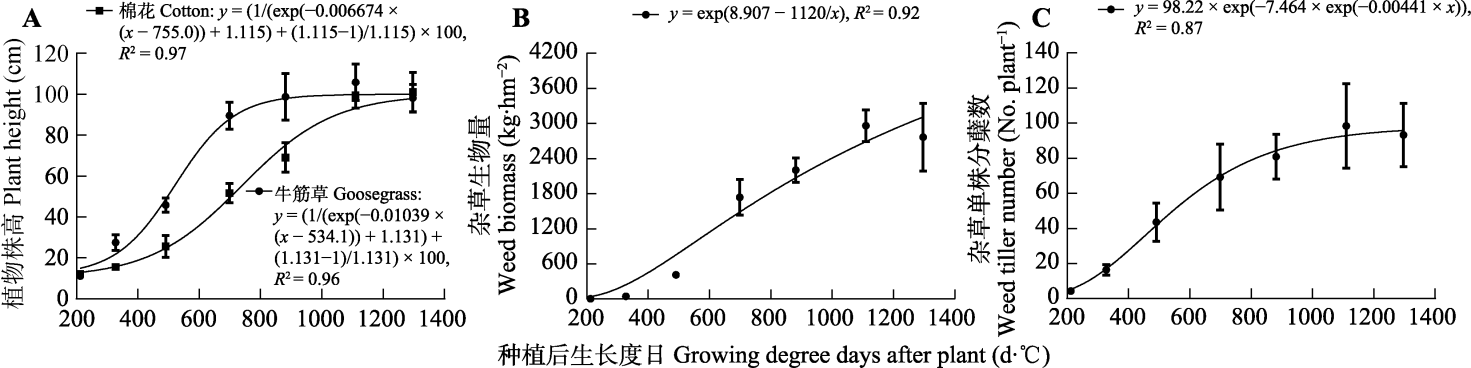
Fig. 3 Effects of different weed removal critical periods on the growth of goosegrass and cotton plant height in 2012 (mean ± SD). A, Logistic model fitted the effect of weed competition time on the plant height of cotton and goosegrass. B, Schumacher model fitted the effect of weed competition time on the biomass of goosegrass. C, Gompertz model was used to fit the effect of weed interference duration on tillers per plant of goosegrass. The model parameters are shown in the formula in the figure, where y represents the plant height of goosegrass and cotton, biomass and tiller number per plant of goosegrass in different weed removal critical periods, and x is the weed interference time (expressed by growing degree days).
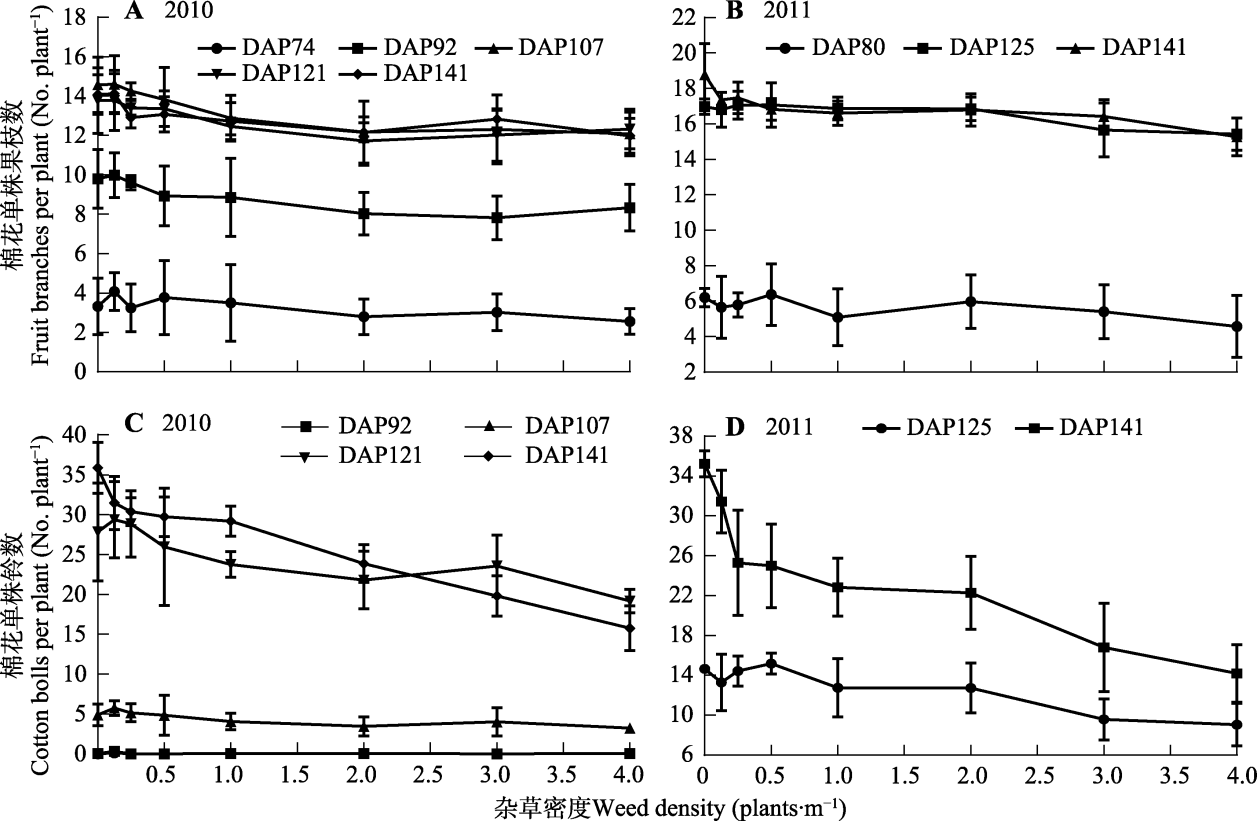
Fig. 4 Temporal dynamics of fruit branch number (A, B) and boll number (C, D) per plant of cotton under different weed densities during 2010 to 2011 (mean ± SD). DAP, days after planting.
| 杂草密度 Weed density (plants·m-1) | 果枝数 Fruit branches (No.·plant-1) | 单铃重 Single boll mass (g) | 子棉产量 Seed cotton yield (kg·hm-2) | ||||||
|---|---|---|---|---|---|---|---|---|---|
| 2010 | 2011 | 2012 | 2010 | 2011 | 2012 | 2010 | 2011 | 2012 | |
| 0 | 14.1a | 18.8a | 18.8ab | 5.8a | 5.4ab | 5.8a | 3 330a | 3 202a | 3 513a |
| 0.125 | 14.1a | 17.4ab | 18.9a | 5.7ab | 5.5a | 5.8a | 2 995b | 2 931ab | 3 055b |
| 0.25 | 12.9ab | 17.5ab | 18.7ab | 5.6ab | 5.4ab | 5.7a | 2 786b | 2 640bc | 2 893b |
| 0.5 | 13.1ab | 16.8bc | 18.3ab | 5.6ab | 5.4ab | 5.7a | 2 768b | 2 578bcd | 2 277c |
| 1 | 12.7b | 16.6bc | 17.2bc | 5.7ab | 5.4ab | 5.5ab | 2 495c | 2 378cde | 2 021c |
| 2 | 12.2b | 16.8bc | 15.9cd | 5.6ab | 5.4ab | 5.3ab | 2 210d | 2 215def | 1 567d |
| 3 | 12.8ab | 16.4bc | 15.4d | 5.6ab | 5.2ab | 5.2ab | 2 119d | 2 031ef | 1 318de |
| 4 | 12.0b | 15.3c | 13.3e | 5.5b | 5.1b | 4.9b | 1 760e | 1 979f | 1 086e |
Table 4 Influence of goosegrass densities on cotton yield and its main components from 2010 to 2012
| 杂草密度 Weed density (plants·m-1) | 果枝数 Fruit branches (No.·plant-1) | 单铃重 Single boll mass (g) | 子棉产量 Seed cotton yield (kg·hm-2) | ||||||
|---|---|---|---|---|---|---|---|---|---|
| 2010 | 2011 | 2012 | 2010 | 2011 | 2012 | 2010 | 2011 | 2012 | |
| 0 | 14.1a | 18.8a | 18.8ab | 5.8a | 5.4ab | 5.8a | 3 330a | 3 202a | 3 513a |
| 0.125 | 14.1a | 17.4ab | 18.9a | 5.7ab | 5.5a | 5.8a | 2 995b | 2 931ab | 3 055b |
| 0.25 | 12.9ab | 17.5ab | 18.7ab | 5.6ab | 5.4ab | 5.7a | 2 786b | 2 640bc | 2 893b |
| 0.5 | 13.1ab | 16.8bc | 18.3ab | 5.6ab | 5.4ab | 5.7a | 2 768b | 2 578bcd | 2 277c |
| 1 | 12.7b | 16.6bc | 17.2bc | 5.7ab | 5.4ab | 5.5ab | 2 495c | 2 378cde | 2 021c |
| 2 | 12.2b | 16.8bc | 15.9cd | 5.6ab | 5.4ab | 5.3ab | 2 210d | 2 215def | 1 567d |
| 3 | 12.8ab | 16.4bc | 15.4d | 5.6ab | 5.2ab | 5.2ab | 2 119d | 2 031ef | 1 318de |
| 4 | 12.0b | 15.3c | 13.3e | 5.5b | 5.1b | 4.9b | 1 760e | 1 979f | 1 086e |
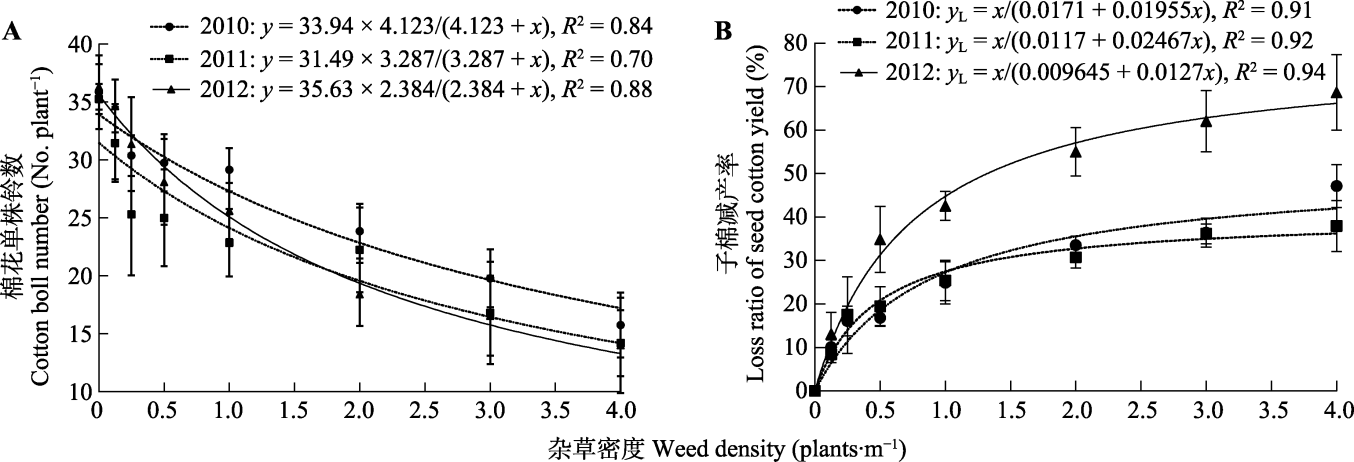
Fig. 5 Effects of goosegrass densities on boll number per plant (A) and yield loss rate of seed cotton (B) from 2010 to 2012 (mean ± SD). A, Fitting equation of boll number per plant of cotton with the density of goosegrass was y$=a\times \frac{b}{b+x}$; y refers to cotton boll number per plant, x are densities of goosegrass. B, Variation trend of seed cotton yield loss rate with the density of goosegrass was fitted by yL$=\frac{d}{a+b\times x}$; yL is the seed cotton yield loss rate, x is the density of goosegrass.
| 有杂草时间 Weedy period (week) | 果枝数 Fruit branches (No.·plant-1) | 铃数 Boll number (No.·plant-1) | 单铃重 Single boll mass (g) | 子棉产量 Seed cotton yield (kg·hm-2) | ||||||||
|---|---|---|---|---|---|---|---|---|---|---|---|---|
| 2010 | 2011 | 2012 | 2010 | 2011 | 2012 | 2010 | 2011 | 2012 | 2010 | 2011 | 2012 | |
| 0 | 17.3a | 17.9a | 19.8a | 42.1a | 36.6a | 39.8a | 5.6a | 6.4a | 4.8a | 3 213a | 4 126a | 2 656a |
| 2 | 16.4ab | 17.8a | 18.9ab | 39.2a | 33.9ab | 36.0ab | 5.5ab | 5.9ab | 4.7a | 3 213a | 4 254a | 2 681a |
| 4 | 17.0a | 17.4ab | 18.6abc | 37.8ab | 31.7abc | 34.2abc | 5.4ab | 6.0ab | 4.5a | 3 134ab | 4 040a | 2 482a |
| 6 | 15.8ab | 17.6ab | 18.3abcd | 34.9abc | 31.2abc | 29.9bcd | 5.1ab | 6.0ab | 4.6a | 3 028ab | 3 867ab | 2 483a |
| 8 | 14.4bc | 16.1bc | 18.5abcd | 35.2abc | 29.3bc | 30.7bcd | 5.2ab | 6.0ab | 4.7a | 2 895bc | 3 496bc | 2 205b |
| 10 | 15.8ab | 15.4c | 16.9cd | 31.3bcd | 28.7bc | 29.9bcd | 5.0b | 5.9ab | 4.6a | 2 950abc | 3 266cd | 2 186b |
| 12 | 15.2abc | 16.2bc | 17.5bcd | 30.7bcd | 28.0bc | 27.8cd | 5.2ab | 5.8b | 4.7a | 2 730c | 3 259cd | 2 096b |
| 14 | 15.1abc | 15.8c | 16.7cd | 28.1cd | 26.7c | 27.2d | 5.2ab | 6.0ab | 4.7a | 2 756c | 3 024d | 1 935b |
| 20 | 13.4c | 15.4c | 16.5d | 25.5d | 26.4c | 26.6d | 5.2ab | 5.7b | 4.6a | 2 475d | 2 963d | 1 916b |
Table 5 Effects of critical period of weed removal on cotton yield and its main components from 2010 to 2012
| 有杂草时间 Weedy period (week) | 果枝数 Fruit branches (No.·plant-1) | 铃数 Boll number (No.·plant-1) | 单铃重 Single boll mass (g) | 子棉产量 Seed cotton yield (kg·hm-2) | ||||||||
|---|---|---|---|---|---|---|---|---|---|---|---|---|
| 2010 | 2011 | 2012 | 2010 | 2011 | 2012 | 2010 | 2011 | 2012 | 2010 | 2011 | 2012 | |
| 0 | 17.3a | 17.9a | 19.8a | 42.1a | 36.6a | 39.8a | 5.6a | 6.4a | 4.8a | 3 213a | 4 126a | 2 656a |
| 2 | 16.4ab | 17.8a | 18.9ab | 39.2a | 33.9ab | 36.0ab | 5.5ab | 5.9ab | 4.7a | 3 213a | 4 254a | 2 681a |
| 4 | 17.0a | 17.4ab | 18.6abc | 37.8ab | 31.7abc | 34.2abc | 5.4ab | 6.0ab | 4.5a | 3 134ab | 4 040a | 2 482a |
| 6 | 15.8ab | 17.6ab | 18.3abcd | 34.9abc | 31.2abc | 29.9bcd | 5.1ab | 6.0ab | 4.6a | 3 028ab | 3 867ab | 2 483a |
| 8 | 14.4bc | 16.1bc | 18.5abcd | 35.2abc | 29.3bc | 30.7bcd | 5.2ab | 6.0ab | 4.7a | 2 895bc | 3 496bc | 2 205b |
| 10 | 15.8ab | 15.4c | 16.9cd | 31.3bcd | 28.7bc | 29.9bcd | 5.0b | 5.9ab | 4.6a | 2 950abc | 3 266cd | 2 186b |
| 12 | 15.2abc | 16.2bc | 17.5bcd | 30.7bcd | 28.0bc | 27.8cd | 5.2ab | 5.8b | 4.7a | 2 730c | 3 259cd | 2 096b |
| 14 | 15.1abc | 15.8c | 16.7cd | 28.1cd | 26.7c | 27.2d | 5.2ab | 6.0ab | 4.7a | 2 756c | 3 024d | 1 935b |
| 20 | 13.4c | 15.4c | 16.5d | 25.5d | 26.4c | 26.6d | 5.2ab | 5.7b | 4.6a | 2 475d | 2 963d | 1 916b |
| 无杂草时间 Weed free period (week) | 果枝数 Fruit branches (No.·plant-1) | 铃数 Boll number (No.·plant-1) | 单铃重 Single boll mass (g) | 子棉产量 Seed cotton yield (kg·hm-2) | ||||||||
|---|---|---|---|---|---|---|---|---|---|---|---|---|
| 2010 | 2011 | 2012 | 2010 | 2011 | 2012 | 2010 | 2011 | 2012 | 2010 | 2011 | 2012 | |
| 0 | 13.4d | 15.4c | 16.5b | 25.5d | 26.4c | 26.6d | 5.2a | 5.7b | 4.6ab | 2 475d | 2 963e | 1 916d |
| 2 | 14.1cd | 15.9bc | 18.6a | 28.4cd | 28.2bc | 30.0cd | 5.1a | 6.0ab | 4.5b | 2 718c | 3 431de | 2 126cd |
| 4 | 15.2abcd | 16.7abc | 18.8a | 31.7bcd | 28.3bc | 31.8bcd | 5.3a | 6.0ab | 5.0ab | 2 818bc | 3 411de | 2 299bc |
| 6 | 15.7abc | 16.5abc | 19.2a | 32.9abcd | 31.9abc | 32.7bcd | 5.2a | 6.2ab | 4.5b | 2 834bc | 3 610cd | 2 442ab |
| 8 | 15.0bcd | 17.2ab | 19.4a | 34.5abcd | 31.3abc | 32.4bcd | 5.3a | 6.0ab | 4.8ab | 3 040ab | 3 668bcd | 2 469ab |
| 10 | 15.9abc | 17.5ab | 19.4a | 35.5abc | 32.2abc | 37.1ab | 5.2a | 6.2ab | 4.9ab | 3 022ab | 3 949abc | 2 658a |
| 12 | 16.4ab | 17.2ab | 19.8a | 38.0ab | 32.3abc | 36.3abc | 5.2a | 6.2ab | 5.0a | 3 075ab | 3 924abcd | 2 673a |
| 14 | 16.4ab | 17.9a | 19.7a | 37.4abc | 33.6ab | 38.4ab | 5.3a | 6.2a | 4.6ab | 3 161a | 4 186a | 2 706a |
| 20 | 17.3a | 17.9a | 19.8a | 42.1a | 36.6a | 39.8a | 5.6a | 6.4a | 4.8ab | 3 213a | 4 126ab | 2 656a |
Table 6 Effects of weed free critical period on cotton yield and its main components from 2010 to 2012
| 无杂草时间 Weed free period (week) | 果枝数 Fruit branches (No.·plant-1) | 铃数 Boll number (No.·plant-1) | 单铃重 Single boll mass (g) | 子棉产量 Seed cotton yield (kg·hm-2) | ||||||||
|---|---|---|---|---|---|---|---|---|---|---|---|---|
| 2010 | 2011 | 2012 | 2010 | 2011 | 2012 | 2010 | 2011 | 2012 | 2010 | 2011 | 2012 | |
| 0 | 13.4d | 15.4c | 16.5b | 25.5d | 26.4c | 26.6d | 5.2a | 5.7b | 4.6ab | 2 475d | 2 963e | 1 916d |
| 2 | 14.1cd | 15.9bc | 18.6a | 28.4cd | 28.2bc | 30.0cd | 5.1a | 6.0ab | 4.5b | 2 718c | 3 431de | 2 126cd |
| 4 | 15.2abcd | 16.7abc | 18.8a | 31.7bcd | 28.3bc | 31.8bcd | 5.3a | 6.0ab | 5.0ab | 2 818bc | 3 411de | 2 299bc |
| 6 | 15.7abc | 16.5abc | 19.2a | 32.9abcd | 31.9abc | 32.7bcd | 5.2a | 6.2ab | 4.5b | 2 834bc | 3 610cd | 2 442ab |
| 8 | 15.0bcd | 17.2ab | 19.4a | 34.5abcd | 31.3abc | 32.4bcd | 5.3a | 6.0ab | 4.8ab | 3 040ab | 3 668bcd | 2 469ab |
| 10 | 15.9abc | 17.5ab | 19.4a | 35.5abc | 32.2abc | 37.1ab | 5.2a | 6.2ab | 4.9ab | 3 022ab | 3 949abc | 2 658a |
| 12 | 16.4ab | 17.2ab | 19.8a | 38.0ab | 32.3abc | 36.3abc | 5.2a | 6.2ab | 5.0a | 3 075ab | 3 924abcd | 2 673a |
| 14 | 16.4ab | 17.9a | 19.7a | 37.4abc | 33.6ab | 38.4ab | 5.3a | 6.2a | 4.6ab | 3 161a | 4 186a | 2 706a |
| 20 | 17.3a | 17.9a | 19.8a | 42.1a | 36.6a | 39.8a | 5.6a | 6.4a | 4.8ab | 3 213a | 4 126ab | 2 656a |
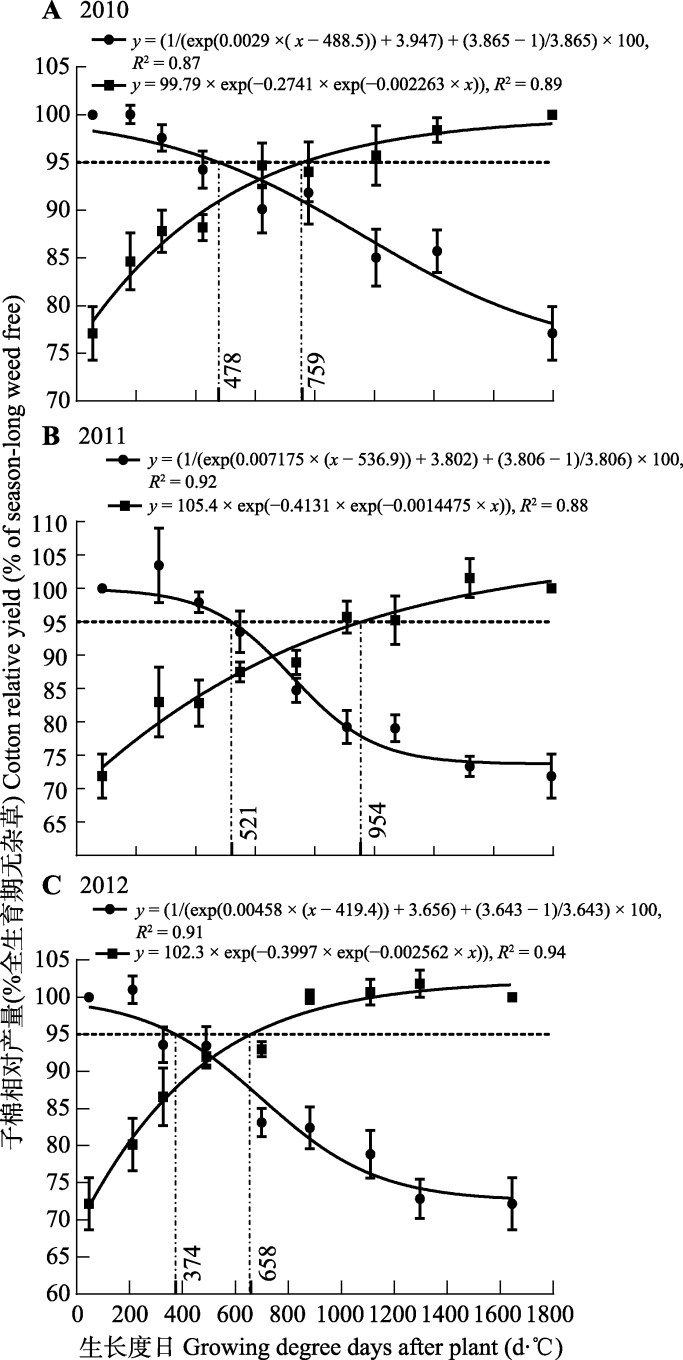
Fig. 6 Relationship between the relative yield of seed cotton and the critical period of weed removal (dot) and weed free (square dot) from 2010 to 2012 (mean ± SD). The Gompertz and Logistic models were used to fit the curve of the relative yield of seed cotton in the weed free period and the weed removal period, respectively. The model parameters were shown in the formula, where y was the relative yield of seed cotton (% seasonally weed free), and x was the growing degree days (GDD) of weed interference duration or weed free period. The horizontal dashed line represented the 5% acceptable cotton yield loss level used to determine the critical period for weed control (CPWC), while the vertical dashed line with values represented the beginning and end of the CPWC.
| [1] | Bendixen LE (1986). Weed hosts of Meloidogyne, the root-knot nematodes//Noda K, Mercado BL. Weeds and the Environment in the Tropics. Asian-Pacific Weed Science Society, Chiang Mai, Thailand. |
| [2] | Bensch CN, Horak MJ, Peterson D (2003). Interference of redroot pigweed (Amaranthus retroflexus), Palmer amaranth (A. palmeri), and common waterhemp (A. rudis) in soybean. Weed Science, 51, 37-43. |
| [3] |
Bridges DC, Chandler JM (1987). Influence of johnsongrass (Sorghum halepense) density and period of competition on cotton yield. Weed Science, 35, 63-67.
DOI URL |
| [4] |
Brown SM, Whitwell T, Street JE (1985). Common bermudagrass (Cynodon dactylon) competition in cotton (Gossypium hirsutum). Weed Science, 33, 503-506.
DOI URL |
| [5] |
Buchanan GA, Burns ER (1970). Influence of weed competition on cotton. Weed Science, 18, 149-154.
DOI URL |
| [6] |
Buchanan GA, Burns ER (1971a). Weed competition in cotton. I. Sicklepod and tall morningglory. Weed Science, 19, 576-579.
DOI URL |
| [7] |
Buchanan GA, Burns ER (1971b). Weed competition in cotton. II. cocklebur and redroot pigweed. Weed Science, 19, 580-582.
DOI URL |
| [8] | Cai XH, Lin P, Shi YH, Han R, Zhang YD, Wang JG (2021). Effects of population density of Bolboschoenus planiculmis on the morphological index, yield and quality of cotton. Plant Protection, 47(4), 90-95. |
| [蔡晓虎, 林萍, 史亚辉, 韩睿, 张玉栋, 王俊刚 (2021). 扁秆荆三棱种群密度对棉花形态指标、产量和品质的影响. 植物保护, 47(4), 90-95.] | |
| [9] |
Charles GW, Sindel BM, Cowie AL, Knox OGG (2019). Determining the critical period for weed control in high-yielding cotton using common sunflower as a mimic weed. Weed Technology, 33, 800-807.
DOI |
| [10] |
Charles GW, Sindel BM, Cowie AL, Knox OGG (2020). Determining the critical period for grass control in high-yielding cotton using Japanese millet as a mimic weed. Weed Technology, 34, 292-300.
DOI |
| [11] |
Chauhan BS, Johnson DE (2008). Germination ecology of goosegrass (Eleusine indica): an important grass weed of rainfed rice. Weed Science, 56, 699-706.
DOI URL |
| [12] | Chen JC, Wei SH, Huang HJ, Cui HL, Zhang CX, Li XJ (2021). Characterization of glyphosate and quizalofop-p-ethyl multiple resistance in Eleusine indica. Pesticide Biochemistry and Physiology, 176, 104862. DOI: 10.1016/j.pestbp.2021.104862. |
| [13] | de Freitas Souza M, Henckes JR, Zobiole LHS, de Oliveira RS, Braz GBP, Constantin J, Machado FG, Almeida do Amarante A, Ferreira CJB (2024). Competitive response of maize against glyphosate-resistant Digitaria insularis and Eleusine indica. Crop Protection, 183, 106760. DOI: 10.1016/j.cropro.2024.106760. |
| [14] |
Evetts LL, Burnside OC (1973). Early root and shoot development of nine plant species. Weed Science, 21, 289-291.
DOI URL |
| [15] | Fang F, Li M, Gao XX, Li J, Zhang CX (2016). Species composition and characterization of weed communities in cotton fields in Yellow River delta. Plant Protection, 42(5), 148-153. |
| [房锋, 李美, 高兴祥, 李健, 张朝贤 (2016). 黄河三角洲地区棉田杂草组成及其群落特征. 植物保护, 42(5), 148-153.] | |
| [16] | Fast BJ, Murdock SW, Farris RL, Willis JB, Murray DS (2009). Critical timing of palmer amaranth (Amaranthus palmeri) removal in second-generation glyphosate-resistant cotton. Journal of Cotton Science, 13, 32-36. |
| [17] |
Hall MR, Swanton CJ, Anderson GW (1992). The critical period of weed control in grain corn (Zea mays). Weed Science, 40, 441-447.
DOI URL |
| [18] | Heap IM (2024). International survey of herbicide resistant weeds. [2024-09-12]. http://www.weedscience.org/Home.aspx. |
| [19] | Holm LG, Plucknett DL, Pancho JV, Herberger JP (1977). The World’s Worst Weeds—Distribution and Biology. The University Press of Hawaii, Honolulu, USA. 52-53. |
| [20] | Ismail BS, Chuah TS, Salmijah S, Teng YT (2003). Effects of shade and watering frequency on growth and development of glyphosate-resistant and susceptible biotypes of goosegrass (Eleusine indica [L.] Gaertn.). Plant Protection Quarterly, 18, 30-34. |
| [21] |
Ismail BS, Chuah TS, Salmijah S, Teng YT, Schumacher RW (2002). Germination and seedling emergence of glyphosate-resistant and susceptible biotypes of goosegrass (Eleusine indica [L.] Gaertn.). Weed Biology and Management, 2, 177-185.
DOI URL |
| [22] |
Jalaludin A, Yu Q, Powles SB (2015). Multiple resistance across glufosinate, glyphosate, paraquat and ACCase-inhibiting herbicides in an Eleusine indica population. Weed Research, 55, 82-89.
DOI URL |
| [23] |
Keeley PE, Thullen RJ (1983). Influence of yellow nutsedge (Cyperus esculentus)—Free periods on yield of cotton (Gossypium hirsutum). Weed Science, 31, 803-807.
DOI URL |
| [24] |
Keeley PE, Thullen RJ (1989). Growth and interaction of johnsongrass (Sorghum halepense) with cotton (Gossypium hirsutum). Weed Science, 37, 339-344.
DOI URL |
| [25] |
Keeley PE, Thullen RJ (1991a). Growth and interaction of barnyardgrass (Echinochloa crus-galli) with cotton (Gossypium hirsutum). Weed Science, 39, 369-375.
DOI URL |
| [26] |
Keeley PE, Thullen RJ (1991b). Growth and interaction of bermudagrass (Cynodon dactylon) by cotton (Gossypium hirsutum). Weed Science, 39, 570-574.
DOI URL |
| [27] |
Kerr RA, Zhebentyayeva T, Saski C, McCarty LB (2019). Comprehensive phenotypic characterization and genetic distinction of distinct goosegrass (Eleusine indica L. Gaertn.) ecotypes. Journal of Plant Science and Phytopathology, 3, 95-100.
DOI URL |
| [28] |
Knezevic SZ, Evans SP, Blankenship EE, van Acker RC, Lindquist JL (2002). Critical period for weed control: the concept and data analysis. Weed Science, 50, 773-786.
DOI URL |
| [29] |
Knezevic SZ, Evans SP, Mainz M (2003). Row spacing influences the critical timing for weed removal in soybean (Glycine max). Weed Technology, 17, 666-673.
DOI URL |
| [30] |
Knezevic SZ, Weise SF, Swanton CJ (1994). Interference of redroot pigweed (Amaranthus retroflexus) in corn (Zea mays). Weed Science, 42, 568-573.
DOI URL |
| [31] |
Korres NE, Norsworthy JK (2015). Influence of a rye cover crop on the critical period for weed control in cotton. Weed Science, 63, 346-352.
DOI URL |
| [32] |
Leach GE, Devine MD, Kirkwood RC, Marshall G (1995). Target enzyme-based resistance to acetyl-coenzyme a carboxylase inhibitors in Eleusine indica. Pesticide Biochemistry and Physiology, 51, 129-136.
DOI URL |
| [33] |
Lee LJ, Ngim J (2000). A first report of glyphosate-resistant goosegrass (Eleusine indica (L) Gaertn) in Malaysia. Pest Management Science, 56, 336-339.
DOI URL |
| [34] | Li JB, Zhang ZQ, Lei Q, Lu BG, Jin CZ, Liu X, Wang YH, Bai LY (2022). Multiple herbicide resistance in Eleusine indica from sugarcane fields in China. Pesticide Biochemistry and Physiology, 182, 105040. DOI: 10.1016/j.pestbp.2022.105040. |
| [35] | Li SY, Zhu JB, Lu XY, Ye SH, Ma Y, Ma XY, Cheng FR (2017). The influence of redroot pigweed (Amaranthus retroflexus) density on cotton (Gossypium hirsutum). Scientia Agricultura Sinica, 50, 286-298. |
|
[李淑英, 朱加保, 路献勇, 叶泗洪, 马艳, 马小艳, 程福如 (2017). 反枝苋对棉花的密度竞争作用. 中国农业科学, 50, 286-298.]
DOI |
|
| [36] | Li SY, Zhu JB, Ma Y, Ma XY, Cheng FR, Lu XY (2015). Emergence pattern of weed seedling community in direct-seeding cotton fields in the southwest of Anhui Province. Journal of Plant Protection, 42, 460-466. |
| [李淑英, 朱加保, 马艳, 马小艳, 程福如, 路献勇 (2015). 皖西南直播棉田杂草群落出苗模式. 植物保护学报, 42, 460-466.] | |
| [37] |
Little NG, DiTommaso A, Westbrook AS, Ketterings QM, Mohler CL (2021). Effects of fertility amendments on weed growth and weed-crop competition: a review. Weed Science, 69, 132-146.
DOI |
| [38] | Liu SL, Ma ZY, Zhang Y, Chen ZW, Du X, Mu YH (2022). Astragalus sinicus incorporated as green manure for weed control in corn. Frontiers in Plant Science, 13, 829421. DOI: 10.3389/fpls.2022.829421. |
| [39] | Ma XY, Ma Y, Peng J, Xi JP, Ma YJ, Li XF (2010). Current situation and developing tendency of the weed researches in cotton field of China. Cotton Science, 22, 372-380. |
|
[马小艳, 马艳, 彭军, 奚建平, 马亚杰, 李希风 (2010). 我国棉田杂草研究现状与发展趋势. 棉花学报, 22, 372-380.]
DOI |
|
| [40] | Ma XY, Ma Y, Xi JP, Jiang WL, Ma YJ, Li XF (2012). Mixed weeds and competition with directly seeded cotton, north Henan Province, China. Cotton Science, 24(1), 91-96. |
|
[马小艳, 马艳, 奚建平, 姜伟丽, 马亚杰, 李希风 (2012). 豫北露地直播棉田杂草的发生及其与棉花的竞争作用. 棉花学报, 24(1), 91-96.]
DOI |
|
| [41] |
Ma XY, Ma YJ, Wu HW, Ren XL, Jiang WL, Ma Y (2019). Emergence timing affects growth and reproduction of goosegrass (Eleusine indica). Weed Technology, 33, 833-839.
DOI URL |
| [42] |
Ma XY, Wu HW, Jiang WL, Ma YJ, Ma Y (2015a). Goosegrass (Eleusine indica) density effects on cotton (Gossypium hirsutum). Journal of Integrative Agriculture, 14, 1778-1785.
DOI URL |
| [43] | Ma XY, Wu HW, Jiang WL, Ma YJ, Ma Y (2015b). Interference between redroot pigweed (Amaranthus retroflexus L.) and cotton (Gossypium hirsutum L.): growth analysis. PLoS ONE, 10, e0130475. DOI: 10.1371/journal.pone.0130475. |
| [44] |
Ma XY, Yang JY, Wu HW, Jiang WL, Ma YJ, Ma Y (2016). Growth analysis of cotton in competition with velvetleaf (Abutilon theophrasti). Weed Technology, 30, 123-136.
DOI URL |
| [45] |
McCullough PE, Yu JL, Raymer PL, Chen ZB (2016). First report of ACCase-resistant goosegrass (Eleusine indica) in the United States. Weed Science, 64, 399-408.
DOI URL |
| [46] |
McElroy JS, Head WB, Wehtje GR, Spak D (2017). Identification of goosegrass (Eleusine indica) biotypes resistant to preemergence-applied oxadiazon. Weed Technology, 31, 675-681.
DOI URL |
| [47] |
Miyaura R, Ito M (1995). Life cycle of Eleusine indica (L.) Gaertn and its implications for upland farming in tropical and temperate Asia. Journal of Weed Science and Technology, 39, 267-274.
DOI URL |
| [48] |
Molin WT, Boykin D, Hugie JA, Ratnayaka HH, Sterling TM (2006). Spurred anoda (Anoda cristata) interference in wide row and ultra narrow row cotton. Weed Science, 54, 651-657.
DOI URL |
| [49] |
Mudge LC, Gossett BJ, Murphy TR (1984). Resistance of goosegrass (Eleusine indica) to dinitroaniline herbicides. Weed Science, 32, 591-594.
DOI URL |
| [50] |
Oliver LR (1988). Principles of weed threshold research. Weed Technology, 2, 398-403.
DOI URL |
| [51] |
Papamichail D, Eleftherohorinos I, Froud-Williams R, Gravanis F (2002). Critical periods of weed competition in cotton in Greece. Phytoparasitica, 30, 105-111.
DOI URL |
| [52] | Schumacher FX (1939). A new growth curve and its application to timber-yield studies. Journal of Forestry, 37, 819-820. |
| [53] |
Seng CT, van Lun L, San CT, Sahid IB (2010). Initial report of glufosinate and paraquat multiple resistance that evolved in a biotype of goosegrass (Eleusine indica) in Malaysia. Weed Biology and Management, 10, 229-233.
DOI URL |
| [54] |
Sharpe SM, Boyd NS (2019). Germination ecology for Florida populations of carpetweed (Mollugo verticillata), Carolina geranium (Geranium carolinianum), eclipta (Eclipta prostrata), and goosegrass (Eleusine indica). Weed Science, 67, 433-440.
DOI |
| [55] |
Sionit N, Patterson DT, Coffin RD, Mortenson DA (1987). Water relations and growth of the weed, goosegrass (Eleusine indica), under drought stress. Field Crops Research, 17, 163-173.
DOI URL |
| [56] | Song WW, Qi NW, Liang C, Duan FM, Zhao HH (2019). First report of the southern root-knot nematode Meloidogyne incognita on goosegrass (Eleusine indica) in China. Plant Disease, 103, 1045. DOI: 10.1094/PDIS-05-21-1005-PDN. |
| [57] |
Stagnari F, Pisante M (2011). The critical period for weed competition in French bean (Phaseolus vulgaris L.) in Mediterranean areas. Crop Protection, 30, 179-184.
DOI URL |
| [58] | Sun FL, Ma J, Shi WJ, Yang YL (2023). Genome-wide association analysis revealed genetic variation and candidate genes associated with the yield traits of upland cotton under drought conditions. Frontiers in Plant Science, 14, 1135302. DOI: 10.3389/fpls.2023.1135302. |
| [59] | Tachie-Menson JW, Buah JN, Adu MO, Afutu E (2021). Morphological diversity in purple nutsedge from four agro-ecological zones in Ghana. Heliyon, 7, e07661. DOI: 10.1016/j.heliyon.2021.e07661. |
| [60] |
Tingle CH, Steele GL, Chandler JM (2003). Competition and control of smellmelon (Cucumis melo var. dudaim Naud.) in cotton. Weed Science, 51, 586-591.
DOI URL |
| [61] |
Tursun N, Datta A, Budak S, Kantarci Z, Knezevic SZ (2016). Row spacing impacts the critical period for weed control in cotton (Gossypium hirsutum). Phytoparasitica, 44, 139-149.
DOI URL |
| [62] |
Vencill WK, Giraudo LJ, Langdale GW (1993). Soil moisture relations and critical period of Cynodon dactylon (L.) Pers. (coastal bermudagrass) competition in conservation-tillage cotton (Gossypium hirsutum L.). Weed Research, 33, 89-96.
DOI URL |
| [63] |
Viator RP, Nuti RC, Edmisten KL, Wells R (2005). Predicting cotton boll maturation period using degree days and other climatic factors. Agronomy Journal, 97, 494-499.
DOI URL |
| [64] |
Wallinga J, van Oijen M (1997). Level of threshold weed density does not affect the long-term frequency of weed control. Crop Protection, 16, 273-278.
DOI URL |
| [65] |
Wandscheer ACD, Rizzardi MA, Reichert M (2013). Competitive ability of corn in coexistence with goosegrass. Planta Daninha, 31, 281-289.
DOI URL |
| [66] |
Webster TM, Grey TL, Flanders JT, Culpepper AS (2009). Cotton planting date affects the critical period of benghal dayflower (Commelina benghalensis) control. Weed Science, 57, 81-86.
DOI URL |
| [67] |
Westoby M (1998). A leaf-height-seed (LHS) plant ecology strategy scheme. Plant and Soil, 199, 213-227.
DOI |
| [68] | Wood ML, Murray DS, Banks JC, Verhalen LM, Westerman RB, Anderson KB (2002). Johnsongrass (Sorghum halepense) density effects on cotton (Gossypium hirsutum) harvest and economic value. Weed Technology, 16, 495-501. |
| [69] | Wu JX, Jenkins JN, McCarty JC, Zhu J (2004). Genetic association of yield with its component traits in a recombinant inbred line population of cotton. Euphytica, 140, 171-179. |
| [70] | Yu SX, Zhang L, Feng WJ (2015). Easy and enjoyable cotton cultivation: developments in China’s cotton production. Cotton Science, 27, 283-290. |
|
[喻树迅, 张雷, 冯文娟 (2015). 快乐植棉——中国棉花生产的发展方向. 棉花学报, 27, 283-290.]
DOI |
|
| [71] | Zhang CX, Hu XE, Qian YX (1997). A practicable model for predicting crop yield loss duo to weed competition. Plant Protection, 23(2), 6-10. |
| [张朝贤, 胡祥恩, 钱益新 (1997). 杂草密度与作物产量损失的预测模型. 植物保护, 23(2), 6-10.] | |
| [72] | Zhang QC, Peng J, Wang JG (2022). Protective enzyme activity regulation in cotton (Gossypium hirsutum L.) in response to Scirpus planiculmis stress. Frontiers in Plant Science, 13, 1068419. DOI: 10.31111/vegrus/2014.25.71. |
| [73] |
Zhang ZP (2003). Development of chemical weed control and integrated weed management in China. Weed Biology and Management, 3, 197-203.
DOI URL |
| [74] | Zhu JB, Li SY, Ma Y, Cheng FR, Zheng SF, Zhang B (2011). Analysis of weed infestation and its harmfulness to cotton in two cultivation patterns of cotton-fields along Changjiang River, Anhui Province. Journal of Anhui Agricultural University, 38, 617-622. |
| [朱加保, 李淑英, 马艳, 程福如, 郑曙峰, 张兵 (2011). 安徽省沿江棉区两种栽培方式下棉田杂草发生与危害研究. 安徽农业大学学报, 38, 617-622.] | |
| [75] | Zhu WD, Zhang CX, Wei SH, Cui HL, Zhang HJ, Zhang J, Li L (2009). Influence of Avena fatua on growth of oilseed rape and its economic threshold. Chinese Journal of Oil Crop Sciences, 31, 233-238. |
| [朱文达, 张朝贤, 魏守辉, 崔海兰, 张宏军, 张佳, 李林 (2009). 野燕麦对油菜生长的影响及其经济阈值. 中国油料作物学报, 31, 233-238.] |
| [1] | LUO Jun-Yu, LIU Chuan-Liang, ZHANG Shuai, WANG Chun-Yi, LÜ Li-Min, LI Chun-Hua, LI Fu-Guang, CUI Jin-Jie. Growth vigour and yield of transgenic RRM2 (RNA recognition motif 2) cotton and their effects on arthropod community in cotton field [J]. Chin J Plant Ecol, 2014, 38(7): 785-794. |
| [2] | ZHANG Chao, ZHAN Dong-Xia, ZHANG Peng-Peng, ZHANG Ya-Li, LUO Hong-Hai, ZHANG Wang-Feng. Responses of photorespiration and thermal dissipation in PSII to soil water in cotton bracts [J]. Chin J Plant Ecol, 2014, 38(4): 387-395. |
| [3] | WU Hui, DAI Hai-Fang, ZHANG Ju-Song, JIAO Xiao-Ling, LIU Cui, SHI Jun-Yi, FAN Zhi-Chao, ALIYAN ·Rouzi. Responses of photosynthetic characteristics to low temperature stress and recovery treatment in cotton seedling leaves [J]. Chin J Plant Ecol, 2014, 38(10): 1124-1134. |
| [4] | TAO Xian-Ping, LUO Hong-Hai, YANG Hai, DING Quan-Sheng, ZHANG Ya-Li, ZHANG Wang-Feng. Effects of water and nitrogen supply on parameters of root and leaf senescence in cotton plants grown under root restriction and with under-mulch drip irrigation [J]. Chin J Plant Ecol, 2013, 37(3): 256-267. |
| [5] | LI Wei, ZHANG Ya-Li, HU Yuan-Yuan, YANG Mei-Sen, WU Jie, ZHANG Wang-Feng. Research on the photoprotection and photosynthesis characteristics of young cotton leaves under field conditions [J]. Chin J Plant Ecol, 2012, 36(7): 662-670. |
| [6] | ZHANG Ya-Li, LUO Yi, YAO He-Sheng, TIAN Jing-Shan, LUO Hong-Hai, ZHANG Wang-Feng. Mechanism for photoprotection of leaves at the bolling stage under field conditions in Gossypium barbadense and G. hirsutum [J]. Chin J Plant Ecol, 2010, 34(10): 1204-1212. |
| [7] | LIU Rui-Xian, CHEN Bing-Lin, WANG You-Hua, GUO Wen-Qi, ZHOU Zhi-Guo. EFFECTS OF NITROGEN ON COTTON ROOT GROWTH UNDER DROUGHT STRESS AND AFTER WATERING DURING FLOWERING AND BOLL-FORMING STAGES [J]. Chin J Plant Ecol, 2009, 33(2): 405-413. |
| [8] | ZHANG Ya-Li, LUO Hong-Hai, ZHANG Wang-Feng, FAN Da-Yong, HE Za-Ju, BAI Hui-Dong. EFFECTS OF WATER DEFICIT ON PHOTOCHEMICAL ACTIVITY AND EXCITATION ENERGY DISSIPATION OF PHOTOSYNTHETIC APPARATUS IN COTTON LEAVES DURING FLOWERING AND BOLL-SETTING STAGES [J]. Chin J Plant Ecol, 2008, 32(3): 681-689. |
| [9] | ZHANG Mei-Jun, YANG Wu-De, LI Yan-E. EFFECTS OF Bt TRANSGENIC COTTONS PLANTING ON RHIZOSPHERE SOIL MICROORGANISMS AT DIFFERENT GROWTH STAGES [J]. Chin J Plant Ecol, 2008, 32(1): 197-203. |
| [10] | WU Hua-Bing, ZHU Yan, TIAN Yong-Chao, YAO Xia, LIU Xiao-Jun, ZHOU Zhi-Guo, CAO Wei-Xing. RELATIONSHIP BETWEEN CANOPY HYPERSPECTRA PARAMETER AND LEAF NITROGEN CONCENTRATION IN COTTON [J]. Chin J Plant Ecol, 2007, 31(5): 903-909. |
| [11] | JIANG Guang_Hua, MENG Ya_Li, CHEN Bing_Lin, BIAN Hai_Yun, ZHOU Zhi_Guo. EFFECTS OF LOW TEMPERATURE ON PHYSIOLOGICAL MECHANISMS OF COTTON FIBER STRENGTH FORMING PROCESS [J]. Chin J Plant Ecol, 2006, 30(2): 335-343. |
| [12] | ZHANG Li-Zhen, CAO Wei-Xing, ZHANG Si-Ping, ZHOU Zhi-Guo. CHARACTERIZING ROOT GROWTH AND SPATIAL DISTRIBUTION IN COTTON [J]. Chin J Plant Ecol, 2005, 29(2): 266-273. |
| [13] | YANG Xing-Hong, ZOU Qi, ZHAO Shi-Jie. PHOTOSYNTHETIC CHARACTERISTICS AND CHLOROPHYLL FLUORESCENCE IN LEAVES OF COTTON PLANTS GROWN IN FULL LIGHT AND 40% SUNLIGHT [J]. Chin J Plan Ecolo, 2005, 29(1): 8-15. |
| [14] | BAI Li-Xin, ZHANG Long-Wa, CHEN Xiao-Bo, FENG Han-Jin. Composition and Diversity of the Weed Community in Transgenic Bt Cotton (Four Bollgard Strains) Fields [J]. Chin J Plan Ecolo, 2003, 27(5): 610-616. |
| [15] | QIANG Sheng, SHEN Jun-Ming, ZHANG Cheng-Qun, SHAO Geng-Yun, HU Jin-Liang, WANG Feng-Liang. The Influence of Cropping Systems on Weed Communities in the Cotton Fields of Jiangsu Province [J]. Chin J Plan Ecolo, 2003, 27(2): 278-282. |
| Viewed | ||||||
|
Full text |
|
|||||
|
Abstract |
|
|||||
Copyright © 2026 Chinese Journal of Plant Ecology
Tel: 010-62836134, 62836138, E-mail: apes@ibcas.ac.cn, cjpe@ibcas.ac.cn

