
Chin J Plant Ecol ›› 2026, Vol. 50 ›› Issue (1): 150-159.DOI: 10.17521/cjpe.2024.0457 cstr: 32100.14.cjpe.2024.0457
• Research Articles • Previous Articles Next Articles
WEI Xin1,2, JIANG Lan1,2, ZHENG Chen-Cheng1,2, ZHU Jing1,2, CHEN Bo1,2, LI Wen-Zhou3, LAI Shu-Yu4, LIU Jin-Fu1,2, HE Zhong-Sheng1,2,*( )
)
Received:2024-12-16
Accepted:2025-02-26
Online:2026-01-20
Published:2026-02-13
Contact:
HE Zhong-Sheng
Supported by:WEI Xin, JIANG Lan, ZHENG Chen-Cheng, ZHU Jing, CHEN Bo, LI Wen-Zhou, LAI Shu-Yu, LIU Jin-Fu, HE Zhong-Sheng. Distribution and influencing factors of woody plant sexual systems along elevational gradient on the south slope of Daiyun Mountain[J]. Chin J Plant Ecol, 2026, 50(1): 150-159.
Add to citation manager EndNote|Ris|BibTeX
URL: https://www.plant-ecology.com/EN/10.17521/cjpe.2024.0457
| 性系统 Sexual system | 植株数 No. of individuals | 比例 Proportion (%) | 物种数 No. of species | 比例 Proportion (%) |
|---|---|---|---|---|
| 两性花 Hermaphroditism | 2 599 | 44.3 | 47 | 55.3 |
| 雌雄异株 Dioecy | 1 619 | 27.6 | 29 | 34.1 |
| 雌雄同株 Monoecy | 1 652 | 28.1 | 9 | 10.6 |
| 总计 Total | 5 870 | 100.0 | 85 | 100.0 |
Table 1 Number of individuals, species, and their proportions of woody plant sexual systems on the south slope of Daiyun Mountain
| 性系统 Sexual system | 植株数 No. of individuals | 比例 Proportion (%) | 物种数 No. of species | 比例 Proportion (%) |
|---|---|---|---|---|
| 两性花 Hermaphroditism | 2 599 | 44.3 | 47 | 55.3 |
| 雌雄异株 Dioecy | 1 619 | 27.6 | 29 | 34.1 |
| 雌雄同株 Monoecy | 1 652 | 28.1 | 9 | 10.6 |
| 总计 Total | 5 870 | 100.0 | 85 | 100.0 |
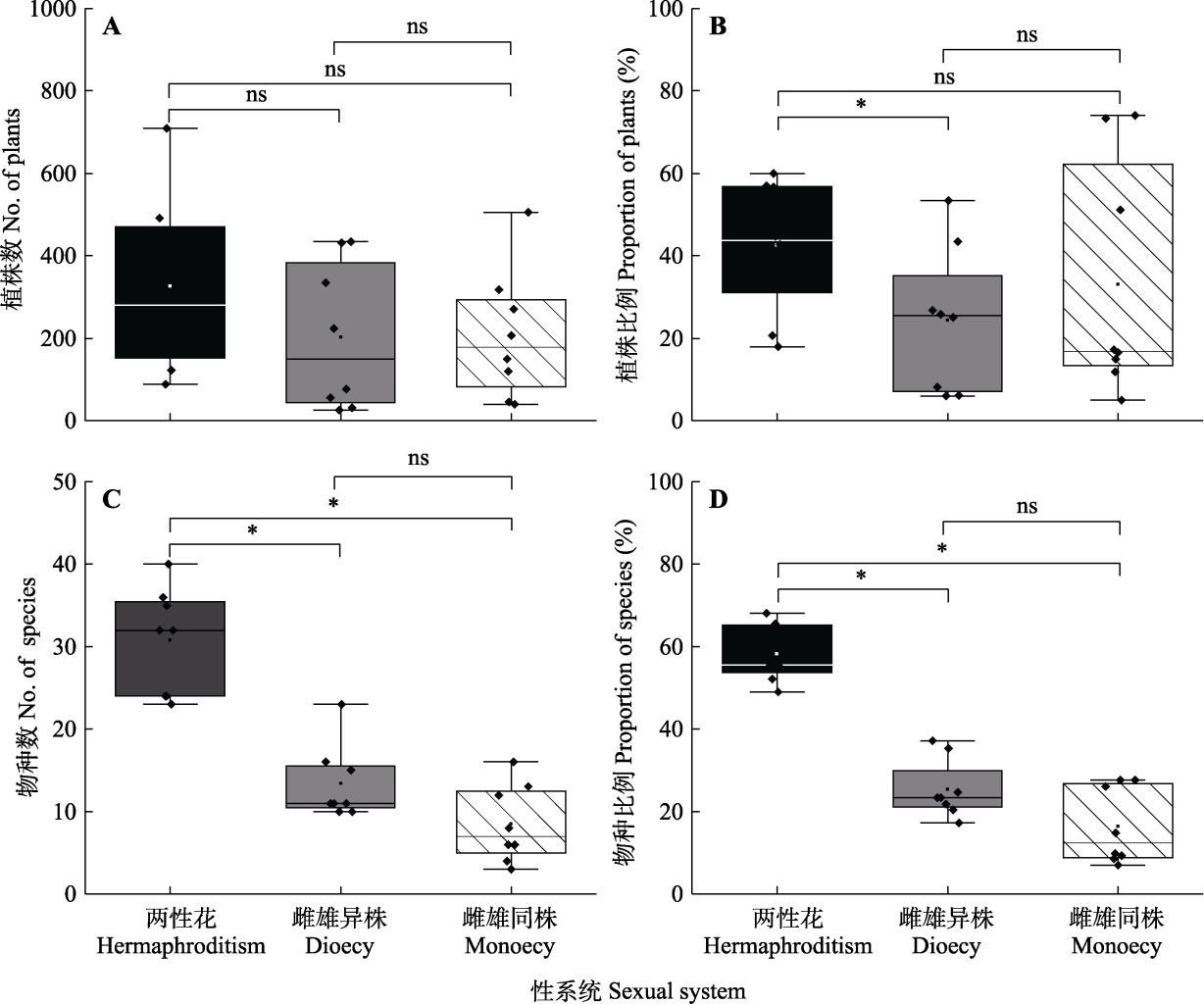
Fig. 1 Quantitative characteristics analysis of woody plant sexual systems on the south slope of Daiyun Mountain. ns, p ≥ 0.05; *, p < 0.05.
| 森林群落 Plant community | 物种数 No. of species | 不同性系统物种比例 Proportion of different sexual systems of total number of species (%) | ||
|---|---|---|---|---|
| 两性花 Hermaphroditism | 雌雄异株 Dioecy | 雌雄同株 Monoecy | ||
| 委内瑞拉巴尔加斯州热带森林 Tropical forest of Vargas State, Venezuela (Ramírez, | 144 | 72.9 | 4.2 | 22.9 |
| 澳大利亚热带雨林 Tropical rainforest of Australia (Gross, | 1 100 | 60.5 | 17.0 | 22.5 |
| 中国云南西双版纳热带雨林 Tropical rainforest of Xishuangbanna, Yunnan, China (Chen & Li, | 685 | 60.6 | 25.1 | 14.3 |
| 中国海南尖峰岭热带雨林 Tropical rainforest in Jianfengling, Hainan, China (Wang et al., | 290 | 60.0 | 21.5 | 17.7 |
| 中国云南哀牢山亚热带森林 Subtropical Forest of Ailao Mountains, Yunnan, China (Chen & Li, | 703 | 60.2 | 24.0 | 15.8 |
| 中国河南白云山温带森林 Temperate Forest of Baiyun Mountain, Henan, China (Zhang et al., | 93 | 58.1 | 20.4 | 21.5 |
| 中国吉林长白山温度森林 Temperate Forest of Changbai Mountain, Jilin, China (Wang et al., | 206 | 51.9 | 18.5 | 29.6 |
| 中国福建戴云山亚热带森林 Subtropical Forest of Daiyun Mountain, Fujian, China | 85 | 55.3 | 34.1 | 10.6 |
Table 2 Comparison of plant sexual systems in different forest communities in China and abroad
| 森林群落 Plant community | 物种数 No. of species | 不同性系统物种比例 Proportion of different sexual systems of total number of species (%) | ||
|---|---|---|---|---|
| 两性花 Hermaphroditism | 雌雄异株 Dioecy | 雌雄同株 Monoecy | ||
| 委内瑞拉巴尔加斯州热带森林 Tropical forest of Vargas State, Venezuela (Ramírez, | 144 | 72.9 | 4.2 | 22.9 |
| 澳大利亚热带雨林 Tropical rainforest of Australia (Gross, | 1 100 | 60.5 | 17.0 | 22.5 |
| 中国云南西双版纳热带雨林 Tropical rainforest of Xishuangbanna, Yunnan, China (Chen & Li, | 685 | 60.6 | 25.1 | 14.3 |
| 中国海南尖峰岭热带雨林 Tropical rainforest in Jianfengling, Hainan, China (Wang et al., | 290 | 60.0 | 21.5 | 17.7 |
| 中国云南哀牢山亚热带森林 Subtropical Forest of Ailao Mountains, Yunnan, China (Chen & Li, | 703 | 60.2 | 24.0 | 15.8 |
| 中国河南白云山温带森林 Temperate Forest of Baiyun Mountain, Henan, China (Zhang et al., | 93 | 58.1 | 20.4 | 21.5 |
| 中国吉林长白山温度森林 Temperate Forest of Changbai Mountain, Jilin, China (Wang et al., | 206 | 51.9 | 18.5 | 29.6 |
| 中国福建戴云山亚热带森林 Subtropical Forest of Daiyun Mountain, Fujian, China | 85 | 55.3 | 34.1 | 10.6 |
| 性系统 Sexual system | 物种 Species | 相对多度 Relative abundance | 相对显著度 Relative prominence | 相对频度 Relative frequency | 重要值 Importance value | 海拔 Elevation (m) |
|---|---|---|---|---|---|---|
| 两性花 Hermaphroditism | 丁香杜鹃 Rhododendron farrerae | 0.12 | 0.02 | 0.04 | 5.94 | 900-1 000, 1 200-1 600 |
| 杜鹃 Rhododendron simsii | 0.09 | 0.01 | 0.03 | 4.61 | 1 000, 1 300-1 600 | |
| 大萼杨桐 Adinandra glischroloma var. macrosepala | 0.05 | 0.03 | 0.04 | 3.86 | 1 000-1 600 | |
| 红楠 Machilus thunbergii | 0.01 | 0.07 | 0.03 | 3.44 | 1 100-1 600 | |
| 杨桐 Adinandra millettii | 0.04 | 0.01 | 0.04 | 2.95 | 900-1 600 | |
| 雌雄异株 Dioecy | 窄基红褐柃 Eurya rubiginosa var. attenuata | 0.14 | 0.03 | 0.03 | 6.62 | 1 200-1 600 |
| 岩柃 Eurya saxicola | 0.05 | 0.01 | 0.03 | 2.82 | 1 300-1 600 | |
| 雌雄同株 Monoecy | 黄山松 Pinus hwangshanensi | 0.09 | 0.36 | 0.03 | 15.74 | 1 300-1 600 |
| 杉木 Cunninghamia lanceolata | 0.06 | 0.22 | 0.03 | 10.39 | 900-1 200 | |
| 青冈 Quercus glauca | 0.11 | 0.07 | 0.04 | 7.08 | 900-1 400 | |
| 马尾松 Pinus massoniana | 0.01 | 0.06 | 0.02 | 2.94 | 900-1 100, 1 500 |
Table 3 Species of woody plants with importance values ≥ 2.0 on the south slope of Daiyun Mountain
| 性系统 Sexual system | 物种 Species | 相对多度 Relative abundance | 相对显著度 Relative prominence | 相对频度 Relative frequency | 重要值 Importance value | 海拔 Elevation (m) |
|---|---|---|---|---|---|---|
| 两性花 Hermaphroditism | 丁香杜鹃 Rhododendron farrerae | 0.12 | 0.02 | 0.04 | 5.94 | 900-1 000, 1 200-1 600 |
| 杜鹃 Rhododendron simsii | 0.09 | 0.01 | 0.03 | 4.61 | 1 000, 1 300-1 600 | |
| 大萼杨桐 Adinandra glischroloma var. macrosepala | 0.05 | 0.03 | 0.04 | 3.86 | 1 000-1 600 | |
| 红楠 Machilus thunbergii | 0.01 | 0.07 | 0.03 | 3.44 | 1 100-1 600 | |
| 杨桐 Adinandra millettii | 0.04 | 0.01 | 0.04 | 2.95 | 900-1 600 | |
| 雌雄异株 Dioecy | 窄基红褐柃 Eurya rubiginosa var. attenuata | 0.14 | 0.03 | 0.03 | 6.62 | 1 200-1 600 |
| 岩柃 Eurya saxicola | 0.05 | 0.01 | 0.03 | 2.82 | 1 300-1 600 | |
| 雌雄同株 Monoecy | 黄山松 Pinus hwangshanensi | 0.09 | 0.36 | 0.03 | 15.74 | 1 300-1 600 |
| 杉木 Cunninghamia lanceolata | 0.06 | 0.22 | 0.03 | 10.39 | 900-1 200 | |
| 青冈 Quercus glauca | 0.11 | 0.07 | 0.04 | 7.08 | 900-1 400 | |
| 马尾松 Pinus massoniana | 0.01 | 0.06 | 0.02 | 2.94 | 900-1 100, 1 500 |
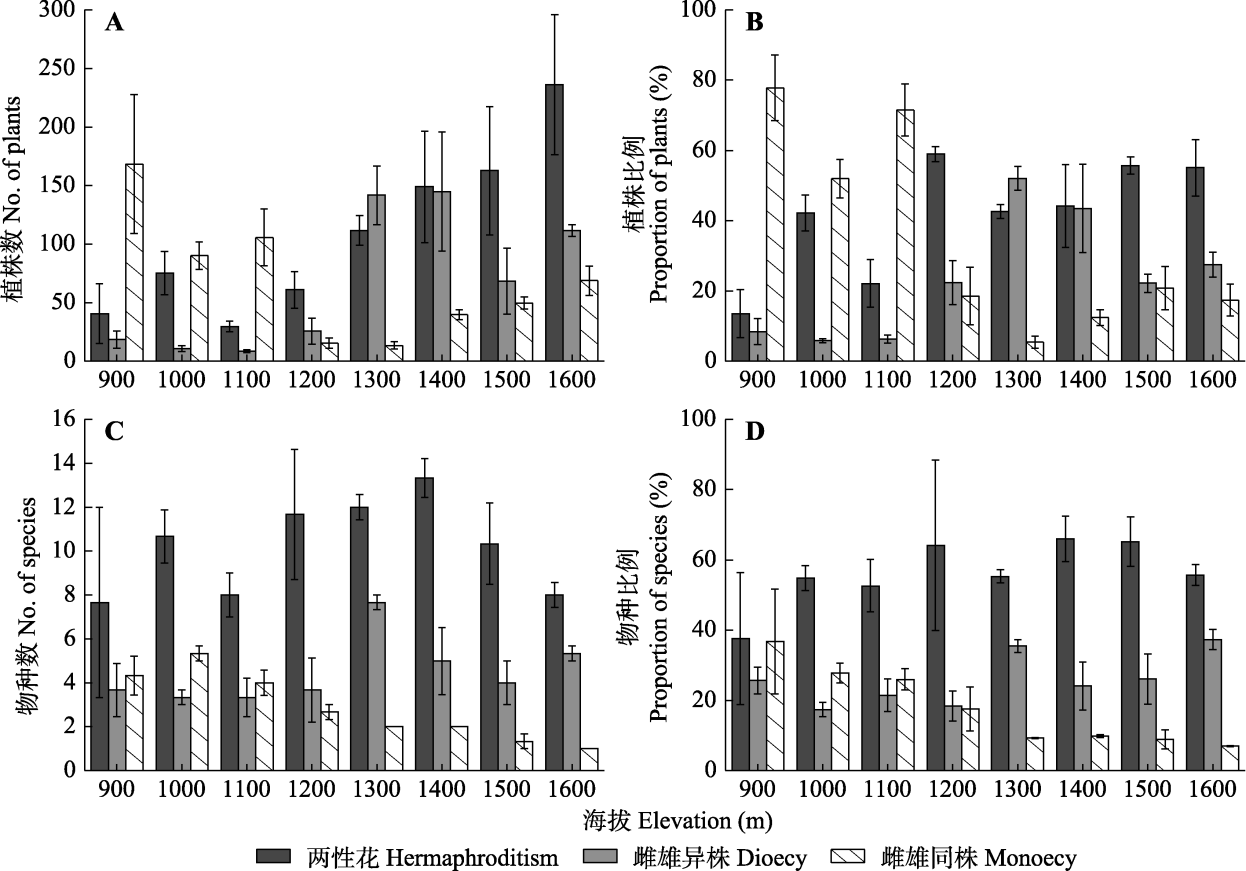
Fig. 2 Number and proportion of individual and species of woody plant sexual systems along the elevational gradient on the south slope of Daiyun Mountain (mean ± SD).
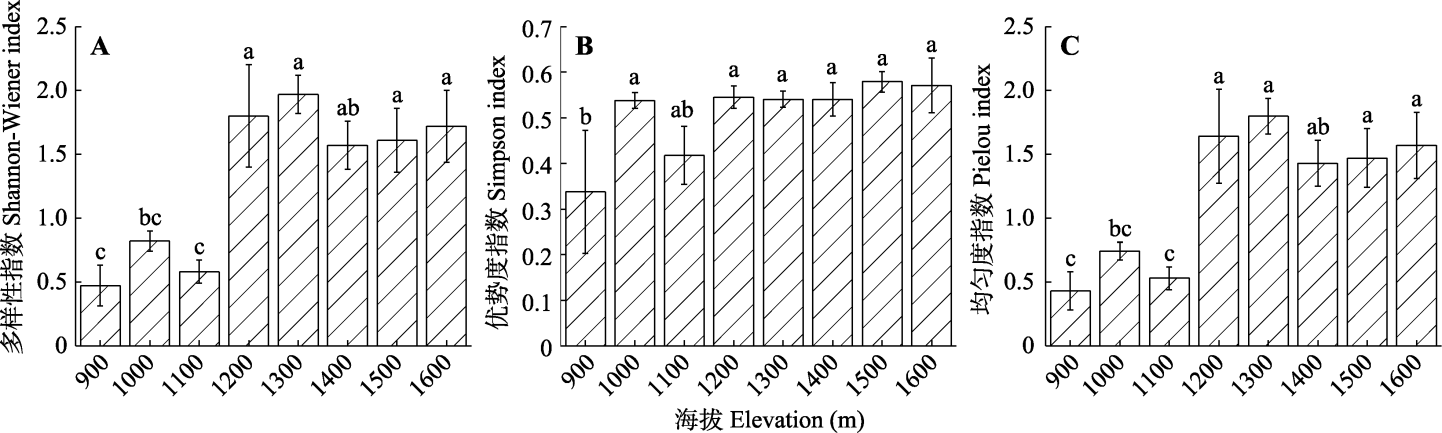
Fig. 3 Elevational variation of woody plant species diversity indices on the south slope of Daiyun Mountain (mean ± SD). Different lowercase letters indicate significant differences among different elevations (p < 0.05).
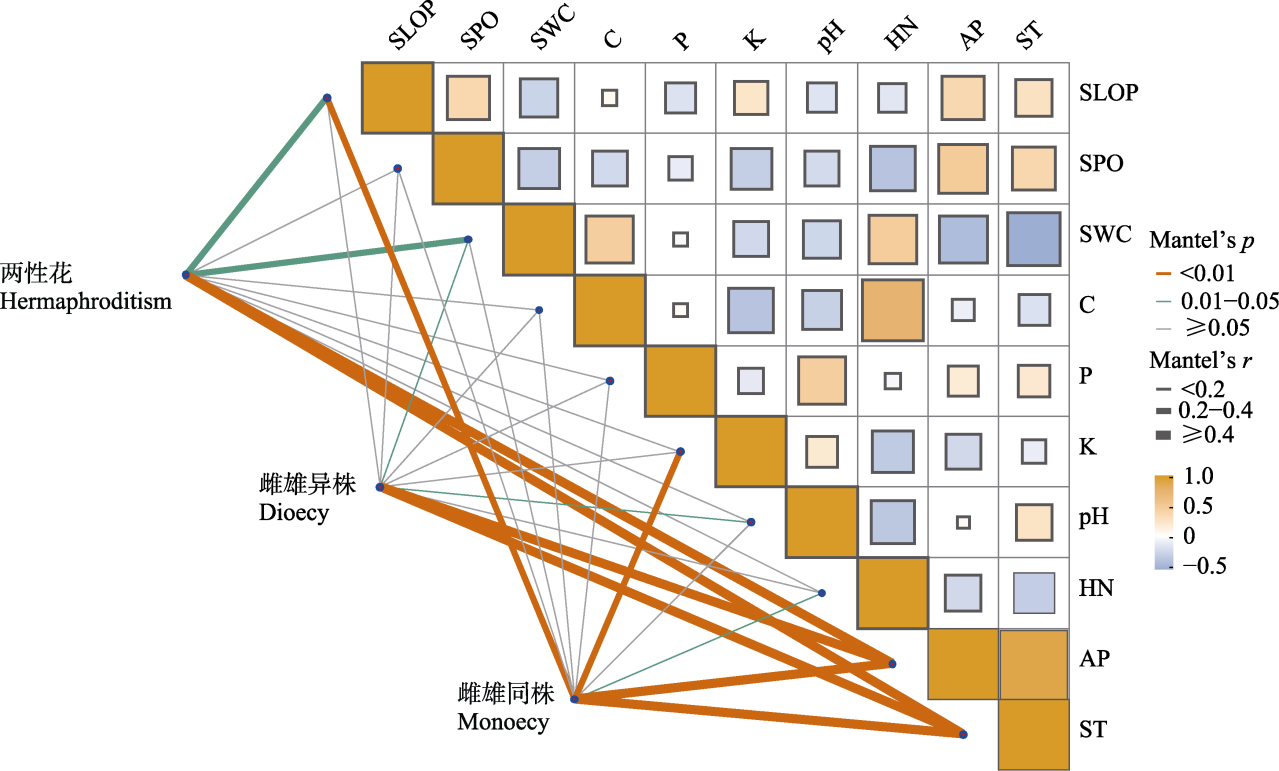
Fig. 4 Mantel correlation between plant sexual systems abundance and environmental factors. AP, available phosphorus content; C, soil total carbon content; HN, hydrolyzed nitrogen content; K, soil total potassium content; P, soil total phosphorus; SLOP, slope; SPO, slope location; ST, soil temperature; SWC, soil water content. The thickness of the lines represents the statistical magnitude of r. The orange, green, and gray lines represent p < 0.01, p < 0.05, and p ≥ 0.05, respectively.
| [1] |
Bawa KS (1980). Evolution of dioecy in flowering plants. Annual Review of Ecology and Systematics, 11, 15-39.
DOI URL |
| [2] |
Case AL, Barrett SCH (2004). Environmental stress and the evolution of dioecy: Wurmbea dioica (Colchicaceae) in Western Australia. Evolutionary Ecology, 18, 145-164.
DOI URL |
| [3] |
Chazdon RL, Careaga S, Webb C, Vargas O (2003). Community and phylogenetic structure of reproductive traits of woody species in wet tropical forests. Ecological Monographs, 73, 331-348.
DOI URL |
| [4] |
Chen XS, Li QJ (2008a). Sexual systems and ecological correlates in an azonal tropical forests, SW China. Biotropica, 40, 160-167.
DOI URL |
| [5] |
Chen XS, Li QJ (2008b). Patterns of plant sexual systems in subtropical evergreen broad-leaved forests in Ailao Mountains, SW China. Journal of Plant Ecology, 1, 179-185.
DOI URL |
| [6] |
Etterson JR, Mazer SJ (2016). How climate change affects plants’ sex lives. Science, 353, 32-33.
DOI PMID |
| [7] | Geber MA, Dawson TE, Delph LF (1999). Gender and Sexual Dimorphism in Flowering Plants. Springer, Heidelberg. |
| [8] |
Gross CL (2005). A comparison of the sexual systems in the trees from the Australian tropics with other tropical biomes—More monoecy but why? American Journal of Botany, 92, 907-919.
DOI PMID |
| [9] | He H, Tan DY, Yang XC (2024). Cryptic dioecy in angiosperms: Diversity, phylogeny and evolutionary significance. Biodiversity Science, 32, 24149. DOI: 10.17520/biods.2024149. |
| [何花, 谭敦炎, 杨晓琛 (2024). 被子植物隐性雌雄异株性系统的多样性、系统演化及进化意义. 生物多样性, 32, 24149. DOI: 10.17520/biods.2024149.] | |
| [10] | He ZS, Chen JJ, Zhu J, Wang ZW, Gu XG, Jiang L, Chen B, Xu DW, Wu ZY, Liu JF (2022a). Characteristics of microbial functional diversity and its influencing factors of forest soils at different elevations on the southern slope of Daiyun Mountain. Acta Ecologica Sinica, 42, 3504-3515. |
| [何中声, 陈佳嘉, 朱静, 王紫薇, 谷新光, 江蓝, 陈博, 徐道炜, 吴则焰, 刘金福 (2022a). 戴云山南坡不同海拔森林土壤微生物功能多样性特征及影响因素. 生态学报, 42, 3504-3515.] | |
| [11] | He ZS, Gu XG, Jiang L, Xu DW, Liu JF, Li WZ, Chen WW (2022b). Characteristics and its influencing factors of forest soil dominant bacterial community in different elevations on the southern slope of Daiyun Mountain. Journal of Beijing Forestry University, 44(7), 107-116. |
| [何中声, 谷新光, 江蓝, 徐道炜, 刘金福, 李文周, 陈文伟 (2022b). 戴云山南坡不同海拔森林土壤优势细菌群落特征及影响因素. 北京林业大学学报, 44(7), 107-116.] | |
| [12] |
Huang SQ (2018). A better understanding of ecological networks needs studying plant-pollinator interactions. Biodiversity Science, 26, 429-432.
DOI URL |
|
[黄双全 (2018). 了解生态网络需要监测植物与传粉者的相互作用. 生物多样性, 26, 429-432.]
DOI |
|
| [13] |
Hultine KR, Grady KC, Wood TE, Shuster SM, Stella JC, Whitham TG (2016). Climate change perils for dioecious plant species. Nature Plants, 2, 16109. DOI: 10.1038/nplants.2016.109.
PMID |
| [14] | Jiang L, He ZS, Liu JF, Xing C, Gu XG, Wei CS, Zhu J, Wang XL (2019). Elevation gradient altered soil C, N, and P stoichiometry of Pinus taiwanensis forest on Daiyun Mountain. Forests, 10, 1089. DOI: 10.3390/f10121089. |
| [15] | Jiang L, Zhang X, Zhu J, Wei X, Chen B, Liu JF, Zheng SQ, He ZS (2023). Environmental heterogeneity determines beta diversity and species turnover for woody plants along an elevation gradient in subtropical forests of China. Forestry Research, 3, 26. DOI: 10.48130/FR-2023-0026. |
| [16] | Li MJ, He ZS, Jiang L, Gu XG, Jin MR, Chen B, Liu JF (2021). Distribution pattern and driving factors of species diversity and phylogenetic diversity along altitudinal gradient on the south slope of Daiyun Mountain. Acta Ecologica Sinica, 41, 1148-1157. |
| [李梦佳, 何中声, 江蓝, 谷新光, 晋梦然, 陈博, 刘金福 (2021). 戴云山物种多样性与系统发育多样性海拔梯度分布格局及驱动因子. 生态学报, 41, 1148-1157.] | |
| [17] | Li TH, Jiang J, Chen JM, Fan SB (2004). The sexual polymorphism of seed plant. Journal of Northeast Forestry University, 32(5), 48-52. |
| [李同华, 姜静, 陈建名, 范士波 (2004). 种子植物性别的多态性. 东北林业大学学报, 32(5), 48-52.] | |
| [18] |
Lin HY, Tseng YH, Hsieh CF, Hu JM (2020). Geographical distribution of dioecy and its ecological correlates based on fine-scaled species distribution data from a subtropical island. Ecological Research, 35, 170-181.
DOI URL |
| [19] | Long R (2011). Study on Community Structure of Deciduous Broad-Leaf Forests and Their Plant Sexual System Diversity in Dalaoling, Hubei Province. PhD dissertation, Beijing Forestry University, Beijing. |
| [龙茹 (2011). 湖北大老岭落叶阔叶林群落结构和植物性系统多样性研究. 博士学位论文, 北京林业大学, 北京.] | |
| [20] |
Ma KP (1994). Measurement method of biological community diversity I. Measurement method of α diversity (I). Biodiversity Science, 2, 231-239.
DOI URL |
| [马克平 (1994). 生物群落多样性的测度方法. I. α多样性的测度方法(上). 生物多样性, 2, 231-239.] | |
| [21] |
MAMUT J, Tan DY (2014). Gynomonoecy in angiosperms: phylogeny, sex expression and evolutionary significance. Chinese Journal of Plant Ecology, 38, 76-90.
DOI |
| [吉乃提汗•马木提, 谭敦炎 (2014). 被子植物雌全同株性系统: 系统演化、性表达与进化意义. 植物生态学报, 38, 76-90.] | |
| [22] |
Ramírez N (2022). Sexual and breeding systems in a xerophytic shrubland. Open Journal of Ecology, 12, 434-482.
DOI URL |
| [23] |
Renner SS (2014). The relative and absolute frequencies of angiosperm sexual systems: dioecy, monoecy, gynodioecy, and an updated online database. American Journal of Botany, 101, 1588-1596.
DOI PMID |
| [24] |
Shi YH, Ren ZX, Zhao YH, Wang H (2021). Effect of climate change on the distribution and phenology of plants, insect pollinators, and their interactions. Biodiversity Science, 29, 495-506.
DOI |
|
[施雨含, 任宗昕, 赵延会, 王红 (2021). 气候变化对植物-传粉昆虫的分布区和物候及其互作关系的影响. 生物多样性, 29, 495-506.]
DOI |
|
| [25] |
Silva DM, Luna ALL, Souza CS, Nunes YRF, Fonseca RS, de Azevedo IFP (2022). Sexual and reproductive systems of woody species in vereda are distributed according to the life form and habitat occurrence. Austral Ecology, 47, 1528-1543.
DOI URL |
| [26] | State Forestry Administration (1999). Forest Soil Analysis Method. China Standards Press, Beijing. |
| [国家林业局 (1999). 森林土壤分析方法. 中国标准出版社, 北京.] | |
| [27] | Tree of Sex Consortium (2014). Tree of Sex: a database of sexual systems. Scientific Data, 1, 140015. DOI: 10.1038/sdata.2014.15. |
| [28] |
Varga S, Soulsbury CD (2020). Environmental stressors affect sex ratios in sexually dimorphic plant sexual systems. Plant Biology, 22, 890-898.
DOI URL |
| [29] | Wang J (2021). A Study on Survival Pressure and Competitiveness of Pinus Sect. Cembra in China. PhD dissertation, Beijing Forestry University, Beijing. |
| [王俊 (2021). 中国五针松组植物生存压力和竞争力研究. 博士学位论文, 北京林业大学, 北京.] | |
| [30] | Wang X, Wang GR, Xia FC, Ni CC, Sun Y, Liu BD, Gao W, Zhou HC (2017). Sexual system and ecological links of woody plants in Changbai Mountains, northeastern China. Journal of Beijing Forestry University, 39(5), 58-64. |
| [王熊, 王戈戎, 夏富才, 倪成才, 孙越, 刘宝东, 高伟, 周海城 (2017). 长白山木本植物性别系统及其生态关联性. 北京林业大学学报, 39(5), 58-64.] | |
| [31] |
Wang YC, Lin JY, Xu H, Lin MX, Li YD (2019). Numerical characteristics of plant sexual system of the woody plants in the 60 ha plot in the tropical rain forest in Jianfengling, Hainan Island. Biodiversity Science, 27, 297-305.
DOI |
|
[王颖灿, 林家怡, 许涵, 林明献, 李意德 (2019). 海南尖峰岭热带山地雨林60 ha大样地木本植物性别系统数量特征. 生物多样性, 27, 297-305.]
DOI |
|
| [32] | Wang YY, Hao ZQ (2022). Angiosperm sexual systems—Concepts, evolution, ecology, and future directions. Biodiversity Science, 30, 243-254. |
| [王芸芸, 郝占庆 (2022). 被子植物性系统的多样性、生态功能及分布规律. 生物多样性, 30, 243-254.] | |
| [33] |
Wang YY, Luo A, Lyu T, Dimitrov D, Xu XT, Freckleton RP, Li YQ, Su XY, Li YC, Liu YP, Sandanov D, Li QJ, Hao ZQ, Liu SG, Wang ZH (2021). Global distribution and evolutionary transitions of angiosperm sexual systems. Ecology Letters, 24, 1835-1847.
DOI URL |
| [34] |
Wang YY, Lyu T, Shrestha N, Lyu LS, Li YQ, Schmid B, Freckleton RP, Dimitrov D, Liu SG, Hao ZQ, Wang ZH (2020). Drivers of large-scale geographical variation in sexual systems of woody plants. Global Ecology and Biogeography, 29, 546-557.
DOI URL |
| [35] | Wu MX, An MT, Tian L, Liu F (2022). Effects of environmental factors on quantitative characteristics of woody plant sexual system in Maolan karst forest. Biodiversity Science, 30, 119-128. |
| [吴墨栩, 安明态, 田力, 刘锋 (2022). 茂兰喀斯特森林木本植物性系统数量特征及其与环境因子的关系. 生物多样性, 30, 119-128.] | |
| [36] | Wu XG, Wang WP, Li B, Liang YL, Liu YZ (2020). Altitudinal gradient of soil organic carbon in forest soils in the mid-subtropical zone of China. Acta Pedologica Sinica, 57, 1539-1547. |
| [吴小刚, 王文平, 李斌, 梁跃龙, 刘以珍 (2020). 中亚热带森林土壤有机碳的海拔梯度变化. 土壤学报, 57, 1539-1547.] | |
| [37] |
Xia ZC, He Y, Yu L, Lv RB, Korpelainen H, Li CY (2020). Sex-specific strategies of phosphorus (P) acquisition in Populus cathayana as affected by soil P availability and distribution. New Phytologist, 225, 782-792.
DOI URL |
| [38] | Xu X, Yang F, Yin CY, Li CY (2007). Research advances in sex-specific responses of dioecious plants to environmental stresses. Chinese Journal of Applied Ecology, 18, 2626-2631. |
| [胥晓, 杨帆, 尹春英, 李春阳 (2007). 雌雄异株植物对环境胁迫响的性别差异研究进展. 应用生态学报, 18, 2626-2631.] | |
| [39] | Xue XX, Wu XP, Wang WB, Luo XH, Wang DP, Zhang YF, Zou BX (2019). Progress of potassium, magnesium and their interaction in plant-soil system. Soils, 51, 1-10. |
| [薛欣欣, 吴小平, 王文斌, 罗雪华, 王大鹏, 张永发, 邹碧霞 (2019). 植物-土壤系统中钾镁营养及其交互作用研究进展. 土壤, 51, 1-10.] | |
| [40] | Zhang DY (2003). Plant Life-History Evolution and Reproductive Ecology. Science Press, Beijing. |
| [张大勇 (2003). 植物生活史进化与繁殖生态学. 科学出版社, 北京.] | |
| [41] | Zhang XY, Zhou ZY, Li ZH, Zhao H, Shao YZ, Wang J, Chen Y, Yuan ZL, Ye YZ (2021). Quantitative characteristics and ecological correlations of sexual system in a deciduous broadleaf forest of the Baiyun Mountains of Henan Province, China. Plant Science Journal, 39, 488-495. |
| [张秀艳, 周紫羽, 李子豪, 赵河, 邵毅贞, 王晶, 陈云, 袁志良, 叶永忠 (2021). 河南白云山落叶阔叶林群落性系统的数量特征及生态关联性. 植物科学学报, 39, 488-495.] | |
| [42] |
Zou LX, He ZS, Jiang L, Liu JF, Zheng SQ, Li WZ (2017). Pollination mode of spermatophyte in Daiyun Mountain nature reserve. Chinese Agricultural Science Bulletin, 33, 38-42.
DOI |
|
[邹霖湘, 何中声, 江蓝, 刘金福, 郑世群, 李文周 (2017). 戴云山自然保护区种子植物传粉模式研究. 中国农学通报, 33, 38-42.]
DOI |
| [1] | guangjin wu, 郭 垚鑫, Ren Chengjie, Wang Jun, YUE Ming, Zhao Fazhu. Distribution of soil organic carbon content and its influencing factors in different vegetation type on the northern foot of the Qinling Mountains [J]. Chin J Plant Ecol, 2026, 50(预发表): 1-. |
| [2] | TIAN Di, CHI Xiao-Long, SHI Liang, LIU Xiao-Han, ZHAO Chang-Ti, WU Mei, ZHANG Yu-Zhong, GAO Yong-Liang. Stoichiometric characteristics of dominant afforestation tree species and their environmental drivers in Saihanba region [J]. Chin J Plant Ecol, 2026, 50(2): 362-373. |
| [3] | CHEN Kai, YANG Yan, XU Ling, JIANG Zhong-Hua. Variations in seed morphology and germination of Primula denticulata along an elevational gradient in the mountains of southwestern Yunnan, China [J]. Chin J Plant Ecol, 2025, 49(7): 1119-1127. |
| [4] | HUANG Mei-Hong, NIU Meng-Qiu, YANG Peng-Fei, LIN Jie, LIAO Zhou-Yu, CHEN Jian-Guo, XIANG Jian-Ying. Effects of temperature and burial depth on seedling emergence and growth of the alpine cushion plant Arenaria oreophila [J]. Chin J Plant Ecol, 2025, 49(12): 2092-2104. |
| [5] | ZHU Wan-Kuan, XU Yu-Xing, HUANG Run-Xia, DU A-Peng, WANG Zhi-Chao. Differences in water use efficiency between dry and rainy seasons and their controlling factors in Eucalyptus plantation in Leizhou Peninsula [J]. Chin J Plant Ecol, 2025, 49(12): 2015-2029. |
| [6] | FU Zhao-Qi, HU Xu, TIAN Qin-Rui, GE Yan-Ling, ZHOU Hong-Juan, WU Xiao-Yun, CHEN Li-Xin. Nocturnal sap flow characteristics of two typical forest tree species and responses to environmental factors in the loess region of West Shanxi, China [J]. Chin J Plant Ecol, 2024, 48(9): 1128-1142. |
| [7] | PAN Yuan-Fang, PAN Liang-Hao, QIU Si-Ting, QIU Guang-Long, SU Zhi-Nan, SHI Xiao-Fang, FAN Hang-Qing. Variations in tree height among mangroves and their environmental adaptive mechanisms in China’s coastal areas [J]. Chin J Plant Ecol, 2024, 48(4): 483-495. |
| [8] | WANG Li-Li, SONG Xiao-Tong, GU Ji-Qi, SHAO Xiao-Ming. Relationship between morphological characteristics of Didymodon constrictus and environmental changes in Xizang and its response strategies [J]. Chin J Plant Ecol, 2024, 48(10): 1351-1360. |
| [9] | ZHAO Meng-Juan, JIN Guang-Ze, LIU Zhi-Li. Vertical variations in leaf functional traits of three typical ferns in mixed broadleaved- Korean pine forest [J]. Chin J Plant Ecol, 2023, 47(8): 1131-1143. |
| [10] | LI An-Yan, HUANG Xian-Fei, TIAN Yuan-Bin, DONG Ji-Xing, ZHENG Fei-Fei, XIA Pin-Hua. Chlorophyll a variation and its driving factors during phase shift from macrophyte- to phytoplankton-dominated states in Caohai Lake, Guizhou, China [J]. Chin J Plant Ecol, 2023, 47(8): 1171-1181. |
| [11] | YANG Li-Lin, XING Wan-Qiu, WANG Wei-Guang, CAO Ming-Zhu. Variation of sap flow rate of Cunninghamia lanceolata and its response to environmental factors in the source area of Xinʼanjiang River [J]. Chin J Plant Ecol, 2023, 47(4): 571-583. |
| [12] | ZHAO Zhen-Xian, CHEN Yin-Ping, WANG Li-Long, WANG Tong-Tong, LI Yu-Qiang. Comparison on leaf construction cost of different plant groups in the desert area of the Hexi Corridor [J]. Chin J Plant Ecol, 2023, 47(11): 1551-1560. |
| [13] | ZHANG Xiao, WU Juan-Juan, JIA Guo-Dong, LEI Zi-Ran, ZHANG Long-Qi, LIU Rui, LÜ Xiang-Rong, DAI Yuan-Meng. Effects of precipitation variations on characteristics of sap flow and water source of Platycladus orientalis [J]. Chin J Plant Ecol, 2023, 47(11): 1585-1599. |
| [14] | ZOU Jin-Lian, ZHANG Zhi-Qiang. Application and progress of sexual selection and sexual conflict theory in plant reproductive evolutionary ecology [J]. Chin J Plant Ecol, 2022, 46(9): 984-994. |
| [15] | ZHENG Ning, LI Su-Ying, WANG Xin-Ting, LÜ Shi-Hai, ZHAO Peng-Cheng, ZANG Chen, XU Yu-Long, HE Jing, QIN Wen-Hao, GAO Heng-Rui. Dominance of different plant life forms in the typical steppe evidenced from impacts of environmental factors on chlorophyll [J]. Chin J Plant Ecol, 2022, 46(8): 951-960. |
| Viewed | ||||||
|
Full text |
|
|||||
|
Abstract |
|
|||||
Copyright © 2026 Chinese Journal of Plant Ecology
Tel: 010-62836134, 62836138, E-mail: apes@ibcas.ac.cn, cjpe@ibcas.ac.cn

