
Chin J Plant Ecol ›› 2026, Vol. 50 ›› Issue (1): 123-133.DOI: 10.17521/cjpe.2025.0024 cstr: 32100.14.cjpe.2025.0024
• Research Articles • Previous Articles Next Articles
LIU Zi-Chen1, CHEN Wen-Na2, HUANG Jiu-Xiang1, LI Yu-Ling1, YAO Gang1,*( )
)
Received:2025-01-14
Accepted:2025-05-28
Online:2026-01-20
Published:2026-02-13
Contact:
YAO Gang
Supported by:LIU Zi-Chen, CHEN Wen-Na, HUANG Jiu-Xiang, LI Yu-Ling, YAO Gang. Potential impact of the establishment of drought climate during the mid-late Miocene on promoting species diversification of Didiereaceae[J]. Chin J Plant Ecol, 2026, 50(1): 123-133.
Add to citation manager EndNote|Ris|BibTeX
URL: https://www.plant-ecology.com/EN/10.17521/cjpe.2025.0024
| 类群 Taxon | trnL-trnF | trnT-trnL | trnG-trnS | trnQ-rps16 | rps16 | rpl16 |
|---|---|---|---|---|---|---|
| 直立亚龙木 Alluaudia ascendens | KM261932 | KM262007 | KM261984 | KM261959 | KM261907 | KM261883 |
| 多叶亚龙木1 Alluaudia comosa 1 | KM261934 | KM262008 | KM261986 | KM261961 | KM261909 | KM261885 |
| 多叶亚龙木2 Alluaudia comosa 2 | KM261933 | - | KM261985 | KM261960 | KM261908 | KM261884 |
| 丛生亚龙木 Alluaudia dumosa | KM261935 | KM262009 | KM261987 | KM261962 | KM261910 | KM261886 |
| 木竹桃 Alluaudia humbertii | KM261936 | - | KM261988 | KM261963 | KM261911 | KM261887 |
| 苍岩亚龙木 Alluaudia montagnacii | KM261937 | KM262010 | KM261989 | KM261964 | KM261912 | KM261888 |
| 亚龙木 Alluaudia procera | KM261938 | KM262011 | KM261990 | KM261965 | KM261913 | KM261889 |
| 枝龙木 Alluaudiopsis fiherenensis | KM261939 | KM262012 | KM261991 | KM261966 | KM261914 | KM261890 |
| 双刺枝龙木 Alluaudiopsis marnieriana | KM261940 | KM262013 | KM261992 | KM261967 | KM261915 | KM261891 |
| 缨苋树 Calyptrotheca somalensis | AF094845 | AF095914 | - | - | - | AF101139 |
| 曲龙木 Decarya madagascariensis | KM261941 | - | KM261993 | KM261968 | KM261916 | KM261892 |
| 刺戟木1 Didierea madagascariensis 1 | KM261943 | KM262015 | KM261995 | KM261970 | KM261918 | KM261894 |
| 刺戟木2 Didierea madagascariensis 2 | KM261942 | KM262014 | KM261994 | KM261969 | KM261917 | KM261893 |
| 平枝刺戟木 Didierea trollii | KM261944 | KM262016 | KM261996 | KM261971 | KM261919 | KM261895 |
| 马齿苋树 Portulacaria afra | KM261950 | KM262022 | KM262002 | KM261977 | KM261925 | KM261901 |
| 高序苋树 Portulacaria armiana | KM261951 | KM262023 | KM262003 | KM261978 | KM261926 | KM261902 |
| 大叶蜡苋树 Portulacaria carrissoana | KM261945 | KM262017 | KM261997 | KM261972 | KM261920 | KM261896 |
| 灌状蜡苋树 Portulacaria fruticulosa | KM261946 | KM262018 | KM261998 | KM261973 | KM261921 | KM261897 |
| 狭叶蜡苋树 Portulacaria longipedunculata | KM261947 | KM262019 | KM261999 | KM261974 | KM261922 | KM261898 |
| 蜡苋树 Portulacaria namaquensis | KM261948 | KM262020 | KM262000 | KM261975 | KM261923 | KM261899 |
| 矮蜡苋树 Portulacaria pygmaea | KM261949 | KM262021 | KM262001 | KM261976 | KM261924 | KM261900 |
| 落葵薯 Anredera cordifolia | NC_041274 | NC_041274 | NC_041274 | NC_041274 | NC_041274 | NC_041274 |
| 落葵 Basella alba | NC_041293 | NC_041293 | NC_041293 | NC_041293 | NC_041293 | NC_041293 |
| 南荒蓬 Halophytum ameghinoi | NC_040949 | NC_040949 | NC_040949 | NC_040949 | NC_040949 | NC_040949 |
Table 1 Information on taxa name and DNA sequences used
| 类群 Taxon | trnL-trnF | trnT-trnL | trnG-trnS | trnQ-rps16 | rps16 | rpl16 |
|---|---|---|---|---|---|---|
| 直立亚龙木 Alluaudia ascendens | KM261932 | KM262007 | KM261984 | KM261959 | KM261907 | KM261883 |
| 多叶亚龙木1 Alluaudia comosa 1 | KM261934 | KM262008 | KM261986 | KM261961 | KM261909 | KM261885 |
| 多叶亚龙木2 Alluaudia comosa 2 | KM261933 | - | KM261985 | KM261960 | KM261908 | KM261884 |
| 丛生亚龙木 Alluaudia dumosa | KM261935 | KM262009 | KM261987 | KM261962 | KM261910 | KM261886 |
| 木竹桃 Alluaudia humbertii | KM261936 | - | KM261988 | KM261963 | KM261911 | KM261887 |
| 苍岩亚龙木 Alluaudia montagnacii | KM261937 | KM262010 | KM261989 | KM261964 | KM261912 | KM261888 |
| 亚龙木 Alluaudia procera | KM261938 | KM262011 | KM261990 | KM261965 | KM261913 | KM261889 |
| 枝龙木 Alluaudiopsis fiherenensis | KM261939 | KM262012 | KM261991 | KM261966 | KM261914 | KM261890 |
| 双刺枝龙木 Alluaudiopsis marnieriana | KM261940 | KM262013 | KM261992 | KM261967 | KM261915 | KM261891 |
| 缨苋树 Calyptrotheca somalensis | AF094845 | AF095914 | - | - | - | AF101139 |
| 曲龙木 Decarya madagascariensis | KM261941 | - | KM261993 | KM261968 | KM261916 | KM261892 |
| 刺戟木1 Didierea madagascariensis 1 | KM261943 | KM262015 | KM261995 | KM261970 | KM261918 | KM261894 |
| 刺戟木2 Didierea madagascariensis 2 | KM261942 | KM262014 | KM261994 | KM261969 | KM261917 | KM261893 |
| 平枝刺戟木 Didierea trollii | KM261944 | KM262016 | KM261996 | KM261971 | KM261919 | KM261895 |
| 马齿苋树 Portulacaria afra | KM261950 | KM262022 | KM262002 | KM261977 | KM261925 | KM261901 |
| 高序苋树 Portulacaria armiana | KM261951 | KM262023 | KM262003 | KM261978 | KM261926 | KM261902 |
| 大叶蜡苋树 Portulacaria carrissoana | KM261945 | KM262017 | KM261997 | KM261972 | KM261920 | KM261896 |
| 灌状蜡苋树 Portulacaria fruticulosa | KM261946 | KM262018 | KM261998 | KM261973 | KM261921 | KM261897 |
| 狭叶蜡苋树 Portulacaria longipedunculata | KM261947 | KM262019 | KM261999 | KM261974 | KM261922 | KM261898 |
| 蜡苋树 Portulacaria namaquensis | KM261948 | KM262020 | KM262000 | KM261975 | KM261923 | KM261899 |
| 矮蜡苋树 Portulacaria pygmaea | KM261949 | KM262021 | KM262001 | KM261976 | KM261924 | KM261900 |
| 落葵薯 Anredera cordifolia | NC_041274 | NC_041274 | NC_041274 | NC_041274 | NC_041274 | NC_041274 |
| 落葵 Basella alba | NC_041293 | NC_041293 | NC_041293 | NC_041293 | NC_041293 | NC_041293 |
| 南荒蓬 Halophytum ameghinoi | NC_040949 | NC_040949 | NC_040949 | NC_040949 | NC_040949 | NC_040949 |
| 属 Genus | 属级物种取样比例 Sampling fraction in genus | 属级所有物种数目 Species number accepted in genus |
|---|---|---|
| 亚龙木属 Alluaudia | 1 | 6 |
| 龙树属 Didierea | 1 | 2 |
| 曲龙木属 Decarya | 1 | 1 |
| 枝龙木属 Alluaudiopsis | 1 | 2 |
| 缨苋树属 Calyptrotheca | 0.5 | 2 |
| 马齿苋树属 Portulacaria | 1 | 7 |
Table 2 Information regarding the taxon sampling fraction for each genus of Didiereaceae
| 属 Genus | 属级物种取样比例 Sampling fraction in genus | 属级所有物种数目 Species number accepted in genus |
|---|---|---|
| 亚龙木属 Alluaudia | 1 | 6 |
| 龙树属 Didierea | 1 | 2 |
| 曲龙木属 Decarya | 1 | 1 |
| 枝龙木属 Alluaudiopsis | 1 | 2 |
| 缨苋树属 Calyptrotheca | 0.5 | 2 |
| 马齿苋树属 Portulacaria | 1 | 7 |
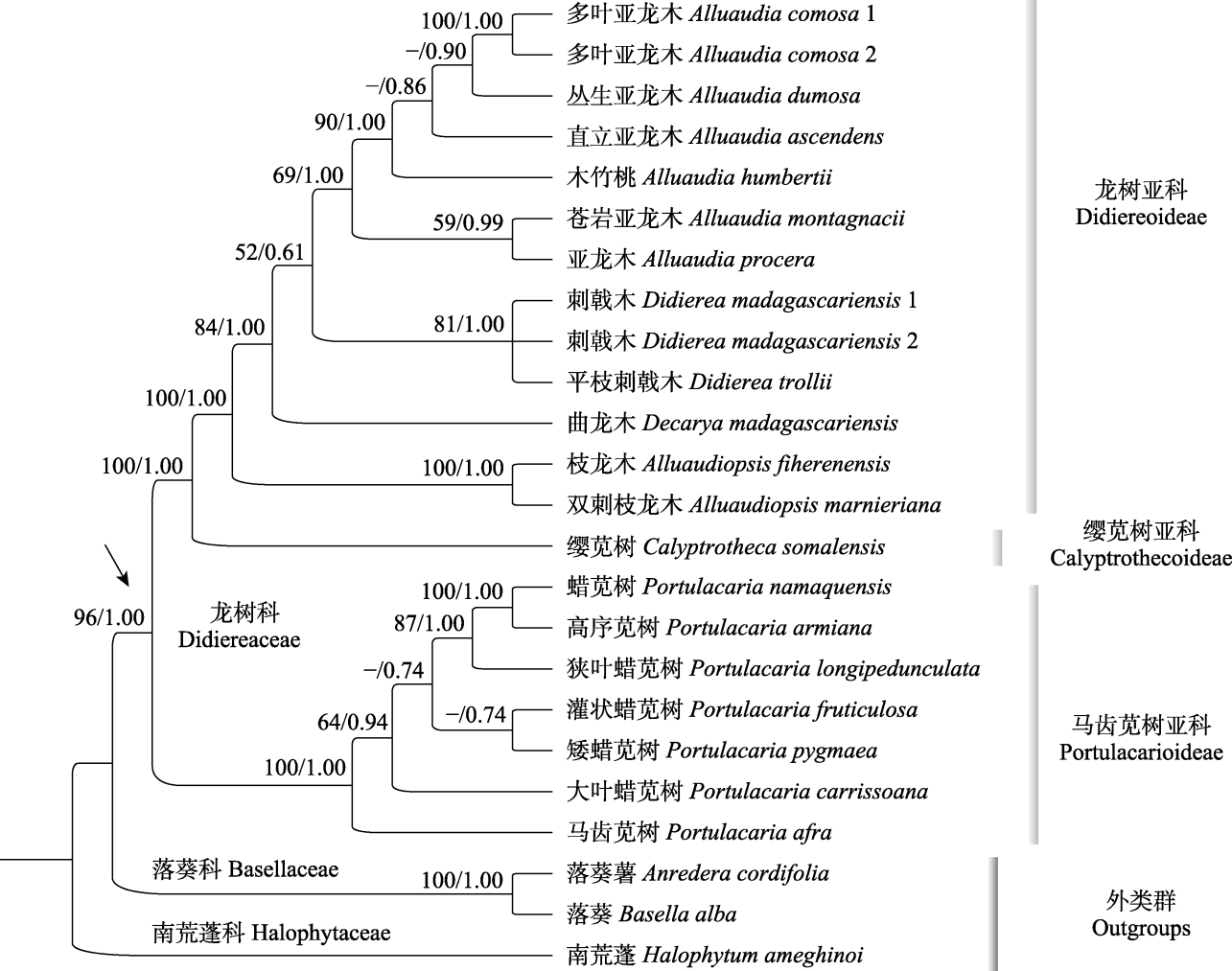
Fig. 1 Bayesian consensus tree inferred from a combined dataset (including trnL-trnF, trnT-trnL, trnG-trnS, trnQ-rps16, rps16, rpl16). Bootstrap (BS) support value in maximum likelihood (ML) analysis/Posterior probability (PP) in Bayesian inference (BI) are indicated near each phylogenetic node. - indicates the topology was not present in ML analysis or BS value in ML analysis was less than 50%.
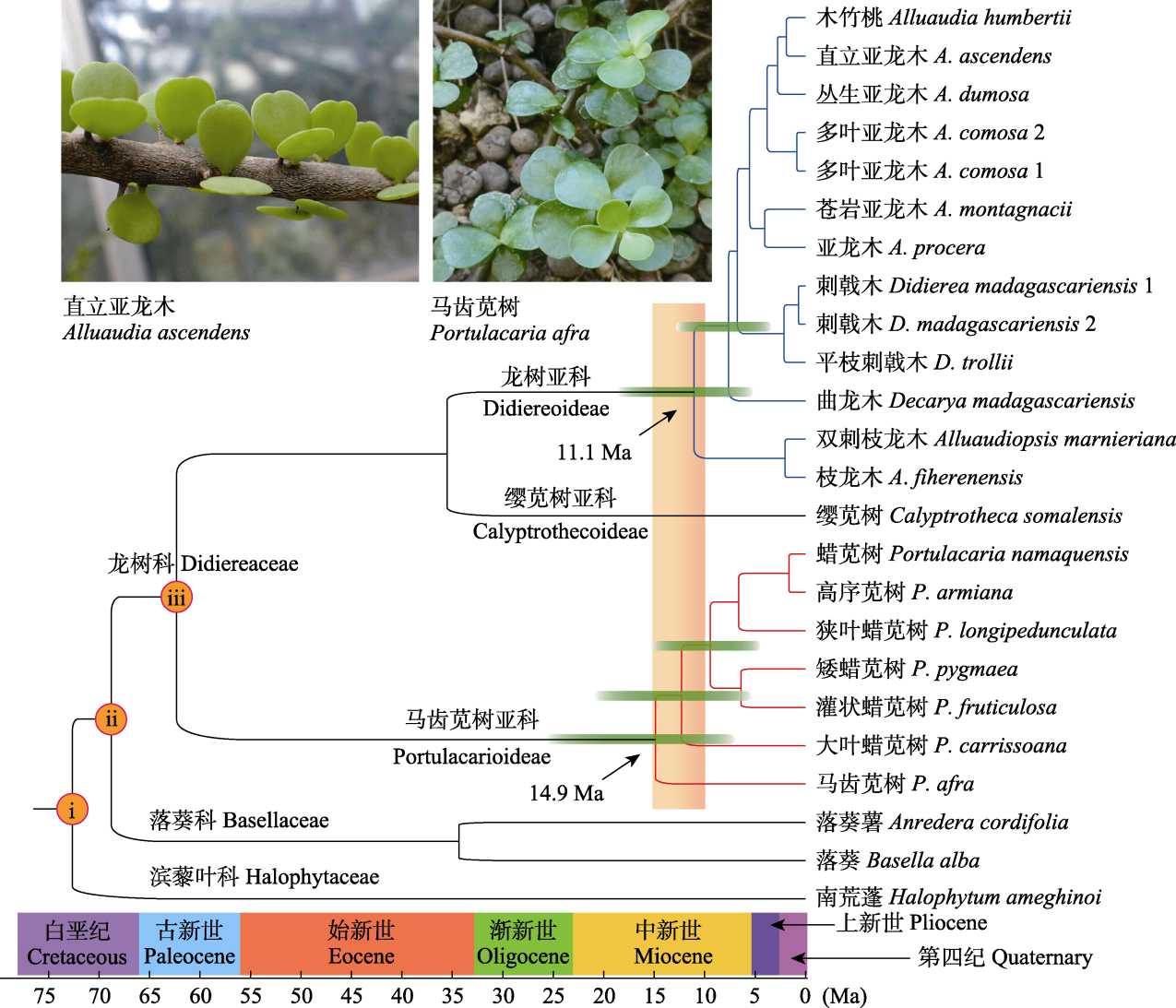
Fig. 2 Branchlets of Alluaudia ascendens and Portulacaria afra (all have succulent leaves), and the chronogram of Didiereaceae inferred from BEAST analysis of combined dataset (including trnL-trnF, trnT-trnL, trnG-trnS, trnQ-rps16, rps16, rpl16) and three calibrations. Calibration points i‒iii indicate: (i) stem node of Halophytaceae, (ii) stem node of Basellaceae, and (iii) crown node of Didiereaceae. The orange band marks the 15‒10 million years ago (Ma) period of widespread arid climate establishment. Green bars represent 95% highest posterior density (HPD) intervals for divergence ages at key nodes.
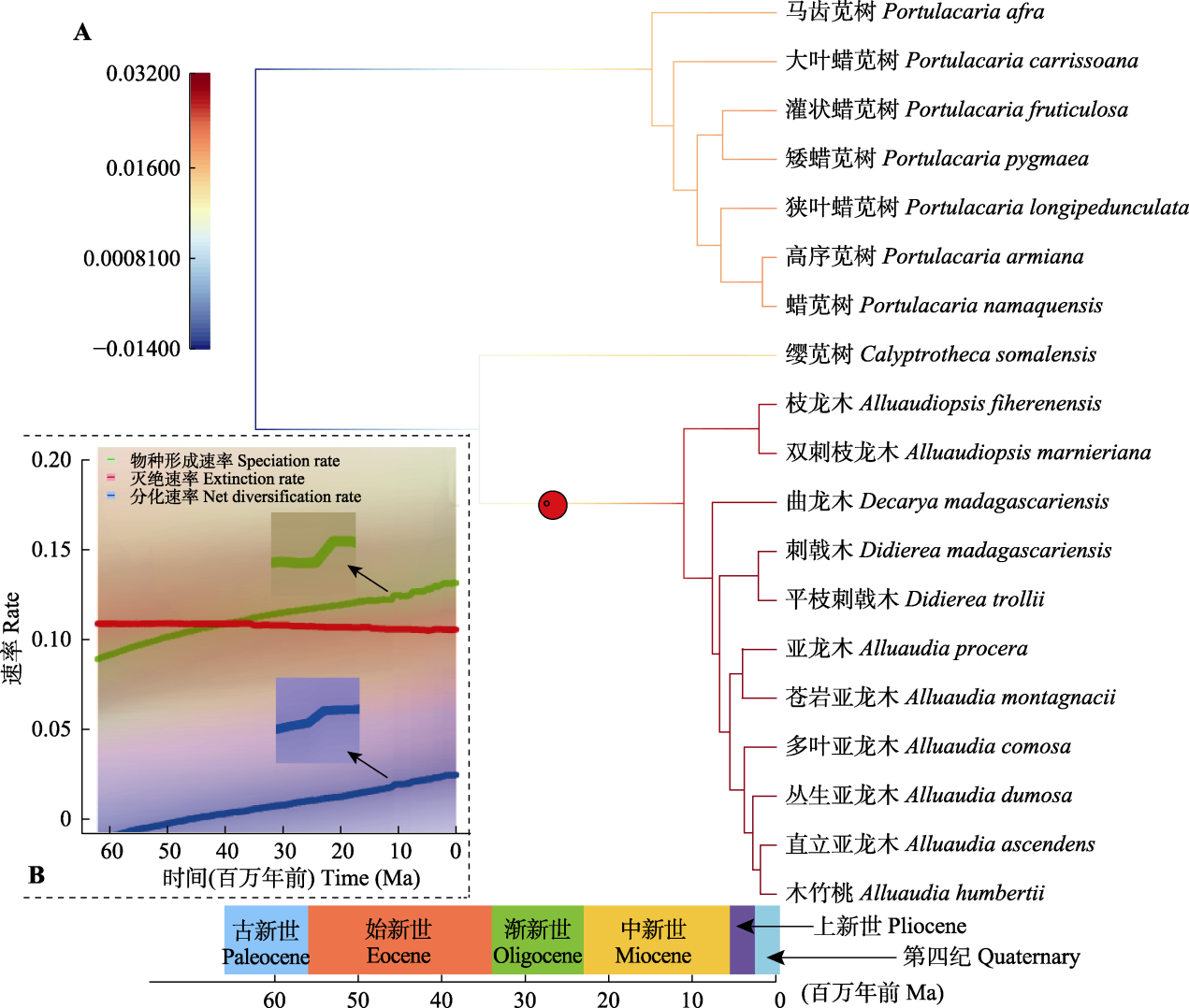
Fig. 3 Diversification history of Didiereaceae inferred from Bayesian Analysis of Macroevolutionary Mixtures (BAMM) analysis. A, Phylorate plot showing net diversification rate (branch colors). The red dot indicates an increased diversification rate shift. B, Rate-through-time plots for speciation, extinction and net diversification. Ma, million years ago.
| [1] |
Arakaki M, Christin PA, Nyffeler R, Lendel A, Eggli U, Ogburn RM, Spriggs E, Moore MJ, Edwards EJ (2011). Contemporaneous and recent radiations of the world’s major succulent plant lineages. Proceedings of the National Academy of Sciences of the United States of America, 108, 8379-8384.
DOI PMID |
| [2] |
Bobe R (2006). The evolution of arid ecosystems in eastern Africa. Journal of Arid Environments, 66, 564-584.
DOI URL |
| [3] |
Bruyns PV, Klak C, Hanáček P (2011). Age and diversity in old world succulent species of Euphorbia (Euphorbiaceae). Taxon, 60, 1717-1733.
DOI URL |
| [4] |
Bruyns PV, Oliveira-Neto M, Melo-de-Pinna GF, Klak C (2014). Phylogenetic relationships in the Didiereaceae with special reference to subfamily Portulacarioideae. Taxon, 63, 1053-1064.
DOI URL |
| [5] |
Cowling RM, Procheş Ş, Partridge TC (2009). Explaining the uniqueness of the cape flora: incorporating geomorphic evolution as a factor for explaining its diversification. Molecular Phylogenetics and Evolution, 51, 64-74.
DOI PMID |
| [6] |
de Wit MJ (2003). Madagascar: heads it’s a continent, tails it’s an island. Annual Review of Earth and Planetary Sciences, 31, 213-248.
DOI URL |
| [7] | Gamisch A, Comes HP (2019). Clade-age-dependent diversification under high species turnover shapes species richness disparities among tropical rainforest lineages of Bulbophyllum (Orchidaceae). BMC Evolutionary Biology, 19, 93. DOI: 10.1186/s12862-019-1416-1. |
| [8] | Grace OM, Buerki S, Symonds MRE, Forest F, van Wyk AE, Smith GF, Klopper RR, Bjorå CS, Neale S, Demissew S, Simmonds MSJ, Rønsted N (2015). Evolutionary history and leaf succulence as explanations for medicinal use in aloes and the global popularity of Aloe vera. BMC Evolutionary Biology, 15, 29. DOI: 10.1186/s12862-015-0291-7. |
| [9] |
Gupta AK, Yuvaraja A, Prakasam M, Clemens SC, Velu A (2015). Evolution of the South Asian monsoon wind system since the late Middle Miocene. Palaeogeography, Palaeoclimatology, Palaeoecology, 438, 160-167.
DOI URL |
| [10] |
Hernández-Hernández T, Brown JW, Schlumpberger BO, Eguiarte LE, Magallón S (2014). Beyond aridification: multiple explanations for the elevated diversification of cacti in the New World Succulent Biome. New Phytologist, 202, 1382-1397.
DOI PMID |
| [11] |
Hoffmann AA, Sgrò CM (2011). Climate change and evolutionary adaptation. Nature, 470, 479-485.
DOI |
| [12] |
Kandziora M, Kadereit JW, Gehrke B (2017). Dual colonization of the Palaearctic from different regions in the Afrotropics by Senecio. Journal of Biogeography, 44, 147-157.
DOI URL |
| [13] |
Katoh K, Standley DM (2013). MAFFT multiple sequence alignment software version 7: improvements in performance and usability. Molecular Biology and Evolution, 30, 772-780.
DOI PMID |
| [14] |
Kong HH, Condamine FL, Harris AJ, Chen JL, Pan B, Möller M, Hoang VS, Kang M (2017). Both temperature fluctuations and East Asian monsoons have driven plant diversification in the karst ecosystems from Southern China. Molecular Ecology, 26, 6414-6429.
DOI PMID |
| [15] | Lei RH, Frasier CL, Hawkins MTR, Engberg SE, Bailey CA, Johnson SE, McLain AT, Groves CP, Perry GH, Nash SD, Mittermeier RA, Louis EE (2017). Phylogenomic reconstruction of sportive lemurs (genus Lepilemur) recovered from mitogenomes with inferences for Madagascar biogeography. Journal of Heredity, 108, 107-119. |
| [16] | Logan RF (1968). Causes, climates, and distribution of deserts// Brown GW. Desert Biology: Special Topics on the Physical and Biological Aspects of Arid Regions: Volume 1. Academic Press, New York. 21-50. |
| [17] | Miller MA, Pfeiffer W, Schwartz T (2010). Creating the CIPRES Science Gateway for inference of large phylogenetics trees// Proceedings of the Gateway Computing Environments Workshop (GCE). New Orleans, USA. |
| [18] |
Nylinder S, Razafimandimbison SG, Anderberg AA (2016). From the Namib around the world: biogeography of the Inuleae-Plucheinae (Asteraceae). Journal of Biogeography, 43, 1705-1716.
DOI URL |
| [19] |
Ocampo G, Columbus JT (2010). Molecular phylogenetics of suborder Cactineae (Caryophyllales), including insights into photosynthetic diversification and historical biogeography. American Journal of Botany, 97, 1827-1847.
DOI PMID |
| [20] | Plummer M, Best N, Cowles K, Vines K (2006). CODA: convergence diagnosis and output analysis for MCMC. R News, 6, 7-11. |
| [21] |
Posada D (2008). jModelTest: phylogenetic model averaging. Molecular Biology and Evolution, 25, 1253-1256.
DOI PMID |
| [22] |
Qin SY, Zuo ZY, Guo C, Du XY, Liu SY, Yu XQ, Xiang XG, Rong J, Liu B, Liu ZF, Ma PF, Li DZ (2023). Phylogenomic insights into the origin and evolutionary history of evergreen broadleaved forests in East Asia under Cenozoic climate change. Molecular Ecology, 32, 2850-2868.
DOI URL |
| [23] | Rambaut A (2012). FigTree version 1.4.0. [2025-06-19]. http://tree.bio.ed.ac.uk/software/figtree/. |
| [24] | Rambaut A, Suchard MA, Drummond AJ (2014). Tracer v1.6. [2025-06-19]. http://beast.bio.ed.ac.uk/Tracer. |
| [25] |
Riddell EA, Iknayan KJ, Hargrove L, Tremor S, Patton JL, Ramirez R, Wolf BO, Beissinger SR (2021). Exposure to climate change drives stability or collapse of desert mammal and bird communities. Science, 371, 633-636.
DOI PMID |
| [26] | Roberts GG, Paul JD, White N, Winterbourne J (2012). Temporal and spatial evolution of dynamic support from river profiles: a framework for Madagascar. Geochemistry, Geophysics, Geosystems, 13, Q04004. DOI: 10.1029/2012GC004040. |
| [27] |
Rabosky DL, Grundler M, Anderson C, Title P, Shi JJ, Brown JW, Huang H, Larson JG (2014). BAMMTOOLS: an R package for the analysis of evolutionary dynamics on phylogenetic trees. Methods in Ecology and Evolution, 5, 701-707.
DOI URL |
| [28] |
Ronquist F, Huelsenbeck JP (2003). MrBayes 3: Bayesian phylogenetic inference under mixed models. Bioinformatics, 19, 1572-1574.
DOI PMID |
| [29] |
Sage RF, Sage TL, Kocacinar F (2012). Photorespiration and the evolution of C4 photosynthesis. Annual Review of Plant Biology, 63, 19-47.
DOI URL |
| [30] | Singh RK, Gupta AK (2014). Miocene history of Indian monsoon: a review of marine records. The Palaeontological Society of India, 5, 101-109. |
| [31] |
Stamatakis A (2006). RAxML-VI-HPC: maximum likelihood-based phylogenetic analyses with thousands of taxa and mixed models. Bioinformatics, 22, 2688-2690.
DOI PMID |
| [32] |
Tripati AK, Roberts CD, Eagle RA (2009). Coupling of CO2 and ice sheet stability over major climate transitions of the last 20 million years. Science, 326, 1394-1397.
DOI URL |
| [33] |
Urban MC (2015). Accelerating extinction risk from climate change. Science, 348, 571-573.
DOI PMID |
| [34] |
Valente LM, Britton AW, Powell MP, Papadopulos AST, Burgoyne PM, Savolainen V (2014). Correlates of hyperdiversity in southern African ice plants (Aizoaceae). Botanical Journal of the Linnean Society, 174, 110-129.
PMID |
| [35] |
Walker JF, Yang Y, Feng T, Timoneda A, Mikenas J, Hutchison V, Edwards C, Wang N, Ahluwalia S, Olivieri J, Walker-Hale N, Majure LC, Puente R, Kadereit G, Lauterbach M, et al. (2018). From cacti to carnivores: Improved phylotranscriptomic sampling and hierarchical homology inference provide further insight into the evolution of Caryophyllales. American Journal of Botany, 105, 446-462.
DOI PMID |
| [36] | Wu SD, Zhang LJ, Lin L, Yu SX, Chen ZD, Wang W (2018). Insights into the historical assembly of global dryland floras: the diversification of Zygophyllaceae. BMC Evolutionary Biology, 18, 166. DOI: 10.1186/S12862-018-127-2. |
| [37] | Xue B, Guo X, Landis JB, Sun M, Tang CC, Soltis PS, Soltis DE, Saunders RK (2020). Accelerated diversification correlated with functional traits shapes extant diversity of the early divergent angiosperm family Annonaceae. Molecular Phylogenetics and Evolution, 142, 106659. DOI: 10.1016/j.ympev.2019.106659. |
| [38] |
Xue BE, Huang EF, Zhao GH, Wei R, Song ZQ, Zhang XC, Yao G (2024). ‘Out of Africa’ origin of the pantropical staghorn fern genus Platycerium (Polypodiaceae) supported by plastid phylogenomics and biogeographical analysis. Annals of Botany, 133, 697-710.
DOI URL |
| [39] | Xue BE, Song ZQ, Cai J, Ma ZH, Huang JX, Li YL, Yao G (2023). Phylogenetic analysis and temporal diversification of the tribe Alsineae (Caryophyllaceae) with the description of three new Genera, Hesperostellaria, Reniostellaria and Torreyostellaria. Frontiers in Plant Science, 14, 1127443. DOI: 10.3389/fpls.2023.1127443. |
| [40] |
Yao G, Jin JJ, Li HT, Yang JB, Mandala VS, Croley M, Mostow R, Douglas NA, Chase MW, Christenhusz MJM, Soltis DE, Soltis PS, Smith SA, Brockington SF, Moore MJ, et al. (2019). Plastid phylogenomic insights into the evolution of Caryophyllales. Molecular Phylogenetics and Evolution, 134, 74-86.
DOI PMID |
| [41] |
Yu XQ, Gao LM, Soltis DE, Soltis PS, Yang JB, Fang L, Yang SX, Li DZ (2017). Insights into the historical assembly of East Asian subtropical evergreen broadleaved forests revealed by the temporal history of the tea family. New Phytologist, 215, 1235-1248.
DOI URL |
| [42] | Zachos JC, Dickens GR, Zeebe RE (2008). An early Cenozoic perspective on greenhouse warming and carbon-cycle dynamics. Nature, 451, 279-283. |
| [43] |
Zhang GJ, Hu Y, Huang MZ, Huang WC, Liu DK, Zhang DY, Hu HH, Downing JL, Liu ZJ, Ma H (2023). Comprehensive phylogenetic analyses of Orchidaceae using nuclear genes and evolutionary insights into epiphytism. Journal of Integrative Plant Biology, 65, 1204-1225.
DOI |
| [44] | Zhou BF, Yuan S, Crowl AA, Liang YY, Shi Y, Chen XY, An QQ, Kang M, Manos PS, Wang BS (2022). Phylogenomic analyses highlight innovation and introgression in the continental radiations of Fagaceae across the Northern Hemisphere. Nature Communications, 13, 1320. DOI: 10.1038/s41467-022-28917-1. |
| [45] |
Zuntini AR, Carruthers T, Maurin O, Bailey PC, Leempoel K, Brewer GE, Epitawalage N, Françoso E, Gallego-Paramo B, McGinnie C, Negrão R, Roy SR, Simpson L, Romero ET, Barber VMA, et al. (2024). Phylogenomics and the rise of the angiosperms. Nature, 629, 843-850.
DOI |
| [1] | FENG Zhe, XU Ge-Xi, LIU Shun, CHEN Jian, LI Fei-Fan, GONG Shan-Shan, JIA Lei, SUN Zhen, YU Mei-Ni, SHI Zuo-Min, ZHOU Qing-Hong, JIANG Dong-Mei. Habitat factors and phylogeny jointly drive leaf stoichiometry in dry-hot valley region of Jinsha River, Yunnan, China [J]. Chin J Plant Ecol, 2026, 50(2): 352-361. |
| [2] | XIANG Wei, HUANG Dong-Liu, ZHU Shi-Dan. Absorptive root anatomical traits of 26 tropical and subtropical fern species [J]. Chin J Plant Ecol, 2022, 46(5): 593-601. |
| [3] | WANG Chun-Cheng, ZHANG Yun-Ling, MA Song-Mei, HUANG Gang, ZHANG Dan, YAN Han. Phylogeny and species differentiation of four wild almond species of subgen. Amygdalus in China [J]. Chin J Plant Ecol, 2021, 45(9): 987-995. |
| [4] | YANG Ke-Tong, CHANG Hai-Long, CHEN Guo-Peng, YU Xiao-Ya, XIAN Jun-Ren. Stomatal traits of main greening plant species in Lanzhou [J]. Chin J Plant Ecol, 2021, 45(2): 187-196. |
| [5] | TANG Li-Li, ZHANG Mei, ZHAO Xiang-Lin, KANG Mu-Yi, LIU Hong-Yan, GAO Xian-Ming, YANG Tong, ZHENG Pu-Fan, SHI Fu-Chen. Species distribution and community assembly rules of Juglans mandshurica in North China [J]. Chin J Plant Ecol, 2019, 43(9): 753-761. |
| [6] | WANG Xue, CHEN Guang-Shui, YAN Xiao-Jun, CHEN Ting-Ting, JIANG Qi, CHEN Yu-Hui, FAN Ai-Lian, JIA Lin-Qiao, XIONG De-Cheng, HUANG Jin-Xue. Variations in the first-order root diameter in 89 woody species in a subtropical evergreen broadleaved forest [J]. Chin J Plant Ecol, 2019, 43(11): 969-978. |
| [7] | YANG Lei, SUN Han, FAN Yan-Wen, HAN Wei, ZENG Ling-Bing, LIU Chao, WANG Xiang-Ping. Changes in leaf nitrogen and phosphorus stoichiometry of woody plants along an altitudinal gradient in Changbai Mountain, China [J]. Chin J Plan Ecolo, 2017, 41(12): 1228-1238. |
| [8] | LU Ning-Na,ZHAO Zhi-Gang. Flower symmetry and flower size variability: an examination of Berg’s hypotheses in an alpine meadow [J]. Chin J Plant Ecol, 2014, 38(5): 460-467. |
| [9] | Jannathan MAMUT, TAN Dun-Yan. Gynomonoecy in angiosperms: phylogeny, sex expression and evolutionary significance [J]. Chin J Plant Ecol, 2014, 38(1): 76-90. |
| [10] | WANG Lu,LEI Yun,ZHANG Ming-Li. A preliminary study of molecular phylogeny and biogeography distribution pattern of Zelkova inferred from trnL-trnF and nrITS sequences [J]. Chin J Plant Ecol, 2013, 37(5): 407-414. |
| [11] | CHEN Yan-Song, ZHOU Shou-Biao, OU Zu-Lan, XU Zhong-Dong, HONG Xin. Seed mass variation in common plant species in Wanfoshan Natural Reservation Region, Anhui, China [J]. Chin J Plant Ecol, 2012, 36(8): 739-746. |
| [12] | TAN Dun-Yan, ZHANG Yang, WANG Ai-Bo. A review of geocarpy and amphicarpy in angiosperms, with special reference to their ecological adaptive significance [J]. Chin J Plant Ecol, 2010, 34(1): 72-88. |
| [13] | HE Ya-Ping, LIU Jian-Quan. A Review on Recent Advances in the Studies of Plant Breeding System [J]. Chin J Plant Ecol, 2003, 27(2): 151-163. |
| Viewed | ||||||
|
Full text |
|
|||||
|
Abstract |
|
|||||
Copyright © 2026 Chinese Journal of Plant Ecology
Tel: 010-62836134, 62836138, E-mail: apes@ibcas.ac.cn, cjpe@ibcas.ac.cn

