
Chin J Plant Ecol ›› 2008, Vol. 32 ›› Issue (3): 521-530.DOI: 10.3773/j.issn.1005-264x.2008.03.001 cstr: 32100.14.j.issn.1005-264x.2008.03.001
• Original article • Next Articles
YU Li1,2( ), CAO Ming-Kui2, TAO Bo2, LI Ke-Rang2, DONG Wen-Jie1, LIU Hong-Bin1, LIU Chang-You1
Received:2007-07-18
Accepted:2007-11-23
Online:2008-07-18
Published:2008-05-30
YU Li, CAO Ming-Kui, TAO Bo, LI Ke-Rang, DONG Wen-Jie, LIU Hong-Bin, LIU Chang-You. QUANTITATIVE ASSESSMENT OF THE VULNERABILITY OF TERRESTRIAL ECOSYSTEMS OF CHINA TO CLIMATE CHANGE BASED ON POTENTIAL VEGETATION[J]. Chin J Plant Ecol, 2008, 32(3): 521-530.

Fig.1 The distribution map of potential vegetation by improved CEVSA model in China
| 指标 Indicators | 二级指标 Sub-indicators | 指示意义 Means of indicators | ||||||||
|---|---|---|---|---|---|---|---|---|---|---|
| 植被类型变化 Vegetation type change | 实际变化频次 Actual changing frequency | S | ||||||||
| 实际变化方向 Actual changing direction | A | |||||||||
| 潜在变化频次 Potential changing frequency | S | |||||||||
| 潜在变化方向 Potential changing direction | A | |||||||||
| 净初级生产力 Net primary productivity | 年际变率 Annual variability | S | ||||||||
| 变化趋势 Trend of annual variability | A | |||||||||
| 植被碳贮量 Vegetation carbon storage | 年际变率 Annual variability | S | ||||||||
| 变化趋势 Trend of annual variability | A | |||||||||
| 土壤碳贮量 Soil carbon storage | 年际变率 Annual variability | S | ||||||||
| 变化趋势 Trend of annual variability | A | |||||||||
| 净生态系统生产力 Net ecosystem productivity | 年际变率 Annual variability | S | ||||||||
| 变化趋势 Trend of annual variability | A | |||||||||
Table 1 The assessing indicators of potential natural ecosystem vulnerability
| 指标 Indicators | 二级指标 Sub-indicators | 指示意义 Means of indicators | ||||||||
|---|---|---|---|---|---|---|---|---|---|---|
| 植被类型变化 Vegetation type change | 实际变化频次 Actual changing frequency | S | ||||||||
| 实际变化方向 Actual changing direction | A | |||||||||
| 潜在变化频次 Potential changing frequency | S | |||||||||
| 潜在变化方向 Potential changing direction | A | |||||||||
| 净初级生产力 Net primary productivity | 年际变率 Annual variability | S | ||||||||
| 变化趋势 Trend of annual variability | A | |||||||||
| 植被碳贮量 Vegetation carbon storage | 年际变率 Annual variability | S | ||||||||
| 变化趋势 Trend of annual variability | A | |||||||||
| 土壤碳贮量 Soil carbon storage | 年际变率 Annual variability | S | ||||||||
| 变化趋势 Trend of annual variability | A | |||||||||
| 净生态系统生产力 Net ecosystem productivity | 年际变率 Annual variability | S | ||||||||
| 变化趋势 Trend of annual variability | A | |||||||||
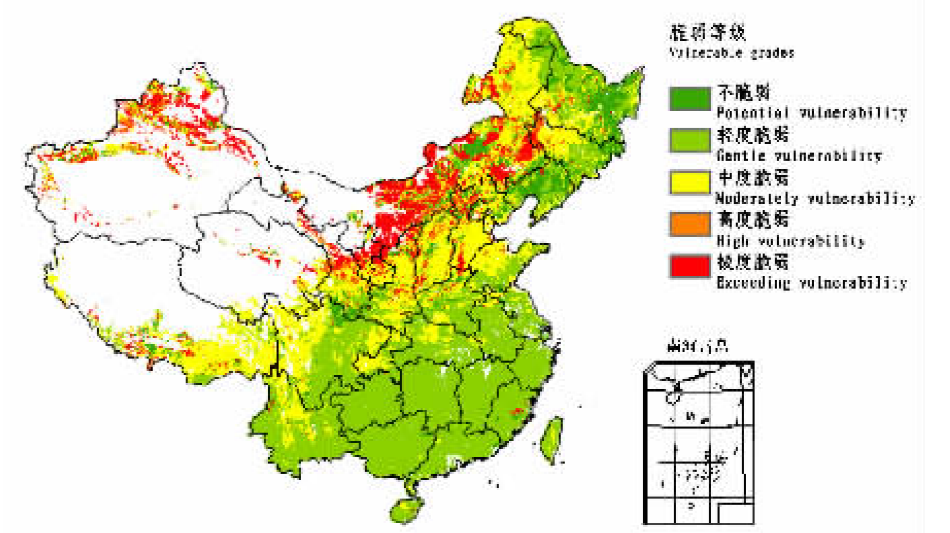
Fig.2 The distribution of natural ecosystems vulnerability under contemporary climate in China
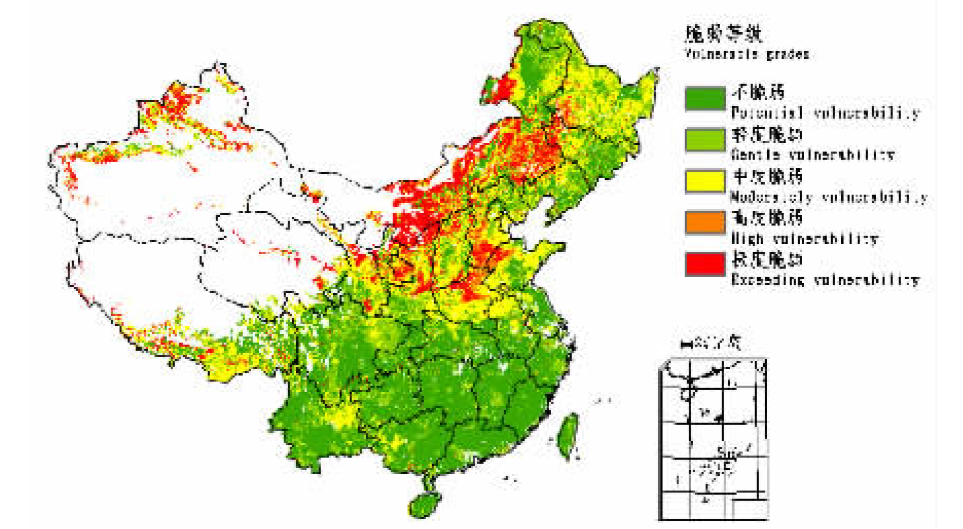
Fig.3 The distribution of natural ecosystems vulnerability under IPCC-SRES-A2 scenarios in 2071-2100 in China
| 地理区 Geographic regionalization | 当前气候条件 Contemporary climate | IPCC-SRES-A2情景 IPCC-SRES-A2 scenarios | ||
|---|---|---|---|---|
| 脆弱等级 Vulnerable grade | 脆弱度排序 Vulnerable order | 脆弱等级 Vulnerable grade | 脆弱度排序 Vulnerable order | |
| 东北地区Northeastern China | 中度脆弱Moderate vulnerability | 4 | 中度脆弱Moderate vulnerability | 5 |
| 华北地区Northern China | 中度脆弱Moderate vulnerability | 3 | 中度脆弱Moderate vulnerability | 3 |
| 华南地区Southern China | 不脆弱Potential vulnerability | 8 | 轻度脆弱Gentle vulnerability | 8 |
| 华中地区Central China | 轻度脆弱Gentle vulnerability | 7 | 轻度脆弱Gentle vulnerability | 7 |
| 内蒙古地区Inner Mongolia | 极度脆弱Exceeding vulnerability | 1 | 极度脆弱Exceeding vulnerability | 2 |
| 西北地区Northwestern China | 高度脆弱High vulnerability | 2 | 极度脆弱Exceeding vulnerability | 1 |
| 西南地区Southwestern China | 轻度脆弱Gentle vulnerability | 6 | 轻度脆弱Gentle vulnerability | 6 |
| 西藏地区Tibet Plateau China | 中度脆弱Moderate vulnerability | 5 | 中度脆弱Moderate vulnerability | 4 |
Table 2 The grade of vulnerability in different physical geographic regionalization under different climate conditions
| 地理区 Geographic regionalization | 当前气候条件 Contemporary climate | IPCC-SRES-A2情景 IPCC-SRES-A2 scenarios | ||
|---|---|---|---|---|
| 脆弱等级 Vulnerable grade | 脆弱度排序 Vulnerable order | 脆弱等级 Vulnerable grade | 脆弱度排序 Vulnerable order | |
| 东北地区Northeastern China | 中度脆弱Moderate vulnerability | 4 | 中度脆弱Moderate vulnerability | 5 |
| 华北地区Northern China | 中度脆弱Moderate vulnerability | 3 | 中度脆弱Moderate vulnerability | 3 |
| 华南地区Southern China | 不脆弱Potential vulnerability | 8 | 轻度脆弱Gentle vulnerability | 8 |
| 华中地区Central China | 轻度脆弱Gentle vulnerability | 7 | 轻度脆弱Gentle vulnerability | 7 |
| 内蒙古地区Inner Mongolia | 极度脆弱Exceeding vulnerability | 1 | 极度脆弱Exceeding vulnerability | 2 |
| 西北地区Northwestern China | 高度脆弱High vulnerability | 2 | 极度脆弱Exceeding vulnerability | 1 |
| 西南地区Southwestern China | 轻度脆弱Gentle vulnerability | 6 | 轻度脆弱Gentle vulnerability | 6 |
| 西藏地区Tibet Plateau China | 中度脆弱Moderate vulnerability | 5 | 中度脆弱Moderate vulnerability | 4 |
| [1] | Andrei PK, Allen MS (1998). Modeling dynamic vegetation response to rapid climate change using bioclimatic classification. Climatic Change, 38,15-49. |
| [2] | Bachelet D, James ML, Daly C, Neilson PR, Dennis SD, William JP (2001). MC1: a dynamic vegetation model for estimating the distribution of vegetation and associated ecosystem fluxes of carbon. Nutrients, and Water Technical Documentation, Version 1.0. Portland, Oregon: U.S. Forest Service,PNW-GTR-508. |
| [3] | Cai YL (1997). Vulnerability and adaptation of Chinese agriculture to global climate change. Chinese Geographical Science, 4,289-301. |
| [4] | Cao MK, Prince SD, Li KR, Small X, Shao XM (2003). Response of terrestrial carbon uptake to climate interannual variability in China. Global Change Biology, 9,536-546. |
| [5] | Cao MK, Woodward FI (1998). Dynamic responses of terrestrial ecosystem carbon cycling to global climate change. Nature, 93,249-252. |
| [6] | Ge DK (葛道阔), Jin ZQ (金之庆), Shi CL (石春林), Gao LZ (高亮之) (2002). Gradual impacts of climate change on rice production and adaptation strategies in Southern China. Jiangsu Journal of Agricultural Sciences (江苏农业学报), 18 (1),1-8. (in Chinese with English abstract) |
| [7] | Hansen JA, Neilson PR, Dale HV, Flather HC (2001). Global change in forests: responses of species, communities, and biomes. BioScience, 151,765-779. |
| [8] | Hansen MC, Defries RS, Townsgend JRG (2000). Global land cover classification at 1 km spatial resolution a classification tree approach. International Journal of Remote Sensing,6- 7,1331-1364. |
| [9] | Hou YH (侯亚红), Liu WQ (刘文泉) (2003). Forecast of changes in climate vulnerability of agricultural production in the Loess Plateau in China. Journal of Catastrophology (灾害学), 8,34-90. (in Chinese with English abstract) |
| [10] | Huq S, Karim Z, Asaduzzaman M, Mahtab F (1999). Vulnerability and Adaptation to Climate Change for Bangladesh. Kluwer Academic Pubilshers, Chapman & Hall, USA. |
| [11] | IPCC Intergovernmental Panel on Climate Change (2001). Climate Change in 2001: the Science of Climate Change. Cambridge University Press, Cambridge. |
| [12] | IPCC Intergovernmental Panel on Climate Change (2007). Climate Change in 2007: the Science of Climate Change. Cambridge University Press, Cambridge. |
| [13] | Landres PB (1999). Overview of the use of natural variability concepts in managing ecological systems. Ecological Applications, 9,1179-1188. |
| [14] | Li KR (李克让), Cao MK (曹明奎), Yu L (於王利), Wu SH (吴绍洪) (2005). Assessment of vulnerability of natural ecosystems in China under the changing climate. Geographical Research (地理研究), 5,653-663. (in Chinese with English abstract) |
| [15] | Li KR (李克让), Chen YF (陈育峰) (1996). Analysis of vulnerability of forests in China responsed to global climate change. Acta Geographica Sinica (地理学报), 51 (Suppl.),40-49. (in Chinese with English abstract) |
| [16] | Li XB (李晓兵), Chen YH (陈云浩), Zhang YX (张云霞), Fan DY (范大一), Zhou T (周涛), Xie F (谢锋) (2002). Impact of climate change on desert steppe in northern China. Advances in Earth Science (地球科学进展), 17,253-261. (in Chinese with English abstract) |
| [17] | Lin ED (1996). Agricultural vulnerability and adaptation to global warming in China. Water,Air and Soil Pollution, (1- 2),63-73. |
| [18] | Liu CZ (刘春蓁) (1999). On some issues in studying climate change impact and adaptation. Climatic and Environmental Research (气候与环境研究), 4,129-134. (in Chinese with English abstract) |
| [19] | Liu GH (刘国华), Fu BJ (傅伯杰) (2001). Effects of global climate change on forest ecosystems. Journal of Natural Resource (自然资源学报), 16,71-78. (in Chinese with English abstract) |
| [20] | Liu LL (刘绿柳) (2002). Concept and quantitative assessment of vulnerability of water resource. Bulletin of Soil and Water Conservation (水土保持通报), 2(2),41-45. (in Chinese with English abstract) |
| [21] | Liu WQ (刘文泉) (2002). Primary discuss of methods for the assessment of agricultural vulnerability to climate change. Journal of Nanjing Institute of Meteorology (南京气象学院学报), 2,214-220. (in Chinese with English abstract) |
| [22] | Liu YH (刘燕华) (1995). Classification and indicator system of critical environment in China. In: Zhao GJ (赵桂久), Liu YH (刘燕华), Zhao MC (赵名茶) eds. Synthesis Renovation and Resume of Eco-Environment (生态环境综合整治). Beijing Science and Technology Press, Beijing, 8-17. (in Chinese) |
| [23] | Llody IC, Adams D, Alig R, Betz JC (2001). Assessing socioeconomic impacts of climate change on US forests, wood-product markets, and forest recreation. BioScience, 51,753-764. |
| [24] | Luers LA, Lobell BD, Sklar SL, Addams LC (2003). A method for quantifuing vulnerability, applied to the agricultural system of the Yaqui Valley, Mexico. Global Environmental Change, 13,255-276. |
| [25] | Minnen JG, Onigkeit J, Alcamo J (2002). Critical climate change as an approach to assess climate change impacts in Europe: development and application. Environmental Science & Policy, 5,335-347. |
| [26] | Ni J (2002). A biome classification of china based on plant functional types and the BIOME3 model. Folia Geobotanica, 36,113-129. |
| [27] | Prentice C, Sykes TM, Cramer W (1993). A simulation model for the transient effects of climate change on forest landscapes. Ecological Modelling, 65,51-70. |
| [28] | Ran SH (冉圣宏), Jin JJ (金建君), Zeng SF (曾思育) (2001). Division of vulnerable ecology region type and analysis of its characteristics. China Population Resources and Environment (中国人口资源与环境), 11,73-77. (in Chinese with English abstract) |
| [29] | Tang GP (唐国平), Li XB (李秀彬), Liu YH (刘燕华) (2000). Assessment method of vulnerability of water resources under global climate change. Advances in Earth Science (地球科学进展), 3,313-317. (in Chinese with English abstract) |
| [30] | Tao B, Cao MK, Li KR, Ji JJ, Huang M (2007). The spatial patterns and variations of net primary productivity in China in the period of 1981-2000. Science in China (Series D), 50,745-753. |
| [31] | Turner BL, Matson AP, James JM, Robert WC, Lindsey C, Noelle E, Grete HB, Jeanne XK, Roger EK, Amy L, Marybeth LM, Svein M, Rosamond N, Colin P, Alexander P, Andrew S, Henrik S, Nicholas T (2003). Science and technology for sustainable development special feature: illustrating the coupled human-environment system for vulnerability analysis: three case studies. Proceedings of the National Academy of Sciences of the United States of America, 100,8080-8085. |
| [32] | Weng ES (翁恩生), Zhou GS (周广胜) (2005). Defining plant functional types in China for global change studies. Acta Phytoecologica Sinica, 1,81-97. (in Chinese with English abstract) |
| [33] | Woodward IF, Thomas MS, William RE (1995). A global land primary productivity and phytogeography model. Global Biogeochemical Cycles, 9,471-490. |
| [34] | Wu SH, Dai EF, Huang M, Shao XM, Li SC, Tao B (2007). Ecosystem vulnerability of China under B2 climate scenario in the 21st century. Chinese Science Bulletin, 52,1379-1386. |
| [35] | Yu L (於王利), Cao MK (曹明奎), Li KR (李克让) (2005). An overview of assessment of ecosystem vulnerability to climate change. Progress in Geography (地理科学进展), 1,61-69. (in Chinese with English abstract) |
| [36] | Yu L, Cao MK, Li KR (2006). Climate-induced changes in the vegetation pattern of China in the 21st century. Ecological Research, 6,908-912. |
| [37] | Zhao MS (赵茂盛), Neilson RP, Yan XD (延晓冬), Dong WJ (董文杰) (2002). Modelling the vegetation of China under changing climate. Acta Geographica Sinica (地理学报), 57,28-38. (in Chinese with English abstract) |
| [38] | Zhao YL (赵跃龙), Zhang JL (张玲娟) (1998). Study on method of quantitative assessment of fragile environment. Acience Geographica Sinica (地理学报), 1,67-72. (in Chinese with English abstract) |
| [1] | TAN Qiu-Yan, ZHANG Qing, GAO Cheng, CHU Hai-Yan, YANG Teng. Ectomycorrhizal fungi: key drivers of carbon and nitrogen cycling in alpine ecosystems [J]. Chin J Plant Ecol, 2026, 50(3): 584-599. |
| [2] | MA Jian-Hui, TONG Xin, ZHANG Si-Rong, MAO Zi-Kun, QIN Jun, MA Ke-Ping. Research advances and perspectives on physiological and ecological functions of mycorrhizal fungi [J]. Chin J Plant Ecol, 2026, 50(3): 498-514. |
| [3] | ZHANG Lin, YUAN Wei-Ying, SONG Chuang-Ye, WU Dong-Xiu. Dynamic dataset of environmental elements, species richness and biomass of long-term observation plots of typical ecosystems in China from 1998 to 2010 [J]. Chin J Plant Ecol, 2025, 49(8): 1182-1190. |
| [4] | FAN Ya-Ran, XIA Shao-Pan, YU Bing-Bing, ZHU Zi-Qi, YANG Wei, FAN Yu-Chuan, LIU Xiao-Yu, ZHANG Xu-Hui, ZHENG Ju-Feng. Effects of elevated atmospheric CO2 concentration and warming on stability of soil organic carbon pool accumulation, molecular composition and structure stability [J]. Chin J Plant Ecol, 2025, 49(7): 1053-1069. |
| [5] | WANG Kun-Ying, QIU Gui-Fu, LIU Zi-He, MENG Jun, LIU Yu-Xuan, JIA Guo-Dong. Climate change regulate tree growth and intrinsic water use efficiency of Populus simonii at different levels of degradation [J]. Chin J Plant Ecol, 2025, 49(2): 343-355. |
| [6] | HUANG Mei-Hong, NIU Meng-Qiu, YANG Peng-Fei, LIN Jie, LIAO Zhou-Yu, CHEN Jian-Guo, XIANG Jian-Ying. Effects of temperature and burial depth on seedling emergence and growth of the alpine cushion plant Arenaria oreophila [J]. Chin J Plant Ecol, 2025, 49(12): 2092-2104. |
| [7] | HE Yi, ZHOU Jing, CHEN Chen, FANG Ting-Zhou, SU Jian, GAO Hao-Jie, CAO Jia-Hao, YANG Fei-Yu, FAN Qi-Bo, ZHU Le-Yao, CHEN Yi-Ming, YANG Fei, WANG Yi-Teng, FENG Lei, LIU Fei, LIANG Shuang, JIANG Ming-Kai, CHEN Jun, ZHAO Yun-Peng, CHEN Wei-Le, ZHAO Ying, HUANG Jian-Guo. Protection and restoration of endangered tree species on coastal islands of Zhejiang, China [J]. Chin J Plant Ecol, 2025, 49(10): 1583-1599. |
| [8] | LU Zi-Jia, WANG Tian-Rui, ZHENG Si-Si, MENG Hong-Hu, CAO Jian-Guo, Gregor KOZLOWSKI, SONG Yi-Gang. Environmental adaptive genetic variation and genetic vulnerability of relict plant Pterocarya hupehensis [J]. Chin J Plant Ecol, 2025, 49(10): 1626-1642. |
| [9] | LIAO Su-Hui, NI Long-Kang, QIN Jia-Shuang, TAN Yu, GU Da-Xing. Hydraulic regulation strategies of karst forest species exhibit variation across different successional stages in the mid-subtropical zone [J]. Chin J Plant Ecol, 2024, 48(9): 1223-1231. |
| [10] | CHEN Si-Yi, TANG Yan, HE Teng, JIANG Yong-Kang, DU Guang-Yuan. Xylem embolism characteristics and hydraulic safety risks of nine tree species in Qinling Mountains [J]. Chin J Plant Ecol, 2024, 48(9): 1213-1222. |
| [11] | ZHANG Peng, JIAO Liang, XUE Ru-Hong, WEI Meng-Yuan, DU Da-Shi, WU Xuan, WANG Xu-Ge, LI Qian. Drought intensity affected the growth recovery of Picea crassifolia across different altitudes in western Qilian Mountains [J]. Chin J Plant Ecol, 2024, 48(8): 977-987. |
| [12] | SHI Qian, TONG Xiao-Juan, XU Ling-Ling, MENG Ping, YU Pei-Yang, LI Jun, YANG Ming-Xin. Response of radial growth of early and late wood of planted Pinus tabuliformis to climate variables [J]. Chin J Plant Ecol, 2024, 48(8): 988-1000. |
| [13] | CHEN Yi-Heng, Yusufujiang RUSULI, Abdureheman WUSIMAN. Analysis of spatial and temporal variation in grassland vegetation cover in Xinjiang section of Tianshan Mountains and the driving factors from 2001 to 2020 [J]. Chin J Plant Ecol, 2024, 48(5): 561-576. |
| [14] | WU Ru-Ru, LIU Mei-Zhen, GU Xian, CHANG Xin-Yue, GUO Li-Yue, JIANG Gao-Ming, QI Ru-Yi. Prediction of suitable habitat distribution and potential impact of climate change on distribution patterns of Cupressus gigantea [J]. Chin J Plant Ecol, 2024, 48(4): 445-458. |
| [15] | LIANG Yi-Xian, WANG Chuan-Kuan, ZANG Miao-Han, SHANGGUAN Hong-Yu, LIU Yi-Xiao, QUAN Xian-Kui. Responses of radial growth and biomass allocation of Larix gmelinii to climate warming [J]. Chin J Plant Ecol, 2024, 48(4): 459-468. |
| Viewed | ||||||
|
Full text |
|
|||||
|
Abstract |
|
|||||
Copyright © 2026 Chinese Journal of Plant Ecology
Tel: 010-62836134, 62836138, E-mail: apes@ibcas.ac.cn, cjpe@ibcas.ac.cn

