
植物生态学报 ›› 2006, Vol. 30 ›› Issue (4): 610-616.DOI: 10.17521/cjpe.2006.0080 cstr: 32100.14.cjpe.2006.0080
石章红1,2, 杨大荣1,*( )
)
收稿日期:2005-10-19
接受日期:2005-12-16
出版日期:2006-10-19
发布日期:2006-07-30
作者简介:*E-mail:yangdr@xtbg.ac.cn基金资助:
SHI Zhang-Hong1,2, YANG Da-Rong1,*()
Received:2005-10-19
Accepted:2005-12-16
Online:2006-10-19
Published:2006-07-30
摘要:
该文主要从物候学、行为学和生态学3个方面首次研究报道了我国西双版纳热带雨林下的一种榕树——歪叶榕(Ficus cyrtophylla)的繁殖机制。研究结果表明,歪叶榕榕小蜂(Blastophaga sp.)是歪叶榕唯一的传粉昆虫,传粉行为方式为被动传粉,而且这种榕小蜂也只能在该种榕树中成功繁衍后代。物候学观察结果表明,歪叶榕常绿且叶量常年变化较小,10~11月和3~4月是歪叶榕雄株落叶的高峰期,这时正值西双版纳的雾凉季和干热季,而雌株的落叶高峰期是3~4月;12月和5月是歪叶榕雄株新叶萌发的高峰期,而4~5月是其雌株新叶萌发的高峰期,这时正值西双版纳干热季向雨季过渡的时期,新叶萌发后同时伴随着一次该种榕树的挂果高峰期;歪叶榕在种群水平上常年持续结果,在每年的11月和4~5月有两次结果高峰期,单株每年大量结果2~3次;单棵雄株内结果异步性较高,而雌株内结果高度同步。单果进蜂数(Foundress number)为0~5只,大多数雄果(78.45%)和雌果(84.25%)只有1只传粉榕小蜂,大约16.02%的雄果和13.33%的雌果内含有2只传粉榕小蜂,其它情况均很少。在自然情况下,雄果中的总瘿花量为147.32±62.61(SD)枚,传粉榕小蜂出蜂量为110.94±62.82(SD)只,其中雌蜂多而雄蜂少,传粉榕小蜂性比为0.143 9±0.131 6(SD),瘿花形成率为64.13%±19.89%(SD),雌果中的种子数为231.44±74.25(SD)粒,种子形成率为85.72%±14.19%(SD)。歪叶榕和其传粉榕小蜂在物候学、传粉行为与花药/胚珠比(A/O ratio)和雄花成熟与其羽化出蜂的时期等方面表现出高度的相互适应。
石章红, 杨大荣. 歪叶榕繁殖生态学. 植物生态学报, 2006, 30(4): 610-616. DOI: 10.17521/cjpe.2006.0080
SHI Zhang-Hong, YANG Da-Rong. THE REPRODUCTIVE ECOLOGY OF FICUS CYRTOPHYLLA, AN UNDERSTORY FIG SPECIES IN XISHUANGBANNA TROPICAL RAINFOREST, CHINA. Chinese Journal of Plant Ecology, 2006, 30(4): 610-616. DOI: 10.17521/cjpe.2006.0080
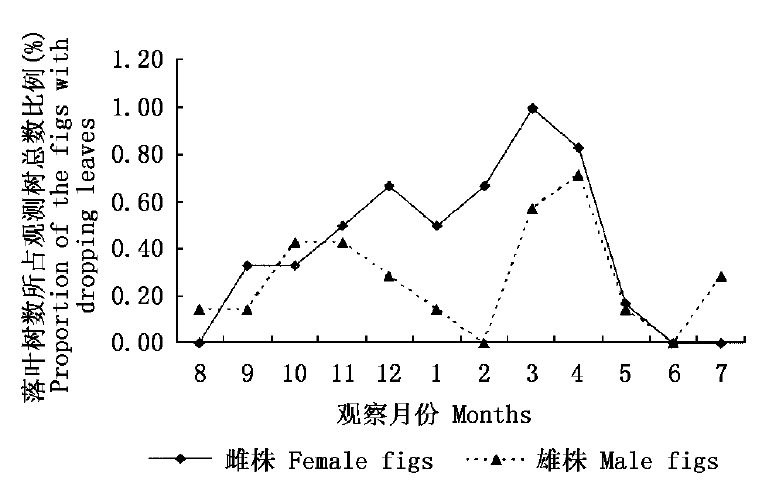
图1 歪叶榕落叶树数量年变化动态
Fig.1 The annual variations of the proportion of the figs with dropping leaves
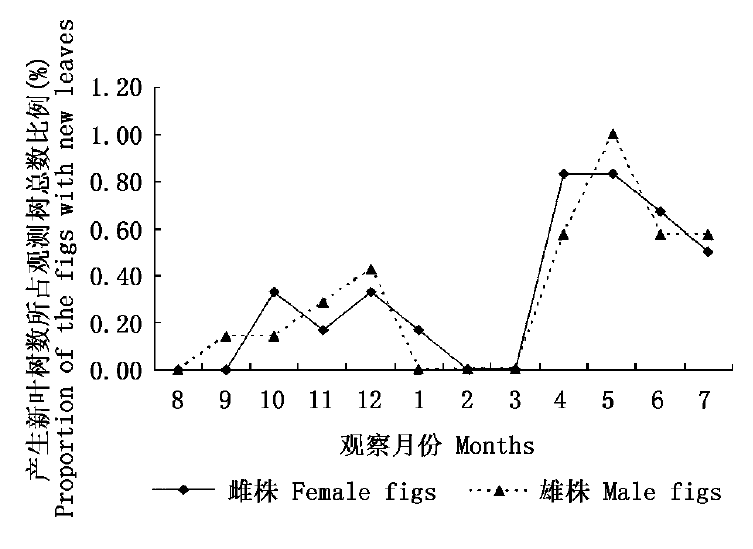
图2 歪叶榕产生新叶树数量年变化动态
Fig.2 The annual changes of the proportion of the figs with new leaves
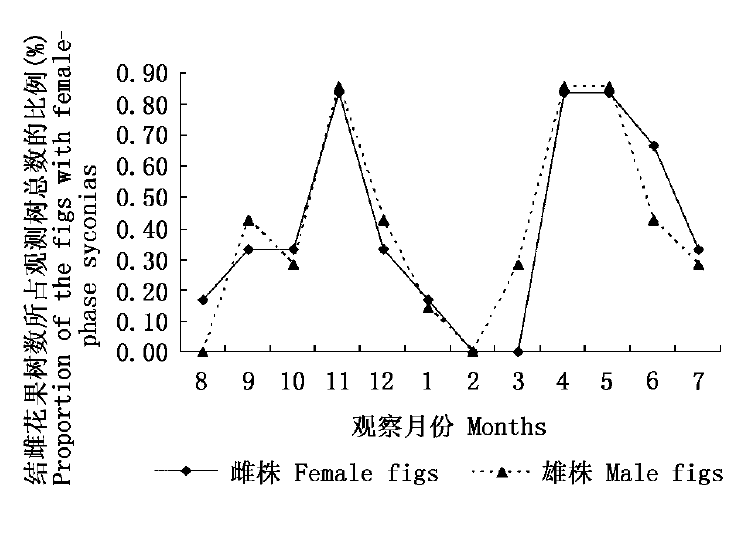
图3 歪叶榕榕树挂雌花期果年数量动态
Fig.3 The annual fluctuations of the number of the figs with female-phase syconia
| 性别 Sex | 样树量 T | 批数 Crop | 果量 F | 有蜂果量 FP | 进蜂率 RFP | 夹死率 RBP | 进蜂范围 Range | 平均进蜂量 Mean | 标准差 SD |
|---|---|---|---|---|---|---|---|---|---|
| 雄株Male | 7 | 8 | 811 | 262 | 22.32% | 42.75% | 0~5 | 0.89 | 0.78 |
| 雌株Female | 5 | 5 | 541 | 60 | 5.92% | 55.00% | 0~5 | 0.72 | 0.94 |
表1 歪叶榕雄株和雌株单果果腔内进蜂量采集解剖情况
Table 1 The illustrations of the pollinator's number in the fig's cavity
| 性别 Sex | 样树量 T | 批数 Crop | 果量 F | 有蜂果量 FP | 进蜂率 RFP | 夹死率 RBP | 进蜂范围 Range | 平均进蜂量 Mean | 标准差 SD |
|---|---|---|---|---|---|---|---|---|---|
| 雄株Male | 7 | 8 | 811 | 262 | 22.32% | 42.75% | 0~5 | 0.89 | 0.78 |
| 雌株Female | 5 | 5 | 541 | 60 | 5.92% | 55.00% | 0~5 | 0.72 | 0.94 |
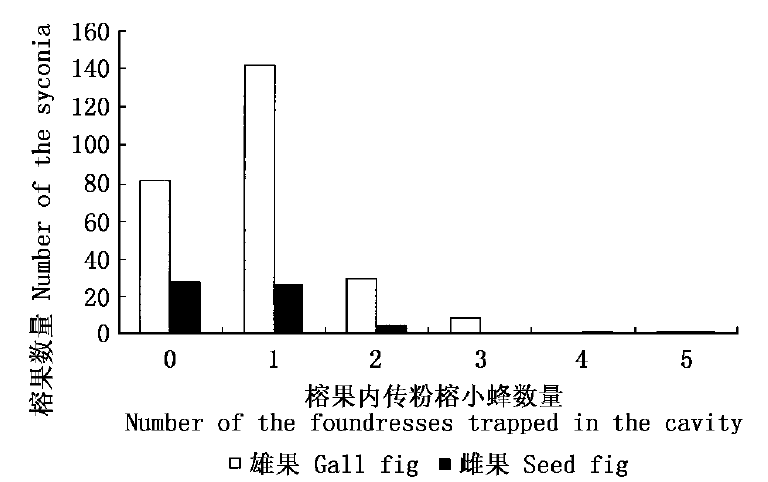
图4 歪叶榕榕果果腔内传粉榕小蜂的数量分布图
Fig.4 The distribution of the number of pollinators trapped in the fig cavity
| [1] |
Bateman AJ (1947). Contamination in seed crops. I. Insect pollination. Journal of Genetics, 48, 257-275.
URL PMID |
| [2] | Bronstein JL (1989). A mutualism at the edge of its range. Experientia, 45, 622-636. |
| [3] | Bronstein JL, Patel A (1992). Causes and consequences of within tree phonological patterns in the Florida strangling fig, Ficus aurea(Moraceae). American Journal of Botany, 79, 41-48. |
| [4] | Chen Y ( 陈勇), Li HQ ( 李宏庆), Ma WL ( 马炜梁) (2002). The reproductive character of Ficus pumilar var. pumilar, Ficus pumilar var. awkeotsang and their pollinators. Acta Phytoecologica Sinica (植物生态学报), 26, 58-63. (in Chinese with English abstract) |
| [5] | Corlett RT (1987). The phenology of Ficus fistulosa in Singapore. Biotropica, 19, 122-124. |
| [6] | Cook JM, Power SA (1996). Effects of within-tree flowering asynchrony on the dynamics of seed and wasp production in an Australia fig species. Journal of Biogeography, 23, 487-493. |
| [7] | Douglas WY, Ridley J, Joussellin E, Herre EA, Compton SG, Cook JM, Moore JC, Weiblen GD (2004). Oviposition strategies host coercion and the stable exploitation of figs by wasps. Proceedings of the Royal Society of London Series B-Biology Science, 767, 1-11. |
| [8] | Galil J, Eisikowitch D (1968). On the pollination ecology of Ficus sycomorus in east Africa. Ecology, 49, 259-269. |
| [9] | Galil J, Zerroni M, Shalom DB (1973). Carbon dioxide and ethylene effects in the coordination between the pollinator Blastophaga quadraticeps and the syconium in Ficus religiosa. New Phytologist, 72, 1113-1127. |
| [10] |
Godt MJW, Hamrick JL (1993). Patterns and levels of pollen-mediated gene flow in Lathyrus latifolius. Evolution, 47, 98-110.
URL PMID |
| [11] | Janzen DH (1979). How to be a fig? Annual Reviews Ecological System, 10, 13-51. |
| [12] | Joussellin E, Kjellberg F (2001). The functional implications of active and passive pollination in dioecious figs. Ecology Letters, 4, 151-158. |
| [13] |
Kjellberg F, Gouyon PH, Ibrahim M, Raymond M, Valdeyron G (1987). The stability of the symbiosis between dioecious figs and their pollinators: a study of Ficus carica L. Evolution, 41, 693-704.
URL PMID |
| [14] | Kjellberg F, Joussellin E, Bronstein JL, Patel A, Yokoyama J, Rasplus JY (2001). Pollination mode in fig wasps:the predictive power of correlated traits. Proceedings of the Royal Society of London Series B-Biology Science, 268, 1-9. |
| [15] |
Kohn JR, Barrett SCH (1992). Experimental studies on the functional significance of heterostyly. Evolution, 46, 43-55.
URL PMID |
| [16] | Patel A (1996). Variation in a mutualism: phenology and the maintenance of gynodioecy in two Indian fig species. Journal of Ecology, 84, 667-680. |
| [17] | Peng YQ ( 彭艳琼), Yang DR ( 杨大荣), Duan ZB ( 段柱标), Deng XB ( 邓晓保) (2005). Reproductive components of Ficus hispida and its pollinators. Acta Phytoecologica Sinica (植物生态学报), 29, 793-798. (in Chinese with English abstract) |
| [18] | Qin JD ( 钦俊德), Wang CZ ( 王琛柱) (2001). The relation of interaction between insects and plants to evolution. Acta Entomologia Sinica (昆虫学报), 44, 360-365. (in Chinese with English abstract) |
| [19] | Spencer H, Weiblen GD, Flick B (1996). Phenology of Ficus variegate in a seasonal wet tropical forest at Cape Tribulation, Australia. Journal of Biogeography, 23, 467-475. |
| [20] | Squillace AE (1967). Effectiveness of 400-foot isolation around a slash pine seed orchard. Journal of Forestry, 65, 823-824. |
| [21] | Weiblen GD, Flick B, Spencer H (1995). Seed set and wasp predation in dioecious Ficus variegata from an Australian wet tropical forest. Biotropica, 27, 391-394. |
| [22] | Weiblen GD (2002). How to be fig wasp? Annual Review of Entomology, 47, 229-330. |
| [23] | Wiebes JT (1976). A short history of fig wasp research. Garden's Bulletin of Straits Settlement, 29, 207-236. |
| [24] | Wiebes JT (1979). Co-evolution of figs and their insect pollinators. Annual Reviews of Ecology and Systematics, 10, 1-12. |
| [25] | Wu ZY, Zhou ZK, Michael GG (2003). Flora of China. In: eFloras Home. Available via DIALOG. http: //www.efloras.org. Cited 9 Oct. 2005. |
| [26] | Xu ZF ( 许再富) (1994). Ficus—a keystone plant species in the tropical rainforest ecosystem of south Yunnan. Chinese Biodiversity (生物多样性), 2, 21-23. (in Chinese with English abstract) |
| [27] | Yang DR ( 杨大荣), Li CD ( 李朝达), Yang B ( 杨兵) (1997). Studies on animal structure and biodiversity on Ficus in the tropical rainforest of Xishuangbanna. Zoological Research (动物学研究), 18, 189-196. (in Chinese with English abstract) |
| [28] | Yang DR ( 杨大荣), Wang RW ( 王瑞武), Song QS ( 宋启示), Zhang GM ( 张光明), Zhao TZ ( 赵庭周) (2000). Rule of seasonal changes of the Ceratosolen sp. in the tropical rainforest of Xishuangbanna, China. Forest Reasearch (林业科学研究), 13, 447-484. (in Chinese with English abstract) |
| [29] | Yang DR, Peng YQ, Song QS, Wang RW (2002). Pollination biology of Ficus hispida in the tropical rainforests of Xishuangbanna China. Acta Botanica Sinica (植物学报), 44, 519-526. |
| [1] | 李孝龙, 周俊, 彭飞, 钟宏韬, Hans LAMBERS. 植物养分捕获策略随成土年龄的变化及生态学意义[J]. 植物生态学报, 2021, 45(7): 714-727. |
| [2] | 李强, 黄迎新, 周道玮, 丛山. 土壤氮磷添加下豆科草本植物生物固氮与磷获取策略的权衡机制[J]. 植物生态学报, 2021, 45(3): 286-297. |
| [3] | 范紫腾, 毋钰灵, 王新菊, 李太强, 高江云. 共生真菌对兰科植物种间杂交后代种子萌发的效应[J]. 植物生态学报, 2019, 43(4): 374-382. |
| [4] | 皮春燕, 刘鑫, 王喆, 包维楷. 苔藓-蓝藻共生体关系与固氮能力研究进展[J]. 植物生态学报, 2018, 42(4): 407-418. |
| [5] | 张亭, 王波, 苗白鸽, 彭艳琼. 榕树隐头花序挥发物组成及其传粉榕小蜂寄主识别行为[J]. 植物生态学报, 2017, 41(5): 549-558. |
| [6] | 盛春玲, 李勇毅, 高江云. 硬叶兰种子的迁地共生萌发及有效共生真菌的分离和鉴定[J]. 植物生态学报, 2012, 36(8): 859-869. |
| [7] | 丑敏霞, 魏新元. 豆科植物共生结瘤的分子基础和调控研究进展[J]. 植物生态学报, 2010, 34(7): 876-888. |
| [8] | 王瑞霞, 何明高, 宋松泉. 培养基与光照对沼兰种子非共生萌发的影响[J]. 植物生态学报, 2010, 34(4): 438-443. |
| [9] | 侯天文, 金辉, 刘红霞, 罗毅波. 实验室条件下五唇兰菌根真菌专一性研究[J]. 植物生态学报, 2010, 34(12): 1433-1438. |
| [10] | 马文娟, 张凤萍, 彭艳琼, 杨大荣. 不同繁育系统的榕树雌花的花柱长度和繁殖率比较[J]. 植物生态学报, 2009, 33(5): 911-918. |
| [11] | 金辉, 许忠祥, 陈金花, 韩素芬, 葛颂, 罗毅波. 铁皮石斛组培苗与菌根真菌共培养过程中的相互作用[J]. 植物生态学报, 2009, 33(3): 433-441. |
| [12] | 张凤萍, 彭艳琼, 杨大荣. 钝叶榕果实内繁殖的两种榕小蜂与寄主榕树间的协同进化[J]. 植物生态学报, 2008, 32(4): 768-775. |
| [13] | 魏宇昆, 高玉葆. 禾草内生真菌的遗传多样性及其共生关系[J]. 植物生态学报, 2008, 32(2): 512-520. |
| [14] | 徐法健, 陈国华, 彭艳琼, 谢晓波, 杨大荣. 非传粉小蜂对榕-蜂共生系统的影响[J]. 植物生态学报, 2007, 31(5): 969-975. |
| [15] | 李苏梅, 龙春林, 刀志灵. 传统农业生态系统中桤木改良土壤效应研究综述[J]. 植物生态学报, 2006, 30(5): 878-886. |
| 阅读次数 | ||||||
|
全文 |
|
|||||
|
摘要 |
|
|||||
Copyright © 2026 版权所有 《植物生态学报》编辑部
地址: 北京香山南辛村20号, 邮编: 100093
Tel.: 010-62836134, 62836138; Fax: 010-82599431; E-mail: apes@ibcas.ac.cn, cjpe@ibcas.ac.cn
备案号: 京ICP备16067583号-19

