
植物生态学报 ›› 2009, Vol. 33 ›› Issue (3): 535-545.DOI: 10.3773/j.issn.1005-264x.2009.03.012 cstr: 32100.14.j.issn.1005-264x.2009.03.012
所属专题: 生态系统碳水能量通量
孙晓新, 牟长城( ), 石兰英, 程伟, 刘霞, 吴云霞, 冯登军
收稿日期:2008-08-20
接受日期:2009-02-02
出版日期:2009-08-20
发布日期:2009-05-31
作者简介:*E-mail: mccnefu@yahoo.com基金资助:
SUN Xiao-Xin, MU Chang-Cheng(), SHI Lan-Ying, CHENG Wei, LIU Xia, WU Yun-Xia, FENG Deng-Jun
Received:2008-08-20
Accepted:2009-02-02
Online:2009-08-20
Published:2009-05-31
摘要:
利用静态箱-气相色谱法, 对小兴安岭5种森林沼泽生长季甲烷 (CH4) 排放通量进行研究, 并探讨了温度、地下水位和植被等主要环境因子对CH4排放的影响。结果表明:毛赤杨 (Alnus sibirica) 沼泽、落叶松 (Larix gmelinii) -藓类 (Moss) 沼泽和落叶松-泥炭藓 (Sphagnum spp.) 沼泽的CH4排放有明显的季节变化规律, 而白桦 (Betula platyphylla) 沼泽和落叶松-苔草 (Carex schmidtii) 沼泽CH4通量的季节变化相对较小。落叶松-泥炭藓沼泽有爆发式CH4通量现象出现, 对生长季CH4排放通量影响较大。在生长季内落叶松-泥炭藓沼泽、毛赤杨沼泽和白桦沼泽为大气CH4的源, 而落叶松-苔草沼泽和落叶松-藓类沼泽为大气CH4的汇, 生长季CH4的平均排放通量分别为 (56.08±200.38) 、 (15.34±14.89) 、 (0.64±0.88) 、 (-0.88±1.76) 和 (-0.94±3.00) mg·m-2·d-1。除落叶松-泥炭藓沼泽外, 不同森林沼泽类型间CH4排放通量随地下水位升高而增大;地下水位在-34.5~-30.8cm之间可能存在CH4源与汇的临界点, 季节平均地下水位低于这一位置的森林沼泽为大气CH4的汇。温度对森林沼泽CH4通量的影响比较复杂, 二者间可能为正或负的显著 (p<0.05) 或非显著 (p>0.05) 相关关系。CH4通量与乔木地上生物量有较强的负相关性, 这有可能成为小兴安岭森林沼泽CH4通量的最佳预测因子。
孙晓新, 牟长城, 石兰英, 程伟, 刘霞, 吴云霞, 冯登军. 小兴安岭森林沼泽甲烷排放及其影响因子. 植物生态学报, 2009, 33(3): 535-545. DOI: 10.3773/j.issn.1005-264x.2009.03.012
SUN Xiao-Xin, MU Chang-Cheng, SHI Lan-Ying, CHENG Wei, LIU Xia, WU Yun-Xia, FENG Deng-Jun. METHANE EMISSION FROM FORESTED SWAMPS IN XIAOXING’AN MOUNTAINS, NORTHEASTERN CHINA. Chinese Journal of Plant Ecology, 2009, 33(3): 535-545. DOI: 10.3773/j.issn.1005-264x.2009.03.012
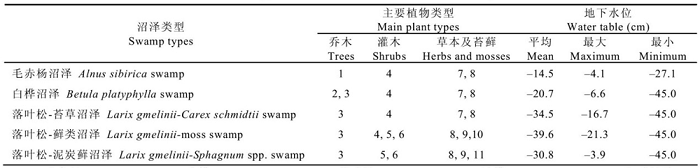 |
表1 森林沼泽类型及其基本特征
Table 1 Types and characteristics of forested swamps
| |
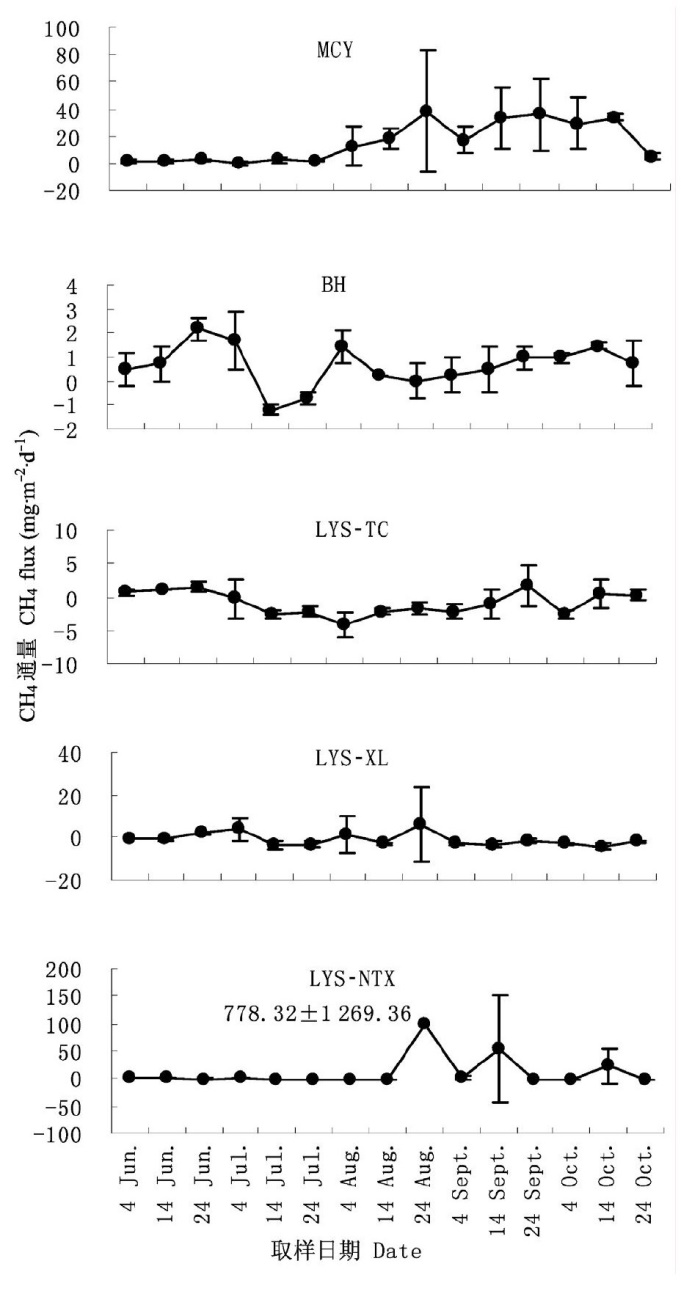
图1 森林沼泽CH4通量的季节变化规律 MCY:毛赤杨沼泽Alnus sibirica swamp BH:白桦沼泽Betula platyphylla swamp LYS-TC:落叶松-苔草沼泽Larix gmelinii-Carex schmidtii swamp LYS-XL:落叶松-藓类沼泽Larix gmelinii-moss swamp LYS-NTX:落叶松-泥炭藓沼泽Larix gmelinii-Sphagnum spp.swamp排放值超出图内的纵坐标时, 直接在图上列出具体数值Values outside of the scale of the figure are given as text on the plot
Fig.1 Seasonal variations of CH4 flux in different forested swamps
 |
表2 生长季平均CH4排放通量 (平均值±标准偏差)
Table 2 Mean CH4 flux during growing season (mean±SD)
| |
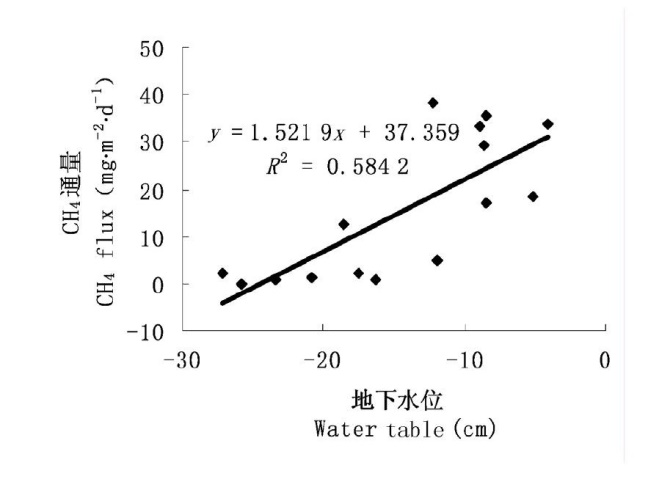
图2 毛赤杨沼泽CH4通量与地下水位的关系
Fig.2 Correlation between CH4 flux and water table of Alnus sibirica swamp
 |
表3 CH4通量与土壤/泥炭温度关系
Table 3 Correlation between CH4 flux and soil/peat temperature
| |
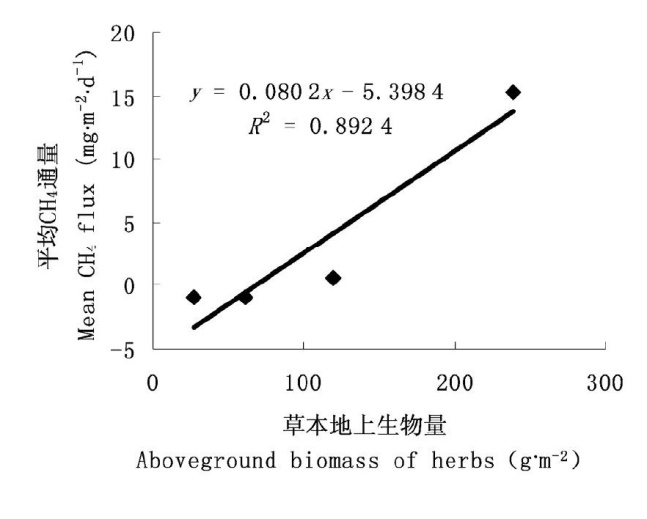
图3 平均CH4通量与草本地上生物量之间的关系
Fig.3 Correlations between mean CH4 flux and above-ground biomass of herbs
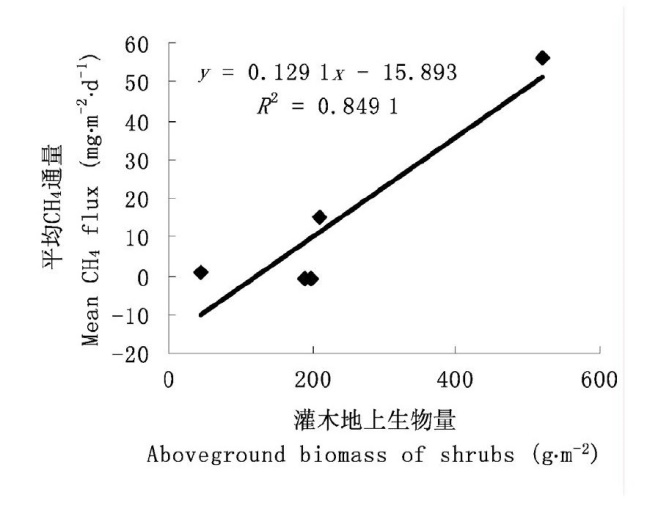
图4 平均CH4通量与灌木地上生物量之间的关系
Fig.4 Correlations between mean CH4 flux and above-ground biomass of shrub
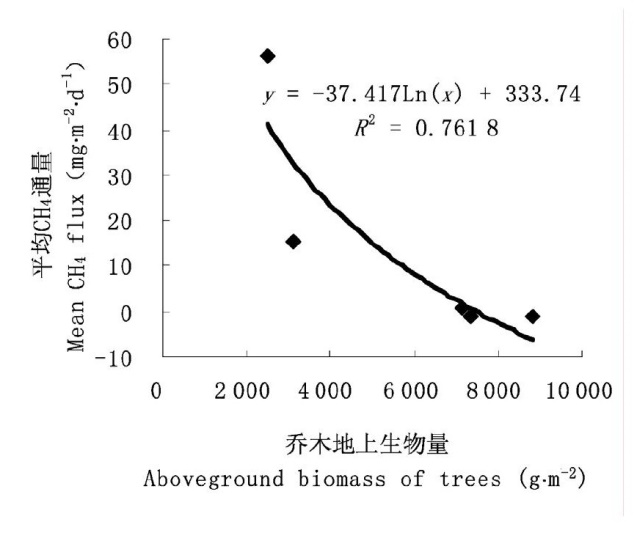
图5 平均CH4通量与乔木生物量之间的关系
Fig.5 Correlation between mean CH4 flux and above-ground biomass of tree
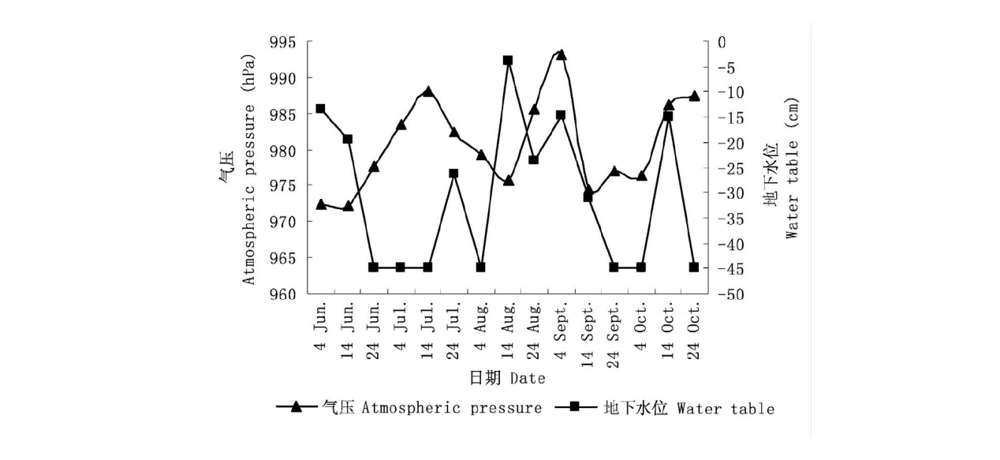
图6 落叶松-泥炭藓沼泽气压和地下水位的季节变化规律
Fig.6 Seasonal variations of atmospheric pressure and water table of Larix gmelinii-Sphagnum swamp
| [1] |
Bellisario LM, Bubier JL, Moore TR, Chanton JP (1999). Controls on CH4emissions from a northern peatland. Global Biogeochemical Cycles, 13,81-91.
DOI URL |
| [2] |
Brix H, Sorrell BK, Lorenzen B (2001). Are Phrag-mites-dominated wetlands a net source or net sink of greenhouse gases? Aquatic Botany, 69,313-324.
DOI URL |
| [3] |
Bubier JL, Moore TR (1994). An ecological perspective on methane emission from northern wetlands. Trends in Ecology and Evolution, 9,460-464.
DOI URL |
| [4] | Bubier JL, Moore TR, Bellisario LM, Comer NT, Crill PM (1995). Ecological controls on methane emission from a northern peatland complex in the zone of discon-tinuous permafrost, Manitoba, Canada. Global Bio-geochemical Cycles, 9,455-470. |
| [5] |
Ding WX, Cai ZC, Tsuruta H, Li XP (2002). Effect of standing water depth on methane emissions from freshwater marshes in northeast China. Atmospheric Environment, 36,5149-5157.
DOI URL |
| [6] |
Ding WX, Cai ZC, Tsuruta H, Li XP (2003). Key factors affecting spatial variation of methane emissions from freshwater marshes. Chemosphere, 51,167-173.
DOI URL |
| [7] |
Ding WX, Cai ZC, Wang DX (2004). Preliminary budget of methane emissions from natural wetlands in China. Atmospheric Environment, 38,751-759.
DOI URL |
| [8] |
Duan XN, Wang XK, Mu YJ, Ouyang ZY (2005). Seasonal and diurnal variations in methane emissions from Wuliangsu Lake in arid regions of China. Atmospheric Environment, 39,4479-4487.
DOI URL |
| [9] |
Harriss RC, Sebacher DI, Day FP (1982). Methane flux in the great Dismal swamp. Nature, 297,673-674.
DOI URL |
| [10] | Hirota M, Tang YH, Hu QW, Hirata S, Kato T, Mo WH, Cao GM, Mariko S (2004). Methane emissions from different vegetation zones in a Qinghai-Tibetan Plateau wetland. Soil Biology&Biochemistry, 36,737-748. |
| [11] | Huang GH (黄国宏), Xiao DN (肖笃宁), Li YX (李玉祥), Chen GX (陈冠雄), Yang YC (杨玉成), Zhao CW (赵长伟) (2001). CH4emission from the reed wetland. Acta Ecologica Sinica (生态学报), 21,1494-1497. (in Chinese with English abstract) |
| [12] | Intergovernmental Panel on Climate Change IPCC (2007). Contribution of Working Group I to the fourth assess-ment report of the intergovernmental panel on climate change.In:Solomo SD, Qin D, Manning M, Chen Z, Marquis M, Averyt KB, Tignor M, Miller HL eds. Climate Change in2007:The Physical Science Basis. Cambridge University Press. Cambridge, UK. |
| [13] |
Jauhiainen J, Takahashi H, Heikkinen JEP, Martikainen P, Vasander H (2005). Carbon fluxes from a tropical peat swamp forest floor. Global Change Biology, 11,1788-1797.
DOI URL |
| [14] | Jin HJ (金会军), Wu J (吴杰), Cheng GD (程国栋), Nakano T (中野智子), Sun GY (孙广友) (1999). Methane emissions from wetlands on the Qinghai-Tibetan Pla-teau. Chinese Science Bulletin (科学通报), 44,1758-1762. (in Chinese) |
| [15] |
Kang H, Freeman C (2002). The influence of hydrochemis-try on methane emissions from two contrasting north-ern wetlands. Water, Air, and Soil Pollution, 141,263-272.
DOI URL |
| [16] | Lang HQ (郎惠卿) (1999). Wetland Vegetation in China (中国湿地植被). Science Press, Beijing, 35-74. (inChinese). |
| [17] | Lelieveld J, Crutzen P, Dentener FJ (1998). Changing con-centration, lifetime and climate forcing of atmosphericmethane. Tellus, 50B,128-150. |
| [18] | Liu XT (刘兴土), Lü XG (吕宪国), Zhao KY (赵魁义) (2007). Wetlands resource and restoration.In:Li WH (李文华) ed. Important Consultation Item of ChineseAcademy of Engineering:Several Stratagem Issues About Water and Soil Resource Configure, Environ-ment Protection, and Sustainable Development in Northeast, China-Volume of Forest:Forest and Wet-lands Restoration and Stratagem of Forest Develop-ment in Northeast, China (东北地区有关水土资源配制、生态与环境保护和可持续发展的若干战略问题研究-林业卷:东北地区森林与湿地保育及林业发展战略研究), Science Press, Beijing,409-449. (in Chi-nese). |
| [19] | Lu CY (卢昌义), Ye Y (叶勇), Huang YS (黄玉山), Tan FY (谭凤仪) (2000). Methane fluxes from mangrove communities at Dongzhai harbour, Hainan. Acta Phy-toecologica Sinica (植物生态学报), 24,87-90. (in Chinese with English abstract) |
| [20] | Mathews E, Fung I (1987). Methane emission from naturawetlands:global distribution, area and environmenta characteristics of sources. Global Biogeochemical Cy-cles, 1,61-86. |
| [21] | Mattson MD, Likens GE (1990). Air pressure and methanefluxes. Nature, 347,718-719. |
| [22] | Megonigal JP, Schlesinger WH (2002). Methane-limitedmethanotrophy in tidal freshwater swamps. GlobalBiogeochemical Cycles, 16,1088-1098. |
| [23] | Melling L, Hatano R, Kah JG (2005). Methane fluxes from three ecosystems in tropical peatland of Sarawak, Ma-laysia. Soil Biology&Biochemistry, 37,1445-1453. |
| [24] | Moore TR, Knowles R (1990). Methane emission from fen, bog and swamp peatlands in Quebec. Biogeochemistry, 11,45-61. |
| [25] |
Moore TR, Roulet NT (1993). Methane flux:water table relations in northern wetlands. Geophysical Research Letters, 20,587-590.
DOI URL |
| [26] |
Morrissey LA, Livingston GP (1992). Methane emissions from Alaska Arctic Tundra:an assessment of local spatial variability. Journal of Geophysical Research, 97,16661-16670.
DOI URL |
| [27] |
Pulliam WM (1993). Carbon dioxide and methane exports from a southeastern floodplain swamp. Ecological Monographs, 63,29-53.
DOI URL |
| [28] | Rask H, Schoenau J, Anderson D (2002). Factors influenc-ing methane flux from a boreal forest wetland in Sas-katchewan, Canada. Soil Biology&Biochemistry, 34,435-443. |
| [29] |
Saarnio S, Alm J, Silvola J, Lohila A, Nykänen H, Marti-kainen PJ (1997). Seasonal variation in CH4emissions and production and oxidation potentials at microsite on an oligotrophic pine fen. Oecologia, 110,414-422.
DOI PMID |
| [30] | Scott KJ, Kelly CA, Rudd JWM (1999). The importance of floating peat to methane fluxes from flooded peatlands. Biogeochemistry, 47,187-202. |
| [31] |
Segers R (1998). Methane production and methane con-sumption―a review of processes underlying wetland methane fluxes. Biogeochemistry, 41,23-51.
DOI URL |
| [32] |
Spahni R, Chappellaz J, Stocker TF, Loulergue L, Hausammann G, Kawamura K, Flückiger J, Schwander J, Raynaud D, Massin-Delmotte V, Jouzel J (2005). Atmospheric methane and nitrous oxide of the late Pleistocene from Antarctic ice cores. Science, 310,1317-1321.
DOI URL |
| [33] | Song CC (宋长春), Wang YY (王毅勇), Wang YS (王跃思), Zhao ZC (赵志春) (2006). Character of the greenhouse gas emission in the freshwater mire under human activities. Scientia Geographica Sinica (地理科学), 26,82-86. (in Chinese with English abstract) |
| [34] | Song CC (宋长春), Yan BX (阎百兴), Wang YS (王跃思), Wang YY (王毅勇), Lou YJ (娄彦景), Zhao ZC (赵志春) (2003). Fluxes of carbon dioxide and methane from swamp and impact factors in Sanjiang Plain, China. Chinese Science Bulletin (科学通报), 48,2473-2477. (in Chinese) |
| [35] | Sugimoto A, Fujita N (1997). Characteristics of methane emission from different vegetations on a wetland. Tel-lus, 49B,382-392. |
| [36] | Van der Pol-van Dasselaar A, van Beusichem ML Oenema O (1999). Determinants of spatial variability of meth-ane emissions from wet grasslands on peat soil. Bio-geochemistry, 44,221-237. |
| [37] | Vann CD, Megoniga JP (2003). Elevated CO2and water depth regulation of methane emissions:comparison of woody and non-woody wetland plant species. Biogeo-chemistry, 63,117-134. |
| [38] |
Wang YS, Wang YH (2003). Quick measurement of CO2, CH4and N2O emissions from a short-plant ecosystem. Advances in Atmospheric Sciences, 20,842-844.
DOI URL |
| [39] | Wang YS (王跃思) (2004). Chamber methods for measur-ing carbon exchange.In:Chen PQ (陈泮勤) ed. Carbon Circling in Earth System (地球系统碳循环). Sci-ence Press, Beijing, 130-145. (in Chinese) |
| [40] |
Wang ZP, Han XG, Li LH (2006). Methane emission patches in riparian marshes of the Inner Mongolia. Atmospheric Environment, 40,5528-5532.
DOI URL |
| [41] |
Whiting GJ, Chanton JP (1993). Primary production control of methane emission from wetlands. Nature, 364,794-795.
DOI URL |
| [42] |
Wilson JO, Crill PM, Bartlett KB, Sebacher DI, Harriss RC, Sass RL (1989). Seasonal variation of methane emis-sion from temperate swamp. Biogeochemistry, 8,55-71.
DOI URL |
| [43] |
Windsor J, Moore TR, Roulet NT (1992). Episodic fluxes of methane from subarctic fens. Canadian Journal of Soil Science, 72,441-452.
DOI URL |
| [44] |
Yang JS (杨继松), Li JS (刘景双), Wang JD (王金达), Yu JB (于君宝), Sun ZG (孙志高), Li XH (李新华) (2006). Emissions of CH4and N2O from wetland in the Sanjiang Plain. Journal of Plant Ecology (Chinese Version) (植物生态学报), 30,432-440. (in Chinese with English abstract)
DOI |
| [1] | 吴光进, 郭垚鑫, 任成杰, 王俊, 岳明, 赵发珠. 秦岭北麓不同植被类型土壤有机碳含量分布及其影响因素[J]. 植物生态学报, 2026, 50(预发表): 1-. |
| [2] | 张静, 陈洁, 李艳朋, 盘李军, 许涵, 李意德, 何海生. 南亚热带针阔混交人工林植物生物量比较及其影响因子分析[J]. 植物生态学报, 2026, 50(2): 400-416. |
| [3] | 徐恩相, 周蕾, 章晓炜, 张国萍, 仲杜伟, 黄智, 刘派, 迟永刚. 基于不同生育阶段冠层光谱和碳通量的水稻产量估算[J]. 植物生态学报, 2026, 50(1): 82-93. |
| [4] | 张健, 孙慕梵, 宋坤, 赖丽茗, 宋永昌. 基于生态外貌-植物区系分类系统的中国常绿阔叶林分类修订[J]. 植物生态学报, 2026, 50(1): 107-122. |
| [5] | 张琳, 袁伟影, 宋创业, 吴冬秀. 1998-2010年中国典型生态系统长期监测样地环境要素、物种丰富度和生物量动态数据集[J]. 植物生态学报, 2025, 49(8): 1182-1190. |
| [6] | 严文秀, 赵诗晗, 郑春燕, 张萍, 沈海花, 常锦峰, 徐亢. 基于多物候指标的人工饲草长势监测及产量估测[J]. 植物生态学报, 2025, 49(7): 1096-1109. |
| [7] | 杜燕, 刘鑫, 张瀚曰, 马少伟, 包维楷. 中国高山松群系的群落特征[J]. 植物生态学报, 2025, 49(6): 816-824. |
| [8] | 熊高明, 申国珍, 赵常明, 徐文婷, 王杨, 谢宗强, 李家湘, 徐耀粘, 李跃林, 陈芳清. 中国檵木灌丛植被类型及群落特征[J]. 植物生态学报, 2025, 49(6): 875-887. |
| [9] | 惠城阳, 章巧依, 刘腾腾, 刘维勇, 周丽娜, 金鑫杰, 张永华, 刘金亮. 温州大罗山主要植被类型及物种组成特征[J]. 植物生态学报, 2025, 49(6): 990-998. |
| [10] | 曹毅, 张松林, 王旭峰, 杨安昌, 任敏慧, 杨浩, 韩超. 兰州市南北两山植物群落数据集[J]. 植物生态学报, 2025, 49(6): 975-989. |
| [11] | 熊高明, 申国珍, 徐文婷, 谢宗强, 李跃林, 徐耀粘, 陈芳清, 李家湘. 中国低山丘陵热性常绿阔叶灌丛主要类型及群落特征[J]. 植物生态学报, 2025, 49(6): 865-874. |
| [12] | 李家湘, 刘文倩, 蒋国平, 赵丽娟, 徐永福, 吴磊, 喻勋林. 植被科学画符号系统设计和标准化绘图范式——以森林群落剖面图为例[J]. 植物生态学报, 2025, 49(6): 897-910. |
| [13] | 李欣怡, 张丽芳, 吴友贵, 郭静, 兰荣光, 吕洪飞, 于明坚. 不同海拔高度下百山祖冷杉幼苗的生长特征及其影响因素[J]. 植物生态学报, 2025, 49(4): 610-623. |
| [14] | 刘柯言, 韩璐, 宋午椰, 张初蕊, 胡旭, 许行, 陈立欣. 基于日光诱导叶绿素荧光探测干旱对黄土高原植被光合稳定性的影响[J]. 植物生态学报, 2025, 49(3): 415-431. |
| [15] | 葛小彩, 李锦隆, 孙俊, 武盼盼, 胡丹丹, 程栋梁, 钟全林. 武夷山亚高山草甸土壤呼吸组分特征及影响因素[J]. 植物生态学报, 2025, 49(3): 502-512. |
| 阅读次数 | ||||||
|
全文 |
|
|||||
|
摘要 |
|
|||||
Copyright © 2026 版权所有 《植物生态学报》编辑部
地址: 北京香山南辛村20号, 邮编: 100093
Tel.: 010-62836134, 62836138; Fax: 010-82599431; E-mail: apes@ibcas.ac.cn, cjpe@ibcas.ac.cn
备案号: 京ICP备16067583号-19

