
植物生态学报 ›› 2009, Vol. 33 ›› Issue (3): 546-554.DOI: 10.3773/j.issn.1005-264x.2009.03.013 cstr: 32100.14.j.issn.1005-264x.2009.03.013
徐洋1,2, 刘文治1, 刘贵华1,*( )
)
收稿日期:2008-07-02
接受日期:2009-02-09
出版日期:2009-07-02
发布日期:2009-05-31
作者简介:*E-mail: liugh@rose.whiob.ac.cn基金资助:
XU Yang1,2, LIU Wen-Zhi1, LIU Gui-Hua1,*()
Received:2008-07-02
Accepted:2009-02-09
Online:2009-07-02
Published:2009-05-31
摘要:
研究了物种库限制与生态位限制在湖滨湿地植物分布格局形成过程中的相对重要性。在龙感湖湖滨湿地具有明显水位梯度的湿生植 物区、挺水植物区和沉水植物区采集种子库土样, 采用幼苗萌发法确定了不同水位区种子库的物种成分;并将不同水位区的种子库土样分别置于0、25和50cm3个水位下萌发和生长, 45和90d后比较不同取样区种子库在不同水位处理下所建立的植物群落的异同。结果表明, 不同取样区的种子库物种成分有显著差异, 沿水深梯度呈现明显的带状分布格局。水位处理实验表明, 0cm水位条件下的群落主要由湿生植物和挺水植物组成, 而25和50cm水位下只有沉水植物, 表明不同功能群的物种对水深有不同的耐受力, 生态位限制是决定湿地植物分布格局的关键因子。同时, 挺水植物区的种子库置于沉水条件下, 以及沉水植物区的种子库置于0cm水位下都只能形成极为简单的植物群落, 表明物种库限制对湿地植物群落的形成同样具有显著影响。研究表明, 湿地植物的群落构成与分布格局是由生态位限制和物种库限制共同决定的, 两者的相对重要性可能取决于水体的稳定性。
徐洋, 刘文治, 刘贵华. 生态位限制和物种库限制对湖滨湿地植物群落分布格局的影响. 植物生态学报, 2009, 33(3): 546-554. DOI: 10.3773/j.issn.1005-264x.2009.03.013
XU Yang, LIU Wen-Zhi, LIU Gui-Hua. PLANT DISTRIBUTION IN FRESHWATER LAKESHORE: RELATIVE IMPORTANCE OF SPECIES POOL LIMITATION VS. NICHE LIMITATION. Chinese Journal of Plant Ecology, 2009, 33(3): 546-554. DOI: 10.3773/j.issn.1005-264x.2009.03.013
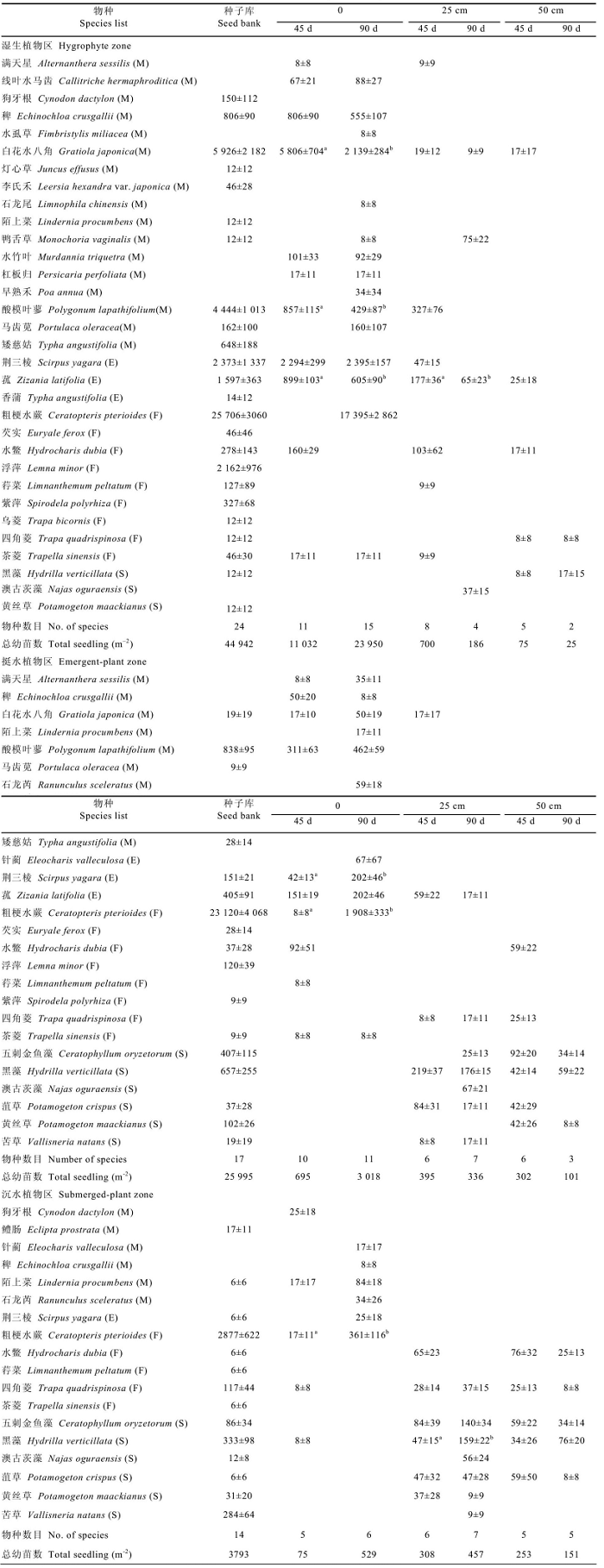 |
表1 不同取样区的种子库经3种水位处理45和90 d后群落的物种成分 (平均种子密度±标准误)
Table 1 Mean seed density of seed banks collected at three water level zones and germinated at 45 and 90 d under three water depth treatments (mean±SE)
| |
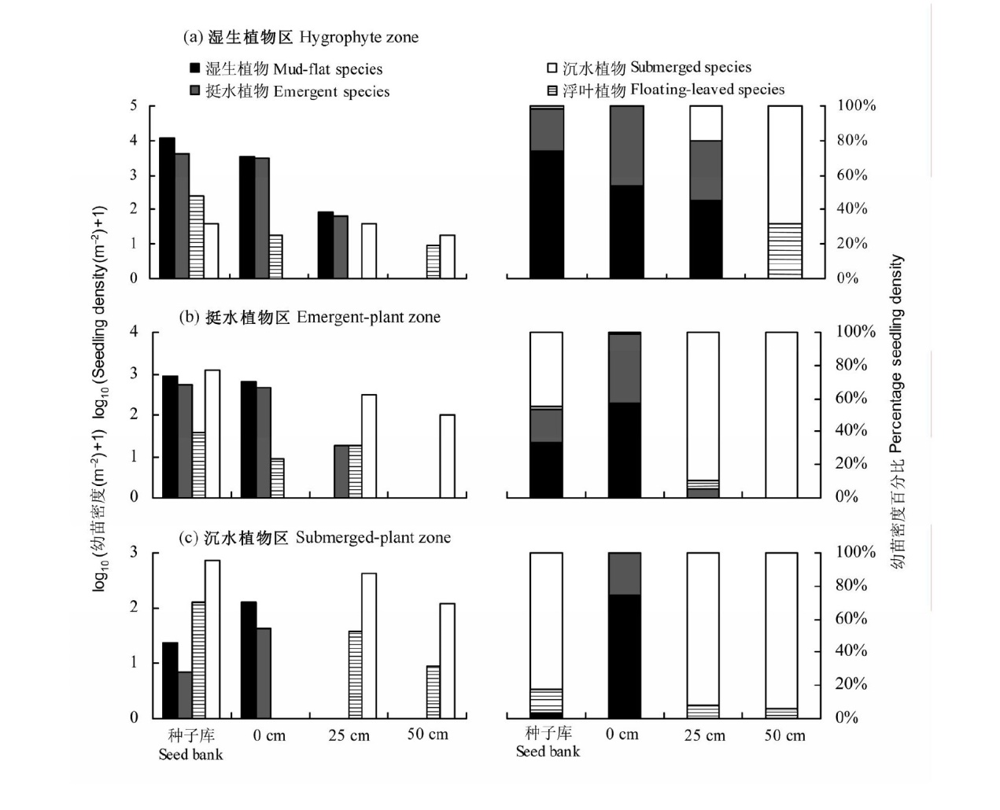
图1 不同取样区的种子库及其经3个水位处理90 d后建成群落的功能群构成
Fig.1 Composition of functional group of seed banks or seedlings germinating in three water depth treatments at 90th day from soils collected at three water level zones
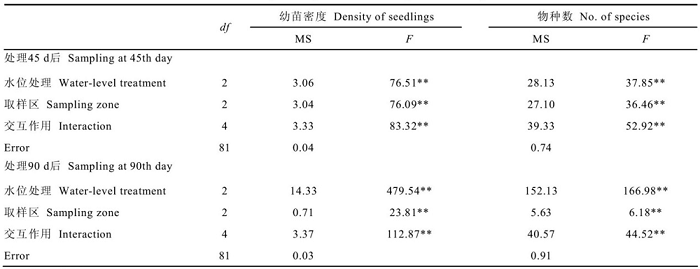 |
表2 水位处理45和90 d后萌发幼苗的密度和物种数的方差分析检验
Table 2 Statistical results from the ANOVA testing the difference of water level treatment and sampling site in the number of seedlings and species at 45th day and 90th day
| |
| [1] |
Abernethy VJ, Willby NJ (1999). Changes along a disturbance gradient in the density and composition of propagule banks in floodplain aquatic habitats. Plant Ecology, 140,177-190.
DOI URL |
| [2] |
Boedeltje G, ter Heerdt GNJ, Bakker JP (2002). Applying the seedling-emergence method under waterlogged conditions to detect the seed bank of aquatic plants in submerged sediments. Aquatic Botany, 72,121-128.
DOI URL |
| [3] |
Casanova MT, Brock MA (2000). How do depth, duration and frequency of flooding influence the establishment of wetland plant communities? Plant Ecology, 147,237-250.
DOI URL |
| [4] |
Ehrlen J, Munzbergova Z, Diekmann M, Eriksson O (2006). Long-term assessment of seed limitation in plants:re-sults from an11-year experiment. Journal of Ecology, 94,1224-1232.
DOI URL |
| [5] |
Eriksson O, Ehrlen J (1992). Seed and microsite limitation of recruitment in plant populations. Oecologia, 91,360-364.
DOI PMID |
| [6] |
Foster BL, Tilman D (2003). Seed limitation and the regu-lation of community structure in oak savanna grass-land. Journal of Ecology, 91,999-1007.
DOI URL |
| [7] |
Galinato MI, van der Valk AG (1986). Seed germination traits of annual sand emergents recruited during draw-downs in the Delta Marsh, Manitoba, Canada. Aquatic Botany, 26,89-102.
DOI URL |
| [8] |
Grace JB (1989). Effects of water depth on Typha latifolia and Typha domingensis. American Journal of Botany, 76,762-768.
DOI URL |
| [9] |
Grime JP (1977). Evidence for the existence of three pri-mary strategies in plants and its relevance to ecological and evolutionary theory. American Naturalist, 111,1169-1194.
DOI URL |
| [10] | Grime JP (1988). The C-S-R model of primary plant strate-gies—Origins, implications and tests.In:Jain SK ed.Plant Evolutionary Biology. Chapman&Hall, London,371-393. |
| [11] |
Harwell MC, Havens KE (2003). Experimental studies on the recovery potential of submerged aquatic vegetation after flooding and dessication in a large subtropical lake. Aquatic Botany, 77,135-151.
DOI URL |
| [12] |
Keddy PA (1989). Effects of competition from shrubs onherbaceous wetland plants:a4-year field experiment Canadian Journal of Botany, 67,708-716.
DOI URL |
| [13] |
Keddy PA, Reznicek AA (1982). The role of seed banks in the persistence of Ontario’s coastal plain flora. American Journal of Botany, 69,13-22.
DOI URL |
| [14] |
Leck MA, Simpson RL (1994). Tidal freshwater wetland zonation:seed and seedling dynamics. Aquatic Botany, 47,61-75.
DOI URL |
| [15] | Liu GH, Li W, Li EH, Yuan LY, Davy AJ (2006a). Landscape-scale variation in seed banks of floodplain wetlands with contrasting hydrology in China. FreshwateBiology, 51,1862-1878. |
| [16] |
Liu GH, Li W, Zhou J, Liu WZ, Yang D, Davy AJ (2006b). How does the propagule bank contribute to cyclicvegetation change in a lakeshore marsh with seasonal drawdown? Aquatic Botany, 84,137-143.
DOI URL |
| [17] | Liu GH (刘贵华), Wang HY (王海洋), Zhou J (周进), Guo YH (郭友好) (2001). Spatial distribution and niche analysis of dominant species at the Oryza rufipogon Reserve in Chaling, Hunan. Acta Phytoecologica Sinica (植物生态学报), 25,65-70. (in Chinese with English abstract) |
| [18] |
Makana JR, Thomas SC (2004). Dispersal limits natural recruitment of African mahoganies. Oikos, 106,67-72.
DOI URL |
| [19] |
Maron JL, Gardner SN (2000). Consumer pressure, seed versus safe-site limitation, and plant population dy-namics. Oecologia, 124,260-269.
DOI PMID |
| [20] |
Pennings SC, Callaway RM (1992). Salt marsh plant zona-tion:the relative importance of competition and physical factors. Ecology, 73,681-690.
DOI URL |
| [21] | Pennings SC, Grant MB, Bertness MD (2005). Plant zona-tion in low-latitude salt marshes:disentangling theroles of flooding, salinity and competition. Journal ofEcology, 93,159-167. |
| [22] | Pennings SC, Moore DJ (2001). Zonation of shrubs in western Atlantic salt marshes. Oecologia, 126,87-594. |
| [23] |
Silvertown JW, Dodd ME, Gowing DJG, Mountford JO (1999). Hydrologically defined niches reveal a basis for species richness in plant communities. Nature, 400,61-63.
DOI URL |
| [24] |
Smith LM, Kadlec JA (1983). Seed banks and their role during drawdown of a North American marsh. Journal of Applied Ecology, 20,673-684.
DOI URL |
| [25] | Spence DHN (1982). The zonation of plants in freshwater lakes. Advances in Ecological Research, 12,37-125. |
| [26] | Thompson K (1978). The occurrence of buried viable seeds in relation to environmental gradients. Journal of Bi-ology, 5,425-430. |
| [27] |
Tilman D (1997). Community invasibility, recruitment limitation, and grassland biodiversity. Ecology, 78,81-92.
DOI URL |
| [28] |
van der Valk AG, Davis CB (1978). The role of seed banks in the vegetation dynamics of prairie glacial marshes. Ecology, 59,322-335.
DOI URL |
| [29] | Wang HY (王海洋), Chen JK (陈家宽), Zhou J (周进) (1999). Influence of water level gradient on plant growth, reproduction and biomass allocation of wet-land plant species. Acta Phytoecologica Sinica (植物生态学报), 23,269-274. (in Chinese with English ab-stract). |
| [30] |
Wilson SD, Keddy PA (1986a). Measuring diffuse competi-tion along an environmental gradient:results from a shoreline plant community. American Naturalist, 127,862-869.
DOI URL |
| [31] |
Wilson SD, Keddy PA (1986b). Species competitive ability and position along a natural stress/disturbance gradi-ent. Ecology, 67,1236-1242.
DOI URL |
| [32] |
Yuan LY, Liu GH, Li W, Li EH (2007). Seed bank variation along a water depth gradient in a subtropical lakeshore marsh, Longgan Lake, China. Plant Ecology, 189,127-137.
DOI URL |
| [33] |
Zobel K, Zobel M, Peet R (1993). Change in pattern diver-sity during secondary succession in Estonian forests. Journal of Vegetation Science, 4,489-498.
DOI URL |
| [34] |
Zobel M, Otsus M, Liira J, Moora M, Mols T (2000). Is small-scale species richness limited by seed availabil-ity or microsite availability? Ecology, 81,3274-3282.
DOI URL |
| [1] | 赵珮杉, 高广磊, 丁国栋, 张英. 林龄和生态位对樟子松人工林地下真菌群落构建的影响[J]. 植物生态学报, 2025, 49(9): 1472-1484. |
| [2] | 李冬梅, 孙龙, 韩宇, 胡同欣, 杨光, 蔡慧颖. 计划火烧对红松人工林生物多样性与生态系统多功能性关系的影响[J]. 植物生态学报, 2025, 49(3): 379-392. |
| [3] | 王雅轩, 王倩, 林倩缇, 张亦嘉, 郑敏, 顾延生. 神农架大九湖6种草本植物叶解剖结构性状对不同水分生境的响应[J]. 植物生态学报, 2025, 49(12): 2149-2165. |
| [4] | 刘洋, 刘傲, 宋璇紫, 杨云, 安柏衡, 韩梦姣, 班玛才格尔, 米玛旺堆. 高原鼠兔干扰对高寒草甸主要植物生态位及种间联结的影响[J]. 植物生态学报, 2025, 49(12): 2054-2068. |
| [5] | 郑立媛, 徐茜竹, 尹嘉淇, 孙小雯, 王艳. 城郊近河退耕地野大豆群落生态位和种间联结[J]. 植物生态学报, 2025, 49(10): 1685-1697. |
| [6] | 张辉, 赵赟鹏, 刘晓琛, 郭增鹏, 胡国瑞, 冯彦皓, 马妙君. 高寒草甸退化过程中土壤种子库的变化及其在植物群落更新中的潜在作用[J]. 植物生态学报, 2025, 49(1): 74-82. |
| [7] | 周红娟, 刘子赫, 刘柯言, 张初蕊, 胡旭, 韩璐, 陈立欣. 不同降雨条件下北京土石山区混生乔灌植物的水分吸收和生态位特征[J]. 植物生态学报, 2024, 48(9): 1089-1103. |
| [8] | 杜忠毓, 王佳, 陈光才. 土壤种子库特征对全球变化和人类活动的响应: 研究进展与展望[J]. 植物生态学报, 2024, 48(12): 1561-1575. |
| [9] | 冉松松, 余再鹏, 万晓华, 傅彦榕, 邹秉章, 王思荣, 黄志群. 邻域树种多样性对杉木叶片氮磷生态化学计量比的影响[J]. 植物生态学报, 2023, 47(7): 932-942. |
| [10] | 胡昭佚, 陈天松, 赵丽, 许培轩, 吴正江, 董李勤, 张昆. 水位下降对若尔盖高寒草本沼泽木里薹草氮磷重吸收的影响[J]. 植物生态学报, 2023, 47(6): 847-855. |
| [11] | 祝维, 周欧, 孙一鸣, 古丽米热·依力哈木, 王亚飞, 杨红青, 贾黎明, 席本野. 混交林内毛白杨和刺槐根系吸水的动态生态位划分[J]. 植物生态学报, 2023, 47(3): 389-403. |
| [12] | 杨玲, 梁思琪, 潘佳明, 韦金鑫, 丁涛, 蒋日红, 邵毅贞, 张宪春, 刘勇波, 向巧萍. 濒危植物百山祖冷杉和资源冷杉的物种划分及其遗传资源的保护[J]. 植物生态学报, 2023, 47(12): 1629-1645. |
| [13] | 李杰, 郝珉辉, 范春雨, 张春雨, 赵秀海. 东北温带森林树种和功能多样性对生态系统多功能性的影响[J]. 植物生态学报, 2023, 47(11): 1507-1522. |
| [14] | 叶洁泓, 于成龙, 卓少菲, 陈新兰, 杨科明, 文印, 刘慧. 木兰科植物叶片光合系统耐热性与叶片形态及温度生态位的关系[J]. 植物生态学报, 2023, 47(10): 1432-1440. |
| [15] | 文可, 姚焕玫, 龚祝清, 纳泽林, 韦毅明, 黄以, 陈华权, 廖鹏任, 唐丽萍. 水淹频率变化对鄱阳湖增强型植被指数的影响[J]. 植物生态学报, 2022, 46(2): 148-161. |
| 阅读次数 | ||||||
|
全文 |
|
|||||
|
摘要 |
|
|||||
Copyright © 2026 版权所有 《植物生态学报》编辑部
地址: 北京香山南辛村20号, 邮编: 100093
Tel.: 010-62836134, 62836138; Fax: 010-82599431; E-mail: apes@ibcas.ac.cn, cjpe@ibcas.ac.cn
备案号: 京ICP备16067583号-19

