
植物生态学报 ›› 2020, Vol. 44 ›› Issue (3): 228-235.DOI: 10.17521/cjpe.2019.0316 cstr: 32100.14.cjpe.2019.0316
所属专题: 苔藓生态
刘雪飞1,2,吴林1,2,*( ),王涵1,2,洪柳1,2,熊莉军3
收稿日期:2019-11-19
接受日期:2020-01-19
出版日期:2020-03-20
发布日期:2020-02-24
基金资助:
LIU Xue-Fei1,2,WU Lin1,2,*(),WANG Han1,2,HONG Liu1,2,XIONG Li-Jun3
Received:2019-11-19
Accepted:2020-01-19
Online:2020-03-20
Published:2020-02-24
Supported by:摘要:
泥炭藓(Sphagnum)是湿地土壤碳的重要来源, 在土壤碳累积过程中发挥着关键作用, 但有关亚热带湿地泥炭藓生长与分解的研究鲜有报道。该研究选择鄂西南亚高山泥炭藓湿地为研究区域, 原位开展不同微生境泥炭藓的生长及其凋落物的分解实验, 室内测试凋落物的化学成分, 探讨亚热带亚高山湿地泥炭藓的生长与分解规律。结果表明: 泥炭藓在自然状态生长12个月后, 丘上和丘间两种微生境下泥炭藓的平均高度增长量分别为2.9和2.7 cm, 对应的净生产量分别为270.94和370.88 g·m -2, 生长时间与微生境对泥炭藓的高度增长量及净生产量均有显著影响, 且两者之间存在交互作用, 但是两种微生境下泥炭藓的生长变化过程不同; 两种微生境下泥炭藓的平均生长速率(2017年7-10月)为0.33 mm·d -1, 其生长速率高于寒温带地区。另外, 分解时间对泥炭藓的分解量有显著影响, 其残留率随时间增加表现为先减少后增加的趋势。12个月后, 丘间、丘上和水坑3种微生境下最终残留率分别为100.67%、90.54%和85.63%。凋落物中碳含量、碳氮比和多酚含量相比初始值均有所下降, 氮含量则为增加。同时, 微生境对凋落物分解的影响取决于分解时间。分解3个月时, 微生境之间凋落物的分解量差异显著, 其他时间段差异不明显。
刘雪飞, 吴林, 王涵, 洪柳, 熊莉军. 鄂西南亚高山湿地泥炭藓的生长与分解. 植物生态学报, 2020, 44(3): 228-235. DOI: 10.17521/cjpe.2019.0316
LIU Xue-Fei, WU Lin, WANG Han, HONG Liu, XIONG Li-Jun. Growth and decomposition characteristics of Sphagnum in a subalpine wetland, southwestern Hubei, China. Chinese Journal of Plant Ecology, 2020, 44(3): 228-235. DOI: 10.17521/cjpe.2019.0316
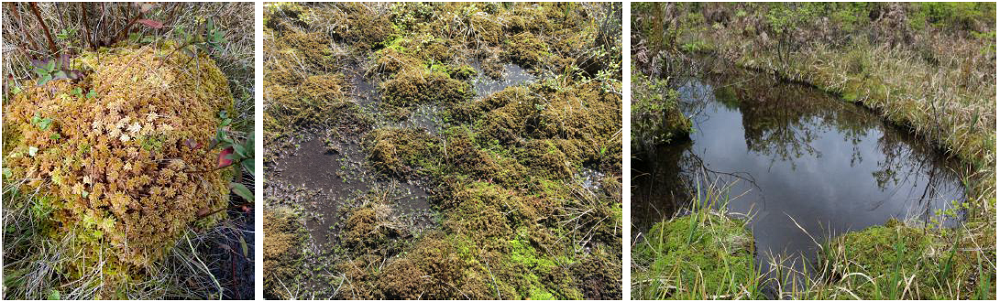
图1 鄂西南亚高山泥炭藓湿地中的3种微生境(从左至右依次为: 丘上、丘间、水坑)。
Fig. 1 Three types of microhabitats in Sphagnum-dominated subalpine wetland in southwestern Hubei (From left to right: hummock, hollow, and pool).
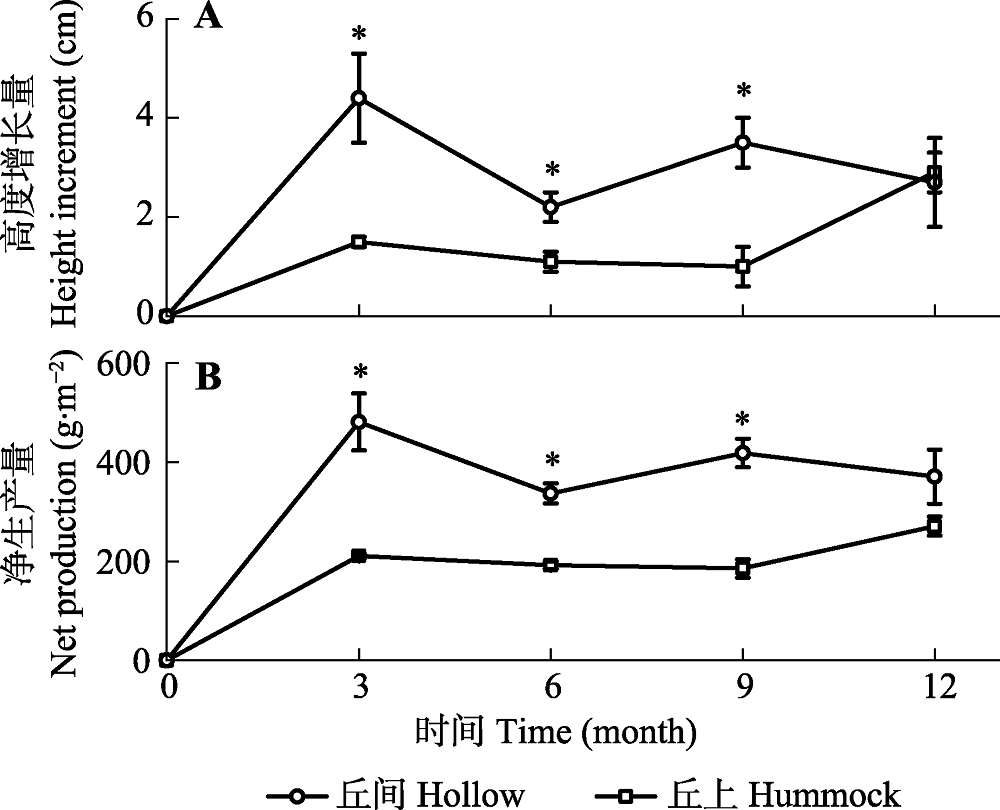
图2 鄂西南亚高山泥炭藓湿地丘间与丘上两种微生境下泥炭藓高度增长量(A)及净生产量(B)变化(平均值±标准误差, n = 3)。*表示在同一时间不同微生境下有显著性差异(p < 0.05)。
Fig. 2 Increment of height growth (A) and net production (B) of Sphagnum in hollow and hummock of Sphagnum-dominated subalpine wetlands in southwestern Hubei (mean ± SE, n = 3). * refers a significant difference between the two microhabitats at the same time (p < 0.05).
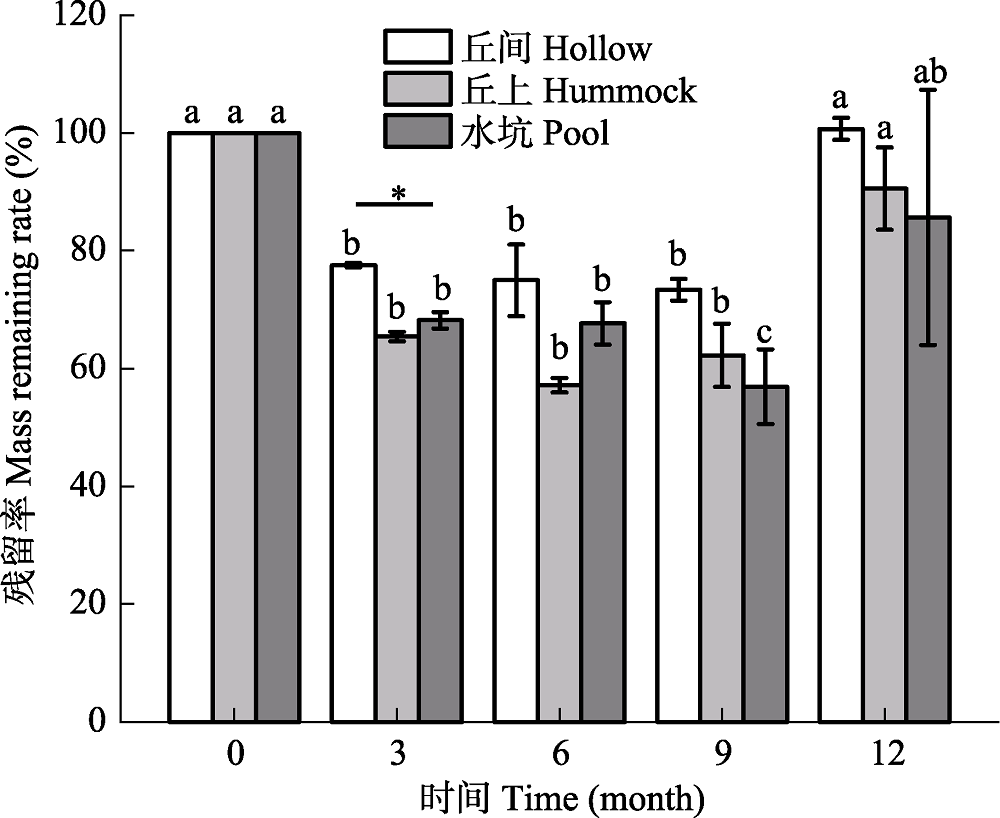
图3 鄂西南亚高山泥炭藓湿地3种微生境下泥炭藓凋落物残留率变化规律(平均值±标准误差, n = 3)。*表示在同一时间不同微生境下有显著性差异(p < 0.05), 不同小写字母表示在同一微生境不同时间有显著性差异(p < 0.05)。
Fig. 3 Changes in litters residual rate of Sphagnum under three microhabitats of Sphagnum-dominated subalpine wetlands in southwestern Hubei (mean ± SE, n = 3). * refers a significant difference among the three microhabitats at the same time (p < 0.05); different lowercase letters indicate significant differences at different time periods in the same microhabitat (p < 0.05).
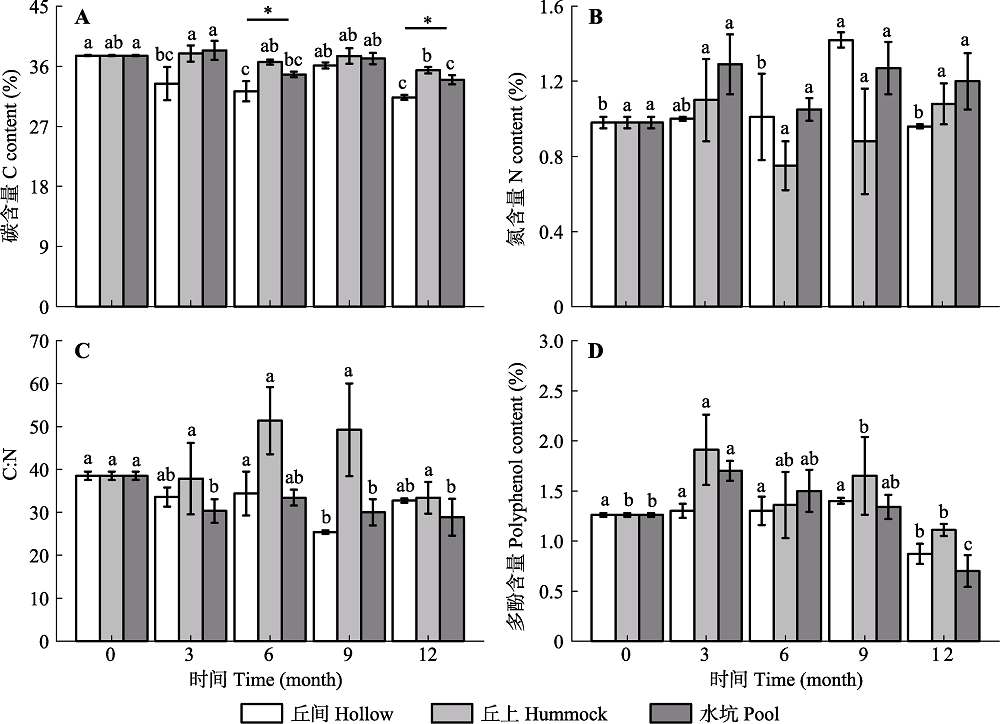
图4 鄂西南亚高山泥炭藓湿地3种微生境下泥炭藓凋落物C (A)、N (B)、C:N (C)及多酚含量(D)变化规律(平均值±标准误差, n = 3)。*表示在同一时间不同微生境下有显著性差异(p < 0.05), 不同小写字母表示在同一微生境不同时间有显著性差异(p < 0.05)。
Fig. 4 Contents of C (A), N (B), C:N (C) and polyphenols (D) in the litters of Sphagnum of the three microhabitats of Sphagnum- dominated subalpine wetlands in southwestern Hubei (mean ± SE, n = 3). * refers a significant difference among the three microhabitats at the same time (p < 0.05); different lowercase letters indicate significant differences at different time periods in the same microhabitat(p < 0.05)
| 纬度 Latitude (°) | 经度 Longitude (°) | 年平均气温 Annual mean temperature (℃) | 年降水量 Precipitation (mm) | 物种 Species | 生长速率 Growth rate (mm·d-1) | 净生产力 Net primary productivity (g·m-2·d-1) | 参考文献 Reference |
|---|---|---|---|---|---|---|---|
| 68.35 | 18.82 | 0.5 | 320 | S. fus | 0.04 | 1.51 | |
| 60.52 | 17.92 | 3.1 | 544 | S. fus | 0.10 | 0.64 | |
| 59.90 | 15.83 | 1.4 | 515 | S. fus, S. mag | 0.13 | 1.12 | |
| 57.15 | -111.98 | 2.1 | 387 | S. fus | 0.09 | 1.68 | |
| 56.63 | -110.20 | 1.1 | 420 | S. fus | 0.09 | 1.72 | |
| 55.68 | -111.83 | 2.1 | 421 | S. fus | 0.10 | 1.96 | |
| 54.68 | -113.47 | 1.7 | 500 | S. fus | 0.03 | 1.15 | |
| 49.67 | -93.72 | 2.6 | 714 | S. mag, S. fus, S. ang | 0.12 | 0.86 | |
| 46.32 | 11.67 | 5.0 | 1 100 | S. cap, S. mag, S. fal | 0.26 | 1.70 | |
| 39.12 | -79.58 | 7.9 | 1 330 | S. mag, S. rec | 0.42 | 3.44 | |
| 30.17 | 109.73 | 7.2 | 1 590 | S. pal | 0.33 | 3.84 | 本研究 This study |
表1 不同纬度地区泥炭藓属植物的生长速率及净生产力
Table 1 Growth rate and net primary productivity of Sphagnum spp. in areas of different latitude
| 纬度 Latitude (°) | 经度 Longitude (°) | 年平均气温 Annual mean temperature (℃) | 年降水量 Precipitation (mm) | 物种 Species | 生长速率 Growth rate (mm·d-1) | 净生产力 Net primary productivity (g·m-2·d-1) | 参考文献 Reference |
|---|---|---|---|---|---|---|---|
| 68.35 | 18.82 | 0.5 | 320 | S. fus | 0.04 | 1.51 | |
| 60.52 | 17.92 | 3.1 | 544 | S. fus | 0.10 | 0.64 | |
| 59.90 | 15.83 | 1.4 | 515 | S. fus, S. mag | 0.13 | 1.12 | |
| 57.15 | -111.98 | 2.1 | 387 | S. fus | 0.09 | 1.68 | |
| 56.63 | -110.20 | 1.1 | 420 | S. fus | 0.09 | 1.72 | |
| 55.68 | -111.83 | 2.1 | 421 | S. fus | 0.10 | 1.96 | |
| 54.68 | -113.47 | 1.7 | 500 | S. fus | 0.03 | 1.15 | |
| 49.67 | -93.72 | 2.6 | 714 | S. mag, S. fus, S. ang | 0.12 | 0.86 | |
| 46.32 | 11.67 | 5.0 | 1 100 | S. cap, S. mag, S. fal | 0.26 | 1.70 | |
| 39.12 | -79.58 | 7.9 | 1 330 | S. mag, S. rec | 0.42 | 3.44 | |
| 30.17 | 109.73 | 7.2 | 1 590 | S. pal | 0.33 | 3.84 | 本研究 This study |
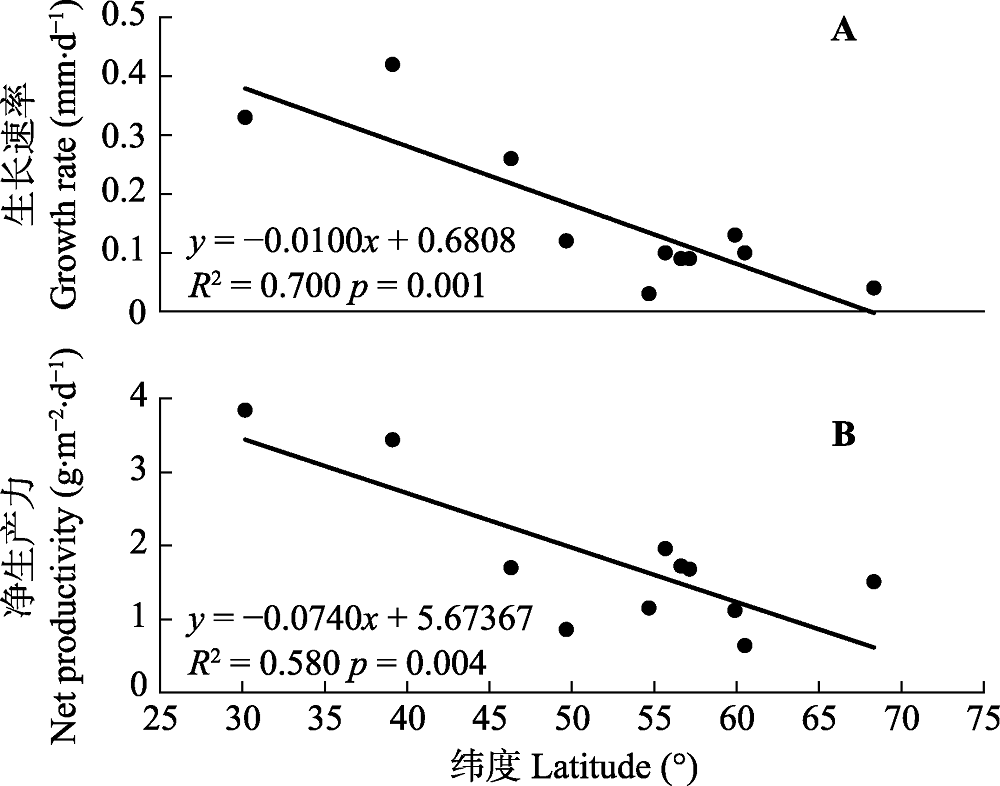
图5 泥炭藓属植物生长速率(A)及净生产力(B)与纬度之间的关系。
Fig. 5 Rrelationships between growth rate (A) and net primary productivity (B) of Sphagnum spp. and latitude.
| [1] |
Asada T, Warner BG, Banner A (2003). Growth of mosses in relation to climate factors in a hypermaritime coastal peatland in British Columbia, Canada. The Bryologist, 106, 516-527.
DOI URL |
| [2] |
Bell MC, Ritson JP, Verhoef A, Brazier RE, Templeton MR, Graham NJD, Freeman C, Clark JM (2018). Sensitivity of peatland litter decomposition to changes in temperature and rainfall. Geoderma, 331, 29-37.
DOI URL |
| [3] |
Bengtsson F, Granath G, Rydin H (2016). Photosynthesis, growth, and decay traits in Sphagnum—A multispecies comparison. Ecology and Evolution, 6, 3325-3341.
DOI URL |
| [4] |
Bengtsson F, Rydin H, Hájek T (2018). Biochemical determinants of litter quality in 15 species of Sphagnum. Plant and Soil, 425, 161-176.
DOI URL |
| [5] |
Bragazza L, Siffi C, Iacumin P, Gerdol R (2007). Mass loss and nutrient release during litter decay in peatland: the role of microbial adaptability to litter chemistry. Soil Biology & Biochemistry, 39, 257-267.
DOI URL |
| [6] |
Breeuwer A, Heijmans M, Robroek BJM, Limpens J, Berendse F (2008). The effect of increased temperature and nitrogen deposition on decomposition in bogs. Oikos, 117, 1258-1268.
DOI URL |
| [7] |
Clymo RS (1970). The growth of Sphagnum: methods of measurement. Journal of Ecology, 58, 13-49.
DOI URL |
| [8] |
Clymo RS, Hayward PM (1982). The ecology of Sphagnum// Smith AJE. Bryophyte Ecology. Chapman and Hall, London.
DOI URL PMID |
| [9] |
Dorrepaal E, Aerts R, Cornelissen JHC, Callaghan TV, van Logtestijn RSP (2003). Summer warming and increased winter snow cover affect Sphagnum fuscum growth, structure and production in a sub-arctic bog. Global Change Biology, 10, 93-104.
DOI URL |
| [10] | Editorial Board of Wetland Vegetation in China (1999). Wetland Vegetation in China. Science Press, Beijing. |
| [ 中国湿地植被编辑委员会(1999). 中国湿地植被. 科学出版社, 北京.] | |
| [11] |
Furness SB, Grime JP (1982). Growth rate and temperature responses in bryophytes: I. An investigation of Brachythecium rutabulum. Journal of Ecology, 70, 513-523.
DOI URL |
| [12] |
Genet H, Oberbauer SF, Colby SJ, Staudhammer CL, Starr G (2013). Growth responses of Sphagnum hollows to a growing season lengthening manipulation in Alaskan Arctic tundra. Polar Biology, 36, 41-50.
DOI URL |
| [13] |
Gerdol R (1995). The growth dynamics of Sphagnum based on field measurements in a temperate bog and on laboratory cultures. Journal of Ecology, 83, 431-437.
DOI URL |
| [14] |
Gerdol R, Petraglia A, Bragazza L, Iacumin P, Brancaleoni L (2007). Nitrogen deposition interacts with climate in affecting production and decomposition rates in Sphagnum mosses. Global Change Biology, 13, 1810-1821.
DOI URL |
| [15] |
Gorham E (1991). Northern peatlands: role in the carbon cycle and probable responses to climatic warming. Ecological Applications, 1, 182-195.
DOI URL |
| [16] |
Gunnarsson U (2005). Global patterns of Sphagnum productivity. Journal of Bryology, 27, 269-279.
DOI URL |
| [17] |
Ho YS, Mckay G (2000). The kinetics of sorption of divalent metal ions onto Sphagnum moss peat. Water Research, 34, 735-742.
DOI URL |
| [18] |
Jassey VEJ, Chiapusio G, Gilbert D, Buttler A, Toussaint ML, Binet P (2011). Experimental climate effect on seasonal variability of polyphenol/phenoloxidase interplay along a narrow fen-bog ecological gradient in Sphagnum fallax. Global Change Biology, 17, 2945-2957.
DOI URL |
| [19] | Johnson LC, Damman AWH (1993). Decay and its regulation in Sphagnum peatlands. Advances in Bryology, 5, 249-296. |
| [20] |
Kosykh NP, Koronatova NG, Granath G (2017). Effect of temperature and precipitation on linear increment of Sphagnum fuscum and S. magellanicum in Western Siberia. Russian Journal of Ecology, 2017,48, 203-211.
DOI URL |
| [21] |
Lang SI, Cornelissen JHC, Klahn T, van Logtestijn RSP, Broekman R, Schweikert W, Aerts R (2009). An experimental comparison of chemical traits and litter decomposition rates in a diverse range of subarctic bryophyte, lichen and vascular plant species. Journal of Ecology, 97, 886-900.
DOI URL |
| [22] |
Leroy F, Gogo S, Guimbaud C, Bernard-Jannin L, Hu Z, Laggoun-Défarge F (2017). Vegetation composition controls temperature sensitivity of CO2 and CH4 emissions and DOC concentration in peatlands. Soil Biology & Biochemistry, 107, 164-167.
DOI URL |
| [23] |
Li H, Parent LE, Karam A, Tremblay C (2004). Potential of Sphagnum peat for improving soil organic matter, water holding capacity, bulk density and potato yield in a sandy soil. Plant and Soil, 265, 355-365.
DOI URL |
| [24] | Li W, Bu ZJ, Zhang BJ, Long C, Tang RJ, Cui QW (2013). Decomposition of Sphagnum litter in 4 peatlands of the Changbai Mountains along an altitudinal gradient. Journal of Mountain Science, 31, 442-447. |
| [ 李伟, 卜兆君, 张兵将, 龙川, 唐瑞江, 崔钱王 (2013). 长白山不同海拔泥炭地泥炭藓残体的分解. 山地学报, 31, 442-447.] | |
| [25] |
Limpens J, Berendse F (2003). How litter quality affects mass loss and N loss from decomposing Sphagnum. Oikos, 103, 537-547.
DOI URL |
| [26] |
Liu YY, Ma JZ, Bu ZJ, Wang SZ, Zhang XB, Zhang TY, Liu SS, Fu B, Kang Y (2018). Effect of geographical sources and biochemical traits on plant litter decomposition in a peatland. Chinese Journal of Plant Ecology, 42, 713-722.
DOI URL |
|
[ 刘媛媛, 马进泽, 卜兆君, 王升忠, 张雪冰, 张婷玉, 刘莎莎, 付彪, 康媛 (2018). 地理来源与生物化学属性对泥炭地植物残体分解的影响. 植物生态学报, 42, 713-722.]
DOI URL |
|
| [27] |
Loisel J, Gallego-Sala AV, Yu Z (2012). Global-scale pattern of peatland Sphagnum growth driven by photosynthetically active radiation and growing season length. Biogeosciences, 9, 2737-2746.
DOI URL |
| [28] | Ma JZ (2018). The Simulation Study on Effects of Climate Warming on Plant Litter Decomposition in Peatlands Basing on Three Experimental Modes. Master degree dissertation, Northeast Normal University, Changchun. |
| [ 马进泽, (2018) . 基于三种实验方式的气候变暖对泥炭地植物凋落物分解影响的模拟研究. 硕士学位论文, 东北师范大学, 长春.] | |
| [29] |
Mironov VL, Kondratev AY (2017). Peat moss Sphagnum riparium follows a circatrigintan growth rhythm in situ: a case report. Chronobiology International, 34, 981-984.
DOI URL |
| [30] |
Moore TR (1989). Growth and net production of Sphagnum at five fen sites, subarctic eastern Canada. Canadian Journal of Botany, 67, 1203-1207.
DOI URL |
| [31] |
Newman TR, Wright N, Wright B, Sjögersten S (2018). Interacting effects of elevated atmospheric CO2 and hydrology on the growth and carbon sequestration of Sphagnum moss. Wetlands Ecology and Management, 26, 763-774.
DOI URL |
| [32] |
Orwin KH, Ostle NJ (2012). Moss species effects on peatland carbon cycling after fire. Functional Ecology, 26, 829-836.
DOI URL |
| [33] |
Philben M, Holmquist J, MacDonald G, Duan DD, Kaiser, K, Benner R (2015). Temperature, oxygen, and vegetation controls on decomposition in a James Bay peatland. Global Biogeochemical Cycles, 29, 729-743.
DOI URL |
| [34] |
Rochefort L, Vitt DH, Bayley SE (1990). Growth, production, and decomposition dynamics of Sphagnum under natural and experimentally acidified conditions. Ecology, 71, 1986-2000.
DOI URL |
| [35] | Singleton VL, Orthofer R, Lamuela-Raventós RM (1999). Analysis of total phenols and other oxidation substrates and antioxidants by means of folin-ciocalteu reagent. Methods in Enzymology, 299, 152-178. |
| [36] |
Tahvanainen T, Haraguchi A (2013). Effect of pH on phenol oxidase activity on decaying Sphagnum mosses. European Journal of Soil Biology, 54, 41-47.
DOI URL |
| [37] |
Thormann MN, Bayley SE (1997). Aboveground net primary production along a bog-fen-marsh gradient in southern boreal Alberta, Canada. Écoscience, 4, 374-384.
DOI URL |
| [38] | Waddington JM, Rochefort L, Campeau S (2003). Sphagnum production and decomposition in a restored cutover peatland. Wetlands Ecology & Management, 11, 85-95. |
| [39] | Wang LS, Jia Y, Zhang XC, Qin HN (2018). Species Catalogue of China. Volume 1 Plants A Synoptic Checklist (I). Science Press, Beijing. |
| [ 王立松, 贾谕, 张宪春, 覃海宁 (2018). 中国生物名录第一卷植物总名录(上册). 科学出版社, 北京.] | |
| [40] |
Wieder RK, Lang GE (1983). Net primary production of the dominant bryophytes in a Sphagnum-dominated wetland in West Virginia. The Bryologist, 86, 280-286.
DOI URL |
| [41] |
Wieder RK, Vitt DH, Burke-Scoll M, Scott KD, House M, Vile MA (2010). Nitrogen and sulphur deposition and the growth of Sphagnum fuscum in bogs of the Athabasca Oil Sands Region, Alberta. Journal of Limnology, 69, 161-170.
DOI URL |
| [42] |
Yazaki T, Yabe K (2012). Effects of snow-load and shading by vascular plants on the vertical growth of hummocks formed by Sphagnum papillosum in a mire of northern Japan. Plant Ecology, 213, 1055-1067.
DOI URL |
| [43] |
Yu ZC (2012). Northern peatland carbon stocks and dynamics: a review. Biogeosciences, 9, 4071-4085.
DOI URL |
| [44] | Yu ZC, Loisel J, Brosseau DP, Beilman DW, Hunt SJ (2010). Global peatland dynamics since the last glacial maximum. Geophysical Research Letters, 37, L13402. DOI: 10.1029/2010gl043584. |
| [45] |
Zhang XH, Sun XX, Mao R (2017). Effects of litter evenness, nitrogen enrichment and temperature on short-term litter decomposition in freshwater marshes of Northeast China. Wetlands, 37, 145-152.
DOI URL |
| [1] | 赵掷艺, 黄伟权, 胡婧妍, 王义越, 虞梦婕, 吴玉环. 泥炭沼泽湿地植物残体分解及微生物作用机理研究进展[J]. , 2026, 50(预发表): 0-. |
| [2] | 王蓉钧, 吴福忠, 吴秋霞, 朱晶晶, 倪祥银. 不同生活型植物叶片氮重吸收效率的差异[J]. 植物生态学报, 2026, 50(2): 344-351. |
| [3] | 侯霄帆, 马辰涵, 孙语倩, 高钰涵, 李品. 臭氧胁迫下叶片与细根凋落物分解的生态化学计量特征差异[J]. 植物生态学报, 2026, 50(2): 268-278. |
| [4] | 夏琦, 聂秀青, 陈轶群, 刘世荣. 南亚热带纯林和混交林根系分泌物代谢组学分析[J]. 植物生态学报, 2026, 50(1): 188-201. |
| [5] | 梁天豪, 吴帆, 黄锦学, 景陈鸿, 傅贺菁, 杨智杰, 熊德成. 增温对中亚热带格氏栲天然林细根生长量及形态特征的影响[J]. 植物生态学报, 2026, 50(1): 94-106. |
| [6] | 闫小红, 胡文海. 亚热带地区3种常绿阔叶植物冬季光保护机制的差异[J]. 植物生态学报, 2025, 49(6): 952-964. |
| [7] | 周思琪, 艾灵, 倪祥银, 吴福忠, 吴秋霞, 朱晶晶, 张欣影. 全球植物凋落物纤维素分解速率的变化特征及其影响因子[J]. 植物生态学报, 2025, 49(3): 393-403. |
| [8] | 郑琳敏, 熊小玲, 姜永孟, 王曼, 张锦秀, 曾志伟, 吕茂奎, 谢锦升. 武夷山不同海拔杉木凋落叶和细根分解规律以及驱动因素的差异[J]. 植物生态学报, 2025, 49(2): 244-255. |
| [9] | 闫小红, 傅英健, 胡文海. 亚热带地区3种常绿阔叶植物光系统II功能对冬季短暂升温的响应[J]. 植物生态学报, 2025, 49(2): 331-342. |
| [10] | 邱丹妮, 彭清清, 张慧玲, 温辉辉, 吴福忠. 中亚热带常绿阔叶林典型乔木树种对蚂蚁群落季节性动态的影响[J]. 植物生态学报, 2025, 49(11): 1805-1816. |
| [11] | 陈诚智, 高钰森, 罗力嘉, 王东. 川西高寒窄叶鲜卑花灌丛凋落枝和凋落叶生产与分解[J]. 植物生态学报, 2025, 49(10): 1733-1743. |
| [12] | 冉佳鑫, 张宇辉, 王云, 杨智杰, 毛超. 增温和氮磷添加对亚热带森林凋落物溶解有机碳生物可降解性的影响[J]. 植物生态学报, 2024, 48(9): 1232-1242. |
| [13] | 李士杰, 王丽, 杜英军, 郑磊, 曾凡锁, 辛颖. 长白山天然水曲柳径向生长对气候的响应[J]. 植物生态学报, 2024, 48(8): 1011-1020. |
| [14] | 刘士玲, 杨保国, 郑路, 舒韦维, 闵惠琳, 张培, 李华, 杨坤, 周炳江, 田祖为. 广西红锥人工林径向生长的季节格局及其对气候因子的响应[J]. 植物生态学报, 2024, 48(8): 1021-1034. |
| [15] | 王晓颖, 孙志高, 陈冰冰, 武慧慧, 张党玉. 闽江河口互花米草残体异位分解及磷养分释放特征[J]. 植物生态学报, 2024, 48(7): 844-857. |
| 阅读次数 | ||||||
|
全文 |
|
|||||
|
摘要 |
|
|||||
Copyright © 2026 版权所有 《植物生态学报》编辑部
地址: 北京香山南辛村20号, 邮编: 100093
Tel.: 010-62836134, 62836138; Fax: 010-82599431; E-mail: apes@ibcas.ac.cn, cjpe@ibcas.ac.cn
备案号: 京ICP备16067583号-19

