
植物生态学报 ›› 2025, Vol. 49 ›› Issue (12): 2004-2014.DOI: 10.17521/cjpe.2024.0424 cstr: 32100.14.cjpe.2024.0424
所属专题: 虚拟专辑 | 干旱响应与适应 | 整合生物学期刊集群跨刊组建
贾慧琳1,2,3, 倪隆康2,3, 秦佳双2,3, 廖苏慧2,3, 谭羽2,3, 何佳懿1,2,3, 顾大形2,3,*( )
)
收稿日期:2024-11-26
接受日期:2025-04-03
出版日期:2025-12-20
发布日期:2025-12-25
通讯作者:
*顾大形(E-gudaxing2008@163.com)基金资助:
JIA Hui-Lin1,2,3, NI Long-Kang2,3, QIN Jia-Shuang2,3, LIAO Su-Hui2,3, TAN Yu2,3, HE Jia-Yi1,2,3, GU Da-Xing2,3,*()
Received:2024-11-26
Accepted:2025-04-03
Online:2025-12-20
Published:2025-12-25
Supported by:摘要:
随着气候变化, 全球极端干旱事件频发, 迫切需要了解树木在遭遇极端干旱之后的恢复能力和影响因素。该研究选取广西桂林喀斯特常绿落叶阔叶混交林中7个优势树种, 分析各树种木质部输水功能在极端干旱末期及干旱后的动态差异及其与木质部特征、环境因子的相关关系。发现: (1)在极端干旱末期, 除樟(Cinnamomum camphora)外, 其他树种的木质部水力导度丧失百分率(PLC)均高于或接近50%, 最高达87.92%。极端干旱末期所有树种的PLC随木质部饱和含水率(SWC)增加而线性降低, 散孔材树种的PLC与木质部密度(WD)和SWC分别存在显著的正相关和负相关关系, 说明木质部储水能力是极端干旱下喀斯特树木输水功能的重要影响因素。(2)光蜡树(Fraxinus griffithii) PLC在极端干旱结束次年春季才出现首次显著降低, 新导管形成可能是其极端干旱后输水功能恢复的策略; 而南酸枣(Choerospondias axillaris)与麻栎(Quercus acutissima)、青冈(Quercus glauca)、黄梨木(Boniodendron minius)和灰岩润楠(Machilus calcicola) PLC分别在极端干旱结束第3天和第13天出现PLC的首次显著降低, 栓塞导管的再充水可能是这些树种恢复输水功能的策略。(3)极端干旱事件结束后, 所有树种后6次采样时PLC较上一次的恢复程度与当次采样前3日内饱和水汽压差(VPD)均值呈显著的正相关关系, 说明土壤水分条件恢复后, 空气干燥程度对极端干旱后喀斯特树木水力功能恢复具有重要影响。(4)极端干旱后的恢复过程中, 多个树种出现接近甚至高于极端干旱末期的栓塞程度, 表现出明显的栓塞疲劳现象, 环孔材树种的栓塞疲劳程度整体高于散孔材树种。
贾慧琳, 倪隆康, 秦佳双, 廖苏慧, 谭羽, 何佳懿, 顾大形. 极端干旱后喀斯特树木水力功能恢复动态及其影响因素. 植物生态学报, 2025, 49(12): 2004-2014. DOI: 10.17521/cjpe.2024.0424
JIA Hui-Lin, NI Long-Kang, QIN Jia-Shuang, LIAO Su-Hui, TAN Yu, HE Jia-Yi, GU Da-Xing. Dynamics of hydraulic function recovery of karst trees following extreme drought and its influencing factors. Chinese Journal of Plant Ecology, 2025, 49(12): 2004-2014. DOI: 10.17521/cjpe.2024.0424
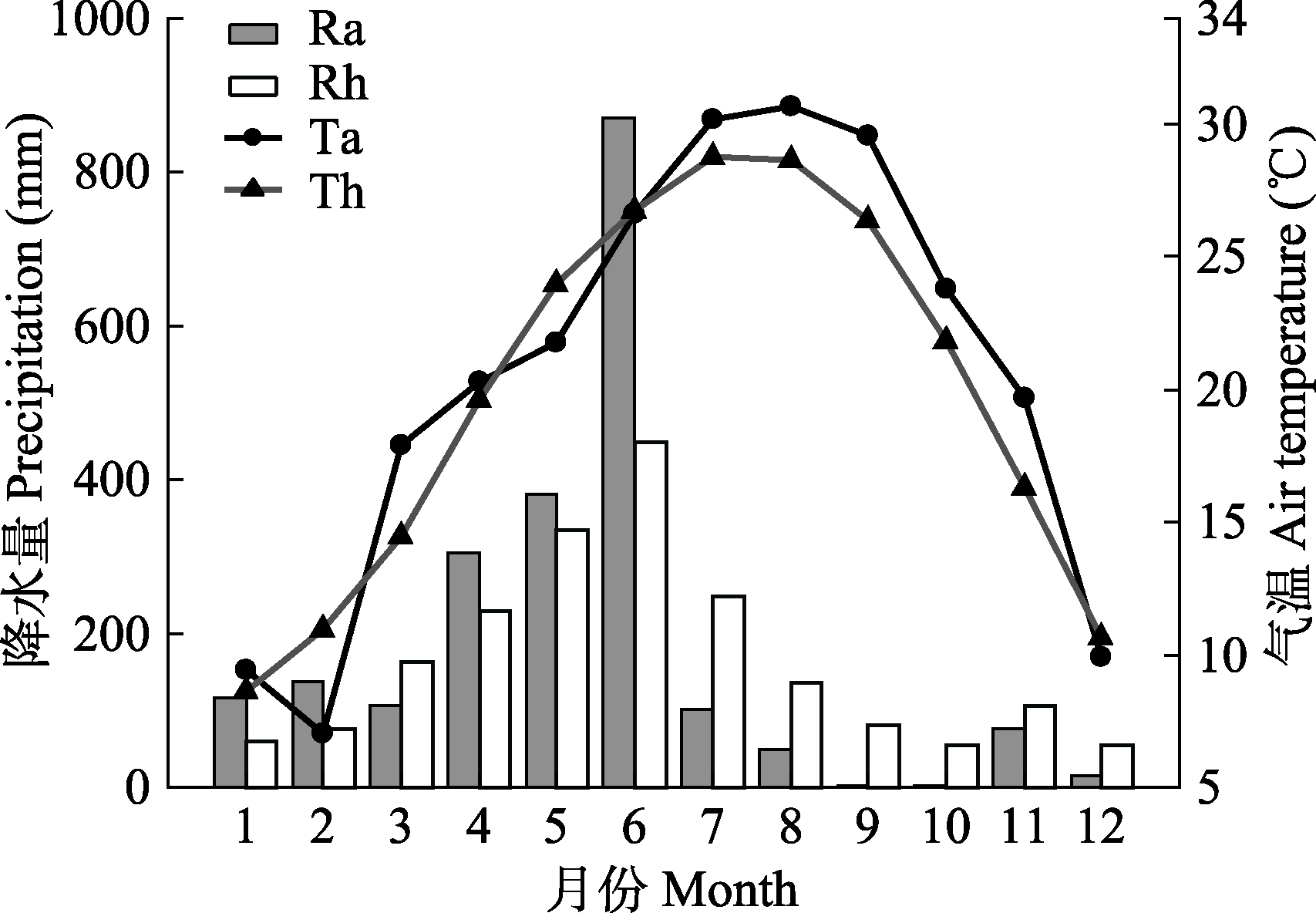
图1 2022年与2000-2021年月降水量与月平均气温。Ra, 2022年月降水量; Rh, 2000-2021年历史同期降水量; Ta, 2022年月平均气温; Th, 2000-2021年历史同期气温。
Fig. 1 Monthly precipitation and average monthly air temperature in 2022 and 2000-2021, respectively. Ra, monthly precipitation in 2022; Rh, historical precipitation in 2000-2021; Ta, average air monthly temperature in 2022; Th, historical air temperature in 2000-2021.
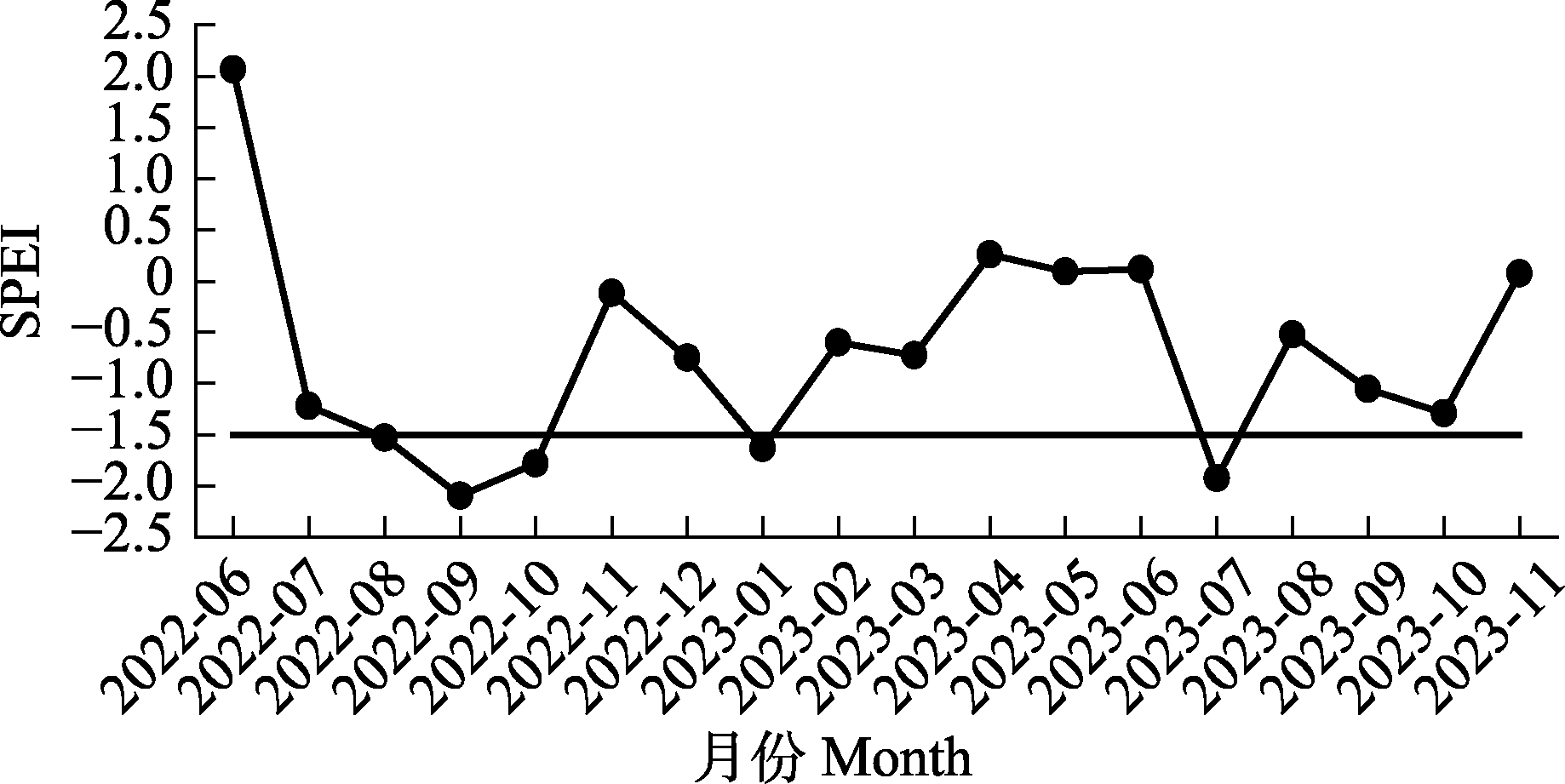
图2 监测期内灵川县月度标准化降水蒸散指数(SPEI)。
Fig. 2 Monthly Standardized Precipitation Evapotranspiration Index (SPEI) of Lingchuan Country during the monitoring period.
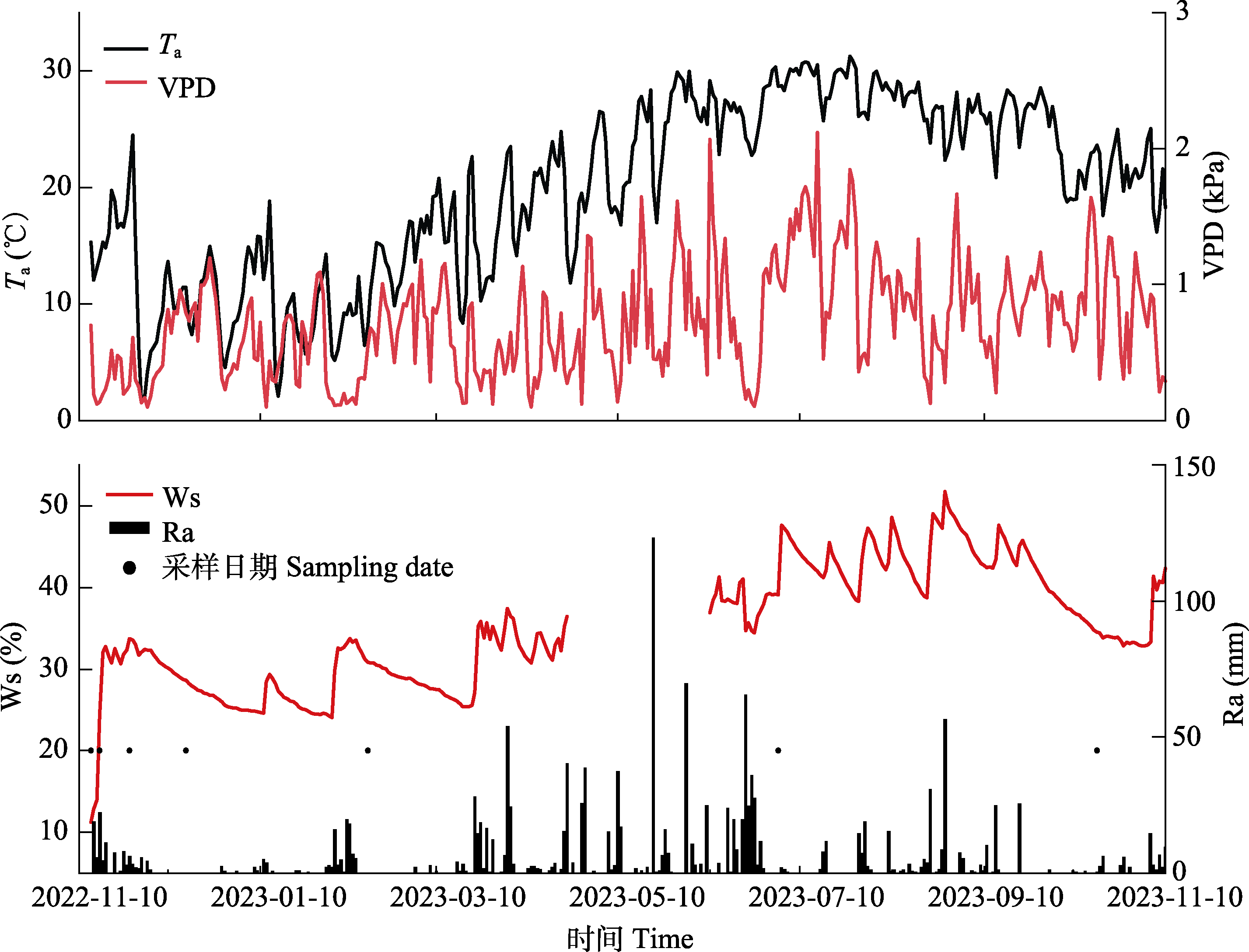
图3 采样地2022年11月至2023年11月的日平均气温(Ta)、日平均饱和水汽压差(VPD)、日平均土壤含水率(Ws)和日降水量(Ra)。
Fig. 3 Daily average air temperature (Ta), daily average saturated vapor pressure deficit (VPD), daily average soil moisture content (Ws) and daily precipitation (Ra) at the sampling site from November 2022 to November 2023.
| 物种 Species | 代码 Code | 生活型 Life form | 材性 Material properties |
|---|---|---|---|
| 麻栎 Quercus acutissima | Qa | 落叶乔木 Deciduous tree | 环孔材 Ring porous wood |
| 南酸枣 Choerospondias axillaris | Ca | ||
| 光蜡树 Fraxinus griffithii | Fg | ||
| 青冈 Quercus glauca | Qg | 常绿乔木 Evergreen tree | 散孔材 Diffuse porous wood |
| 灰岩润楠 Machilus calcicola | Mc | ||
| 黄梨木 Boniodendron minius | Bm | ||
| 樟 Cinnamomum camphora | Cc |
表1 灵川县喀斯特树种采样信息
Table 1 Sampling information of karst tree species in Lingchuan County
| 物种 Species | 代码 Code | 生活型 Life form | 材性 Material properties |
|---|---|---|---|
| 麻栎 Quercus acutissima | Qa | 落叶乔木 Deciduous tree | 环孔材 Ring porous wood |
| 南酸枣 Choerospondias axillaris | Ca | ||
| 光蜡树 Fraxinus griffithii | Fg | ||
| 青冈 Quercus glauca | Qg | 常绿乔木 Evergreen tree | 散孔材 Diffuse porous wood |
| 灰岩润楠 Machilus calcicola | Mc | ||
| 黄梨木 Boniodendron minius | Bm | ||
| 樟 Cinnamomum camphora | Cc |

图4 极端干旱后喀斯特地区7个树种木质部栓塞程度的动态变化(平均值±标准误)。PLC, 木质部水力导度丧失百分率。图中不同大写英文字母表示不同时间各树种种内木质部栓塞程度差异显著(p < 0.05), 不同小写英文字母表示不同树种在同一时间种间木质部栓塞程度差异显著(p < 0.05)。
Fig. 4 Dynamic changes in the degree of xylem embolism among seven tree species in karst regions after extreme drought (mean ± SE). PLC, percentage loss of hydraulic conductivity. Different uppercase letters in the figure indicate significant differences in the degree of xylem embolism within each tree species at different times (p < 0.05), and different lowercase letters indicate significant differences in the degree of xylem embolism between different tree species at the same time (p < 0.05).
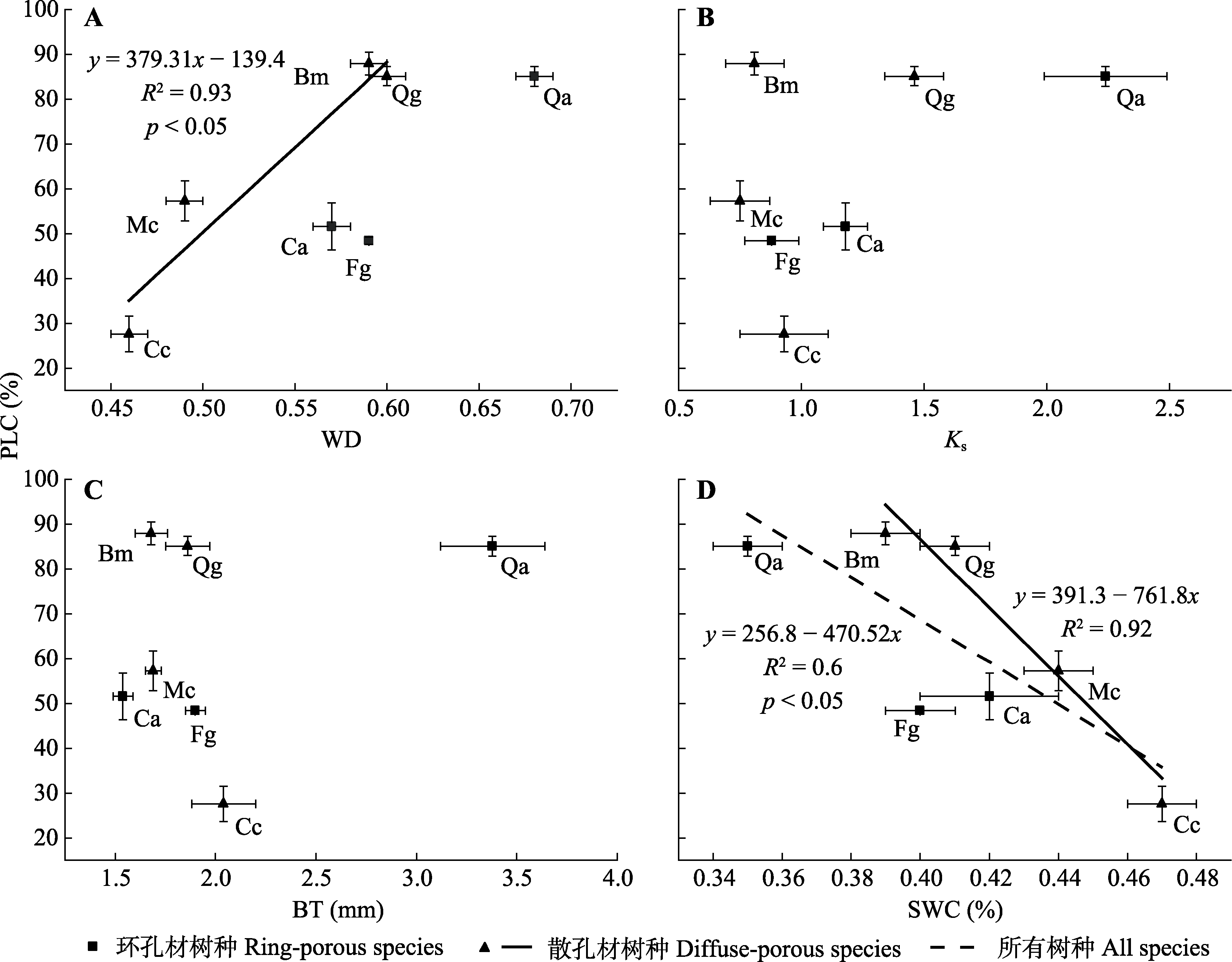
图5 极端干旱末期木质部栓塞程度与木质部特征的关系。BT, 树皮厚度; Ks, 木质部最大水力导度; PLC, 木质部水力导度丧失百分率; SWC, 木质部饱和含水率; WD, 木质部密度。物种名见表1。
Fig. 5 Relationship between xylem embolism degree and xylem characteristics at the end of extreme drought. BT, bark thickness; Ks, maximum hydraulic conductivity of xylem; PLC, Percentage loss of hydraulic conductivity; SWC, saturated water content of xylem; WD, xylem density. Species names are shown in Table 1.
| 恢复率/木质部特征 Recovery rate/xylem characteristics | WD | KS | BT | SWC | |
|---|---|---|---|---|---|
| 短期恢复率 Short-term recovery rate | 环孔材 Ring porous wood | -0.334 | 0.042 | -0.348 | 0.435 |
| 散孔材 Diffuse porous wood | 0.284 | -0.611 | -0.571 | -0.545 | |
| 所有树种 All tree species | 0.001 | 0.096 | -0.232 | 0.068 | |
| 长期平均恢复率 Long-term average recovery rate | 环孔材 Ring porous wood | -0.136 | 0.244 | -0.150 | 0.244 |
| 散孔材 Diffuse porous wood | 0.508 | -0.077 | -0.927 | -0.664 | |
| 所有树种 All tree species | 0.212 | 0.057 | -0.246 | -0.245 | |
表2 木质部栓塞恢复率与木质部特征的相关性分析
Table 2 Correlation analysis between xylem embolism recovery rate and xylem characteristics
| 恢复率/木质部特征 Recovery rate/xylem characteristics | WD | KS | BT | SWC | |
|---|---|---|---|---|---|
| 短期恢复率 Short-term recovery rate | 环孔材 Ring porous wood | -0.334 | 0.042 | -0.348 | 0.435 |
| 散孔材 Diffuse porous wood | 0.284 | -0.611 | -0.571 | -0.545 | |
| 所有树种 All tree species | 0.001 | 0.096 | -0.232 | 0.068 | |
| 长期平均恢复率 Long-term average recovery rate | 环孔材 Ring porous wood | -0.136 | 0.244 | -0.150 | 0.244 |
| 散孔材 Diffuse porous wood | 0.508 | -0.077 | -0.927 | -0.664 | |
| 所有树种 All tree species | 0.212 | 0.057 | -0.246 | -0.245 | |
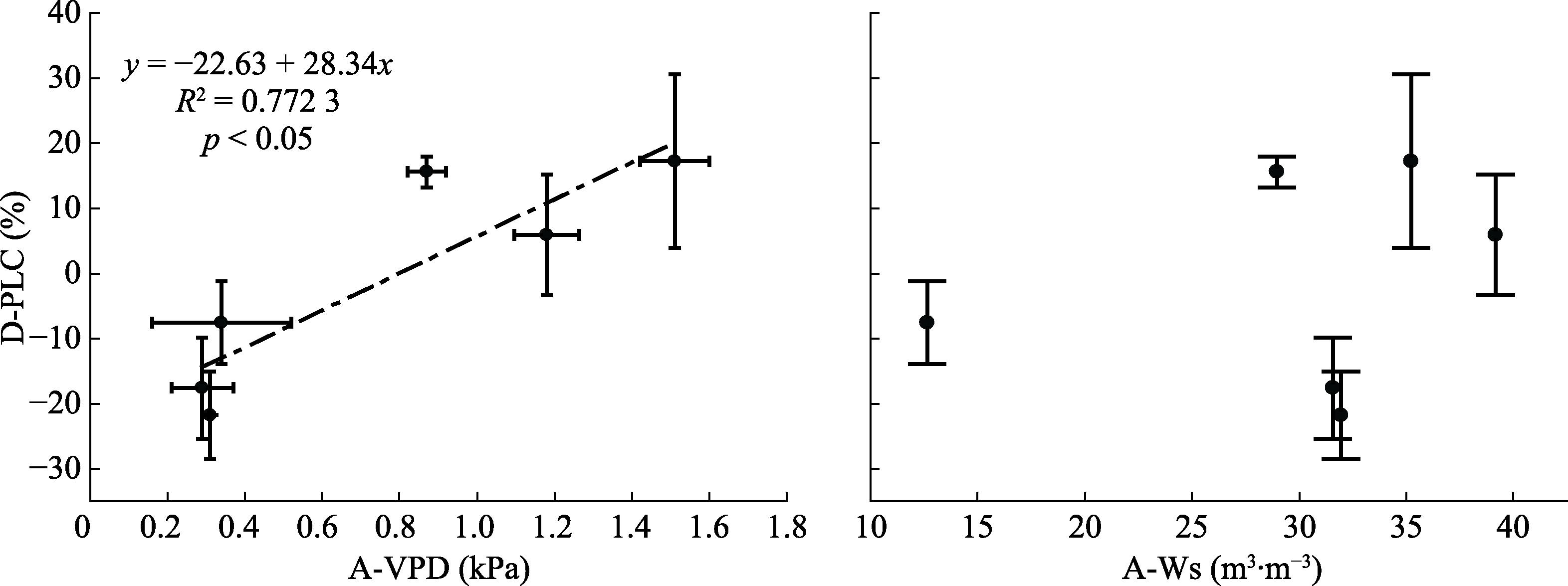
图6 广西桂林喀斯特地区7个树种木质部水力导度丧失百分率(PLC)较上次测量的平均恢复程度(D-PLC)与PLC测量前3日内饱和水汽压差(VPD)均值(A-VPD)与土壤含水率均值(A-Ws)的关系。PLC较上次测量的恢复程度计算方法是: 当次PLC -上次PLC, 正值表示当次PLC高于上次PLC, 负值表示当次PLC低于上次PLC。
Fig. 6 Relationship between the average degree of recovery of percentage loss of hydraulic conductivity (PLC) (D-PLC) of the seven tree species of karst area in Guilin, Guangxi compared with the last measurement and the mean saturated vapor pressure deficit (VPD) (A-VPD) and soil moisture content (A-Ws) in the 3 days before PLC measurement. The degree of recovery of the PLC compared to the last measurement is calculated as follows: current PLC - last PLC, a positive value means that the current PLC is higher than the last PLC, and a negative value means that the current PLC is lower than the last PLC.
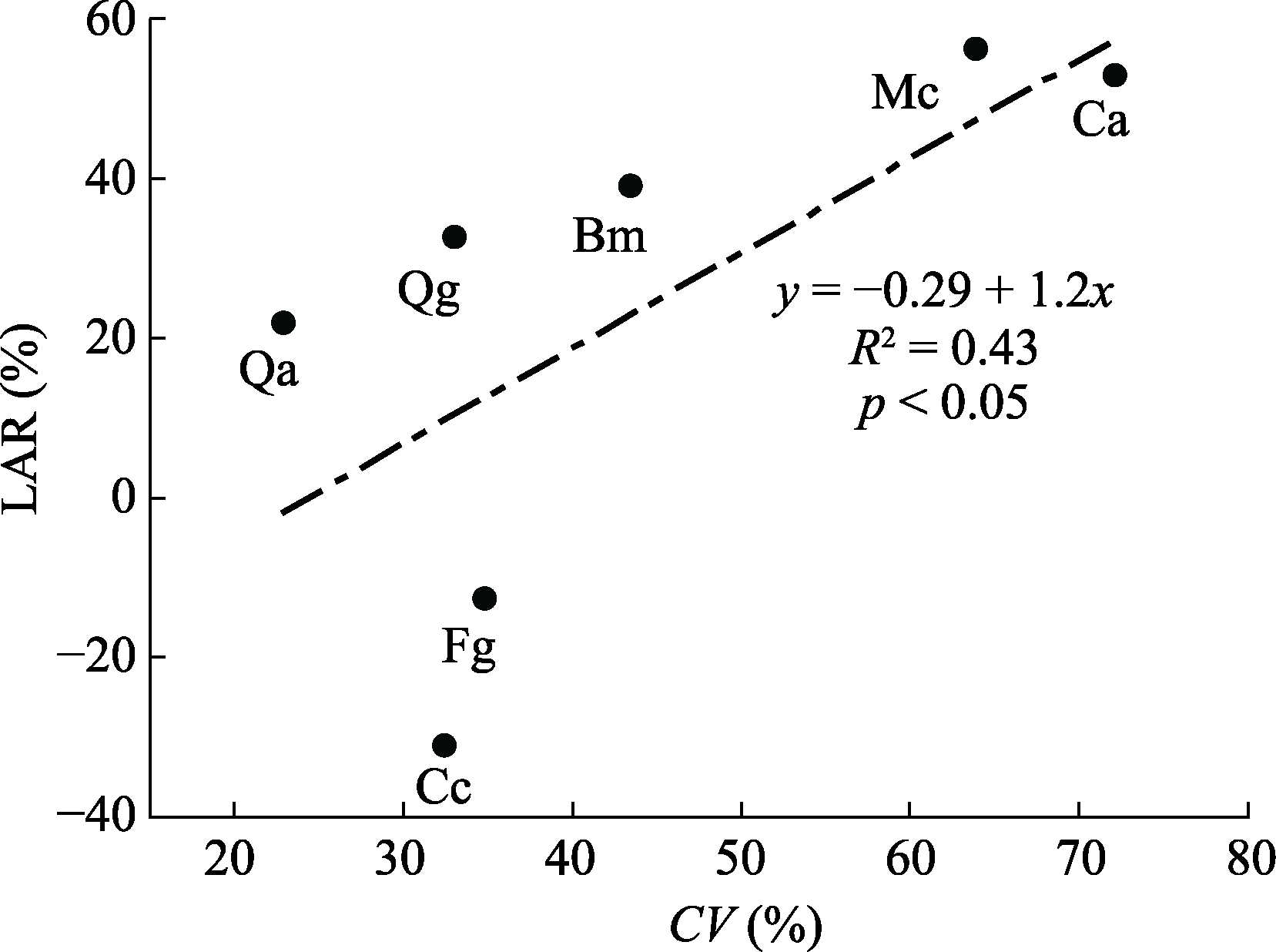
图7 长期平均恢复率(LAR)与木质部水力导度丧失百分率(PLC)变异系数(CV)的关系。长期平均恢复率: 干旱结束后6次测量的栓塞恢复率的平均值。物种名见表1。
Fig. 7 Relationship between long-term average recovery rate (LAR) and coefficient of variation (CV) of percentage loss of hydraulic conductivity (PLC). Long-term average recovery rate, the average of the embolism recovery rates measured six times after the end of the drought. The species names are shown in Table 1.
| [1] |
Améglio T, Bodet C, Lacointe A, Cochard H (2002). Winter embolism, mechanisms of xylem hydraulic conductivity recovery and springtime growth patterns in walnut and peach trees. Tree Physiology, 22, 1211-1220.
DOI PMID |
| [2] |
Anderegg WRL, Anderegg LDL (2013). Hydraulic and carbohydrate changes in experimental drought-induced mortality of saplings in two conifer species. Tree Physiology, 33, 252-260.
DOI PMID |
| [3] | Borghetti M, Vendramin GG (1987). Seasonal changes of soil and plant water relations in Douglas-fir forest. Acta Oecologica, Oecologia Plantarum, 8, 113-126. |
| [4] |
Brodribb TJ, Bowman DJMS, Nichols S, Delzon S, Burlett R (2010). Xylem function and growth rate interact to determine recovery rates after exposure to extreme water deficit. New Phytologist, 188, 533-542.
DOI PMID |
| [5] |
Bucci SJ, Scholz FG, Goldstein G, Meinzer FC, Sternberg LDASL (2003). Dynamic changes in hydraulic conductivity in petioles of two savanna tree species: factors and mechanisms contributing to the refilling of embolized vessels. Plant, Cell & Environment, 26, 1633-1645.
DOI URL |
| [6] |
Canny MJ (1997). Vessel contents during transpiration— Embolisms and refilling. American Journal of Botany, 84, 1223-1230.
PMID |
| [7] |
Chave J, Coomes D, Jansen S, Lewis SL, Swenson NG, Zanne AE (2009). Towards a worldwide wood economics spectrum. Ecology Letters, 12, 351-366.
DOI PMID |
| [8] |
Cochard H, Delzon S (2013). Hydraulic failure and repair are not routine in trees. Annals of Forest Science, 70, 659-661.
DOI URL |
| [9] | Dang W, Jiang ZM, Li R, Zhang SX, Cai J (2017). Relationship between hydraulic traits and refilling of embolism in the xylem of one-year-old twigs of six tree species. Scientia Silvae Sinicae, 53(3), 49-59. |
| [党维, 姜在民, 李荣, 张硕新, 蔡靖 (2017). 6个树种1年生枝木质部的水力特征及与栓塞修复能力的关系. 林业科学, 53(3), 49-59.] | |
| [10] |
Dai YX, Wang L, Wan XC (2020). Frost fatigue and its spring recovery of xylem conduits in ring-porous, diffuse-porous, and coniferous species in situ. Plant Physiology and Biochemistry, 146, 177-186.
DOI URL |
| [11] |
Gauthey A, Peters JMR, Lòpez R, Carins-Murphy MR, Rodriguez-Dominguez CM, Tissue DT, Medlyn BE, Brodribb TJ, Choat B (2022). Mechanisms of xylem hydraulic recovery after drought in Eucalyptus saligna. Plant, Cell & Environment, 45, 1216-1228.
DOI URL |
| [12] |
Hacke U, Sauter JJ (1996). Xylem dysfunction during winter and recovery of hydraulic conductivity in diffuse-porous and ring-porous trees. Oecologia, 105, 435-439.
DOI PMID |
| [13] |
Hacke UG, Sperry JS (2003). Limits to xylem refilling under negative pressure in Laurus nobilis and Acer negundo. Plant, Cell & Environment, 26, 303-311.
DOI URL |
| [14] |
Hacke UG, Stiller V, Sperry JS, Pittermann J, McCulloh KA (2001). Cavitation fatigue. Embolism and refilling cycles can weaken the cavitation resistance of xylem. Plant Physiology, 125, 779-786.
DOI PMID |
| [15] |
Hölttä T, Vesala T, Perämäki M, Nikinmaa E (2006). Refilling of embolised conduits as a consequence of ‘Münch water’ circulation. Functional Plant Biology, 33, 949-959.
DOI PMID |
| [16] |
Jin Y, Wang CK, Zhou ZH (2016). Mechanisms of xylem embolism repair in woody plants: research progress and questions. Chinese Journal of Plant Ecology, 40, 834-846.
DOI |
|
[金鹰, 王传宽, 周正虎 (2016). 木本植物木质部栓塞修复机制: 研究进展与问题. 植物生态学报, 40, 834-846.]
DOI |
|
| [17] |
King G, Fonti P, Nievergelt D, Büntgen U, Frank D (2013). Climatic drivers of hourly to yearly tree radius variations along a 6 °C natural warming gradient. Agricultural and Forest Meteorology, 168, 36-46.
DOI URL |
| [18] |
Lens F, Sperry JS, Christman MA, Choat B, Rabaey D, Jansen S (2011). Testing hypotheses that link wood anatomy to cavitation resistance and hydraulic conductivity in the genus Acer. New Phytologist, 190, 709-723.
DOI URL |
| [19] | Li JY, Zhai HB, Liu XY (2002). Day and night change of tree hydraulic architecture characteristics. Journal of Beijing Forestry University, 24(4), 39-44. |
| [李吉跃, 翟洪波, 刘晓燕 (2002). 树木水力结构特征的昼夜变化规律. 北京林业大学学报, 24(4), 39-44.] | |
| [20] | Li XY, Fan XH, Shen FY (2011). Review on micro-process and mechanism of xylem cavitation and embolism refilling. Shandong Agricultural Sciences, 43, 46-49. |
| [李星月, 范秀华, 沈繁宜 (2011). 木质部空穴化与栓塞修复的过程和机理. 山东农业科学, 43, 46-49.] | |
| [21] | Liao SH, Ma BL, Lü QZ, Zhang JY, Cai J (2024). Cavitation fatigue in five Rosaceae species and its relationships with vessel anatomy. Journal of Northwest Forestry University, 39, 96-103. |
| [廖苏慧, 马博龙, 吕倾子, 张钧堯, 蔡靖 (2024). 5个蔷薇科树种栓塞疲劳及其与导管解剖结构的关系. 西北林学院学报, 39, 96-103.] | |
| [22] |
Ma L, Chao L, He YS, Li ZG, Wang AH, Liu SY, Hu BQ, Liu YY (2024). Relationship of embolism resistance with xylem anatomical structure and related traits of 12 tree species in tropical karst seasonal rainforests. Chinese Journal of Plant Ecology, 48, 888-902.
DOI |
|
[马琳, 巢林, 何雨莎, 李忠国, 王爱华, 刘晟源, 胡宝清, 刘艳艳 (2024). 热带喀斯特季节性雨林12个树种木质部栓塞抗性与其解剖结构及相关性状间的关系. 植物生态学报, 48, 888-902.]
DOI |
|
| [23] |
Maherali H, Pockman WT, Jackson RB (2004). Adaptive variation in the vulnerability of woody plants to xylem cavitation. Ecology, 85, 2184-2199.
DOI URL |
| [24] |
McCulloh KA, Domec JC, Johnson DM, Smith DD, Meinzer FC (2019). A dynamic yet vulnerable pipeline: integration and coordination of hydraulic traits across whole plants. Plant, Cell & Environment, 42, 2789-2807.
DOI URL |
| [25] |
McCulloh KA, Meinzer FC (2015). Further evidence that some plants can lose and regain hydraulic function daily. Tree Physiology, 35, 691-693.
DOI PMID |
| [26] |
McDowell N, Pockman WT, Allen CD, Breshears DD, Cobb N, Kolb T, Plaut J, Sperry J, West A, Williams DG, Yepez EA (2008). Mechanisms of plant survival and mortality during drought: Why do some plants survive while others succumb to drought? New Phytologist, 178, 719-739.
DOI PMID |
| [27] | Mei HD (2024). Effects of drought environment on Robinia pseudoacacia seedling growth. Contemporary Horticulture, (7), 6-7. |
| [梅海东 (2024). 干旱环境对刺槐幼苗生长情况的影响. 现代园艺, (7), 6-7.] | |
| [28] |
Pei GT, Li X, He TX, Li J, Pang Y, Hu BQ, Zhang WD, Sun JF (2024). Characteristics of soil microbial diversity and community structure under different revegetation types in karst rocky desertification areas and analysis of driving factors. Scientia Geographica Sinica, 44, 1630-1642.
DOI |
|
[裴广廷, 李夏, 贺同鑫, 黎俊, 庞榆, 胡宝清, 张伟东, 孙建飞 (2024). 广西喀斯特石漠化区不同植被恢复模式下土壤微生物多样性与群落结构特征及驱动因素分析. 地理科学, 44, 1630-1642.]
DOI |
|
| [29] |
Peña J, Grace J (1986). Water relations and ultrasound emissions of Pinus sylvestris L. before, during and after a period of water stress. New Phytologist, 103, 515-524.
DOI URL |
| [30] |
Poorter L, McDonald I, Alarcón A, Fichtler E, Licona JC, Peña-Claros M, Sterck F, Villegas Z, Sass-Klaassen U (2010). The importance of wood traits and hydraulic conductance for the performance and life history strategies of 42 rainforest tree species. New Phytologist, 185, 481-492.
DOI PMID |
| [31] |
Sack L, Frole K (2006). Leaf structural diversity is related to hydraulic capacity in tropical rain forest trees. Ecology, 87, 483-491.
DOI PMID |
| [32] |
Salleo S, Gullo ML, De Paoli D, Zippo M (1996). Xylem recovery from cavitation-induced embolism in young plants of Laurus nobilis: a possible mechanism. New Phytologist, 132, 47-56.
DOI URL |
| [33] |
Salleo S, Gullo ML, Trifilò P, Nardini A (2004). New evidence for a role of vessel-associated cells and phloem in the rapid xylem refilling of cavitated stems of Laurus nobilis L. Plant, Cell & Environment, 27, 1065-1076.
DOI URL |
| [34] |
Secchi F, Zwieniecki MA (2011). Sensing embolism in xylem vessels: the role of sucrose as a trigger for refilling. Plant, Cell & Environment, 34, 514-524.
DOI URL |
| [35] | Shen WJ, Zhang SX, Jin Y (1999a). Seasonal variation of xylem embolism in some woody plants. Journal of Northwest Forestry University, 14(1), 28-32. |
| [申卫军, 张硕新, 金燕 (1999a). 几种木本植物木质部栓塞的季节变化. 西北林学院学报, 14(1), 28-32.] | |
| [36] | Shen WJ, Zhang SX, Liu LK (1999b). Diurnal variation of xylem embolism in some woody plants. Journal of Northwest Forestry University, 14(1), 22-27. |
| [申卫军, 张硕新, 刘立科 (1999b). 几种木本植物木质部栓塞的日变化. 西北林学院学报, 14(1), 22-27.] | |
| [37] |
Sperry JS, Donnelly JR, Tyree MT (1988). A method for measuring hydraulic conductivity and embolism in xylem. Plant, Cell & Environment, 11, 35-40.
DOI URL |
| [38] |
Trifilò P, Kiorapostolou N, Petruzzellis F, Vitti S, Petit G, Lo Gullo MA, Nardini A, Casolo V (2019). Hydraulic recovery from xylem embolism in excised branches of twelve woody species: relationships with parenchyma cells and non-structural carbohydrates. Plant Physiology and Biochemistry, 139, 513-520.
DOI PMID |
| [39] |
Waring RH, Running SW (1978). Sapwood water storage: its contribution to transpiration and effect upon water conductance through the stems of old-growth Douglas-fir. Plant, Cell & Environment, 1, 131-140.
DOI URL |
| [40] | West H, Quinn N, Horswell M (2019). Remote sensing for drought monitoring & impact assessment: progress, past challenges and future opportunities. Remote Sensing of Environment, 232, 111291. DOI: 10.1016/j.rse.2019.111291. |
| [41] |
Wheeler JK, Huggett BA, Tofte AN, Rockwell FE, Holbrook NM (2013). Cutting xylem under tension or supersaturated with gas can generate PLC and the appearance of rapid recovery from embolism. Plant, Cell & Environment, 36, 1938-1949.
DOI URL |
| [42] | Wu XP, Zhou ZF, Zhu M, Huang DH, Peng RW (2023). Spatiotemporal characteristics of drought in different geomorphic types in typical karst cluster areas. Research of Soil and Water Conservation, 30, 336-347. |
| [吴小飘, 周忠发, 朱孟, 黄登红, 彭睿文 (2023). 典型喀斯特聚集区不同地貌类型干旱时空特征. 水土保持研究, 30, 336-347.] | |
| [43] |
Xu XY, Wang XF, Zhang SL, Yang YP, Li ZX (2025). Characteristics of spatial and temporal variations of global terrestrial droughts and analysis of their future trends. Plateau Meteorology, 44, 923-942.
DOI |
|
[徐欣瑶, 王旭峰, 张松林, 杨彦鹏, 李宗省 (2025). 全球陆地干旱的时空变化特征及其未来变化趋势分析. 高原气象, 44, 923-942.]
DOI |
|
| [44] |
Yang S, Tyree MT (1992). A theoretical model of hydraulic conductivity recovery from embolism with comparison to experimental data on Acer saccharum. Plant, Cell & Environment, 15, 633-643.
DOI URL |
| [45] | Yuan DX (2006). The development of modern karstology in China. Geological Review, 52, 733-736. |
| [袁道先 (2006). 现代岩溶学在中国的发展. 地质论评, 52, 733-736.] | |
| [46] | Zhang SX, Hanno R (1996). Study on the recovery of xylem embolism in Taxus berry. Journal of Northwest Forestry University, 11, 5-8. |
| [张硕新, Hanno R (1996). 浆果紫杉木质部栓塞恢复状况的研究. 西北林学院学报, 11, 5-8.] | |
| [47] |
Zhang YP, Xu JL, Su W, Zhao XP, Xu XL (2019). Spring precipitation effects on formation of first row of earlywood vessels in Quercus variabilis at Qinling Mountain (China). Trees, 33, 457-468.
DOI |
| [48] |
Zwieniecki MA, Holbrook NM (2000). Bordered pit structure and vessel wall surface properties. Implications for embolism repair. Plant Physiology, 123, 1015-1020.
DOI PMID |
| [49] |
Zwieniecki MA, Holbrook NM (2009). Confronting Maxwell’s demon: biophysics of xylem embolism repair. Trends in Plant Science, 14, 530-534.
DOI PMID |
| [1] | 韩吉梅, 张旺锋, 熊栋梁, 张亚黎. 植物光合作用叶肉导度及主要限制因素研究进展[J]. 植物生态学报, 2017, 41(8): 914-924. |
| [2] | 李志民, 王传宽, 罗丹丹. 兴安落叶松叶水力与光合性状的变异性和相关性[J]. 植物生态学报, 2017, 41(11): 1140-1148. |
| [3] | 黄宗胜, 喻理飞, 符裕红, 杨瑞. 茂兰退化喀斯特森林植被自然恢复中生态系统碳吸存特征[J]. 植物生态学报, 2015, 39(6): 554-564. |
| [4] | 金鹰, 王传宽. 植物叶片水力与经济性状权衡关系的研究进展[J]. 植物生态学报, 2015, 39(10): 1021-1032. |
| [5] | 张新时. 关于生态重建和生态恢复的思辨及其科学涵义与发展途径[J]. 植物生态学报, 2010, 34(1): 112-118. |
| [6] | 田桂泉, 白学良, 徐杰, 王先道. 腾格里沙漠固定沙丘藓类植物结皮层的自然恢复及人工培养试验研究[J]. 植物生态学报, 2005, 29(1): 164-169. |
| [7] | 包维楷, 刘照光, 刘朝禄, 袁亚夫, 刘仁东. 中亚热带湿性常绿阔叶次生林自然恢复15年来群落乔木层的变化动态[J]. 植物生态学报, 2000, 24(6): 702-709. |
| 阅读次数 | ||||||
|
全文 |
|
|||||
|
摘要 |
|
|||||
Copyright © 2026 版权所有 《植物生态学报》编辑部
地址: 北京香山南辛村20号, 邮编: 100093
Tel.: 010-62836134, 62836138; Fax: 010-82599431; E-mail: apes@ibcas.ac.cn, cjpe@ibcas.ac.cn
备案号: 京ICP备16067583号-19

