
植物生态学报 ›› 2025, Vol. 49 ›› Issue (12): 2015-2029.DOI: 10.17521/cjpe.2024.0277 cstr: 32100.14.cjpe.2024.0277
所属专题: 虚拟专辑 | 干旱响应与适应 | 整合生物学期刊集群跨刊组建
竹万宽( ), 许宇星, 黄润霞, 杜阿朋, 王志超*(
 )
)
收稿日期:2024-08-14
接受日期:2024-12-10
出版日期:2025-12-20
发布日期:2024-12-10
通讯作者:
*王志超(wzc2254@163.com)作者简介:竹万宽,ORCID:0000-0002-4344-1688
基金资助:
ZHU Wan-Kuan(), XU Yu-Xing, HUANG Run-Xia, DU A-Peng, WANG Zhi-Chao*()
Received:2024-08-14
Accepted:2024-12-10
Online:2025-12-20
Published:2024-12-10
Supported by:摘要:
研究人工林生态系统水分利用效率(WUE)对环境因子的响应, 对于揭示植被的水分利用策略及评估生态系统碳水循环能力具有重要意义。该研究基于广东湛江桉树林生态系统定位观测研究站2018-2022年涡度相关通量数据及同步气象观测数据, 采用逐步回归分析、路径分析和冗余分析方法, 分析尾叶桉(Eucalyptus urophylla)人工林生态系统WUE的时间变化及季节性差异特征, 研究WUE与生物环境因子的关系, 探讨WUE旱、雨季差异及其主要影响因素。主要结果: (1)观测期间尾叶桉人工林生态系统旱季(11-4月)和雨季(5-10月) WUE平均值分别为3.85和2.61 g C·kg-1 H2O, WUE全年平均值为3.22 g C·kg-1 H2O。(2) WUE具有明显的日间变化特征, 旱季和雨季变化趋势相似。日间WUE与饱和水汽压差(VPD)、空气温度(Tair)、土壤温度(Tsoil)、光合有效辐射(PAR)及土壤湿度(SM)均存在极显著负相关关系, 逐步回归分析表明VPD是调控WUE日间变化的主要环境因子。(3)日均值尺度WUE的变化趋势与总初级生产力(GPP)和蒸散(ET)相反, 路径分析表明WUE主要受到VPD和Tsoil的直接负面影响, 以及PAR的间接负面影响。WUE对VPD、Tsoil变化的响应存在明显旱、雨季差异, 对PAR变化的季节响应类似。(4)在月均值尺度上, 旱季WUE主要受温度和VPD影响, 雨季WUE主要受到PAR影响, WUE的季节差异由温度、VPD和PAR调控下ET的变化主导。桉树人工林生态系统WUE旱季高于雨季, 日间变化主要受VPD影响, 日、月变化除受到VPD影响外, 还受到光照和温度的影响。
竹万宽, 许宇星, 黄润霞, 杜阿朋, 王志超. 雷州半岛桉树人工林生态系统水分利用效率旱雨季差异及其控制因素. 植物生态学报, 2025, 49(12): 2015-2029. DOI: 10.17521/cjpe.2024.0277
ZHU Wan-Kuan, XU Yu-Xing, HUANG Run-Xia, DU A-Peng, WANG Zhi-Chao. Differences in water use efficiency between dry and rainy seasons and their controlling factors in Eucalyptus plantation in Leizhou Peninsula. Chinese Journal of Plant Ecology, 2025, 49(12): 2015-2029. DOI: 10.17521/cjpe.2024.0277
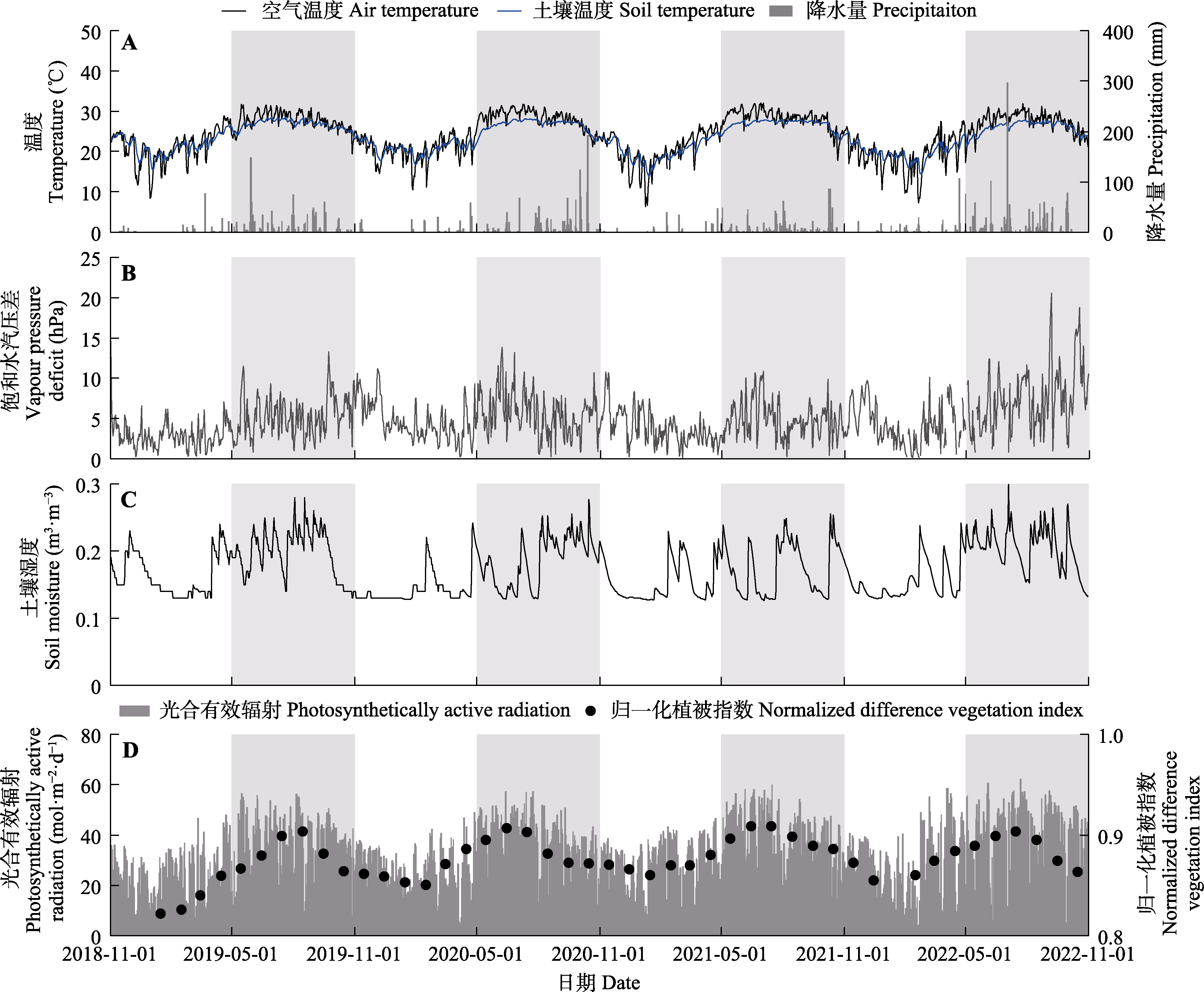
图1 雷州半岛桉树人工林研究区观测期间环境因子变化。空气温度、土壤温度、饱和水汽压差、土壤湿度为日均值, 降水量、光合有效辐射为累积值。归一化植被指数为每月最大值。阴影部分代表雨季。
Fig. 1 Variations in environmental factors during the observation period in the study area in the Eucalyptus plantation of Leizhou Peninsula. Air temperature, soil temperature, vapour pressure deficit, and soil moisture are daily means. Precipitation and photosynthetically active radiation are cumulative values. Normalized difference vegetation index is the monthly maximum. The shade represents the rainy season.
| 季节 Season | 环境因子 Environmental factor | ||||||
|---|---|---|---|---|---|---|---|
| Tair (°C) | VPD (hPa) | Tsoil (°C) | SM (m3·m-3) | PAR (mol·m-2·d-1) | NDVI | P (mm) | |
| 旱季 Dry season (2018-2019) | 21.20 ± 0.31c | 2.99 ± 0.14g | 21.54 ± 0.18c | 0.16 ± 0.03e | 23.02 ± 0.72d | 0.84 ± 0.01d | 228.95c |
| 雨季 Rainy season (2019) | 27.73 ± 0.16ab | 5.22 ± 0.18bc | 26.76 ± 0.08a | 0.20 ± 0.03b | 34.92 ± 0.91b | 0.88 ± 0.02ab | 1 246.63a |
| 旱季 Dry season (2019-2020) | 20.64 ± 0.22cd | 4.61 ± 0.17de | 20.95 ± 0.12d | 0.14 ± 0.02g | 24.69 ± 0.72d | 0.86 ± 0.01c | 307.34bc |
| 雨季 Rainy season (2020) | 28.25 ± 0.16a | 5.63 ± 0.20b | 26.63 ± 0.11a | 0.19 ± 0.04c | 36.31 ± 0.82ab | 0.89 ± 0.02a | 1 306.32a |
| 旱季 Dry season (2020-2021) | 20.32 ± 0.33d | 3.84 ± 0.16f | 20.38 ± 0.20e | 0.15 ± 0.03f | 27.22 ± 0.75c | 0.87 ± 0.01bc | 232.84c |
| 雨季 Rainy season (2021) | 28.27 ± 0.17a | 4.88 ± 0.16cd | 26.81 ± 0.09a | 0.17 ± 0.04d | 37.49 ± 0.90a | 0.90 ± 0.01a | 988.20ab |
| 旱季 Dry season (2021-2022) | 19.34 ± 0.31e | 4.20 ± 0.19ef | 19.99 ± 0.16f | 0.15 ± 0.03f | 27.35 ± 0.98c | 0.87 ± 0.01c | 364.20bc |
| 雨季 Rainy season (2022) | 27.28 ± 0.19b | 7.41 ± 0.28a | 26.00 ± 0.11b | 0.21 ± 0.03a | 38.48 ± 1.04a | 0.89 ± 0.02a | 1 585.70a |
表1 雷州半岛桉树人工林环境因子旱、雨季差异(平均值±标准误)
Table 1 Differences of environmental factors between dry and rainy seasons in Eucalyptus plantation in Leizhou Peninsula (mean ± SE)
| 季节 Season | 环境因子 Environmental factor | ||||||
|---|---|---|---|---|---|---|---|
| Tair (°C) | VPD (hPa) | Tsoil (°C) | SM (m3·m-3) | PAR (mol·m-2·d-1) | NDVI | P (mm) | |
| 旱季 Dry season (2018-2019) | 21.20 ± 0.31c | 2.99 ± 0.14g | 21.54 ± 0.18c | 0.16 ± 0.03e | 23.02 ± 0.72d | 0.84 ± 0.01d | 228.95c |
| 雨季 Rainy season (2019) | 27.73 ± 0.16ab | 5.22 ± 0.18bc | 26.76 ± 0.08a | 0.20 ± 0.03b | 34.92 ± 0.91b | 0.88 ± 0.02ab | 1 246.63a |
| 旱季 Dry season (2019-2020) | 20.64 ± 0.22cd | 4.61 ± 0.17de | 20.95 ± 0.12d | 0.14 ± 0.02g | 24.69 ± 0.72d | 0.86 ± 0.01c | 307.34bc |
| 雨季 Rainy season (2020) | 28.25 ± 0.16a | 5.63 ± 0.20b | 26.63 ± 0.11a | 0.19 ± 0.04c | 36.31 ± 0.82ab | 0.89 ± 0.02a | 1 306.32a |
| 旱季 Dry season (2020-2021) | 20.32 ± 0.33d | 3.84 ± 0.16f | 20.38 ± 0.20e | 0.15 ± 0.03f | 27.22 ± 0.75c | 0.87 ± 0.01bc | 232.84c |
| 雨季 Rainy season (2021) | 28.27 ± 0.17a | 4.88 ± 0.16cd | 26.81 ± 0.09a | 0.17 ± 0.04d | 37.49 ± 0.90a | 0.90 ± 0.01a | 988.20ab |
| 旱季 Dry season (2021-2022) | 19.34 ± 0.31e | 4.20 ± 0.19ef | 19.99 ± 0.16f | 0.15 ± 0.03f | 27.35 ± 0.98c | 0.87 ± 0.01c | 364.20bc |
| 雨季 Rainy season (2022) | 27.28 ± 0.19b | 7.41 ± 0.28a | 26.00 ± 0.11b | 0.21 ± 0.03a | 38.48 ± 1.04a | 0.89 ± 0.02a | 1 585.70a |
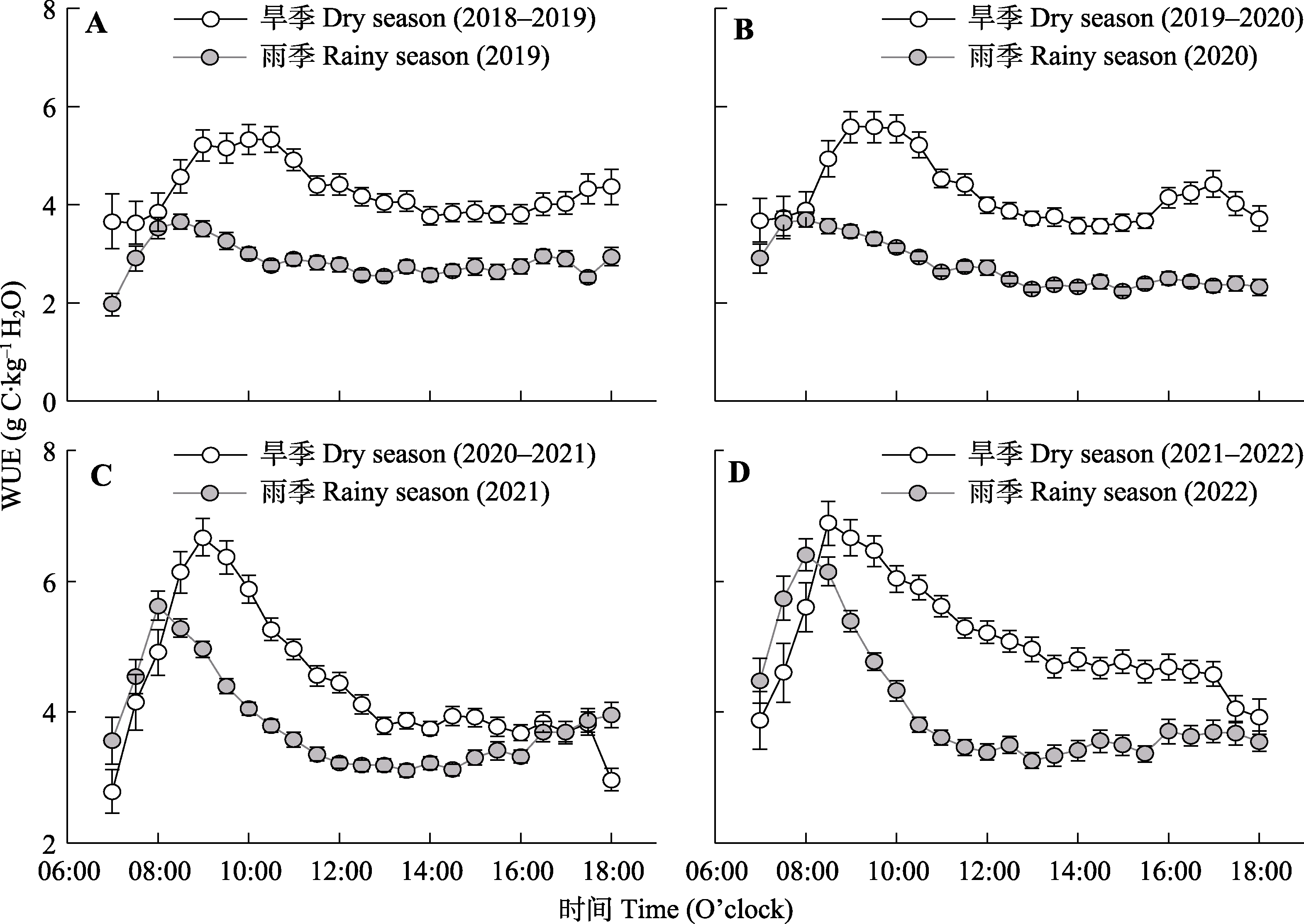
图2 雷州半岛桉树人工林生态系统水分利用效率(WUE)的日间半小时动态变化(平均值±标准误)。
Fig. 2 Dynamic in water use efficiency (WUE) on a half-hourly basis within the Eucalyptus plantation ecosystem in the Leizhou Peninsula (mean ± SE).
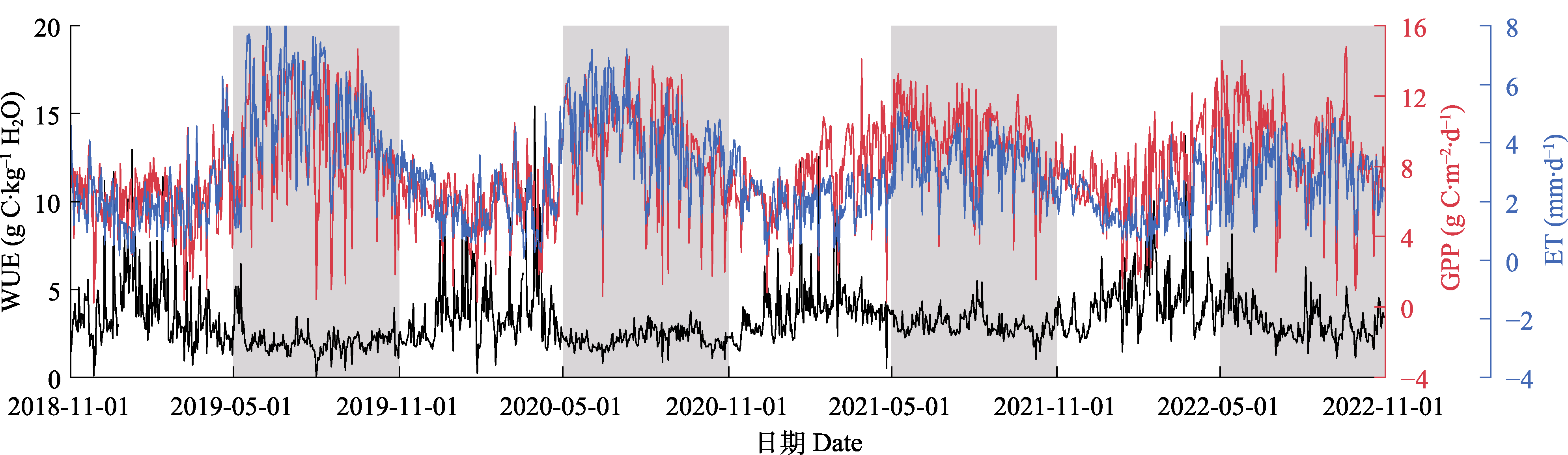
图3 桉树人工林生态系统总初级生产力(GPP)、蒸散(ET)和水分利用效率(WUE)的动态变化。阴影部分代表雨季。
Fig. 3 Temporal dynamics of gross primary productivity (GPP), evapotranspiration (ET), and water use efficiency (WUE) in Eucalyptus plantation ecosystem. The shade represents the rainy season.
| 季节 Season | GPP (g C·m-2·d-1) | ET (mm·d-1) | WUE (g C·kg-1 H2O) |
|---|---|---|---|
| 旱季 Dry season (2018-2019) | 6.18 ± 0.15c | 2.02 ± 0.08e | 3.66 ± 0.15b |
| 雨季 Rainy season (2019) | 9.29 ± 0.22a | 4.82 ± 0.13a | 2.07 ± 0.06d |
| 旱季 Dry season (2019-2020) | 6.02 ± 0.13c | 2.02 ± 0.07e | 3.66 ± 0.15b |
| 雨季 Rainy season (2020) | 9.16 ± 0.20a | 4.27 ± 0.10b | 2.21 ± 0.04d |
| 旱季 Dry season (2020-2021) | 7.23 ± 0.17b | 2.10 ± 0.06e | 3.82 ± 0.12b |
| 雨季 Rainy season (2021) | 9.42 ± 0.16a | 3.23 ± 0.07c | 3.02 ± 0.05c |
| 旱季 Dry season (2021-2022) | 7.41 ± 0.17b | 1.93 ± 0.06e | 4.28 ± 0.13a |
| 雨季 Rainy season (2022) | 8.90 ± 0.20a | 2.98 ± 0.07d | 3.14 ± 0.08c |
表2 桉树人工林生态系统总初级生产力(GPP)、蒸散(ET)和水分利用效率(WUE)的旱、雨季差异(平均值±标准误)
Table 2 Differences of gross primary productivity (GPP), evapotranspiration (ET), and water use efficiency (WUE) between dry and rainy seasons in Eucalyptus plantation in Leizhou Peninsula (mean ± SE)
| 季节 Season | GPP (g C·m-2·d-1) | ET (mm·d-1) | WUE (g C·kg-1 H2O) |
|---|---|---|---|
| 旱季 Dry season (2018-2019) | 6.18 ± 0.15c | 2.02 ± 0.08e | 3.66 ± 0.15b |
| 雨季 Rainy season (2019) | 9.29 ± 0.22a | 4.82 ± 0.13a | 2.07 ± 0.06d |
| 旱季 Dry season (2019-2020) | 6.02 ± 0.13c | 2.02 ± 0.07e | 3.66 ± 0.15b |
| 雨季 Rainy season (2020) | 9.16 ± 0.20a | 4.27 ± 0.10b | 2.21 ± 0.04d |
| 旱季 Dry season (2020-2021) | 7.23 ± 0.17b | 2.10 ± 0.06e | 3.82 ± 0.12b |
| 雨季 Rainy season (2021) | 9.42 ± 0.16a | 3.23 ± 0.07c | 3.02 ± 0.05c |
| 旱季 Dry season (2021-2022) | 7.41 ± 0.17b | 1.93 ± 0.06e | 4.28 ± 0.13a |
| 雨季 Rainy season (2022) | 8.90 ± 0.20a | 2.98 ± 0.07d | 3.14 ± 0.08c |
| 环境因子 Environment factor | WUE | ||
|---|---|---|---|
| 日间半小时尺度 Daytime half-hour scale | 日尺度 Day scale | 月尺度 Month scale | |
| Tair | -0.31*** | -0.40*** | -0.69*** |
| Tsoil | -0.25*** | -0.45*** | -0.73*** |
| SM | -0.13*** | -0.26*** | -0.40** |
| PAR | -0.14*** | -0.39*** | -0.59*** |
| VPD | -0.28*** | -0.49*** | -0.62*** |
| NDVI | - | - | -0.41** |
| P | - | - | -0.47*** |
表3 桉树人工林生态系统水分利用效率(WUE)与环境因子的Pearson相关系数
Table 3 Pearson correlation coefficient between water use efficiency (WUE) of Eucalyptus plantation ecosystem and environmental factors
| 环境因子 Environment factor | WUE | ||
|---|---|---|---|
| 日间半小时尺度 Daytime half-hour scale | 日尺度 Day scale | 月尺度 Month scale | |
| Tair | -0.31*** | -0.40*** | -0.69*** |
| Tsoil | -0.25*** | -0.45*** | -0.73*** |
| SM | -0.13*** | -0.26*** | -0.40** |
| PAR | -0.14*** | -0.39*** | -0.59*** |
| VPD | -0.28*** | -0.49*** | -0.62*** |
| NDVI | - | - | -0.41** |
| P | - | - | -0.47*** |
| 自变量 Independent variable | 旱季 Dry season | 雨季 Rainy season | ||||||||
|---|---|---|---|---|---|---|---|---|---|---|
| 非标准化系数 Non-standardized coefficient | 标准化系数 Standardized coefficient | p | R2 | F | 非标准化系数 Non-standardized coefficient | 标准化系数 Standardized coefficient | p | R2 | F | |
| 常数 Constant | 6.46 | - | 0.47 | 0.98 | 630.54 | -4.94 | - | <0.001 | 0.92 | 197.83 |
| 饱和水汽压差 Vapor pressure deficit | -0.32 | -0.99 | <0.001 | -0.18 | -0.96 | <0.001 | ||||
表4 水分利用效率(WUE)日间变化与环境因子的逐步回归模型参数
Table 4 Stepwise regression model parameters of diurnal variation of water use efficiency (WUE) and environmental factors
| 自变量 Independent variable | 旱季 Dry season | 雨季 Rainy season | ||||||||
|---|---|---|---|---|---|---|---|---|---|---|
| 非标准化系数 Non-standardized coefficient | 标准化系数 Standardized coefficient | p | R2 | F | 非标准化系数 Non-standardized coefficient | 标准化系数 Standardized coefficient | p | R2 | F | |
| 常数 Constant | 6.46 | - | 0.47 | 0.98 | 630.54 | -4.94 | - | <0.001 | 0.92 | 197.83 |
| 饱和水汽压差 Vapor pressure deficit | -0.32 | -0.99 | <0.001 | -0.18 | -0.96 | <0.001 | ||||
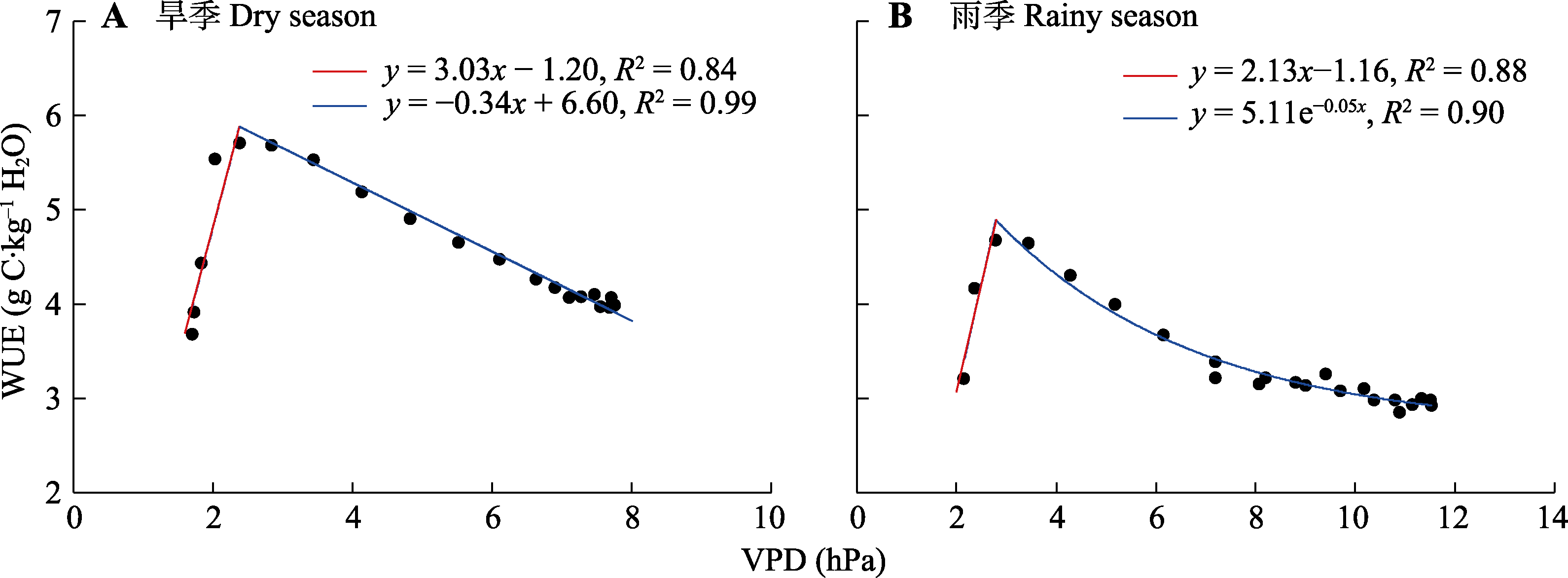
图4 桉树人工林生态系统水分利用效率(WUE)与饱和水汽压差(VPD)的回归分析。
Fig. 4 Regression analysis between water use efficiency (WUE) and vapor pressure deficit (VPD) in Eucalyptus plantation ecosystem.
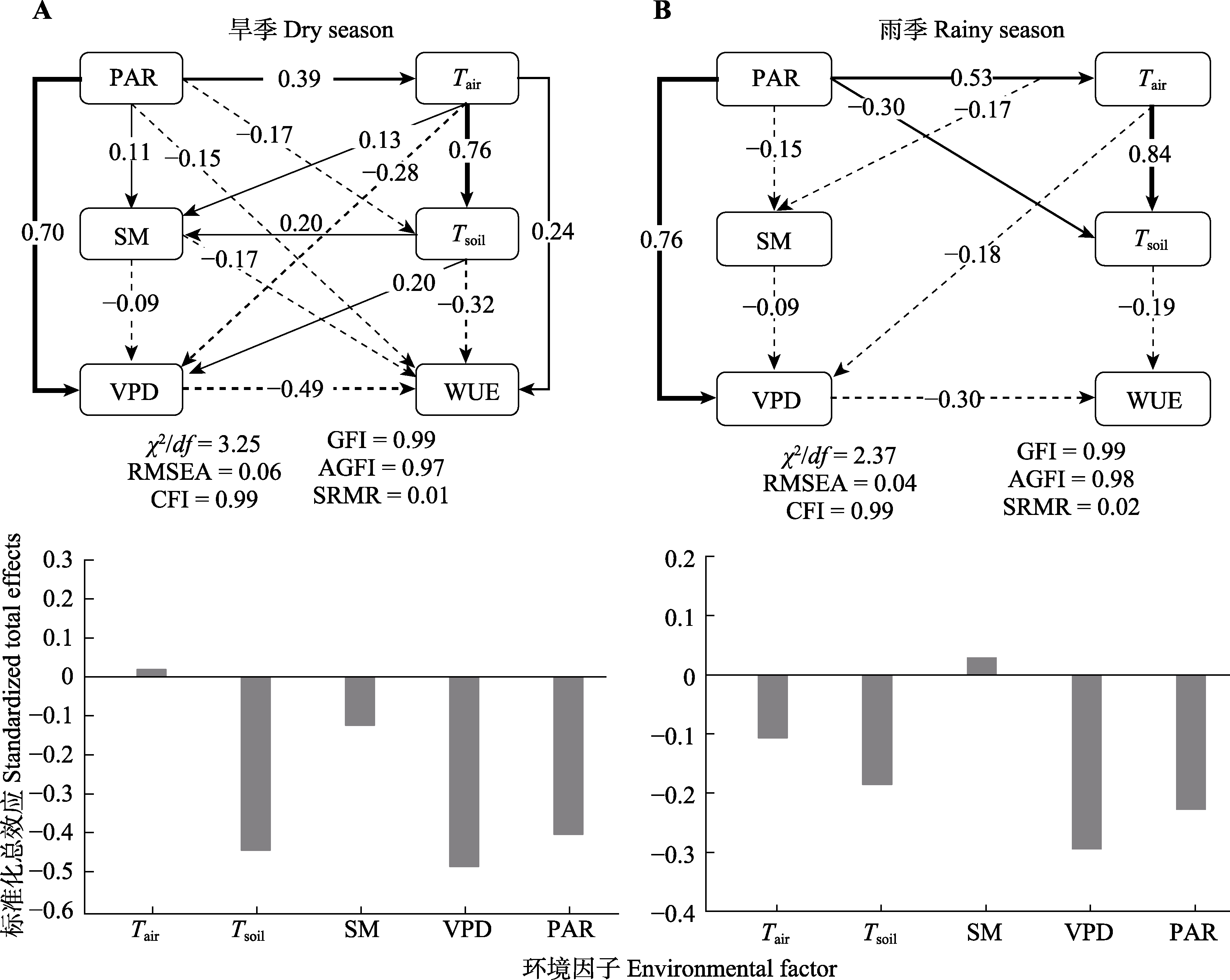
图5 水分利用效率(WUE)和环境因子日均值的路径分析。PAR, 光合有效辐射; SM, 土壤湿度; Tair, 空气温度; Tsoil, 土壤温度; VPD, 饱和水汽压差。图中箭头表示正(实线)和负(虚线)路径, 箭头宽度与关系的强度成正比。图中所有路径均在统计学上显著(p < 0.01)。箭头中的数字表示标准化路径系数。标准化总效应是直接效应和间接效应的总和。
Fig. 5 Path analysis of water use efficiency (WUE) and environmental factors. PAR, photosynthetically active radiation; SM, soil moisture; Tair, air temperature; Tsoil, soil temperature; VPD, vapor pressure deficit. The arrows in the figure represent positive (solid) and negative (dashed) paths, and the width of the arrows is proportional to the strength of the relationship. All pathways in the figure are statistically significant (p < 0.01). The number in the arrow represents the standardized path coefficient. The total effect of standardization is the sum of direct and indirect effects.
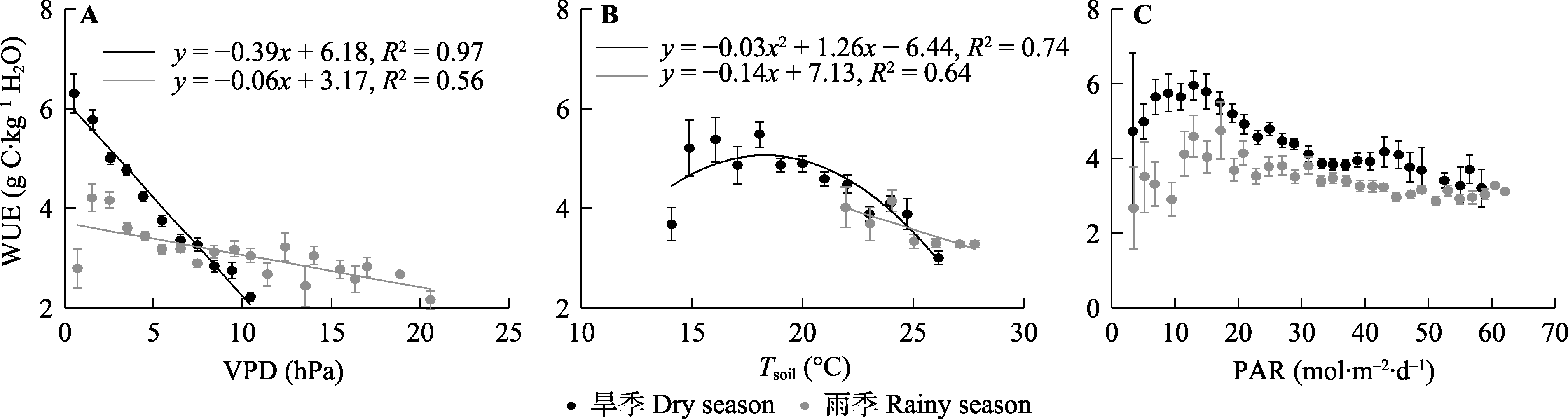
图6 水分利用效率(WUE)和环境因子日均值的关系(平均值±标准误)。PAR, 光合有效辐射; Tsoil, 土壤温度; VPD, 饱和水汽压差。
Fig. 6 Relationship between water use efficiency and daily mean value of environmental factors (mean ± SE). PAR, photosynthetically active radiation; Tsoil, soil temperature; VPD, vapor pressure deficit.
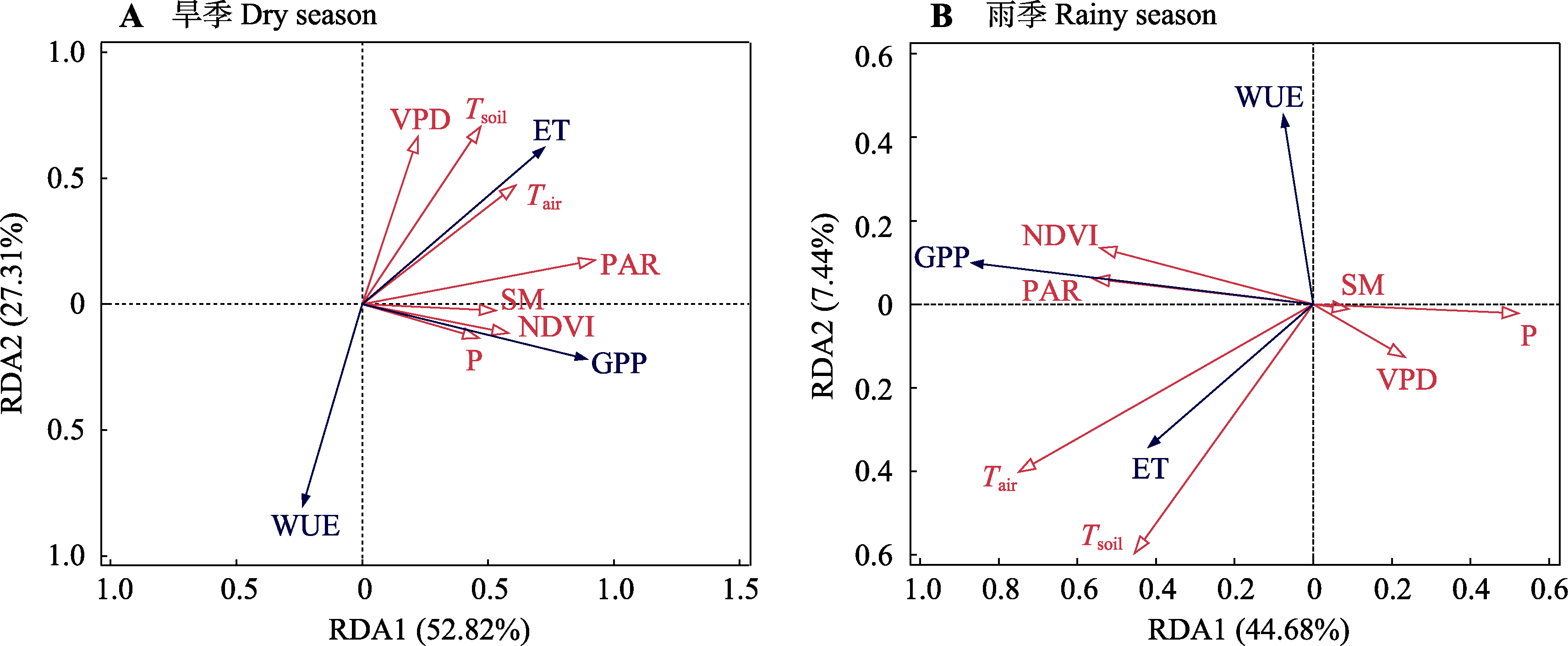
图7 水分利用效率(WUE)和环境因子间冗余分析(RDA)图。ET, 蒸散; GPP, 总初级生产力; NDVI, 归一化植被指数; P, 降水量; PAR, 光合有效辐射; SM, 土壤湿度; Tair, 空气温度; Tsoil, 土壤温度; VPD, 饱和水汽压差。
Fig. 7 Redundancy analysis between environmental factors and water use efficiency (WUE). ET, evapotranspiration; GPP, gross primary productivity; NDVI, normalized difference vegetation index; P, precipitation; PAR, photosynthetically active radiation; SM, soil moisture; Tair, air temperature; Tsoil, soil temperature; VPD, vapor pressure deficit.
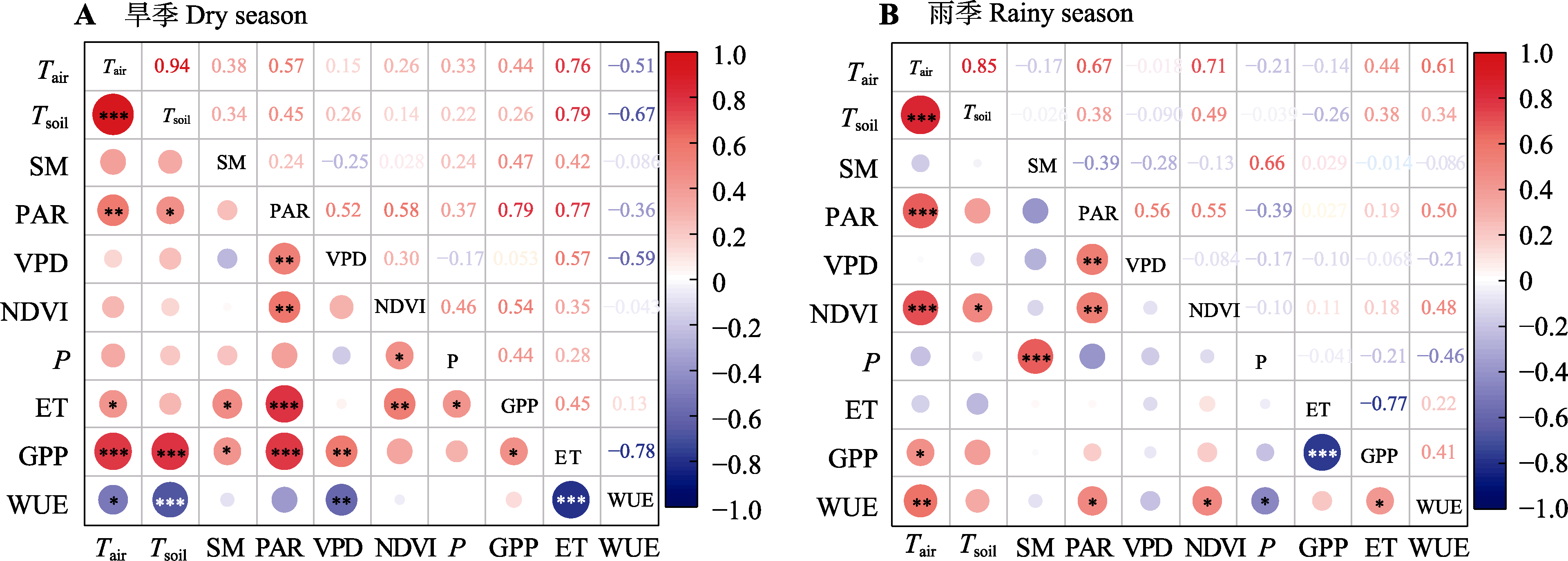
图8 水分利用效率(WUE)和环境因子间相关性。ET, 蒸散; GPP, 总初级生产力; NDVI, 归一化植被指数; P, 降水量; PAR, 光合有效辐射; SM, 土壤湿度; Tair, 空气温度. Tsoil, 土壤温度; VPD, 饱和水汽压差。*, p < 0.05; **, p < 0.01; ***, p < 0.001。
Fig. 8 Correlations between environmental factors and water use efficiency (WUE). ET, evapotranspiration; GPP, gross primary productivity; NDVI, normalized difference vegetation index; P, precipitation; PAR, photosynthetically active radiation; SM, soil moisture; Tair, air temperature; Tsoil, soil temperature; VPD, vapor pressure deficit. *, p < 0.05; **, p < 0.01; ***, p < 0.001.
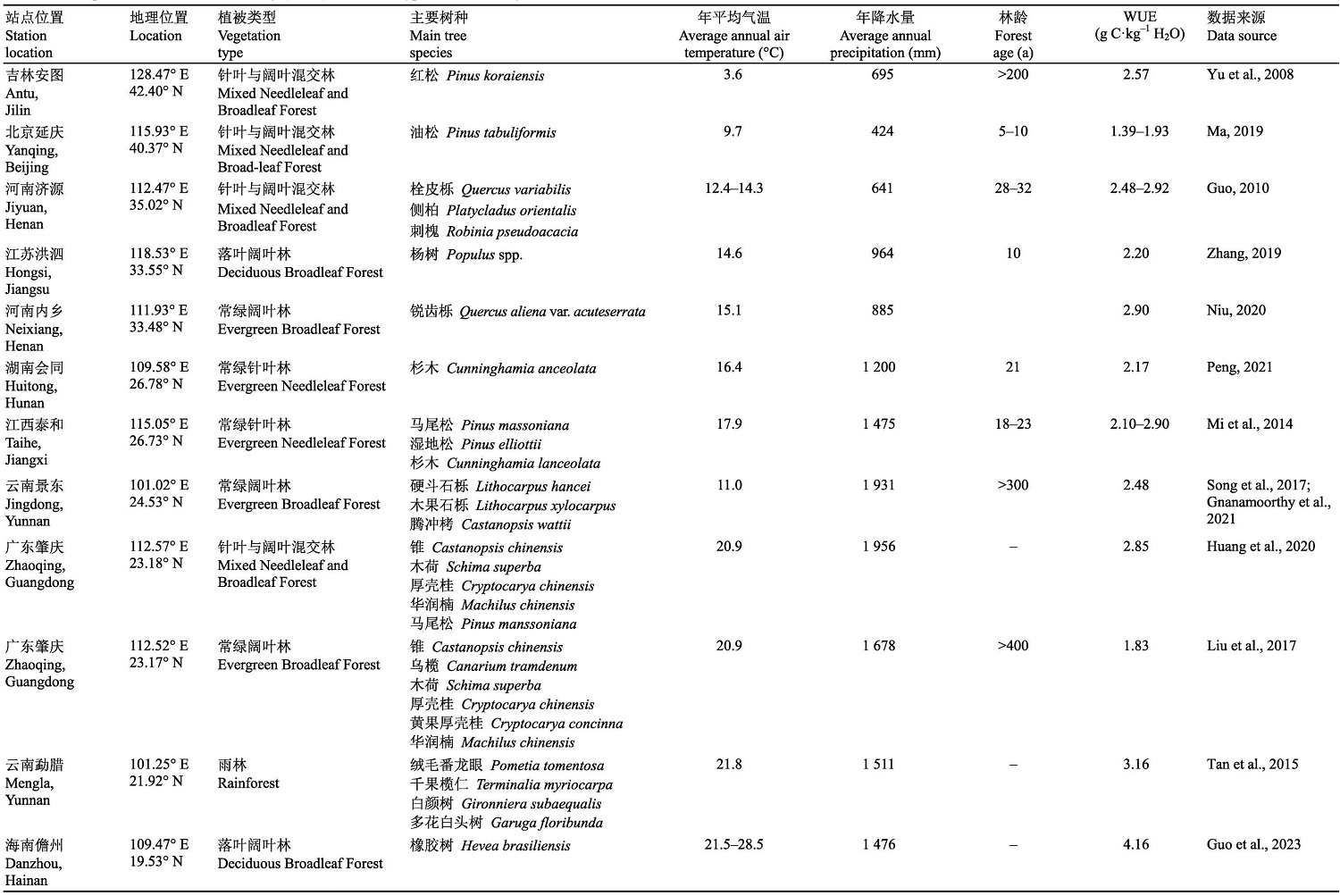 |
表5 不同类型森林生态系统水分利用效率(WUE)对比
Table 5 Comparison of water use efficiency (WUE) of different types of forest ecosystems
| |
| [1] |
Avola G, Cavallaro V, Patanè C, Riggi E (2008). Gas exchange and photosynthetic water use efficiency in response to light, CO2 concentration and temperature in Vicia faba. Journal of Plant Physiology, 165, 796-804.
DOI URL |
| [2] |
Battie-Laclau P, Delgado-Rojas JS, Christina M, Nouvellon Y, Bouillet JP, de Cassia Piccolo M, Moreira MZ, de Moraes Gonçalves JL, Roupsard O, Laclau JP (2016). Potassium fertilization increases water-use efficiency for stem biomass production without affecting intrinsic water-use efficiency in Eucalyptus grandis plantations. Forest Ecology and Management, 364, 77-89.
DOI URL |
| [3] |
Brümmer C, Black TA, Jassal RS, Grant NJ, Spittlehouse DL, Chen BZ, Nesic Z, Amiro BD, Arain MA, Barr AG, Bourque CPA, Coursolle C, Dunn AL, Flanagan LB, Humphreys ER, et al. (2012). How climate and vegetation type influence evapotranspiration and water use efficiency in Canadian forest, peatland and grassland ecosystems. Agricultural and Forest Meteorology, 153, 14-30.
DOI URL |
| [4] | Chen LY (2019). Study on Soil Water and Water Use Efficiency of Eucalyptus Plantation on Multi-time Scale. Master degree dissertation, Hainan Normal University, Haikou. 29-46. |
| [陈丽艳 (2019). 桉树人工林土壤水分多时间尺度变化及水分利用效率研究. 硕士学位论文, 海南师范大学, 海口. 29-46.] | |
| [5] | Du XZ, Zhao X, Wang HY, He B (2018). Responses of terrestrial ecosystem water use efficiency to climate change: a review. Acta Ecologica Sinica, 38, 8296-8305. |
| [杜晓铮, 赵祥, 王昊宇, 何斌 (2018). 陆地生态系统水分利用效率对气候变化的响应研究进展. 生态学报, 38, 8296-8305.] | |
| [6] |
Forrester DI, Theiveyanathan S, Collopy JJ, Marcar NE (2010). Enhanced water use efficiency in a mixed Eucalyptus globulus and Acacia mearnsii plantation. Forest Ecology and Management, 259, 1761-1770.
DOI URL |
| [7] |
Gnanamoorthy P, Song QH, Zhao JB, Zhang YP, Liu YT, Zhou WJ, Sha LQ, Fan ZX, Burman PKD (2021). Altered albedo dominates the radiative forcing changes in a subtropical forest following an extreme snow event. Global Change Biology, 27, 6192-6205.
DOI PMID |
| [8] | Guo L (2010). The Variations of Water Use Efficiency and Evapotranspiration over a Plantation in the Southern Part of Hilly Areas of North-China. Master degree dissertation, Chinese Academy of Forestry, Beijing. 43-56. |
| [国琳 (2010). 华北低丘南段山地人工林蒸散和水分利用效率的变化特征. 硕士学位论文, 中国林业科学研究院, 北京. 43-56.] | |
| [9] | Guo SS, Wu ZX, Liu WJ, Zhao H, Li YS, Wang YB, Wang P (2023). Seasonal differences and attribution analysis of water use efficiency in rubber plantations at the north fringe of the tropics. Journal of Tropical Biology, 14, 424-432. |
| [郭沈沈, 吴志祥, 刘文杰, 赵豪, 李运帅, 王誉博, 王鹏 (2023). 热带北缘地区橡胶林水分利用效率的季节差异及归因分析. 热带生物学报, 14, 424-432.] | |
| [10] |
Hu HL, Zhang J, Wan XQ, Chen H, Yi WY, Zhou YC (2012). The water consumption and water use efficiency of the seedlings of Eucalyptus grandis and other five tree species in Sichuan Province. Acta Ecologica Sinica, 32, 3873-3882.
DOI URL |
| [胡红玲, 张健, 万雪琴, 陈洪, 易万洋, 周永春 (2012). 巨桉与5种木本植物幼树的耗水特性及水分利用效率的比较. 生态学报, 32, 3873-3882.] | |
| [11] | Huang JQ, Deng YH, Zeng XP, Meng Z, Zhang QM, Li YL (2020). Water-use efficiency in a mixed conifer-broadleaf forest ecosystem in lower subtropical China. Chinese Journal of Ecology, 39, 2538-2545. |
| [黄健强, 邓永红, 曾小平, 孟泽, 张倩媚, 李跃林 (2020). 南亚热带针阔叶混交林生态系统水分利用效率. 生态学杂志, 39, 2538-2545.] | |
| [12] |
Huang L, He B, Han L, Liu JJ, Wang HY, Chen ZY (2017). A global examination of the response of ecosystem water-use efficiency to drought based on MODIS data. Science of the Total Environment, 601-602, 1097-1107.
DOI URL |
| [13] |
Hubbard RM, Stape J, Ryan MG, Almeida AC, Rojas J (2010). Effects of irrigation on water use and water use efficiency in two fast growing Eucalyptus plantations. Forest Ecology and Management, 259, 1714-1721.
DOI URL |
| [14] |
Jassal RS, Black TA, Spittlehouse DL, Brümmer C, Nesic Z (2009). Evapotranspiration and water use efficiency in different-aged Pacific Northwest Douglas-fir stands. Agricultural and Forest Meteorology, 149, 1168-1178.
DOI URL |
| [15] | Jiang SZ, Liang C, Cui NB, Zhao L, Liu CW, Feng Y, Hu XT, Gong DZ, Zou QY (2020). Water use efficiency and its drivers in four typical agroecosystems based on flux tower measurements. Agricultural and Forest Meteorology, 295, 108200. DOI: 10.1016/j.agrformet.2020.108200. |
| [16] | Jiang YY, Still CJ, Rastogi B, Page GFM, Wharton S, Meinzer FC, Voelker S, Kim JB (2019). Trends and controls on water-use efficiency of an old-growth coniferous forest in the Pacific Northwest. Environmental Research Letters, 14, 074029. DOI: 10.1088/1748-9326/ab2612. |
| [17] |
Kang M, Zhang Z, Noormets A, Fang X, Zha T, Zhou J, Sun G, McNulty SG, Chen J (2015). Energy partitioning and surface resistance of a poplar plantation in northern China. Biogeosciences, 12, 4245-4259.
DOI URL |
| [18] |
Lavergne A, Graven H, de Kauwe MG, Keenan TF, Medlyn BE, Prentice IC (2019). Observed and modelled historical trends in the water-use efficiency of plants and ecosystems. Global Change Biology, 25, 2242-2257.
DOI PMID |
| [19] |
Law BE, Falge E, Gu L, Baldocchi DD, Bakwin P, Berbigier P, Davis K, Dolman AJ, Falk M, Fuentes JD, Goldstein A, Granier A, Grelle A, Hollinger D, Janssens IA, et al. (2002). Environmental controls over carbon dioxide and water vapor exchange of terrestrial vegetation. Agricultural and Forest Meteorology, 113, 97-120.
DOI URL |
| [20] |
Li SE, Kang SZ, Zhang L, Du TS, Tong L, Ding RS, Guo WH, Zhao P, Chen X, Xiao H (2015). Ecosystem water use efficiency for a sparse vineyard in arid northwest China. Agricultural Water Management, 148, 24-33.
DOI URL |
| [21] |
Li XY, Li Y, Chen AP, Gao MD, Slette IJ, Piao SL (2019). The impact of the 2009/2010 drought on vegetation growth and terrestrial carbon balance in Southwest China. Agricultural and Forest Meteorology, 269-270, 239-248.
DOI URL |
| [22] | Liu GC, Du AP, Zhao ZY, Xie YJ, Zhang J (2015). Transpiration and water consumption of Eucalyptus urophlla plantations on the Leizhou Peninsula. Journal of Huazhong Agricultural University, 34(6), 27-32. |
| [刘国粹, 杜阿朋, 赵知渊, 谢耀坚, 张婧 (2015). 雷州半岛尾叶桉人工林蒸腾耗水特征. 华中农业大学学报, 34(6), 27-32.] | |
| [23] | Liu XD, Chen XZ, Li RH, Long FL, Zhang L, Zhang QM, Li JY (2017). Water-use efficiency of an old-growth forest in lower subtropical China. Scientific Reports, 7, 42761. DOI: 10.1038/srep42761. |
| [24] | Lowry AL, McGowan HA, Gray MA (2021). Multi-year carbon and water exchanges over contrasting ecosystems on a sub-tropical sand island. Agricultural and Forest Meteorology, 304-305, 108404. DOI: 10.1016/j.agrformet.2021.108404. |
| [25] | Ma JY (2019). Water Vapour, Heat Fluxes and Water Use Efficiency over a Young Pinus tabuliformis Plantation in Beijing. PhD dissertation, Beijing Forestry University, Beijing. 71-98. |
| [马景永 (2019). 北京油松人工幼林生态系统水热通量及水分利用效率研究. 博士学位论文, 北京林业大学, 北京. 71-98.] | |
| [26] |
Ma JY, Jia X, Zha TS, Bourque CPA, Tian Y, Bai YJ, Liu P, Yang RZ, Li C, Li CY, Xie J, Yu HQ, Zhang F, Zhou CX (2019). Ecosystem water use efficiency in a young plantation in Northern China and its relationship to drought. Agricultural and Forest Meteorology, 275, 1-10.
DOI URL |
| [27] |
Mauder M, Foken T, Clement R, Elbers JA, Eugster W, Grünwald T, Heusinkveld B, Kolle O (2008). Quality control of CarboEurope flux data—Part 2: Inter-comparison of eddy-covariance software. Biogeosciences, 5, 451-462.
DOI URL |
| [28] |
Mencuccini M, Grace J (1996). Hydraulic conductance, light interception and needle nutrient concentration in Scots pine stands and their relations with net primary productivity. Tree Physiology, 16, 459-468.
PMID |
| [29] | Mi N, Wen XF, Cai F, Wang Y, Zhang YS (2014). Effects of seasonal drought on the water use efficiency of Qianyanzhou plantation. Scientia Silvae Sinicae, 50(12), 24-31. |
| [米娜, 温学发, 蔡福, 王阳, 张玉书 (2014). 季节性干旱对千烟洲人工林水分利用效率的影响. 林业科学, 50(12), 24-31.] | |
| [30] |
Moore CJ (1986). Frequency response corrections for eddy correlation systems. Boundary-Layer Meteorology, 37, 17-35.
DOI URL |
| [31] |
Niu SL, Wu MY, Han Y, Xia JY, Li LH, Wan SQ (2008). Water-mediated responses of ecosystem carbon fluxes to climatic change in a temperate steppe. New Phytologist, 177, 209-219.
DOI PMID |
| [32] |
Niu SL, Xing XR, Zhang Z, Xia JY, Zhou XH, Song B, Li LH, Wan SQ (2011). Water-use efficiency in response to climate change: from leaf to ecosystem in a temperate steppe. Global Change Biology, 17, 1073-1082.
DOI URL |
| [33] | Niu XD (2020). A Study on Ecosystem Carbon/Water Fluxes and Water Use Efficiency in a Warm-temperature Oak (Quercus aliena var. acuteserrata) Forest. PhD dissertation, Chinese Academy of Forestry, Beijing. 74-84. |
| [牛晓栋 (2020). 暖温带锐齿栎林生态系统碳水通量与水分利用效率研究. 博士学位论文, 中国林业科学研究院, 北京. 74-84.] | |
| [34] | Peng L (2021). Flux Changes and Distribution Characteristics of Carbon and Water in Chinese Fir Plantation in Huitong. Master degree dissertation, Central South University of Forestry & Technology, Changsha. 46-49. |
| [彭丽 (2021). 会同杉木人工林碳水通量动态变化及分配特征. 硕士学位论文, 中南林业科技大学, 长沙. 46-49.] | |
| [35] |
Ponton S, Flanagan LB, Alstad KP, Johnson BG, Morgenstern K, Kljun N, Black TA, Barr AG (2006). Comparison of ecosystem water-use efficiency among Douglas-fir forest, aspen forest and grassland using eddy covariance and carbon isotope techniques. Global Change Biology, 12, 294-310.
DOI URL |
| [36] | Qiu Q, Pan X, Li JY, He Q, Su Y, Lin W (2014). Water consumption characteristics and water use efficiency of Eucalyptus urophylla × Eucalyptus grandis and bamboo-willow seedlings. Acta Ecologica Sinica, 34, 1401-1410. |
| [邱权, 潘昕, 李吉跃, 何茜, 苏艳, 林雯 (2014). 速生树种尾巨桉和竹柳幼苗耗水特性和水分利用效率. 生态学报, 34, 1401-1410.] | |
| [37] |
Reichstein M, Falge E, Baldocchi D, Papale D, Aubinet M, Berbigier P, Bernhofer C, Buchmann N, Gilmanov T, Granier A, Grünwald T, Havránková K, Ilvesniemi H, Janous D, Knohl A, et al. (2005). On the separation of net ecosystem exchange into assimilation and ecosystem respiration: review and improved algorithm. Global Change Biology, 11, 1424-1439.
DOI URL |
| [38] |
Reichstein M, Tenhunen JD, Roupsard O, Ourcival JM, Rambal S, Miglietta F, Peressotti A, Pecchiari M, Tirone G, Valentini R (2002). Severe drought effects on ecosystem CO2 and H2O fluxes at three Mediterranean evergreen sites: revision of current hypotheses? Global Change Biology, 8, 999-1017.
DOI URL |
| [39] |
Sheng WP, Ren SJ, Yu GR, Fang HJ, Jiang CM, Zhang M (2011). Patterns and driving factors of WUE and NUE in natural forest ecosystems along the North-South Transect of Eastern China. Journal of Geographical Sciences, 21, 651-665.
DOI |
| [40] | Shi ZJ, Xu DP, Zhang NN, Qiu ZJ, Hu ZS, Guo JY (2009). Progress in researches on hydrological effects of Eucalyptus plantation. Scientia Silvae Sinicae, 45(11), 135-140. |
| [时忠杰, 徐大平, 张宁南, 邱志军, 胡哲森, 郭俊誉 (2009). 桉树人工林水文影响研究进展. 林业科学, 45(11), 135-140.] | |
| [41] | Song QH, Fei XH, Zhang YP, Sha LQ, Liu YT, Zhou WJ, Wu CS, Lu ZY, Luo K, Gao JB, Liu YH (2017). Water use efficiency in a primary subtropical evergreen forest in Southwest China. Scientific Reports, 7, 43031. DOI: 10.1038/srep43031. |
| [42] | Song X, Yu GR, Liu YF, Sun XM, Lin YM, Wen XF (2006). The seasonal fluctuations in water use efficiency within subtropical plantations and the influence of environmental variables. Science in China Series D: Earth Sciences, 36 (Suppl. I), 111-118. |
| [宋霞, 于贵瑞, 刘允芬, 孙晓敏, 林耀明, 温学发 (2006). 亚热带人工林水分利用效率的季节变化及其环境因子的影响. 中国科学D辑: 地球科学, 36(增刊I), 111-118.] | |
| [43] | Stape JL, Binkley D, Ryan MG, do Nascimento Gomes A (2004). Water use, water limitation, and water use efficiency in a Eucalyptus plantation. Bosque (Valdivia, Chile), 25(2), 35-41. |
| [44] | Sun G, Caldwell P, Noormets A, McNulty SG, Cohen E, Moore Myers J, Domec JC, Treasure E, Mu QZ, Xiao JF, John R, Chen JQ (2011). Upscaling key ecosystem functions across the conterminous United States by a water-centric ecosystem model. Journal of Geophysical Research, 116, G00J05. DOI: 10.1029/2010JG001573. |
| [45] |
Tan ZH, Zhang YP, Deng XB, Song QH, Liu WJ, Deng Y, Tang JW, Liao ZY, Zhao JF, Song L, Yang LY (2015). Interannual and seasonal variability of water use efficiency in a tropical rainforest: results from a 9 year eddy flux time series. Journal of Geophysical Research: Atmospheres, 120, 464-479.
DOI URL |
| [46] |
Tong XJ, Mu YM, Zhang JS, Meng P, Li J (2019). Water stress controls on carbon flux and water use efficiency in a warm-temperate mixed plantation. Journal of Hydrology, 571, 669-678.
DOI URL |
| [47] |
Tong XJ, Zhang JS, Meng P, Li J, Zheng N (2014). Ecosystem water use efficiency in a warm-temperate mixed plantation in the North China. Journal of Hydrology, 512, 221-228.
DOI URL |
| [48] |
Webb EK, Pearman GI, Leuning R (1980). Correction of flux measurements for density effects due to heat and water vapor transfer. Quarterly Journal of the Royal Meteorological Society, 106, 85-100.
DOI URL |
| [49] |
Xiao JF, Sun G, Chen JQ, Chen H, Chen SP, Dong G, Gao SH, Guo HQ, Guo JX, Han SJ, Kato T, Li YL, Lin GH, Lu WZ, Ma MG, et al. (2013). Carbon fluxes, evapotranspiration, and water use efficiency of terrestrial ecosystems in China. Agricultural and Forest Meteorology, 182-183, 76-90.
DOI URL |
| [50] |
Xie J, Zha TS, Zhou CX, Jia X, Yu HQ, Yang B, Chen JQ, Zhang F, Wang B, Bourque CPA, Sun G, Ma H, Liu H, Peltola H (2016). Seasonal variation in ecosystem water use efficiency in an urban-forest reserve affected by periodic drought. Agricultural and Forest Meteorology, 221, 142-151.
DOI URL |
| [51] | Yang YT, Guan HD, Batelaan O, McVicar TR, Long D, Piao SL, Liang W, Liu B, Jin Z, Simmons CT (2016). Contrasting responses of water use efficiency to drought across global terrestrial ecosystems. Scientific Reports, 6, 23284. DOI: 10.1038/srep23284. |
| [52] |
Yu GR, Wang QF, Zhuang J (2004). Modeling the water use efficiency of soybean and maize plants under environmental stresses: application of a synthetic model of photosynthesis-transpiration based on stomatal behavior. Journal of Plant Physiology, 161, 303-318.
DOI URL |
| [53] |
Yu GR, Song X, Wang QF, Liu YF, Guan DX, Yan JH, Sun XM, Zhang LM, Wen XF (2008). Water-use efficiency of forest ecosystems in eastern China and its relations to climatic variables. New Phytologist, 177, 927-937.
DOI PMID |
| [54] |
Yuan YH, Fan HB, Wu JP, Liu WF, Hu L, Liao YC, Zhang WF, Cai QK (2016). The photosynthesis characteristics and water use efficiency of Eucalyptus urophylla × E. grandis plantations of different ages. Chinese Journal of Applied and Environmental Biology, 22, 58-63.
DOI URL |
| [袁颖红, 樊后保, 吴建平, 刘文飞, 胡良, 廖迎春, 张文锋, 蔡乾坤 (2016). 不同年龄人工林尾巨桉(Eucalyptus urophylla × E. grandis)叶片光合特性及水分利用效率. 应用与环境生物学报, 22, 58-63.] | |
| [55] |
Zhang FM, Ju WM, Shen SH, Wang SQ, Yu GR, Han SJ (2014). How recent climate change influences water use efficiency in East Asia. Theoretical and Applied Climatology, 116, 359-370.
DOI URL |
| [56] | Zhang Y (2019). Study on Dynamic Change and Influencing Factors of Carbon Water Flux and Water Use Efficiency over a Poplar Plantation in Lake Hongze Basin. Master degree dissertation, Nanjing Forestry University, Nanjing. 30-37. |
| [张悦 (2019). 洪泽湖地区杨树人工林碳水通量、水分利用效率动态变化及影响因子研究. 硕士学位论文, 南京林业大学, 南京. 30-37.] | |
| [57] |
Zhang Z, Jiang H, Liu JX, Zhou GM, Liu SR, Zhang XY (2012). Assessment on water use efficiency under climate change and heterogeneous carbon dioxide in China terrestrial ecosystems. Procedia Environmental Sciences, 13, 2031-2044.
DOI URL |
| [58] | Zheng PF, Yu XX, Jia GD, Liu ZQ, Zhang YE, Zhu XH (2019). Water use efficiency and its influencing factors of Platycladus orientalis plantation in Beijing mountains area, China. Chinese Journal of Applied Ecology, 30, 727-734. |
|
[郑鹏飞, 余新晓, 贾国栋, 刘自强, 张永娥, 朱栩辉 (2019). 北京山区侧柏人工林水分利用效率及其影响因素. 应用生态学报, 30, 727-734.]
DOI |
|
| [59] |
Zhou GY, Wei XH, Wu YP, Liu SG, Huang YH, Yan JH, Zhang DQ, Zhang QM, Liu JX, Meng Z, Wang CL, Chu GW, Liu SZ, Tang XL, Liu XD (2011). Quantifying the hydrological responses to climate change in an intact forested small watershed in Southern China. Global Change Biology, 17, 3736-3746.
DOI URL |
| [60] |
Zhu QA, Jiang H, Peng CH, Liu JX, Wei XH, Fang XQ, Liu SR, Zhou GM, Yu SQ (2011). Evaluating the effects of future climate change and elevated CO2 on the water use efficiency in terrestrial ecosystems of China. Ecological Modelling, 222, 2414-2429.
DOI URL |
| [61] |
Zhu SD, Song JJ, Li RH, Ye Q (2013). Plant hydraulics and photosynthesis of 34 woody species from different successional stages of subtropical forests. Plant, Cell & Environment, 36, 879-891.
DOI URL |
| [62] |
Zhu XJ, Yu GR, Wang QF, Hu ZM, Han SJ, Yan JH, Wang YF, Zhao L (2014). Seasonal dynamics of water use efficiency of typical forest and grassland ecosystems in China. Journal of Forest Research, 19, 70-76.
DOI URL |
| [1] | 吴风燕, 吴永胜, 陈晓涵, 冯骥, 卢丽媛, 查斯娜, 王超宇, 孟元发, 尹强. 鄂尔多斯高原3种固沙灌木水分利用效率的时空变化特征[J]. 植物生态学报, 2024, 48(9): 1180-1191. |
| [2] | 王音, 同小娟, 张劲松, 李俊, 孟平, 刘沛荣, 张静茹. 干旱对栓皮栎人工林碳水通量及其耦合的影响[J]. 植物生态学报, 2024, 48(9): 1157-1171. |
| [3] | 李伟斌, 张红霞, 张玉书, 陈妮娜. 昼夜不对称增温对长白山阔叶红松林碳汇能力的影响[J]. 植物生态学报, 2023, 47(9): 1225-1233. |
| [4] | 冯印成, 王云琦, 王玉杰, 王凯, 王松年, 王杰帅. 重庆缙云山针阔混交林水汽通量特征及其影响因子[J]. 植物生态学报, 2022, 46(8): 890-903. |
| [5] | 黄樱, 陈挚, 石喆, 熊博文, 鄢春华, 邱国玉. 蒸散发广义互补原理中关键参数αe的时空变化特征及计算方法分析[J]. 植物生态学报, 2022, 46(3): 300-310. |
| [6] | 王俐爽, 同小娟, 孟平, 张劲松, 刘沛荣, 李俊, 张静茹, 周宇. 辽西半干旱地区两种典型人工林生态系统能量通量及蒸散特征[J]. 植物生态学报, 2022, 46(12): 1508-1522. |
| [7] | 王彦兵, 游翠海, 谭星儒, 陈波宇, 许梦真, 陈世苹. 中国北方干旱半干旱区草原生态系统能量平衡闭合的季节和年际变异[J]. 植物生态学报, 2022, 46(12): 1448-1460. |
| [8] | 林雍, 陈智, 杨萌, 陈世苹, 高艳红, 刘冉, 郝彦宾, 辛晓平, 周莉, 于贵瑞. 中国干旱半干旱区生态系统光合参数的时空变异及其影响因素[J]. 植物生态学报, 2022, 46(12): 1461-1472. |
| [9] | 郑周涛, 张扬建. 1982-2018年青藏高原水分利用效率变化及归因分析[J]. 植物生态学报, 2022, 46(12): 1486-1496. |
| [10] | 李红琴, 张亚茹, 张法伟, 马文婧, 罗方林, 王春雨, 杨永胜, 张雷明, 李英年. 增强回归树模型在青藏高原高寒灌丛通量数据插补中的应用[J]. 植物生态学报, 2022, 46(12): 1437-1447. |
| [11] | 韩璐, 杨菲, 吴应明, 牛云明, 曾祎明, 陈立欣. 晋西黄土区典型乔灌木短期水分利用效率对环境因子的响应[J]. 植物生态学报, 2021, 45(12): 1350-1364. |
| [12] | 周雄, 孙鹏森, 张明芳, 刘世荣. 西南高山亚高山区植被水分利用效率时空特征及其与气候因子的关系[J]. 植物生态学报, 2020, 44(6): 628-641. |
| [13] | 冯兆忠, 李品, 张国友, 李征珍, 平琴, 彭金龙, 刘硕. 二氧化碳浓度升高对陆地生态系统的影响: 问题与展望[J]. 植物生态学报, 2020, 44(5): 461-474. |
| [14] | 陈世苹, 游翠海, 胡中民, 陈智, 张雷明, 王秋凤. 涡度相关技术及其在陆地生态系统通量研究中的应用[J]. 植物生态学报, 2020, 44(4): 291-304. |
| [15] | 艾则孜提约麦尔·麦麦提, 玉素甫江·如素力, 何辉, 拜合提尼沙·阿不都克日木. 2000-2017年新疆天山植被水分利用效率时空特征及其与气候因子关系分析[J]. 植物生态学报, 2019, 43(6): 490-500. |
| 阅读次数 | ||||||
|
全文 |
|
|||||
|
摘要 |
|
|||||
Copyright © 2026 版权所有 《植物生态学报》编辑部
地址: 北京香山南辛村20号, 邮编: 100093
Tel.: 010-62836134, 62836138; Fax: 010-82599431; E-mail: apes@ibcas.ac.cn, cjpe@ibcas.ac.cn
备案号: 京ICP备16067583号-19

