
植物生态学报 ›› 2025, Vol. 49 ›› Issue (12): 2166-2174.DOI: 10.17521/cjpe.2024.0392 cstr: 32100.14.cjpe.2024.0392
所属专题: 数据论文
• 数据论文 • 上一篇
都兰, 李晓田, 王铁娟*( ), 张丽
), 张丽
收稿日期:2024-11-04
接受日期:2025-05-01
出版日期:2025-12-20
发布日期:2026-01-15
通讯作者:
*王铁娟(wtj105@163.com)基金资助:
DU Lan, LI Xiao-Tian, WANG Tie-Juan*(), ZHANG Li
Received:2024-11-04
Accepted:2025-05-01
Online:2025-12-20
Published:2026-01-15
Supported by:摘要:
绵刺(Potaninia mongolica)为阿拉善荒漠的重要建群种和古特有种, 是国家二级重点保护植物。研究绵刺群落的分类和群落特征, 可为该种的保护与长期监测提供数据支撑。该研究在东阿拉善地区调查了14个样地, 通过样方法进行群落数量特征研究。结果表明: (1)调查的绵刺群落共记录到48种植物, 隶属14科39属, 以禾本科、苋科、菊科和豆科占优势; 生活型以一、二年生草本种类最多, 占总物种数的33.33%, 多年生草本(25.00%)、灌木(20.83%)、半灌木(20.83%)比例接近, 但灌木为群落的优势层片; 水分生态类型以旱生植物为主, 占总物种数的79.17%, 其中强旱生植物占35.42%, 反映出强烈干旱的气候特征; 区系地理成分以戈壁种和戈壁-蒙古种为主, 分别占29.16%和22.92%, 体现了荒漠植被的区系特点。(2)根据生活型和优势度将东阿拉善绵刺荒漠划分为4个群丛组: 绵刺-草本荒漠、绵刺+灌木-草本荒漠、绵刺+灌木荒漠、绵刺-半灌木-草本荒漠, 进一步划分为13个群丛。
都兰, 李晓田, 王铁娟, 张丽. 东阿拉善绵刺荒漠的分类与群落特征. 植物生态学报, 2025, 49(12): 2166-2174. DOI: 10.17521/cjpe.2024.0392
DU Lan, LI Xiao-Tian, WANG Tie-Juan, ZHANG Li. Classification and community characteristics of Potaninia mongolica desert in eastern Alxa, China. Chinese Journal of Plant Ecology, 2025, 49(12): 2166-2174. DOI: 10.17521/cjpe.2024.0392
| 样地编号 Plot number | 地点 Location | 纬度 Latitude (° N) | 经度 Longitude (° E) | 海拔 Altitude (m) | 群丛类型 Association type |
|---|---|---|---|---|---|
| P1 | 鄂尔多斯杭锦旗巴拉贡 Balagong, Hangjin Banner, Ordos | 40.27 | 107.20 | 1 179 | IX |
| P2 | 阿拉善盟阿拉善左旗巴彦诺日公 Bayan Nuorigong, Alxa Left Banner, Alxa League | 39.80 | 105.06 | 1 387 | XIII |
| P3 | 阿拉善盟阿拉善左旗乌兰陶勒盖 Ulan Tolgoi, Alxa Left Banner, Alxa League | 39.84 | 105.06 | 1 397 | I |
| P4 | 阿拉善盟阿拉善左旗多尔勒吉 Duo’erleji, Alxa Left Banner, Alxa League | 40.18 | 104.81 | 1 294 | IV |
| P5 | 鄂尔多斯鄂托克旗蒙西镇碱柜村 Jiangui Village, Mengxi Town, Otog Banner, Ordos | 39.94 | 106.76 | 1 054 | VIII |
| P6 | 阿拉善盟阿拉善左旗苏木图高勒 Sumt Gol, Alxa Left Banner, Alxa League | 39.14 | 105.65 | 1 320 | V |
| P7 | 阿拉善盟阿拉善左旗苏木图高勒 Sumt Gol, Alxa Left Banner, Alxa League | 39.07 | 105.66 | 1 320 | XI |
| P8 | 鄂尔多斯鄂托克旗蒙西镇 Mengxi Town, Otog Banner, Ordos | 40.05 | 106.78 | 1 090 | VI |
| P9 | 鄂尔多斯鄂托克旗蒙西镇伊克布拉格 Yikebulage, Mengxi Town, Otog Banner, Ordos | 40.07 | 106.92 | 1 158 | VII |
| P10 | 鄂尔多斯鄂托克旗蒙西镇章古塔拉 Zhanggutala, Mengxi Town, Otog Banner, Ordos | 40.11 | 106.86 | 1 061 | XII |
| P11 | 阿拉善盟阿左旗敖伦布拉格镇伊克乌苏 Yik Wusu, Olon Bulag Town, Alxa Left Banner, Alxa League | 40.58 | 106.21 | 1 379 | II |
| P12 | 阿拉善盟阿左旗敖伦布拉格镇乌兰呼都格 Ulan Huduge, Olon Bulag Town, Alxa Left Banner, Alxa League | 40.69 | 106.00 | 1 319 | X |
| P13 | 阿拉善盟阿左旗敖伦布拉格镇乌兰呼都格 Ulan Huduge, Olon Bulag Town, Alxa Left Banner, Alxa League | 40.68 | 106.06 | 1 418 | Ⅲ |
| P14 | 巴彦淖尔乌拉特后旗巴音前达门苏木 Bayin Qiandamen Sum, Urad Rear Banner, Bayannur | 41.74 | 107.00 | 1 267 | VII |
表1 绵刺群落调查样地信息及群丛类型
Table 1 Plot information and association types of Potaninia mongolica community
| 样地编号 Plot number | 地点 Location | 纬度 Latitude (° N) | 经度 Longitude (° E) | 海拔 Altitude (m) | 群丛类型 Association type |
|---|---|---|---|---|---|
| P1 | 鄂尔多斯杭锦旗巴拉贡 Balagong, Hangjin Banner, Ordos | 40.27 | 107.20 | 1 179 | IX |
| P2 | 阿拉善盟阿拉善左旗巴彦诺日公 Bayan Nuorigong, Alxa Left Banner, Alxa League | 39.80 | 105.06 | 1 387 | XIII |
| P3 | 阿拉善盟阿拉善左旗乌兰陶勒盖 Ulan Tolgoi, Alxa Left Banner, Alxa League | 39.84 | 105.06 | 1 397 | I |
| P4 | 阿拉善盟阿拉善左旗多尔勒吉 Duo’erleji, Alxa Left Banner, Alxa League | 40.18 | 104.81 | 1 294 | IV |
| P5 | 鄂尔多斯鄂托克旗蒙西镇碱柜村 Jiangui Village, Mengxi Town, Otog Banner, Ordos | 39.94 | 106.76 | 1 054 | VIII |
| P6 | 阿拉善盟阿拉善左旗苏木图高勒 Sumt Gol, Alxa Left Banner, Alxa League | 39.14 | 105.65 | 1 320 | V |
| P7 | 阿拉善盟阿拉善左旗苏木图高勒 Sumt Gol, Alxa Left Banner, Alxa League | 39.07 | 105.66 | 1 320 | XI |
| P8 | 鄂尔多斯鄂托克旗蒙西镇 Mengxi Town, Otog Banner, Ordos | 40.05 | 106.78 | 1 090 | VI |
| P9 | 鄂尔多斯鄂托克旗蒙西镇伊克布拉格 Yikebulage, Mengxi Town, Otog Banner, Ordos | 40.07 | 106.92 | 1 158 | VII |
| P10 | 鄂尔多斯鄂托克旗蒙西镇章古塔拉 Zhanggutala, Mengxi Town, Otog Banner, Ordos | 40.11 | 106.86 | 1 061 | XII |
| P11 | 阿拉善盟阿左旗敖伦布拉格镇伊克乌苏 Yik Wusu, Olon Bulag Town, Alxa Left Banner, Alxa League | 40.58 | 106.21 | 1 379 | II |
| P12 | 阿拉善盟阿左旗敖伦布拉格镇乌兰呼都格 Ulan Huduge, Olon Bulag Town, Alxa Left Banner, Alxa League | 40.69 | 106.00 | 1 319 | X |
| P13 | 阿拉善盟阿左旗敖伦布拉格镇乌兰呼都格 Ulan Huduge, Olon Bulag Town, Alxa Left Banner, Alxa League | 40.68 | 106.06 | 1 418 | Ⅲ |
| P14 | 巴彦淖尔乌拉特后旗巴音前达门苏木 Bayin Qiandamen Sum, Urad Rear Banner, Bayannur | 41.74 | 107.00 | 1 267 | VII |
| 科名 Family name | 属数 Number of genera | 种数 Number of species | 占总种数的百分比 Percentage of the total species (%) |
|---|---|---|---|
| 苋科 Amaranthaceae | 8 | 10 | 20.83 |
| 十字花科 Brassicaceae | 1 | 1 | 2.08 |
| 蔷薇科 Rosaceae | 2 | 2 | 4.17 |
| 豆科 Fabaceae | 5 | 5 | 10.42 |
| 白刺科 Nitrariaceae | 2 | 2 | 4.17 |
| 蒺藜科 Zygophyllaceae | 3 | 4 | 8.33 |
| 大戟科 Euphorbiaceae | 1 | 1 | 2.08 |
| 柽柳科 Tamaricaceae | 1 | 2 | 4.17 |
| 报春花科 Primulaceae | 1 | 1 | 2.08 |
| 旋花科 Convolvulaceae | 1 | 2 | 4.17 |
| 菊科 Asteraceae | 3 | 5 | 10.42 |
| 禾本科 Poaceae | 9 | 10 | 20.83 |
| 百合科 Liliaceae | 1 | 2 | 4.17 |
| 天门冬科 Asparagaceae | 1 | 1 | 2.08 |
| 合计 Total | 39 | 48 | 100.00 |
表2 绵刺荒漠物种科属组成统计表
Table 2 Statistic table of family and genus composition of Potaninia mongolica desert species
| 科名 Family name | 属数 Number of genera | 种数 Number of species | 占总种数的百分比 Percentage of the total species (%) |
|---|---|---|---|
| 苋科 Amaranthaceae | 8 | 10 | 20.83 |
| 十字花科 Brassicaceae | 1 | 1 | 2.08 |
| 蔷薇科 Rosaceae | 2 | 2 | 4.17 |
| 豆科 Fabaceae | 5 | 5 | 10.42 |
| 白刺科 Nitrariaceae | 2 | 2 | 4.17 |
| 蒺藜科 Zygophyllaceae | 3 | 4 | 8.33 |
| 大戟科 Euphorbiaceae | 1 | 1 | 2.08 |
| 柽柳科 Tamaricaceae | 1 | 2 | 4.17 |
| 报春花科 Primulaceae | 1 | 1 | 2.08 |
| 旋花科 Convolvulaceae | 1 | 2 | 4.17 |
| 菊科 Asteraceae | 3 | 5 | 10.42 |
| 禾本科 Poaceae | 9 | 10 | 20.83 |
| 百合科 Liliaceae | 1 | 2 | 4.17 |
| 天门冬科 Asparagaceae | 1 | 1 | 2.08 |
| 合计 Total | 39 | 48 | 100.00 |
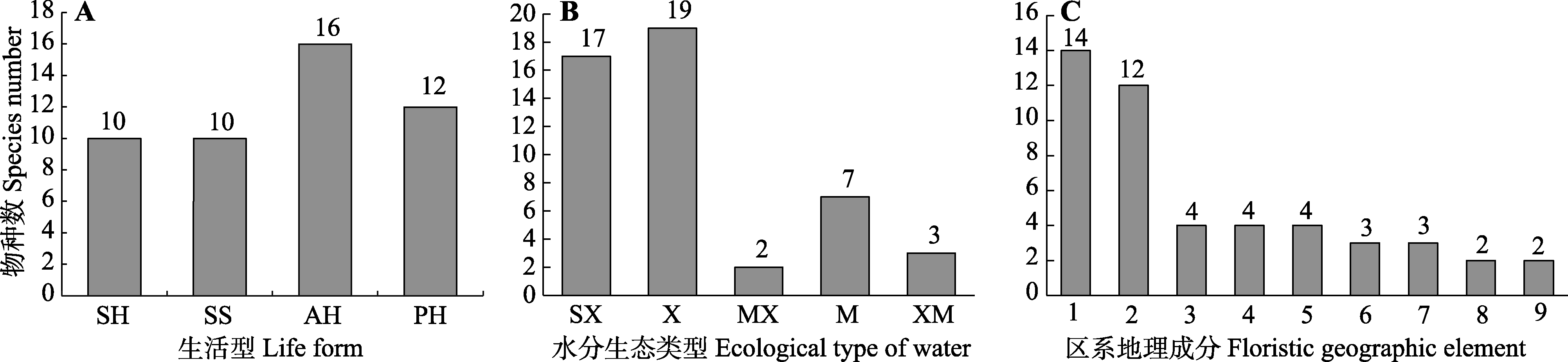
图1 绵刺群落物种的生活型(A)、水分生态类型(B)和区系地理成分组成(C)。AH, 一年生草本; PH, 多年生草本; SH, 灌木; SS, 半灌木。M, 典型中生植物; MX, 中旱生植物; SX, 强旱生植物; X, 典型旱生植物; XM, 旱中生植物。1, 戈壁分布种; 2, 蒙古分布种; 3, 中亚东部分布种; 4, 古地中海分布种; 5, 温带亚洲分布种; 6, 旧大陆温带分布种; 7, 世界分布种; 8, 全温带分布种; 9, 北温带分布种。
Fig. 1 Life form (A), water ecological type (B) and floristic geographic element (C) of the species in Potaninia mongolica community. AH, annual herb; PH, perennial herb; SH, shrub; SS, semi-shrub. M, typical mesophytes; MX, meso-xerophytes; SX, super-xerophytes; X, typical xerophytes; XM, xero-mesophytes. 1, gobi distribution species; 2, Mongolia distribution species; 3, Eastern Central Asia distribution species; 4, ancient Mediterranean distribution species; 5, temperate Asia distribution species; 6, old continent temperate distribution species; 7, world spread distribution species; 8, Pan-temperate distribution species; 9, northern temperate distribution species.
| [1] | Du ZY, He YM, Fang PP, Duan YZ, Lu K (2020). Community composition, plant species diversity and soil nutrient content of endangered plant Tetraena mongolica Maxim. Chinese Journal of Ecology, 39, 3537-3548. |
| [杜忠毓, 贺一鸣, 房朋朋, 段义忠, 鲁客 (2020). 孑遗濒危植物四合木群落组成、物种多样性及土壤养分含量. 生态学杂志, 39, 3537-3548.] | |
| [2] |
Fang JY, Wang XP, Shen ZH, Tang ZY, He JS, Yu D, Jiang Y, Wang ZH, Zheng CY, Zhu JL, Guo ZD (2009). Methods and protocols for plant community inventory. Biodiversity Science, 17, 533-548.
DOI |
|
[方精云, 王襄平, 沈泽昊, 唐志尧, 贺金生, 于丹, 江源, 王志恒, 郑成洋, 朱江玲, 郭兆迪 (2009). 植物群落清查的主要内容、方法和技术规范. 生物多样性, 17, 533-548.]
DOI |
|
| [3] |
Guo K, Fang JY, Wang GH, Tang ZY, Xie ZQ, Shen ZH, Wang RQ, Qiang S, Liang CZ, Da LJ, Yu D (2020). A revised scheme of vegetation classification system of China. Chinese Journal of Plant Ecology, 44, 111-127.
DOI |
|
[郭柯, 方精云, 王国宏, 唐志尧, 谢宗强, 沈泽昊, 王仁卿, 强胜, 梁存柱, 达良俊, 于丹 (2020). 中国植被分类系统修订方案. 植物生态学报, 44, 111-127.]
DOI |
|
| [4] | Inner Mongolia and Ningxia Scientific Expedition Group, Chinese Academic of Sciences (1985). Vegetation of Inner Mongolia. Science Press, Beijing. 663-670. |
| [中国科学院内蒙古宁夏综合考察队 (1985). 内蒙古植被. 科学出版社, 北京. 663-670.] | |
| [5] | Li NN, Yang JY, Jia ZT, Yan RL, Chen Q (2021). Effects of different grazing patterns on community characteristics and soil nutrients in the main pasture types of Alxa Zuoqi. Acta Agrestia Sinica, 29, 991-1003. |
|
[李娜娜, 杨九艳, 贾喆亭, 闫瑞玲, 陈琪 (2021). 不同放牧方式对阿拉善左旗主要草场类型群落特征和土壤养分的影响. 草地学报, 29, 991-1003.]
DOI |
|
| [6] |
Li ZJ, Sha N, Shi YB, Tong XZ, Dong L, Zhang XQ, Sun Q, Liang CZ (2019). Classification and characteristics of Helianthemum songaricum communities in western Erdos region, Nei Mongol, China. Chinese Journal of Plant Ecology, 43, 806-816.
DOI URL |
|
[李紫晶, 莎娜, 史亚博, 佟旭泽, 董雷, 张小青, 孙蔷, 梁存柱 (2019). 内蒙古西鄂尔多斯地区半日花荒漠群落特征及其分类. 植物生态学报, 43, 806-816.]
DOI |
|
| [7] | Liu XT (2024). Study on Species Composition and Population Distribution Pattern of Ammopiptanthus mongolicus Community in Eastern Alashan Desert. Master degree dissertation, Inner Mongolia Normal University, Hohhot. |
| [刘晓婷 (2024). 东阿拉善荒漠沙冬青群落的种类组成与种群分布格局研究. 硕士学位论文, 内蒙古师范大学, 呼和浩特.] | |
| [8] | Ma YQ, Fu XQ, Chen S (1998). Flora Intramongolica. 2nd ed. Inner Mongolian People’s Publishing House, Hohhot. |
| [马毓泉, 富象乾, 陈山 (1998). 内蒙古植物志. 2版. 内蒙古人民出版社, 呼和浩特.] | |
| [9] | Wang GH (2005). The western Ordos Plateau as a biodiversity center of relic shrubs in arid areas of China. Biodiversity & Conservation, 14, 3187-3200. |
| [10] |
Wang GH, Fang JY, Guo K, Xie ZQ, Tang ZY, Shen ZH, Wang RQ, Wang XP, Wang DL, Qiang S, Yu D, Peng SL, Da LJ, Liu Q, Liang CZ (2020). Contents and protocols for the classification and description of Vegetation Formations, Alliances and Associations of vegetation of China. Chinese Journal of Plant Ecology, 44, 128-178.
DOI |
|
[王国宏, 方精云, 郭柯, 谢宗强, 唐志尧, 沈泽昊, 王仁卿, 王襄平, 王德利, 强胜, 于丹, 彭少麟, 达良俊, 刘庆, 梁存柱 (2020). 《中国植被志》研编内容与规范. 植物生态学报, 44, 128-178.]
DOI |
|
| [11] | Wang HS, Zhang YL (1994). The bio-diversity and characters of spermatophytic genera endemic to China. Acta Botanica Yunnanica, 16, 209-220. |
| [王荷生, 张镱锂 (1994). 中国种子植物特有属的生物多样性和特征. 云南植物研究, 16, 209-220.] | |
| [12] | Wang JM, Cui PJ, Zhong YM, Li JW, Chu JM (2019). Biogeographic patterns and environmental interpretation of plant regional species richness in Alxa Plateau of northern China. Journal of Beijing Forestry University, 41(3), 14-23. |
| [王健铭, 崔盼杰, 钟悦鸣, 李景文, 褚建民 (2019). 阿拉善高原植物区域物种丰富度格局及其环境解释. 北京林业大学学报, 41(3), 14-23.] | |
| [13] | Wang YC, Li X (2007). Water characteristics of the xerophytic shrublet, Potaninia mongolica, during fissurate growth. Journal of Plant Ecology (Chinese Version), 31, 476-483. |
|
[王迎春, 李骁 (2007). 强旱生小灌木绵刺劈裂生长过程中的水分特征. 植物生态学报, 31, 476-483.]
DOI |
|
| [14] | Zeng XD, Zhang YJ, Wang CX, Xue BR, Li WL, Zhang J, Li R (2016). Community structure and species diversity characteristics of Potaninia mongolica community in the lower reaches of Shiyanghe River. Journal of Northeast Forestry University, 44(11), 36-40. |
| [曾新德, 张有佳, 王承勋, 薛斌瑞, 李威龙, 张杰, 李锐 (2016). 石羊河下游绵刺群落结构和物种多样性特征. 东北林业大学学报, 44(11), 36-40.] | |
| [15] | Zhang T, Wang W, An HJ, Liang CZ, Zhang HD, Wu JL (2005). Relevant analysis on changed population spot and priority protection order of the peculiar endangered plants in eastern Alasham-western Erdos. Journal of Arid Land Resources & Environment, 19(5), 179-184. |
| [张韬, 王炜, 安慧君, 梁存柱, 张慧东, 吴金灵 (2005). 东阿拉善—西鄂尔多斯地区特有濒危植物种群斑块变化与优先保护级相关分析. 干旱区资源与环境, 19(5), 179-184.] | |
| [16] | Zhang YM, Jin H, Gao RH, Wang SL, Zhao G (2005). Allelopathic effects of the extracts from several plants on Potaninia mongolica Maxim. Grassland of China, 27(3), 44-48. |
| [张永明, 金洪, 高润宏, 王胜利, 赵钢 (2005). 几种植物对濒危物种绵刺他感作用的研究. 中国草地, 27(3), 44-48.] | |
| [17] | Zhao YZ, Zhao LQ, Cao R (2019). Flora Intramongolica. 3rd ed. Inner Mongolian People’s Publishing House, Hohhot. |
| [赵一之, 赵利清, 曹瑞 (2019). 内蒙古植物志. 3版. 内蒙古人民出版社, 呼和浩特.] | |
| [18] |
Zhou L, Yang JL, Yang H, Dou JD, Huang W, Li XW (2022). Community characteristics and classification of Amygdalus mongolian in Ningxia, China. Chinese Journal of Plant Ecology, 46, 243-248.
DOI URL |
|
[周亮, 杨君珑, 杨虎, 窦建德, 黄维, 李小伟 (2022). 宁夏蒙古扁桃群落特征与分类. 植物生态学报, 46, 243-248.]
DOI |
| [1] | 饶朝康, 唐亮. 不同潮位红树植物叶际微生物群落特征及其影响因素[J]. 植物生态学报, 2026, 50(预发表): 1-. |
| [2] | 蔡榕榕, 沈历都, 刘雅各, 费雯丽, 戴冠华. 2005-2010年长白山阔叶红松林长期监测样地植物物种组成和群落特征数据集[J]. 植物生态学报, 2025, 49(8): 1236-1245. |
| [3] | 白帆, 王杨. 2007-2015年北京东灵山暖温带落叶阔叶林长期监测样地植物物种组成和群落特征数据集[J]. 植物生态学报, 2025, 49(8): 1229-1235. |
| [4] | 赵常明, 熊高明, 申国珍, 葛结林, 徐文婷, 徐凯, 武元帅, 谢宗强. 2010年神农架常绿落叶阔叶混交林和亚高山针叶林长期监测样地植物物种组成和群落特征数据集[J]. 植物生态学报, 2025, 49(8): 1215-1228. |
| [5] | 饶兴权, 蔡锡安, 林永标, 刘素萍. 2005-2015年鹤山马占相思林长期监测样地植物物种组成和群落特征数据集[J]. 植物生态学报, 2025, 49(8): 1246-1254. |
| [6] | 徐志雄, 杞金华, 杨国平, 鲁志云, 杨效东, 范泽鑫. 2005-2010年哀牢山中山湿性常绿阔叶林长期监测样地植物物种组成和群落特征数据集[J]. 植物生态学报, 2025, 49(8): 1191-1204. |
| [7] | 周志琼, 丁建林, 李晓明, 何其华. 2005-2010年西南山地人工林长期监测样地植物物种组成与群落特征数据集[J]. 植物生态学报, 2025, 49(8): 1255-1262. |
| [8] | 刘世忠, 张倩媚, 张德强, 刘菊秀, 褚国伟, 李跃林. 1999-2015年鼎湖山季风常绿阔叶林长期监测样地植物物种组成和群落特征数据集[J]. 植物生态学报, 2025, 49(8): 1205-1214. |
| [9] | 张坤, 伊丽晴, 刘占军, 张志杰, 王顼, 李明乐, 苗百岭, 张景慧, 李智勇, 董雷, 梁存柱. 毛刺锦鸡儿群落特征及分类[J]. 植物生态学报, 2025, 49(6): 888-896. |
| [10] | 韩鹏宾, 裴康迪, 何斌, 肖书礼, 唐勤. 中国云南铁杉林的群落组成及特征[J]. 植物生态学报, 2025, 49(6): 840-851. |
| [11] | 要振宇, 辛玥, 穆文奎, 张全民, 杨柳, 赵利清. 内蒙古羊草草原的群落特征[J]. 植物生态学报, 2024, 48(10): 1385-1392. |
| [12] | 李冰, 朱湾湾, 韩翠, 余海龙, 黄菊莹. 降水量变化下荒漠草原土壤呼吸及其影响因素[J]. 植物生态学报, 2023, 47(9): 1310-1321. |
| [13] | 于笑, 纪若璇, 任天梦, 夏新莉, 尹伟伦, 刘超. 中国北方蒙古莸群落的分布、特征和分类[J]. 植物生态学报, 2023, 47(8): 1182-1192. |
| [14] | 李晓田, 王铁娟, 韩文娟, 张丽, 张慧, 刘晓婷, 刘雅洁. 东阿拉善珍稀濒危植物绵刺种群结构与点格局分析[J]. 植物生态学报, 2023, 47(4): 506-514. |
| [15] | 师斌, 窦建德, 黄维, 李小伟. 宁夏贺兰山斑子麻黄荒漠群落特征[J]. 植物生态学报, 2022, 46(3): 362-367. |
| 阅读次数 | ||||||
|
全文 |
|
|||||
|
摘要 |
|
|||||
Copyright © 2026 版权所有 《植物生态学报》编辑部
地址: 北京香山南辛村20号, 邮编: 100093
Tel.: 010-62836134, 62836138; Fax: 010-82599431; E-mail: apes@ibcas.ac.cn, cjpe@ibcas.ac.cn
备案号: 京ICP备16067583号-19

