
植物生态学报 ›› 2026, Vol. 50 ›› Issue (2): 474-488.DOI: 10.17521/cjpe.2025.0038 cstr: 32100.14.cjpe.2025.0038
• 研究论文 • 上一篇
李沁1,2, 贺鹏程1, 叶清1,*( )
)
收稿日期:2025-01-26
接受日期:2025-07-09
出版日期:2026-02-28
发布日期:2026-04-01
通讯作者:
*叶清(qye@scbg.ac.cn)基金资助:
LI Qin1,2, HE Peng-Cheng1, YE Qing1,*()
Received:2025-01-26
Accepted:2025-07-09
Online:2026-02-28
Published:2026-04-01
Contact:
*YE Qing (qye@scbg.ac.cn)Supported by:摘要:
植物功能性状是指植物形态、结构、生理等方面的特征, 反映植物对环境变化的响应与适应。花是植物的繁殖器官, 其功能性状表征植物对传粉媒介、传粉者的选择以及繁殖过程的碳投资策略。研究表明, 花是由叶片发育而来的变态器官, 但两者在结构和生理性状上的差异研究较少。为了揭示花和叶片功能性状的差异, 该研究以华南国家植物园的24个物种为研究对象, 分别测定花和叶片的形态性状(大小和厚度)、结构性状(花脉直径与密度、叶脉直径与密度、比花重、比叶重和干物质含量)、机械抗性(穿透力、撕裂力)和生理性状(寿命、呼吸速率、蒸腾速率、气孔导度、氮含量和磷含量)。研究发现, 花与叶片碳投资策略存在显著差异。与叶片相比, 花的穿透力、撕裂力和干物质含量为叶片的50.0%、42.9%、30.7%, 且花的蒸腾速率和气孔导度为叶片的73.9%和84.6%。同时, 花大小、花机械抗性均随花脉直径增大而显著增加; 叶片大小与叶片一级脉直径呈显著正相关关系, 叶片机械抗性与叶片末端脉直径呈显著正相关关系。而花寿命与花瓣的呼吸速率、蒸腾速率和气孔导度呈显著负相关关系, 与花机械抗性(即撕裂力和穿透力)、比花重均无显著关系; 而叶片寿命与叶片呼吸速率、机械抗性、比叶重均呈显著正相关关系。该研究通过系统测定花和叶片的功能性状, 探究了植物两类器官结构与功能之间的差异, 揭示了植物在繁殖与生长之间的资源分配权衡, 为国家植物园的物种保护提供科学依据和数据支持。
李沁, 贺鹏程, 叶清. 华南国家植物园24种植物花与叶片功能性状变异. 植物生态学报, 2026, 50(2): 474-488. DOI: 10.17521/cjpe.2025.0038
LI Qin, HE Peng-Cheng, YE Qing. Variation in flower and leaf functional traits of 24 species in South China National Botanical Garden. Chinese Journal of Plant Ecology, 2026, 50(2): 474-488. DOI: 10.17521/cjpe.2025.0038
| 物种 Species | 科名 Family | 生长型 Growth form | 采样时间 Sampling time |
|---|---|---|---|
| 山茶 Camellia japonica | 山茶科 Theaceae | 乔木 Tree | 12月 December |
| 茶梅 Camellia sasanqua | 山茶科 Theaceae | 乔木 Tree | 12月 December |
| 红皮糙果茶 Camellia crapnelliana | 山茶科 Theaceae | 乔木 Tree | 12月 December |
| 白兰 Michelia alba | 木兰科 Magnoliaceae | 乔木 Tree | 2月 February |
| 黄山玉兰 Magnolia cylindrica | 木兰科 Magnoliaceae | 乔木 Tree | 2月 February |
| 荷花玉兰 Magnolia grandiflora | 木兰科 Magnoliaceae | 乔木 Tree | 5月 May |
| 盖裂木 Talauma hodgsonii | 木兰科 Magnoliaceae | 乔木 Tree | 5月 May |
| 红花木莲 Manglietia insignis | 木兰科 Magnoliaceae | 乔木 Tree | 5月 May |
| 香港木兰 Lirianthe championii | 木兰科 Magnoliaceae | 乔木 Tree | 5月 May |
| 含笑 Michelia figo | 木兰科 Magnoliaceae | 灌木 Shrub | 2月 February |
| 毛棉杜鹃 Rhododendron moulmainense | 杜鹃花科 Ericaceae | 灌木 Shrub | 3月 March |
| 锦绣杜鹃 Rhododendron pulchrum | 杜鹃花科 Ericaceae | 灌木 Shrub | 3月 March |
| 杜鹃 Rhododendron simsii | 杜鹃花科 Ericaceae | 灌木 Shrub | 2月 February |
| 悬铃花 Malvaviscus arboreus | 锦葵科 Malvaceae | 灌木 Shrub | 2月 February |
| 宫粉羊蹄甲 Bauhinia variegata | 豆科 Fabaceae | 乔木 Tree | 3月 March |
| 黄蝉 Allamanda schottii | 夹竹桃科 Apocynaceae | 灌木 Shrub | 3月 March |
| 金杯花 Solandra guttata | 茄科 Solanaceae | 藤本 Vine | 3月 March |
| 炮仗藤 Pyrostegia venusta | 紫葳科 Bignoniaceae | 藤本 Vine | 2月 February |
| 红花酢浆草 Oxalis corymbosa | 酢浆草科 Oxalidaceae | 草本 Herb | 3月 March |
| 碗花草 Thunbergia fragrans | 爵床科 Acanthaceae | 草本 Herb | 3月 March |
| 宽叶十万错 Asystasia gangetica | 爵床科 Acanthaceae | 草本 Herb | 3月 March |
| 翠芦莉 Ruellia simplex | 爵床科 Acanthaceae | 草本 Herb | 3月 March |
| 艳山姜 Alpinia zerumbet | 姜科 Zingiberaceae | 草本 Herb | 3月 March |
| 华南忍冬 Lonicera confusa | 忍冬科 Caprifoliaceae | 藤本 Vine | 3月 March |
表1 本实验所选华南国家植物园24个物种
Table 1 24 species selected from South China National Botanical Garden in this study
| 物种 Species | 科名 Family | 生长型 Growth form | 采样时间 Sampling time |
|---|---|---|---|
| 山茶 Camellia japonica | 山茶科 Theaceae | 乔木 Tree | 12月 December |
| 茶梅 Camellia sasanqua | 山茶科 Theaceae | 乔木 Tree | 12月 December |
| 红皮糙果茶 Camellia crapnelliana | 山茶科 Theaceae | 乔木 Tree | 12月 December |
| 白兰 Michelia alba | 木兰科 Magnoliaceae | 乔木 Tree | 2月 February |
| 黄山玉兰 Magnolia cylindrica | 木兰科 Magnoliaceae | 乔木 Tree | 2月 February |
| 荷花玉兰 Magnolia grandiflora | 木兰科 Magnoliaceae | 乔木 Tree | 5月 May |
| 盖裂木 Talauma hodgsonii | 木兰科 Magnoliaceae | 乔木 Tree | 5月 May |
| 红花木莲 Manglietia insignis | 木兰科 Magnoliaceae | 乔木 Tree | 5月 May |
| 香港木兰 Lirianthe championii | 木兰科 Magnoliaceae | 乔木 Tree | 5月 May |
| 含笑 Michelia figo | 木兰科 Magnoliaceae | 灌木 Shrub | 2月 February |
| 毛棉杜鹃 Rhododendron moulmainense | 杜鹃花科 Ericaceae | 灌木 Shrub | 3月 March |
| 锦绣杜鹃 Rhododendron pulchrum | 杜鹃花科 Ericaceae | 灌木 Shrub | 3月 March |
| 杜鹃 Rhododendron simsii | 杜鹃花科 Ericaceae | 灌木 Shrub | 2月 February |
| 悬铃花 Malvaviscus arboreus | 锦葵科 Malvaceae | 灌木 Shrub | 2月 February |
| 宫粉羊蹄甲 Bauhinia variegata | 豆科 Fabaceae | 乔木 Tree | 3月 March |
| 黄蝉 Allamanda schottii | 夹竹桃科 Apocynaceae | 灌木 Shrub | 3月 March |
| 金杯花 Solandra guttata | 茄科 Solanaceae | 藤本 Vine | 3月 March |
| 炮仗藤 Pyrostegia venusta | 紫葳科 Bignoniaceae | 藤本 Vine | 2月 February |
| 红花酢浆草 Oxalis corymbosa | 酢浆草科 Oxalidaceae | 草本 Herb | 3月 March |
| 碗花草 Thunbergia fragrans | 爵床科 Acanthaceae | 草本 Herb | 3月 March |
| 宽叶十万错 Asystasia gangetica | 爵床科 Acanthaceae | 草本 Herb | 3月 March |
| 翠芦莉 Ruellia simplex | 爵床科 Acanthaceae | 草本 Herb | 3月 March |
| 艳山姜 Alpinia zerumbet | 姜科 Zingiberaceae | 草本 Herb | 3月 March |
| 华南忍冬 Lonicera confusa | 忍冬科 Caprifoliaceae | 藤本 Vine | 3月 March |
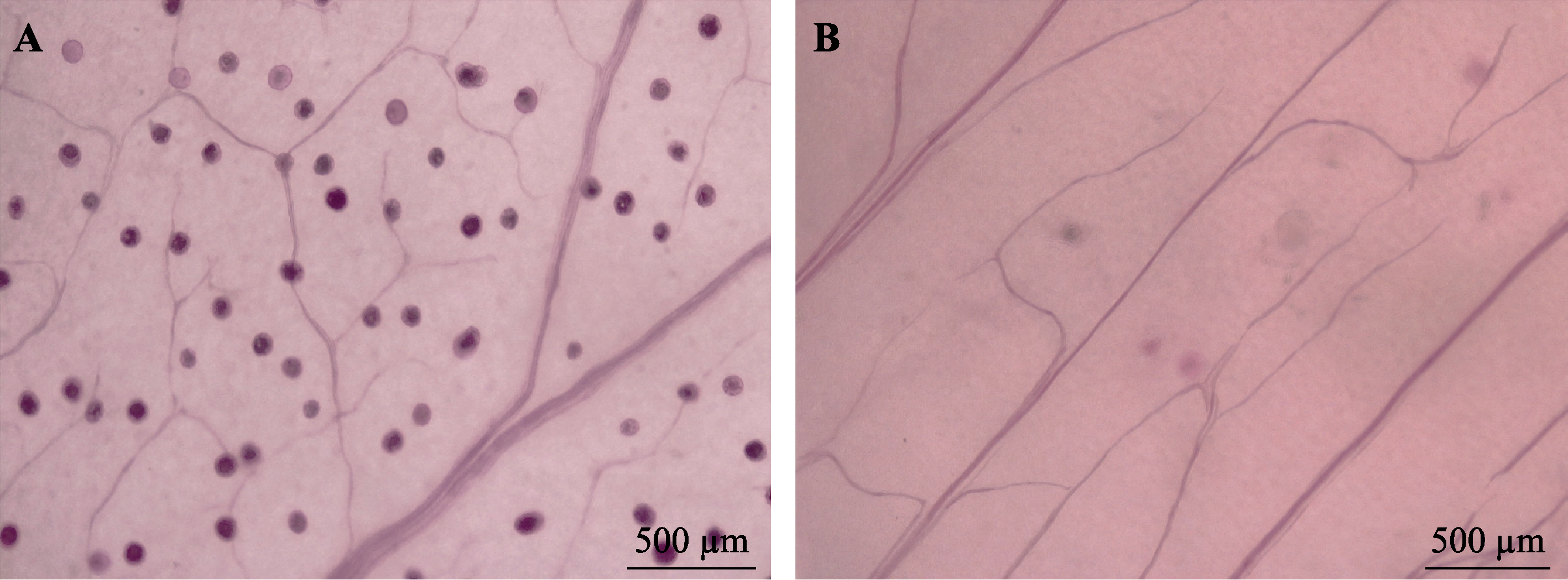
图1 花脉性状的测定。A, 黄山玉兰。B, 炮仗藤。
Fig. 1 Determination of flower vein properties. A, Magnolia cylindrica. B, Pyrostegia venusta.
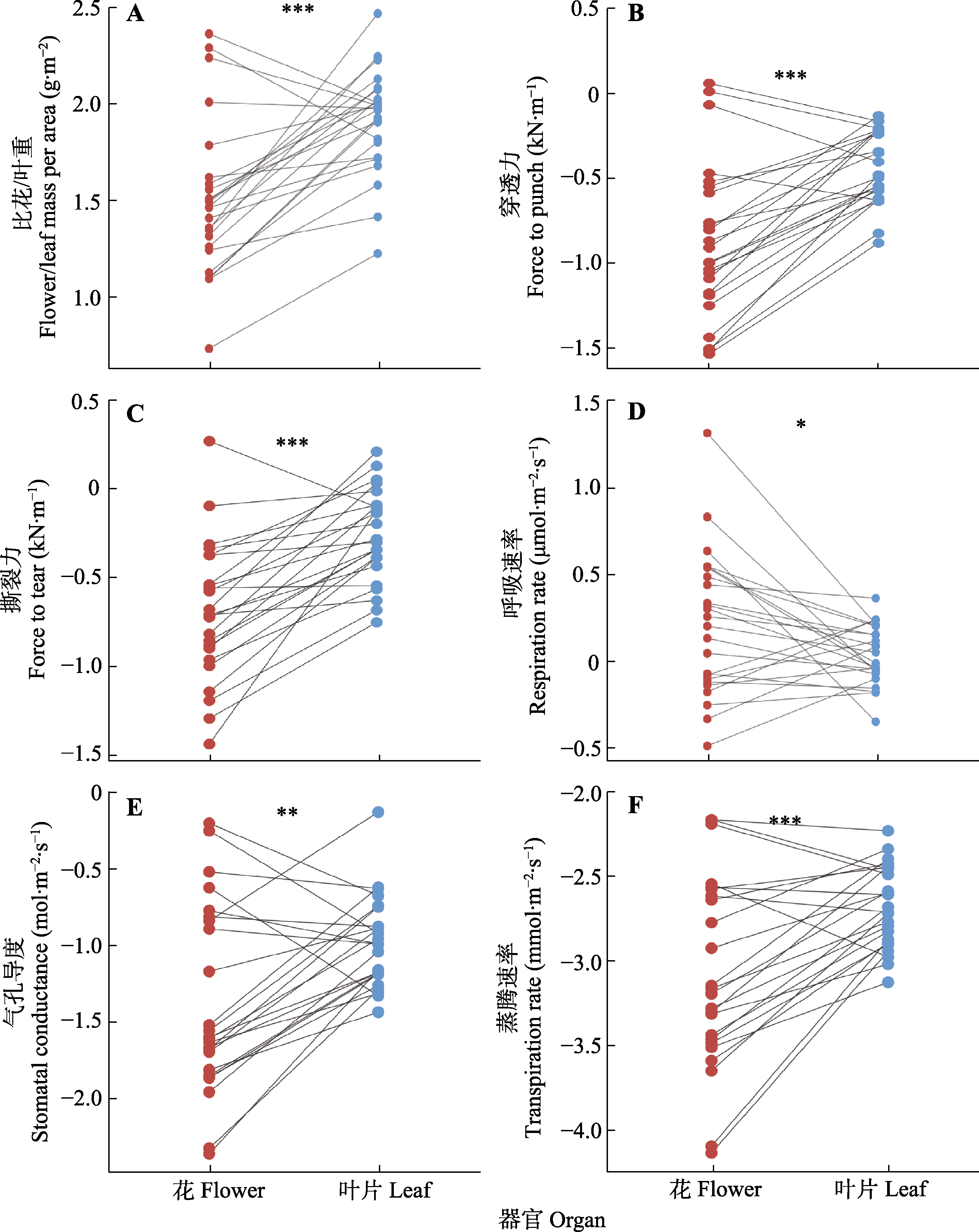
图2 植物花与叶片功能性状的比较。数据进行lg转化。花和叶片性状之间的比较用配对样本t检验。*, 0.01 ≤ p < 0.05; **, 0.001 ≤ p < 0.01; ***, p < 0.001。
Fig. 2 Comparison of functional traits between flower and leaf. Figures are plotted on lg scales. Traits were compared between flower and leaf using pared-samples t-test. *, 0.01 ≤ p < 0.05; **, 0.001 ≤ p < 0.01; ***, p < 0.001.
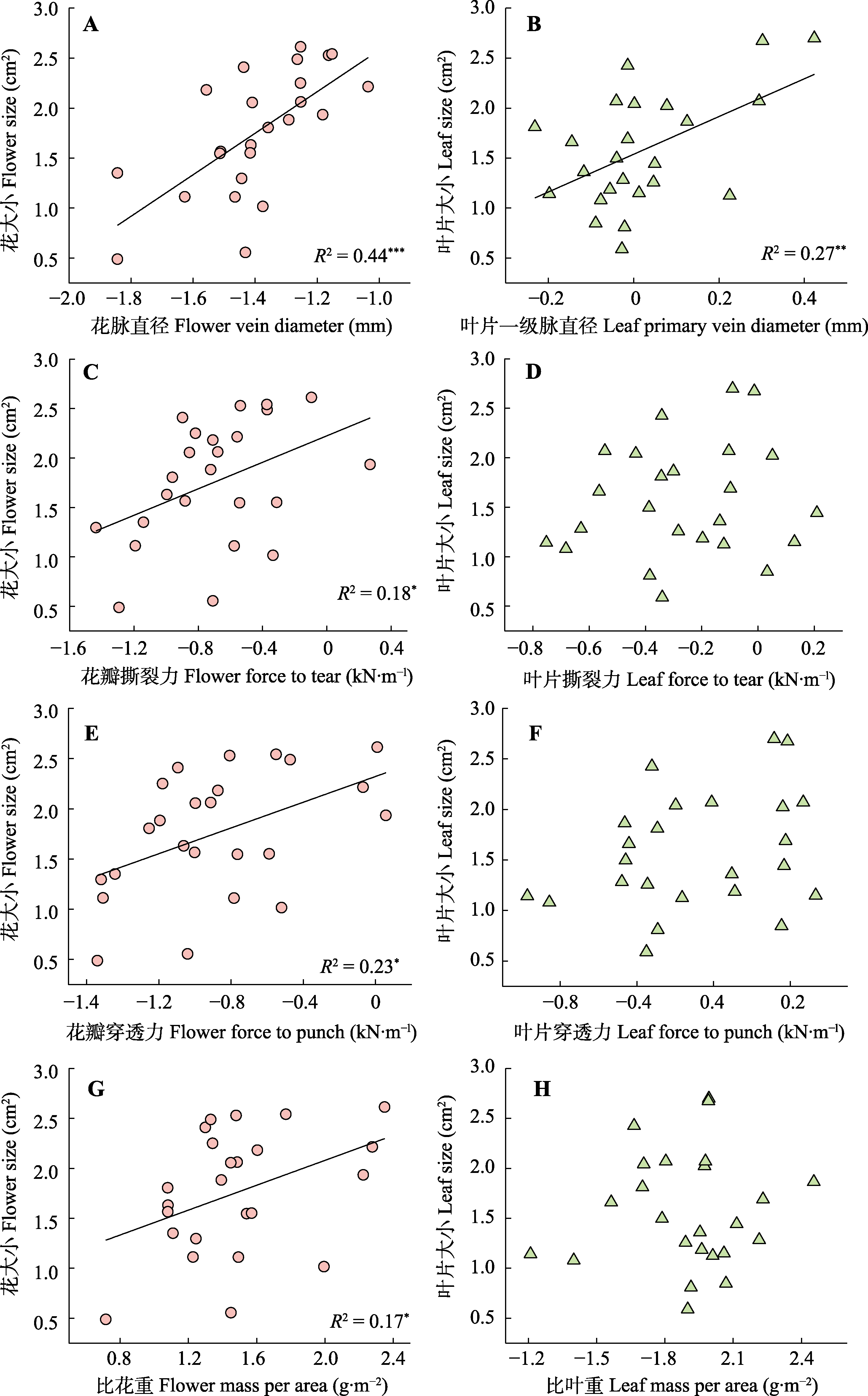
图3 花和叶片的大小与脉直径、机械抗性、比花/叶重之间的关系。数据进行了lg转化。*, 0.01 ≤ p < 0.05; **, 0.001 ≤ p < 0.01; ***, p < 0.001。
Fig. 3 Relationships between size and vein diameter, mechanical strength, mass per area of flower and leaf. Figures are plotted on lg scales. *, 0.01 ≤ p < 0.05; **, 0.001 ≤ p < 0.01; ***, p < 0.001.
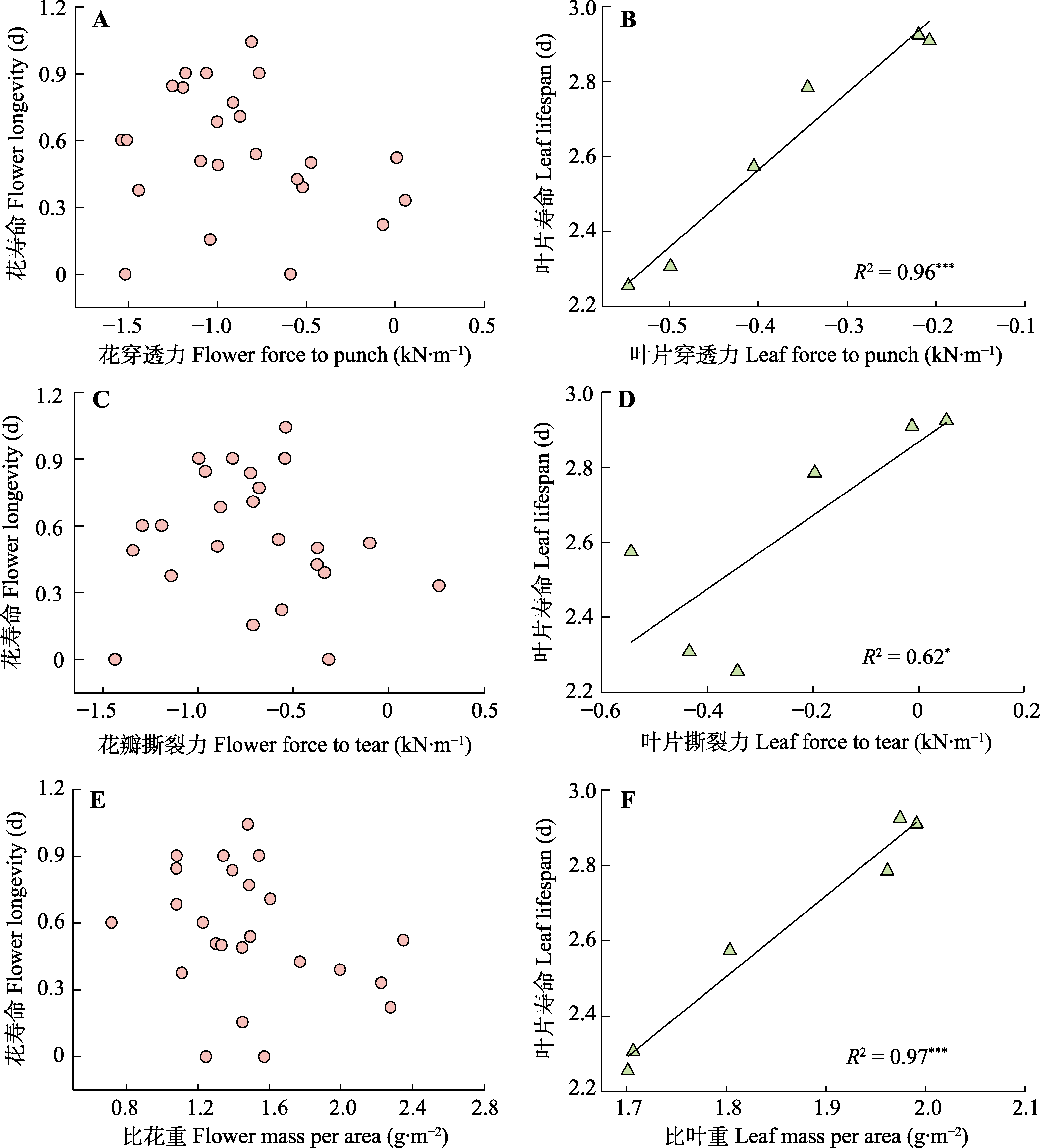
图4 植物花和叶片的寿命与机械抗性、比花/叶重之间的关系。数据进行了lg转化。*, 0.01 ≤ p < 0.05; ***, p < 0.001。
Fig. 4 Relationships between longevity and mechanical strength, mass per area of flower and leaf. Figures are plotted on lg scales. *, 0.01 ≤ p < 0.05; ***, p < 0.001.
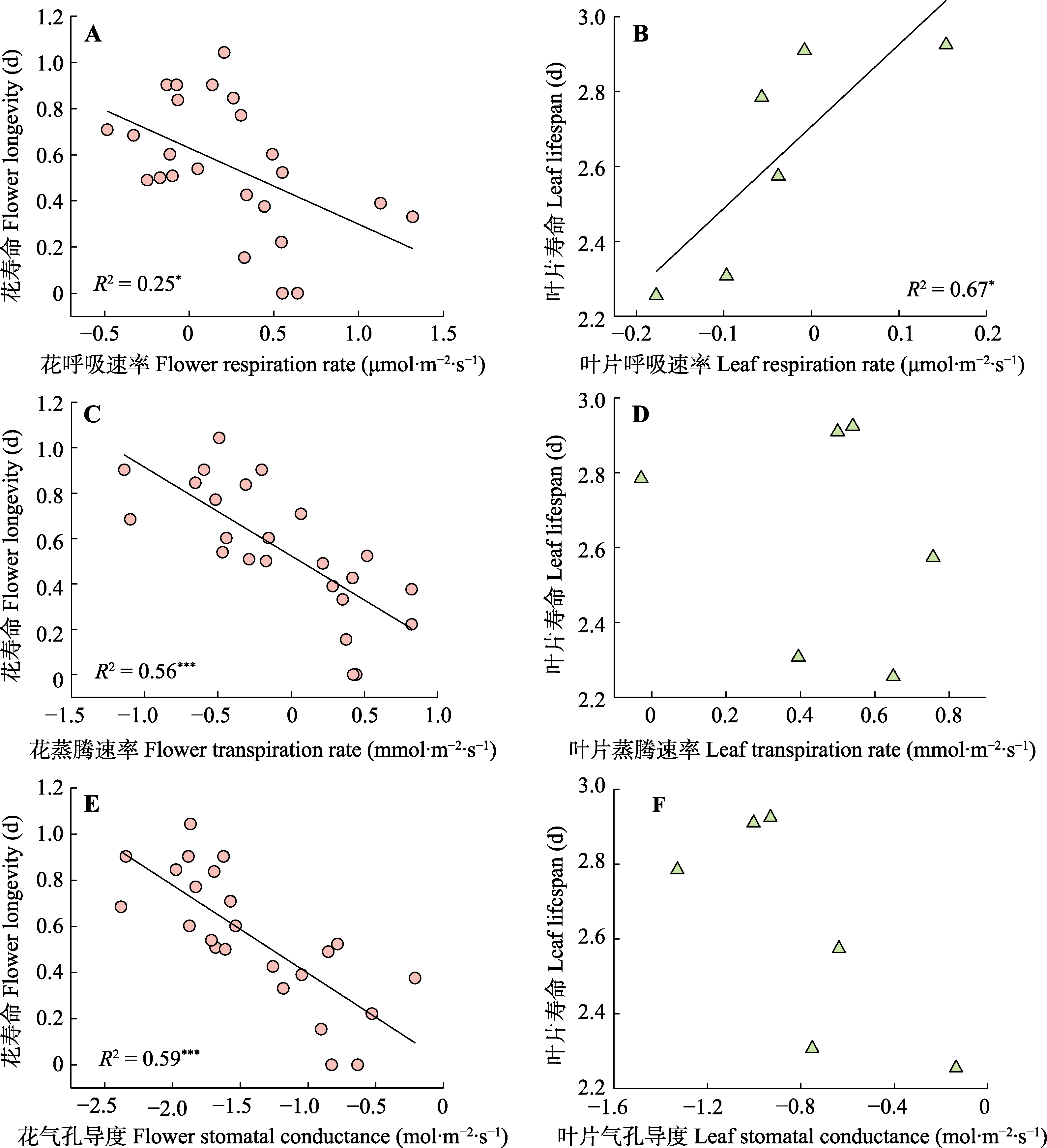
图5 花和叶片的寿命与呼吸速率、蒸腾速率、气孔导度之间的关系。数据进行了lg转化。*, 0.01 ≤ p < 0.05; ***, p < 0.001。
Fig. 5 Relationships between longevity and respiration rate, transpiration rate, stomatal conductance of flower and leaf. Figures are plotted on lg scales. *, 0.01 ≤ p < 0.05; ***, p < 0.001.
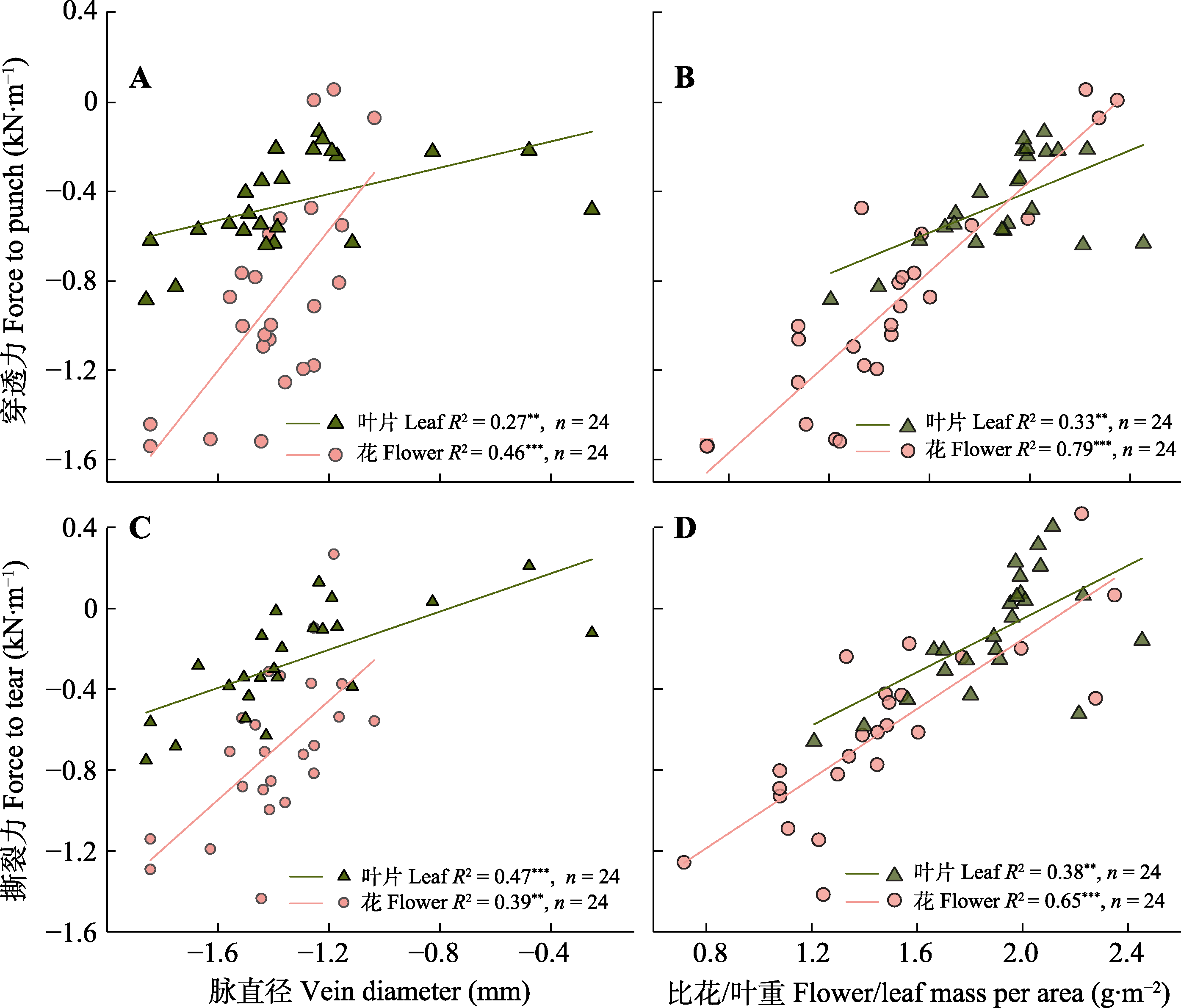
图6 花和叶片的机械抗性与脉直径、比花/叶重之间关系。数据进行了lg转化。**, 0.001 ≤ p < 0.01; ***, p < 0.001。
Fig. 6 Relationships between mechanical strength and vein diameter, mass per area of flower and leaf. Figures are plotted on lg scales. **, 0.001 ≤ p < 0.01; ***, p < 0.001.
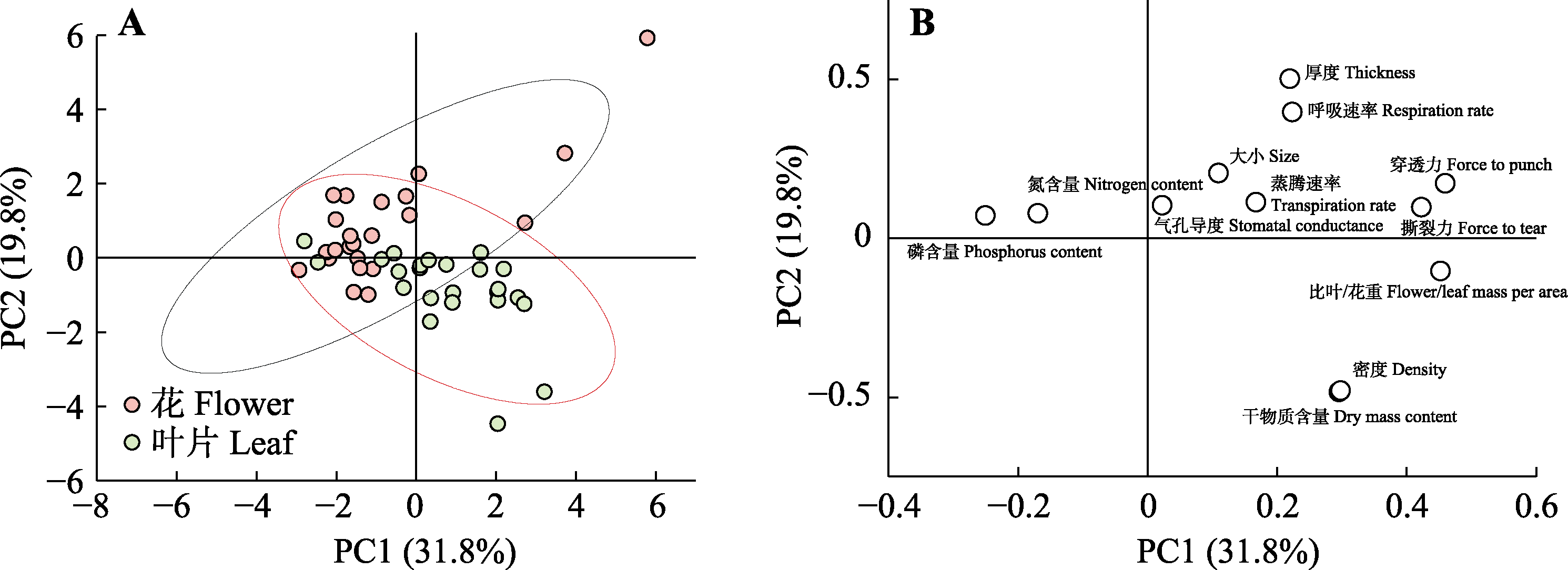
图7 植物花和叶片性状的主成分(PC)分析。A, 花和叶片的物种分布。B, 主成分载荷。
Fig. 7 Principal component (PC) analysis of flower and leaf traits. A, Species scores with flower and leaf traits. B, Principal component loadings of plant traits.
| [1] |
Anten NPR, Alcalá-Herrera R, Schieving F, Onoda Y (2010). Wind and mechanical stimuli differentially affect leaf traits in Plantago major. New Phytologist, 188, 554-564.
DOI URL |
| [2] |
Armbruster WS, Di Stilio VS, Tuxill JD, Flores TC, Velásquez Runk JL (1999). Covariance and decoupling of floral and vegetative traits in nine Neotropical plants: a re-evaluation of Berg’s correlation-Pleiades concept. American Journal of Botany, 86, 39-55.
PMID |
| [3] |
Arroyo MTK, Dudley LS, Jespersen G, Pacheco DA, Cavieres LA (2013). Temperature-driven flower longevity in a high-alpine species of Oxalis influences reproductive assurance. New Phytologist, 200, 1260-1268.
DOI PMID |
| [4] |
Ashman TL, Schoen DJ (1994). How long should flowers live. Nature, 371, 788-791.
DOI |
| [5] |
Berg RL (1960). The ecological significance of correlation Pleiades. Evolution, 14, 171-180.
DOI URL |
| [6] |
Bjerring Jensen N, Vrobel O, Akula Nageshbabu N, de Diego N, Tarkowski P, Ottosen CO, Zhou R (2024). Stomatal effects and ABA metabolism mediate differential regulation of leaf and flower cooling in tomato cultivars exposed to heat and drought stress. Journal of Experimental Botany, 75, 2156-2175.
DOI PMID |
| [7] |
Blonder B, Violle C, Bentley LP, Enquist BJ (2011). Venation networks and the origin of the leaf economics spectrum. Ecology Letters, 14, 91-100.
DOI PMID |
| [8] |
Brito-Rocha E, Schilling AC, Dos Anjos L, Piotto D, Dalmolin AC, Mielke MS (2016). Regression models for estimating leaf area of seedlings and adult individuals of Neotropical rainforest tree species. Brazilian Journal of Biology, 76, 983-989.
DOI PMID |
| [9] | Caldwell E, Read J, Sanson GD (2016). Which leaf mechanical traits correlate with insect herbivory among feeding guilds. Annals of Botany, 117, 349-361. |
| [10] |
Chen X, Li J, Peñuelas J, Li X, Hu D, Wang M, Zhong Q, Cheng D (2024). Temperature dependence of carbon metabolism in the leaves in sun and shade in a subtropical forest. Oecologia, 204, 59-69.
DOI PMID |
| [11] |
Choong MF, Lucas PW, Ong JSY, Pereira B, Tan HTW, Turner IM (1992). Leaf fracture toughness and sclerophylly: their correlations and ecological implications. New Phytologist, 121, 597-610.
DOI URL |
| [12] |
Coley PD, Bryant JP, Chapin III FS (1985). Resource availability and plant antiherbivore defense. Science, 230, 895-899.
DOI PMID |
| [13] |
Cooley AM, Reich A, Rundel P (2004). Leaf support biomechanics of neotropical understory herbs. American Journal of Botany, 91, 573-581.
DOI PMID |
| [14] |
Cornelissen JHC, Lavorel S, Garnier E, Díaz S, Buchmann N, Gurvich DE, Reich PB, ter Steege H, Morgan HD, van der Heijden MGA, Pausas JG, Poorter H (2003). A handbook of protocols for standardised and easy measurement of plant functional traits worldwide. Australian Journal of Botany, 51, 335-380.
DOI URL |
| [15] |
Díaz S, Kattge J, Cornelissen JHC, Wright IJ, Lavorel S, Dray S, Reu B, Kleyer M, Wirth C, Prentice IC, Garnier E, Bönisch G, Westoby M, Poorter H, Reich PB, et al. (2016). The global spectrum of plant form and function. Nature, 529, 167-171.
DOI |
| [16] |
Dudley LS, Arroyo MTK, Fernández-Murillo MP (2018). Physiological and fitness response of flowers to temperature and water augmentation in a high Andean geophyte. Environmental and Experimental Botany, 150, 1-8.
DOI URL |
| [17] |
E-Vojtkó A, Junker RR, de Bello F, Götzenberger L (2022). Floral and reproductive traits are an independent dimension within the plant economic spectrum of temperate central Europe. New Phytologist, 236, 1964-1975.
DOI PMID |
| [18] |
Franks PJ, Beerling DJ (2009). Maximum leaf conductance driven by CO2 effects on stomatal size and density over geologic time. Proceedings of the National Academy of Sciences of the United States of America, 106, 10343-10347.
DOI PMID |
| [19] | Genty L, Kazakou E, Metay A, Baude M, Gardarin A, Michelot-Antalik A, Leroy A, Sotillo A, Crouzet J, Barkaoui K (2023). Flowers of ruderal species are numerous but small, short and low-rewarding. Oikos, 10, e10219. DOI: 10.1111/oik.10219. |
| [20] |
He P, Wright IJ, Zhu S, Onoda Y, Liu H, Li R, Liu X, Hua L, Oyanoghafo OO, Ye Q (2019). Leaf mechanical strength and photosynthetic capacity vary independently across 57 subtropical forest species with contrasting light requirements. New Phytologist, 223, 607-618.
DOI PMID |
| [21] |
Hua L, He P, Goldstein G, Liu H, Yin D, Zhu S, Ye Q (2020). Linking vein properties to leaf biomechanics across 58 woody species from a subtropical forest. Plant Biology, 22, 212-220.
DOI PMID |
| [22] |
Kitajima K, Llorens AM, Stefanescu C, Timchenko MV, Lucas PW, Wright SJ (2012). How cellulose-based leaf toughness and Lamina density contribute to long leaf lifespans of shade-tolerant species. New Phytologist, 195, 640-652.
DOI PMID |
| [23] |
Kleyer M, Minden V (2015). Why functional ecology should consider all plant organs: an allocation-based perspective. Basic and Applied Ecology, 16, 1-9.
DOI URL |
| [24] |
Lambrecht SC (2013). Floral water costs and size variation in the highly selfing Leptosiphon bicolor (Polemoniaceae). International Journal of Plant Sciences, 174, 74-84.
DOI URL |
| [25] |
Lambrecht SC, Dawson TE (2007). Correlated variation of floral and leaf traits along a moisture availability gradient. Oecologia, 151, 574-583.
PMID |
| [26] |
Li QJ, Kress WJ, Xu ZF, Xia YM, Zhang L, Deng XB, Gao JY (2002). Mating system and stigmatic behaviour during flowering of Alpinia kwangsiensis (Zingiberaceae). Plant Systematics and Evolution, 232, 123-132.
DOI URL |
| [27] | Martel C, Cairampoma L, Stauffer FW, Ayasse M (2016). Telipogon peruvianus (Orchidaceae) flowers elicit pre-mating behaviour in Eudejeania (Tachinidae) males for pollination. PLoS ONE, 11, 165896. DOI: 10.1371/journal.pone.0165896. |
| [28] |
Mason CM, Donovan LA (2015). Evolution of the leaf economics spectrum in herbs: evidence from environmental divergences in leaf physiology across Helianthus (Asteraceae). Evolution, 69, 2705-2720.
DOI URL |
| [29] |
McCall AC, Fordyce JA (2010). Can optimal defence theory be used to predict the distribution of plant chemical defences. Journal of Ecology, 98, 985-992.
DOI URL |
| [30] |
McMann N, Peichel A, Savage JA (2022). Early spring flowers rely on xylem hydration but are not limited by stem xylem conductivity. New Phytologist, 233, 838-850.
DOI URL |
| [31] |
Melville R (1960). A new theory of the angiosperm flower. Nature, 188, 14-18.
DOI |
| [32] |
Melville R (1969). Leaf venation patterns and the origin of the angiosperms. Nature, 224, 121-125.
DOI |
| [33] |
Méndez-Alonzo R, Ewers FW, Sack L (2013). Ecological variation in leaf biomechanics and its scaling with tissue structure across three Mediterranean-climate plant communities. Functional Ecology, 27, 544-554.
DOI URL |
| [34] |
Murren CJ (2002). Phenotypic integration in plants. Plant Species Biology, 17, 89-99.
DOI URL |
| [35] |
Onoda Y, Schieving F, Anten NPR (2008). Effects of light and nutrient availability on leaf mechanical properties of Plantago major: a conceptual approach. Annals of Botany, 101, 727-736.
DOI URL |
| [36] |
Onoda Y, Westoby M, Adler PB, Choong AMF, Clissold FJ, Cornelissen JHC, Díaz S, Dominy NJ, Elgart A, Enrico L, Fine PVA, Howard JJ, Jalili A, Kitajima K, Kurokawa H, et al. (2011). Global patterns of leaf mechanical properties. Ecology Letters, 14, 301-312.
DOI URL |
| [37] |
Pérez-Harguindeguy N, Díaz S, Garnier E, Lavorel S, Poorter H, Jaureguiberry P, Bret-Harte MS, Cornwell WK, Craine JM, Gurvich DE, Urcelay C, Veneklaas EJ, Reich PB, Poorter L, Wright IJ, et al. (2016). Corrigendum to: new handbook for standardised measurement of plant functional traits worldwide. Australian Journal of Botany, 64, 715-716.
DOI URL |
| [38] |
Primack R (1985). Longevity of individual flowers. Annual Review of Ecology and Systematics, 16, 15-37.
DOI URL |
| [39] |
Read J, Stokes A (2006). Plant biomechanics in an ecological context. American Journal of Botany, 93, 1546-1565.
DOI PMID |
| [40] |
Roddy AB, Brodersen CR, Dawson TE (2016). Hydraulic conductance and the maintenance of water balance in flowers. Plant, Cell & Environment, 39, 2123-2132.
DOI URL |
| [41] |
Roddy AB, Guilliams CM, Fine PVA, Mambelli S, Dawson TE, Simonin KA (2023). Flowers are leakier than leaves but cheaper to build. New Phytologist, 239, 2076-2082.
DOI URL |
| [42] |
Roddy AB, Guilliams CM, Lilittham T, Farmer J, Wormser V, Pham T, Fine PVA, Feild TS, Dawson TE (2013). Uncorrelated evolution of leaf and petal venation patterns across the angiosperm phylogeny. Journal of Experimental Botany, 64, 4081-4088.
DOI PMID |
| [43] |
Roddy AB, Jiang GF, Cao KF, Simonin KA, Brodersen CR (2019). Hydraulic traits are more diverse in flowers than in leaves. New Phytologist, 223, 193-203.
DOI PMID |
| [44] |
Roddy AB, Martínez-Perez C, Teixido AL, Cornelissen TG, Olson ME, Oliveira RS, Silveira FAO (2021). Towards the flower economics spectrum. New Phytologist, 229, 665-672.
DOI URL |
| [45] |
Roddy AB, Simonin KA, McCulloh KA, Brodersen CR, Dawson TE (2018). Water relations of Calycanthus flowers: hydraulic conductance, capacitance, and embolism resistance. Plant, Cell & Environment, 41, 2250-2262.
DOI URL |
| [46] | Sack L, Scoffoni C, McKown AD, Frole K, Rawls M, Havran JC, Tran H, Tran T (2012). Developmentally based scaling of leaf venation architecture explains global ecological patterns. Nature Communications, 3, 837. DOI: 10.1038/ncomms1835. |
| [47] | Sauret-Güeto S, Schiessl K, Bangham A, Sablowski R, Coen E (2013). JAGGED controls Arabidopsis petal growth and shape by interacting with a divergent polarity field. PLoS Biology, 11, e1001550. DOI: 10.1371/journal.pbio.1001550. |
| [48] |
Seymour RS, White CR, Gibernau M (2003). Heat reward for insect pollinators. Nature, 426, 243-244.
DOI |
| [49] |
Song B, Sun L, Barrett SCH, Moles AT, Luo YH, Armbruster WS, Gao YQ, Zhang S, Zhang ZQ, Sun H (2022). Global analysis of floral longevity reveals latitudinal gradients and biotic and abiotic correlates. New Phytologist, 235, 2054-2065.
DOI URL |
| [50] | Sun M, Feng CH, Liu ZY, Tian K (2020). Evolutionary correlation of water-related traits between different structures of Dendrobium plants. Botanical Studies, 61, 16. DOI: 10.1186/s40529-020-00292-4. |
| [51] |
Taneda H, Terashima I (2012). Co-ordinated development of the leaf midrib xylem with the lamina in Nicotiana tabacum. Annals of Botany, 110, 35-45.
DOI URL |
| [52] |
Teixido AL, Valladares F (2014). Disproportionate carbon and water maintenance costs of large corollas in hot Mediterranean ecosystems. Perspectives in Plant Ecology, Evolution and Systematics, 16, 83-92.
DOI URL |
| [53] |
Wright IJ, Dong N, Maire V, Prentice IC, Westoby M, Díaz S, Gallagher RV, Jacobs BF, Kooyman R, Law EA, Leishman MR, Niinemets Ü, Reich PB, Sack L, Villar R, et al. (2017). Global climatic drivers of leaf size. Science, 357, 917-921.
DOI PMID |
| [54] |
Wright IJ, Reich PB, Westoby M (2001). Strategy shifts in leaf physiology, structure and nutrient content between species of high- and low-rainfall and high- and low-nutrient habitats. Functional Ecology, 15, 423-434.
DOI URL |
| [55] |
Wright IJ, Reich PB, Westoby M, Ackerly DD, Baruch Z, Bongers F, Cavender-Bares J, Chapin T, Cornelissen JHC, Diemer M, Flexas J, Garnier E, Groom PK, Gulias J, Hikosaka K, et al. (2004). The worldwide leaf economics spectrum. Nature, 428, 821-827.
DOI |
| [56] |
Zhang FP, Carins Murphy MR, Cardoso AA, Jordan GJ, Brodribb TJ (2018). Similar geometric rules govern the distribution of veins and stomata in petals, sepals and leaves. New Phytologist, 219, 1224-1234.
DOI URL |
| [57] | Zhang FP, Yang YJ, Yang QY, Zhang W, Brodribb TJ, Hao GY, Hu H, Zhang SB (2017). Floral mass per area and water maintenance traits are correlated with floral longevity in Paphiopedilum (Orchidaceae). Frontiers in Plant Science, 8, 501. DOI: 10.3389/fpls.2017.00501. |
| [1] | 饶朝康, 唐亮. 不同潮位红树植物叶际微生物群落特征及其影响因素[J]. 植物生态学报, 2026, 50(预发表): 1-. |
| [2] | 王梦雪, 胡明艳, 储诚进, 陈阳, 罗文启, 马子龙. 亚热带森林不同菌根真菌树种叶片和细根的碳氮磷化学计量特征[J]. 植物生态学报, 2026, 50(2): 334-343. |
| [3] | 冯哲, 许格希, 刘顺, 陈健, 李非凡, 巩闪闪, 贾磊, 孙镇, 余美霓, 史作民, 周庆宏, 蒋冬梅. 生境因子和系统发育协同驱动云南金沙江干热河谷植物叶片化学计量特征[J]. 植物生态学报, 2026, 50(2): 352-361. |
| [4] | 田地, 迟小龙, 石亮, 刘宵含, 赵常提, 吴梅, 张玉忠, 高永亮. 塞罕坝地区优势造林树种叶片化学计量特征及其环境驱动[J]. 植物生态学报, 2026, 50(2): 362-373. |
| [5] | 谭聪, 石亮, 赵常提, 甘沛钦, 陈冰瑞, 谭深, 卜燕华, 田地. 基于叶片功能性状多维特征的北京平原林生态优化策略解析[J]. 植物生态学报, 2026, 50(2): 388-399. |
| [6] | 叶学敏, 高伟, 唐星林, 陈伏生, 孙荣喜, 罗坤水. 氮磷添加对常绿阔叶林幼树叶片植食损伤的影响及调控机制[J]. 植物生态学报, 2026, 50(2): 256-267. |
| [7] | 侯霄帆, 马辰涵, 孙语倩, 高钰涵, 李品. 臭氧胁迫下叶片与细根凋落物分解的生态化学计量特征差异[J]. 植物生态学报, 2026, 50(2): 268-278. |
| [8] | 李月琪, 麻仲花, 刘威帆, 苏明, 万猛虎, 李清云, 张丹, 刘吉利, 吴娜. 垂直深旋耕配施有机肥对盐碱地玉米叶片衰老特性及产量的影响[J]. 植物生态学报, 2026, 50(1): 222-236. |
| [9] | 李淑英, 朱加保, 马艳, 徐道青, 阚画春, 陈敏, 刘小玲, 郑曙峰, 马小艳. 牛筋草对棉花的密度竞争和防治临界期[J]. 植物生态学报, 2026, 50(1): 134-149. |
| [10] | 郭志红, 杨妮, 张涛, 李海波, 田太安, 黄小波, 李聪, 马驷驹, 苏建荣, 李帅锋. 梵净山天然林菌根植物功能多样性与群落构建沿海拔梯度的变化[J]. 植物生态学报, 2025, 49(9): 1410-1423. |
| [11] | 张箫荻, 王晓霞, 章毓文, 侯靖雨, 石骁鹏, 和璐璐, 刘亚栋, 薛柳, 何宝华, 段劼. 北京山区三种林下灌木水力结构、叶片功能性状及其环境适应策略[J]. 植物生态学报, 2025, 49(7): 1128-1143. |
| [12] | 段俊丞, 王志勇, 高维聪, 张成凯, 高长宏, 刘晓彤, 李振今. 黄河三角洲湿地入侵物种互花米草时空演化与景观格局分析[J]. 植物生态学报, 2025, 49(6): 922-938. |
| [13] | 张琨, 钱敏, 汪阳, 李志华, 孔令娜, 李明洋, 马瑾煜, 努尔艾合麦提•玉苏普, 陈乙一, 成沂芮, 张焕仕, 覃凤飞, 渠晖. 紫花苜蓿耐阴性综合评价及其鉴定指标的筛选[J]. 植物生态学报, 2025, 49(5): 773-787. |
| [14] | 杜英杰, 范爱连, 王雪, 闫晓俊, 陈廷廷, 贾林巧, 姜琦, 陈光水. 亚热带天然常绿阔叶林乔木树种与林下灌木树种根-叶功能性状协调性及差异[J]. 植物生态学报, 2025, 49(4): 585-595. |
| [15] | 赵洪贤, 刘鹏, 史曼英, 徐铭泽, 贾昕, 田赟, 查天山. 毛乌素沙地典型固沙植物黑沙蒿和赖草叶片氮分配对最大净光合速率的影响[J]. 植物生态学报, 2025, 49(3): 460-474. |
| 阅读次数 | ||||||
|
全文 |
|
|||||
|
摘要 |
|
|||||
Copyright © 2026 版权所有 《植物生态学报》编辑部
地址: 北京香山南辛村20号, 邮编: 100093
Tel.: 010-62836134, 62836138; Fax: 010-82599431; E-mail: apes@ibcas.ac.cn, cjpe@ibcas.ac.cn
备案号: 京ICP备16067583号-19

