
Chin J Plant Ecol ›› 2023, Vol. 47 ›› Issue (9): 1245-1255.DOI: 10.17521/cjpe.2023.0028 cstr: 32100.14.cjpe.2023.0028
Special Issue: 草原与草业
• Research Articles • Previous Articles Next Articles
CHEN Ying-Jie1,2, FANG Kai2,3,*( ), QIN Shu-Qi2, GUO Yan-Jun1,4, YANG Yuan-He2,5
Received:2023-02-01
Accepted:2023-04-21
Online:2023-09-20
Published:2023-09-28
Contact:
* FANG Kai(CHEN Ying-Jie, FANG Kai, QIN Shu-Qi, GUO Yan-Jun, YANG Yuan-He. Spatial patterns and determinants of soil organic carbon component contents and decomposition rate in temperate grasslands of Nei Mongol, China[J]. Chin J Plant Ecol, 2023, 47(9): 1245-1255.
Add to citation manager EndNote|Ris|BibTeX
URL: https://www.plant-ecology.com/EN/10.17521/cjpe.2023.0028
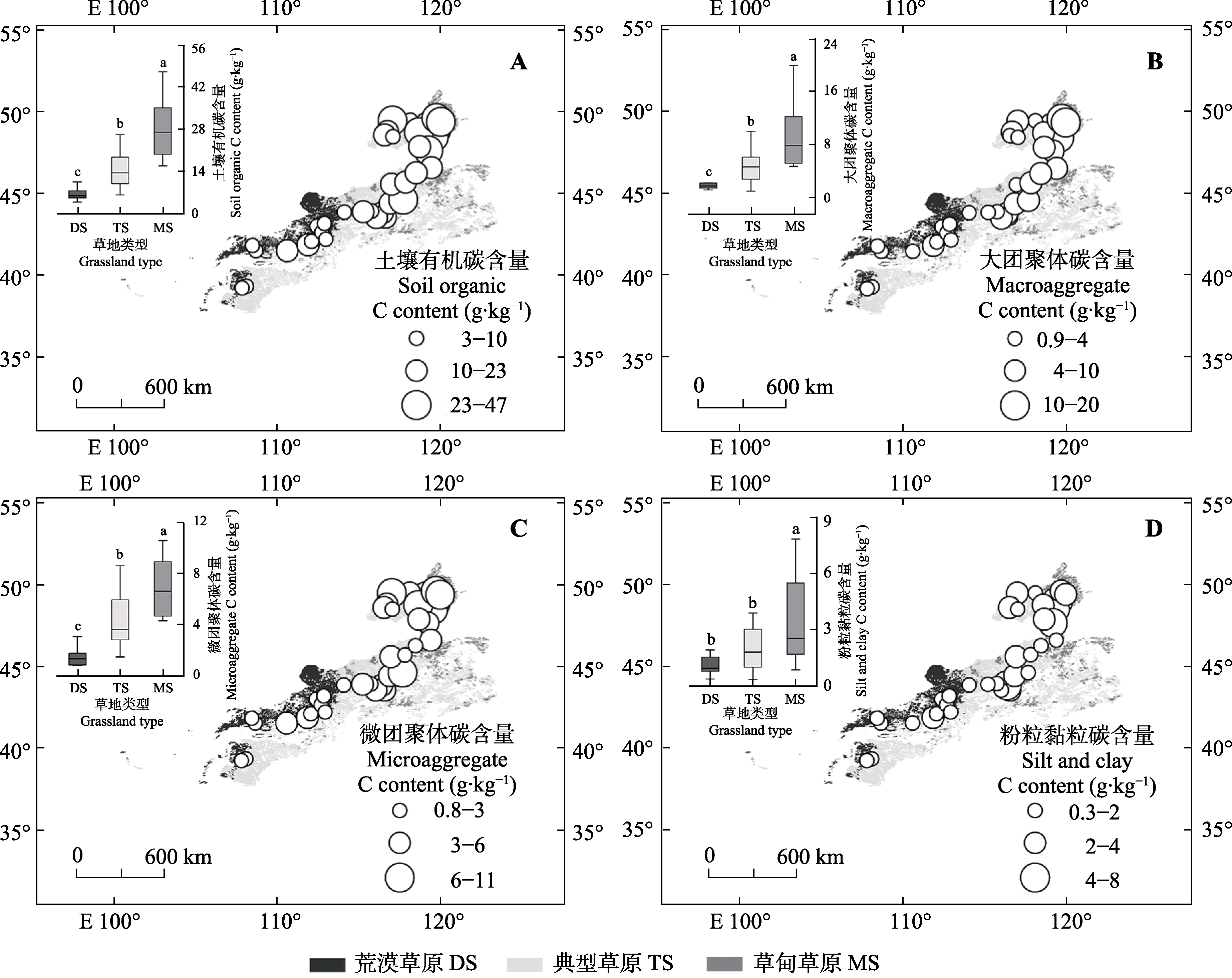
Fig. 1 Spatial distributions of total soil organic carbon (C) content (A) and in three fractions content (B-D) in temperate grasslands of Nei Mongol. The vegetation map was obtained from China’s vegetation atlas with a scale of 1:1 000 000 (The Editorial Committee of Vegetation Map of China, Chinese Academy of Sciences, 2001). The lines, lower and upper boundaries, and bars in the boxes show median values, 25th and 75th percentiles, and standard deviations of all data, respectively. Different lowercase letters denote significant differences among different grassland types (p < 0.05). DS, desert steppe; MS, meadow steppe; TS, typical steppe.
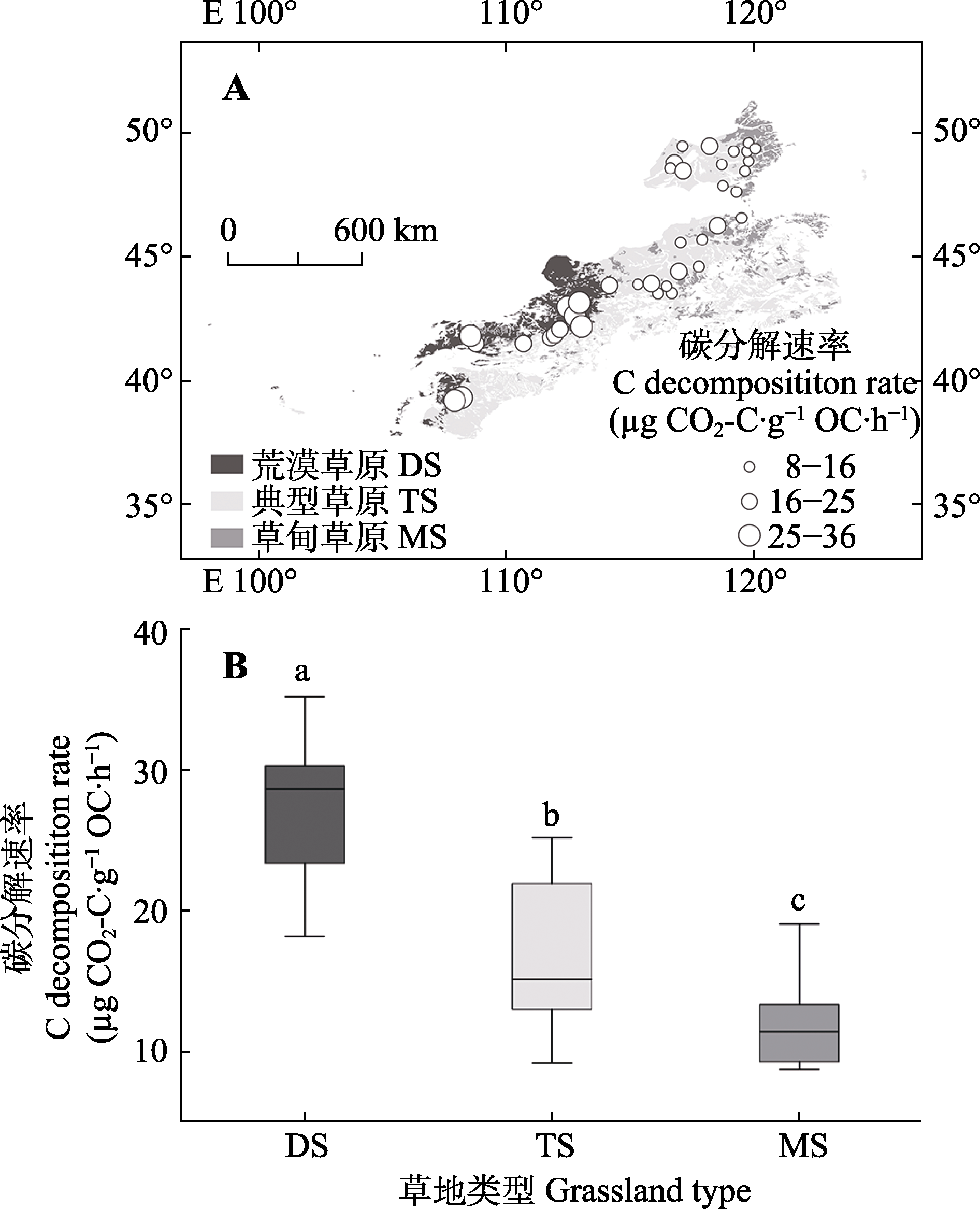
Fig. 2 Spatial distribution of soil carbon (C) decomposition rate standardized by soil organic C (OC) in temperate grasslands of Nei Mongol (A), and comparison of soil C decomposition rate among different grassland types (B). The vegetation map was obtained from China’s vegetation atlas with a scale of 1:1 000 000 (The Editorial Committee of Vegetation Map of China, Chinese Academy of Sciences, 2001). The lines, lower and upper boundaries, and bars in the boxes show median values, 25th and 75th percentiles, and standard deviations of all data, respectively. Different lowercase letters denote significant differences among different grassland types (p < 0.05). DS, desert steppe; MS, meadow steppe; TS, typical steppe.
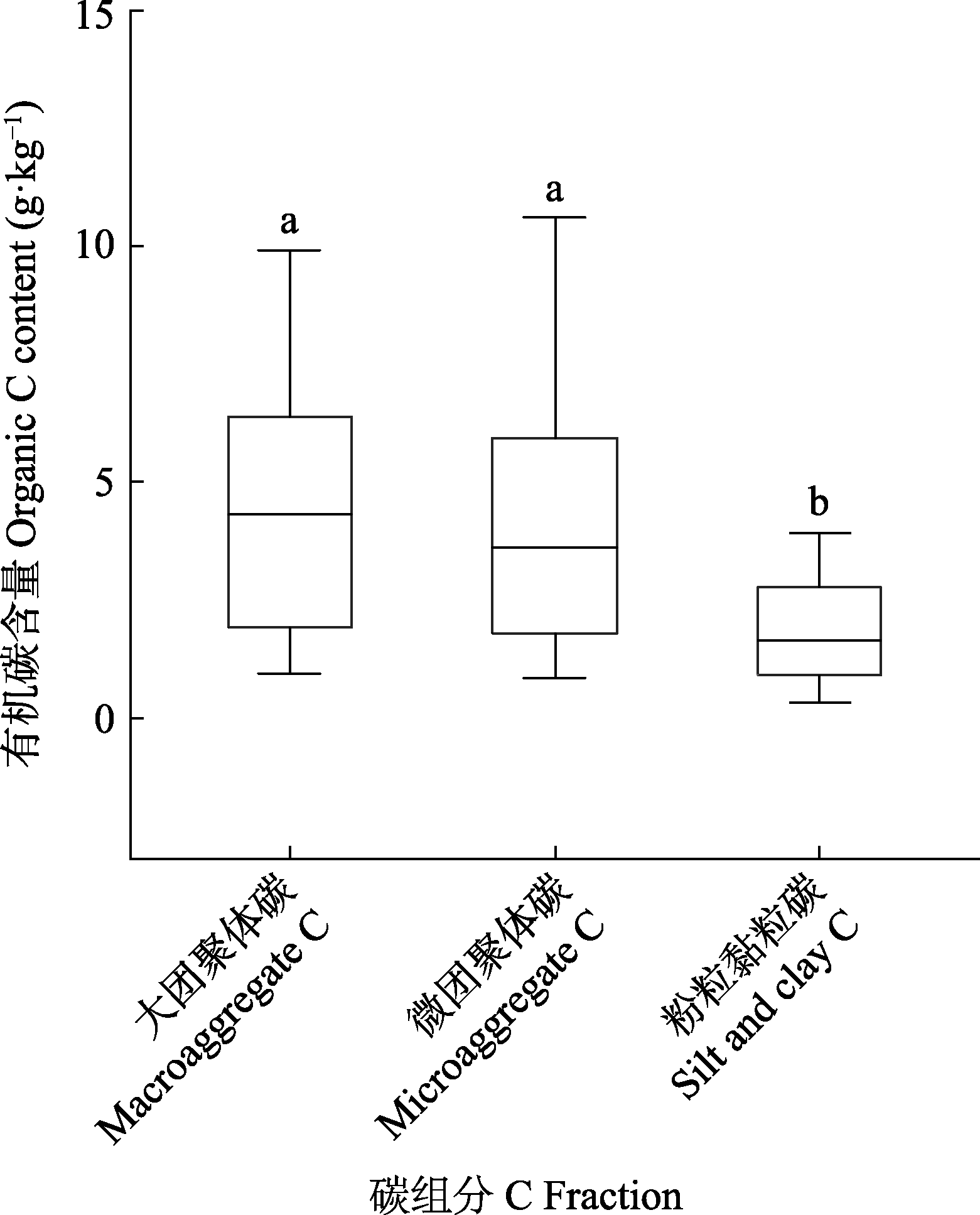
Fig. 3 Comparison of organic carbon (C) contents among different soil aggregate fractions in temperate grasslands of Nei Mongol. The lines, lower and upper boundaries, and bars in the boxes show median values, 25th and 75th percentiles, and standard deviations of all data, respectively. Different lowercase letters denote significant differences of C fractions among different grassland types (p < 0.05).
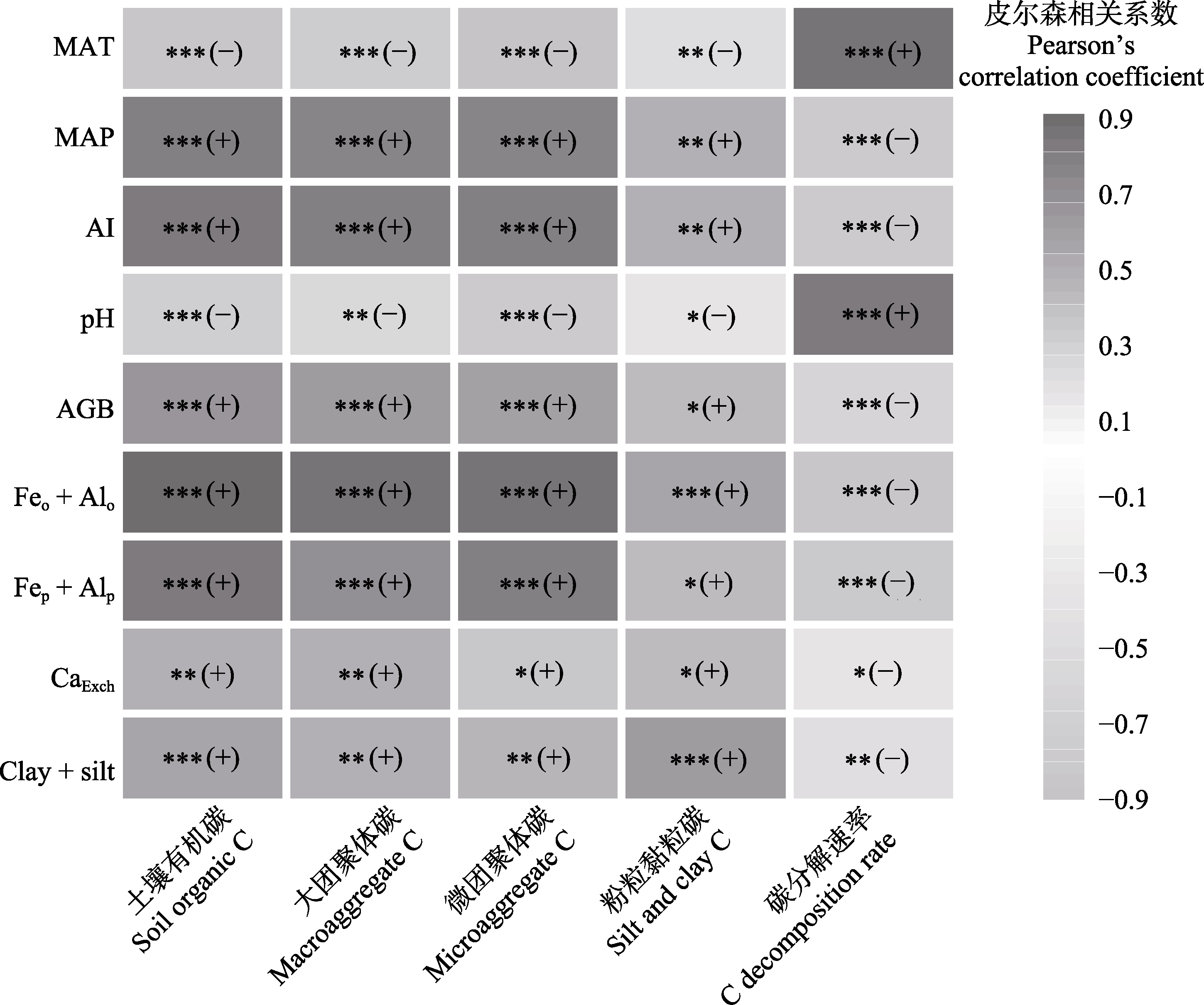
Fig. 4 Correlations of total soil organic carbon (C) content, C content in different aggregate fractions and C decomposition rate with climatic, edaphic, plant and mineral variables in temperate grasslands of Nei Mongol. Soil organic C, macroaggregate C, microaggregate C, silt and clay C, and C decomposition rate standardized by SOC are lg transformed. The “+” and “-” in parentheses represent positive and negative correlations, respectively. AGB, aboveground biomass; AI, aridity index; CaExch, exchangeable Ca2+; Clay + silt, clay and silt content; Feo + Alo, poorly crystalline Fe/Al oxide; Fep + Alp, organically complexed Fe/Al oxide; MAP, mean annual precipitation; MAT, mean annual air temperature. *, p < 0.05; **, p < 0.01; ***, p < 0.001.
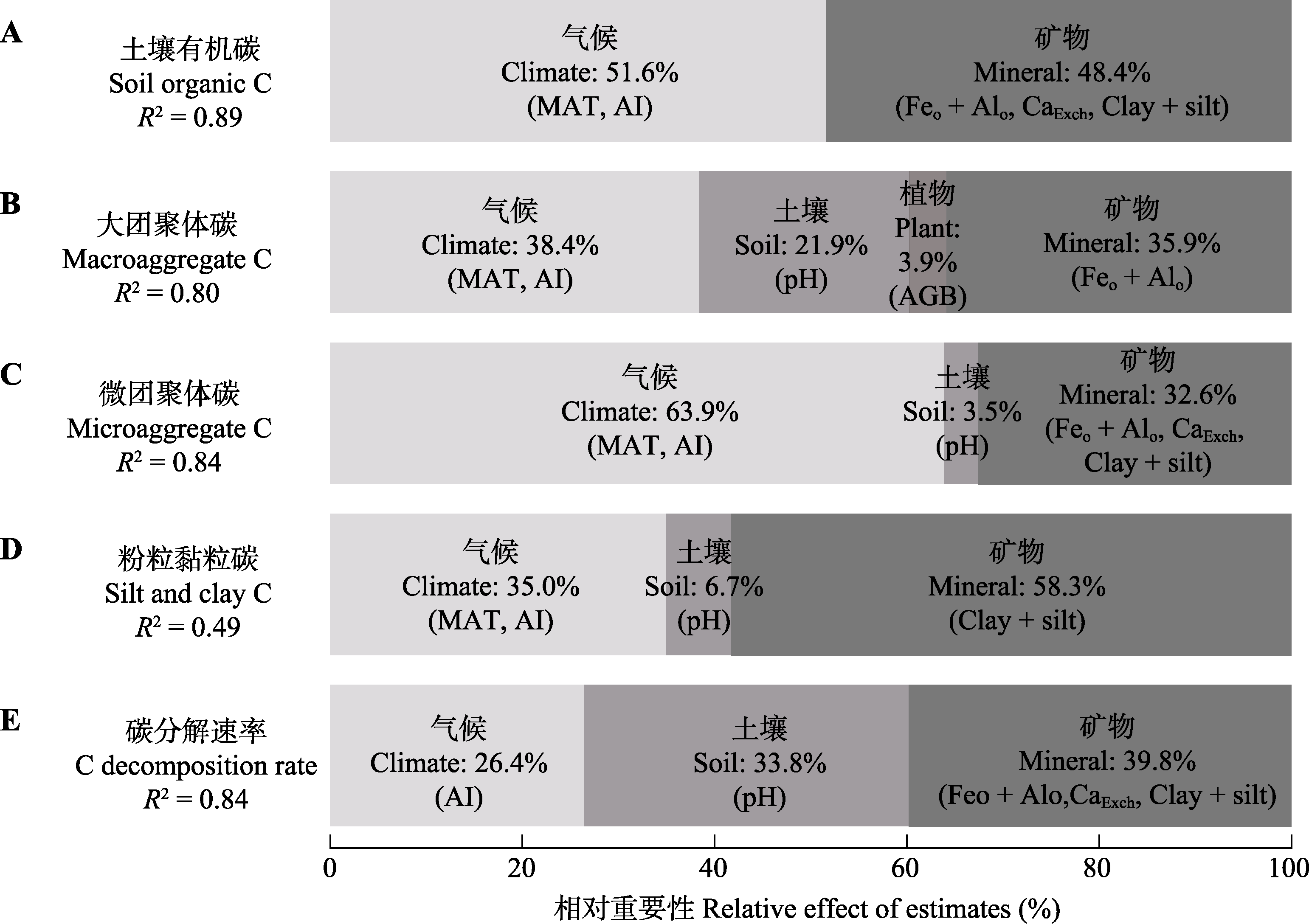
Fig. 5 Relative effects of climatic, edaphic, plant and mineral variables on soil organic carbon (C) content (A), aggregate C fractions content (B-D), and C decomposition rate (E) in temperate grasslands of Nei Mongol. Soil organic C, macroaggregate C, microaggregate C, silt and clay C contents, and C decomposition rate standardized by SOC are lg transformed. AGB, aboveground biomass; AI, aridity index; CaExch, exchangeable Ca2+ content; Clay + silt, clay and silt content; Feo + Alo, poorly crystalline Fe/Al oxide content; MAP, mean annual precipitation; MAT, mean annual air temperature.
| [1] |
Bai Y, Cotrufo MF (2022). Grassland soil carbon sequestration: current understanding, challenges, and solutions. Science, 377, 603-608.
DOI PMID |
| [2] | Bao SD (2000). Soil and Agricultural Chemistry Analysis. 3rd ed. China Agriculture Press, Beijing. |
| [鲍士旦 (2000). 土壤农化分析. 3版. 中国农业出版社, 北京.] | |
| [3] | Burnham KP, Anderson DR (2002). Model Selection and Multimodel Inference: A Practical Information-Theoretic Approach. 2nd ed. Springer, New York. |
| [4] |
Cao YQ, Xu L, Zhang Z, Chen Z, He NP (2019). Soil microbial metabolic quotient in Inner Mongolian grasslands: patterns and influence factors. Chinese Geographical Science, 29, 1001-1010.
DOI |
| [5] |
Chen LY, Liang JY, Qin SQ, Liu L, Fang K, Xu YP, Ding JZ, Li F, Luo YQ, Yang YH (2016). Determinants of carbon release from the active layer and permafrost deposits on the Tibetan Plateau. Nature Communications, 7, 13046. DOI: 10.1038/ncomms13046.
PMID |
| [6] | Chen QM, Wang SQ, Yu GR (2003). Spatial characteristics of soil organic carbon and nitrogen in Inner Mongolia. Chinese Journal of Applied Ecology, 14, 699-704. |
| [陈庆美, 王绍强, 于贵瑞 (2003). 内蒙古自治区土壤有机碳、氮蓄积量的空间特征. 应用生态学报, 14, 699-704.] | |
| [7] |
Colman BP, Schimel JP (2013). Drivers of microbial respiration and net N mineralization at the continental scale. Soil Biology & Biochemistry, 60, 65-76.
DOI URL |
| [8] |
Davidson EA, Janssens IA (2006). Temperature sensitivity of soil carbon decomposition and feedbacks to climate change. Nature, 440, 165-173.
DOI |
| [9] | Ding JZ, Chen LY, Zhang BB, Liu L, Yang GB, Fang K, Chen YL, Li F, Kou D, Ji CJ, Luo YQ, Yang YH (2016). Linking temperature sensitivity of soil CO2 release to substrate, environmental, and microbial properties across alpine ecosystems. Global Biogeochemical Cycles, 30, 1310-1323. |
| [10] |
Doetterl S, Stevens A, Six J, Merckx R, Van Oost K, Pinto MC, Casanova-Katny A, Muñoz C, Boudin M, Venegas EZ, Boeckx P (2015). Soil carbon storage controlled by interactions between geochemistry and climate. Nature Geoscience, 8, 780-783.
DOI |
| [11] |
Dungait JAJ, Hopkins DW, Gregory AS, Whitmore AP (2012). Soil organic matter turnover is governed by accessibility not recalcitrance. Global Change Biology, 18, 1781-1796.
DOI URL |
| [12] |
Elliott ET, Palm CA, Reuss DE, Monz CA (1991). Organic matter contained in soil aggregates from a tropical chronosequence: correction for sand and light fraction. Agriculture, Ecosystems & Environment, 34, 443-451.
DOI URL |
| [13] | Fang JY, Geng XQ, Zhao X, Shen HH, Hu HF (2018). How many areas of grasslands are there in China? Chinese Science Bulletin, 63, 1731-1739. |
| [方精云, 耿晓庆, 赵霞, 沈海花, 胡会峰 (2018). 我国草地面积有多大? 科学通报, 63, 1731-1739.] | |
| [14] |
Fang K, Qin SQ, Chen LY, Zhang QW, Yang YH (2019). Al/Fe mineral controls on soil organic carbon stock across Tibetan alpine grasslands. Journal of Geophysical Research: Biogeosciences, 124, 247-259.
DOI |
| [15] |
Friedlingstein P, O’Sullivan M, Jones MW, Andrew RM, Hauck J, Olsen A, Peters GP, Peters W, Pongratz J, Sitch S le Quéré C, Canadell JG, Ciais P, Jackson RB, Alin S, et al. (2020). Global carbon budget 2020. Earth System Science Data, 12, 3269-3340.
DOI URL |
| [16] |
Gentsch N, Mikutta R, Alves RJE, Barta J, Čapek P, Gittel A, Hugelius G, Kuhry P, Lashchinskiy N, Palmtag J, Richter A, Šantrůčková H, Schnecker J, Shibistova O, Urich T, et al. (2015). Storage and transformation of organic matter fractions in cryoturbated permafrost soils across the Siberian Arctic. Biogeosciences, 12, 4525-4542.
DOI URL |
| [17] |
Kou D, Ma WH, Ding JZ, Zhang BB, Fang K, Hu HF, Yu JC, Wang T, Qin SQ, Zhao X, Fang JY, Yang YH (2018). Dryland soils in northern China sequester carbon during the early 2000s warming hiatus period. Functional Ecology, 32, 1620-1630.
DOI URL |
| [18] | Krige DG (1951). A statistical approach to some basic mine valuation problems on the Witwatersrand. Journal of the Southern African Institute of Mining and Metallurgy, 52, 119-139. |
| [19] |
Lavallee JM, Soong JL, Cotrufo MF (2020). Conceptualizing soil organic matter into particulate and mineral-associated forms to address global change in the 21st century. Global Change Biology, 26, 261-273.
DOI PMID |
| [20] |
le Provost G, Badenhausser I, le Bagousse-Pinguet Y, Clough Y, Henckel L, Violle C, Bretagnolle V, Roncoroni M, Manning P, Gross N (2020). Land-use history impacts functional diversity across multiple trophic groups. Proceedings of the National Academy of Sciences of the United States of America, 117, 1573-1579.
DOI PMID |
| [21] |
Lehmann J, Kleber M (2015). The contentious nature of soil organic matter. Nature, 528, 60-68.
DOI |
| [22] |
Li P, Sayer EJ, Jia Z, Liu WX, Wu YT, Yang S, Wang CZ, Yang L, Chen DM, Bai YF, Liu LL (2020). Deepened winter snow cover enhances net ecosystem exchange and stabilizes plant community composition and productivity in a temperate grassland. Global Change Biology, 26, 3015-3027.
DOI PMID |
| [23] |
Lugato E, Lavallee JM, Haddix ML, Panagos P, Cotrufo MF (2021). Different climate sensitivity of particulate and mineral-associated soil organic matter. Nature Geoscience, 14, 295-300.
DOI |
| [24] |
Luo YQ, Ahlström A, Allison SD, Batjes NH, Brovkin V, Carvalhais N, Chappell A, Ciais P, Davidson EA, Finzi AC, Georgiou K, Guenet B, Hararuk O, Harden JW, He YJ, et al. (2016). Toward more realistic projections of soil carbon dynamics by earth system models. Global Biogeochemical Cycles, 30, 40-56.
DOI URL |
| [25] |
Ma WH, He JS, Yang YH, Wang XP, Liang CZ, Anwar M, Zeng H, Fang JY, Schmid B (2010). Environmental factors covary with plant diversity-productivity relationships among Chinese grassland sites. Global Ecology and Biogeography, 19, 233-243.
DOI URL |
| [26] | Ma WH, Yang YH, He JS, Zeng H, Fang JY (2008). Above and belowground biomass in relation to environmental factors in temperate grasslands, Inner Mongolia. Scientia Sinica (Vitae), 38, 84-92. |
| [马文红, 杨元合, 贺金生, 曾辉, 方精云 (2008). 内蒙古温带草地生物量及其与环境因子的关系. 中国科学: 生命科学, 38, 84-92.] | |
| [27] | National Agricultural Technology Extension and Service Center (2006). Soil Analysis Technology Standard. 2nd ed. China Agriculture Press, Beijing. |
| [全国农业技术推广服务中心 (2006). 土壤分析技术规范. 2版. 中国农业出版社, 北京.] | |
| [28] | Ni XY, Liao S, Tan SY, Wang DY, Peng Y, Yue K, Wu FZ, Yang YS (2020). A quantitative assessment of amino sugars in soil profiles. Soil Biology & Biochemistry, 143, 107762. DOI: 10.1016/j.soilbio.2020.107762. |
| [29] |
Oades JM (1988). The retention of organic matter in soils. Biogeochemistry, 5, 35-70.
DOI URL |
| [30] | Qin SQ, Kou D, Mao C, Chen YL, Chen LY, Yang YH (2021). Temperature sensitivity of permafrost carbon release mediated by mineral and microbial properties. Science Advances, 7, eabe3596. DOI: 10.1126/sciadv.abe3596. |
| [31] |
Rey A, Jarvis P (2006). Modelling the effect of temperature on carbon mineralization rates across a network of European forest sites (FORCAST). Global Change Biology, 12, 1894-1908.
DOI URL |
| [32] |
Rowley MC, Grand S, Verrecchia ÉP (2018). Calcium- mediated stabilisation of soil organic carbon. Biogeochemistry, 137, 27-49.
DOI |
| [33] |
Shi Y, Baumann F, Ma Y, Song C, Kühn P, Scholten T, He JS (2012). Organic and inorganic carbon in the topsoil of the Mongolian and Tibetan grasslands: pattern, control and implications. Biogeosciences, 9, 2287-2299.
DOI URL |
| [34] |
Six J, Conant RT, Paul EA, Paustian K (2002). Stabilization mechanisms of soil organic matter: implications for C-saturation of soils. Plant and Soil, 241, 155-176.
DOI URL |
| [35] |
Six J, Elliott ET, Paustian K (2000). Soil macroaggregate turnover and microaggregate formation: a mechanism for C sequestration under no-tillage agriculture. Soil Biology & Biochemistry, 32, 2099-2103.
DOI URL |
| [36] | Soil Census Office of Inner Mongolia Autonomous Region, Soil and Fertilizer Workstation of Inner Mongolia Autonomous Region (1994). Soil of Inner Mongolia. Science Press, Beijing. |
| [内蒙古自治区土壤普查办公室, 内蒙古自治区土壤肥料工作站 (1994). 内蒙古土壤. 科学出版社, 北京.] | |
| [37] | The Editorial Committee of Vegetation Map of China, Chinese Academy of Sciences (2001). 1:1000000 Vegetation Atlas of China. Science Press, Beijing. |
| [中国科学院中国植被图编辑委员会 (2001). 1:1000000中国植被图集. 科学出版社, 北京.] | |
| [38] |
Todd-Brown KEO, Randerson JT, Hopkins F, Arora V, Hajima T, Jones C, Shevliakova E, Tjiputra J, Volodin E, Wu T, Zhang Q, Allison SD (2014). Changes in soil organic carbon storage predicted by Earth system models during the 21st century. Biogeosciences, 11, 2341-2356.
DOI URL |
| [39] |
von Lützow M, Kögel-Knabner I, Ekschmitt K, Matzner E, Guggenberger G, Marschner B, Flessa H (2006). Stabilization of organic matter in temperate soils: mechanisms and their relevance under different soil conditions—A review. European Journal of Soil Science, 57, 426-445.
DOI URL |
| [40] |
Wang T, Xu S, Zhao MY, Li H, Kou D, Fang JY, Hu HF (2017). Allocation of mass and stability of soil aggregate in different types of Nei Mongol grasslands. Chinese Journal of Plant Ecology, 41, 1168-1176.
DOI |
|
[王甜, 徐姗, 赵梦颖, 李贺, 寇丹, 方精云, 胡会峰 (2017). 内蒙古不同类型草原土壤团聚体含量的分配及其稳定性. 植物生态学报, 41, 1168-1176.]
DOI |
|
| [41] |
Were K, Bui DT, Dick ØB, Singh BR (2015). A comparative assessment of support vector regression, artificial neural networks, and random forests for predicting and mapping soil organic carbon stocks across an Afromontane landscape. Ecological Indicators, 52, 394-403.
DOI URL |
| [42] | White RP, Murray S, Rohweder M (2000). Pilot Analysis of Global Ecosystems: Grassland Ecosystems. World Resources Institute, Washington D.C., USA. |
| [43] |
Yang YH, Fang JY, Ma WH, Smith P, Mohammat A, Wang SP, Wang W (2010). Soil carbon stock and its changes in northern China’s grasslands from 1980s to 2000s. Global Change Biology, 16, 3036-3047.
DOI URL |
| [44] |
Yang YH, Fang JY, Tang YH, Ji CJ, Zheng CY, He JS, Zhu B (2008). Storage, patterns and controls of soil organic carbon in the Tibetan grasslands. Global Change Biology, 14, 1592-1599.
DOI URL |
| [45] |
Yang YH, Shi Y, Sun WJ, Chang JF, Zhu JX, Chen LY, Wang X, Guo YP, Zhang HT, Yu LF, Zhao SQ, Xu K, Zhu JL, Shen HH, Wang YY, et al. (2022). Terrestrial carbon sinks in China and around the world and their contribution to carbon neutrality. Science China: Life Sciences, 65, 861-895.
DOI |
| [46] | Ye CL, Huang WJ, Hall SJ, Hu SJ (2022). Association of organic carbon with reactive iron oxides driven by soil pH at the global scale. Global Biogeochemical Cycles, 36, e2021GB007128. DOI: 10.1029/2021GB007128. |
| [47] | Zhang CH, Wang MJ, Zhang L, Yang LP (2013). Response of meadow steppe ANPP to climate change in Hulunbeir, Inner Mongolia—A simulation study. Acta Prataculturae Sinica, 22(3), 41-50. |
|
[张存厚, 王明玖, 张立, 杨丽萍 (2013). 呼伦贝尔草甸草原地上净初级生产力对气候变化响应的模拟. 草业学报, 22(3), 41-50.]
DOI |
|
| [48] | Zhou ZH, Liu L, Hou L (2022). Soil organic carbon stabilization and formation: mechanism and model. Journal of Beijing Forestry University, 44(10), 11-22. |
| [周正虎, 刘琳, 侯磊 (2022). 土壤有机碳的稳定和形成: 机制和模型. 北京林业大学学报, 44(10), 11-22.] | |
| [49] | Zhuang QW, Shao ZF, Li DR, Huang X, Cai BW, Altan O, Wu SX (2022). Unequal weakening of urbanization and soil salinization on vegetation production capacity. Geoderma, 411, 115712. DOI: 10.1016/j.geoderma.2022.115712. |
| [50] | Zimmerman AR, Ahn MY (2011). Organo-mineral-enzyme interaction and soil enzyme activity//Shukla G, Varma A. Soil Biology: Soil Enzyme. Springer, Berlin. |
| [51] |
Zomer RJ, Trabucco A, Bossio DA, Verchot LV (2008). Climate change mitigation: a spatial analysis of global land suitability for clean development mechanism afforestation and reforestation. Agriculture, Ecosystems & Environment, 126, 67-80.
DOI URL |
| [1] | guangjin wu, 郭 垚鑫, Ren Chengjie, Wang Jun, YUE Ming, Zhao Fazhu. Distribution of soil organic carbon content and its influencing factors in different vegetation type on the northern foot of the Qinling Mountains [J]. Chin J Plant Ecol, 2026, 50(预发表): 1-. |
| [2] | HE Zheng-Jia, ZENG Xin-Ran, WANG Lin-Ying, XUE Xin-Yu, SU Qin-Ze, LI Yu, ZHANG Yin-Jie, WU Hui-Huang, CHEN Cheng-Cong, WU Liang-Quan, WEI An-Ni, QIU Yun-Peng, GUO Li-Jin. Response of arbuscular mycorrhizal fungal communities and soil organic carbon to magnesium fertilization in tea plantations [J]. Chin J Plant Ecol, 2026, 50(3): 700-709. |
| [3] | LI Wen-Zhu, LUAN Jun-Wei, DI Ya-Ping, WANG Yi, NIE Xiu-Qing, LIU Shi-Rong. Effects of manipulative drought on mycorrhiza-mediated soil enzyme activities and soil organic carbon fractions in a warm temperate Quercus aliena var. acuteserrata forest [J]. Chin J Plant Ecol, 2026, 50(3): 660-673. |
| [4] | RAN Jia-Xin, HE Shu-Ting, LUO Su-Ping, WANG Yun, MAO Chao. Global patterns and drivers of soil gross nitrogen transformations of forest ecosystems [J]. Chin J Plant Ecol, 2026, 50(1): 45-54. |
| [5] | CHANG Peng-Fei, LI Ping, Nairsag , WANG Jing, WANG Zhen-Hua, YANG Sen, JIA Zhou, YANG Lu, LIU Ling-Li, DENG Mei-Feng. Contributions of soil organic carbon and inorganic carbon stocks to total soil carbon stock and their driving factors across different types in Nei Mongol temperate grasslands [J]. Chin J Plant Ecol, 2025, 49(9): 1374-1387. |
| [6] | LIU Ying, LI Jiang-Feng, WU Jia-Qi, WANG Yi-Fan, YIN Qing-Lin, WANG Jing. Effects of root and mycorrhizal fungi of Cleistogenes squarrosa on soil carbon and nitrogen under drought conditions [J]. Chin J Plant Ecol, 2025, 49(9): 1388-1398. |
| [7] | ZHANG Fa-Wei, LI Hong-Qin, ZHU Jing-Bin, FAN Bo, ZHOU Hua-Kun, LI Ying-Nian, LIANG Nai-Shen. Response of aboveground and belowground carbon storage to nitrogen addition and precipitation change in an alpine meadow ecosystem [J]. Chin J Plant Ecol, 2025, 49(9): 1399-1409. |
| [8] | FAN Ya-Ran, XIA Shao-Pan, YU Bing-Bing, ZHU Zi-Qi, YANG Wei, FAN Yu-Chuan, LIU Xiao-Yu, ZHANG Xu-Hui, ZHENG Ju-Feng. Effects of elevated atmospheric CO2 concentration and warming on stability of soil organic carbon pool accumulation, molecular composition and structure stability [J]. Chin J Plant Ecol, 2025, 49(7): 1053-1069. |
| [9] | HAN Fei, WANG Ge, WU Shuai-Kai, LIN Mao, DONG Kuan-Hu, $\boxed{\hbox{WANG Chang-Hui}}$ , SU Yuan. Effects of extreme precipitation on soil gross nitrification rate, gross nitrogen mineralization rate and sensitivity of different types of grassland [J]. Chin J Plant Ecol, 2025, 49(5): 697-709. |
| [10] | HU Jing, LÜ Shi-Qi, LI Bing, MA Zhi-Bo, FU Li-Yong, YIN Jian-Zhang, XIAO Jiu-Jin, YAN Jia-Yuan, HU Zong-Da. Characteristics of soil organic carbon fractions and carbon pool management index in four typical natural forests in temperature-transition zone [J]. Chin J Plant Ecol, 2025, 49(11): 1957-1972. |
| [11] | HUANG Zhi-Jun, GAN Zi-Ying, ZHU Jia-Xin, QIU Qing-Yan, HU Ya-Lin. Impacts and mechanisms of carbon to nitrogen ratios of different organs of Cunninghamia lanceolata on soil priming effect [J]. Chin J Plant Ecol, 2025, 49(10): 1710-1720. |
| [12] | DU Shu-Hui, CHU Jian-Min, DUAN Jun-Guang, XUE Jian-Guo, XU Lei, XU Xiao-Qing, WANG Qi-Bing, HUANG Jian-Hui, ZHANG Qian. Influence of lignin phenols on soil organic carbon in degraded grassland in Nei Mongol, China [J]. Chin J Plant Ecol, 2025, 49(1): 30-41. |
| [13] | PENG Si-Rui, ZHANG Hui-Ling, SUN Zhao-Lin, ZHAO Xue-Chao, TIAN Peng, CHEN Di-Ma, WANG Qing-Kui, LIU Sheng-En. Effects of long-term litter removal on soil organic carbon and multiple components in subtropical Cunninghamia lanceolata forest [J]. Chin J Plant Ecol, 2024, 48(8): 1078-1088. |
| [14] | QIN Wen-Kuan, ZHANG Qiu-Fang, AO Gu-Kai-Lin, ZHU Biao. Responses and mechanisms of soil organic carbon dynamics to warming: a review [J]. Chin J Plant Ecol, 2024, 48(4): 403-415. |
| [15] | WANG Ge, HU Shu-Ya, LI Yang, CHEN Xiao-Peng, LI Hong-Yu, DONG Kuan-Hu, HE Nian-Peng, WANG Chang-Hui. Temperature sensitivity of soil net nitrogen mineralization rates across different grassland types [J]. Chin J Plant Ecol, 2024, 48(4): 523-533. |
| Viewed | ||||||
|
Full text |
|
|||||
|
Abstract |
|
|||||
Copyright © 2026 Chinese Journal of Plant Ecology
Tel: 010-62836134, 62836138, E-mail: apes@ibcas.ac.cn, cjpe@ibcas.ac.cn

