
Chin J Plant Ecol ›› 2025, Vol. 49 ›› Issue (12): 1991-2003.DOI: 10.17521/cjpe.2024.0291 cstr: 32100.14.cjpe.2024.0291
• Research Articles • Previous Articles Next Articles
HU Yan1,2, LI Lin3, WEI Shi-Guang1,2,*( ), YIN Yu-Hang1,2, ZHOU Jing-Gang4,5, ZHONG Jian-Jun1,2, WANG Xue1,2
Received:2024-08-27
Accepted:2024-12-31
Online:2025-12-20
Published:2025-01-02
Contact:
WEI Shi-Guang
Supported by:HU Yan, LI Lin, WEI Shi-Guang, YIN Yu-Hang, ZHOU Jing-Gang, ZHONG Jian-Jun, WANG Xue. Traits for 1 to 3 order fine roots of 30 shrub species and their root economic spectrum in karst areas[J]. Chin J Plant Ecol, 2025, 49(12): 1991-2003.
Add to citation manager EndNote|Ris|BibTeX
URL: https://www.plant-ecology.com/EN/10.17521/cjpe.2024.0291
| 功能性状 Functional trait | 根序 Root order | 物种数量 n | 最小值 Minimum | 最大值 Maximum | 平均值±标准差 Mean ± SD | 标准误 SE | 变异系数 CV |
|---|---|---|---|---|---|---|---|
| 直径 Average diameter (mm) | 1 | 30 | 0.21 | 0.99 | 0.51 ± 0.21 | 0.04 | 0.41 |
| 2 | 30 | 0.35 | 1.60 | 1.04 ± 0.45 | 0.08 | 0.43 | |
| 3 | 30 | 0.49 | 1.96 | 1.33 ± 1.69 | 0.31 | 1.27 | |
| 根长 Root length (cm) | 1 | 30 | 117.05 | 3 651.99 | 673.43 ± 830.07 | 151.55 | 1.23 |
| 2 | 30 | 70.30 | 613.72 | 232.53 ± 151.46 | 27.65 | 0.65 | |
| 3 | 30 | 27.57 | 263.48 | 97.37 ± 59.28 | 10.82 | 0.61 | |
| 根组织密度 Root tissue density (g·m-3) | 1 | 30 | 0.21 | 4.04 | 1.13 ± 1.38 | 0.25 | 1.22 |
| 2 | 30 | 0.22 | 5.25 | 1.25 ± 1.20 | 0.22 | 0.96 | |
| 3 | 30 | 0.44 | 4.04 | 1.56 ± 0.73 | 0.13 | 0.47 | |
| 比表面积 Root specific surface area (cm2·g-1) | 1 | 30 | 16.35 | 390.61 | 167.68 ± 92.42 | 16.87 | 0.55 |
| 2 | 30 | 12.25 | 194.07 | 59.28 ± 44.16 | 8.06 | 0.74 | |
| 3 | 30 | 14.55 | 120.40 | 23.97 ± 21.35 | 3.90 | 0.89 | |
| 碳含量 (mg·g-1) Root carbon content | 1 | 30 | 338.90 | 458.40 | 426.80 ± 23.39 | 4.27 | 0.05 |
| 2 | 30 | 402.40 | 475.50 | 442.31 ± 16.14 | 2.95 | 0.04 | |
| 3 | 30 | 415.00 | 488.60 | 446.90 ±15.82 | 2.89 | 0.04 | |
| 氮含量 Root nitrogen content (mg·g-1) | 1 | 30 | 0.60 | 16.30 | 7.14 ± 4.00 | 0.73 | 0.56 |
| 2 | 30 | 0.20 | 15.00 | 4.82 ±0.59 | 0.11 | 0.12 | |
| 3 | 30 | 0.30 | 11.50 | 3.52 ± 0.52 | 0.09 | 0.15 | |
| 磷含量 Phosphorus content in roots (mg·g-1) | 1 | 30 | 0.01 | 1.17 | 0.29 ± 0.27 | 0.05 | 0.93 |
| 2 | 30 | 0.02 | 0.12 | 0.31 ± 0.26 | 0.05 | 0.84 | |
| 3 | 30 | 0.02 | 1.26 | 0.31 ± 0.33 | 0.06 | 1.06 | |
| 生物量 Fine root biomass (g) | 1 | 30 | 0.07 | 2.99 | 0.67 ± 0.77 | 0.14 | 1.15 |
| 2 | 30 | 0.21 | 5.57 | 1.48 ± 1.16 | 0.21 | 0.78 | |
| 3 | 30 | 0.45 | 16.01 | 2.80 ± 3.13 | 0.57 | 1.12 |
Table 1 Basic statistical characteristics of interspecific variation in functional traits of 1st to 3rd order roots of 30 shrub species in karst region
| 功能性状 Functional trait | 根序 Root order | 物种数量 n | 最小值 Minimum | 最大值 Maximum | 平均值±标准差 Mean ± SD | 标准误 SE | 变异系数 CV |
|---|---|---|---|---|---|---|---|
| 直径 Average diameter (mm) | 1 | 30 | 0.21 | 0.99 | 0.51 ± 0.21 | 0.04 | 0.41 |
| 2 | 30 | 0.35 | 1.60 | 1.04 ± 0.45 | 0.08 | 0.43 | |
| 3 | 30 | 0.49 | 1.96 | 1.33 ± 1.69 | 0.31 | 1.27 | |
| 根长 Root length (cm) | 1 | 30 | 117.05 | 3 651.99 | 673.43 ± 830.07 | 151.55 | 1.23 |
| 2 | 30 | 70.30 | 613.72 | 232.53 ± 151.46 | 27.65 | 0.65 | |
| 3 | 30 | 27.57 | 263.48 | 97.37 ± 59.28 | 10.82 | 0.61 | |
| 根组织密度 Root tissue density (g·m-3) | 1 | 30 | 0.21 | 4.04 | 1.13 ± 1.38 | 0.25 | 1.22 |
| 2 | 30 | 0.22 | 5.25 | 1.25 ± 1.20 | 0.22 | 0.96 | |
| 3 | 30 | 0.44 | 4.04 | 1.56 ± 0.73 | 0.13 | 0.47 | |
| 比表面积 Root specific surface area (cm2·g-1) | 1 | 30 | 16.35 | 390.61 | 167.68 ± 92.42 | 16.87 | 0.55 |
| 2 | 30 | 12.25 | 194.07 | 59.28 ± 44.16 | 8.06 | 0.74 | |
| 3 | 30 | 14.55 | 120.40 | 23.97 ± 21.35 | 3.90 | 0.89 | |
| 碳含量 (mg·g-1) Root carbon content | 1 | 30 | 338.90 | 458.40 | 426.80 ± 23.39 | 4.27 | 0.05 |
| 2 | 30 | 402.40 | 475.50 | 442.31 ± 16.14 | 2.95 | 0.04 | |
| 3 | 30 | 415.00 | 488.60 | 446.90 ±15.82 | 2.89 | 0.04 | |
| 氮含量 Root nitrogen content (mg·g-1) | 1 | 30 | 0.60 | 16.30 | 7.14 ± 4.00 | 0.73 | 0.56 |
| 2 | 30 | 0.20 | 15.00 | 4.82 ±0.59 | 0.11 | 0.12 | |
| 3 | 30 | 0.30 | 11.50 | 3.52 ± 0.52 | 0.09 | 0.15 | |
| 磷含量 Phosphorus content in roots (mg·g-1) | 1 | 30 | 0.01 | 1.17 | 0.29 ± 0.27 | 0.05 | 0.93 |
| 2 | 30 | 0.02 | 0.12 | 0.31 ± 0.26 | 0.05 | 0.84 | |
| 3 | 30 | 0.02 | 1.26 | 0.31 ± 0.33 | 0.06 | 1.06 | |
| 生物量 Fine root biomass (g) | 1 | 30 | 0.07 | 2.99 | 0.67 ± 0.77 | 0.14 | 1.15 |
| 2 | 30 | 0.21 | 5.57 | 1.48 ± 1.16 | 0.21 | 0.78 | |
| 3 | 30 | 0.45 | 16.01 | 2.80 ± 3.13 | 0.57 | 1.12 |
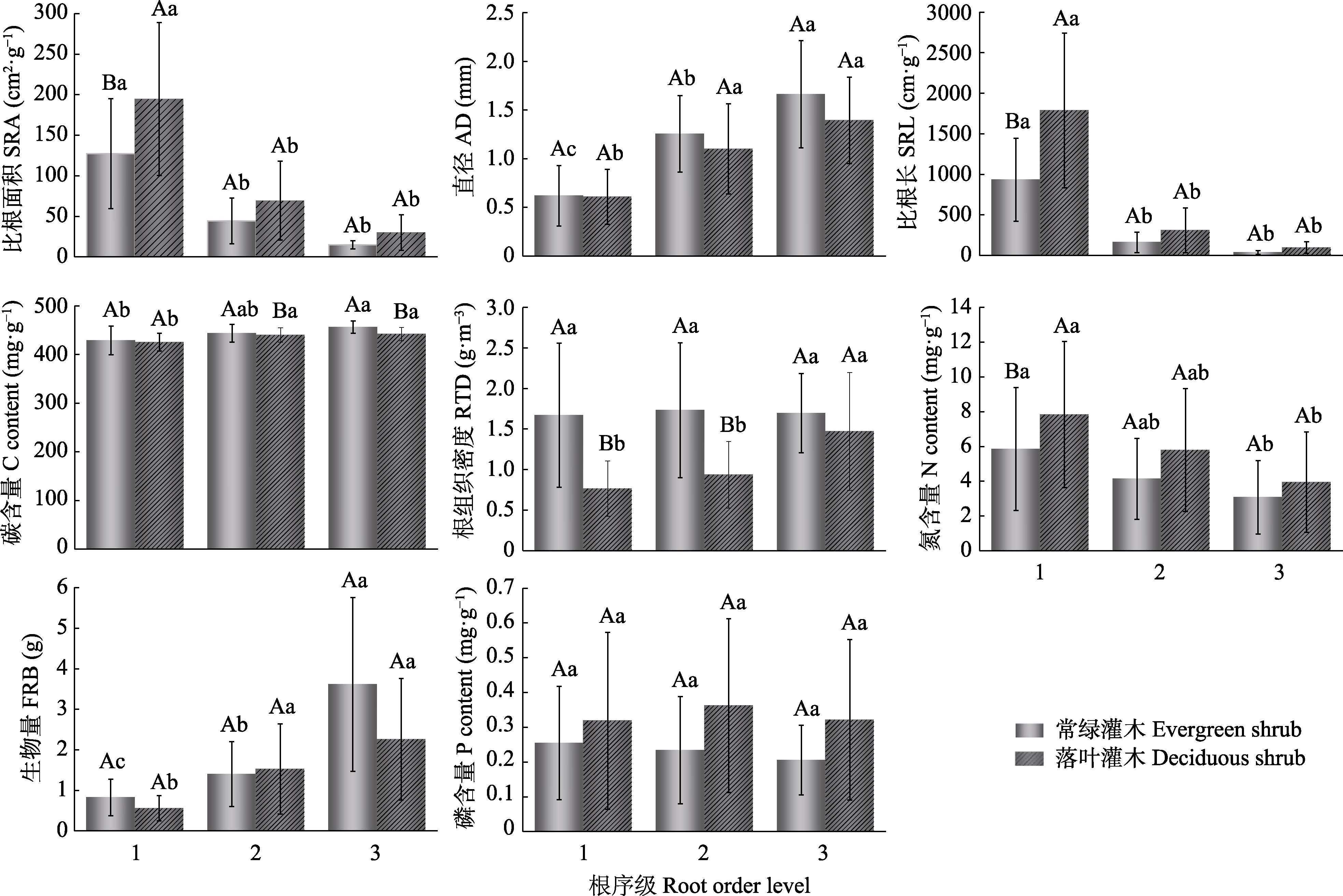
Fig. 1 Specific root area (SRA), specific root length (SRL), tissue density (RTD), fine root biomass (FRB);, average diameter (AD), carbon content (RCC), nitrogen content (RNC), and phosphorus content (RPC) of fine roots of evergreen and deciduous shrubs of 1-3 order classes (mean ± SD). Different uppercase letters for the same order indicated significant differences among different life forms (p < 0.05), and different lowercase letters for the same life form indicated significant differences among different orders (p < 0.05).
| 生活型 Life from | 样本数量 n | 比根长 SRL (cm·g-1) | 比表面积 SRA (cm2·g-1) | 直径 AD (mm) | 根长 RL (cm) | 根组织密度 RTD (g·m-3) | 生物量 FRB (g) |
|---|---|---|---|---|---|---|---|
| E | 18 | 377.09 ± 187.57b | 62.17 ± 30.55b | 1.18 ± 0.36a | 191.03 ± 98.03b | 1.70 ± 1.28a | 1.95 ± 1.43a |
| D | 12 | 732.20 ± 366.26a | 97.96 ± 41.69a | 1.03 ± 0.23a | 430.05 ± 399.49a | 1.06 ± 0.43a | 1.45 ± 0.85a |
Table 2 Differences in fine root morphology traits between evergreen and deciduous shrubs (mean ± SD)
| 生活型 Life from | 样本数量 n | 比根长 SRL (cm·g-1) | 比表面积 SRA (cm2·g-1) | 直径 AD (mm) | 根长 RL (cm) | 根组织密度 RTD (g·m-3) | 生物量 FRB (g) |
|---|---|---|---|---|---|---|---|
| E | 18 | 377.09 ± 187.57b | 62.17 ± 30.55b | 1.18 ± 0.36a | 191.03 ± 98.03b | 1.70 ± 1.28a | 1.95 ± 1.43a |
| D | 12 | 732.20 ± 366.26a | 97.96 ± 41.69a | 1.03 ± 0.23a | 430.05 ± 399.49a | 1.06 ± 0.43a | 1.45 ± 0.85a |
| 生活型 Life from | 样本数量 Sample number (n) | 碳含量 Carbon (C) content (mg·g-1) | 氮含量 Nitrogen (N) content (mg·g-1) | 磷含量 Phosphorus (P) content (mg·g-1) | 碳氮比 C:N | 碳磷比 C:P | 氮磷比 N:P |
|---|---|---|---|---|---|---|---|
| E | 18 | 442.37 ± 16.96a | 4.35 ± 2.81a | 0.23 ± 0.21b | 235.62 ± 221.27a | 5 704.58 ± 4244.70a | 55.73 ± 65.50a |
| D | 12 | 436.29 ± 10.75a | 5.56 ± 2.37a | 0.33 ± 0.19a | 200.98 ± 267.13a | 3 912.63 ± 4694.43 a | 69.29 ± 122.00a |
Table 3 Differences in fine root nutrient traits between evergreen and deciduous shrubs (mean ± SD)
| 生活型 Life from | 样本数量 Sample number (n) | 碳含量 Carbon (C) content (mg·g-1) | 氮含量 Nitrogen (N) content (mg·g-1) | 磷含量 Phosphorus (P) content (mg·g-1) | 碳氮比 C:N | 碳磷比 C:P | 氮磷比 N:P |
|---|---|---|---|---|---|---|---|
| E | 18 | 442.37 ± 16.96a | 4.35 ± 2.81a | 0.23 ± 0.21b | 235.62 ± 221.27a | 5 704.58 ± 4244.70a | 55.73 ± 65.50a |
| D | 12 | 436.29 ± 10.75a | 5.56 ± 2.37a | 0.33 ± 0.19a | 200.98 ± 267.13a | 3 912.63 ± 4694.43 a | 69.29 ± 122.00a |
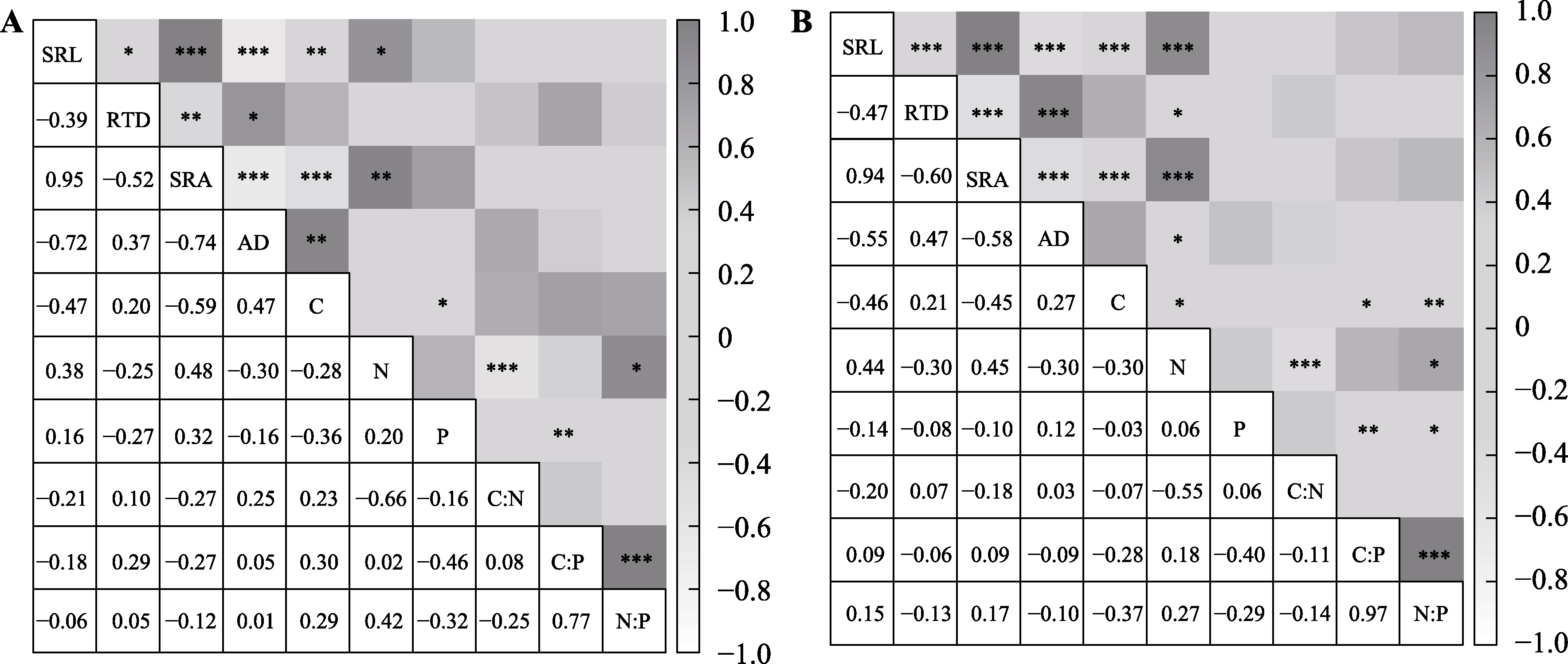
Fig. 2 Correlation analysis between morphological and nutrient traits of fine roots of evergreen (A) and deciduous shrubs (B). AD, average diameter; C, carbon content; N, nitrogen content; P, phosphorus content; RTD, root tissue density; SRA, specific surface area; SRL, specific root length. *, p < 0.05; **, p < 0.01; ***, p < 0.001.
| 序级 Root order | 比根长vs.比表面积 SRL vs. SRA | 根直径vs.比表面积 AD vs. SRA | 比根长vs.根直径 SRL vs. AD | 比表面积vs.根组织密度 SRA vs. RTD | 比根长vs.根组织密度 SRL vs. RTD |
|---|---|---|---|---|---|
| 1 | 0.90*** | -0.01 | 0.01 | -0.81*** | -0.66* |
| 2 | 0.87*** | -0.44 | 0.51*** | -0.71*** | -0.46* |
| 3 | 0.95*** | -0.63** | -0.71*** | -0.54* | -0.38 |
Table 4 Correlation between morphological traits of fine roots at the same order level in deciduous shrubs
| 序级 Root order | 比根长vs.比表面积 SRL vs. SRA | 根直径vs.比表面积 AD vs. SRA | 比根长vs.根直径 SRL vs. AD | 比表面积vs.根组织密度 SRA vs. RTD | 比根长vs.根组织密度 SRL vs. RTD |
|---|---|---|---|---|---|
| 1 | 0.90*** | -0.01 | 0.01 | -0.81*** | -0.66* |
| 2 | 0.87*** | -0.44 | 0.51*** | -0.71*** | -0.46* |
| 3 | 0.95*** | -0.63** | -0.71*** | -0.54* | -0.38 |
| 序级 Root order | 比根长vs.比表面积 SRL vs. SRA | 根直径vs.比表面积 AD vs. SRA | 比根长vs.根直径 SRL vs. AD | 比表面积vs.根组织密度 SRA vs. RTD | 比根长vs.根组织密度 SRL vs. RTD |
|---|---|---|---|---|---|
| 1 | 0.90*** | -0.75** | -0.77** | -0.88*** | -0.79** |
| 2 | 0.90*** | -0.75* | -0.63* | -0.66* | -0.34 |
| 3 | 0.87** | -0.67* | -0.50 | 0.21 | 0.45 |
Table 5 Correlation between morphological traits of fine roots at the same order level in evergreen shrubs
| 序级 Root order | 比根长vs.比表面积 SRL vs. SRA | 根直径vs.比表面积 AD vs. SRA | 比根长vs.根直径 SRL vs. AD | 比表面积vs.根组织密度 SRA vs. RTD | 比根长vs.根组织密度 SRL vs. RTD |
|---|---|---|---|---|---|
| 1 | 0.90*** | -0.75** | -0.77** | -0.88*** | -0.79** |
| 2 | 0.90*** | -0.75* | -0.63* | -0.66* | -0.34 |
| 3 | 0.87** | -0.67* | -0.50 | 0.21 | 0.45 |
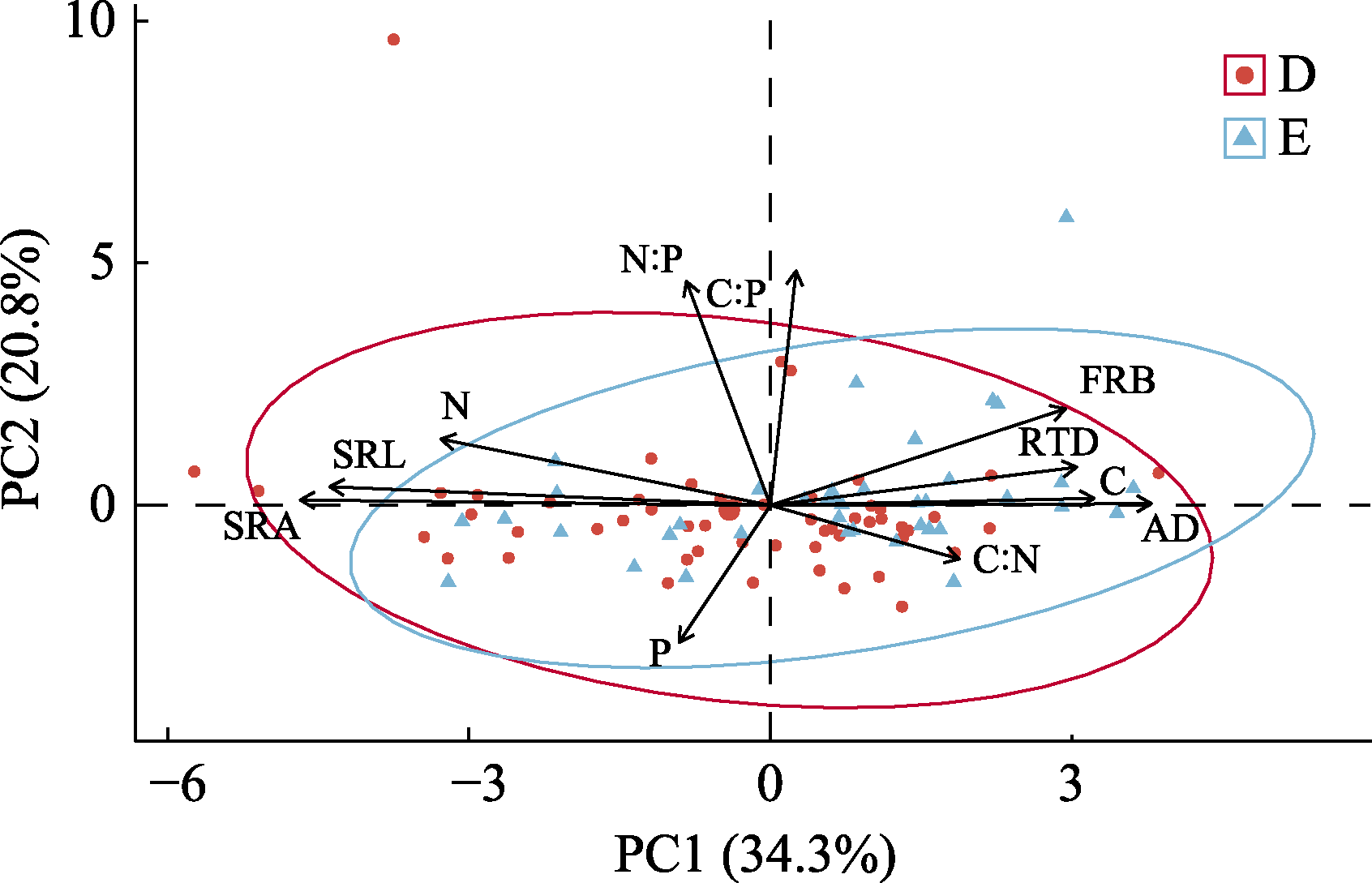
Fig. 3 Principle component (PC) analysis of traits for 1-3 order fine roots in evergreen and deciduous shrubs. D, deciduous shrubs; E, evergreen shrubs. AD, average diameter; C, carbon content; N, nitrogen content; P, phosphorus content; FRB, fine root biomass; RTD, root tissue density; SRA, specific surface area; SRL, specific root length.
| 细根性状 Fine root trait | PC1 | PC2 |
|---|---|---|
| 比根长 SRL | 0.859 | 0.117 |
| 比根面积 SRA | 0.918 | 0.066 |
| 根组织密度 RTD | -0.606 | 0.123 |
| 直径 AD | -0.751 | -0.038 |
| 生物量 FRB | -0.589 | 0.359 |
| 碳含量 Carbon content (C) | -0.641 | -0.012 |
| 氮含量 Nitrogen content (N) | 0.586 | 0.238 |
| 磷含量 Phosphorus content (P) | 0.186 | -0.558 |
| C:P | -0.072 | 0.951 |
| N:P | 0.134 | 0.908 |
Table 6 Principle component (PC) analysis scores of various traits of fine roots of evergreen and deciduous shrubs
| 细根性状 Fine root trait | PC1 | PC2 |
|---|---|---|
| 比根长 SRL | 0.859 | 0.117 |
| 比根面积 SRA | 0.918 | 0.066 |
| 根组织密度 RTD | -0.606 | 0.123 |
| 直径 AD | -0.751 | -0.038 |
| 生物量 FRB | -0.589 | 0.359 |
| 碳含量 Carbon content (C) | -0.641 | -0.012 |
| 氮含量 Nitrogen content (N) | 0.586 | 0.238 |
| 磷含量 Phosphorus content (P) | 0.186 | -0.558 |
| C:P | -0.072 | 0.951 |
| N:P | 0.134 | 0.908 |
| [1] |
Bader M, Hiltbrunner E, Körner C (2009). Fine root responses of mature deciduous forest trees to free air carbon dioxide enrichment (FACE). Functional Ecology, 23, 913-921.
DOI URL |
| [2] | Bergmann J, Weigelt A, van der Plas F, Laughlin DC, Kuyper TW, Guerrero-Ramirez N, Valverde-Barrantes OJ, Bruelheide H, Freschet GT, Iversen CM, Kattge J, McCormack ML, Meier IC, Rillig MC, Roumet C, et al. (2020). The fungal collaboration gradient dominates the root economics space in plants. Science Advances, 6, eaba3756. DOI: 10.1126/sciadv.aba3756. |
| [3] |
Comas LH, Eissenstat DM (2004). Linking fine root traits to maximum potential growth rate among 11 mature temperate tree species. Functional Ecology, 18, 388-397.
DOI URL |
| [4] |
Dannowski M, Block A (2005). Fractal geometry and root system structures of heterogeneous plant communities. Plant and Soil, 272, 61-76.
DOI URL |
| [5] | Díaz S, Kattge J, Cornelissen JHC, Wright IJ, Lavorel S, Dray S, Reu B, Kleyer M, Wirth C, Prentice IC, Garnier E, Bönisch G, Westoby M, Poorter H, Reich PB, et al. (2022). The global spectrum of plant form and function: enhanced species-level trait dataset. Scientific Data, 9, 755. DOI: 10.1038/s41597-022-01774-9. |
| [6] |
Ding JX, Kong DL, Zhang ZL, Cai Q, Xiao J, Liu Q, Yin HJ (2020). Climate and soil nutrients differentially drive multidimensional fine root traits in ectomycorrhizal- dominated alpine coniferous forests. Journal of Ecology, 108, 2544-2556.
DOI URL |
| [7] |
Galloway JN, Townsend AR, Erisman JW, Bekunda M, Cai ZC, Freney JR, Martinelli LA, Seitzinger SP, Sutton MA (2008). Transformation of the nitrogen cycle: recent trends, questions, and potential solutions. Science, 320, 889-892.
DOI PMID |
| [8] |
Gu WP, Liu RP, Li XH, Sun T, Zhang ZJ, Zan P, Wen LN, Ma PY, Mao ZJ (2018). Decomposition of different root branch orders and its dominant controlling factors in four temperate tree species. Chinese Journal of Plant Ecology, 42, 955-962.
DOI URL |
|
[顾伟平, 刘瑞鹏, 李兴欢, 孙涛, 张子嘉, 昝鹏, 温璐宁, 马鹏宇, 毛子军 (2018). 四个典型温带树种不同根序细根分解速率及其主要影响因素. 植物生态学报, 42, 955-962.]
DOI |
|
| [9] |
Guo DL, Mitchell RJ, Hendricks JJ (2004). Fine root branch orders respond differentially to carbon source-sink manipulations in a longleaf pine forest. Oecologia, 140, 450-457.
PMID |
| [10] |
Guo DL, Xia MX, Wei X, Chang WJ, Liu Y, Wang ZQ (2008). Anatomical traits associated with absorption and mycorrhizal colonization are linked to root branch order in twenty-three Chinese temperate tree species. New Phytologist, 180, 673-683.
DOI PMID |
| [11] |
Guo K, Liu CC, Dong M (2011). Ecological adaptation of plants and control of rocky-desertification on karst region of Southwest China. Chinese Journal of Plant Ecology, 35, 991-999.
DOI |
|
[郭柯, 刘长成, 董鸣 (2011). 我国西南喀斯特植物生态适应性与石漠化治理. 植物生态学报, 35, 991-999.]
DOI |
|
| [12] |
Han WX, Fang JY, Guo DL, Zhang Y (2005). Leaf nitrogen and phosphorus stoichiometry across 753 terrestrial plant species in China. New Phytologist, 168, 377-385.
DOI PMID |
| [13] |
Hishi T, Takeda H (2005). Life cycles of individual roots in fine root system of Chamaecyparis obtusa Sieb. et Zucc. Journal of Forest Research, 10, 181-187.
DOI URL |
| [14] |
Holdaway RJ, Richardson SJ, Dickie IA, Peltzer DA, Coomes DA (2011). Species- and community-level patterns in fine root traits along a 120 000-year soil chronosequence in temperate rain forest. Journal of Ecology, 99, 954-963.
DOI URL |
| [15] | Huang TL, Tang LX, Chen L, Zhang QY (2019). Root architecture and ecological adaptation strategy of three shrubs in karst area. Science of Soil and Water Conservation, 17(1), 89-94. |
| [黄同丽, 唐丽霞, 陈龙, 张乔艳 (2019). 喀斯特区3种灌木根系构型及其生态适应策略. 中国水土保持科学, 17(1), 89-94.] | |
| [16] |
Kong DL, Ma CG, Zhang Q, Li L, Chen XY, Zeng H, Guo DL (2014). Leading dimensions in absorptive root trait variation across 96 subtropical forest species. New Phytologist, 203, 863-872.
DOI PMID |
| [17] |
Li GY, Yang DM, Sun SC (2008). Allometric relationships between lamina area, lamina mass and petiole mass of 93 temperate woody species vary with leaf habit, leaf form and altitude. Functional Ecology, 22, 557-564.
DOI URL |
| [18] |
Li ZY, Ye XZ, Wang SP (2021). Ecosystem stability and its relationship with biodiversity. Chinese Journal of Plant Ecology, 45, 1127-1139.
DOI URL |
|
[李周园, 叶小洲, 王少鹏 (2021). 生态系统稳定性及其与生物多样性的关系. 植物生态学报, 45, 1127-1139.]
DOI |
|
| [19] | Luo GJ, Li YB, Wang SJ, Cheng AY, Dan WL (2011). Comparison of ecological significance of landscape diversity changes in karst mountains: a case study of 4 typical karst area in Guizhou Province. Acta Ecologica Sinica, 31, 3882-3889. |
| [罗光杰, 李阳兵, 王世杰, 程安云, 丹文丽 (2011). 岩溶山区景观多样性变化的生态学意义对比——以贵州四个典型地区为例. 生态学报, 31, 3882-3889.] | |
| [20] | Luo T, Huang FZ, Li JX, Lu F, Wen SJ, Ruan PZ, Li XK (2024). Ecological stoichiometry characteristics of plant dominant species leaf and soil at different restoration stages of vegetation in the karst area of the Lijiang River Basin in Guangxi. Journal of Plant Resources and Environment, 33(2), 80-90. |
| [罗婷, 黄甫昭, 李健星, 陆芳, 文淑均, 阮枰臻, 李先琨 (2024). 广西漓江流域喀斯特地区植被不同恢复阶段植物优势种叶片和土壤的生态化学计量特征. 植物资源与环境学报, 33(2), 80-90.] | |
| [21] | Luo XQ, Zhang GL, Du XL, Wang SJ, Yang HY, Huang TZ (2014). Characteristics of element contents and ecological stoichiometry in leaves of common calcicole species in Maolan karst forest. Ecology and Environmental Sciences, 23, 1121-1129. |
| [罗绪强, 张桂玲, 杜雪莲, 王世杰, 杨鸿雁, 黄天志 (2014). 茂兰喀斯特森林常见钙生植物叶片元素含量及其化学计量学特征. 生态环境学报, 23, 1121-1129.] | |
| [22] |
Ma YZ, Zhong QL, Jin BJ, Lu HD, Guo BQ, Zheng Y, Li M, Cheng DL (2015). Spatial changes and influencing factors of fine root carbon, nitrogen and phosphorus stoichiometry of plants in China. Chinese Journal of Plant Ecology, 39, 159-166.
DOI URL |
|
[马玉珠, 钟全林, 靳冰洁, 卢宏典, 郭炳桥, 郑媛, 李曼, 程栋梁 (2015). 中国植物细根碳、氮、磷化学计量学的空间变化及其影响因子. 植物生态学报, 39, 159-166.]
DOI |
|
| [23] |
Mei L, Gu JC, Zhang ZW, Wang ZQ (2010). Responses of fine root mass, length, production and turnover to soil nitrogen fertilization in Larix gmelinii and Fraxinus mandshurica forests in Northeastern China. Journal of Forest Research, 15, 194-201.
DOI URL |
| [24] |
Meier IC, Brunner I, Godbold DL, Helmisaari HS, Ostonen I, Soudzilovskaia NA, Prescott CE (2019). Roots and rhizospheres in forest ecosystems: recent advances and future challenges. Forest Ecology and Management, 431, 1-5.
DOI |
| [25] | Piao HC, Liu CQ, Zhu SF, Zhu JM (2005). Variations of C4 and C3 plant N:P ratios influenced by nutrient stoichiometry in limestone and sandstone areas of Guizhou. Quaternary Sciences, 25, 552-560. |
| [朴河春, 刘丛强, 朱书法, 朱建明 (2005). 贵州石灰岩和砂岩地区C4和C3植物营养元素的化学计量对N/P比值波动的影响. 第四纪研究, 25, 552-560.] | |
| [26] |
Pregitzer KS, DeForest JL, Burton AJ, Allen MF, Ruess RW, Hendrick RL (2002). Fine root architecture of nine North American trees. Ecological Monographs, 72, 293-309.
DOI URL |
| [27] |
Pregitzer KS, King JS, Burton AJ, Brown SE (2000). Responses of tree fine roots to temperature. New Phytologist, 147, 105-115.
DOI URL |
| [28] |
Prieto I, Roumet C, Cardinael R, Dupraz C, Jourdan C, Kim JH, Maeght JL, Mao Z, Pierret A, Portillo N, Roupsard O, Thammahacksa C, Stokes A (2015). Root functional parameters along a land-use gradient: evidence of a community-level economics spectrum. Journal of Ecology, 103, 361-373.
DOI URL |
| [29] | Qi DH, Wen ZM, Yang SS, Wang HX, Guo R (2015). Trait-based responses and adaptation of Artemisia sacrorum to environmental changes. Chinese Journal of Applied Ecology, 26, 1921-1927. |
| [戚德辉, 温仲明, 杨士梭, 王红霞, 郭茹 (2015). 基于功能性状的铁杆蒿对环境变化的响应与适应. 应用生态学报, 26, 1921-1927.] | |
| [30] |
Reich PB (2014). The world-wide ‘fast-slow’ plant economics spectrum: a traits manifesto. Journal of Ecology, 102, 275-301.
DOI URL |
| [31] | Shi Y, Wen ZM, Gong SH (2011). Comparisons of relationships between leaf and fine root traits in hilly area of the Loess Plateau, Yanhe River basin, Shaanxi Province, China. Acta Ecologica Sinica, 31, 6805-6814. |
| [施宇, 温仲明, 龚时慧 (2011). 黄土丘陵区植物叶片与细根功能性状关系及其变化. 生态学报, 31, 6805-6814.] | |
| [32] |
Sun JH, Shi HL, Chen KY, Ji BM, Zhang J (2023). Research advances on trade-off relationships of plant fine root functional traits. Chinese Journal of Plant Ecology, 47, 1055-1070.
DOI URL |
|
[孙佳慧, 史海兰, 陈科宇, 纪宝明, 张静 (2023). 植物细根功能性状的权衡关系研究进展. 植物生态学报, 47, 1055-1070.]
DOI |
|
| [33] | Sun JQ, Xiong WB, Li YQ, Cai TR, Yu H (2021). Stoichiometric characteristics of carbon, nitrogen and phosphorus in fine roots of plants with different life forms in China and their influencing factors. Protective Forest Technology, (4), 28-32. |
| [孙佳祺, 熊维彬, 李永奇, 蔡天润, 余华 (2021). 中国不同生活型植物细根碳氮磷化学计量特征及其影响因子. 防护林科技, (4), 28-32.] | |
| [34] | Sun MM, Guan JH, Yue JW, Li GQ, Du S (2017). Carbon, nitrogen, and phosphorus stoichiometry in plant organs and soil of coniferous forests on the western Loess Plateau. Journal of Soil and Water Conservation, 31, 202-208. |
| [孙美美, 关晋宏, 岳军伟, 李国庆, 杜盛 (2017). 黄土高原西部针叶林植物器官与土壤碳氮磷化学计量特征. 水土保持学报, 31, 202-208.] | |
| [35] | Tong F (2015). Morphology and Spatial Distribution of Fine Roots of Major Tree Species in an Evergreen and Deciduous Broad-leaved Mixed Forest in Badagongshan, Central China. Master degree dissertation, Wuhan Botanical Garden, Chinese Academy of Sciences, Wuhan. |
| [童芳 (2015). 八大公山亚热带常绿落叶阔叶混交林主要树种细根形态及其空间分布. 硕士学位论文, 中国科学院武汉植物园, 武汉.] | |
| [36] |
Poorter H (1994). The chemical composition and anatomical structure of leaves of grass species differing in relative growth rate. Plant, Cell & Environment, 17, 963-970.
DOI URL |
| [37] |
Vogt KA, Grier CC, Gower ST, Sprugel DG, Vogt DJ (1986). Overestimation of net root production: a real or imaginary problem? Ecology, 67, 577-579.
DOI URL |
| [38] |
Wang X, Chen GS, Yan XJ, Chen TT, Jiang Q, Chen YH, Fan AL, Jia LQ, Xiong DC, Huang JX (2019). Variations in the first-order root diameter in 89 woody species in a subtropical evergreen broadleaved forest. Chinese Journal of Plant Ecology, 43, 969-978.
DOI |
|
[王雪, 陈光水, 闫晓俊, 陈廷廷, 姜琦, 陈宇辉, 范爱连, 贾林巧, 熊德成, 黄锦学 (2019). 亚热带常绿阔叶林89种木本植物一级根直径的变异. 植物生态学报, 43, 969-978.]
DOI |
|
| [39] | Wang XR, Gu JC, Mei L, Han YZ, Yu SQ, Shi JW, Yu LZ (2006). Fine root order morphology and proportion between mother roots and daughter roots in Fraxinus mandshurica and Larix gmelinii plantations. Acta Ecologica Sinica, 26, 1686-1692. |
| [王向荣, 谷加存, 梅莉, 韩有志, 于水强, 史建伟, 于立忠 (2006). 水曲柳和落叶松细根形态及母根与子根比例关系. 生态学报, 26, 1686-1692.] | |
| [40] | Wei LD, Zhu JY, Li XR, Sun GP, Zhang XN, Xu CY (2021). Interspecific trait variation in the adaptation of root functional traits to dry-barren sites: a case study of the main ornamental tree species in stony mountainous region of Beijing. Acta Ecologica Sinica, 41, 9492-9501. |
| [韦柳端, 朱济友, 李夏榕, 孙广鹏, 张新娜, 徐程扬 (2021). 根系功能性状对干瘠立地适应的种间差异——以北京石质山地主要观赏树种为例. 生态学报, 41, 9492-9501.] | |
| [41] |
Weigelt A, Mommer L, Andraczek K, Iversen CM, Bergmann J, Bruelheide H, Fan Y, Freschet GT, Guerrero-Ramírez NR, Kattge J, Kuyper TW, Laughlin DC, Meier IC, van der Plas F, Poorter H, et al. (2021). An integrated framework of plant form and function: the belowground perspective. New Phytologist, 232, 42-59.
DOI PMID |
| [42] | Whittaker R (1975). Communities and Ecosystems. Macmillan, New York. |
| [43] | Wickham H (2016). Elegant Graphics for Data Analysis. Springer-Verlag, New York. |
| [44] | Wu J, Sheng MY (2020). Research progress in root ecology of karst vegetation in China. Plant Science Journal, 38, 565-573. |
| [吴静, 盛茂银 (2020). 我国喀斯特植被根系生态学研究进展. 植物科学学报, 38, 565-573.] | |
| [45] | Xu L (2022). Study on the Functional Traits of Fine Roots of 20 Subtropical Tree Species. Master degree dissertation, Central South University of Forestry and Technology, Changsha. |
| [许立 (2022). 亚热带20个树种细根功能性状研究. 硕士学位论文, 中南林业科技大学, 长沙.] | |
| [46] | Xu LQ, Cui DH, Wang QC, Zhang Y, Ma SJ, Zhu KY, Hu JW, Li HL (2020). Root architecture and fine root characteristics of Juglans mandshurica saplings in different habitats in the secondary forest on the west slope of Zhangguangcailing, China. Chinese Journal of Applied Ecology, 31, 373-380. |
|
[徐立清, 崔东海, 王庆成, 张勇, 马双娇, 朱凯月, 胡建文, 李红丽 (2020). 张广才岭西坡次生林不同生境胡桃楸幼树根系构型及细根特征. 应用生态学报, 31, 373-380.]
DOI |
|
| [47] | Yan XJ (2019). Functional Traits of the First-order Roots of 89 Woody Species in a Mid-subtropical Evergreen Broadleaved Forest. Master degree dissertation, Fujian Normal University, Fuzhou. |
| [闫晓俊 (2019). 中亚热带常绿阔叶林89种木本植物1级根功能性状研究. 硕士学位论文, 福建师范大学, 福州.] | |
| [48] | Yang Y, Li FL, Bao WK, Huang L, Hu H (2020). Fine-root morphology of common shrubs in the subalpine forests of western Sichuan. Chinese Journal of Applied and Environmental Biology, 26, 1376-1384. |
| [杨雨, 李芳兰, 包维楷, 黄龙, 胡慧 (2020). 川西亚高山11种常见灌木细根形态特征. 应用与环境生物学报, 26, 1376-1384.] | |
| [49] | Yu YF, Wei JH, Hu JM, Zhang JH, Li TT, Zheng FH, Zhang Y, Su LR, He TG (2024). Nitrogen and phosphorus stoichiometric homoeostasis in different organs of shrubs and herbs in degraded vegetation communities in the karst area of northwestern Guangxi. Acta Ecologica Sinica, 44, 5367-5376. |
| [俞月凤, 韦建华, 胡钧铭, 张俊辉, 李婷婷, 郑富海, 张野, 苏利荣, 何铁光 (2024). 桂西北喀斯特地区退化群落灌草不同器官N、P生态化学计量内稳性特征. 生态学报, 44, 5367-5376.] | |
| [50] |
Zeng DP, Jiang LL, Zeng CS, Wang WQ, Wang C (2013). Reviews on the ecological stoichiometry characteristics and its applications. Acta Ecologica Sinica, 33, 5484-5492.
DOI URL |
| [曾冬萍, 蒋利玲, 曾从盛, 王维奇, 王纯 (2013). 生态化学计量学特征及其应用研究进展. 生态学报, 33, 5484-5492.] | |
| [51] |
Zeng FP, Peng WX, Song TQ, Wang KL, Wu HY, Song XJ, Zeng ZX (2007). Changes in vegetation after 22 years’ natural restoration in the karst disturbed area in Northwest Guangxi. Acta Ecologica Sinica, 27, 5110-5119.
DOI URL |
| [曾馥平, 彭晚霞, 宋同清, 王克林, 吴海勇, 宋希娟, 曾昭霞 (2007). 桂西北喀斯特人为干扰区植被自然恢复22年后群落特征. 生态学报, 27, 5110-5119.] | |
| [52] | Zeng WK (2023). The Research on Fine Root Functional Traits and Root Rconomic Space of Common Subtropical Tree Species. Master degree dissertation, Central South University of Forestry & Technology, Changsha. |
| [曾伟康 (2023). 亚热带常见树种细根功能性状特征分析. 硕士学位论文, 中南林业科技大学, 长沙.] | |
| [53] |
Zhang CZ, Wright IJ, Nielsen UN, Geisen S, Liu MQ (2024). Linking nematodes and ecosystem function: a trait-based framework. Trends in Ecology & Evolution, 39, 644-653.
DOI URL |
| [54] | Zhang JR, Yan XJ, Jia LQ, Fan AL, Wang X, Chen TT, Chen GS (2022). Morphology and C and N stoichiometry traits of fine roots of nine understory shrubs in subtropical natural evergreen broad-leaved forest. Acta Ecologica Sinica, 42, 3716-3726. |
| [张进如, 闫晓俊, 贾林巧, 范爱连, 王雪, 陈廷廷, 陈光水 (2022). 亚热带天然常绿阔叶林林下9种灌木细根形态和C、N化学计量特征. 生态学报, 42, 3716-3726.] | |
| [55] | Zhao WJ, Cui YC, Liu N, Wu P, Zhou H, Zhou T (2023). Branch system configuration of typical shrubs in Maolan karst areas. Guizhou Forestry Science and Technology, 51(3), 38-44. |
| [赵文君, 崔迎春, 刘娜, 吴鹏, 周华, 周汀 (2023). 茂兰喀斯特区典型灌木枝系构型特征. 贵州林业科技, 51(3), 38-44.] | |
| [56] | Zhou C, Liu T, Wang QG, Han SJ (2022). Effects of long-term nitrogen addition on fine root morphological, anatomical structure and stoichiometry of broadleaved korean pine forest. Journal of Beijing Forestry University, 44(11), 31-40. |
| [周诚, 刘彤, 王庆贵, 韩士杰 (2022). 长期氮添加对阔叶红松林细根形态、解剖结构和化学组分的影响. 北京林业大学学报, 44(11), 31-40.] | |
| [57] | Zhou YH, Xiao KC, Xia SB, He XY, Li DJ (2024). Effects of afforestation on soil carbon and nitrogen fractions in the karst-cluster depression region of Guangxi. Research of Agricultural Modernization, 45(2), 316-325. |
| [周业恒, 肖孔操, 夏世斌, 何寻阳, 李德军 (2024). 广西喀斯特峰丛洼地造林对土壤有机碳、氮及其组分的影响. 农业现代化研究, 45(2), 316-325.] | |
| [58] | Zhou YJ, Wang MT, Wang ZY, Zhu GJ, Sun J, Zhong QL, Cheng DL (2020). Nutrient and ecological stoichiometry of different root order fine roots of 59 evergreen and deciduous tree species in subtropical zone. Acta Ecologica Sinica, 40, 4975-4984. |
| [周永姣, 王满堂, 王钊颖, 朱国洁, 孙俊, 钟全林, 程栋梁 (2020). 亚热带59个常绿与落叶树种不同根序细根养分及化学计量特征. 生态学报, 40, 4975-4984.] |
| Viewed | ||||||
|
Full text |
|
|||||
|
Abstract |
|
|||||
Copyright © 2026 Chinese Journal of Plant Ecology
Tel: 010-62836134, 62836138, E-mail: apes@ibcas.ac.cn, cjpe@ibcas.ac.cn

