
Chin J Plant Ecol ›› 2025, Vol. 49 ›› Issue (12): 2092-2104.DOI: 10.17521/cjpe.2024.0456 cstr: 32100.14.cjpe.2024.0456
• Research Articles • Previous Articles Next Articles
HUANG Mei-Hong1,2,*, NIU Meng-Qiu2,3,*, YANG Peng-Fei2,4, LIN Jie2,5, LIAO Zhou-Yu3, CHEN Jian-Guo2,**( )(
)( ), XIANG Jian-Ying1,**()
Received:2024-12-16
Accepted:2025-05-28
Online:2025-12-20
Published:2025-12-25
Contact:
CHEN Jian-Guo, XIANG Jian-Ying
About author:* Contributed equally to this work
Supported by:HUANG Mei-Hong, NIU Meng-Qiu, YANG Peng-Fei, LIN Jie, LIAO Zhou-Yu, CHEN Jian-Guo, XIANG Jian-Ying. Effects of temperature and burial depth on seedling emergence and growth of the alpine cushion plant Arenaria oreophila[J]. Chin J Plant Ecol, 2025, 49(12): 2092-2104.
Add to citation manager EndNote|Ris|BibTeX
URL: https://www.plant-ecology.com/EN/10.17521/cjpe.2024.0456
| 因子 Factor | 时间 Time (d) | 自由度 numDF | 分母自由度 denDF | F | p |
|---|---|---|---|---|---|
| 出苗率 Seedling emergency | |||||
| 截距 Intercept | 28 | 1 | 85 | 1264.85 | <0.001 |
| 41 | 90 | 1434.59 | <0.001 | ||
| 温度 Temperature | 28 | 2 | 85 | 109.54 | <0.001 |
| 41 | 90 | 11.24 | <0.001 | ||
| 海拔 Altitude | 28 | 1 | 85 | 0.99 | 0.32 |
| 41 | 90 | 2.29 | 0.13 | ||
| 埋深 Burried depth | 28 | 2 | 85 | 209.95 | <0.001 |
| 41 | 90 | 217.55 | <0.001 | ||
| 温度×海拔 Temperature × Altitude | 28 | 2 | 85 | 1.34 | 0.27 |
| 41 | 90 | 8.92 | <0.001 | ||
| 温度×埋深 Temperature × Burried depth | 28 | 4 | 85 | 13.35 | <0.001 |
| 41 | 90 | 0.93 | 0.45 | ||
| 海拔×埋深 Altitude × Burried depth | 28 | 2 | 85 | 0.27 | 0.77 |
| 41 | 90 | 6.07 | <0.01 | ||
| 温度×海拔×埋深 Temperature × Altitude × Burried depth | 28 | 4 | 85 | 1.56 | 0.19 |
| 41 | 90 | 6.25 | <0.001 | ||
| 幼苗株高 Seedling height | |||||
| 截距 Intercept | 1 | 74 | 4 864.89 | <0.001 | |
| 温度 Temperature | 2 | 74 | 91.98 | <0.001 | |
| 海拔 Altitude | 1 | 74 | 26.04 | <0.001 | |
| 埋深 Burried depth | 2 | 74 | 14.16 | <0.001 | |
| 幼苗鲜质量 Seedling fresh mass | |||||
| 截距 Intercept | 1 | 74 | 4 864.89 | <0.001 | |
| 温度 Temperature | 2 | 74 | 91.98 | <0.001 | |
| 海拔 Altitude | 1 | 74 | 26.04 | <0.001 | |
| 埋深 Burried depth | 2 | 74 | 14.16 | <0.001 | |
| 幼苗干质量 Seedling dry mass | |||||
| 截距 Intercept | 1 | 74 | 4 864.89 | <0.001 | |
| 温度 Temperature | 2 | 74 | 91.98 | <0.001 | |
| 海拔 Altitude | 1 | 74 | 26.04 | <0.001 | |
| 埋深 Burried depth | 2 | 74 | 14.16 | <0.001 | |
| 幼苗死亡率 Seedling mortality | |||||
| 截距 Intercept | 1 | 78 | 140.66 | <0.001 | |
| 温度 Temperature | 2 | 78 | 13.61 | <0.001 | |
| 海拔 Altitude | 1 | 78 | 0.73 | 0.39 | |
| 埋深 Burried depth | 2 | 78 | 2.39 | 0.10 | |
Table 1 Results of linear mixed-effect models of testing the effects of temperature, altitude and burial depth on seedling emergency (28th and 41st day, respectively) and performances of Arenaria oreophila
| 因子 Factor | 时间 Time (d) | 自由度 numDF | 分母自由度 denDF | F | p |
|---|---|---|---|---|---|
| 出苗率 Seedling emergency | |||||
| 截距 Intercept | 28 | 1 | 85 | 1264.85 | <0.001 |
| 41 | 90 | 1434.59 | <0.001 | ||
| 温度 Temperature | 28 | 2 | 85 | 109.54 | <0.001 |
| 41 | 90 | 11.24 | <0.001 | ||
| 海拔 Altitude | 28 | 1 | 85 | 0.99 | 0.32 |
| 41 | 90 | 2.29 | 0.13 | ||
| 埋深 Burried depth | 28 | 2 | 85 | 209.95 | <0.001 |
| 41 | 90 | 217.55 | <0.001 | ||
| 温度×海拔 Temperature × Altitude | 28 | 2 | 85 | 1.34 | 0.27 |
| 41 | 90 | 8.92 | <0.001 | ||
| 温度×埋深 Temperature × Burried depth | 28 | 4 | 85 | 13.35 | <0.001 |
| 41 | 90 | 0.93 | 0.45 | ||
| 海拔×埋深 Altitude × Burried depth | 28 | 2 | 85 | 0.27 | 0.77 |
| 41 | 90 | 6.07 | <0.01 | ||
| 温度×海拔×埋深 Temperature × Altitude × Burried depth | 28 | 4 | 85 | 1.56 | 0.19 |
| 41 | 90 | 6.25 | <0.001 | ||
| 幼苗株高 Seedling height | |||||
| 截距 Intercept | 1 | 74 | 4 864.89 | <0.001 | |
| 温度 Temperature | 2 | 74 | 91.98 | <0.001 | |
| 海拔 Altitude | 1 | 74 | 26.04 | <0.001 | |
| 埋深 Burried depth | 2 | 74 | 14.16 | <0.001 | |
| 幼苗鲜质量 Seedling fresh mass | |||||
| 截距 Intercept | 1 | 74 | 4 864.89 | <0.001 | |
| 温度 Temperature | 2 | 74 | 91.98 | <0.001 | |
| 海拔 Altitude | 1 | 74 | 26.04 | <0.001 | |
| 埋深 Burried depth | 2 | 74 | 14.16 | <0.001 | |
| 幼苗干质量 Seedling dry mass | |||||
| 截距 Intercept | 1 | 74 | 4 864.89 | <0.001 | |
| 温度 Temperature | 2 | 74 | 91.98 | <0.001 | |
| 海拔 Altitude | 1 | 74 | 26.04 | <0.001 | |
| 埋深 Burried depth | 2 | 74 | 14.16 | <0.001 | |
| 幼苗死亡率 Seedling mortality | |||||
| 截距 Intercept | 1 | 78 | 140.66 | <0.001 | |
| 温度 Temperature | 2 | 78 | 13.61 | <0.001 | |
| 海拔 Altitude | 1 | 78 | 0.73 | 0.39 | |
| 埋深 Burried depth | 2 | 78 | 2.39 | 0.10 | |
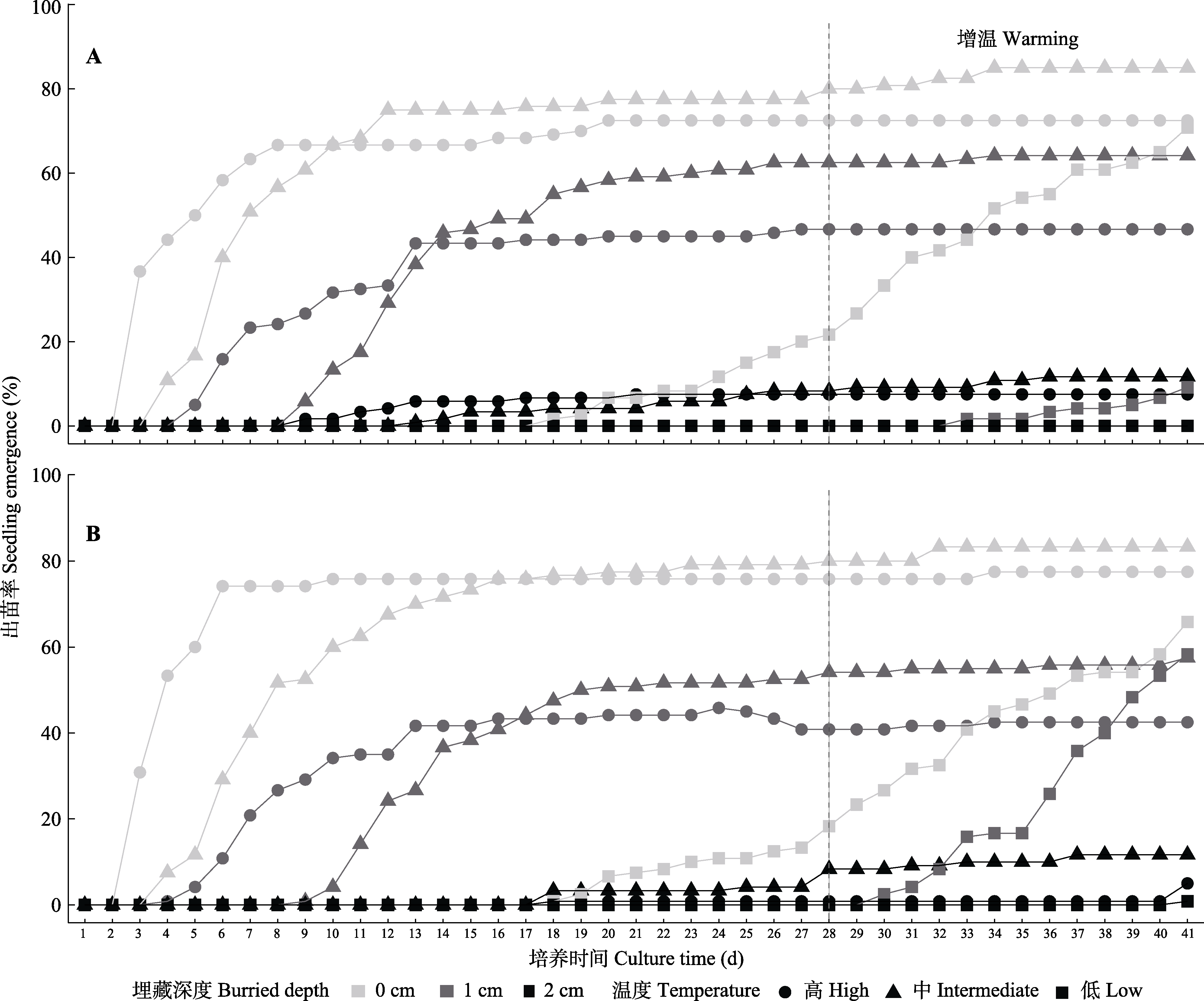
Fig. 1 Seedling emergence of Arenaria oreophila seeds from high (A) and low (B) altitude populations, respectively, along with culture time and with different temperature and burial depth.
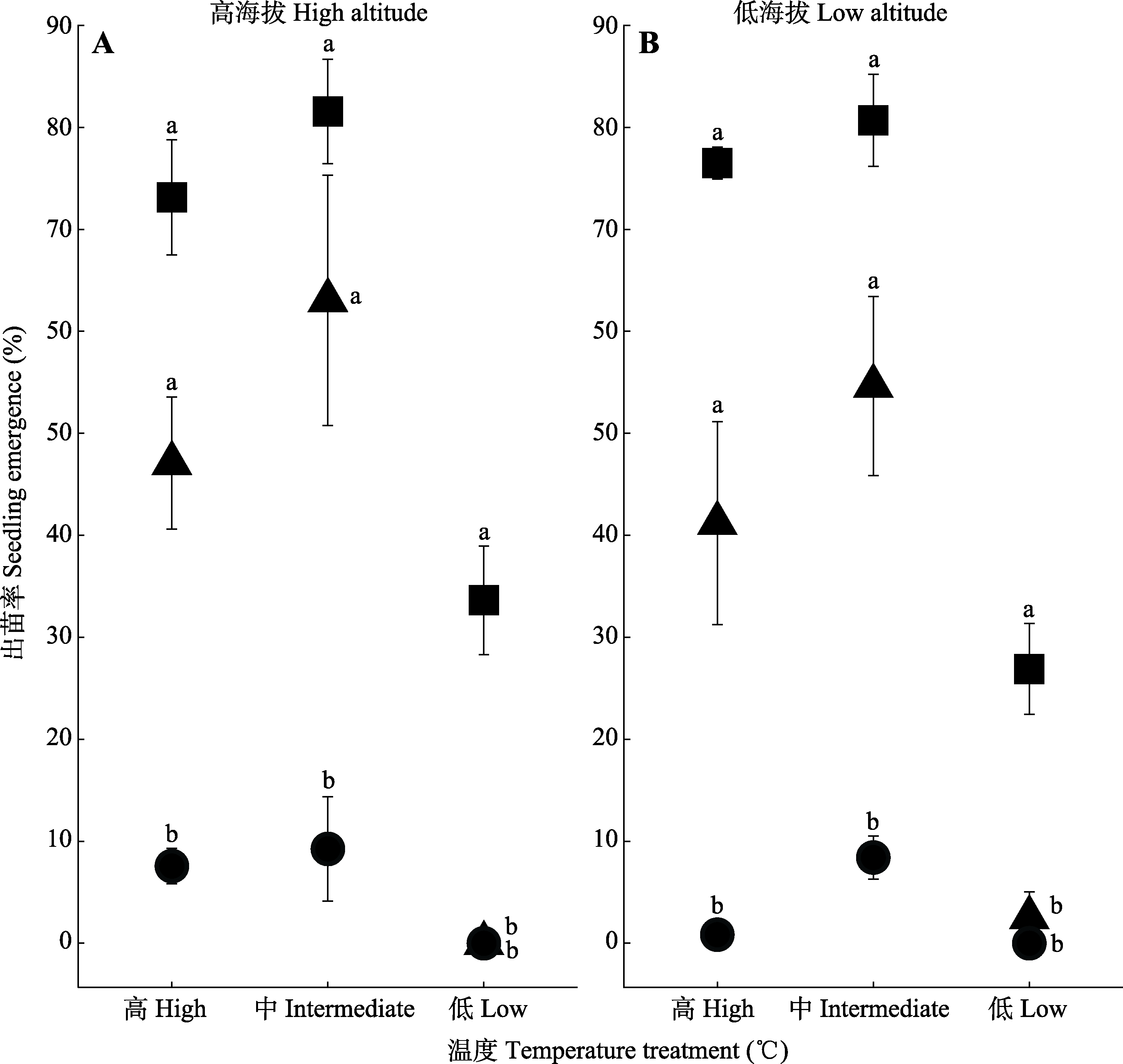
Fig. 2 Seedling emergence (mean ± SE) of Arenaria oreophila seeds from different altitude populations cultivated at different temperatures and burial depths (∎, 0 cm ; ▲, 1 cm; ●, 2 cm) before initiation of warming treatment. Different lowercase letters indicate significant difference between groups at different burial depths under the same temperature condition (p < 0.05).
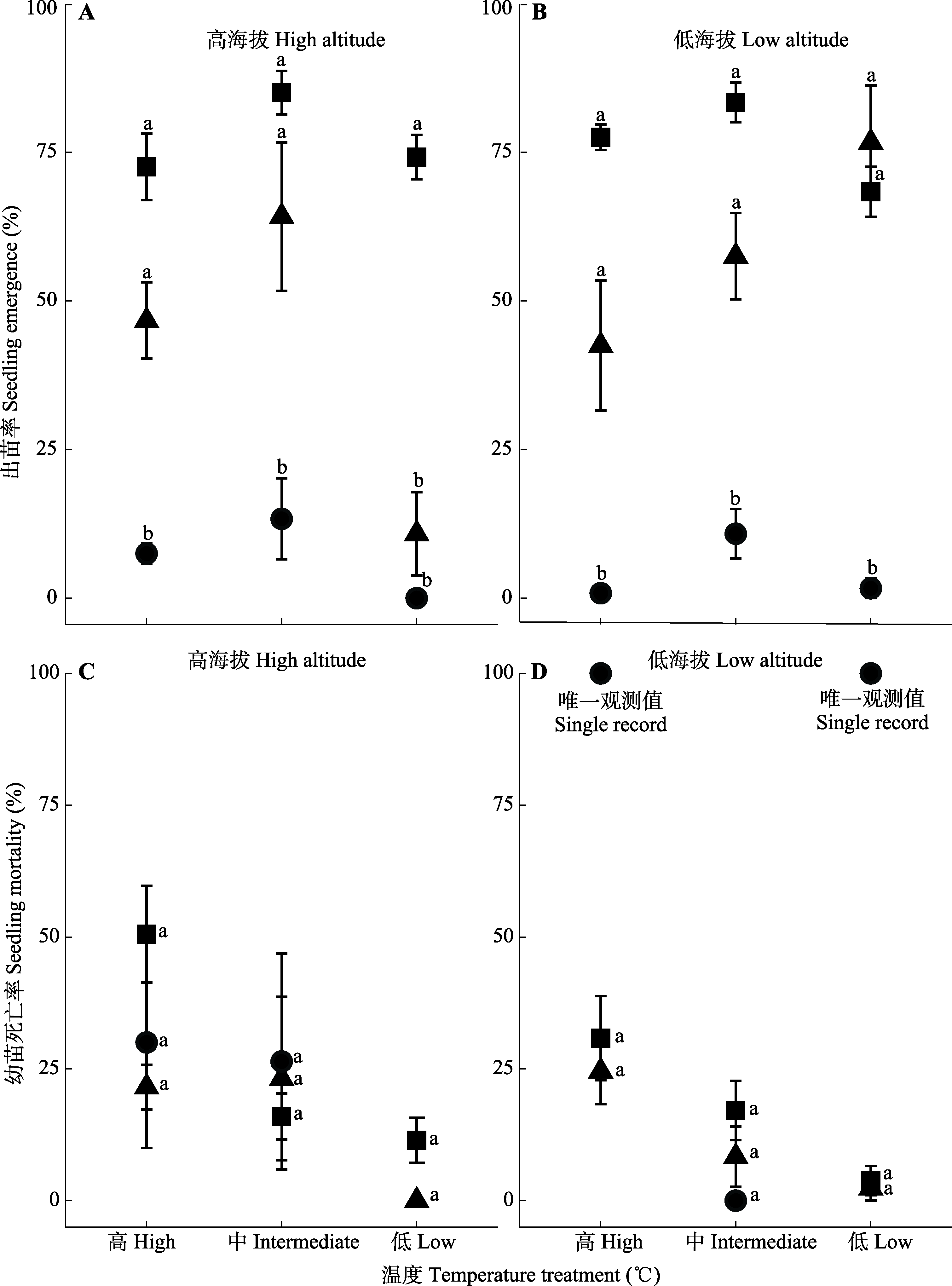
Fig. 3 Final seedling emergence (A, B) and seedling mortality (C, D) of seeds from different altitude populations cultivated at different temperatures and burial depths (∎, 0 cm ; ▲, 1 cm; ●, 2 cm) (mean ± SE). Different lowercase letters indicate significant difference between groups at different burial depths under the same temperature condition (p < 0.05).
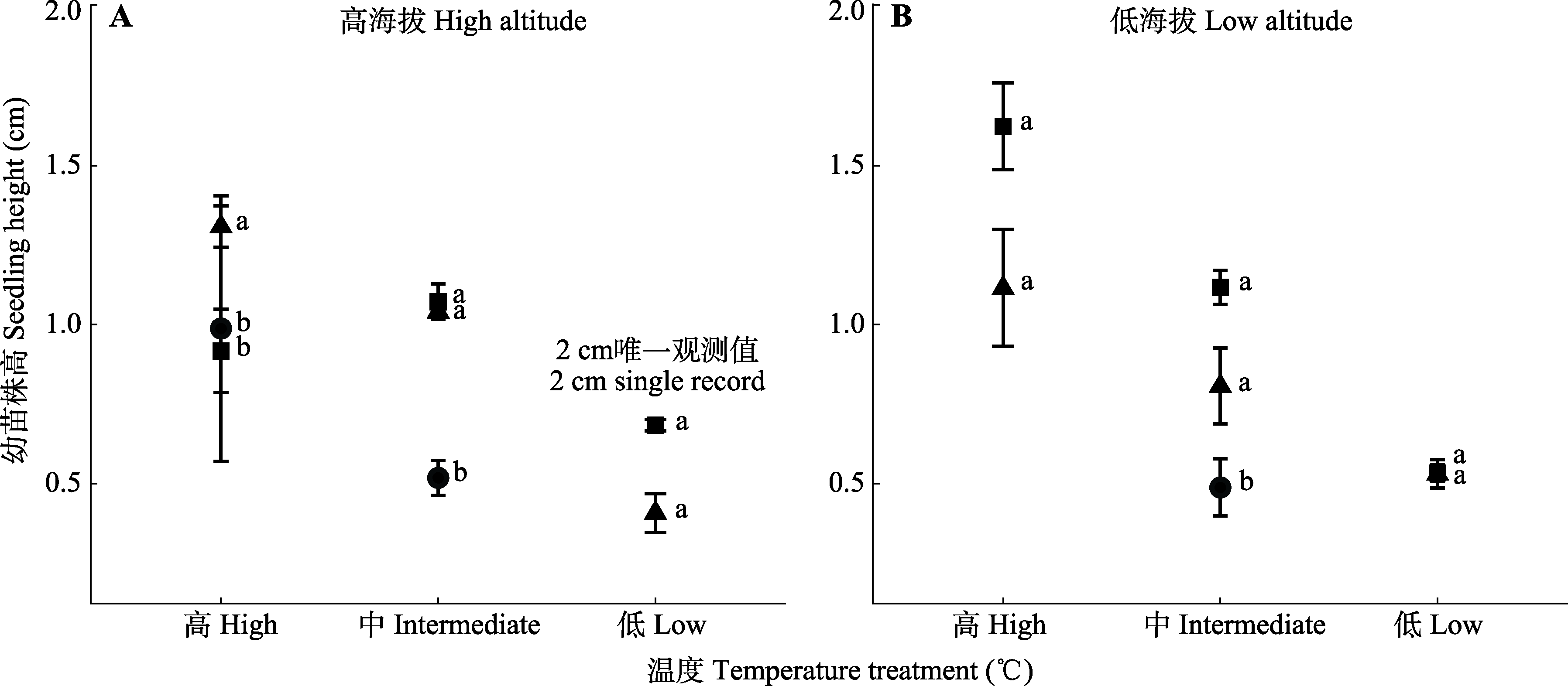
Fig. 4 Final height of Arenaria oreophila seedlings (mean ± SE) from seeds of different populations cultured at different temperatures and burial depths (∎, 0 cm ; ▲, 1 cm; ●, 2 cm) at the end of the experiment. Different lowercase letters indicate significant difference between groups at different burial depths under the same temperature condition (p < 0.05).
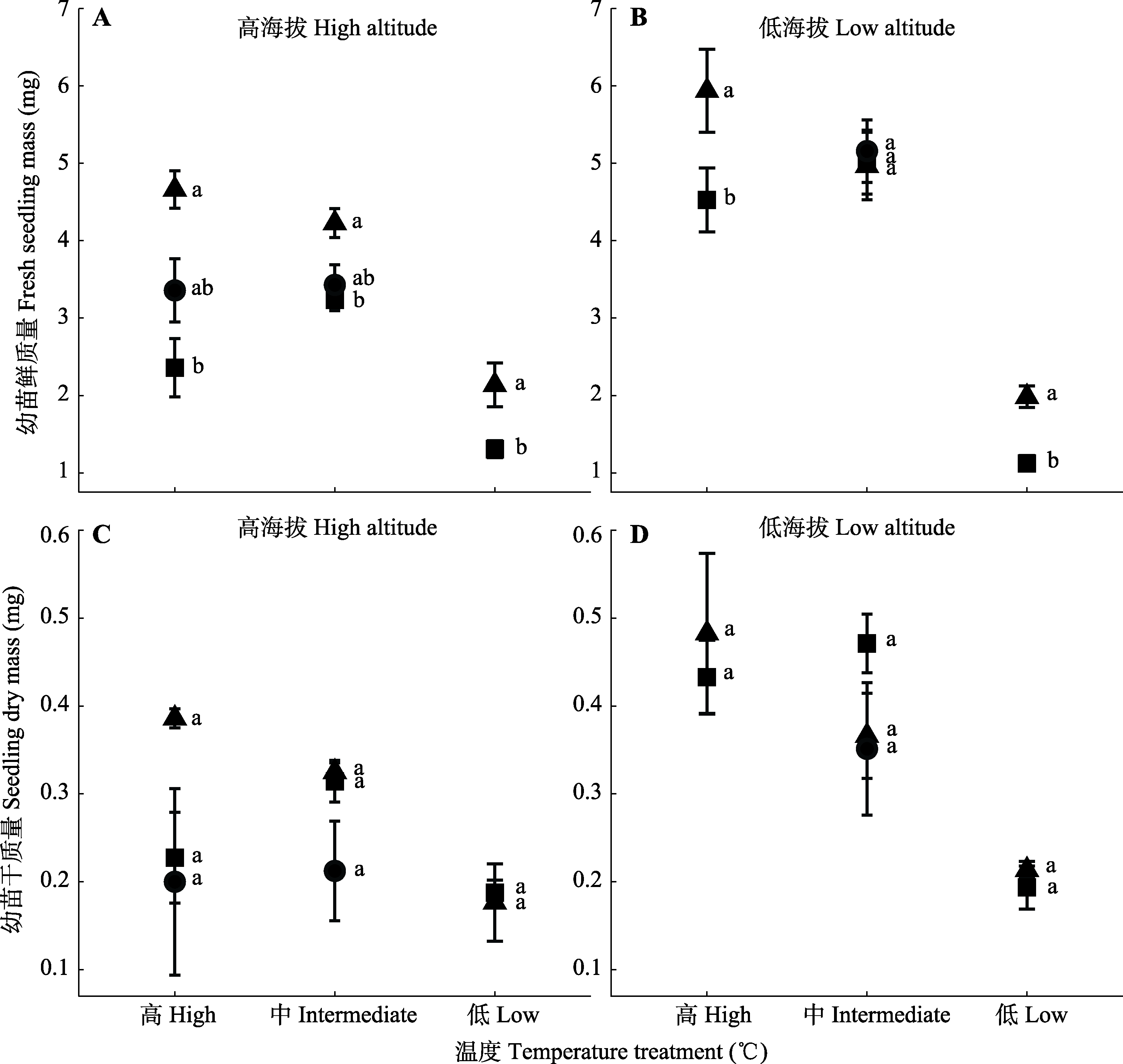
Fig. 5 Fresh (A, B) and dry (C, D) mass (mean ± SE) of Arenaria oreophila seedlings from seeds of different populations cultured at different temperatures and burial depths (∎, 0 cm ; ▲, 1 cm; ●, 2 cm) at the end of the experiment. Different lowercase letters indicate significant difference between groups at different burial depths under the same temperature condition (p < 0.05).
| [1] |
Arroyo MTK, Cavieres LA, Peñaloza A, Arroyo-Kalin MA (2003). Positive associations between the cushion plant Azorella monantha (Apiaceae) and alpine plant species in the Chilean Patagonian Andes. Plant Ecology, 169, 121-129.
DOI |
| [2] |
Badano EI, Cavieres LA (2006). Ecosystem engineering across ecosystems: Do engineer species sharing common features have generalized or idiosyncratic effects on species diversity? Journal of Biogeography, 33, 304-313.
DOI URL |
| [3] |
Badano EI, Jones CG, Cavieres LA, Wright JP (2006). Assessing impacts of ecosystem engineers on community organization: a general approach illustrated by effects of a high-Andean cushion plant. Oikos, 115, 369-385.
DOI URL |
| [4] |
Badano EI, Marquet PA (2008). Ecosystem engineering affects ecosystem functioning in high-Andean landscapes. Oecologia, 155, 821-829.
DOI PMID |
| [5] |
Bascompte J, Jordano P (2007). Plant-animal mutualistic networks: the architecture of biodiversity. Annual Review of Ecology, Evolution, and Systematics, 38, 567-593.
DOI URL |
| [6] | Bascompte J, Jordano P (2013). Mutualistic Networks. Princeton University Press, Princeton. |
| [7] | Baskin CC, Baskin JM (2014). Seeds: Ecology, Biogeography, and Evolution of Dormancy, and Germination. 2nd ed. Academic Press, San Diego, USA. |
| [8] |
Borchert MI, Davis FW, Michaelsen J, Oyler LD (1989). Interactions of factors affecting seedling recruitment of blue oak (Quercus douglasii) in California. Ecology, 70, 389-404.
DOI URL |
| [9] |
Brighenti S, Hotaling S, Finn DS, Fountain AG, Hayashi M, Herbst D, Saros JE, Tronstad LM, Millar CI (2021). Rock glaciers and related cold rocky landforms: overlooked climate refugia for mountain biodiversity. Global Change Biology, 27, 1504-1517.
DOI PMID |
| [10] |
Burkart M, Alsleben K, Lachmuth S, Schumacher J, Hofmann R, Jeltsch F, Schurr FM (2010). Recruitment requirements of the rare and threatened Juncus atratus. Flora, 205, 583-589.
DOI URL |
| [11] | Callaway RM (2007). Positive Interactions and Inter-dependence in Plant Communities. Springer, Dordrecht, the Netherlands. |
| [12] |
Carrillo-Garcia Á, León De La Luz JL, Bashan Y, Bethlenfalvay GJ(1999). Nurse plants, mycorrhizae, and plant establishment in a disturbed area of the Sonoran Desert. Restoration Ecology, 7, 321-335.
DOI URL |
| [13] |
Casanova-Katny MA, Torres-Mellado GA, Palfner G, Cavieres LA (2011). The best for the guest: high Andean nurse cushions of Azorella madreporica enhance arbuscular mycorrhizal status in associated plant species. Mycorrhiza, 21, 613-622.
DOI PMID |
| [14] |
Cavieres LA, Badano EI (2009). Do facilitative interactions increase species richness at the entire community level? Journal of Ecology, 97, 1181-1191.
DOI URL |
| [15] |
Cavieres LA, Brooker RW, Butterfield BJ, Cook BJ, Kikvidze Z, Lortie CJ, Michalet R, Pugnaire FI, Schöb C, Xiao S, Anthelme F, Björk RG, Dickinson KJM, Cranston BH, Gavilán R, et al. (2014). Facilitative plant interactions and climate simultaneously drive alpine plant diversity. Ecology Letters, 17, 193-202.
DOI PMID |
| [16] |
Cavieres LA, Hernández-Fuentes C, Sierra-Almeida A, Kikvidze Z (2016). Facilitation among plants as an insurance policy for diversity in Alpine communities. Functional Ecology, 30, 52-59.
DOI URL |
| [17] |
Chang S, Chen JG, Su JQ, Yang Y, Sun H (2018). Seasonal comparison of bacterial communities in rhizosphere of alpine cushion plants in the Himalayan Hengduan Mountains. Plant Diversity, 40, 209-216.
DOI PMID |
| [18] | Chen JG, Chen XF, Qian LS, Zhang YZ, Li B, Shi HH, Sun L, Schöb C, Sun H (2024a). Degeneration of foundation cushion species induced by ecological constraints can cause massive changes in alpine plant communities. Science China: Life Sciences, 67, 789-802. |
| [19] |
Chen JG, He XF, Wang SW, Yang Y, Sun H (2019). Cushion and shrub ecosystem engineers contribute differently to diversity and functions in alpine ecosystems. Journal of Vegetation Science, 30, 362-374.
DOI URL |
| [20] |
Chen JG, Schöb C, Zhou Z, Gong QB, Li XH, Yang Y, Li ZM, Sun H (2015a). Cushion plants can have a positive effect on diversity at high elevations in the Himalayan Hengduan Mountains. Journal of Vegetation Science, 26, 768-777.
DOI URL |
| [21] | Chen JG, Yang Y, Stöcklin J, Cavieres LA, Peng DL, Li ZM, Sun H (2015b). Soil nutrient availability determines the facilitative effects of cushion plants on other plant species at high elevations in the south-eastern Himalayas. Plant Ecology & Diversity, 8, 199-210. |
| [22] |
Chen JG, Yang Y, Wang SW, Stöcklin J, Peng DL, Sun H (2020). Recruitment of the high elevation cushion plant Arenaria polytrichoides is limited by competition, thus threatened by currently established vegetation. Journal of Systematics and Evolution, 58, 59-68.
DOI URL |
| [23] | Chen JG, Zhang YZ, Zhang HR, Schöb C, Wang SW, Chang S, Sun H (2021). The positive effects of the alpine cushion plant Arenaria polytrichoides on insect dynamics are determined by both physical and biotic factors. Science of the Total Environment, 762,14309. DOI: 10.1016/j.scitotenv.2020.143091. |
| [24] | Chen XF, Qian LS, Shi HH, Zhang YZ, Song MS, Sun H, Chen JG (2024b). Allelopathic potentials of surrounding vegetation on seedling establishment of alpine cushion Arenaria polytrichoides. Journal of Plant Ecology, 17, rtae026. DOI: 10.1093/jpe/rtae045. |
| [25] |
Donath TW, Hölzel N, Otte A (2006). Influence of competition by sown grass, disturbance and litter on recruitment of rare flood-meadow species. Biological Conservation, 130, 315-323.
DOI URL |
| [26] |
Dullinger S, Gattringer A, Thuiller W, Moser D, Zimmermann NE, Guisan A, Willner W, Plutzar C, Leitner M, Ekrtová E, Košnar J (2012). Habitat-related variation in seedling recruitment of Gentiana pannonica. Acta Oecologica, 45, 88-97.
DOI URL |
| [27] |
Ekrtova E, Kosnar J (2012). Habitat-related variation in seedling recruitment of Gentiana pannonica. Acta Oecologica-International Journal of Ecology, 45, 88-97.
DOI URL |
| [28] |
Elsen PR, Tingley MW (2015). Global mountain topography and the fate of montane species under climate change. Nature Climate Change, 5, 772-776.
DOI |
| [29] | Fenner M, Thompson K (2005). The Ecology of Seeds. Cambridge University Press, Cambridge, UK. |
| [30] |
Fernández-Pascual E, Carta A, Mondoni A, Cavieres LA, Rosbakh S, Venn S, Satyanti A, Guja L, Briceño VF, Vandelook F, Mattana E, Saatkamp A, Bu HY, Sommerville K, Poschlod P, et al. (2021). The seed germination spectrum of alpine plants: a global meta-analysis. New Phytologist, 229, 3573-3586.
DOI PMID |
| [31] |
Finch-Savage WE, Leubner-Metzger G (2006). Seed dormancy and the control of germination. New Phytologist, 171, 501-523.
DOI PMID |
| [32] |
Frei ES, Scheepens JF, Stöcklin J (2012). Dispersal and microsite limitation of a rare alpine plant. Plant Ecology, 213, 395-406.
DOI URL |
| [33] |
Gavini SS, Ezcurra C, Aizen MA (2020). Patch-level facilitation fosters high-Andean plant diversity at regional scales. Journal of Vegetation Science, 31, 1133-1143.
DOI URL |
| [34] |
Gottfried M, Pauli H, Futschik A, Akhalkatsi M, Barančok P, Benito Alonso JL, Coldea G, Dick J, Erschbamer B, Fernández Calzado MR, Kazakis G, Krajči J, Larsson P, Mallaun M, Michelsen O, et al. (2012). Continent-wide response of mountain vegetation to climate change. Nature Climate Change, 2, 111-115.
DOI |
| [35] |
Graae BJ, Ejrnæs R, Lang SI, Meineri E, Ibarra PT, Bruun HH (2011). Strong microsite control of seedling recruitment in tundra. Oecologia, 166, 565-576.
DOI PMID |
| [36] |
Guo CR, Lu JQ, Yang DZ, Zhao LP (2009). Impacts of burial and insect infection on germination and seedling growth of acorns of Quercus variabilis. Forest Ecology and Management, 258, 1497-1502.
DOI URL |
| [37] |
Guo CR, Wang ZL, Lu JQ (2010). Seed germination and seedling development of Prunus armeniaca under different burial depths in soil. Journal of Forestry Research, 21, 492-496.
DOI URL |
| [38] | Guo Ke, Li Rui, Werger MJA (2001). Effect of acorn burying depth on germination, seedling emergence and development of Quercus aliena var. acuteserrata. Acta Botanica Sinica, 43, 974-978. |
| [郭柯, 李睿, Werger MJA (2001). 锐齿槲栎橡子埋藏深度对发芽、幼苗出土和发育的影响. 植物学报, 43, 974-978.] | |
| [39] |
Jones CG, Lawton JH, Shachak M (1994). Organisms as ecosystem engineers. Oikos, 69, 373.
DOI URL |
| [40] |
Kikvidze Z, Brooker RW, Butterfield BJ, Callaway RM, Cavieres LA, Cook BJ, Lortie CJ, Michalet R, Pugnaire FI, Xiao S, Anthelme F, Björk RG, Cranston BH, Gavilán RG, Kanka R, et al. (2015). The effects of foundation species on community assembly: a global study on alpine cushion plant communities. Ecology, 96, 2064-2069.
PMID |
| [41] |
Klanderud K (2010). Species recruitment in alpine plant communities: the role of species interactions and productivity. Journal of Ecology, 98, 1128-1133.
DOI URL |
| [42] | Körner C (2003). Alpine Plant Life: Functional Plant Ecology of High Mountain Ecosystems. 2nd ed. Springer, New York. |
| [43] |
Koutsovoulou K, Daws MI, Thanos CA (2014). Campanulaceae: a family with small seeds that require light for germination. Annals of Botany, 113, 135-143.
DOI PMID |
| [44] | Losapio G, Fortuna MA, Bascompte J, Schmid B, Michalet R, Neumeyer R, Castro L, Cerretti P, Germann C, Haenni JP, Klopfstein S, Ortiz-Sanchez FJ, Pont AC, Rousse P, Schmid J, Sommaggio D, Schöb C (2019). Plant interactions shape pollination networks via nonadditive effects. Ecology, 100, e02619. DOI: 10.1002/ecy.2619. |
| [45] |
Losapio G, Schöb C (2017). Resistance of plant-plant networks to biodiversity loss and secondary extinctions following simulated environmental changes. Functional Ecology, 31, 1145-1152.
DOI URL |
| [46] | Lüscher A, Stäheli B, Braun R, Nösberger J (2001). Leaf area, competition with grass, and clover cultivar: key factors to successful overwintering and fast regrowth of white clover (Trifolium repens L.) in spring. Annals of Botany, 88, 725-735. |
| [47] | Ma HY, Liang ZW, Yan C, Chen Y, Huang LH (2007). Effects of sand-burial depth on Leymus chinensis seedlings emergence and growth. Chinese Journal of Ecology, 26, 2003-2007. |
| [马红媛, 梁正伟, 闫超, 陈渊, 黄立华 (2007). 四种沙埋深度对羊草种子出苗和幼苗生长的影响. 生态学杂志, 26, 2003-2007.] | |
| [48] |
Mennan H, Zandstra BH (2006). The effects of depth and duration of seed burial on viability, dormancy, germination, and emergence of ivyleaf speedwell (Veronica hederifolia). Weed Technology, 20, 438-444.
DOI URL |
| [49] | Molenda O, Reid A, Lortie CJ (2012). The alpine cushion plant Silene acaulis as foundation species: a bug’s-eye view to facilitation and microclimate. PLoS ONE, 7, e37223. DOI: 10.1371/journal.pone.0037223. |
| [50] |
Molina-Montenegro MA, Badano EI, Cavieres LA (2006). Cushion plants as microclimatic shelters for two ladybird beetles species in alpine zone of central Chile. Arctic, Antarctic, and Alpine Research, 38, 224-227.
DOI URL |
| [51] |
Peng DL, Hu XJ, Yang J, Sun H (2018). Seed dormancy, germination and soil seed bank of Lamiophlomis rotata and Marmoritis complanatum (Labiatae), two endemic species from Himalaya-Hengduan Mountains. Plant Biosystems, 152, 642-648.
DOI URL |
| [52] |
Peng DL, Ou XK, Xu B, Zhang ZQ, Niu Y, Li ZM, Sun H (2014). Plant sexual systems correlated with morphological traits: reflecting reproductive strategies of alpine plants. Journal of Systematics and Evolution, 52, 368-377.
DOI URL |
| [53] | Reid AM, Lortie CJ (2012). Cushion plants are foundation species with positive effects extending to higher trophic levels. Ecosphere, 3, 1-18. |
| [54] |
Roy J, Albert CH, Ibanez S, Saccone P, Zinger L, Choler P, Clément JC, Lavergne S, Geremia RA (2013). Microbes on the cliff: alpine cushion plants structure bacterial and fungal communities. Frontiers in Microbiology, 4, 64. DOI: 10.3389/fmicb.2013.00064.
PMID |
| [55] |
Schielzeth H, Dingemanse NJ, Nakagawa S, Westneat DF, Allegue H, Teplitsky C, Réale D, Dochtermann NA, Garamszegi LZ, Araya-Ajoy YG (2020). Robustness of linear mixed-effects models to violations of distributional assumptions. Methods in Ecology and Evolution, 11, 1141-1152.
DOI |
| [56] |
Schöb C, Armas C, Pugnaire FI (2013). Direct and indirect interactions co-determine species composition in nurse plant systems. Oikos, 122, 1371-1379.
DOI URL |
| [57] | Song B, Stöcklin J, Zhang ZQ, Yang Y, Sun H (2013). Seed and microsite limitation in Rheum nobile, a rare and endemic plant from the subnival zone of Sino-Himalaya. Plant Ecology & Diversity, 6, 503-509. |
| [58] | Wang XJ, Zhou XH, Zhang MT, Ge WJ, Yang GC, Zhou HK, Ma L, Liu K, Qi W, Bu HY (2024). Influence of seed mass and shape on light plasticity of germination of alpine plants on the Tibetan Plateau: the role of photoblastic taxa, dispersal ability, and life history. Global Ecology and Conservation, 51, e02896. DOI: 10.1016/j.gecco.2024.e02896. |
| [59] |
Yang Y, Niu Y, Cavieres LA, Sun H (2010). Positive associations between the cushion plant Arenaria polytrichoides (Caryophyllaceae) and other alpine plant species increase with altitude in the Sino-Himalayas. Journal of Vegetation Science, 21, 1048-1057.
DOI URL |
| [60] |
Zhao DS, Wu SH, Yin YH, Yin ZY (2011). Vegetation distribution on Tibetan Plateau under climate change scenario. Regional Environmental Change, 11, 905-915.
DOI URL |
| [61] |
Zhou RY, Yang PF, Chen XF, Song MS, Sun H, Chen JG (2025). Simulated climate warming strongly constrains the seedling establishment of alpine cushion Arenaria oreophila. Plant Diversity, 47, 889-898.
DOI URL |
| [1] | guangjin wu, 郭 垚鑫, Ren Chengjie, Wang Jun, YUE Ming, Zhao Fazhu. Distribution of soil organic carbon content and its influencing factors in different vegetation type on the northern foot of the Qinling Mountains [J]. Chin J Plant Ecol, 2026, 50(预发表): 1-. |
| [2] | TAN Qiu-Yan, ZHANG Qing, GAO Cheng, CHU Hai-Yan, YANG Teng. Ectomycorrhizal fungi: key drivers of carbon and nitrogen cycling in alpine ecosystems [J]. Chin J Plant Ecol, 2026, 50(3): 584-599. |
| [3] | TIAN Di, CHI Xiao-Long, SHI Liang, LIU Xiao-Han, ZHAO Chang-Ti, WU Mei, ZHANG Yu-Zhong, GAO Yong-Liang. Stoichiometric characteristics of dominant afforestation tree species and their environmental drivers in Saihanba region [J]. Chin J Plant Ecol, 2026, 50(2): 362-373. |
| [4] | WEI Xin, JIANG Lan, ZHENG Chen-Cheng, ZHU Jing, CHEN Bo, LI Wen-Zhou, LAI Shu-Yu, LIU Jin-Fu, HE Zhong-Sheng. Distribution and influencing factors of woody plant sexual systems along elevational gradient on the south slope of Daiyun Mountain [J]. Chin J Plant Ecol, 2026, 50(1): 150-159. |
| [5] | ZHANG Lin, YUAN Wei-Ying, SONG Chuang-Ye, WU Dong-Xiu. Dynamic dataset of environmental elements, species richness and biomass of long-term observation plots of typical ecosystems in China from 1998 to 2010 [J]. Chin J Plant Ecol, 2025, 49(8): 1182-1190. |
| [6] | FAN Ya-Ran, XIA Shao-Pan, YU Bing-Bing, ZHU Zi-Qi, YANG Wei, FAN Yu-Chuan, LIU Xiao-Yu, ZHANG Xu-Hui, ZHENG Ju-Feng. Effects of elevated atmospheric CO2 concentration and warming on stability of soil organic carbon pool accumulation, molecular composition and structure stability [J]. Chin J Plant Ecol, 2025, 49(7): 1053-1069. |
| [7] | WANG Kun-Ying, QIU Gui-Fu, LIU Zi-He, MENG Jun, LIU Yu-Xuan, JIA Guo-Dong. Climate change regulate tree growth and intrinsic water use efficiency of Populus simonii at different levels of degradation [J]. Chin J Plant Ecol, 2025, 49(2): 343-355. |
| [8] | ZHU Wan-Kuan, XU Yu-Xing, HUANG Run-Xia, DU A-Peng, WANG Zhi-Chao. Differences in water use efficiency between dry and rainy seasons and their controlling factors in Eucalyptus plantation in Leizhou Peninsula [J]. Chin J Plant Ecol, 2025, 49(12): 2015-2029. |
| [9] | HE Yi, ZHOU Jing, CHEN Chen, FANG Ting-Zhou, SU Jian, GAO Hao-Jie, CAO Jia-Hao, YANG Fei-Yu, FAN Qi-Bo, ZHU Le-Yao, CHEN Yi-Ming, YANG Fei, WANG Yi-Teng, FENG Lei, LIU Fei, LIANG Shuang, JIANG Ming-Kai, CHEN Jun, ZHAO Yun-Peng, CHEN Wei-Le, ZHAO Ying, HUANG Jian-Guo. Protection and restoration of endangered tree species on coastal islands of Zhejiang, China [J]. Chin J Plant Ecol, 2025, 49(10): 1583-1599. |
| [10] | FU Zhao-Qi, HU Xu, TIAN Qin-Rui, GE Yan-Ling, ZHOU Hong-Juan, WU Xiao-Yun, CHEN Li-Xin. Nocturnal sap flow characteristics of two typical forest tree species and responses to environmental factors in the loess region of West Shanxi, China [J]. Chin J Plant Ecol, 2024, 48(9): 1128-1142. |
| [11] | ZHANG Peng, JIAO Liang, XUE Ru-Hong, WEI Meng-Yuan, DU Da-Shi, WU Xuan, WANG Xu-Ge, LI Qian. Drought intensity affected the growth recovery of Picea crassifolia across different altitudes in western Qilian Mountains [J]. Chin J Plant Ecol, 2024, 48(8): 977-987. |
| [12] | SHI Qian, TONG Xiao-Juan, XU Ling-Ling, MENG Ping, YU Pei-Yang, LI Jun, YANG Ming-Xin. Response of radial growth of early and late wood of planted Pinus tabuliformis to climate variables [J]. Chin J Plant Ecol, 2024, 48(8): 988-1000. |
| [13] | CHEN Yi-Heng, Yusufujiang RUSULI, Abdureheman WUSIMAN. Analysis of spatial and temporal variation in grassland vegetation cover in Xinjiang section of Tianshan Mountains and the driving factors from 2001 to 2020 [J]. Chin J Plant Ecol, 2024, 48(5): 561-576. |
| [14] | ZHANG Ji-Shen, SHI Xin-Jie, LIU Yu-Nuo, WU Yang, PENG Shou-Zhang. Dynamics of ecosystem carbon storage of potential natural vegetation in China under climate change [J]. Chin J Plant Ecol, 2024, 48(4): 428-444. |
| [15] | ZANG Miao-Han, WANG Chuan-Kuan, LIANG Yi-Xian, LIU Yi-Xiao, SHANGGUAN Hong-Yu, QUAN Xian-Kui. Stoichiometric characteristics of leaf, branch and root in Larix gmelinii in response to climate warming based on latitudinal transplantation [J]. Chin J Plant Ecol, 2024, 48(4): 469-482. |
| Viewed | ||||||
|
Full text |
|
|||||
|
Abstract |
|
|||||
Copyright © 2026 Chinese Journal of Plant Ecology
Tel: 010-62836134, 62836138, E-mail: apes@ibcas.ac.cn, cjpe@ibcas.ac.cn

