
Chin J Plant Ecol ›› 2025, Vol. 49 ›› Issue (12): 2105-2118.DOI: 10.17521/cjpe.2024.0372 cstr: 32100.14.cjpe.2024.0372
• Research Articles • Previous Articles Next Articles
LU Lei-Qin, SUN Long, SONG Yu-Xuan, YANG Guang, CAI Hui-Ying*( )
)
Received:2024-10-21
Accepted:2025-02-26
Online:2025-12-20
Published:2025-12-29
Contact:
CAI Hui-Ying
Supported by:LU Lei-Qin, SUN Long, SONG Yu-Xuan, YANG Guang, CAI Hui-Ying. Post-fire time impacts on nonstructural carbohydrates in leaves-branches-roots of Vaccinium vitis-idaea in Da Hinggan Mountains[J]. Chin J Plant Ecol, 2025, 49(12): 2105-2118.
Add to citation manager EndNote|Ris|BibTeX
URL: https://www.plant-ecology.com/EN/10.17521/cjpe.2024.0372
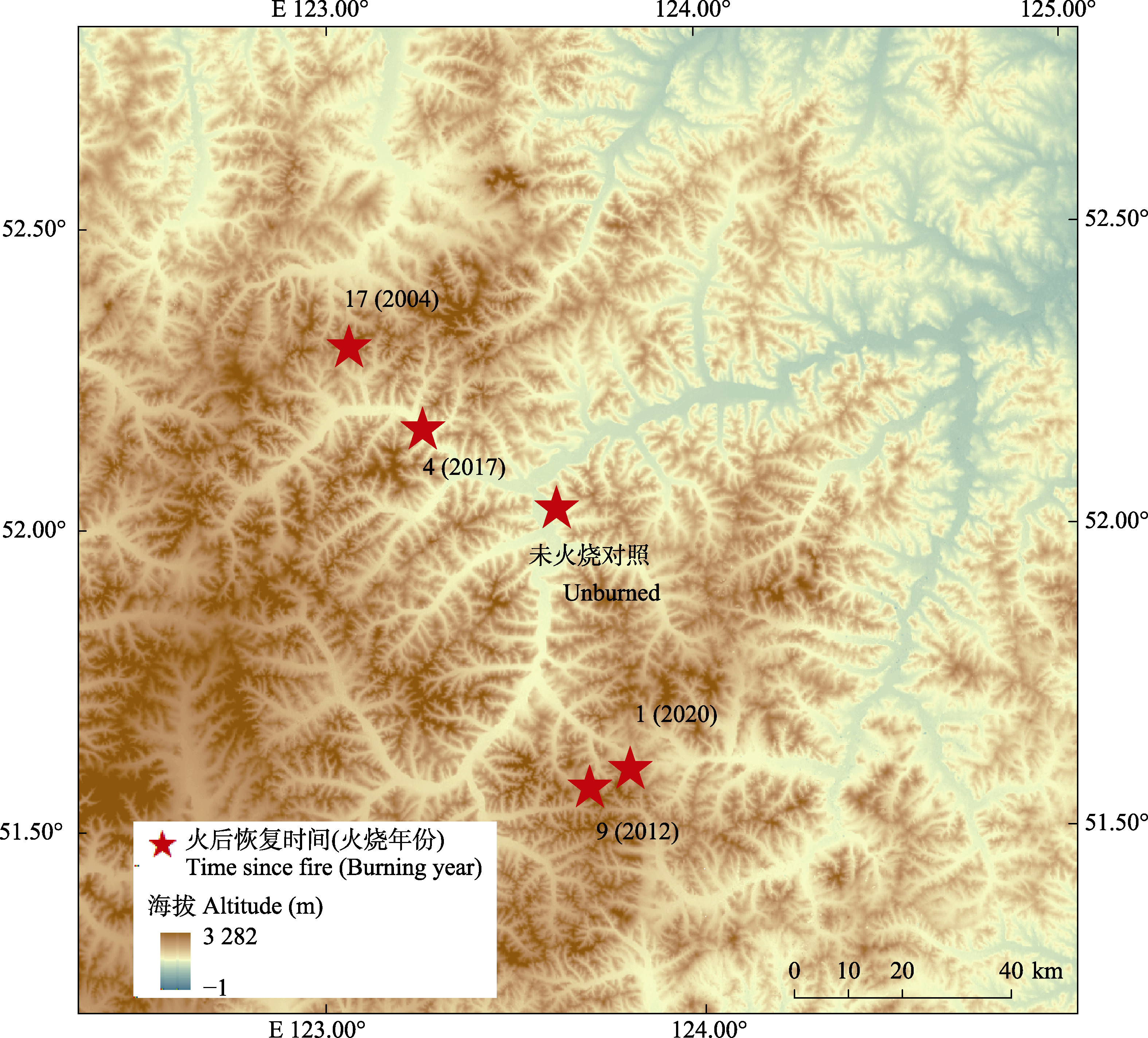
Fig. 1 Distribution map of study plots for post-fire restoration of Larix gmelinii forests in Da Hinggan Mountains.
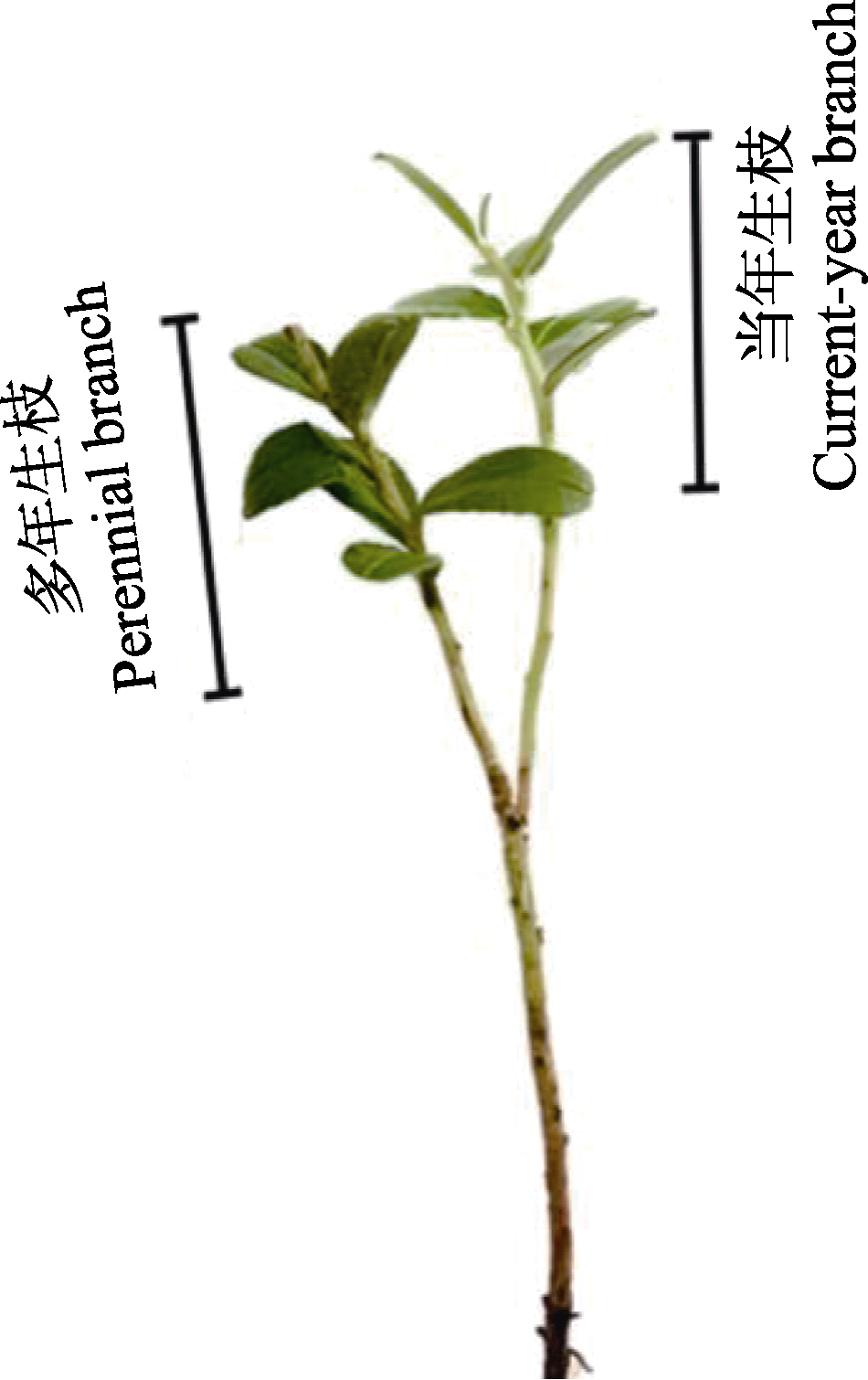
Fig. 2 Basic characteristics of branches and leaves of different ages of Vaccinium vitis-idaea
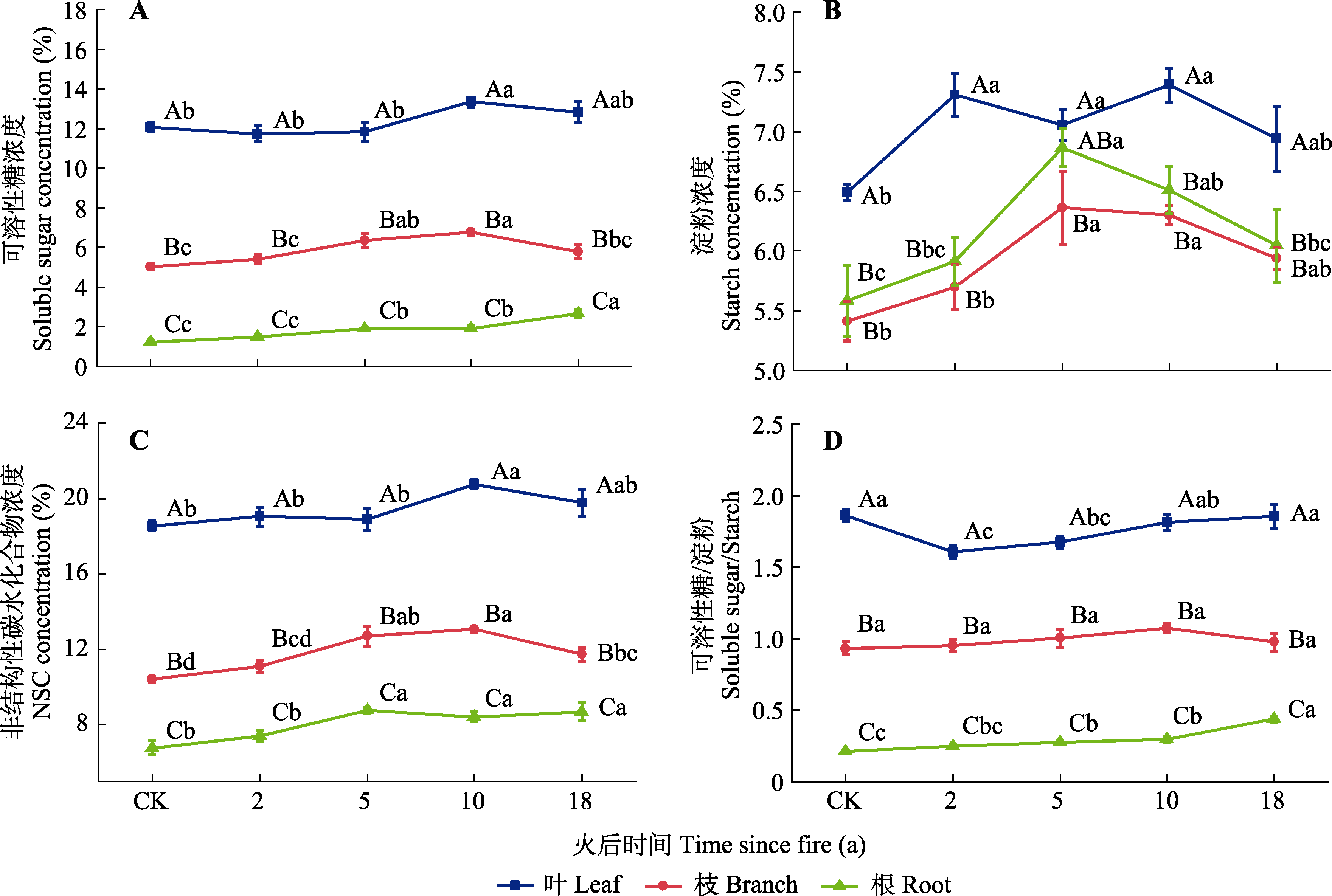
Fig. 3 Changes in concentrations of non-structural carbohydrates (NSC) and its components in Vaccinium vitis-idaea leaves-branches-roots with time post fire (mean ± SE). Different lowercase letters indicate significant differences among different time in the same organ and component (p < 0.05), and different uppercase letters indicate significant differences between organs in the same time and component (p < 0.05). CK indicates unburned control.
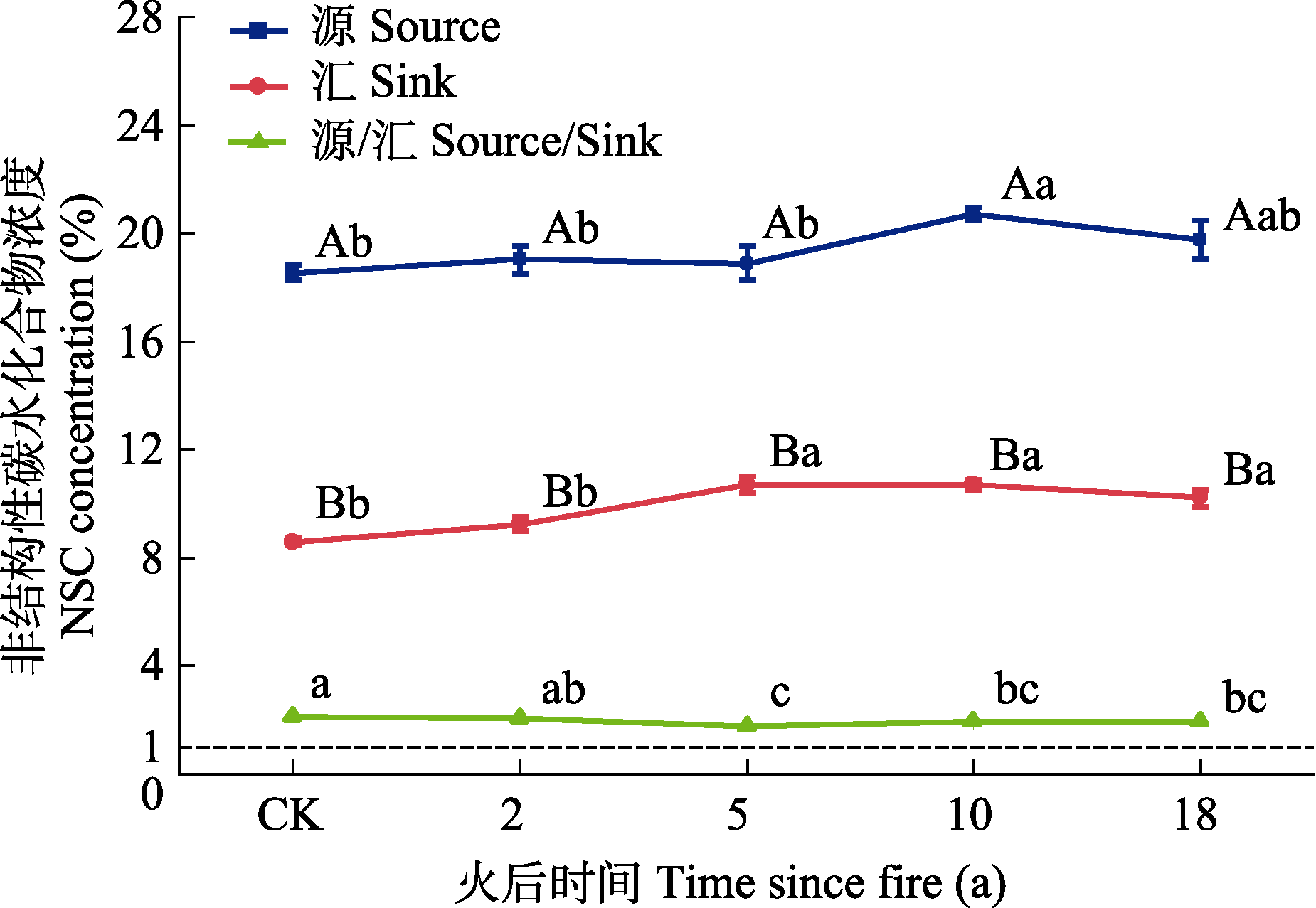
Fig. 4 Changes in concentration of non-structural carbohydrates (NSC) source-sink in Vaccinium vitis-idaea with time post fire (mean ± SE). Different lowercase letters indicate significant differences among different time in the same component (p < 0.05), and different uppercase letters indicate significant differences between source and sink in the same time (p < 0.05). CK indicates unburned control. The dotted line indicates that the concentrations of non-structural carbohydrate sources and sinks are equal.
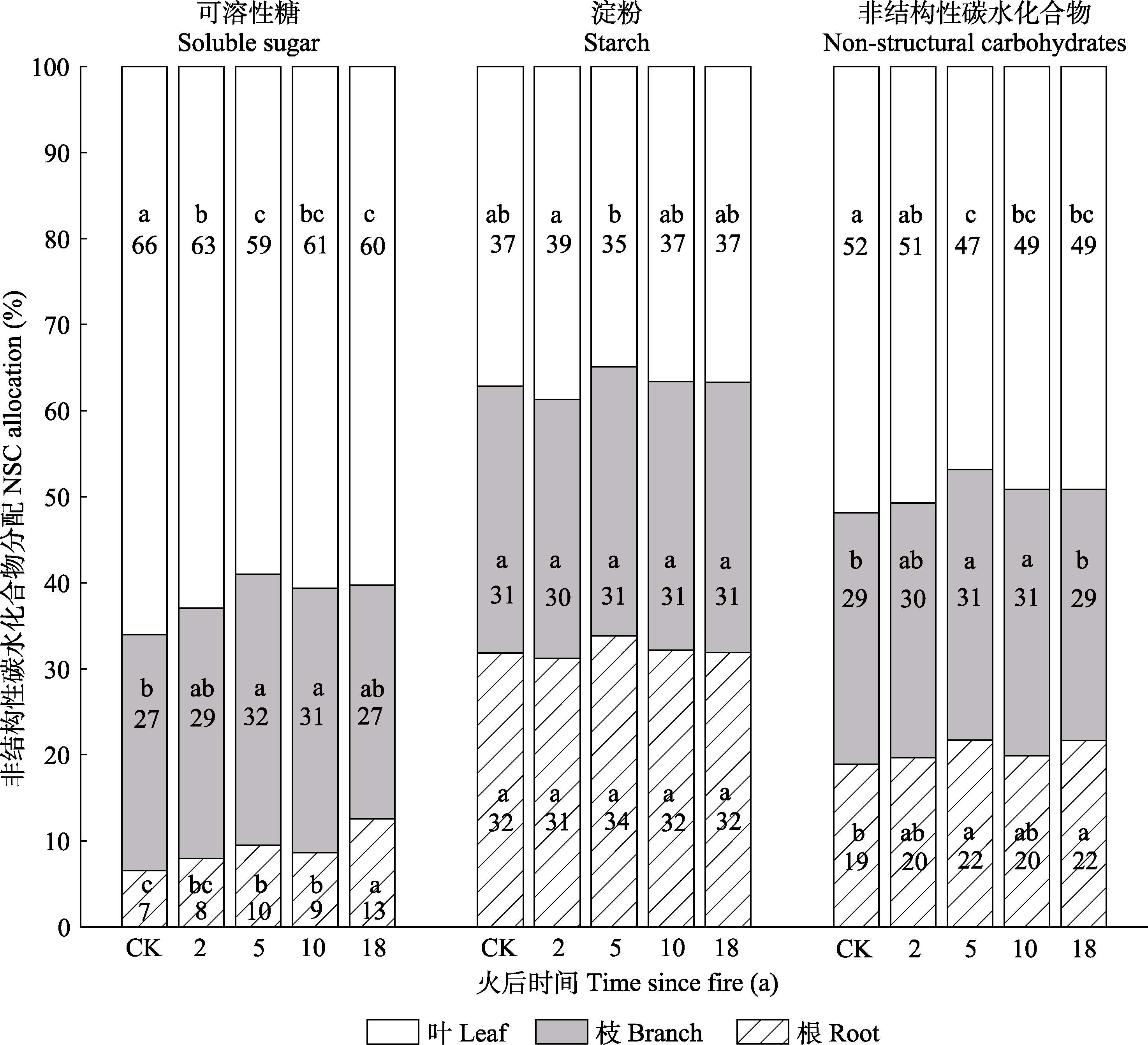
Fig. 5 Allocation of non-structural carbohydrates (NSC) and its components within leaves-branches-roots of Vaccinium vitis-idaea with time post fire. Different lowercase letters indicate significant differences in the same component of the same organ among the time post fire (p < 0.05). CK indicates unburned control.
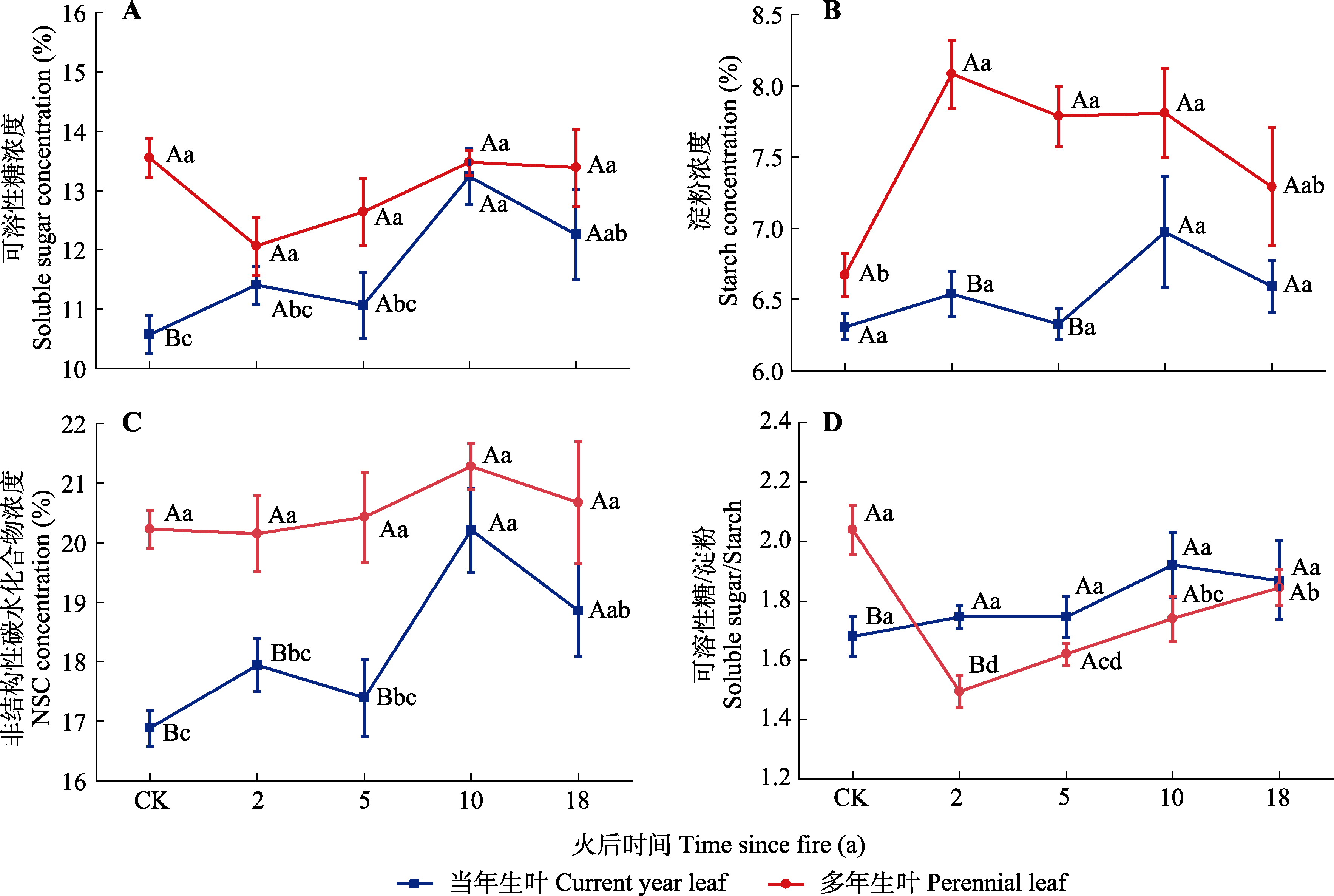
Fig. 6 Changes in concentrations of non-structural carbohydrates (NSC) and its components in different leaf ages of Vaccinium vitis-idaea with time post fire (mean ± SE). Different lowercase letters indicate significant differences among time in the same organ and component (p < 0.05), and different uppercase letters indicate significant differences between leaf ages in the same time and component (p < 0.05). CK indicates unburned control.
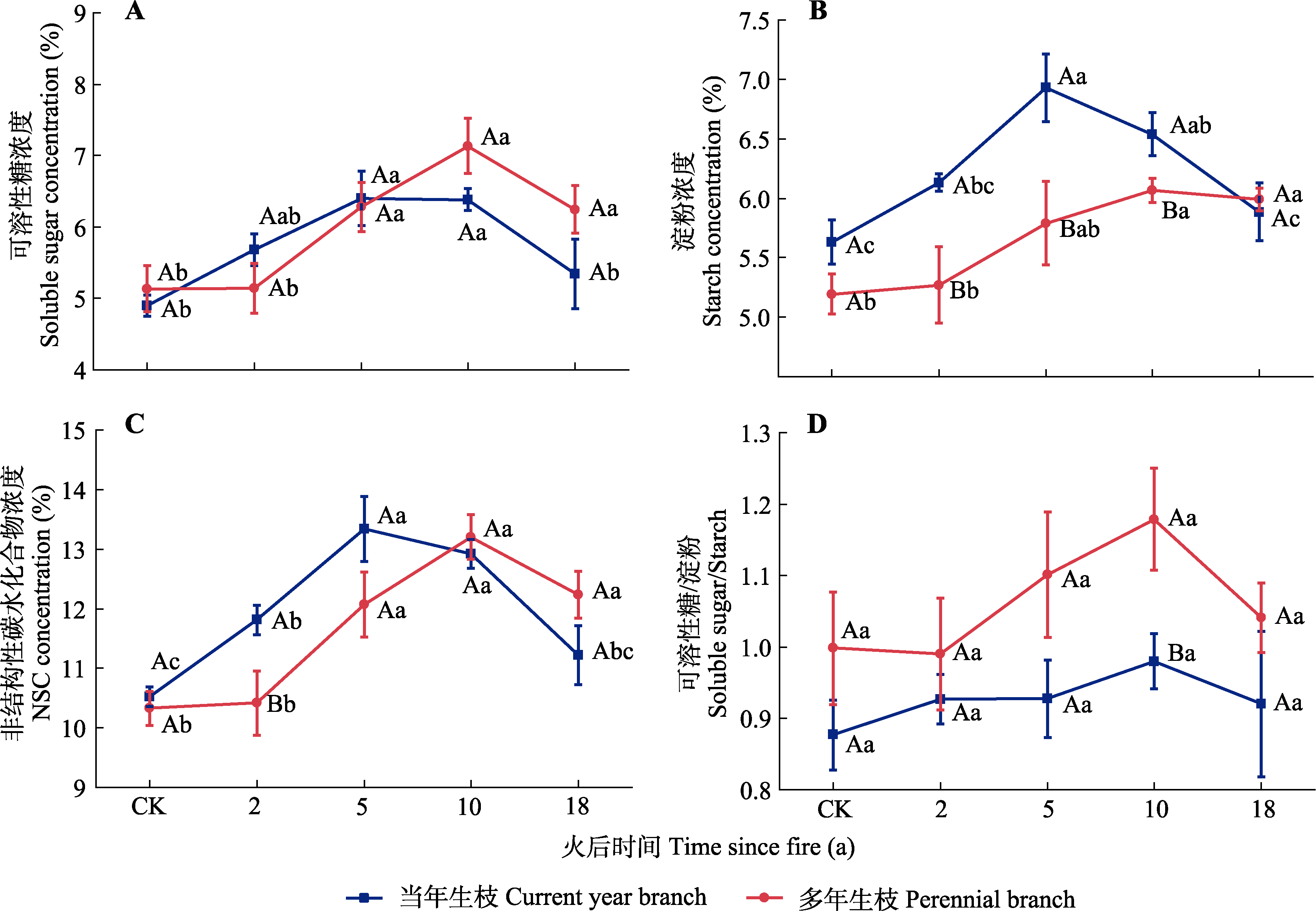
Fig. 7 Changes in concentrations of non-structural carbohydrates (NSC) and its components in different age branches of Vaccinium vitis-idaea with time post fire (mean ± SE). Different lowercase letters indicate significant differences among time in the same organ and component (p < 0.05), and different uppercase letters indicate significant differences between branch ages in the same time and component (p < 0.05). CK indicates unburned control.
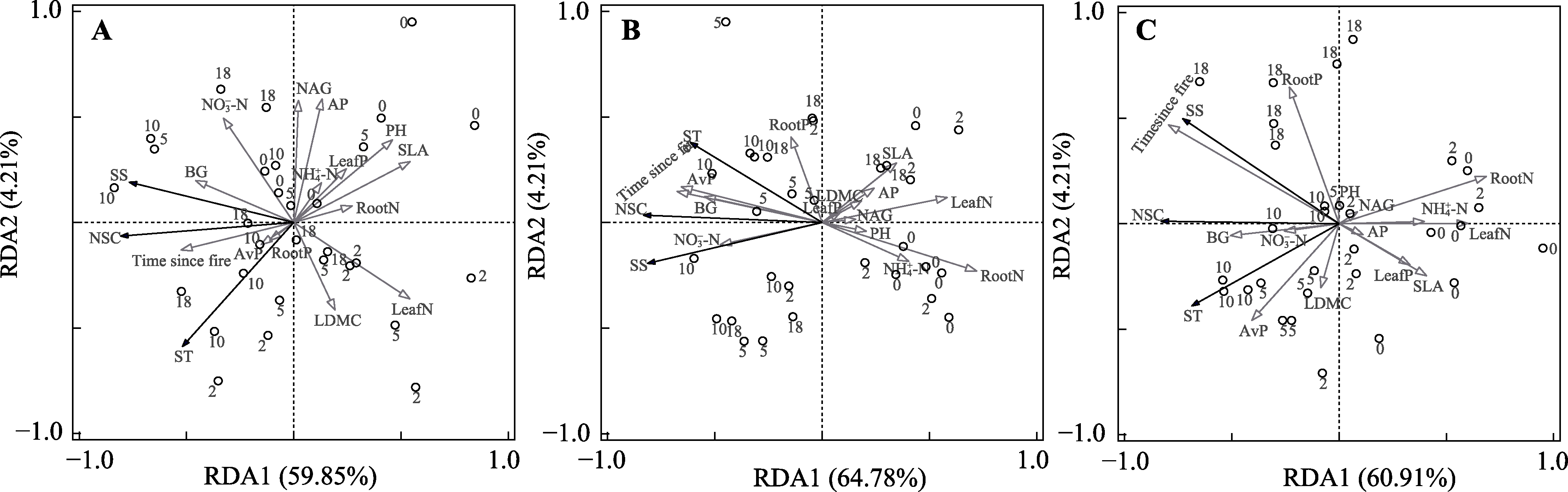
Fig. 8 Redundancy analysis (RDA) of the relationship among time, soil properties, plant traits and non-structural carbohydrates (NSC) and its components of leaves (A), branches (B) and roots (C) of Vaccinium vitis-idaea. 0, 2, 5, 10, 18 denote the time since fire. The black arrow represents NSC components: NSC, non-structural carbohydrates concentration; SS, soluble sugar concentration; ST, starch concentration. The gray arrow represents environmental variables: AP, soil acid phosphatase activity; AvP, soil available phosphorus; BG, soil β-glucosidase activity; LDMC, leaf dry matter content; LeafN, leaf nitrogen content; LeafP, leaf phosphorus content; NAG, soil N-acetyl-β-glucosidase activity; NH4+-N, Soil ammonium nitrogen; NO3--N, Soil nitrate nitrogen; pH, Soil acidity and alkalinity; RootN, fine root nitrogen content; RootP, fine root phosphorus content. SLA, specific leaf area; Time since fire, time post fire.
| [1] |
Baber O, Slot M, Celis G, Kitajima K (2014). Diel patterns of leaf carbohydrate concentrations differ between seedlings and mature trees of two sympatric oak species. Botany, 92, 535-540.
DOI URL |
| [2] |
Bär A, Michaletz ST, Mayr S (2019). Fire effects on tree physiology. New Phytologist, 223, 1728-1741.
DOI PMID |
| [3] |
Bazot S, Barthes L, Blanot D, Fresneau C (2013). Distribution of non-structural nitrogen and carbohydrate compounds in mature oak trees in a temperate forest at four key phenological stages. Trees, 27, 1023-1034.
DOI URL |
| [4] |
Buysse J, Merckx R (1993). An improved colorimetric method to quantify sugar content of plant tissue. Journal of Experimental Botany, 44, 1627-1629.
DOI URL |
| [5] |
Cao P, Wang W, Xu X, Li L, Yu S, Wu Y, Xue J, Wang Y, Wang M (2024). Responses of non-structural carbohydrate content to different stand densities and configurations in poplar plantations. New Forests, 55, 825-843.
DOI |
| [6] |
Chapin F (1990). The ecology and economics of storage in plants. Annual Review of Ecology and Systematics, 21, 423-447.
DOI URL |
| [7] | Fan ZY, Chen K, Li JR, Wang HJ, Pan KW (2022). Spatiotemporal dynamic characteristics of non-structural carbohydrates of Abies georgei var. smithii in Sygera Mountain. Forest Research, 35, 123-133. |
| [樊志颖, 陈康, 李江荣, 汪汉驹, 潘开文 (2022). 藏东南色季拉山急尖长苞冷杉非结构性碳水化合物时空动态特征. 林业科学研究, 35, 123-133.] | |
| [8] | Fontúrbel T, Carrera N, Vega JA, Fernández C (2021). The effect of repeated prescribed burning on soil properties: a review. Forests, 12, 767. DOI: 10.3390/f12060767. |
| [9] | Gong XW, Liu CJ, Li J, Luo Y, Yang QH, Zhang WL, Yang P, Feng BL (2019). Responses of rhizosphere soil properties, enzyme activities and microbial diversity to intercropping patterns on the Loess Plateau of China. Soil and Tillage Research, 195, 104355. DOI: 10.1016/j.still.2019.104355. |
| [10] | Gu Z, Wang B, Chen SF, Wang YW, Suo AL, Liu XD, Chen F (2022). Changes of leaf functional traits of Pinus tabuliformis in burned areas with different fire severities. Chinese Journal of Applied Ecology, 33, 1497-1504. |
|
[顾泽, 王博, 陈思帆, 王忆文, 索奥丽, 刘晓东, 陈锋 (2022). 不同火烈度火烧迹地内油松叶功能性状的变化. 应用生态学报, 33, 1497-1504.]
DOI |
|
| [11] | Guo RQ, Xiong DC, Song TT, Cai YY, Chen TT, Chen WY, Chen GS (2018). Effects of simulated nitrogen deposition on stoichiometry of fine roots of Chinese fir (Cunninghamia lanceolata) seedlings. Acta Ecologica Sinica, 38, 6101-6110. |
| [郭润泉, 熊德成, 宋涛涛, 蔡瑛莹, 陈廷廷, 陈望远, 陈光水 (2018). 模拟氮沉降对杉木幼苗细根化学计量学特征的影响. 生态学报, 38, 6101-6110.] | |
| [12] |
Hartmann H, Ziegler W, Trumbore S (2013). Lethal drought leads to reduction in nonstructural carbohydrates in Norway spruce tree roots but not in the canopy. Functional Ecology, 27, 413-427.
DOI URL |
| [13] |
He R, Zhou Q, Shi H, Shi H, Liu H, Zhu W, Yu D, Zhang Q, Dang H (2022). Variations in trade-off of carbon storage and growth in subalpine larch across an elevational gradient. Trees, 36, 1895-1907.
DOI |
| [14] |
Hendricks JJ, Nadelhoffer KJ, Aber JD (1993). Assessing the role of fine roots in carbon and nutrient cycling. Trends in Ecology & Evolution, 8, 174-178.
DOI URL |
| [15] | Hong CH, Hong Z, Lei XH, Wang JF, Yan DL (2020). Effects of nitrogen addition on contents of C, N and P nutrient and non-structural carbohydrate in Ulmus elongata. Scientia Silvae Sinicae, 56(6), 186-192. |
| [洪琮浩, 洪震, 雷小华, 汪俊峰, 闫道良 (2020). 氮添加对长序榆C、N、P养分含量及非结构性碳水化合物含量的影响. 林业科学, 56(6), 186-192.] | |
| [16] |
Horn KJ, Wilkinson J, White S, St Clair SB (2015). Desert wildfire impacts on plant community function. Plant Ecology, 216, 1623-1634.
DOI URL |
| [17] |
Huang C, He HS, Yu L, Wu ZW, Hawbaker TJ, Gong P, Zhu ZL (2018). Long-term effects of fire and harvest on carbon stocks of boreal forests in northeastern China. Annals of Forest Science, 75, 42.
DOI |
| [18] |
Huang JB, Hammerbacher A, Weinhold A, Reichelt M, Gleixner G, Behrendt T, Hartmann H (2019). Eyes on the future—Evidence for trade-offs between growth, storage and defense in Norway spruce. New Phytologist, 222, 144-158.
DOI URL |
| [19] | Huang XY, Guo WJ, Yang L, Zou ZG, Zhang XY, Addo-Danso SD, Zhou LL, Li SB (2023). Effects of drought stress on non-structural carbohydrates in different organs of Cunninghamia lanceolata. Plants, 12, 2477. DOI: 10.3390/plants.2023.2477. |
| [20] |
Jhariya MK, Raj A (2014). Effects of wildfires on flora, fauna and physico-chemical properties of soil—An overview. Journal of Applied and Natural Science, 6, 887-897.
DOI URL |
| [21] | Kleynhans EJ, Atchley AL, Michaletz ST (2021). Modeling fire effects on plants: from organs to ecosystems//Johnson EA, Miyanishi K. Plant Disturbance Ecology—The Process and the Response. Academin Press, San Diego, USA. 383-421. |
| [22] |
Kozlowski TT (1992). Carbohydrate sources and sinks in woody plants. The Botanical Review, 58, 107-222.
DOI URL |
| [23] | Leng F, Yang ZJ, Wu YC, He DW (2020). Physiological and photosynthetic characteristics and active component contents of Polygonum multiflorum Thunb. under different soil pH values. Acta Botanica Boreali-Occidentalia Sinica, 40, 1566-1573. |
| [冷芬, 杨在君, 吴一超, 何道文 (2020). 土壤pH值对何首乌生理及其光合特性和有效成分含量的影响. 西北植物学报, 40, 1566-1573.] | |
| [24] |
Li BB, Zhang FH, Zhao YG, Sun BN (2023). Effects of different clipping degrees on non-structural carbohydrate metabolism and biomass of Cyperus esculentus. Chinese Journal of Plant Ecology, 47, 101-113.
DOI URL |
|
[李变变, 张凤华, 赵亚光, 孙秉楠 (2023). 不同刈割程度对油莎豆非结构性碳水化合物代谢及生物量的影响. 植物生态学报, 47, 101-113.]
DOI |
|
| [25] | Li H, Chen JP, Ding ZH, Shu Y, Wei JS, Zhao PW, Zhou M, Wang YX, Liang CH, Zhang YC (2023). Effects of fire disturbance on soil nitrogen fractions and functional genes of nitrogen cycling in soil of Larix gmelinii forests. Ecology and Environmental Sciences, 32, 1563-1573. |
|
[李航, 陈金平, 丁兆华, 舒洋, 魏江生, 赵鹏武, 周梅, 王宇轩, 梁驰昊, 张轶超 (2023). 火干扰对兴安落叶松林土壤氮组分及土壤中氮循环功能基因的影响. 生态环境学报, 32, 1563-1573.]
DOI |
|
| [26] |
Li MC, Kong GQ, Zhu JJ (2009). Vertical and leaf-age-related variations of nonstructural carbohydrates in two alpine timberline species, southeastern Tibetan Plateau. Journal of Forest Research, 14, 229-235.
DOI URL |
| [27] | Li ML, Song ZP, Liu YH, Wang HL (2019). Effects of fire intensity on leaf functional traits and functional diversity of Larix gmelinii community. Chinese Journal of Applied Ecology, 30, 4021-4030. |
|
[栗马玲, 宋沼鹏, 刘艳红, 王洪林 (2019). 火烧强度对兴安落叶松群落叶片功能性状及功能多样性的影响. 应用生态学报, 30, 4021-4030.]
DOI |
|
| [28] | Li YL, Jin ZX, Luo GY, Chen C, Sun ZS, Wang XY (2022). Effects of arbuscular mycorrhizal fungi inoculation on non-structural carbohydrate contents and C:N:P stoichiometry of Heptacodium miconioides under drought stress. Chinese Journal of Applied Ecology, 33, 963-971. |
|
[李月灵, 金则新, 罗光宇, 陈超, 孙中帅, 王晓燕 (2022). 干旱胁迫下接种丛枝菌根真菌对七子花非结构性碳水化合物积累及C、N、P化学计量特征的影响. 应用生态学报, 33, 963-971.]
DOI |
|
| [29] | Liang K, Fan Y, Feng HJ, Tan TT, Shi JM (2019). Concentration and distribution pattern of non-structural carbohydrate of Phyllostachys glauca in different limestone habitats. Scientia Silvae Sinicae, 55, 22-27. |
| [梁宽, 樊燕, 冯火炬, 谈太腾, 施建敏 (2019). 不同石灰岩生境淡竹非结构性碳水化合物浓度及分配特征. 林业科学, 55, 22-27.] | |
| [30] | Liu C, Jin GZ, Liu ZL (2021). Importance of organ age in driving intraspecific trait variation and coordination for three evergreen coniferous species. Ecological Indicators, 121, 107099. DOI: 10.1016/j.ecolind.2020.107099. |
| [31] | Liu YX, Wu JW, Zhao ZJ, Sun JL, Xiao JD (2024). Characterization of non-structural carbohydrates and carbon, nitrogen and phosphorus stoichiometry of needles in young and middle-aged Pinus yunnanensis forests. Journal of Northwest A&F University (Natural Science Edition), 52, 30-39. |
| [刘元玺, 吴俊文, 赵志娟, 孙建丽, 肖建冬 (2024). 云南松幼龄林和中龄林针叶非结构性碳水化合物与碳氮磷化学计量特征分析. 西北农林科技大学学报(自然科学版), 52, 30-39.] | |
| [32] |
Liu ZL, Jiang F, Li FR, Jin GZ (2019). Coordination of intra and inter-species leaf traits according to leaf phenology and plant age for three temperate broadleaf species with different shade tolerances. Forest Ecology and Management, 434, 63-75.
DOI URL |
| [33] | Lou H (2023). Study on Collaborative Mechanism of Lingonberry-soil Restoration Post-fire in the Greater Khingan Range. PhD dissertation, Northeast Forestry University, Harbin. |
| [娄虎 (2023). 火后大兴安岭越橘-土壤协同恢复的影响机制研究. 博士学位论文, 东北林业大学, 哈尔滨.] | |
| [34] |
McDowell NG (2011). Mechanisms linking drought, hydraulics, carbon metabolism, and vegetation mortality. Plant Physiology, 155, 1051-1059.
DOI PMID |
| [35] | Meng M (2020). The Collaborative Mechanism of Vegetation-soil Restoration in Burned Area of Daxing’anling. PhD dissertation, Inner Mongolia Agricultural University, Hohhot. |
| [孟勐 (2020). 大兴安岭火烧迹地植被-土壤协同恢复机制. 博士学位论文, 内蒙古农业大学, 呼和浩特.] | |
| [36] |
Mo QF, Chen YQ, Yu SQ, Fan YX, Peng ZT, Wang WJ, Li ZA, Wang FM (2020). Leaf nonstructural carbohydrate concentrations of understory woody species regulated by soil phosphorus availability in a tropical forest. Ecology and Evolution, 10, 8429-8438.
DOI PMID |
| [37] | Morgan JB, Connolly EL (2013). Plant-soil interactions: nutrient uptake. Nature Education Knowledge, 4(8), 2. |
| [38] |
Nadelhoffer KJ (2000). The potential effects of nitrogen deposition on fine-root production in forest ecosystems. New Phytologist, 147, 131-139.
DOI URL |
| [39] |
Olano JM, Menges ES, Martínez E (2006). Carbohydrate storage in five resprouting Florida scrub plants across a fire chronosequence. New Phytologist, 170, 99-106.
PMID |
| [40] |
Partelli-Feltrin R, Smith AMS, Adams HD, Thompson RA, Kolden CA, Yedinak KM, Johnson DM (2023). Death from hunger or thirst? Phloem death, rather than xylem hydraulic failure, as a driver of fire-induced conifer mortality. New Phytologist, 237, 1154-1163.
DOI URL |
| [41] |
Peng ZT, Chen MX, Huang ZJ, Zou HR, Qin XL, Yu YH, Bao YT, Zeng SC, Mo QF (2021). Non-structural carbohydrates regulated by nitrogen and phosphorus fertilization varied with organs and fertilizer levels in Moringa oleifera seedlings. Journal of Plant Growth Regulation, 40, 1777-1786.
DOI |
| [42] |
Peng ZT, Jin GZ, Liu ZL (2024). Leaf trait variations and relationships of three Acer species in different tree sizes and canopy conditions in Xiao Hinggan Mountains of Northeast China. Chinese Journal of Plant Ecology, 48, 730-743.
DOI URL |
|
[彭仲韬, 金光泽, 刘志理 (2024). 小兴安岭三种槭树叶性状随植株大小和林冠条件的变异. 植物生态学报, 48, 730-743.]
DOI |
|
| [43] |
Sala AN, Hoch G (2009). Height-related growth declines in ponderosa pine are not due to carbon limitation. Plant, Cell & Environment, 32, 22-30.
DOI URL |
| [44] |
Sayer MAS, Haywood JD (2006). Fine root production and carbohydrate concentrations of mature longleaf pine (Pinus palustris P. Mill.) as affected by season of prescribed fire and drought. Trees, 20, 165-175.
DOI URL |
| [45] | Shi SZ, Xiong DC, Feng JX, Xu CS, Zhong BY, Deng F, Chen YY, Chen GS, Yang YS (2017). Ecophysiological effects of simulated nitrogen deposition on fine roots of Chinese fir (Cunninghamia lanceolata) seedlings. Acta Ecologica Sinica, 37, 74-83. |
| [史顺增, 熊德成, 冯建新, 许辰森, 钟波元, 邓飞, 陈云玉, 陈光水, 杨玉盛 (2017). 模拟氮沉降对杉木幼苗细根的生理生态影响. 生态学报, 37, 74-83.] | |
| [46] | Song ZP, Tian HX, Li ZL, Luo YQ, Liu YH (2021). Changes in plant nutrient utilization during ecosystem recovery after wildfire. Journal of Environmental Management, 295, 112994. DOI: 10.1016/J.Jenvman.2021.112994. |
| [47] | Wang K, Pang YY, Zhang RS, Shen C, Song LN (2021). Allocation of non-structural carbohydrates of different aged Pinus sylvestris var. mongolica in sandland. Chinese Journal of Ecology, 40, 1264-1274. |
| [王凯, 逄迎迎, 张日升, 沈潮, 宋立宁 (2021). 不同年龄沙地樟子松非结构性碳水化合物分布特征. 生态学杂志, 40, 1264-1274.] | |
| [48] | Wang K, Song Q, Zhang RS, Zhang DP, Sun J (2020). Distribution characteristics of non-structural carbohydrate in main tree species of shelterbelt forests in Horqin sandy land. Scientia Silvae Sinicae, 56(12), 39-48. |
| [王凯, 宋琪, 张日升, 张大鹏, 孙菊 (2020). 科尔沁沙地防护林主要树种的非结构性碳水化合物分布特征. 林业科学, 56(12), 39-48.] | |
| [49] | Wang K, Xing SQ, Zhang RS, Liu JH (2023). Changes of non-structural carbohydrates of Pinus sylvestris var. mongolica under different stand densities. Chinese Journal of Ecology, 43, 2607-2614. |
| [王凯, 邢仕奇, 张日升, 刘建华 (2023). 不同密度下樟子松非结构性碳水化合物变化规律. 生态学杂志, 43, 2607-2614.] | |
| [50] | Wang RZ, Mao YX, Yun LL, You WZ, Zhang HD (2022). Effects of nitrogen addition on leaf carbon, nitrogen and phosphorus stoichiometry and nonstructural carbohydrates in Mongolian oak (Quercus mongolica). Chinese Journal of Ecology, 41, 1369-1377. |
| [王睿照, 毛沂新, 云丽丽, 尤文忠, 张慧东 (2022). 氮添加对蒙古栎叶片碳氮磷化学计量与非结构性碳水化合物的影响. 生态学杂志, 41, 1369-1377.] | |
| [51] | Wang X, Wang K, Zhang RS, Liu C (2024). Seasonal variations in non-structural carbohydrate of Pinus tabuliformis and Pinus densiflora in Horqin Sandy Land. Chinese Journal of Ecology, 43, 3615-3623. |
| [王欣, 王凯, 张日升, 刘畅 (2024). 科尔沁沙地油松和赤松非结构性碳水化合物的季节变化. 生态学杂志, 43, 3615-3623. ] | |
| [52] | Wang XJ (2019). Plant Physiology. 8th ed. Higher Education Press, Beijing. |
| [王小菁 (2019). 植物生理学. 8版. 高等教育出版社, 北京 ] | |
| [53] |
Wiley E (2020). Do carbon reserves increase tree survival during stress and following disturbance? Current Forestry Reports, 6, 14-25.
DOI |
| [54] |
Wiley E, Helliker B (2012). A re-evaluation of carbon storage in trees lends greater support for carbon limitation to growth. New Phytologist, 195, 285-289.
DOI PMID |
| [55] | Wu ML, Guan YY, Wang YY, Liu Y, He ZH, Zhang SC, Mo QF (2024). Response of non-structural carbohydrate content in different organs of Acacia mangium seedlings to phosphorus addition. Chinese Journal of Applied and Environmental Biology, 30, 247-253. |
| [吴妙兰, 官滢滢, 王艺颖, 刘悦, 何至杭, 张少纯, 莫其锋 (2024). 马占相思幼苗不同器官非结构性碳水化合物含量对磷添加的响应. 应用与环境生物学报, 30, 247-253.] | |
| [56] | Yan LN, Zhang ZY, Jin GZ, Liu ZL (2022). Variations of leaf nonstructural carbohydrates in an evergreen coniferous species: needle age and phenology dominate over life history. Ecological Indicators, 136, 108685. DOI: 10.1016/J.ecolind.2022.108685. |
| [57] |
Yang Q, Bejarano MD, Ma WC, Salam M, Pu B, Wei H, Su XL (2023). Effects of long-term submergence on non-structural carbohydrates and N and P concentrations of Salix matsudana along the Three Gorges Reservoir. Hydrobiologia, 850, 2035-2047.
DOI |
| [58] |
Yang T, Tedersoo L, Lin XW, Fitzpatrick MC, Jia YS, Liu X, Ni YY, Shi Y, Lu PP, Zhu JG, Chu HY (2020). Distinct fungal successional trajectories following wildfire between soil horizons in a cold-temperate forest. New Phytologist, 227, 572-587.
DOI PMID |
| [59] |
Yu HX, Qu LP, Tang XH, Liu N, Zhang ZL, Wang H, Wang YX, Shao CL, Dong G, Hu YL (2023). Divergent responses of non-structural carbohydrates in Phoebe bournei and Schima superba to different heat wave patterns. Chinese Journal of Plant Ecology, 47, 249-261.
DOI URL |
|
[余海霞, 曲鲁平, 汤行昊, 刘南, 张子雷, 王浩, 王艺璇, 邵长亮, 董刚, 胡亚林 (2023). 闽楠和木荷非结构性碳水化合物对不同模式热浪的差异性响应. 植物生态学报, 47, 249-261.]
DOI |
|
| [60] |
Yu QH, Jin GZ, Liu ZL (2020). Plant size, branch age and environment factors co-drive variations of branch traits of Pinus koraiensis. Chinese Journal of Plant Ecology, 44, 939-950.
DOI URL |
| [于青含, 金光泽, 刘志理 (2020). 植株大小、枝龄和环境共同驱动红松枝性状的变异. 植物生态学报, 44, 939-950.] | |
| [61] | Zhai PF, Guan JX, He P, Liu HY, Man L, Jiang Y, Ma CC (2022). Changes of non-structural carbohydrates and nitrogen contents of needles and twigs in Pinus sylvestris var. mongolica plantations along an aridity gradient. Chinese Journal of Applied Ecology, 33, 1518-1524. |
|
[翟培凤, 关家欣, 何鹏, 刘贺永, 满良, 姜勇, 马成仓 (2022). 沿干旱梯度樟子松人工林针叶和枝条非结构性碳水化合物及氮含量的变化. 应用生态学报, 33, 1518-1524.]
DOI |
|
| [62] | Zhang D, Jing H, Wang GL (2019). Responses of non-structural carbohydrates content in leaves of different plant species in Pinus tabuliformis plantation to nitrogen addition. Chinese Journal of Applied Ecology, 30, 489-495. |
|
[张豆, 景航, 王国梁 (2019). 人工油松林中不同植物叶片非结构性碳水化合物含量对氮添加的响应. 应用生态学报, 30, 489-495.]
DOI |
|
| [63] | Zhang GQ, Maillard P, Mao Z, Brancheriau L, Engel J, Gérard B, Fortunel C, Maeght JL, Martínez-Vilalta J, Ramel M, Nourissier-Mountou S, Fourtier S, Stokes A (2022). Non-structural carbohydrates and morphological traits of leaves, stems and roots from tree species in different climates. BMC Research Notes, 15, 251. DOI: 10.1186/S13104-022-06136-7. |
| [64] | Zhang HY, Wang CK, Wang XC (2015). Within-crown variation in concentrations of non-structural carbohydrates of five temperate tree species. Acta Ecologica Sinica, 35, 6496-6506. |
| [张海燕, 王传宽, 王兴昌 (2015). 5个温带树种冠层枝叶非结构性碳水化合物浓度的空间变异. 生态学报, 35, 6496-6506.] | |
| [65] | Zhang JW, Busse M, Wang SL, Young D, Mattson K (2023). Wildfire loss of forest soil C and N: Do pre-fire treatments make a difference? Science of the Total Environment, 854, 158742. DOI: 10.1016/J.scitotenv.2022.158742. |
| [66] | Zhang PP, Zhou XH, Fu YL, Shao JJ, Zhou LY, Li SS, Zhou GY, Hu ZH, Hu JQ, Bai SH, McDowell NG (2020). Differential effects of drought on nonstructural carbohydrate storage in seedlings and mature trees of four species in a subtropical forest. Forest Ecology and Management, 469, 118159. DOI: 10.1016/j.foreco.2020.118159. |
| [67] | Zhang XR, Duan GD, Hao LF, Liu TY, Zhang Y, Zhang SX (2022). Responses of the non-structural carbohydrates and rhizosphere soil enzymes of Clematis fruticosa to nitrogen deposition and inoculation mycorrhizal fungi. Journal of Nanjing Forestry University (Natural Sciences Edition), 46, 171-178. |
|
[张晓荣, 段广德, 郝龙飞, 刘婷岩, 张友, 张盛晰 (2022). 氮沉降和接种菌根真菌对灌木铁线莲非结构性碳水化合物及根际土壤酶活性的影响. 南京林业大学学报(自然科学版), 46, 171-178.]
DOI |
|
| [68] |
Zhang Y, Li C, Wang ML (2019). Linkages of C:N:P stoichiometry between soil and leaf and their response to climatic factors along altitudinal gradients. Journal of Soils and Sediments, 19, 1820-1829.
DOI |
| [69] |
Zhao JJ, Gong L (2021). Response of fine root carbohydrate content to soil nitrogen addition and its relationship with soil factors in a schrenk (Picea schrenkiana) forest. Journal of Plant Growth Regulation, 40, 1210-1221.
DOI |
| [70] | Zhao JT, Huang RZ, Wang XZ, Ma CH, Li M, Zhang QB (2023). Effects of combined nitrogen and phosphorus application on protein fractions and nonstructural carbohydrate of alfalfa. Frontiers in Plant Science, 14, 1124664. DOI: 10.3389/fpls.2023.1124664. |
| [71] | Zheng LL, Zhao Q, Sun QY, Liu L, Zeng DH (2020). Nitrogen addition elevated autumn phosphorus retranslocation of living needles but not resorption in a nutrient-poor Pinus sylvestris var. mongolica plantation. Forest Ecology and Management, 468, 118174. DOI: 10.1016/j.foreco.2020.118174. |
| [72] | Zhong XR, Zhang L, Pan XH, Ye XY, Huang XF, Ke D, Sun RX (2022). Response and adaptation of leaf functional traits to different altitudes in evergreen broad-leaved forest of Castanopsis carlesii. Acta Agriculturae Universitatis Jiangxiensis, 44, 1438-1447. |
| [仲小茹, 张露, 潘昕昊, 叶雄英, 黄献峰, 柯叮, 孙荣喜 (2022). 常绿阔叶林米槠叶片功能性状对不同海拔梯度的响应与适应. 江西农业大学学报, 44, 1438-1447.] |
| [1] | WANG Zi-Xuan, XING Ai-Jun, CHEN Zi-Xin, SHEN Hai-Hua, FANG Jing-Yun. Effects of long-term nitrogen addition on understory plant functional traits in a boreal forest [J]. Chin J Plant Ecol, 2026, 50(2): 244-255. |
| [2] | JIA Zi-Xuan, FANG Tao, ZHANG Shu-Xin, LIU Yi-Fan, ZHAO Wei, WANG Rong, CHANG Hai-Chao, ZHU Yao-Jun, LUO Fang-Li, GUO Yun-Qian, YU Fei-Hai. Responses of aboveground-belowground traits of Phragmites australis in different marsh wetlands to changes in soil moisture [J]. Chin J Plant Ecol, 2025, 49(9): 1448-1460. |
| [3] | CAI Hui-Ying, LI Lan-Hui, LIN Yang, LIANG Ya-Tao, YANG Guang, SUN Long. Responses of non-structural carbohydrates in Betula platyphylla leaves and fine roots to time since fire [J]. Chin J Plant Ecol, 2024, 48(6): 780-793. |
| [4] | NIU Yi-Di, CAI Ti-Jiu. Changes in species diversity and influencing factors in secondary forest succession in northern Da Hinggan Mountains [J]. Chin J Plant Ecol, 2024, 48(3): 349-363. |
| [5] | SHEN Jian, HE Zong-Ming, DONG Qiang, GAO Shi-Lei, LIN Yu. Effects of mild fire on soil respiration rate and abiotic factors in coastal sandy plantation [J]. Chin J Plant Ecol, 2023, 47(7): 1032-1042. |
| [6] | DONG Han-Jun, WANG Xing-Chang, YUAN Dan-Yang, LIU Di, LIU Yu-Long, SANG Ying, WANG Xiao-Chun. Radial distribution differences of non-structural carbohydrates in stems of tree species of different wood in a temperate forest [J]. Chin J Plant Ecol, 2022, 46(6): 722-734. |
| [7] | WU Qiu-Xia, WU Fu-Zhong, HU Yi, KANG Zi-Jia, ZHANG Yao-Yi, YANG Jing, YUE Kai, NI Xiang-Yin, YANG Yu-Sheng. Difference in non-structural carbohydrates between fresh and senescent leaves of 11 tree species in a subtropical common-garden [J]. Chin J Plant Ecol, 2021, 45(7): 771-779. |
| [8] | HAN Lu, YANG Fei, WU Ying-Ming, NIU Yun-Ming, ZENG Yi-Ming, CHEN Li-Xin. Responses of short-term water use efficiency to environmental factors in typical trees and shrubs of the loess area in West Shanxi, China [J]. Chin J Plant Ecol, 2021, 45(12): 1350-1364. |
| [9] | LI Yao-Qi, WANG Zhi-Heng. Leaf morphological traits: ecological function, geographic distribution and drivers [J]. Chin J Plant Ecol, 2021, 45(10): 1154-1172. |
| [10] | Yuan-Feng SUN, Hong-Wei WAN, Yu-Jin ZHAO, Shi-Ping CHEN, Yong-Fei BAI. Spatial patterns and drivers of root turnover in grassland ecosystems in China [J]. Chin J Plan Ecolo, 2018, 42(3): 337-348. |
| [11] | Dan-Dan LUO, Chuan-Kuan WANG, Ying JIN. Plant water-regulation strategies: Isohydric versus anisohydric behavior [J]. Chin J Plan Ecolo, 2017, 41(9): 1020-1032. |
| [12] | Yang-Qing LUO, Mei-Sheng YU, Jing-Jing YU, Shi-Lu ZHENG, Jia-Jia LIU, Ming-Jian YU. Effects of plant traits and the relative abundance of common woody species on seedling herbivory in the Thousand Island Lake region [J]. Chin J Plant Ecol, 2017, 41(10): 1033-1040. |
| [13] | Yan-Ting ZHANG, Jian-Jun ZHANG, Jian-Xiu WANG, Xiao-Hong WU, Bao-Qiang CHEN, Peng-Fei LI, Zhi-Zhen WANG. Effects of long-term flooding on respiratory metabolism of Taxodium ‘Zhongshansha 118’ seedlings [J]. Chin J Plant Ecol, 2016, 40(6): 585-593. |
| [14] | WANG Biao,JIANG Yuan,WANG Ming-Chang,DONG Man-Yu,ZHANG Yi-Ping. Variations of non-structural carbohydrate concentration of Picea meyeri at different elevations of Luya Mountain, China [J]. Chin J Plan Ecolo, 2015, 39(7): 746-752. |
| [15] | LI Ming-Ze,WANG Bin,FAN Wen-Yi,ZHAO Dan-Dan. Simulation of forest net primary production and the effects of fire disturbance in Northeast China [J]. Chin J Plan Ecolo, 2015, 39(4): 322-332. |
| Viewed | ||||||
|
Full text |
|
|||||
|
Abstract |
|
|||||
Copyright © 2026 Chinese Journal of Plant Ecology
Tel: 010-62836134, 62836138, E-mail: apes@ibcas.ac.cn, cjpe@ibcas.ac.cn

