
Chin J Plant Ecol ›› 2025, Vol. 49 ›› Issue (11): 1890-1906.DOI: 10.17521/cjpe.2024.0192 cstr: 32100.14.cjpe.2024.0192
Special Issue: 虚拟专辑 | 干旱响应与适应 | 整合生物学期刊集群跨刊组建
• Research Articles • Previous Articles Next Articles
LU Hao-Fei1,3,4, DAI Yue2,3,4,*( ), Anwaier ABUDUREYIMU1,3,4, YE Zhuan-Xiong1,3,4
Received:2024-06-11
Accepted:2025-01-09
Online:2025-11-20
Published:2025-11-20
Contact:
DAI Yue
Supported by:LU Hao-Fei, DAI Yue, Anwaier ABUDUREYIMU, YE Zhuan-Xiong. Radial growth of Populus euphratica and Tamarix ramosissima in response to climate change at different groundwater depths at the hinterland of Taklamakan Desert, China[J]. Chin J Plant Ecol, 2025, 49(11): 1890-1906.
Add to citation manager EndNote|Ris|BibTeX
URL: https://www.plant-ecology.com/EN/10.17521/cjpe.2024.0192
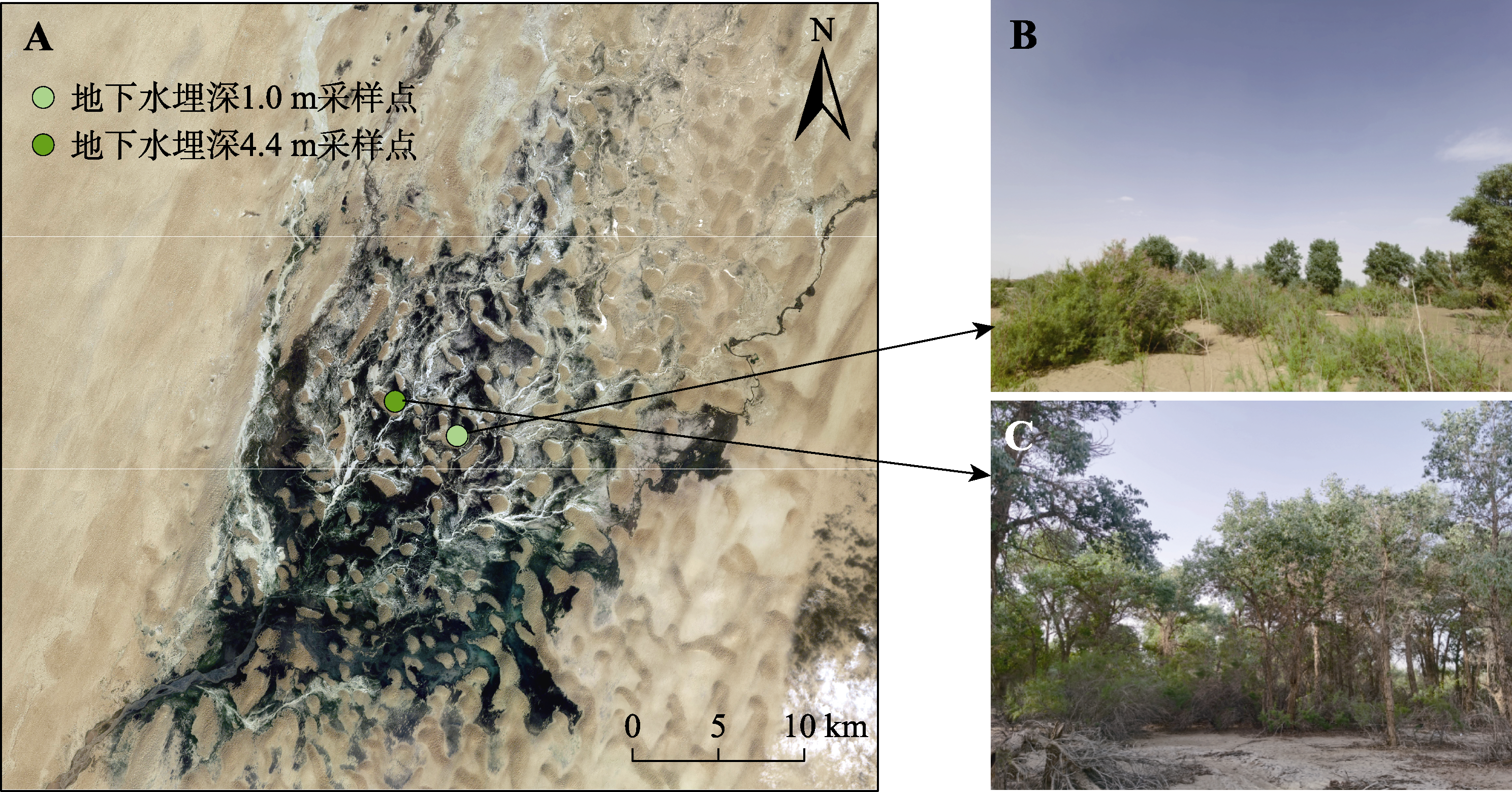
Fig. 1 Image of the Daliyaboyi Oasis (A) and distribution of the sampling sites. B, Photograph of the sampling site with a groundwater depth of 1.0 m. C, Photograph of the sampling site with a groundwater depth of 4.4 m.
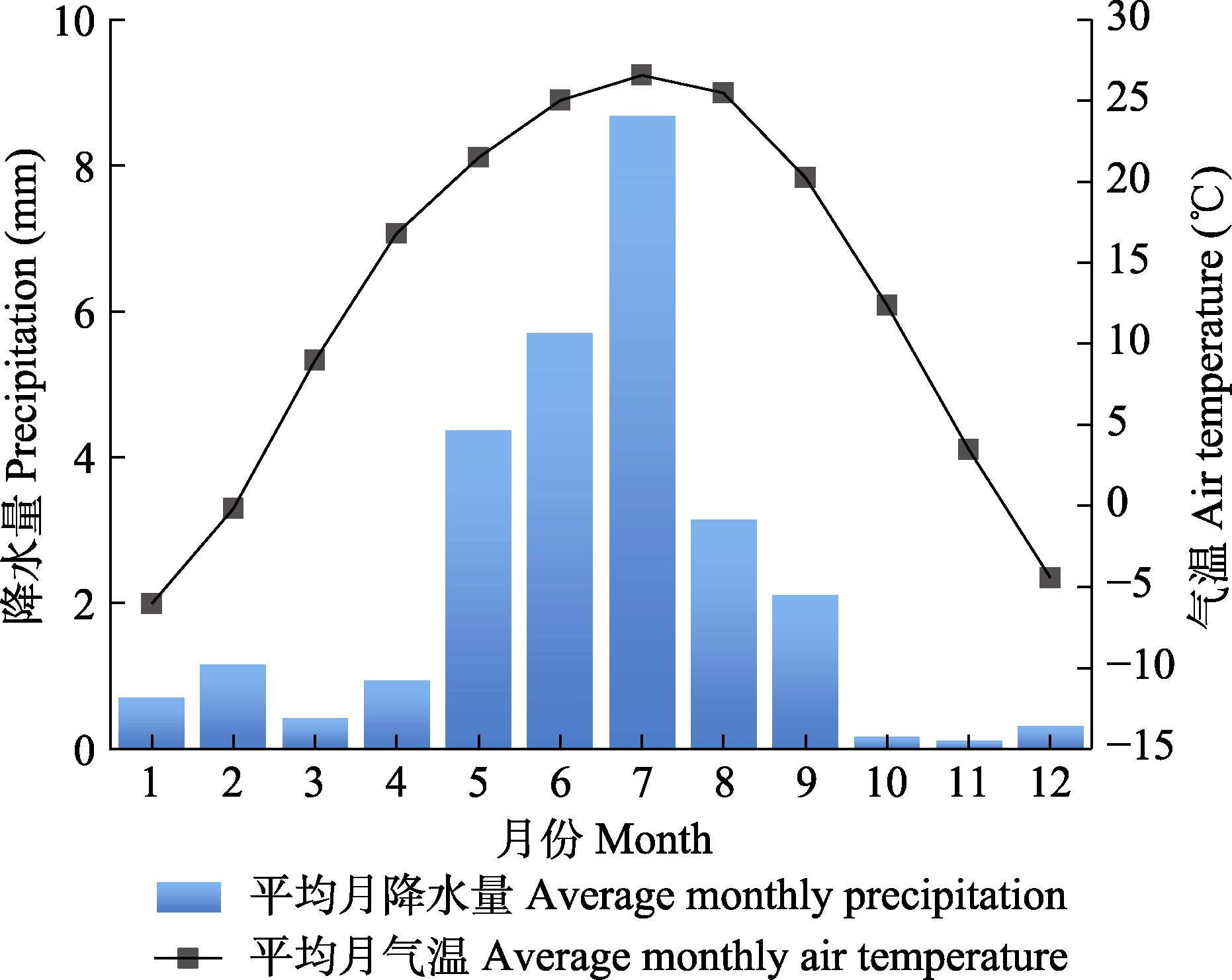
Fig. 2 Monthly average precipitation and temperature from 1960 to 2021 at the Daliyaboyi Oasis, in the hinterland of the Taklamakan Desert, Xinjiang, China
| 地下水埋深 Groundwater depth (m) | 经纬度 Latitude and longitude | 海拔 Altitude (m) | 林分类型 Stands type | 树种组成(胡杨 /多枝柽柳) Tree (P. euphratica/ T. ramosissima) (%) | 胡杨胸径 Average DBH of Populus euphratica (cm) | 树高(胡杨/多枝柽柳) Average height (P. euphratica/ T. ramosissima) (m) | 冠径(胡杨/多枝柽柳) Average crown width (P. euphratica/ T. ramosissima) (m) |
|---|---|---|---|---|---|---|---|
| 1.0 | 38.42° N 81.93° E | 1 176 | 胡杨×多枝柽柳 P. euphratica × T. ramosissima | 30/70 | 33.9 | 8.0/3.1 | 4.7/3.5 |
| 4.4 | 38.42° N 81.90° E | 1 181 | 胡杨×多枝柽柳 P. euphratica × T. ramosissima | 37/63 | 27.5 | 8.7/2.5 | 4.9/3.0 |
Table 1 Vegetation inventory characteristics for the Populus euphratica and Tamarix ramosissima community at two sample sites with different groundwater depth
| 地下水埋深 Groundwater depth (m) | 经纬度 Latitude and longitude | 海拔 Altitude (m) | 林分类型 Stands type | 树种组成(胡杨 /多枝柽柳) Tree (P. euphratica/ T. ramosissima) (%) | 胡杨胸径 Average DBH of Populus euphratica (cm) | 树高(胡杨/多枝柽柳) Average height (P. euphratica/ T. ramosissima) (m) | 冠径(胡杨/多枝柽柳) Average crown width (P. euphratica/ T. ramosissima) (m) |
|---|---|---|---|---|---|---|---|
| 1.0 | 38.42° N 81.93° E | 1 176 | 胡杨×多枝柽柳 P. euphratica × T. ramosissima | 30/70 | 33.9 | 8.0/3.1 | 4.7/3.5 |
| 4.4 | 38.42° N 81.90° E | 1 181 | 胡杨×多枝柽柳 P. euphratica × T. ramosissima | 37/63 | 27.5 | 8.7/2.5 | 4.9/3.0 |
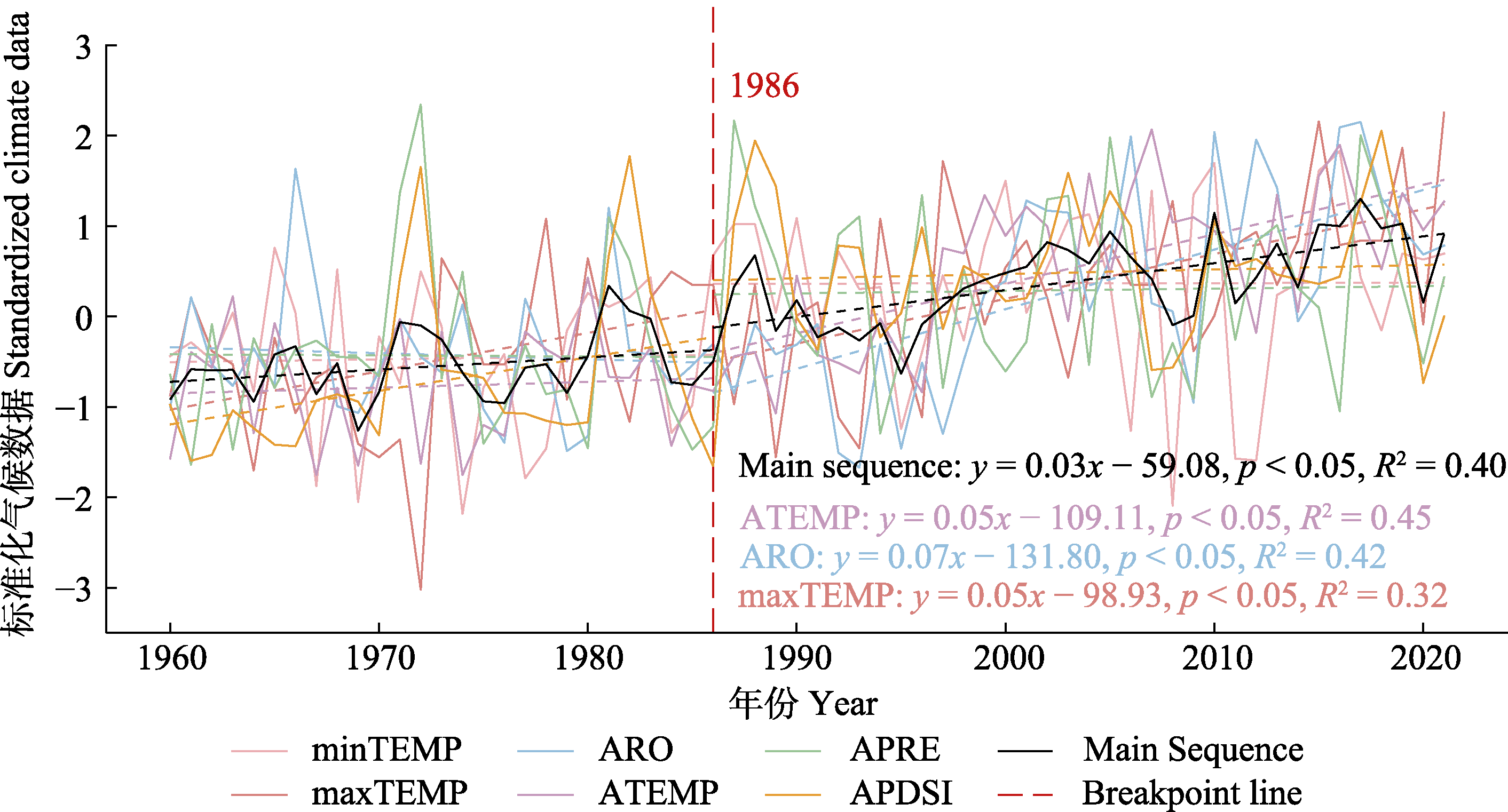
Fig. 3 Abrupt change in the detection of annual average runoff and climate factors in the Daliyaboyi Oasis from 1960-2021. APDSI, annual average Palmer Drought Severity Index; APRE, annual average precipitation; ARO, annual runoff; ATEMP, annual average temperature; Breakpoint line, year of breakpoint detected by a Pettitt’s test; maxTEMP, annual maximum temperature; minTEMP, annual minimum temperature; Main Sequence, main sequence of standardized climate data.
| 地下水埋深 Groundwater depth (m) | 物种 Species | 时段 Span | 样芯间平均相关系数 Mean interseries correlation (MC) | 平均敏感度 Mean sensitivity (MS) | 标准差 Standard deviation (SD) | 一阶自相关 First order auto-correlation (AC1) | 样本总体代表性 Express population signal (EPS) | 信噪比 Signal to noise ratio (SNR) |
|---|---|---|---|---|---|---|---|---|
| 1.0 | 胡杨 P. euphratica | 1987-2021 | 0.633 | 0.304 | 0.472 | 0.708 | 0.869 | 6.609 |
| 1.0 | 多枝柽柳 T. ramosissima | 1935-2021 | 0.548 | 0.314 | 0.363 | 0.397 | 0.952 | 19.685 |
| 4.4 | 胡杨 P. euphratica | 1966-2021 | 0.724 | 0.291 | 0.374 | 0.593 | 0.840 | 5.241 |
| 4.4 | 多枝柽柳 T. ramosissima | 1969-2021 | 0.349 | 0.214 | 0.285 | 0.322 | 0.910 | 10.078 |
Table 2 Statistical characteristics of the standardized annual rings of Populus euphratica and Tamarix ramosissima
| 地下水埋深 Groundwater depth (m) | 物种 Species | 时段 Span | 样芯间平均相关系数 Mean interseries correlation (MC) | 平均敏感度 Mean sensitivity (MS) | 标准差 Standard deviation (SD) | 一阶自相关 First order auto-correlation (AC1) | 样本总体代表性 Express population signal (EPS) | 信噪比 Signal to noise ratio (SNR) |
|---|---|---|---|---|---|---|---|---|
| 1.0 | 胡杨 P. euphratica | 1987-2021 | 0.633 | 0.304 | 0.472 | 0.708 | 0.869 | 6.609 |
| 1.0 | 多枝柽柳 T. ramosissima | 1935-2021 | 0.548 | 0.314 | 0.363 | 0.397 | 0.952 | 19.685 |
| 4.4 | 胡杨 P. euphratica | 1966-2021 | 0.724 | 0.291 | 0.374 | 0.593 | 0.840 | 5.241 |
| 4.4 | 多枝柽柳 T. ramosissima | 1969-2021 | 0.349 | 0.214 | 0.285 | 0.322 | 0.910 | 10.078 |
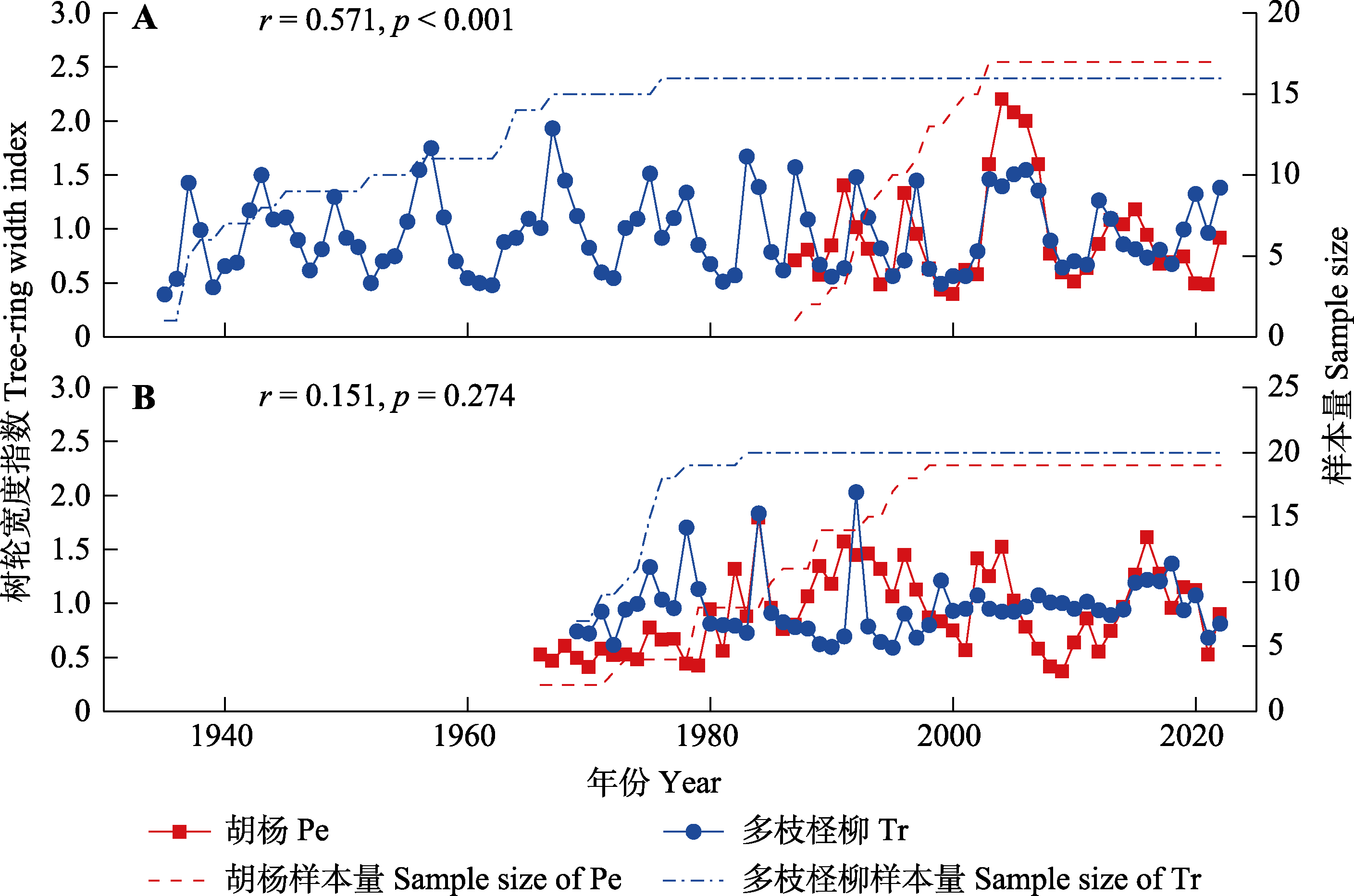
Fig. 4 Standardized chronologies of the widths of annual rings and the sample size of Populus euphratica (Pe) and Tamarix ramosissima (Tr) under groundwater depths of 1.0 m (A) and 4.4 m (B).
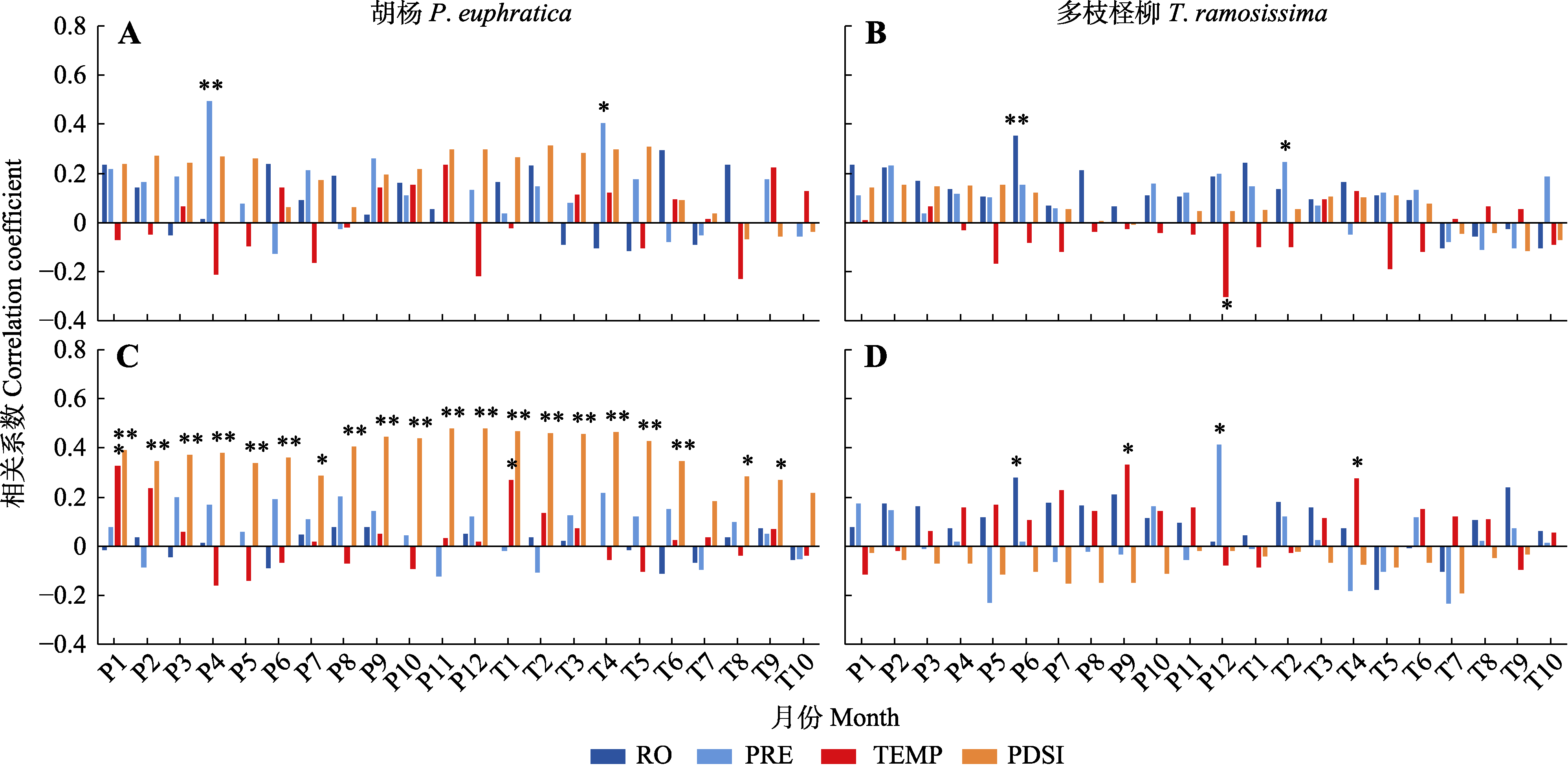
Fig. 5 Correlation between the tree ring indices of Populus euphratica and Tamarix ramosissima with runoff and monthly climate factors. A, P. euphratica at a groundwater depth of 1.0 m. B, T. ramosissima at a groundwater depth of 1.0 m. C, P. euphratica at a groundwater depth of 4.4 m. D, T. ramosissima at a groundwater depth of 4.4 m. P1-P12, January to December of the previous year; T1-T10, January to October of the current year; PDSI, Palmer Drought Severity Index; PRE, monthly precipitation; RO, monthly runoff; TEMP, monthly average temperature. *, p < 0.05; **, p < 0.01.
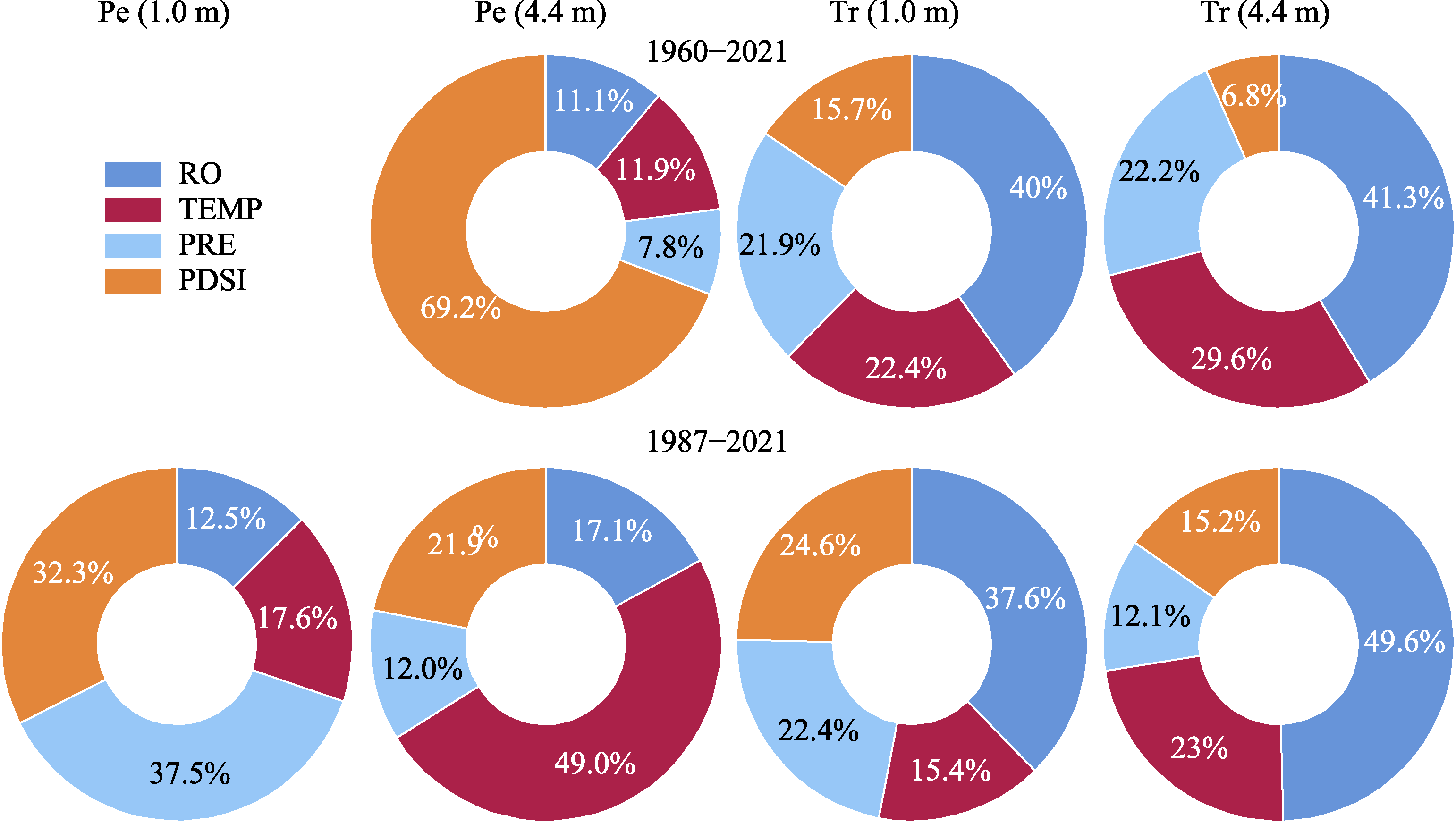
Fig. 6 Contribution rate of runoff and climate factors to the radial growth of Populus euphratica (Pe) and Tamarix ramosissima (Tr) under different groundwater depths. PDSI, Palmer Drought Severity Index; PRE, monthly precipitation; RO, monthly runoff; TEMP, monthly average temperature.
| 地下水埋深 Groundwater depth (m) | 物种 Species | 径流 RO | 气温 TEMP | 降水 PRE | 干旱指数 PDSI | 总解释方差 TEV (%) | 决定系数 R² | 均方误差 MSE |
|---|---|---|---|---|---|---|---|---|
| 解释方差百分比 Percentage of variance explained (%) (1960-2021) | ||||||||
| 4.4 | 胡杨 Pe | 7.84 | 8.41 | 5.50 | 48.86 | 70.60 | 0.969 | 0.004 |
| 1.0 | 多枝柽柳 Tr | 30.44 | 17.04 | 16.64 | 11.95 | 76.08 | 0.967 | 0.004 |
| 4.4 | 多枝柽柳 Tr | 30.47 | 21.85 | 16.40 | 5.03 | 73.75 | 0.967 | 0.003 |
| 解释方差百分比 Percentage of variance explained (%) (1987-2021) | ||||||||
| 1.0 | 胡杨 Pe | 9.76 | 13.74 | 29.17 | 25.18 | 77.86 | 0.961 | 0.009 |
| 4.4 | 胡杨 Pe | 12.17 | 34.77 | 8.54 | 15.53 | 71.00 | 0.970 | 0.004 |
| 1.0 | 多枝柽柳 Tr | 27.08 | 11.05 | 16.11 | 17.71 | 71.95 | 0.968 | 0.004 |
| 4.4 | 多枝柽柳 Tr | 37.51 | 17.43 | 9.18 | 11.52 | 75.64 | 0.965 | 0.002 |
| p (Mann-Whitney U) | ||||||||
| 4.4 | 胡杨 Pe | 0.681 2 | 0.001 5 | 0.296 2 | 0.000 1 | / | / | / |
| 1.0 | 多枝柽柳 Tr | 0.533 9 | 0.235 9 | 0.254 9 | 0.162 5 | / | / | / |
| 4.4 | 多枝柽柳 Tr | 0.597 4 | 0.549 5 | 0.018 3 | 0.459 7 | / | / | / |
Table 3 Main statistical characteristics of the Random Forest-XGBoost ensemble model and the Mann-Whitney U test
| 地下水埋深 Groundwater depth (m) | 物种 Species | 径流 RO | 气温 TEMP | 降水 PRE | 干旱指数 PDSI | 总解释方差 TEV (%) | 决定系数 R² | 均方误差 MSE |
|---|---|---|---|---|---|---|---|---|
| 解释方差百分比 Percentage of variance explained (%) (1960-2021) | ||||||||
| 4.4 | 胡杨 Pe | 7.84 | 8.41 | 5.50 | 48.86 | 70.60 | 0.969 | 0.004 |
| 1.0 | 多枝柽柳 Tr | 30.44 | 17.04 | 16.64 | 11.95 | 76.08 | 0.967 | 0.004 |
| 4.4 | 多枝柽柳 Tr | 30.47 | 21.85 | 16.40 | 5.03 | 73.75 | 0.967 | 0.003 |
| 解释方差百分比 Percentage of variance explained (%) (1987-2021) | ||||||||
| 1.0 | 胡杨 Pe | 9.76 | 13.74 | 29.17 | 25.18 | 77.86 | 0.961 | 0.009 |
| 4.4 | 胡杨 Pe | 12.17 | 34.77 | 8.54 | 15.53 | 71.00 | 0.970 | 0.004 |
| 1.0 | 多枝柽柳 Tr | 27.08 | 11.05 | 16.11 | 17.71 | 71.95 | 0.968 | 0.004 |
| 4.4 | 多枝柽柳 Tr | 37.51 | 17.43 | 9.18 | 11.52 | 75.64 | 0.965 | 0.002 |
| p (Mann-Whitney U) | ||||||||
| 4.4 | 胡杨 Pe | 0.681 2 | 0.001 5 | 0.296 2 | 0.000 1 | / | / | / |
| 1.0 | 多枝柽柳 Tr | 0.533 9 | 0.235 9 | 0.254 9 | 0.162 5 | / | / | / |
| 4.4 | 多枝柽柳 Tr | 0.597 4 | 0.549 5 | 0.018 3 | 0.459 7 | / | / | / |
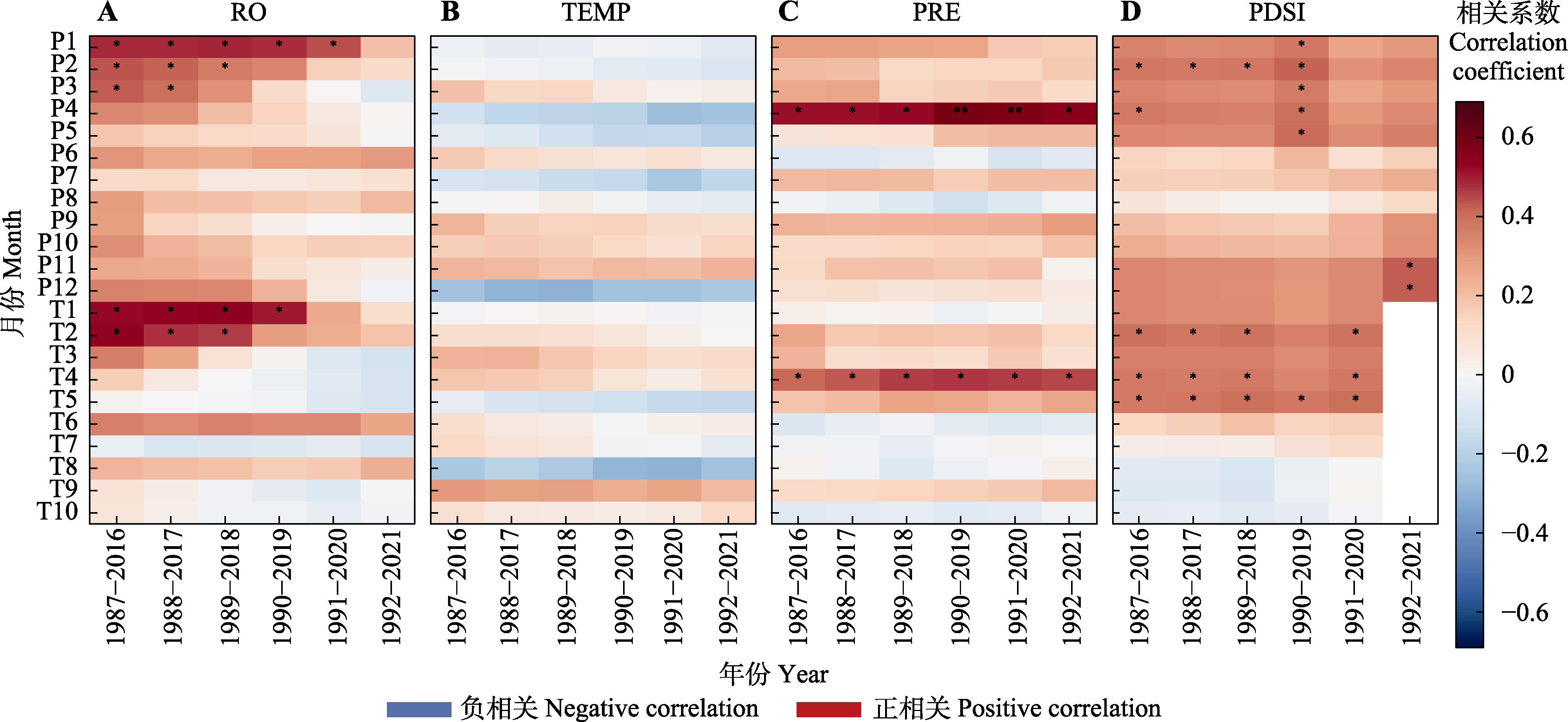
Fig. 7 Analysis of the sliding response of the tree ring width index of Populus euphratica to the monthly runoff and climatic factors at a groundwater depth of 1.0 m. PDSI, monthly palmer drought standard index; PRE, monthly precipitation; RO, monthly runoff; TEMP, monthly mean temperature. P1-P12, January to December of the previous year; T1-T10, January to October of the current year. *, p < 0.05; **, p < 0.01.
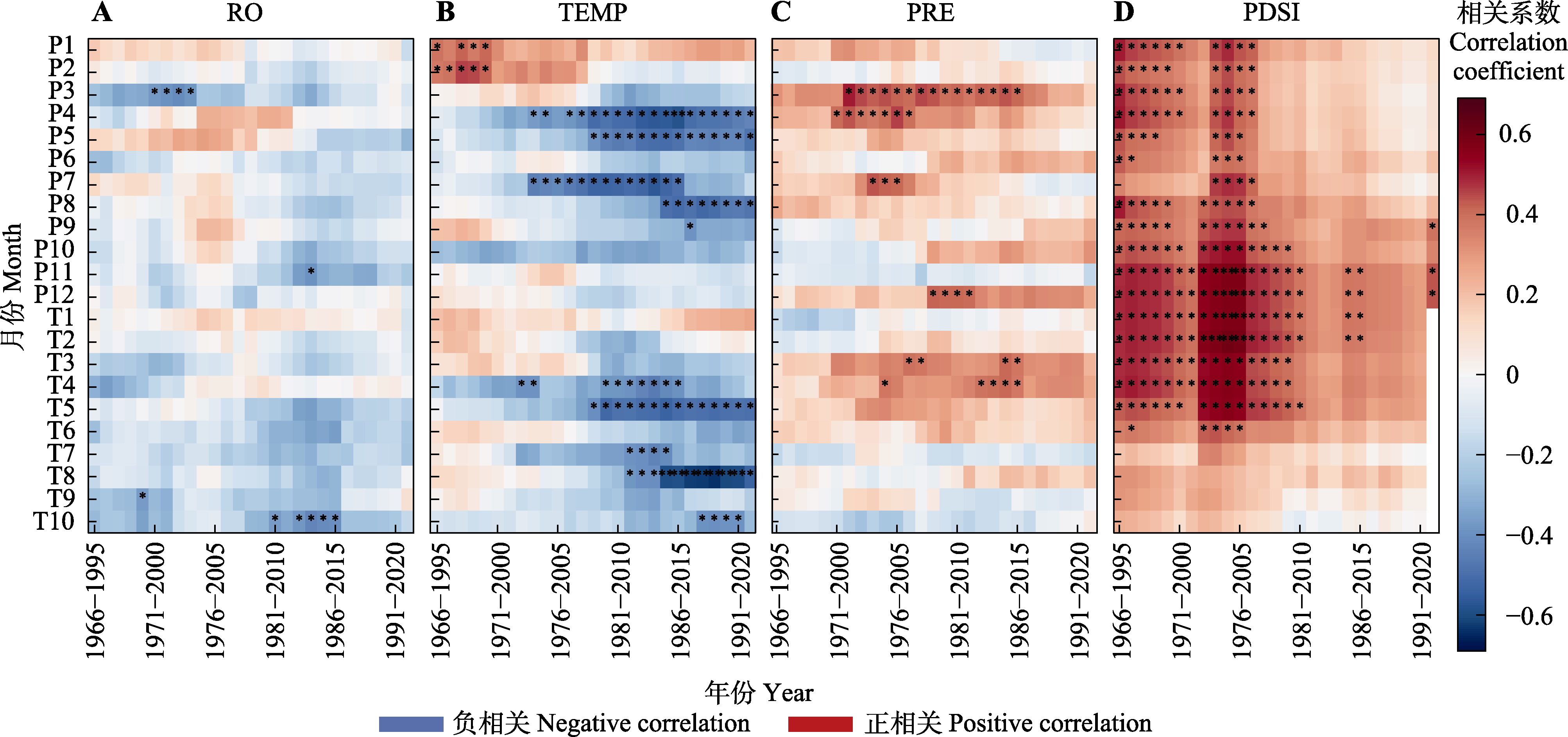
Fig. 8 Analysis of the sliding response of the tree ring width index of Populus euphratica to monthly runoff and climatic factors at a groundwater depth of 4.4 m. PDSI, monthly palmer drought standard index; PRE, monthly precipitation; RO, monthly runoff; TEMP, monthly mean temperature. P1-P12, January to December of the previous year; T1-T10, January to October of the current year. *, p < 0.05; **, p < 0.01.
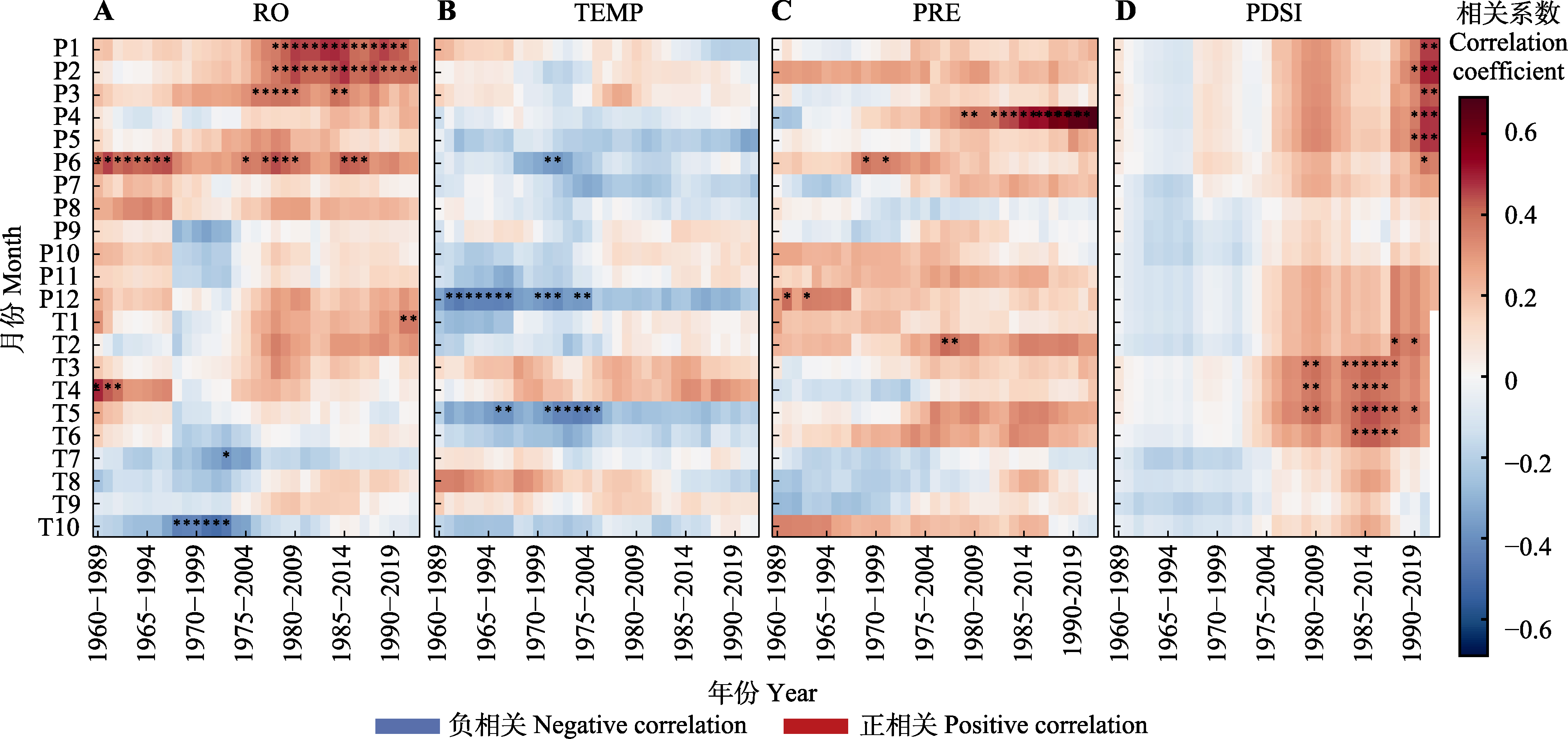
Fig. 9 Analysis of the sliding response of the tree ring width index of Tamarix ramosissima to monthly runoff and climatic factors at a groundwater depth of 1.0 m. PDSI, monthly palmer drought standard index; PRE, monthly precipitation; RO, monthly runoff; TEMP, monthly mean temperature. P1-P12, January to December of the previous year; T1-T10, January to October of the current year. *, p < 0.05; **, p < 0.01.
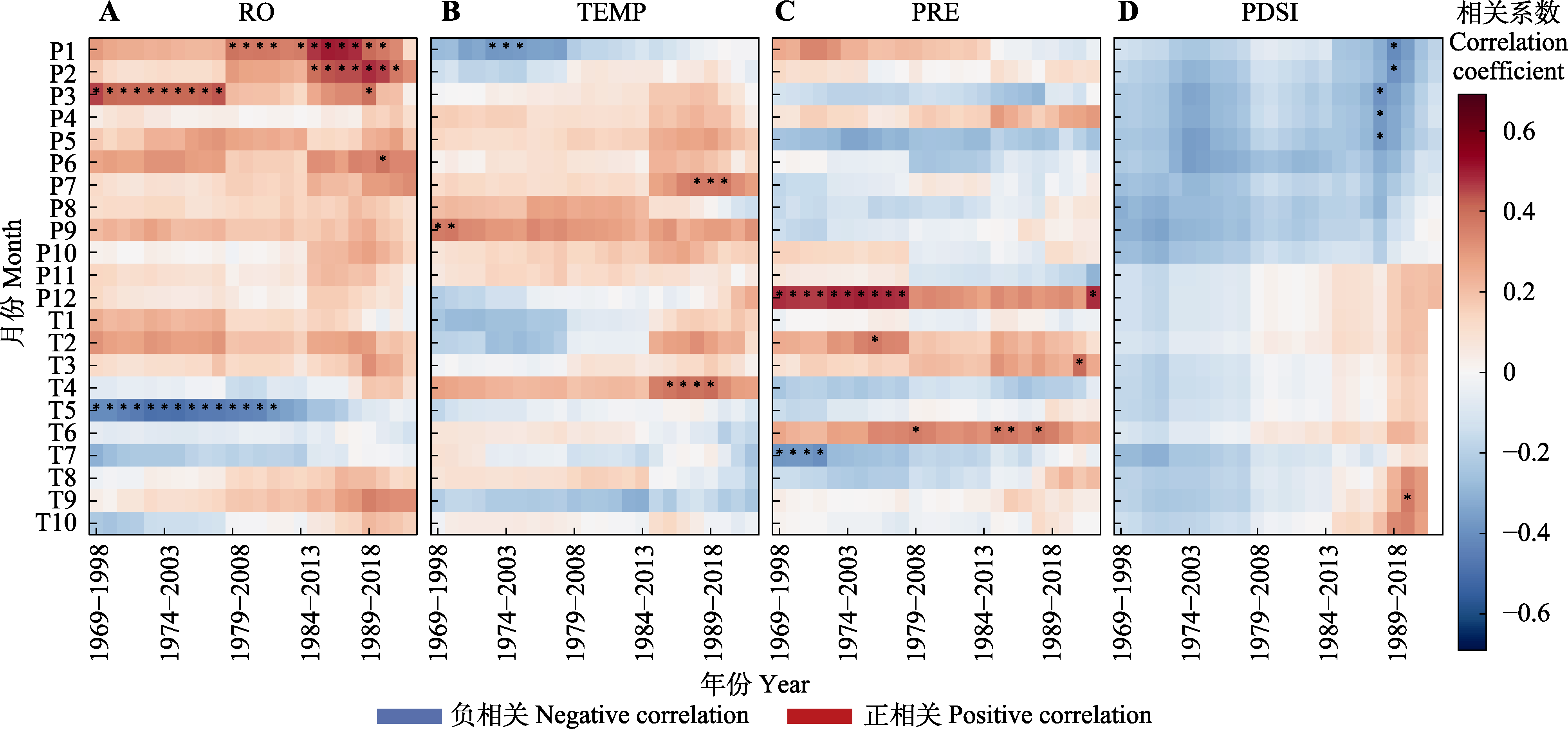
Fig. 10 Analysis of the sliding response of tree ring width index of Tamarix ramosissima to monthly runoff and climatic factors at groundwater depth of 1.0 m. PDSI, monthly palmer drought standard index; PRE, monthly precipitation; RO, monthly runoff; TEMP, monthly mean temperature. P1-P12 represent January to December of the previous year; T1-T10 represent January to October of the current year. *, p < 0.05.
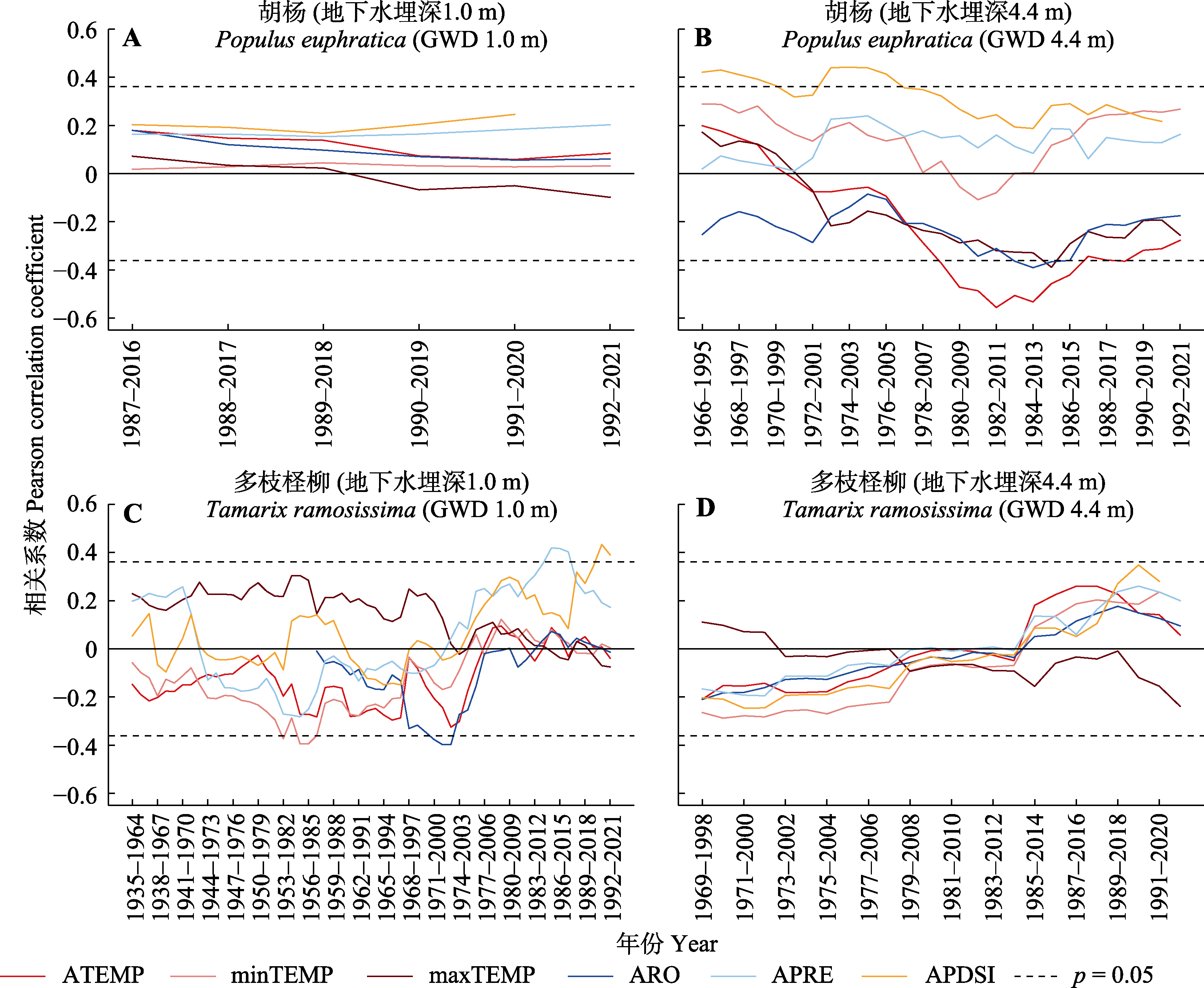
Fig. 11 Sliding response of the tree ring width indices of Populus euphratica and Tamarix ramosissima to runoff and climate factors. APDSI, annual palmer drought standard index; APRE, annual precipitation; ARO, annual runoff; ATEMP, annual mean temperature; maxTEMP, annual maximum temperature; minTEMP, annual minimum temperature. GWD, ground water depth.
| [1] | Abulaiti K, Mao DL, Cao YX, Su SL (2021). Response of Populus euphratica tree rings to meteorological factors in the Yulong Kashgar and Cele river basins, Xinjiang. Acta Botanica Boreali-Occidentalia Sinica, 41, 672-681. |
| [开买尔古丽•阿不来提, 毛东雷, 曹永香, 苏松领 (2021). 新疆玉龙喀什河与策勒河流域胡杨年轮对气象因子的响应研究. 西北植物学报, 41, 672-681.] | |
| [2] | Anderegg WRL, Hicke JA, Fisher RA, Allen CD (2015). Climate-driven risk of forest drought-induced tree mortality is increasing in the western United States. New Phytologist, 208, 682-693. |
| [3] |
Breiman L (2001). Random forests. Machine Learning, 45, 5-32.
DOI |
| [4] | Chen TQ, Guestrin C, Chen TQ, Guestrin C (2016a). XGBoost. Proceedings of the 22nd ACM SIGKDD International Conference on Knowledge Discovery and Data Mining. The Association for Computing Machinery, New York. 785-794. |
| [5] |
Chen YP, Chen YN, Xu CC, Li WH (2016b). The effects of groundwater depth on water uptake of Populus euphratica and Tamarix ramosissima in the hyperarid region of Northwestern China. Environmental Science and Pollution Research, 23, 17404-17412.
DOI URL |
| [6] | Chu GQ, Liu JQ, Sun Q, Chen R, Mu GJ (2002). Preliminary research on the flood events based on the studies of tree ring width (Populus euphratica) in the Keriya River, Xinjiang. Quaternary Sciences, 22, 252-257. |
| [储国强, 刘嘉麒, 孙青, 陈锐, 穆桂金 (2002). 新疆克里雅河洪泛事件与树轮记录的初步研究. 第四纪研究, 22, 252-257.] | |
| [7] | Cook ER, Kairiukstis LA (1990). Methods of Dendrochronology: Applications in the Environmental Sciences. Springer, Dordrecht, The Netherlands. |
| [8] |
Cooper DJ, D’Amico DR, Scott ML (2006). Physiological and morphological response patterns of Populus deltoides and Salix exigua to stream flow and temperature, contrasting and strategies for survival. Tree Physiology, 26, 689-700.
DOI URL |
| [9] | D’Arrigo , Baker P, Palmer J, Anchukaitis K, Cook G(2008). Experimental reconstruction of monsoon drought variability for Australasia using tree rings and corals. Geophysical Research Letters, 35, L12709. DOI: 10.1029/2008GL034393. |
| [10] |
Dai AG, Trenberth KE, Qian TT (2004). A global dataset of palmer drought severity index for 1870-2002: relationship with soil moisture and effects of surface warming. Journal of Hydrometeorology, 5, 1117-1130.
DOI URL |
| [11] | Ding AJ, Xiao SC, Peng XM, Tian QY (2018). Wet/dry variation recorded by Sarcozygium xanthoxylon tree-rings in the middle of Alashan Desert, China. Journal of Desert Research, 38, 401-409. |
|
[丁爱军, 肖生春, 彭小梅, 田全彦 (2018). 霸王(Sarcozygium xanthoxylon)灌木年轮记录的1902-2015年阿拉善荒漠中部气候干湿变化. 中国沙漠, 38, 401-409.]
DOI |
|
| [12] | Du HW, Ye M (2020). Response of radial growth of Populus euphratica Oliv. to extreme low temperature in the lower reaches of Tarim River. Journal of Biology, 37, 50-53. |
| [杜恒文, 叶茂 (2020). 塔里木河下游胡杨年轮径向生长对极端低温的响应研究. 生物学杂志, 37, 50-53.] | |
| [13] |
Fan Y (2015). Groundwater in the earth’s critical zone: relevance to large-scale patterns and processes. Water Resources Research, 51, 3052-3069.
DOI URL |
| [14] | Gou XX, Ye M, Gao SF, Xu Q (2017). Response of radial growth of Populus euphraticato climate change in the middle reaches of the Tarim River. Acta Botanica Boreali-Occidentalia Sinica, 37, 1864-1871. |
| [苟晓霞, 叶茂, 高生峰, 徐俏 (2017). 塔里木河中游胡杨径向生长对气候变化的响应研究. 西北植物学报, 37, 1864-1871.] | |
| [15] | Gou XX, Ye M, Wang LL, Gou XH (2018). Response of radial growth of Populus euphratica to runoff in the Tarim River. Chinese Bulletin of Botany, 53, 801-811. |
|
[苟晓霞, 叶茂, 汪亮亮, 苟晓红 (2018). 塔里木河干流胡杨径向生长对地表径流变化的响应. 植物学报, 53, 801-811.]
DOI |
|
| [16] | Holmes RL (1983). Computer-assisted quality control in tree-ring dating and measurement. Tree-Ring Bulletin, 43, 69-78. |
| [17] |
Hoppe J, Zhang X, Thomas FM (2020). Belowground inter-ramet water transport capacity in Populus euphratica, a Central Asian desert phreatophyte. Plant Biology, 22, 38-46.
DOI PMID |
| [18] | Hu WK, Zhang LY (1990). History condition and prospects of desert vegetation in the lower reaches of the Keriya River. Arid Land Geography, 13, 46-51. |
|
[胡文康, 张立运 (1990). 克里雅河下游荒漠河岸植被的历史、现状和前景. 干旱区地理, 13, 46-51.]
DOI |
|
| [19] | Huang WY, Dai Y, Abudureyimu A (2024). Response of annual ring width of Tamarix spp. to groundwater depth in the hinterland of the Taklimakan Desert. Acta Botanica Boreali-Occidentalia Sinica, 44, 134-141. |
| [黄婉媛, 戴岳, 安外尔·阿卜杜热伊木 (2024). 塔克拉玛干沙漠腹地柽柳年轮宽度对地下水埋深的响应. 西北植物学报, 44, 134-141.] | |
| [20] | Hultine KR, Bush SE (2011). Ecohydrological consequences of non-native riparian vegetation in the southwestern United States: a review from an ecophysiological perspective. Water Resources Research, 47, W07542. DOI: 10.1029/2010WR010317. |
| [21] | IPCC (2021). Climate Change 2021: The Physical Science Basis. Contribution of Working Group I to the Sixth Assessment Report of the Intergovernmental Panel on Climate Change. Cambridge University Press, Cambridge, UK. |
| [22] | Kang LF, Ye M (2020). Response of radial growth of Populus euphratica to temperature and runoff in the middle reaches of the Tarim River. Acta Botanica Boreali-Occidentalia Sinica, 40, 697-705. |
| [康利飞, 叶茂 (2020). 塔里木河中游胡杨径向生长对气温和径流量的响应. 西北植物学报, 40, 697-705.] | |
| [23] |
Körner C, Basler D (2010). Phenology under global warming. Science, 327, 1461-1462.
DOI URL |
| [24] |
Kujansuu J, Yasue K, Koike T, Abaimov AP, Kajimoto T, Takeda T, Tokumoto M, Matsuura Y (2007). Climatic responses of tree-ring widths of Larix gmelinii on contrasting north-facing and south-facing slopes in central Siberia. Journal of Wood Science, 53, 87-93.
DOI URL |
| [25] | Li D, Si JH, Zhang XY, Gao YY, Luo H, Qin J, Gao GL (2019). The mechanism of changes in hydraulic properties of Populus euphratica in response to drought stress. Forests, 10, 904. DOI: 10.3390/f10100904. |
| [26] | Li XQ, Zhang LN, Zeng XM, Wang KY, Wang YB, Lu QQ, Liu XH (2020). Different response of conifer and shrubs radial growth to climate in the middle Loess Plateau. Acta Ecologica Sinica, 40, 5685-5697. |
| [李晓琴, 张凌楠, 曾小敏, 王可逸, 王雅波, 路强强, 刘晓宏 (2020). 黄土高原中部针叶树与灌木径向生长对气候的响应差异. 生态学报, 40, 5685-5697.] | |
| [27] | Ling HB, Xu HL, Zhang QQ (2012). Nonlinear analysis of runoff changes and climate factors in the headstream of Keriya River, Xinjiang. Geographical Research, 31, 792-802. |
| [凌红波, 徐海量, 张青青 (2012). 新疆克里雅河源流区径流变化与气候因子关系的非线性分析. 地理研究, 31, 792-802.] | |
| [28] | Liu FY, You QG, Xue X, Peng F, Huang CH, Ma SX, Pan J, Shi YF, Chen XJ (2022). The stem sap flow and water sources for Tamarix ramosissima in an artificial shelterbelt with a deep groundwater table in Northwest China. Frontiers in Plant Science, 13, 794084. DOI: 10.3389/fpls.2022.794084. |
| [29] | Liu R, Jiang SX, Zhang TW, Chen F, Shang HM, Yu SL, Zhang RB, Wang YH (2020). Comparative analysis of dendrohydrological in Xinjiang. Desert and Oasis Meteorology, 14, 1-10. |
| [刘蕊, 姜盛夏, 张同文, 陈峰, 尚华明, 喻树龙, 张瑞波, 王勇辉 (2020). 新疆树木年轮水文研究对比分析. 沙漠与绿洲气象, 14, 1-10.] | |
| [30] | Ma YX, Zhang YL, Li YL, Yoshikawa K, Li XG (2019). Effects of environmental factors on radial growth of Populus euphratica in the lower reaches of the Heihe River at different time scales. Arid Zone Research, 36, 1502-1511. |
| [马玉祥, 张永利, 李玉灵, 吉川贤, 李晓刚 (2019). 不同时间尺度环境因子对黑河下游胡杨(Populus euphratica)径向生长的影响. 干旱区研究, 36, 1502-1511.] | |
| [31] | Meng YY, Liu B, Liu C (2018). Photosynthetic response characteristics and water use efficiency of Tamarix ramosissima under water and salt gradient in wetlands. Journal of Desert Research, 38, 568-577. |
|
[孟阳阳, 刘冰, 刘婵 (2018). 水盐梯度下湿地柽柳(Tamarix ramosissima)光合响应特征和水分利用效率. 中国沙漠, 38, 568-577.]
DOI |
|
| [32] |
Nie CY, Zhang QB, Lyu LX (2017). Millennium-long tree-ring chronology reveals megadroughts on the Southeastern Tibetan Plateau. Tree-Ring Research, 73, 1-10.
DOI URL |
| [33] | Peng L, Wan YB, Shi HB, Anwaier A, Shi QD (2023). Influence of climate, topography, and hydrology on vegetation distribution patterns-oasis in the Taklamakan Desert Hinterland. Remote Sensing, 15, 5299. DOI: 10.3390/rs15225299. |
| [34] | Qi YY, Keyimu M, Li ZS, Zeng FJ (2024). Radial growth response of Populus euphratica to climate change in the Cele desert oasis ecotone, China. Chinese Journal of Applied Ecology, 35, 1187-1195. |
|
[齐艳莹, 买尔当•克依木, 李宗善, 曾凡江 (2024). 策勒沙漠绿洲过渡带胡杨径向生长对气候变化的响应. 应用生态学报, 35, 1187-1195.]
DOI |
|
| [35] | Qin L, Shang HM, Su JJ, Yuan YJ, Zhang TW, Yu SL, Fan ZA, Chen F (2016). Radial growth of Populus euphratica response to climate change at southwest edge of the Badain Jaran Desert. Desert and Oasis Meteorology, 10, 77-81. |
| [秦莉, 尚华明, 苏佳佳, 袁玉江, 张同文, 喻树龙, 范子昂, 陈峰 (2016). 巴丹吉林沙漠西南缘胡杨径向生长对气候的响应. 沙漠与绿洲气象, 10, 77-81.] | |
| [36] |
Rathgeber C, Nicault A, Guiot J, Keller T, Guibal F, Roche P (2000). Simulated responses of Pinus halepensis forest productivity to climatic change and CO2 increase using a statistical model. Global and Planetary Change, 26, 405-421.
DOI URL |
| [37] |
Rzepecki A, Zeng F, Thomas FM (2011). Xylem anatomy and hydraulic conductivity of three co-occurring desert phreatophytes. Journal of Arid Environments, 75, 338-345.
DOI URL |
| [38] |
Serreze MC, Walsh JE, Chapin FS, Osterkamp T, Dyurgerov M, Romanovsky V, Oechel WC, Morison J, Zhang T, Barry RG (2000). Observational evidence of recent change in the northern high-latitude environment. Climatic Change, 46, 159-207.
DOI |
| [39] | Shi HB, Shi QD, Dai Y, Zhou XL, Wan YB, Peng L (2021). Response of the age structure of Populus euphratica population to groundwater depth in the oasis at the end of Keriya River. Acta Botanica Boreali-Occidentalia Sinica, 41, 1401-1408. |
| [史浩伯, 师庆东, 戴岳, 周小龙, 万彦博, 彭磊 (2021). 克里雅河尾闾绿洲胡杨种群年龄结构对地下水埋深的响应. 西北植物学报, 41, 1401-1408.] | |
| [40] | Shi HB, Shi QD, Zhou XL, Imin B, Li H, Zhang WQ, Kahaer YJ (2021). Effect of the competition mechanism of between co-dominant species on the ecological characteristics of Populus euphratica under a water gradient in a desert oasis. Global Ecology and Conservation, 27, e01611. DOI: 10.1016/j.gecco.2021.e01611. |
| [41] | Shi YF, Shen YP, Li DL, Zhang GW, Ding YJ, Hu RJ, Kang ES (2003). Discussion on the present climate change from warm-dry to warm-wet in Northwest China. Quaternary Sciences, 23, 152-164. |
| [施雅风, 沈永平, 李栋梁, 张国威, 丁永健, 胡汝骥, 康尔泗 (2003). 中国西北气候由暖干向暖湿转型的特征和趋势探讨. 第四纪研究, 23, 152-164.] | |
| [42] |
Si JH, Feng Q, Zhang XY, Chang ZQ, Su YH, Yang HX (2007). Sap flow of Populus euphratica in a desert riparian forest in an extreme arid region during the growing season. Journal of Integrative Plant Biology, 49, 425-436.
DOI URL |
| [43] |
Stockton CW, Meko DM (1975). A long-term history of drought occurrence in western United States as inferred from tree rings. Weatherwise, 28, 244-249.
DOI URL |
| [44] | Stromberg JC, Tiller R, Richter B (1996). Effects of groundwater decline on riparian vegetation of semiarid regions:the San Pedro, Arizona. Ecological Applications, 6, 113-131. |
| [45] |
Sun CF, Liu Y (2019). Tree-ring-based drought variability in the eastern region of the Silk Road and its linkages to the Pacific Ocean. Ecological Indicators, 96, 421-429.
DOI URL |
| [46] | Tu WX, Ye M, Xu HL, Bai Y (2014). Radial growth of Populus euphratica and the effect of runoff in the Tarim River Basin. Arid Zone Research, 31, 508-515. |
| [涂文霞, 叶茂, 徐海量, 白元 (2014). 塔里木河不同河段胡杨径向生长及径流的影响差异. 干旱区研究, 31, 508-515.] | |
| [47] | Wan YB, Shi QD, Dai Y, Marhaba N, Peng LP, Peng L, Shi HB (2022). Water use characteristics of Populus euphratica Oliv. and Tamarix chinensis Lour. at different growth stages in a desert oasis. Forests, 13, 236. DOI: 10.3390/f13020236. |
| [48] | Wang A, Gao XR, Zhou ZY, Yang H, Zhao XH, Wang YM, Li M, Zhao XN (2022). Dynamic responses of tree-ring growth to drought over Loess Plateau in the past three decades. Ecological Indicators, 143, 109423. DOI: 10.1111/gcb.14367. |
| [49] |
Wang CH, Zhang SN, Zhang FM, Li KC, Yang K (2021). On the increase of precipitation in the Northwestern China under the global warming. Advances in Earth Science, 36, 980-989.
DOI |
|
[王澄海, 张晟宁, 张飞民, 李课臣, 杨凯 (2021). 论全球变暖背景下中国西北地区降水增加问题. 地球科学进展, 36, 980-989.]
DOI |
|
| [50] | Wang DW, Shi QD, Dong DW, Chen CJ (2018). Response of runoff volume change to climate in the Keriya River in Xinjiang. Arid Zone Research, 35, 1271-1279. |
|
[王大伟, 师庆东, 董弟文, 陈朝军 (2018). 新疆克里雅河径流量变化的气候响应. 干旱区研究, 35, 1271-1279.]
DOI |
|
| [51] |
Wang F, Xu YL, Yang XD, Liu YJ, Lv GH, Yang ST (2018). Soil water potential determines the presence of hydraulic lift of Populus euphratica Olivier across growing seasons in an arid desert region. Journal of Forest Science, 64, 319-329.
DOI URL |
| [52] | Wang LL, Ye M, Gao SF, Gou XX, Xu Q, Zhang TG (2017). Effects of hydrothermal factors on vegetation index and tree-ring index of Populus euphratica in the lower reaches of the Tarim River. Journal of Nanjing Forestry University (Natural Sciences Edition), 41, 85-91. |
|
[汪亮亮, 叶茂, 高生峰, 苟晓霞, 徐俏, 张同刚 (2017). 水热因子对塔里木河下游胡杨年轮指数和植被指数的影响. 南京林业大学学报(自然科学版), 41, 85-91.]
DOI |
|
| [53] | Wang T, Yu D, Li JF, Ma KP (2003). Advances in research on the relationship between climatic change and tree-ring width. Acta Phytoecologica Sinica, 27, 23-33. |
|
[王婷, 于丹, 李江风, 马克平 (2003). 树木年轮宽度与气候变化关系研究进展. 植物生态学报, 27, 23-33.]
DOI |
|
| [54] | Wei X, Wang N, Zhou MT, Guo YC (2022). Combined impact of climate change and human activities on runoff in the Keriya River. Journal of Irrigation and Drainage, 41, 80-86. |
| [魏宣, 王宁, 周明通, 郭玉川 (2022). 气候变化和人类活动对克里雅河径流变化影响定量研究. 灌溉排水学报, 41, 80-86.] | |
| [55] |
Wigley TML, Briffa KR, Jones PD (1984). On the average value of correlated time series, with applications in dendroclimatology and hydrometeorology. Journal of Climate and Applied Meteorology, 23, 201-213.
DOI URL |
| [56] | Yao JQ, Li MY, Tolewbek D, Chen J, Mao WY (2022). The assessment on “warming-wetting” trend in Xinjiang at multi-scale during 1961-2019. Arid Zone Research, 39, 333-346. |
|
[姚俊强, 李漠岩, 迪丽努尔·托列吾别克, 陈静, 毛炜峄, (2022). 不同时间尺度下新疆气候“暖湿化”特征. 干旱区研究, 39, 333-346.]
DOI |
|
| [57] |
Yuan GF, Zhang P, Xue SS, Zhuang W (2012). Change characteristics in soil water content in root zone and evidence of root hydraulic lift in Tamarix ramosissima thickets on sand dunes. Chinese Journal of Plant Ecology, 36, 1033-1042.
DOI URL |
|
[袁国富, 张佩, 薛沙沙, 庄伟 (2012). 沙丘多枝柽柳灌丛根层土壤含水量变化特征与根系水力提升证据. 植物生态学报, 36, 1033-1042.]
DOI |
|
| [58] | Zeng XM, Evans MN, Liu XH, Wang WZ, Xu GB, Wu GJ, Zhang LN (2019). Spatial patterns of precipitation-induced moisture availability and their effects on the divergence of conifer stem growth in the western and eastern parts of China’s semi-arid region. Forests Ecology and Management, 451, 117524. DOI: 10.1016/j.foreco.2019.117524. |
| [59] | Zhang L, Ma Y (2018). An evaluation of ensemble learning models based on decision tree in temperature-vegetation indices. ISPRS Journal of Photogrammetry and Remote Sensing, 12, 241-256. |
| [60] | Zhang P, Yuan GF, Zhuang W, Xue SS (2011). Ecophysiological responses and adaptation of Tamarix ramosissima to changes in groundwater depth in the Heihe River basin. Acta Ecologica Sinica, 31, 6677-6687. |
| [张佩, 袁国富, 庄伟, 薛沙沙 (2011). 黑河中游荒漠绿洲过渡带多枝柽柳对地下水位变化的生理生态响应与适应. 生态学报, 31, 6677-6687.] | |
| [61] | Zhang X, Wu MW, Kwon SM, Pan LL, Han H, Yang XH, Liu YS, Shi ZJ (2022). Radial growth responses of Mongolian pine (Pinus sylvestris var. mongolica) plantations at different ages to climate and groundwater level changes. Acta Ecologica Sinica, 42, 6827-6837. |
| [张晓, 吴梦婉, 邝胜明, 潘磊磊, 韩辉, 杨晓晖, 刘艳书, 时忠杰 (2022). 不同林龄樟子松人工林径向生长对气候及地下水位变化的响应. 生态学报, 42, 6827-6837.] | |
| [62] |
Zhang YM, Chen YN, Pan BR (2005). Distribution and floristics of desert plant communities in the lower reaches of Tarim River, southern Xinjiang, People’s Republic of China. Journal of Arid Environments, 63, 772-784.
DOI URL |
| [63] | Zhang YX, Gou XH, Hu WD, Peng JF, Liu PX (2005). The drought events recorded in tree ring width in Helan Mt. over past 100 years. Acta Ecologica Sinica, 25, 2121-2126. |
| [张永香, 勾晓华, 胡文东, 彭剑峰, 刘普幸 (2005). 树轮记录的贺兰山区近百年来的干旱事件. 生态学报, 25, 2121-2126.] | |
| [64] | Zhao CY, Si JH, Feng Q, Yu TF, Li PD (2017). Response of transpiration of Populus euphratica small rainfall events in desert riparian forest. Journal of Desert Research, 37, 942-949. |
|
[赵春彦, 司建华, 冯起, 鱼腾飞, 李培都 (2017). 胡杨(Populus euphratica)蒸腾耗水对小降雨事件的响应. 中国沙漠, 37, 942-949.]
DOI |
|
| [65] |
Zhou HH, Chen YN, Li WH, Ayup M (2013). Xylem hydraulic conductivity and embolism in riparian plants and their responses to drought stress in desert of Northwest China. Ecohydrology, 6, 984-993.
DOI URL |
| [66] | Zhou HH, Chen YN, Zhu CG, Li Z, Fang GH, Li YP, Fu AH (2020). Climate change may accelerate the decline of desert riparian forest in the lower Tarim River, Northwestern China: evidence from tree-rings of Populus euphratica. Ecological Indicators, 111, 105997. DOI: 10.1016/j.ecolind.2019.105997. |
| Viewed | ||||||
|
Full text |
|
|||||
|
Abstract |
|
|||||
Copyright © 2026 Chinese Journal of Plant Ecology
Tel: 010-62836134, 62836138, E-mail: apes@ibcas.ac.cn, cjpe@ibcas.ac.cn

