
Chin J Plant Ecol ›› 2025, Vol. 49 ›› Issue (11): 1833-1843.DOI: 10.17521/cjpe.2024.0323 cstr: 32100.14.cjpe.2024.0323
• Research Articles • Previous Articles Next Articles
GUO Huan-Min, SHEN Xiao-Xue, LI Rui-Li*( )
)
Received:2024-09-23
Accepted:2025-01-27
Online:2025-11-20
Published:2025-11-20
Contact:
LI Rui-Li
Supported by:GUO Huan-Min, SHEN Xiao-Xue, LI Rui-Li. Species co-occurrence and distribution probability in Futian Mangrove Nature Reserve of Shenzhen Bay[J]. Chin J Plant Ecol, 2025, 49(11): 1833-1843.
Add to citation manager EndNote|Ris|BibTeX
URL: https://www.plant-ecology.com/EN/10.17521/cjpe.2024.0323
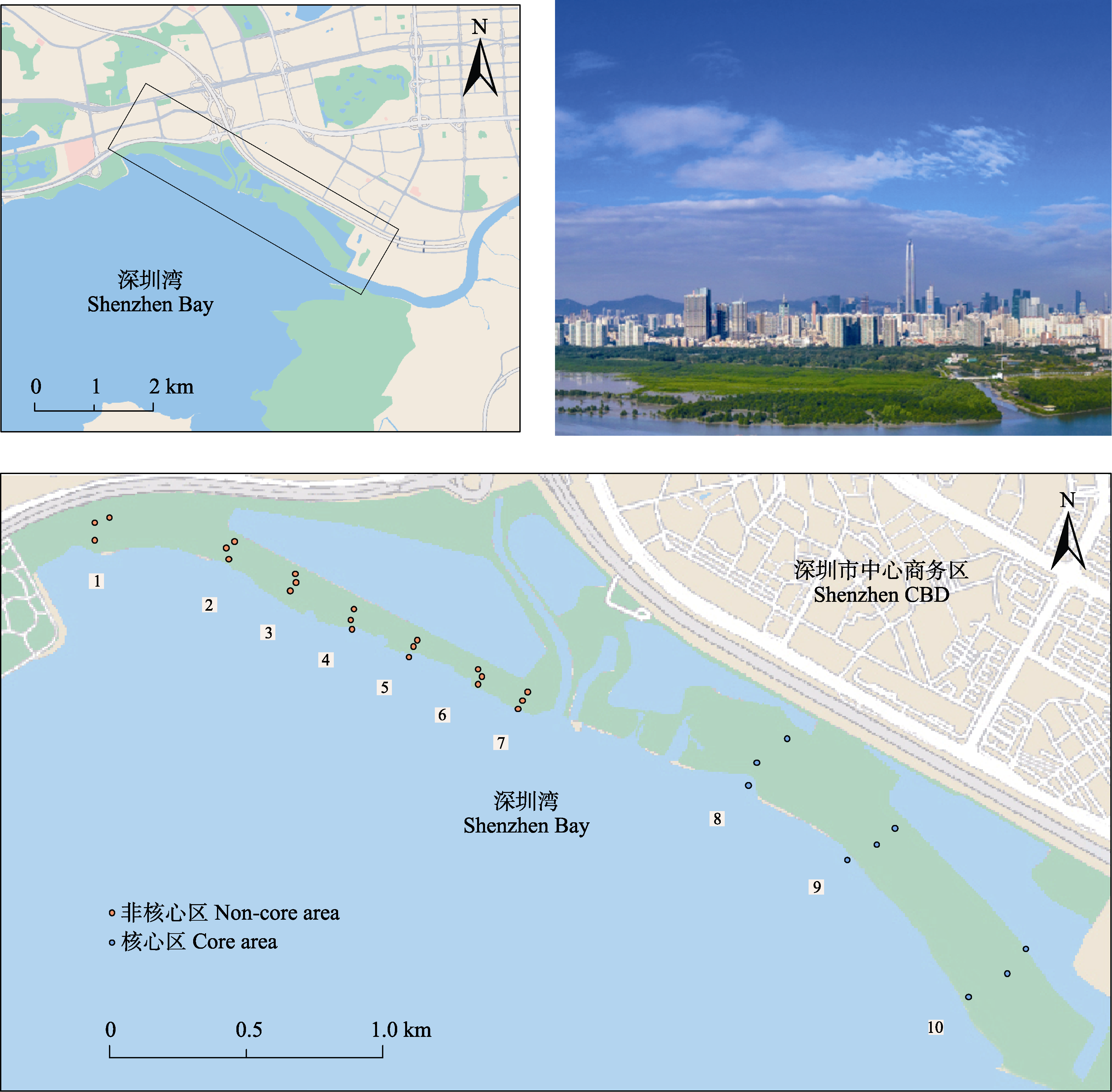
Fig. 1 Location of sampling sites in Futian Mangrove Nature Reserve of Shenzhen Bay. 1-10 are belt transects ID.
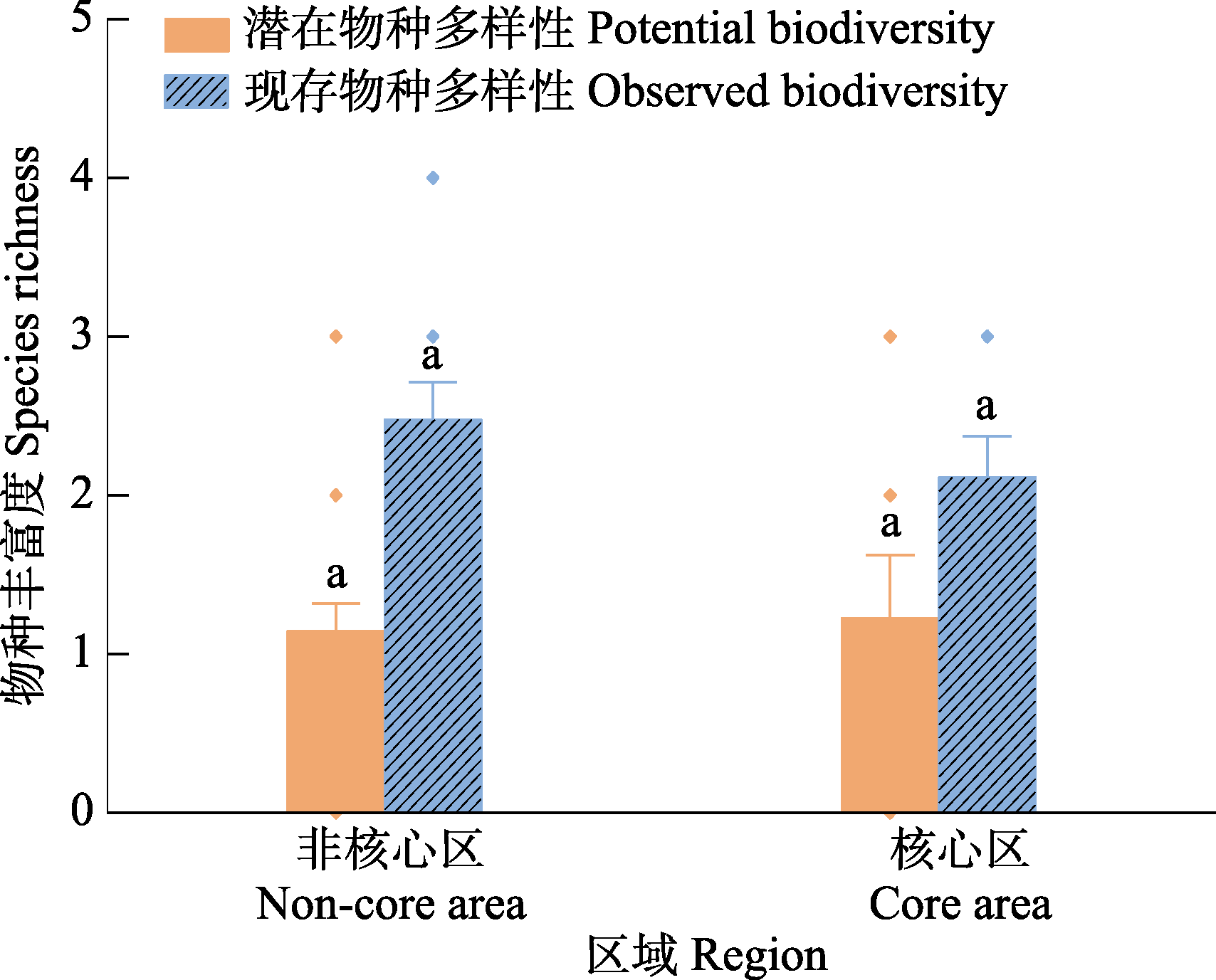
Fig. 2 Potential biodiversity and observed biodiversity in the non-core and core areas of Futian Mangrove Nature Reserve of Shenzhen Bay (mean ± SE). The same lowercase letters indicate no significant differences in diversity indices among different regions (p > 0.05).
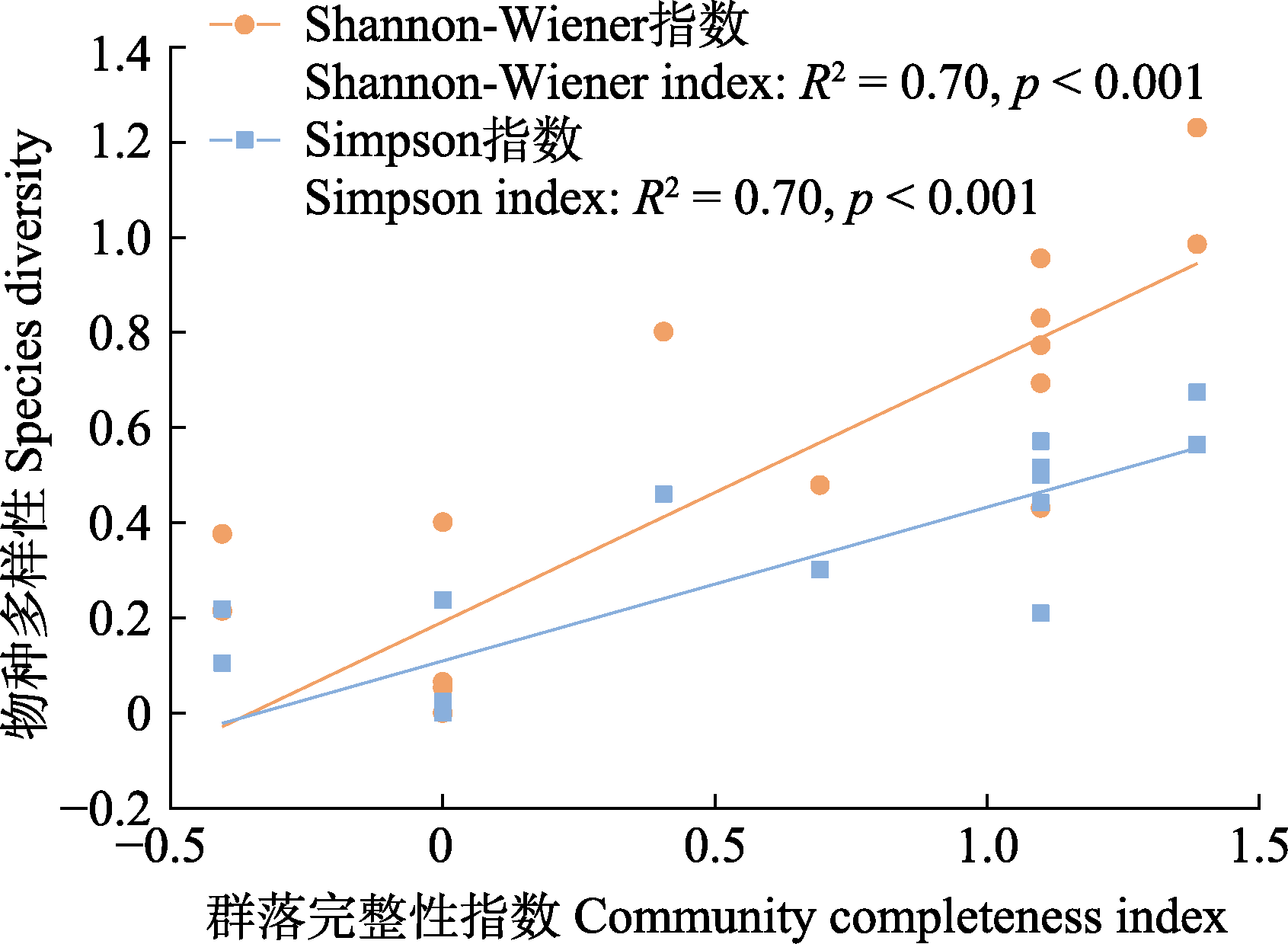
Fig. 3 Correlation between community completeness and species diversity in Futian Mangrove Nature Reserve of Shenzhen Bay.
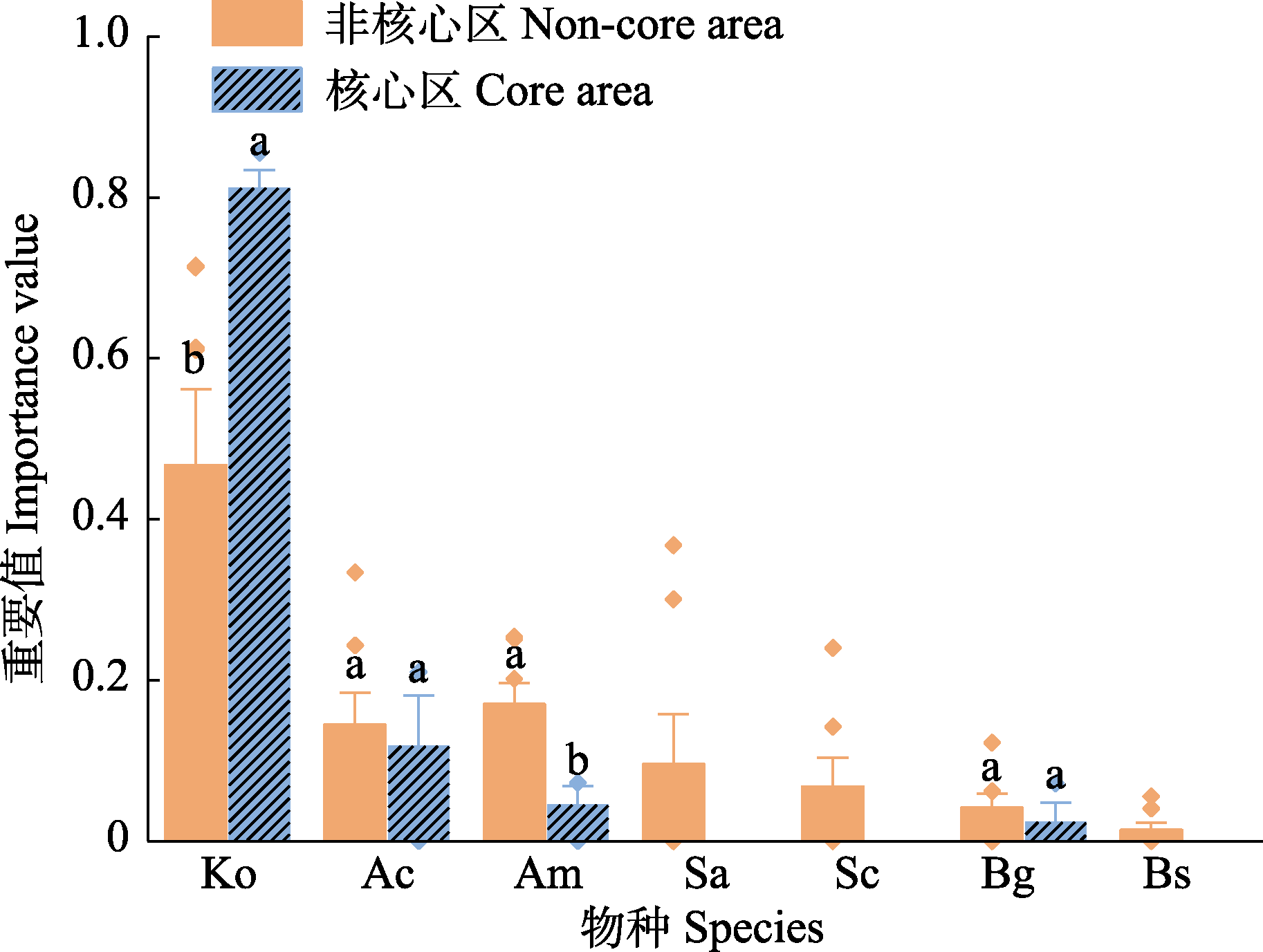
Fig. 4 Important value of woody canopy mangrove plants in the non-core and core areas of Futian Mangrove Nature Reserve of Shenzhen Bay (mean ± SE). Different lowercase letters indicate significant differences in site-scale probability for the same species in the non-core and core areas (p < 0.05). Ac, Aegiceras corniculatum; Am, Avicennia marina; Bg, Bruguiera gymnorrhiza; Bs, B. sexangula; Ko, Kandelia obovata; Sa, Sonneratia apetala; Sc, S. caseolaris.
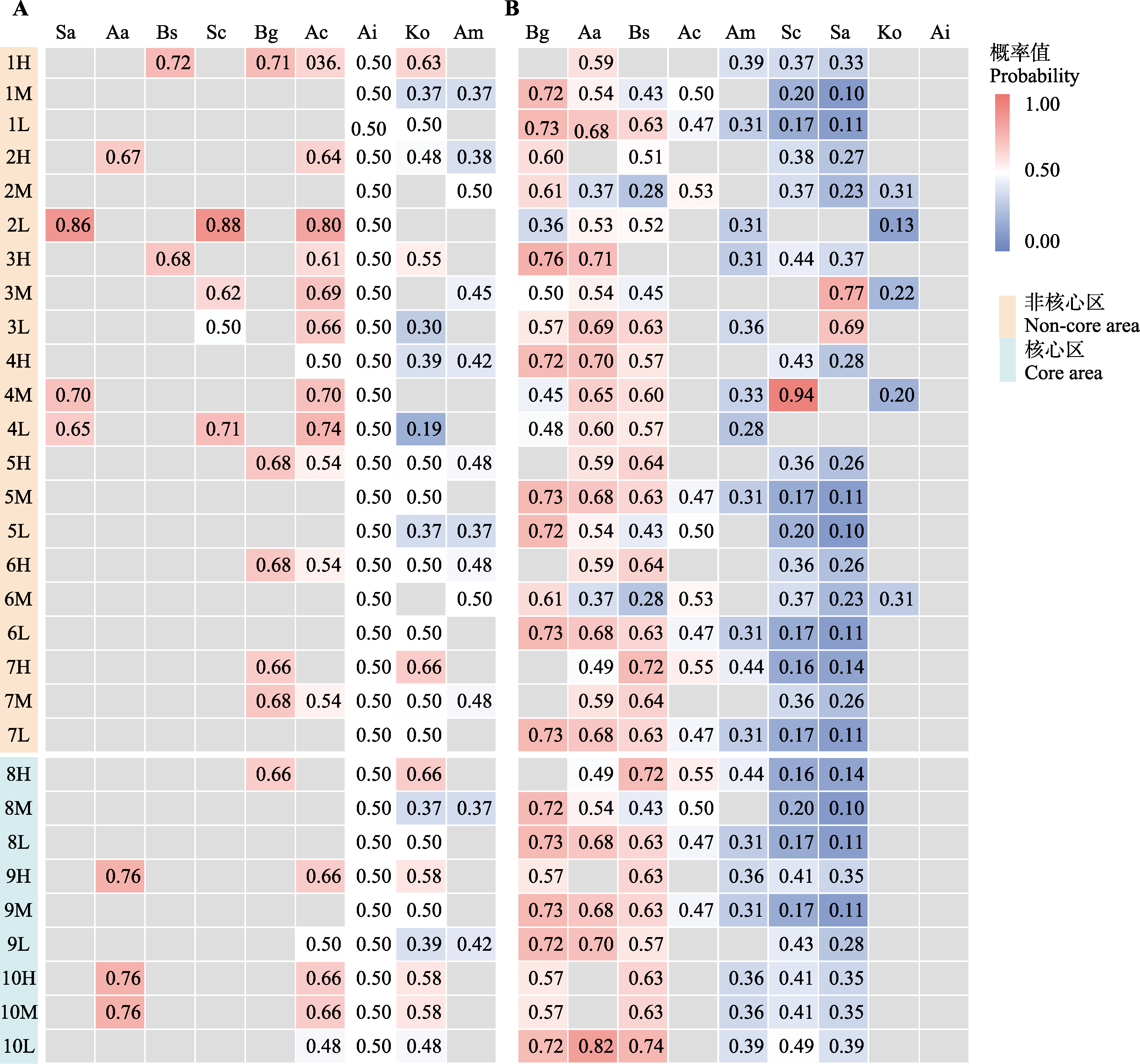
Fig. 5 Probability of observed (A), potential (B) species in site-specific species pool in Futian Mangrove Nature Reserve of Shenzhen Bay. Each grid represents one sampling site. Gray grid represents that the species is absent (A), observed (B) in the sampling site. Aa, Acrostichum aureum; Ac, Aegiceras corniculatum; Ai, Acanthus ilicifolius; Am, Avicennia marina; Bg, Bruguiera gymnorrhiza; Bs, B. sexangula; Ko, Kandelia obovata; Sa, Sonneratia apetala; Sc, S. caseolaris. H, M, and L denote sampling plots in the high, middle, and low tide zones, respectively. 1-10 are belt transects ID.
| 物种 Species | 相对多度 Relative abundance (%) | 相对频度 Relative frequency (%) | 相对优势度 Relative dominance (%) | 重要值 Importance value (%) |
|---|---|---|---|---|
| 非核心区 Non-core area | ||||
| 无瓣海桑 Sonneratia apetala | 33.1 ± 1.9 | 48.9 ± 6.6 | 18.3 ± 5.6 | 33.4 ± 4.7 |
| 海莲 Bruguiera sexangula | 1.5 ± 0.9 | 0.3 ± 0.1 | 12.7 ± 2.2 | 4.8 ± 1.1 |
| 海桑 Sonneratia caseolaris | 11.7 ± 3.6 | 19.9 ± 14.6 | 15.9 ± 5.7 | 15.8 ± 7.5 |
| 木榄 Bruguiera gymnorrhiza | 1.7 ± 0.7 | 0.4 ± 0.2 | 19.6 ± 9.2 | 7.2 ± 3.3 |
| 蜡烛果 Aegiceras corniculatum | 18.3 ± 20.7 | 2.6 ± 3.7 | 22.4 ± 8.9 | 14.4 ± 10.6 |
| 秋茄树 Kandelia obovata | 57.9 ± 35.8 | 52.0 ± 30.9 | 30.2 ± 10.9 | 46.7 ± 25.1b |
| 海榄雌 Avicennia marina | 8.0 ± 5.6 | 22.5 ± 10.4 | 20.5 ± 9.4 | 17.0 ± 7.0a |
| 核心区 Core area | ||||
| 木榄 Bruguiera gymnorrhiza | 0.6 ± 0.0 | 0.9 ± 0.0 | 20.0 ± 0.0 | 7.2 ± 0.0 |
| 蜡烛果 Aegiceras corniculatum | 9.8 ± 1.3 | 1.9 ± 0.5 | 41.7 ± 11.8 | 17.8 ± 4.5 |
| 秋茄树 Kandelia obovata | 92.7 ± 5.3 | 97.6 ± 0.4 | 53.3 ± 5.8 | 81.2 ± 3.8a |
| 海榄雌 Avicennia marina | 0.9 ± 0.3 | 1.2 ± 0.1 | 18.3 ± 2.4 | 6.8 ± 0.6b |
Table 1 Importance values of mangrove plants in Futian Mangrove Nature Reserve of Shenzhen Bay (mean ± SE)
| 物种 Species | 相对多度 Relative abundance (%) | 相对频度 Relative frequency (%) | 相对优势度 Relative dominance (%) | 重要值 Importance value (%) |
|---|---|---|---|---|
| 非核心区 Non-core area | ||||
| 无瓣海桑 Sonneratia apetala | 33.1 ± 1.9 | 48.9 ± 6.6 | 18.3 ± 5.6 | 33.4 ± 4.7 |
| 海莲 Bruguiera sexangula | 1.5 ± 0.9 | 0.3 ± 0.1 | 12.7 ± 2.2 | 4.8 ± 1.1 |
| 海桑 Sonneratia caseolaris | 11.7 ± 3.6 | 19.9 ± 14.6 | 15.9 ± 5.7 | 15.8 ± 7.5 |
| 木榄 Bruguiera gymnorrhiza | 1.7 ± 0.7 | 0.4 ± 0.2 | 19.6 ± 9.2 | 7.2 ± 3.3 |
| 蜡烛果 Aegiceras corniculatum | 18.3 ± 20.7 | 2.6 ± 3.7 | 22.4 ± 8.9 | 14.4 ± 10.6 |
| 秋茄树 Kandelia obovata | 57.9 ± 35.8 | 52.0 ± 30.9 | 30.2 ± 10.9 | 46.7 ± 25.1b |
| 海榄雌 Avicennia marina | 8.0 ± 5.6 | 22.5 ± 10.4 | 20.5 ± 9.4 | 17.0 ± 7.0a |
| 核心区 Core area | ||||
| 木榄 Bruguiera gymnorrhiza | 0.6 ± 0.0 | 0.9 ± 0.0 | 20.0 ± 0.0 | 7.2 ± 0.0 |
| 蜡烛果 Aegiceras corniculatum | 9.8 ± 1.3 | 1.9 ± 0.5 | 41.7 ± 11.8 | 17.8 ± 4.5 |
| 秋茄树 Kandelia obovata | 92.7 ± 5.3 | 97.6 ± 0.4 | 53.3 ± 5.8 | 81.2 ± 3.8a |
| 海榄雌 Avicennia marina | 0.9 ± 0.3 | 1.2 ± 0.1 | 18.3 ± 2.4 | 6.8 ± 0.6b |
| 物种 Species | 分布概率 Site-scale probability | ||
|---|---|---|---|
| 整个研究区 All sites | 核心区 Core area | 非核心区 Non-core area | |
| 无瓣海桑 Sonneratia apetala | 0.30 ± 0.21 | 0.24 ± 0.12 | 0.33 ± 0.25 |
| 卤蕨 Acrostichum aureum | 0.62 ± 0.11 | 0.69 ± 0.11a | 0.59 ± 0.10b |
| 海莲 Bruguiera sexangula | 0.58 ± 0.12 | 0.62 ± 0.09 | 0.56 ± 0.13 |
| 海桑 Sonneratia caseolaris | 0.37 ± 0.20 | 0.32 ± 0.14 | 0.40 ± 0.23 |
| 木榄 Bruguiera gymnorrhiza | 0.65 ± 0.10 | 0.66 ± 0.07 | 0.64 ± 0.11 |
| 蜡烛果 Aegiceras corniculatum | 0.57 ± 0.10 | 0.55 ± 0.09 | 0.58 ± 0.10 |
| 老鼠簕 Acanthus ilicifolius | 0.50 ± 0.00 | 0.50 ± 0.00 | 0.50 ± 0.00 |
| 秋茄树 Kandelia obovata | 0.44 ± 0.14 | 0.51 ± 0.09a | 0.41 ± 0.15b |
| 海榄雌 Avicennia marina | 0.38 ± 0.07 | 0.37 ± 0.04 | 0.38 ± 0.07 |
Table 2 Distribution probability of 9 mangrove species in Futian Mangrove Nature Reserve of Shenzhen Bay (mean ± SE)
| 物种 Species | 分布概率 Site-scale probability | ||
|---|---|---|---|
| 整个研究区 All sites | 核心区 Core area | 非核心区 Non-core area | |
| 无瓣海桑 Sonneratia apetala | 0.30 ± 0.21 | 0.24 ± 0.12 | 0.33 ± 0.25 |
| 卤蕨 Acrostichum aureum | 0.62 ± 0.11 | 0.69 ± 0.11a | 0.59 ± 0.10b |
| 海莲 Bruguiera sexangula | 0.58 ± 0.12 | 0.62 ± 0.09 | 0.56 ± 0.13 |
| 海桑 Sonneratia caseolaris | 0.37 ± 0.20 | 0.32 ± 0.14 | 0.40 ± 0.23 |
| 木榄 Bruguiera gymnorrhiza | 0.65 ± 0.10 | 0.66 ± 0.07 | 0.64 ± 0.11 |
| 蜡烛果 Aegiceras corniculatum | 0.57 ± 0.10 | 0.55 ± 0.09 | 0.58 ± 0.10 |
| 老鼠簕 Acanthus ilicifolius | 0.50 ± 0.00 | 0.50 ± 0.00 | 0.50 ± 0.00 |
| 秋茄树 Kandelia obovata | 0.44 ± 0.14 | 0.51 ± 0.09a | 0.41 ± 0.15b |
| 海榄雌 Avicennia marina | 0.38 ± 0.07 | 0.37 ± 0.04 | 0.38 ± 0.07 |
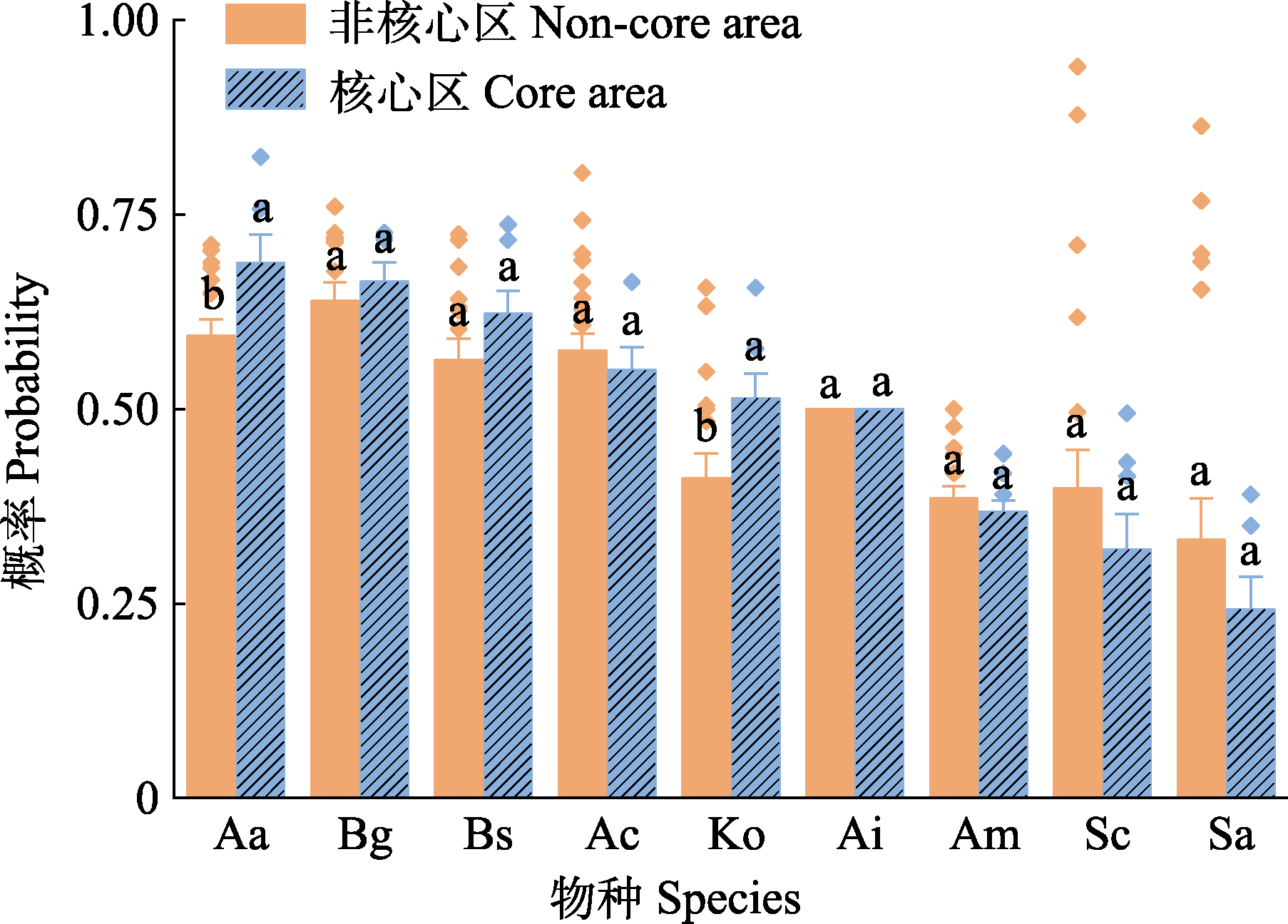
Fig. 6 Distribution probability of 9 mangrove species in the non-core and core areas of Futian Mangrove Nature Reserve of Shenzhen Bay (mean ± SE). Different lowercase letters indicate significant differences in distribution probability for the same species in the non-core and core areas (p < 0.05). Aa, Acrostichum aureum; Ac, Aegiceras corniculatum; Ai, Acanthus ilicifolius; Am, Avicennia marina; Bg, Bruguiera gymnorrhiza; Bs, B. sexangula; Ko, Kandelia obovata; Sa, Sonneratia apetala; Sc, S. caseolaris.
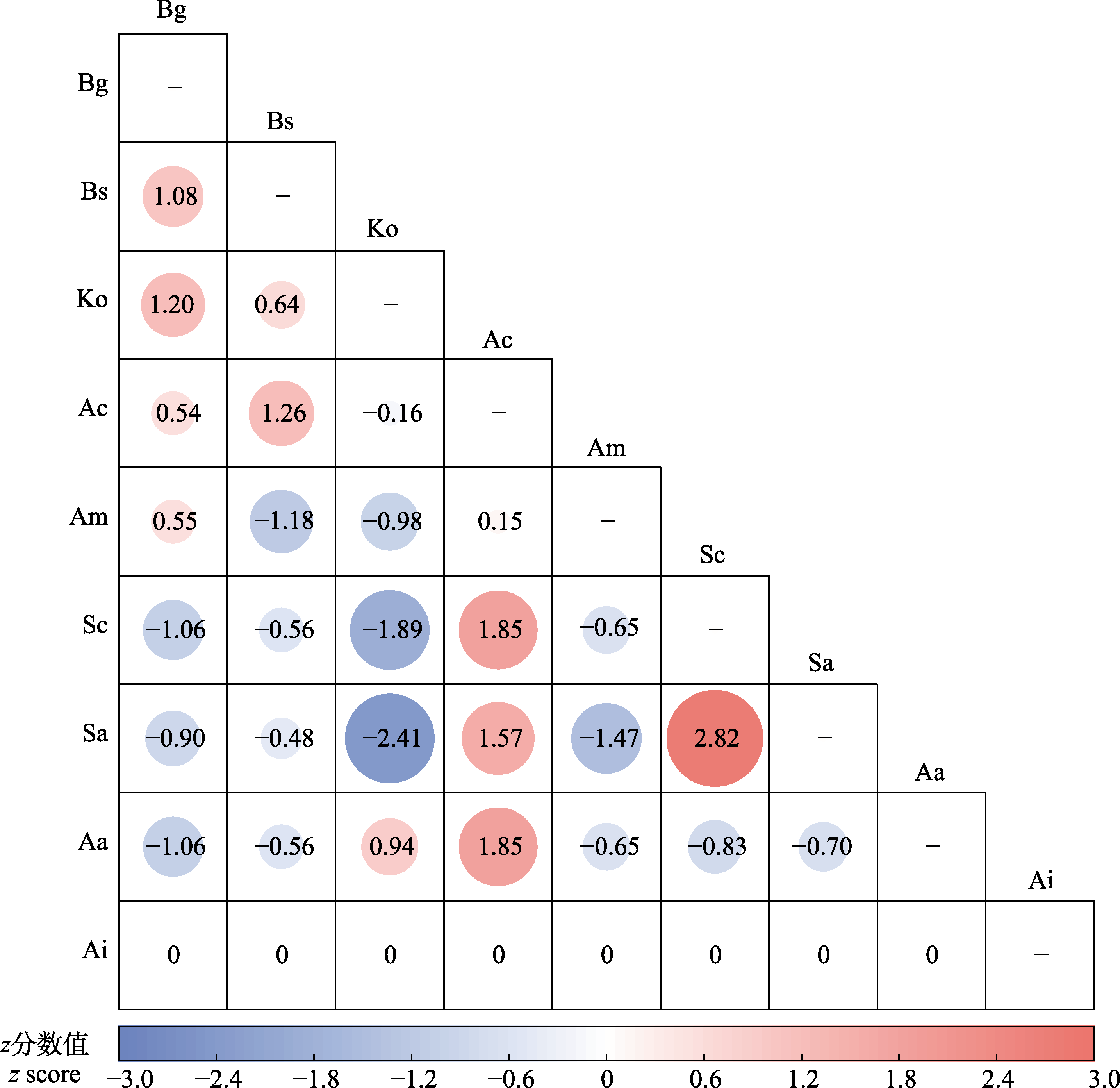
Fig. 7 Relationship among of the 9 mangrove species in Futian Mangrove Nature Reserve of Shenzhen Bay. Aa, Acrostichum aureum; Ac, Aegiceras corniculatum; Ai, Acanthus ilicifolius; Am, Avicennia marina; Bg, Bruguiera gymnorrhiza; Bs, B. sexangula; Ko, Kandelia obovata; Sa, Sonneratia apetala; Sc, S. caseolaris. z-score values less than 0 indicate a negative correlation, values greater than 0 indicate a positive correlation, and values equal to 0 represent random cooccurrence. The z-scores along the diagonal are meaningless for comparison and have been marked with “-”.
| [1] | Analuddin K, Kadidae LO, Muhammad Yasir LO, Septiana A, Syahrir L, Rahim S, Pratama D, Fajar LA, Nadaoka K (2021). Blue carbon dynamics in mangroves and conservation of their services in the Coral Triangle Ecoregion, Southeast Sulawesi, Indonesia. Journal of Physics: Conference Series, 1899, 012016. DOI: 10.1088/1742-6596/1899/1/012016. |
| [2] |
Arita HT (2016). Species co-occurrence analysis: pairwise versus matrix-level approaches. Global Ecology and Biogeography, 25, 1397-1400.
DOI URL |
| [3] |
Arrivabene HP, Campos CQ, da Costa Souza I, Wunderlin DA, Milanez CRD, Machado SR (2016). Differential bioaccumulation and translocation patterns in three mangrove plants experimentally exposed to iron. Consequences for environmental sensing. Environmental Pollution, 215, 302-313.
DOI PMID |
| [4] | Branoff B (2002). Urban mangrove biology and ecology: emergent patterns and management implications// Makowski C, Finkl CW. Threats to Mangrove Forests: Hazards, Vulnerability, and Management. Springer. 521-537. |
| [5] |
Carmona CP, Pärtel M (2021). Estimating probabilistic site-specific species pools and dark diversity from co-occurrence data. Global Ecology and Biogeography, 30, 316-326.
DOI URL |
| [6] | Chen GG, Li YY, Cai LQ, Xu JJ, Lin PR, Chen WC, Huang SL (2017). Impacts of alien species Sonneratia apetala on morphological characteristics and biomass of native species Kandelia candel. Marine Sciences, 41(6), 26-33. |
| [陈国贵, 李元跃, 蔡丽钦, 徐佳佳, 林沛然, 陈文城, 黄森磊 (2017). 红树植物外来种无瓣海桑对乡土种秋茄形态特征与生物量的影响. 海洋科学, 41(6), 26-33.] | |
| [7] |
Chen Q, Ma KM (2015). Research overview and trend on biological invasion in mangrove forests. Chinese Journal of Plant Ecology, 39, 283-299.
DOI |
|
[陈权, 马克明 (2015). 红树林生物入侵研究概况与趋势. 植物生态学报, 39, 283-299.]
DOI |
|
| [8] | Chen GZ, Mou SY, Zhang JH (1996). Ecologic study on the mangrove forest in Futian Nature Reserve, Shenzhen, China. Acta Scientiarum Naturalium Universitatis Sunyatseni, 35, 298-304. |
| [陈桂珠, 缪绅裕, 章金鸿 (1996). 深圳福田红树林生态学研究. 中山大学学报(自然科学版), 35, 298-304.] | |
| [9] |
Chu CJ, Wang YS, Liu Y, Jiang L, He FL (2017). Advances in species coexistence theory. Biodiversity Science, 25, 345-354.
DOI |
|
[储诚进, 王酉石, 刘宇, 蒋林, 何芳良 (2017). 物种共存理论研究进展. 生物多样性, 25, 345-354.]
DOI |
|
| [10] |
Dixon P (2003). VEGAN, a package of R functions for community ecology. Journal of Vegetation Science, 14, 927-930.
DOI URL |
| [11] | Fang JY, Shen ZH, Tang ZY, Wang ZH (2004). The protocol for the survey plan for plant species diversity of China’s Mountains. Chinese Biodiversity, 12, 5-9. |
|
[方精云, 沈泽昊, 唐志尧, 王志恒 (2004). “中国山地植物物种多样性调查计划”及若干技术规范. 生物多样性, 12, 5-9.]
DOI |
|
| [12] |
Goldberg L, Lagomasino D, Thomas N, Fatoyinbo T (2020). Global declines in human-driven mangrove loss. Global Change Biology, 26, 5844-5855.
DOI URL |
| [13] | Guan KL, Zhang XJ, Tan GW, Zeng F, Yi HL, Liao WB (2021). Species composition and structural diversity of typical mangrove communities in Shenzhen. Ecological Science, 40(4), 83-91. |
| [关开朗, 张信坚, 谭广文, 曾凤, 易慧琳, 廖文波 (2021). 深圳市红树林典型群落的物种组成及结构多样性研究. 生态科学, 40(4), 83-91.] | |
| [14] |
Hagger V, Worthington TA, Lovelock CE, Adame MF, Amano T, Brown BM, Friess DA, Landis E, Mumby PJ, Morrison TH, O’Brien KR, Wilson KA, Zganjar C, Saunders MI (2022). Drivers of global mangrove loss and gain in social-ecological systems. Nature Communications, 13, 6373. DOI: 10.1038/s41467-022-33962-x.
PMID |
| [15] | He ZY, Yen L, Huang HJ, Wang ZH, Zhao LL, Chen ZH, Lee SY, Peng YS (2022). Linkage between mangrove seedling colonization, sediment traits, and nitrogen input. Frontiers in Marine Science, 9, 793818. DOI: 10.3389/fmars.2022.793818. |
| [16] | Hu P, Xiang XL, Huang ZJ, Tan M, Yu SX, Yang Q (2024). Biomass dynamics in exotic and native mangrove species. Chinese Journal of Applied and Environmental Biology, 30, 929-934. |
| [胡平, 向雪莲, 黄子健, 谭敏, 余世孝, 杨琼 (2024). 外来与乡土红树植物群落生物量动态. 应用与环境生物学报, 30, 929-934.] | |
| [17] | Hu T, Chou QC, He SY, Xu HL, Shi XH (2016). Structural regulation and natural restoration of Futian mangrove in Shenzhen Bay. Chinese Journal of Ecology, 35, 1491-1496. |
| [胡涛, 丑庆川, 何诗雨, 徐华林, 史秀华 (2016). 深圳湾红树林结构调控及自然恢复状况. 生态学杂志, 35, 1491-1496.] | |
| [18] | Hu ZW, Wu JJ, Wang JZ, Zhang YH, Zhou HC, Gao CJ, Wang JJ, Wu GF (2023). How exotic Sonneratia species affect the spatiotemporal dynamics of mangroves in Shenzhen Bay, China: a remote sensing perspective. Ecological Indicators, 153, 110479. DOI: 10.1016/j.ecolind.2023.110479. |
| [19] |
Jia MM, Wang ZM, Zhang YZ, Mao DH, Wang C (2018). Monitoring loss and recovery of mangrove forests during 42 years: the achievements of mangrove conservation in China. International Journal of Applied Earth Observation and Geoinformation, 73, 535-545.
DOI URL |
| [20] | Lande R (1996). Statistics and partitioning of species diversity, and similarity among multiple communities. Oikos, 76, 5-13. |
| [21] |
Lewis RJ, Szava-Kovats R, Pärtel M (2016). Estimating dark diversity and species pools: an empirical assessment of two methods. Methods in Ecology and Evolution, 7, 104-113.
DOI URL |
| [22] | Li RL, Chai MW, Qiu GY, He B (2012). Mercury and copper accumulation during last fifty years and their potential ecological risk assessment in sediment of mangrove wetland of Shenzhen, China. Environmental Science, 33, 4276-4283. |
| [李瑞利, 柴民伟, 邱国玉, 贺蓓 (2012). 近50年来深圳湾红树林湿地Hg、Cu累积及其生态危害评价. 环境科学, 33, 4276-4283.] | |
| [23] | Li Z, Li Y, Zan QJ, Yu SX (2017). A comparison of mangrove community distribution and landscape pattern between Futian and Maipo Nature Reserve at Shenzhen Bay. Acta Scientiarum Naturalium Universitatis Sunyatseni, 56, 12-19. |
| [李真, 李瑜, 昝启杰, 余世孝 (2017). 深圳福田与香港米埔红树林群落分布与景观格局比较. 中山大学学报(自然科学版), 56, 12-19.] | |
| [24] | Liang SC, Liang MZ, Wu YL, Zan QJ, Wang YJ, Xie Q (2005). Analysis of the spatial structure of natural Sonneratia caseolaris + S. apetala forest in Futian, Shenzhen. Guihaia, 25, 393-398. |
| [梁士楚, 梁铭忠, 吴苑玲, 昝启杰, 王勇军, 谢强 (2005). 深圳福田海桑+无瓣海桑自然林的空间结构分析. 广西植物, 25, 393-398.] | |
| [25] | Liao BW, Li M, Zheng SF, Chen YJ, Zhong CR, Huang ZQ (2005). Niches of several mangrove species in Dongzhai Harbor of Hainan Island. Chinese Journal of Applied Ecology, 16, 403-407. |
| [廖宝文, 李玫, 郑松发, 陈玉军, 钟才荣, 黄仲琪 (2005). 海南岛东寨港几种红树植物种间生态位研究. 应用生态学报, 16, 403-407.] | |
| [26] | Liu BE, Liao BW (2013). The physio-ecological response of Acanthus ilicifolius seedlings to different degrees of light intensity in tide environment. Forest Research, 26, 192-199. |
| [刘滨尔, 廖宝文 (2013). 老鼠簕幼苗在潮汐环境下对不同光强的生理生态响应. 林业科学研究, 26, 192-199.] | |
| [27] |
Ma ZS (2019). A new DTAR (diversity-time-area relationship) model demonstrated with the indoor microbiome. Journal of Biogeography, 46, 2024-2041.
DOI URL |
| [28] |
Moeslund JE, Brunbjerg AK, Clausen KK, Dalby L, Fløjgaard C, Juel A, Lenoir J (2017). Using dark diversity and plant characteristics to guide conservation and restoration. Journal of Applied Ecology, 54, 1730-1741.
DOI URL |
| [29] |
Pärtel M, Szava-Kovats R, Zobel M (2011). Dark diversity: shedding light on absent species. Trends in Ecology & Evolution, 26, 124-128.
DOI URL |
| [30] |
Pärtel M, Szava-Kovats R, Zobel M (2013). Community completeness: linking local and dark diversity within the species pool concept. Folia Geobotanica, 48, 307-317.
DOI URL |
| [31] |
Peng D, Chen LZ, Pennings SC, Zhang YH (2018). Using a marsh organ to predict future plant communities in a Chinese estuary invaded by an exotic grass and mangrove. Limnology and Oceanography, 63, 2595-2605.
DOI URL |
| [32] |
Peng X, Jin GZ (2022). Effects of plant characteristics and environmental factors on the dark diversity in a broadleaved Korean pine forest. Chinese Journal of Plant Ecology, 46, 656-666.
DOI |
|
[彭鑫, 金光泽 (2022). 植物特性和环境因子对阔叶红松林暗多样性的影响. 植物生态学报, 46, 656-666.]
DOI |
|
| [33] |
Ren H, Jian SG, Lu HF, Zhang QM, Shen WJ, Han WD, Yin ZY, Guo QF (2008). Restoration of mangrove plantations and colonization by native species in Leizhou bay, South China. Ecological Research, 23, 401-407.
DOI URL |
| [34] |
Ren H, Lu HF, Shen WJ, Huang C, Guo QF, Li ZA, Jian SG (2009). Sonneratia apetala Buch.Ham in the mangrove ecosystems of China: an invasive species or restoration species? Ecological Engineering, 35, 1243-1248.
DOI URL |
| [35] |
Ren H, Wu XM, Ning TZ, Huang G, Wang J, Jian SG, Lu HF (2011). Wetland changes and mangrove restoration planning in Shenzhen Bay, Southern China. Landscape and Ecological Engineering, 7, 241-250.
DOI URL |
| [36] | Simpson EH (1949). Measurement of diversity. Nature, 163, 688. DOI: 10.1038/163688a0. |
| [37] | Smart LS, Vukomanovic J, Sills EO, Sanchez G (2021). Cultural ecosystem services caught in a ‘coastal squeeze’ between sea level rise and urban expansion. Global Environmental Change, 66, 102209. DOI: 10.1016/j.gloenvcha.2020.102209. |
| [38] | Song SS, Ding YL, Li W, Meng YC, Zhou J, Gou RK, Zhang CH, Ye SB, Saintilan N, Krauss KW, Crooks S, Lv SG, Lin GH (2023). Mangrove reforestation provides greater blue carbon benefit than afforestation for mitigating global climate change. Nature Communications, 14, 756. DOI: 10.1038/s41467-023-36477-1. |
| [39] | Tang LL, Wang RX, He KS, Shi C, Yang T, Huang YP, Zheng PF, Shi FC (2019). Throwing light on dark diversity of vascular plants in China: predicting the distribution of dark and threatened species under global climate change. PeerJ, 7, e6731. DOI: 10.7717/peerj.6731. |
| [40] | Toral-Granda MV, Causton CE, Jäger H, Trueman M, Izurieta JC, Araujo E, Cruz M, Zander KK, Izurieta A, Garnett ST (2017). Alien species pathways to the Galapagos Islands, Ecuador. PLoS ONE, 12, e0184379. DOI: 10.1371/journal.pone.0184379. |
| [41] |
Trindade DPF, Carmona CP, Pärtel M (2020). Temporal lags in observed and dark diversity in the Anthropocene. Global Change Biology, 26, 3193-3201.
DOI PMID |
| [42] |
Ulrich W, Gotelli NJ (2013). Pattern detection in null model analysis. Oikos, 122, 2-18.
DOI URL |
| [43] |
Veech JA (2013). A probabilistic model for analysing species co-occurrence. Global Ecology and Biogeography, 22, 252-260.
DOI URL |
| [44] | Wang WQ, Shi JB, Chen LZ (2021). Research of Conservation and Restoration Strategy of Mangrove Wetlands in China. China Environmental Science Press, Beijing. |
| [王文卿, 石建斌, 陈鹭真 (2021). 中国红树林湿地保护与恢复战略研究. 中国环境出版集团, 北京.] | |
| [45] |
Wu QH, Leung JYS, Yuan X, Huang XX, Li HY, Huang ZY, Li Y (2015). Biological risk, source and pollution history of organochlorine pesticides (OCPs) in the sediment in Nansha mangrove, South China. Marine Pollution Bulletin, 96, 57-64.
DOI PMID |
| [46] | Zan QJ, Wang BS, Wang YJ, Li MG (2003). Ecological assessment on the introduced Sonneratia caseolaris and S. apetala at the mangrove forest of Shenzhen Bay, China. Acta Botanica Sinica, 544-551. |
| [昝启杰, 王伯荪, 王勇军, 李鸣光 (2003). 深圳湾红树林引种海桑、无瓣海桑的生态评价. 生态学报, 544-551.] | |
| [47] | Zhang LE, Liao BW, Guan W (2011). Effects of simulated tide inundation on seed germination and seedling growth of mangrove species Acanthus ilicifolius. Chinese Journal of Ecology, 30, 2165-2172. |
| [张留恩, 廖宝文, 管伟 (2011). 模拟潮汐淹浸对红树植物老鼠簕种子萌发及幼苗生长的影响. 生态学杂志, 30, 2165-2172.] | |
| [48] | Zhang YQ, Zhang Z, Jiang BQ, Shen XX, Li RL (2022). Ecosystem health assessment and management strategies of urban mangrove: a case study of Guangdong-Hong Kong-Macao Greater Bay Area. China Environmental Science, 42, 2352-2369. |
| [张月琪, 张志, 江鎞倩, 沈小雪, 李瑞利 (2022). 城市红树林生态系统健康评价与管理对策——以粤港澳大湾区为例. 中国环境科学, 42, 2352-2369.] |
| [1] | Rao Chaokang, Tang Liang. Characteristics and Drivers of Mangrove Phyllosphere Microbial Communities across Different Tidal Elevations [J]. Chin J Plant Ecol, 2026, 50(预发表): 1-. |
| [2] | LI Meng-Qi, MIAO Ling-Feng, LI Da-Dong, LONG Yi-Fan, YE Bing-Bing, YANG Fan. Response of mangrove fine root functional traits to sediment nutrient changes at different tide levels in Dongzhaigang, Hainan, China [J]. Chin J Plant Ecol, 2025, 49(4): 552-561. |
| [3] | QIAO Pei-Yang, GU Xiao-Xuan, LIU Chang-Xin, CAO Ze-Yu, ZHANG Ting-Ting, LIN Chen, CHEN Qin-Chang, PENG Xiu-Fan, CHEN Fei-Fei, LI Hua-Liang, CHEN Wei, CHEN Lu-Zhen. Damage to the mangrove forests in Dongzhaigang of Hainan caused by super typhoon “Yagi” [J]. Chin J Plant Ecol, 2025, 49(4): 540-551. |
| [4] | ZHANG Xiao-Ting, WANG Jun-Jie. Chlorophyll fluorescence characteristics of mangrove plants under salt and copper treatments and their relationship with leaf structure and biochemical components [J]. Chin J Plant Ecol, 2025, 49(11): 1944-1956. |
| [5] | PAN Yuan-Fang, PAN Liang-Hao, QIU Si-Ting, QIU Guang-Long, SU Zhi-Nan, SHI Xiao-Fang, FAN Hang-Qing. Variations in tree height among mangroves and their environmental adaptive mechanisms in China’s coastal areas [J]. Chin J Plant Ecol, 2024, 48(4): 483-495. |
| [6] | ZHANG Xiao-Yan, WEE Kim Shan Alison, KAJITA Tadashi, CAO Kun-Fang. Effects of provenance on leaf structure and function of two mangrove species: the genetic adaptation to temperature [J]. Chin J Plant Ecol, 2021, 45(11): 1241-1250. |
| [7] | SUN Hui-Min, JIANG Jiang, CUI Li-Na, ZHANG Shui-Feng, ZHANG Jin-Chi. Effects of Spartina alterniflora invasion on soil organic carbon composition of mangrove wetland in Zhangjiang River Estuary [J]. Chin J Plant Ecol, 2018, 42(7): 774-784. |
| [8] | Xiao-Xuan ZHOU, Ling-Ling CAI, Mei-Ping FU, Li-Wei HONG, Ying-Jia SHEN, Qingshun Quinn LI. Progress in the studies of vivipary in mangrove plants [J]. Chin J Plan Ecolo, 2016, 40(12): 1328-1343. |
| [9] | CHEN Quan,MA Ke-Ming. Research overview and trend on biological invasion in mangrove forests [J]. Chin J Plan Ecolo, 2015, 39(3): 283-299. |
| [10] | CHEN Lu-Zhen, WANG Wen-Qing, ZHANG Yi-Hui, HUANG Li, ZHAO Chun-Lei, YANG Sheng-Chang, YANG Zhi-Wei, CHEN Yue-Chao, XU Hua-Lin, ZHONG Cai-Rong, SU Bo, FANG Bai-Zhou, CHEN Nai-Ming, ZENG Chuan-Zhi, LIN Guang-Hui. Damage to mangroves from extreme cold in early 2008 in southern China [J]. Chin J Plant Ecol, 2010, 34(2): 186-194. |
| [11] | MU Mei-Rong, JIANG Qiao-Lan, WANG Wen-Qing. COMPARISONS OF LEAF CHLORIDE CONTENT AND LEAF TRAITS BETWEEN TRUE MANGROVE PLANTS AND SEMI-MANGROVE PLANTS [J]. Chin J Plant Ecol, 2007, 31(3): 497-504. |
| [12] | HE Bin, WEN Yuan-Guang, LIANG Hong-Wen, LI Zhi-Xian, LIU Shi-Rong. Element Distribution and its Relationship with Soil Fertility in Different Succession Stages of a Mangrove Community in Yingluo Bay, Guangxi [J]. Chin J Plan Ecolo, 2002, 26(5): 518-524. |
| [13] | MO Zhu-Cheng, FAN Hang-Qing, HE Bin-Yuan. Effects of Seawater Salinity on Hypocotyl Growth in Two Mangrove Species [J]. Chin J Plan Ecolo, 2001, 25(2): 235-239. |
| [14] | YE Yong, TAN Feng-Yi, LU Chang-Yi. Effects of Soil Texture and Light on Growth and Physiology Parameters in Kandelia candel [J]. Chin J Plan Ecolo, 2001, 25(1): 42-49. |
| [15] | GE Jing-Ping, LIN Peng. Mating System of Bruguiera gymnorrhiza Populations of Mangrove, China [J]. Chin J Plan Ecolo, 2001, 25(1): 50-56. |
| Viewed | ||||||
|
Full text |
|
|||||
|
Abstract |
|
|||||
Copyright © 2026 Chinese Journal of Plant Ecology
Tel: 010-62836134, 62836138, E-mail: apes@ibcas.ac.cn, cjpe@ibcas.ac.cn

