
Chin J Plant Ecol ›› 2025, Vol. 49 ›› Issue (12): 2054-2068.DOI: 10.17521/cjpe.2024.0447 cstr: 32100.14.cjpe.2024.0447
• Research Articles • Previous Articles Next Articles
LIU Yang, LIU Ao, SONG Xuan-Zi, YANG Yun, AN Bai-Heng, HAN Meng-Jiao, Banma-Caigeer , Migmar-Wangdwei *( )
)
Received:2024-12-09
Accepted:2025-04-08
Online:2025-12-20
Published:2026-01-19
Contact:
Migmar-Wangdwei
Supported by:LIU Yang, LIU Ao, SONG Xuan-Zi, YANG Yun, AN Bai-Heng, HAN Meng-Jiao, Banma-Caigeer , Migmar-Wangdwei. Effects of plateau pika disturbance on the niche and interspecific associations of major plant species in alpine rangelands[J]. Chin J Plant Ecol, 2025, 49(12): 2054-2068.
Add to citation manager EndNote|Ris|BibTeX
URL: https://www.plant-ecology.com/EN/10.17521/cjpe.2024.0447
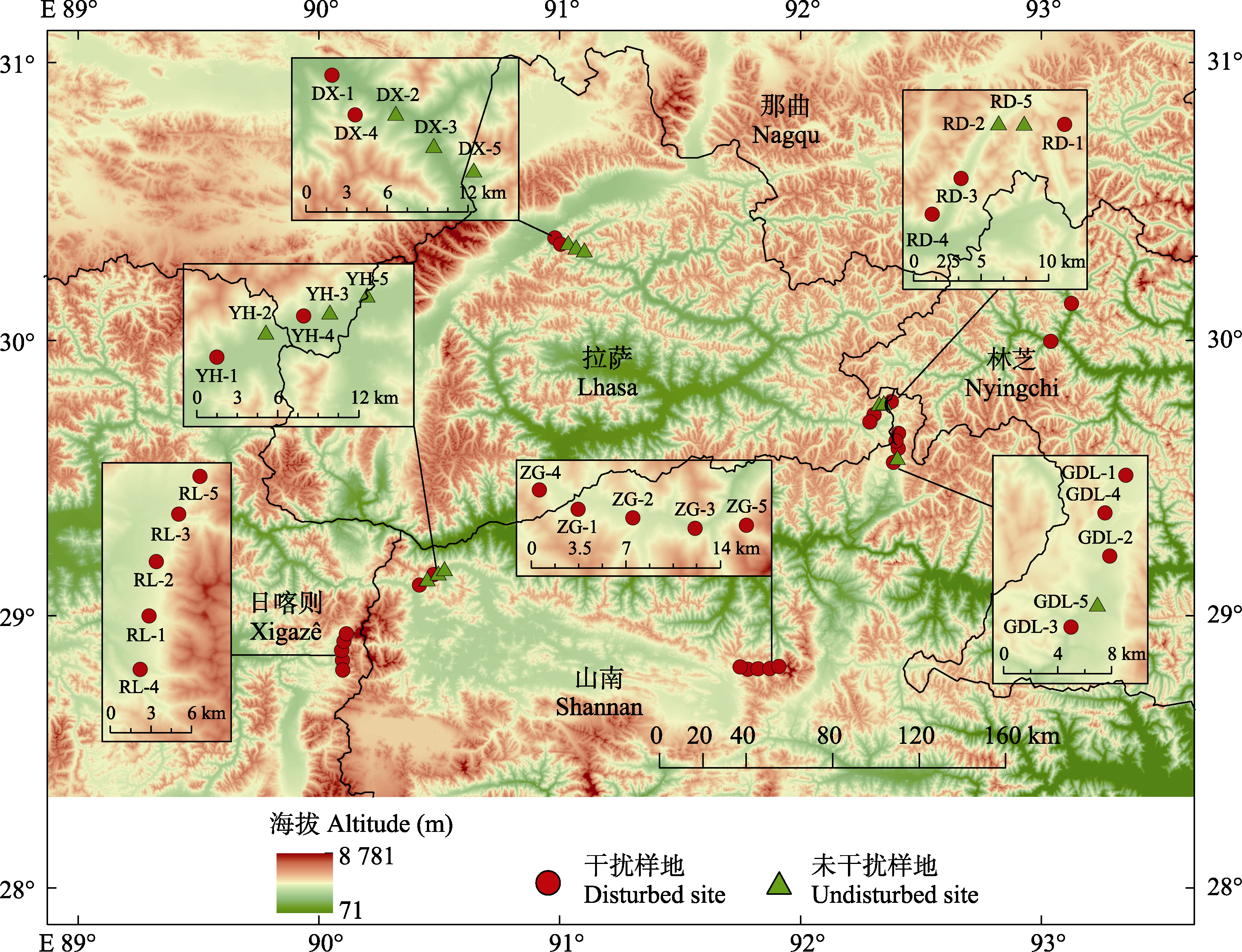
Fig. 1 Location of the study area and distribution of sampling plots on alpine meadow located in the south-central part of Xizang.
| 编号 No. | 物种 Species | 干扰 Disturbed | 未干扰 Undisturbed | ||
|---|---|---|---|---|---|
| 重要值 Important value (%) | 生态位宽度 Niche width | 重要值 Important value (%) | 生态位宽度 Niche width | ||
| S01 | 木根香青 Anaphalis xylorhiza | 3.92 | 0.37 | 2.42 | 0.30 |
| S02 | 矮生嵩草 Carex alatauensis | 8.48 | 0.78 | 10.04 | 0.91 |
| S03 | 高山嵩草 Carex parvula | 10.65 | 0.94 | 13.36 | 1.00 |
| S04 | 蓝钟花 Cyananthus hookeri | 2.54 | 0.25 | 2.42 | 0.30 |
| S05 | 厚叶兔耳草 Lagotis crassifolia | 2.06 | 0.18 | 2.42 | 0.19 |
| S06 | 肉果草 Lancea tibetica | 7.70 | 0.73 | 7.07 | 0.63 |
| S07 | 弱小火绒草 Leontopodium pusillum | 6.39 | 0.65 | 7.25 | 0.64 |
| S08 | 独一味 Phlomoides rotata | 4.27 | 0.39 | 9.47 | 0.72 |
| S09 | 米林蔓黄耆 Phyllolobium milingense | 4.60 | 0.46 | 5.38 | 0.43 |
| S10 | 钉柱委陵菜 Potentilla saundersiana | 8.22 | 0.74 | 12.07 | 0.98 |
Table 1 Importance value and niche width of major plants species under disturbed and undisturbed conditions of plateau pikas
| 编号 No. | 物种 Species | 干扰 Disturbed | 未干扰 Undisturbed | ||
|---|---|---|---|---|---|
| 重要值 Important value (%) | 生态位宽度 Niche width | 重要值 Important value (%) | 生态位宽度 Niche width | ||
| S01 | 木根香青 Anaphalis xylorhiza | 3.92 | 0.37 | 2.42 | 0.30 |
| S02 | 矮生嵩草 Carex alatauensis | 8.48 | 0.78 | 10.04 | 0.91 |
| S03 | 高山嵩草 Carex parvula | 10.65 | 0.94 | 13.36 | 1.00 |
| S04 | 蓝钟花 Cyananthus hookeri | 2.54 | 0.25 | 2.42 | 0.30 |
| S05 | 厚叶兔耳草 Lagotis crassifolia | 2.06 | 0.18 | 2.42 | 0.19 |
| S06 | 肉果草 Lancea tibetica | 7.70 | 0.73 | 7.07 | 0.63 |
| S07 | 弱小火绒草 Leontopodium pusillum | 6.39 | 0.65 | 7.25 | 0.64 |
| S08 | 独一味 Phlomoides rotata | 4.27 | 0.39 | 9.47 | 0.72 |
| S09 | 米林蔓黄耆 Phyllolobium milingense | 4.60 | 0.46 | 5.38 | 0.43 |
| S10 | 钉柱委陵菜 Potentilla saundersiana | 8.22 | 0.74 | 12.07 | 0.98 |
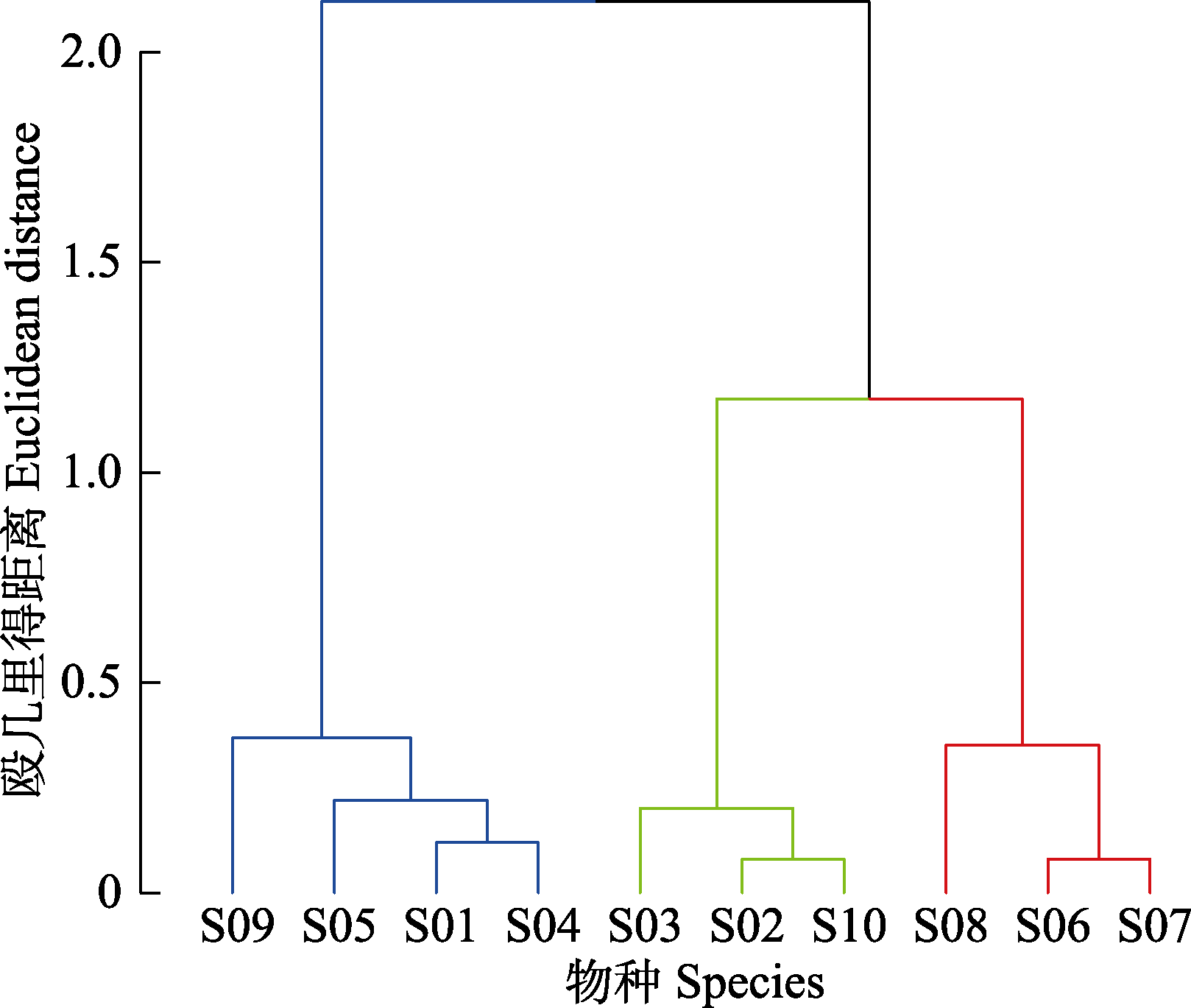
Fig. 2 Cluster analysis of niche breadth of major plant species under disturbed and undisturbed conditions caused by plateau pikas. Species numbers correspond to those in Table 1.
| 物种编号 Species No. | S01 | S02 | S03 | S04 | S05 | S06 | S07 | S08 | S09 | S10 |
|---|---|---|---|---|---|---|---|---|---|---|
| S01 | 1.000 | |||||||||
| S02 | 0.547 | 1.000 | ||||||||
| S03 | 0.577 | 0.913 | 1.000 | |||||||
| S04 | 0.254 | 0.451 | 0.524 | 1.000 | ||||||
| S05 | 0.146 | 0.361 | 0.435 | 0.074 | 1.000 | |||||
| S06 | 0.628 | 0.861 | 0.853 | 0.422 | 0.374 | 1.000 | ||||
| S07 | 0.586 | 0.748 | 0.769 | 0.225 | 0.451 | 0.660 | 1.000 | |||
| S08 | 0.517 | 0.634 | 0.668 | 0.103 | 0.376 | 0.749 | 0.613 | 1.000 | ||
| S09 | 0.365 | 0.585 | 0.625 | 0.290 | 0.090 | 0.430 | 0.667 | 0.313 | 1.000 | |
| S10 | 0.561 | 0.816 | 0.901 | 0.327 | 0.290 | 0.803 | 0.767 | 0.725 | 0.683 | 1.000 |
Table 2 Niche overlap values of major plant species under disturbed conditions caused by plateau pikas
| 物种编号 Species No. | S01 | S02 | S03 | S04 | S05 | S06 | S07 | S08 | S09 | S10 |
|---|---|---|---|---|---|---|---|---|---|---|
| S01 | 1.000 | |||||||||
| S02 | 0.547 | 1.000 | ||||||||
| S03 | 0.577 | 0.913 | 1.000 | |||||||
| S04 | 0.254 | 0.451 | 0.524 | 1.000 | ||||||
| S05 | 0.146 | 0.361 | 0.435 | 0.074 | 1.000 | |||||
| S06 | 0.628 | 0.861 | 0.853 | 0.422 | 0.374 | 1.000 | ||||
| S07 | 0.586 | 0.748 | 0.769 | 0.225 | 0.451 | 0.660 | 1.000 | |||
| S08 | 0.517 | 0.634 | 0.668 | 0.103 | 0.376 | 0.749 | 0.613 | 1.000 | ||
| S09 | 0.365 | 0.585 | 0.625 | 0.290 | 0.090 | 0.430 | 0.667 | 0.313 | 1.000 | |
| S10 | 0.561 | 0.816 | 0.901 | 0.327 | 0.290 | 0.803 | 0.767 | 0.725 | 0.683 | 1.000 |
| 物种编号 Species No. | S01 | S02 | S03 | S04 | S05 | S06 | S07 | S08 | S09 | S10 |
|---|---|---|---|---|---|---|---|---|---|---|
| S01 | 1.000 | |||||||||
| S02 | 0.433 | 1.000 | ||||||||
| S03 | 0.544 | 0.954 | 1.000 | |||||||
| S04 | 0.333 | 0.519 | 0.544 | 1.000 | ||||||
| S05 | 0.152 | 0.512 | 0.433 | 0.910 | 1.000 | |||||
| S06 | 0.457 | 0.712 | 0.793 | 0.572 | 0.468 | 1.000 | ||||
| S07 | 0.600 | 0.751 | 0.802 | 0.273 | 0.099 | 0.767 | 1.000 | |||
| S08 | 0.626 | 0.767 | 0.851 | 0.626 | 0.490 | 0.882 | 0.830 | 1.000 | ||
| S09 | 0.236 | 0.551 | 0.654 | 0.236 | 0.000 | 0.210 | 0.401 | 0.305 | 1.000 | |
| S10 | 0.446 | 0.952 | 0.989 | 0.574 | 0.479 | 0.765 | 0.730 | 0.811 | 0.685 | 1.000 |
Table 3 Niche overlap values of major plant species under undisturbed conditions caused by plateau pikas
| 物种编号 Species No. | S01 | S02 | S03 | S04 | S05 | S06 | S07 | S08 | S09 | S10 |
|---|---|---|---|---|---|---|---|---|---|---|
| S01 | 1.000 | |||||||||
| S02 | 0.433 | 1.000 | ||||||||
| S03 | 0.544 | 0.954 | 1.000 | |||||||
| S04 | 0.333 | 0.519 | 0.544 | 1.000 | ||||||
| S05 | 0.152 | 0.512 | 0.433 | 0.910 | 1.000 | |||||
| S06 | 0.457 | 0.712 | 0.793 | 0.572 | 0.468 | 1.000 | ||||
| S07 | 0.600 | 0.751 | 0.802 | 0.273 | 0.099 | 0.767 | 1.000 | |||
| S08 | 0.626 | 0.767 | 0.851 | 0.626 | 0.490 | 0.882 | 0.830 | 1.000 | ||
| S09 | 0.236 | 0.551 | 0.654 | 0.236 | 0.000 | 0.210 | 0.401 | 0.305 | 1.000 | |
| S10 | 0.446 | 0.952 | 0.989 | 0.574 | 0.479 | 0.765 | 0.730 | 0.811 | 0.685 | 1.000 |
| 物种编号 Species No. | 干扰 Disturbed | 未干扰 Undisturbed | ||
|---|---|---|---|---|
| ΔOik | R | ΔOik | R | |
| S01 | -5.71 | -0.065 | -13.18 | -0.022 |
| S02 | 11.65 | 0.067 | 10.06 | 0.091 |
| S03 | 15.13 | 0.062 | 14.21 | 0.070 |
| S04 | -20.81 | -0.012 | -5.59 | -0.053 |
| S05 | -21.54 | -0.008 | -16.03 | -0.012 |
| S06 | 10.27 | 0.071 | 4.83 | 0.130 |
| S07 | 7.33 | 0.088 | 1.09 | 0.591 |
| S08 | -0.53 | -0.727 | 10.42 | 0.070 |
| S09 | -7.02 | -0.066 | -18.67 | -0.023 |
| S10 | 11.22 | 0.066 | 12.87 | 0.076 |
Table 4 Relative occupied resources (ΔOik) and ecological response rate (R) of major plant species under disturbed and undisturbed conditions caused by plateau pikas
| 物种编号 Species No. | 干扰 Disturbed | 未干扰 Undisturbed | ||
|---|---|---|---|---|
| ΔOik | R | ΔOik | R | |
| S01 | -5.71 | -0.065 | -13.18 | -0.022 |
| S02 | 11.65 | 0.067 | 10.06 | 0.091 |
| S03 | 15.13 | 0.062 | 14.21 | 0.070 |
| S04 | -20.81 | -0.012 | -5.59 | -0.053 |
| S05 | -21.54 | -0.008 | -16.03 | -0.012 |
| S06 | 10.27 | 0.071 | 4.83 | 0.130 |
| S07 | 7.33 | 0.088 | 1.09 | 0.591 |
| S08 | -0.53 | -0.727 | 10.42 | 0.070 |
| S09 | -7.02 | -0.066 | -18.67 | -0.023 |
| S10 | 11.22 | 0.066 | 12.87 | 0.076 |
| 条件 Condition | σ2T | S2T | VR | W | χ2 临界值 χ2 Critical value | 测度结果 Measurement result | |
|---|---|---|---|---|---|---|---|
| χ20.95(N) | χ20.05(N) | ||||||
| 干扰 Disturbed | 2.657 6 | 2.625 9 | 0.988 1 | 20.749 1 | 11.591 | 32.671 | 无显著负关联 No significantly negative correlated |
| 未干扰 Undisturbed | 2.082 3 | 2.444 4 | 1.173 9 | 10.565 2 | 3.325 | 16.919 | 无显著正关联 No significantly positive correlated |
Table 5 General interspecific associations of major plant species under disturbed and undisturbed conditions caused by plateau pikas
| 条件 Condition | σ2T | S2T | VR | W | χ2 临界值 χ2 Critical value | 测度结果 Measurement result | |
|---|---|---|---|---|---|---|---|
| χ20.95(N) | χ20.05(N) | ||||||
| 干扰 Disturbed | 2.657 6 | 2.625 9 | 0.988 1 | 20.749 1 | 11.591 | 32.671 | 无显著负关联 No significantly negative correlated |
| 未干扰 Undisturbed | 2.082 3 | 2.444 4 | 1.173 9 | 10.565 2 | 3.325 | 16.919 | 无显著正关联 No significantly positive correlated |
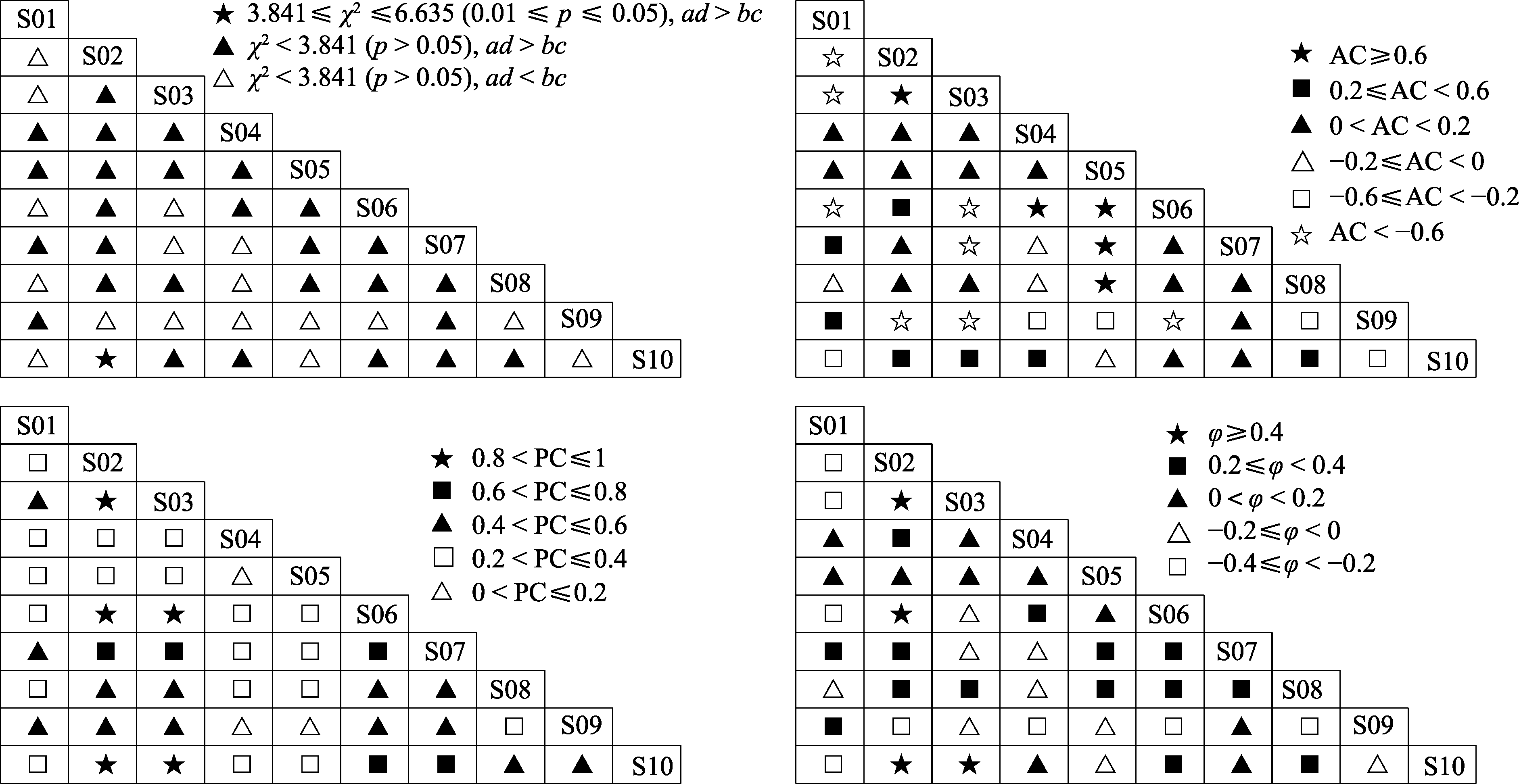
Fig. 3 Interspecific association of major plant species under disturbed conditions caused by plateau pikas. Species No. are the same as in Table 1. AC, association coefficient; PC, percentage co-occurrence; $\varphi$, percentage point correlation.
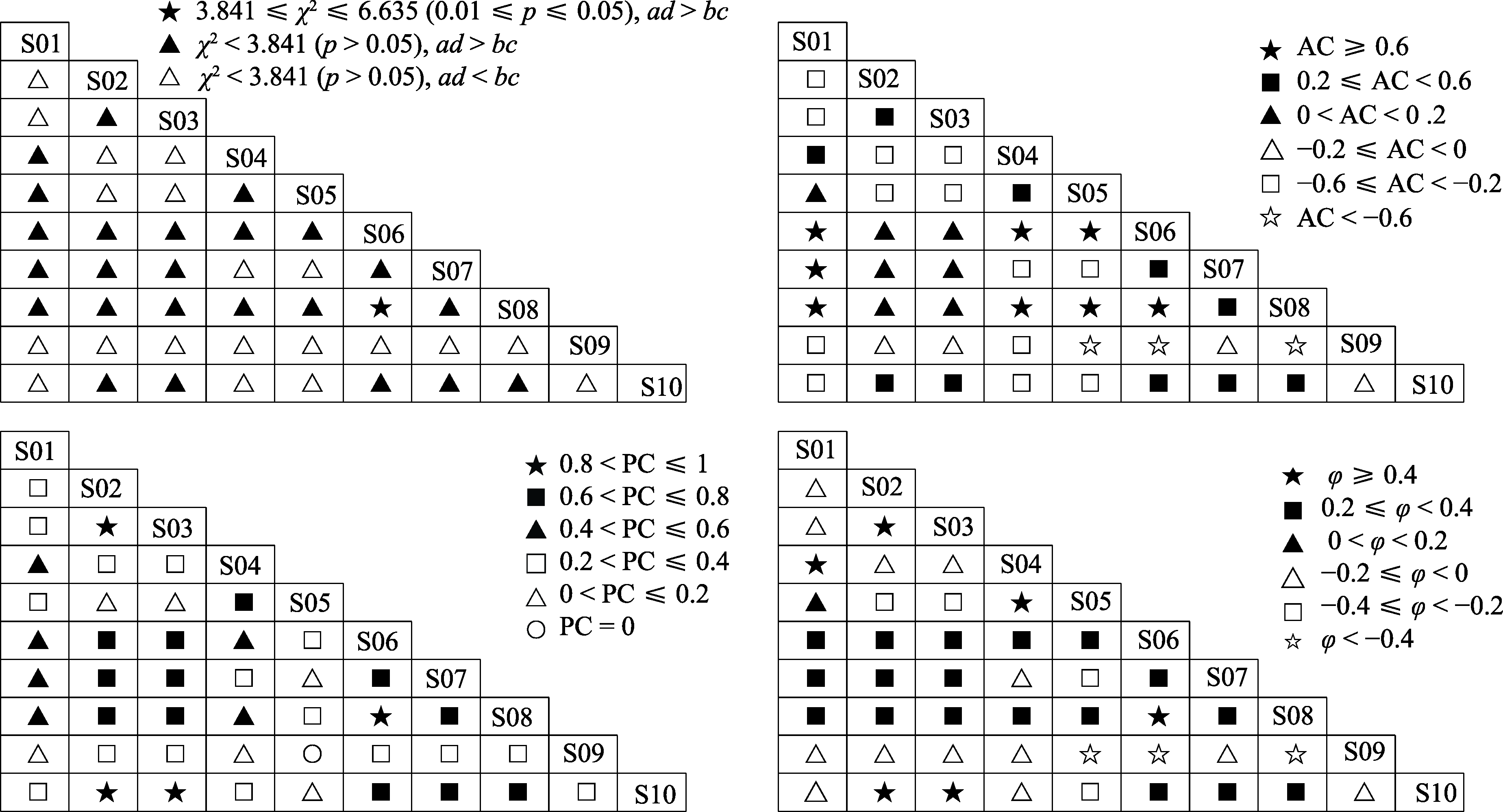
Fig. 4 Interspecific association of major plant species under undisturbed conditions caused by plateau pikas. Species numbers are the same as in Table 1. AC, association coefficient; PC, percentage co-occurrence; $\varphi$, percentage point correlation.
| [1] | An RZ, Zhang P, Da Z, Qiao NQ, Tang QY, Ba S (2021). Niche and interspecific association of dominant protozoan species under different hydrologic periods in the Mitika wetland of Tibet, China. Scientia Silvae Sinicae, 57(2), 126-138. |
| [安瑞志, 张鹏, 达珍, 乔楠茜, 汤秋月, 巴桑 (2021). 西藏麦地卡湿地不同水文期原生动物优势种生态位及其种间联结性. 林业科学, 57(2), 126-138.] | |
| [2] |
Callaway RM, Walker LR (1997). Competition and facilitation: a synthetic approach to interactions in plant communities. Ecology, 78, 1958-1965.
DOI URL |
| [3] |
Cao GM, Tang YH, Mo WH, Wang YS, Li YN, Zhao XQ (2004). Grazing intensity alters soil respiration in an alpine meadow on the Tibetan Plateau. Soil Biology & Biochemistry, 36, 237-243.
DOI URL |
| [4] | Chen L, Xin JN, Su Y, Li YF, Song NP, Wang L, Yang XG, Bian YY, Tian N (2019). Effects of heterogeneous habitats on community composition and niche characteristics of different plant populations in the desert steppe of China. Acta Ecologica Sinica, 39, 6187-6205. |
| [陈林, 辛佳宁, 苏莹, 李月飞, 宋乃平, 王磊, 杨新国, 卞莹莹, 田娜 (2019). 异质生境对荒漠草原植物群落组成和种群生态位的影响. 生态学报, 39, 6187-6205.] | |
| [5] |
Chen XY, Li J, Wang SQ, Tan ZX, Wang R, Zhang Y, Wang YH, Yao BH, Qu JP (2025). Response of plant phylogenetic structure to plateau pika (Ochotona curzoniae) disturbance on alpine meadow of Qinghai-Tibetan Plateau. Land Degradation & Development, 36, 218-230.
DOI URL |
| [6] | Cheng RM, Wang RL, Liu ZB, Feng XH, Wang XR, Xiao WF (2013). Interconnection among species of dominant tree populations of Castanopsis community in Three Gorges Reservoir Region. Scientia Silvae Sinicae, 49(5), 36-42. |
| [程瑞梅, 王瑞丽, 刘泽彬, 封晓辉, 王晓荣, 肖文发 (2013). 三峡库区栲属群落主要乔木种群的种间联结性. 林业科学, 49(5), 36-42.] | |
| [7] |
Chesson P (2000). Mechanisms of maintenance of species diversity. Annual Review of Ecology and Systematics, 31, 343-366.
DOI URL |
| [8] |
Colwell RK, Futuyma DJ (1971). On the measurement of niche breadth and overlap. Ecology, 52, 567-576.
DOI PMID |
| [9] |
Dai DX, Yu CG, Liu H, Yan WC, Sun BB, Jian KK, Xin Y, Zhang WJ (2019). Niche and interspecific association of major nekton in the sea area to the east of the Nanji Islands. Chinese Journal of Applied Ecology, 30, 4249-4258.
DOI |
|
[戴冬旭, 俞存根, 刘惠, 颜文超, 孙蓓蓓, 菅康康, 辛艺, 张文俊 (2019). 南麂列岛东侧海域主要游泳动物生态位及种间联结性. 应用生态学报, 30, 4249-4258.]
DOI |
|
| [10] | Du GZ, Qin GL, Li ZZ, Liu ZH, Dong GS (2003). Relationship between species richness and productivity in an alpine meadow plant community. Acta Phytoecologica Sinica, 27, 125-132. |
|
[杜国祯, 覃光莲, 李自珍, 刘正恒, 董高生 (2003). 高寒草甸植物群落中物种丰富度与生产力的关系研究. 植物生态学报, 27, 125-132.]
DOI |
|
| [11] | Du J, Pu GJ, Suolangwangdui, Wang T,巴桑 (2023). Phenological change and its climatic impact factors of apple under the background of climate warming in south-central Tibet. Chinese Journal of Agrometeorology, 44(3), 171-181. |
| [杜军, 蒲桂娟, 索朗旺堆, 王挺, 巴桑 (2023). 气候变暖背景下西藏中南部苹果物候期变化及其气候影响因子分析. 中国农业气象, 44(3), 171-181.] | |
| [12] |
Elhacham E, Ben-Uri L, Grozovski J, Bar-On YM, Milo R (2020). Global human-made mass exceeds all living biomass. Nature, 588, 442-444.
DOI |
| [13] | Elton C (1927). Animal Ecology. MacMillan, New York. |
| [14] | Feng YC, Zheng XY, Wang ZN, Liu B, Lan SR (2019). Niche characteristics of plant populations in understory herbaceous layer of Cunninghamia lanceolata pure forest and mixed forest. Journal of Ecology and Rural Environment, 35, 217-224. |
| [冯玉超, 郑晓阳, 王正宁, 刘博, 兰思仁 (2019). 杉木纯林和混交林林下草本层种群生态位特征. 生态与农村环境学报, 35, 217-224.] | |
| [15] |
Foggin JM (2008). Depopulating the Tibetan grasslands. Mountain Research and Development, 28, 26-31.
DOI URL |
| [16] | Gause GF (1934). The Struggle for Existence. Williams and Wilkins, Baltimore, USA. |
| [17] | Gen G, Zhou S, Yang K, Wang Y, Yang SW, Liu G, Yang TY, Zha D, Wang ZG (2022). Effects of plateau pika disturbance on plant community and soil physical property of alpine meadow in northwest Sichuan. Grassland and Turf, 42(1), 38-48. |
| [根呷羊批, 周俗, 杨孔, 王钰, 杨思维, 刘刚, 杨廷勇, 扎德, 王泽光 (2022). 高原鼠兔干扰对川西北高寒草甸植物群落及土壤物理性状的影响. 草原与草坪, 42(1), 38-48.] | |
| [18] |
Grime JP (1974). Vegetation classification by reference to strategies. Nature, 250, 26-31.
DOI |
| [19] |
Grime JP (1977). Evidence for the existence of three primary strategies in plants and its relevance to ecological and evolutionary theory. The American Naturalist, 111, 1169-1194.
DOI URL |
| [20] |
Grinnell J (1917). The niche-relationships of the California thrasher. The Auk, 34, 427-433.
DOI URL |
| [21] | Hao JF, Li Y, Qi JQ, Pei ZL, Huang YJ, Jiang Q, Chen Y (2016). Effects of anthropogenic disturbances on the species diversity and niche of the dominant populations in a Castanopsis fargesii secondary forest community in Bifengxia, Sichuan. Acta Ecologica Sinica, 36, 7678-7688. |
| [郝建锋, 李艳, 齐锦秋, 裴曾莉, 黄雨佳, 蒋倩, 陈亚 (2016). 人为干扰对碧峰峡栲树次生林群落物种多样性及其优势种群生态位的影响. 生态学报, 36, 7678-7688.] | |
| [22] | Holling CS (1973). Resilience and Stability of Ecological Systems. Cambridge University Press, Cambridge, UK. |
| [23] | Huang SD, Nie S, Xiao XX, Huang YP, Lin J, Gao W (2023). Niches and interspecific associations of dominant tree populations of Castanopsis carlesii (Hemsl.) Hay. in Wuyi Mountain. Plant Science Journal, 41, 291-300. |
| [黄石德, 聂森, 肖祥希, 黄云鹏, 林捷, 高伟 (2023). 武夷山米槠群落优势种群生态位与种间联结. 植物科学学报, 41, 291-300.] | |
| [24] | Huo XK, Wang YG, Zhou LT, Wang SH, Jiang X, Chen K, Wang PF (2024). Characterization of the ecological niche and interspecific connectivity of plankton in baiyangdian lake by combining ecological networks. Environmental Science, 45, 5298-5307. |
| [霍笑康, 王永刚, 周灵同, 王书航, 姜霞, 陈珂, 王鹏飞 (2024). 结合生态网络解析白洋淀浮游生物生态位和种间联结性特征. 环境科学, 45, 5298-5307.] | |
| [25] | Levins R (1968). Evolution in Changing Environments: Some Theoretical Explorations. Princeton University Press, Princeton. |
| [26] | Li DZ, Shi Q, Zang RG, Wang XP, Sheng LJ, Zhu ZL, Wang CA (2006). Models for niche breadth and niche overlap of species or populations. Scientia Silvae Sinicae, 42(7), 95-103. |
| [李德志, 石强, 臧润国, 王绪平, 盛丽娟, 朱志玲, 王长爱 (2006). 物种或种群生态位宽度与生态位重叠的计测模型. 林业科学, 42(7), 95-103.] | |
| [27] | Li JL, Zhang JT (2006). Niche of dominant species in the midst of Taihang Mountain. Bulletin of Botanical Research, 26, 2156-2162. |
| [李军玲, 张金屯 (2006). 太行山中段植物群落优势种生态位研究. 植物研究, 26, 2156-2162.] | |
| [28] | Liang D, Xia J, Song JX, Chang JB, Wu Q, Cheng DD, Zhang YX, Kong FH, Ren YX (2021). Diversity of zooplankton and niche characteristics of keystone species in the Weihe River based on eDNA. Environmental Science, 42, 4708-4716. |
| [梁东, 夏军, 宋进喜, 常剑波, 吴琼, 程丹东, 张怡晅, 孔飞鹤, 任源鑫 (2021). 基于eDNA技术的渭河浮游动物多样性及关键种生态位特征. 环境科学, 42, 4708-4716.] | |
| [29] |
Liu Y, Zhang YQ, Song WT, Gong QL, Liu A, Chen JL, An RZ, Ba S (2024). The spatio-temporal dynamics and ecological adaptability of dominant phytoplankton species in Lhalu Wetland, Tibet, China. Journal of Lake Sciences, 36, 1864-1878.
DOI URL |
| [刘洋, 张艳秋, 宋文涛, 龚秋丽, 刘傲, 陈俊霖, 安瑞志, 巴桑 (2024). 西藏拉鲁湿地浮游植物优势种时空动态及其生态适应性. 湖泊科学, 36, 1864-1878.] | |
| [30] |
Liu YS, Fan JW, Harris W, Shao QQ, Zhou YC, Wang N, Li YZ (2013). Effects of plateau pika (Ochotona curzoniae) on net ecosystem carbon exchange of grassland in the Three Rivers Headwaters region, Qinghai-Tibet, China. Plant and Soil, 366, 491-504.
DOI URL |
| [31] | Meng DP, Wang CH, Xin XY, Zhang JT (2006). Niche analysis of algae species in Taiyuan segment of Fenhe River. Environmental Science & Technology, 29(10), 95-97. |
| [孟东平, 王翠红, 辛晓芸, 张金屯 (2006). 汾河太原段水体浮游藻类生态位的研究. 环境科学与技术, 29(10), 95-97.] | |
| [32] |
Meng FS, Shi PL, Yan W, He YT (2013). The function of cushion plants in alpine ecosystems: patterns and mechanisms. Chinese Journal of Applied and Environmental Biology, 19, 561-568.
DOI URL |
| [孟丰收, 石培礼, 闫巍, 何永涛 (2013). 垫状植物在高山生态系统中的功能: 格局与机制. 应用与环境生物学报, 19, 561-568.] | |
| [33] | Migmar WD, Xu GQ, Renzeng, Liu YJ, Wang K (2018). Niche overlapping by the summer sympatric species grey-backed shrike (Lanius tephronotus) and rufous turtle dove (Streptopelia orientalis) in Lhasa, Tibet Autonomous Region. Plateau Science Research, 2(3), 1-9. |
| [米玛旺堆, 许国琪, 仁增, 刘宇佳, 王凯 (2018). 西藏拉萨市区夏季同域物种灰背伯劳与山斑鸠生态位重叠初探. 高原科学研究, 2(3), 1-9.] | |
| [34] | Niu HH, Chen H, Fu Y, Yang Y, Zhang SQ, Zhang BX (2019). Ecological niche characteristics of desert plants in the eastern Qaidam Basin. Acta Ecologica Sinica, 39, 2862-2871. |
| [牛慧慧, 陈辉, 付阳, 杨祎, 张斯琦, 张博雄 (2019). 柴达木盆地东部荒漠植物生态位特征. 生态学报, 39, 2862-2871.] | |
| [35] | Pang CH, Fan X, Zhang F, Ni RJ, Feng XJ, Ma XB (2015). The niches of dominant species in different resource dimensions in the lower reaches of Fenhe River, Shanxi Province of China. Chinese Journal of Ecology, 34, 380-386. |
| [庞春花, 范晓, 张峰, 倪瑞军, 冯晓佳, 马晓波 (2015). 不同资源维度上汾河流域下游优势种的生态位. 生态学杂志, 34, 380-386.] | |
| [36] |
Pianka ER (1973). The structure of lizard communities. Annual Review of Ecology and Systematics, 4, 53-74.
DOI URL |
| [37] |
Pianka ER (1974). Niche overlap and diffuse competition. Proceedings of the National Academy of Sciences of the United States of America, 71, 2141-2145.
PMID |
| [38] | Shao ZT, Qin Y (2022). Advance in studying the influence of plateau pikas disturbance on carbon cycle of alpine grasslands. Acta Agrestia Sinica, 30, 1086-1094. |
|
[邵梓桐, 秦彧 (2022). 高原鼠兔干扰对高寒草地碳循环的影响研究进展. 草地学报, 30, 1086-1094.]
DOI |
|
| [39] |
Smith AT, Badingqiuying, Wilson MC, Hogan BW (2019). Functional-trait ecology of the plateau pika Ochotona curzoniae in the Qinghai-Tibetan Plateau ecosystem. Integrative Zoology, 14, 87-103.
DOI URL |
| [40] | Song XZ, Migmar W (2021). Study on difference of plant community characteristics between Ochotona curzoniae disturbed and non disturbed in an alpine meadow ecosystem. Heilongjiang Agricultural Sciences, (7), 28-34. |
| [宋璇紫, 米玛旺堆 (2021). 高寒草甸生态系统中高原鼠兔干扰与非干扰的植物群落特征差异研究. 黑龙江农业科学, (7), 28-34.] | |
| [41] | Song YC (2001). Vegetation Ecology. East China Normal University Press, Shanghai. |
| [宋永昌 (2001). 植被生态学. 华东师范大学出版社, 上海.] | |
| [42] | Su XX, Li XL, Sun HF, Song ZH, Li JX, Zhang J (2024). Effects of plateau pika and mowing disturbances on plant community and soil physical and chemical properties in alpine meadow. Acta Ecologica Sinica, 44, 10189-10199. |
| [苏晓雪, 李希来, 孙华方, 宋梓涵, 李杰霞, 张静 (2024). 高原鼠兔和刈割扰动对高寒草甸植物群落和土壤特征的影响. 生态学报, 44, 10189-10199.] | |
| [43] | Tilman D (1982). Resource Competition and Community Structure. Princeton University Press, Princeton, USA. |
| [44] | Wan LF, Liu GH, Fan H, Liu J, Ni J, Shi SL, Shen Y, Cheng H, Su XK (2024). Niche characteristics and diversity influencing factors of forest community on the southeastern Qinghai-Tibet Plateau. Acta Ecologica Sinica, 44, 5658-5668. |
| [万凌凡, 刘国华, 樊辉, 柳江, 倪健, 石松林, 申宇, 程浩, 苏旭坤 (2024). 青藏高原东南部森林群落生态位特征与物种多样性的影响因素. 生态学报, 44, 5658-5668.] | |
| [45] |
Wang CT, Long RJ, Ding LM (2004). The effects of differences in functional group diversity and composition on plant community productivity in four types of alpine meadow communities. Biodiversity Science, 12, 403-409.
DOI URL |
|
[王长庭, 龙瑞军, 丁路明 (2004). 高寒草甸不同草地类型功能群多样性及组成对植物群落生产力的影响. 生物多样性, 12, 403-409.]
DOI |
|
| [46] | Wang RZ (1997). The niche breadths and niche overlaps of main plant populations in Leymus chinensis grassland for grazing. Acta Phytoecologica Sinica, 21, 304-311. |
| [王仁忠 (1997). 放牧影响下羊草草地主要植物种群生态位宽度与生态位重叠的研究. 植物生态学报, 21, 304-311.] | |
| [47] | Wang XF, Guo QS, Bahar GL, Liu ZY, Ren MB (2008). Niche of dominant arbor populations in Thuja sutchuenensis community. Scientia Silvae Sinicae, 44(4), 6-13. |
| [王祥福, 郭泉水, 巴哈尔古丽, 刘正宇, 任明波 (2008). 崖柏群落优势乔木种群生态位. 林业科学, 44(4), 6-13.] | |
| [48] | Wei ZJ, Niu FB, Liu HM, Lv SJ, Liu WT (2015). Study on response of niche of Stipa breviflora desert steppe plant populations to grazing. Chinese Journal of Grassland, 37(5), 24-32. |
| [卫智军, 牛富宝, 刘红梅, 吕世杰, 刘文亭 (2015). 短花针茅荒漠草原植物种群生态位对放牧的响应. 中国草地学报, 37(5), 24-32.] | |
| [49] | Wu KT, Zhang Y, Ma YD, Zheng QZ, Yue HT, Wang XR, Liang KM, Zeng H (2023). Relationship between plant diversity and plant competition intensity andniche overlap across a habitat gradient in Zoige. Acta Ecologica Sinica, 43, 10334-10344. |
| [吴凯婷, 张勇, 马燕丹, 郑秋竹, 岳海涛, 王晓蓉, 梁克敏, 曾昊 (2023). 若尔盖不同生境植物多样性与植物竞争强度和生态位重叠度的关系. 生态学报, 43, 10334-10344.] | |
| [50] | Wu YL, Wei ZJ, Yun XJ, Lv SJ (2018). Effects of continuous grazing on niche and ecological attribute of plant populations in Stipa breviflora desert steppe. Chinese Journal of Grassland, 40(2), 81-88. |
| [吴艳玲, 卫智军, 运向军, 吕世杰 (2018). 放牧对短花针茅荒漠草原植物种群生态位及生态属性的影响. 中国草地学报, 40(2), 81-88.] | |
| [51] |
Wu Z, Peng YF, Yang GB, Li QL, Liu Y, Ma LH, Yang YH, Jiang XJ (2022). Effects of land degradation on soil and microbial stoichiometry in Qingzang Plateau alpine grasslands. Chinese Journal of Plant Ecology, 46, 461-472.
DOI |
|
[吴赞, 彭云峰, 杨贵彪, 李秦鲁, 刘洋, 马黎华, 杨元合, 蒋先军 (2022). 青藏高原高寒草地退化对土壤及微生物化学计量特征的影响. 植物生态学报, 46, 461-472.]
DOI |
|
| [52] | Xu MH, Liu M, Zhai DT, Liu T (2016). A review of contents and methods used to analyze various aspects of plant interspecific associations. Acta Ecologica Sinica, 36, 8224-8233. |
| [徐满厚, 刘敏, 翟大彤, 刘彤 (2016). 植物种间联结研究内容与方法评述. 生态学报, 36, 8224-8233.] | |
| [53] | Yan TF, Cong PT, Liu XH, Zu YG (1999). Effect analysis of environmental factors on plant niche breadth. Journal of Northeast Forestry University, 27(1), 36-39. |
| [颜廷芬, 丛沛桐, 刘兴华, 祖元刚 (1999). 环境因子对植物生态位宽度影响程度分析. 东北林业大学学报, 27(1), 36-39.] | |
| [54] | Yang LJ, Li XL, Shi DJ, Sun HQ, Yang YW (2005). Research or regulation of vegetation succession in degraded grassland in Qinghai and Tibetan Plateau. Qinghai Prataculture, 14(1), 2-5. |
| [杨力军, 李希来, 石德军, 孙海群, 杨元武 (2005). 青藏高原“黑土滩”退化草地植被演替规律的研究. 青海草业, 14(1), 2-5.] | |
| [55] | Yin ZH, Chen XF, La D (2023). Analysis on the niche and interspecific association of dominant plant species in alpine meadow under simulated warming and grazing. Acta Agrestia Sinica, 31, 1302-1313. |
|
[尹正辉, 陈新丰, 拉多 (2023). 模拟增温和放牧对高寒草甸主要植物生态位及种间联结的影响. 草地学报, 31, 1302-1313.]
DOI |
|
| [56] | Zhang JG, Liu DW, Meng BP, Chen JJ, Wang XY, Jiang H, Yu Y, Yi SH (2021). Using UAVs to assess the relationship between alpine meadow bare patches and disturbance by pikas in the source region of Yellow River on the Qinghai-Tibetan Plateau. Global Ecology and Conservation, 26, e01517. DOI: 10.1016/j.gecco.2021.e01517. |
| [57] | Zhang JT (2004). Quantitative Ecology. Science Press, Beijing. |
| [张金屯 (2004). 数量生态学. 科学出版社, 北京.] | |
| [58] |
Zhang LN, Zhu GQ, Yang K, Liu XY, Gong HD, Zheng L (2022). Niche and interspecific association of main woody plants in Myrica nana shrubland in central Yunnan, China. Chinese Journal of Plant Ecology, 46, 1400-1410.
DOI URL |
|
[张零念, 朱贵青, 杨宽, 刘星月, 巩合德, 郑丽 (2022). 滇中云南杨梅灌丛主要木本植物生态位与种间联结. 植物生态学报, 46, 1400-1410.]
DOI |
|
| [59] | Zhang P, Liu Y, An RZ, Qiao NQ, Da Z, Ba S (2022). Spatio-temporal niche of dominant protozoa species in the midstream and downstream of Lhasa River, Tibet, China. Scientia Silvae Sinicae, 58(1), 78-88. |
| [张鹏, 刘洋, 安瑞志, 乔楠茜, 达珍, 巴桑 (2022). 西藏拉萨河中下游原生动物优势种时空生态位. 林业科学, 58(1), 78-88.] | |
| [60] | Zhao DS, Zhang XM (2021). Review of alternative stable states theory in ecosystem. Acta Ecologica Sinica, 41, 6314-6328. |
| [赵东升, 张雪梅 (2021). 生态系统多稳态研究进展. 生态学报, 41, 6314-6328.] | |
| [61] | Zhou HK, Zhao XQ, Wen J, Chen Z, Yao BQ, Yang YW, Xu WX, Duan JC (2012). The characteristics of soil and vegetation of degenerated alpine steppe in the Yellow River Source Region. Acta Prataculturae Sinica, 21(5), 1-11. |
| [周华坤, 赵新全, 温军, 陈哲, 姚步青, 杨元武, 徐维新, 段吉闯 (2012). 黄河源区高寒草原的植被退化与土壤退化特征. 草业学报, 21(5), 1-11.] | |
| [62] | Zobel M (1992). Plant species coexistence: the role of historical, evolutionary and ecological factors. Oikos, 314-320. |
| [1] | Li Yi, Huang Huan, Chao ZHAO Yan, CHEN Li-Tong. Effects of nutrient addition on community diversity and composition of alpine meadows across elevations [J]. Chin J Plant Ecol, 2026, 50(预发表): 0-. |
| [2] | ZHENG Zi-Yi, CHEN Jiang-Hui, LIU Hui-Ying. Climate warming increases root exudation rates of dominant species in alpine meadow on the Qingzang Plateau [J]. Chin J Plant Ecol, 2025, 49(9): 1363-1373. |
| [3] | ZHANG Fa-Wei, LI Hong-Qin, ZHU Jing-Bin, FAN Bo, ZHOU Hua-Kun, LI Ying-Nian, LIANG Nai-Shen. Response of aboveground and belowground carbon storage to nitrogen addition and precipitation change in an alpine meadow ecosystem [J]. Chin J Plant Ecol, 2025, 49(9): 1399-1409. |
| [4] | GE Xiao-Cai, LI Jing-Long, SUN Jun, WU Pan-Pan, HU Dan-Dan, CHENG Dong-Liang, ZHONG Quan-Lin. Characteristics of soil respiration components and influencing factors in the subalpine meadows of Wuyi Mountain [J]. Chin J Plant Ecol, 2025, 49(3): 502-512. |
| [5] | ZHENG Li-Yuan, XU Xi-Zhu, YIN Jia-Qi, SUN Xiao-Wen, WANG Yan. Niche and interspecific associations of Glycine soja community on abandoned farmland near a river in suburban [J]. Chin J Plant Ecol, 2025, 49(10): 1685-1697. |
| [6] | YAO Bao-Hui, WANG Rong, TAN Zhao-Xian, ZHANG Yan, WANG Yi-Hong, WANG Su-Qin, ZHOU Hua-Kun, QU Jia-Peng. Effects of Eimeria spp. control of plateau pika on the plant community characteristics of alpine grassland [J]. Chin J Plant Ecol, 2025, 49(1): 199-210. |
| [7] | XU Jia-Xin, XIAO Yuan-Ming, WANG Xiao-Yun, WANG Wen-Ying, MA Yu-Hua, LI Qiang-Feng, ZHOU Guo-Ying. Effects of microbial fertilizer and nitrogen and phosphorus fertilizer backfilling on soil physicochemical properties and enzyme activities in degraded alpine meadows [J]. Chin J Plant Ecol, 2025, 49(1): 159-172. |
| [8] | WANG Wen-Ying, XIAO Yuan-Ming, WANG Xiao-Yun, XU Jia-Xin, MA Yu-Hua, LI Qiang-Feng, ZHOU Guo-Ying. Relationship between plant diversity and ecosystem multifunctionality in degraded alpine meadows under multifunctional group species combination models [J]. Chin J Plant Ecol, 2025, 49(1): 103-117. |
| [9] | ZHANG Hui, ZHAO Yun-Peng, LIU Xiao-Chen, GUO Zeng-Peng, HU Guo-Rui, FENG Yan-Hao, MA Miao-Jun. Dynamics of soil seed bank and its role in plant community regeneration during alpine meadow degradation [J]. Chin J Plant Ecol, 2025, 49(1): 74-82. |
| [10] | MA Dong-Feng, JIA Cun-Zhi, WANG Xue-Peng, ZHAO Peng-Peng, HU Xiao-Wen. Effect of multi-species grouping on restoration of alpine degraded meadows in Gannan, China [J]. Chin J Plant Ecol, 2025, 49(1): 93-102. |
| [11] | LIU Wei-Hui, SONG Xiao-Yan, CAIRENDUOJIE , DING Lu-Ming, WANG Chang-Ting. Effects of degradation degree on the root morphological traits and biomass of dominant plant species in alpine meadows [J]. Chin J Plant Ecol, 2024, 48(12): 1666-1682. |
| [12] | LI Hong-Qin, ZHANG Fa-Wei, YI Lü-Bei. Stoichiometric responses in topsoil and leaf of dominant species to precipitation change and nitrogen addition in an alpine meadow [J]. Chin J Plant Ecol, 2023, 47(7): 922-931. |
| [13] | LÜ Zi-Li, LIU Bin, CHANG Feng, MA Zi-Jing, CAO Qiu-Mei. Relationship between plant functional diversity and ecosystem multifunctionality in Bayanbulak alpine meadow along an altitude gradient [J]. Chin J Plant Ecol, 2023, 47(6): 822-832. |
| [14] | LI Wei, ZHANG Rong. Case verification of community structure determining community productivity in subalpine meadow [J]. Chin J Plant Ecol, 2023, 47(5): 713-723. |
| [15] | XIA Jing-Yu, ZHANG Yang-Jian, ZHENG Zhou-Tao, ZHAO Guang, ZHAO Ran, ZHU Yi-Xuan, GAO Jie, SHEN Ruo-Nan, LI Wen-Yu, ZHENG Jia-He, ZHANG Yu-Xue, ZHU Jun-Tao, SUN Osbert Jianxin. Asynchronous response of plant phenology to warming in a Kobresia pygmaea meadow in Nagqu, Qingzang Plateau [J]. Chin J Plant Ecol, 2023, 47(2): 183-194. |
| Viewed | ||||||
|
Full text |
|
|||||
|
Abstract |
|
|||||
Copyright © 2026 Chinese Journal of Plant Ecology
Tel: 010-62836134, 62836138, E-mail: apes@ibcas.ac.cn, cjpe@ibcas.ac.cn

