
Chin J Plant Ecol ›› 2026, Vol. 50 ›› Issue (1): 188-201.DOI: 10.17521/cjpe.2025.0047 cstr: 32100.14.cjpe.2025.0047
• Research Articles • Previous Articles Next Articles
XIA Qi, NIE Xiu-Qing, CHEN Yi-Qun, LIU Shi-Rong*( )
)
Received:2025-02-09
Accepted:2025-05-01
Online:2026-01-20
Published:2026-02-13
Contact:
LIU Shi-Rong
Supported by:XIA Qi, NIE Xiu-Qing, CHEN Yi-Qun, LIU Shi-Rong. Metabolomics analysis of root exudates in southern subtropical pure and mixed stands[J]. Chin J Plant Ecol, 2026, 50(1): 188-201.
Add to citation manager EndNote|Ris|BibTeX
URL: https://www.plant-ecology.com/EN/10.17521/cjpe.2025.0047
| 指标 Indicator | 马尾松纯林 Pinus massoniana stands | 格木纯林 Erythrophleum fordii stands | 马尾松×格木混交林 P. massoniana × E. fordii mixed stands |
|---|---|---|---|
| 树种特性 Tree species properties | 速生、针叶 Fast-growing, coniferous | 固氮、阔叶 Nitrogen-fixing, broadleaf | 速生、针叶(马尾松) 固氮、阔叶(格木) Fast-growing, coniferous (Pinus massoniana ) Nitrogen-fixing, broadleaf (Erythrophleum fordii) |
| 林龄 Stand age (a) | 22 | 22 | 20 |
| 生长阶段 Growth stage | 近熟林 Near-mature | 近熟林 Near-mature | 近熟林 Near-mature |
| 土壤类型 Soil type | 赤红壤 Lateritic red soil | 赤红壤 Lateritic red soil | 赤红壤 Lateritic red soil |
| 林分密度 Stand density (Ind.·hm-2) | 1 615 ± 115 | 1 633 ± 236 | 1 575 ± 148 |
| 胸径 Diameter at breast height (cm) | 17.53 ± 3.40 | 13.52 ± 3.69 | 17.37 ± 3.12 |
| 树高 Tree height (m) | 15.94 ± 1.12 | 13.67 ± 2.19 | 15.42 ± 1.11 |
| 海拔 Altitude (m) | 274 ± 6 | 246 ± 4 | 216 ± 4 |
| 坡度 Slope (°) | 12 ± 2 | 13 ± 1 | 10 ± 2 |
Table 1 Tree species properties and stand characteristics of southern subtropical pure and mixed stands (mean ± SE)
| 指标 Indicator | 马尾松纯林 Pinus massoniana stands | 格木纯林 Erythrophleum fordii stands | 马尾松×格木混交林 P. massoniana × E. fordii mixed stands |
|---|---|---|---|
| 树种特性 Tree species properties | 速生、针叶 Fast-growing, coniferous | 固氮、阔叶 Nitrogen-fixing, broadleaf | 速生、针叶(马尾松) 固氮、阔叶(格木) Fast-growing, coniferous (Pinus massoniana ) Nitrogen-fixing, broadleaf (Erythrophleum fordii) |
| 林龄 Stand age (a) | 22 | 22 | 20 |
| 生长阶段 Growth stage | 近熟林 Near-mature | 近熟林 Near-mature | 近熟林 Near-mature |
| 土壤类型 Soil type | 赤红壤 Lateritic red soil | 赤红壤 Lateritic red soil | 赤红壤 Lateritic red soil |
| 林分密度 Stand density (Ind.·hm-2) | 1 615 ± 115 | 1 633 ± 236 | 1 575 ± 148 |
| 胸径 Diameter at breast height (cm) | 17.53 ± 3.40 | 13.52 ± 3.69 | 17.37 ± 3.12 |
| 树高 Tree height (m) | 15.94 ± 1.12 | 13.67 ± 2.19 | 15.42 ± 1.11 |
| 海拔 Altitude (m) | 274 ± 6 | 246 ± 4 | 216 ± 4 |
| 坡度 Slope (°) | 12 ± 2 | 13 ± 1 | 10 ± 2 |
| 指标 Indicator | 马尾松纯林 Pinus massoniana stands | 格木纯林 Erythrophleum fordii stands | 马尾松×格木混交林 P. massoniana × E. fordii mixed stands |
|---|---|---|---|
| pH | 3.56 ± 0.02b | 3.68 ± 0.04a | 3.62 ± 0.03a |
| 含水量 Water content (%) | 31.67 ± 1.74a | 30.46 ± 2.50a | 31.21 ± 1.29a |
| 容重 Bulk density (g·cm-3) | 1.26 ± 0.02a | 1.21 ± 0.03a | 1.28 ± 0.01a |
| 粉粒含量 Silt content (%) | 20.30 ± 1.83a | 5.79 ± 0.76b | 16.73 ± 2.50a |
| 黏粒含量 Clay content (%) | 25.48 ± 1.22a | 7.43 ± 0.79b | 21.95 ± 3.70a |
| 有机碳含量 Organic carbon content (g·kg-1) | 15.08 ± 1.11b | 21.06 ± 1.03a | 14.76 ± 0.43b |
| 全氮含量 Total nitrogen content (g·kg-1) | 1.33 ± 0.05b | 1.60 ± 0.07a | 1.50 ± 0.17a |
| 有效氮含量 Available nitrogen content (mg·kg-1) | 120.33 ± 9.85a | 139.79 ± 5.27a | 139.43 ± 3.09a |
| 全磷含量 Total phosphorus content (g·kg-1) | 0.22 ± 0.04a | 0.27 ± 0.03a | 0.30 ± 0.01a |
| 碳氮比 Ratio of carbon to nitrogen | 11.40 ± 0.87b | 13.20 ± 0.62a | 10.09 ± 0.72b |
| 氮磷比 Ratio of nitrogen to phosphorus | 6.59 ± 0.42a | 6.12 ± 0.66ab | 5.15 ± 0.18b |
| 微生物生物量碳含量 Microbial biomass carbon content (mg·kg-1) | 599.71 ± 73.98b | 1 526.31 ± 150.64a | 849.13 ± 43.81b |
| 微生物生物量氮含量 Microbial biomass nitrogen content (mg·kg-1) | 49.14 ± 5.66c | 140.25 ± 9.52a | 96.72 ± 3.25b |
| 微生物量碳氮比 Ratio of microbial biomass carbon to microbial biomass nitrogen | 12.21 ± 0.44a | 10.80 ± 0.40a | 8.81 ± 0.35b |
Table 2 Soil properties of experimental plots of southern subtropical pure and mixed stands (mean ± SE)
| 指标 Indicator | 马尾松纯林 Pinus massoniana stands | 格木纯林 Erythrophleum fordii stands | 马尾松×格木混交林 P. massoniana × E. fordii mixed stands |
|---|---|---|---|
| pH | 3.56 ± 0.02b | 3.68 ± 0.04a | 3.62 ± 0.03a |
| 含水量 Water content (%) | 31.67 ± 1.74a | 30.46 ± 2.50a | 31.21 ± 1.29a |
| 容重 Bulk density (g·cm-3) | 1.26 ± 0.02a | 1.21 ± 0.03a | 1.28 ± 0.01a |
| 粉粒含量 Silt content (%) | 20.30 ± 1.83a | 5.79 ± 0.76b | 16.73 ± 2.50a |
| 黏粒含量 Clay content (%) | 25.48 ± 1.22a | 7.43 ± 0.79b | 21.95 ± 3.70a |
| 有机碳含量 Organic carbon content (g·kg-1) | 15.08 ± 1.11b | 21.06 ± 1.03a | 14.76 ± 0.43b |
| 全氮含量 Total nitrogen content (g·kg-1) | 1.33 ± 0.05b | 1.60 ± 0.07a | 1.50 ± 0.17a |
| 有效氮含量 Available nitrogen content (mg·kg-1) | 120.33 ± 9.85a | 139.79 ± 5.27a | 139.43 ± 3.09a |
| 全磷含量 Total phosphorus content (g·kg-1) | 0.22 ± 0.04a | 0.27 ± 0.03a | 0.30 ± 0.01a |
| 碳氮比 Ratio of carbon to nitrogen | 11.40 ± 0.87b | 13.20 ± 0.62a | 10.09 ± 0.72b |
| 氮磷比 Ratio of nitrogen to phosphorus | 6.59 ± 0.42a | 6.12 ± 0.66ab | 5.15 ± 0.18b |
| 微生物生物量碳含量 Microbial biomass carbon content (mg·kg-1) | 599.71 ± 73.98b | 1 526.31 ± 150.64a | 849.13 ± 43.81b |
| 微生物生物量氮含量 Microbial biomass nitrogen content (mg·kg-1) | 49.14 ± 5.66c | 140.25 ± 9.52a | 96.72 ± 3.25b |
| 微生物量碳氮比 Ratio of microbial biomass carbon to microbial biomass nitrogen | 12.21 ± 0.44a | 10.80 ± 0.40a | 8.81 ± 0.35b |
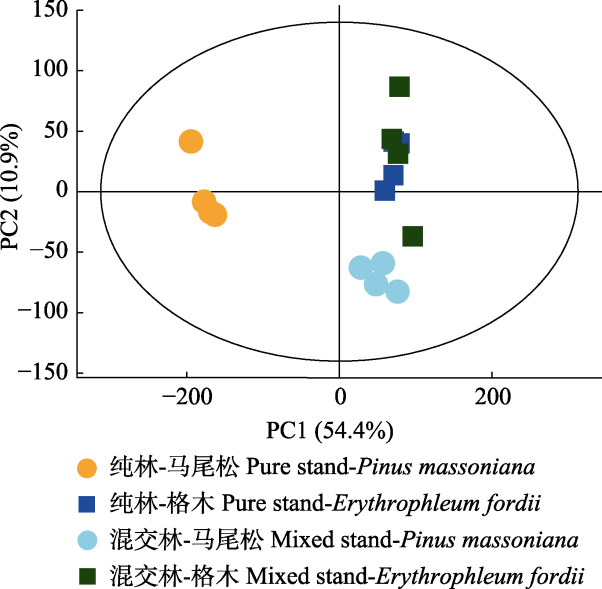
Fig. 1 Score scatter plot of principal component (PC) analysis model for all detected root exudation metabolites. Each scatter represents a sample, differ color and shape indicate different groupings.
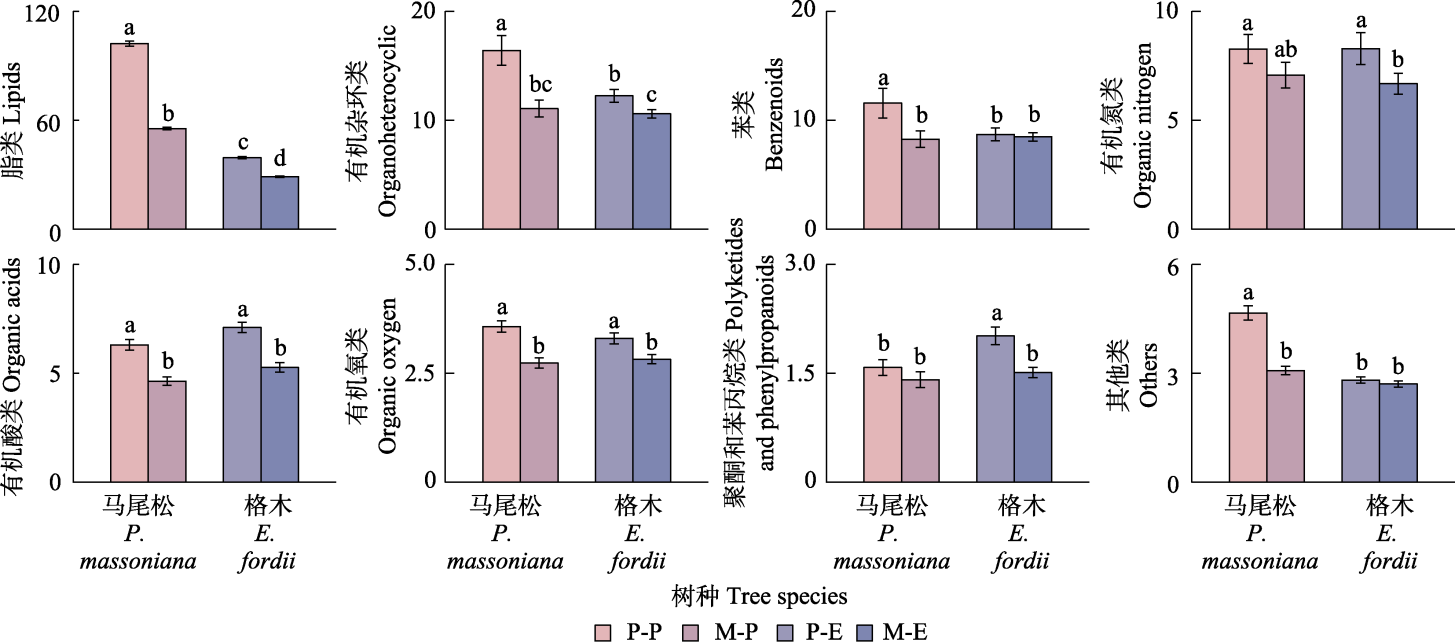
Fig. 2 Relative quantitative values of metabolite composition in root exudates of Pinus massoniana and Erythrophleum fordii among forest stands (mean ± SE). Different lowercase letters indicate significant differences between tree species (p < 0.05). M-E, E. fordii in mixed stand; M-P, P. massoniana in mixed stand; P-E, E. fordii in pure stand; P-P, P. massoniana in pure stand.
| 差异代谢物状态 Differential metabolite status | 马尾松纯林-混交林对比 P. massoniana pure-mixed stand comparison | 格木纯林-混交林对比 E. fordii pure-mixed stand comparison |
|---|---|---|
| 上调 Up-regulated | 199 | 103 |
| 下调 Down-regulated | 9 | 3 |
Table 3 Differential metabolite quantities of Pinus massoniana and Erythrophleum fordii in pure and mixed plantations
| 差异代谢物状态 Differential metabolite status | 马尾松纯林-混交林对比 P. massoniana pure-mixed stand comparison | 格木纯林-混交林对比 E. fordii pure-mixed stand comparison |
|---|---|---|
| 上调 Up-regulated | 199 | 103 |
| 下调 Down-regulated | 9 | 3 |
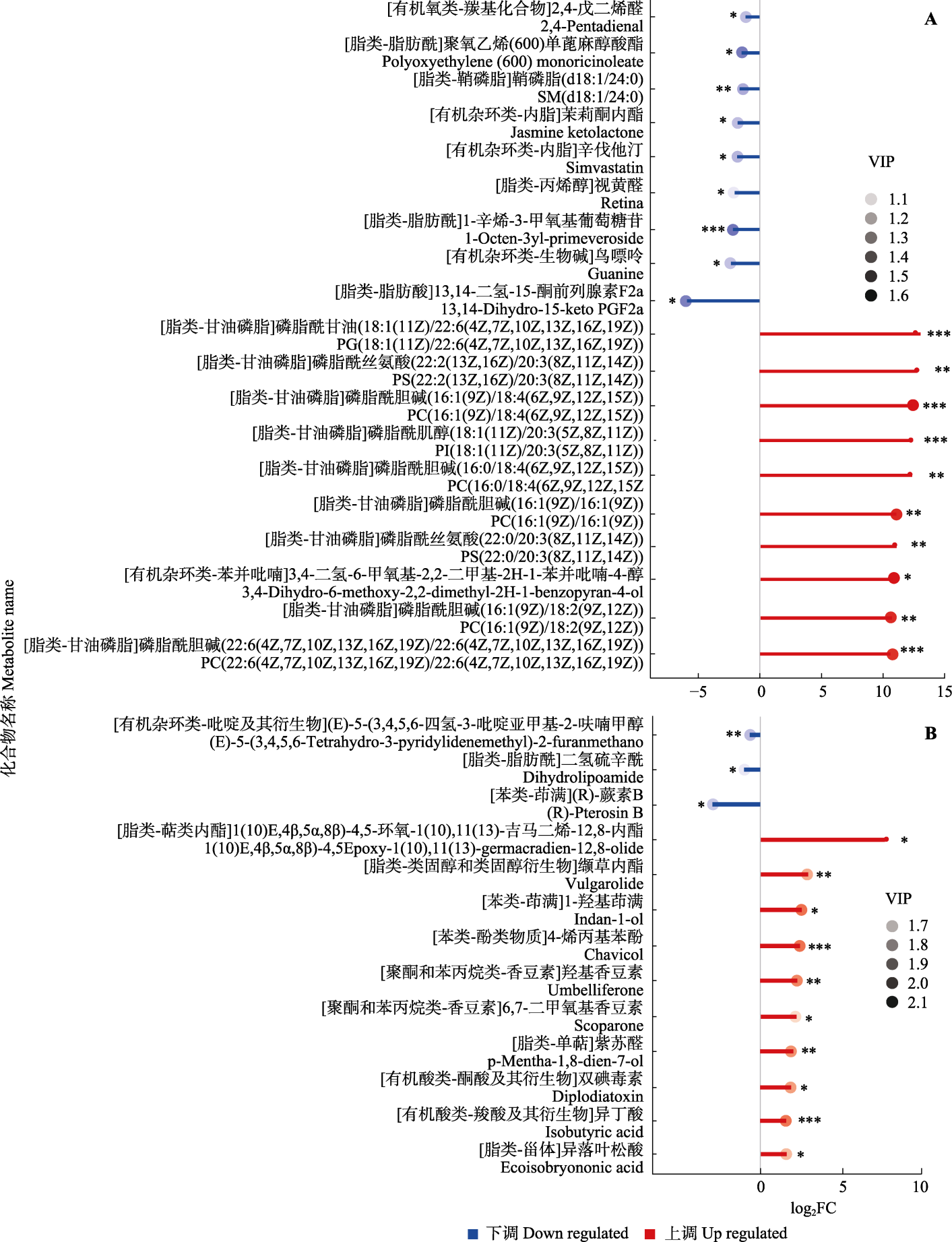
Fig. 3 Matchstick analysis for top 10 differential metabolites variable importance in the projection (VIP) value of Pinus massoniana (A) and Erythrophleum fordii (B) in pure and mixed plantations. Chinese name of compounds is expressed as [HMDB class-HMDB subclass]MS2 names. Dot color represents the value of VIP value. *, p < 0.05; **, p < 0.01; ***, p < 0.001.
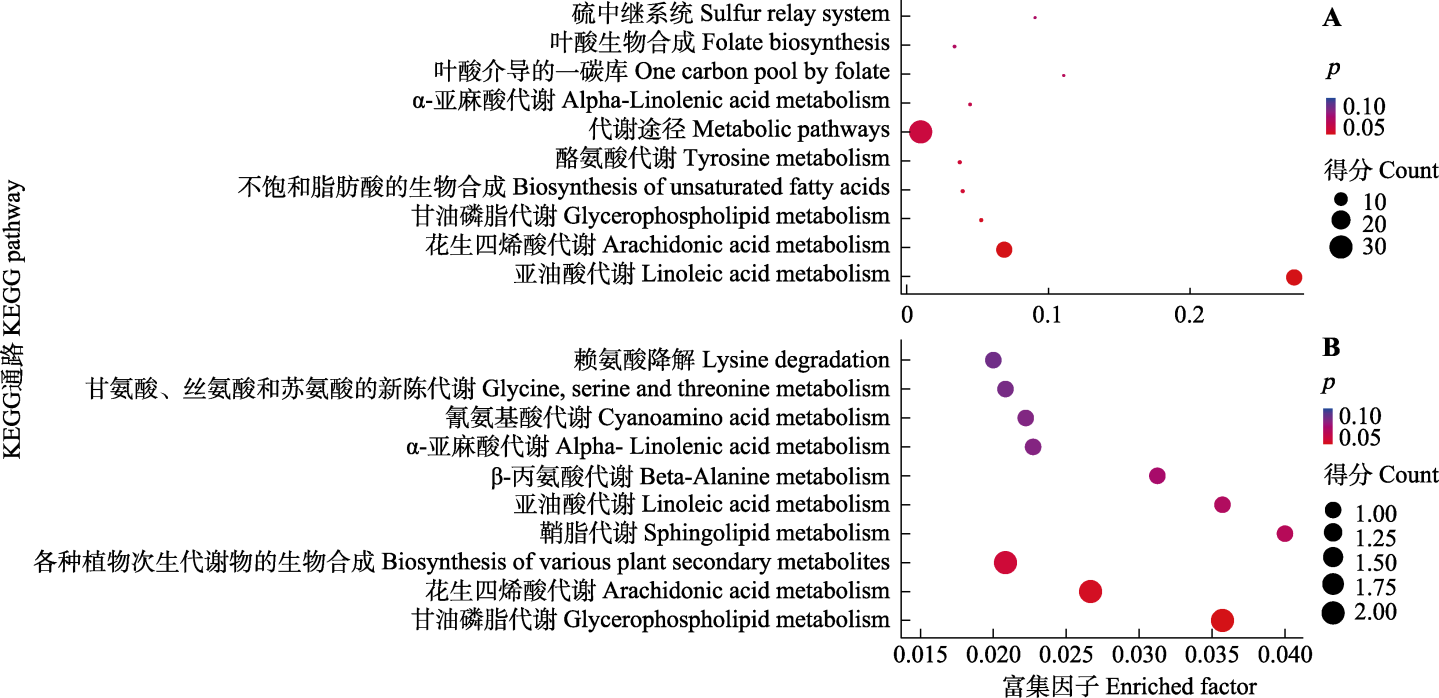
Fig. 4 KEGG pathway enrichment for top 10 differential metabolites of Pinus massoniana (A) and Erythrophleum fordii (B) in pure and mixed plantations. KEGG, Kyoto encyclopedia of genes and genomes. Dot size, the amount of differential metabolites enriched in KEGG pathway; color, the size of the p-value, with smaller p-values and redder colors indicating more significant enrichment.
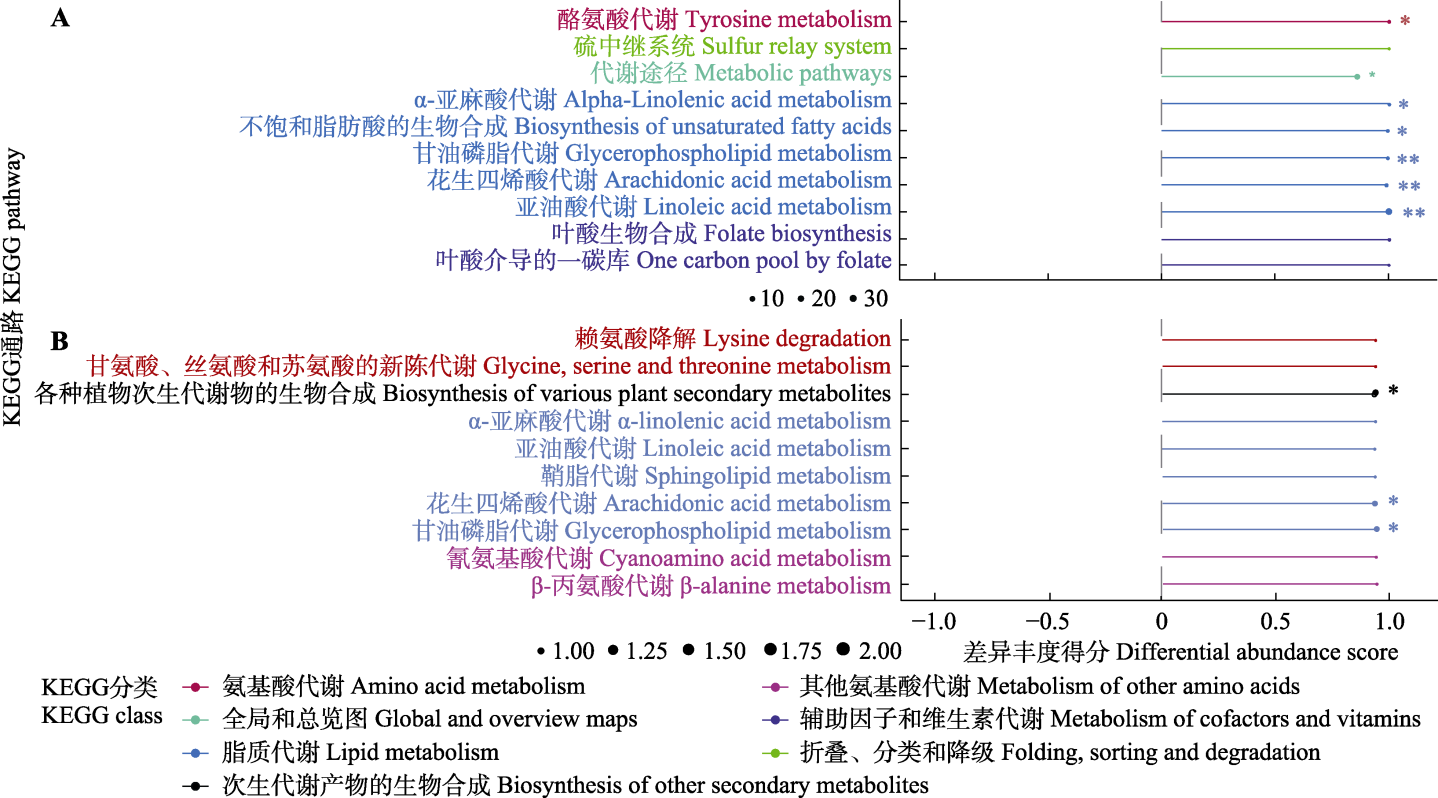
Fig. 5 Differential abundance score for Pinus massoniana (A) and Erythrophleum fordii (B) in pure and mixed plantations. KEGG, Kyoto encyclopedia of genes and genomes. Differential abundance score represents the overall changes in all metabolites of the KEGG pathway, 1 indicates up-regulated, -1 indicates down-regulated. Dot size indicates the number of differential metabolites noted in the KEGG pathway, larger dot means more metabolites, smaller dot means less metabolites. *, p < 0.05; **, p < 0.01.
| [1] |
Bais HP, Vepachedu R, Gilroy S, Callaway RM, Vivanco JM (2003). Allelopathy and exotic plant invasion: from molecules and genes to species interactions. Science, 301, 1377-1380.
DOI PMID |
| [2] |
Bardgett RD, Mommer L, De Vries FT (2014). Going underground: root traits as drivers of ecosystem processes. Trends in Ecology & Evolution, 29, 692-699.
DOI URL |
| [3] | Chang HD, Gu CH, Wang MR, Chang ZQ, Zhou JP, Yue MZ, Chen JX, Qin XW, Feng Z (2024). Integrating shotgun metagenomics and metabolomics to elucidate the dynamics of microbial communities and metabolites in fine flavor cocoa fermentation in Hainan. Food Research International, 177, 113849. DOI: 10.1016/j.foodres.2023.113849. |
| [4] | Chen M, Yao XD, Cheng HZ, Fan AL, Lin RR, Wang XH, Yang YS, Chen GS (2023). Changes in Chinese fir plantations root exudation strategies seasonally and as tree age. Forest Ecology and Management, 545, 121239. DOI: 10.1016/j.foreco.2023.121239. |
| [5] |
Deng L, Shangguan ZP (2017). Afforestation drives soil carbon and nitrogen changes in China. Land Degradation & Development, 28, 151-165.
DOI URL |
| [6] | Dunn WB, Broadhurst D, Begley P, Zelena E, Francis-McIntyre S, Anderson N, Brown M, Knowles JD, Halsall A, Haselden JN, Nicholls AW, Wilson ID, Kell DB, Goodacre R (2011). Procedures for large-scale metabolic profiling of serum and plasma using gas chromatography and liquid chromatography coupled to mass spectrometry. Nature Protocols, 6, 1060-1083. |
| [7] |
Feng YH, Schmid B, Loreau M, Forrester DI, Fei SL, Zhu JX, Tang ZY, Zhu JL, Hong PB, Ji CJ, Shi Y, Su HJ, Xiong XY, Xiao J, Wang SP, et al. (2022). Multispecies forest plantations outyield monocultures across a broad range of conditions. Science, 376, 865-868.
DOI PMID |
| [8] | Fracchia F, Guinet F, Engle NL, Tschaplinski TJ, Veneault-Fourrey C, Deveau A (2024). Microbial colonisation rewires the composition and content of poplar root exudates, root and shoot metabolomes. Microbiome, 12, 173. DOI: 10.1186/s40168-024-01888-9. |
| [9] | Guo S, Zhao HB, Zhou GY, Long WG, Gan GL, Wu SY, Meng MY, Chen JL (2022). Biomass and its distribution pattern of four tree species plantation in south subtropical China. Forest Research, 35, 182-189. |
| [郭耆, 赵厚本, 周光益, 隆卫革, 甘谷列, 吴尚勇, 蒙敏燕, 陈金兰 (2022). 南亚热带4个树种人工林生物量及其分配格局. 林业科学研究, 35, 182-189.] | |
| [10] | Guo WJ, Zhang ZL, Liu Q, Yin HJ (2019). Research progress of root exudates collection technology. Chinese Journal of Applied Ecology, 30, 3951-3962. |
|
[郭婉玑, 张子良, 刘庆, 尹华军 (2019). 根系分泌物收集技术研究进展. 应用生态学报, 30, 3951-3962.]
DOI |
|
| [11] |
Haichar FEZ, Santaella C, Heulin T, Achouak W (2014). Root exudates mediated interactions belowground. Soil Biology & Biochemistry, 77, 69-80.
DOI URL |
| [12] | Hu JJ, Wang H, Liu SR, Wang J, Song ZC, Li ZY, Ming AG, Chen H (2022). Effects of tree species identity and diversity on young tree growth in a south subtropical plantation. Chinese Journal of Applied Ecology, 33, 1511-1517. |
|
[胡佳佳, 王晖, 刘世荣, 王健, 宋战超, 李朝英, 明安刚, 陈海 (2022). 树种多样性组配对南亚热带人工林早期树木生长的影响. 应用生态学报, 33, 1511-1517.]
DOI |
|
| [13] | Hu LF, Robert CAM, Cadot S, Zhang X, Ye M, Li BB, Manzo D, Chervet N, Steinger T, van der Heijden MGA, Schlaeppi K, Erb M (2018). Root exudate metabolites drive plant-soil feedbacks on growth and defense by shaping the rhizosphere microbiota. Nature Communications, 9, 2738. DOI: 10.1038/s41467-018-05122-7. |
| [14] | Jia YF, Zhai GQ, Zhu SS, Liu XJ, Schmid B, Wang ZH, Ma KP, Feng XJ (2021). Plant and microbial pathways driving plant diversity effects on soil carbon accumulation in subtropical forest. Soil Biology & Biochemistry, 161, 108375. DOI: 10.1016/j.soilbio.2021.108375. |
| [15] |
Jones DL, Nguyen C, Finlay RD (2009). Carbon flow in the rhizosphere: carbon trading at the soil-root interface. Plant and Soil, 321, 5-33.
DOI URL |
| [16] |
Kanehisa M, Goto S (2000). KEGG Kyoto encyclopedia of genes and genomes. Nucleic Acids Research, 28, 27-30.
DOI PMID |
| [17] | Kanehisa M, Sato Y, Kawashima M, Furumichi M, Tanabe M (2016). KEGG as a reference resource for gene and protein annotation. Nucleic Acids Research, 44, D457-D462. |
| [18] | Lambers H, Ahmedi I, Berkowitz O, Dunne C, Finnegan PM, St J Hardy GE, Jost R, Laliberté E, Pearse SJ, Teste FP (2013). Phosphorus nutrition of phosphorus-sensitive Australian native plants: threats to plant communities in a global biodiversity hotspot. Conservation Physiology, 1, cot010. DOI: 10.1093/conphys/cot010. |
| [19] | Li J, Jiang XM, Yin HJ, Yin CY, Wei YH, Liu Q (2014). Root exudates and soil microbes in three Picea asperata plantations with different stand ages. Chinese Journal of Applied Ecology, 25, 325-332. |
| [李娇, 蒋先敏, 尹华军, 尹春英, 魏宇航, 刘庆 (2014). 不同林龄云杉人工林的根系分泌物与土壤微生物. 应用生态学报, 25, 325-332.] | |
| [20] | Li WQ, Huang YX, Chen FS, Liu YQ, Lin XF, Zong YY, Wu GY, Yu ZR, Fang XM (2021). Mixing with broad-leaved trees shapes the rhizosphere soil fungal communities of coniferous tree species in subtropical forests. Forest Ecology and Management, 480, 118664. DOI: 10.1016/j.foreco.2020.118664. |
| [21] |
Li WY, Song TZ, Wallrad L, Kudla J, Wang XM, Zhang WH (2019). Tissue-specific accumulation of pH-sensing phosphatidic acid determines plant stress tolerance. Nature Plants, 5, 1012-1021.
DOI PMID |
| [22] | Li ZY, Zhao YQ, Zu C, Li ZG, Zheng WQ, Yu H, Gao SF, Liu SC, Zhang BG, Wang XX, Wang C, Yang JF (2025). Root exudates from Areca catechu L. intercropping system promote nutrient uptake and sustainable production of Piper nigrum L. Agronomy, 15, 355. DOI: 10.3390/agronomy15020355. |
| [23] |
Liang RB, Liang J, Qiao MF, Xu ZF, Liu Q, Yin HJ (2015). Effects of simulated exudate C:N stoichiometry on dynamics of carbon and microbial community composition in a subalpine coniferous forest of western Sichuan, China. Chinese Journal of Plant Ecology, 39, 466-476.
DOI URL |
|
[梁儒彪, 梁进, 乔明锋, 徐振锋, 刘庆, 尹华军 (2015). 模拟根系分泌物C:N化学计量特征对川西亚高山森林土壤碳动态和微生物群落结构的影响. 植物生态学报, 39, 466-476.]
DOI |
|
| [24] | Liu Q, Xiao J, Li YF, Yin HJ, Chen JZ, Chen JS (2012). An in situ collection device and system for root exudate: China, CN201120557060.5. 2012-10-03. |
| [刘庆, 肖娟, 李宇飞, 尹华军, 陈建中, 陈劲松 (2012). 一种根系分泌物原位收集装置及系统: 中国, CN201120557060.5. 2012-10-03.] | |
| [25] |
Liu SR, Yang YJ, Wang H (2018). Development strategy and management countermeasures of planted forests in China: transforming from timber-centered single objective management towards multi-purpose management for enhancing quality and benefits of ecosystem services. Acta Ecologica Sinica, 38, 1-10.
DOI URL |
| [刘世荣, 杨予静, 王晖 (2018). 中国人工林经营发展战略与对策: 从追求木材产量的单一目标经营转向提升生态系统服务质量和效益的多目标经营. 生态学报, 38, 1-10.] | |
| [26] | Liu ZX, Zhu TH, Zhang J (2005). Research advances in root exudates and rhizosphere microorganisms of forest trees. World Forestry Research, 18(6), 25-31. |
| [刘子雄, 朱天辉, 张建 (2005). 林木根系分泌物与根际微生物研究进展. 世界林业研究, 18(6), 25-31.] | |
| [27] | Luo XM, Zhou SY, Yang X (2019). Classification and function of plant roots exudates. Journal of Anhui Agricultural Sciences, 47(4), 37-39. |
| [罗晓蔓, 周书宇, 杨雪 (2019). 植物根系分泌物的分类和作用. 安徽农业科学, 47(4), 37-39.] | |
| [28] |
Macabuhay A, Arsova B, Walker R, Johnson A, Watt M, Roessner U (2022). Modulators or facilitators? Roles of lipids in plant root-microbe interactions. Trends in Plant Science, 27, 180-190.
DOI URL |
| [29] | Mao MX, Zhu F (2021). Progress and perspective in research on plant resistance mediated by root exudates. Chinese Journal of Eco-Agriculture, 29, 1649-1657. |
| [毛梦雪, 朱峰 (2021). 根系分泌物介导植物抗逆性研究进展与展望. 中国生态农业学报(中英文), 29, 1649-1657.] | |
| [30] |
Meier IC, Tückmantel T, Heitkötter J, Müller K, Preusser S, Wrobel TJ, Kandeler E, Marschner B, Leuschner C (2020). Root exudation of mature beech forests across a nutrient availability gradient: the role of root morphology and fungal activity. New Phytologist, 226, 583-594.
DOI PMID |
| [31] | Peng Y, Schmidt IK, Zheng HF, Heděnec P, Bachega LR, Yue K, Wu FZ, Vesterdal L (2020). Tree species effects on topsoil carbon stock and concentration are mediated by tree species type, mycorrhizal association, and N-fixing ability at the global scale. Forest Ecology and Management, 478, 118510. DOI: 10.1016/j.foreco.2020.118510. |
| [32] | Pereira LB, de Oliveira Gambarini VM, de Menezes AB, Ottoboni LMM, Vicentini R (2021). Responses of the sugarcane rhizosphere microbiota to different levels of water stress. Applied Soil Ecology, 159, 103817. DOI: 10.1016/j.apsoil.2020.103817. |
| [33] |
Phillips RP, Erlitz Y, Bier R, Bernhardt ES (2008). New approach for capturing soluble root exudates in forest soils. Functional Ecology, 22, 990-999.
DOI URL |
| [34] |
Schmidt MWI, Torn MS, Abiven S, Dittmar T, Guggenberger G, Janssens IA, Kleber M, Kögel-Knabner I, Lehmann J, Manning DAC, Nannipieri P, Rasse DP, Weiner S, Trumbore SE (2011). Persistence of soil organic matter as an ecosystem property. Nature, 478, 49-56.
DOI |
| [35] | Shao DH, Ren Q, Ning XZ, Bai SL (2011). Root exudate constituents and allelopathic effects from forests of Pinus tabulaeformis, Ostryopsis davidiana, and a mixed forest. Journal of Zhejiang A&F University, 28, 333-338. |
| [邵东华, 任琴, 宁心哲, 白淑兰 (2011). 油松和虎榛子不同林型根系分泌物组分及化感效应. 浙江农林大学学报, 28, 333-338.] | |
| [36] | Shen X, Yang F, Xiao CW, Zhou Y (2020). Increased contribution of root exudates to soil carbon input during grassland degradation. Soil Biology & Biochemistry, 146, 107817. DOI: 10.1016/j.soilbio.2020.107817. |
| [37] |
Shi SJ, Condron L, Larsen S, Richardson AE, Jones E, Jiao J, O’Callaghan M, Stewart A (2011). In situ sampling of low molecular weight organic anions from rhizosphere of Radiata pine (Pinus radiata) grown in a rhizotron system. Environmental and Experimental Botany, 70, 131-142.
DOI URL |
| [38] |
Smith CA, Want EJ, O’Maille G, Abagyan R, Siuzdak G (2006). XCMS: processing mass spectrometry data for metabolite profiling using nonlinear peak alignment, matching, and identification. Analytical Chemistry, 78, 779-787.
DOI PMID |
| [39] |
Sun LJ, Ataka M, Han MG, Han YF, Gan DY, Xu TL, Guo YP, Zhu B (2021). Root exudation as a major competitive fine-root functional trait of 18 coexisting species in a subtropical forest. New Phytologist, 229, 259-271.
DOI URL |
| [40] | Tang XL, Zhao X, Bai YF, Tang ZY, Wang WT, Zhao YC, Wan HW, Xie ZQ, Shi XZ, Wu BF, Wang GX, Yan JH, Ma KP, Du S, Li SG, et al. (2018). Carbon pools in China’s terrestrial ecosystems: new estimates based on an intensive field survey. Proceedings of the National Academy of Sciences of the United States of America, 115, 4021-4026. |
| [41] |
van Dam NM, Bouwmeester HJ (2016). Metabolomics in the rhizosphere: tapping into belowground chemical communication. Trends in Plant Science, 21, 256-265.
DOI PMID |
| [42] | Vives-Peris V, López-Climent MF, Pérez-Clemente RM, Gómez-Cadenas A (2020). Root involvement in plant responses to adverse environmental conditions. Agronomy, 10, 942. DOI: 10.3390/agronomy10070942. |
| [43] | Wang H, Chen ZJ, Wang M, Long MX, Ren TY, Chen C, Dai XT, Yang S, Tan SM (2022). The effect of polyphenol extract from Rosa roxburghii fruit on plasma metabolome and gut microbiota in type 2 diabetic mice. Foods, 11, 12. DOI: 10.3390/foods11121747. |
| [44] |
Wang QT, Xiao J, Ding JX, Zou TT, Zhang ZL, Liu Q, Yin HJ (2021a). Differences in root exudate inputs and rhizosphere effects on soil N transformation between deciduous and evergreen trees. Plant and Soil, 458, 277-289.
DOI |
| [45] | Wang QT, Yuan YS, Zhang ZL, Liu DY, Xiao J, Yin HJ (2021b). Exudate components mediate soil C dynamic through different priming mechanisms in forest soils. Applied Soil Ecology, 160, 103855. DOI: 10.1016/j.apsoil.2020.103855. |
| [46] | Wang YQ, Ma ZQ, Hou JX, Zong YQ, Hao HR, Liu GY, Wei H, Lian BL, Chen YH, Zhang J (2024). Research progress in the composition analysis and ecological function of plant root exudates under salt stress. Biotechnology Bulletin, 40(1), 12-23. |
|
[王雨晴, 马子奇, 侯嘉欣, 宗钰琪, 郝晗睿, 刘国元, 魏辉, 连博琳, 陈艳红, 张健 (2024). 盐胁迫下植物根系分泌物的成分分析与生态功能研究进展. 生物技术通报, 40(1), 12-23.]
DOI |
|
| [47] |
Wen T, Yu GH, Hong WD, Yuan J, Niu GQ, Xie PH, Sun FS, Guo LD, Kuzyakov Y, Shen QR (2022). Root exudate chemistry affects soil carbon mobilization via microbial community reassembly. Fundamental Research, 2, 697-707.
DOI URL |
| [48] |
Wiklund S, Johansson E, Sjöström L, Mellerowicz EJ, Edlund U, Shockcor JP, Gottfries J, Moritz T, Trygg J (2008). Visualization of GC/TOF-MS-based metabolomics data for identification of biochemically interesting compounds using OPLS class models. Analytical Chemistry, 80, 115-122.
DOI PMID |
| [49] |
Wold S, Sjöström M, Eriksson L (2001). PLS-regression: a basic tool of chemometrics. Chemometrics and Intelligent Laboratory Systems, 58, 109-130.
DOI URL |
| [50] | Xia RX, Liu J, Zhao WQ, Fang K, Liu L, Liu Q (2024). Differences in the chemical composition and content of root exudates of dominant coniferous and broadleaf tree species in subalpine forests of western Sichuan, China. Chinese Journal of Applied and Environmental Biology, 30, 26-34. |
| [夏瑞雪, 刘佳, 赵文强, 方楷, 刘露, 刘庆 (2024). 川西亚高山森林优势针阔树种根系分泌物的化学组分与含量差异. 应用与环境生物学报, 30, 26-34.] | |
| [51] | Xue JH, Wang Z, Lv XS (2002). Progress on the interaction between tree roots and soil environment. Journal of Nanjing Forestry University, 26(3), 79-84. |
|
[薛建辉, 王智, 吕祥生 (2002). 林木根系与土壤环境相互作用研究综述. 南京林业大学学报(自然科学版), 26(3), 79-84.]
DOI |
|
| [52] | Ye XD, Luan JW, Wang H, Zhang Y, Wang Y, Liu SR (2024). N-fixing tree species promote the chemical stability of soil organic carbon in subtropical plantations through increasing the relative contribution of plant-derived lipids. Forest Ecosystems, 11, 100232. DOI: 10.1016/j.fecs.2024.100232. |
| [53] | Ye XD, Luan JW, Wang H, Zhang Y, Wang Y, Ma JH, Liu SR (2022). Tree species richness and N-fixing tree species enhance the chemical stability of soil organic carbon in subtropical plantations. Soil Biology & Biochemistry, 174, 108828. DOI: 10.1016/j.soilbio.2022.108828. |
| [54] |
Ye YQ, Wang H, Luan JW, Ma JH, Ming AG, Liu SR (2024). Early effects of different tree species mixing on aggregate organic carbon fractions. Chinese Journal of Ecology, 43, 3350-3356.
DOI |
| [叶钰倩, 王晖, 栾军伟, 马金豪, 明安刚, 刘世荣 (2024). 不同树种混交对团聚体有机碳及其组分的早期影响. 生态学杂志, 43, 3350-3356.] | |
| [55] | Ye YQ, Wang H, Luan JW, Ma JH, Ming AG, Niu BL, Liu CJ, Freedman Z, Wang JX, Liu SR (2023). Nitrogen-fixing tree species modulate species richness effects on soil aggregate-associated organic carbon fractions. Forest Ecology and Management, 546, 121315. DOI: 10.1016/j.foreco.2023.121315. |
| [56] |
Yin HJ, Li YF, Xiao J, Xu ZF, Cheng XY, Liu Q (2013). Enhanced root exudation stimulates soil nitrogen transformations in a subalpine coniferous forest under experimental warming. Global Change Biology, 19, 2158-2167.
DOI PMID |
| [57] |
Yin HJ, Wheeler E, Phillips RP (2014). Root-induced changes in nutrient cycling in forests depend on exudation rates. Soil Biology & Biochemistry, 78, 213-221.
DOI URL |
| [58] |
Yin HJ, Zhang ZL, Liu Q (2018). Root exudates and their ecological consequences in forest ecosystems: problems and perspective. Chinese Journal of Plant Ecology, 42, 1055-1070.
DOI URL |
|
[尹华军, 张子良, 刘庆 (2018). 森林根系分泌物生态学研究: 问题与展望. 植物生态学报, 42, 1055-1070.]
DOI |
|
| [59] | Zeng HY, Yao N (2022). Sphingolipids in plant immunity. Phytopathology Research, 4, 20. DOI: 10.1186/s42483-022-00125-1. |
| [60] |
Zhalnina K, Louie KB, Hao Z, Mansoori N, da Rocha UN, Shi SJ, Cho H, Karaoz U, Loqué D, Bowen BP, Firestone MK, Northen TR, Brodie EL (2018). Dynamic root exudate chemistry and microbial substrate preferences drive patterns in rhizosphere microbial community assembly. Nature Microbiology, 3, 470-480.
DOI PMID |
| [61] |
Zhang DD, Liang XH, Wang J (2014). A review of plant root exudates. Chinese Agricultural Science Bulletin, 30(35), 314-320.
DOI |
|
[张豆豆, 梁新华, 王俊 (2014). 植物根系分泌物研究综述. 中国农学通报, 30(35), 314-320.]
DOI |
|
| [62] |
Zhang J, Elser JJ (2017). Carbon: nitrogen: phosphorus stoichiometry in fungi: a meta-analysis. Frontiers in Microbiology, 8, 1281. DOI: 10.3389/fmicb.2017.01281.
PMID |
| [63] |
Zhang Q, Wang ZQ, Gao RJ, Jiang YN (2025). Sugars, lipids and more: new insights into plant carbon sources during plant-microbe interactions. Plant, Cell & Environment, 48, 1656-1673.
DOI URL |
| [64] | Zhang Y, Cao J, Li G, Jiang ST, Yu Q, Nie HJ, LI LA, Zhu L (2024). Metabolomics analysis of root exudates in Echinochloa frumentacea seedling stage under saline-alkali stress. Acta Ecologica Sinica, 44, 3540-3549. |
| [张杨, 曹靖, 李广, 姜世腾, 于倩, 聂豪杰, 李林傲, 朱林 (2024). 盐碱胁迫下湖南稷子苗期根系分泌物代谢组学. 生态学报, 44, 3540-3549.] | |
| [65] | Zhao XC, Wei YL, Zhang JJ, Yang L, Liu XY, Zhang HY, Shao WJ, He L, Li ZT, Zhang YF, Xu JY (2021). Membrane lipids’ metabolism and transcriptional regulation in maize roots under cold stress. Frontiers in Plant Science, 12, 639132. DOI: 10.3389/fpls.2021.639132. |
| [66] |
Zhu B, Gutknecht JLM, Herman DJ, Keck DC, Firestone MK, Cheng WX (2014). Rhizosphere priming effects on soil carbon and nitrogen mineralization. Soil Biology & Biochemistry, 76, 183-192.
DOI URL |
| [1] | LIU Run-Hong, YANG Liu-Rong, LIANG Hui-Ting, SHEN Wei-Jun. Research progress and prospect on phosphorus acquisition and utilization strategies of arbuscular mycorrhizal and ectomycorrhizal plants [J]. Chin J Plant Ecol, 2026, 50(3): 566-583. |
| [2] | HAO Huan-Huan, LI Dan, GUO Zi-Hua, ZHOU Ao, LI Yan-Jie, YANG Liang, ZHANG Ran, LU Ying-Shuai, ZHAO Xiang, CHEN Xiao-Peng. Effects of salt stress on secretion of amino acids and their derivatives in root of Elytrigia elongata [J]. Chin J Plant Ecol, 2026, 50(1): 202-212. |
| [3] | LIANG Tian-Hao, XIONG De-Cheng, LIU Yuan-Hao, DU Xu-Long, YANG Zhi-Jie, HUANG Jin-Xue. Research progress on root exudates and rhizosphere effects of tree species associated with different mycorrhizal types [J]. Chin J Plant Ecol, 2025, 49(7): 1038-1052. |
| [4] | LONG Ji-Lan, JIANG Zheng, LIU Ding-Qin, MIAO Yu-Xuan, ZHOU Ling-Yan, FENG Ying, PEI Jia-Ning, LIU Rui-Qiang, ZHOU Xu-Hui, FU Yu-Ling. Effects of drought on plant root exudates and associated rhizosphere priming effect: review and prospect [J]. Chin J Plant Ecol, 2024, 48(7): 817-827. |
| [5] | HE Fei, LI Chuan, Faisal SHAH, LU Xie-Min, WANG Ying, WANG Meng, RUAN Jia, WEI Meng-Lin, MA Xing-Guang, WANG Zhuo, JIANG Hao. Carbon transport and phosphorus uptake in an intercropping system of Robinia pseudoacacia and Amorphophallus konjac mediated by arbuscular mycorrhizal hyphal networks [J]. Chin J Plant Ecol, 2023, 47(6): 782-791. |
| [6] | LUO Si-Sheng, LUO Bi-Zhen, WEI Shu-Jing, HU Hai-Qing, LI Xiao-Chuan, WU Ze-Peng, WANG Zhen-Shi, ZHOU Yu-Fei, ZHONG Ying-Xia. Effects of moderate forest fires on soil organic carbon density in secondary forests of Pinus massoniana [J]. Chin J Plant Ecol, 2020, 44(10): 1073-1086. |
| [7] | Hua-Jun YIN, Zi-Liang ZHANG, Qing LIU. Root exudates and their ecological consequences in forest ecosystems: Problems and perspective [J]. Chin J Plant Ecol, 2018, 42(11): 1055-1070. |
| [8] | Ping SONG, Rui ZHANG, Zhi-Chun ZHOU, Jian-She TONG, Hui WANG. Effects of localized nitrogen supply treatments on growth and root parameters in Pinus massoniana families under phosphorus deficiency [J]. Chin J Plan Ecolo, 2017, 41(6): 622-631. |
| [9] | Sheng-Wang PAN, Xin YUAN, Can LIU, Yan-Lan LI, Ting YANG, Hai-Yuan TANG. Effects of benzo [α] pyrene on the organic compounds of low molecule weight excreted by root systems in five Festuca species with different remediation potentials [J]. Chin J Plant Ecol, 2016, 40(6): 604-614. |
| [10] | Qin WANG, Wan-Qin YANG, Fu-Zhong WU, Jian ZHANG, Bo TAN, Xi-Tao ZHANG. Characteristics of stump stock and decomposition in Pinus massoniana plantation [J]. Chin J Plant Ecol, 2016, 40(5): 458-468. |
| [11] | Ping SONG, Rui ZHANG, Yi ZHANG, Zhi-Chun ZHOU, Zhong-Ping FENG. Effects of simulated nitrogen deposition on fine root morphology, nitrogen and phosphorus efficiency of Pinus massoniana clone under phosphorus deficiency [J]. Chin J Plant Ecol, 2016, 40(11): 1136-1144. |
| [12] | CHEN Yun-Yu,XIONG De-Cheng,HUANG Jin-Xue,WANG Wei-Wei,HU Shuang-Cheng,DENG Fei,XU Chen-Sen,FENG Jian-Xin,SHI Shun-Zeng,ZHONG Bo-Yuan,CHEN Guang-Shui. Fine root production of Pinus massoniana plantation and Castanopsis carlesii plantation at different successional stages in subtropical China [J]. Chin J Plan Ecolo, 2015, 39(11): 1071-1081. |
| [13] | CUI Ning-Jie,ZHANG Dan-Ju,LIU Yang,ZHANG Jian,YANG Wan-Qin,OU Jiang,ZHANG Jie,SONG Xiao-Yan,YIN Rui. Plant diversity and seasonal dynamics in forest gaps of varying sizes in Pinus massoniana plantations [J]. Chin J Plant Ecol, 2014, 38(5): 477-490. |
| [14] | WU Lin-Kun, LIN Xiang-Min, LIN Wen-Xiong. Advances and perspective in research on plant-soil-microbe interactions mediated by root exudates [J]. Chin J Plant Ecol, 2014, 38(3): 298-310. |
| [15] | PANG Li, ZHANG Yi, ZHOU Zhi-Chun, FENG Zhong-Ping, CHU De-Yu. Effects of simulated nitrogen deposition on root exudates and phosphorus efficiency in Pinus massoniana families under low phosphorus stress [J]. Chin J Plant Ecol, 2014, 38(1): 27-35. |
| Viewed | ||||||
|
Full text |
|
|||||
|
Abstract |
|
|||||
Copyright © 2026 Chinese Journal of Plant Ecology
Tel: 010-62836134, 62836138, E-mail: apes@ibcas.ac.cn, cjpe@ibcas.ac.cn

