
Chin J Plant Ecol ›› 2025, Vol. 49 ›› Issue (12): 2149-2165.DOI: 10.17521/cjpe.2025.0039 cstr: 32100.14.cjpe.2025.0039
Special Issue: 虚拟专辑 | 干旱响应与适应 | 整合生物学期刊集群跨刊组建
• Research Articles • Previous Articles Next Articles
WANG Ya-Xuan1,*, WANG Qian1,*, LIN Qian-Ti2, ZHANG Yi-Jia1, ZHENG Min1,**( ), GU Yan-Sheng1
Received:2025-02-01
Accepted:2025-06-09
Online:2025-12-20
Published:2025-12-25
Contact:
ZHENG Min
About author:* Contributed equally to this work
Supported by:WANG Ya-Xuan, WANG Qian, LIN Qian-Ti, ZHANG Yi-Jia, ZHENG Min, GU Yan-Sheng. Leaf anatomical structure traits of six herbaceous plants response to different water habitats in Dajiuhu wetland, Mt. Shennongjia[J]. Chin J Plant Ecol, 2025, 49(12): 2149-2165.
Add to citation manager EndNote|Ris|BibTeX
URL: https://www.plant-ecology.com/EN/10.17521/cjpe.2025.0039
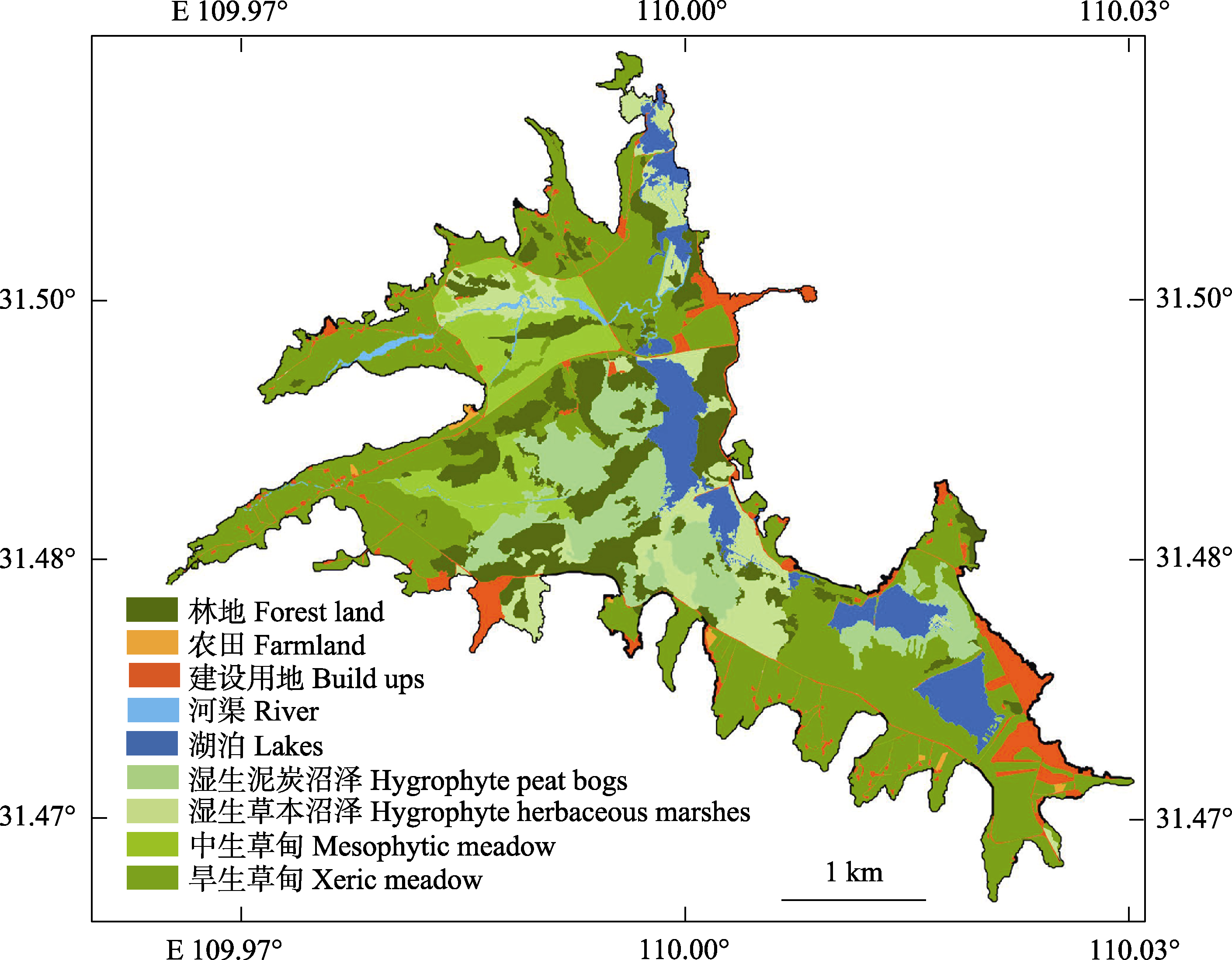
Fig. 1 Land-use map of the Dajiuhu Peatland.
| 生境 Habitat | 经度 Longitude | 纬度 Latitude | 海拔 Altitude (m) | 地下水埋深 Groundwater depth (cm) | 物种 Species |
|---|---|---|---|---|---|
| 旱生草甸 HA | 110.02° E | 31.48° N | 1 760 | >100 | 假苇拂子茅、画眉草 Calamagrostis pseudophragmites, Eragrostis pilosa |
| 中生-旱生草甸 HB | 110.02° E | 31.47° N | 1 760 | >100 | 华北剪股颖、假苇拂子茅、画眉草 Agrostis clavata, Calamagrostis pseudophragmites, Eragrostis pilosa |
| 湿生-中生草甸 Z | 100.00° E | 31.48° N | 1 760 | 50 | 华北剪股颖、假苇拂子茅、画眉草 Agrostis clavata, Calamagrostis pseudophragmites, Eragrostis pilosa |
| 退化半湿生沼泽 SA | 110.01° E | 31.48° N | 1 750 | 10 | 华东藨草、阿齐薹草 Scirpus karuisawensis, Carex argyi |
| 湿生草本沼泽 SB | 110.00° E | 31.48° N | 1 750 | -5 | 华东藨草、华刺子莞 Scirpus karuisawensis, Rhynchospora chinensis |
| 湿生泥炭沼泽 SC | 110.00° E | 31.49° N | 1 760 | -5 | 华东藨草、阿齐薹草、华刺子莞 Scirpus karuisawensis, Carex argyi, Rhynchospora chinensis |
Table 1 Basic information of six herbaceous plants and sample plots in Dajiuhu wetland, Mt. Shennongjia
| 生境 Habitat | 经度 Longitude | 纬度 Latitude | 海拔 Altitude (m) | 地下水埋深 Groundwater depth (cm) | 物种 Species |
|---|---|---|---|---|---|
| 旱生草甸 HA | 110.02° E | 31.48° N | 1 760 | >100 | 假苇拂子茅、画眉草 Calamagrostis pseudophragmites, Eragrostis pilosa |
| 中生-旱生草甸 HB | 110.02° E | 31.47° N | 1 760 | >100 | 华北剪股颖、假苇拂子茅、画眉草 Agrostis clavata, Calamagrostis pseudophragmites, Eragrostis pilosa |
| 湿生-中生草甸 Z | 100.00° E | 31.48° N | 1 760 | 50 | 华北剪股颖、假苇拂子茅、画眉草 Agrostis clavata, Calamagrostis pseudophragmites, Eragrostis pilosa |
| 退化半湿生沼泽 SA | 110.01° E | 31.48° N | 1 750 | 10 | 华东藨草、阿齐薹草 Scirpus karuisawensis, Carex argyi |
| 湿生草本沼泽 SB | 110.00° E | 31.48° N | 1 750 | -5 | 华东藨草、华刺子莞 Scirpus karuisawensis, Rhynchospora chinensis |
| 湿生泥炭沼泽 SC | 110.00° E | 31.49° N | 1 760 | -5 | 华东藨草、阿齐薹草、华刺子莞 Scirpus karuisawensis, Carex argyi, Rhynchospora chinensis |
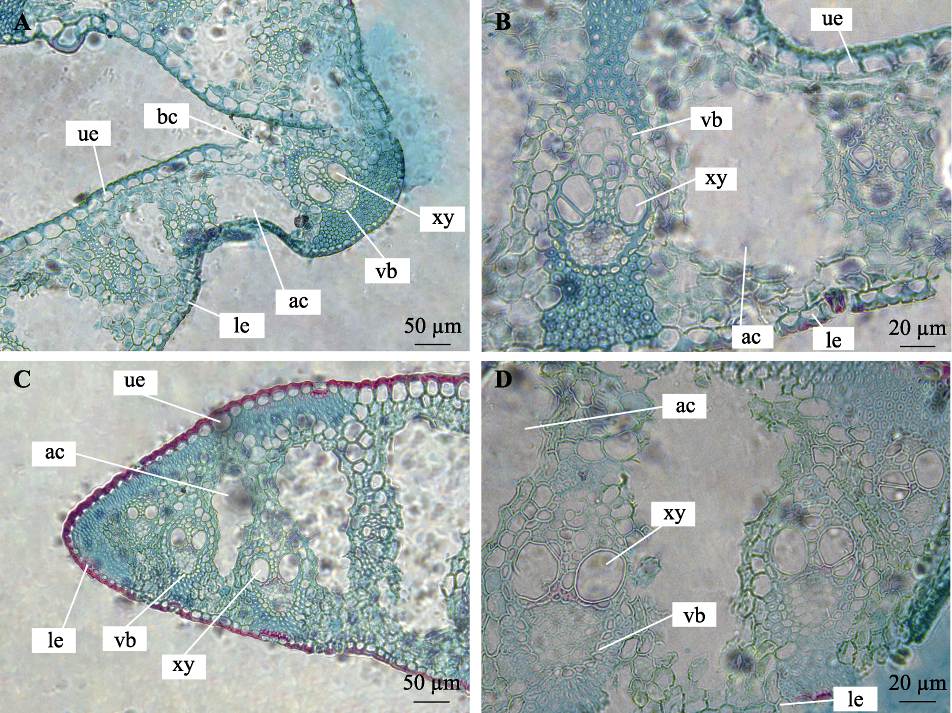
Fig. 2 Leaf transverse sections of Carex argyi under light microscope. A, B, Degraded semi-hygrophyte marshes (SA habitat). C, D, Hygrophyte peat bogs (SC habitat). ac, air cavity; bc, bulliform cell; le, lower epidermis; ue, upper epidermis; vb, vascular bundle; xy, xylem.
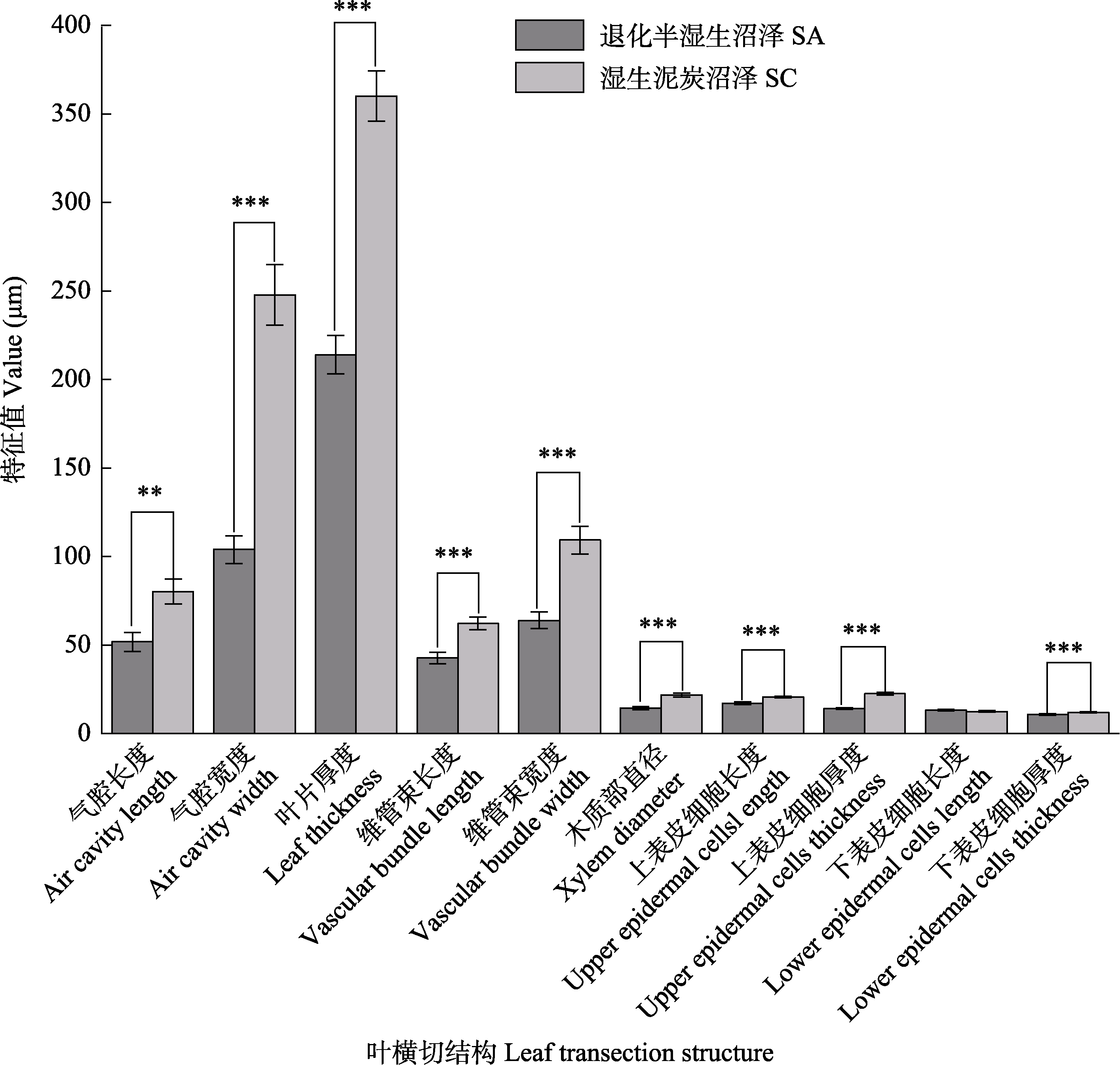
Fig. 3 Comparison of the mean values of leaf transection structure characters of Carex argyi in different habitats (mean ± SE). SA, degraded semi-hygrophyte marshes; SC, hygrophyte peat bogs. **, p < 0.01; ***, p < 0.001.
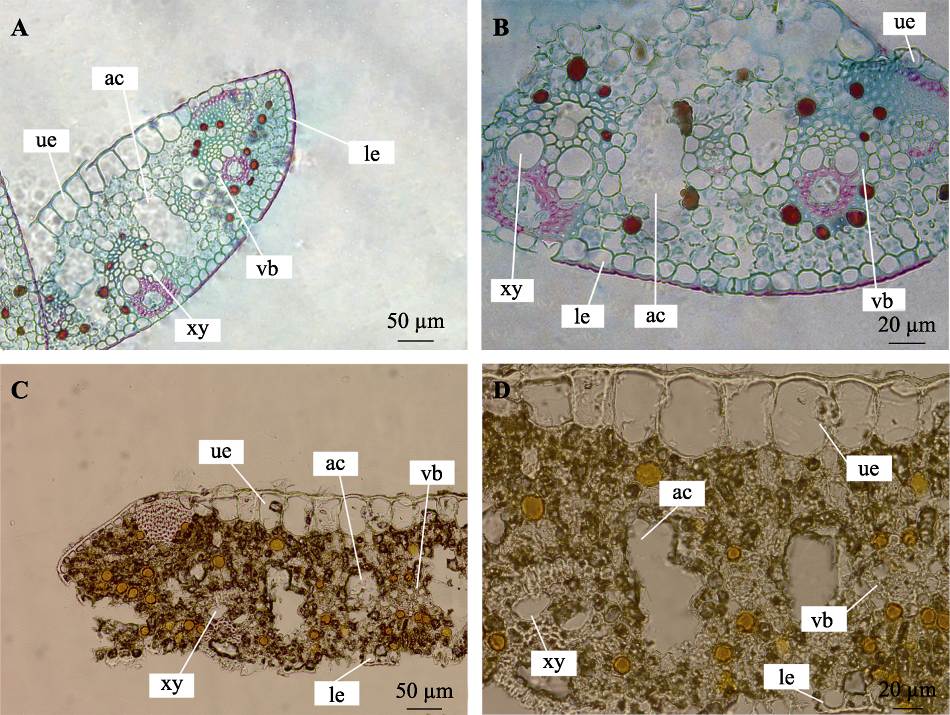
Fig. 4 Leaf transverse sections of Rhynchospora chinensis under light microscope. A, B, Hygrophyte herbaceous marshes (SB habitat). C, D, Hygrophyte peat bogs (SC habitat). ac, air cavity; bc, bulliform cell; le, lower epidermis; ue, upper epidermis; vb, vascular bundle; xy, xylem.
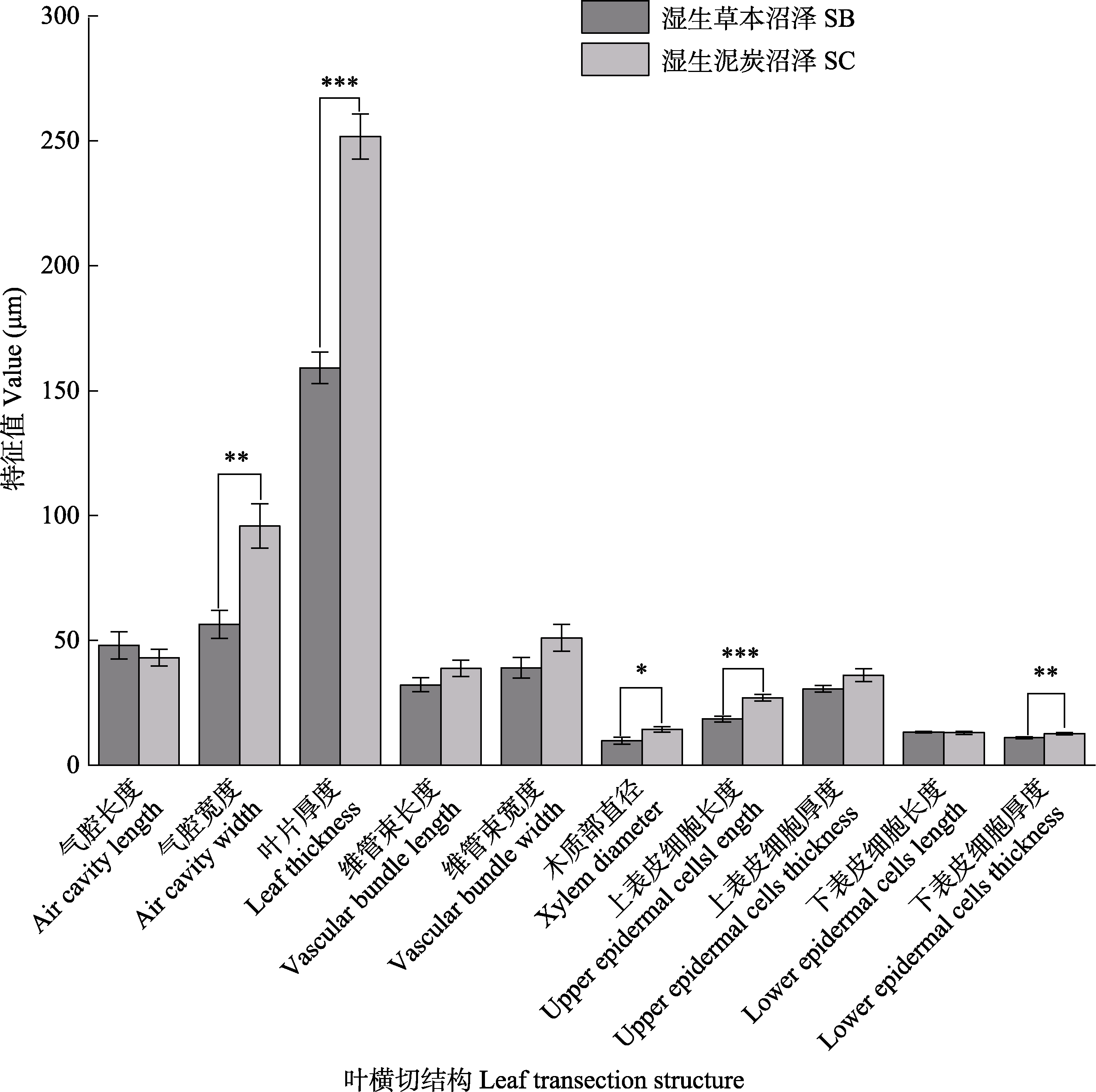
Fig. 5 Comparison of the mean values of leaf transection structure characters of Rhynchospora chinensis in different habitats (mean ± SE). SB, hygrophyte herbaceous marshes; SC, hygrophyte peat bogs. *, p < 0.05; **, p < 0.01; ***, p < 0.001.
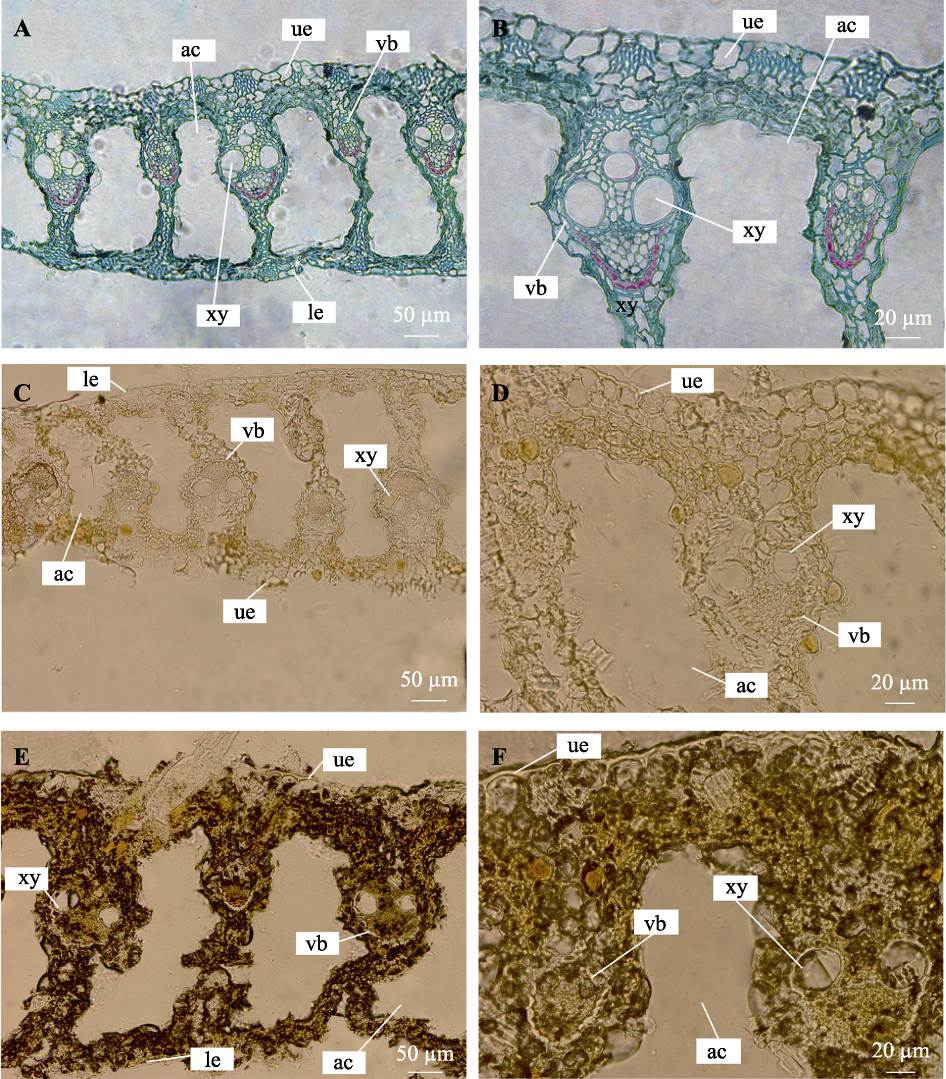
Fig. 6 Leaf transverse sections of Scirpus karuizawensis under light microscope. A, B, Degraded semi-hygrophyte marshes (SA habitat). C, D, Hygrophyte herbaceous marshes (SB habitat). E, F, Hygrophyte peat bogs (SC habitat). ac, air cavity; bc, bulliform cell; le, lower epidermis; ue, upper epidermis; vb, vascular bundle; xy, xylem.
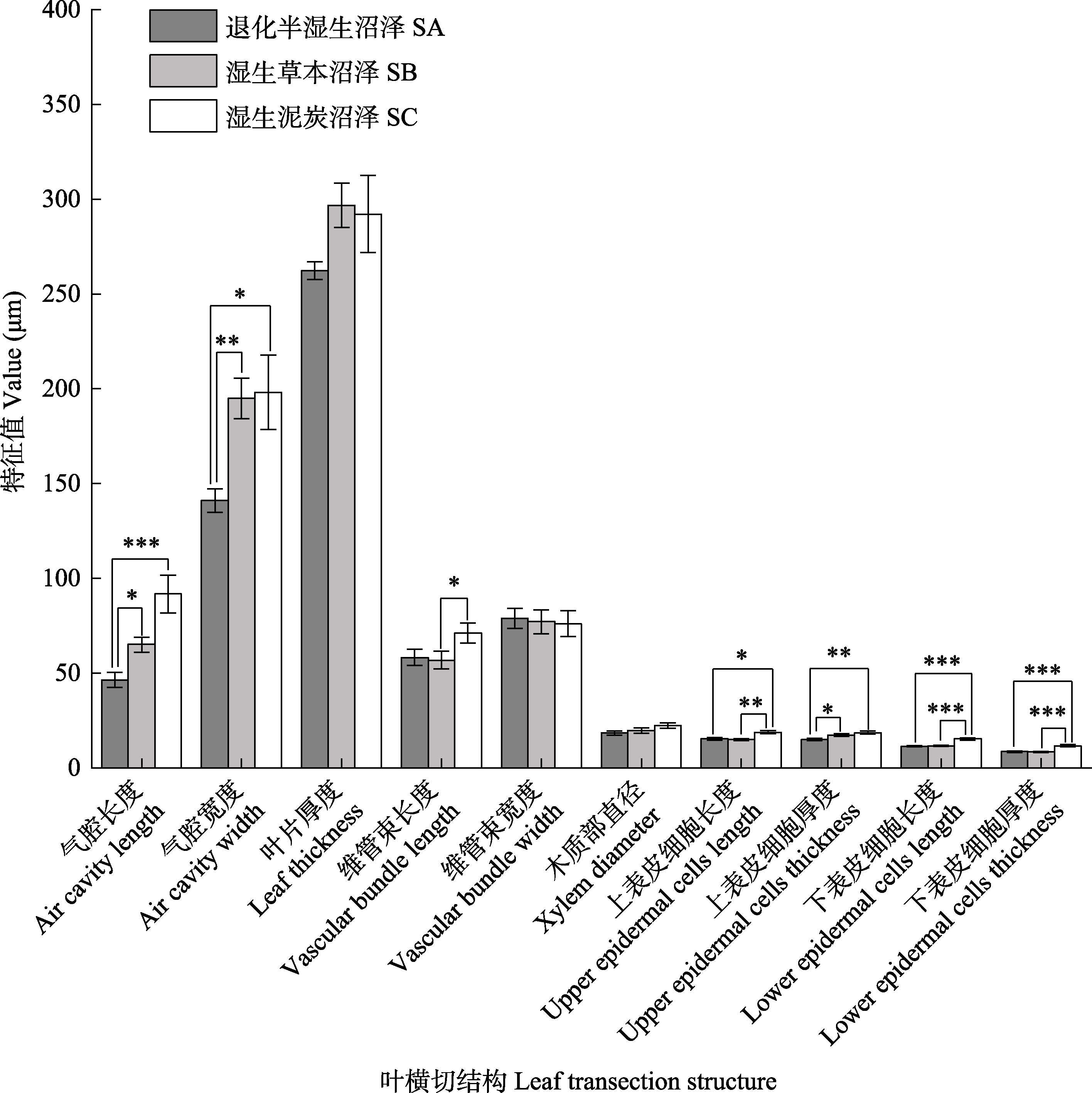
Fig. 7 Comparison of the mean values of leaf transection structure characters of Scirpus karuizawensis in different habitats (mean ± SE). SA, degraded semi-hygrophyte marshes; SB, hygrophyte herbaceous marshes; SC, hygrophyte peat bogs. *, p < 0.05; **, p < 0.01; ***, p < 0.001.
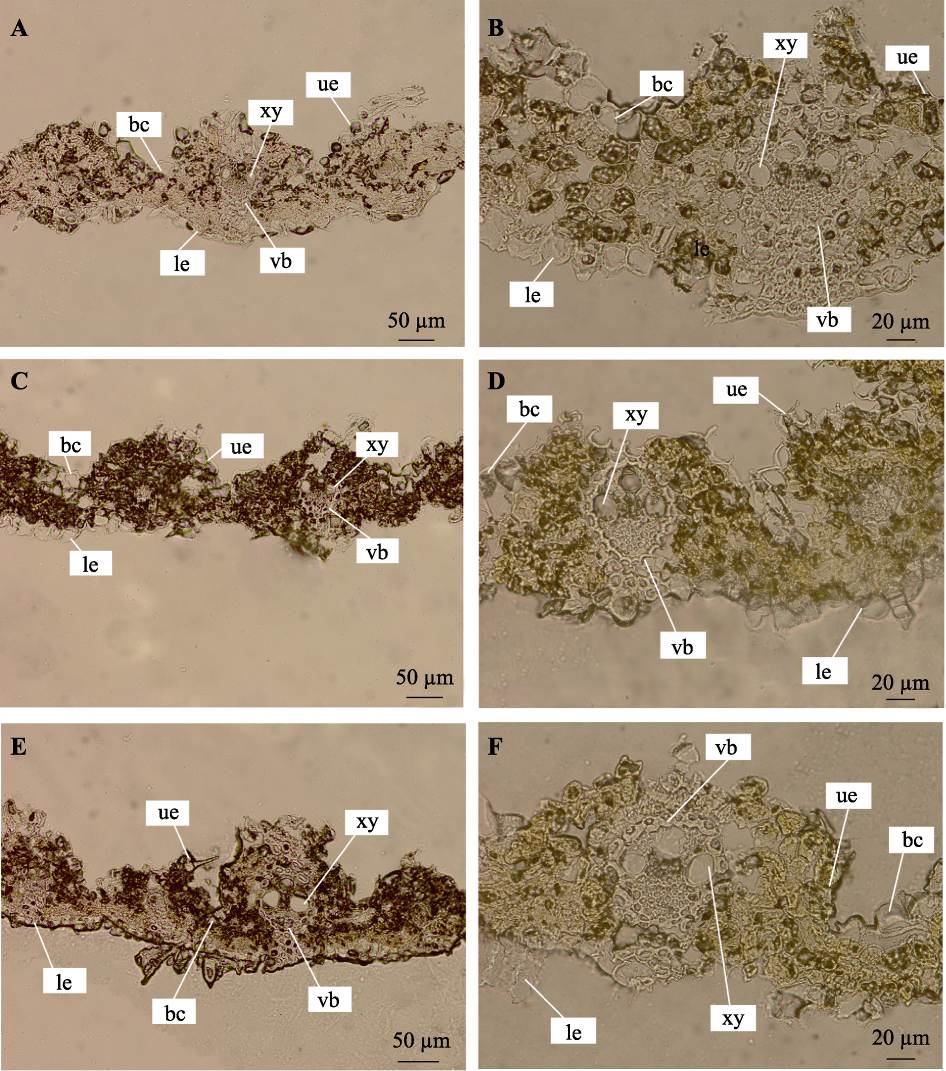
Fig. 8 Leaf transverse sections of Eragrostis pilosa under light microscope. A, B, Xeric meadow (HA habitat). C, D, Moderate-xeric meadow (HB habitat). E, F, Hygrophyte-mesophyte meadow (Z habitat). ac, air cavity; bc, bulliform cell; le, lower epidermis; ue, upper epidermis; vb, vascular bundle; xy, xylem.
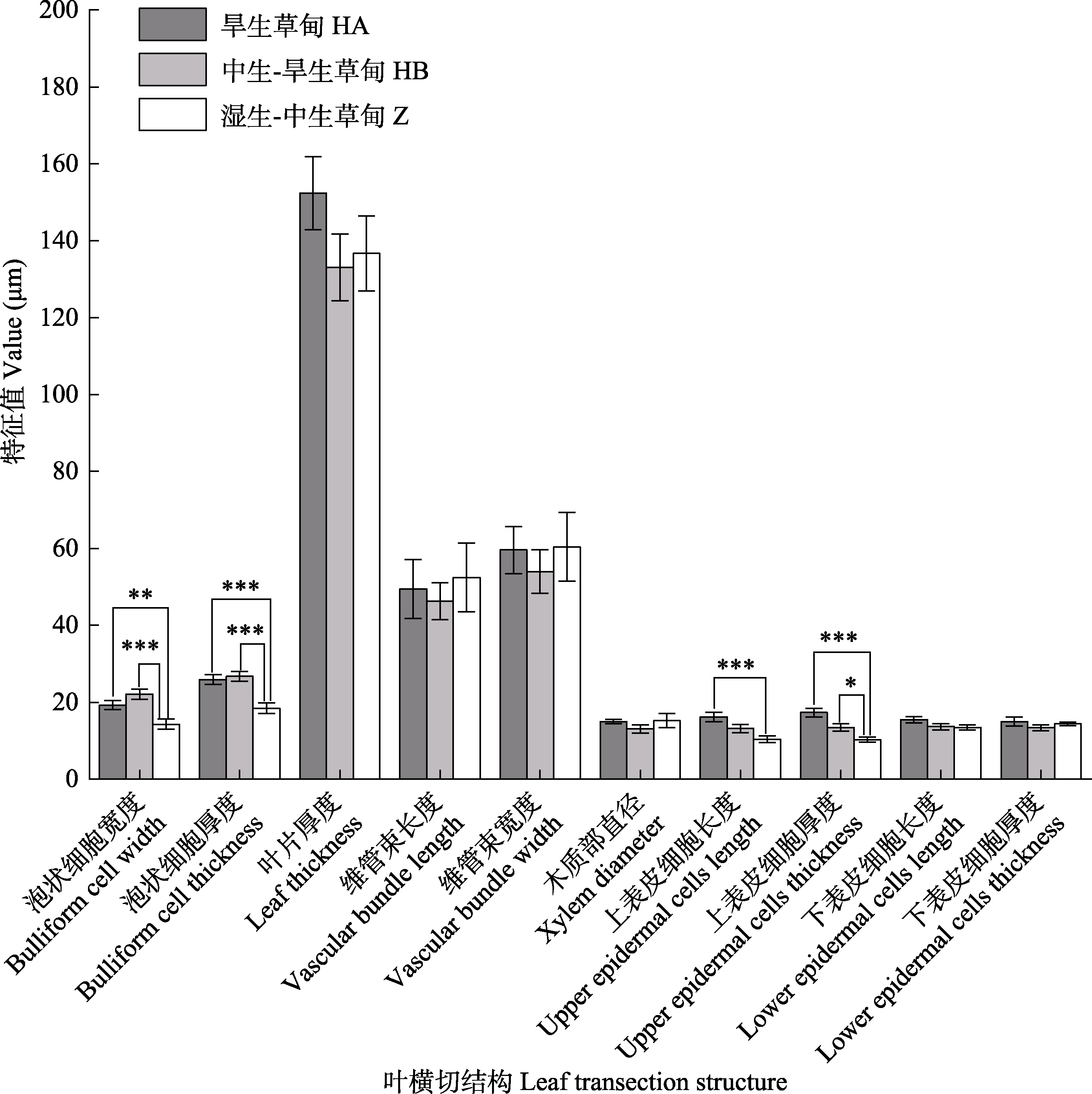
Fig. 9 Comparison of the mean values of leaf transection structure characters of Eragrostis pilosa in different habitats (mean ± SE). HA, xeric meadow; HB, moderate-xeric meadow; Z, hygrophyte-mesophyte meadow. *, p < 0.05; **, p < 0.01; ***, p < 0.001.
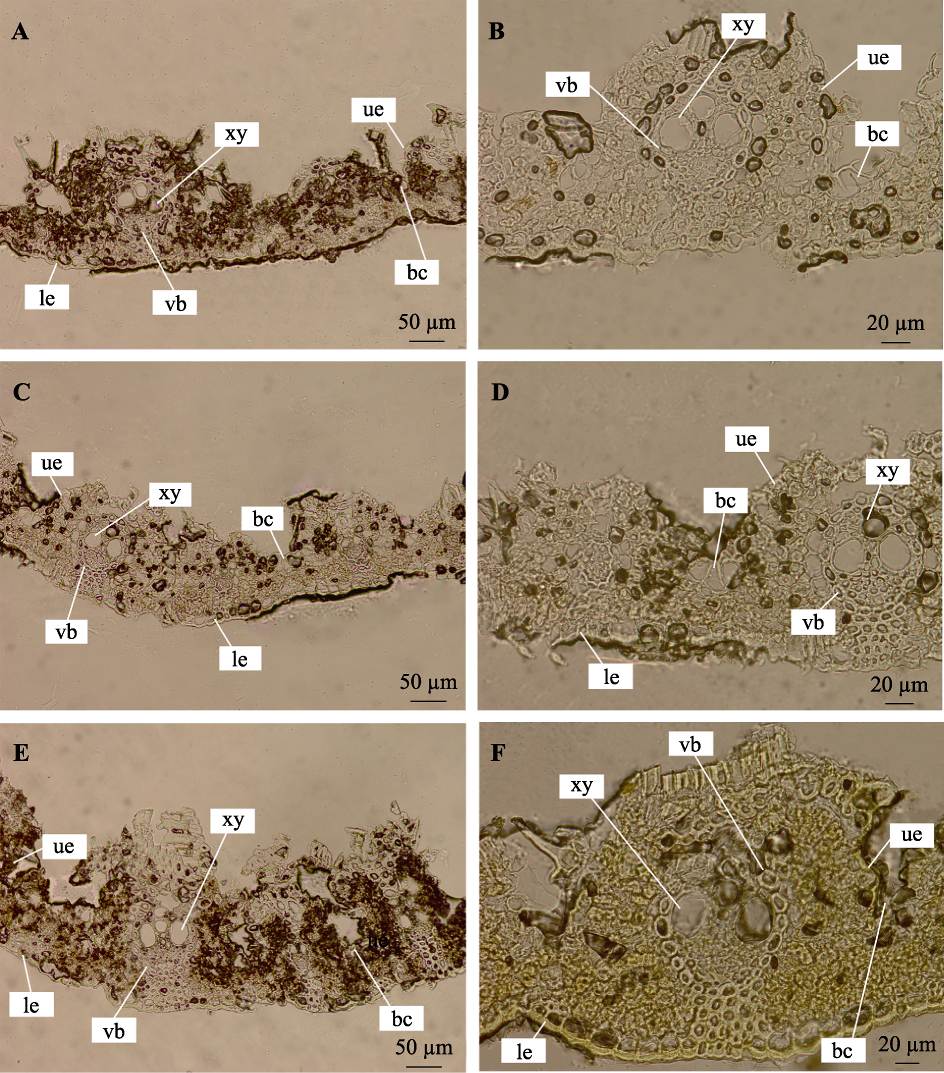
Fig. 10 Leaf transverse sections of Calamagrostis pseudophragmites under light microscope. A, B, Xeric meadow (HA habitat). C, D, Moderate-xeric meadow (HB habitat). E, F, Hygrophyte-mesophyte meadow (Z habitat). ac, air cavity; bc, bulliform cell; le, lower epidermis; ue, upper epidermis; vb, vascular bundle; xy, xylem.
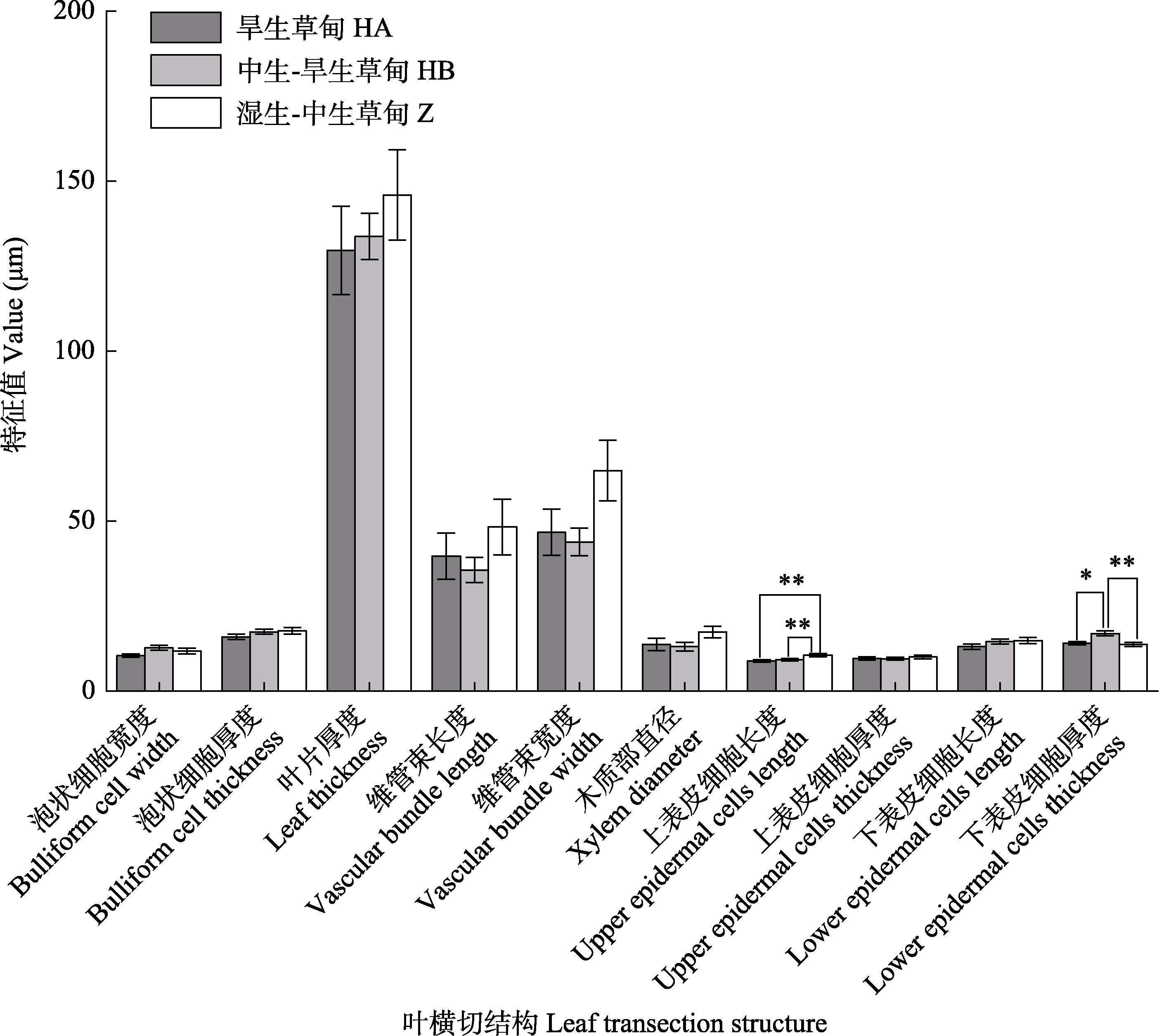
Fig. 11 Comparison of the mean values of leaf transection structure characters of Calamagrostis pseudophragmites in different habitats (mean ± SE). HA, xeric meadow; HB, moderate-xeric meadow; Z, hygrophyte-mesophyte meadow. *, p < 0.05; **, p < 0.01.
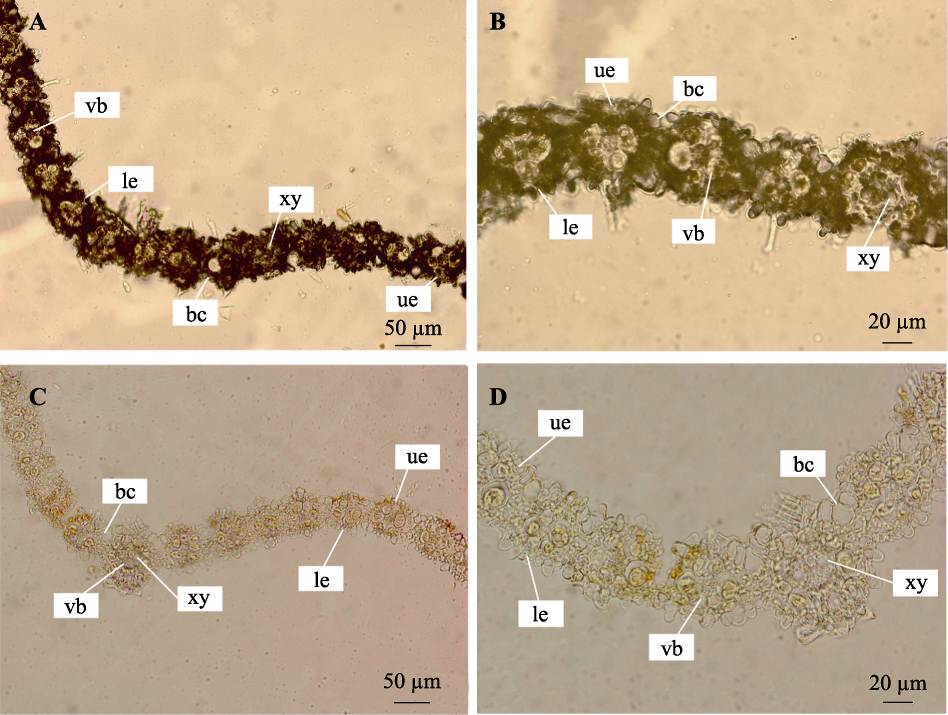
Fig. 12 Leaf transverse sections of Agrostis clavata under light microscope. A, B, Moderate-xeric meadow (HB habitat). C, D, Hygrophyte-mesophyte meadow (Z habitat). ac, air cavity; bc, bulliform cell; le, lower epidermis; ue, upper epidermis; vb, vascular bundle; xy, xylem.
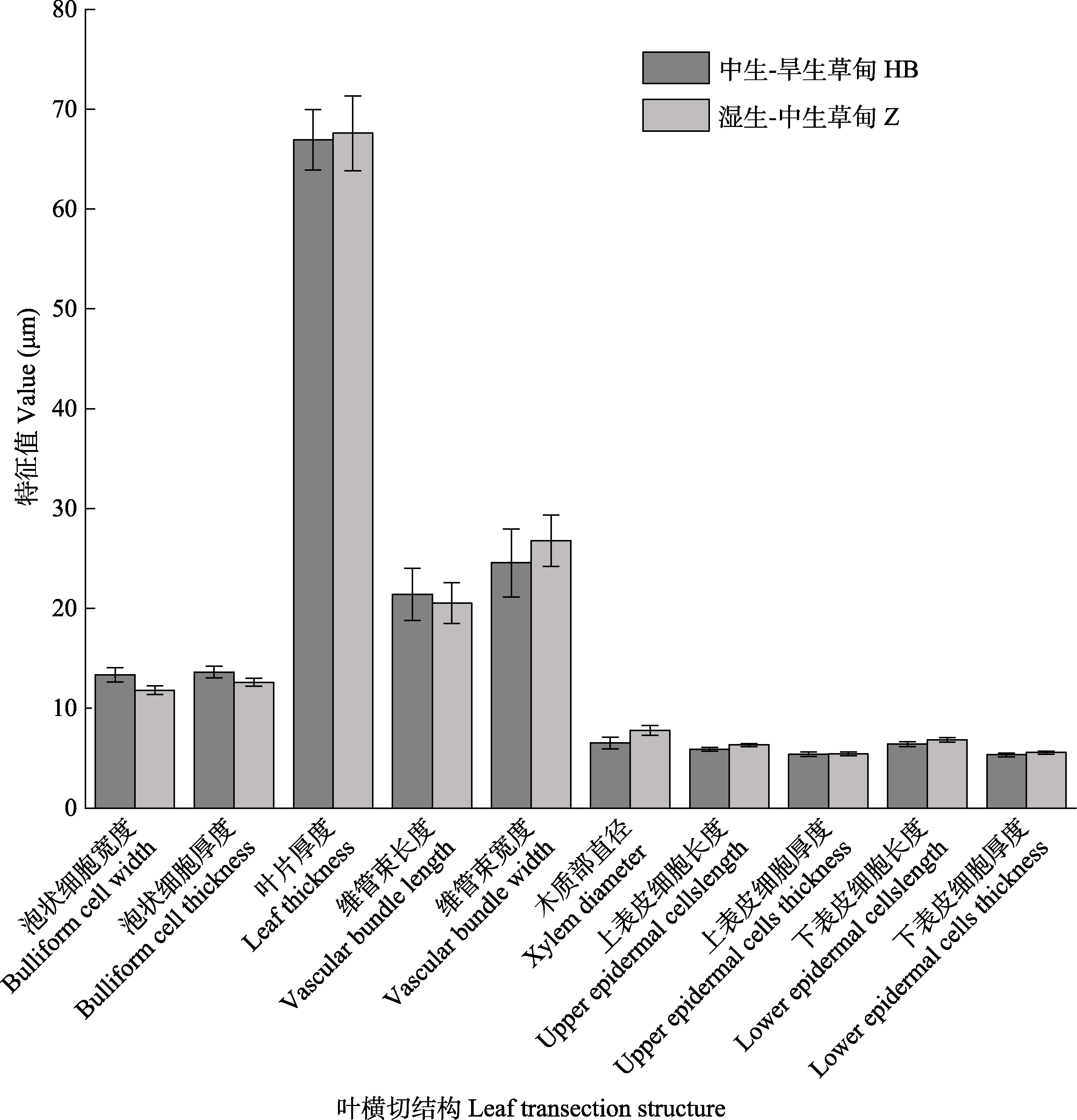
Fig. 13 Comparison of the mean values of leaf transection structure characters of Agrostis clavata in different habitats (mean ± SE). HB, moderate-xeric meadow; Z, hygrophyte-mesophyte meadow.
| [1] |
Bordbar F, Safari A, Adelifar N, Rezanejad F, Mirtadzadini M (2022). Leaf anatomical investigations in Acantholimon (Plumbaginaceae). Brazilian Journal of Botany, 45, 729-741.
DOI |
| [2] | Chang XG (2011). Study on Drought Adaptability of 7 Roegneria Species. Master degree dissertation, Inner Mongolia Agricultural University, Hohhot. |
| [常雪刚 (2011). 7种鹅观草属(Roegneria)植物耐旱适应性研究. 硕士学位论文, 内蒙古农业大学, 呼和浩特.] | |
| [3] |
Chartzoulakis K, Patakas A, Kofidis G, Bosabalidis A, Nastou A (2002). Water stress affects leaf anatomy, gas exchange, water relations and growth of two avocado cultivars. Scientia Horticulturae, 95, 39-50.
DOI URL |
| [4] |
Chaves MM, Maroco JP, Pereira JS (2003). Understanding plant responses to drought—From genes to the whole plant. Functional Plant Biology, 30, 239.
DOI URL |
| [5] | Che LP (2022). Anatomical Characteristics of Xylem and Leaf and Evaluation of Drought Resistance of 14 Tree Species. Master degree dissertation, Shandong Agricultural University, Tai’an, Shandong. |
| [车路平 (2022). 14个造林树种木质部、叶片解剖特征及抗旱性评价. 硕士学位论文, 山东农业大学, 山东泰安.] | |
| [6] | Chen X, Xu YF, Zhang ZY (2012). Leaf anatomical structure and photosynthetic physiology responses of Sorbus folgneri seedlings under drought stress. Acta Botanica Boreali-Occidentalia Sinica, 32, 111-116. |
| [陈昕, 徐宜凤, 张振英 (2012). 干旱胁迫下石灰花楸幼苗叶片的解剖结构和光合生理响应. 西北植物学报, 32, 111-116.] | |
| [7] | Chen XN (2019). Study on Adaptability of two Blueberry Varieties to Water Stress. Master degree dissertation, Central South University of Forestry and Technology, Changsha. |
| [陈雪妮 (2019). 两个蓝莓品种对水分胁迫的适应性研究. 硕士学位论文, 中南林业科技大学, 长沙.] | |
| [8] | Chen YT (2023). Study on the Effect of Water Level Changes on the Physiology and Ecology of the Submerged Plant Potamogeton crispus. Master degree dissertation, Jiangxi Normal University, Nanchang. |
| [陈怡听 (2023). 水位变化对沉水植物菹草生理生态的影响研究. 硕士学位论文, 江西师范大学, 南昌.] | |
| [9] | Cui XP, Liu GH, Zhang RL (2006). Comparison of leaf anatomical structure between Salix gordejevii growing under contrasting habitats of Otingdag Sandland and Salix microtachya var. bordensis growing on the lowlands of dunes. Acta Ecologica Sinica, 26, 1842-1847. |
| [崔秀萍, 刘果厚, 张瑞麟 (2006). 浑善达克沙地不同生境下黄柳叶片解剖结构的比较. 生态学报, 26, 1842-1847.] | |
| [10] |
Deegan BM, White SD, Ganf GG (2007). The influence of water level fluc tuations on the growth of four emergent macrophyte species. Aquatic Botany, 86, 309-315.
DOI URL |
| [11] |
Ennajeh M, Vadel AM, Cochard H, Khemira H (2010). Comparative impacts of water stress on the leaf anatomy of a drought-resistant and a drought-sensitive olive cultivar. Journal of Horticultural Science and Biotechnology, 85, 289-294.
DOI URL |
| [12] | Fradera-Soler M, Rudall PJ, Prychid CJ, Grace OM (2021). Evolutionary success in arid habitats: Morpho-anatomy of succulent leaves of Crassula species from southern Africa. Journal of Arid Environments, 185, 104319. DOI: 10.1016/j.jaridenv.2020.104319. |
| [13] | Han M, Ji CJ, Zuo WY, He JS (2006). Interactive effects of elevated CO2 and temperature on the leaf anatomical characteristics of eleven species. Acta Ecologica Sinica, 26, 326-333. |
| [韩梅, 吉成均, 左闻韵, 贺金生 (2006). CO2浓度和温度升高对11种植物叶片解剖特征的影响. 生态学报, 26, 326-333.] | |
| [14] | Hao RM, Li XZ, Hu JL (2005). Leaf structural change of Cyclobalanopsis multinervis and Michelia foveolata after shaded treatment. Acta Botanica Boreali-Occidentalia Sinica, 25, 1083-1088. |
| [郝日明, 李晓征, 胡金良 (2005). 遮荫处理下多脉青冈和金叶含笑的叶解剖结构变化研究. 西北植物学报, 25, 1083-1088.] | |
| [15] | Hu JY (2007). Morphological and Structural Traits, and Their Ecological Adaptation of Two Dominant Species in Alpine Grassland in Tibetan Plateau. Master degree dissertation, Institute of Botany, Chinese Academy of Sciences, Beijing. |
| [胡建莹 (2007). 青藏薹草和紫花针茅形态结构及其生态适应性. 硕士学位论文, 中国科学院植物研究所, 北京.] | |
| [16] | Hu SLY, Li H, Gu YS, Huang XY, Zhang ZQ, Wang YC (2021). An analysis of land use changes and driving forces of Dajiuhu wetland in Shennongjia based on high resolution remote sensing images: constraints from the multi-source and long-term remote sensing information. Remote Sensing for Land and Resources, 33, 221-230. |
| [胡苏李扬, 李辉, 顾延生, 黄咸雨, 张志麒, 汪迎春 (2021). 基于高分辨率遥感影像的神农架大九湖湿地土地利用类型变化及其驱动力分析——来自长时间尺度多源遥感信息的约束. 国土资源遥感, 33, 221-230.] | |
| [17] | Jiang C, Luo DQ, Wang LH (2011). Drought-resistant characteristics of leaf structures of five shrubs in semi-arid region of Tibet. Journal of Northwest Forestry University, 26(4), 13-17. |
| [江川, 罗大庆, 王立辉 (2011). 西藏半干旱区5种灌木叶片结构的抗旱特征研究. 西北林学院学报, 26(4), 13-17.] | |
| [18] |
Kalve S, de Vos D, Beemster GTS (2014). Leaf development: a cellular perspective. Frontiers in Plant Science, 5, 362.
DOI PMID |
| [19] | Kou M, Yin QL, Jiao JY (2019). Leaf anatomical structures and acclimation of ten monocotyledons in the hilly-gullied Loess Plateau Region. Acta Botanica Boreali-Occidentalia Sinica, 39, 102-109. |
| [寇萌, 尹秋龙, 焦菊英 (2019). 黄土丘陵沟壑区10种单子叶植物叶片解剖结构及环境适应性. 西北植物学报, 39, 102-109.] | |
| [20] | Li FL, Bao WK (2005). Responses of the morphological and anatomical structure of the plant leaf to environmental change. Chinese Bulletin of Botany, 40, 118-127. |
| [李芳兰, 包维楷 (2005). 植物叶片形态解剖结构对环境变化的响应与适应. 植物学通报, 40, 118-127.] | |
| [21] |
Li YH, Lu Q, Wu B, Zhu YJ, Liu DJ, Zhang JX, Jin ZH (2012). A review of leaf morphology plasticity linked to plant response and adaptation characteristics in arid ecosystems. Chinese Journal of Plant Ecology, 36, 88-98.
DOI URL |
|
[李永华, 卢琦, 吴波, 朱雅娟, 刘殿君, 张金鑫, 靳占虎 (2012). 干旱区叶片形态特征与植物响应和适应的关系. 植物生态学报, 36, 88-98.]
DOI |
|
| [22] | Liu HY, Gu YS, Ge JW, Yu ZC, Xu XN, Zhang ZQ, Cheng SG, Xie SC (2022). The response of the Dajiuhu Peatland ecosystem to hydrological variations: implications for carbon sequestration and peatlands conservation. Journal of Hydrology, 612, 128307. DOI: 10.1016/j.jhydrol.2022.128307. |
| [23] | Liu JQ (1982). The xeromorphic structure of different typical plants in deserts of China. Chinese Journal of Plant Ecology, 6, 314-319. |
| [刘家琼 (1982). 我国荒漠不同生态类型植物的旱生结构. 植物生态学与地植物学丛刊, 6, 314-319.] | |
| [24] | Liu Q, Wu JY, Li ZH (2015). Research progress of leaf anatomical structure of plants under drought stress. Hunan Forestry Science & Technology, 42(3), 101-104. |
| [刘球, 吴际友, 李志辉 (2015). 干旱胁迫对植物叶片解剖结构影响研究进展. 湖南林业科技, 42(3), 101-104.] | |
| [25] |
Liu XD, Hou ZY, Xie YH, Yu XY, Li X, Zeng J (2021). Influence of water level on four typical submerged plants in wetlands of Lake Dongting. Journal of Lake Sciences, 33, 181-191.
DOI URL |
| [刘向东, 侯志勇, 谢永宏, 于晓英, 李旭, 曾静 (2021). 水位对洞庭湖湿地4种典型沉水植物的影响. 湖泊科学, 33, 181-191.] | |
| [26] | Liu XF (2015). The Lanatomical Structure Characteristics of Greening Plants and Its Response to Air Pollution. Master dissertation, Xi’an University of Architecture and Technology, Xi’an. |
| [刘雄飞 (2015). 绿化植物叶解剖结构特征及其对城市空气环境的响应. 硕士学位论文, 西安建筑科技大学, 西安.] | |
| [27] |
Liu YB, Li XR, Li MM, Liu D, Zhang WL (2016). Leaf (or assimilation branch) epidermal micromorphology of desert plant in arid and semiarid areas of China. Chinese Journal of Plant Ecology, 40, 1189-1207.
DOI URL |
|
[刘玉冰, 李新荣, 李蒙蒙, 刘丹, 张雯莉 (2016). 中国干旱半干旱区荒漠植物叶片(或同化枝)表皮微形态特征. 植物生态学报, 40, 1189-1207.]
DOI |
|
| [28] | Luo T, Lun ZJ, Gu YS, Qin YM, Zhang ZQ, Zhang B (2015). Plant community survey and ecological protection of Dajiuhu wetlands in Shennongjia area. Wetland Science, 13, 153-160. |
| [罗涛, 伦子健, 顾延生, 秦养民, 张志麒, 张兵 (2015). 神农架大九湖湿地植物群落调查与生态保护研究. 湿地科学, 13, 153-160.] | |
| [29] | Mitrović M, Pavlović P, Djurdjević L, Gajić G, Kostić O, Bojovic S (2006). Differences in Norway maple leaf morphology and anatomy among polluted (Belgrade city parks) and unpolluted (Maljen Mt.) landscapes. Ekológia (Bratislava), 25, 126-137. |
| [30] |
Péli ER, Nagy-Déri H (2018). Different morpho-anatomical strategies against desiccation in five species of Xerophyta genus in relation to their ecophysiological aspects. South African Journal of Botany, 118, 232-240.
DOI URL |
| [31] | Sha W, Xu ZW, Wang XQ, Ni HW (2006). Leaf anatomy of Carex pseudocuraica growing in different environments of Sanjiang Campagna. Guihaia, 26, 583-588. |
| [沙伟, 徐忠文, 王晓琦, 倪红伟 (2006). 三江平原不同生境下漂筏苔草叶片解剖结构的研究. 广西植物, 26, 583-588.] | |
| [32] | Tan SD, Zhu MY, Zhang KR, Dang HS, Zhang QF (2009). Response and adaptation of plants to submergence stress. Chinese Journal of Ecology, 28, 1871-1877. |
| [谭淑端, 朱明勇, 张克荣, 党海山, 张全发 (2009). 植物对水淹胁迫的响应与适应. 生态学杂志, 28, 1871-1877.] | |
| [33] | Tian MN, Bi QX, He XH, Sai FL, Li GT, Wang LB (2019). Analysis and evaluation of drought resistance of Xanthoceras sorbifolium leaf anatomical structure. Molecular Plant Breeding, 17, 8261-8270. |
| [田梦妮, 毕泉鑫, 贺晓辉, 赛富勒, 李钢铁, 王利兵 (2019). 文冠果叶片解剖结构的抗旱性分析与评价. 分子植物育种, 17, 8261-8270.] | |
| [34] |
Vernescu C, Ryser P (2009). Constraints on leaf structural traits in wetland plants. American Journal of Botany, 96, 1068-1074.
DOI PMID |
| [35] | Wang H, Qi Z, Zhang FC (2016). Leaf anatomical structure of Halostachys caspica under different concentrations of salt stress. Xinjiang Agricultural Sciences, 53, 2098-2105. |
| [王虹, 齐政, 张富春 (2016). 不同浓度盐胁迫下盐穗木叶片结构的比较观察. 新疆农业科学, 53, 2098-2105.] | |
| [36] | Wang HY, Chen JK, Zhou J (1999). Influence of water level gradient on plant growth reproduction and biomass allocation of wetland plant species. Acta Phytoecologica Sinica, 23, 269-274. |
| [王海洋, 陈家宽, 周进 (1999). 水位梯度对湿地植物生长、繁殖和生物量分配的影响. 植物生态学报, 23, 269-274.] | |
| [37] | Wang RZ, Chen YP, Chen YN, Pan YP, He GZ (2016). Effects of groundwater level on morphological, anatomical structure and leaf hydraulic conductance of Populus euphratica. Journal of Desert Research, 36, 1302-1309. |
|
[王日照, 陈亚鹏, 陈亚宁, 潘莹萍, 何广志 (2016). 地下水埋深对胡杨(Populus euphratica)叶片形态结构和水力导度的影响. 中国沙漠, 36, 1302-1309.]
DOI |
|
| [38] | Wang YJ (2005). Vacuole-shaped cells in monocotyledons. Biology Teaching, 30(11), 7-9. |
| [王元军 (2005). 禾本科植物的泡状细胞. 生物学教学, 30(11), 7-9.] | |
| [39] | Wu LJ (2015). Response and Adaptation of Cyclobalanopsis gilva Seedlings to Drought Stress. PhD dissertation, Central South University of Forestry & Technology, Changsha. |
| [吴丽君 (2015). 赤皮青冈幼苗对干旱胁迫的响应与适应. 博士学位论文, 中南林业科技大学, 长沙.] | |
| [40] | Xue J, Wang GJ, Li JD, Sun B, Wang R (2010). Ecology compatibility of leaf anatomical structure of Ambrosia trifida to different water condition. Ecology and Environmental Sciences, 19, 686-691. |
|
[薛静, 王国骄, 李建东, 孙备, 王蕊 (2010). 不同水分条件下三裂叶豚草叶解剖结构的生态适应性. 生态环境学报, 19, 686-691.]
DOI |
|
| [41] | Yang J, Li EH, Cai XB, Wang Z, Wang XL (2014). Research progress in response of plants in wetlands to water level change. Wetland Science, 12, 807-813. |
| [杨娇, 厉恩华, 蔡晓斌, 王智, 王学雷 (2014). 湿地植物对水位变化的响应研究进展. 湿地科学, 12, 807-813.] | |
| [42] | Yu J (2014). Research on Anatomical Structure and Ecological Adaptability of Dominant Plants in Poyang Lake Wetland. Master degree dissertation, Nanchang University, Nanchang. |
| [余静 (2014). 鄱阳湖湿地优势植物的解剖结构及其生态适应性研究. 硕士学位论文, 南昌大学, 南昌.] | |
| [43] | Zhang SS, Ji NN, Sun L (2017). Effect of heavy metal stress on leaf anatomical structure of Prunus padus. Protection Forest Science and Technology, (7), 76-78. |
| [张树森, 纪楠楠, 孙龙 (2017). 重金属胁迫对紫叶稠李叶片解剖结构的影响. 防护林科技, (7), 76-78.] | |
| [44] | Zhang WX, Wang CG, Yin XF, Wang HC (2018). The response of Cleistogenes songorica leaf anatomical structure to desert grassland deterioration gradient. Ecology and Environmental Sciences, 27, 1809-1817. |
|
[张文霞, 王春光, 殷晓飞, 王海超 (2018). 无芒隐子草叶片解剖结构对荒漠草原不同退化梯度的响应. 生态环境学报, 27, 1809-1817.]
DOI |
|
| [45] | Zhang WY, Zhou MC, Hu ZQ, Wu ZJ, Zhang K, Dong LQ (2025). Response of stomatal and photosynthetic traits of Carex muliensis in the Ruoergai Alpine Marsh to water table drawdown. Acta Ecologica Sinica, 45, 4405-4416. |
| [张文耀, 周么措, 胡再勤, 吴正江, 张昆, 董李勤 (2025). 若尔盖高寒沼泽木里薹草气孔与光合性状对水位下降的响应. 生态学报, 45, 4405-4416.] | |
| [46] | Zhang X, Yang XJ (2003). Study of leaves characters of 3 species and relationship between in structure and moist habitat. Journal of Science of Teachers College and University, 23(1), 46-49. |
| [张兴, 杨晓杰 (2003). 3种植物叶的结构特征及其与湿地生态环境关系的研究. 高师理科学刊, 23(1), 46-49.] | |
| [47] | Zhang Y, Leng HN, Cao HJ, Xu MY (2022). Study on the influence of drought stress on botany. Heilongjiang Science, 13(14), 22-24. |
| [张玉, 冷海楠, 曹宏杰, 徐明怡 (2022). 干旱胁迫对植物的影响研究. 黑龙江科学, 13(14), 22-24.] | |
| [48] | Zhao XH, Li XH, Guo L, Gao Y (2020). Regional and environmental differentiation of leaf morphology and anatomical structure of Nitraria tangutorum. Journal of Arid Land Resources and Environment, 34, 143-150. |
| [赵杏花, 李旭红, 郭璐, 高永 (2020). 唐古特白刺叶片形态结构的地域环境分异. 干旱区资源与环境, 34, 143-150.] | |
| [49] | Zhou Y, Fang LC, Tong J, Dong YF, Xu DY, Mao J, Wei M (2018). Effect of drought stress on leaf epidermal anatomical structure of Rhododendron. Hubei Agricultural Sciences, 57(14), 67-72. |
| [周媛, 方林川, 童俊, 董艳芳, 徐冬云, 毛静, 魏鸣 (2018). 干旱胁迫对杜鹃叶片表皮解剖结构的影响. 湖北农业科学, 57(14), 67-72.] | |
| [50] | Zhou ZB, Li PJ (2002). A review on the phytotomy research of xerophytes in China. Arid Zone Research, 19, 35-40. |
|
[周智彬, 李培军 (2002). 我国旱生植物的形态解剖学研究. 干旱区研究, 19, 35-40.]
DOI |
|
| [51] | Zhu RQ, Liu ML, Li G, Kang HM, Yang T, Wang ZY (2020). Responses of leaf functional traits of Reaumuria soongorica in two different desert habitats. Journal of Northwest Forestry University, 35(5), 29-34. |
| [朱瑞清, 刘美玲, 李刚, 康红梅, 杨涛, 王治业 (2020). 2种水分生境下红砂叶片功能性状的响应及适应机制. 西北林学院学报, 35(5), 29-34.] | |
| [52] | Zou DS, Wang FA, Yang SY, Hu SP (2000). Studies on the morophological and anatomical feastures and physiological functions of leaves in Eulaliopsis binata. Acta Botanica Boreali-Occidentalia Sinica, 20, 484-488. |
| [邹冬生, 王凤翱, 阳树英, 胡颂平 (2000). 龙须草叶片形态结构与生理功能的研究. 西北植物学报, 20, 484-488.] |
| Viewed | ||||||
|
Full text |
|
|||||
|
Abstract |
|
|||||
Copyright © 2026 Chinese Journal of Plant Ecology
Tel: 010-62836134, 62836138, E-mail: apes@ibcas.ac.cn, cjpe@ibcas.ac.cn

