
Chin J Plant Ecol ›› 2012, Vol. 36 ›› Issue (6): 491-503.DOI: 10.3724/SP.J.1258.2012.00491 cstr: 32100.14.SP.J.1258.2012.00491
• Research Articles • Previous Articles Next Articles
GAO Run-Mei*( ), SHI Xiao-Dong, GUO Yue-Dong
Received:2012-01-04
Accepted:2012-03-09
Online:2012-01-04
Published:2012-06-04
Contact:
GAO Run-Mei
GAO Run-Mei, SHI Xiao-Dong, GUO Yue-Dong. Community stability evaluation of riparian forest of the upper reaches of Wenyuhe in Shanxi, China[J]. Chin J Plant Ecol, 2012, 36(6): 491-503.
Add to citation manager EndNote|Ris|BibTeX
URL: https://www.plant-ecology.com/EN/10.3724/SP.J.1258.2012.00491
| 群落类型 Community type | 海拔 Elevation (m) | 坡度 Slope (°) | 坡向 Slope aspect (°) | 郁闭度 Canopy coverage | 样地数量 Plot number |
|---|---|---|---|---|---|
| 1 青杨林 PCS | 1 680 | 0-2 | 275 | 0.40-0.45 | 3 |
| 2 青杨辽东栎混交林 PQM | 1 818-1 935 | 0-16 | 110-243 | 0.36-0.40 | 3 |
| 3 青杨白桦混交林 PBM | 1 830-1 869 | 0-8 | 197-297 | 0.45-0.48 | 6 |
| 4 杨桦落叶松混交林 PBL | 1 940-2 144 | 22-40 | 180-299 | 0.44-0.50 | 6 |
| 5 青杨白杄混交林 PPM | 1 818-1 935 | 2-15 | 60-168 | 0.50-0.53 | 3 |
| 6 杨桦青杄混交林 PBP | 1 935-2 099 | 8-25 | 60-197 | 0.48-0.55 | 6 |
| 7 油松白桦混交林 TBM | 1 780-1 820 | 17-25 | 290-310 | 0.60-0.70 | 5 |
| 8 落叶松辽东栎混交林 LQM | 1 820-1 950 | 23-25 | 310-330 | 0.60-0.63 | 5 |
| 9 落叶松青杨混交林 LPM | 1 980-2 135 | 15-36 | 241-304 | 0.60-0.68 | 4 |
| 10 白杄杨桦混交林 PPB | 1 895-1 935 | 0-15 | 110-164 | 0.68-0.71 | 3 |
| 11 落叶松白杄混交林 LMM | 1 785-2 030 | 4-27 | 142-224 | 0.75-0.78 | 3 |
| 12 落叶松青杄混交林 LWM | 1 950-2 250 | 18-33 | 221-327 | 0.68-0.72 | 6 |
| 13 青杄林 PWS | 2 020-2 270 | 0-10 | 22-83 | 0.75-0.80 | 3 |
Table 1 Environment situations of 13 riparian forest communities
| 群落类型 Community type | 海拔 Elevation (m) | 坡度 Slope (°) | 坡向 Slope aspect (°) | 郁闭度 Canopy coverage | 样地数量 Plot number |
|---|---|---|---|---|---|
| 1 青杨林 PCS | 1 680 | 0-2 | 275 | 0.40-0.45 | 3 |
| 2 青杨辽东栎混交林 PQM | 1 818-1 935 | 0-16 | 110-243 | 0.36-0.40 | 3 |
| 3 青杨白桦混交林 PBM | 1 830-1 869 | 0-8 | 197-297 | 0.45-0.48 | 6 |
| 4 杨桦落叶松混交林 PBL | 1 940-2 144 | 22-40 | 180-299 | 0.44-0.50 | 6 |
| 5 青杨白杄混交林 PPM | 1 818-1 935 | 2-15 | 60-168 | 0.50-0.53 | 3 |
| 6 杨桦青杄混交林 PBP | 1 935-2 099 | 8-25 | 60-197 | 0.48-0.55 | 6 |
| 7 油松白桦混交林 TBM | 1 780-1 820 | 17-25 | 290-310 | 0.60-0.70 | 5 |
| 8 落叶松辽东栎混交林 LQM | 1 820-1 950 | 23-25 | 310-330 | 0.60-0.63 | 5 |
| 9 落叶松青杨混交林 LPM | 1 980-2 135 | 15-36 | 241-304 | 0.60-0.68 | 4 |
| 10 白杄杨桦混交林 PPB | 1 895-1 935 | 0-15 | 110-164 | 0.68-0.71 | 3 |
| 11 落叶松白杄混交林 LMM | 1 785-2 030 | 4-27 | 142-224 | 0.75-0.78 | 3 |
| 12 落叶松青杄混交林 LWM | 1 950-2 250 | 18-33 | 221-327 | 0.68-0.72 | 6 |
| 13 青杄林 PWS | 2 020-2 270 | 0-10 | 22-83 | 0.75-0.80 | 3 |
| 群落类型 Community type | 幼苗 Seedling (%) | 标准值 Standard value | 幼树 Sapling (%) | 标准值 Standard value | 平均值 Mean |
|---|---|---|---|---|---|
| 1 青杨林 PCS | 49.22 | 500.46 | 2.03 | 26.43 | 263.44 |
| 2 青杨辽东栎混交林 PQM | 44.81 | 455.62 | 76.80 | 1 000.00 | 727.81 |
| 3 青杨白桦混交林 PBM | 21.94 | 223.08 | 48.17 | 627.21 | 425.15 |
| 4 杨桦落叶松混交林 PBL | 1.33 | 13.52 | 17.53 | 228.26 | 120.89 |
| 5 青杨白杄混交林 PPM | 2.45 | 24.91 | 39.54 | 514.84 | 269.88 |
| 6 杨桦青杄混交林 PBP | 41.58 | 422.78 | 10.61 | 138.15 | 280.46 |
| 7 油松白桦混交林 TBM | 69.47 | 706.35 | 58.20 | 757.81 | 732.08 |
| 8 落叶松辽东栎混交林 LQM | 10.46 | 106.35 | 15.69 | 204.30 | 155.33 |
| 9 落叶松青杨混交林 LPM | 2.52 | 25.62 | 17.65 | 229.82 | 127.72 |
| 10 白杄杨桦混交林 PPB | 69.47 | 706.35 | 15.98 | 208.07 | 457.21 |
| 11 落叶松白杄混交林 LMM | 98.35 | 1 000.00 | 42.18 | 549.22 | 774.61 |
| 12 落叶松青杄混交林 LWM | 66.41 | 675.24 | 35.98 | 468.49 | 571.87 |
| 13 青杄林 PWS | 52.23 | 531.06 | 19.03 | 247.79 | 389.42 |
Table 2 Regeneration potential characteristics of dominant tree species of tree layer
| 群落类型 Community type | 幼苗 Seedling (%) | 标准值 Standard value | 幼树 Sapling (%) | 标准值 Standard value | 平均值 Mean |
|---|---|---|---|---|---|
| 1 青杨林 PCS | 49.22 | 500.46 | 2.03 | 26.43 | 263.44 |
| 2 青杨辽东栎混交林 PQM | 44.81 | 455.62 | 76.80 | 1 000.00 | 727.81 |
| 3 青杨白桦混交林 PBM | 21.94 | 223.08 | 48.17 | 627.21 | 425.15 |
| 4 杨桦落叶松混交林 PBL | 1.33 | 13.52 | 17.53 | 228.26 | 120.89 |
| 5 青杨白杄混交林 PPM | 2.45 | 24.91 | 39.54 | 514.84 | 269.88 |
| 6 杨桦青杄混交林 PBP | 41.58 | 422.78 | 10.61 | 138.15 | 280.46 |
| 7 油松白桦混交林 TBM | 69.47 | 706.35 | 58.20 | 757.81 | 732.08 |
| 8 落叶松辽东栎混交林 LQM | 10.46 | 106.35 | 15.69 | 204.30 | 155.33 |
| 9 落叶松青杨混交林 LPM | 2.52 | 25.62 | 17.65 | 229.82 | 127.72 |
| 10 白杄杨桦混交林 PPB | 69.47 | 706.35 | 15.98 | 208.07 | 457.21 |
| 11 落叶松白杄混交林 LMM | 98.35 | 1 000.00 | 42.18 | 549.22 | 774.61 |
| 12 落叶松青杄混交林 LWM | 66.41 | 675.24 | 35.98 | 468.49 | 571.87 |
| 13 青杄林 PWS | 52.23 | 531.06 | 19.03 | 247.79 | 389.42 |
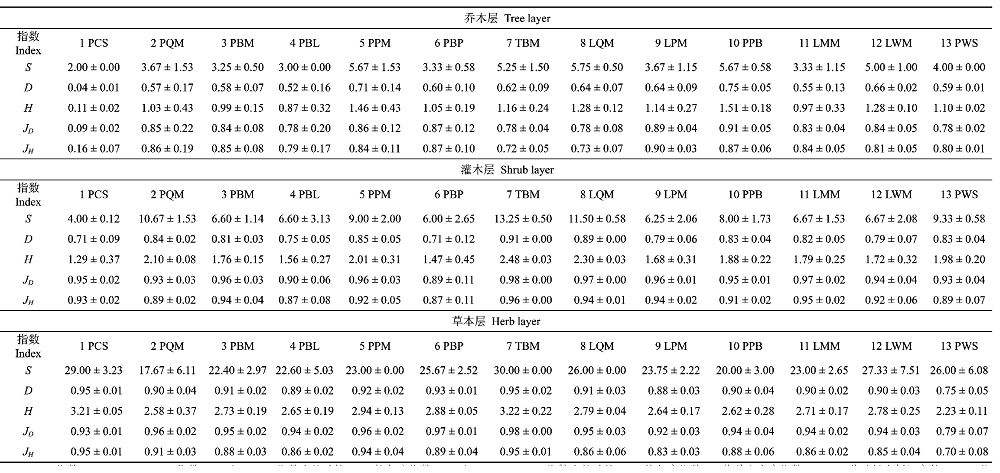 |
Table 3 Species diversity index of tree layer, shrub layer and herb layer of community (mean±SD)
| |
| 群落类型 Community type | 层次 Layer | S | D | H | JD | JH | 平均值 Mean |
|---|---|---|---|---|---|---|---|
| 1 青杨林 PCS | 乔木 Tree | 347.83 | 56.34 | 72.85 | 98.90 | 177.78 | 613.78 |
| 灌木 Shrub | 301.89 | 780.22 | 520.16 | 969.39 | 968.75 | ||
| 草本 Herb | 966.67 | 1 000.00 | 996.89 | 948.98 | 1 000.00 | ||
| 2 青杨辽东栎混交林 PQM | 乔木 Tree | 638.26 | 802.82 | 682.12 | 934.07 | 955.56 | 849.27 |
| 灌木 Shrub | 805.28 | 923.08 | 846.77 | 948.98 | 927.08 | ||
| 草本 Herb | 589.00 | 947.37 | 801.24 | 979.59 | 957.89 | ||
| 3 青杨白桦混交林 PBM | 乔木 Tree | 565.22 | 816.90 | 655.63 | 923.08 | 944.44 | 827.33 |
| 灌木 Shrub | 498.11 | 890.11 | 709.68 | 979.59 | 979.17 | ||
| 草本 Herb | 746.67 | 957.89 | 847.83 | 969.39 | 926.32 | ||
| 4 杨桦落叶松混交林 PBL | 乔木 Tree | 521.74 | 732.39 | 576.16 | 857.14 | 877.78 | 781.25 |
| 灌木 Shrub | 498.11 | 824.18 | 629.03 | 918.37 | 906.25 | ||
| 草本 Herb | 753.33 | 936.84 | 822.98 | 959.18 | 905.26 | ||
| 5 青杨白杄混交林 PPM | 乔木 Tree | 986.09 | 1 000.00 | 966.89 | 945.05 | 933.33 | 920.69 |
| 灌木 Shrub | 679.25 | 934.07 | 810.48 | 979.59 | 958.33 | ||
| 草本 Herb | 766.67 | 968.42 | 913.04 | 979.59 | 989.47 | ||
| 6 杨桦青杄混交林 PBP | 乔木 Tree | 579.13 | 845.07 | 695.36 | 956.04 | 966.67 | 822.54 |
| 灌木 Shrub | 452.83 | 780.22 | 592.74 | 908.16 | 906.25 | ||
| 草本 Herb | 855.67 | 978.95 | 894.41 | 989.80 | 936.84 | ||
| 7 油松白桦混交林 TBM | 乔木 Tree | 913.04 | 873.24 | 768.21 | 857.14 | 800.00 | 947.44 |
| 灌木 Shrub | 1 000.00 | 1 000.00 | 1 000.00 | 1 000.00 | 1 000.00 | ||
| 草本 Herb | 1 000.00 | 1 000.00 | 1 000.00 | 1 000.00 | 1 000.00 | ||
| 8 落叶松辽东栎混交林 LQM | 乔木 Tree | 1 000.00 | 901.41 | 847.68 | 857.14 | 811.11 | 915.02 |
| 灌木 Shrub | 867.92 | 978.02 | 927.42 | 989.80 | 979.17 | ||
| 草本 Herb | 866.67 | 957.89 | 866.46 | 969.39 | 905.26 | ||
| 9 落叶松青杨混交林 LPM | 乔木 Tree | 638.26 | 901.41 | 754.97 | 978.02 | 1 000.00 | 839.93 |
| 灌木 Shrub | 471.70 | 868.13 | 677.42 | 979.59 | 979.17 | ||
| 草本 Herb | 791.67 | 926.32 | 819.88 | 938.78 | 873.68 | ||
| 10 白杄杨桦混交林 PPB | 乔木 Tree | 986.09 | 1056.34 | 1 000.00 | 1 000.00 | 966.67 | 900.90 |
| 灌木 Shrub | 603.77 | 912.09 | 758.06 | 969.39 | 947.92 | ||
| 草本 Herb | 666.67 | 947.37 | 813.66 | 959.18 | 926.32 | ||
| 11 落叶松白杄混交林 LMM | 乔木 Tree | 579.13 | 774.65 | 642.38 | 912.09 | 933.33 | 824.49 |
| 灌木 Shrub | 503.40 | 901.10 | 721.77 | 989.80 | 989.58 | ||
| 草本 Herb | 766.67 | 947.37 | 841.61 | 959.18 | 905.26 | ||
| 12 落叶松青杄混交林 LWM | 乔木 Tree | 869.57 | 929.58 | 847.68 | 923.08 | 900.00 | 868.54 |
| 灌木 Shrub | 503.40 | 868.13 | 693.55 | 959.18 | 958.33 | ||
| 草本 Herb | 911.00 | 947.37 | 863.35 | 959.18 | 894.74 | ||
| 13 青杄林 PWS | 乔木 Tree | 695.65 | 830.99 | 728.48 | 857.14 | 888.89 | 812.23 |
| 灌木 Shrub | 704.15 | 912.09 | 798.39 | 948.98 | 927.08 | ||
| 草本 Herb | 866.67 | 789.47 | 692.55 | 806.12 | 736.84 |
Table 4 Standard value of species diversity index of community
| 群落类型 Community type | 层次 Layer | S | D | H | JD | JH | 平均值 Mean |
|---|---|---|---|---|---|---|---|
| 1 青杨林 PCS | 乔木 Tree | 347.83 | 56.34 | 72.85 | 98.90 | 177.78 | 613.78 |
| 灌木 Shrub | 301.89 | 780.22 | 520.16 | 969.39 | 968.75 | ||
| 草本 Herb | 966.67 | 1 000.00 | 996.89 | 948.98 | 1 000.00 | ||
| 2 青杨辽东栎混交林 PQM | 乔木 Tree | 638.26 | 802.82 | 682.12 | 934.07 | 955.56 | 849.27 |
| 灌木 Shrub | 805.28 | 923.08 | 846.77 | 948.98 | 927.08 | ||
| 草本 Herb | 589.00 | 947.37 | 801.24 | 979.59 | 957.89 | ||
| 3 青杨白桦混交林 PBM | 乔木 Tree | 565.22 | 816.90 | 655.63 | 923.08 | 944.44 | 827.33 |
| 灌木 Shrub | 498.11 | 890.11 | 709.68 | 979.59 | 979.17 | ||
| 草本 Herb | 746.67 | 957.89 | 847.83 | 969.39 | 926.32 | ||
| 4 杨桦落叶松混交林 PBL | 乔木 Tree | 521.74 | 732.39 | 576.16 | 857.14 | 877.78 | 781.25 |
| 灌木 Shrub | 498.11 | 824.18 | 629.03 | 918.37 | 906.25 | ||
| 草本 Herb | 753.33 | 936.84 | 822.98 | 959.18 | 905.26 | ||
| 5 青杨白杄混交林 PPM | 乔木 Tree | 986.09 | 1 000.00 | 966.89 | 945.05 | 933.33 | 920.69 |
| 灌木 Shrub | 679.25 | 934.07 | 810.48 | 979.59 | 958.33 | ||
| 草本 Herb | 766.67 | 968.42 | 913.04 | 979.59 | 989.47 | ||
| 6 杨桦青杄混交林 PBP | 乔木 Tree | 579.13 | 845.07 | 695.36 | 956.04 | 966.67 | 822.54 |
| 灌木 Shrub | 452.83 | 780.22 | 592.74 | 908.16 | 906.25 | ||
| 草本 Herb | 855.67 | 978.95 | 894.41 | 989.80 | 936.84 | ||
| 7 油松白桦混交林 TBM | 乔木 Tree | 913.04 | 873.24 | 768.21 | 857.14 | 800.00 | 947.44 |
| 灌木 Shrub | 1 000.00 | 1 000.00 | 1 000.00 | 1 000.00 | 1 000.00 | ||
| 草本 Herb | 1 000.00 | 1 000.00 | 1 000.00 | 1 000.00 | 1 000.00 | ||
| 8 落叶松辽东栎混交林 LQM | 乔木 Tree | 1 000.00 | 901.41 | 847.68 | 857.14 | 811.11 | 915.02 |
| 灌木 Shrub | 867.92 | 978.02 | 927.42 | 989.80 | 979.17 | ||
| 草本 Herb | 866.67 | 957.89 | 866.46 | 969.39 | 905.26 | ||
| 9 落叶松青杨混交林 LPM | 乔木 Tree | 638.26 | 901.41 | 754.97 | 978.02 | 1 000.00 | 839.93 |
| 灌木 Shrub | 471.70 | 868.13 | 677.42 | 979.59 | 979.17 | ||
| 草本 Herb | 791.67 | 926.32 | 819.88 | 938.78 | 873.68 | ||
| 10 白杄杨桦混交林 PPB | 乔木 Tree | 986.09 | 1056.34 | 1 000.00 | 1 000.00 | 966.67 | 900.90 |
| 灌木 Shrub | 603.77 | 912.09 | 758.06 | 969.39 | 947.92 | ||
| 草本 Herb | 666.67 | 947.37 | 813.66 | 959.18 | 926.32 | ||
| 11 落叶松白杄混交林 LMM | 乔木 Tree | 579.13 | 774.65 | 642.38 | 912.09 | 933.33 | 824.49 |
| 灌木 Shrub | 503.40 | 901.10 | 721.77 | 989.80 | 989.58 | ||
| 草本 Herb | 766.67 | 947.37 | 841.61 | 959.18 | 905.26 | ||
| 12 落叶松青杄混交林 LWM | 乔木 Tree | 869.57 | 929.58 | 847.68 | 923.08 | 900.00 | 868.54 |
| 灌木 Shrub | 503.40 | 868.13 | 693.55 | 959.18 | 958.33 | ||
| 草本 Herb | 911.00 | 947.37 | 863.35 | 959.18 | 894.74 | ||
| 13 青杄林 PWS | 乔木 Tree | 695.65 | 830.99 | 728.48 | 857.14 | 888.89 | 812.23 |
| 灌木 Shrub | 704.15 | 912.09 | 798.39 | 948.98 | 927.08 | ||
| 草本 Herb | 866.67 | 789.47 | 692.55 | 806.12 | 736.84 |
| 群落类型 Community type | 更新潜力 Regeneration potential | 物种多样性 Species diversity | Godron指数 Godron index | 立地质量 Site quality | 保护强度 Protection intensity | 平均值 Mean |
|---|---|---|---|---|---|---|
| 1 青杨林 PCS | 0.22 | 0.00 | 0.00 | 0.54 | 0.00 | 0.15 |
| 2 青杨辽东栎混交林 PQM | 0.93 | 0.71 | 0.78 | 0.00 | 0.13 | 0.51 |
| 3 青杨白桦混交林 PBM | 0.47 | 0.64 | 0.70 | 0.24 | 0.00 | 0.41 |
| 4 杨桦落叶松混交林 PBL | 0.00 | 0.50 | 0.78 | 0.50 | 0.20 | 0.40 |
| 5 青杨白杄混交林 PPM | 0.23 | 0.92 | 0.52 | 0.46 | 0.13 | 0.45 |
| 6 杨桦青杄混交林 PBP | 0.24 | 0.63 | 0.68 | 0.44 | 0.53 | 0.50 |
| 7 油松白桦混交林 TBM | 0.93 | 1.00 | 0.72 | 0.40 | 0.00 | 0.61 |
| 8 落叶松辽东栎混交林 LQM | 0.05 | 0.90 | 0.41 | 0.88 | 0.28 | 0.50 |
| 9 落叶松青杨混交林 LPM | 0.01 | 0.68 | 0.79 | 0.93 | 0.10 | 0.50 |
| 10 白杄杨桦混交林 PPB | 0.51 | 0.86 | 0.98 | 0.89 | 0.39 | 0.73 |
| 11 落叶松白杄混交林 LMM | 1.00 | 0.63 | 0.88 | 0.61 | 0.39 | 0.70 |
| 12 落叶松青杄混交林 LWM | 0.69 | 0.76 | 0.65 | 0.86 | 0.70 | 0.73 |
| 13 青杄林 PWS | 0.41 | 0.59 | 1.00 | 1.00 | 1.00 | 0.80 |
Table 8 Subordinate function values of five stability indexes and their means of community
| 群落类型 Community type | 更新潜力 Regeneration potential | 物种多样性 Species diversity | Godron指数 Godron index | 立地质量 Site quality | 保护强度 Protection intensity | 平均值 Mean |
|---|---|---|---|---|---|---|
| 1 青杨林 PCS | 0.22 | 0.00 | 0.00 | 0.54 | 0.00 | 0.15 |
| 2 青杨辽东栎混交林 PQM | 0.93 | 0.71 | 0.78 | 0.00 | 0.13 | 0.51 |
| 3 青杨白桦混交林 PBM | 0.47 | 0.64 | 0.70 | 0.24 | 0.00 | 0.41 |
| 4 杨桦落叶松混交林 PBL | 0.00 | 0.50 | 0.78 | 0.50 | 0.20 | 0.40 |
| 5 青杨白杄混交林 PPM | 0.23 | 0.92 | 0.52 | 0.46 | 0.13 | 0.45 |
| 6 杨桦青杄混交林 PBP | 0.24 | 0.63 | 0.68 | 0.44 | 0.53 | 0.50 |
| 7 油松白桦混交林 TBM | 0.93 | 1.00 | 0.72 | 0.40 | 0.00 | 0.61 |
| 8 落叶松辽东栎混交林 LQM | 0.05 | 0.90 | 0.41 | 0.88 | 0.28 | 0.50 |
| 9 落叶松青杨混交林 LPM | 0.01 | 0.68 | 0.79 | 0.93 | 0.10 | 0.50 |
| 10 白杄杨桦混交林 PPB | 0.51 | 0.86 | 0.98 | 0.89 | 0.39 | 0.73 |
| 11 落叶松白杄混交林 LMM | 1.00 | 0.63 | 0.88 | 0.61 | 0.39 | 0.70 |
| 12 落叶松青杄混交林 LWM | 0.69 | 0.76 | 0.65 | 0.86 | 0.70 | 0.73 |
| 13 青杄林 PWS | 0.41 | 0.59 | 1.00 | 1.00 | 1.00 | 0.80 |
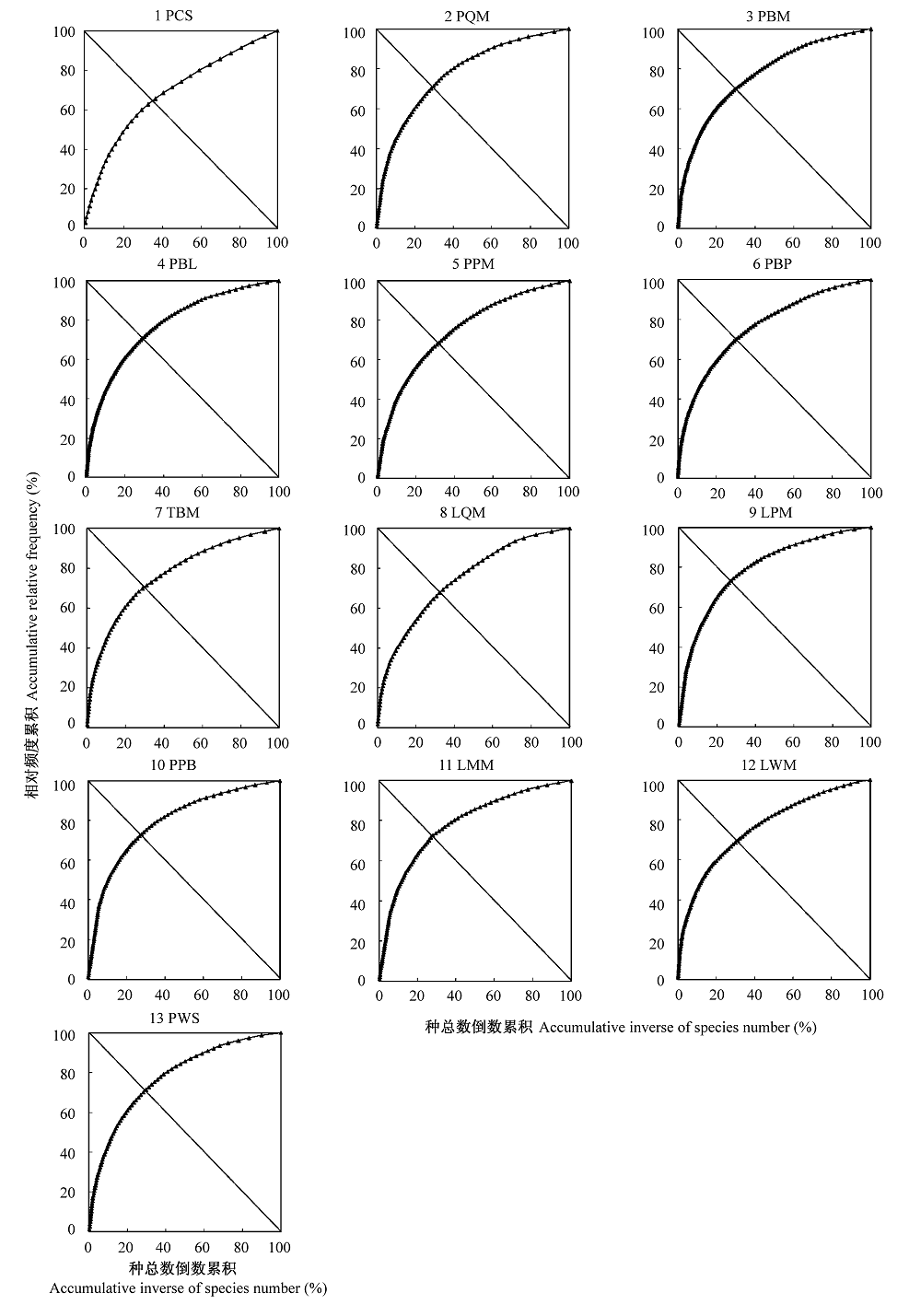
Fig. 1 Godron scatter graphs of 13 communities. LMM, Larix principis-rupprechtii + Picea meyeri mixed forest; LPM, Larix principis-rupprechtii + Populus cathayana mixed forest; LQM, Larix principis-rupprechtii + Quercus wutaishanica mixed forest; LWM, Larix principis-rupprechtii + Picea wilsonii mixed forest; PBL, Populus cathayana + Betula platyphylla + Larix principis-rupprechtii mixed forest; PBM, Populus cathayana + Betula platyphylla mixed forest; PBP, Populus cathayana + Betula platyphylla + Picea wilsonii mixed forest; PCS, Populus cathayana single forest; PPB, Picea meyeri + Populus cathayana + Betula platyphylla mixed forest; PPM, Populus cathayana + Picea meyeri mixed forest; PQM, Populus cathayana + Quercus wutaishanica mixed forest; PWS, Picea wilsonii single forest; TBM, Pinus tabulaeformis + Betula platyphylla mixed forest.
| 群落类型 Community type | 曲线类型 Type of curve | 相关系数 Correlation coefficient | 交点坐标 Coordinates | 标准值 Standard value |
|---|---|---|---|---|
| 1 青杨林 PCS | y = -0.01x2 + 1.87x + 10.75 | 0.98 | 35.75/64.25 | 890.01 |
| 2 青杨辽东栎混交林 PQM | y = -0.02x2 + 2.36x + 15.23 | 0.96 | 29.53/70.47 | 976.17 |
| 3 青杨白桦混交林 PBM | y = -0.02x2 + 2.25x + 16.13 | 0.95 | 30.16/69.84 | 967.45 |
| 4 杨桦落叶松混交林 PBL | y = -0.02x2 + 2.35x + 15.59 | 0.96 | 29.56/70.44 | 975.76 |
| 5 青杨白杄混交林 PPM | y = -0.01x2 + 2.21x + 13.10 | 0.97 | 31.64/68.36 | 946.95 |
| 6 杨桦青杄混交林 PBP | y = -0.02x2 + 2.23x + 16.13 | 0.96 | 30.38/69.62 | 964.40 |
| 7 油松白桦混交林 TBM | y = -0.02x2 + 2.22x + 16.85 | 0.95 | 30.05/69.95 | 968.97 |
| 8 落叶松辽东栎混交林 LQM | y = -0.01x2 + 2.06x + 14.28 | 0.97 | 32.53/67.47 | 934.62 |
| 9 落叶松青杨混交林 LPM | y = -0.02x2 + 2.36x + 15.56 | 0.96 | 29.46/70.54 | 977.14 |
| 10 白杄杨桦混交林 PPB | y = -0.02x2 + 2.49x + 16.61 | 0.93 | 27.99/72.01 | 997.51 |
| 11 落叶松白杄混交林 LMM | y = -0.02x2 + 2.46x + 15.19 | 0.94 | 28.75/71.25 | 986.98 |
| 12 落叶松青杄混交林 LWM | y = -0.01x2 + 2.16x + 17.04 | 0.95 | 30.61/69.39 | 961.21 |
| 13 青杄林 PWS | y = -0.02x2 + 2.55x + 16.01 | 0.94 | 27.81/72.19 | 1 000.00 |
Table 5 Godron index and standard index of 13 communities
| 群落类型 Community type | 曲线类型 Type of curve | 相关系数 Correlation coefficient | 交点坐标 Coordinates | 标准值 Standard value |
|---|---|---|---|---|
| 1 青杨林 PCS | y = -0.01x2 + 1.87x + 10.75 | 0.98 | 35.75/64.25 | 890.01 |
| 2 青杨辽东栎混交林 PQM | y = -0.02x2 + 2.36x + 15.23 | 0.96 | 29.53/70.47 | 976.17 |
| 3 青杨白桦混交林 PBM | y = -0.02x2 + 2.25x + 16.13 | 0.95 | 30.16/69.84 | 967.45 |
| 4 杨桦落叶松混交林 PBL | y = -0.02x2 + 2.35x + 15.59 | 0.96 | 29.56/70.44 | 975.76 |
| 5 青杨白杄混交林 PPM | y = -0.01x2 + 2.21x + 13.10 | 0.97 | 31.64/68.36 | 946.95 |
| 6 杨桦青杄混交林 PBP | y = -0.02x2 + 2.23x + 16.13 | 0.96 | 30.38/69.62 | 964.40 |
| 7 油松白桦混交林 TBM | y = -0.02x2 + 2.22x + 16.85 | 0.95 | 30.05/69.95 | 968.97 |
| 8 落叶松辽东栎混交林 LQM | y = -0.01x2 + 2.06x + 14.28 | 0.97 | 32.53/67.47 | 934.62 |
| 9 落叶松青杨混交林 LPM | y = -0.02x2 + 2.36x + 15.56 | 0.96 | 29.46/70.54 | 977.14 |
| 10 白杄杨桦混交林 PPB | y = -0.02x2 + 2.49x + 16.61 | 0.93 | 27.99/72.01 | 997.51 |
| 11 落叶松白杄混交林 LMM | y = -0.02x2 + 2.46x + 15.19 | 0.94 | 28.75/71.25 | 986.98 |
| 12 落叶松青杄混交林 LWM | y = -0.01x2 + 2.16x + 17.04 | 0.95 | 30.61/69.39 | 961.21 |
| 13 青杄林 PWS | y = -0.02x2 + 2.55x + 16.01 | 0.94 | 27.81/72.19 | 1 000.00 |
| 群落类型 Community type | 立木蓄积量 Growing stock volume (m3·hm-2) | 标准值 Standard value | 平均树高 Mean of tree height (m) | 标准值 Standard value | 枯落物厚度 Litter thickness (cm) | 标准值 Standard value | 平均值 Mean |
|---|---|---|---|---|---|---|---|
| 1 青杨林 PCS | 316.27 | 966.86 | 15.06 | 741.81 | 2.20 | 362.44 | 690.37 |
| 2 青杨辽东栎混交林 PQM | 102.13 | 312.23 | 10.02 | 493.60 | 3.93 | 647.45 | 484.42 |
| 3 青杨白桦混交林 PBM | 103.87 | 317.53 | 14.31 | 705.10 | 3.57 | 588.14 | 536.92 |
| 4 杨桦落叶松混交林 PBL | 177.58 | 542.86 | 15.70 | 773.17 | 4.27 | 703.46 | 673.16 |
| 5 青杨白杄混交林 PPM | 129.97 | 397.33 | 16.14 | 795.00 | 4.63 | 762.77 | 651.70 |
| 6 杨桦青杄混交林 PBP | 139.37 | 426.07 | 13.78 | 678.89 | 4.92 | 810.54 | 638.50 |
| 7 油松白桦混交林 TBM | 224.34 | 685.82 | 11.38 | 560.68 | 3.70 | 609.56 | 618.69 |
| 8 落叶松辽东栎混交林 LQM | 273.25 | 835.34 | 20.30 | 1 000.00 | 4.70 | 774.30 | 869.88 |
| 9 落叶松青杨混交林 LPM | 327.11 | 1 000.00 | 16.24 | 800.05 | 5.38 | 886.33 | 895.46 |
| 10 白杄杨桦混交林 PPB | 323.94 | 990.29 | 14.41 | 710.09 | 5.60 | 922.57 | 874.32 |
| 11 落叶松白杄混交林 LMM | 160.75 | 491.41 | 15.08 | 742.77 | 5.80 | 955.52 | 729.90 |
| 12 落叶松青杄混交林 LWM | 262.14 | 801.37 | 18.81 | 926.64 | 5.10 | 840.20 | 856.07 |
| 13 青杄林 PWS | 300.92 | 919.93 | 17.73 | 873.60 | 6.07 | 1 000.00 | 931.18 |
Table 6 Site quality characteristics of community
| 群落类型 Community type | 立木蓄积量 Growing stock volume (m3·hm-2) | 标准值 Standard value | 平均树高 Mean of tree height (m) | 标准值 Standard value | 枯落物厚度 Litter thickness (cm) | 标准值 Standard value | 平均值 Mean |
|---|---|---|---|---|---|---|---|
| 1 青杨林 PCS | 316.27 | 966.86 | 15.06 | 741.81 | 2.20 | 362.44 | 690.37 |
| 2 青杨辽东栎混交林 PQM | 102.13 | 312.23 | 10.02 | 493.60 | 3.93 | 647.45 | 484.42 |
| 3 青杨白桦混交林 PBM | 103.87 | 317.53 | 14.31 | 705.10 | 3.57 | 588.14 | 536.92 |
| 4 杨桦落叶松混交林 PBL | 177.58 | 542.86 | 15.70 | 773.17 | 4.27 | 703.46 | 673.16 |
| 5 青杨白杄混交林 PPM | 129.97 | 397.33 | 16.14 | 795.00 | 4.63 | 762.77 | 651.70 |
| 6 杨桦青杄混交林 PBP | 139.37 | 426.07 | 13.78 | 678.89 | 4.92 | 810.54 | 638.50 |
| 7 油松白桦混交林 TBM | 224.34 | 685.82 | 11.38 | 560.68 | 3.70 | 609.56 | 618.69 |
| 8 落叶松辽东栎混交林 LQM | 273.25 | 835.34 | 20.30 | 1 000.00 | 4.70 | 774.30 | 869.88 |
| 9 落叶松青杨混交林 LPM | 327.11 | 1 000.00 | 16.24 | 800.05 | 5.38 | 886.33 | 895.46 |
| 10 白杄杨桦混交林 PPB | 323.94 | 990.29 | 14.41 | 710.09 | 5.60 | 922.57 | 874.32 |
| 11 落叶松白杄混交林 LMM | 160.75 | 491.41 | 15.08 | 742.77 | 5.80 | 955.52 | 729.90 |
| 12 落叶松青杄混交林 LWM | 262.14 | 801.37 | 18.81 | 926.64 | 5.10 | 840.20 | 856.07 |
| 13 青杄林 PWS | 300.92 | 919.93 | 17.73 | 873.60 | 6.07 | 1 000.00 | 931.18 |
| 群落类型 Community type | 实验区 Test area (0.18) | 缓冲区 Buffer area (0.31) | 核心区 Core area (0.52) | 总和 Total | 保护程度 Protection degree |
|---|---|---|---|---|---|
| 1 青杨林 PCS | 3 | 0 | 0 | 3 | 0.18 |
| 2 青杨辽东栎混交林 PQM | 2 | 1 | 0 | 3 | 0.22 |
| 3 青杨白桦混交林 PBM | 6 | 0 | 0 | 6 | 0.18 |
| 4 杨桦落叶松混交林 PBL | 3 | 3 | 0 | 6 | 0.25 |
| 5 青杨白杄混交林 PPM | 2 | 1 | 0 | 3 | 0.22 |
| 6 杨桦青杄混交林 PBP | 1 | 3 | 2 | 6 | 0.36 |
| 7 油松白桦混交林 TBM | 5 | 0 | 0 | 5 | 0.18 |
| 8 落叶松辽东栎混交林 LQM | 3 | 1 | 1 | 5 | 0.27 |
| 9 落叶松青杨混交林 LPM | 3 | 1 | 0 | 4 | 0.21 |
| 10 白杄杨桦混交林 PPB | 0 | 3 | 0 | 3 | 0.31 |
| 11 落叶松白杄混交林 LMM | 0 | 3 | 0 | 3 | 0.31 |
| 12 落叶松青杄混交林 LWM | 0 | 3 | 3 | 6 | 0.41 |
| 13 青杄林 PWS | 0 | 0 | 3 | 3 | 0.51 |
Table 7 Protection degree of community
| 群落类型 Community type | 实验区 Test area (0.18) | 缓冲区 Buffer area (0.31) | 核心区 Core area (0.52) | 总和 Total | 保护程度 Protection degree |
|---|---|---|---|---|---|
| 1 青杨林 PCS | 3 | 0 | 0 | 3 | 0.18 |
| 2 青杨辽东栎混交林 PQM | 2 | 1 | 0 | 3 | 0.22 |
| 3 青杨白桦混交林 PBM | 6 | 0 | 0 | 6 | 0.18 |
| 4 杨桦落叶松混交林 PBL | 3 | 3 | 0 | 6 | 0.25 |
| 5 青杨白杄混交林 PPM | 2 | 1 | 0 | 3 | 0.22 |
| 6 杨桦青杄混交林 PBP | 1 | 3 | 2 | 6 | 0.36 |
| 7 油松白桦混交林 TBM | 5 | 0 | 0 | 5 | 0.18 |
| 8 落叶松辽东栎混交林 LQM | 3 | 1 | 1 | 5 | 0.27 |
| 9 落叶松青杨混交林 LPM | 3 | 1 | 0 | 4 | 0.21 |
| 10 白杄杨桦混交林 PPB | 0 | 3 | 0 | 3 | 0.31 |
| 11 落叶松白杄混交林 LMM | 0 | 3 | 0 | 3 | 0.31 |
| 12 落叶松青杄混交林 LWM | 0 | 3 | 3 | 6 | 0.41 |
| 13 青杄林 PWS | 0 | 0 | 3 | 3 | 0.51 |
| [1] | An LJ ( 安丽娟), Zhu ZH ( 朱志红), Wang XA ( 王孝安), Guo H ( 郭华) (2007). Stability analysis of major communities in Malan forest region of Ziwuling Mountain. Acta Botanica Boreali-Occidentalia Sinica (西北植物学报), 27, 1000-1007. (in Chinese with English abstract) |
| [2] |
Cardinale BJ, Srivastava DS, Duffy JE, Wright JP, Downing AL, Sankaran M, Jouseau C (2006). Effects of biodiversity on the functioning of trophic groups and ecosystems. Nature, 443, 989-992.
URL PMID |
| [3] | Cheng XQ ( 程小琴), Han HR ( 韩海荣), Wei AS ( 魏阿沙), Zhang YH ( 张延华), Yi LT ( 伊力塔), Chen Y ( 陈圆) (2007). Niche characteristics of dominant species in forest community in Pangquangou Nature Reserve, Shanxi Province. Journal of Beijing Forestry University (北京林业大学学报), 29(Suppl. 2), 283-287. (in Chinese with English abstract) |
| [4] | Dang CL ( 党承林) (1998). Redundancy structure in phytocoenosiums as an explanation of ecosystem stability. Acta Ecologica Sinica (生态学报), 18, 665-672. (in Chinese with English abstract) |
| [5] | Dang CL ( 党承林), Wang CY ( 王崇云), Wang BR ( 王宝荣), Li YL ( 李彦玲), Huang QM ( 黄其明) (2002). Succession and stability in plant community. Chinese Journal of Ecology (生态学杂志), 21, 30-35. (in Chinese with English abstract) |
| [6] |
Doak DF, Bigger D, Harding EK, Marvier MA, O’Malley RE, Thomson D (1998). The statistical inevitability of sta- bility-diversity relationships in community ecology. The American Naturalist, 151, 264-276.
URL PMID |
| [7] | Elton CS (1958). The Ecology of Invasion by Animals and Plants. Chapmanand Hall, London. 143-153. |
| [8] | Gao JF ( 高俊峰), Zhang YX ( 张芸香) (2005). Species diversity in overlapped zones of typical secondary forests in Guandishan Mountains. Acta Botanica Boreali- Occidentalia Sinica (西北植物学报), 25, 2017-2023. (in Chinese with English abstract) |
| [9] | Gao RM ( 高润梅), Guo JP ( 郭晋平) (2010). Succession and prediction of the riparian forest in upper-reach of Wenyuhe watershed. Acta Ecologica Sinica (生态学报), 30, 1564-1572. (in Chinese with English abstract) |
| [10] | Gao RM ( 高润梅), Guo JP ( 郭晋平), Guo YD ( 郭跃东) (2011a). Characteristics of soil seed bank and tree regenerations of riparian forests in the upper reach of Wenyuhe watershed in Shanxi Province. Plant Science Journal (植物科学学报), 29, 580-588. (in Chinese with English abstract) |
| [11] | Gao RM ( 高润梅), Guo JP ( 郭晋平), Guo YD ( 郭跃东), Zhang DX ( 张东旭) (2011b). Community structure and plant diversity characteristics of riparian forests on upper reaches of Wenyuhe River. Forest Research (林业科学研究), 24(1), 74-81. (in Chinese with English abstract) |
| [12] | Grime JP (1998). Benefits of plant diversity to ecosystems: immediate, filter and founder effects. Journal of Ecology, 86, 902-910. |
| [13] |
Guo JP ( 郭晋平), Li HB ( 李海波), Liu N ( 刘宁), Zhang YX ( 张芸香) (2009). Comparison of responses of Larix principis-rupprechtii and Picea meyeri seedling growth to light availability and planting density under controlled environment. Scientia Silvae Sinicae (林业科学), 45, 53-59. (in Chinese with English abstract)
DOI URL |
| [14] | Guo QQ ( 郭其强), Zhang WH ( 张文辉), Cao XP ( 曹旭平) (2009). Establishment of an evaluation model of the forest community stability based on fuzzy synthetic evaluation: a case study of main forest communities in Huanglong Mountains. Scientia Silvae Sinicae (林业科学), 45, 19-24. (in Chinese with English abstract) |
| [15] | Guo YD ( 郭跃东), Guo JP ( 郭晋平), Zhang YX ( 张芸香), Ji JC ( 吉久昌) (2010). Environmental gradient analysis and succession process of riparian forest communities in upper reach of Wenyuhe watershed. Acta Ecologica Sinica (生态学报), 30, 4046-4055. (in Chinese with English abstract) |
| [16] |
Ives AR, Carpenter SR (2007). Stability and diversity of ecosystems. Science, 317, 58-62.
URL PMID |
| [17] | Liu XW ( 柳新伟), Zhou HC ( 周厚诚), Li P ( 李萍), Peng SL ( 彭少麟) (2004). A conceptual analysis of ecosystem stability. Acta Ecologica Sinica (生态学报), 24, 2635-2640. (in Chinese with English abstract) |
| [18] |
Lu QB ( 鲁庆彬), You WY ( 游卫云), Zhao CJ ( 赵昌杰), Wang XW ( 王向伟), Meng XX ( 孟秀祥) (2011). Effects of tourism disturbance on plant diversity in Qingshan Lake scenic area of Zhejiang Province. Chinese Journal of Applied Ecology (应用生态学报), 22, 295-302. (in Chinese with English abstract)
URL PMID |
| [19] | MacArthur RH (1955). Fluctuations of animal populations, and a measure of community stability. Ecology, 36, 533-536. |
| [20] | Ma FY ( 马风云) (2002). Research advances on ecosystem stability. Journal of Desert Research (中国沙漠), 22, 401-407. (in Chinese with English abstract) |
| [21] | Ma JM ( 马姜明), Li K ( 李昆) (2004). Current situation of research and prospects on forest ecosystem stability. World Forestry Research (世界林业研究), 17, 15-19. (in Chinese with English abstract) |
| [22] | McCann K, Hastings A, Huxel GR (1998). Weak trophic interactions and the balance of nature. Nature, 395, 794-798. |
| [23] |
McCann KS (2000). The diversity-stability debate. Nature, 405, 228-233.
URL PMID |
| [24] | Meng XY ( 孟宪宇) (2006). Forest Measuration (测树学) 3rd edn. China Forestry Publishing House, Beijing. 139-141. (in Chinese) |
| [25] | Moore JC, Hunt HW (1988). Resource compartmentation and the stability of real ecosystems. Nature, 333, 261-263. |
| [26] | Naiman RJ, Décamps H (1997). The ecology of interfaces: riparian zones. Annual Review of Ecology and Systematics, 28, 621-658. |
| [27] | Naiman RJ, Décamps H, McClain ME, (2005). Riparian- Ecology, Conservation and Management of Streamside Communities. Academic Press, London. 91-120. |
| [28] | Naiman RJ, Robern EB, Bisson PA (2000). Riparian ecology and management in the Pacific coastal rain forest. BioScience, 50, 996-1011. |
| [29] | Polis GA (1998). Stability is woven by complex webs. Nature, 395, 744-745. |
| [30] |
Richardson DM, Holmes PM, Esler KJ, Galatowitsch SM, Stromberg JC, Kirkman SP, Pyšek P, Hobbs RJ (2007). Riparian vegetation: degradation, alien plant invasions, and restoration prospects. Diversity and Distributions, 13, 126-139.
DOI URL |
| [31] |
Tilman D, Downing JA (1994). Biodiversity and stability in grasslands. Nature, 367, 363-365.
DOI URL |
| [32] |
Walker BH (1992). Biodiversity and ecological redundancy. Conservation Biology, 6, 18-23.
DOI URL |
| [33] | Wan HL ( 万慧霖), Feng ZW ( 冯宗炜) (2008). Species composition and succession trend of evergreen broad-leaved forest in Lushan Mountain, Jiangxi Province, China. Acta Ecologica Sinica (生态学报), 28, 1147-1156. (in Chinese with English abstract) |
| [34] | Wang GH ( 王国宏) (2002). Further thoughts on diversity and stability in ecosystem. Biodiversity Science (生物多样性), 10, 126-134. (in Chinese with English abstract) |
| [35] |
Wang LH ( 王立海), Meng C ( 孟春) (2005). Landscape diversity and stability of Korean pine broad-leaved forest in Xiaoxing’anling forest region. Chinese Journal of Applied Ecology (应用生态学报), 16, 2267-2270. (in Chinese with English abstract)
URL PMID |
| [36] |
Wang QH ( 王庆海), Yuan XH ( 袁小环), Wu JY ( 武菊英), Teng WJ ( 滕文军) (2008). Index system and fuzzy synthetic assessment in landscape evaluation of ornamental grasses. Chinese Journal of Applied Ecology (应用生态学报), 19, 381-386. (in Chinese with English abstract)
URL PMID |
| [37] | Xu H ( 许涵), Li YD ( 李意德), Luo TS ( 骆土寿), Lin MX ( 林明献), Chen DX ( 陈德祥), Mo JH ( 莫锦华), Luo W ( 罗文), Hong XJ ( 洪小江), Jiang ZL ( 蒋忠亮) (2009). Community structure characteristics of tropical montane rain forests with different regeneration types in Jianfengling. Scientia Silvae Sinicae (林业科学), 45, 14-20. (in Chinese with English abstract) |
| [38] | Yan DF ( 闫东锋), Wang XY ( 王向阳), Yang XT ( 杨喜田) (2011). Comparison of the analysis methods for forest community stability using principal component analysis and stability degree index methods. Journal of Henan Agricultural University (河南农业大学学报), 45, 166-171, 182. (in Chinese with English abstract) |
| [39] | Yang HX ( 阳含熙), Pan YD ( 潘愉德), Wu YG ( 伍业钢) (1988). Markov chain model of succession of the mixed broadleaf Korean pine forest at Changbaishan biosphere reserves in China. Acta Ecologica Sinica (生态学报), 8, 211-219. (in Chinese with English abstract) |
| [40] | Zhang JC ( 张建春), Peng BZ ( 彭补拙) (2002). A study on riparian area and its ecological rehabilitation. Geographical Research (地理研究), 21, 373-383. (in Chinese with English abstract) |
| [41] | Zhang JT ( 张金屯) (2004). Quantitative Ecology (数量生态学) 2nd edn. Chinese Science and Technology Press, Beijing. 94-98. (in Chinese) |
| [42] | Zhang JY ( 张继义), Zhao HL ( 赵哈林) (2003). Review on the study of vegetation stability. Chinese Journal of Ecology (生态学杂志), 22, 42-48. (in Chinese with English abstract) |
| [43] | Zhang LM ( 张立敏), Chen B ( 陈斌), Li ZY ( 李正跃) (2010). Analysis of the species diversity and community stability in local-community using the neutral theory. Acta Ecologica Sinica (生态学报), 30, 1556-1563. (in Chinese with English abstract) |
| [44] | Zhang M ( 张谧), Xiong GM ( 熊高明), Zhao CM ( 赵常明), Chen ZG ( 陈志刚), Xie ZQ ( 谢宗强) (2003). The structures and patterns of a Fagus engleriana-Cyclobalanopsis oxyodon community in Shennongjia Area, Hubei Province. Acta Phytoecologica Sinica (植物生态学报), 27, 603-609. (in Chinese with English abstract) |
| [45] | Zheng YR ( 郑元润) (2000). Comparison of methods for studying stability of forest community. Scientia Silvae Sinicae (林业科学), 36, 28-32. (in Chinese with English abstract) |
| [1] | Qing He, Xudong Yuan, Boshen Ren, Zhiyang Feng, Mengzhen Lu, Qiaoling Lin, Qinghu Jiang, Linsen Yang, Huiliang Yu, Hui Yao, Jingyuan Yang, Feng Liu, Mingxi Jiang. Effects of Erigeron annuus invasion on plant community structure and diversity in subalpine peat wetlands [J]. Chin J Plant Ecol, 2026, 50(预发表): 0-. |
| [2] | JIANG Kang-Wei, LÜ Cheng, WANG Ya-Fei, LI Hong, ZHANG Zhi-Qing, WANG Yu, ZHANG Qing-Qing, Tuerxunnayi REYIMU. Effects of soil arbuscular mycorrhizal fungal communities on soil multifunctionality under grazing disturbance [J]. Chin J Plant Ecol, 2026, 50(3): 685-699. |
| [3] | FAN Ya-Ran, XIA Shao-Pan, YU Bing-Bing, ZHU Zi-Qi, YANG Wei, FAN Yu-Chuan, LIU Xiao-Yu, ZHANG Xu-Hui, ZHENG Ju-Feng. Effects of elevated atmospheric CO2 concentration and warming on stability of soil organic carbon pool accumulation, molecular composition and structure stability [J]. Chin J Plant Ecol, 2025, 49(7): 1053-1069. |
| [4] | HUI Cheng-Yang, ZHANG Qiao-Yi, LIU Teng-Teng, LIU Wei-Yong, ZHOU Li-Na, JIN Xin-Jie, ZHANG Yong-Hua, LIU Jin-Liang. Main vegetation types and species composition of Daluo Mountain, Wenzhou, Zhejiang, China [J]. Chin J Plant Ecol, 2025, 49(6): 990-998. |
| [5] | ZHENG Li-Yuan, XU Xi-Zhu, YIN Jia-Qi, SUN Xiao-Wen, WANG Yan. Niche and interspecific associations of Glycine soja community on abandoned farmland near a river in suburban [J]. Chin J Plant Ecol, 2025, 49(10): 1685-1697. |
| [6] | MA Dong-Feng, JIA Cun-Zhi, WANG Xue-Peng, ZHAO Peng-Peng, HU Xiao-Wen. Effect of multi-species grouping on restoration of alpine degraded meadows in Gannan, China [J]. Chin J Plant Ecol, 2025, 49(1): 93-102. |
| [7] | MA Xu-Han, HUANG Ju-Ying, YU Hai-Long, HAN Cui, LI Bing. Soil organic carbon and its easily decomposed components under precipitation change and nitrogen addition in a desert steppe in northwest China [J]. Chin J Plant Ecol, 2024, 48(8): 1065-1077. |
| [8] | NIU Yi-Di, CAI Ti-Jiu. Changes in species diversity and influencing factors in secondary forest succession in northern Da Hinggan Mountains [J]. Chin J Plant Ecol, 2024, 48(3): 349-363. |
| [9] | ZHANG Jia-Rui, DUAN Xiao-Yang, LAN Tian-Xiang, SURIGAOGE Surigaoge, LIU Lin, GUO Zhong-Yang, LÜ Hao-Ran, ZHANG Wei-Ping, LI Long. Advances in the role of plant diversity in soil organic carbon content and stability [J]. Chin J Plant Ecol, 2024, 48(11): 1393-1405. |
| [10] | LI Na, TANG Shi-Ming, GUO Jian-Ying, TIAN Ru, WANG Shan, HU Bing, LUO Yong-Hong, XU Zhu-Wen. Meta-analysis of effects of grazing on plant community properties in Nei Mongol grassland [J]. Chin J Plant Ecol, 2023, 47(9): 1256-1269. |
| [11] | YU Xiao, JI Ruo-Xuan, REN Tian-Meng, XIA Xin-Li, YIN Wei-Lun, LIU Chao. Distribution, characteristics and classification of Caryopteris mongholica communities in northern China [J]. Chin J Plant Ecol, 2023, 47(8): 1182-1192. |
| [12] | YANG Xin, REN Ming-Xun. Species distribution pattern and formation mechanism of mangrove plants around the South China Sea [J]. Chin J Plant Ecol, 2023, 47(8): 1105-1115. |
| [13] | ZHU Hua, TAN Yun-Hong. Community characteristics, research states and problems of tropical rain forests in China [J]. Chin J Plant Ecol, 2023, 47(4): 447-468. |
| [14] | LI Jie, HAO Min-Hui, FAN Chun-Yu, ZHANG Chun-Yu, ZHAO Xiu-Hai. Effect of tree species and functional diversity on ecosystem multifunctionality in temperate forests of northeast China [J]. Chin J Plant Ecol, 2023, 47(11): 1507-1522. |
| [15] | YANG Yuan-He, ZHANG Dian-Ye, WEI Bin, LIU Yang, FENG Xue-Hui, MAO Chao, XU Wei-Jie, HE Mei, WANG Lu, ZHENG Zhi-Hu, WANG Yuan-Yuan, CHEN Lei-Yi, PENG Yun-Feng. Nonlinear responses of community diversity, carbon and nitrogen cycles of grassland ecosystems to external nitrogen input [J]. Chin J Plant Ecol, 2023, 47(1): 1-24. |
| Viewed | ||||||
|
Full text |
|
|||||
|
Abstract |
|
|||||
Copyright © 2026 Chinese Journal of Plant Ecology
Tel: 010-62836134, 62836138, E-mail: apes@ibcas.ac.cn, cjpe@ibcas.ac.cn

