
植物生态学报 ›› 2010, Vol. 34 ›› Issue (7): 811-818.DOI: 10.3773/j.issn.1005-264x.2010.07.006 cstr: 32100.14.j.issn.1005-264x.2010.07.006
苏日古嘎1, 张金屯1,*( ), 田世广1, 张钦弟1, 张斌1, 程佳佳1, 刘素军2
收稿日期:2009-11-16
接受日期:2010-05-21
出版日期:2010-11-16
发布日期:2010-07-01
作者简介:* E-mail: zhangjt@bnu.edu.cn
SURI Guga1, ZHANG Jin-Tun1,*(), TIAN Shi-Guang1, ZHANG Qin-Di1, ZHANG Bin1, CHENG Jia-Jia1, LIU Su-Jun2
Received:2009-11-16
Accepted:2010-05-21
Online:2010-11-16
Published:2010-07-01
摘要:
采用自组织特征映射网络(SOM)对松山自然保护区山地草甸群落进行了数量分类研究, 并用Kruskal-Wallis检验和Tukey多重比较方法分析了草甸类型的环境因子之间差异的显著性。结合完全连接法和SOM, 将松山自然保护区的山地草甸群落分为7个类型, 其群落结构、物种组成等特征明显。这7个山地草甸群落主要受海拔高度、坡度、枯枝落叶层厚度和土壤深度等环境因子的影响, 其差异极显著。生态学分析表明SOM是非常有效的植物群落分类方法, 适合于山地草甸植被的 研究。
苏日古嘎, 张金屯, 田世广, 张钦弟, 张斌, 程佳佳, 刘素军. 自组织特征映射网络在北京松山自然保护区山地草甸数量分析中的应用. 植物生态学报, 2010, 34(7): 811-818. DOI: 10.3773/j.issn.1005-264x.2010.07.006
SURI Guga, ZHANG Jin-Tun, TIAN Shi-Guang, ZHANG Qin-Di, ZHANG Bin, CHENG Jia-Jia, LIU Su-Jun. Application of self-organizing map to quantitative analysis of mountain meadow in the Songshan Nature Reserve of Beijing, China. Chinese Journal of Plant Ecology, 2010, 34(7): 811-818. DOI: 10.3773/j.issn.1005-264x.2010.07.006
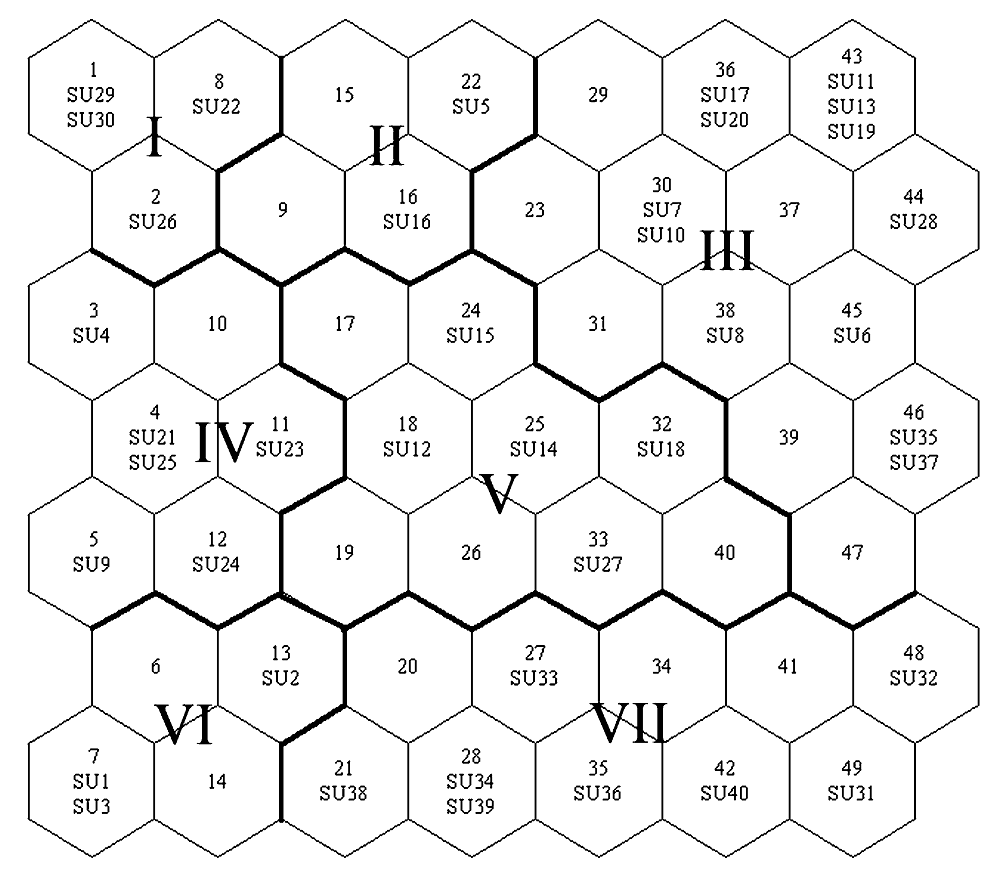
图1 松山山地草甸样方的自组织特征映射网络分类图。 I-VII代表7个草甸类型。SU表示样方名称。
Fig. 1 Classification of the quadrats of the Songshan mountain meadow by self-organizing map (SOM). I-VII represent seven meadow types. SU shows the name of sample units.
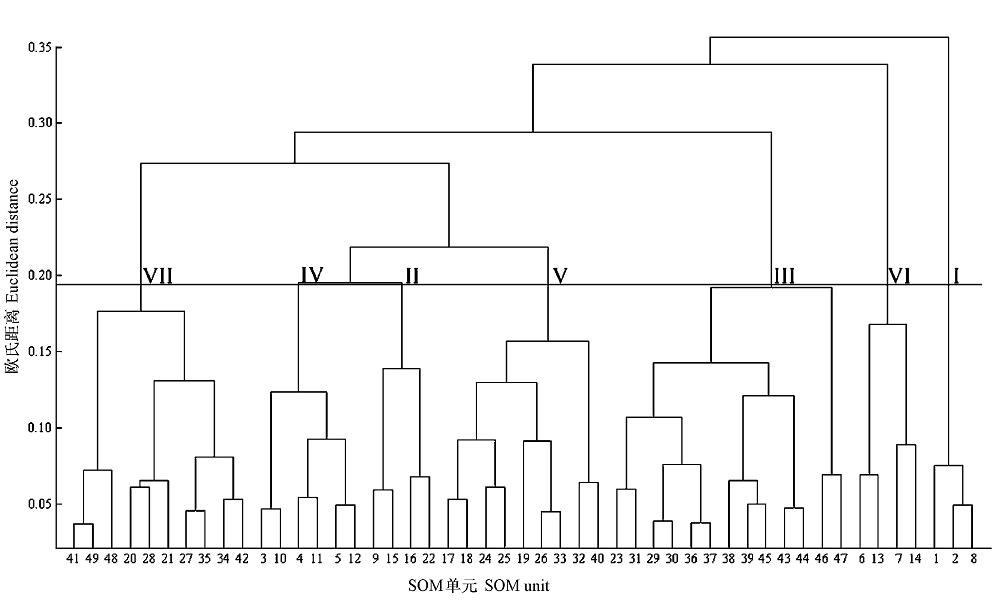
图2 用完全连接法分类自组织特征映射网络(SOM)单元。 数字(1-49) 表示其对应的SOM单元。
Fig. 2 Cluster analysis self-organizing map (SOM) unit with the complete linkage method using Euclidean distance. The numbers (1-49) on the dendrogram indicate their corresponding SOM units.
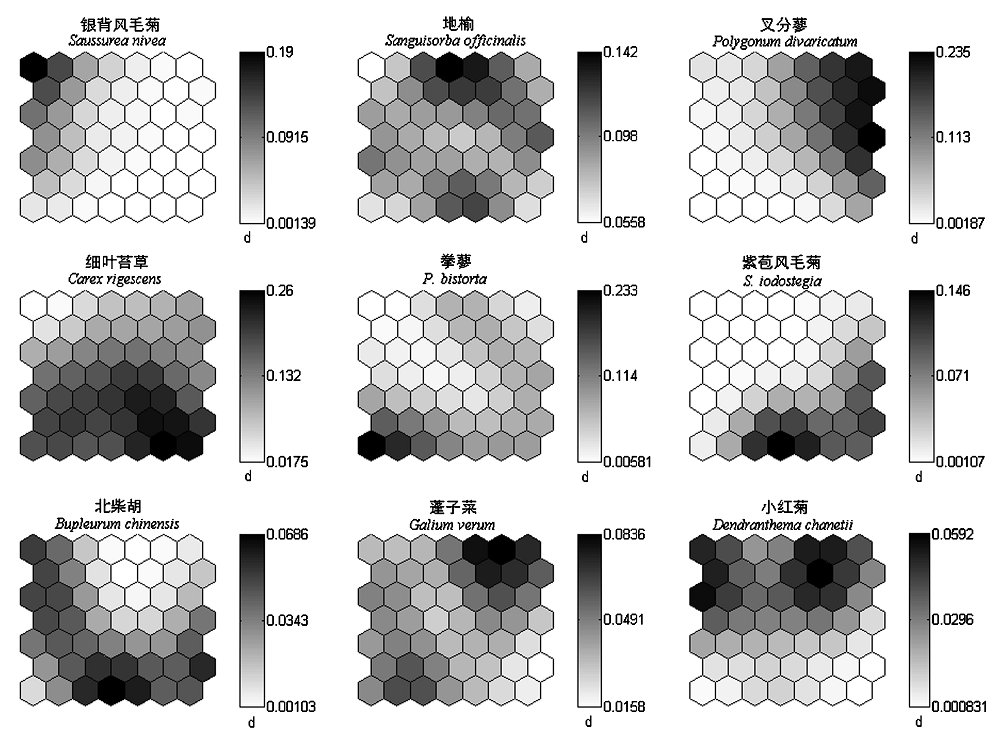
图3 松山山地草甸优势种在自组织特征映射网络训练图上的分布。 d表示重要值。
Fig. 3 Visualization of dominant species of the Songshan mountain meadow in the trained self-organizing map (SOM). d means important value (IV).
| 海拔 Elevation | 坡度 Slope | 坡向 Slope aspect | 枯枝落叶层厚度 Litter layer thickness | 土壤深度 Soil depth | 土壤紧实度 Soil solidity | |
|---|---|---|---|---|---|---|
| 卡方检验Chi-Square | 23.751 | 22.628 | 7.117 | 18.163 | 21.255 | 6.779 |
| 自由度 df | 6 | 6 | 6 | 6 | 6 | 6 |
| p | 0.001 | 0.001 | 0.310 | 0.006 | 0.002 | 0.342 |
表1 松山7个山地草甸类型环境因子的Kruskal-Wallis检验
Table 1 Kruskal-Wallis test of six environmental variables between seven clusters of the Songshan mountain meadow
| 海拔 Elevation | 坡度 Slope | 坡向 Slope aspect | 枯枝落叶层厚度 Litter layer thickness | 土壤深度 Soil depth | 土壤紧实度 Soil solidity | |
|---|---|---|---|---|---|---|
| 卡方检验Chi-Square | 23.751 | 22.628 | 7.117 | 18.163 | 21.255 | 6.779 |
| 自由度 df | 6 | 6 | 6 | 6 | 6 | 6 |
| p | 0.001 | 0.001 | 0.310 | 0.006 | 0.002 | 0.342 |
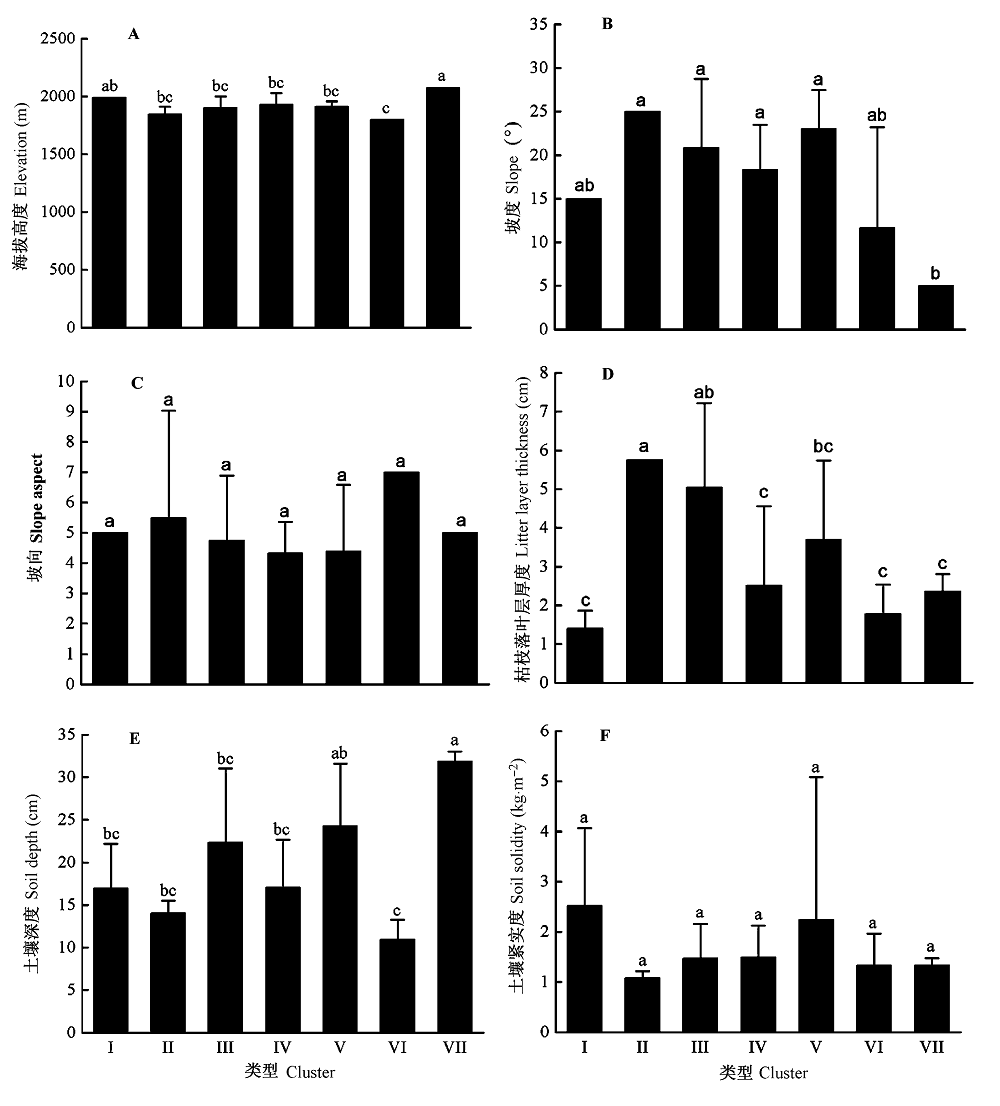
图4 松山山地草甸7个群落环境因子的差异(平均值±标准偏差)。 不同字母表示差异显著(p < 0.05)。A, 海拔高度。B, 坡度。C, 坡向。D, 枯枝落叶层厚度。E, 土壤深度。F, 土壤紧实度。
Fig. 4 Differences of environmental variables at seven clusters of the Songshan mountain meadow (mean ± SD). Different letters indicate significant difference at the 0.05 level. A, Elevation. B, Slope. C, Aspect. D, Litter layer thickness. E, Soil depth. F, Soil solidity.
| [1] | Alhoniemi E, Himberg J, Parhankangas J, Vesanto J (2000). SOM Toolbox. http://www.cis.hut.fi/projects/somtoolbox. |
| [2] | Céréghino R, Giraudel JL, Compin A (2001). Spatial analysis of stream invertebrates distribution in the Adour-Garonne drainage basin (France), using Kohonen self organizing maps. Ecological Modelling, 146, 167-180. |
| [3] | Chon TS, Park YS, Moon KH, Cha EY (1996). Patternizing communities by using an artificial neural network. Ecological Modelling, 90, 69-78. |
| [4] | Dong LS (董林水), Zhang XD (张旭东), Zhou JX (周金星), Song AY (宋爱云) (2007). Quantitative classification and ordination of shrub species and communities in a loess landscape of western Shanxi. Acta Ecologica Sinica (生态学报), 27, 3072-3880. (in Chinese with English abstract) |
| [5] | Eric BS, Christopher TR, Minshall GW, Samuel RR (2002). Regional patterns in periphyton accrual and diatom assemblage structure in a heterogeneous nutrient landscape. Canadian Journal of Fisheries and Aquatic Sciences, 59, 564-577. |
| [6] | Foody GM (1999). Applications of the self-organising feature map neural network in community data analysis. Ecological Modelling, 120, 97-107. |
| [7] | Fu BQ (付必谦) (2006). Principal and Method of Ecology Experimental (生态学实验原理和方法). Science Press, Beijing. (in Chinese) |
| [8] | Gao J (高隽) (2007). Practical Example of Artificial Neural Network Principal and Simulation (人工神经网络原理及仿真实例). Mechanical Industrial Press, Beijing. (in Chinese) |
| [9] | Han LQ (韩力群) (2007). Theory, Design and Application of Artificial Neural Network (人工神经网络理论、设计及应用). Chemical Industry Press, Beijing. (in Chinese) |
| [10] | He HQ (何惠琴), Li SC (李绍才), Sun HL (孙海龙), Liu SC (刘世昌), Xiong WL (熊文兰) (2008). Quantitative classification and ordination of Jingping hydropower station, Sichuan Province, China. Acta Ecologica Sinica (生态学报), 28, 3706-3712. (in Chinese with English abstract) |
| [11] | Henning KS, Hans Estrup A, Kathrin K (2005). Rejecting the mean: estimating the response of fen plant species to environmental factors by non-linear quantile regression, Journal of Vegetation Science, 16, 373-382. |
| [12] | Kohonen T (1982) . Self-organized formation of topologically correct feature maps. Biological Cybernetics, 43, 59-69. |
| [13] | Kohonen T (2001). Self-Organizing Maps. Springer, Berlin. |
| [14] | Lee J, Kwak IS, Lee E, Kim KA (2007). Classification of breeding bird communities along an urbanization gradient using an unsupervised artificial neural network. Ecological Modelling, 203, 62-71. |
| [15] | Lek-Ang S, Park YS, Ait-Mouloud S, Deharveng L (2007). Collembolan communities in a peat bog versus surrounding forest analyzed by using self-organizing map. Ecological Modelling, 203, 9-17. |
| [16] | Niu LL (牛丽丽), Yu XX (余新晓), Yue YJ (岳永杰) (2008). Spatial patterns of different age-class individuals in Pinus tabulaeformis forest in Songshan Nature Reserve of Beijing, China. Chinese Journal of Applied Ecology (应用生态学报), 19, 1414-1418. (in Chinese with English abstract) |
| [17] | Obach M, Wagner R, Werner H, Schmidt HH (2001). Modelling population dynamics of aquatic insects with artificial neural networks. Ecological Modelling, 146, 207-217. |
| [18] | Park YS, Céréghino R, Compin A, Lek S (2003a). Applications of artificial neural networks for patterning and predicting aquatic insect species richness in running waters. Ecological Modelling, 160, 265-280. |
| [19] | Park YS, Jianbo C, Lek S, Wenxuan C, Brosse S (2003b). Conservation strategies for endemic fish species threatened by the Three Gorges Dam. Conversation Biology, 17, 1748-1758. |
| [20] | Park YS, Kwak IS, Chon TS, Kim JK, Jørgensen SE (2001). Implementation of artificial neural networks in patterning and prediction of exergy in response to temporal dynamics of benthic macroinvertebrate communities in streams. Ecological Modelling, 146, 143-157. |
| [21] | Park YS, Tison J, Lek S, Giraudel JL, Coste M, Delmas F (2006). Application of a self-organizing map to select representative species in multivariate analysis: a case study determining diatom distribution patterns across France. Ecological Informatics, 1, 247-257. |
| [22] | Song MY, Hwang HJ, Kwak IS, Ji CW, Oh YN, Youn BJ, Chon TS (2007). Self-organizing mapping of benthic macroinvertebrate communities implemented to community assessment and water quality evaluation. Ecological Modelling, 203, 18-25. |
| [23] | Wu S (吴姗), Qin DH (覃德华), Bi XL (毕晓丽), Wang XC (王秀春), Ge JP (葛剑平) (2004). Purifying service of Songshan mountain and its value. Journal of Beijing Normal University (Natural Science) 北京师范大学学报 (自然科学版)), 40, 386-389. (in Chinese with English abstract) |
| [24] | Zhang LJ (张良均), Cao J (曹晶), Jiang SZ (蒋世忠) (2008). Practical Course of Neural Network (神经网络实用教程). Mechanical Industrial Press, Beijing. (in Chinese) |
| [25] | Zhang JT (张金屯) (2004). Quantitative Ecology (数量生态学). Science Press, Beijing. (in Chinese) |
| [26] | Zhang JT, Dong Y, Xi Y (2008). A comparison of SOFM ordination with DCA and PCA in gradient analysis of plant communities in the midst of Taihang Mountains, China. Ecological Informatics, 3, 367-374. |
| [27] | Zhang JT (张金屯), Meng DP (孟东平), Xi YX (席跃翔) (2008). Ordination of self-organizing feature map neural network and its application in the study of plant communities. Journal of Beijing Forestry University (北京林业大学学报), 30, 1-5. (in Chinese with English abstract) |
| [28] | Zhang JT (张金屯), Yang HX (杨洪晓) (2007). Application of self-organizing neural networks to classification of plant communities in Pangquangou Nature Reserve, North China. Acta Ecologica Sinica (生态学报), 27, 1005-1010. (in Chinese with English abstract) |
| [29] | Zhang JT, Zhang F (2007). Diversity and composition of plant functional groups in mountain forests of the Lishan Nature Reserve, North China. Botanical Studies, 48, 339-348. |
| [30] | Zhang Y (张赟), Zhao YZ (赵亚洲), Zhang CY (张春雨), Zhao XH (赵秀海) (2009). Structure and spatial distribution of Pinus tabulaeformis population in the Songshan Nature Reserve, Beijing, China. Chinese Journal of Applied and Environmental Biology (应用与环境生物学报), 15, 175-179. (in Chinese with English abstract) |
| [31] | Zhou R (周睿), Ge JP (葛剑平), Yu B (于波), Liu LJ (刘丽娟), Wu JG (吴记贵) (2007). Simulation of forest dynamics at Songshan Mountain, Beijing. Journal of Beijing Forestry University (北京林业大学学报), 29, 19-25. (in Chinese with English abstract) |
| [32] | Zhou R (周睿), Wang H (王辉), Ge JP (葛剑平), Xiong YC (熊友才), Wu JG (吴记贵) (2006). Vegetation dynamics and patterns of change in functional protection subzones in Songshan National Nature Reserve, Beijing. Biodiversity Science (生物多样性), 14, 470-478. (in Chinese with English abstract) |
| [33] | Zuzana R, Michal H (2008). Changes in nutrient limitation of spring fen vegetation along environmental gradients in the West Carpathians. Journal of Vegetation Science, 19, 613-620. |
| [1] | 江康威, 吕程, 王亚菲, 李宏, 张芷晴, 王雨, 张青青, 吐尔逊娜依•热依木. 放牧干扰下丛枝菌根真菌群落对土壤多功能性的影响[J]. 植物生态学报, 2026, 50(3): 685-699. |
| [2] | 张健, 孙慕梵, 宋坤, 赖丽茗, 宋永昌. 基于生态外貌-植物区系分类系统的中国常绿阔叶林分类修订[J]. 植物生态学报, 2026, 50(1): 107-122. |
| [3] | 刘碧颖, 陈子豪, 源思浩, 周婷. 植被志书研编中图表绘制的常见问题与技术参考[J]. 植物生态学报, 2025, 49(6): 911-921. |
| [4] | 熊高明, 申国珍, 徐文婷, 谢宗强, 李跃林, 徐耀粘, 陈芳清, 李家湘. 中国低山丘陵热性常绿阔叶灌丛主要类型及群落特征[J]. 植物生态学报, 2025, 49(6): 865-874. |
| [5] | 熊高明, 申国珍, 赵常明, 徐文婷, 王杨, 谢宗强, 李家湘, 徐耀粘, 李跃林, 陈芳清. 中国檵木灌丛植被类型及群落特征[J]. 植物生态学报, 2025, 49(6): 875-887. |
| [6] | 张坤, 伊丽晴, 刘占军, 张志杰, 王顼, 李明乐, 苗百岭, 张景慧, 李智勇, 董雷, 梁存柱. 毛刺锦鸡儿群落特征及分类[J]. 植物生态学报, 2025, 49(6): 888-896. |
| [7] | 段俊丞, 王志勇, 高维聪, 张成凯, 高长宏, 刘晓彤, 李振今. 黄河三角洲湿地入侵物种互花米草时空演化与景观格局分析[J]. 植物生态学报, 2025, 49(6): 922-938. |
| [8] | 杜燕, 刘鑫, 张瀚曰, 马少伟, 包维楷. 中国高山松群系的群落特征[J]. 植物生态学报, 2025, 49(6): 816-824. |
| [9] | 陈颖, 王迎雪, 邓清雅, 李培杨, 肖自新, 许艳蓉, 邓传远. 海坛岛典型灌丛群落数量分类与排序[J]. 植物生态学报, 2025, 49(4): 653-666. |
| [10] | 都兰, 李晓田, 王铁娟, 张丽. 东阿拉善绵刺荒漠的分类与群落特征[J]. 植物生态学报, 2025, 49(12): 2166-2174. |
| [11] | 韦丹丹, 杜燕, 包维楷, 胡斌, 张瀚曰, 王瀚婕, 唐圆圆, 黄龙, 郭昌安, 刘鑫. 冬麻豆群落的地理分布、特征和分类[J]. 植物生态学报, 2025, 49(10): 1698-1709. |
| [12] | 董劭琼, 侯东杰, 曲孝云, 郭柯. 柴达木盆地植物群落样方数据集[J]. 植物生态学报, 2024, 48(4): 534-540. |
| [13] | 陈香蕾, 崔树娟, 赵晨军, 顾洪亮, 陈晓萍, 李锦隆, 孙俊. 基于叶形分类的木本植物单叶片面积预测模型[J]. 植物生态学报, 2024, 48(12): 1683-1691. |
| [14] | 郑亚纹, 樊海东, 刘立斌, 倪健. 基于高精度遥感影像和精细植被踏查的金华北山植被制图[J]. 植物生态学报, 2024, 48(11): 1471-1485. |
| [15] | 张智洋, 赵颖慧, 甄贞. 基于LUCC的1986-2022年松花江流域陆地生态系统碳储量动态监测[J]. 植物生态学报, 2024, 48(10): 1274-1290. |
| 阅读次数 | ||||||
|
全文 |
|
|||||
|
摘要 |
|
|||||
Copyright © 2026 版权所有 《植物生态学报》编辑部
地址: 北京香山南辛村20号, 邮编: 100093
Tel.: 010-62836134, 62836138; Fax: 010-82599431; E-mail: apes@ibcas.ac.cn, cjpe@ibcas.ac.cn
备案号: 京ICP备16067583号-19

